Keep Your Eggs Away: Ant Presence Reduces Ceratitis capitata Oviposition Behaviour through Trait-Mediated Indirect Interactions
by
 , , , , , ,
Stefania Smargiassi
1,† ,
,
Alberto Masoni
1,2,†,
Filippo Frizzi
1,*,
Paride Balzani
3,
Elisa Desiato
1,
Giovanni Benelli
4 ,
,
Angelo Canale
4 and
Giacomo Santini
1,2
1
Department of Biology, University of Florence, 50121 Firenze, Italy
2
National Biodiversity Future Center, 90133 Palermo, Italy
3
South Bohemian Research Center of Aquaculture and Biodiversity of Hydrocenoses, Faculty of Fisheries and Protection of Waters, University of South Bohemia in Ceske Budejovice, Zátiší 728/II, 389 25 Vodňany, Czech Republic
4
Department of Agriculture, Food and Environment, University of Pisa, 56124 Pisa, Italy
*
Author to whom correspondence should be addressed.
†
These authors contributed equally to this work.
Insects 2023, 14(6), 532; https://doi.org/10.3390/insects14060532
Submission received: 17 May 2023
/
Revised: 2 June 2023
/
Accepted: 5 June 2023
/
Published: 7 June 2023
(This article belongs to the Section Insect Pest and Vector Management)
Simple Summary
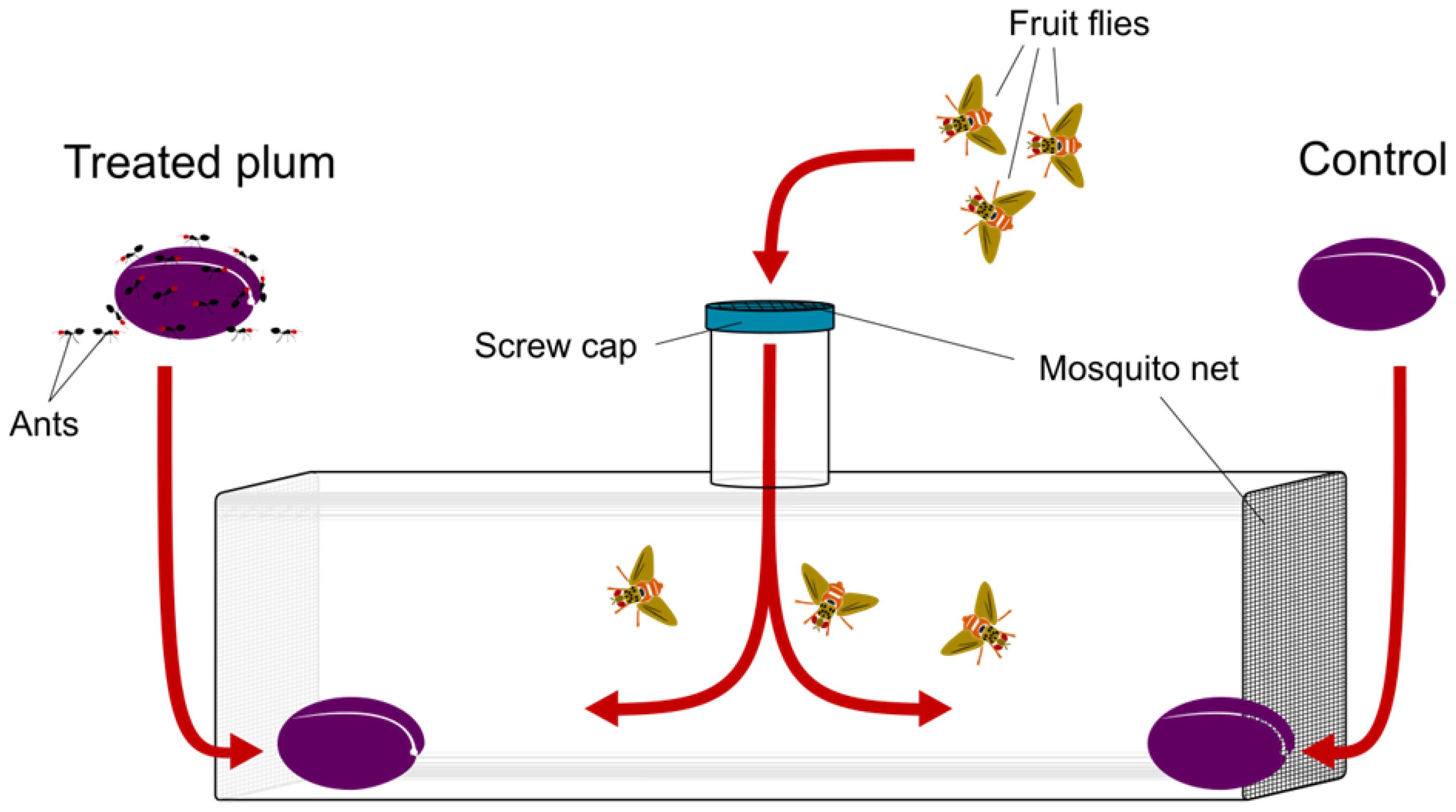
The use of chemical pesticides in agriculture is a critical threat to the environment. Implementing the use of biological control practices is an increasing worldwide challenge to cope with this matter. The exploitation of trait-mediated indirect interactions (TMIIs), which is an avoidance behaviour of pests when detecting possible risk, is a new and interesting pathway to follow. Ants, which are predators of many insect pests, are commonly active on plants and release several different chemical traces in the substrate, making them potential candidates for TMII-based management approaches. We tested whether semiochemicals released by two Mediterranean ants, Crematogaster scutellaris and Tapinoma nigerrimum, are able to deter the occurrence of a strongly harmful pest of tree crops, the tephritid Ceratitis capitata, which lays eggs within fruits. Using binary choice tests between a plum previously visited by ants and another used as control, we actually observed an avoidance behaviour by females of C. capitata, which results in a lower amount of progeny production, suggesting that flies can detect the chemical compounds released by ants. This study suggests that scents triggering this deterrence effect are conserved across ant subfamilies and encourages improving this research to achieve a new low-impacting control method against agricultural pests.
Abstract
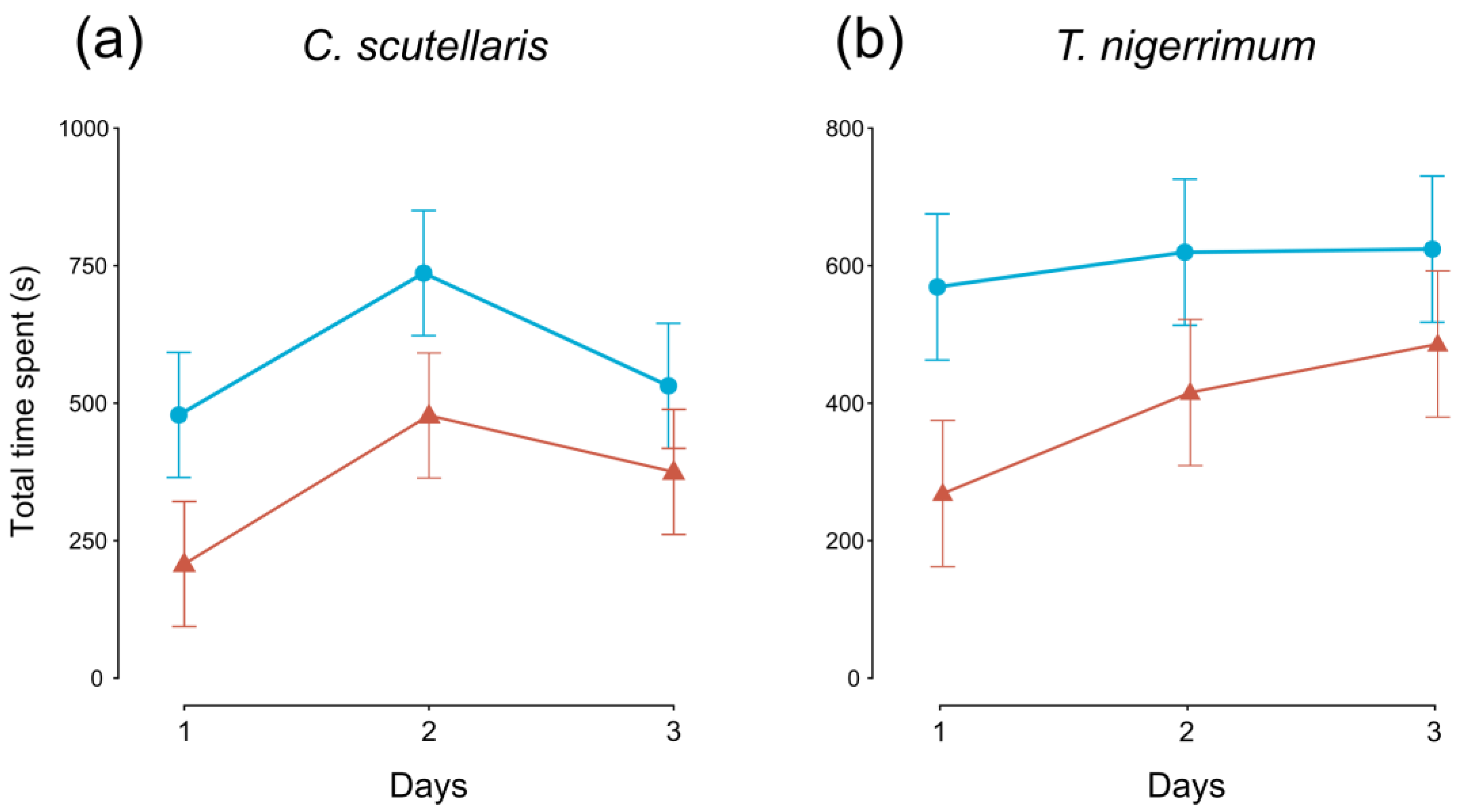
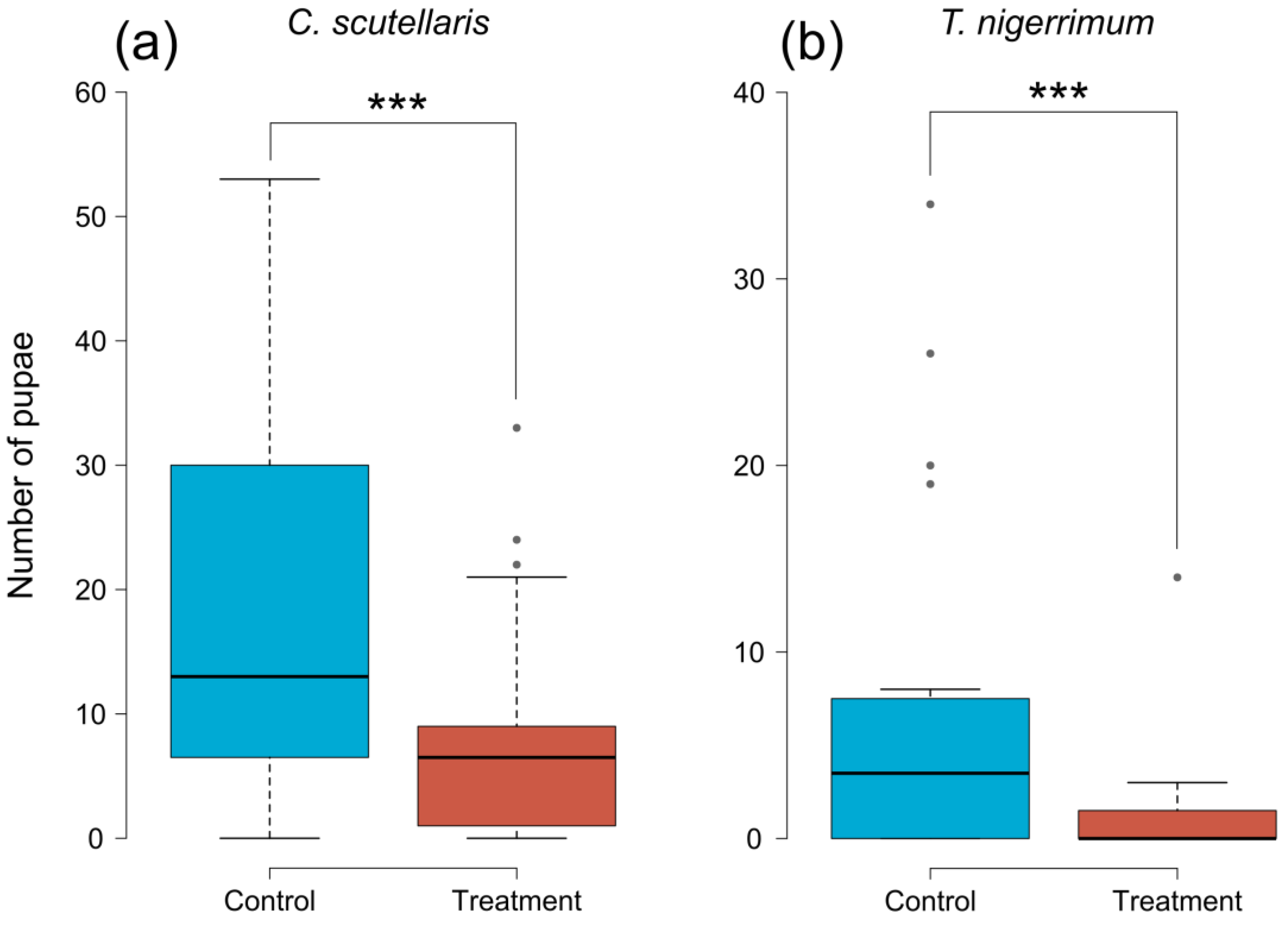
Alternative methods to achieve sustainable agricultural production while reducing the use of chemical pesticides, such as biological control, are increasingly needed. The exploitation of trait-mediated indirect interactions (TMIIs), in which pests modify their behavior in response to some cues (e.g., pheromones and other semiochemicals) to avoid predation risk, may be a possible strategy. In this study, we tested the effect of TMIIs of two Mediterranean ant species, Crematogaster scutellaris and Tapinoma nigerrimum, on the oviposition behaviour of Ceratitis capitata (Diptera: Tephritidae), one of the world’s most economically damaging pests, which attacks fruits. For each ant species, we performed choice experiments using ant-scented and control plums, counting the time spent by medflies on fruits and the number of pupae emerging from them. Results of both ant species tests showed a significantly shorter time spent by ovipositing medflies on ant-exposed plums and a lower number of pupae, when compared to the control group. Our findings highlighted that the semiochemicals released by ants on plums triggered an avoidance behaviour by medfly females, leading to lower oviposition rates. This study contributes to the understanding of indirect ant–pest interactions in Mediterranean agricultural settings and points out the potential of utilising ant-borne semiochemicals in sustainable IPM strategies.