


Simple Summary
The citrus fruit borer has become one of the main pests in citrus orchards in Brazil, possibly due to biological imbalances caused by multiple insecticide applications. This pest is managed with insecticides, but studies indicate a potential use of Trichogramma atopovirilia to control its eggs. In this way, we evaluated the selectivity of new products that could eventually be used in the Brazilian citrus orchards on T. atopovirilia. Among the products tested, spinetoram was considered harmful. Cyantraniliprole, cyantraniliprole + abamectin, abamectin, sulfoxaflor, and the entomopathogenic fungi Cordyceps fumosorosea were considered selective and non-persistent to the parasitoid.
Abstract
In Brazil, the citrus fruit borer, Gymnandrosoma aurantianum Lima, 1927, is a serious pest in orange orchards, causing an annual loss of 80 million US dollars, and is managed with multiple insecticide applications, often 56 in a single season. On the other hand, the parasitoid wasp Trichogramma atopovirilia Oatman & Platner, 1983 has the potential for controlling G. aurantianum by attacking its eggs. Considering the intensive insecticide applications in citrus orchards in Brazil to control the large complex of pests, especially Diaphorina citri Kuwayama, 1908, evaluation of the harmful effects of insecticides on T. atopovirilia is important to maximize efficiency in managing G. aurantianum. Here, we tested the effects of new products used in citrus orchards (cyantraniliprole, cyantraniliprole + abamectin, abamectin, sulfoxaflor, spinetoram, flupyradifure, and Cordyceps fumosorosea (Wize) Kepler, B. Shrestha & Spatafora) on adults and pupae of T. atopovirilia. Of the insecticides tested, spinetoram caused the highest impacts on T. atopovirilia parasitism, longevity, emergence, and mortality. The other products caused more sublethal than lethal effects and were classified as 1 and/or 2 in the IOBC/WPRS classification. Abamectin, cyantraniliprole, cyantraniliprole + abamectin, and the entomopathogenic fungus C. fumosorosea were classified as short-lived. Except for spinetoram, these products were classified as selective. In this study, spinetoram was considered harmful to T. atopovirilia and, therefore, should be managed carefully in IPM programs combining this parasitoid. In order to safely use this insecticide, one should respect the interval of release of the parasitoid, which is 21 days after its spraying. The novel products tested, cyantraniliprole, cyantraniliprole + abamectin, abamectin, sulfoxaflor, and the entomopathogenic fungi C. fumosorosea were selective and non-persistent to T. atopovirilia. These products are possible replacements for non-selective insecticides to achieve higher control from both chemical and biological tools.
1. Introduction
The use of biological control agents and their conservation in an agricultural system are among the integrated pest management (IPM) strategies to maintain pest populations below the level of economic damage [1,2]. Considering that, in many cases, pest control requires a simultaneous application of biological control agents and insecticides, the success of IPM programs may depend on the use of selective phytosanitary products, i.e., those that efficiently act against insect pests present in an agroecosystem and that have the least possible impact on non-target organisms [2,3].
Although chemical control is used most often worldwide, agrochemicals can significantly reduce the efficiency of predators and parasitoids, for example, from the genus Trichogramma [2], which is currently used in pest control programs on approximately 4 million hectares in Brazil [4]. The harmful effects of agrochemicals on natural enemies can cause mortality or biological disorders that will impact the fitness of a particular individual and its offspring. The use of compatible products is essential in the release of these parasitoids [2]. In general, these natural enemies are more affected by insecticides than by other agrochemicals, as they can cause high adult mortality, in some cases up to 30 days after spraying [5,6,7].
Currently in Brazil, the citrus fruit borer, Gymnandrosoma aurantianum Lima, 1927 (Lepidoptera: Tortricidae), is one of the main pests in orange orchards. This micro lepidopteran is managed with insecticides that are often applied on a scheduled basis. The citrus fruit borer became a key pest for Brazilian citrus orchards in the late 1980s, possibly due to biological imbalances caused by the excessive application of agrochemicals to control the vectors of citrus variegated chlorosis (CVC) [8].
A research program led by the Department of Entomology and Acarology at ESALQ/USP, with the support of Fundecitrus (Fund for Citrus Protection, Brazil) and the participation of UFV (Federal University of Viçosa, Brazil) and the University of California, Davis (CA, USA), developed a technological package, including the identification of a sex pheromone for citrus fruit borer adults. The product, patented as Ferocitrus Furão®, has been successfully used since the end of 2001 and prevented losses of more than 1.3 billion dollars in the 2001–2012 period [9]. However, after 2004 when “greening” (HLB) was first recorded in Brazil, resulting in massive amounts of agrochemicals applied to control the vector Diaphorina citri Kuwayama, 1908 (Hemiptera: Psyllidae), a new population explosion of G. aurantianum occurred in the citrus-growing areas of São Paulo state [10].
Generally, G. aurantianum females lay one egg per fruit, and after hatching, the caterpillar penetrates the fruit, making it unfeasible for immediate consumption and industrial processing [10]. Currently in Brazil, even though G. aurantianum is managed with weekly applications of insecticides on a prescribed schedule, the estimated annual loss is on the order of 80 million dollars because of the damage caused by the citrus fruit borer. This means that about 30 million boxes of oranges are annually lost, about equal to the losses caused by “greening” [10].
On the other hand, laboratory and field studies have demonstrated the potential of using the parasitoid wasp Trichogramma atopovirilia Oatman & Platner, 1983 (Hymenoptera: Trichogrammatidae) to control G. aurantianum by parasitizing its eggs [11,12,13,14]. Therefore, considering the high dependence on agrochemicals in citrus orchards in Brazil to control the large complex of pests, mainly Diaphorina citri, tests to evaluate the harmful effect of insecticides on T. atopovirilia are essential to maximizing the efficiency of managing G. aurantianum through the harmonious integration of chemical and biological controls. We evaluated the effects of insecticides on T. atopovirilia adults and pupae, their impacts on parasitism capacity, and their biological persistence. This information will make it possible to select insecticides with the lowest toxicity to the natural enemy and to adjust the spraying schedule to release parasitoids at the appropriate time to minimize their exposure to insecticide residues.
2. Materials and Methods
2.1. Insect Rearing
Orange fruits attacked by Gymnandrosoma aurantianum were collected from citrus orchards in different municipalities of São Paulo state (20°33′33″ S, 48°34′8″ W (Barretos), 20°56′59″ S, 48°28′44″ W (Bebedouro), 20°54′26″ S, 48°38′29″ W (Monte Azul Paulista), 21°35′46″ S, 48°48′48″ W (Itápolis), 21°3′60″ S, and 48°24′32″ W (Taquaral)), and brought to the Insect Biology Laboratory of the Department of Entomology and Acarology (LEA), ESALQ/USP. The fruits were sliced open, and the larvae of the citrus fruit borer were removed and transferred to glass tubes (2.5 cm wide × 8.5 cm high, the size used in all procedures) with an artificial diet [15], where they matured to adults. After emergence, the adults were transferred to PVC cages (15 cm wide × 15 cm high) that were lined inside with white paper, where the eggs were collected [16]. The colony was maintained at 26 ± 2 °C, 50 ± 10% RH, and 14:10 L:D photoperiod.
Trichogramma atopovirilia individuals were collected in eggs of Helicoverpa zea (Boddie, 1850) (Lepidoptera: Noctuidae), in a corn-growing area in São José dos Pinhais, Paraná, Brazil (25°32′06″ S, 49°12′21″ W, elevation 906 m) (temperate climate with mild summers, Köppen Cfb). The wasps were maintained for more than 20 generations (the life cycle (egg-adult) of this parasitoid is about 10 days [11,12,13]), on the eggs of Ephestia kuehniella (Zeller, 1879) (Lepidoptera: Pyralidae) in a rearing room in the same environmental conditions as above, at the Insect Biology Laboratory [17].
2.2. Insecticides
The insecticides were selected according to the trend of Brazilian citrus market requirements. For example, the application of organophosphates and pyrethroids to citrus makes it difficult to export fruit and juice, mainly to Europe and the U.S.A. These markets are increasingly requiring attention to the residues of these products. Therefore, we opted for products that will likely be used in the citrus industry soon, following the constantly changing list of citrus protection products, Protecitrus, maintained by Fundecitrus (https://www.fundecitrus.com.br/Protecitrus accessed on 10 February 2020) (Table 1).
Table 1.
Insecticides evaluated against the parasitoid Trichogramma atopovirilia. Standardized commercial product doses for 2000 L of spray.
2.3. Evaluation of Lethal and Sublethal Effects on Adults of T. atopovirilia
Pieces of paper containing 25 unparasitized eggs of G. aurantianum up to 24 h old were immersed in the insecticide solutions for 5 s [18]. These pieces of paper were then dried and kept together with a previously mated T. atopovirilia female for 24 h in test tubes containing a drop of pure honey and covered with a piece of plastic film to allow parasitism. After 24 h, the females were offered ≈200 E. kuehniella eggs to parasitize, which were changed daily until the female died. This experiment had 30 females per treatment, each considered a replication. The females were maintained in a climate-controlled room with a temperature of 25 ± 1 °C, 14:10 (L:D) photoperiod, and relative humidity of 60 ± 10%.
Mortality, parasitism capacity, and longevity of the surviving females were evaluated. Parasitism was evaluated based on the color of the eggs of E. kuehniella, either black (parasitized) or yellowish white (non-parasitized), observed under a stereoscopic microscope [19]. The percentage of emergence (number of eggs with holes in relation to the number of black eggs) and sex ratio—the proportion of females in the population (based on the adults’ antennae)—were also evaluated [20].
The effects on offspring were evaluated based on the F1 parasitism capacity for three days (number of E. kuehniella eggs parasitized by each 24-h-old female wasp, previously mated, for three days) replacing E. kuehniella eggs daily. Thus, the emergence of F2 offspring was also evaluated. The assays of sublethal effects on the offspring were carried out with 10 replicates of each treatment, each female representing one replicate.
The insecticides evaluated were classified into toxicological categories based on their effects on reducing the beneficial capacity of the parasitoid (parasitism), according to the IOBC/WPRS recommendations: class 1 = innocuous (<30% reduction), class 2 = slightly toxic (30% to 80% reduction), class 3 = moderately toxic (>80% to 99% reduction), and class 4 = toxic (>99% emergence reduction) [21].
2.4. Evaluation of Lethal and Sublethal Effects on Pupae of T. atopovirilia
The lethal effects of insecticides on the pupae (7 days after parasitism) of T. atopovirilia were evaluated by observing the emergence of adults. Pieces of paper containing 25 eggs of G. aurantianum were submitted to parasitism for 24 h, and then (7 days after) were immersed in an insecticide solution for 5 s [18]. After drying, the eggs were placed in glass tubes and covered with plastic film for the emergence of adults. The assay used 30 replicates per treatment. The pupae were maintained in a climate-controlled room with a temperature of 25 ± 1 °C, 14:10 (L:D) photoperiod, and relative humidity of 60 ± 10%. The emergence rate, longevity, and sex ratio of adults were evaluated. The toxicity of the insecticides, in terms of the reduction in emergence, was classified according to the above IOBC/WPRS recommendations [21].
2.5. Residual Activity (Persistence) of Insecticides to T. atopovirilia
Two-year-old orange seedling of Citrus sinensis (L.) Osbeck (Rutacea) of the Valencia variety were sprayed with the selected insecticides (Table 1), with a volume corresponding to ≈250 mL per orange seedling, using a Jacto PJH manual sprayer (Jacto do Brasil S.A., Pompéia, SP, Brazil) equipped with an FL-5VS conical nozzle (Teejet Technologies Company, São Paulo, SP, Brazil) [22] and maintained in a greenhouse under natural ambient temperature and partial shading. The pots containing the orange seedlings were irrigated, only in the soil, every two days. To provide enough leaves, each treatment had three orange seedlings. The control treatment was sprayed with water.
At 3, 7, 14, 21, and 30 days after the insecticides were sprayed (DAS), mature leaves from each treatment were collected and transported to the laboratory [23]. Each treatment had 20 replicates, each consisting of a 24-h-old female of T. atopovirilia and a leaf treated with the respective insecticide placed in a glass tube with a drop of pure honey and covered with plastic film. The females were maintained in a climate-controlled room with a temperature of 25 ± 1 °C, 14:10 (L:D) photoperiod, and relative humidity of 60 ± 10%. Mortality was assessed 24 h after the parasitoids were exposed to the treated leaves. If a product reduced insect mortality by less than 30% compared with the control treatment, it was classified according to the IOBC/WPRS persistence scale, as 1—short-lived (<5 days), 2—slightly persistent (5–15 days), 3—moderately persistent (16–30 days), or 4—persistent (>30 days) [21]. For the surviving females, E. kuehniella eggs were offered and replaced daily for three days to evaluate the parasitism.
2.6. Statistical Analysis
Data residuals were tested for Shapiro–Wilk normality and Bartlett variance homoscedasticity. Because the residuals did not follow a normal distribution, the data were submitted to nonparametric tests. Longevity and parasitism data were subjected to a Kruskal–Wallis test and compared by Dunn’s test with Bonferroni correction (p < 0.05). Emergence and sex-ratio data were compared using a generalized linear model, binomial, or quasi-binomial, depending on the best fit for each data set (p < 0.05). The analyses were carried out with the programming language R version 4.0 (R Development Core Team, 2017).
3. Results
3.1. Evaluation of Lethal and Sublethal Effects on Adults of T. atopovirilia
The results indicated significant differences in mortality rates of T. atopovirilia exposed to eggs treated with insecticides (χ2 = 36.56, df = 7, p < 0.001) (Table 2). Adult mortality was highest when eggs treated with spinetoram were offered, while the other products caused <10% of T. atopovirilia adults.
Table 2.
Lethal and sublethal effect of insecticides when Trichogramma atopovirilia adults are placed in contact with Gymnandrosoma aurantianum eggs previously submerged in insecticide solution.
T. atopovirilia females showed significant decreases in the percentage of G. aurantianum eggs parasitized in 24 h (χ2 = 26.99, df = 7, p < 0.001) (Table 2). The 24-h parasitism of treated G. aurantianum eggs ranged from 3.71 (abamectin) to 9.36 eggs (cyantraniliprole) (Table 2). The reduction in parasitism was highest in spinetoram (77.31%), abamectin (53.81%), and cyantraniliprole + abamectin (45.53%), followed by flupyradifurone (27.62%). The products that least affected the parasitism were C. fumosorosea (3.57%), sulfoxaflor (0%), and cyantraniliprole (0%) (Table 2).
The other parameters, total parasitism (χ2 = 49.91, df = 7, p < 0.001) and longevity of females (χ2 = 54.62, df = 7, p < 0.001), were similar for all insecticides tested, except for spinetoram. Spinetoram reduced total parasitism and female longevity the most. Cyantraniliprole, flupyradifurone, sulfoxaflor, and C. fumosorosea reduced total parasitism and female longevity the least (Table 2).
The longevity (χ2 = 24.85, df = 7, p < 0.001) and emergence of the offspring (χ2 = 27.17, df = 7, p < 0.001) were most affected by the insecticides abamectin + cyantraniliprole, abamectin, and spinetoram. The emergence of individuals from treated G. aurantianum eggs was most affected by spinetoram (12%), statistically differing from the other treatments (Table 3). Despite the effects on the F0 female parasitism caused by the products, the parasitism of females (F1) was not affected by the insecticides (Table 3).
Table 3.
Sublethal effects on the offspring (F1) of Trichogramma atopovirilia females exposed to Gymnandrosoma aurantianum eggs submerged in insecticide solution.
The sex ratio (proportion of females in the population) was most affected by cyantraniliprole and cyantraniliprole + abamectin, 0.21 and 0.28, respectively (χ2 = 99.89, df = 7, p < 0.001) (Table 3). These numbers are far below the expected ratios for quality checking in a population of parasitoids [24].
3.2. Evaluation of Lethal and Sublethal Effects on Pupae of T. atopovirilia
Among the insecticides tested, only spinetoram drastically reduced (92.92%) the emergence of T. atopovirilia when applied to 7-day-old parasitoid pupae in G. aurantianum eggs (χ2 = 79.75, df = 7, p < 0.001). The other insecticides reduced emergence by less than 5% and were considered innocuous according to the IOBC/WPRS classification (Table 4).
Table 4.
Effect of insecticides on the emergence of Trichogramma atopovirilia, by previous immersion of Gymnandrosoma aurantianum eggs containing parasitoid pupae (7 days after parasitism) (mean ± standard error).
3.3. Residual Effects (Persistence) of Insecticides on T. atopovirilia
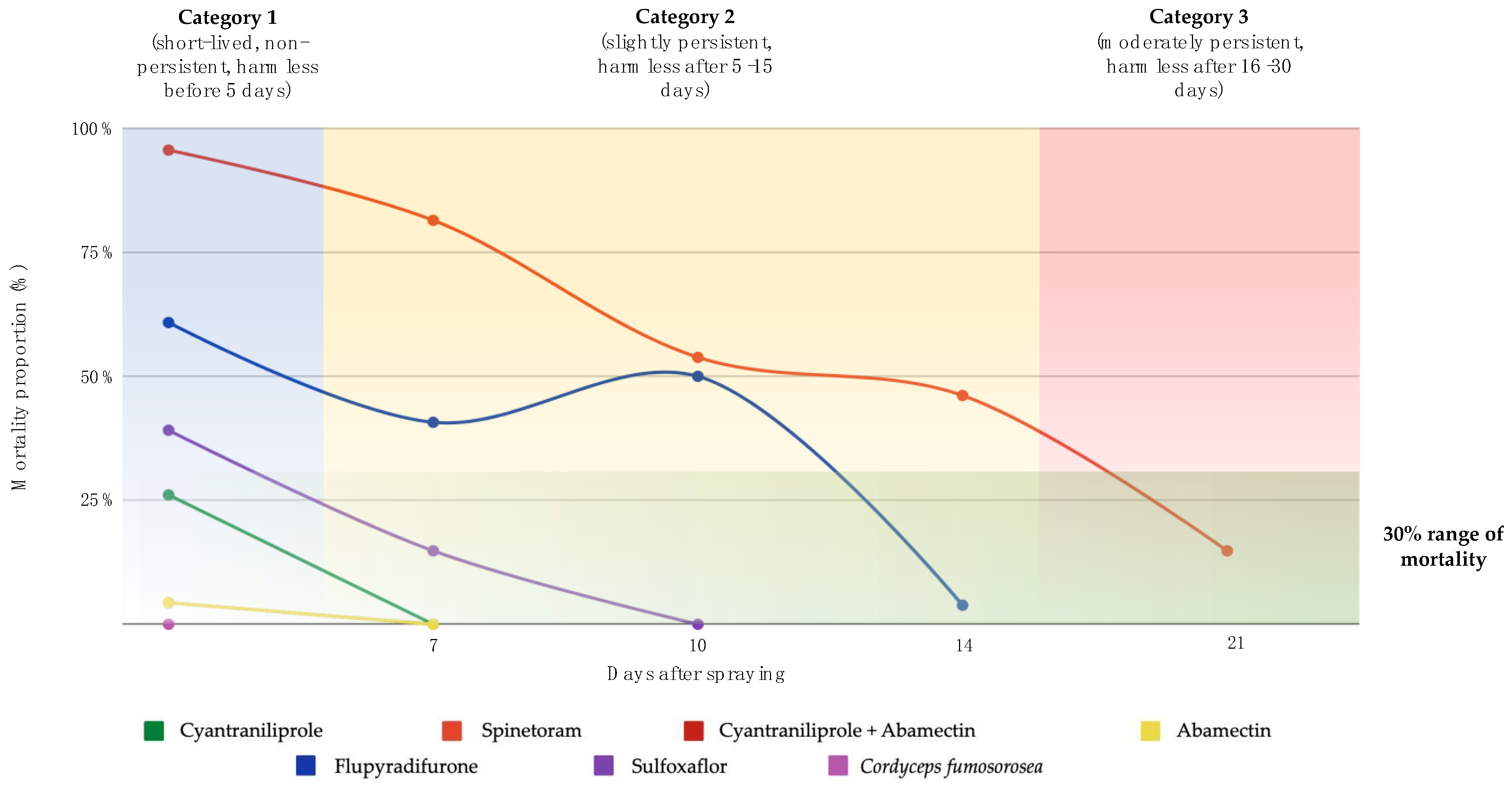
Based on the results, abamectin, cyantraniliprole, cyantraniliprole + abamectin, and C. fumosorosea were classified as short-lived, that is, T. atopovirilia can be released only 5 days after application of these products. Sulfoxaflor and flupyradifurone were classified as mildly persistent because they affect the parasitoid up to 15 days after application. Spinetoram was classified as moderately persistent, as it killed over 30% of the parasitoids two weeks after application (Figure 1).
Figure 1.
Toxicity and persistence of insecticides on Trichogramma atopovirilia adults, based on the IOBC classification. The insecticide cyantraniliprole + abamectin caused the same mortality as Abamectin, so its line is not visible in the figure.
The number of eggs parasitized by females in contact with Citrus leaves 3 DAS ranged from 9.16 (abamectin) to 33.56 (flupyradifurone) (χ2 = 21.46, df = 7, p = 0.0015), and emergence was up to 88% (χ2 = 69.55, df = 7, p = 0.008). On days 3, 7, and 10, there were insufficient replicates to analyze because of the high mortality caused by spinetoram (Table 5).
Table 5.
Sublethal effects (after three days of parasitism and emergence) of insecticides on Trichogramma atopovirilia in contact with orange leaves treated with insecticides, at 3, 7, and 10 days after application. P = three days of parasitism; E (%) = emergence.
4. Discussion
In this study, we evaluated the compatibility of new products that will be more widely used in Brazilian citrus crops with T. atopovirilia, a parasitoid that will likely be commercially used for citrus fruit borer control. Among the insecticides tested, spinetoram caused the highest parasitoid mortality. Takahashi [25] found similar results when eggs of the noctuid lepidopterans Anticarsia gemmatalis Hübner, 1818 and Chrysodeixis includens (Walker, 1858) treated with spinetoram were offered to T. atopovirilia. Takahashi [25] observed 100% mortality after 24 h in both hosts, similar to the findings of Khan [26] for Trichogramma chilonis Ishii, 1941 (Hymenoptera: Trichogrammatidae). According to the results of the present study and the results obtained by Takahashi [25] and Khan [26], spinetoram is lethal to adults of several species of Trichogramma, independent of the surface characteristics of the host eggs. Spinetoram may cause mortality in two ways: first, by the contact of the tarsus with the egg surface, and second, by the contact with the ovipositor as it penetrates during the parasitism process. This insecticide may penetrate through the egg aerophiles and, regardless of its host species’ morphology, contaminate the parasitoid [27]. It is well documented that some spinosyns are harmless to predators but often negativity affect hymenopteran parasitoids [28]. The selective property of spinosyns is quite controversial. The use of insecticides derived from spinosyns is sometimes recommended in IPM programs because of their demonstrated low toxicity for non-target organisms in field conditions. However, in other cases, spinosyns are harmful to biological agents [28]. Although, in the present study, spinetoram reduced parasitoid emergence in laboratory conditions by almost 100%, further work is needed to determine its toxicity to T. atopovirilia in the field.
Cyantraniliprole has been reported to kill more than 80% of Trichogramma adults exposed to treated eggs in the first 24 h [29]. In our study, this product caused 3.33% mortality in the first 24 h. Although cyantraniliprole is a novel insecticide of the diamide group and seems very efficient for insect pest control, the mortality of egg parasitoids cannot be overlooked in IPM programs. In the present study, the same active ingredient was classified as non-persistent.
Based on IOBC standards, flupyradifurone is often classified as harmless to Trichogramma after a 24-h exposure [30]. Iost Filho et al. [31] and Costa et al. [32] found that flupyradifurone did not affect the emergence and parasitism rate of Trichogramma pretiosum Riley, 1879. In contrast, based on the results of the current study, we classified flupyradifurone as slightly persistent, causing 50% mortality 10 days after the citrus leaves were sprayed. We found an incongruence, because flupyradifurone caused zero mortality when applied to G. aurantianum egg surfaces after 24 h but caused about 60% mortality 3 days after the citrus leaves were sprayed. This also occurred with other products, where mortality was higher at the beginning of exposure to citrus leaves than to G. aurantianum eggs. This may have occurred because the leaf’s surface is larger than the surface of the egg, hence the parasitoids’ exposure to the products was higher. These results show the importance of the persistence test, which is closer to field reality, and would prevent the recommendation of a product that would be more lethal by adopting the method of offering treated eggs in test tubes. Also, the interaction of the insecticide flupyradifurone on citrus plants may have increased the toxicity of the product, as it is a systemic product. This interaction does not occur with this pest’s eggs [33].
Parasitism 24 h after exposure to treated G. aurantianum eggs ranged from 3.71 (abamectin) to 9.36 eggs (cyantraniliprole). The reduction in parasitism was highest in spinetoram (77.31%), abamectin (53.81%), and cyantraniliprole + abamectin (45.53%), followed by flupyradifurone (27.62%). Another study showed that parasitism by T. atopovirilia is twice as high in eggs of Diaphania hyalinata (L., 1767) (Lepidoptera, Pyralidae) and emergence is three times as high when treated with abamectin [34] than the treated G. aurantianum eggs found here. This might be explained by the difference in egg surfaces between the host species. The present study is the first to offer insecticide-treated eggs of G. aurantianum to T. atopovirilia. The products that least affected the parasitism were C. fumosorosea (3.57%), sulfoxaflor (0%), and cyantraniliprole (0%).
Spinetoram and abamectin most affected the longevity of females, 2.93 and 4.26 days, respectively, compared with 8 days for the control treatment. Similar values were obtained by Takahashi [25] and Pratissoli [34]. Usually, parasitism by Trichogramma species peaks in the first five days [14], so if a parasitoid dies before reaching this peak, it would not perform efficiently.
The emergence of individuals from treated G. aurantianum eggs was most affected by spinetoram. Khan et al. [26] also found that the emergence of the Trichogramma chilonis (Ishii) from eggs of A. gemmatalis treated with spinetoram was reduced. These results again show that, regardless of the host, spinetoram causes considerable lethal and sublethal effects on T. atopovirilia.
The sex ratio was most affected by cyantraniliprole and cyantraniliprole + abamectin, 0.21 and 0.28, respectively. These numbers are considerably below the expected level for parasitoid-rearing quality [35]. Fertilization of the egg is controlled by the central nervous system [26]. Cyantraniliprole and abamectin block nerve transmissions, which could therefore interfere with the control of fertilization of eggs. This would explain the decrease in emerging females. This hypothesis was also suggested by Delpuech & Meyet [36].
The parasitism of the offspring was higher than their mothers’, and the emergence of F2 was above 80% in all treatments. This can be explained by the pre-imaginal conditioning also found by [28] and [30]. Pre-imaginal conditioning could also be termed “Hopkins’ host selection principle”, i.e., a species that reproduces in two or more hosts will prefer to continue reproducing in the host to which it is most adapted [37].
Spinetoram reduced emergence from T. atopovirilia adults by 99.91%. Takahashi [25] found no emergence of T. atopovirilia in eggs of A. gemmatalis and C. includens treated with spinetoram seven days after parasitism. In our study, other products were classified as harmless because the emergence reduction was below 30%. An insecticide may cause mortality in two ways: by contact (penetration into the eggs through aeropiles, reaching the parasitoid) or by ingestion at the egg surface (to emerge, the parasitoid eats the egg corium) [27]. Therefore, spinetoram can cause mortality of the pupa itself and/or prevent the adult from emerging. According to Salgado et al. [38], the lipophilic nature of spinosyns aids in penetrating the egg, but the best activity is observed via injection.
Knowing the persistence of products applied to surfaces can help in practical management by allowing growers to avoid releasing parasitoids until after an insecticide sprayed is no longer toxic to them [2,22,23]. Depending on the period, the parasitoid release can be associated with the application of the active ingredient of interest to improve management. To accomplish this, it is necessary to understand the bioecology of both the biological agent and the pest, to consider the period of greatest efficiency, the peak of parasitism, and the presence of the pest’s eggs [14], for example, respecting the period of action of the product.
Augmentative releases of Trichogramma are now done in Brazil; for some crops, approximately 90–95% of the releases are done with drones at a cost competitive with chemicals [4].
This method could also be used in citrus orchards because T. atopovirilia can soon be used to control the citrus fruit borer (pers. comm.). Successful use of this egg parasitoid also depends on the compatibility of pest-control techniques, especially biological and chemical tools.
According to our results, the citrus fruit borer could be managed with releases of T. atopovirilia at 3–7-day intervals between applications of the active ingredients cyantraniliprole, cyantraniliprole + abamectin, C. fumosorosea, sulfoxaflor, and abamectin. Flupyradifurone and spinetoram, on the other hand, should be applied with intervals of 2 or 3 weeks, respectively, between T. atopovirilia releases, or could be avoided.
Despite the present results regarding physiological selectivity, the products classified as harmful can still be integrated into management programs, considering their ecological selectivity. In other words, this study provides information to aid in the timing of releases of T. atopovirilia to control G. aurantianum before, together with, or after insecticides are sprayed, depending on the selectivity and persistence of the insecticides.
5. Conclusions
In this study, spinetoram is considered harmful to T. atopovirilia and, therefore, should be managed carefully in IPM programs combining this parasitoid. In order to safely use this insecticide, one should respect the interval of the release of the parasitoid, which is 21 days after its spraying. The novel products tested, cyantraniliprole, cyantraniliprole + abamectin, abamectin, sulfoxaflor, and the entomopathogenic fungi C. fumosorosea are selective and non-persistent to T. atopovirilia. These products are possible replacements for non-selective insecticides to achieve higher control from both chemical and biological tools.
Author Contributions
Conceptualization, L.V.C., F.H.I.F., J.d.B.P. and A.J.F.D.; data curation, F.H.I.F. and L.V.C.; formal analysis, F.H.I.F.; funding acquisition, J.R.P.P. and P.T.Y.; investigation, L.V.C., F.H.I.F. and J.d.B.P.; methodology, L.V.C., F.H.I.F., J.d.B.P. and P.T.Y.; project administration, L.V.C. and J.R.P.P.; resources, J.R.P.P.; supervision, J.R.P.P. and P.T.Y.; validation, L.V.C., F.H.I.F. and J.d.B.P.; writing—original draft, L.V.C., F.H.I.F., J.d.B.P. and A.J.F.D.; writing—review and editing, L.V.C., F.H.I.F., J.d.B.P. and P.T.Y. All authors have read and agreed to the published version of the manuscript.
Funding
This work was supported by the São Paulo Advanced Research Center in Biological Control (SPARCBIO) FAPESP-Koppert, 2018/02317-5 and the Fund for Citrus Protection—FUNDECITRUS (Project Tamarixia 837).
Data Availability Statement
The datasets generated during and/or analyzed during the current study are available from the corresponding author upon reasonable request.
Acknowledgments
We are grateful to members of Integrated Pest Management of the University of São Paulo, Department of Entomology and Acarology for assistance with the experiments.
Conflicts of Interest
The authors declare no conflict of interest.
References
- Slone, J.D.; Burrack, H.J. Integrated Pest Management Practices Reduce Insecticide Applications, Preserve Beneficial Insects, and Decrease Pesticide Residues in Flue-Cured Tobacco Production. J. Econ. Entomol. 2016, 109, 2397–2404. [Google Scholar] [CrossRef]
- Rakes, M.; Pasini, R.A.; Morais, M.C.; Araújo, M.B.; de Bastos Pazini, J.; Seidel, E.J.; Bernardi, D.; Grützmacher, A.D. Pesticide Selectivity to the Parasitoid Trichogramma pretiosum: A Pattern 10-Year Database and Its Implications for Integrated Pest Management. Ecotoxicol. Environ. Saf. 2021, 208, 111504. [Google Scholar] [CrossRef] [PubMed]
- Bueno, A.d.F.; Carvalho, G.A.; dos Santos, A.C.; Sosa-Gómez, D.R.; da Silva, D.M. Pesticide Selectivity to Natural Enemies: Challenges and Constraints for Research and Field Recommendation. Ciência Rural. 2017, 47, e20160829. [Google Scholar] [CrossRef]
- Parra, J.R.P.; Coelho, A. Insect Rearing Techniques for Biological Control Programs, a Component of Sustainable Agriculture in Brazil. Insects 2022, 13, 105. [Google Scholar] [CrossRef] [PubMed]
- Bull, D.L.; House, V.S. Effects of Different Insecticides on Parasitism of Host Eggs by Trichogramma pretiosum Riley. Southw. Entomol. 1983, 1, 46–53. [Google Scholar]
- Jacobs, R.J.; Kouskolekas, C.A.; Gross Júnior, H.R. Responses of Trichogramma pretiosum (Hymenoptera: Trichogrammatidae) to Residues of Permethin and Endosulfan. Environ. Entomol. 1984, 2, 355–358. [Google Scholar] [CrossRef]
- Brunner, J.F.; Dunley, J.E.; Doerr, M.D.; Beers, E.H. Effect of Pesticides on Colpoclypeus florus (Hymenoptera: Eulophidae) and Trichogramma platneri (Hymenoptera: Trichogrammatidae), Parasitoids of Leafrollers in Washington. J. Econ. Entomol. 2001, 94, 1075–1084. [Google Scholar] [CrossRef]
- Parra, J.R.P.; Bento, J.M.S.; Garcia, M.S.; Yamamoto, P.T.; Vilela, E.F.; Leal, W.S. Development of a Control Alternative for the Citrus Fruit Borer, Ecdytolopha aurantiana (Lepidoptera, Tortricidae): From Basic Research to the Grower. Rev. Bras. Entomol. 2004, 48, 561–567. [Google Scholar] [CrossRef]
- Bento, J.M.S.; Parra, J.R.P.; De Miranda, S.H.G.; Adami, A.C.O.; Vilela, E.F.; Leal, W.S. How Much Is a Pheromone Worth? F1000Research 2016, 5, 1763. [Google Scholar] [CrossRef]
- Bento, J.M.S. Manual de Bicho-Furão: Medidas Essenciais de Controle; Bento, J.M., Parra, J.R.P., Yamamoto, P.T., Eds.; Fundecitrus: Araraquara, Brazil, 2019. [Google Scholar]
- Molina, R.M.S.; Fronza, V.; Parra, J.R.P. Seleção de Trichogramma spp., Para o Controle de Ecdytolopha aurantiana, Com Base Na Biologia e Exigências Térmicas. Rev. Bras. Entomol. 2005, 49, 152–158. [Google Scholar] [CrossRef]
- Molina, R.M.S. Bioecologia de Duas Espécies de Trichogramma Para o Controle de Ecdytolopha aurantiana (Lima, 1927) (Lepidoptera: Tortricidae) Em Citros. Dissertação (Mestrado em Entomologia). Master’s Thesis, ESALQ/USP, Piracicaba, Brazil, 2003. [Google Scholar]
- Gómez-Torres, M.L. Controle Biológico de Ecdytolopha aurantiana (Lima, 1927) (Lepidoptera: Tortricidae) Com Trichogramma atopovirilia Oatman & Platner, 1983. Dissertação (Mestrado em Entomologia). Master’s Thesis, ESALQ/USP, Piracicaba, Brazil, 2005. [Google Scholar]
- Garcia, M.S. Bioecologia e Potencial de Controle Biológico de Eclytolopha aurantianum (LIMA, 1927) (Lepidoptera: Tortricidae), o Bicho-Furão-Dos-Citros, Através de Trichogramma pretiosum Rley, 1879. Tese (Doutorado em Entomologia). Ph.D. Thesis, ESALQ/USP, Piracicaba, Brazil, 1998. [Google Scholar]
- Greene, G.L.; Leppla, N.C. DWA Velvet Bean Caterpillar: A Rearing Procedure and Artificial Medium. J. Econ. Entomol. 1976, 69, 487–488. [Google Scholar] [CrossRef]
- Garcia, M.S.; Parra, J.R.P. Comparação de Dietas Artificiais, Com Fontes Protéicas Variáveis, Para Criação de Ecdytolopha aurantiana (Lima) (Lepidoptera: Tortricidae). An. Soc. Entomol. Bras. 1999, 28, 219–232. [Google Scholar] [CrossRef]
- Camarozano, C.T.; Coelho, A.; da Silva, R.B.Q.; Parra, J.R.P. Can Trichogramma atopovirilia Oatman & Platner Replaces Trichogramma galloi Zucchi for Diatraea saccharalis (Fabricius) Control? Sci. Agric. 2021, 79. [Google Scholar] [CrossRef]
- Asrar, M.; Ali, S.; Mushtaq, N.; Zia, K.; Bibi, R.; Akhtar, I.; Hussain, D.; Li, Y.; Niaz, Y.; Alwahibi, M.S.; et al. Toxicity of Neem Seed Extract and Different Insecticides on Trichogramma chilonis (Hymenoptera: Trichogrammatidae). J. King Saud. Univ. Sci. 2022, 34, 102135. [Google Scholar] [CrossRef]
- Cônsoli, L.F.; Parra, J.R.; Vinson, S.B. Estimating Parasitoid Immature Mortality by Comparing Oviposition and Pupal Development of Trichogramma galloi Zucchi and T. pretiosum Riley on Natural and Factitious Hosts. Rev. Bras. Biol. 2000, 60, 381–387. [Google Scholar] [CrossRef]
- Bowen, W.R.; Stern, V.M. Effect of Temperature on the Production of Males and Sexual Mosaics in a Uniparental Race of Trichogramma semifumatum (Hymenoptera: Trichogrammatidae). Ann. Entomol. Soc. Am. 1996, 59, 823–834. [Google Scholar] [CrossRef]
- Hassan, S.A. Métodos Padronizados Para Testes de Seletividade Com Ênfase Em Trichogramma. In Trichogramma e o Controle Biológico Aplicado; Parra, J.R.P., Zucchi, R.A., Eds.; Fealq: Piracicaba, Brazil, 1997; pp. 207–233. [Google Scholar]
- Fagundes Matioli, T.; Zanuzo Zanardi, O.; Takao Yamamoto, P. Impacts of Seven Insecticides on Cotesia flavipes (Cameron) (Hymenoptera: Braconidae). Ecotoxicology 2019, 28, 1210–1219. [Google Scholar] [CrossRef]
- Ramírez-Cerón, D.; Rodríguez-Leyva, E.; Lomeli-Flores, J.R.; Soto-Rojas, L.; Ramírez-Alarcón, S.; Segura-Miranda, A. Toxicity and Residual Activity of Insecticides against Diadegma insulare, a Parasitoid of the Diamondback Moth. Insects 2022, 13, 514. [Google Scholar] [CrossRef]
- Hassan, S.A.; Bigler, F.; Bogenschütz, H.; Boller, E.; Brun, J.; Calis, J.N.M.; Coremans-Pelseneer, J.; Duso, C.; Grove, A.; Heimbach, U.; et al. Results of the Sixth Joint Pesticide Testing Programme of the IOBC/WPRS-Working Group «pesticides and Beneficial Organisms». Entomophaga 1994, 39, 107–119. [Google Scholar] [CrossRef]
- Takahashi, T.A. Seletividade de Inseticidas a Trichogramma atopovirilia e Trichogramma pretiosum (Hymenoptera: Trichogrammatidae) em Ovos de Dois Hospedeiros Naturais. Ph.D. Thesis, Universidade Federal do Paraná, Curitiba, Brazil, 2016. [Google Scholar]
- Khan, M.A. Lethal and Parasitism Effects of Selected Novel Pesticides on Adult Trichogramma chilonis (Hymenoptera: Trichogrammatidae). J. Plant Dis. Prot. 2020, 127, 81–90. [Google Scholar] [CrossRef]
- Sr, J.L. Insect Physiology and Biochemistry, 4th ed.; CRC Press: Boca Raton, FL, USA, 2022. [Google Scholar]
- Williams, L.; Price, L.D. A Space-Efficient Contact Toxicity Bioassay for Minute Hymenoptera, Used to Test the Effects of Novel and Conventional Insecticides on the Egg Parasitoids Anaphes Iole and Trichogramma pretiosum. BioControl 2004, 49, 163–185. [Google Scholar] [CrossRef]
- Nidagundi, K.S.; Mallapur, C.P. Contact Toxicity of Insecticides and Biopesticides to Trichogramma chilonis Ishii. (Hymenoptera: Trichogrammatidae) under Laboratory Condition. Res. Sq. 2021, 1–16. [Google Scholar] [CrossRef]
- Tabebordbar, F.; Shishehbor, P.; Ziaee, M.; Sohrabi, F. Lethal and Sublethal Effects of Two New Insecticides Spirotetramat and Flupyradifurone in Comparison to Conventional Insecticide Deltamethrin on Trichogramma evanescens (Hymenoptera: Trichogrammatidae). J. Asia Pac. Entomol. 2020, 23, 1114–1119. [Google Scholar] [CrossRef]
- Iost Filho, F.H.; Paiva, A.C.R.; Yamamoto, P.T. Flupyradifurone Is Selective to the Egg’s Parasitoid Trichogramma pretiosum. In Proceedings of the ESA 2017 Annual Meeting, Denver, CO, USA, 5–8 November 2017. [Google Scholar]
- Costa, M.A.; Farias, E.S.; Passos, L.C.; Carvalho, V.C.; Carvalho, G.A. Side Effects of Insecticides Applied to Cotton on Adult Trichogramma pretiosum by Three Exposure Routes. Pest. Manag. Sci. 2022, 78, 1895–1902. [Google Scholar] [CrossRef]
- Harwood, G.P.; Prayugo, V.; Dolezal, A.G. Butenolide Insecticide Flupyradifurone Affects Honey Bee Worker Antiviral Immunity and Survival. Front. Insect Sci. 2022, 2, 907555. [Google Scholar] [CrossRef]
- Pratissoli, D.; Milanez, A.M.; Celestino, F.N.; Barbosa, W.F. Trichogramma atopovirilia Oatman & Platner (Hymenoptera: Trichogrammatidae) Em Condições de Laboratório. Rev. Ceres 2011, 58, 661–664. [Google Scholar]
- Soares, M.A.; Leão, G.; Leite, D.; Zanuncio, J.C.; Mendes De Sá, V.G.; Soares Ferreira, C.; Rocha, S.L.; Pires, M.; Serrão, J.E. Quality Control of Trichogramma atopovirilia and Trichogramma pretiosum (Hym.: Trichogrammatidae) Adults Reared under Laboratory Conditions. Arch. Biol. Technol. 2012, 55, 305–311. [Google Scholar] [CrossRef]
- Delpuech, J.M.; Meyet, J. Reduction in the Sex Ratio of the Progeny of a Parasitoid Wasp (Trichogramma brassicae) Surviving the Insecticide Chlorpyrifos. Arch. Environ. Contam. Toxicol. 2003, 45, 203–208. [Google Scholar] [CrossRef]
- van Emden, H.F.; Sponagl, B.; Wagner, E.; Baker, T.; Ganguly, S.; Douloumpaka, S. Hopkins’ ‘Host Selection Principle’, Another Nail in Its Coffin. Phv. Entomol. 1996, 21, 325–328. [Google Scholar] [CrossRef]
- Salgado, V.L.; Sparks, T.C. The Spinosyns: Chemistry, Biochemistry, Mode of Action, and Resistance. In Comprehensive Molecular Insect Science; Gilbert, L.I., Latrou, K., Gill, S.S., Eds.; Elsevier: Oxford, UK, 2005; pp. 137–173. [Google Scholar]
Disclaimer/Publisher’s Note: The statements, opinions and data contained in all publications are solely those of the individual author(s) and contributor(s) and not of MDPI and/or the editor(s). MDPI and/or the editor(s) disclaim responsibility for any injury to people or property resulting from any ideas, methods, instructions or products referred to in the content. |
© 2023 by the authors. Licensee MDPI, Basel, Switzerland. This article is an open access article distributed under the terms and conditions of the Creative Commons Attribution (CC BY) license (https://creativecommons.org/licenses/by/4.0/).


