Bacterial Isolates Derived from Nest Soil Affect the Attraction and Digging Behavior of Workers of the Red Imported Fire Ant, Solenopsis invicta Buren
by
 , ,
, ,
Nicholas V. Travanty
1, 
Edward L. Vargo
2,
Coby Schal
1,3,
Charles S. Apperson
1,3 and
Loganathan Ponnusamy
1,3,*
1
Department of Entomology and Plant Pathology, North Carolina State University, Raleigh, NC 27695, USA
2
Department of Entomology, Texas A&M University, College Station, TX 77840, USA
3
Comparative Medicine Institute, North Carolina State University, Raleigh, NC 27695, USA
*
Author to whom correspondence should be addressed.
Insects 2022, 13(5), 444; https://doi.org/10.3390/insects13050444
Submission received: 11 April 2022
/
Revised: 30 April 2022
/
Accepted: 3 May 2022
/
Published: 7 May 2022
(This article belongs to the Section Insect Behavior and Pathology)
Simple Summary
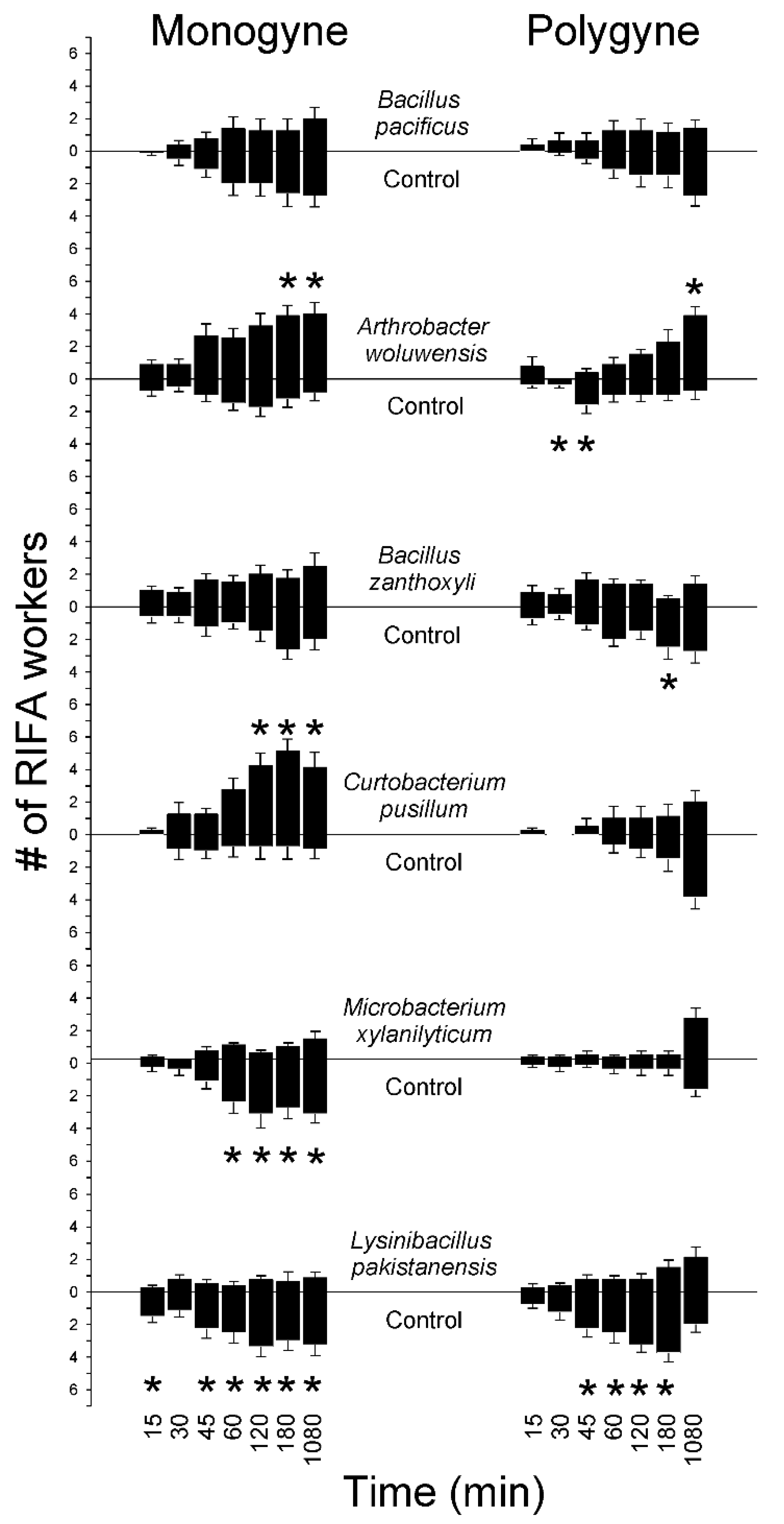
Populations of the red imported fire ant (Solenopsis invicta) are found throughout the southern United States. Because these invasive ants sting and are highly territorial, they are hazardous to people and livestock and are detrimental to native ant populations. Control of this species generally relies on insecticidal baits that attract and kill the ant. The aim of our study was to determine if bacteria cultured from S. invicta nest soils affected worker ant behaviors and whether the bacteria were attractive or repellent to the ants. Bacterial isolates cultured from nest soils were used in binary choice bioassays that tested for effects of bacterial species and bacterial concentrations on worker ant digging and residing preferences. Arthrobacter woluwensis (Actinobacteria) attracted worker ants while bacteria identified as Firmicutes generally repelled ants. This study provides a basis for the identification of new biologically derived compounds that can be used to alter behaviors of the red imported fire ant and be implemented in novel control strategies.
Abstract
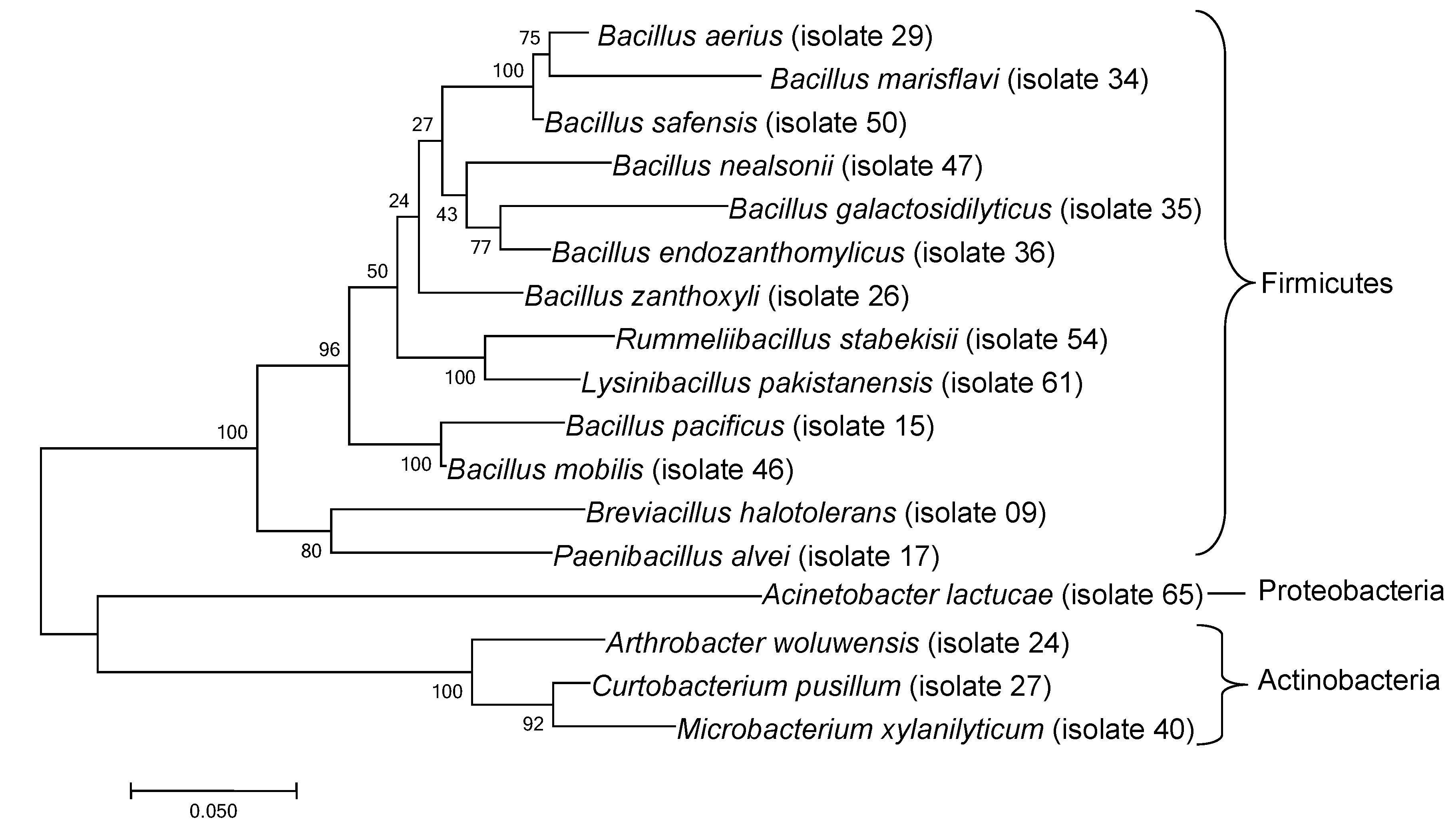
Populations of monogyne and polygyne red imported fire ants (RIFA), Solenopsis invicta Buren, are distributed throughout the southern United States. This ant species is hazardous to farm animals and workers, damages infrastructure, and depletes native arthropod populations. Colony expansion is affected by several biotic factors, but the effects of soil microbes on ant behavior related to soil excavation within nest sites have not been investigated. Consequently, we cultured bacteria from RIFA nest soils. The effects of individual bacterial isolates and bacterial cell densities on the choice of digging site as well as digging activity of monogyne and polygyne RIFA worker ants were evaluated in two-choice bioassays. Based on phylogenetic analysis, 17 isolates were selected and tested initially at 5 × 10⁸ cells/mL and 20 workers per assay. Firmicutes (Bacillus, Paenibacillus, Brevibacillus) repelled the ants, but Arthrobacter woluwensis strongly attracted ants. Subsequently, the six isolates having the greatest positive or negative effects on ant behavior were evaluated at a lower bacterial cell and worker ant densities. Ant responses to these bacteria generally decreased as cell densities declined to 5 × 10⁶ cells/mL. Observations of ant behavior during a three-hour, two-choice bioassay revealed that ants generally visited both control and bacteria-treated sand prior to making a digging site choice. Our research results indicate that soil bacteria may mediate ant nest expansion or relocation and foraging tunnel construction. Identification of bacterial metabolites that affect RIFA digging behavior merits additional research because these compounds may provide a basis for novel management strategies that repel RIFA away from sensitive infrastructure or attract fire ants to insecticidal baits.