Enantiomeric Discrimination in Insects: The Role of OBPs and ORs

1
Biointeractions and Crop Protection Department, Rothamsted Research, Harpenden, Hertfordshire AL5 2JQ, UK
2
School of Chemistry, University of Nottingham, University Park, Nottingham NG7 2RD, UK
*
Author to whom correspondence should be addressed.
Insects 2022, 13(4), 368; https://doi.org/10.3390/insects13040368
Submission received: 1 March 2022
/
Revised: 25 March 2022
/
Accepted: 30 March 2022
/
Published: 8 April 2022
(This article belongs to the Special Issue Recent Advances in Physiology of Insect Olfaction)
Simple Summary
Insects use olfaction, i.e., their sense of smell, to detect odors that elicit behavioral responses, with structurally similar compounds eliciting different responses. The roles of specific recognition proteins, i.e., odorant-binding proteins (OBPs) and odorant receptors (ORs), located in insect antennae, in discriminating between structurally similar compounds are not fully understood. Here, we explore current research in understanding the role of OBPs and ORs in discriminating between enantiomers—mirror image structures—in insect chemical ecology and chemoperception.
Abstract
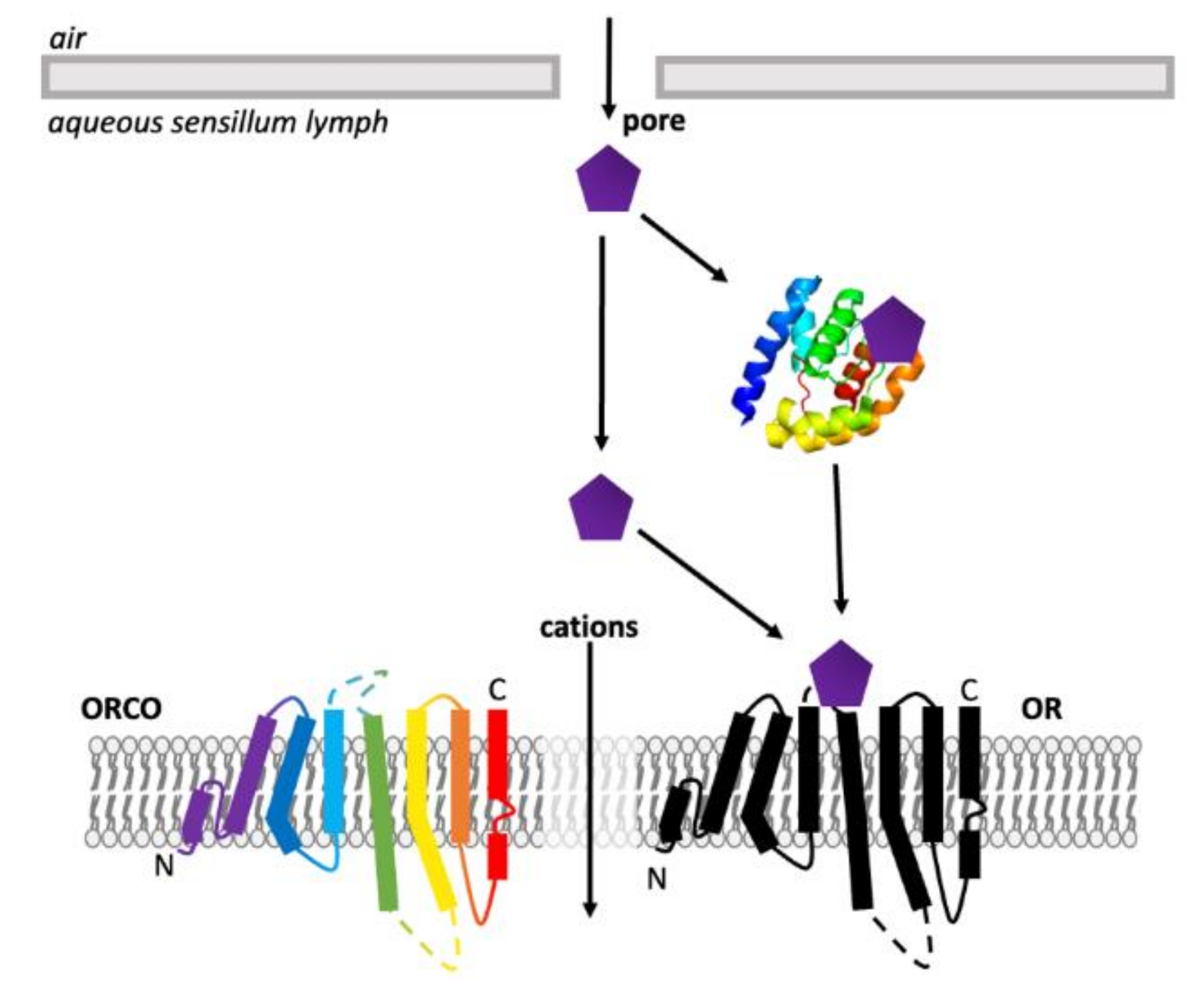
Olfaction is a complex recognition process that is critical for chemical communication in insects. Though some insect species are capable of discrimination between compounds that are structurally similar, little is understood about how this high level of discrimination arises. Some insects rely on discriminating between enantiomers of a compound, demonstrating an ability for highly selective recognition. The role of two major peripheral olfactory proteins in insect olfaction, i.e., odorant-binding proteins (OBPs) and odorant receptors (ORs) has been extensively studied. OBPs and ORs have variable discrimination capabilities, with some found to display highly specialized binding capability, whilst others exhibit promiscuous binding activity. A deeper understanding of how odorant-protein interactions induce a response in an insect relies on further analysis such as structural studies. In this review, we explore the potential role of OBPs and ORs in highly specific recognition, specifically enantiomeric discrimination. We summarize the state of research into OBP and OR function and focus on reported examples in the literature of clear enantiomeric discrimination by these proteins.