Myzus persicae Management through Combined Use of Beneficial Insects and Thiacloprid in Pepper Seedlings
by
 , ,
, ,
Qingcai Lin
1,†, 
Hao Chen
1,†,
Xiaoyan Dai
1,
Shuyan Yin
2,
Chenghao Shi
1,2,
Zhenjuan Yin
3,
Jinping Zhang
4,
Feng Zhang
4,
Li Zheng
1 and
Yifan Zhai
1,* 1
Institute of Plant Protection, Shandong Academy of Agricultural Sciences, Jinan 250100, China
2
College of Plant Protection, Shandong Agricultural University, Tai’an 271000, China
3
College of Agriculture, Guizhou University, Guiyang 550025, China
4
MoA-CABI Joint Laboratory for Bio-Safety, Institute of Plant Protection, Chinese Academy of Agricultural Sciences, Beijing 100193, China
*
Author to whom correspondence should be addressed.
†
These authors contributed equally to this work.
Insects 2021, 12(9), 791; https://doi.org/10.3390/insects12090791
Submission received: 13 July 2021
/
Revised: 27 August 2021
/
Accepted: 30 August 2021
/
Published: 3 September 2021
(This article belongs to the Collection Improving IPM of Specialty Crop Pests and Global Food Security)
Simple Summary
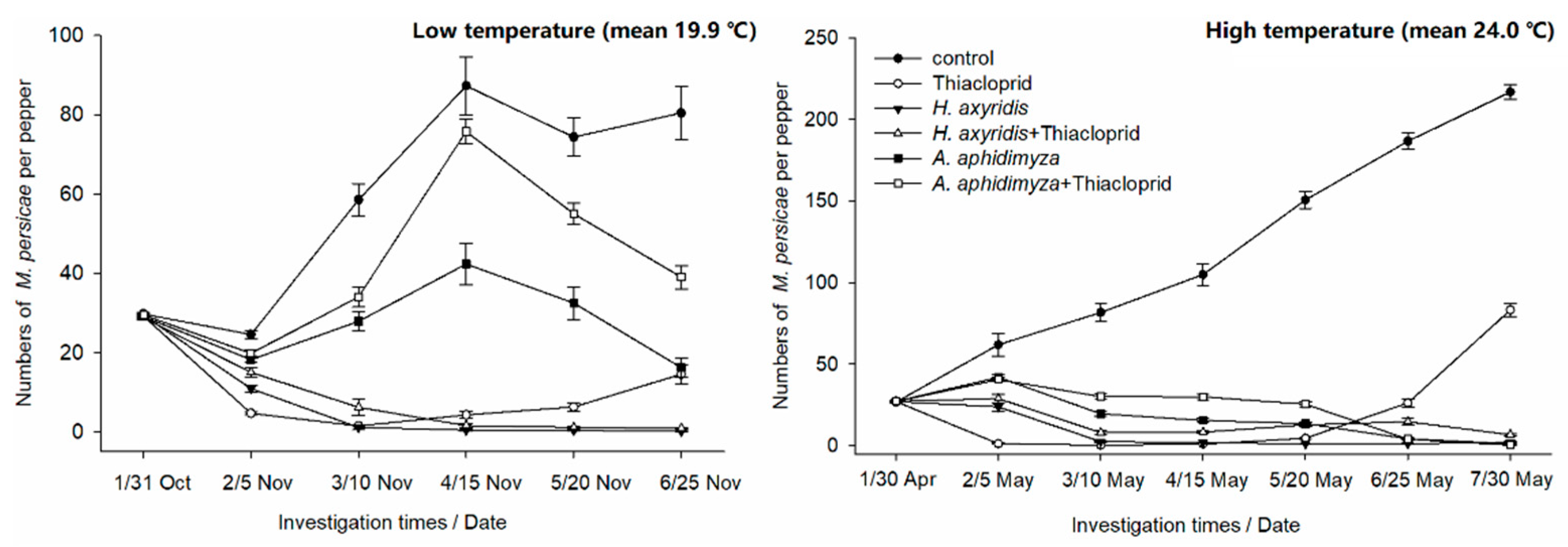
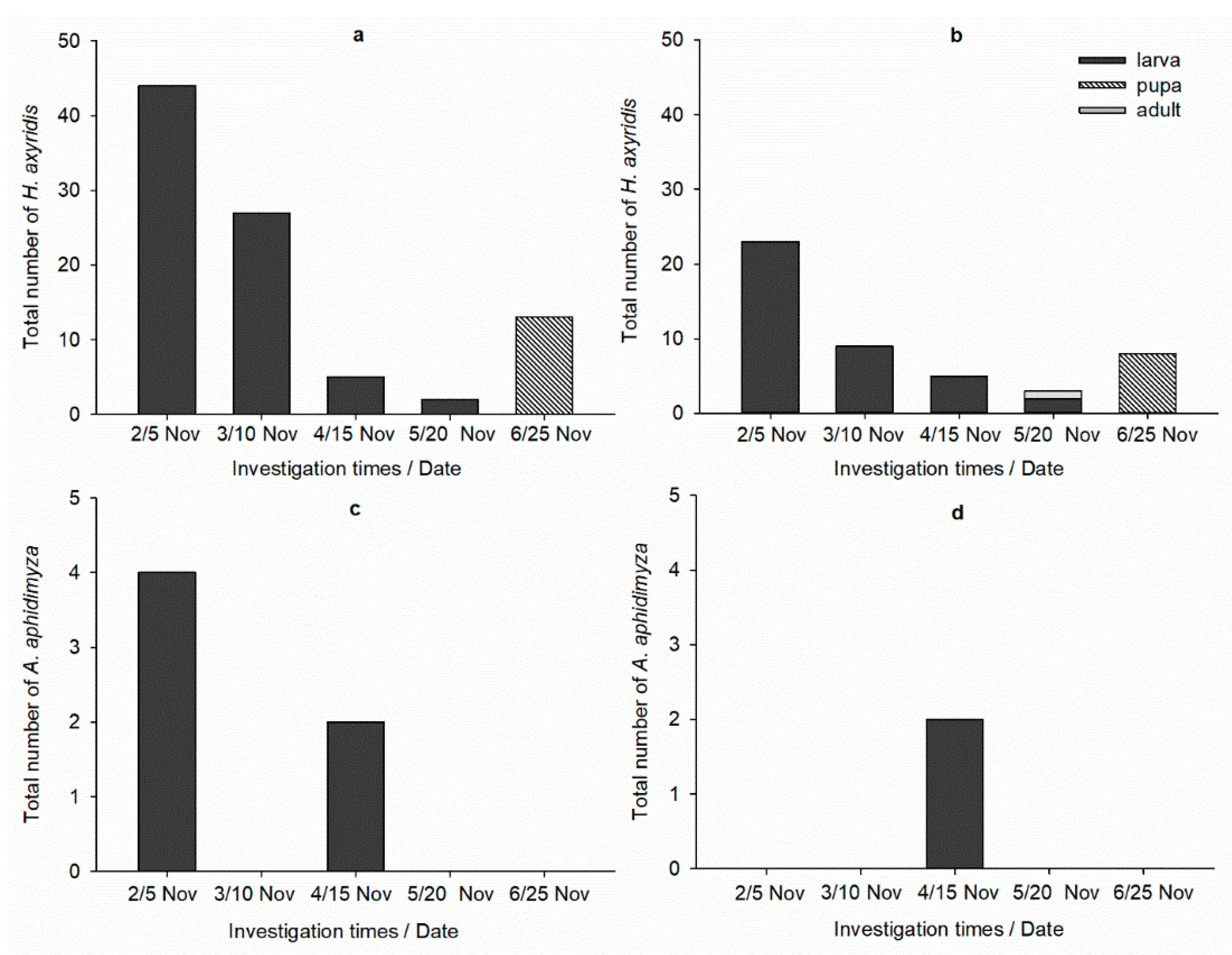
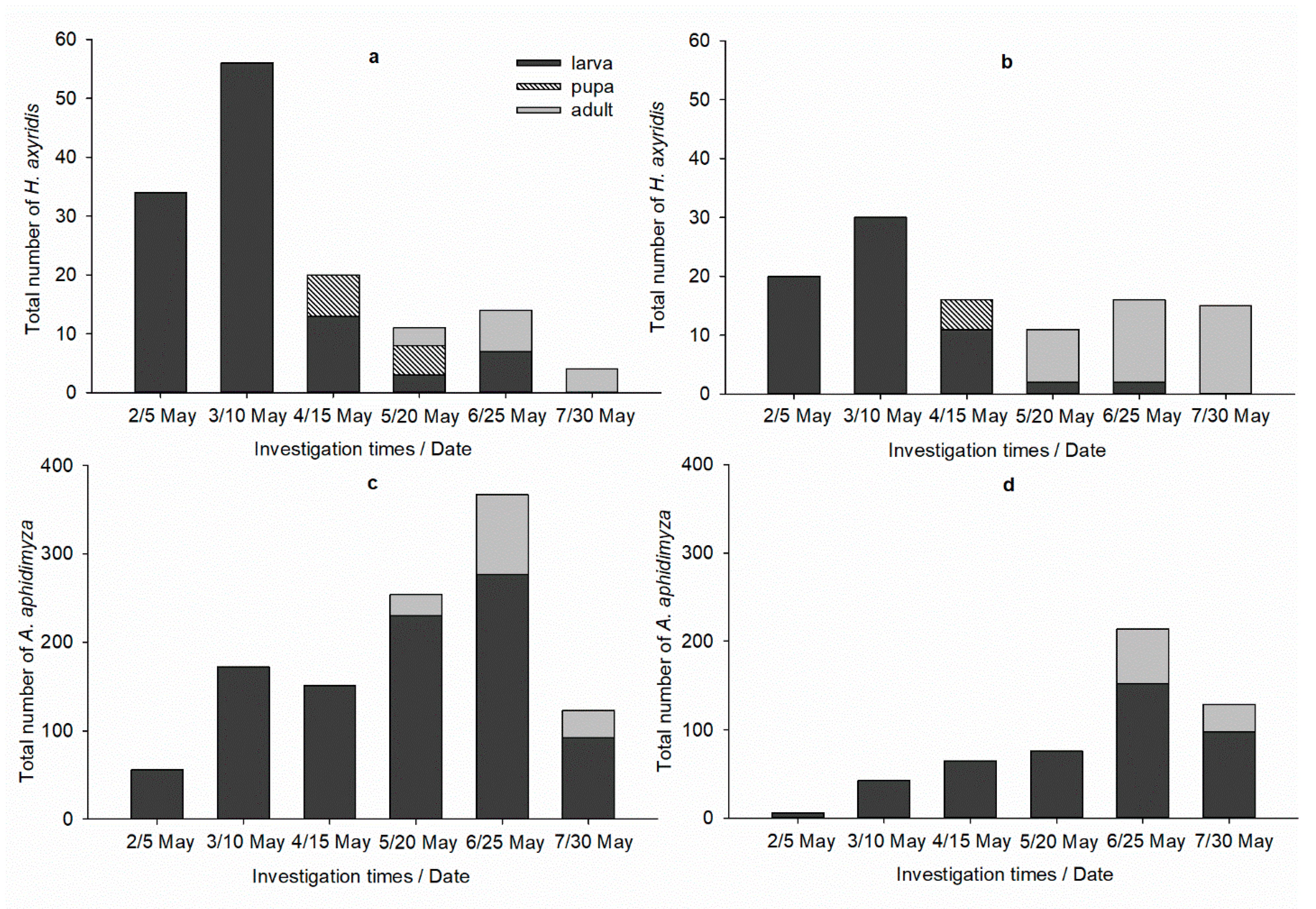
Myzus persicae is a worldwide pest causing significant economic loss, especially to vegetables. However, the mainly applied insecticides were not effective, whilst also endangering the safety of pollinators. Harmonia axyridis and Aphidoletes aphidimyza are predators of aphids, but they are costly and affected by temperature and insecticides. We conducted toxicity tests and greenhouse trails to make an effective combination of neonicotinoid insecticides and predators. Both H. axyridis and A. aphidimyza effectively controlled aphids whether combined with thiacloprid or not, at above 20 °C temperature condition. Our results indicated that it is it is necessary to choose H. axyridis or A. aphidimyza to control aphids based on economic and thermal considerations. Practically, thiacloprid could be used either as an emergency option to control aphids’ abundance alone or in combination with natural enemies.
Abstract
Excessive insecticide application has posed a threat to pollinators and has also increased insecticide resistance of Myzus persicae Sulzer. Therefore, it is urgent to develop an economical and effective strategy, especially for greenhouse vegetables. Firstly, we selected a neonicotinoid insecticide that is specifically fatal to M. persicae but relatively safe to predators and bumblebees by laboratory toxicity tests and risk assessments. Then, we tested the effectiveness of the neonicotinoid insecticide under different temperature conditions. According to the LC50 values and the hazard quotients, thiacloprid met the requirements. Greenhouse trails indicated that thiacloprid was quite efficient, while control dropped to 80% without the application of thiacloprid. As for biological control, Harmonia axyridis effectively controlled 90% of aphids with thiacloprid or not. However, Aphidoletes aphidimyza performed better above 20 °C. Our results indicated that it is cost-effective to control M. persicae with A. aphidimyza in suitable temperature conditions and H. axyridis was more effective at low temperatures. Practically, thiacloprid could be used either as an emergency option to control aphids’ abundance alone or in combination with natural enemies.