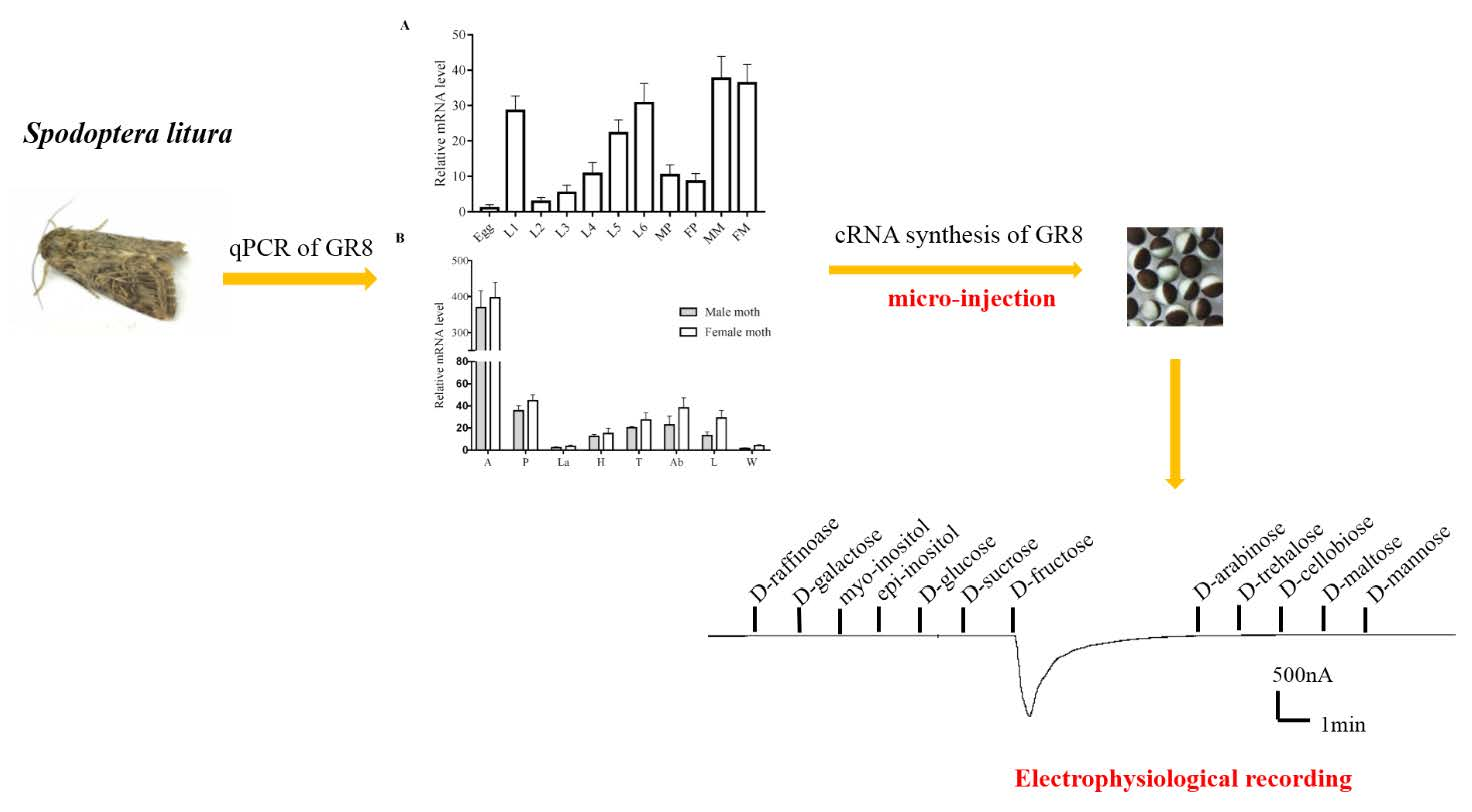
A Gustatory Receptor GR8 Tunes Specifically to D-Fructose in the Common Cutworm Spodoptera litura

Abstract
Share and Cite
Liu, X.-L.; Yan, Q.; Yang, Y.-L.; Hou, W.; Miao, C.-L.; Peng, Y.-C.; Dong, S.-L. A Gustatory Receptor GR8 Tunes Specifically to D-Fructose in the Common Cutworm Spodoptera litura. Insects 2019, 10, 272. https://doi.org/10.3390/insects10090272
Liu X-L, Yan Q, Yang Y-L, Hou W, Miao C-L, Peng Y-C, Dong S-L. A Gustatory Receptor GR8 Tunes Specifically to D-Fructose in the Common Cutworm Spodoptera litura. Insects. 2019; 10(9):272. https://doi.org/10.3390/insects10090272
Chicago/Turabian StyleLiu, Xiao-Long, Qi Yan, Yi-Lin Yang, Wen Hou, Chun-Li Miao, Ying-Chuan Peng, and Shuang-Lin Dong. 2019. "A Gustatory Receptor GR8 Tunes Specifically to D-Fructose in the Common Cutworm Spodoptera litura" Insects 10, no. 9: 272. https://doi.org/10.3390/insects10090272
APA StyleLiu, X.-L., Yan, Q., Yang, Y.-L., Hou, W., Miao, C.-L., Peng, Y.-C., & Dong, S.-L. (2019). A Gustatory Receptor GR8 Tunes Specifically to D-Fructose in the Common Cutworm Spodoptera litura. Insects, 10(9), 272. https://doi.org/10.3390/insects10090272