

Susceptibility of Environmentally Friendly Sheep Wool Insulation Panels to the Common Clothes Moth Tineola bisselliella in Laboratory Assays



Abstract
1. Introduction
2. Materials and Methods
2.1. Materials and Insecticidal Preparations
2.2. Resistance Bioassays
2.3. Concentration-Response Bioassays
2.4. Statistical Analyses
3. Results
3.1. Resistance Bioassays
3.2. Concentration-Response Bioassays
4. Discussion
5. Conclusions
Author Contributions
Funding
Acknowledgments
Conflicts of Interest
References
- Aditya, L.; Mahlia, T.M.I.; Rismanchi, B.; Ng, H.M.; Hasan, M.H.; Metselaar, H.S.C.; Muraza, O.; Aditiya, H.B. A review on insulation materials for energy conservation in buildings. Renew. Sust. Energ. Rev. 2017, 73, 1352–1365. [Google Scholar] [CrossRef] [Scilit]
- Pennacchio, R.; Savio, L.; Bosia, D.; Thiebat, F.; Piccablotto, G.; Patrucco, A.; Fantucci, S. Fitness: Sheep-wool and Hemp Sustainable Insulation Panels. Energy Procedia 2017, 111, 287–297. [Google Scholar] [CrossRef] [Scilit]
- Ward, C.W. Resolution of proteases in the keratinolytic larvae of the webbing clothes moth. Aust. J. Biol. Sci. 1975, 28, 1–24. [Google Scholar] [CrossRef] [Scilit] [PubMed]
- Cox, P.D.; Pinniger, D.B. Biology, behaviour and environmentally sustainable control of Tineola bisselliella (Hummel) (Lepidoptera: Tineidae). J. Stored Prod. Res. 2007, 43, 2–32. [Google Scholar] [CrossRef] [Scilit]
- Pinniger, D.B.; Harmon, J.D. Pest management, prevention and control. In Care and Conservation of Natural History Collections; Carter, D., Walker, A.K., Eds.; Butterworth Heinemann: Oxford, UK, 1999; pp. 152–176. [Google Scholar]
- Trematerra, P.; Fontana, F. Monitoring of webbing clothes moth, Tineola bisselliella, by sex pheromone. Anzeiger für Schädlingskunde Pflanzenschutz Umweltschutz 1996, 69, 119–121. [Google Scholar] [CrossRef] [Scilit]
- Zimmermann, O.; Scholler, M.; Prozell, S. Investigations on the biological control of Tineola bisselliella with Trichogramma species (Hymenoptera: Trichogrammatidae). In Proceedings of the Eighth International Working Conference on Stored Product Protection, York, UK, 22–26 July 2002; Credland, P.F., Armitage, D.M., Bell, C.H., Cogan, P.M., Highley, E., Eds.; CAB International: Wallingford, UK, 2003; pp. 319–321. [Google Scholar]
- Brokerhof, A.W.; Jonathan Banks, H.; Morton, R. A model for time-temperature-mortality relationships for eggs of the webbing clothes moth, Tineola bisselliella (Lepidoptera: Tineidae), exposed to cold. J. Stored Prod. Res. 1992, 28, 269–277. [Google Scholar] [CrossRef] [Scilit]
- Bernard, C.E.; Harrass, M.C.; Manning, M.J. Boric Acid and Inorganic Borate Pesticides. In Hayes’ Handbook of Pesticide Toxicology; Krieger, R.I., Krieger, W.C., Eds.; Academic Press: Riverside, CA, USA, 2010; pp. 2033–2053. [Google Scholar]
- Farfán-García, E.D.; Castillo-Mendieta, N.T.; Ciprés-Flores, F.J.; Padilla-Martínez, I.I.; Trujillo-Ferrara, J.G.; Soriano-Ursúa, M.A. Current data regarding the structure-toxicity relationship of boron-containing compounds. Toxicol. Lett. 2018, 258, 115–125. [Google Scholar] [CrossRef] [Scilit] [PubMed]
- International Organization for Standardization (ISO). Textiles—Determination of Resistance to Certain Insect Pests; SO Standard No. 3998; International Organization for Standardization (ISO): Geneve, Switzerland, 1977; Available online: https://www.iso.org/obp/ui/#iso:std:iso:3998:en (accessed on 24 January 2019).
- SAS Institute. SAS/STAT 9.1: User’s Guide; SAS Publishers: Hojai, India, 2004. [Google Scholar]
- Braulio-Gonzalo, M.; Bovea, M.D. Environmental and cost performance of building’s envelope insulation materials to reduce energy demand: Thickness optimisation. Energy Build. 2019, 150, 527–545. [Google Scholar] [CrossRef] [Scilit]
- Vasile, V.; Petcu, C.; Meitą, V.; Zaharia, M.C. Innovative Thermal Insulation Products for a Circular Economy. IOP Conf. Ser. Earth. Environ. Sci. 2019, 290, 012037. [Google Scholar] [CrossRef] [Scilit]
- Trematerra, P.; Pinniger, D. Museum Pests—Cultural Heritage Pests. In Recent Advances in Stored Product Protection; Athanassiou, G.C., Arthur, F.H., Eds.; Springer: Berlin, Germany, 2018; pp. 229–260. [Google Scholar]
- Moretti, E.; Belloni, E.; Agosti, F. Innovative mineral fiber insulation panels for buildings: Thermal and acoustic characterization. Appl. Energy 2016, 169, 421–432. [Google Scholar] [CrossRef] [Scilit]
- See, A.S.; Salleh, A.B.; Bakar, F.A.; Yusof, N.A.; Abdulamir, A.S.; Heng, L.Y. Risk and health effect of boric acid. Am. J. Appl. Sci. 2010, 7, 620–627. [Google Scholar] [CrossRef] [Scilit]
- Larkin, G.M.; Merrick, P.; Gnatowski, M.J.; Laks, P.E. In-process protection of wood composites: An industry perspective. ACS Symp. Ser. Am. Chem. Soc. 2008, 982, 458–469. [Google Scholar]
- Lloyd, J.D. Borates and Their Biological Applications. In International Research Group on Wood Preservation; IRG/WP 98-30178; IRG Secretariat: Stockholm, Sweden, 1998. [Google Scholar]
- Lloyd, J.D.; Dickinson, D.J.; Murphy, R.J. The Probable Mechanisms of Action of Boric Acid and Borates as Wood Preservatives. In International Research Group on Wood Preservation; IRG/WP/1450—IRG; Secretariat: Stockholm, Sweden, 1990. [Google Scholar]
- Tokoro, M.; Su, N. Wood protection by surface treatment of two borate preservatives, TIMBOR and BORA-CARE, for the formosan subterranean termite and eastern subterrean termite. In International Research Group on Wood Preservation; IRG/WP 93-10044; IRG Secretariat: Stockholm, Sweden, 1993. [Google Scholar]
- Gentz, M.C.; Grace, J.K. A Review of Boron Toxicity in Insects with an Emphasis on Termites. J. Agric. Urban Entomol. 2006, 23, 201–207. [Google Scholar]
- Salman, S.; Pétrissans, A.; Thévenon, M.F.; Dumarçay, S.; Perrin, D.; Pollier, B.; Gérardin, P. Development of new wood treatments combining boron impregnation and thermo modification: Effect of additives on boron leachability. Eur. J. Wood Wood Prod. 2014, 72, 355–365. [Google Scholar] [CrossRef] [Scilit]
- Butterwick, L.; Oude, N.; Raymond, K. Safety assessment of boron in aquatic and terrestrial environments. Ecotox. Environ. Safe. 1989, 17, 339–371. [Google Scholar] [CrossRef] [Scilit]
- Schoderboeck, L.; Mühlegger, S.; Losert, A.; Gausterer, C.; Hornek, R. Effects assessment: Boron compounds in the aquatic environment. Chemosphere 2011, 82, 483–487. [Google Scholar] [CrossRef] [Scilit] [PubMed]
- Dubey, N.K.; Srivastava, B.; Kumar, A. Current Status of Plant Products as Botanical Pesticides instorage pest management. J. Biopest. 2018, 1, 182–186. [Google Scholar]
- Bouchikhi Tani, Z.; Khelil, M.A.; Hassani, F. Fight against the bruche bean Acanthoscelides obtectus (coleoptera: Bruchidae) and the mite Tineola bisselliella (lepidoptera, tineidae) by the essential oils extracted from Rosmarinus officinalis. Biosci. Biotechnol. Res. Asia 2008, 5, 651–656. [Google Scholar]
- Vega, F.E.; Kaya, H.K. Insect Pathology, 2nd ed.; Elsevier: London, UK, 2012; p. 504. [Google Scholar]
- Rai, M.; Ingle, A. Role of nanotechnology in agriculture with special reference to management of insect pests. Appl. Microbiol. Biotechnol. 2012, 94, 287–293. [Google Scholar] [CrossRef] [Scilit]
- Sunderland, M.R.; McNeil, S.J. Protecting wool carpets from beetle and moth larvae with nanocidal titanium dioxide desiccant. Clean Technol. Environ. 2017, 19, 1205–1213. [Google Scholar] [CrossRef] [Scilit]
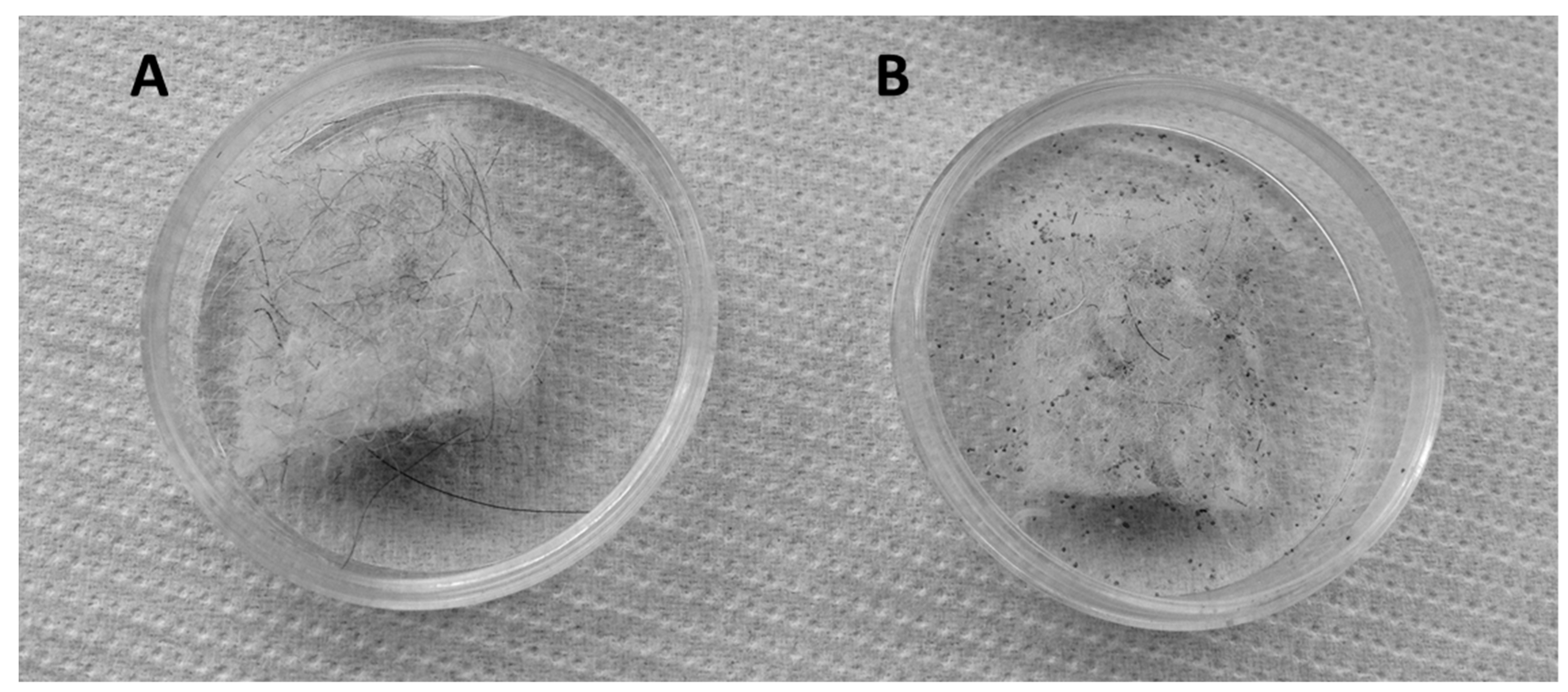
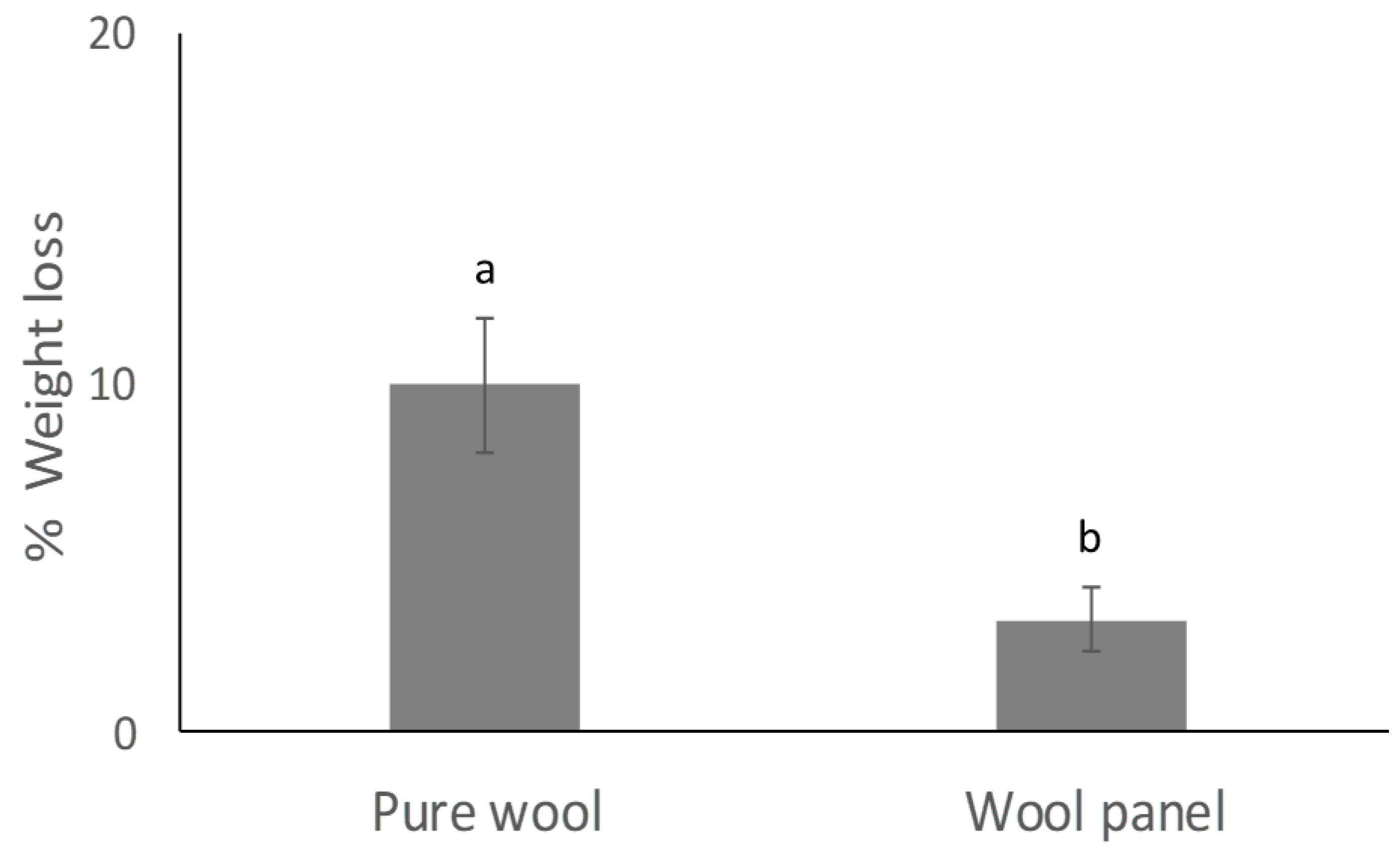
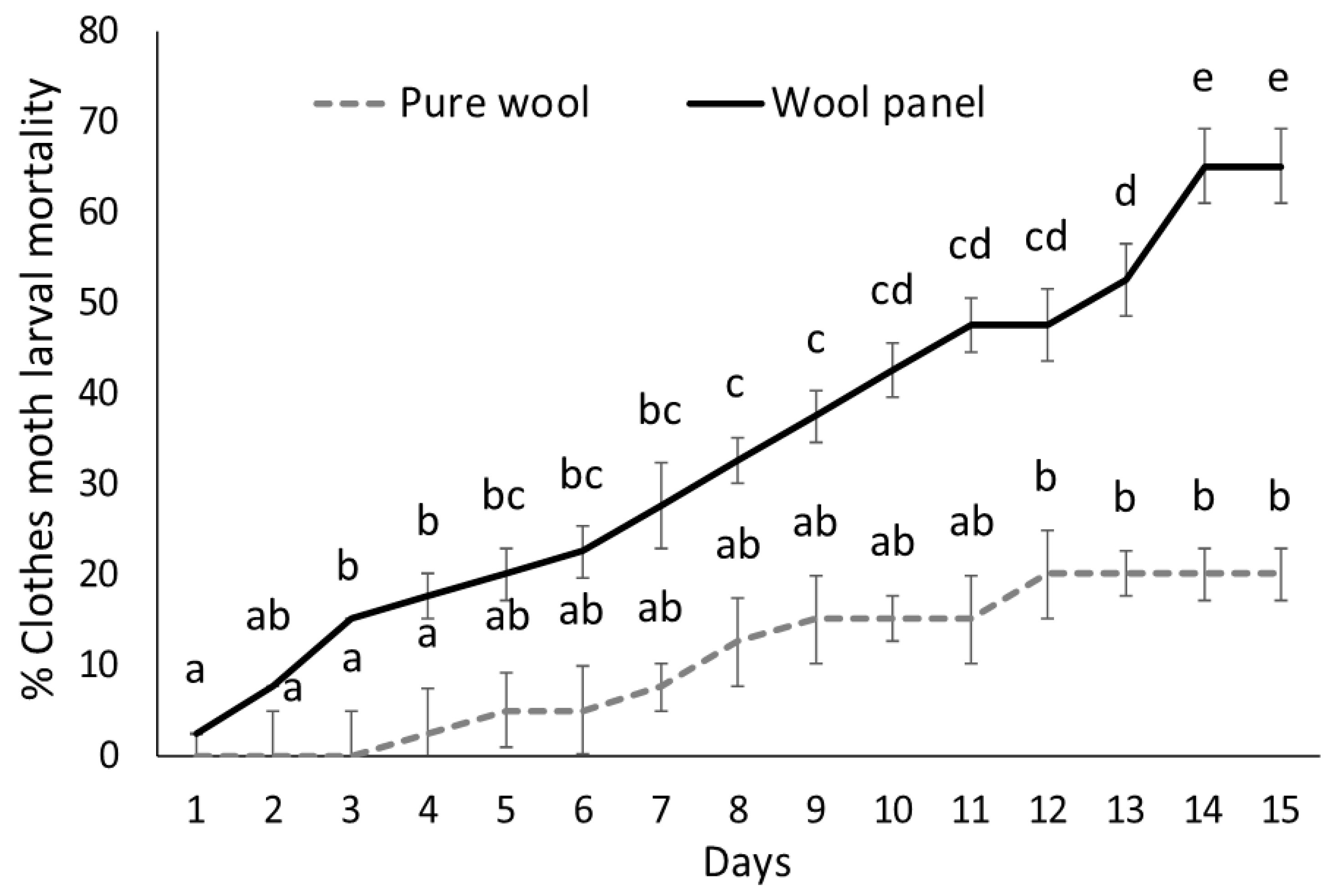
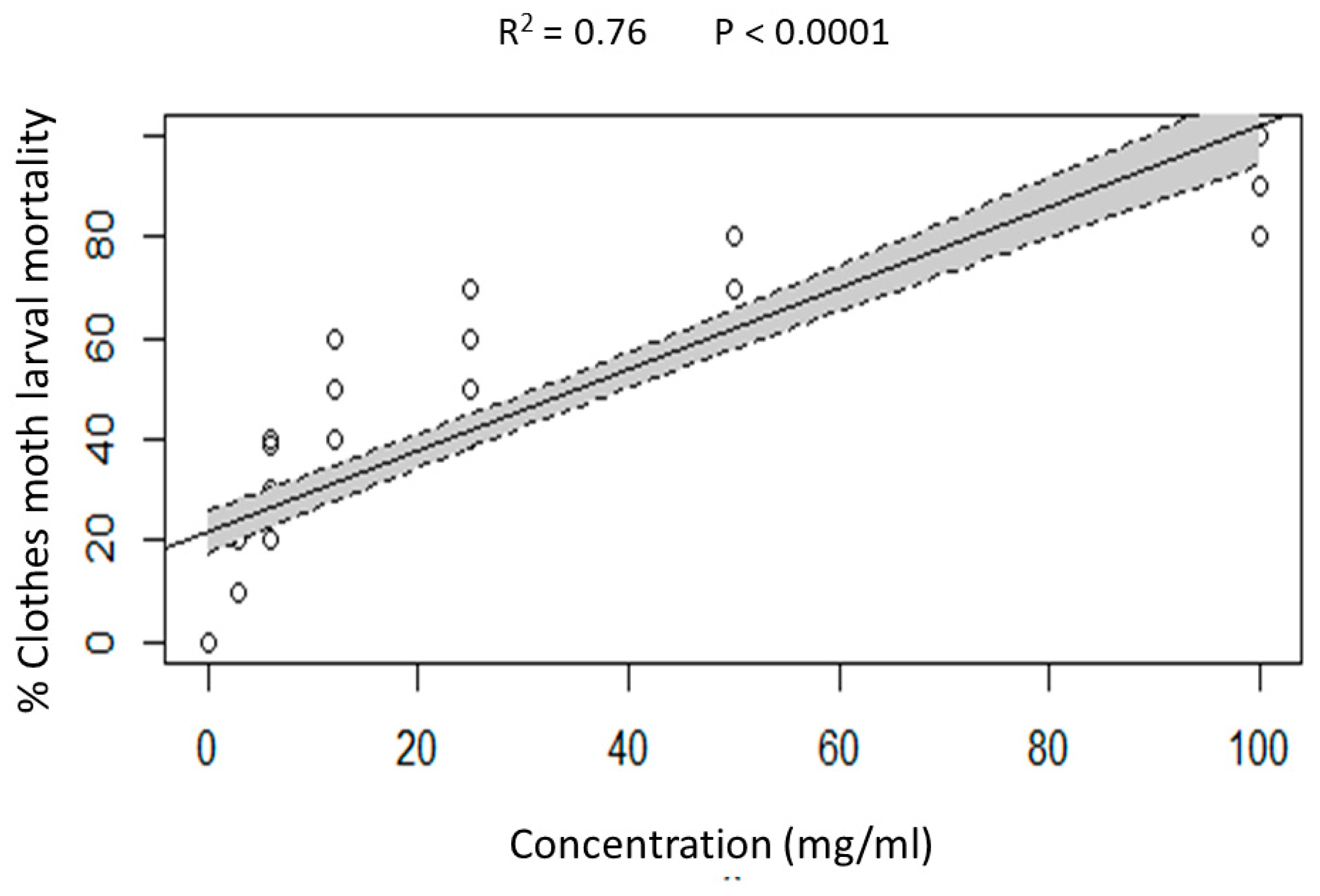

| Grade | Superficial Attack | Grade | Deep Attack |
|---|---|---|---|
| 1 | no attack | A | no holes |
| 2 | slight attack | B | partially damaged fibers |
| 3 | moderate attack | C | small and sparse holes |
| 4 | strong attack | D | large and deep holes |
© 2019 by the authors. Licensee MDPI, Basel, Switzerland. This article is an open access article distributed under the terms and conditions of the Creative Commons Attribution (CC BY) license (http://creativecommons.org/licenses/by/4.0/).
Share and Cite
Ruiu, L.; Floris, I. Susceptibility of Environmentally Friendly Sheep Wool Insulation Panels to the Common Clothes Moth Tineola bisselliella in Laboratory Assays. Insects 2019, 10, 379. https://doi.org/10.3390/insects10110379
Ruiu L, Floris I. Susceptibility of Environmentally Friendly Sheep Wool Insulation Panels to the Common Clothes Moth Tineola bisselliella in Laboratory Assays. Insects. 2019; 10(11):379. https://doi.org/10.3390/insects10110379
Chicago/Turabian StyleRuiu, Luca, and Ignazio Floris. 2019. "Susceptibility of Environmentally Friendly Sheep Wool Insulation Panels to the Common Clothes Moth Tineola bisselliella in Laboratory Assays" Insects 10, no. 11: 379. https://doi.org/10.3390/insects10110379
APA StyleRuiu, L., & Floris, I. (2019). Susceptibility of Environmentally Friendly Sheep Wool Insulation Panels to the Common Clothes Moth Tineola bisselliella in Laboratory Assays. Insects, 10(11), 379. https://doi.org/10.3390/insects10110379

