1. Introduction
Stringent regulations on marine oil pollution implemented by organizations such as the International Maritime Organization (IMO) are driving a paradigm shift in marine environments, like vessels from traditional oil-lubricated systems to environmentally friendly water-lubricated systems [
1]. Currently, the rapid development of new high-efficiency drive devices, including rim-driven thrusters and integrated pump-jet propulsors, is placing higher performance requirements on water-lubricated bearings [
2]. However, the seawater medium, characterized by high salinity, low viscosity, elevated suspended particle concentration, and abundant chloride ions, constitutes a highly erosive environment where electrochemical and mechanical effects act synergistically [
3], posing a severe threat to marine mechanical equipment operating in marine settings. As a result, bearings in critical load-bearing components, including ship propulsion systems, deep-sea robot joints, and offshore platform equipment, face a markedly increased risk of failure [
4].
The fundamental shift in lubricating medium from oil to water has triggered the reconstruction of bearing interface mechanics [
5]. The low viscosity of seawater severely diminishes the hydrodynamic pressure effect, leading to a reduced lubricating film thickness ratio [
6]. As a result, the system frequently operates in a state of mixed lubrication or even boundary lubrication, significantly increasing the proportion of asperity contact, triggering severe wear and high friction energy consumption [
7]. More critically, seawater possesses strong corrosiveness, and Cl
− exhibits a powerful destructive capacity against the passive films of most metallic materials that readily induces pitting corrosion, crevice corrosion, and intergranular corrosion, thereby rapidly compromising the geometric accuracy and integrity of the bearing working surfaces [
8]. The ultra-high hydrostatic pressure in deep-sea environments not only alters the bearing clearance and material deformation, but may also exacerbate the risks of tribocorrosion and brittle failure of materials by influencing dissolved gas dynamics and facilitating hydrogen permeation [
9]. These challenges arising from the multi-field coupling of low-viscosity lubrication and strong corrosive environments expose the inherent limitations of conventional bearing materials: metallic materials like stainless steel and aluminum alloy are prone to localized corrosion, while polymeric materials suffer from severe high-pressure creep and poor heat dissipation.
Tungsten carbide-based cemented carbides are candidates for addressing complex marine conditions [
10]. Beyond high hardness and compressive strength, they possess an elastic modulus of 500–700 GPa [
11,
12]. Unlike polymer bearing materials prone to creep under deep-sea hydrostatic pressure, cemented carbides maintain dimensional stability and geometric precision, sustaining the hydrodynamic lubrication film [
13]. Their thermal conductivity, superior to that of engineering ceramics, aids in dissipating frictional heat from mixed lubrication [
14]. Regarding corrosion, unlike metallic materials relying on passive films, the WC ceramic phase is chemically inert to seawater. The bottleneck for cemented carbides in marine use lies not in the ceramic skeleton but in the traditional binder: Co binders are sensitive to chloride ions and prone to selective dissolution, thus damaging the integrity of the material microstructure [
15]. Moreover, the inherent brittleness of the WC phase makes it prone to fracture and particle spalling under high load or impact; the synergistic coupling mechanism among multiple physical fields and factors, such as mechanical wear, electrochemical corrosion, fluid pressure, temperature and microbial activity, remains unclear [
16], which poses great challenges to the reliability design and service life prediction of cemented carbide bearings.
A systematic review and analysis of the research progress on cemented carbide bearings in marine environments holds significant scientific and engineering value for advancing far-reaching marine equipment technology. Aiming to connect the technical chain of “material-interface-system” and deeply conduct an in-depth analysis of the strategies and mechanisms of cemented carbide bearings for coping with extreme marine working conditions, this paper first analyzes the core requirements of marine environmental characteristics for bearing materials, with a focused discussion on the performance evolution and adaptability trade-offs of different material systems, including WC-Co, WC-Ni and WC-high entropy alloys. Second, it systematically explores the tribological behavior of cemented carbides under seawater lubrication conditions, especially addressing the tribocorrosion synergistic effect, the influence of hydrostatic pressure and the regulatory role of surface engineering technologies. From an engineering application perspective, the research summarizes the reliability guarantee strategies such as design theory, failure prevention and control, and condition monitoring for bearings. Comparing competing materials clarifies the application boundaries and development trends of cemented carbides in the field of marine bearings. Finally, the paper summarizes current technical bottlenecks and core scientific issues and outlines future development directions. The objective is to provide theoretical reference and technical support for the research and development of a new generation of long-life, high-reliability bearings for marine equipment.
2. Analysis of Extreme Marine Environments and Their Impacts on Bearing Materials
The marine service environment exposes bearing materials to the coupled effects of multiple physical and chemical fields, resulting in performance degradation characterized by synergistic and even amplified multi-field interactions. Targeting the service environment of cemented carbides in the ocean, this chapter conducts an in-depth analysis of environmental characteristics and systematically expounds the coupling mechanisms between bearing materials and their surroundings, thereby establishing a clear performance requirement framework for the subsequent review of material systems.
2.1. Electrochemical Corrosion Characteristics of Marine Environments
The strong corrosiveness of the marine environment originates from the unique chemical composition of seawater as an electrolyte. The high electrical conductivity of seawater provides an ideal ionic conduction path for electrochemical corrosion, while the high concentration of chloride ions therein acts as the primary medium that impairs the chemical stability of material surfaces [
17]. Due to their small ionic radius, low hydration energy, and strong permeability, chloride ions pose a universal threat to most engineering materials, although the specific corrosion mechanisms vary with different material types [
18].
For metallic materials, the primary hazard of chloride ions lies in their ability to damage the surface passivation film. This process initiates with the preferential adsorption of chloride ions at the defects of the passive film [
19]. Through a competitive adsorption mechanism, chloride ions can displace oxygen atoms on the metal surface, inducing localized dissolution of the passive film, a process referred to as pitting nucleation [
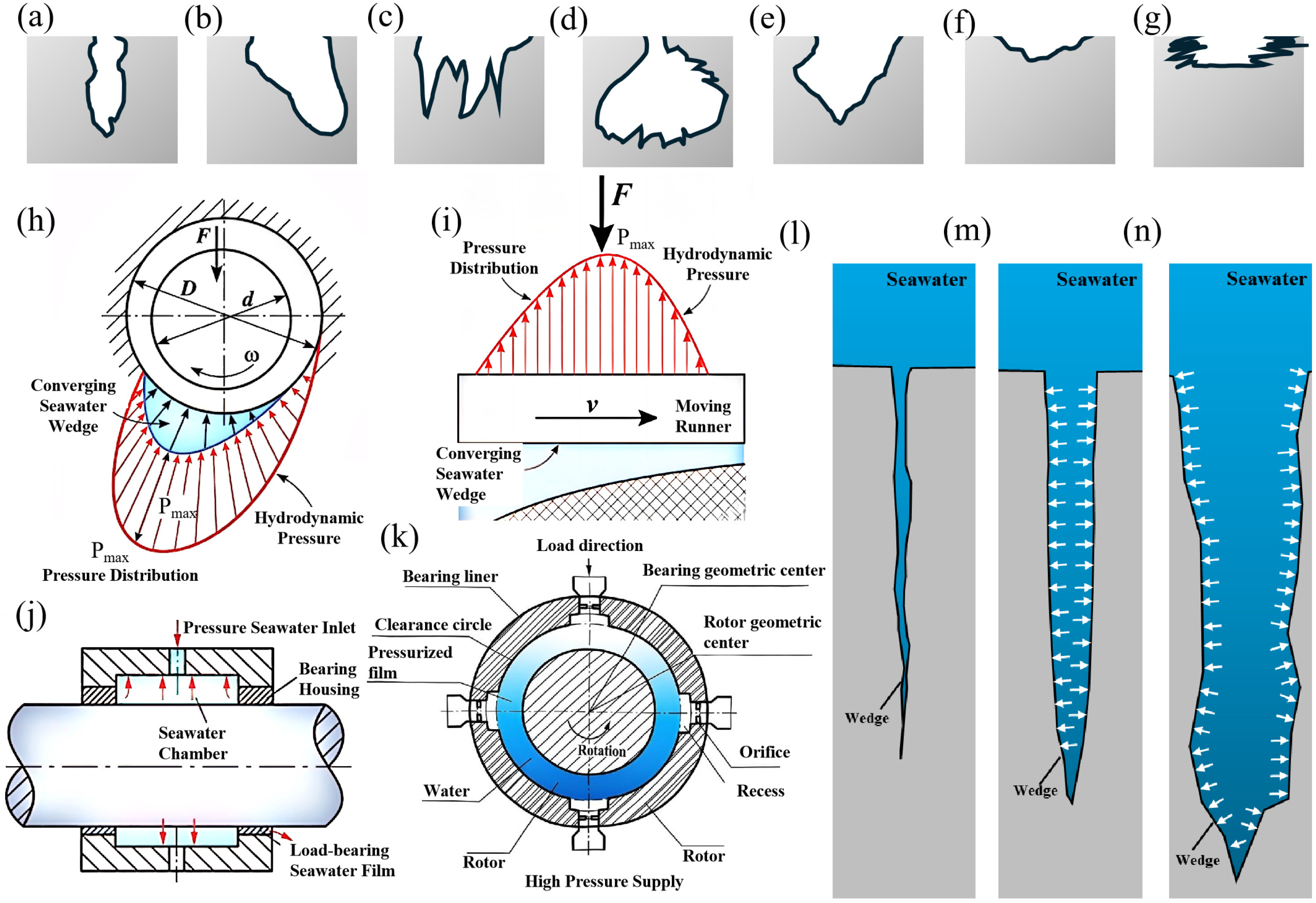
20]. As shown in
Figure 1a–g, localized corrosion exhibits various morphologies, including narrow-deep pits in
Figure 1a, shallow-wide pits in
Figure 1b, and grain boundary attacks in
Figure 1c,g. In subsurface mode shown in
Figure 1e and undercutting mode shown in
Figure 1f, chloride ions penetrate along grain boundaries and expand laterally. This microstructural damage acts as an initiation site for mechanical spalling. In the stagnant electrolyte solution within the formed micro-pits or narrow crevices [
21], restricted oxygen ingress leads to a significant drop in local pH value, which accelerates the metal dissolution rate and ultimately develops into corrosion forms such as pitting and crevice corrosion [
22]. This localized corrosion mechanism can rapidly compromise the structural integrity of cemented carbides, posing a severe challenge to metal-matrix bearing materials designed for long-term service in marine environments.
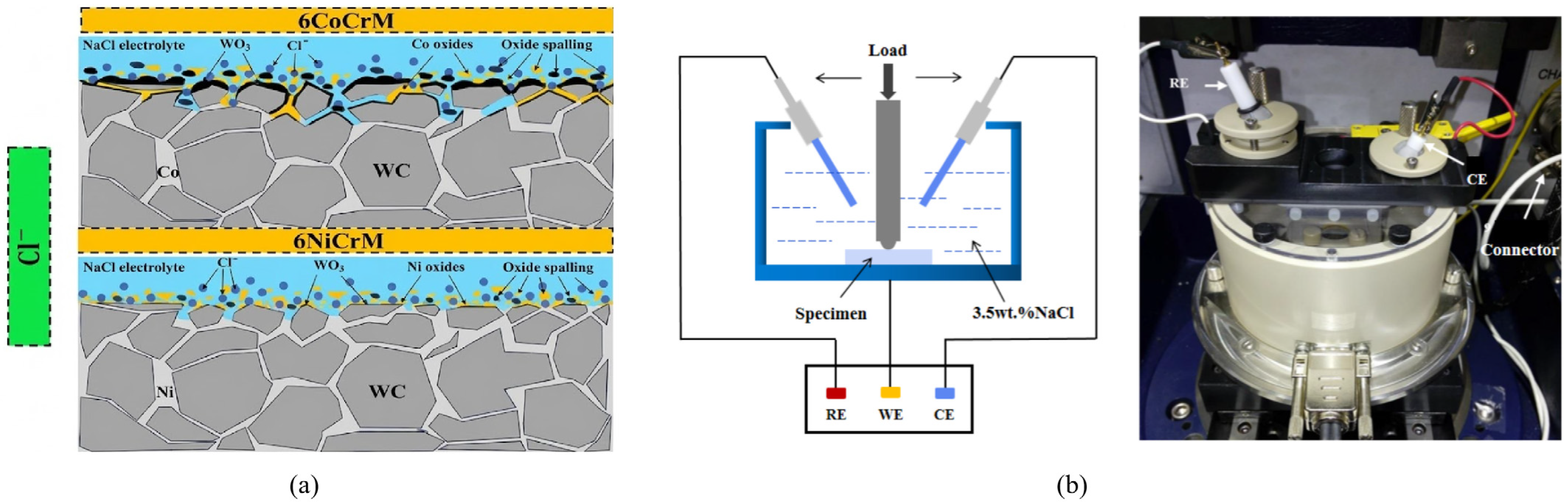
Figure 2a clearly illustrates the key differences in corrosion mechanisms between WC-Co and WC-Ni systems in chloride-containing media. In the WC-Co system, the Co binder preferentially dissolves to form distinct corrosion pits, whereas in the WC-Ni system, corrosion is inhibited due to the passivation of Ni.
Figure 2b displays the corrosive friction machine used to simulate such seawater salt spray environments, which is capable of synchronous electrochemical measurement and friction testing.
For non-metallic materials, the corrosive effect of chloride ions in the marine environment cannot be ignored either. For polymers and composites, while chloride ions do not directly induce electrochemical corrosion similar to that in metals, their presence can significantly accelerate the degradation process [
23]. Chloride ions can act as catalysts or participate in reactions, expediting the hydrolysis of molecular chains, such as polymer amide bonds, by seawater. This leads to a reduction in molecular weight, which in turn causes material softening, swelling and strength degradation [
24]. More importantly, chloride ions can penetrate into the interfaces and interfacial transition zones of composite materials, accelerating moisture accumulation and ingress at the interface. This further exacerbates interfacial defects and performance degradation, while also promoting the initiation and propagation of internal microcracks. By damaging the bonding environment, these processes significantly compromise the material’s impermeability and interfacial integrity, which ultimately lead to a substantial decline in load-bearing capacity, severe deterioration in durability, and a marked reduction in service life [
25].
Figure 2.
(
a) Schematic diagram of key corrosion mechanisms for WC-Co and WC-Ni cemented carbides in chloride-containing media [
26]; and (
b) schematic view and some components of the tribocorrosion tester [
27].
Figure 2.
(
a) Schematic diagram of key corrosion mechanisms for WC-Co and WC-Ni cemented carbides in chloride-containing media [
26]; and (
b) schematic view and some components of the tribocorrosion tester [
27].
In summary, high concentrations of Cl− can cause significant chemical erosion to both metallic and non-metallic materials through different physicochemical pathways. Therefore, the ability to resist various Cl−-mediated degradation mechanisms is the primary and common requirement that any marine bearing material must satisfy.
2.2. Weak Hydrodynamic Effect of Seawater Lubrication
The fundamental limitation of seawater as a lubricating medium lies in its inherent low viscosity. Compared with the viscosity of typical mineral oil, ranging from 20 to 100 mPa·s, the dynamic viscosity of seawater is only about 1 mPa·s, just one order of magnitude lower [
6,
28]. While this low viscosity facilitates seawater penetration into bearing clearances and other confined regions, it also results in a weak hydrodynamic effect, making it difficult to establish a sufficient load-bearing film [
29]. The diagrams in
Figure 1h,i show this difference: in radial and thrust bearings, the thin seawater film cannot form an effective pressure wedge like oil, reducing the load-bearing area. Consequently, the operation tends to remain in a state of mixed lubrication or even boundary lubrication [
30].
Under such thin film conditions (λ << 3), the load is primarily supported by direct asperity contact. For WC cemented carbides, this contact induces unique failure modes: the soft metallic binder phase, typically Co, is preferentially removed under the synergistic action of mechanical wear and seawater electrochemical corrosion, a process commonly referred to as tribocorrosion [
31,
32]. As the binder is depleted, the hard WC grains lose support, leading to brittle fracture or whole-grain pull-out under shear forces. These detached WC grains act as high-hardness third-body abrasives entrapped in the contact zone, further exacerbating abrasive wear [
33].
Particularly crucially, under boundary lubrication conditions, mechanical actions such as shear forces and asperity interactions are strongly coupled with chemical processes, including molecular adsorption, surface film formation, and tribochemical reactions, among which tribochemical processes play a core role [
30]. Driven by the mechanical energy of sliding friction, the chemical reaction barrier on the material surface is significantly reduced, making it more prone to react with water molecules and dissolved oxygen in the environment to form oxide layers or hydroxides. However, such film layers generally lack sufficient mechanical strength and adhesion, making them easily removed by continuous frictional action. This initiates a cycle of adhesive wear and oxide layer consumption, and may generate a nanoscale “third-body” surface reaction layer [
34]. The properties of these third-body layers, such as shear strength, adhesion to the substrate, and regeneration rate, exert a decisive influence on the friction coefficient and wear rate. A stable, low-shear-strength reaction layer can act as a solid lubricant, reducing friction by forming a transfer film attached to the friction surface. Conversely, unstable or brittle reaction products may accumulate at the friction interface, forming debris that exacerbates abrasive wear and thus increases the wear effect [
35].
Therefore, the weak hydrodynamic pressure characteristic of the marine environment imposes explicit and universal requirements on bearing materials. The material must possess excellent intrinsic wear resistance to withstand direct mechanical contact, while its surfaces should be capable of forming beneficial tribochemical reaction layers to achieve friction reduction and surface protection. Essentially, this demands a balance between the macroscopic mechanical properties and microscopic interfacial chemical activity of the material system.
2.3. High-Pressure and Low-Temperature Environments
As water depth increases, hydrostatic pressure rises significantly at a gradient of approximately 0.1 MPa per 10 m, becoming an environmental factor that cannot be ignored. Ultra-high hydrostatic pressure exerts complex and multifaceted effects on the bearing tribosystem. Under high pressure, the fit clearance of bearings tends to decrease [
36], which may induce elastic-plastic deformation of the friction pair materials.
Figure 1j,k shows that deep-sea pressure alters the bearing stress state. The seawater wedging effect illustrated in
Figure 1l–n, driven by hydrostatic pressure, increases stress concentration at micro-crack tips, promoting propagation. This alters the actual contact area, contact stress distribution, and lubricant flow characteristics, thereby affecting its tribological performance. High hydrostatic pressure can significantly change the solubility, mass transfer rates, and chemical activity of dissolved gases such as oxygen and carbon dioxide in seawater, modulating the local electrochemical environment of the friction interface [
37]. It may also directly interfere with the corrosion and passivation behavior of material surfaces. Studies have shown that high-pressure conditions can impair the protective capability of passive films on certain materials [
9]. Simultaneously, the high-pressure environment may facilitate hydrogen permeation and enrichment [
38]. Under the combined action of stress and corrosion, more hydrogen atoms may be adsorbed and diffuse into the material interior, particularly in stress-concentrated regions such as crack tips, thereby exacerbating hydrogen embrittlement susceptibility and increasing the risk of hydrogen-induced cracking [
9].
The temperature in the marine environment spans a wide range, from warm surface water to deep-sea water close to the freezing point. Temperature variations directly affect the physical properties of seawater, such as viscosity and density, as well as chemical processes, including corrosion reaction rates. Meanwhile, temperature influences the mechanical properties of bearing materials themselves, including strength and toughness [
39,
40]. Therefore, bearing materials must maintain performance stability in extreme environments coupled with high pressure and a wide temperature range, which puts forward higher requirements for the microstructure design and phase stability of the materials.
3. Evolution of Cemented Carbide Material Systems in Response to Marine Environmental Challenges
Based on the preceding analysis of the multi-field coupling characteristics of extreme marine environments, the reliability of cemented carbide as a key material for addressing such harsh operating conditions fundamentally hinges on the adaptive evolution of its material systems. A review of existing research shows that their development path clearly features efforts that start from the failure mechanisms of the traditional WC-Co system and gradually move toward systematically reconciling the contradictions among corrosion resistance, wear resistance, and toughness through binder phase innovation and microstructure regulation.
3.1. Failure Mechanisms and Material Design Strategies of WC-Co Systems in Marine Environments
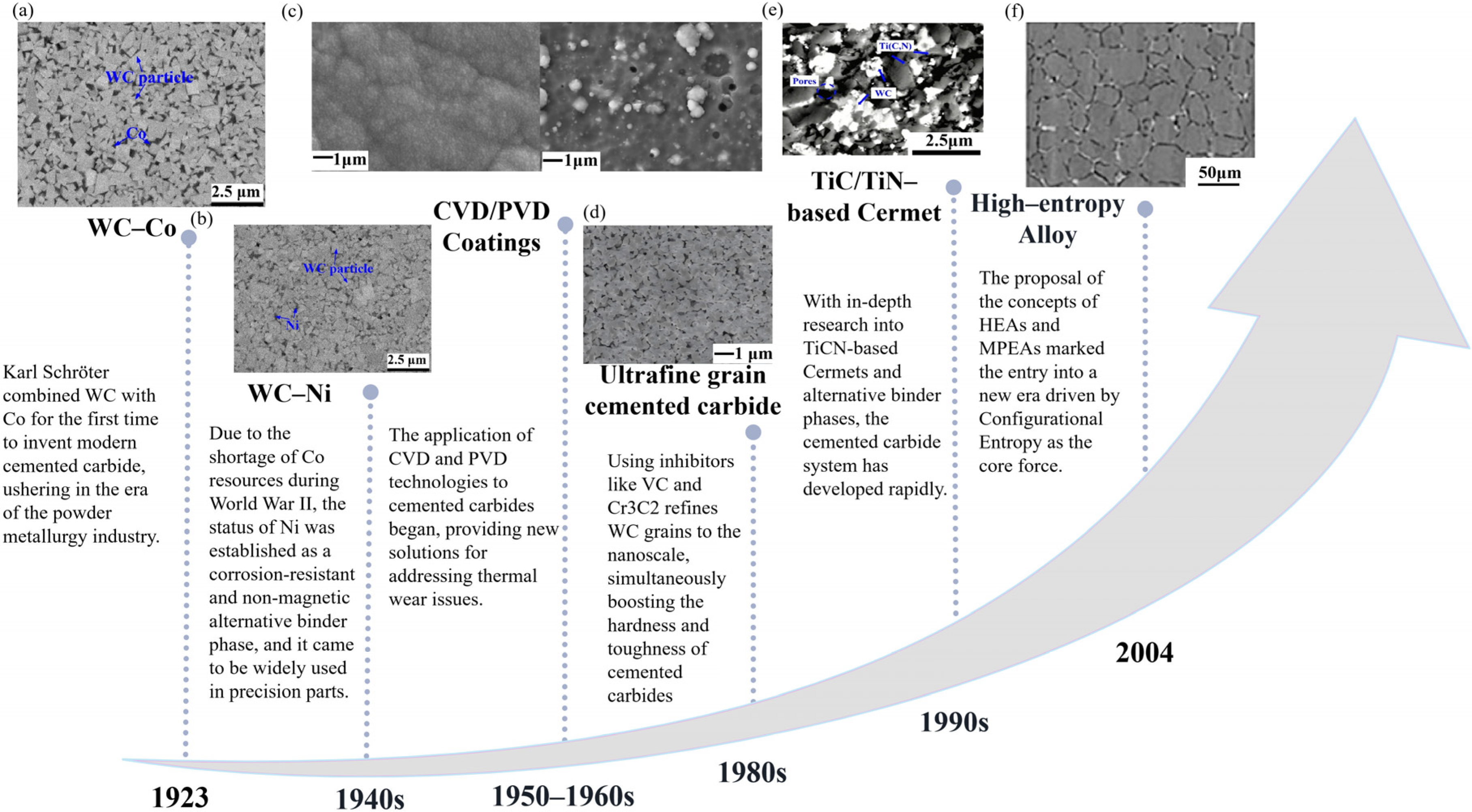
As illustrated in
Figure 3, the development history of cemented carbides reflects the response of material design to industrial demands: from the establishment of the early WC-Co binary system, to the introduction of Ni and Co-Cr binders in the mid-term to address corrosion issues, and to the modern emergence of ultrafine grains, surface coating technology, and High-Entropy Alloy (HEA) binders for extreme conditions. This evolution demonstrates a clear trend in capitalizing on overall performance optimization, shifting from solely pursuing hardness to balancing corrosion resistance and toughness to meet increasingly rigorous marine application demands.
As a typical representative of cemented carbides, the WC-Co system has been widely employed in industrial fields due to its excellent hardness-toughness balance and mature preparation processes. Nevertheless, its failure in extreme marine environments stems from the inherently high electrochemical activity of the Co binder phase in its microstructure [
41]. This section will delve into the tribocorrosion synergistic failure mechanisms of WC-Co in marine environments, and systematically review the research progress on improving its environmental adaptability through strategies such as microstructure optimization and binder phase modification.
Figure 3.
Key development timeline of WC hard alloy and representative microstructures: (
a) WC-Co cemented carbide; (
b) WC-Ni cemented carbide; (
c) CVD/PVD coatings; (
d) Ultrafine-grained cemented carbide; (
e) TiC/TiN-based cermet; (
f) High-entropy alloy [
42,
43,
44,
45,
46].
Figure 3.
Key development timeline of WC hard alloy and representative microstructures: (
a) WC-Co cemented carbide; (
b) WC-Ni cemented carbide; (
c) CVD/PVD coatings; (
d) Ultrafine-grained cemented carbide; (
e) TiC/TiN-based cermet; (
f) High-entropy alloy [
42,
43,
44,
45,
46].
3.1.1. Selective Dissolution of Cobalt Binder Phase and Induced Microstructural Degradation
The corrosion resistance of WC-Co cemented carbides deteriorates significantly in chloride-containing environments, with the materials exhibiting more negative corrosion potentials and higher corrosion current densities. This corrosion susceptibility stems from the preferential reactive dissolution of the Co binder phase in electrochemical reactions, leading to the exposure of WC phases and the formation of corrosion products such as WO
3 [
26]. The root cause of this failure lies in the electrochemical inhomogeneity of its two-phase structure. In conductive seawater media, the Co binder phase acts as the anode, while WC grains serve as the cathode; a microgalvanic couple forms between them to initiate corrosion, resulting in the gradual dissolution or leaching of Co from the WC-Co surface [
47]. This corrosion process does not proceed uniformly, but initiates at high-energy localized sites such as WC/Co phase boundaries and Co grain boundaries—defect locations where WC phase detachment occurs after the onset of corrosion. The presence of chloride ions not only stimulates reactivity and accelerates the dissolution rate of Co in the prepassivation potential region [
48] but also penetrates the weak passive film that may form on the cobalt surface, enabling the sustained progression of the dissolution reaction. As corrosion progresses, the continuous Co binder phase network is damaged, and its function of supporting and bonding WC grains is severely impaired [
49].
Subsequently, under the action of mechanical wear such as sliding or impact, the WC grains that have lost support are highly prone to loosening, pull-out, and spalling, resulting in severe abrasive wear and accelerated material failure. Scanning electron microscopy (SEM) analysis can usually clearly observe the concave morphology on the worn surface after selective dissolution of the Co phase, as well as the obvious protrusion and spalling pits of WC grains. This synergistic degradation failure mechanism, characterized by electrochemical corrosion preceding and mechanical wear exacerbating the damage, is the core reason for the sharp performance deterioration of WC-Co alloys in marine environments [
50,
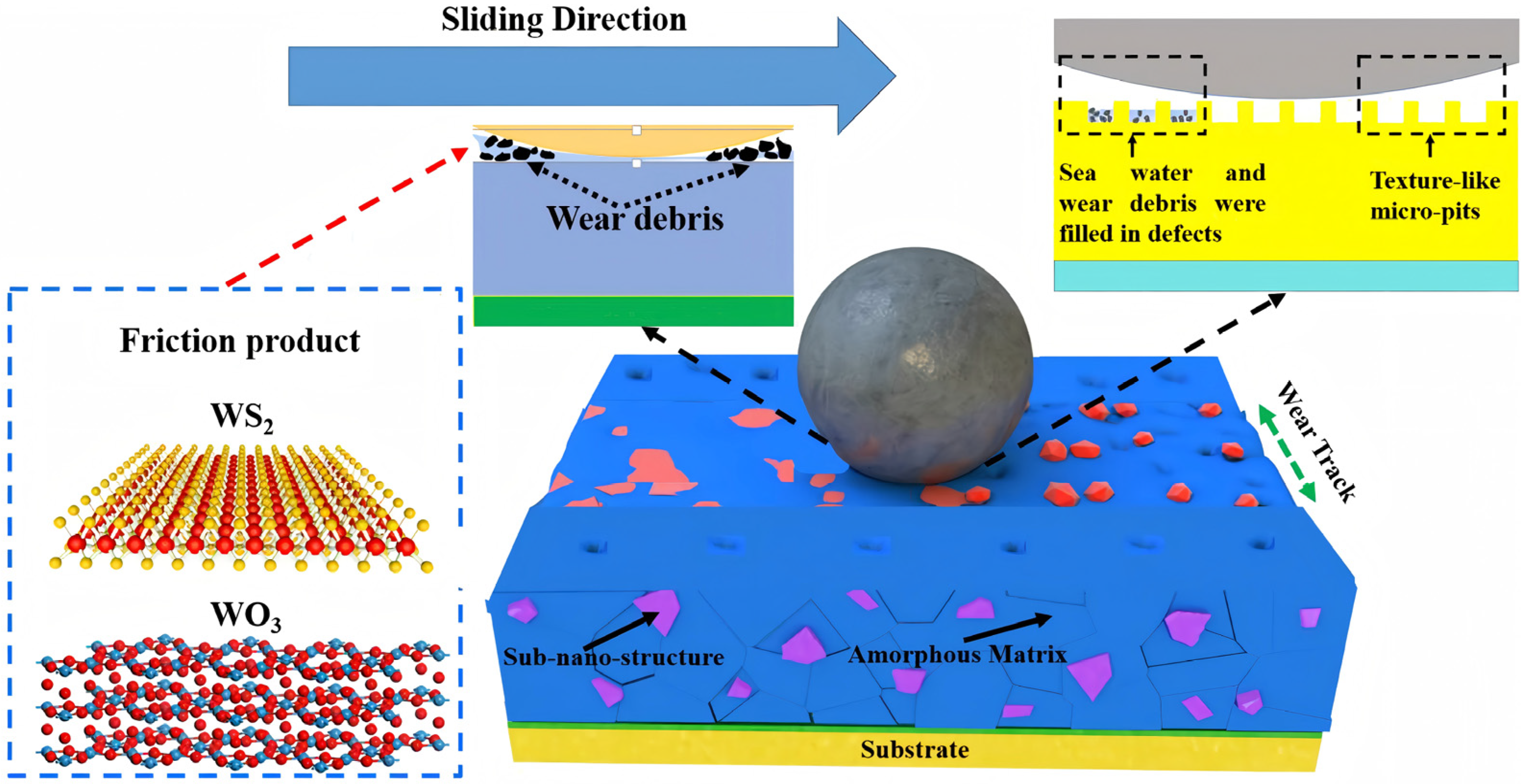
51]. The schematic diagram in
Figure 4 further explains the friction behavior in seawater. Between the corresponding counterpart, typically an amorphous carbon coating, and the WC film, the presence of seawater alters the interfacial chemical state, where physicochemical interactions at the micro-contact zone determine the evolution of the friction coefficient.
3.1.2. Inherent Contradiction Between Intrinsic Material Parameters and Environmental Tolerance
The mechanical properties of WC-Co alloys, such as hardness and fracture toughness, are strongly dependent on their microstructural parameters, especially WC grain size and Co content. According to the Hall-Petch relationship, reducing the WC grain size can effectively enhance the hardness of cemented carbides [
53]. Concurrently, Co content is another key factor in regulating toughness. Generally, within the range of 5.9–15.6 wt%, toughness generally increases with the rise in metallic Co phase content, whereas hardness decreases accordingly, indicating an inherent trade-off between hardness and toughness [
54]. From the perspective of corrosion resistance, however, these microstructural features that are beneficial to mechanical properties may exert negative effects. Finer WC grains imply a larger total area of phase boundaries, providing more channels for corrosive medium penetration. A higher Co content directly increases the volume fraction of the anode phase susceptible to corrosion. Studies have demonstrated that in static or flowing seawater, when the WC grain sizes are similar, WC-Co cemented carbides with lower Co content exhibit lower corrosion current densities compared with those with higher Co content, meaning the corrosion rate of WC-Co alloys increases with the increase in Co content [
55]. This profoundly reveals the inherent contradiction between “mechanical properties” and “environmental tolerance” within the WC-Co system in the context of marine applications. Consequently, the traditional material design principle, focused solely on high hardness and toughness, faces significant challenges in this regard. However, it is crucial to note that this limitation primarily applies to active binder systems like pure Co. When chemically stable binders such as Ni or Co-Cr are employed, the passivation capability of the binder phase itself can effectively mitigate the risk associated with the increased boundary area, allowing the mechanical benefits of grain refinement to be utilized.
3.1.3. Material Modification Strategies for Enhancing Marine Environmental Adaptability
Addressing the inherent trade-off between structural integrity and chemical stability in marine-grade WC-Co requires a multifaceted approach, primarily through the dual pathways of architectural microstructure refinement and binder phase metallurgy.
Precise modulation of sintering thermodynamics—specifically carbon potential and thermal cycles [
56]—facilitates a homogeneous phase distribution that effectively decouples mechanical load-bearing capacity from preferential corrosion pathways. Beyond simple homogeneity, functionally graded cemented carbides (FGCC) have emerged as a robust design paradigm. By engineering a surface layer with localized cobalt depletion or refined grain morphology, the material establishes a kinetic barrier that retards the inward flux of corrosive ions. Such graded composites, particularly those with a cobalt-rich yet cubic-phase-free surface, achieve a rare synergy: they preserve the high fracture toughness of the substrate while presenting a highly wear-resistant interface to the marine environment [
57].
Fundamental suppression of the binder’s electrochemical activity is achieved through strategic alloying. The introduction of noble or passivating elements like Ni and Mo significantly shifts the corrosion potential, enhancing the binder’s surface stability under electrochemical stress [
58,
59]. In high-performance WC cermet coatings, Cr enrichment of the binder phase proves particularly effective. This strategy leverages the repassivation kinetics of Chromium, which facilitates the rapid formation of a dense, self-healing oxide film in saline media. This high-impedance passive layer acts as a molecular-scale shield, effectively blocking chloride-mediated pitting and minimizing the selective dissolution of the binder domains [
60].
3.2. Corrosion Behavior and Performance Trade-Offs of Nickel-Based Binder Cemented Carbides
To address the failure of WC-Co systems caused by the selective dissolution of the binder phase in marine environments, the use of Ni and its alloys as alternative binder phases is regarded as a highly promising solution. Ni-based binder phases have attracted considerable attention due to their intrinsic passivation capability and superior resistance to chloride ions. This section focuses on reviewing the corrosion behavior, passive film characteristics, and mechanical performance of Ni-based binder cemented carbides in marine environments and conducting an in-depth analysis of the performance trade-offs and challenges they face in engineering applications.
3.2.1. Passivation Behavior and Corrosion Mechanism of Ni-Based Binder Phases
Transitioning from Co to Ni-based binder systems fundamentally alters the electrochemical interfacial dynamics in saline electrolytes [
23]. Compared to traditional WC-Co, Ni-bonded grades demonstrate enhanced thermodynamic stability in neutral to alkaline seawater, characterized by a significantly suppressed binder dissolution rate. This performance advantage stems from Ni’s lower intrinsic sensitivity to chloride-induced localized attack and its propensity for developing a resilient oxy-hydroxide passive film in oxygenated environments, which preserves the binder’s structural role in supporting the WC phase [
61]. The resultant reduction in exchange current density is reflected in elevated polarization charge transfer resistance, signifying a robust energetic barrier that hinders the oxidation reaction and slows charge transfer at the interface [
26].
The synergistic integration of Mo or Mo
2C further optimizes the passivation envelope by refining the surface electronic structure and improving overall wear resistance [
62]. Notably, Cr-enriched variants—WC-Ni-Cr—demonstrate a dramatic shift in corrosion potential (E
corr) and a reduction in corrosion current density (i
corr) by up to two orders of magnitude compared to traditional Co-bonded grades, effectively suppressing both generalized and pitting attack [
26]. Electrochemical Impedance Spectroscopy (EIS) and potentiodynamic polarization profiling corroborate this behavior, revealing a substantially expanded passive window and high-impedance characteristics indicative of a stable surface layer [
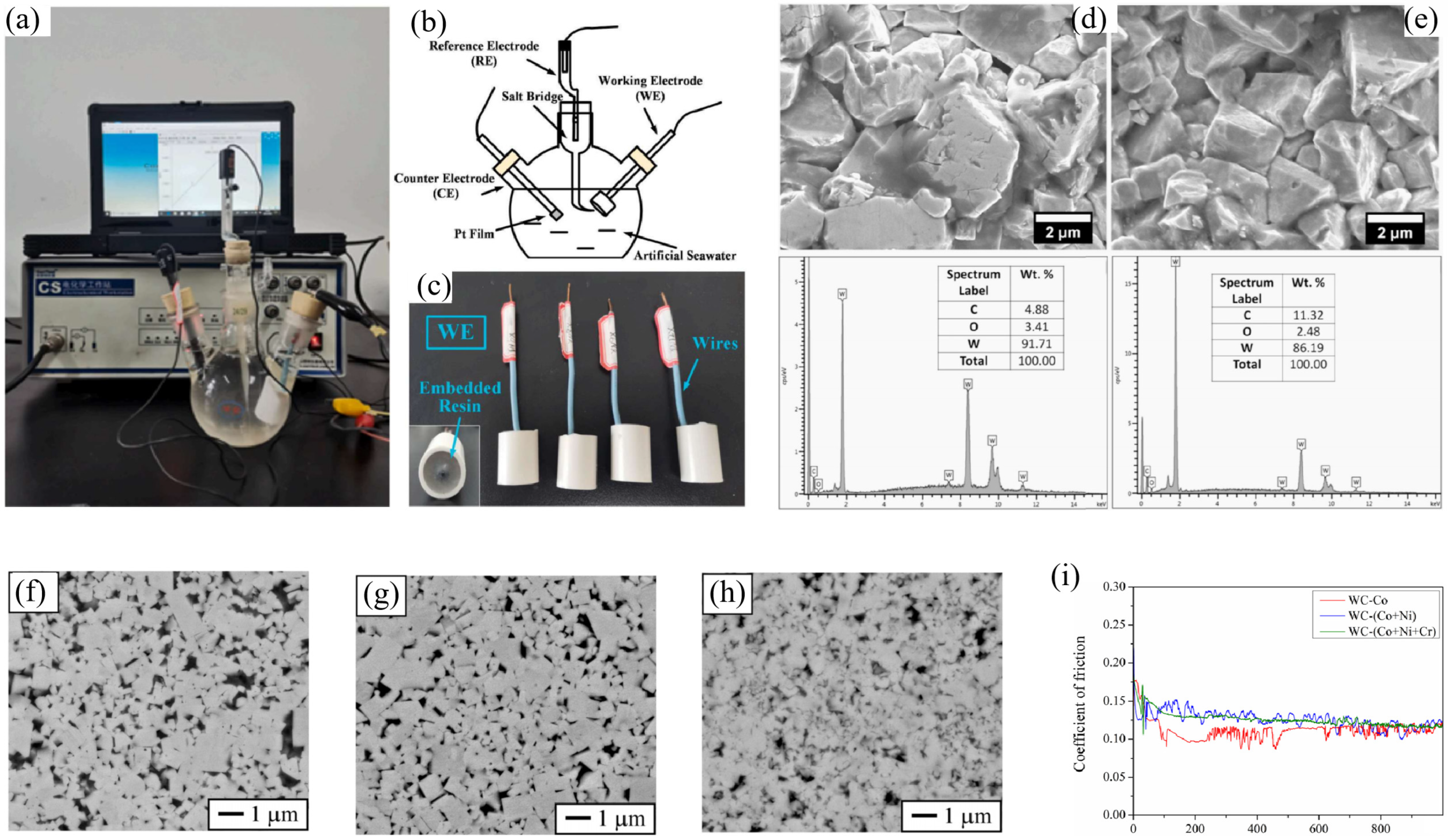
32]. To quantify this difference,
Figure 5a–c presents the electrochemical workstation setup used to compare the effects of different Ni/Co contents. The FE-SEM micrographs in
Figure 5d,e intuitively show typical microstructural morphologies after cyclic corrosion in 3.5% and 5% NaCl solutions, revealing severe binder loss on the WC-Co surface, whereas the WC-Ni surface remains relatively intact.
Figure 5f–i further compares the wear track morphologies and friction coefficient curves of WC-Co, WC-(Co+Ni), and WC-(Co+Ni+Cr) in alkaline wet media, confirming that the addition of Cr markedly reduces the friction coefficient and mitigates wear.
Nevertheless, the service life in marine environment bearings is governed by the dynamic equilibrium between mechanical depassivation and electrochemical repassivation. The instantaneous exposure of the reactive matrix upon asperity contact triggers a transient current surge; consequently, the repassivation kinetics—rather than static corrosion resistance—become the decisive metric for determining tribocorrosion resilience in harsh marine environments.
3.2.2. Retention and Optimization Strategies for Mechanical Properties
Replacing the binder phase from Co to Ni inevitably alters the material’s mechanical properties. Typically, compared with Co-bonded alloys with similar content, alloys with pure Ni binder phases have comparable or slightly lower hardness and transverse rupture strength, but their toughness is generally lower [
65]. This relative lack of toughness stems from the differences in the interfacial bonding energy between Ni and WC, as well as the work-hardening capacity of the Ni binder phase itself. To optimize mechanical properties, regulating WC grain size, morphology, and distribution via sintering process control and compositional adjustment, which inhibits the abnormal growth of WC grains and yields a uniform and fine-grained structure, thereby compensating for the impact of binder phase replacement on the overall toughness of the material. Based on the Ostwald ripening mechanism, incorporating a Ni-Fe composite binder phase into the system can reduce the solubility of W in the binder phase, decrease the dissolution and reprecipitation of fine WC grains, and significantly increase the volume fraction of fine WC grains [
66,
67,
68]. Meanwhile, Ni and Fe can reduce the interfacial energy between WC and the binder phase, inhibit the unbalanced growth of WC grains, promote the formation of near-spherical WC grains, and effectively maintain or even improve the overall hardness of the cemented carbide [
68]. On the other hand, a Co-Ni-Fe multi-component alloying design can be applied to the Ni-based binder phase. Adding an appropriate amount of Fe can partially participate in the composition of the binder phase; through the smaller interfacial spacing between Fe and W, the interaction at the WC-binder phase interface is enhanced, forming stronger covalent bonds and a more matched electronic structure [
69]. This not only improves the interfacial bonding energy but also enhances binder phase stability through solid solution strengthening [
66]. Through the precise regulation of composition and microstructure, the optimal balance between corrosion resistance, strength, and toughness can be achieved, leading to the design of WC-Ni-based alloys with superior performance.
3.2.3. Tribological Properties and Application Challenges in Marine Environments
Under seawater lubrication conditions, the tribological advantages of WC-Ni-based alloys, especially WC-Ni-Cr, are mainly attributed to their excellent corrosion resistance. Since the binder phase is not prone to selective dissolution, the material surface can maintain good integrity, avoiding the exacerbation of abrasive wear caused by the formation of corrosion pits and the loosening and detachment of WC grains [
70]. In long-term tribocorrosion tests, WC-Ni-based alloys generally exhibit more stable friction coefficients and lower wear rates than WC-Co-based alloys [
63]. Their wear mechanism is dominated by mild abrasive wear and oxidation, whereas pure Co-based cemented carbides are prone to rapid failure due to the tribocorrosion synergistic effect in marine environments.
Nevertheless, the application of WC-Ni-based alloys still faces challenges. Ni exhibits toxicity toward certain marine organisms, and its utilization in critical marine components may be restricted by increasingly stringent environmental regulations [
71]. Additionally, Ni-based cemented carbides have relatively low toughness, posing a risk of brittle fracture in scenarios subject to high impact loads or extreme contact stresses, such as the start-stop and variable load stages of thruster bearings. In addition, the sintering window and process control of Ni-based binder alloys are usually more sensitive than those of the mature WC-Co system, which imposes higher requirements on the control of preparation technology and increases the difficulty and cost of fabrication.
3.3. Emerging Binder Phases
To overcome the limitations of traditional WC-Co and WC-Ni systems in reconciling corrosion resistance with strength and toughness, the research frontier is actively exploring binder phases based on novel principles and developing multi-scale innovative design strategies. These efforts represent a paradigm shift in cemented carbide design, from fine-tuning compositions based on single elements toward actively leveraging multi-component synergistic effects and microstructural control to achieve targeted performance customization.
3.3.1. Multi-Principal-Element Synergistic Design of High-Entropy Alloy Binder Phases
Since the concept of high-entropy alloys (HEAs) or multi-principal-element alloys (MPEAs) was proposed by Yeh et al. in 2004 [
72,
73], these concepts have become the focus of new material research and attracted attention in the field of cemented carbides. The core objective is to replace traditional Co or Ni binder phases in cemented carbides with high-entropy alloys or multi-principal-element alloys. HEAs typically consist of four or more elements and possess unique thermodynamic high-entropy effects, kinetic sluggish diffusion effects, structural lattice distortion effects, and performance-related “cocktail effects” [
74]. These characteristics provide a brand-new mechanism for designing binder phases that simultaneously exhibit excellent mechanical properties and environmental tolerance. In marine environments, HEA binder phases can form denser and more stable passive films, and their corrosion resistance is significantly superior to that of traditional Co or Ni binder phases [
75]. Comprehensive evaluations of the microstructure, physical properties, and mechanical properties of cemented carbides have shown that novel cemented carbides with MPEAs as binders can achieve bending strength comparable to that of traditional alloys. For instance, MPEA binders such as the Co-Ni-Cu system have the potential to replace conventional cobalt metal binders [
76], offering a new approach to enhance the overall performance of cemented carbides. In marine environments, HEA binder phases can form denser and more stable passive films, and their corrosion resistance is significantly superior to that of traditional Co or Ni binder phases [
63]. Studies have confirmed that alloys or coatings using CoCrFeNi as binder phases exhibit the lowest corrosion current density (i
corr), which helps to improve the corrosion resistance of high-entropy alloy coatings. Additionally, their passivation behavior is more likely to occur, with passive films forming faster and demonstrating higher stability [
77]. This combination of properties endows them with broad application prospects in tribocorrosion environments.
To quantitatively evaluate the performance differences across generations of cemented carbides,
Table 1 summarizes key experimental comparisons between traditional WC-Co, corrosion-resistant WC-Ni/Cr, and novel WC-HEA systems in different wear and corrosion environments. This table highlights the evolutionary path from optimizing singular mechanical properties to achieving overall corrosion-wear resistance.
3.3.2. Outlook for Other Emerging Binder Phase Systems
Beyond high-entropy alloys, other emerging binder phase systems also demonstrate application potential. Intermetallic compound binder phases integrate the toughness of metals with the high-temperature oxidation resistance and corrosion resistance of ceramics, rendering them suitable for harsher working conditions. For example, iron aluminides exhibit higher wear resistance at elevated temperatures than Co or Ni aluminides, along with high melting points, relatively low wear rates and densities [
82]. Ahmadian et al. [
20] reported the beneficial effect of boron on hot-pressed WC/(FeAl-B) cermets, noticing that incorporating a small amount of boron into the FeAl binder phase improves the toughness of the composite by enhancing the toughness of the binder phase [
83].
On the other hand, the exploration of non-metallic binder phases such as Al
2O
3 and MgO remains in the initial stage. Nevertheless, they can theoretically completely avoid electrochemical corrosion, providing a new idea for fundamentally solving the corrosion problem [
32,
84]. These explorations beyond traditional metallic binder phases have greatly enriched the material systems of cemented carbides, indicating that future designs will be more diversified and functionalized.
At present, cemented carbide material systems provide diversified technical approaches, ranging from mature commercial applications to cutting-edge explorations for marine bearings. However, to meet the requirements of longer service life and higher reliability in future applications, it is still necessary to establish a more comprehensive performance database covering indicators such as long-term creep resistance and impact resistance. It is imperative to develop machine learning-based multi-objective optimization design methods to accelerate the screening of new compositions and structures suitable for specific complex working conditions. Equally essential, special material evaluation standards and specifications for extreme marine environments, such as high pressure and low temperature, should be formulated. These measures are essential to address the comprehensive challenges faced by emerging material systems in large-scale preparation, cost control, and environmental compatibility.
4. Tribological Behavior and Mechanism of Cemented Carbides Under Seawater Lubrication
The excellent intrinsic properties of cemented carbides provide the potential for their application in marine bearings. However, their actual service effectiveness and lifespan are ultimately determined by the dynamic behavior at the friction interface. In the unique marine environment characterized by coupled lubrication and corrosion, the interaction between mechanical wear and electrochemical corrosion at the interface becomes the dominant mechanism for material degradation. The resulting damage far exceeds the simple sum of individual factors. Therefore, gaining an in-depth understanding of the tribological principles of cemented carbides and the friction-corrosion coupling mechanisms under seawater lubrication constitutes the key theoretical foundation for achieving high performance and long service life.
4.1. Macroscopic Tribological Response Laws of Cemented Carbides Under Seawater Lubrication
The particularity of seawater as a lubricating medium, namely its low viscosity and poor film-forming ability, fundamentally reconstructs the contact mechanism and energy dissipation path of tribopairs. Having a viscosity significantly lower than that of oil, seawater finds it difficult to form an effective hydrodynamic lubricating film or a stable boundary lubricating film on friction surfaces. This readily induces direct contact between surface asperities of tribopairs, thereby accelerating wear [
85]. Concurrently, the macroscopic tribological behavior of various metals, alloys and polymer composites in seawater environments exhibits unique differences compared with those under oil lubrication [
86]. The tribological behavior in seawater strongly depends on the transformation of lubrication states dominated by working condition parameters such as velocity and load.
Under low-speed and high-load working conditions, the system tends to be in a boundary lubrication state, where the hydrodynamic lubrication support effect is negligible, and the external load is almost entirely borne by the direct contact of surface asperities [
87]. Research indicates that in tribological tests of WC cemented carbide sliding against Si
3N
4 balls under artificial seawater lubrication, a relatively high friction coefficient of approximately 0.12 is observed, accompanied by a significant wear rate [
52]. The dominant wear mechanisms are abrasive wear and local adhesive wear. Typical Stribeck curves show that with the increase in sliding speed or the decrease in load, the system can transition to a mixed lubrication state, where the proportion of fluid lubrication increases and the friction coefficient and wear rate show a downward trend. However, the boundary lubrication region under seawater lubrication is far wider than that under oil lubrication, while the velocity and load thresholds required to achieve hydrodynamic lubrication are significantly increased, which are often difficult to reach in actual bearing operating conditions [
88].
The transition of lubrication states and the corresponding tribological responses fundamentally depend on key operating parameters such as load and sliding velocity and their interaction with the properties of the seawater medium. The influence of these key parameters on tribological performance exhibits distinct regularity. As load increases, the contact stress borne by surface asperities rises significantly, which intensifies plastic deformation and energy dissipation, leading to a marked increase in contact damage and wear rate on the material surface [
85]. In contrast, sliding velocity exerts a dual effect: on one hand, increasing speed helps enhance the hydrodynamic pressure effect and promote the formation of lubricating films, thereby reducing friction [
89]. On the other hand, the frictional heat generated can accelerate interfacial electrochemical reactions and may alter the chemical environment of the local medium [
90]. This results in a non-monotonic relationship between wear rate and speed, and there may exist an optimal range where the comprehensive damage is minimized. The physicochemical properties of seawater, including temperature, pH value, and dissolved oxygen content, indirectly affect the tribological responses by regulating the corrosion kinetics of alloys and the viscosity of the medium [
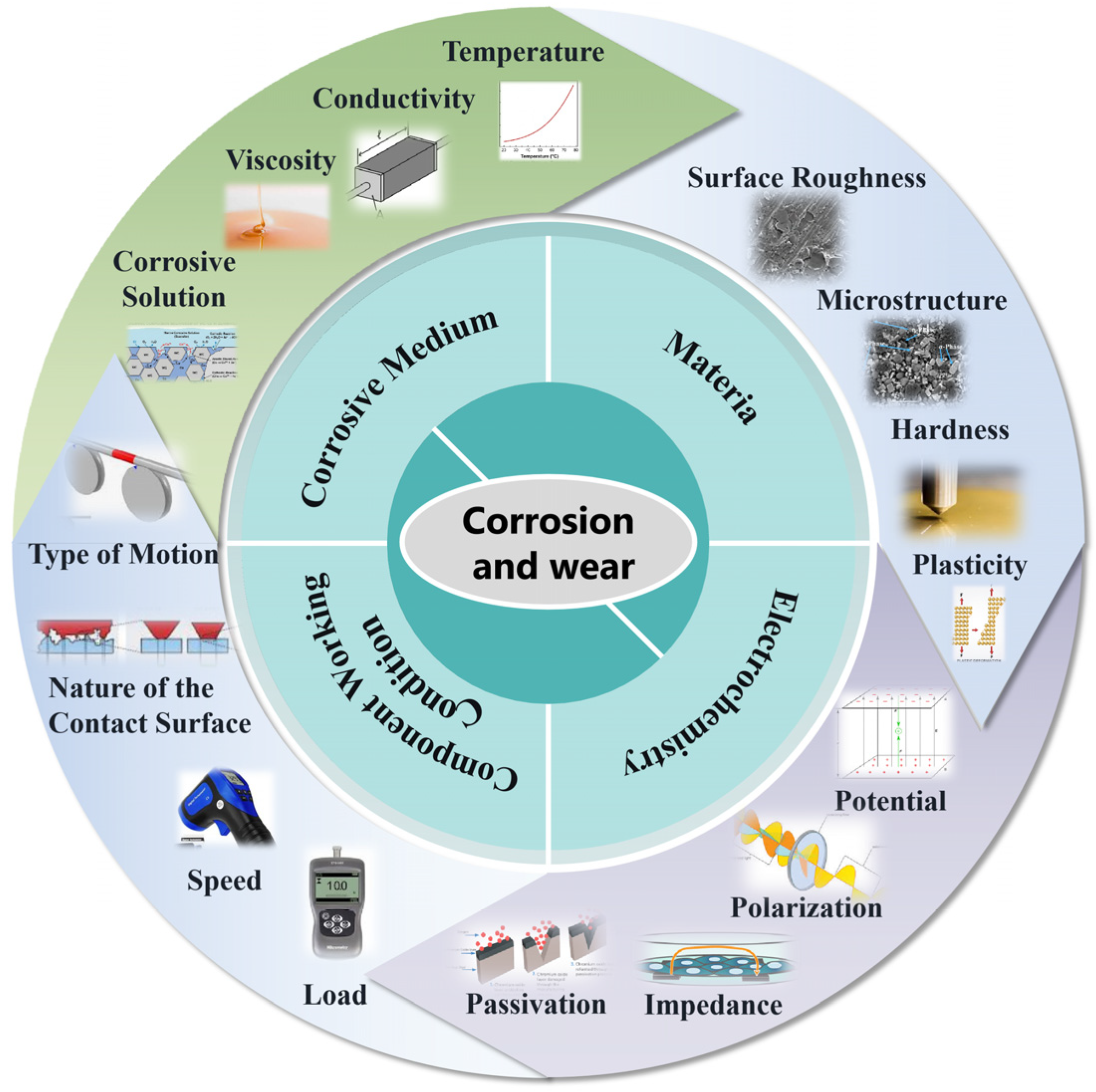
40]. Taking temperature as an example, increasing temperature not only accelerates the corrosion process but also reduces the viscosity of seawater. The competitive mechanism between these two factors complicates the final wear results. As summarized in
Figure 6, the main influencing factors of the tribocorrosion synergistic effect encompass four aspects: Corrosive Medium, Material, Electrochemistry, and Component Working. The interaction of these four factors jointly determines the degradation rate of the material.
Therefore, the macroscopic tribological behavior of cemented carbides under seawater lubrication essentially reflects the synergistic effect of various operating parameters under specific lubrication states. Precise mastery of these macroscopic laws is the foundation for in-depth research on microscopic friction-corrosion coupling mechanisms.
4.2. Tribocorrosion Synergistic Effect: Mechanism and Quantitative Analysis
The failure of cemented carbides in seawater environments is not a simple linear superposition of wear and corrosion but stems from their intense dynamic interaction at the interface, namely the tribocorrosion synergistic effect. This interaction constitutes a self-accelerating vicious cycle, which is the core mechanism leading to the sharp degradation of material properties [
91]. Cemented carbides typically consist of tungsten carbide-based hard ceramic phases surrounded by a metallic matrix, exhibiting excellent wear resistance. However, due to the coexistence of hard phases and soft phases in the material itself, different wear mechanisms are present, and crucially, microgalvanic cells tend to form in seawater environments, which reduces the overall tribocorrosion performance [
92]. Therefore, quantifying the tribocorrosion synergistic effect of cemented carbides is of great importance. Accurate quantitative characterization of its action paths and revelation of the underlying physical and chemical processes are the keys to predicting the service behavior and lifespan of components.
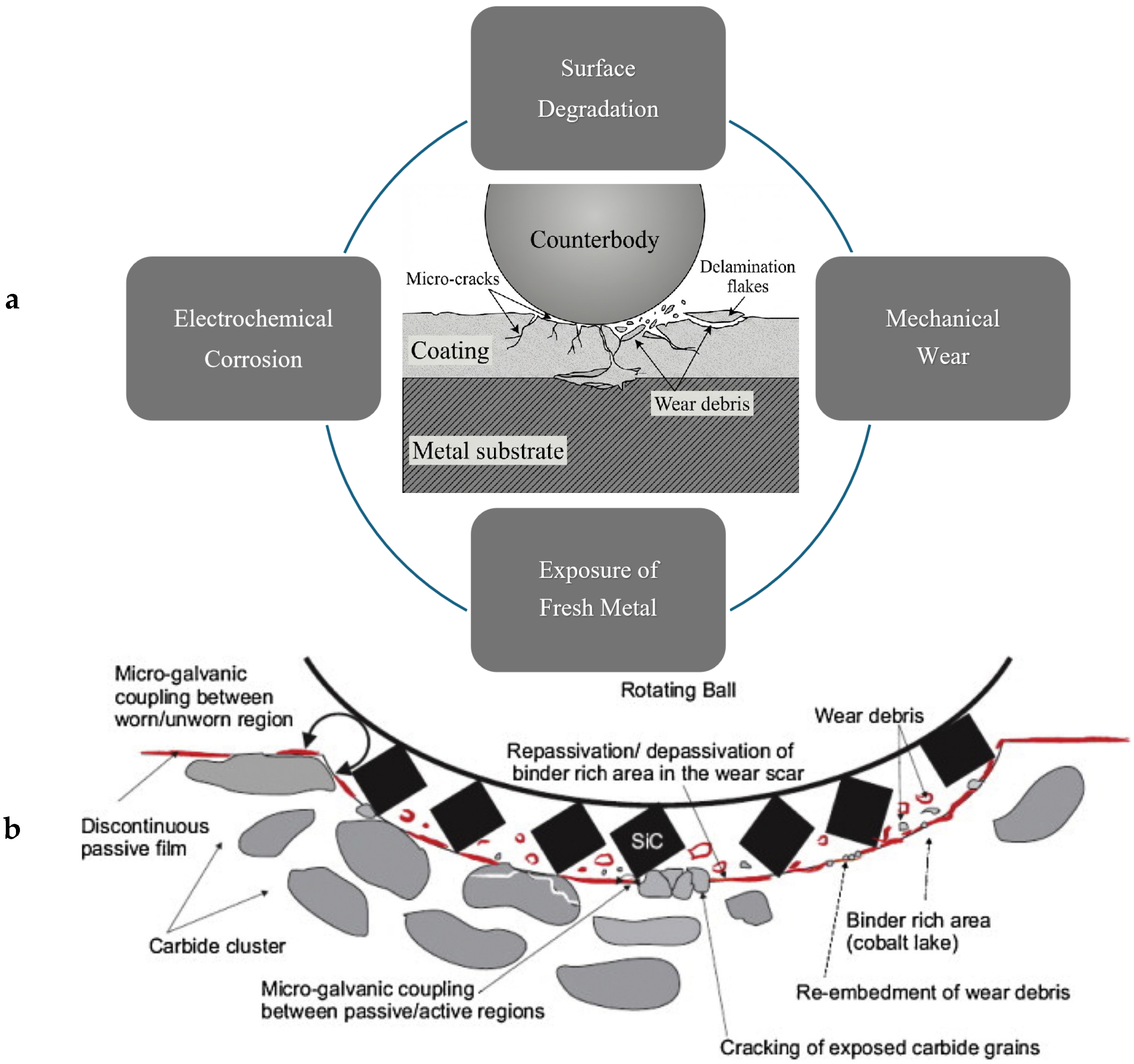
To better understand this core failure mode,
Figure 7 illustrates the fundamental mechanisms of tribocorrosion. As shown in
Figure 7a, the process involves a synergistic cycle of mechanical wear, fresh metal exposure, electrochemical corrosion, and surface degradation.
Figure 7b specifically details the micro-abrasion process in WC-10Co-4Cr coatings. The depassivation and repassivation occurring within the wear-scar is a complex process influenced by factors such as abrasive indentation size, applied load, abrasive concentration, and pH.
Figure 7b depicts the three-body indentation in the binder-rich region, where multiple indentations by abrasive particles result in passive film rupture along with abrasive wear of the binder phase, generating wear debris composed of oxide particles and abrasive fragments. Consequently, the removal of the passive film on binder-rich areas exposes the underlying fresh surface to the abrasive slurry.
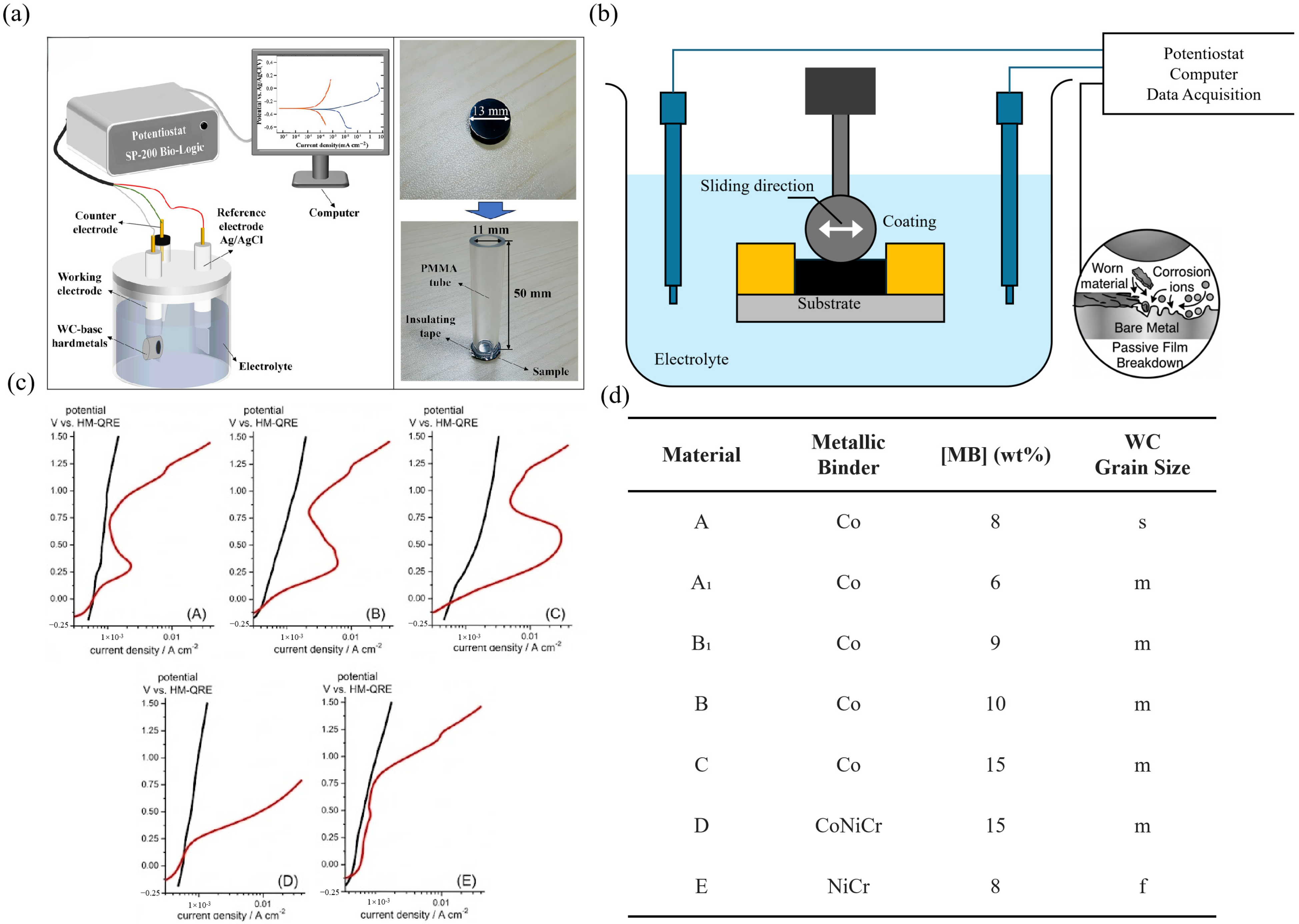
To accurately capture the dynamic coupling process of wear and corrosion, it is necessary to resort to in situ triboelectrochemical measurement techniques such as synchronous monitoring of open-circuit potential (OCP). By integrating an electrochemical test system into a friction tester, this technology can real-time reveal the equilibrium relationship between the depassivation induced by sliding wear and the reverse repassivation reaction that inhibits material dissolution under controlled potential [
33]. Correspondingly,
Figure 8 depicts the experimental setup and electrochemical characterization results designed to quantify these effects.
Figure 8a,b shows the standard electrochemical workstation and tribocorrosion apparatus used for simulating marine environments. The Linear Sweep Voltammetry (LSV) curves in
Figure 8c provide a quantitative ranking of corrosion resistance for different binder chemistries labeled as Materials A through E in tap water versus 0.6 M NaCl solution. As anticipated, the presence of chloride ions significantly increases anodic currents. The pure Co binder grades, exemplified by Sample C, exhibit the least noble Open Circuit Potential (OCP) and high corrosion current densities exceeding 1 mAcm
−2, indicating poor resistance. In contrast, the Cr-doped Ni-based binder, specifically Sample E, demonstrates superior performance, maintaining pseudopassivation under OCP conditions even in the presence of chlorides. The overall corrosion resistance ranking revealed by these curves is E > A > B > C > D, confirming the critical role of binder composition, particularly Ni and Cr doping, in enhancing environmental tolerance [
93]. On this basis, the total material loss (T) can be decomposed into pure mechanical wear loss (W), pure corrosion loss (C), and the synergistic increment (S) between the two, namely T = W + C + S, thus realizing the quantitative separation and evaluation of the synergistic effect [
94].
The acceleration of corrosion by mechanical wear is the primary manifestation of the synergistic effect. Friction mechanically removes the surface passive film or corrosion product layer, continuously exposing the underlying highly reactive fresh metal surface to the electrolyte, which causes the anodic dissolution current to increase sharply by several orders of magnitude instantaneously [
95]. This dynamic cycle of mechanical removal-exposure-chemical dissolution hinders the formation of an effective protective layer, keeping the material surface in a state of activated dissolution at all times [
51]. Concurrently, the exacerbation of wear by corrosion forms a feedback loop. In seawater environments, preferential material dissolution, especially the binder phase, leads to the formation of corrosion pits, interfacial weakening, or micro-roughening on the surface. These defects act as stress concentration sites, which significantly promote crack initiation, grain pull-out, and material spalling under mechanical loads [
84].
Therefore, tribocorrosion synergy is a dynamic coupling process involving mechanics, electrochemistry, and materials science. Its intensity is sensitively dependent on the inherent corrosion resistance and wear resistance of the cemented carbide binder phase material itself, environmental electrochemical parameters, and external mechanical load conditions. Beyond its corrosivity, seawater can interact with various materials such as polymers, ceramics, metals, and metal alloys, which further complicates the relevant processes [
96,
97].
4.3. The Regulatory Mechanisms of Material Properties and Surface Engineering on Tribocorrosion Behavior
Effectively mitigating the tribocorrosion synergistic effect hinges on active intervention in the interfacial processes. The tribological response of cemented carbides in seawater environments is not only governed by external operating conditions but also profoundly influenced by their inherent material characteristics and artificially applied surface engineering strategies, which provide the possibility of regulating interfacial behaviors at different scales.
As previously discussed, the chemical properties and microstructure of the binder phase are the intrinsic factors modulating its tribocorrosion behavior. The fundamental advantage of shifting from the traditional metallic cobalt binder phase to corrosion-resistant Ni and Ni-based alloys, or high-entropy alloy (HEA) binder phases, lies in the enhanced repassivation capability of the binder phase under mechanical disturbance and its overall chemical stability. By clarifying the synergistic effects of electrochemical and mechanical damage between Co-based and Ni-based cemented carbides under identical tribocorrosive conditions, comparative studies clearly reveal that NiCr binder phases can more rapidly repair the passive films damaged by wear, thereby significantly reducing the wear component exacerbated by corrosion [
23]. For the emerging HEA binder phases, their unique lattice distortion effects and sluggish diffusion characteristics affect the degree of interaction between HEAs and WC [
98]. This prevents the formation of harmful carbide phases or promotes the generation of special complex carbide phases, which in turn improve the performance of cemented carbides [
99]. As a result, HEA binders exhibit unique potential to maintain interfacial integrity under extreme mechanical-chemical coupling conditions.
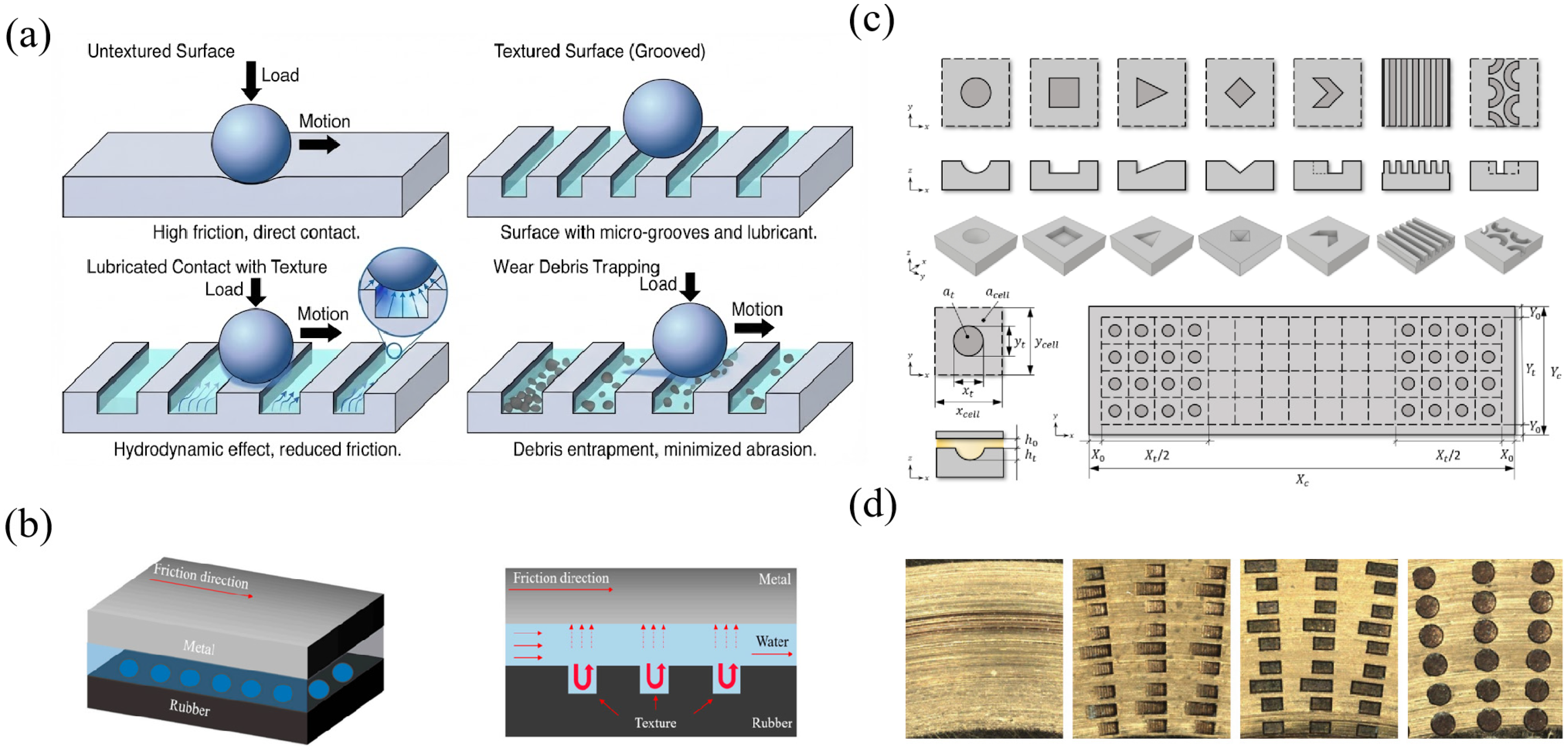
Beyond bulk material optimization, surface texturing technology serves as an effective approach to improve interfacial lubrication conditions and mitigate direct contact. Fabricating regularly distributed micro-scale dimples or grooves on friction pair surfaces primarily functions through three mechanisms: (1) Abrasive Debris Trapping Effect: Capturing wear debris to prevent three-body abrasive wear [
100]. (2) Lubricant Reservoir Effect: Under mixed to boundary lubrication conditions, surface textures can act as lubricant reservoirs, continuously supplying lubricant to the sliding interface [
101,
102]. (3) Micro-Hydrodynamic Bearing Effect: Under hydrodynamic lubrication conditions, surface textures function as micro-hydrodynamic bearings, enhancing dynamic fluid pressure and thereby increasing overall load-carrying capacity [
103]. The schematic diagrams in
Figure 9a,b intuitively explain the lubrication and debris-trapping functions of surface textures: micro-dimples generate a micro-bearing effect under hydrodynamic pressure while accommodating abrasive particles to reduce three-body wear. As depicted in
Figure 9c,d, typical geometric shapes, exemplified by circular and grooved patterns, and their distribution parameter definitions are displayed. The optimization of these geometric parameters is crucial for achieving the optimal friction reduction effect.
Notably, surface modification coating technology enables the direct creation of a functional interfacial layer on the substrate surface, thereby achieving a leap-forward improvement in performance. Depositing protective coatings such as diamond-like carbon (DLC) coatings or corrosion-resistant ceramic coatings can form an ultra-thin yet functionally distinct protective layer on the surface of cemented carbides [
106]. For instance, tetrahedral amorphous carbon coatings with a high sp
3 bond content can not only achieve a low-friction state via their low shear strength, but also fundamentally block the electrochemical corrosion pathway of the substrate due to their excellent chemical inertness [
107]. Coatings designed with gradient or multilayer structures can effectively coordinate the mechanical property matching between the coating and the substrate, enhance the bonding strength and load impact resistance, and ensure the long-term effectiveness of the protective function [
108].
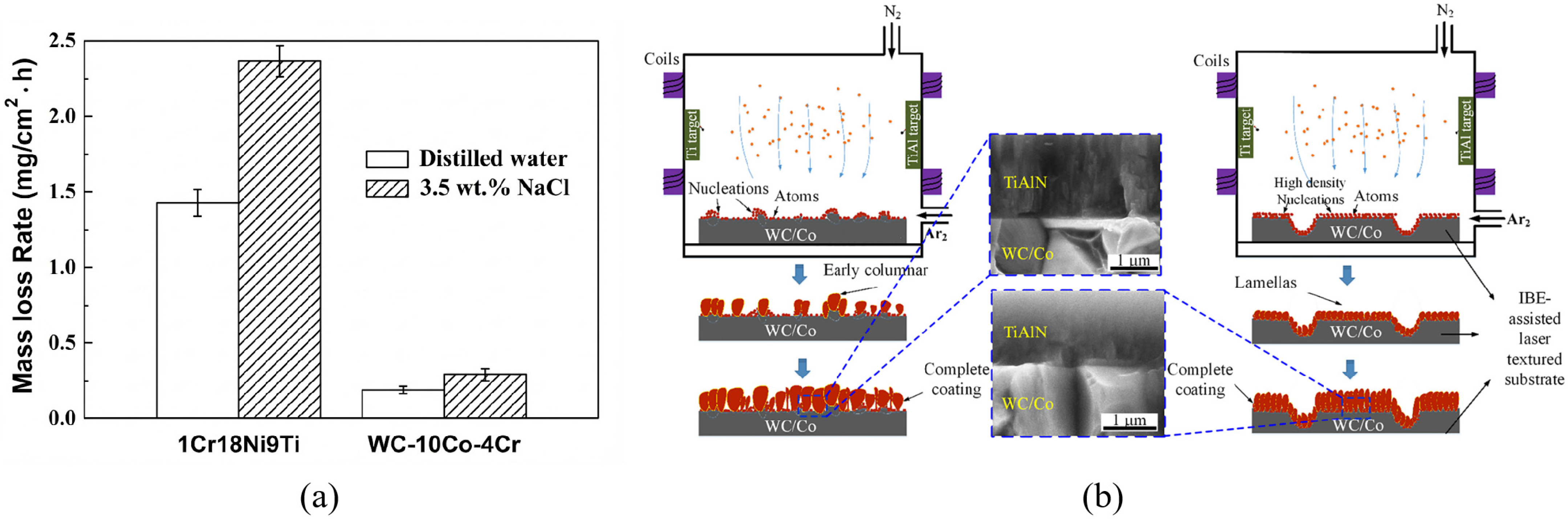
Figure 10a highlights the superior corrosion resistance of the HVOF-sprayed WC-10Co-4Cr coating compared to 1Cr18Ni9Ti stainless steel in simulated seawater by comparing mass loss rates.
Figure 10b further illustrates the deposition mechanism model of TiAlN hard alloy coatings on polished versus laser-textured substrates, demonstrating the substantial influence of substrate pretreatment on coating adhesion and growth modes.
In summary, a multi-dimensional strategy system for controlling tribocorrosion has been established. This is achieved by designing novel binder phases to innovate the material system, creating surface textures to modify surface topography, and optimizing functional coatings to reconstitute the interfacial chemical state. This approach spans from the macro to the micro scale and shifts from passive adaptation to active design. It provides multi-layered technical support for enhancing the service reliability of marine bearing components in harsh environments.
5. Reliability Design and Engineering Applications of Cemented Carbide Bearings
The inherent strong tribocorrosion coupling effect in extreme marine environments renders the failure of cemented carbide bearings a complex system degradation process driven by multi-field synergy [
111]. Based on the previous analysis of material systems, tribological behaviors and environmental challenges, this section focuses on the application status, design considerations, selection strategies, as well as typical application cases. By integrating the latest research progress, this study aims to provide theoretical guidance and practical reference for constructing high-reliability and long-life marine bearing solutions, ensuring their long-term stable operation under harsh conditions such as electrochemical corrosion, insufficient lubrication and high-pressure alternating loads.
5.1. Application Status of Cemented Carbide Bearings in Marine Environments
The development of cemented carbide bearings in marine application fields such as ships, offshore platforms, and underwater equipment has demonstrated remarkable advantages in performance, reliability and adaptability, by integrating the latest research achievements in materials science and tribology.
Cemented carbide bearings, primarily based on WC-Co and WC-Ni materials, have been widely applied in marine propulsion shafting, deep-sea drilling equipment, underwater robotic systems, and marine journal bearing pump and valve systems [
112,
113]. Their application forms include integral sintered components, wear-resistant coatings and thermal spray repair layers. For instance, in the water-lubricated thrust bearings of ship rim-driven thrusters (RDT), WC-Co or WC-Co-Cr coatings deposited by high-velocity oxygen fuel (HVOF) spraying can form high-performance tribopairs with mating materials [
112]. Hybrid tribopairs composed of WC-Co coatings, as well as WC and WB thermal spray coatings, significantly enhance the surface hardness and wear resistance under seawater lubrication conditions, effectively elevating the performance level of water-lubricated tribosystems [
80]. Research indicates that the wear rate and friction coefficient of such coatings in simulated seawater environments are significantly lower than those of many traditional metallic materials. Similarly, the WC-10Co-4Cr coating prepared by HVOF spraying technology has been applied to seawater pipeline components of offshore platforms. Its mass loss rate under simulated seawater conditions is only 12% of that of 1Cr18Ni9Ti stainless steel, exhibiting excellent erosion-corrosion resistance in dynamic ocean current environments [
109].
The advantages of cemented carbide bearings are mainly reflected in their ability to effectively cope with the tribocorrosion synergistic effect under seawater lubrication [
23]. Compared with traditional steel bearings, their service life is extended by 2 to 5 times. Especially in conditions of insufficient hydrodynamic lubrication and static pressure environments, the application of nanotechnology and additive manufacturing technology has significantly improved the mechanical properties and environmental adaptability of bearing materials [
114]. Meanwhile, surface texturing and coating technologies can optimize the low-friction response and self-lubricating performance of the bearings [
115]. Studies have shown that compared with non-textured samples, herringbone textures with a certain texture density help reduce the friction on the surface of YT15 cemented carbide, with the minimum friction coefficient reaching approximately 0.02 [
116]. In a 3.5 wt% NaCl solution simulating a marine environment, HVOF-sprayed WC-10Co-4Cr coatings exhibit higher microhardness and lower wear rates due to their dense microstructure and porosity sealing by oxide layers [
109]. However, in the wear test between WC-Co cemented carbide rings containing 8% Co and bearing counterparts, the corrosiveness of underwater conditions accelerates the spalling of hard carbide particles on the surface and increases the surface roughness.
Despite the distinct advantages, the large-scale application of cemented carbide bearings in marine engineering still faces multiple challenges. Due to high costs and complex manufacturing processes, the market share of cemented carbide bearings in global marine engineering remains limited at present, primarily concentrated in areas such as naval equipment and high-end marine energy development [
117,
118]. Secondly, the degradation mechanism of cemented carbides during long-term service in corrosive media is sophisticated. The corrosive effect of media such as seawater transforms the material’s microstructure from an effective bulk ceramic-metal composite into a porous WC skeleton layer. Under cyclic mechanical loads, this structural transformation tends to induce grain detachment and crack propagation, thereby exacerbating wear [
119]. Further compounding these challenges, particle agglomeration is prone to cause stress concentration; long-term immersion in seawater leads to three-body abrasion; and load fluctuations will accelerate fatigue failure [
86]. Environmental sustainability is also a crucial consideration. The resource supply risks associated with traditional cobalt-based materials and the potential ecological toxicity of cemented carbide coatings are driving the development of cobalt-free or low-toxicity binder phase materials [
120]. Meanwhile, when technologies such as additive manufacturing are applied to fabricate complex load-bearing marine components, it is still necessary to address key issues, including porosity defect control, residual stress elimination and interlayer bonding strength improvement, so as to ensure the long-term reliable large-scale application in marine engineering [
121].
Future development trends will focus on advanced composite materials and intelligent coatings. This includes enhancing corrosion resistance by introducing novel multi-component alloys or high-entropy alloys, developing hybrid technologies that combine smart coatings with surface texture to dynamically adapt to changing operating conditions, and utilizing machine learning methods to integrate material data and service conditions. The aim is to construct tribocorrosion performance maps for rapid material screening and intelligent lifetime prediction. While improving performance and reliability, emphasis will also be placed on balancing environmental friendliness and economic feasibility. The development of alternative materials, such as Ni-based and Co-free binders, is accelerating to enable reliable applications in a broader range of marine engineering fields.
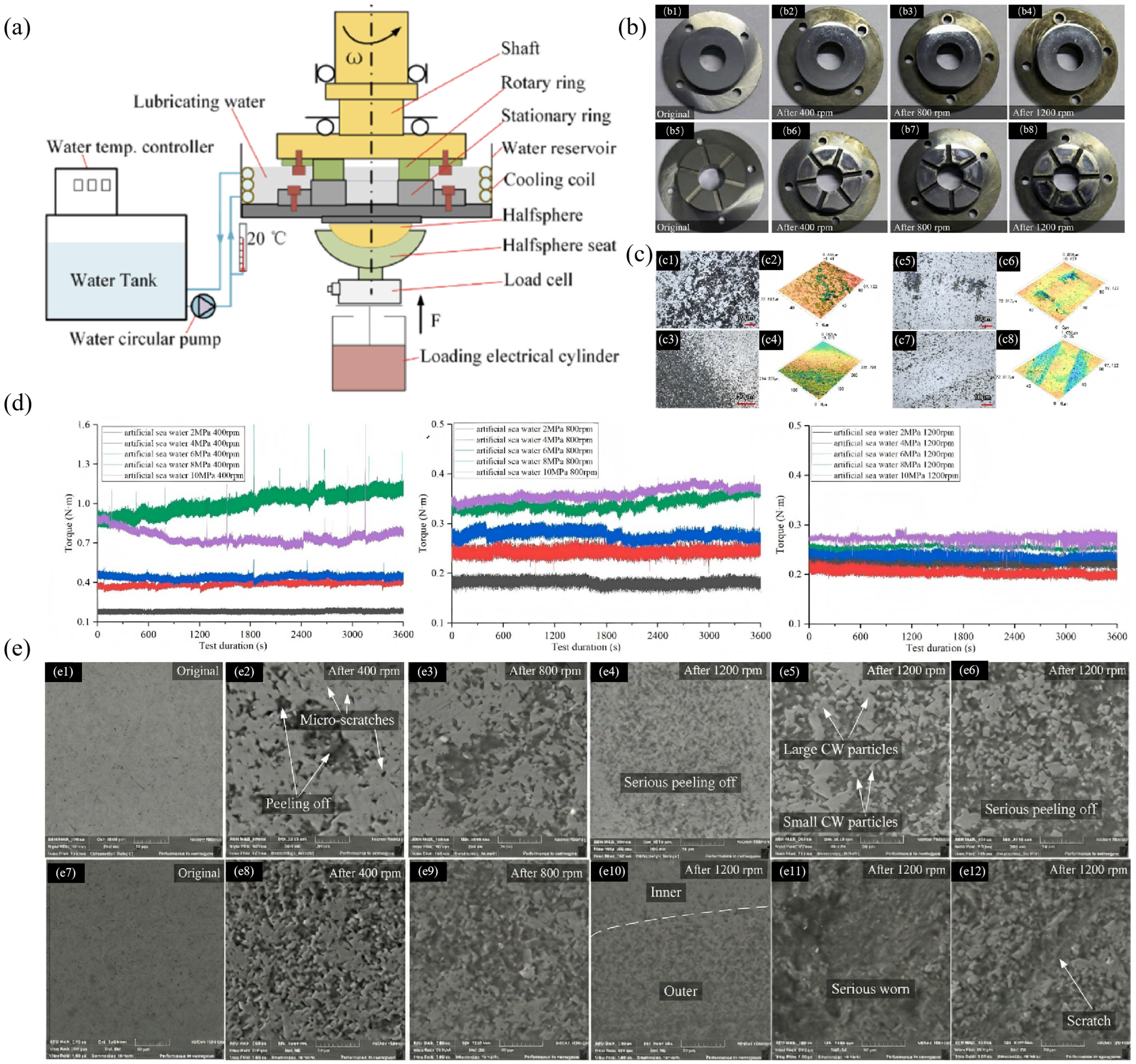
Figure 11 presents a typical engineering test case. Cemented carbide specimens with 8% Co mass fraction were tested using the ring-block tribo-tester shown in
Figure 11a.
Figure 11b–e record the variations in friction torque and worn surface morphologies at different rotational speeds. The laser confocal microscopy images in
Figure 11e clearly reveal the intensified surface damage characteristics at high rotational speeds, providing a direct basis for evaluating material reliability under actual operating conditions.
5.2. Reliability Design Principles
The reliability design of cemented carbide bearings must adhere to a multi-dimensional systematic principle ranging from load analysis to lubrication optimization, so as to address the challenges posed by the synergistic effects of corrosion, wear, and mechanical stress in marine environments. Its core lies in ensuring stability and durability under extreme conditions through full-life-cycle management. This encompasses the initial load spectrum analysis and failure mode and effects analysis, as well as micro-structure design based on fatigue resistance, lubrication system optimization, thermal management strategies, and ultimately design verification and service life prediction. These principles aim to actively prevent failures rather than merely provide post-failure responses. The development of lifetime prediction models is evolving from a reliance on macroscopic empirical correlations towards approaches based on microscopic physical mechanisms and data-driven inference.
Traditional numerical wear models, such as the classic Archard wear model and three-body abrasive wear model, are mostly empirical or semi-empirical models, which calculate wear volume based on the friction coefficient, nominal contact force, and sliding distance. However, these models exhibit limited universality under complex seawater lubrication conditions and cannot fully incorporate practical influencing factors, such as the geometric characteristics and types of abrasive particles, the coupling effect of environmental temperature and sliding speed, material transfer behavior, and the synergistic tribocorrosion mechanism [
13]. Therefore, their prediction results typically require combining with a large amount of experimental data.
Physically based prediction models achieve more universal and accurate predictions by describing specific physical failure processes, coupling the kinetics of mechanical wear and electrochemical corrosion, and quantifying the synergistic effects. Their core paradigm is usually expressed as the total material degradation rate being equal to the sum of the pure mechanical wear rate, pure corrosion rate, and their synergistic increment: Total Material Loss Rate = Pure Wear Rate + Pure Corrosion Rate + Synergistic Increment [
123]. Cutting-edge models further incorporate micro-structural variables to simulate the selective dissolution kinetics of the binder phase, the consequent weakening of WC grain support, and the subsequent grain detachment process. By coupling mechanical wear and electrochemical corrosion kinetics and integrating bench test data, these models construct a cross-scale lifetime prediction framework.
With the proliferation of condition monitoring technologies, data-driven intelligent prediction methods have emerged as a prominent research approach. Machine learning algorithms, such as deep learning networks, are employed to mine the complex nonlinear mapping relationships between operational data and the remaining service life of cemented carbide bearings [
124,
125,
126]. Their strength lies in not relying on complete prior knowledge of complex physical mechanisms but rather on high-quality, large-scale datasets. These methods possess the potential for autonomous learning and evolution from historical data, enabling accurate early warning of failures [
126]. The future development trend lies in integrating the interpretability of mechanism-based models with the adaptability of data-driven models, developing physics-informed machine learning models, and thereby establishing a more accurate, robust and engineering-practical service life prediction system for cemented carbide bearings.
5.3. Selection and Recommendation Strategy for Cemented Carbide Bearings
To ensure the reliability of cemented carbide bearings in harsh marine environments, this section proposes a comprehensive selection framework. Based on environmental adaptability, performance indicators and sustainability, this framework integrates material strengthening technologies, advanced testing protocols and life cycle assessment, while taking core factors such as seawater corrosion, hydrostatic pressure and long-term durability into consideration. It provides quantitative recommendations and scientific decision support for specific marine applications.
In the applications of stern tube bearings and mechanical seal rings of marine propellers, materials are immersed in high-salinity seawater for long periods, and subjected to mixed lubrication during start-stop phases as well as abrasive wear induced by sediment particle intrusion. In such environments, traditional WC-Co cemented carbides face severe tribocorrosion synergistic challenges. Specifically, the cobalt binder, acting as the anode phase, undergoes preferential electrochemical dissolution, which causes the tungsten carbide hard phase to lose support and spall off, thereby accelerating the infiltration of corrosive media into the material interior. The core of the selection strategy for this scenario thus lies in completely inhibiting the active dissolution of the binder to enhance resistance to seawater and salt spray, while balancing hardness and toughness to alleviate pitting corrosion and electrochemical corrosion under dynamic loads. Comparative experiments confirm that WC-Ni cemented carbides or WC-Ni-Cr series cemented carbides are more optimal choices. They exhibit more stable passivation behavior in NaCl solutions, with corrosion resistance significantly superior to that of WC-Co, and also feature lower volume wear rates in sediment-containing seawater. It is further recommended to adopt submicron grains to resist micro-cutting by sediment particles, and the use of pure cobalt binders on surfaces in direct contact with seawater is strictly prohibited [
78,
127,
128,
129].
For downhole motors in offshore platforms and subsea booster pump bearings, the service environment typically involves high-solid-content drilling fluids or multiphase flow. The materials are required to withstand high contact stress and resist the erosion caused by hard particles carried in high-speed fluids. In the selection process, the focus should be placed on micro-structure regulation, i.e., coordinating grain size and binder content to optimize performance. Research confirms that using medium-to-coarse grains in the range of 2–4 μm and appropriately increasing binder content within the empirical range of 10–15 wt% can significantly enhance fracture toughness while maintaining erosion resistance, thus effectively inhibiting spalling induced by impact fatigue. Simply increasing hardness will lead to higher brittleness of the material, making it prone to micro-crack propagation under impact loads [
79,
130,
131,
132,
133]. Consequently, for applications without direct seawater contact, high-toughness, medium-coarse grained WC-Co grades can be selected. If there is a risk of seawater contact, WC-Ni grades with similar microstructures should be adopted instead. In the selection process, special attention should be paid to the impact wear resistance and fatigue performance of the materials.
In precision applications such as joints of underwater manipulators, bearings usually operate under water-lubricated conditions. However, the low viscosity of water makes it difficult to form a hydrodynamic lubricating film, which often results in the bearings operating in boundary or mixed lubrication regimes. Therefore, in the selection of cemented carbides, priority should be given to grades with low thermal expansion coefficients and high precision to reduce friction coefficients and inhibit adhesive wear. Experiments have shown that ultra-fine grained WC-Ni cemented carbides with grain sizes less than 0.8 μm can form more stable tribochemical reaction films in aqueous media. Combined with ultrahigh surface finish, these carbides significantly reduce the starting friction torque and mitigate the wear of mating components [
134,
135]. Consequently, a strategic trade-off is required: Although finer grains theoretically increase the phase boundary area exposed to corrosion, a mechanism discussed in
Section 3.1.2, the priority for precision mechatronic components is maintaining high dimensional accuracy and low surface roughness. By pairing ultra-fine grains with a corrosion-resistant Ni binder to suppress boundary dissolution, the material achieves a balance where wear resistance is maximized while corrosion is kept under control. Accordingly, for such precision, low-load, water-lubricated conditions, it is recommended to select ultra-fine-grained WC-Ni grades, emphasizing nano-scale surface polishing and surface coating reinforcement treatments to optimize the tribological behavior. Hydrostatic testing and molecular dynamics simulations should be employed to ensure the long-term performance reliability during deep-water operations [
136,
137].
Bearings applied in tidal and wave energy power generation equipment are usually located in deep-sea areas that are difficult to access for maintenance. Their operating conditions involve high-frequency small-amplitude reciprocating motion, which can easily induce fretting wear and tribocorrosion. This synergistic damage will accelerate the volume loss of materials. To meet the demand for maintenance-free lifespans exceeding 20 years in such applications, the selection strategy must be based on tribocorrosion performance mapping. Research indicates that modified cemented carbides with Cr
3C
2 or VC added as grain growth inhibitors can resist fretting corrosion synergy by forming a dense oxide passive film [
138,
139,
140]. Based on fretting-corrosion resistance mapping, it is recommended to select special cemented carbides alloyed with corrosion-resistant elements like chromium or vanadium to maximize the maintenance-free service period.
The practical value of cemented carbide bearings in marine engineering ultimately depends on their service efficacy under specific operating conditions and their comprehensive advantages compared to alternative materials. The selection schemes proposed above, based on application scenarios, clearly define their application boundaries and performance competitive landscape. This provides direct and effective guidance for material selection and equipment design.
6. Conclusions and Future Outlook
This paper systematically summarizes the key research consensus formed in the application of cemented carbide bearings to address extreme marine environments, revealing the performance evolution patterns across three dimensions: material systems, interface behavior, and reliability design.
(1) In terms of material systems, the research focus has clearly shifted from reliance on traditional WC-Co alloys to developing corrosion-resistant material systems based on WC-Ni and alloyed with elements such as Cr and V. Microstructural design has evolved from a simple pursuit of high hardness to the precise regulation of grain size and binder phase composition, aiming to achieve the optimal synergy among corrosion resistance, wear resistance, fracture toughness and fatigue resistance.
(2) Regarding bearing interface behavior, the academic community has profoundly recognized that the “tribocorrosion synergistic effect” is the core mechanism leading to material failure in corrosive environments such as seawater, rather than a simple linear superposition of the two factors. The research focus has progressed from describing macroscopic wear morphologies to revealing the dynamic interaction processes and microscopic mechanisms between electrochemical dissolution and mechanical wear.
(3) In terms of bearing reliability design and selection, the approach has advanced from experience-based qualitative selection to a quantitative and systematic framework integrating mechanism-based models, data-driven predictions, and working condition-specific performance maps. Lifetime prediction models increasingly emphasize the quantification of tribocorrosion synergistic effects, while the selection strategies highly depend on the precise deconstruction of specific service environments, including sand-containing seawater, high-pressure multiphase flow, water-lubricated precision systems and deep-sea fretting conditions.
Despite substantial progress, the application of cemented carbide bearings in extreme marine environments still faces critical challenges. To transcend current limitations, future research must go beyond the single-material perspective and advance synergistically across eco-friendly materials, micro-coupling mechanisms, intelligent lifetime prediction, and testing standardization. In the material dimension, given the scarcity and toxicity of cobalt, research focus must shift towards eco-friendly and structurally integrated novel binder phases, such as High-Entropy Alloys, focusing on overcoming manufacturability and homogeneity issues through grain boundary engineering to achieve intrinsic corrosion resistance without compromising toughness. Parallel to material development, clarifying the microscopic mechanisms of tribocorrosion in deep-sea environments is essential; current research often overlooks the micro-scale effects of deep-sea-specific factors like ultra-high hydrostatic pressure and dissolved oxygen gradients, necessitating future combinations of in situ electrochemical monitoring and multi-scale simulation to reveal the dynamic evolution of passive films. Building on this understanding, establishing more accurate lifetime prediction models will address the insufficient accuracy of empirical formulas in complex sea conditions by combining physical models of tribocorrosion with experimental data and utilizing machine learning algorithms to enable precise lifecycle state perception. Ultimately, the engineering implementation of these technological paths depends on standardizing marine tribology testing, where establishing a unified evaluation system covering distinct marine characteristics serves as the foundation for normative engineering material selection.
Author Contributions
Conceptualization, R.L., Z.Y., W.O. and J.H.; formal analysis, C.S. and H.Z.; investigation, Q.Z. and H.X.; data curation, R.L. and Z.Y.; writing—original draft preparation, R.L.; writing—review and editing, F.S., W.O. and J.H.; visualization, A.C. and R.L.; supervision, W.O. and J.H.; project administration, W.O. and J.H.; funding acquisition, J.H. All authors have read and agreed to the published version of the manuscript.
Funding
This work was supported by the National Natural Science Foundation of China (Grant No. 52101370) and the Hubei Provincial Natural Science Foundation (Grant No. 2025AFD090).
Data Availability Statement
The original contributions presented in the study are included in the article; further inquiries can be directed to the corresponding author.
Conflicts of Interest
Quan Zou and Hao Xie are employees of Wuhan Heavy Industry Casting and Forging Co., Ltd. The remaining eight authors declare that the research was conducted in the absence of any commercial or financial relationships that could be construed as a potential conflict of interest.
Correction Statement
This article has been republished with a minor correction to the Funding statement. This change does not affect the scientific content of the article.
References
- Pelić, V.; Mrakovčić, T.; Radonja, R.; Račić, N. Technical and Ecological Aspects of Water-Lubricated Stern Tube Bearings. J. Marit. Transp. Sci. 2022, 4, 289–304. [Google Scholar] [CrossRef]
- Wang, B.; Ouyang, W.; Wang, S.; Sheng, C.; He, T.; Yan, Z. Load Carrying Capacity Enhancing Design and Lubrication Investigation of the Magnetic-Water Double Suspension Elastic Support Thrust Bearing. Lubricants 2023, 11, 401. [Google Scholar] [CrossRef]
- Ijsseling, F.P. General Guidelines for Corrosion Testing of Materials for Marine Applications: Literature Review on Sea Water as Test Environment. Br. Corros. J. 1989, 24, 53–78. [Google Scholar] [CrossRef]
- Liu, Y.; Gao, G.; Jiang, D. Experimental Research of Abnormal Wear for Water-Lubricated Polymer Bearings under Low Speed, Heavy Pressure, and High Water Temperature. Polymers 2023, 15, 1227. [Google Scholar] [CrossRef]
- Zhang, Z.; Shen, C.; Zhang, P.; Xu, S.; Kong, L.; Liang, X.; Li, C.; Qiu, X.; Huang, J.; Cui, X. Fundamental, Mechanism and Development of Hydration Lubrication: From Bio-Inspiration to Artificial Manufacturing. Adv. Colloid Interface Sci. 2024, 327, 103145. [Google Scholar] [CrossRef] [PubMed]
- Zhou, Z.; Zhou, X.; Huang, Q.; Liu, X.; Wang, L.; Xing, S. Impact of Oil-Water Emulsions on Lubrication Performance of Ship Stern Bearings. Sci. Rep. 2024, 14, 31478. [Google Scholar] [CrossRef] [PubMed]
- Liang, Y.; Zhang, Z.; Liu, X.; Shen, M.; Wang, W.; Xing, H.; Wang, C.; Gao, D. Experimental Study on Tribological Properties of Coated Surface and Textured Surface under Seawater Lubrication Conditions. Coatings 2024, 14, 415. [Google Scholar] [CrossRef]
- Abbas, M.; Shafiee, M. An Overview of Maintenance Management Strategies for Corroded Steel Structures in Extreme Marine Environments. Mar. Struct. 2020, 71, 102718. [Google Scholar] [CrossRef]
- Huang, F.; Zhu, Y.; Yu, M.; Wen, L.; Jin, Y. Synergistic Effects of Hydrostatic Pressure and Dissolved Oxygen on the SCC Behavior of Hydrogenated Ti6Al4V Alloy in Deep-Sea Environment. Metals 2023, 13, 449. [Google Scholar] [CrossRef]
- Zhang, J.; Hassan Saeed, M.; Li, S. Recent Progress in Development of High-Performance Tungsten Carbide-Based Composites. In Advances in Ceramic Matrix Composites; Elsevier: Amsterdam, The Netherlands, 2018; pp. 307–329. [Google Scholar] [CrossRef]
- Roa, J.J.; Sudharshan Phani, P.; Oliver, W.C.; Llanes, L. Mapping of Mechanical Properties at Microstructural Length Scale in WC-Co Cemented Carbides: Assessment of Hardness and Elastic Modulus by Means of High Speed Massive Nanoindentation and Statistical Analysis. Int. J. Refract. Met. Hard Mater. 2018, 75, 211–217. [Google Scholar] [CrossRef]
- Bist, S.; Pandey, R.K.; Shah, S.; Kalita, P.; Sarma, A.; Sen, S.; Avasthi, D.K. Effect of Substrate Temperature on the Structural Properties of Tungsten Carbide and Tungsten-Rich Tungsten Carbide Films. Radiat. Eff. Defects Solids 2024, 179, 936–944. [Google Scholar] [CrossRef]
- Ma, Z.; Nie, S.; Yin, F.; Ji, H. Lifetime Prediction of WC-6Ni/SiC Friction Pair under Seawater Lubrication Using an Inverse Gaussian Model. Ceram. Int. 2022, 48, 463–471. [Google Scholar] [CrossRef]
- Li, D.; Liu, Y.; Ye, J.; Chen, X.; Wang, L. The Enhancement of the Microstructure and Mechanical Performances of Ultrafine WC-Co Cemented Carbides by Optimizing Cr2(C,N) Addition and WC Particle Sizes. Int. J. Refract. Met. Hard Mater. 2021, 97, 105518. [Google Scholar] [CrossRef]
- Straumal, B.; Konyashin, I. WC-Based Cemented Carbides with High Entropy Alloyed Binders: A Review. Metals 2023, 13, 171. [Google Scholar] [CrossRef]
- Wood, R.J.K.; Lu, P. Coatings and Surface Modification of Alloys for Tribo-Corrosion Applications. Coatings 2024, 14, 99. [Google Scholar] [CrossRef]
- Nishimura, R. The Effect of Chloride Ions on Stress Corrosion Cracking of Type 304 and Type 316 Austenitic Stainless Steels in Sulfuric Acid Solution. Corros. Sci. 1993, 34, 1859–1868. [Google Scholar] [CrossRef]
- Fan, Y.; Liu, W.; Sun, Z.; Chowwanonthapunya, T.; Zhao, Y.; Dong, B.; Zhang, T.; Banthukul, W. Effect of Chloride Ion on Corrosion Resistance of Ni-Advanced Weathering Steel in Simulated Tropical Marine Atmosphere. Constr. Build. Mater. 2021, 266, 120937. [Google Scholar] [CrossRef]
- Zhang, B.; Wang, J.; Wu, B.; Guo, X.W.; Wang, Y.J.; Chen, D.; Zhang, Y.C.; Du, K.; Oguzie, E.E.; Ma, X.L. Unmasking Chloride Attack on the Passive Film of Metals. Nat. Commun. 2018, 9, 2559. [Google Scholar] [CrossRef]
- Qiao, Z.; Shi, Y.; Lin, C.; Liang, P.; Meng, Z. Study on the Corrosion Behavior and Pitting Mechanism of Ni-Based Alloy Coatings in Chloride Ion Media. J. Solid State Electrochem. 2023, 27, 841–855. [Google Scholar] [CrossRef]
- Betts, A.J.; Boulton, L.H. Crevice Corrosion: Review of Mechanisms, Modelling, and Mitigation. Br. Corros. J. 1993, 28, 279–296. [Google Scholar] [CrossRef]
- Xia, R.; Jia, C.; Garbatov, Y. Deterioration of Marine Offshore Structures and Subsea Installations Subjected to Severely Corrosive Environment: A Review. Mater. Corros. 2025, 76, 758–775. [Google Scholar] [CrossRef]
- De Gaudenzi, G.P.; Tavola, F.; Tedeschi, S.; Bozzini, B. Corrosion Behaviour of Cemented Carbides with Co- and Ni-Alloy Binders in the Presence of Abrasion. Metals 2022, 12, 1914. [Google Scholar] [CrossRef]
- Ohno, M.; Manalo, C.; Rossetto, L.; Okuda, T.; Nakai, S.; Nishijima, W. Effect of Coexisting Metal Ions on the Degradation of Polyamide Reverse Osmosis Membrane by Hypochlorite Treatment. Desalination 2016, 381, 126–134. [Google Scholar] [CrossRef]
- Xue, Q.; Zheng, T.-Y.; Wang, J.; Zhang, J.-J.; Xia, W.; Cui, S.-A. Study on Chloride Permeability and Chloride Ion Transport of Fiber-Reinforced Cementitious Composite Repair System. Buildings 2025, 15, 975. [Google Scholar] [CrossRef]
- Zheng, Y.; Huang, T.; Yao, J.; Fargas, G.; Armelin, E.; Llanes, L.; Xie, C.; Crespo, D.; Bruna, P.; Lavigne, O. Electrochemical Corrosion Behavior of WC-Co and WC-Ni Cemented Carbides: Effect of Chloride and Sulfate Ions. Int. J. Refract. Met. Hard Mater. 2025, 132, 107224. [Google Scholar] [CrossRef]
- Wang, X.-Z.; Wang, Y.; Huang, Z.; Zhou, Q.; Wang, H. Tribocorrosion Behavior of CoCrNi Medium Entropy Alloy in Simulated Seawater. Metals 2022, 12, 401. [Google Scholar] [CrossRef]
- Ouyang, W.; Yan, Z.; Zhou, X.; Luo, B.; Wang, B.; Huang, J. A Thermal Hydrodynamic Model for Emulsified Oil-Lubricated Tilting-Pad Thrust Bearings. Lubricants 2023, 11, 529. [Google Scholar] [CrossRef]
- Wang, L.; Zhao, Q.; Feng, W.; Xiang, G. On the Film Stiffness Characteristics of Water-Lubricated Rubber Bearings in Deep-Sea Environments. Lubricants 2025, 13, 451. [Google Scholar] [CrossRef]
- Choudhari, A.; Kumar, A.; Gupta, A.K.; Kumar, A.; Kumar, A. A Comprehensive Review on Introduction to Lubrication Chemistry. In Performance Characterization of Lubricants; CRC Press: Boca Raton, 2024; pp. 1–32. [Google Scholar] [CrossRef]
- Hu, K.; Liu, X.; Zhang, S.; Xue, Z.; Yang, Y.; Yang, K. Tribocorrosion Behavior of HVOF Sprayed WC-Based Cermet Coatings in Sodium Chloride Solution Environment in Relation to Binder Phases. Surf. Coat. Technol. 2022, 435, 128248. [Google Scholar] [CrossRef]
- Balbino, N.A.N.; Corrêa, E.O.; Huanca, D.R.; De Freitas Matos, F.A.; De Carvalho Valeriano, L. Comparative Study of Corrosion Behaviors of WC-NiMo and WC-Co Cemented Carbides. Materials 2023, 16, 4480. [Google Scholar] [CrossRef] [PubMed]
- Kronberger, M.; Brenner, J. Tribocorrosive Aspects of Tungsten Carbide, Silicon Nitride, and Martensitic Steel under Fretting-like Conditions. Lubricants 2023, 11, 195. [Google Scholar] [CrossRef]
- Tang, J.; Chen, S.; Cao, W.; Xie, H.; Quan, X.; Ding, Q. Tribological Performance and Lubrication Mechanism of Polyacrylamide as a High-Efficiency Water-Based Lubricant Additive for Titanium Alloys. Sci. Rep. 2025, 15, 19411. [Google Scholar] [CrossRef] [PubMed]
- Singer, I.L.; Dvorak, S.D.; Wahl, K.J.; Scharf, T.W. Role of Third Bodies in Friction and Wear of Protective Coatings. J. Vac. Sci. Technol. Vac. Surf. Films 2003, 21, S232–S240. [Google Scholar] [CrossRef]
- Liu, Y.; Zou, J.; Deng, Y.; Ji, H. Research on the Seawater-Lubricated Sliding Bearing of a Novel Buoyancy-Regulating Seawater Pump Considering the Working Depth. Aust. J. Mech. Eng. 2022, 20, 469–488. [Google Scholar] [CrossRef]
- Liu, R.; Liu, L.; Wang, F. The Role of Hydrostatic Pressure on the Metal Corrosion in Simulated Deep-Sea Environments—A Review. J. Mater. Sci. Technol. 2022, 112, 230–238. [Google Scholar] [CrossRef]
- Zhou, C.; Zhou, H.; Zhang, L. The Impact of Impurity Gases on the Hydrogen Embrittlement Behavior of Pipeline Steel in High-Pressure H2 Environments. Materials 2024, 17, 2157. [Google Scholar] [CrossRef]
- Zhu, Y.; Wang, J.; Liu, H.; Ren, P.; Yan, F. The Tribocorrosion Behavior of Monel 400 Alloy in Seawater at Different Temperatures. Tribol. Int. 2023, 189, 108975. [Google Scholar] [CrossRef]
- Chohan, I.M.; Ahmad, A.; Sallih, N.; Bheel, N.; Salilew, W.M.; Almaliki, A.H. Effect of Seawater Salinity, pH, and Temperature on External Corrosion Behavior and Microhardness of Offshore Oil and Gas Pipeline: RSM Modelling and Optimization. Sci. Rep. 2024, 14, 16543. [Google Scholar] [CrossRef]
- Han, B.; Dong, W.; Fan, B.; Zhu, S. Comparison on the Immersion Corrosion and Electrochemical Corrosion Resistance of WC–Al2O3 Composites and WC–Co Cemented Carbide in NaCl Solution. RSC Adv. 2021, 11, 22495–22507. [Google Scholar] [CrossRef]
- Xu, K.; Wang, Z.; Cao, P.; Peng, X.; Chen, C.; Liu, Q.; Xie, S.; Wu, X.; Jian, Y. Microstructure, Mechanical Properties and Wear Behaviors of Ultrafine-Grain WC-Based Cermets with Different Binder Phases Fabricated by Spark Plasma Sintering. Materials 2024, 17, 659. [Google Scholar] [CrossRef]
- Wu, L.; Qiu, L.; Du, Y.; Zeng, F.; Lu, Q.; Tan, Z.; Yin, L.; Chen, L.; Zhu, J. Structure and Mechanical Properties of PVD and CVD TiAlSiN Coatings Deposited on Cemented Carbide. Crystals 2021, 11, 598. [Google Scholar] [CrossRef]
- Yin, C.; Ruan, J.; Du, Y.; Long, J.; Peng, Y.; Li, K. Effects of Cr3C2, VC, and TaC on Microstructure, WC Morphology and Mechanical Properties of Ultrafine WC–10 wt. % Co Cemented Carbides. Metals 2020, 10, 1211. [Google Scholar] [CrossRef]
- Qiao, M.; Zhao, Z.; Zhang, G.; Zheng, H. Effects of Mo2C on Microstructures and Comprehensive Properties of Ti (C, N)-Based Cermets Prepared Using Spark Plasma Sintering. Molecules 2025, 30, 492. [Google Scholar] [CrossRef]
- Zhao, F.; Zhao, X.; Jiang, T.; Zhao, R.; Wu, F. Comprehensive Study of CoCrCuNi High-Entropy Alloys: Effects of Preparation, Heat Treatment, Computational Simulation, and Alloying Elements. Metals 2024, 14, 1240. [Google Scholar] [CrossRef]
- Katiyar, P.K.; Randhawa, N.S. Corrosion Behavior of WC-Co Tool Bits in Simulated (Concrete, Soil, and Mine) Solutions with and without Chloride Additions. Int. J. Refract. Met. Hard Mater. 2019, 85, 105062. [Google Scholar] [CrossRef]
- Ismail, A. Corrosion Behavior of WC-Co in High Sulphate Content. Adv. Mater. Res. 2014, 911, 82–86. [Google Scholar] [CrossRef]
- Zheng, Y.; Fargas, G.; Armelin, E.; Lavigne, O.; Llanes, L. Corrosion-Induced Damage and Residual Strength of WC-Co,Ni Cemented Carbides: Influence of Microstructure and Corrosion Medium. Metals 2019, 9, 1018. [Google Scholar] [CrossRef]
- Ma, Q.; Ma, Y.; Zhang, D.; Yan, J.; Chen, L.; Zhou, H.; Chen, J. Trivalent Cerium-Doped Zinc Phosphate Composite Coating: A Novel Solution to the Wear-Corrosion Coupling Issue. Surf. Coat. Technol. 2025, 509, 132213. [Google Scholar] [CrossRef]
- Thakare, M.R.; Wharton, J.A.; Wood, R.J.K.; Menger, C. Investigation of Micro-Scale Abrasion–Corrosion of WC-Based Sintered Hardmetal and Sprayed Coating Using in Situ Electrochemical Current-Noise Measurements. Wear 2009, 267, 1967–1977. [Google Scholar] [CrossRef]
- Sun, S.; Wang, Y.; Lu, X.; Lu, X.; Mao, C.; Zeng, Z.; Xue, Q. Achieving Excellent Tribological Performance of A-C: WC Film by Controlling Sub-Nano-Structure. Tribol. Int. 2018, 128, 65–74. [Google Scholar] [CrossRef]
- Yang, Q.; Yang, J.; Yang, H.; Ruan, J. The Effects of Fine WC Contents and Temperature on the Microstructure and Mechanical Properties of Inhomogeneous WC-(Fine WC-Co) Cemented Carbides. Ceram. Int. 2016, 42, 18100–18107. [Google Scholar] [CrossRef]
- Mahani, S.F.; Liu, C.; Lin, L.L.; Ramírez, G.; Wen, X.; Llanes, L. Damage Tolerance and Residual Fatigue Strength/Life of WC-Co Cemented Carbides. Int. J. Refract. Met. Hard Mater. 2025, 129, 107117. [Google Scholar] [CrossRef]
- Potgieter, J.H.; Whitefield, D.; Motsumi, V. Electrochemical Corrosion Behaviour of Different Grades of WC-Co, High-Cr White Cast Irons and Hadfield Steel in 1 M Sulphuric Acid. Materials 2021, 14, 6130. [Google Scholar] [CrossRef]
- Balbino, N.A.N.; Correa, E.O.; De Carvalho Valeriano, L.; Amâncio, D.A. Microstructure and Mechanical Properties of 90WC-8Ni-2Mo 2 C Cemented Carbide Developed by Conventional Powder Metallurgy. Int. J. Refract. Met. Hard Mater. 2017, 68, 49–53. [Google Scholar] [CrossRef]
- Sun, J.; Zhao, J.; Gong, F.; Li, Z.; Ni, X. Design, Fabrication and Characterization of Multi-Layer Graphene Reinforced Nanostructured Functionally Graded Cemented Carbides. J. Alloys Compd. 2018, 750, 972–979. [Google Scholar] [CrossRef]
- Correa, E.O.; Santos, J.N.; Klein, A.N. Microstructure and Mechanical Properties of WC Ni–Si Based Cemented Carbides Developed by Powder Metallurgy. Int. J. Refract. Met. Hard Mater. 2010, 28, 572–575. [Google Scholar] [CrossRef]
- Sutthiruangwong, S.; Mori, G.; Kösters, R. Passivity and Pseudopassivity of Cemented Carbides. Int. J. Refract. Met. Hard Mater. 2005, 23, 129–136. [Google Scholar] [CrossRef]
- Picas, J.A.; Punset, M.; Rupérez, E.; Menargues, S.; Martin, E.; Baile, M.T. Corrosion Mechanism of HVOF Thermal Sprayed WC-CoCr Coatings in Acidic Chloride Media. Surf. Coat. Technol. 2019, 371, 378–388. [Google Scholar] [CrossRef]
- Ismail, A.; Abd Aziz, N. Corrosion Behavior of WC-Co and WC-Ni in 3.5% NaCl at Increasing Temperature. Appl. Mech. Mater. 2014, 660, 135–139. [Google Scholar] [CrossRef]
- Guo, S.; Bao, R.; Yang, J.; Chen, H.; Yi, J. Effect of Mo and Y2O3 Additions on the Microstructure and Properties of Fine WC-Co Cemented Carbides Fabricated by Spark Plasma Sintering. Int. J. Refract. Met. Hard Mater. 2017, 69, 1–10. [Google Scholar] [CrossRef]
- Zhai, X.; Ji, H.; Nie, S.; Yin, F.; Ma, Z. Effect of Different Ni Concentration on the Corrosion and Friction Properties of WC-hNi/SiC Pair Lubricated with Seawater. Int. J. Refract. Met. Hard Mater. 2022, 102, 105727. [Google Scholar] [CrossRef]
- Boukantar, A.-R.; Djerdjare, B.; Guiberteau, F.; Ortiz, A.L. A Critical Comparison of the Tribocorrosive Performance in Highly-Alkaline Wet Medium of Ultrafine-Grained WC Cemented Carbides with Co, Co+Ni, or Co+Ni+Cr Binders. Int. J. Refract. Met. Hard Mater. 2021, 95, 105452. [Google Scholar] [CrossRef]
- Jonda, E.; Łatka, L. Comparative Analysis of Mechanical Properties of WC-Based Cermet Coatings Sprayed by HVOF onto AZ31 Magnesium Alloy Substrates. Adv. Sci. Technol. Res. J. 2021, 15, 57–64. [Google Scholar] [CrossRef]
- Yang, S.; Ye, N.; Zhang, M.; Zhu, Y.; Zhang, C.; Zhu, W.; Zhang, F.; Jiang, J.; Tang, J. Effects of Nickel and Iron Content on the Microstructures and Mechanical Properties of Cemented Carbide with Coarse and Fine-Grained Heterostructures. Materials 2025, 18, 2045. [Google Scholar] [CrossRef]
- Zhang, J.; Li, K.; Chen, Y.; Qian, C.; Zhang, S.; Cheng, H. Interplay of Carbon Content and Sintering Temperature on Microstructure and Mechanical Behavior in Ultrafine-Grained WC-10CoNiFe and WC-10Co Cemented Carbides. Materials 2025, 18, 2789. [Google Scholar] [CrossRef] [PubMed]
- Roulon, Z.; Missiaen, J.-M.; Lay, S. Carbide Grain Growth in Cemented Carbides Sintered with Alternative Binders. Int. J. Refract. Met. Hard Mater. 2020, 86, 105088. [Google Scholar] [CrossRef]
- Li, H.; Zhang, H.; Jiang, Z. Investigation of the Effect of Partial Co Substitution by Ni and Fe on the Interface Bond Strength of WC Cemented Carbide Based on First-Principles Calculations. Mater. Today Commun. 2024, 40, 109470. [Google Scholar] [CrossRef]
- Zhang, Y.; Sun, Y.; Yang, J.; Fan, X.; Deng, C.; Li, S.; Wang, C.; Liu, J.; Xv, Y.; Li, K. Tribological Behavior of WC–NiMoCrFeCo Coating in Seawater Environment: Long-Term Self-Lubricating Effects of a Novel Dynamic Reaction Product. Tribol. Int. 2025, 215, 111460. [Google Scholar] [CrossRef]
- Buxton, S.; Garman, E.; Heim, K.E.; Lyons-Darden, T.; Schlekat, C.E.; Taylor, M.D.; Oller, A.R. Concise Review of Nickel Human Health Toxicology and Ecotoxicology. Inorganics 2019, 7, 89. [Google Scholar] [CrossRef]
- Yeh, J.-W.; Chen, S.-K.; Lin, S.-J.; Gan, J.-Y.; Chin, T.-S.; Shun, T.-T.; Tsau, C.-H.; Chang, S.-Y. Nanostructured High-Entropy Alloys with Multiple Principal Elements: Novel Alloy Design Concepts and Outcomes. Adv. Eng. Mater. 2004, 6, 299–303. [Google Scholar] [CrossRef]
- Cantor, B.; Chang, I.T.H.; Knight, P.; Vincent, A.J.B. Microstructural Development in Equiatomic Multicomponent Alloys. Mater. Sci. Eng. A 2004, 375–377, 213–218. [Google Scholar] [CrossRef]
- Fan, C.; Wu, K.; Liu, Y.; Ni, S.; Jiang, W.; Liu, B.; Chen, Y. Research Status of WC-Based Cemented Carbides with HEA Binders: A Review. Smart Mater. Manuf. 2025, 4, 100098. [Google Scholar] [CrossRef]
- Luo, W.; Liu, Y.; Dong, B.; Wu, Z.; Zhou, L. Corrosion Resistance of WC-Based Cemented Carbides with 10 wt% AlxCrCoCuFeNi High-Entropy Alloy Binders. Intermetallics 2022, 151, 107738. [Google Scholar] [CrossRef]
- Li, M.; Yu, R.; Deng, T.; Huang, Y.; Qiu, F.; Xu, F.; Liang, B.; Xie, X.; Wang, Z.; Zhong, Z.; et al. Microstructures and Properties of a Novel Cemented Carbide Prepared Using a Co–Ni–Cu Multiprincipal Element Alloy as the Binder. J. Alloys Compd. 2024, 1008, 176868. [Google Scholar] [CrossRef]
- Xu, J.; Wang, S.; Shang, C.; Huang, S.; Wang, Y. Microstructure and Properties of CoCrFeNi(WC) High-Entropy Alloy Coatings Prepared Using Mechanical Alloying and Hot Pressing Sintering. Coatings 2018, 9, 16. [Google Scholar] [CrossRef]
- Pereira, P.; Rocha, A.M.F.; Sacramento, J.; Oliveira, F.J.; Senos, A.M.R.; Malheiros, L.F.; Bastos, A.C. Corrosion Resistance of WC Hardmetals with Different Co and Ni-Based Binders. Int. J. Refract. Met. Hard Mater. 2022, 104, 105799. [Google Scholar] [CrossRef]
- Pereira, P.; Vilhena, L.M.; Sacramento, J.; Senos, A.M.R.; Malheiros, L.F.; Ramalho, A. Abrasive Wear Resistance of WC-Based Composites, Produced with Co or Ni-Rich Binders. Wear 2021, 482–483, 203924. [Google Scholar] [CrossRef]
- Zhang, C.; Fujii, M. Tribological Behavior of Thermally Sprayed WC Coatings under Water Lubrication. Mater. Sci. Appl. 2016, 07, 527–541. [Google Scholar] [CrossRef]
- Krakhmalev, P.V. On the Abrasion of Ultrafine WC–Co Hardmetals by Small SiC Abrasive. Tribol. Lett. 2008, 30, 35–39. [Google Scholar] [CrossRef]
- Mottaghi, M.; Ahmadian, M. Comparison of the Wear Behavior of WC/(FeAl-B) and WC-Co Composites at High Temperatures. Int. J. Refract. Met. Hard Mater. 2017, 67, 105–114. [Google Scholar] [CrossRef]
- Ahmadian, M.; Wexler, D.; Calka, A.; Chandra, T. Liquid Phase Sintering of WC-FeAl and WC-Ni3Al Composites with and without Boron. Mater. Sci. Forum 2003, 426–432, 1951–1956. [Google Scholar] [CrossRef]
- Sun, J.; Chen, Y.; Zhao, J. Nano-Ceramic Replacing Cobalt in Cemented Carbide as Binder Phase: Is It Feasible? J. Alloys Compd. 2022, 896, 162968. [Google Scholar] [CrossRef]
- Wang, H.; Lin, N.; Nouri, M.; Liu, Z.; Yu, Y.; Zeng, Q.; Ma, G.; Fan, J.; Li, D.; Wu, Y. Improvement in Surface Performance of Stainless Steel by Nitride and Carbon-Based Coatings Prepared via Physical Vapor Deposition for Marine Application. J. Mater. Res. Technol. 2023, 27, 6021–6046. [Google Scholar] [CrossRef]
- Irfan Ul Haq, M.; Raina, A.; Vohra, K.; Kumar, R.; Anand, A. An Assessment of Tribological Characteristics of Different Materials under Sea Water Environment. Mater. Today Proc. 2018, 5, 3602–3609. [Google Scholar] [CrossRef]
- Johnson, K.L.; Greenwood, J.A.; Poon, S.Y. A Simple Theory of Asperity Contact in Elastohydro-Dynamic Lubrication. Wear 1972, 19, 91–108. [Google Scholar] [CrossRef]
- Alkan, S. Evaluation of Pitting Susceptibility and Tribocorrosion Behaviors of AISI 304 Stainless Steel in Marine Environments. Proc. Inst. Mech. Eng. Part J J. Eng. Tribol. 2023, 237, 808–823. [Google Scholar] [CrossRef]
- Guo, F.; Tian, Y.; Liu, Y.; Wang, Y. Ultralow Friction between Cemented Carbide and Graphite in Water Using Three-Step Ring-on-Ring Friction Test. Wear 2016, 352–353, 54–64. [Google Scholar] [CrossRef]
- Landolt, D.; Mischler, S.; Stemp, M. Electrochemical Methods in Tribocorrosion: A Critical Appraisal. Electrochim. Acta 2001, 46, 3913–3929. [Google Scholar] [CrossRef]
- Katiyar, P.K. A Comprehensive Review on Synergy Effect between Corrosion and Wear of Cemented Tungsten Carbide Tool Bits: A Mechanistic Approach. Int. J. Refract. Met. Hard Mater. 2020, 92, 105315. [Google Scholar] [CrossRef]
- Wood, R.J.K.; Herd, S.; Thakare, M.R. A Critical Review of the Tribocorrosion of Cemented and Thermal Sprayed Tungsten Carbide. Tribol. Int. 2018, 119, 491–509. [Google Scholar] [CrossRef]
- Pu, G.A.O.; Dong-qing, H.E.; Shao-xian, Z.; Ji-bin, P.U.; Feng, G.U.O. In-Situ Study of Tribocorrosion Behavior of Carbon-Based and Nitride-Based Coatings. Tribology 2015, 35, 138–146. [Google Scholar] [CrossRef]
- Li, Z.; Geng, M.; Wang, J.; Wen, L.; Ai, Y.; Sun, D. Synergy Analysis of Tribocorrosion Behaviour of Aluminum Alloy under Different Hydrostatic Pressures. J. Mater. Res. Technol. 2024, 33, 6949–6957. [Google Scholar] [CrossRef]
- Mischler, S.; Debaud, S.; Landolt, D. Wear-Accelerated Corrosion of Passive Metals in Tribocorrosion Systems. J. Electrochem. Soc. 1998, 145, 750–758. [Google Scholar] [CrossRef]
- Shan, L.; Wang, Y.; Li, J.; Li, H.; Wu, X.; Chen, J. Tribological Behaviours of PVD TiN and TiCN Coatings in Artificial Seawater. Surf. Coat. Technol. 2013, 226, 40–50. [Google Scholar] [CrossRef]
- Min, C.; Nie, P.; Song, H.-J.; Zhang, Z.; Zhao, K. Study of Tribological Properties of Polyimide/Graphene Oxide Nanocomposite Films under Seawater-Lubricated Condition. Tribol. Int. 2014, 80, 131–140. [Google Scholar] [CrossRef]
- Qiang, F.; Zheng, P.; He, P.; Wang, W.; Zhang, Y.; Han, P.; Wang, K. Insight into Grain Refinement Mechanisms of WC Cemented Carbide with Al0. 5CoCrFeNiTi0. 5 Binder. Materials 2024, 17, 4223. [Google Scholar] [CrossRef] [PubMed]
- Nakonechnyi, S.O.; Yurkova, A.I.; Loboda, P.I. WC-Based Cemented Carbide with NiFeCrWMo High-Entropy Alloy Binder as an Alternative to Cobalt. Vacuum 2024, 222, 113052. [Google Scholar] [CrossRef]
- Lu, P.; Wood, R.J.K. Tribological Performance of Surface Texturing in Mechanical Applications—a Review. Surf. Topogr. Metrol. Prop. 2020, 8, 043001. [Google Scholar] [CrossRef]
- Tang, Z.; Liu, X.; Liu, K. Effect of Surface Texture on the Frictional Properties of Grease Lubricated Spherical Plain Bearings under Reciprocating Swing Conditions. Proc. Inst. Mech. Eng. Part J J. Eng. Tribol. 2017, 231, 125–135. [Google Scholar] [CrossRef]
- Hamilton, D.B.; Walowit, J.A.; Allen, C.M. A Theory of Lubrication by Microirregularities. J. Basic Eng. 1966, 88, 177–185. [Google Scholar] [CrossRef]
- Lu, P.; Wood, R.J.K.; Gee, M.G.; Wang, L.; Pfleging, W. A Novel Surface Texture Shape for Directional Friction Control. Tribol. Lett. 2018, 66, 51. [Google Scholar] [CrossRef]
- Zhu, A.; Ji, A.; Sheng, L.; Zhu, D.; Zheng, Q.; Zhou, X.; Wang, J.; Kuang, F. Computer Vision-Based Research on the Mechanism of Stick–Slip Vibration Suppression and Wear Reduction in Water-Lubricated Rubber Bearing by Surface Texture. Lubricants 2024, 12, 402. [Google Scholar] [CrossRef]
- Li, W.; Li, Y.; Fan, J.; Chen, Z.; Huo, P. Experimental Study on the Tribological Performance of Shark Denticle-Inspired Texture for Roller Cone Bit Bearings. Lubricants 2025, 13, 468. [Google Scholar] [CrossRef]
- Derakhshandeh, M.R.; Eshraghi, M.J.; Jam, A.; Rajaei, H.; Fazili, A. Comparative Studies on Corrosion and Tribological Performance of Multilayer Hard Coatings Grown on WC-Co Hardmetals. Int. J. Refract. Met. Hard Mater. 2020, 92, 105339. [Google Scholar] [CrossRef]
- Viswanathan, S.; Mohan, L.; Bera, P.; Kumar, V.P.; Barshilia, H.C.; Anandan, C. Corrosion and Wear Behaviors of Cr-Doped Diamond-Like Carbon Coatings. J. Mater. Eng. Perform. 2017, 26, 3633–3647. [Google Scholar] [CrossRef]
- Tu, R.; Jiao, J.; Jiang, M.; Yang, M.; Ji, B.; Gao, T.; Li, Q.; Zhang, S.; Zhang, L. Effect of Gradient Multilayer Design on Tribological Performance of TiN/TiSiN Coatings Prepared by Cathodic Arc Ion Plating. Coatings 2023, 13, 836. [Google Scholar] [CrossRef]
- Hong, S.; Wu, Y.; Gao, W.; Zhang, J.; Zheng, Y.; Zheng, Y. Slurry Erosion-Corrosion Resistance and Microbial Corrosion Electrochemical Characteristics of HVOF Sprayed WC-10Co-4Cr Coating for Offshore Hydraulic Machinery. Int. J. Refract. Met. Hard Mater. 2018, 74, 7–13. [Google Scholar] [CrossRef]
- Guo, X.; Liu, F.; Zhang, K.; Wang, C.; Piao, Z.; Sun, L. Controllable Preparation of Micro-Textures on WC/Co Substrate Surface by an Integrated Laser-Dry Etching Process for Improving PVD Coatings Adhesion. Appl. Surf. Sci. 2020, 534, 147580. [Google Scholar] [CrossRef]
- Zheng, Y.; Fargas, G.; Armelin, E.; Lavigne, O.; Zhang, Q.; Yao, J.; Llanes, L. Influence of Corrosion-Induced Damage on Mechanical Integrity and Load-Bearing Capability of Cemented Carbides. Metals 2022, 12, 2104. [Google Scholar] [CrossRef]
- Zhang, Z.; Ouyang, W.; Liang, X.; Yan, X.; Yuan, C.; Zhou, X.; Guo, Z.; Dong, C.; Liu, Z.; Jin, Y.; et al. Review of the Evolution and Prevention of Friction, Wear, and Noise for Water-Lubricated Bearings Used in Ships. Friction 2024, 12, 1–38. [Google Scholar] [CrossRef]
- Lin, J.; Hong, S.; Zheng, Y.; Sun, W.; Kang, M.; Fu, X. Cavitation Erosion Resistance in NaCl Medium of HVOF Sprayed WC-Based Cermet Coatings at Various Flow Velocities: A Comparative Study on the Effect of Ni and CoCr Binder Phases. Int. J. Refract. Met. Hard Mater. 2021, 94, 105407. [Google Scholar] [CrossRef]
- Zhao, Z.; Ni, X.; Hu, Z.; Yang, W.; Deng, X.; Wu, S.; Li, Y.; Nie, G.; Wu, H.; Liu, J.; et al. A Short Review of Advancements in Additive Manufacturing of Cemented Carbides. Crystals 2025, 15, 146. [Google Scholar] [CrossRef]
- Jiang, J.; Stack, M.M.; Neville, A. Modelling the Tribo-Corrosion Interaction in Aqueous Sliding Conditions. Tribol. Int. 2002, 35, 669–679. [Google Scholar] [CrossRef]
- Ding, H.-Y.; Zhou, G.-H.; Hui, D. Friction and Wear Performance of An Aluminium Alloy in Artificial Seawater. Proc. Inst. Mech. Eng. Part J J. Eng. Tribol. 2011, 225, 43–49. [Google Scholar] [CrossRef]
- García, J.; Collado Ciprés, V.; Blomqvist, A.; Kaplan, B. Cemented Carbide Microstructures: A Review. Int. J. Refract. Met. Hard Mater. 2019, 80, 40–68. [Google Scholar] [CrossRef]
- Nugroho, A.; Daud, S.; Puranto, P.; Mamat, R.; Bo, Z.; Ghazali, M.F. Next-Generation Thermal Spray Coatings for Military Use: Innovations, Challenges, and Applications (Bibliometric Review 2015–2025). Digit. Chem. Eng. 2025, 17, 100259. [Google Scholar] [CrossRef]
- Zheng, Y.F.; Fargas, G.; Lavigne, O.; Llanes, L. Indentation and Scratch Testing of a WC-6%wtCo Cemented Carbide: Corrosion Effects on Load-Bearing Capability and Induced Damage. Ceram. Int. 2020, 46, 17591–17598. [Google Scholar] [CrossRef]
- Aromaa, R.; Rinne, M.; Lundström, M. Comparative Life Cycle Assessment of Hardmetal Chemical Recycling Routes. ACS Sustain. Chem. Eng. 2022, 10, 10234–10242. [Google Scholar] [CrossRef]
- Guo, X.; Ma, M.; Zhang, S.; Wei, Z. Microstructure and Wear Resistance of Tungsten Carbide Particle Reinforced Titanium Alloy Coating by WAAM. Tribol. Int. 2024, 194, 109536. [Google Scholar] [CrossRef]
- Liang, X.; Qi, S.; Yang, Z.; Zhang, S.; Zhang, Z.; Han, M.; An, G.; Ouyang, W. Friction and Wear Behavior of Cemented Carbide Self-Matching Pairs under Different Water Lubrication Conditions. Wear 2023, 523, 204832. [Google Scholar] [CrossRef]
- Gant, A.J.; Gee, M.G.; May, A.T. The Evaluation of Tribo-Corrosion Synergy for WC–Co Hardmetals in Low Stress Abrasion. Wear 2004, 256, 500–516. [Google Scholar] [CrossRef]
- Li, X.; Zhang, W.; Ding, Q. Deep Learning-Based Remaining Useful Life Estimation of Bearings Using Multi-Scale Feature Extraction. Reliab. Eng. Syst. Saf. 2019, 182, 208–218. [Google Scholar] [CrossRef]
- Sayyad, S.; Kumar, S.; Bongale, A.; Kotecha, K.; Abraham, A. Remaining Useful-Life Prediction of the Milling Cutting Tool Using Time–Frequency-Based Features and Deep Learning Models. Sensors 2023, 23, 5659. [Google Scholar] [CrossRef]
- Sarat Babu, M. Hybrid Deep Learning for Cutting Tool Life Monitoring and Prediction in IN718 Milling Using Limited Data. Forsch. Im Ingenieurwesen 2025, 89, 137. [Google Scholar] [CrossRef]
- Yan, S.; Ren, X.; Zou, H.; Diao, Q.; Wang, Y.; Chen, B.; Wang, J.; Lin, B. Effect of Laser Shock Peening on Tribological Properties of WC-Ni under Seawater Conditions: Anomalous Behavior and Solutions. Int. J. Refract. Met. Hard Mater. 2024, 123, 106743. [Google Scholar] [CrossRef]
- Litwin, W.; Dymarski, C. Experimental Research on Water-Lubricated Marine Stern Tube Bearings in Conditions of Improper Lubrication and Cooling Causing Rapid Bush Wear. Tribol. Int. 2016, 95, 449–455. [Google Scholar] [CrossRef]
- Wu, C.; Chen, F.; Long, X. The Self-Excited Vibration Induced by Friction of the Shaft-Hull Coupled System with the Water-Lubricated Rubber Bearing and Its Stick-Slip Phenomenon. Ocean Eng. 2020, 198, 107002. [Google Scholar] [CrossRef]
- Ma, T.; Chen, P.; Zhao, J. Overview on Vertical and Directional Drilling Technologies for the Exploration and Exploitation of Deep Petroleum Resources. Geomech. Geophys. Geo-Energy Geo-Resour. 2016, 2, 365–395. [Google Scholar] [CrossRef]
- He, R.; Yang, Q.; Li, B.; Lou, J.; Yang, H.; Ruan, J. Grain Growth Behaviour and Mechanical Properties of Coarse-Grained Cemented Carbides with Bimodal Grain Size Distributions. Mater. Sci. Eng. A 2021, 805, 140586. [Google Scholar] [CrossRef]
- Antonov, M.; Yung, D.-L.; Goljandin, D.; Mikli, V.; Hussainova, I. Effect of Erodent Particle Impact Energy on Wear of Cemented Carbides. Wear 2017, 376–377, 507–515. [Google Scholar] [CrossRef]
- Chukwuemeka, A.O.; Oluyemi, G.; Mohammed, A.I.; Attar, S.; Njuguna, J. Multi-Criteria Decision-Making Approach to Material Selection for Abandonment of High-Pressure High-Temperature (HPHT) Wells Exposed to Harsh Reservoir Fluids. Polymers 2025, 17, 1329. [Google Scholar] [CrossRef] [PubMed]
- Meng, Y.; Xu, J.; Ma, L.; Jin, Z.; Prakash, B.; Ma, T.; Wang, W. A Review of Advances in Tribology in 2020–2021. Friction 2022, 10, 1443–1595. [Google Scholar] [CrossRef]
- Zhao, D.; Guo, Z.; Yuan, C. Bioinspired Self-Sensing Materials: From Comprehensive Advances to Outlook on Self-Monitoring Water-Lubricated Bearings. J. Mater. Chem. A 2025, 13, 25213–25257. [Google Scholar] [CrossRef]
- Fedorynenko, D.; Kirigaya, R.; Nakao, Y. Dynamic Characteristics of Spindle with Water-Lubricated Hydrostatic Bearings for Ultra-Precision Machine Tools. Precis. Eng. 2020, 63, 187–196. [Google Scholar] [CrossRef]
- Olsson, M.; Cinca, N. Mechanisms Controlling Friction and Material Transfer in Sliding Contacts between Cemented Carbide and Aluminum during Metal Forming. Int. J. Refract. Met. Hard Mater. 2024, 118, 106481. [Google Scholar] [CrossRef]
- Lei, Y.; Sun, J.; Du, X.; Zhai, Q.; Hu, S. Properties and Microstructure of VC/Cr3C2-Doped WC/Co Cemented Carbides. Rare Met. 2007, 26, 584–590. [Google Scholar] [CrossRef]
- Meicke, S.; Paasch, R. Seawater Lubricated Polymer Journal Bearings for Use in Wave Energy Converters. Renew. Energy 2012, 39, 463–470. [Google Scholar] [CrossRef]
- Poetschke, J.; Richter, V.; Holke, R. Influence and Effectivity of VC and Cr3C2 Grain Growth Inhibitors on Sintering of Binderless Tungsten Carbide. Int. J. Refract. Met. Hard Mater. 2012, 31, 218–223. [Google Scholar] [CrossRef]
| Disclaimer/Publisher’s Note: The statements, opinions and data contained in all publications are solely those of the individual author(s) and contributor(s) and not of MDPI and/or the editor(s). MDPI and/or the editor(s) disclaim responsibility for any injury to people or property resulting from any ideas, methods, instructions or products referred to in the content. |



 ,
,