Article

Synthesis and Characterization of Trimethylolpropane Esters via Guanidine Carbonate-Catalyzed Transesterification of Sunflower Oil Methyl Esters


by
Dimosthenis Filon
1,
George Anastopoulos
1,
Ypatia Zannikou
1 and
Dimitrios Karonis
1,2,*
1
Laboratory of Fuels and Lubricants Technology, School of Chemical Engineering, National Technical University of Athens, Iroon Polytechniou 9, 15780 Athens, Greece
2
Institute of Petroleum Research (IPR)-FORTH, 73100 Chania, Greece
*
Author to whom correspondence should be addressed.
Lubricants 2026, 14(2), 82; https://doi.org/10.3390/lubricants14020082
Submission received: 17 December 2025 / Revised: 3 February 2026 / Accepted: 6 February 2026 / Published: 10 February 2026

Abstract

This study investigates the synthesis and physicochemical characterization of biolubricant base oils derived from sunflower oil methyl esters (SUNOMEs) via transesterification with trimethylolpropane (TMP) using guanidine carbonate (GNDC) as a green and efficient catalyst. The transesterification process was optimized to achieve high conversion and desirable physicochemical properties suitable for lubrication applications. The synthesized esters were characterized by viscosity, density, pour point, and oxidation stability, confirming their suitability as environmentally friendly lubricants. Reaction parameters, such as catalyst concentration (3.0–5.0 wt%), were optimized under both solvent-free and vacuum-assisted conditions. The use of guanidine carbonate achieved enhanced physicochemical properties with significantly reduced reaction times (≈6 h) and eliminated soap formation. The resulting TMP triesters exhibited kinematic viscosities in ranges of 41.27–52.73 cSt (40 °C) and 8.668–10.02 cSt (100 °C), a viscosity index in the range of 180–196, and excellent oxidation stability (RSSOT: up to 54.27 min). Fourier transform infrared (FTIR) analysis confirmed the formation of complete triester structures with characteristic carbonyl and C–O stretching bands at 1735 cm−1 and 1050 cm−1, respectively. Spectra showed also distinct stretching vibrations near 1640–1670 cm−1 and 3300–3400 cm−1, which correspond to amide carbonyl and N–H characteristic groups. The tribological performance was evaluated using Four-Ball Standard Test Method, demonstrating significant improvements compared to commercial mineral oils. The results indicate that guanidine carbonate is an effective catalyst for producing sunflower-oil-derived esters with favorable lubricating properties, highlighting their potential as sustainable biolubricants for industrial applications.

1. Introduction

The accelerating need to reduce greenhouse gas emissions, stricter environmental regulation, and the finite nature of crude-oil reserves have driven the development of renewable alternatives to petroleum-derived lubricants. Biolubricants—base oils and formulated lubricants produced from renewable vegetable oil feedstocks or oleochemical intermediates—have gained substantial research interest due to their low aquatic toxicity and favorable lubricity, inherently high viscosity index, low volatility and ability to biodegrade rapidly in natural environments. This set of properties makes them attractive options for use in ecologically sensitive environments and in sectors subject to regulatory controls [1]. Market and technical reviews report steady growth in research and commercial interest for biobased lubricants, driven by environmental policy, industrial demand, and improvements in chemical modification methods that tailor vegetable-oil properties to lubrication requirements [2]. As a result, in recent years, bio-based lubricants appeared to be technically mature for multiple industrial applications, including hydraulic fluids, gear oils, compressor lubricants, and metalworking fluids, especially—as mentioned before—in ecologically sensitive sectors such as forestry and agriculture [3].
Among vegetable oils, sunflower oil remains one of the most versatile, presenting several practical advantages for biolubricant base stocks synthesis due to its wide agricultural availability, favorable fatty acid composition, and competitive cost relative to other high-value oils [4]. Sunflower-derived fatty acid methyl esters (SUNOMEs)—commonly produced at an industrial scale—combine broad availability, a favorable fatty acid composition for chemical upgrading (notably high linoleic/oleic fractions), and the possibility to use non-food or lower-grade streams that minimize competition with food uses. Its high content of oleic and linoleic esters enables efficient upgrading into high-performance synthetic esters with enhanced viscosity–temperature behavior [5]. Furthermore, non-edible, off-spec, or oxidized grades of sunflower oil can be diverted into industrial oleochemical processing without competing with food chains, supporting circular-economy and agricultural-income objectives [5,6,7,8]. These features have motivated multiple studies converting sunflower FAME into higher-molecular-weight branched esters (for example, trimethylolpropane triesters—TMPE) that exhibit improved kinematic viscosity, viscosity index (VI), and low-temperature flow relative to unmodified oils [3,9].
Native triglycerides and simple methyl esters, however, have intrinsic limitations for direct use as base oils: oxidation instability and sensitivity to thermal degradation associated with unsaturated fatty chains, insufficient high-temperature viscosity, and, in some cases, poor cold-flow properties. As a result, chemical modification by transesterification of SUNOMEs with high-molecular-weight polyols, such as trimethylolpropane (TMP, producing TMP-triesters), is a well-established route to produce branched, high-VI esters suited for lubricant base oils [9,10,11,12]. TMP-based esters display the branched molecular architecture that provides high-viscosity indices, increased oxidation and thermal stability compared to the raw material, reduced volatility, improved anti-wear and thermal-viscosity behavior, making them a staple target in oleochemical biolubricant research [10,11,12].
Catalyst selection is central to efficient performance in such transformations (TMP-SUNOME transesterification). Conventional homogeneous alkaline catalysts (e.g., sodium methoxide, potassium methoxide) can provide high reaction rates but suffer from drawbacks such as byproduct (soap) formation in the presence of free fatty acids or water, corrosivity, moisture sensitivity, catalyst-handling hazards, difficulties in catalyst recovery and reuse, and complicated downstream purification in general [13,14]. To overcome these drawbacks, altered processing conditions (e.g., vacuum-assisted methanol removal), heterogeneous basic alkoxides and milder or designer basic catalysts, supported basic catalysts, and ionic liquids have been investigated to reduce byproduct formation, simplify downstream separation, and improve process sustainability [14,15,16]. Specifically, heterogeneous alkoxide systems (for example, Ca/TEA alkoxide) and supported basic catalysts have been previously shown to enhance selectivity and enable catalyst recovery, while process intensification measures (vacuum methanol stripping, solvent vs. solvent-free operation) further influence conversion and product purity [16].
In recent years, guanidine-based catalysts—including guanidine carbonate, guanidine-functionalized solids, and guanidine-containing organic bases—have emerged as potent, efficient, and environmentally safer basic catalysts in alkaline transesterification processes [17,18,19,20,21,22]. Owing to the high Brønsted basicity (often comparable to strong alkoxides) and nucleophile-activating ability of the guanidinium/guanidinate system, these catalysts reportedly exhibit excellent performance in transesterification, glycerol carbonate synthesis, biodiesel production, and various carbonyl-activation pathways [17,22,23,24]. Several studies report high activity of guanidine derivatives in biodiesel/transesterification contexts and in related carbonate–ester transformations, with benefits such as carbonyl activation acceleration, rapid reaction rates, and reduced soap formation when feedstocks contain free fatty acids and moisture [25,26,27]. Moreover, guanidine-functionalized heterogeneous catalysts (e.g., guanidine carbonate) have demonstrated reusability and good conversion performance in oil transesterifications [28].
Despite reports on guanidine catalysts in biodiesel and other transesterification reactions, explicit studies of guanidine carbonate as a catalyst for the synthesis of TMP triesters from sunflower FAME are rarely reported. The mechanistic advantages of guanidine carbonate—strong organic base strength with carbonate counter-ion and the prospect of zero soap formation—suggest it could be an effective, greener alternative to classical homogeneous alkoxides for producing TMP triesters [17,29]. However, demonstrations that link guanidine carbonate catalysis to full physicochemical and tribological evaluation of the resulting TMP triesters (including viscosity–temperature behavior, pour point, oxidation stability, FTIR verification of triester formation, and basic tribological screening) are limited. This gap motivates a targeted comparison of guanidine-carbonate-catalyzed routes with established catalyst systems and processing modes [1,17,26,28,29].
In addition, process variables—solvent-assisted versus vacuum-assisted process, catalyst concentration, reaction temperature, and time—are known to strongly influence conversion, byproduct formation, reaction time, and final base-oil quality. Prior work on Ca/TEA alkoxide and sodium methoxide catalysts for SUNOME to TMP triesters conversion has shown that vacuum-assisted methanol removal often reduces reaction time and solvent needs while improving some product attributes (e.g., water content, VI), and that heterogeneous alkoxide catalysts can yield products with elevated viscosities and improved oxidation resistance relative to homogeneous catalysts [1,13,15,16,30]. These findings provide a comparative frame for assessing guanidine carbonate under similar process options.
Guanidine carbonate functions as a strong organic base capable of generating the reactive guanidinate species upon interaction with alcohols. Its catalytic activity is attributed to [1,3,17]:
  • Deprotonation and activation of TMP hydroxyl groups.
  • Nucleophilic activation of FAME carbonyl carbons via hydrogen bonding or ion-pair interactions.
  • Enhanced methanol displacement due to carbonate buffering.
  • Suppression of saponification compared to strong metal alkoxides because guanidines stabilize transition states without forming strongly nucleophilic metal–oxygen species.
These mechanistic characteristics make guanidine carbonate a highly promising candidate for green, selective, and sustainable transesterification processes with low byproduct formation.
Therefore, the present study investigates the guanidine-carbonate-catalyzed transesterification of sunflower oil methyl esters with trimethylolpropane to produce TMP triesters suitable as biolubricant base oils. In more detail, it examines both solvent-assisted and vacuum-assisted (solvent-free) reaction modes, optimizes key reaction parameters (catalyst concentration, temperature, and time), and conducts comprehensive physicochemical characterization of the produced oleochemical esters (kinematic viscosity at 40 °C and 100 °C, viscosity index, density, pour point, oxidation stability by RSSOT, and FTIR confirmation of triester formation). Basic tribological screening (Four-Ball test method) and assessment of byproduct formation are included to evaluate application-relevant performance [30]. Results are benchmarked against mineral oils and previously reported catalytic systems for sunflower TMP-esters synthesis, to determine whether guanidine carbonate provides a greener, technically competitive, and sustainable pathway to sunflower-derived biolubricant base oils.

2. Materials and Methods

A domestically produced mixture of sunflower oil methyl esters (SUNOMEs) was employed as the raw material for biolubricant synthesis. This product, synthesized to be utilized as biodiesel with no additives, not commercially available, was supplied by P.N. Pettas S.A. (Patras, Greece) and was used without further purification. Its composition and quality characteristics are presented in Table 1 and Table 2 respectively. Furthermore, trimethylolpropane (TMP) in crystalline form, with 98 wt% purity (Sigma-Aldrich, St. Louis, MA, USA), served as the polyol in all reactions, resulting in fatty acid trimethylolpropane esters (FATMPEs) as the final products.
Guanidine carbonate (GNDC, Thermo Fisher Scientific, Waltham, MA, USA, 99 wt% purity) was used as the transesterification catalyst at concentrations ranging from 3 wt% to 5 wt%. The primary objective was to determine the optimal formulation that minimizes reaction time, while maximizing conversion efficiency and ensuring the desired physicochemical properties and tribological performance of the synthesized TMP esters. Analytical-grade isooctane (Sigma-Aldrich, St. Louis, MA, USA) was applied as a solvent in selected experiments. All reagents utilized for synthesis, purification, and property evaluation were of analytical grade.
It should be pointed out that, for this study, the SUNOME mixture was characterized only in terms of specific physicochemical properties, including density, kinematic viscosity at 40 °C, acid value, water content, and ester content (assessed in Table 2). These parameters were selected because they are critical for ensuring proper performance in the subsequent transesterification reactions and are consistent with EN 14214 quality standards for methyl esters [31]. Since SUNOME served exclusively as an intermediate for the production of fatty acid trimethylolpropane esters, rather than as a fuel, more extensive testing of other properties was not considered necessary.
Table 1. Composition of the methyl esters (in w/w contents).
Fatty AcidMolecular Formula SUNOME
CaproicCH3(CH2)4COOCH3C6:00.1%
CaprylicCH3(CH2)6COOCH3C8:00.0%
CapricCH3(CH2)8COOCH3C10:00.0%
LauricCH3(CH2)10COOCH3C12:00.0%
MyristicCH3(CH2)12COOCH3C14:00.1%
MyristoleicCH3(CH2)3CH=CH(CH2)7COOCH3C14:10.3%
PalmiticCH3(CH2)14COOCH3C16:07.3%
PalmitoleicCH3(CH2)5CH=CH(CH2)7COOCH3C16:10.2%
MargaricCH3(CH2)15COOCH3C 17:00.0%
StearicCH3(CH2)16COOCH3C18:03.1%
OleicCH3(CH2)7CH=CH(CH2)7COOCH3C18:137.3%
LinoleicCH3(CH2)4CH=CHCH2CH=CH-(CH2)7COOCH3C18:249.3%
LinolenicCH3(CH2CH=CH)3(CH2)7COOCH3C18:30.4%
ArachidicCH3(CH2)18COOCH3C20:00.2%
EicosenoicCH3(CH2)7CH=CH(CH2)9COOCH3C20:10.3%
BehenicC21H43COOCH3C22:00.7%
ErucicCH3(CH2)7CH=CH(CH2)11COOCH3C22:10.4%
LignocericC23H47COOCH3C24:00.3%
Table 2. Physicochemical properties of SUNOME.
PropertyUnitSUNOMEEN 14214 LimitsStandard Method
Density (15 °C)g/cm30.8820.860–0.900EN ISO 12185 [32]
Kinematic Viscosity (40 °C)mm2/s4.633.50–5.00EN ISO 3104 [33]
Water Contentmg/kg250.4Max. 500EN ISO 12937 [34]
Acid Value (AV)mg KOH/g0.21Max. 0.50%EN 14104 [35]
Ester Contentm/m98.8%Min. 96.5%EN 14103 [36]
Methanol Contentm/m0.06%Max. 0.2%EN 14110 [37]
Linolenic acid methyl ester contentm/m0.4%Max. 12%EN 14103 [36]

2.1. Synthesis Procedure

The conversion of SUNOME into fatty acid trimethylolpropane esters (FATMPEs) was carried out through alkaline transesterification catalyzed by guanidine carbonate.
I.
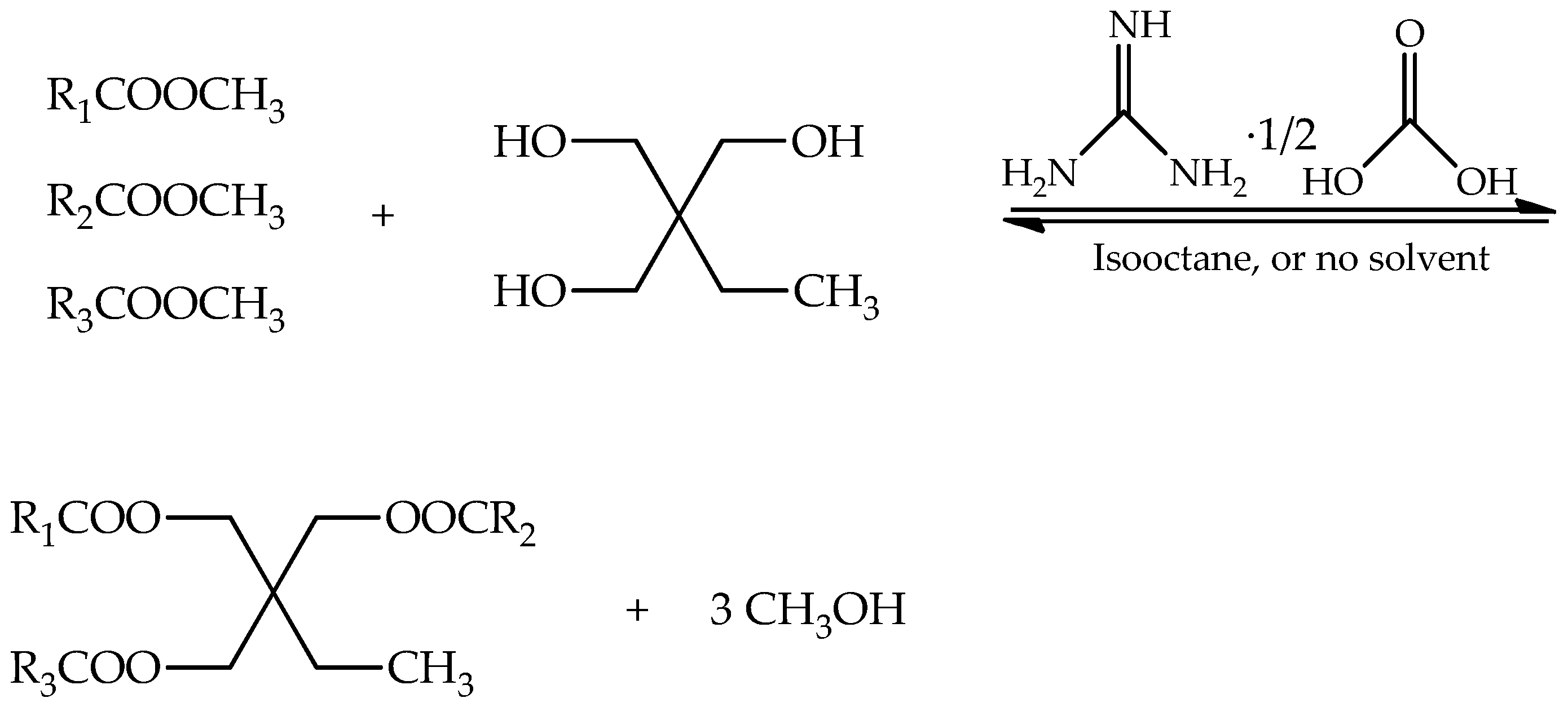
Sunflower oil methyl esters (SUNOME, 50 g) and trimethylolpropane (TMP, 7.67 g) were charged into a 250 mL round-bottom reactor at a molar ratio of 3:1 according to the general reaction shown in Figure 1.
II.
Guanidine carbonate was added at the desired concentration (3.0–5.0 wt% relative to the total mass of the reactants) and two distinct methodologies were employed [12,16,38]:
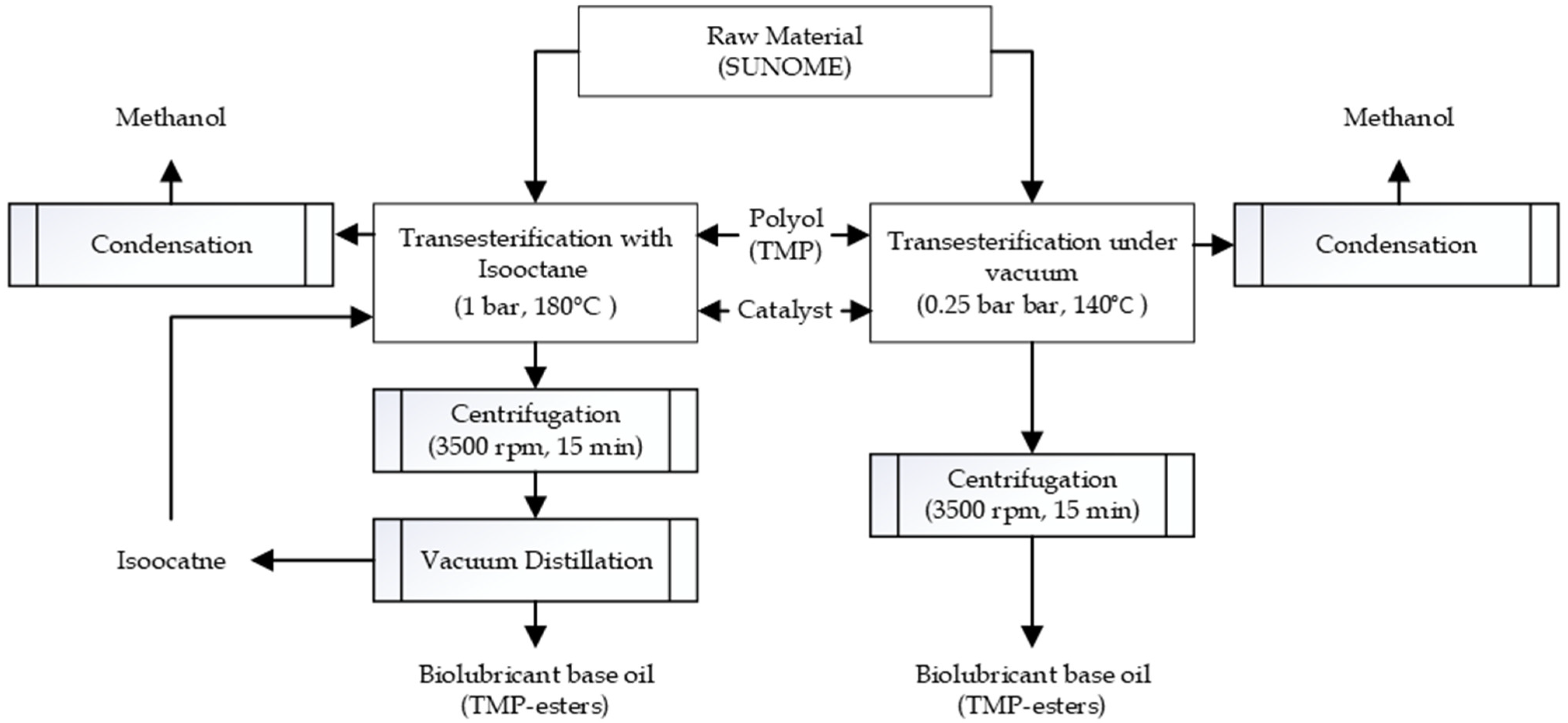
  • Isooctane-assisted transesterification: Reactions were performed in a 250 mL round-bottom flask fitted with a Dean–Stark trap and reflux condenser. Isooctane (40 mL) was used as a solvent to facilitate reactant contact and to collect and remove methanol generated during the process, thereby promoting higher conversion via Le Chatelier’s principle. The reactive mixture was heated to 180 °C under atmospheric pressure.
  • Vacuum-assisted transesterification: The reaction was conducted under 0.25 bar vacuum maintained with a centrifugal pump, with methanol vapors condensed in a cold trap. The mixture was heated to 140 °C, keeping the methyl ester-to-TMP ratio at 3:1.
Figure 1. Conversion of fatty acid methyl esters (FAMEs) into TMP esters. R1, R2, and R3 denote long-chain fatty acid groups.
Lubricants 14 00082 g001
III.
Upon completion of each batch reaction, the mixtures were allowed to cool to ambient temperature, followed by cessation of stirring.
IV.
The products were then centrifuged at 3500 rpm for 15 min to remove the catalyst and any precipitated solids. When centrifugation was insufficient, vacuum filtration was performed. In reactions employing isooctane, the solvent was recovered by vacuum distillation using a rotary evaporator [16].
The overall synthetic route of trimethylolpropane esters from SUNOMEs was is visualized in the following simplified flow chart of the production process shown in Figure 2.

2.2. Conversion Rate and Reaction Time Monitoring and Determination

The progress and conversion rate of the transesterification reaction were monitored indirectly through the generation and removal of methanol, which is the stoichiometric by-product of the reaction, always taking into account the methanol content of the methyl esters mixture. In the isooctane-assisted configuration, methanol was continuously collected as condensed droplets in a Dean–Stark trap, whereas under vacuum-assisted conditions, the condensation rate of methanol vapors was monitored using a cold trap. The conversion rate of SUNOME to TMP-esters (mono-, di- and triesters and/or partially to sunflower oil guanidinamides) was determined by stoichiometric calculations based on the total amount of collected methanol, assuming complete conversion corresponds to the theoretical methanol yield. The reaction time was defined as the interval between catalyst addition (accompanied by reactor heating) and the condensation of the final methanol droplet. It is noted that the calculated conversion values represent a conservative estimation, as minor methanol vapor losses cannot be entirely excluded during operation.

2.3. Characterization and Testing

The synthesized TMP esters were evaluated for their physicochemical properties, including density, kinematic viscosity, acid number, water content, and ester content, according to EN 14214 standards. FT-IR spectroscopy was conducted to confirm the chemical structure of the products, and stoichiometric analysis verified the reaction completeness and FATMPE quantitative composition [38,39].
Additionally, oxidation stability was determined using the Rapid Small Scale Oxidation Test (RSSOT) according to ASTM D7545 [40]. Measurements were conducted at 140 °C under an oxygen pressure of 700 kPa. For each sample, three independent measurements were performed. The reported values represent mean results; standard deviations were below ±1 min.
Furthermore, the lubricating performance was evaluated using the ASTM D4172 standard four-ball wear test [41]. This method assesses the ability of a lubricant to reduce friction and wear under well-defined boundary-lubrication conditions. During the test, a rotating steel ball is pressed against three stationary steel balls immersed in the lubricant under a 40 kg load, rotational speed of 1200 rpm, and temperature of 75 °C for an operation time of 60 min. The frictional force is recorded continuously to calculate the coefficient of friction, while the antiwear performance is quantified by measuring the average wear scar diameter formed on the stationary balls after the test. Wear scar diameters were measured optically according to ASTM D4172 and calculated as the average diameter of the three stationary balls after each test. Each test was performed under the above-mentioned conditions, and the reported values represent mean results from repeated measurements, ensuring good repeatability. Together, these parameters provide a reliable indication of the lubricant’s hydrodynamic film-forming capability, surface protection efficiency, and overall tribological behavior under moderate contact pressures [38,39].
Lastly, the extreme-pressure performance of the biolubricant base oils was evaluated using the ASTM D2783 four-ball test [42]. In this method, the applied load is increased stepwise while maintaining a constant rotational speed and test duration until seizure and welding occur between the rotating and stationary balls. The lowest load (in kg) at which welding is observed is recorded as the weld point, which provides a measure of the lubricant’s load-carrying capacity under severe contact conditions
The ASTM D4172 test is widely used as a benchmark for comparing base oils, biolubricants, and additive-modified formulations in terms of their friction-reducing and wear-minimizing properties. Therefore, comparative testing was performed against conventional Group I mineral base oils (SN-150 and SN-500, Oil Compo, Paiania, Greece) to evaluate the potential of FATMPE compounds as renewable lubricants.

3. Results

The sunflower oil TMP esters (SUNOTMPEs) produced through the conversion of SUNOME using guanidine carbonate as a catalyst at various concentrations were evaluated in terms of their physicochemical and tribological properties as potential base lubricating oils.
The study of the physicochemical properties of the synthesized SUNOTMPE under various catalytic and process conditions clearly demonstrates the influence of catalyst type and concentration on product quality. Based on Table 3 and Table 4, the optimum concentrations of guanidine carbonate were 4.0 wt% with isooctane and 4.5 wt% under vacuum. The optimal catalyst concentration values for each experimental configuration were selected and are summarized in Table 5. This Table also includes a comparison with the corresponding physicochemical property values of SN-150 and SN-500 oils, which belong to Group I of base lubricating oils.
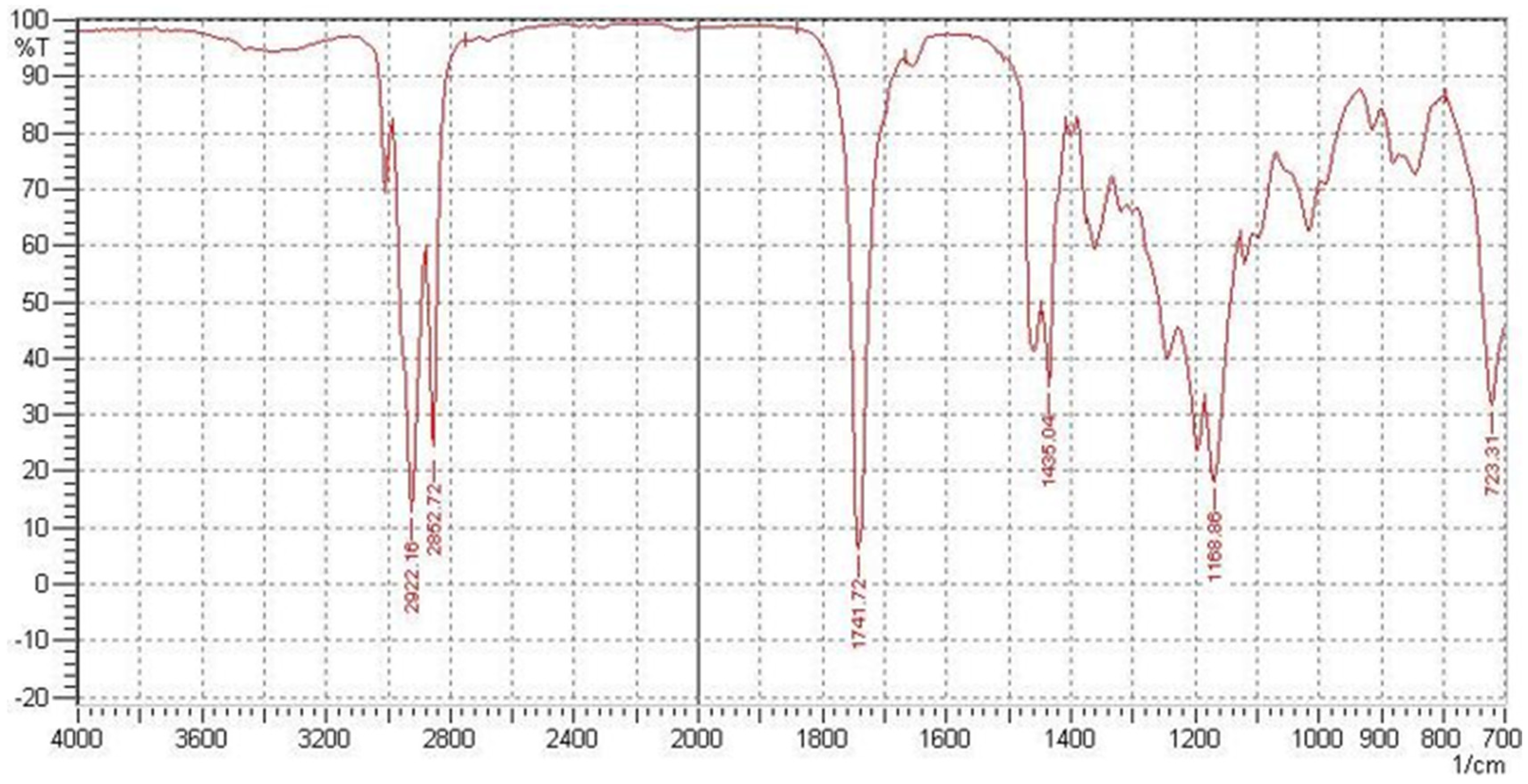
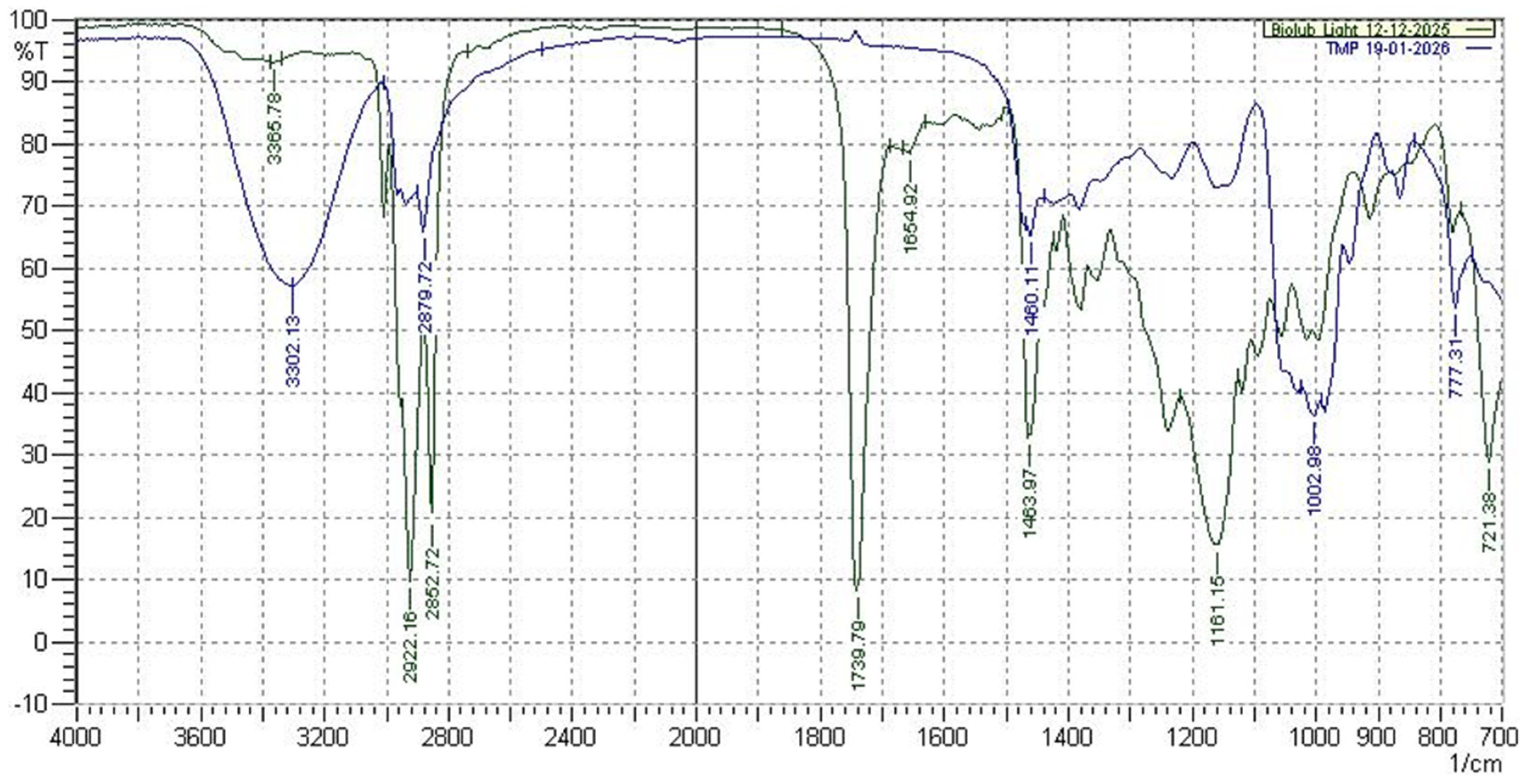
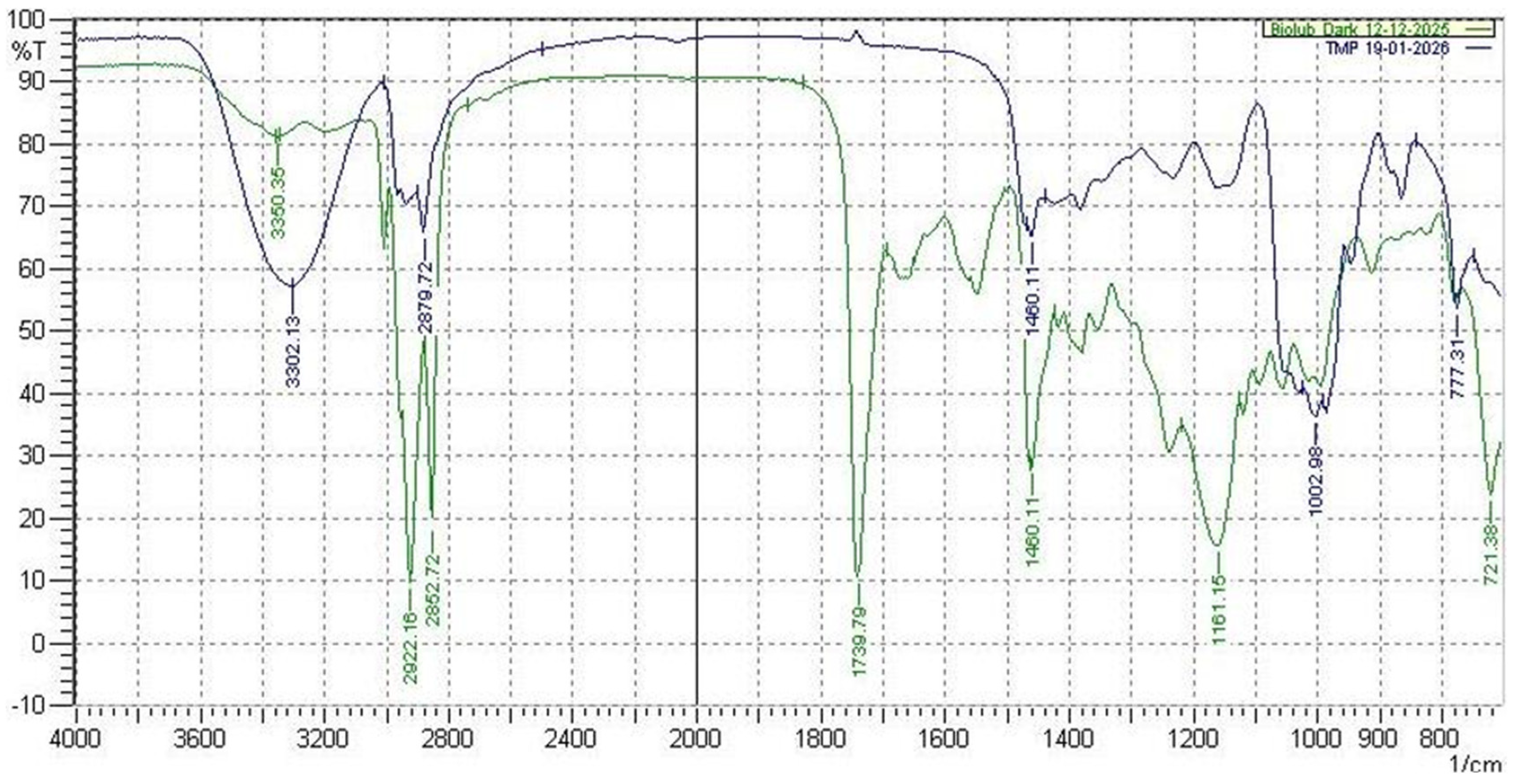
Initially, the TMP esters that were produced at optimal catalyst concentration in each case were subjected to FTIR spectroscopic analysis in order to be identified based on their characteristic functional groups and to elemental analysis in order for the elemental composition to be determined. For comparison purposes, the IR spectrum of the raw material (SUNOME) is also presented in Figure 3. The results of these analyses are presented in the spectra shown in Figure 4 and Figure 5 and Table 6, respectively.
Lastly, tribological aspects, such as the mean wear scar diameter and the coefficient of friction, are presented in Table 7, in comparison to the respective properties of the commercial mineral oils SN-150 and SN-500.

4. Discussion

The results of the study of the conversion of sunflower methyl esters into SUNOTMPE under varying catalyst concentrations and process conditions revealed clear trends in product quality, reaction efficiency, and tribological performance. Comparison between the two synthetic approaches—isooctane-assisted transesterification and vacuum-assisted transesterification—highlights the decisive role of process configuration in achieving both high conversion and desirable lubricant properties.

4.1. Comparison of the Two Synthetic Methods and Selection of Optimal Catalyst Concentration

As summarized in Table 3 and Table 4, both transesterification routes resulted in high conversion rates over the investigated catalyst concentration range. The isooctane-assisted process reached a maximum conversion of approximately 97% at intermediate catalyst loadings, while the vacuum-assisted route exhibited marginally higher conversion rates, reaching up to 97.8%. Higher conversion rates can be attributed to more effective methanol removal and the resulting favorable shift in the reaction equilibrium toward TMP ester formation.
The physicochemical properties of SUNOTMPEs synthesized using guanidine carbonate under both isooctane-assisted and vacuum-assisted conditions demonstrate a strong dependence on catalyst concentration and process configuration (Table 3 and Table 4). Among the evaluated properties, kinematic viscosity, viscosity index, and oxidation stability were identified as the most critical parameters for assessing lubricant quality and guiding the selection of optimal catalyst concentration.
For the isooctane-assisted synthesis (Table 3), the kinematic viscosity at 40 °C increased progressively from 41.27 cSt at 3.0 wt% catalyst to 46.37 cSt at 4.0 wt%, indicating enhanced SUNOME conversion and higher-molecular-weight product formation as the catalyst concentration increased. Beyond this point, viscosity slightly decreased to 45.44–44.49 cSt at 4.5–5.0 wt%, suggesting that further catalyst addition does not contribute to additional ester growth. A similar trend was observed at 100 °C, where viscosity peaked at 9.235 cSt at 4.0 wt%. The increase in kinematic viscosity with catalyst concentration up to 4.0–4.5 wt% reflects improved conversion toward higher-molecular-weight and branched oleochemical esters as the transesterification efficiency increases. Beyond this optimal catalyst loading, a slight decrease in viscosity is observed, which can be attributed to equilibrium limitations and the intense contribution of secondary reactions, leading to a broader molecular-weight distribution and reduced average molecular weight.
In contrast, the vacuum-assisted process (Table 4) resulted in consistently higher viscosities across all catalyst concentrations. The viscosity at 40 °C increased from 45.55 cSt at 3.0 wt% to a maximum of 52.73–52.56 cSt at 4.0–4.5 wt%, before declining slightly at 5.0 wt%. This behavior reflects the more effective removal of methanol under reduced pressure, which shifts the equilibrium toward triester formation and leads to products of higher average molecular weight [38,46,47]. The corresponding viscosities at 100 °C reached ~10.0 cSt, further supporting improved conversion under vacuum conditions.
The viscosity index (VI) followed complementary trends. In the isooctane-assisted reactions, VI values remained high (187–196) and relatively stable, with the highest VI recorded at lower catalyst loadings. Under vacuum, VI values were slightly lower (179–187) but still significantly higher than those of conventional Group I base oils [1]. The modest decrease in VI with increasing catalyst concentration under vacuum may be attributed to increased incorporation of nitrogen-containing species and subtle changes in molecular architecture, as evidenced by the FTIR spectra and the elemental analysis below. Nevertheless, all SUNOTMPE samples exhibited VI values well above those of SN-150 and SN-500, underscoring their superior viscosity–temperature behavior [1,2,3].
Oxidation stability, measured by RSSOT, provided another decisive criterion for selecting the optimal catalyst concentration. For the isooctane-assisted synthesis, oxidation stability increased from 40.53 min at 3.0 wt% to a maximum of 53.55 min at 4.0 wt%, followed by a decline at higher concentrations. This peak suggests that 4.0 wt% catalyst yields the most chemically stable product, likely due to optimal conversion and minimal residual reactive species.
Under vacuum conditions, oxidation stability showed a similar but more pronounced improvement, increasing from 44.10 min at 3.0 wt% to 54.27 min at 4.5 wt%, before decreasing at 5.0 wt%. The enhanced oxidation resistance of the vacuum-derived esters reflects both higher conversion efficiency and reduced exposure to oxidative environments during synthesis [47]. The slight decline beyond the optimal catalyst concentration may be associated with increased formation of nitrogen-containing by-products, which, while beneficial tribologically, can reduce oxidation stability at elevated concentrations.
Despite their favorable viscosity–temperature behavior and superior tribological performance, SUNOTMPEs exhibited significantly lower oxidation stability compared to the reference mineral oils SN-150 and SN-500. This behavior is attributed to the inherently higher unsaturation of sunflower-derived fatty acid chains, which increases susceptibility to oxidative degradation. Nevertheless, the observed oxidation stability values are typical for ester-based biolubricants and can be substantially improved through the incorporation of suitable antioxidant additives, as commonly applied in formulated lubricant systems [1,2,3].
All biolubricant formulations exhibited low acid values. Acid values decreased with increasing catalyst concentration in both methods, reaching <0.02 mg KOH/g at and beyond the optimal catalyst loadings. These low values indicate near-complete consumption of acidic species and confirm effective transesterification with minimal corrosive behavior.
Water content remained consistently low across all samples (68–97 mg/kg), well within acceptable limits for lubricating base oils. Slightly lower water contents were observed in vacuum-assisted products, reflecting the combined removal of methanol and moisture under reduced pressure [47]. Preserving water content at low levels (i.e., below 100 mg/kg) suggests a critical factor for improving storage stability and reducing the risk of hydrolytic degradation.
The synthesized sunflower oil-based TMP esters exhibited pour points between −18 and −21 °C for the isooctane-assisted route and between −15 and −18 °C for the vacuum-assisted route. These relatively low pour points arise from the branched molecular architecture of TMP esters, which disrupts orderly crystal packing, as well as from the presence of nitrogen-containing amide species associated with guanidine carbonate catalysis. Such polar amide functionalities interfere with crystallization and act as crystal growth inhibitors, thereby improving low-temperature flow behavior. The slightly lower pour points observed for the isooctane-assisted products suggest a more favorable concentration or distribution of these amide species in combination with improved transesterification uniformity.
The superiority of the vacuum process is attributed to the efficient removal of methanol, which drives the equilibrium toward ester formation more effectively than solvent-assisted reflux at atmospheric pressure. This effect is reflected in higher viscosity, slightly higher density, and improved oxidation stability of the vacuum-derived esters. Overall, vacuum operation enhances conversion by suppressing methanol accumulation and ensuring cleaner reaction conditions [47].

4.2. FTIR Spectroscopy and Evidence of Amide Formation

The FTIR spectrum of sunflower oil methyl esters (SUNOMEs) is characterized by a strong ester carbonyl stretching band at approximately 1740 cm−1, along with C–H stretching vibrations in the 2920–2850 cm−1 region, which are typical of long aliphatic chains. The spectrum of trimethylolpropane (TMP) exhibits a broad absorption band centered around 3300–3350 cm−1, attributed to O–H stretching vibrations of hydroxyl groups [38].
In contrast, the FTIR spectra of the final optimal products obtained via both isooctane-assisted and vacuum-assisted transesterification show a pronounced reduction or near disappearance of this broad O–H band, indicating extensive substitution of TMP hydroxyl groups and the formation of TMP esters. Simultaneously, the ester carbonyl band in the 1735–1745 cm−1 region becomes more intense in the product spectra compared to SUNOMEs, confirming the increased ester functionality associated with triester formation [38].
Additionally, both spectra showed weak but distinct stretching vibrations near 1640–1670 cm−1 and 3300–3400 cm−1, which are not typical of pure esters. These signals correspond to amide carbonyl (amide I) and N–H stretching vibrations, respectively, and are consistent with the formation of small quantities of fatty acid guanidinamides [48]. Their presence aligns with the chemistry of guanidine carbonate, which can lead to aminolysis of methyl esters during high-temperature transesterification. Although present in minor amounts, these amide derivatives were found to contribute positively to the tribological behavior, as discussed below.
It should be noted that broad absorption bands in the 3300–3400 cm−1 region may, in general, be attributed to either O–H or N–H stretching vibrations. In the FTIR spectrum of TMP, a pronounced broad band with a maximum at approximately 3302 cm−1 is clearly observed and assigned to hydroxyl groups. In contrast, this band is absent or significantly suppressed in the spectra of the final products obtained after transesterification, indicating extensive substitution of TMP hydroxyl groups and the formation of TMP triesters as mentioned above. Therefore, the disappearance of the characteristic TMP-OH stretching band provides strong evidence for successful ester formation. Any residual absorption in this region is weak and may be associated with minor nitrogen-containing species derived from guanidine carbonate, rather than unreacted TMP hydroxyl groups [48].

4.3. Elemental Analysis and Its Implications for Reaction Pathways

Elemental analysis revealed a measurable increase in nitrogen content from 0.62 wt% (isooctane product) to 1.43 wt% (vacuum product), compared with only 0.08 wt% in the raw SUNOME. This confirms the incorporation of guanidine-derived nitrogen into the final products. The change in nitrogen content supports the proposed formation of guanidine–fatty acid amides, which explains the additional FTIR absorption features.
The vacuum-derived product contained a higher nitrogen fraction because the reaction proceeds more efficiently under reduced pressure, enhancing both transesterification and side reactions leading to amide formation. Despite being a side reaction, the formation of these polar nitrogen-containing species provides an advantage during lubrication: amides are known for their strong adsorption on steel surfaces and can significantly enhance boundary hydrodynamic film stability.

4.4. Tribological Performance and Comparison with Mineral Base Oils

Tribological evaluation using the ASTM D4172 method revealed that SUNOTMPEs exhibit excellent boundary lubrication performance, especially in the vacuum-derived sample. The mean wear scar diameters of 0.62 mm (4.0% isooctane) and 0.54 mm (4.5% vacuum) are considerably lower than those of the reference mineral oils SN-150 (1.23 mm) and SN-500 (0.90 mm). Likewise, the coefficients of friction of SUNOTMPEs (0.034 and 0.021, respectively) are significantly reduced relative to SN-150 (0.080) and SN-500 (0.067).
These results confirm that the synthesized TMP esters form more effective boundary lubrication films than Group I mineral oils. The superior performance can be attributed to two synergistic factors:
  • The inherently polar structure of TMP esters, which promotes strong adsorption and reduces metal–metal contact [46,47].
  • The presence of small amounts of guanidinamide species, which reinforce the surface film through additional hydrogen-bonding and dipole interactions with steel surfaces [48].
The vacuum-derived SUNOTMPEs, containing a slightly higher amide content and showing higher conversion, consistently achieved the lowest wear and friction among all samples. This demonstrates that the processing method and catalyst concentration not only affect the physicochemical quality but also directly influence tribofilm formation, boundary lubrication performance, and tribological behavior in general.
The extreme-pressure performance of the synthesized TMP ester biolubricants was evaluated using the ASTM D2783 four-ball test and compared with conventional Group I mineral base oils. Both biolubricant base oils exhibited weld point values of 160 kg, exceeding those of SN-150 (100 kg) and SN-500 (120 kg). This improved load-carrying capacity is attributed to the polar ester functionality of the TMP esters, which promotes strong adsorption onto metal surfaces and enhances boundary film strength under high loads. In addition, the presence of nitrogen-containing amide species associated with guanidine carbonate catalysis may further contribute to load-bearing capability by reinforcing surface interactions [2,3,48].
The results demonstrate the superior intrinsic wear-preventive and extreme-pressure performance of the sunflower-oil-based biolubricant base oils relative to mineral base stocks [1,2,3].

5. Conclusions

This study presents an evaluation of trimethylolpropane esters produced through alkaline transesterification processes under vacuum or using isooctane as a solvent under atmospheric pressure, in the presence of guanidine carbonate as a catalyst. Based on the experimental investigation of the synthetic oleochemical trimethylolpropane esters and the comparison of their properties with those of conventional mineral oils, the following conclusions can be drawn:
  • Both methods demonstrate excellent catalytic efficiency, with optimal conversion achieved at intermediate catalyst concentrations.
  • The concentration of guanidine carbonate was found to be a critical parameter affecting the reaction efficiency and product quality. The optimal catalyst concentrations were determined to be 4.0 wt% for the isooctane-assisted process and 4.5 wt% for the vacuum-assisted process, based on the combined evaluation of reaction time and physicochemical properties.
  • The vacuum-assisted synthesis proved more effective in promoting ester formation, resulting in shorter reaction times and higher kinematic viscosities at both 40 °C and 100 °C, as well as slightly improved oxidation stability compared to the solvent-assisted method.
  • All synthesized SUNOTMPEs exhibited high-viscosity index values, significantly exceeding those of conventional Group I mineral base oils, indicating superior viscosity–temperature behavior.
  • The examination of the conversion rate, the study of the physicochemical properties and FTIR spectroscopy confirmed the formation of trimethylolpropane esters and revealed additional absorption features attributed to nitrogen-containing functional groups. The elemental analysis verified the incorporation of small amounts of nitrogen into the products, consistent with the formation of fatty acid guanidinamides as secondary reaction products.
  • Although formed in minor quantities, the presence of guanidinamide species was found to have a beneficial impact on the boundary lubrication performance due to their strong surface activity and ability to enhance tribofilm stability.
  • Tribological testing, according to ASTM D4172 and ASTM D 2783, demonstrated that SUNOTMPEs exhibit substantially lower wear scar diameters and coefficients of friction and higher weld loads compared to SN-150 and SN-500 mineral oils, confirming their superior anti-wear and friction-reducing performance.
  • Overall, SUNOTMPEs synthesized using guanidine carbonate—particularly via the vacuum-assisted route—show strong potential as renewable base lubricating oils, combining favorable physicochemical characteristics with enhanced tribological behavior, and represent a promising alternative to conventional mineral-based lubricants.
Future studies may focus on long-term oxidation and thermal stability assessments, formulation of the synthesized TMP esters with antioxidant and antiwear additives, and evaluation under extended tribological conditions relevant to industrial applications. In addition, scale-up studies and life-cycle assessments would provide further insight into the commercial feasibility and environmental benefits of guanidine-carbonate-catalyzed biolubricant production.

Author Contributions

Conceptualization, D.F. and G.A.; Methodology, G.A. and Y.Z.; Formal analysis, D.F.; Investigation, Y.Z.; Resources, D.K.; Data curation, G.A. and Y.Z.; Writing—original draft, D.F. and G.A.; Writing—review & editing, D.K.; Supervision, D.K. All authors have read and agreed to the published version of the manuscript.

Funding

This research received no external funding.

Data Availability Statement

The original contributions presented in the study are included in the article; further inquiries can be directed to the corresponding author.

Conflicts of Interest

The authors declare no conflicts of interest.

Abbreviations

The following abbreviations are used in this manuscript:
SUNOMESunflower oil methyl esters
FAMEFatty acid methyl esters
TMPTrimethylolpropane
GNDC Guanidine carbonate
FATMPEFatty acid trimethylolpropane esters
SUNOTMPESunflower oil trimethylolpropane esters
WSDWear scar diameter
CoFCoefficient of friction

References

  1. Nogales-Delgado, S.; Encinar, J.M.; González, J.F. A Review on Biolubricants Based on Vegetable Oils through Transesterification and the Role of Catalysts: Current Status and Future Trends. Catalysts 2023, 13, 1299. [Google Scholar] [CrossRef]
  2. Salih, N.; Salimon, J. A Review on Eco-Friendly Green Biolubricants from Renewable and Sustainable Plant Oil Sources. Barrier Release Interface Chem. 2021, 11, 13303–13327. [Google Scholar] [CrossRef]
  3. Cecilia, J.A.; Plata, D.B.; Saboya, R.M.A.; de Luna, F.M.T.; Cavalcante, C.L.; Rodríguez-Castellón, E. An overview of the biolubricant production process: Challenges and future perspectives. Processes 2020, 8, 257. [Google Scholar] [CrossRef]
  4. European Commission. EU Agricultural Markets Data—Sunflower Seeds. 2023. Available online: https://agriculture.ec.europa.eu (accessed on 29 November 2025).
  5. Appiah, G.; Tulashie, S.K.; Akpari, E.E.A.; Rene, E.R.; Dodoo, D. Biolubricant production via esterification and transesterification processes: Current updates and perspectives. Int. J. Energy Res. 2022, 46, 3860–3890. [Google Scholar] [CrossRef]
  6. FAO. FAOSTAT Statistical Database: Crops and Livestock Products. 2023. Available online: https://www.fao.org/faostat/en/ (accessed on 29 November 2025).
  7. de Sá Parente, E.J.; de Oliveira, L.B.; de Luna, F.M.T.; Cavalcante, C.L. Integrated production of biolubricants and biodiesel: Process simulation and technical–economic analysis. Biomass Convers. Biorefin. 2023, 14, 23709–23732. [Google Scholar] [CrossRef]
  8. OECD-FAO. OECD-FAO Agricultural Outlook 2021–2030; Organisation for Economic Co-Operation and Development and Food and Agriculture Organization of the United Nations: Paris, France, 2021. [Google Scholar] [CrossRef]
  9. Kurre, S.K.; Yadav, J. A Review on Bio-Based Feedstock, Synthesis, and Chemical Modification to Enhance Tribological Properties of Biolubricants. Ind. Crops Prod. 2023, 193, 116122. [Google Scholar] [CrossRef]
  10. Reeves, C.J.; Siddaiah, A.; Menezes, P.L. A Review on the Science and Technology of Natural and Synthetic Biolubricants. J. Bio-Tribocorros. 2017, 3, 11. [Google Scholar] [CrossRef]
  11. Sarker, M.I.; Ngo, H.; Sharma, B.K.; Wagner, K.M.; Jones, K.C.; Powell, M.J. Green Synthesis of Trimethylolpropane Triisostearate and Triisooleate for Usage as Bio-Lubricants. Tribol. Int. 2023, 186, 108649. [Google Scholar] [CrossRef]
  12. Shi, Y.; Qiao, S.; Wang, X.; Lin, Z.; Jiang, Y. Synthesis of Bio-Lubricant Trimethylolpropane Trioleate and Its Lubricant Base Oil Properties. Energy Fuels 2017, 31, 7185–7190. [Google Scholar] [CrossRef]
  13. Barbera, E.; Hirayama, K.; Maglinao, R.L.; Davis, R.W.; Kumar, S. Recent Developments in Synthesizing Biolubricants—A Review. Biomass Convers. Biorefin. 2024, 14, 2867–2887. [Google Scholar] [CrossRef]
  14. Hájek, M.; Vávra, A.; de Paz Carmona, H.; Kocík, J. The Catalysed Transformation of Vegetable Oils or Animal Fats to Biofuels and Bio-Lubricants: A Review. Catalysts 2021, 11, 1118. [Google Scholar] [CrossRef]
  15. Nogales-Delgado, S.; Encinar, J.M.; González, J.F. Use of Mild Reaction Conditions to Improve Quality Parameters and Sustainability during Biolubricant Production. Biomass Bioenergy 2022, 161, 106456. [Google Scholar] [CrossRef]
  16. Filon, D.; Anastopoulos, G.; Karonis, D. Synthesis and Evaluation of Sunflower-Oil-Based Esters as Biolubricant Base Oils Using Ca/TEA Alkoxide Catalyst. Lubricants 2025, 13, 345. [Google Scholar] [CrossRef]
  17. Selig, P. Guanidine Organocatalysis. Synthesis 2013, 45, 703–718. [Google Scholar] [CrossRef]
  18. Chipurici, P.; Vlaicu, A.; Călinescu, I.; Vînătoru, M.; Busuioc, C.; Dinescu, A.; Ghebaur, A.; Rusen, E.; Voicu, G.; Ignat, M.; et al. Magnetic Silica Particles Functionalized with Guanidine Derivatives—Efficient Catalysts for Microwave-Assisted Transesterification. Sci. Rep. 2021, 11, 22000. [Google Scholar] [CrossRef] [PubMed]
  19. Balbino, J.M.; de Menezes, E.W.; Benvenutti, E.V.; Cataluña, R.; Ebeling, G.; Dupont, J. Silica-supported guanidine catalyst for continuous flow biodiesel production. Green Chem. 2011, 13, 3111–3116. [Google Scholar] [CrossRef]
  20. Xie, W.; Wan, F. Guanidine Post-Functionalized Crystalline ZIF-90 Frameworks as a Promising Recyclable Catalyst for the Production of Biodiesel via Soybean Oil Transesterification. Energy Convers. Manag. 2019, 198, 111922. [Google Scholar] [CrossRef]
  21. Nayab, R.; Imran, M.; Ramzan, M.; Tariq, M.; Taj, M.B.; Akhtar, M.N.; Iqbal, H.M.N. Sustainable Biodiesel Production via Catalytic and Non-Catalytic Transesterification of Feedstock Materials—A Review. Fuel 2022, 328, 125254. [Google Scholar] [CrossRef]
  22. Răducanu, C.E.; Dobre, T.; Mihăiescu, D.E.; Moroșan, A.; Jidveian, R.; Cioroiu Tîrpan, D.R.; Vasiliu, A.D.; Gogoașă, C.I.; Pârvulescu, O.C.; Trică, B. Synthesis of Guanidine and Its Deposition on Bacterial Cellulose as Green Heterogeneous Catalyst for Transesterification to Methyl Esters. Energies 2024, 17, 1344. [Google Scholar] [CrossRef]
  23. Ji, Y. Recent Development of Heterogeneous Catalysis in the Transesterification of Glycerol to Glycerol Carbonate. Catalysts 2019, 9, 581. [Google Scholar] [CrossRef]
  24. Al-Saadi, L.S.; Eze, V.C.; Harvey, A.P. Coupling of Biodiesel Production with In Situ Glycerol Carbonate Formation—Process Optimization. Front. Chem. 2018, 6, 625. [Google Scholar] [CrossRef]
  25. Santos, E.C.S.; dos Santos, T.C.; Guimarães, R.B.; Ishida, L.; Freitas, R.S.; Ronconi, C.M. Guanidine-functionalized Fe3O4 magnetic nanoparticles as basic recyclable catalysts for biodiesel production. RSC Adv. 2015, 5, 48031–48038. [Google Scholar] [CrossRef]
  26. Racar, M.; Jerbić, I.Š.; Glasovac, Z.; Jukić, A. Guanidine catalysts for biodiesel production: Activity, process modelling and optimization. Renew. Energy 2023, 202, 1046–1053. [Google Scholar] [CrossRef]
  27. Peng, W.; Hao, P.; Luo, J.; Peng, B.; Han, X.; Liu, H. Guanidine-Functionalized Amphiphilic Silica Nanoparticles as a Pickering Interfacial Catalyst for Biodiesel Production. Ind. Eng. Chem. Res. 2020, 59, 4273–4280. [Google Scholar] [CrossRef]
  28. Sercheli, R.; Vargas, R.M.; Schuchardt, U. Alkylguanidine-catalyzed heterogeneous transesterification of soybean oil. J. Am. Oil Chem. Soc. 1999, 76, 1207–1210. [Google Scholar] [CrossRef]
  29. Elmelawy, M.S.; El-Meligy, A.; Mawgoud, H.A.; Morshedy, A.S.; Hanafy, S.A.; El-Tantawy El-Sayed, I. Synthesis and Kinetics Study of Trimethylolpropane Fatty Acid Triester from Oleic Acid Methyl Ester as Potential Biolubricant. Biomass Convers. Biorefin. 2023, 13, 1645–1657. [Google Scholar] [CrossRef]
  30. Karmakar, G.; Ghosh, P.; Sharma, B.K. Chemically modifying vegetable oils to prepare green lubricants. Lubricants 2017, 5, 4. [Google Scholar] [CrossRef]
  31. DIN EN 14214:2019; Liquid Petroleum Products—Fatty Acid Methyl Esters (FAME) for Use in Biodiesel Engines and Heating Applications–Requirements and Test Methods (Includes Amendment: 2019). Deutsche Institut für Normung e.V. (DIN): Berlin, Germany, 2019.
  32. EN ISO 12185:1996; Petroleum Products—Determination of Density—Oscillating U-tube Method. International Organization for Standardization (ISO): Geneva, Switzerland, 1996.
  33. EN ISO 3104:2017; Petroleum Products—Transparent and Opaque Liquids—Determination of Kinematic Viscosity and Calculation of Dynamic Viscosity. International Organization for Standardization (ISO): Geneva, Switzerland, 2017.
  34. EN ISO 12937:2000; Petroleum Products—Determination of Water—Karl Fischer Method. International Organization for Standardization (ISO): Geneva, Switzerland, 2000.
  35. EN 14104:2011; Fat and Oil Derivatives—Fatty Acid Methyl Esters (FAME)—Determination of Acid Value. European Committee for Standardization (CEN): Brussels, Belgium, 2011.
  36. EN 14103:2011; Fat and Oil Derivatives—Fatty Acid Methyl Esters (FAME)—Determination of Ester Content and Ester Distribution. European Committee for Standardization (CEN): Brussels, Belgium, 2011.
  37. UNE EN 14110; Fat and Oil Derivatives—Fatty Acid Methyl Esters (FAME)—Determination of Methanol Content. European Committee for Standardization (CEN): Brussels, Belgium, 2003.
  38. Kamyab, B.; Beims, R.F.; Chio, C.; Qin, W.; Chambers, D.W.; Xu, C.C. Synthesis of TMP Esters as a Biolubricant from Canola Oil via a Two-Step Transesterification–Transesterification Process. Can. J. Chem. Eng. 2024, 102, 35–52. [Google Scholar] [CrossRef]
  39. Hussain, M.M.; Gaval, V.; Pratap, A.; Sonawane, D. Tribological Study of Vegetable Oil and Its TMP Esters as Biolubricants. J. Tribol. 2021, 31, 13–27. [Google Scholar]
  40. ASTM D7545:2020; Standard Test Method for Oxidation Stability of Middle Distillate Fuels—Rapid Small Scale Oxidation Test (RSSOT). ASTM International: West Conshohocken, PA, USA, 2020.
  41. ASTM D4172-21; Standard Test Method for Wear Preventive Characteristics of Lubricating Fluid (Four-Ball Method). ASTM International: West Conshohocken, PA, USA, 2021. [CrossRef]
  42. ASTM D2783:2021; Standard Test Method for Measurement of Extreme-Pressure Properties of Lubricating Fluids (Four-Ball Method). ASTM International: West Conshohocken, PA, USA, 2021.
  43. ASTM D97:2020; Standard Test Method for Pour Point of Petroleum Products. ASTM International: West Conshohocken, PA, USA, 2020.
  44. ASTM D7042:2020; Standard Guide for Properties of Diesel Fuels. ASTM International: West Conshohocken, PA, USA, 2020.
  45. ASTM D2270:2020; Standard Practice for Calculating Viscosity Index of Petroleum Oils. ASTM International: West Conshohocken, PA, USA, 2020.
  46. Raof, N.A.; Hamid, H.A.; Mohamad Aziz, N.A.; Yunus, R. Prospects of Plant-Based Trimethylolpropane Esters in the Biolubricant Formulation for Various Applications: A Review. Front. Mech. Eng. 2022, 8, 833438. [Google Scholar] [CrossRef]
  47. Nowicki, J.; Drabik, J.; Woszczyński, P.; Gębura, K.; Nowakowska-Bogdan, E.; Kozdrach, R. Tribological Characterisation of Plant Oil Derived Fatty Acid Esters of Higher Polyols: Comparative Experimental Study. Lubr. Sci. 2019, 31, 61–72. [Google Scholar] [CrossRef]
  48. Drabik, J.; Korasiak, K.; Chrobak, J.; Woch, J.; Brzeźniak, N.; Barszcz, W.; Kozdrach, R.; Iłowska, J. Amide/Amino-Based Functional Additives for Lubricants: Structure, Antimicrobial Activity and Wear Resistance. Molecules 2024, 29, 122. [Google Scholar] [CrossRef] [PubMed]
Figure 2. Simplified flow diagram of the production process of bio-lubricant base oil (TMP-esters).
Lubricants 14 00082 g002
Figure 3. Infrared spectrum of the SUNOME.
Lubricants 14 00082 g003
Figure 4. Combined infrared spectrum of TMP (brown) and SUNOTMPE (black) produced with guanidine carbonate as a catalyst at 4.0 wt% and isooctane as the solvent.
Lubricants 14 00082 g004
Figure 5. Combined infrared spectrum of TMP (brown) and SUNOTMPE (black) produced with guanidine carbonate as a catalyst at 4.5 wt% under vacuum.
Lubricants 14 00082 g005
Table 3. Physicochemical properties of SUNOTMPE synthesized in the presence of different concentrations (m/m) of guanidine carbonate as a catalyst using isooctane as the solvent.
PropertyUnit3.0%3.5%4.0%4.5%5.0%Standard Method
Acid ValuemgKOH/g0.070.080.06<0.02<0.02EN 14104 [35]
Water Contentmg/kg9791778090EN ISO 12937 [34]
Pour Point°C−21−20−18−19−21ASTM D 97 [43]
Kin. Viscosity (40 °C)mm2/s41.2744.9046.3745.4444.49ASTM D 7042 [44]
Kin. Viscosity (100 °C)mm2/s8.6689.0549.2359.0948.941
Viscosity Index-196188187187187ASTM D 2270 [45]
Density (15 °C)g/cm30.92490.92640.92600.92570.9282ASTM D 7042 [44]
Oxidation Stability
(RSSOT 140 °C, 700 kPa)
min40.5344.7353.5550.0744.23ASTM D7545 [46]
Reaction timeh10108.08.07.5-
Conversion Rate-86.5%94.1%97.2%95.8%93.7%
Table 4. Physicochemical properties of SUNOTMPE synthesized in the presence of different concentrations (m/m) of guanidine carbonate as a catalyst under vacuum.
PropertyUnit3.0%3.5%4.0%4.5%5.0%Standard Method
Acid ValuemgKOH/g0.060.06<0.02<0.02<0.02EN 14104 [35]
Water Contentmg/kg8068717773EN ISO 12937 [34]
Pour Point°C−18−17−17−15−16ASTM D 97 [43]
Kin. Viscosity (40 °C)mm2/s45.5549.0152.7352.5650.45ASTM D 7042 [44]
Kin. Viscosity (100 °C)mm2/s9.1239.5829.99510.029.625
Viscosity Index-187184180181179ASTM D 2270 [45]
Density (15 °C)g/cm30.93280.93540.93410.93380.9337ASTM D 7042 [44]
Oxidation Stability
(RSSOT 140 °C, 700 kPa)
min44.1048.2852,5254.2750.82ASTM D7545 [40]
Reaction timeh108.07.56.06.0-
Conversion Rate-91.7%95.5%97.1%97.8%96.8%
Table 5. Physicochemical properties of SUNOTMPE synthesized at the optimal catalyst concentrations, using isooctane as solvent or under vacuum, and of base lubricating oils SN-150 and SN-500.
PropertyUnitGNDC (4.0 wt%)-IsooctaneGNDC (4.5 wt%)-VacuumSN-150SN-500Standard Method
Acid ValuemgKOH/g0.06<0.02<0.02<0.02EN 14104 [35]
Water Contentmg/kg77779798EN ISO 12937 [34]
Pour Point°C−18−15−13−9ASTM D 97 [43]
Kin. Viscosity (40 °C)mm2/s46.3752.5634.9867.57ASTM D 7042 [44]
Kin. Viscosity (100 °C)mm2/s9.23510.025.8139.128
Viscosity Index-187181107112ASTM D 2270 [45]
Density (15 °C)g/cm30.92600.93380.87260.8736ASTM D 7042 [44]
Oxidation Stability (RSSOT 140 °C, 700 kPa)min53.5554.27427.81453ASTM D7545 [40]
Table 6. Elemental analysis of the raw material (SUNOME) and the products (SUNOTMPE) at optimal catalyst concentrations.
%C%H%O%N%S
SUNOME77.7912.209.930.08<0.01
GNDC (4.0 wt%)-Isooctane77.0011.7210.660.62<0.01
GNDC (4.5 wt%)-Vacuum76.1211.7710.681.43<0.01
Table 7. Wear-preventive and extreme-pressure properties of the SUNOTMPE and commercial lubricant oil.
WSD (mm)Weld Load (kg)CoF
GNDC (4.0 wt%)-Isooctane0.621600.03
GNDC (4.5 wt%)-Vacuum0.541600.02
SN-1501.231000.08
SN-5000.901200.07
Disclaimer/Publisher’s Note: The statements, opinions and data contained in all publications are solely those of the individual author(s) and contributor(s) and not of MDPI and/or the editor(s). MDPI and/or the editor(s) disclaim responsibility for any injury to people or property resulting from any ideas, methods, instructions or products referred to in the content.