1. Introduction
Tapered roller bearings act as critical core components that find widespread application in vehicle axle housings and various types of speed reducers. However, experimental studies have shown that the “edge effect” occurring at contact positions exerts a significant impact on the bearing’s service life. Roller profile modification is recognized as an effective technical measure to eliminate or mitigate this edge effect, thereby further enhancing the fatigue life of the bearing [
1]. Existing roller profile modification design theories primarily focus on performance indicators such as contact stress distribution without fully considering the subsequent impact of wear evolution on the bearing’s long-term operational stability [
2,
3,
4,
5]. This paper aims to address this research gap by conducting a systematic study on the influence of roller profile modification on the wear behavior of tapered roller bearings.
Wang [
6] performed contact analysis on logarithmically modified tapered rollers, and the stress concentration at the ends of the modified tapered rollers was significantly alleviated. Yang [
7] investigated the influence of logarithmic profile modification on the radial stiffness of the contact pairs in tapered roller bearings. Wei [
8] studied the symmetrical modification of the rollers in the axle box and the tapered roller bearings of high-speed trains, providing guidance for the optimization design of the modification of such bearings. Li [
9] conducted research on the modification move towards to the ends of the roller technology for automotive tapered roller bearings and proposed the optimal modification scheme to improve fatigue life. Chen [
10] analyzed the elastohydrodynamic lubrication problem of logarithmically modified tapered rollers, and the research showed that the elastohydrodynamic lubrication state of logarithmically modified rollers was significantly improved. He [
11] analyzed the influence of modification on contact deformation and vibration, providing a theoretical basis for the design of roller profile modification. Lundberg [
12] studied the dry contact problem of finite-length contacts and proposed logarithmic profile modification formulas for cylindrical and tapered rollers. Reusner [
13] from SKF analyzed the contact stress and fatigue life of logarithmic rollers, concluding that logarithmic rollers are superior to straight generatrix rollers under heavy loads and skewing conditions, i.e., they exhibit stronger fatigue resistance. Ma [
14] established a numerical calculation method for the elastic contact problem of three-dimensional finite-length line contact pairs using the influence coefficient method in structural analysis, discussed the impact of roller profile modification on the contact stress distribution, pointed out the stress concentration problem under finite-length line contact conditions, and provided a basis for the design of roller profile modification. Houpert [
15,
16] used the slice method to calculate the contact stress distribution of the non-Hertzian contact pairs between rollers and raceways in tapered roller bearings under skewing conditions. Horng TL et al. [
17] analyzed the contact stress distribution of cylindrical rollers with different modifications between two flat plates using the finite element method, indicating that exponential curve modification, similar to logarithmic curve modification, can achieve a superior stress distribution. Wang [
18] et al. studied the influence of the modification parameters of rollers and raceways on the thermal characteristics of tapered roller bearings. An excessively large modification coefficient leads to an increase in the temperature of the contact area between rollers; when the modification offsets of the rollers and raceways are close, the maximum temperature of the contact area between the rollers and the large rib decreases.
At present, the optimization design results of tapered roller modification are mainly characterized by indicators such as contact stress distribution, radial stiffness, and bearing fatigue life, and none of them consider the impact of raceway wear. Wear affects the above indicators by changing the contact state, aggravating surface damage, and deteriorating lubrication, ultimately shortening fatigue life and thus significantly changing the operating state of the bearings. As one of the early classic research works on wear, Archard [
19] proposed the Archard model applicable to adhesive wear and sliding wear phenomena based on the relationship between wear and load, which has been widely cited in the research on bearing wear by Gu et al. [
20]. A coupled wear model and dynamic simulation method were established to systematically analyze the influence of wear of angular contact ball bearings on their dynamic characteristics and reveal the key role of operating parameters such as preload, horizontal load, and geometric parameters on wear evolution and nonlinear response. Liu [
21] et al. analyzed the fatigue wear problem of the 32,011 tapered roller bearing used in a crane, and the results showed that the quality of raw materials and heat treatment process are the main causes of bearing failure. Long Risheng [
22] et al. studied the tribological and vibration performance of dimple-textured tapered roller bearings under grease lubrication conditions using a universal friction and wear tester. The test results indicated that the dimple texture on the raceway surface helps reduce the friction force and wear loss of the bearing. Hu [
23] et al. carried out experiments on Linear Filament Wear (LFW) and Curved Filament Wear (CFW) of the raceways of Elastic Flexible Thin-Wall Bearings (EFTWB), aiming to investigate the polymorphic wear mechanisms and failure characteristics of the bearing raceways. The results revealed that the EFTWB raceways exhibited two types of failure modes, namely complete rolling friction and sliding filament wear, and the axial and tangential residual stresses of the inner and outer ring raceways were all compressive stresses. Rahnejat and Gohar [
24] conducted pioneering research on the contact mechanics of profiled tapered roller bearings, revealing that the contact between the roller and raceways, coupled with the rib contact reaction, induces roller misalignment, leading to non-Hertzian contact pressure distributions that deviate from simple Hertzian analysis. Kabus et al. [
25] further developed a quasi-static multi-degree-of-freedom model for tapered roller bearings, accurately capturing non-Hertzian contact pressures caused by contact footprint expansion at the edges due to misalignment. However, both studies focused on contact stress and dynamic equilibrium rather than the subsequent wear evolution induced by profile modification.
Despite extensive research on roller profile modification and bearing wear, existing studies have three key shortcomings: (1) Most modification design theories focus on contact stress, radial stiffness, and fatigue life, neglecting the long-term impact of wear evolution on bearing stability. (2) Few studies systematically couple roller profile modification parameters with wear evolution, especially under combined radial–axial loads. (3) Classical Hertzian analysis is often adopted without fully considering the non-Hertzian contact characteristics caused by roller misalignment, and the coupling effects of centrifugal force, gyroscopic effect, and modification on wear are rarely addressed.
This paper strives to overcome these gaps by constructing a coupled quasi-static-wear model, considering non-Hertzian contact characteristics and combined loads, and systematically investigating the influence of modification parameters on wear.
This study constructed a comprehensive analytical framework integrating a quasi-static model for profiled rollers and a wear depth calculation model. The reliability and effectiveness of the proposed model were verified by comparing the calculation results of the quasi-static model with load distribution data from existing literature and through experimental measurements on a specially designed bearing wear test platform. Based on the established model, the influence of different logarithmic profile modification parameters on the contact stress distribution, sliding velocity, and raceway wear depth of the bearing under both pure axial load and combined radial–axial load was investigated. The conclusions drawn provide important guidance for the design of tapered roller bearings.
In addition, the novelty of this study lies in three aspects: (1) constructing a comprehensive analytical framework that couples a quasi-static model, incorporating centrifugal force and gyroscopic effect with an Archard-based wear model, filling the gap that existing roller profile modification designs neglect the coupling between modification parameters and wear evolution; (2) systematically investigating the influence of logarithmic profile modification on wear under both pure axial and combined radial–axial loads, revealing the non-linear and asymmetric wear mechanisms rarely addressed in prior studies; (3) verifying the model through a custom-built test platform, providing experimental evidence for the quantitative correlation between modification amount and wear depth. This study addresses the knowledge gap that the existing literature focuses primarily on contact stress and fatigue life rather than wear evolution and lacks systematic analysis of the combined effects of load type and modification parameters on wear.
2. Roller Profile Modification Form and Modification Parameters
In the design of tapered roller bearings, the modification design of rollers consists of two parts: modification shape design and modification amount design. The modification shape refers to the geometric shape of the roller surface perpendicular to the direction of motion, i.e., the shape of the roller generatrix; the modification amount refers to the radial drop of the contour surface at a certain distance from the roller ends. Commonly used roller profile modification forms in engineering include circular arc curve modification, partial modification (i.e., straight lines with circular arcs at both ends, which can intersect or be tangent), logarithmic curve modification, and exponential curve modification. Logarithmic profile modification is widely used in tapered roller design and is generally recognized as the optimal modification form. Therefore, this paper mainly studies the influence of logarithmic profile modification on bearing wear.
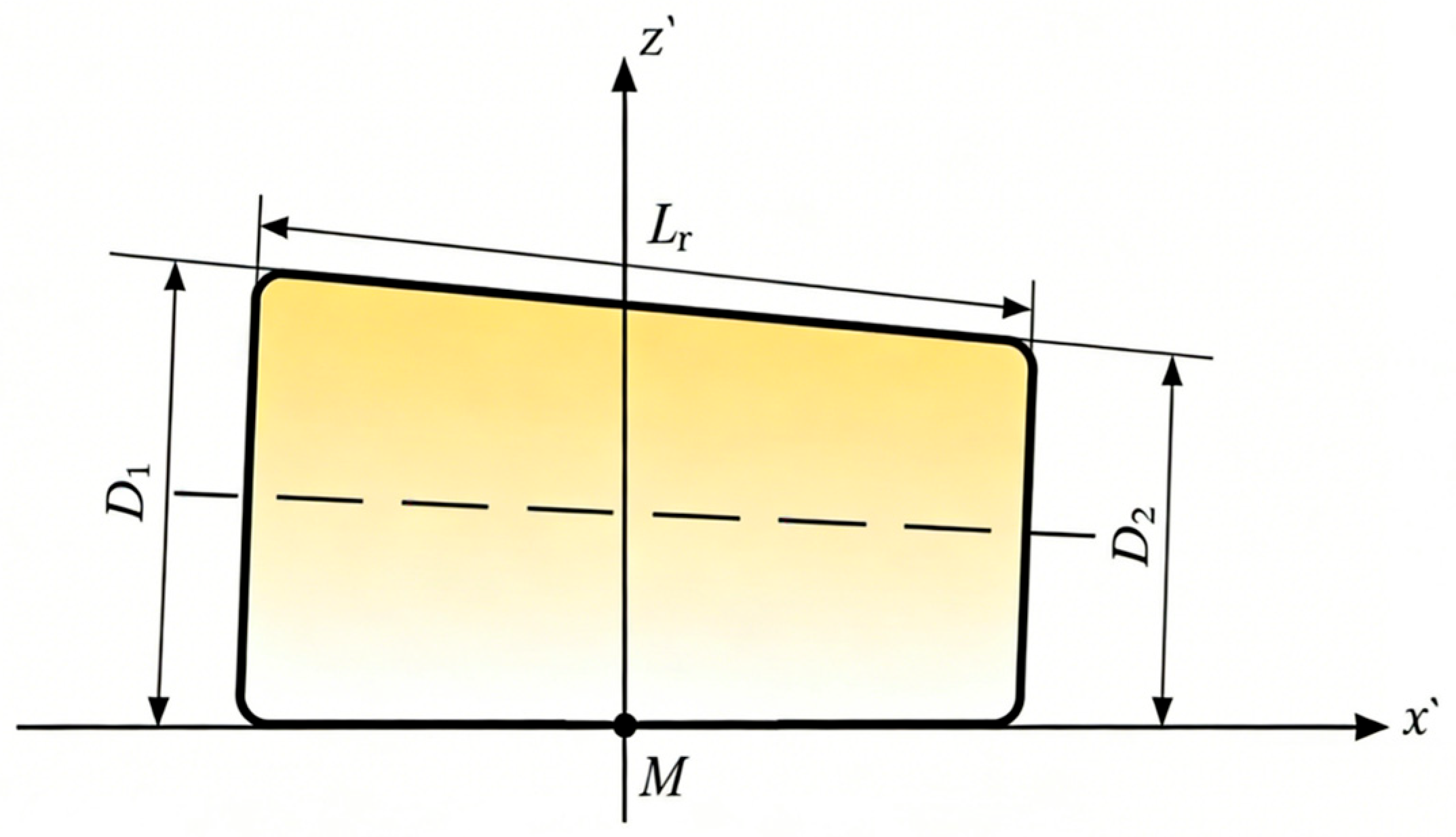
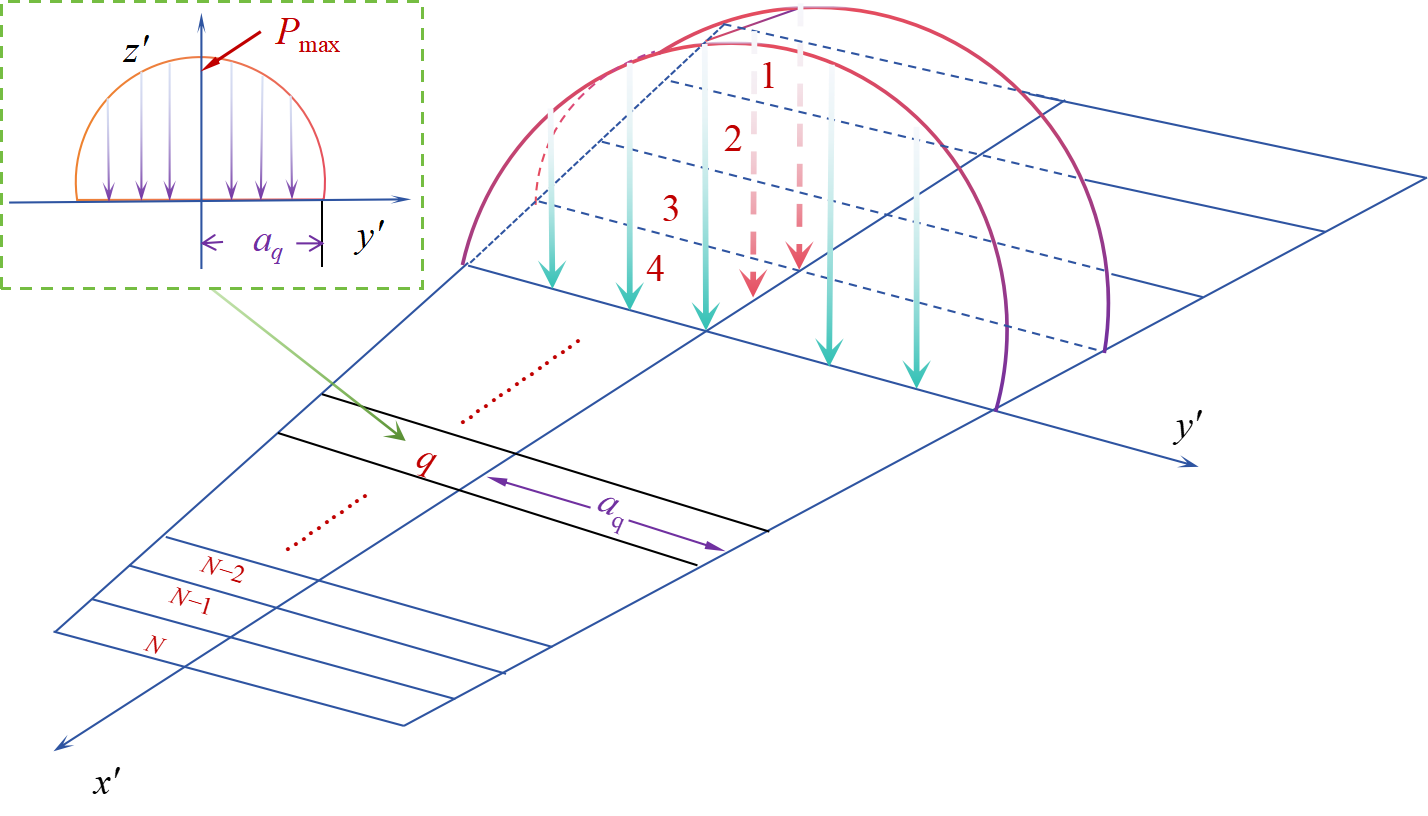
To characterize the generatrix profile modification form of tapered rollers, a coordinate system is established as illustrated in
Figure 1. This coordinate system serves as a fundamental tool for defining geometric parameters and analyzing modification effects accurately in bearing design.
The generatrix of a logarithmically profiled roller is described by the following equation, which defines the contour shape perpendicular to the direction of motion:
where
f1 is the logarithmic profile modification parameter (in units of μm), primarily determining the magnitude of the modification.
f2 is a dimensionless logarithmic profile modification parameter influencing the shape of the curve. This equation provides a mathematical foundation for characterizing the precise geometry of the roller’s profile, which is crucial for analyzing its contact behavior and wear performance.
Profile modification parameters refer to [
26]:
where
Q represents the total contact load between a single roller and the raceway, integrated load along the contact line.
Q is consistent with the contact load definition in Hertzian line contact theory, reflecting the overall load-bearing capacity of the roller–raceway contact pair.
Literature studies [
5,
27] have shown that under the same load condition, the change in the modification parameter
f2 has a negligible effect on the contact stress along the entire length of the rolling element generatrix and the service life of the tapered roller bearing. Therefore, the influence of the change in
f2 can be ignored; in the subsequent modification design and analysis,
f2 is selected as 0.997, and only
f1 is taken as the core modification design parameter.
3. Geometric Analysis of Tapered Roller Bearings
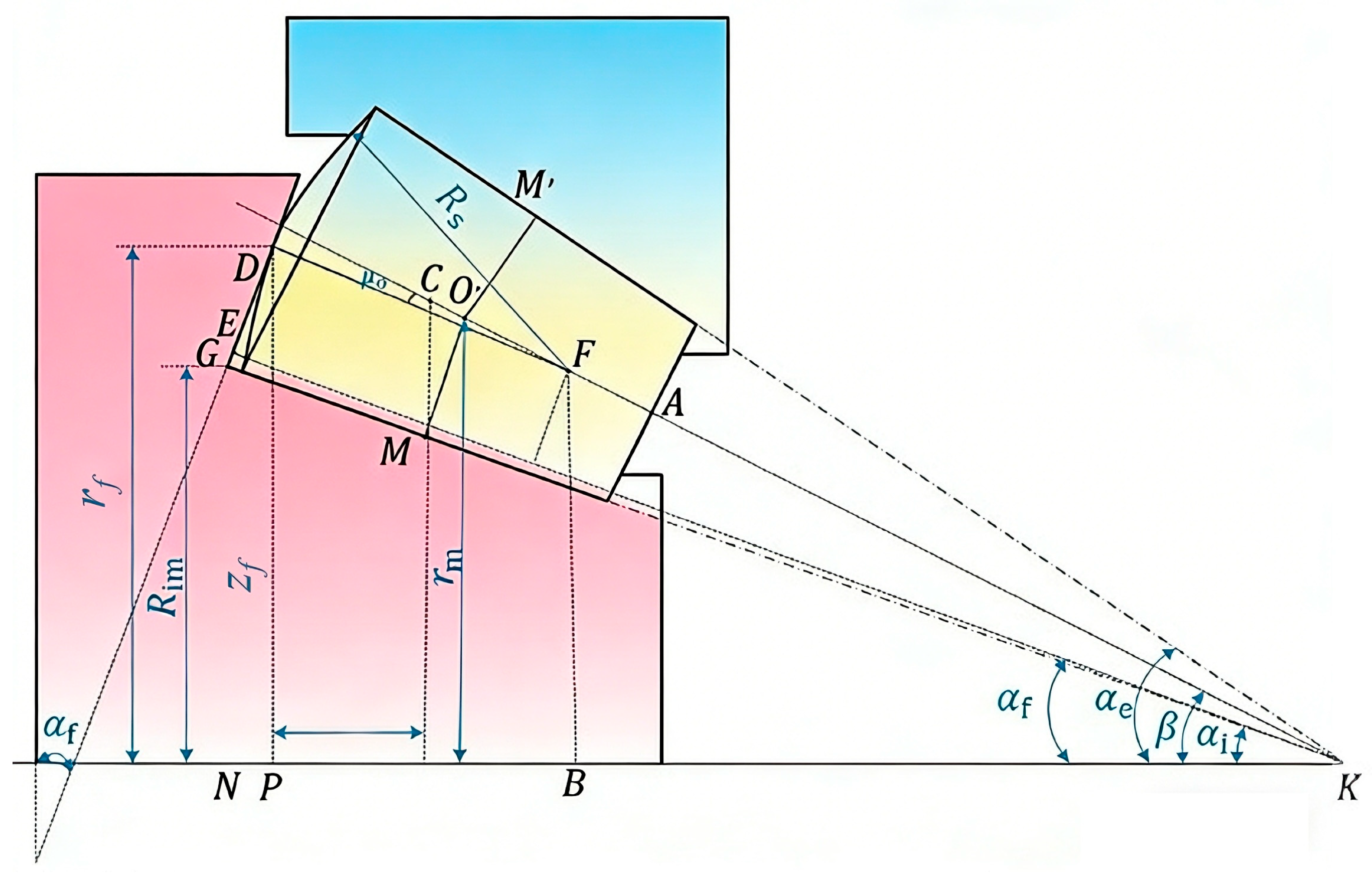
To establish a precise framework for mechanical and wear analysis, it is essential first to define the key geometric parameters and their interrelationships within a tapered roller bearing. The geometric correlations between components are illustrated in
Figure 2. This focus is chosen to optimize the lubrication conditions, heat generation, and wear at the contact interface between the roller’s large end and the rib while also considering the need for improved machining accuracy and reduced manufacturing difficulty. The following section provides a brief description of the key geometric parameters involved.
Point
K represents the intersection of the raceway generatrix and the bearing axis. A line
KE is drawn through point
K perpendicular to
DG, with its length defined as
Rp. The radius of the spherical large end face of the roller is denoted as
Rs. Based on geometric relationships, the following parameters are derived:
The distance
DG is calculated as
The radial distance from the contact point
D to the bearing axis is
The tapered roller can be considered a combination of a conical frustum and a spherical base. Ignoring the spherical base, the effective axial height of the roller,
hr, is determined from its large-end diameter
D1, small-end diameter
D2, and the contact generatrix length
Lr:
The pitch circle radius of the bearing is
The common normal at the contact point between the roller’s large end face and the inner ring rib intersects the roller’s central axis at point
F. The distance
lFB is obtained from the geometric relations:
The horizontal distance from the roller’s center of mass, point
C, to the contact point
D is
4. Quasi-Static Model of Tapered Roller Bearings
To simplify the analytical framework while ensuring the core mechanism is captured, the following assumptions are made: (a) Classical line contact Hertzian analysis is adopted for the roller-raceway contact, with friction neglected in the contact force calculation. (b) The contact surfaces of the roller and raceways are assumed to be smooth, with no surface roughness considered. (c) Thermal effects are ignored in the model, such as temperature-induced material property changes and thermal deformation.
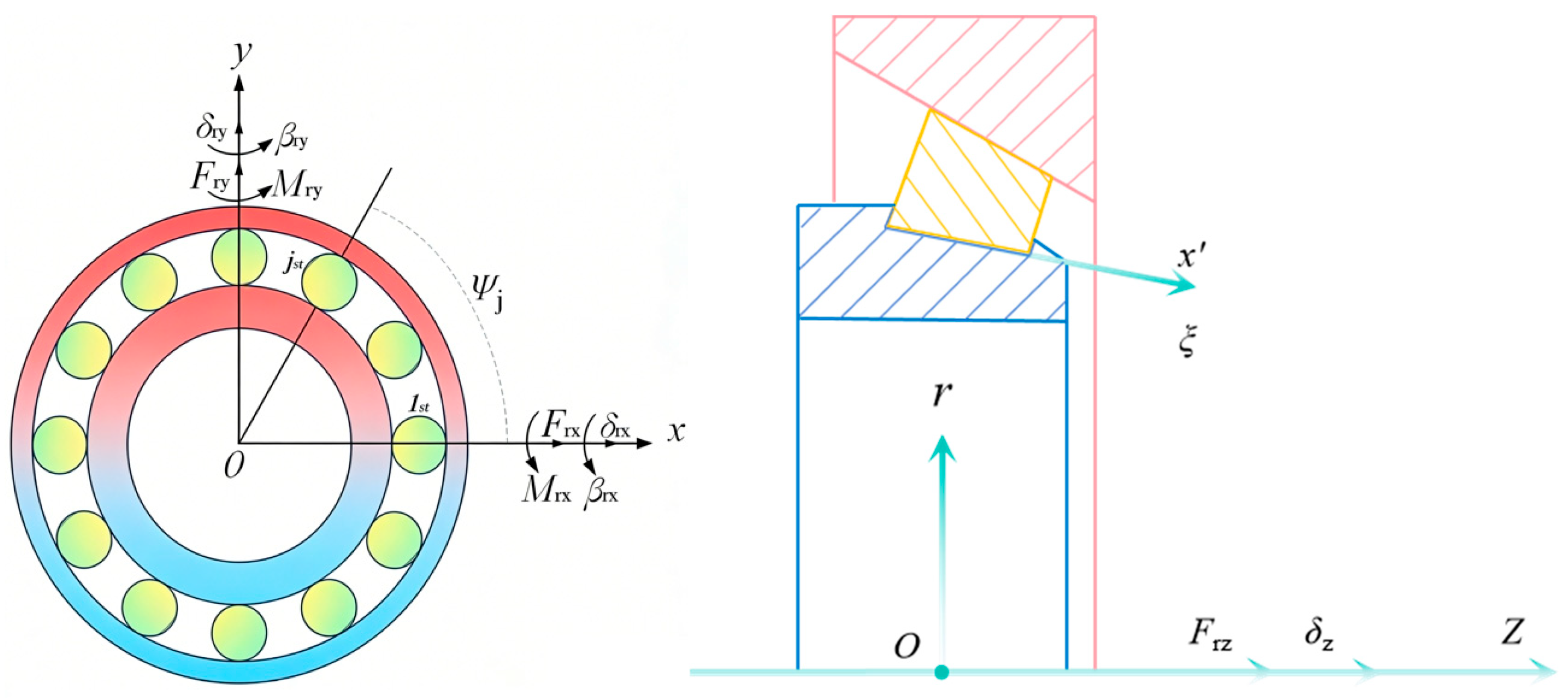
Under external loading, with the outer ring fixed, the inner ring undergoes displacements {
δrx,
δry,
δrz,
βrx,
βry} to equilibrate the external loads {
Frx,
Fry,
Frz,
Mrx,
Mry}. The loading and displacement state is depicted in
Figure 3.
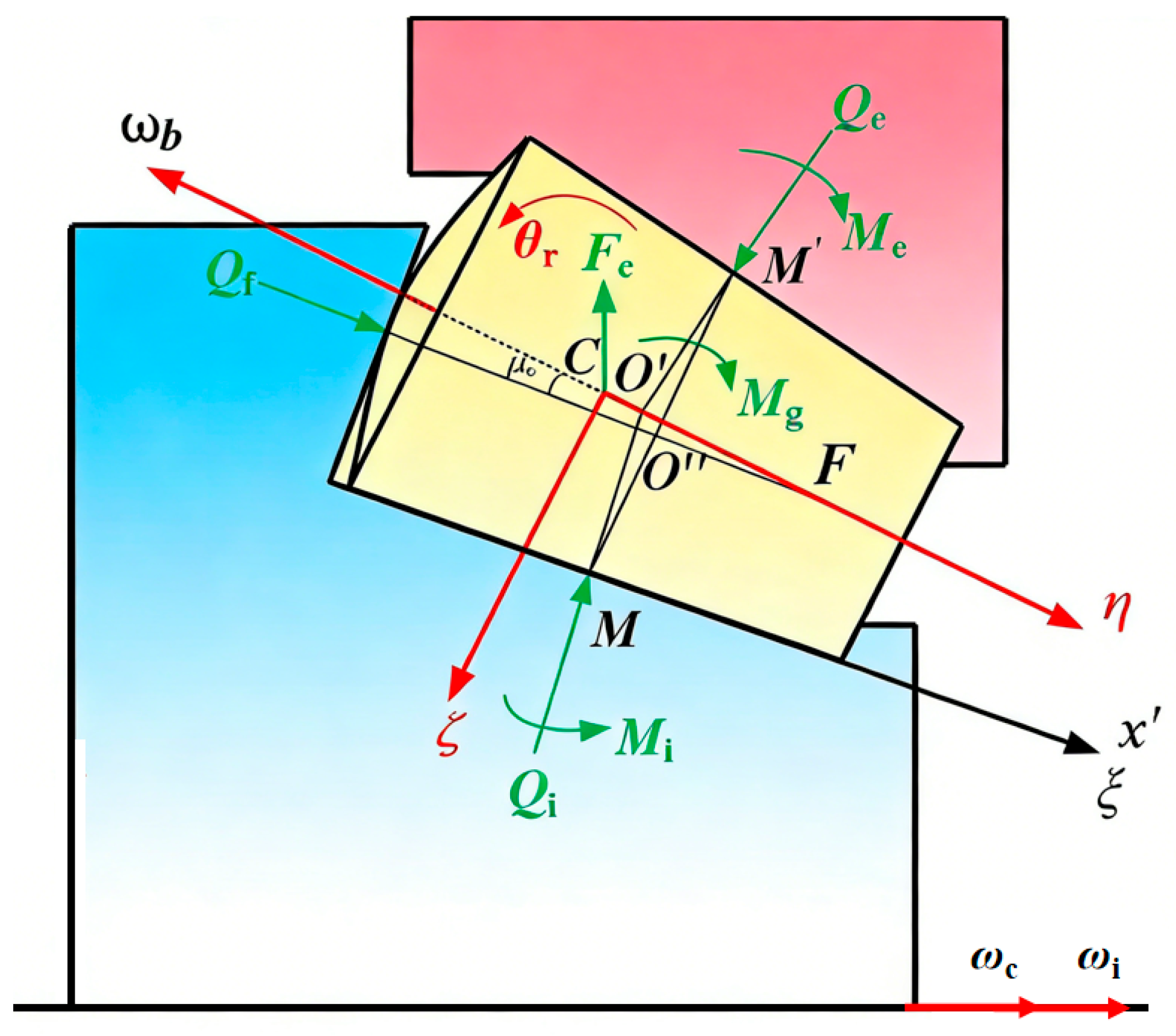
The contact load between the roller and the raceway is non-uniformly distributed along the contact line. For analytical simplification, this distributed load is reduced to an equivalent contact force
Qi/e and an equivalent moment
Mi/e acting at the midpoint
M of the roller generatrix. The force analysis for the
jth roller, illustrated in
Figure 4, includes the normal contact forces from the inner and outer raceways
Qi and
Qe, the contact force with the inner ring rib
Qf, the centrifugal force Fcdue to its revolution around the bearing axis, and the gyroscopic moment
Mg.
Under the action of these forces and moments, the roller experiences two translational displacements η, ζ and one rotational displacement θr about its center of mass C in the radial plane. To facilitate the calculation of contact deformation, the x’-axis and ξ-axis are established along the contact line between the roller and the inner raceway, with their origin at the generatrix midpoint M. The relationship between the coordinates is ξ = x′/Lr, where Lr is the effective contact length of the roller, and ξ ranges from −0.5 to 0.5.
The derivation and calculation of the contact deformation between the roller and raceway in this study have been supported by numerous studies [
28,
29,
30]. This study simplifies the derivation process here and only lists the force and torque formulas used in the subsequent calculation and analysis.
Contact force calculation is based on Hertzian contact theory. For line contact between the roller and the inner/outer rings, the contact force is obtained by integrating the deformation along the contact line:
Here, Kn is the contact stiffness coefficient, and for line contact, the exponent n = 10/9. The integration limits ξ1, ξ2 are determined by the region where the deformation is greater than zero.
For point contact between the roller and the rib, the contact force is
where the exponent
n = 3/2.
The centrifugal force
Fc and the gyroscopic moment
Mg of the roller are calculated as
where
m is the roller mass,
, and
Jb is the roller’s moment of inertia about its own axis,
.
Due to the non-uniform load distribution, the load eccentricity
eij/ej is introduced to represent the position of the equivalent point of action on the
x’-axis:
The static equilibrium equations for each roller consist of three force equilibrium equations and three moment equilibrium equations, forming a system of nonlinear equations:
Finally, the forces and moments exerted by all rollers on the inner ring must balance the externally applied loads, constituting the equilibrium equations for the entire bearing system:
5. Raceway Wear Depth Model of Roller Bearings
Wear is a critical factor affecting bearing life and reliability [
31]. In tapered roller bearings, wear primarily occurs in two regions: the conical surfaces of the inner and outer raceways (contact area with the roller generatrix) and the ends of the roller (near the large/small end faces), where micro-sliding and stress concentration are prominent. Addressing the predominant sliding wear mechanism in tapered roller bearings, based on the Archard model that has been widely verified and recognized in the industry, this study describes the relevant behaviors of the local contact area as the following formula [
32]:
Wear model acts as the theoretical foundation. This model establishes the fundamental relationship between the local wear volume d
V in the contact area, the local contact load d
Q, and the sliding distance d
L:
where d
V is the local wear volume, d
Q is the local contact load, d
L is the local sliding distance,
k is the wear coefficient with units of MPa
−1, and its value depends on factors such as material pairing and lubrication conditions.
Although the Archard model was initially proposed for sliding friction, it is applicable to tapered roller bearings because pure rolling does not exist in practical rolling bearings—the logarithmic profile modification, centrifugal force, and gyroscopic effect cause micro-sliding between the roller and raceway. This micro-sliding leads to adhesive and abrasive wear, which aligns with the wear mechanism described by the Archard model.
For tapered rollers, the sliding distance dL varies along the generatrix (different for the large and small ends). In Equation (18), dL refers to the instantaneous sliding distance of the local contact point on the roller generatrix. During calculation, we discretize the roller into N elements, and dL of each element is calculated based on its sliding velocity v and time increment dt.
To translate wear volume into the more intuitive wear depth, both sides of the equation are divided by the contact area d
S. Letting d
h = d
V/d
S represent the infinitesimal wear depth and
p = d
Q/d
S represent the local contact stress, the equation simplifies to
Furthermore, by differentiating this relationship with respect to time d
t, the wear depth rate per unit time at any point on the contact interface is obtained:
Here, is the core equation for calculating time-varying wear.
To accurately compute the wear depth at different positions along the raceway generatrix, the roller is discretized into rectangular elements along the generatrix direction, as shown in
Figure 5. Each element can be approximated as an independent contact area, allowing the application of the Archard model for local wear calculation [
33].
- (1)
Contact Stress Calculation
According to Hertzian contact theory, the normal contact load
Qijq on the
qth rectangular element within the contact area between the
jth roller and the raceway is calculated as
where Δ
l =
Lr/
N is the element length, and the exponent
n = 10/9.
The contact half-width
aijq/ejq of this rectangular element is
Consequently, the maximum contact stress at the geometric center of the element is
The contact stress at any point (
x′,
y′) within the element follows a semi-elliptical distribution:
- (2)
Sliding Velocity Calculation
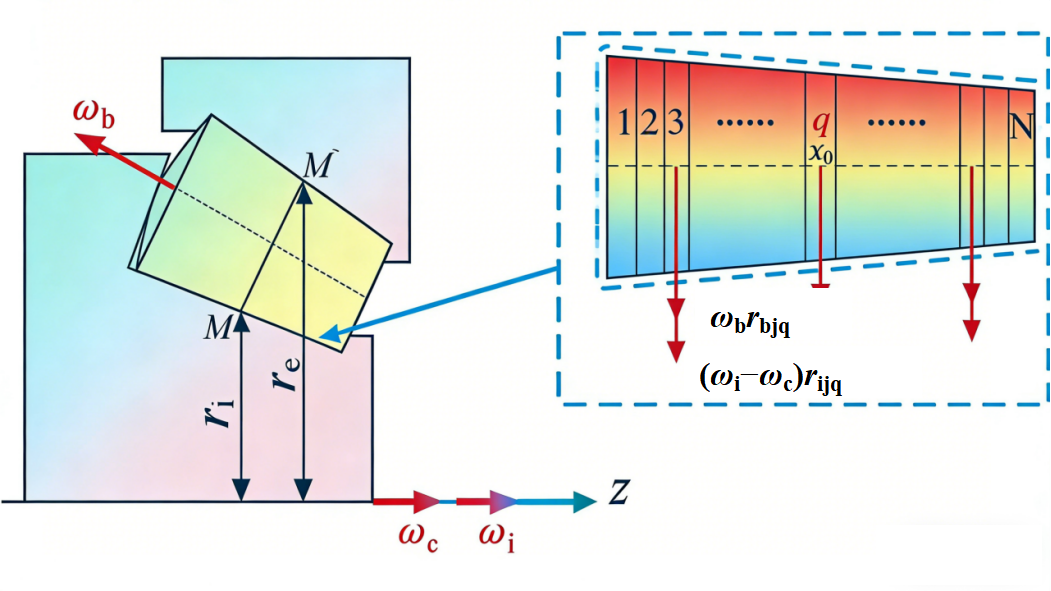
During the operation of the bearing, as shown in
Figure 6, taking the bearing cage as the reference coordinate system, the inner ring rotates around the bearing axis with an angular velocity of
ωi − ωc, where
ωi is the rotational angular velocity of the inner ring, and
ωc is the orbital angular velocity of the roller (rotational angular velocity of the cage); the roller rotates around its own axis with a rotational angular velocity of
ωb. Roller profile modification reduces the radius of the roller, resulting in a certain difference between the linear velocity of the roller and the linear velocity of the inner and outer rings of the bearing at contact points other than the pure rolling point, leading to sliding.
The analysis of sliding velocity is based on the kinematics of the bearing, as shown in
Figure 6. Considering the variation in roller radius due to profiling, relative sliding occurs between the roller and the inner/outer rings at points other than the pure rolling point.
The roller radius
rbjq at the
qth element, accounting for the profile modification amount
z′, is
The distances from the inner and outer raceway centers
M and
M′ to the bearing axis are, respectively,
The radius of the inner and outer raceways at the contact point
ξ are
Assuming the midpoint
M of the roller generatrix is the pure rolling point, the roller’s orbital angular velocity
ωe and rotational angular velocity
ωb can be derived:
Finally, the differential sliding velocities at the
qth element between the roller and the inner/outer rings are
Wear Depth Calculation is performed by integrating over each discrete element. Substituting the contact stress
pijq(
y′) and sliding velocity
Vijq into the Archard wear rate formula and integrating over the area
Aq of the element yields the wear volume per unit time
for that element:
Considering the different loading modes of the inner and outer raceways:
Outer Raceway: As a stationary component, the wear at any point is caused only by the rollers passing over that location. Therefore, the wear depth
hejq of the
qth element at the angular position of the
jth roller on the outer raceway is
where
. Because the load varies with the azimuth angle
ψj, the wear depth on the outer raceway is non-uniformly distributed.
Inner Raceway: As a rotating component, any point on it periodically contacts all rollers. Therefore, the wear depth
hijq of the
qth element on the inner raceway is the accumulation of wear from all
Z rollers and is independent of the roller azimuth angle (uniform wear):
where
is the surface area of the inner raceway corresponding to this element.
6. Results and Discussion
6.1. Model Validity Verification
To assess the accuracy of the established quasi-static model for tapered roller bearings, which incorporates centrifugal forces and gyroscopic effects, along with its computational program, a comparative verification was conducted using the example from reference [
34,
35]. In this benchmark case, the bearing is subjected to an axial load
Fz = 4500 N and a radial load
Fx = 4500 N.
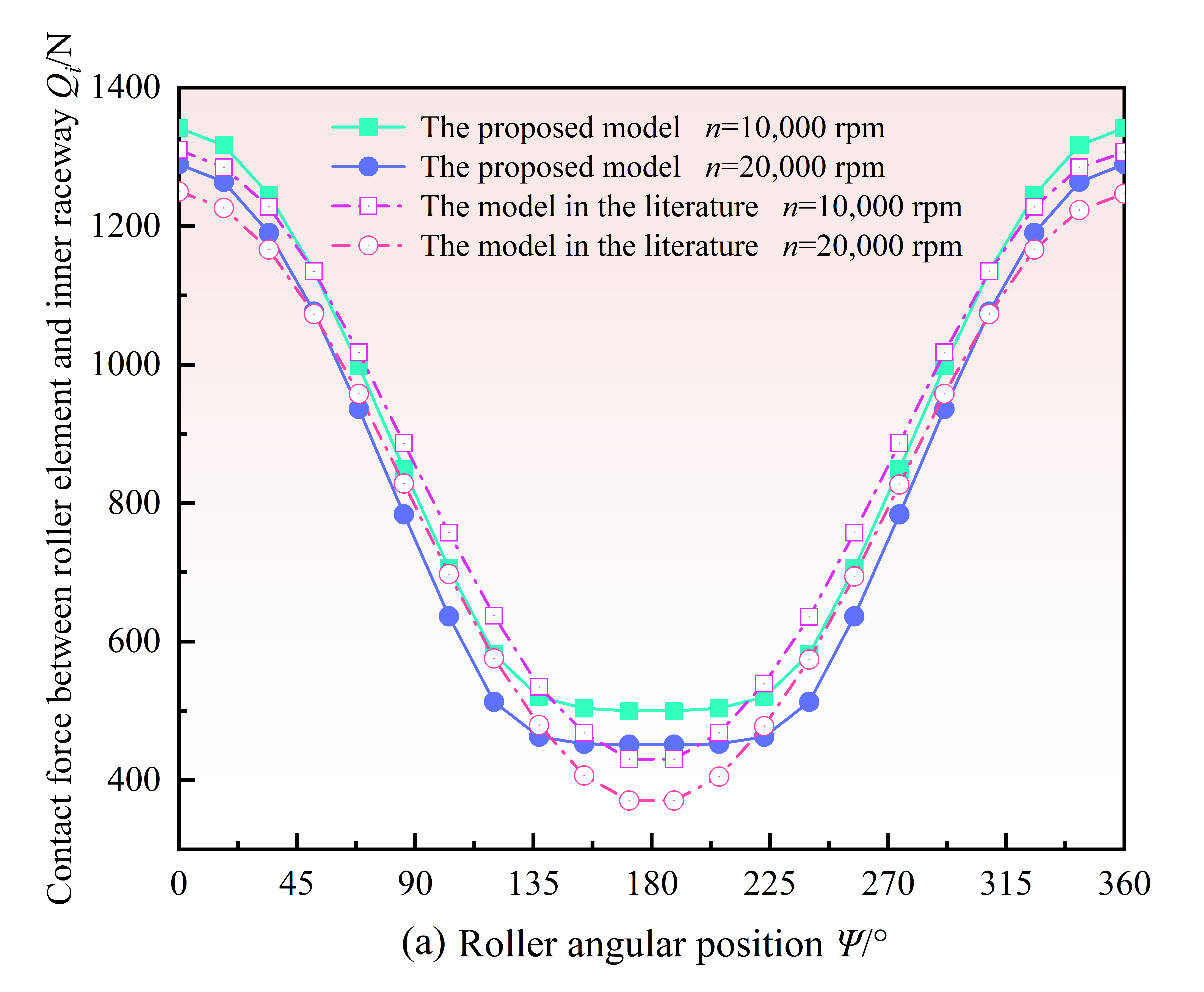
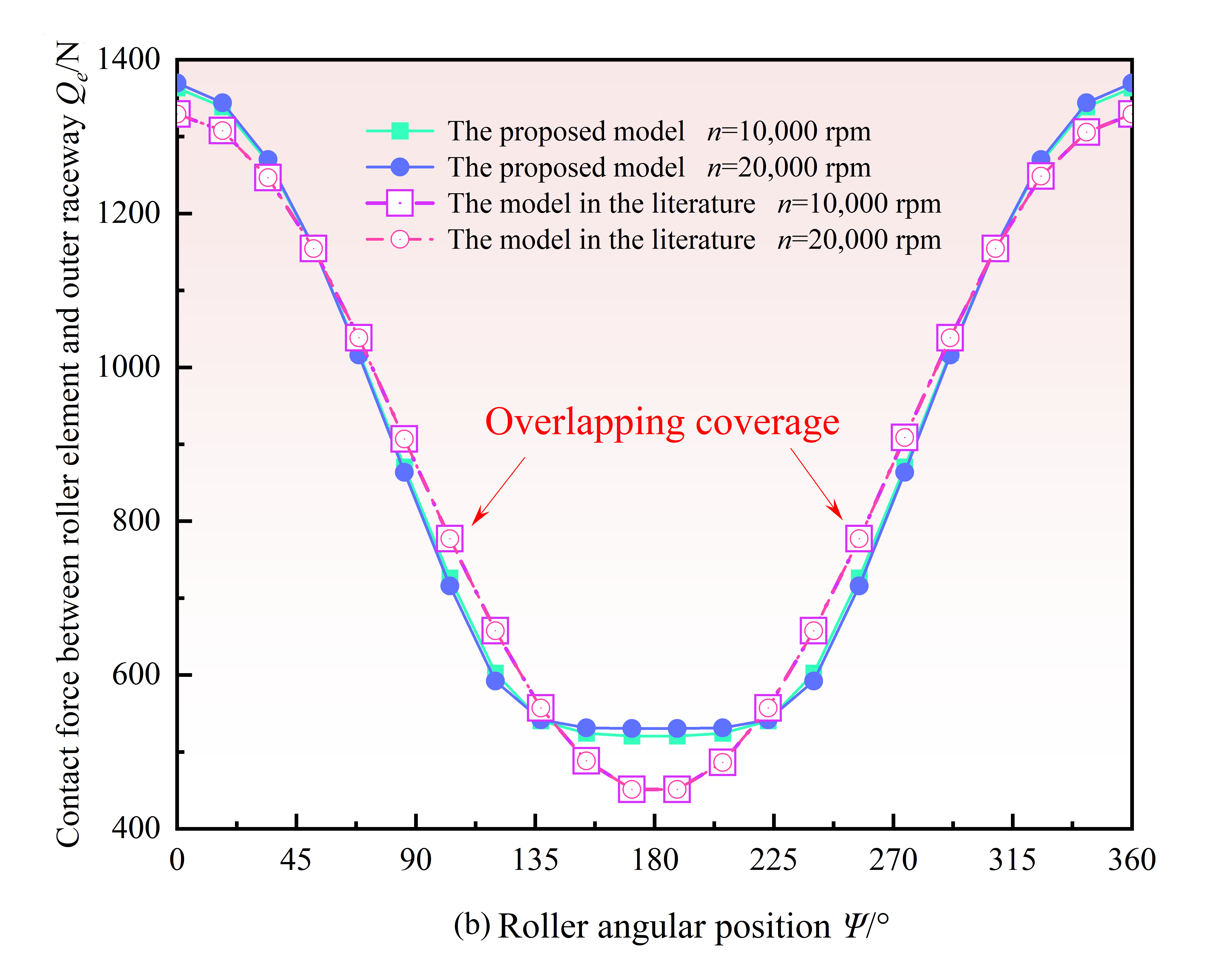
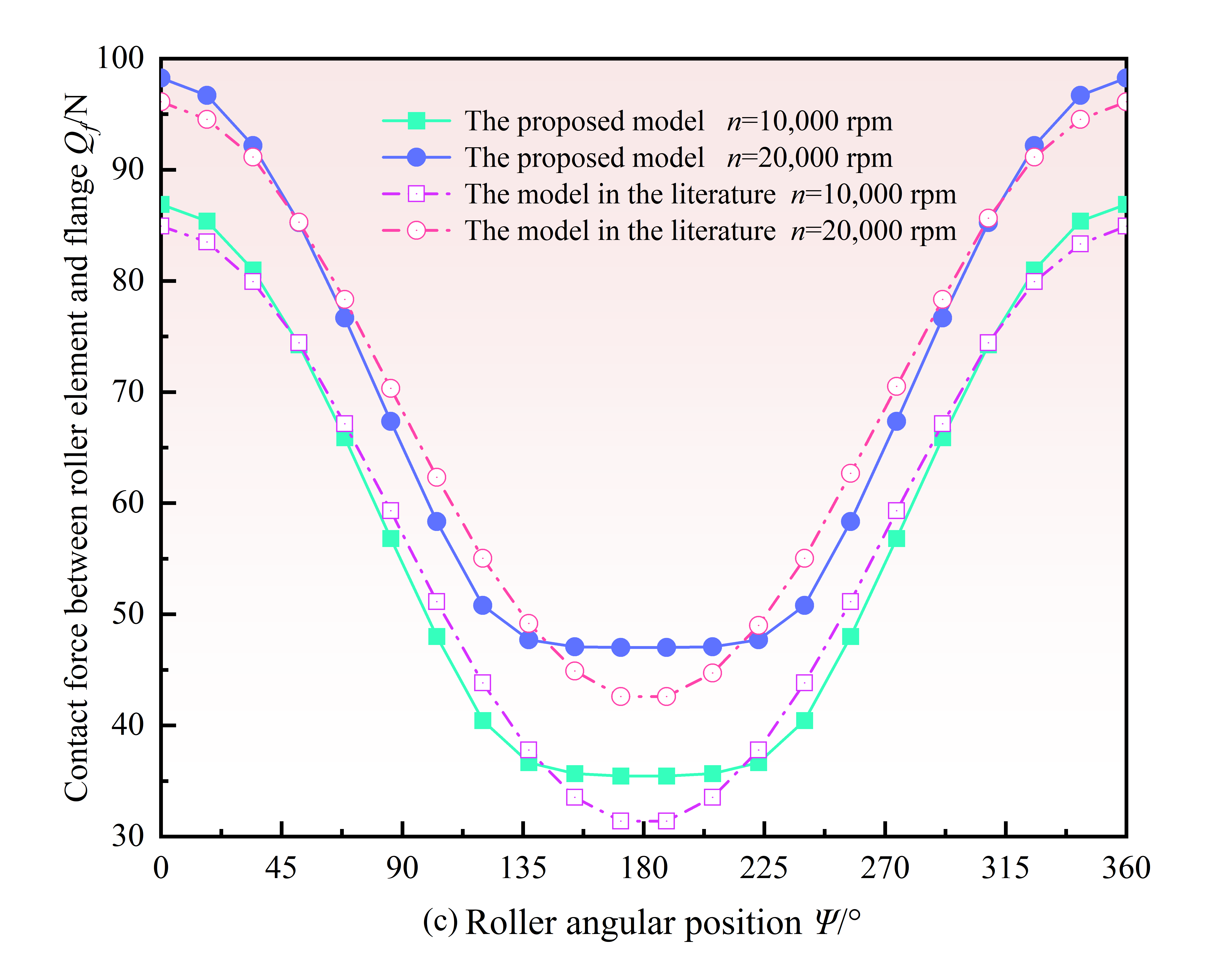
Figure 7 illustrates the influence of rotational speed variation on the contact forces between the rollers and the inner/outer raceways, as well as between the rollers and the flange rib.
The comparison reveals that for the vast majority of rollers, the contact forces calculated by the proposed model for the roller-inner raceway, roller-outer raceway, and roller–flange interactions show good agreement with the results from the reference. For a small number of rollers near an azimuth angle of 180°, a certain discrepancy exists between the results of this paper and the reference, but the maximum deviation does not exceed 20%.
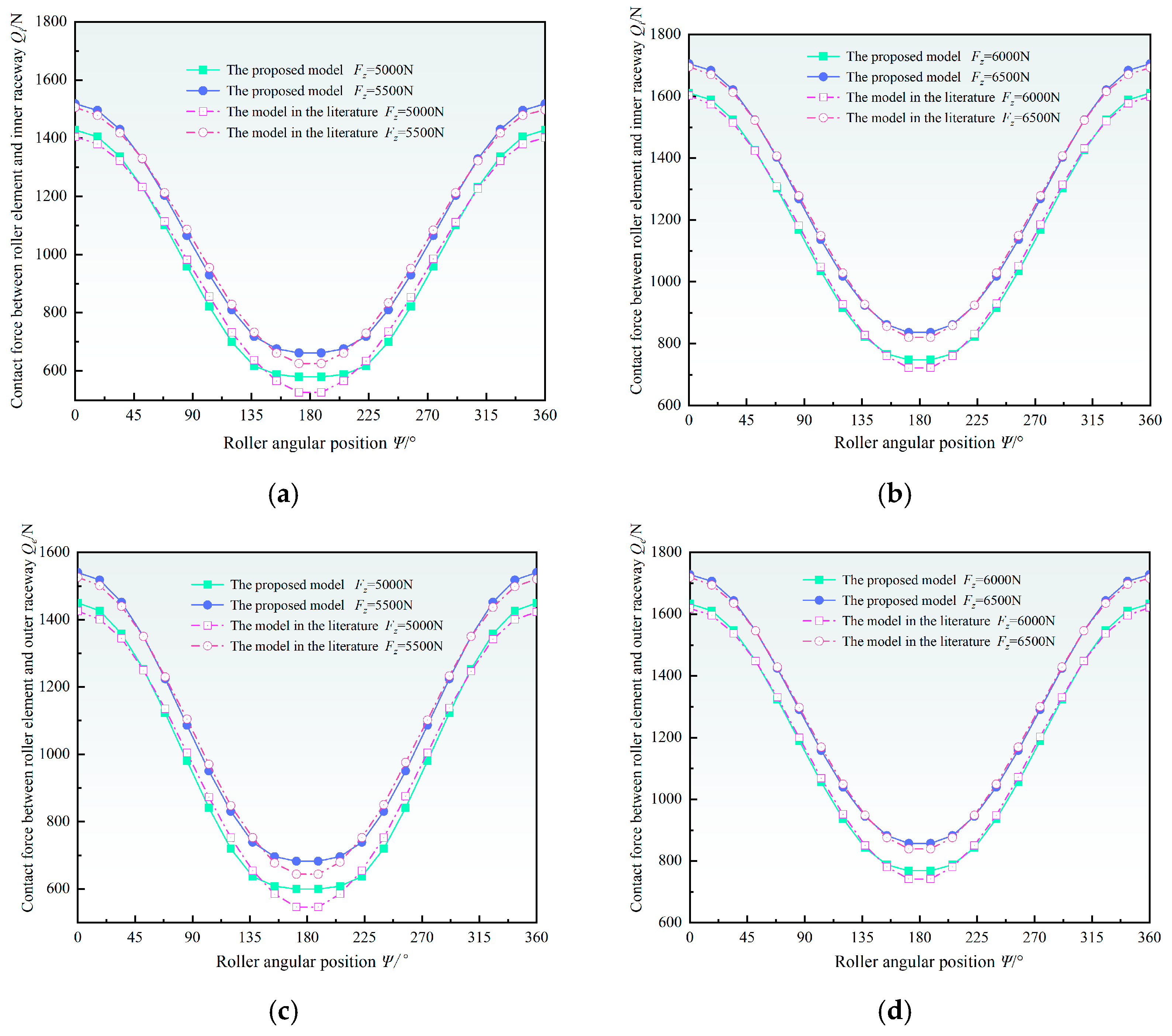
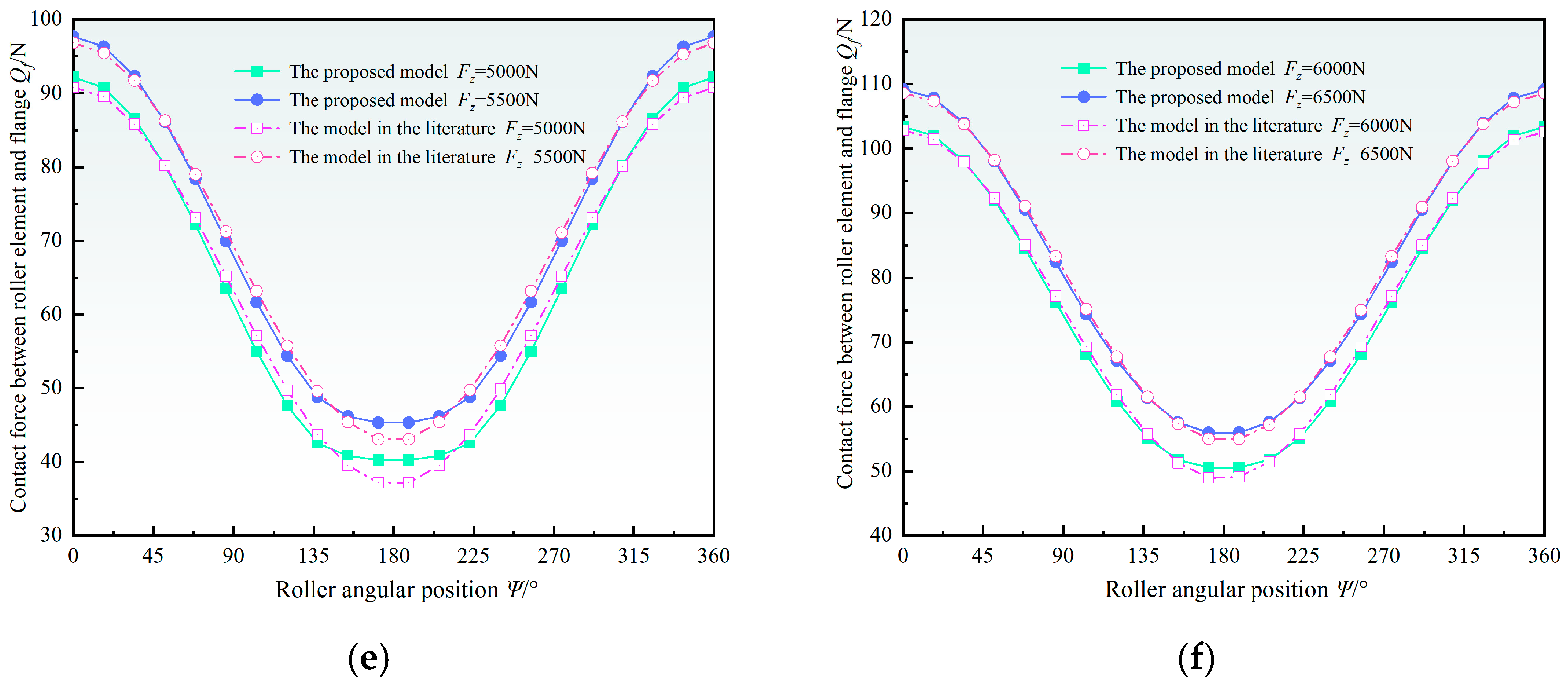
Figure 8 further analyzes the impact of axial load variation on the aforementioned contact forces.
The comparative results demonstrate that under different axial loads, the contact forces calculated in this study are in excellent agreement with the reference results, with minimal differences. These comparisons adequately validate the reliability and effectiveness of the proposed tapered roller bearing model and computational program, confirming its suitability for accurate bearing load distribution analysis.
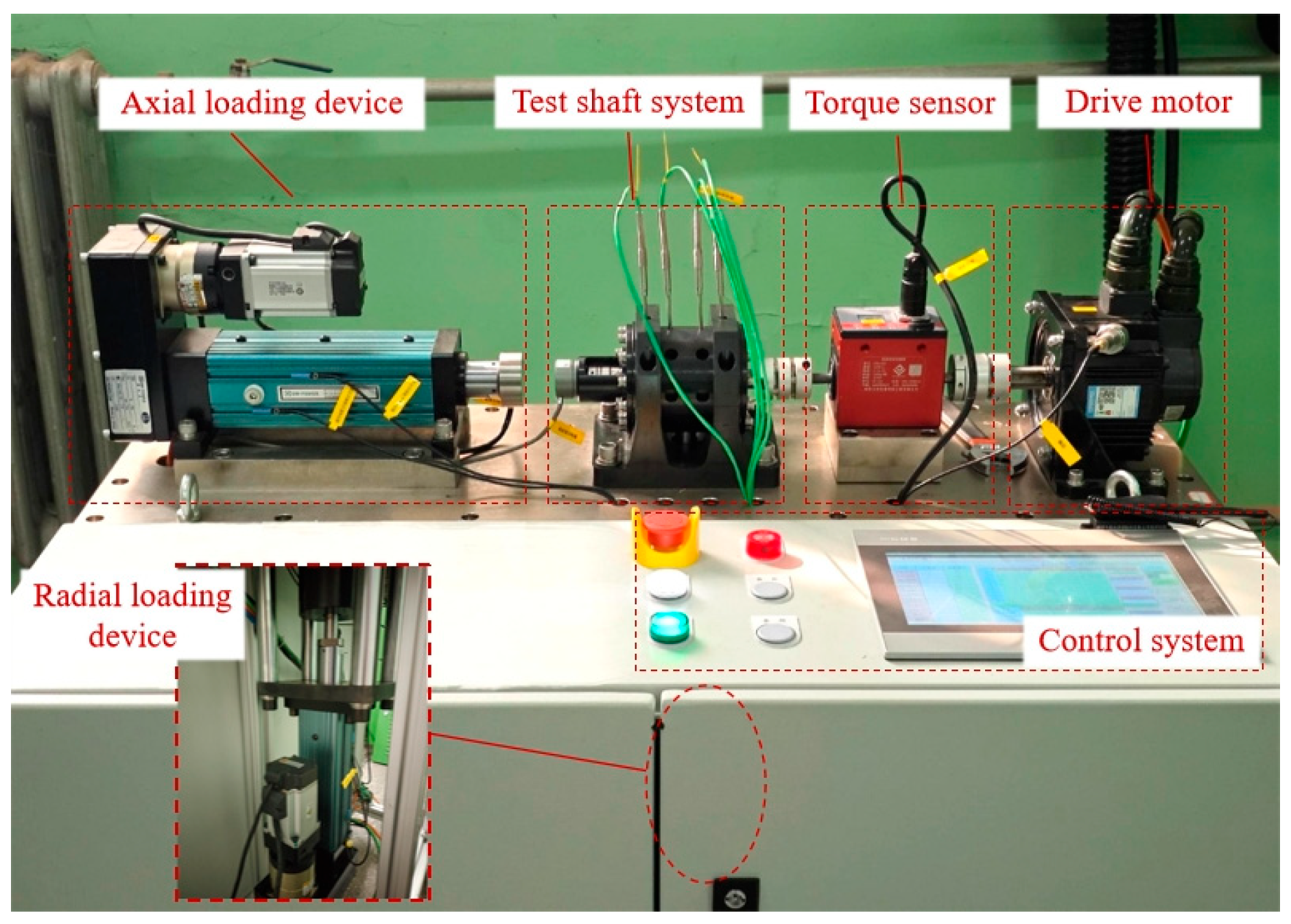
Regarding the direct experimental validation of the wear depth model, it is recognized that bearing wear is a slow evolutionary process, and obtaining sufficient and precise measured data poses significant challenges. However, the authors have previously successfully derived and established a wear model applicable to ball bearings based on Archard’s wear theory. This model has been utilized to study the influence of bearing ring installation angular misalignment on wear dispersion, and the relevant findings have been published [
36]. The wear depth model developed in this paper for tapered roller bearings follows a similar analytical approach and derivation methodology as the prior work. Therefore, it is reasonable to consider the validity of this model credible.
6.2. Bearing Model
The key structural parameters of the bearing analyzed in this study are listed in
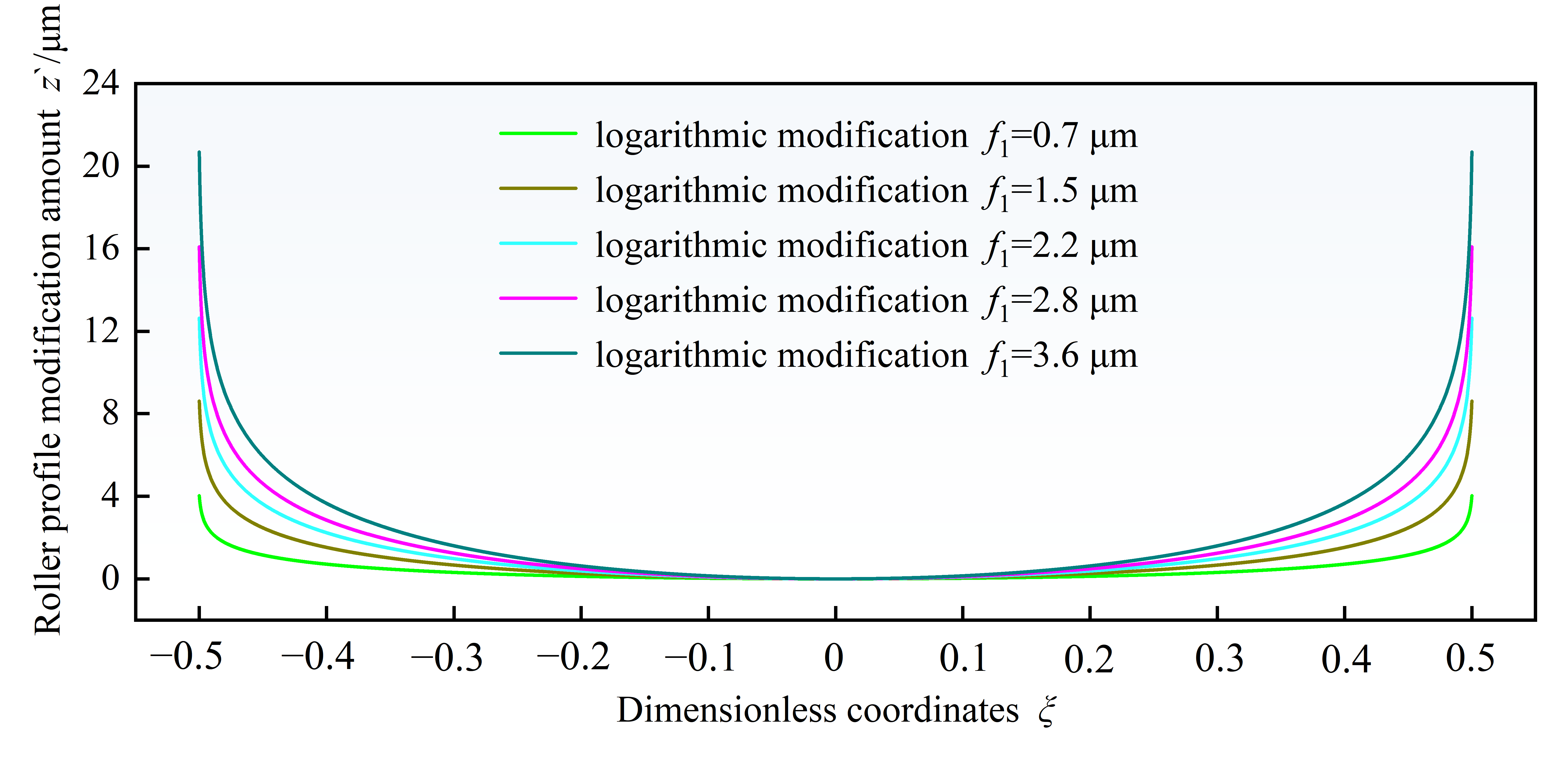
Table 1. The roller profile modification adopts a logarithmic curve form. The core modification parameter
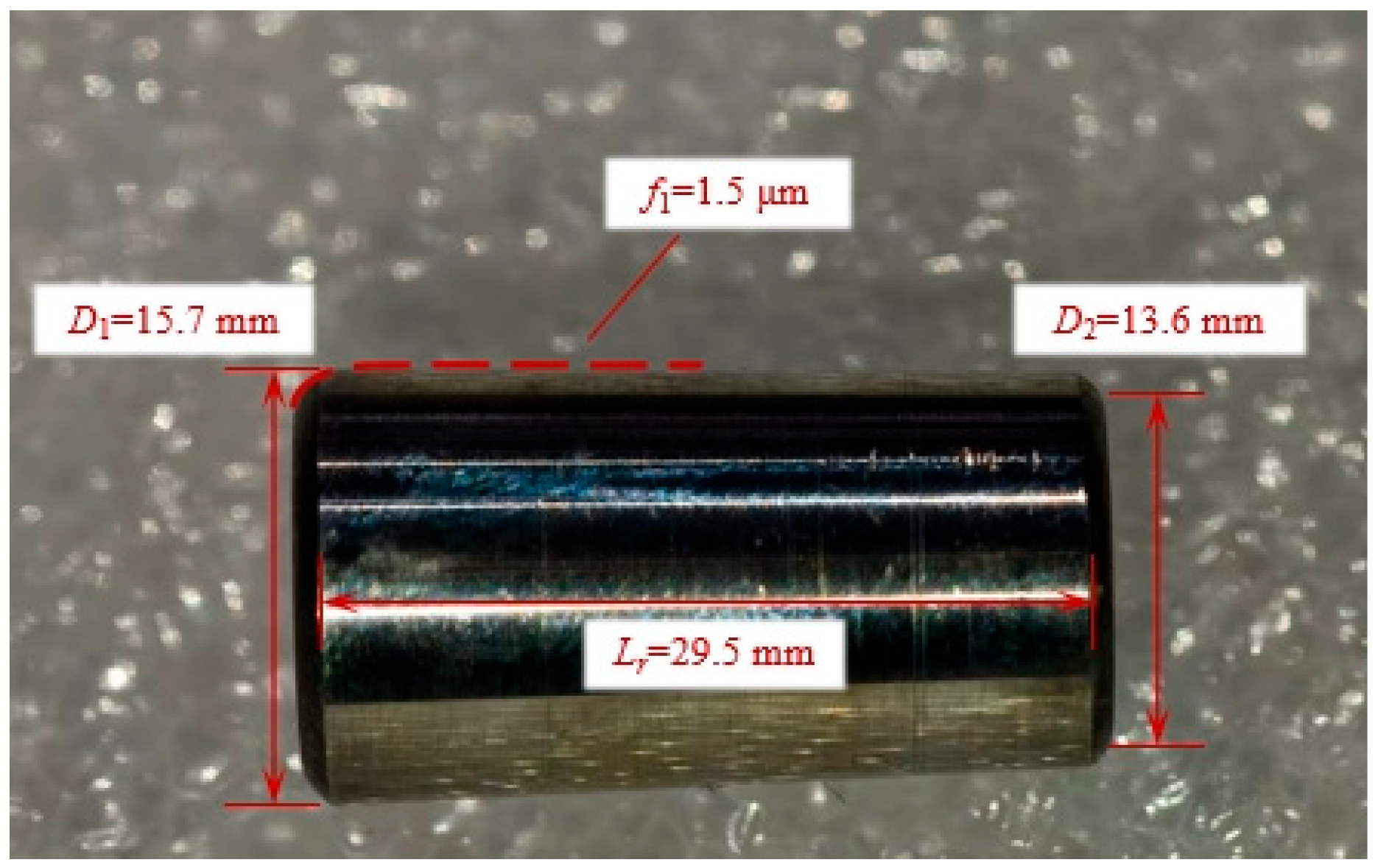
f1 is set to values of 0.7 μm, 1.5 μm, 2.2 μm, 2.8 μm, and 3.6 μm, respectively.
Figure 9 visually presents the specific generatrix profiles of the roller under these different
f1 parameters.
This research focuses on investigating the influence of different roller profiling parameters on bearing wear behavior under two loading conditions:
① Pure Axial Load Condition: Axial force is 2600 N.
② Combined Radial–Axial Load Condition: Axial force is 2400 N, and radial force is 1000 N.
The key structural parameters of the bearing analyzed in this study correspond to a standard medium-sized tapered roller bearing that is widely used in practical engineering, particularly in medium-light duty vehicle axle housings and industrial speed reducers. This bearing size was selected for three main reasons: (1) Its structural parameters are representative of mainstream tapered roller bearing designs, ensuring that the research findings can reflect the general rules of logarithmic profile modification on bearing wear. (2) It is readily available in the market and easy to process customized modified rollers, which facilitates the construction of the test platform and the implementation of experimental validation. (3) Relevant load distribution data for this size of bearing have been reported in the existing literature, providing a reliable benchmark for model validation.
Regarding the generalizability to larger-sized tapered roller bearings, the proposed analytical framework, integrating a quasi-static model and Archard-based wear model, is fundamentally universal. This is because the model is derived based on Hertzian contact theory, rigid-body kinematics, and Archard wear theory—all of which are general mechanical and tribological principles independent of specific bearing dimensions.
According to the definition method for bearing equivalent load, the equivalent load values for these two conditions are equal, both being 0.026 Cr, which falls within the light load range. The limiting speed of the bearing is 5300 r/min, while the operational speed in this study is set to 4500 r/min, meaning the bearing operates under light-load and high-speed conditions. Assuming the bearing operates two shifts per day, 8 h per shift, with an expected service life of 2 years, the total wear duration amounts to 12,000 h. Considering starved lubrication conditions, the bearing operates in the boundary lubrication regime. Referring to the work of Liu [
34], the dimensionless wear coefficient in the wear model is
K = 1.77 × 10
−8. Given the yield strength of the bearing steel
σs = 1667 MPa, the calculated wear coefficient is
Mpa
−1.
6.3. Influence of Roller Profile Modification on Contact Force and Contact Stress
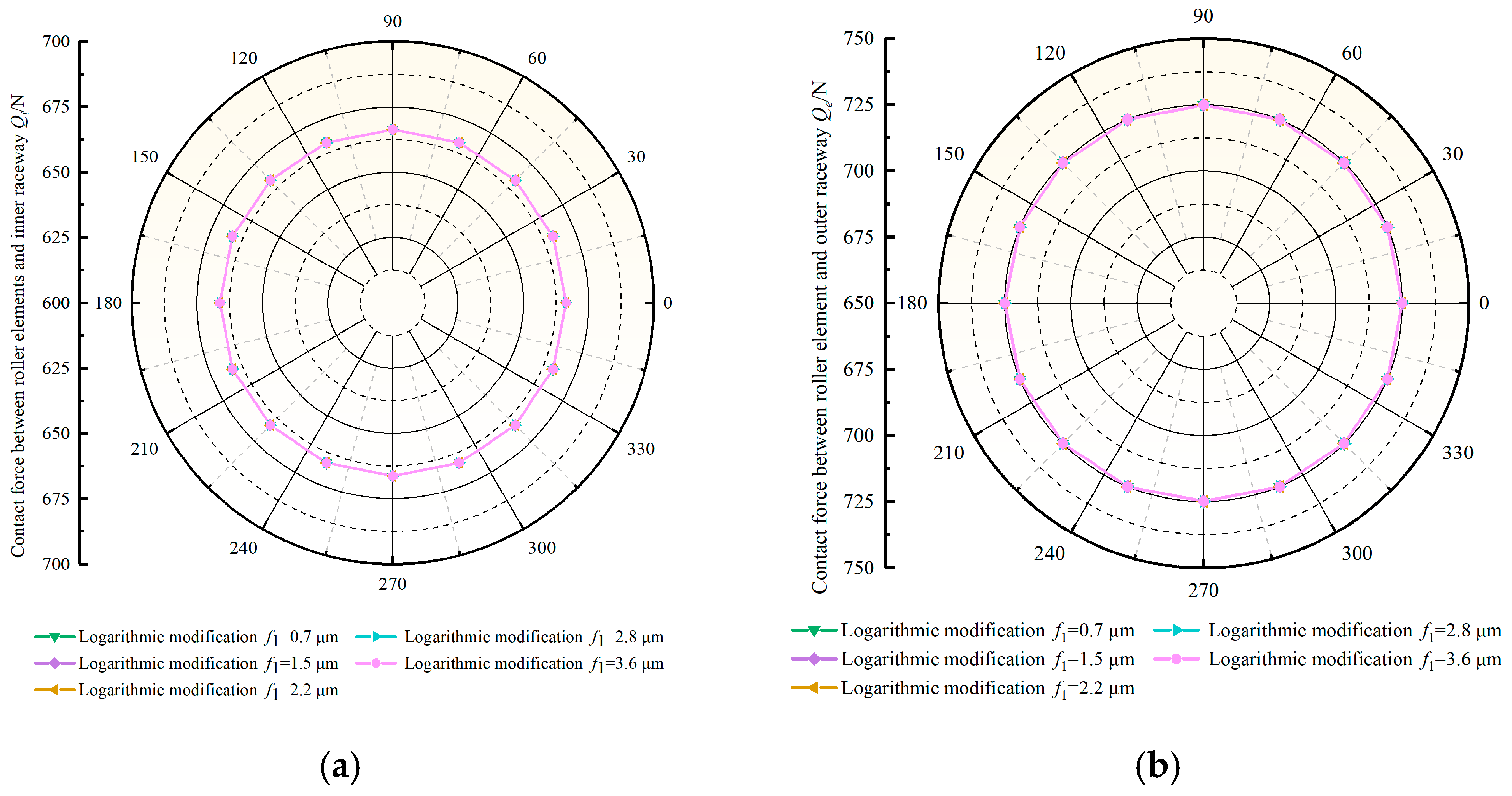
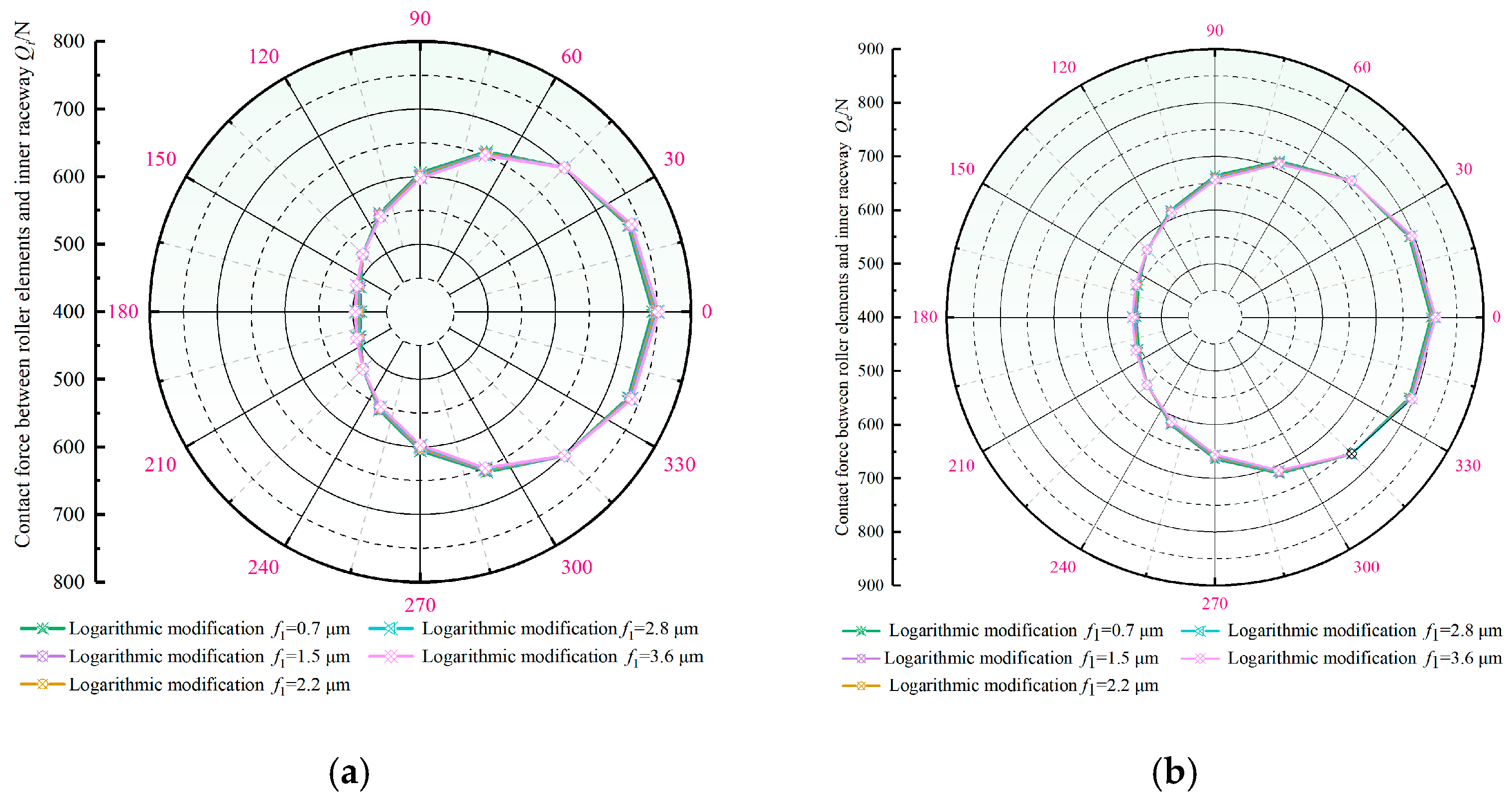
Figure 10 and
Figure 11 display the distribution of contact forces between the rollers and the inner/outer raceways under pure axial load and combined radial–axial load, respectively.
Analysis of
Figure 10a,b indicates that under pure axial load, the contact forces between the rollers and the inner/outer raceways are 665 N and 725 N, respectively. These forces remain constant regardless of the roller azimuth angle, showing a uniform distribution. In contrast, under the combined load action (
Figure 11a,b), the contact forces exhibit significant periodic fluctuation. The variation ranges for the contact forces between the rollers and the inner/outer raceways are 500 N–750 N and 550 N–800 N, respectively. It is noteworthy that although the pure axial load and the combined load have equivalent values, their contact force distribution characteristics differ markedly. A key observation is that at a speed of 4500 r/min, the centrifugal force generated by a single roller is approximately 58 N, and the difference between the contact forces on the inner and outer raceways is close to this centrifugal force value. The contact force under pure axial load is closer to the maximum value of the fluctuation range observed under combined load.
Crucially, the analysis results demonstrate that the roller profile modification form and amount have a negligible effect on the magnitude of the contact forces between the rollers and the raceways. The contact forces are primarily determined by the type and magnitude of the external loads.
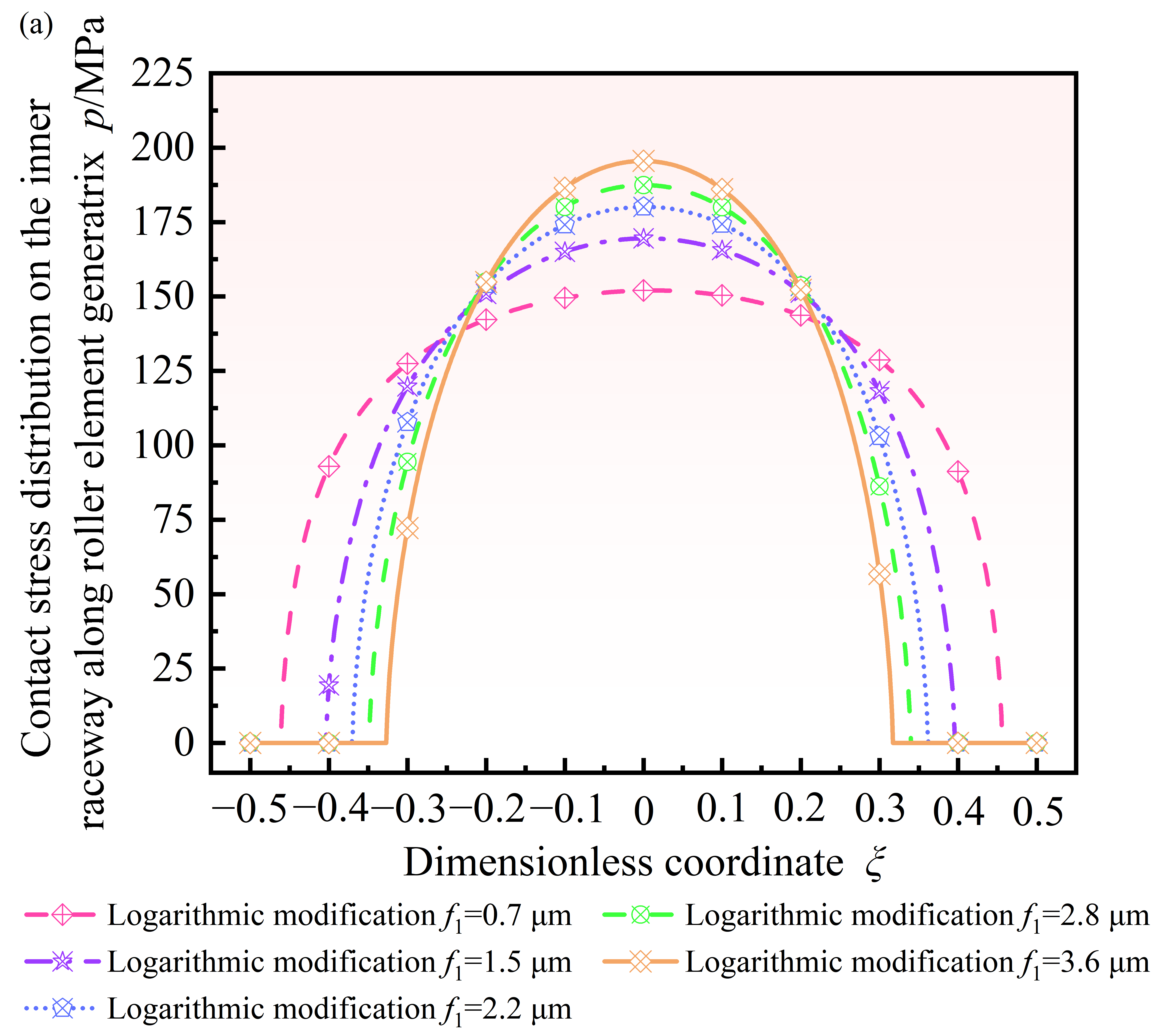
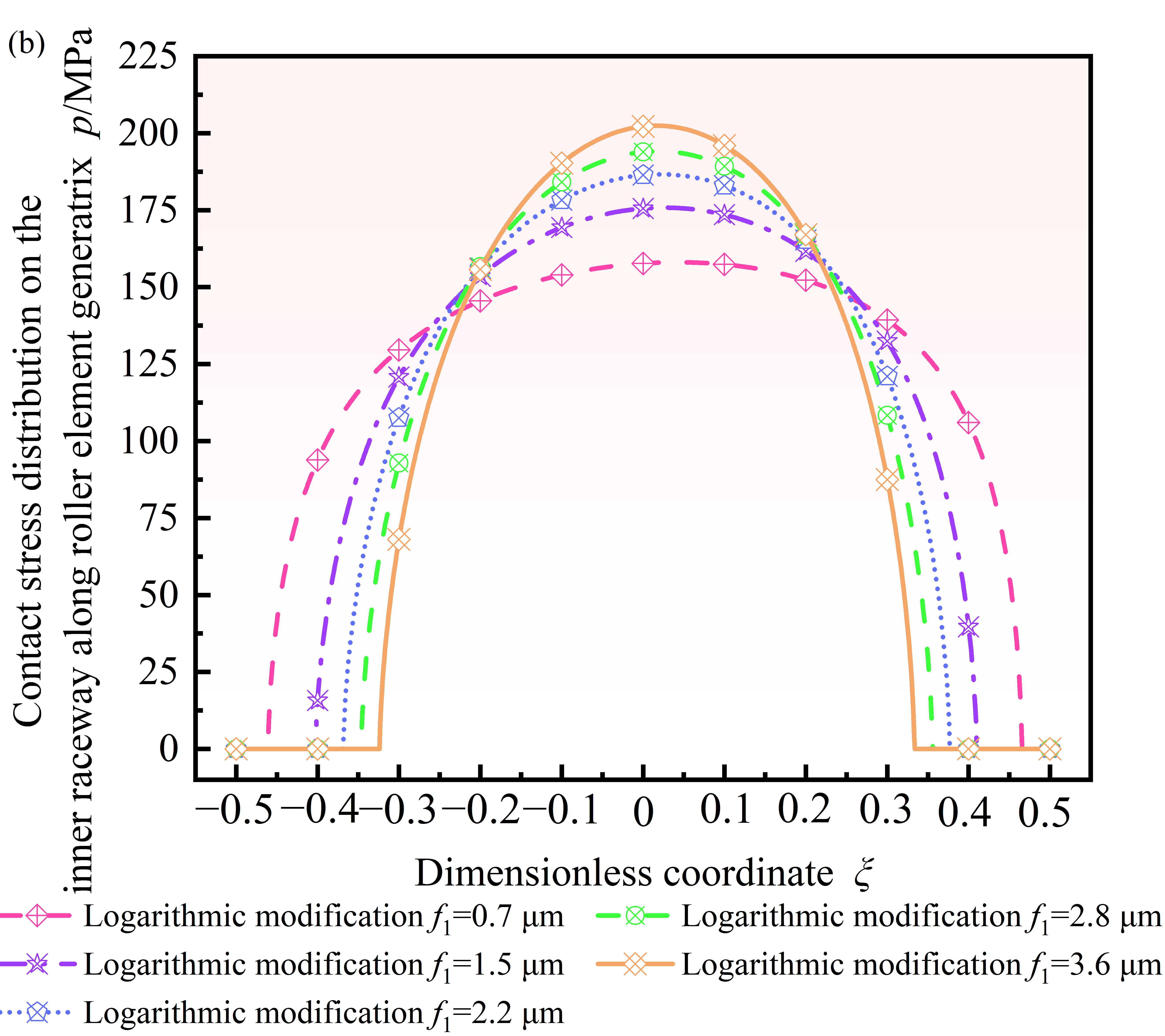
However, roller profiling exerts a decisive influence on the contact stress distribution.
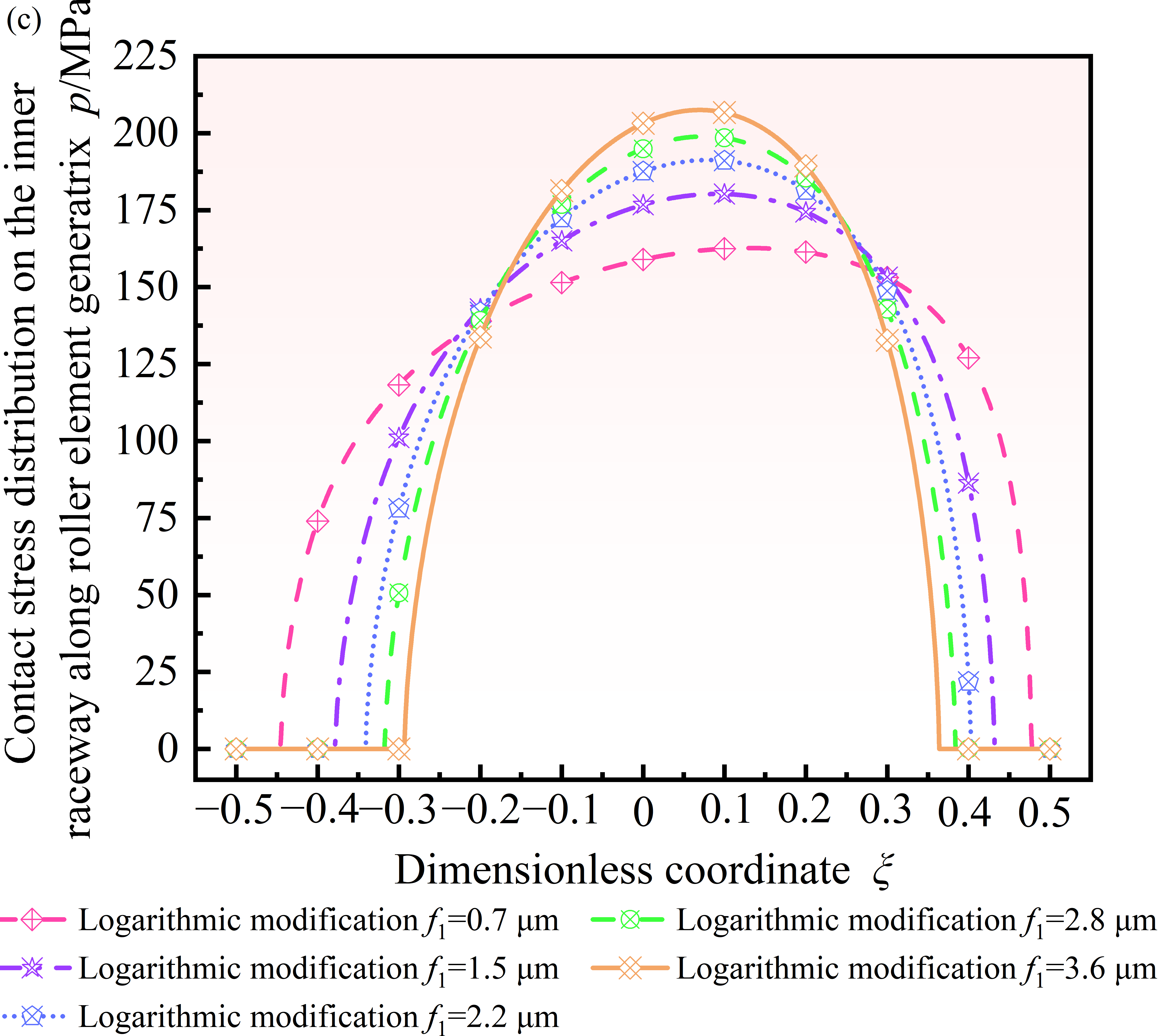
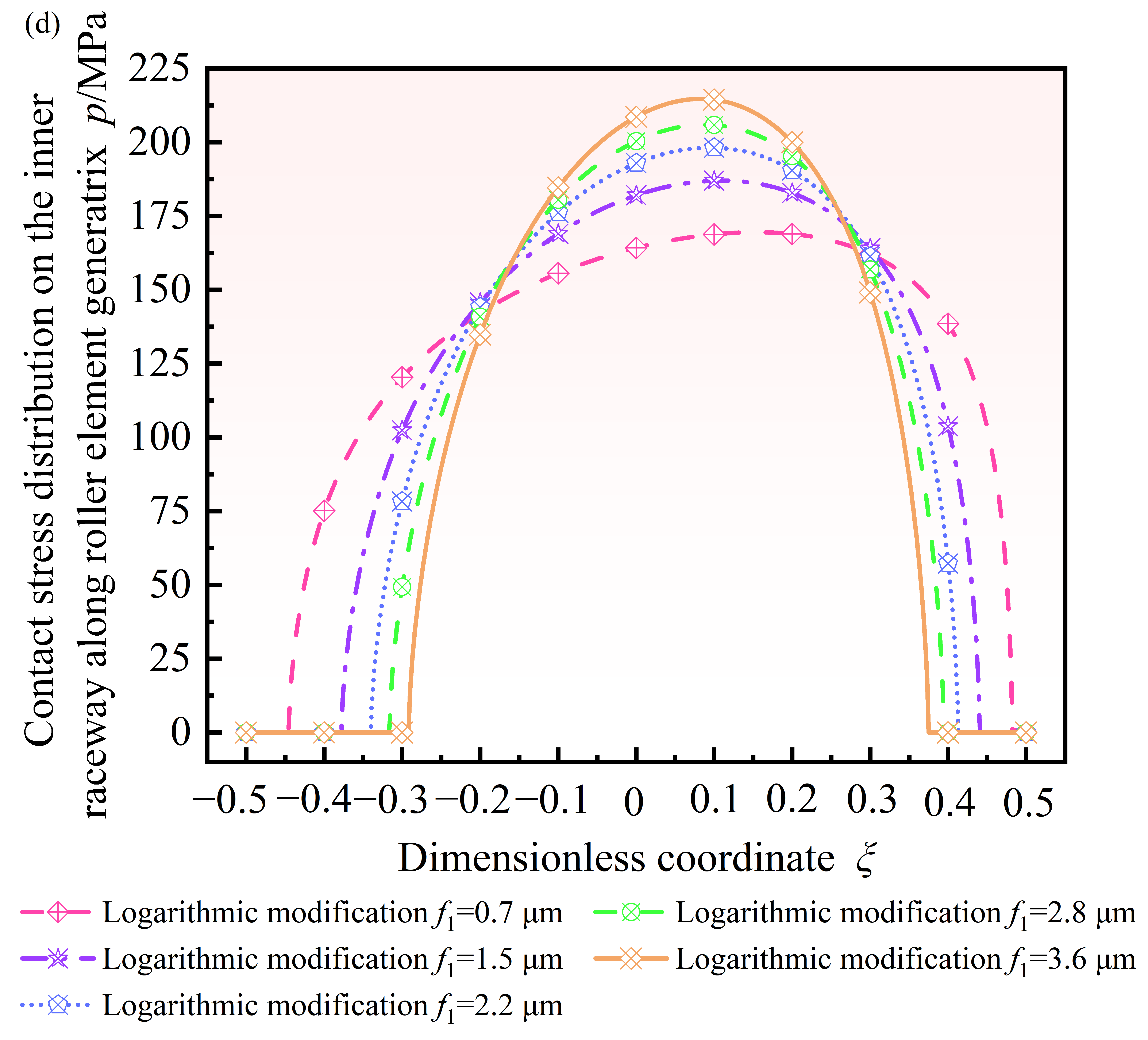
Figure 12 shows the contact stress distribution along the contact line direction for different modification coefficients
f1.
When the bearing is subjected solely to axial load (
Figure 12a,b), the contact stress is approximately symmetrically distributed about the midpoint of the roller generatrix, exhibiting only slight skewness due to centrifugal forces, raceway constraints, and rib contact. However, when the bearing is under combined load (
Figure 12c,d), pronounced asymmetric skewed distribution characteristics are observed. This is mainly attributed to the radial load component causing an angular displacement (tilting) of the inner ring, leading to a relative rotation angle between the inner ring and the rollers. Consequently, the compressive deformations on either side of the roller generatrix midpoint differ.
An increase in the modification coefficient
f1 significantly accentuates this skewed distribution characteristic. This is because a larger
f1 results in a greater profile modification amount at the roller ends, a shorter effective contact length along the generatrix direction between the roller and the raceways, and a weaker constraining effect of the raceways on the roller, thereby increasing the relative rotation angle. Quantitatively, for
f1 = 2.2 μm, the peak contact stress on the highly loaded side exceeds that on the opposite side by approximately 28%. This asymmetric pressure distribution is a critical factor predisposing the bearing to non-uniform wear and potential premature failure in the heavily loaded region [
37]. Furthermore, as
f1 increases, the contact stress distribution becomes more concentrated, and the stress peak rises significantly. This occurs because the increased modification amount reduces the roller’s actual load-bearing area.
6.4. Influence of Roller Profile Modification on Sliding Velocity
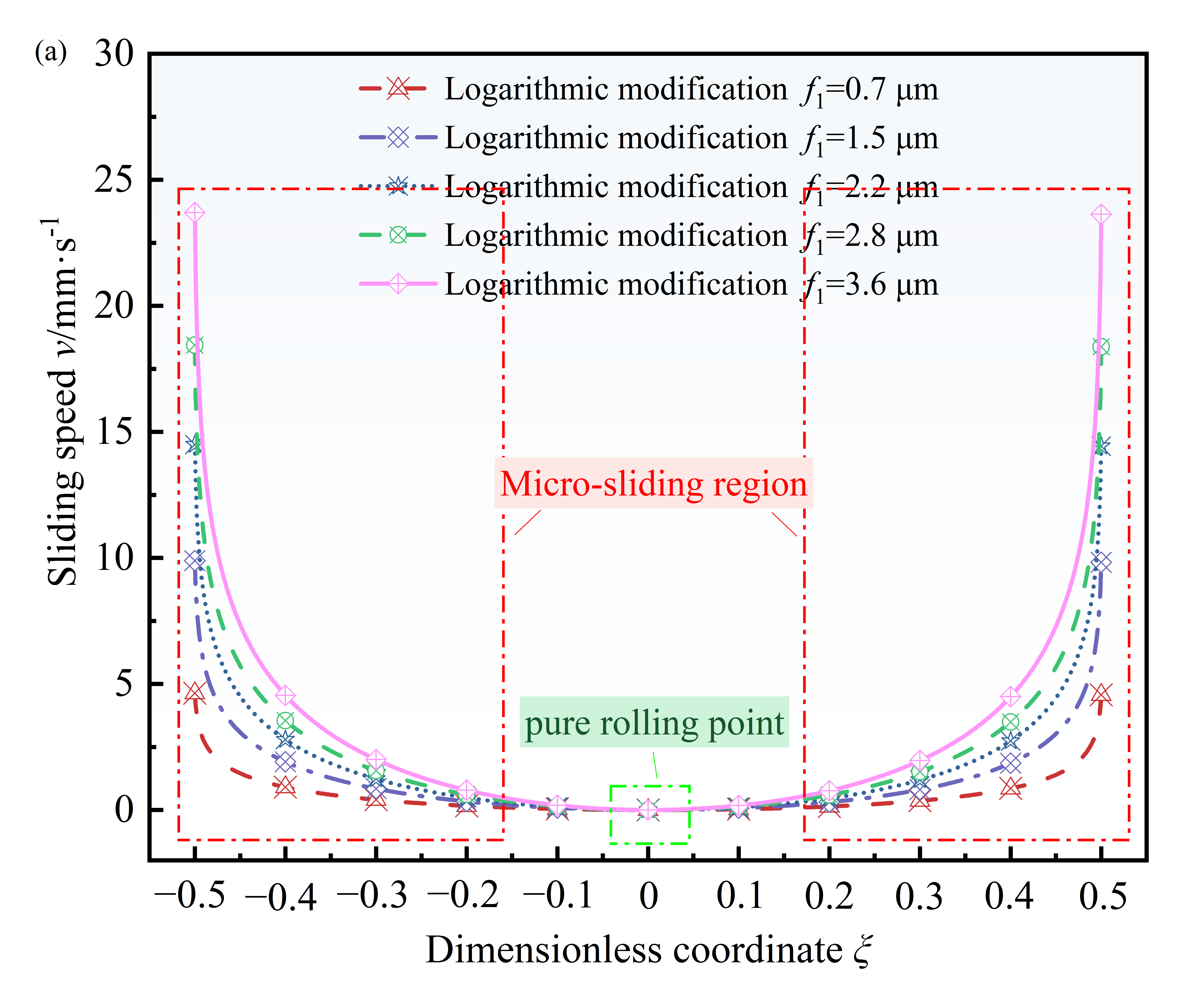
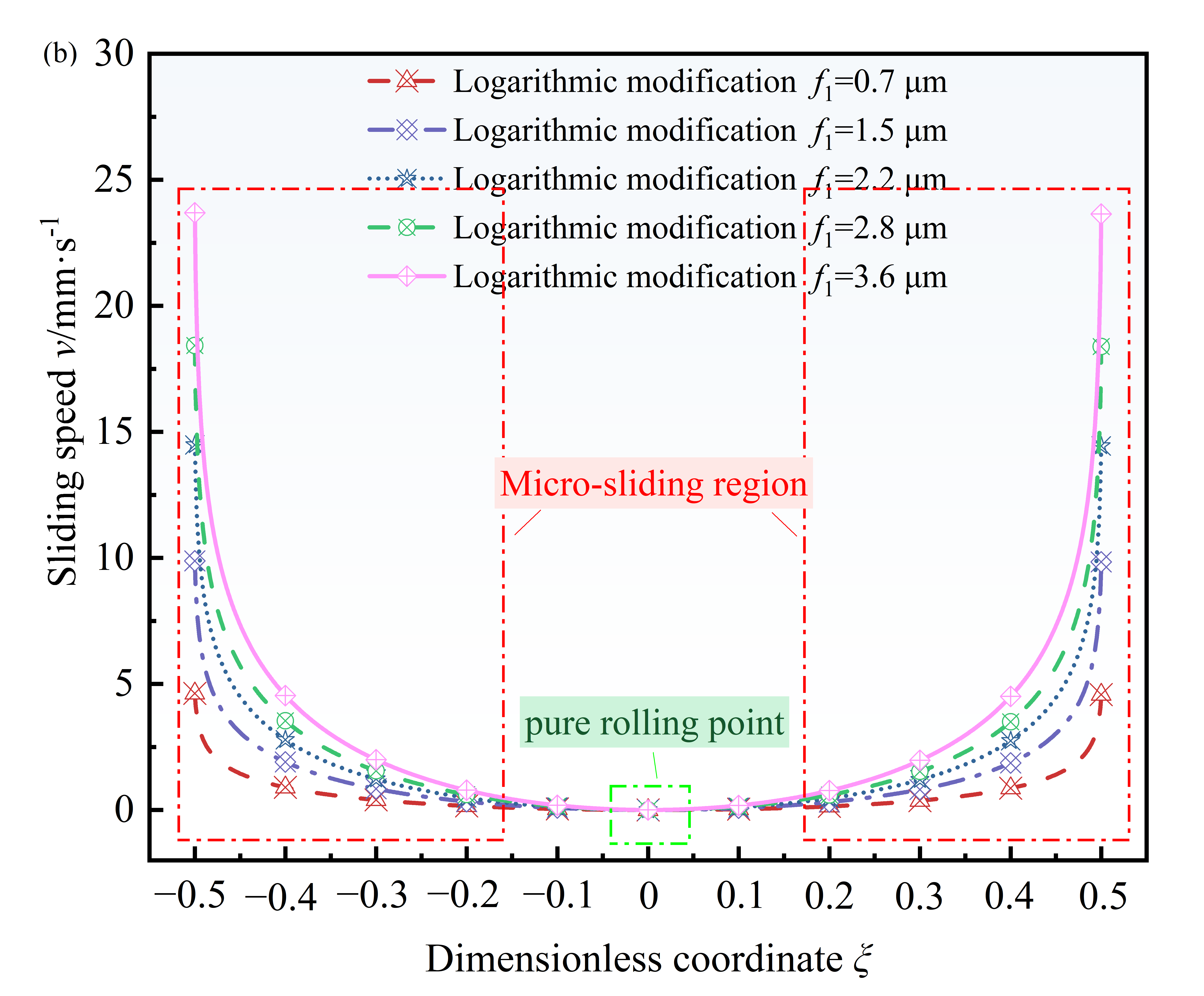
The distribution of sliding velocity along the contact lines between the rollers and the inner/outer raceways is illustrated in
Figure 13a,b. In the calculations performed for this study, the influence of contact deformation was neglected in the sliding velocity analysis, as it is considered minor compared to the geometric dimensions of the rollers and raceways. The magnitude of the sliding velocity primarily depends on the geometric parameters of the raceways and rollers, as well as the roller profile modification amount. Consequently, differences in the load applied to the rollers do not alter the fundamental distribution pattern of the sliding velocity.
Analysis of
Figure 13a,b reveals that the distribution pattern of the sliding velocity is highly correlated with the roller’s profile contour and exhibits symmetry about the midpoint of the roller generatrix. An increase in the modification parameter
f1 directly leads to an elevation in the sliding velocity. It is particularly noteworthy that the sliding velocity values are relatively large in the regions near the roller ends. When the modification coefficient
f1 reaches 3.6 μm, the maximum sliding velocity approaches 24 mm/s, indicating the potential for significant wear in this area. However, referring back to the contact stress distribution results in
Figure 12a–d, it is observed that the contact stress is effectively zero at the theoretical boundaries of the roller. This implies that wear will not occur at the roller edges [
38,
39]. Sliding occurs primarily near the roller ends and regions with geometric mismatch caused by profile modification. The midpoint of the roller generatrix is the pure rolling point.
6.5. Influence of Roller Profile Modification on Bearing Raceway Wear
The preceding analysis indicates that both the contact stress and sliding velocity between the roller and the raceway vary along the generatrix. This inevitably leads to differences in the wear depth at various points within the contact area on the tapered roller bearing raceways.
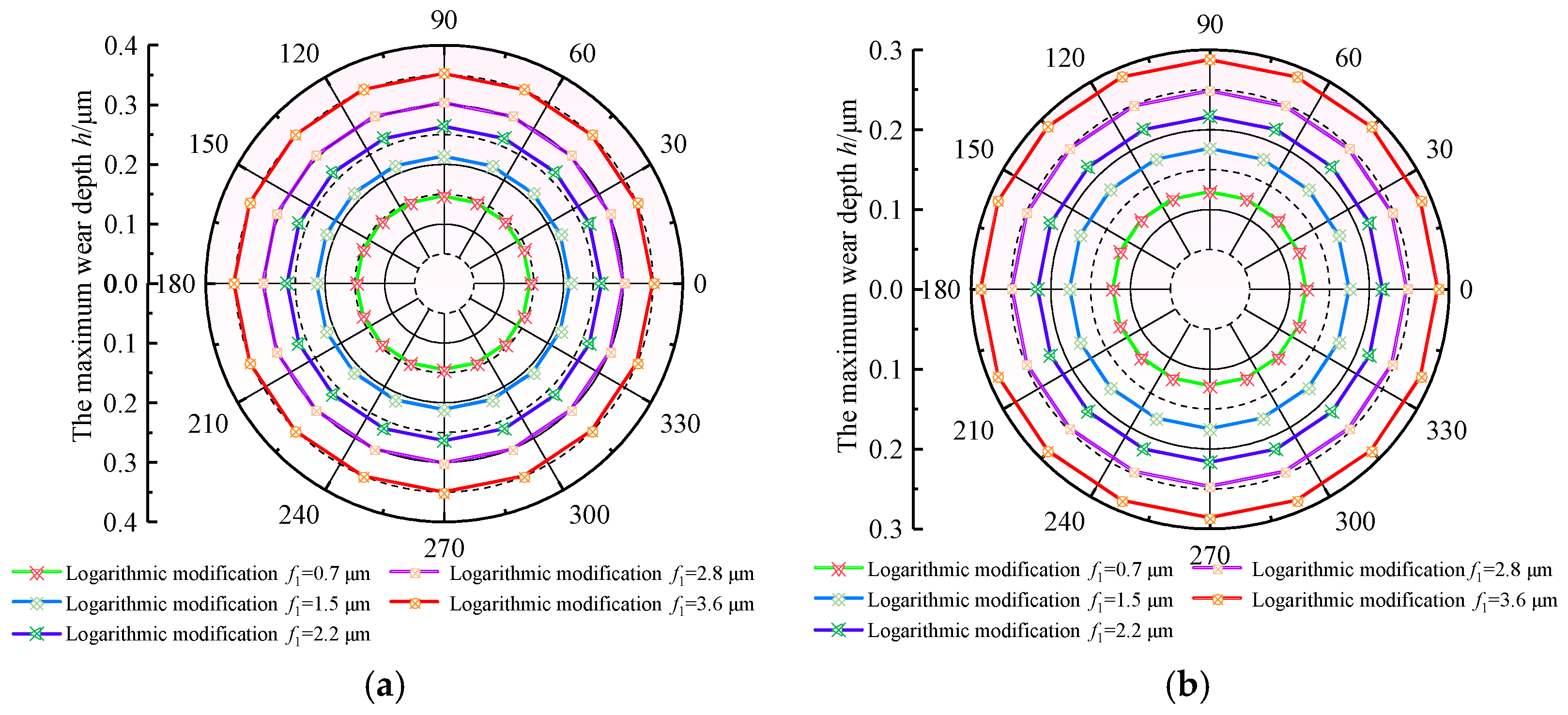
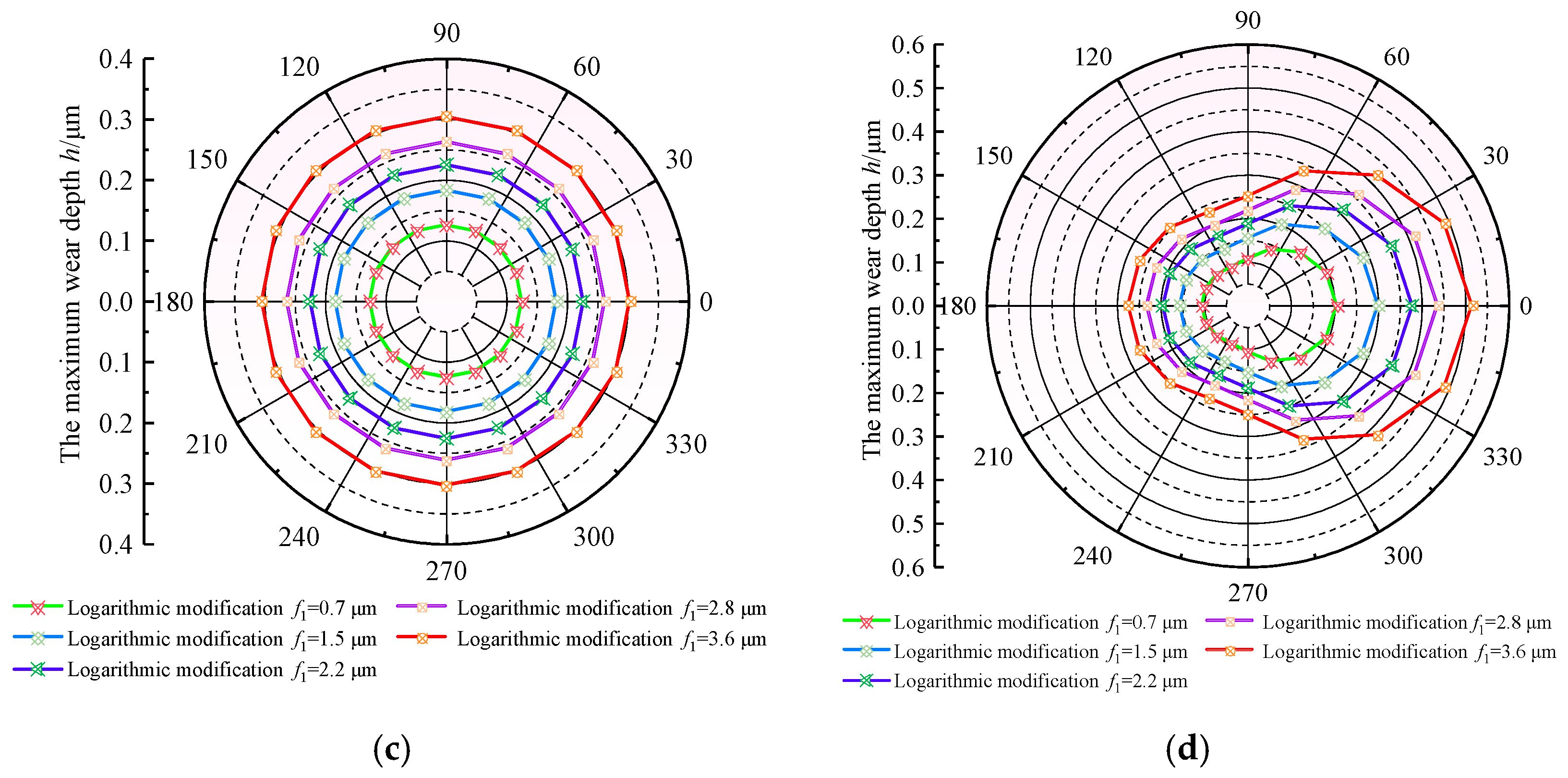
Figure 14a–d present the maximum wear depth in the contact area between the rollers and the inner/outer raceways at different azimuth angles under pure axial load and combined radial–axial load, respectively.
For the inner raceway, the maximum wear depth remains consistent across different azimuth angles, regardless of the loading condition. This uniformity arises because the rotation of the inner ring subjects its entire circumference to an identical load history, resulting in even wear. In contrast, the wear depth on the outer raceway is strongly dependent on the angular position of the roller. Under pure axial load, the wear depth is the same at all points on the outer raceway. However, under combined load, the significantly different contact load distributions at various position angles, as shown in
Figure 11a,b, lead to distinct contact stress distributions, causing the maximum wear depth on the outer raceway to exhibit considerable variation with the roller’s azimuth angle.
A clear trend is observed: the wear depth of both the inner and outer raceways increases monotonically with the increase in the roller profile modification amount f1, irrespective of the load type.
Specifically, for the inner raceway, under axial load, when f1 increases from 0.7 μm to 3.6 μm, the wear depth rises from 0.15 μm to 0.35 μm, an increase of 133%. Under combined load, it increases from 0.125 μm to 0.305 μm, an increase of 144%. For the outer raceway, under axial load, the wear depth increases from 0.12 μm to 0.29 μm (a 142% increase). Under combined load, due to non-uniform wear, the range of wear depth distribution expands from 0.1 to 0.2 μm to 0.23–0.52 μm as f1 increases.
This data fully demonstrates that the degree of modification is a critical factor affecting bearing wear depth. The fundamental reason lies in the significant alteration of the contact stress distribution between the roller and the raceway caused by profiling, as shown in
Figure 12a–d.
Comparing the total wear depth under the two loading conditions reveals that even with equivalent loads, combined load induces significant non-uniformity in the wear depth of the bearing raceways. For instance, when
f1 = 0.7 μm, the variation range of the total wear depth under combined load (0.225–0.325 μm) is distributed around the value under pure axial load (0.27 μm). However, when
f1 = 3.6 μm, the total wear depth under pure axial load (0.64 μm) is close to the lower limit of the range under combined load (0.535–0.825 μm). This suggests that as the modification amount increases, combined load tends to aggravate bearing wear [
26,
40].
A deeper analysis of the data in
Figure 14a–d shows that the growth of wear depth is not simply linear with
f1 but exhibits an accelerating growth characteristic. For example, when
f1 increases from 0.7 μm to 2.2 μm (a 214% increase), the wear depth of the inner raceway increases by about 47%. Yet, a further increase in
f1 from 2.2 μm to 3.6 μm (a 64% increase) results in an additional 40% growth in wear depth. This non-linear behavior can be explained by the Archard wear model (Equation (29)): wear depth is the product of contact stress
p and sliding velocity
v. As shown in
Figure 12 and
Figure 13, larger modification coefficients lead to a reduced contact area and exacerbated geometric mismatch, causing both
p and
v to increase super-linearly. Ultimately, this results in the wear depth increasing at a faster rate than the increase in
f1 itself, highlighting the trade-off between the benefit of profiling in mitigating edge stress and its detrimental effect on wear resistance [
41].
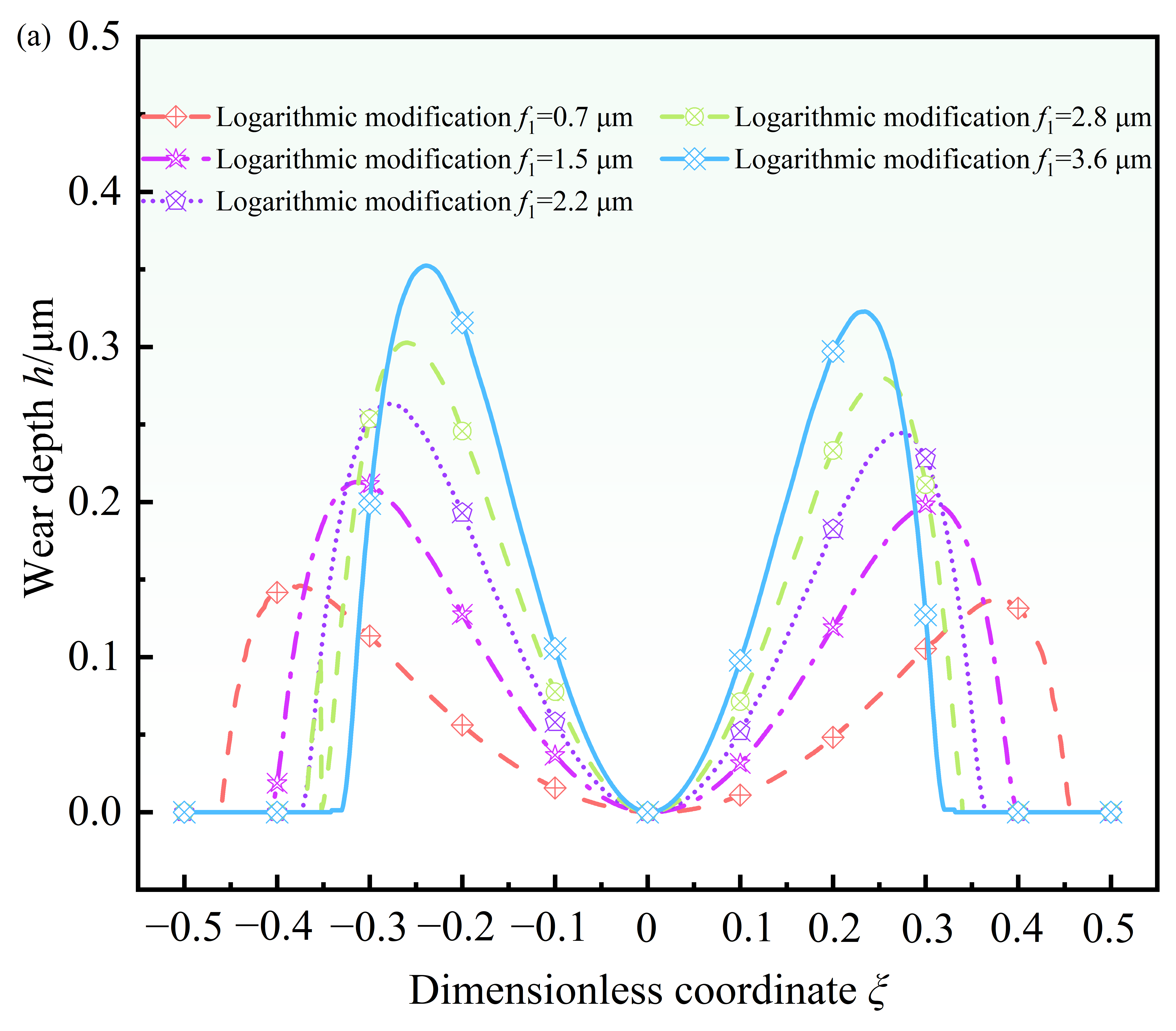
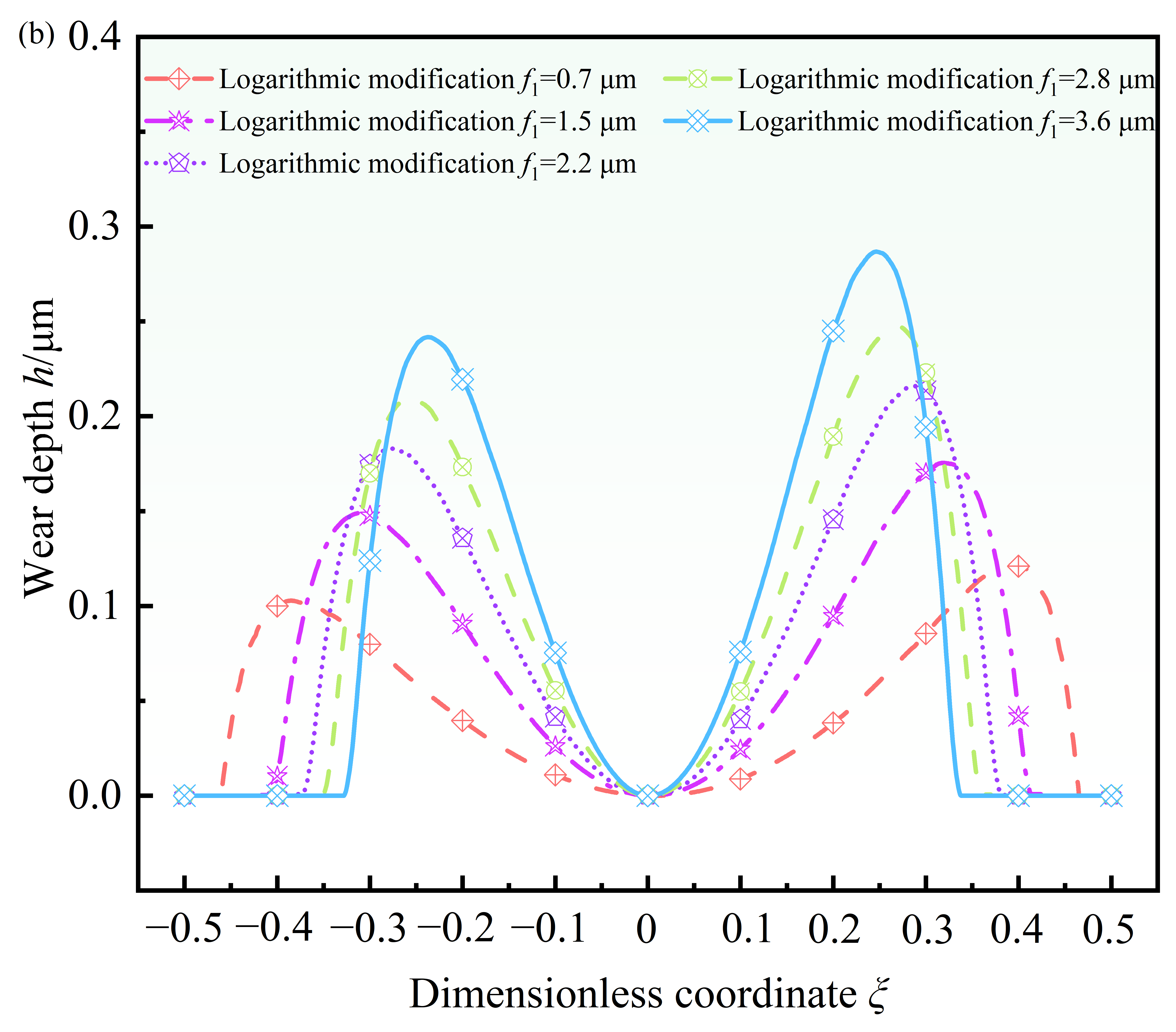
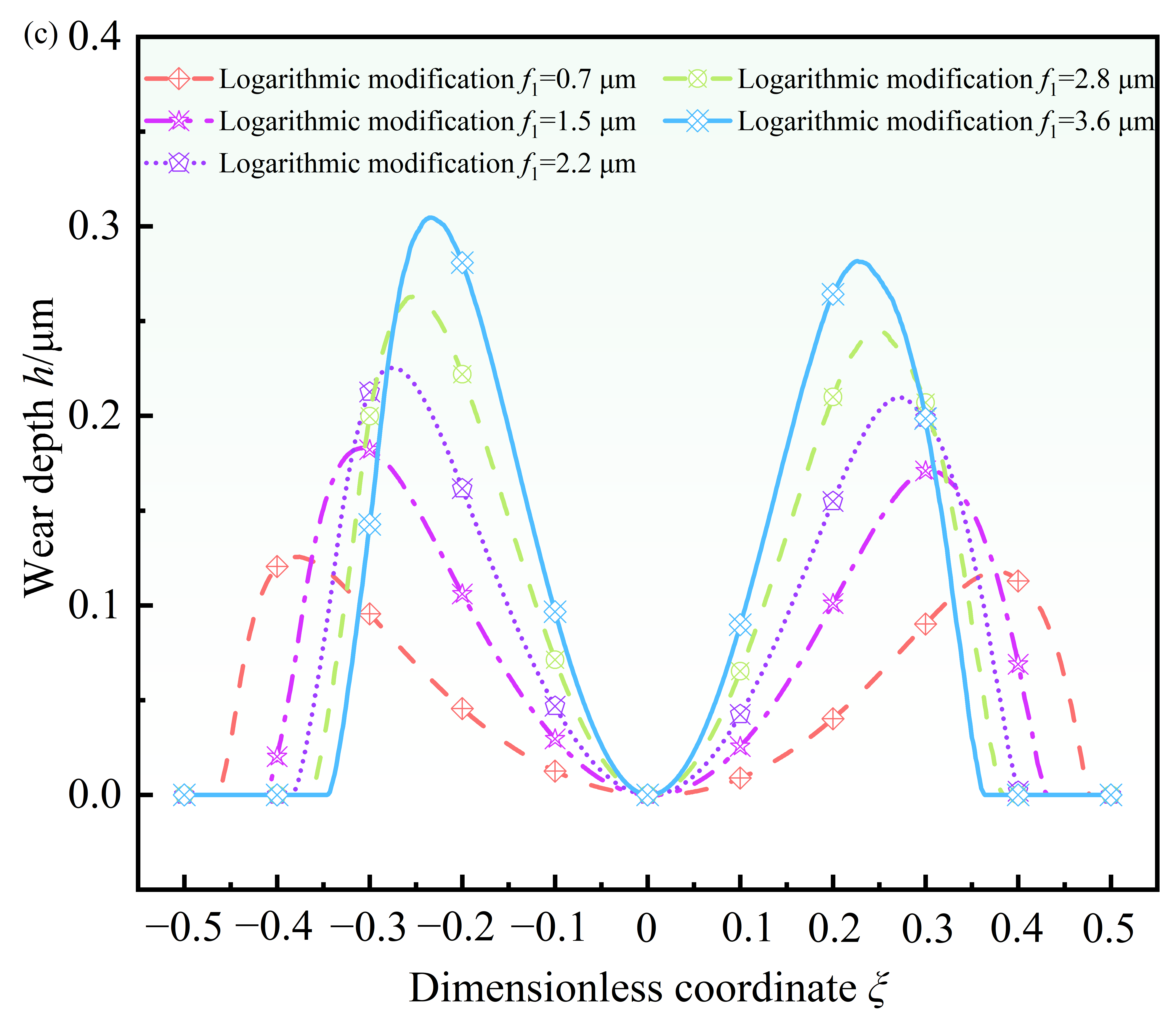
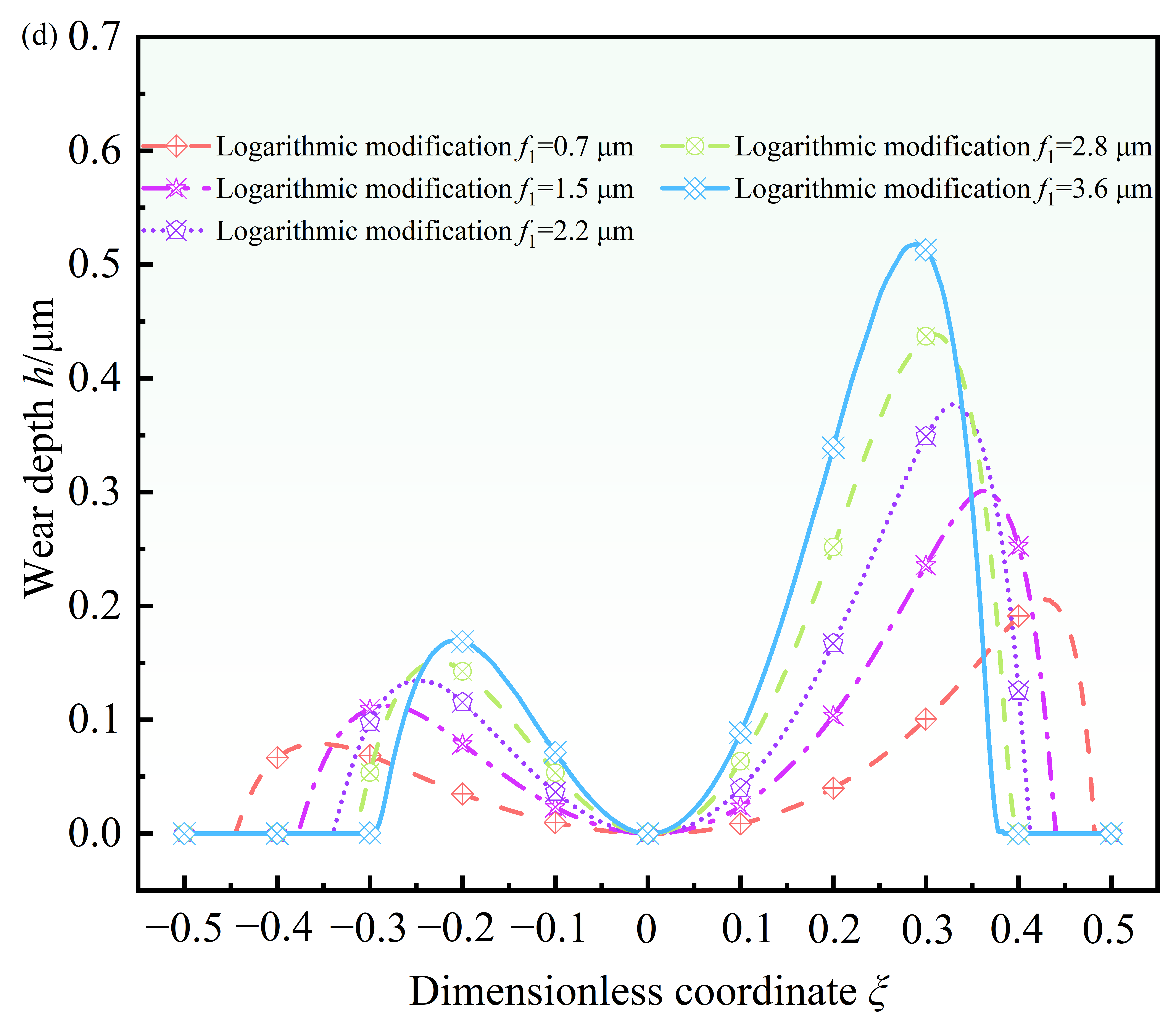
Figure 15a–d provide further details of the wear depth distribution along the roller generatrix. For the combined load, only the distribution at the position of the most heavily loaded roller is shown. Although the peak contact stress is located near the generatrix midpoint, as shown in
Figure 12, the wear amount in this vicinity is not the highest due to the relatively small sliding velocity there as shown in
Figure 13. The maximum wear depth occurs at the position where the product of contact stress and sliding velocity is greatest. The figures show that the wear depth first increases and then decreases from the generatrix midpoint towards the ends. As the modification coefficient
f1 decreases, the wear peak value decreases, and the location of the peak shifts towards the roller ends. This implies that a smaller modification amount yields a smaller maximum wear depth, but the area of concentrated wear moves closer to the ends.
The shifting of the wear peak location has important implications for bearing life prediction. A wear peak near the midpoint might seem less critical initially, but combined with the higher sliding velocity in that region, it could lead to rapid alteration of the roller profile, potentially inducing new stress concentration points. Conversely, a wear peak near the ends, if accompanied by an optimized profile design that ensures more uniform pressure distribution, might be more manageable. Furthermore, the significant asymmetry of the wear depth under combined load implies that the bearing clearance will evolve asymmetrically. This could define a functional service life shorter than that predicted by traditional fatigue models due to unacceptable vibration and noise occurring well before the average wear depth becomes critical.
Finally, the non-uniform distribution of wear depth along the generatrix is primarily caused by the non-uniformity of the contact stress. Especially under combined load, the tilting of the inner ring leads to a severely skewed contact stress distribution, resulting in a significantly asymmetric wear depth profile. This phenomenon is particularly pronounced on the outer raceway and intensifies with increasing modification amount (e.g., the difference between the two wear peaks on the outer raceway increases from 0.13 μm to 0.35 μm as f1 increases from 0.7 μm to 3.6 μm under combined load). Such asymmetric wear can worsen the contact stress distribution, increasing heat generation and thermal stress and creating a positive feedback loop that further shortens the bearing’s service life.