Article

Comparison of Tribological Performance of Ashless Sulfur-Free Phosphite Ester Versus ZDDP Additives at Electrified Interfaces


1
Department of Chemical Engineering, Materials Research Institute, Pennsylvania State University, University Park, PA 16803, USA
2
Syensqo, Bristol, PA 19007, USA
*
Authors to whom correspondence should be addressed.
These authors contributed equally to this work.
Lubricants 2026, 14(2), 67; https://doi.org/10.3390/lubricants14020067
Submission received: 30 December 2025 / Revised: 21 January 2026 / Accepted: 26 January 2026 / Published: 1 February 2026
(This article belongs to the Collection Rising Stars in Tribological Research)

Abstract

In electric vehicle (EV) drivetrains, lubricant films must not only mitigate friction and wear but also manage stray currents to safely dissipate stray charge and avoid micro-arcing. This study directly compares how a conventional antiwear additive (ZDDP) and a long-chain, ashless, sulfur-free phosphite ester (Duraphos AP240L) manage this balance under current-carrying boundary lubrication conditions. Reciprocating steel-on-steel tests were conducted at fixed load and speed with applied current densities of 0, 0.02, and 42.4 A/cm2. Friction and four-probe electrical contact resistance (ECR) were measured in situ, and impedance of tribofilms was measured over a 1–105 Hz range after friction test. In the presence of ZDDP, ECR initially increased and then decreased to a value that was as low as the initial direct contact of two solid surfaces or even lower sometimes. During the initial stage with high ECR, a well-defined impedance semicircle was observed in the Nyquist plot; after forming the tribofilm with low ECR, frequency dependence of impedance could not be measured due to the very low resistance. The decrease in ECR suggested a structural evolution of the anti-wear film on the substrate. However, post-test wear analysis indicated that the formation of this film was accompanied by tribochemical polishing of the countersurface and sometimes pitting of the substrate, which may have been due to localized electrical discharge producing trenches deeper than ~0.5 µm; in additive-free base oil, wear was dominated by ploughing with micro-cutting of the substrate. In contrast, AP240L performed better in terms of friction and wear, showing a remarkable ~30% lower coefficient of friction, while the overall cycle dependence of ECR was similar to the ZDDP case. AP240L showed negligible boundary film controlled wear producing a shallow, smooth track (depth < 0.2 µm) during the friction test, and there was no sign of electrical arc damage. These findings support long-chain, ashless, sulfur-free phosphite esters as promising candidates for EV boundary lubrication where both mechanical and electrical protection are required.

1. Introduction

Zinc dialkyldithiophosphate (ZDDP) is the anti-wear additive most widely used in engine and industrial oils because, under frictional shear, it is readily transformed to protective polyphosphate tribofilms that markedly reduce wear at high contact pressure [1,2]. However, the question remains regarding whether ZDDP chemistry is still the best for electrified drivetrains in modern electric vehicles (EVs) [3]. In these drivetrains, inverter switching creates a potential difference between the stationary parts of the motor (windings and housing) and its rotating parts (rotor and shaft), building up interfacial charges that are dissipated as stray currents through capacitive paths in bearings and sliding contacts [4,5]. If the tribofilm is not conductive enough, the local electrical charge buildup can lead to dielectric breakdown and electrical arcing [6,7,8], which can damage the solid surface. It has been reported that small electrical biases (even 1–5 V) can suppress ZDDP film growth; since the film is not homogeneous, direct current can flow to locally thin zones, causing band-like damage [9]. Severe wear under a direct current flow condition has also been reported for ZDDP-containing oils [7,10]. These reports suggest that ZDDP films may not be ideal for current-carrying tribo-contacts. For current-carrying sliding interfaces, it is imperative to pursue additives that deliver reliable friction and wear performance while maintaining a boundary film that remains electrically stable under stray current and resists breakdown, thereby preventing discharge-type damage.
Recently, ashless sulfur-free phosphorus esters (phosphates/phosphites) have been introduced as anti-wear additives [11,12,13] that can replace ZDDP in EV drivetrains. They can form zinc-free iron (poly)phosphate tribofilms while avoiding the Zn/S-derived copper corrosion and ash associated with ZDDP, especially under high loads and transient heating [13,14]. This is particularly relevant in wet e-machine (oil-cooled motor) designs, where lubricant circulates through the integrated motor–axle unit and directly contacts copper windings and bearings. Sulfur species in the oil can form copper sulfides, and conductive deposits can create electrical bridges that reduce insulation [15,16]. The absence of Zn and S in ashless sulfur-free phosphorus esters prevent the formation of conductive sulfide species (ZnS or FeS), resulting in a tribofilm with a higher interfacial contact resistance than that from ZDDP. Tribofilm with higher resistance will reduce the possibility of excessive current leakage through the conductive spots, thereby mitigating surface damage.
Despite their promise, studies of ashless sulfur-free additives under electrified conditions have been limited. Nonequilibrium molecular dynamics simulations suggest that external electric fields may accelerate phosphate ester mechanochemical decomposition on iron and, at sufficiently strong fields, lower the activation barrier and favor the polyphosphate growth [17]. In electrified tribo-tests, ashless amine phosphate ester additives were reported to lower friction and markedly reduce wear compared to a conventional automatic transmission fluid (ATF) [13]. An ATF containing a phosphonium-based ionic liquid was found to raise the mean electrical potential across the contact (i.e., interfacial electrical resistance) and reduce wear, though friction was higher at very high loads and currents [18].
Within ashless phosphorus chemistry, dialkyl hydrogen phosphites (DAHPs) are particularly promising in the EV context. They have been touted as the “most potent phosphorus source” for high-torque, low-speed contacts, and they also provide secondary antioxidant capability [19]. Their alkyl architecture appears to render a balance between antiwear and antiscuff performance [20,21,22,23]. Short alkyl chains can push scuffing thresholds but increase corrosivity, whereas appropriately structured long chains mitigate corrosive wear [23]. The surface reactivity of three coordinated phosphorus compounds seems beneficial since phosphites readily react with Fe/Fe-oxide, forming iron–phosphorus films early and surpassing analogous dialkyl phosphates in incipient seizure load [23]. In boundary lubrication regimes, DAHP films are often thinner than ZDDP and yield low friction, with wear not significantly higher than that of ZDDP under the reported conditions [12]. These considerations motivate our focus on DAHPs under applied current to test whether their sulfur-free boundary chemistry can also sustain higher interfacial resistivity while controlling friction and wear in stray current conditions.
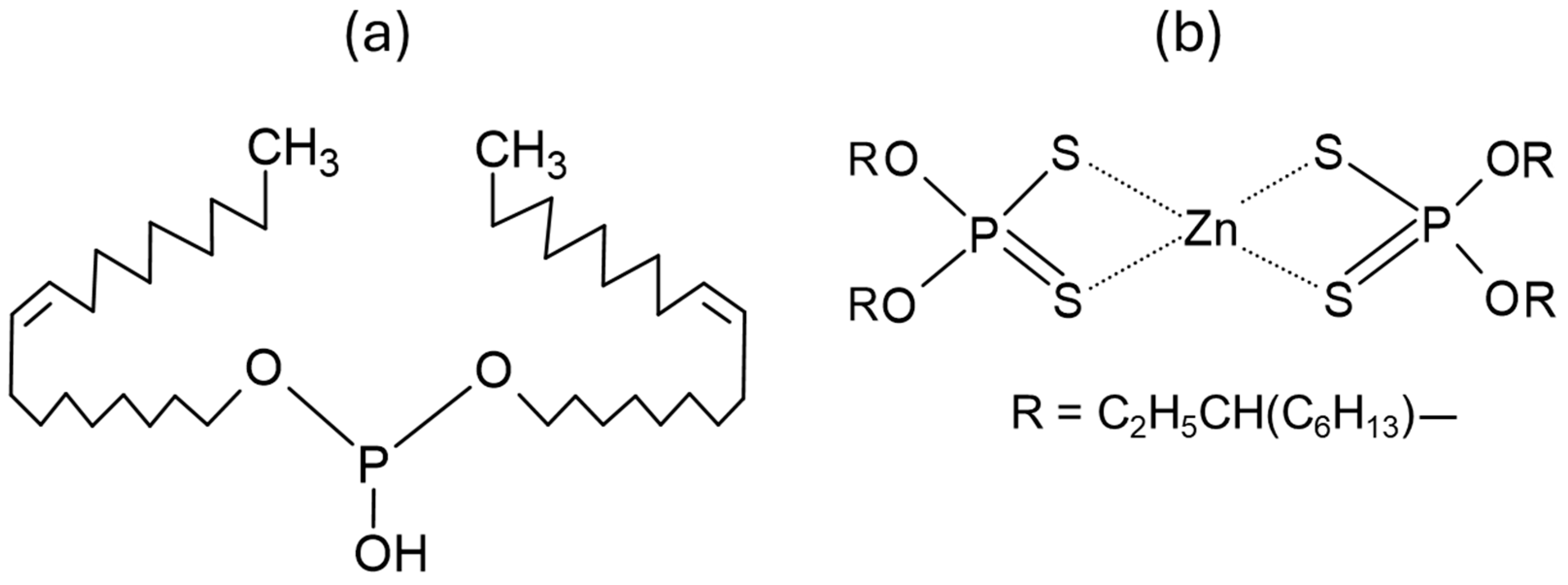
In this work, we compare a commercially available long-chain ashless sulfur-free phosphite ester (Duraphos AP240L, Syensqo, Bristol, PA, USA); dioleyl hydrogen phosphite, Figure 1a) with a ZDDP with secondary alkyl groups (Figure 1b) in a current-carrying contact under boundary lubrication conditions. Previously, we have established electrical impedance spectroscopy (EIS) and electrical contact resistance (ECR) measurement techniques for studying tribofilms produced from vapor-phase lubrication [24]. These techniques were extended to liquid lubricants to quantify the resistivity, dielectric constant, and effective thickness during early tribofilm growth. By combining these electrical measurements with friction and wear, we provide insight into interfacial resistance and film stability under current-flowing conditions, and assess whether ashless long-chain phosphite chemistries can meet the dual mechanical and electrical requirements of electrified boundary lubrication.

2. Methods

2.1. Tribotests and Wear Analysis

Tribo-testing was performed using a custom-built reciprocating sphere-on-flat tribometer, equipped with in situ four-probe ECR measurement synchronized with the coefficient of friction (COF) measurement along the sliding track [24]. Tribo-tests were conducted for AISI 52100 high-carbon chromium alloy; the sphere was a bearing-grade ball (diameter 3.15 mm, McMaster-Carr) and the flat was a mirror-polished 52,100 substrate. Although the alloy composition of the ball and substrate were identical, the manufacturer specification indicated that they had undergone different heat treatment conditions: thermal hardening for the ball and thermal annealing for the substrate. The hardness of the ball was ~7 GPa based on the manufacturer’s specification, and that of the flat substrate was 2.2 GPa (measured with microindentation; Figure S2). The mirror-finished surface was prepared by sequentially polishing the flat substrate with sandpapers with various grits, followed by a 0.03 µm alumina colloidal suspension, yielding a root mean square (RMS) roughness of ~20 nm, based on measurements taken from three different regions, each covering an area of 220 mm × 220 mm [25]. The RMS roughness of the ball, after removing the ball curvature, was ~8 nm. Before tribo-tests, all specimens were cleaned by successive rinses with acetone, ethanol, and distilled water, then subjected to UV/ozone for 20 min to remove ambient adsorbates and adventitious surface residues [26].
The base oil used was highly refined mineral oil (group III). The concentration of additives (Duraphos AP240L or ZDDP) in the base oil was fixed at 1 wt%. Experiments were conducted in ambient air at room temperature. The reciprocating track length was 2.3 mm, the sliding speed was 5 mm/s, and each experiment ran 1000 cycles at a normal load of 2 N. These parameters were selected to maintain boundary lubrication conditions following our established reciprocating ball-on-flat protocols used in prior studies [24,27]. The sliding speed was kept in this range to minimize flash temperature rise (<5 °C), and the associated electrical (joule) heating was estimated to be negligible under these conditions [24]. The number of cycles was sufficient to capture run-in and subsequent steady-state behavior. Prior to each test, the oil was applied dropwise in excess to the wear track such that the contact remained immersed in lubricant during reciprocating sliding. There was no visible oil leakage from the contact zone. Under these conditions, Hertzian contact mechanics for an AISI 52,100/52,100 pair (Young’s modulus ≈ 210 GPa, Poisson’s ratio ≈ 0.30) give a contact radius of 27.4 µm, an elastic deformation depth of 0.38 mm, and an average pressure of 0.52 GPa.
Wear of the ball and substrate surfaces was quantified using optical profilometry (Zygo NexView 3D, ZYGO AMETEK, Middlefield, CT, USA ). Prior to imaging, residual lubricant was removed by rinsing with heptane followed by an ethanol rinse for spot-free drying; then the surfaces were blow-dried with nitrogen. Surface topography images were acquired at multiple segments of each track (both ends and mid-track) on the substrate. For analysis, images were plane-leveled using the unworn regions adjacent to the wear scar, which were established as the zero-height baseline. For the counter surface, we extracted line profiles through the tribo-tested region and overlaid them with a pristine-ball reference of the same radius. Using that pristine profile as the baseline, ball wear was reported as the maximum vertical depth between the worn profile and the reference [27]. The chemical analysis of the tribofilm formed from lubricants was performed using energy-dispersive X-ray spectroscopy (EDS) with an Ultim Max 100 detector (Oxford Instruments, Concord, MA, USA) on an Apreo S system (Thermo Fisher Scientific, Hillsboro, OR, USA) with an electron-accelerating voltage of 5 kV.

2.2. ECR and EIS Measurements

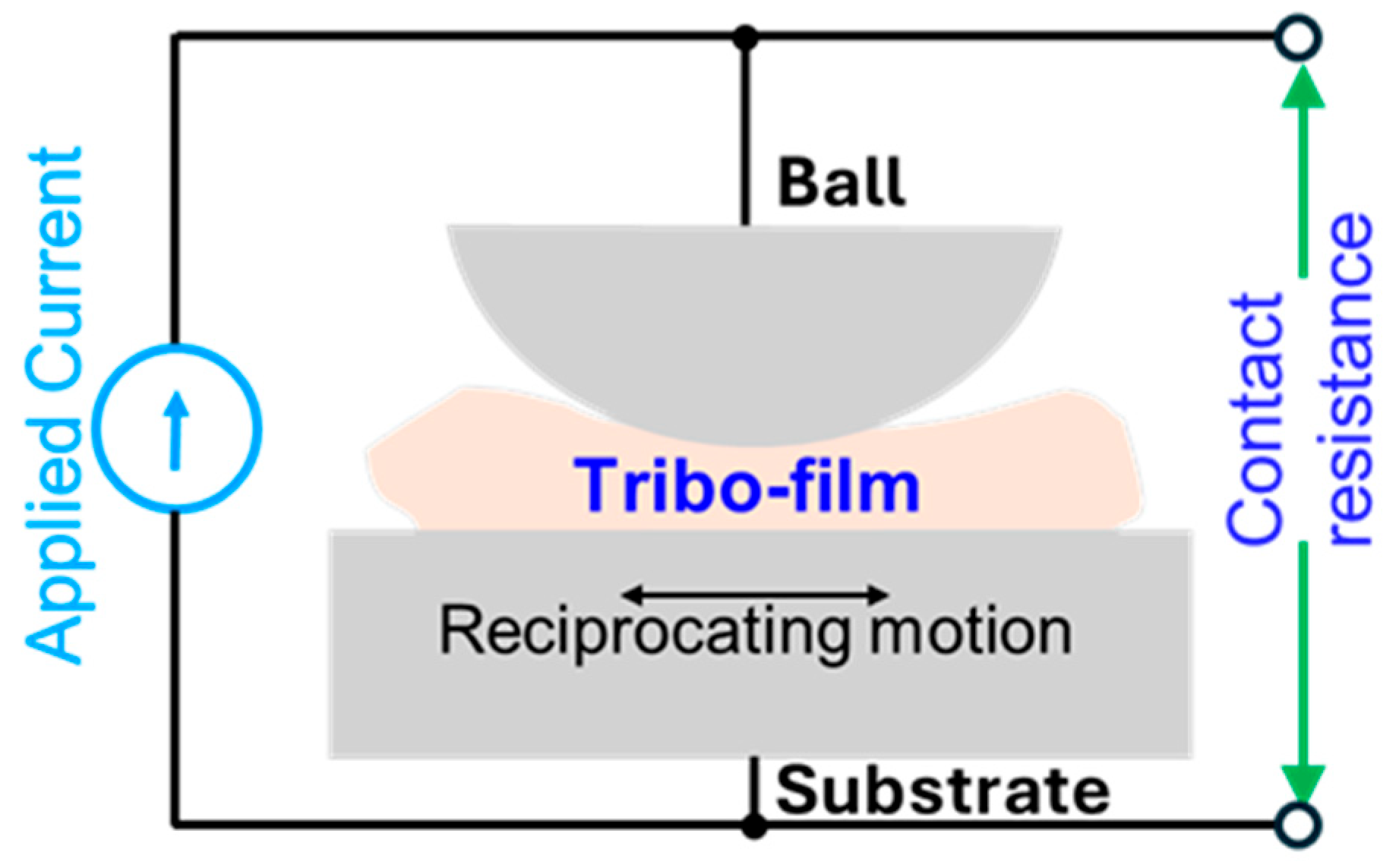
The ECR measurement was conducted by applying a constant current (I) across the sliding contact and measuring the voltage drop (V) across the contact in a four-probe configuration with a digital multimeter unit (Agilent 34401A 6½ Digit Multimeter, Agilent Technologies, Santa Clara, CA, USA) (Figure 2) [24]. ECR, computed as V/I, was recorded continuously and synchronized with the tribometer position and force signals. Two current levels, 1.0 mA and 500 nA, were used, which correspond, based on the Hertz contact area, to J = 42.4 A/cm2 and J = 0.02 A/cm2, respectively.
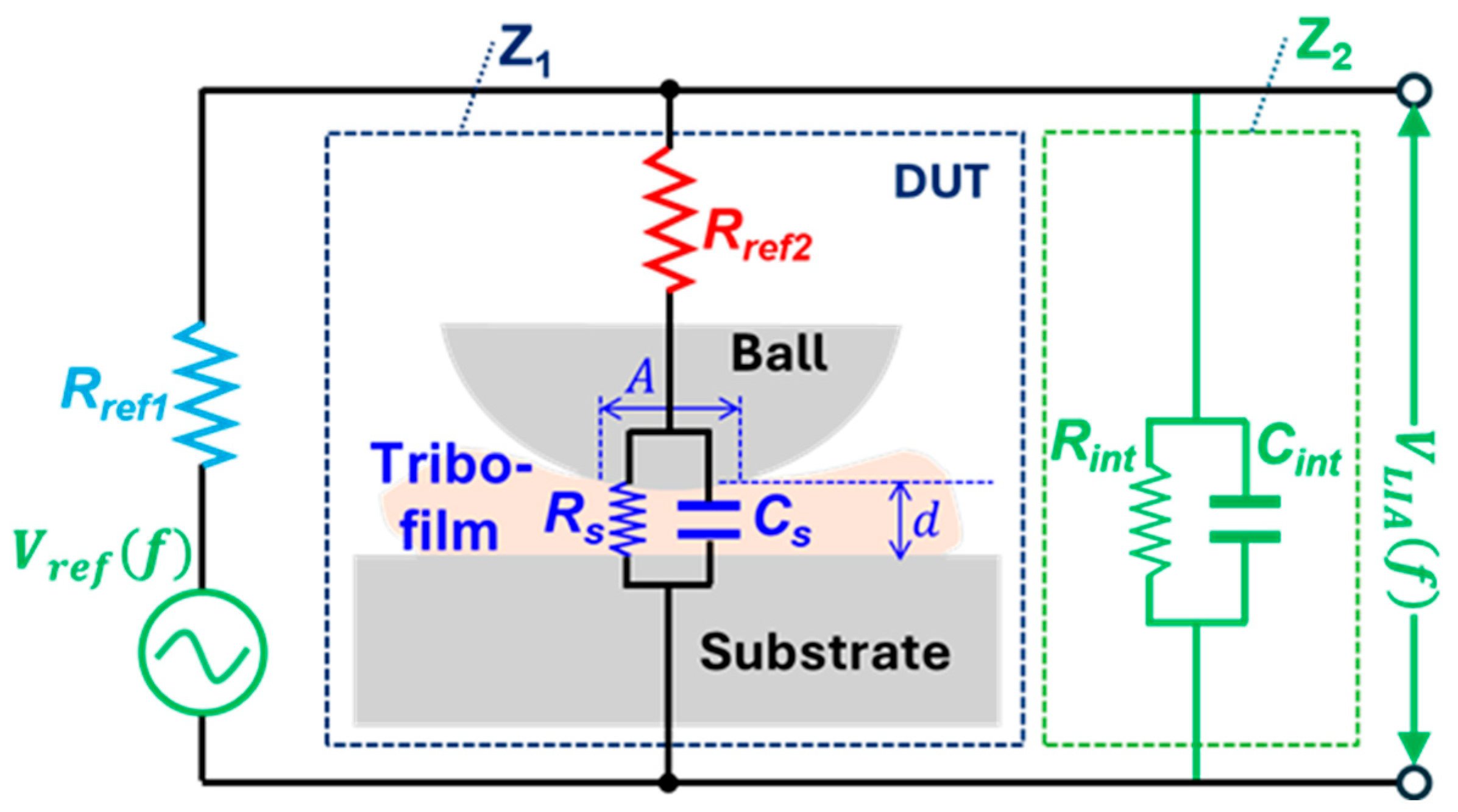
EIS was used to measure the resistance ( R S ) and capacitance ( C S ) of the tribofilm [24]. The ball–flat contact serves as the device under test (DUT); the tribofilm is represented by a parallel element R S || C S spanning the contact area A with effective thickness d . The same electrical contacts used for the ECR measurement served as electrodes for frequency-swept impedance measurements using a lock-in amplifier (SR830, Stanford Research Systems, Sunnyvale, CA, USA). A small sinusoidal voltage ( V r e f ( f ) ) was applied through a known reference resistor ( R r e f 1 ) to the DUT unit, and the in-phase V X f and quadrature V Y f components of the voltage drop across the DUT were recorded over a frequency range from 1 Hz to 105 Hz (Figure 3). Since the electrical resistance of the tribofilm was small, an additional resistor ( R r e f 2 ) was added in series to the sample between the electrical measurement points. The measured DUT branch Z 1 consists of R S || C S in series with the auxiliary reference resistor R r e f 2 . The instrument input Z 2 is modeled as R i n t || C i n t ; the lock-in measures the complex voltage V L I A f across Z 1 || Z 2 . The complex effective impedance Z e f f ( f ) was calculated from V r e f f and the lock-in outputs ( V L I A f ), which was further fitted with a model circuit treating the tribofilm as a parallel R S || C S element and the parasitic instrument as another parallel R i n t || C i n t .
In brief, Z e f f ( f ) was calculated from the in-phase ( V X f ) and quadrature ( V Y f ) components of V L I A f using the following relationship [24]:
Z e f f f = V X f + j V Y f   R r e f 1 V r e f f V X f + j V Y f = Z f + j Z f
This can be deconvoluted into the DUT impedance ( Z 1 f ) and the measurement instrument impedance ( Z 2 f ) using the following equation:
Z f + j Z f = 1 Z 1 f + 1 Z 2 f 1
where Z 1 f = R r e f 2 + R S 1 + j 2 π f C S R S and Z 2 f = R i n t 1 + j 2 π f C i n t R i n t . Since we know R r e f 2 , R i n t , and C i n t , we can obtain R S and C S . A penalty-based elastic net-regularized fit [28] was used to extract the R S and C S values of the tribofilm. The fitting procedure was independently validated against known RC test circuits (see Supplementary Section S1, Figure S1 and Table S1). Conversion from R S and C S of the tribofilm to resistivity ( ρ ), the dielectric constant ( ε r ), and zero-load thickness ( d 0 ) follows our previous method [24]; details specific to the liquid lubrication case are shown in Supplementary Section S2. In short, the resistivity ( ρ ), dielectric constant ( ε r ), and zero-load thickness ( d 0 ) are obtained by jointly fitting three sets of R s and C s measurements (from impedance spectroscopy) at three different loads L . R s ( L ) , C s ( L ) , and d ( L ) are all functions of the tribofilm thickness, and thickness is a function of applied normal load. Therefore, by performing impedance spectroscopy at three different normal loads, nine equations were obtained and there were three unknowns (resistivity ( ρ ), dielectric constant ( ε r ), and zero-load thickness ( d 0 ) ). Fitting these equations allows us to extract the three unknown parameters.

3. Results and Discussion

First of all, it is important to clearly distinguish electrochemical reactions that occur under an applied electrical potential from tribochemical reactions that arise during frictional contact while electrical current is conducted across the interface. In conventional electrochemistry, an external potential bias drives Faradaic charge transfer across an electrolyte–electrode interface. This interfacial electron (or ion) transfer induces well-defined redox reactions involving chemical species located at or near the interface. In contrast, tribochemical reactions emerge from mechanically driven interfacial processes in which two contacting solids undergo frictional sliding while simultaneously conducting electrical current. Here, the chemical transformations are not primarily governed by an externally imposed electrochemical double layer and redox environment; rather, they are mediated by local phenomena generated by the mechanical contact—such as flash temperature spikes, stress-assisted molecular deformation, mechanochemical activation, and spatially confined electron transport paths. These tribologically induced conditions can facilitate interfacial reactions even in the absence of conventional electrochemical control. This study focuses on the latter case.

3.1. Friction and ECR Behavior of Lubricant Additives

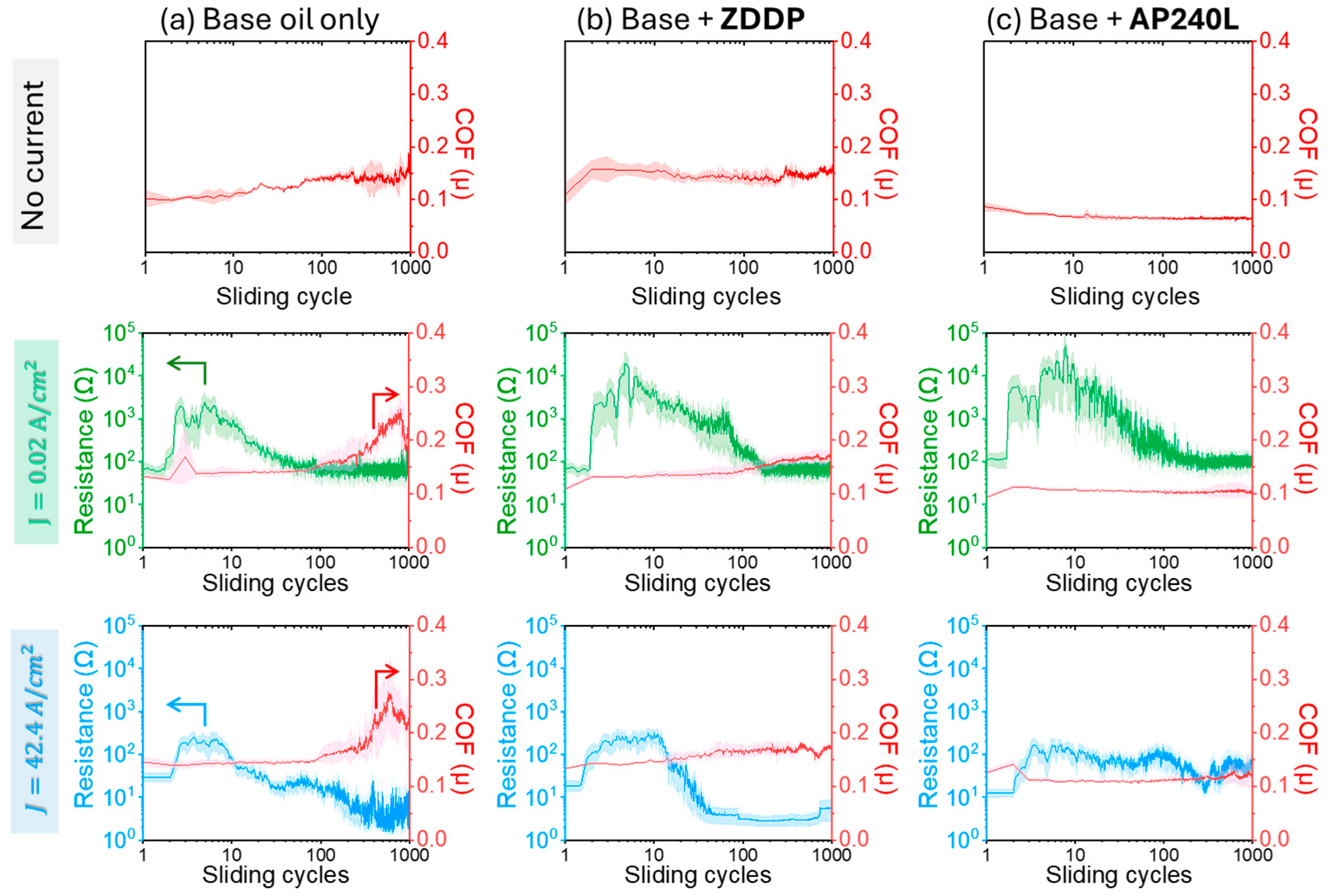
Figure 4 compares the evolution of the coefficient of friction (COF) as a function of reciprocating cycles for 52,100/52,100 sliding in base oil, without and with 1 wt% ZDDP and 1 wt% AP240L, without and with direct electrical current through the sliding contact at a current density of 0.02 and 42.4 A/cm2, and the ECR measured in situ with a four-probe setup. In Figure 4, solid traces represent the average of four experiments, and shaded envelopes indicate the standard error of the mean (SEM) from those experiments. Obviously, there were no ECR data for the no-current case because it cannot be measured without passing electrical current through the sliding contact. In all three cases, COF varied gradually, although magnitude was small, in the first 50–100 cycles. These initial periods can be called “run-in.”
In the absence of additives (i.e., base oil only, Figure 4a), the COF was around 0.15 after the initial run-in period; in contrast, in the electrified conditions, the COF change was relatively small during the initial run-in period and then gradually increased to 0.2~0.3. The initial COF of ~0.15 is a typical value often observed for boundary lubrications by a monolayer of organic molecules [29,30]. Before sliding started, the ECR value was around 20 ~ 50 Ω, which must correspond to the electrical resistance of a monolayer of oil sandwiched between native oxide layers of the pristine 52,100 alloys [31,32,33]. When the sliding started, ECR rose to >100 Ω over the first ~10 cycles and then decreased to the initial value in the 0.02 A/cm2 case and even lower in the 42.4 A/cm2 case. This means that even though the COF did not change substantially during the initial run-in period, the electrical contact condition changed drastically. If wear occurred during this stage, the contact transitioned to a state where current was conducted through microscopic metallic contact spots [34,35], resulting in the observed low ECR.
The addition of ZDDP additive resulted in a slightly lower friction coefficient (approximately 0.15–0.17), as shown in Figure 4b. ZDDP tribofilms are typically glassy and relatively hard [1,2], contributing to reduced friction. Under electrified conditions, the ECR at both low and high current densities initially increased during the first ~100 cycles, then decreased to values below 100 Ω. Unlike the base oil, ZDDP is able to decompose under heat or shear, and self-react on surfaces to form tribofilms primarily composed of zinc/iron phosphates and oxides [1,2,36]. During the tribofilm formation, sulfur-rich layers and thick polymerized phosphorus layers acted as an insulator, resulting in higher ECR values at the onset. With continued sliding, metal ions such as Fe and Zn can diffuse into the formed tribofilm, breaking down the polyphosphate network into short chain units [2,37,38]. As depolymerization and wear progresses, the metal content in the phosphorus-rich layer tends to increase [37,38], which likely accounted for the observed decrease in ECR after 100 cycles. It is worth noting that the overall ECR value at high current density (42.4 A/cm2) was nearly one order of magnitude lower than that at low current density (0.02 A/cm2). It is speculated that the higher electrical current may intensify oxidation of the exposed surface, reducing the availability of cations diffusing from the alloy and thus inhibiting ZDDP tribofilm formation, which results in a thinner interfacial film at the electrified surface [39].
Phosphites have recently been developed as anti-wear additives and friction modifiers in industrial applications [12]. Owing to the polar phosphite ester head and long alkyl tail, oil formulated with Duraphos AP240L exhibited a superior COF of around 0.1, which is nearly 30% lower than that of neat oil or oil with added ZDDP. The ECR trace of AP240L at low current density followed a trend similar to that observed with ZDDP, while at high current density, the ECR value stabilized at around 50–100 ohms throughout the test. Different from the ZDDP tribofilm, ashless phosphites cannot self-react to form metal-containing tribofilms unless metal ions are released from the worn metal surfaces or wear debris. In the case of low current density, the phosphites may have initially reacted with the worn metal surfaces under shear stress, forming iron phosphate or other iron phosphorus compounds, which were associated with ECR values as high as 104 W. As wear progressed, nanoparticles from wear debris may have been incorporated into the tribofilm, forming a metal particle-rich top layer [40]. Continued sliding led to a decrease in ECR as the metal content in the tribofilm increased. Under high current density, tribofilm growth was significantly affected, as electro-oxidation might have rapidly consumed available fresh metal and wear debris, resulting in the formation of an iron oxide-dominated layer. Consequently, the ECR remained similar to the initial direct contact before sliding started.

3.2. Analysis of Wear Tracks and Counter Surface

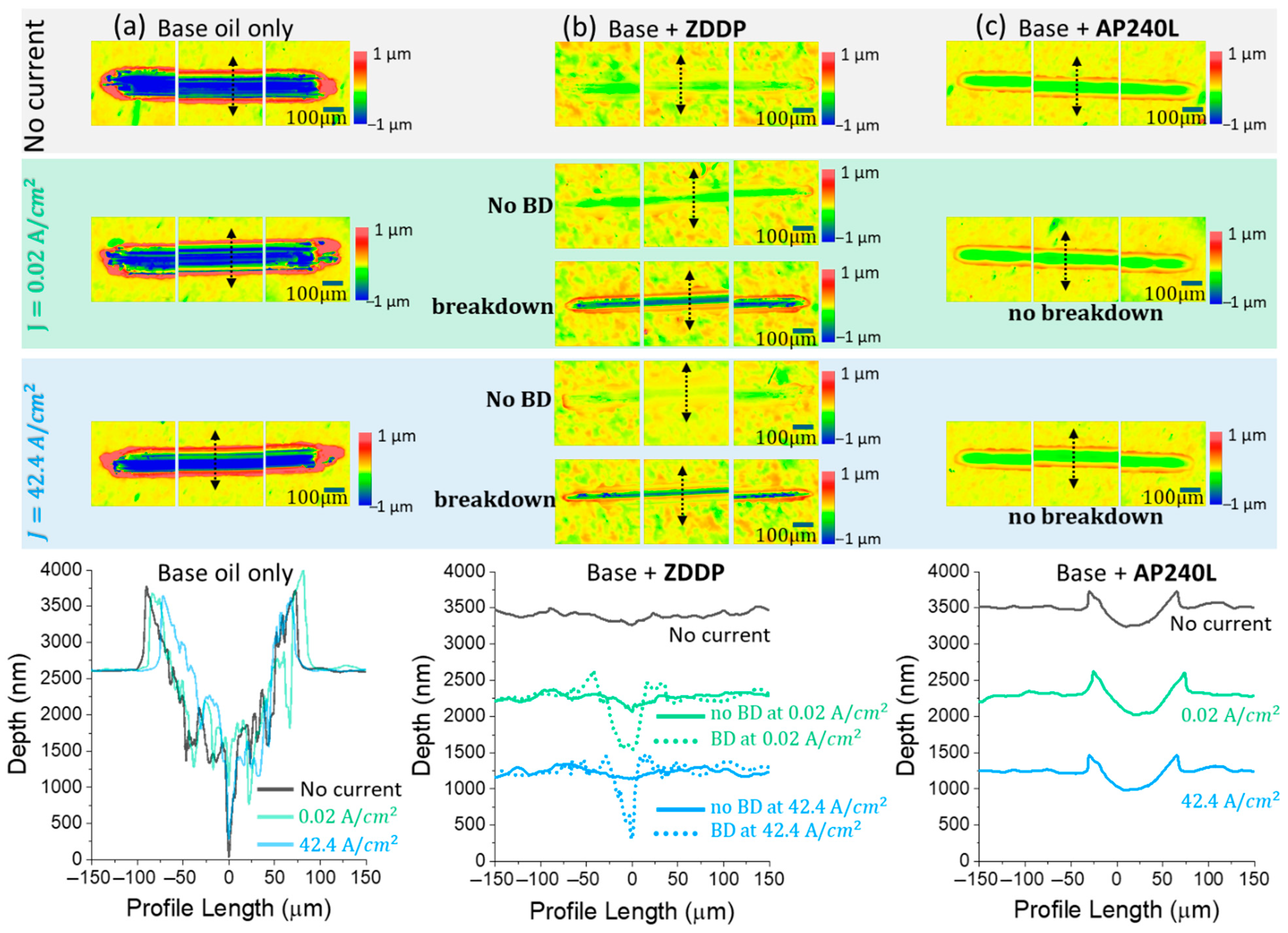
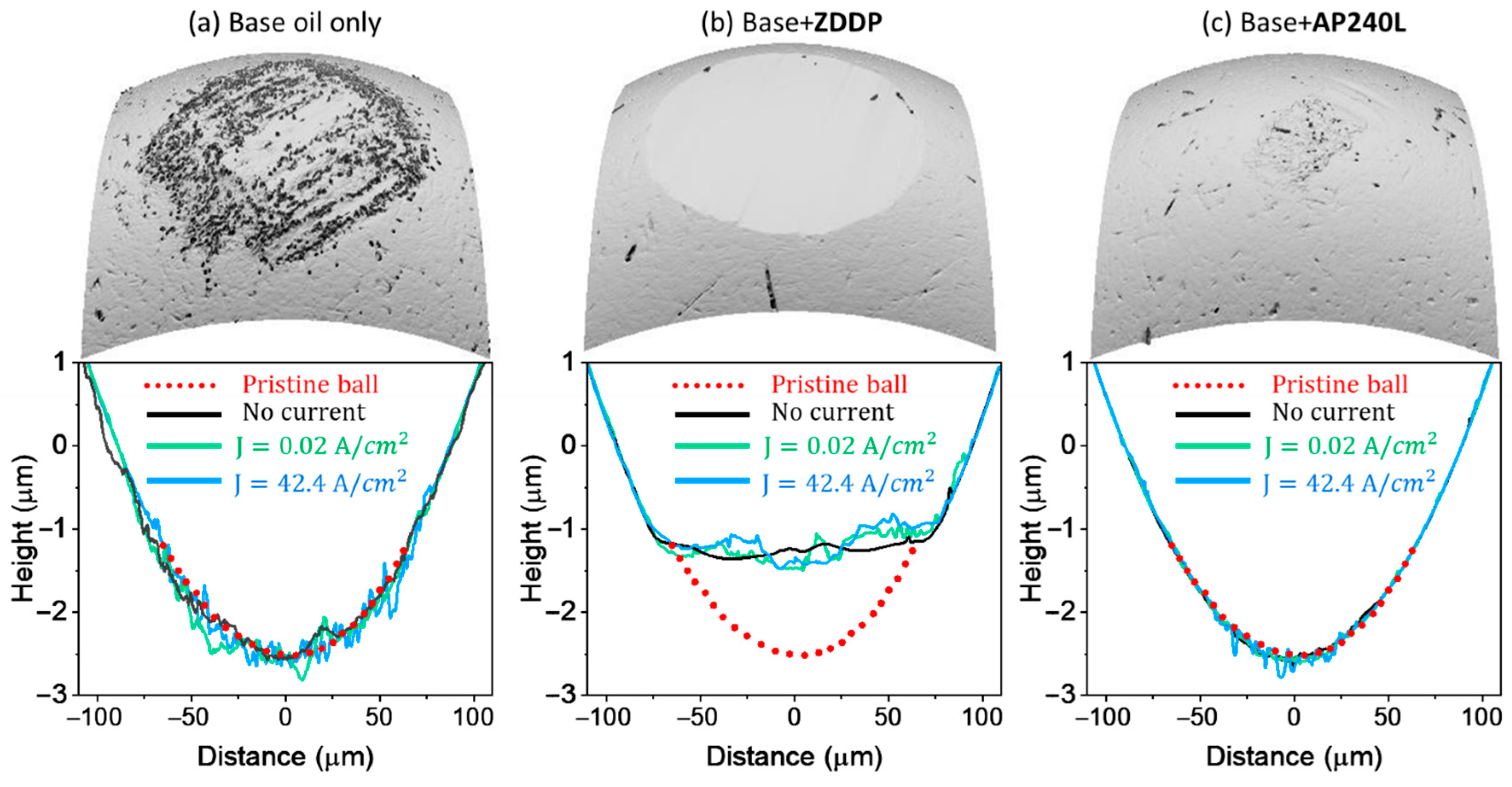
Figure 5 and Figure 6 show the profilometry images of the wear tracks and the worn balls, respectively. The line profiles shown at the bottom row of Figure 5 were taken along the black arrows marked in the 3D profilometry images in each case. In Figure 6, the top images show the 3D wear scars, and the plots at the bottom show height profiles taken through the center of each scar. For each condition, the height profile represents the average of three tests and is drawn together with the profile of a pristine ball curvature shown as a red dotted line. In the case of neat oil only, the wear tracks on the substrate exhibited a groove with depths of up to ~2 µm, with some roughness, under both the no-current and current-applied conditions (Figure 5a). The ball surface remained close to its original curvature, with only scattered marks and minor adhered residue (Figure 6a). These wear profiles are characteristic of a ploughing mechanism, in which a harder counter surface scrapes across a softer surface [41,42]. When a hardened 52,100 steel ball (hardness ≈ 7 GPa, based on the manufacturer’s specification) slides against a mirror-polished steel flat (hardness ≈ 2.2 GPa, measured by micro-indentation; Figure S2), asperities on the ball act as the abrasive counterpart. Repeated sliding generated micro-cutting and material displacement, which produced a continuous groove accompanied by shoulder pile-up and loose wear debris. Some particles were visible on the ball, but their sparse, nonuniform presence indicate that they were not the dominant load-bearing third body.
When ZDDP-containing oil was used (Figure 5b), both the wear depth and width on the flat specimens were reduced to less than half of those observed with neat oil, under both non-electrified and electrified conditions. In contrast, the ball surface exhibited significant polishing, as shown in Figure 6b. During reciprocating sliding, ZDDP, known for its high chemical reactivity under tribological conditions, initially formed a sulfur-rich particulate patch at the center of the ball contact area [43]. This patch subsequently fragmented and was redistributed toward the periphery of the contact zone. With continued sliding, a zinc- and phosphorus-rich tribofilm developed in the central region, overlaying the fragmented sulfur-rich material. The resulting fine solid debris acted as a third-body polishing medium, mechanically flattening the ball apex into the truncated, capped geometry observed in Figure 6b. This process is reminiscent of a chemical–mechanical polishing (CMP) mechanism, where the synergistic effect of chemical reactions and mechanical abrasion—particularly intensified by the high localized stress at the ball’s contact point—leads to efficient material removal and surface smoothing. Similar wear features, attributed to third-body polishing by ZDDP-derived debris, have been reported previously [44], supporting our observations. Furthermore, the wear debris generated from the ball surface may serve as a source of metal ions, facilitating the formation of thick and stable tribofilms on the flat substrate and thereby reducing its wear.
Under electrified conditions, two distinct wear patterns were observed on the flat for base + 1 wt% ZDDP. Deep wedge-shaped trenches formed in six cases out of a total of twelve tests performed in this study (Figure 5b), while the remainders exhibited smooth, shallow tracks similar to those under non-electrified conditions (depths less than 0.2 µm). The deep trenches were likely due to localized electrical discharge damage during boundary film breakdown (BD) [45,46]. However, distinct spikes were not observed in either the ECR or the COF signals over the 1000 cycles (Figure 4b), despite the occurrence of micropitting in the post-test wear track. This may be explained by the worn ball’s topography, as the truncated plateau retained the asperities only ~100−200 nm high, which could not reach the base of the wear tracks deeper than ~500 nm formed on the flat (Figure 5b). These cavities were quickly refilled with lubricant, rendering both electrical and frictional responses insensitive to micropitting events.
In contrast to the rough wear tracks observed with the base oil and ZDDP-containing oil, the addition of AP240L resulted in a shallow and smoother wear track (~0.2 µm, Figure 5c). The ball surface remained nearly unchanged (Figure 6c). Ashless phosphorus additives such as AP240L produce tribofilms that are much thinner and smoother than ZDDP [12,47]. These smoother films accounted for lower friction coefficients and superior wear performance. In the case of low electrical current, the tribo-electro oxidation may facilitate the oxidation of portions of the worn surface or debris. The high electric resistance observed during the running-in period (Figure 4c) still confirmed the formation of tribofilms. While the high electrical current was applied, the rapid oxidation reaction may have facilitated the formation of an iron oxide-dominated layer. This layer continued to work as a protective layer with boundary lubrication effects from the adsorbed AP240L, which resulted in lower friction and wear.
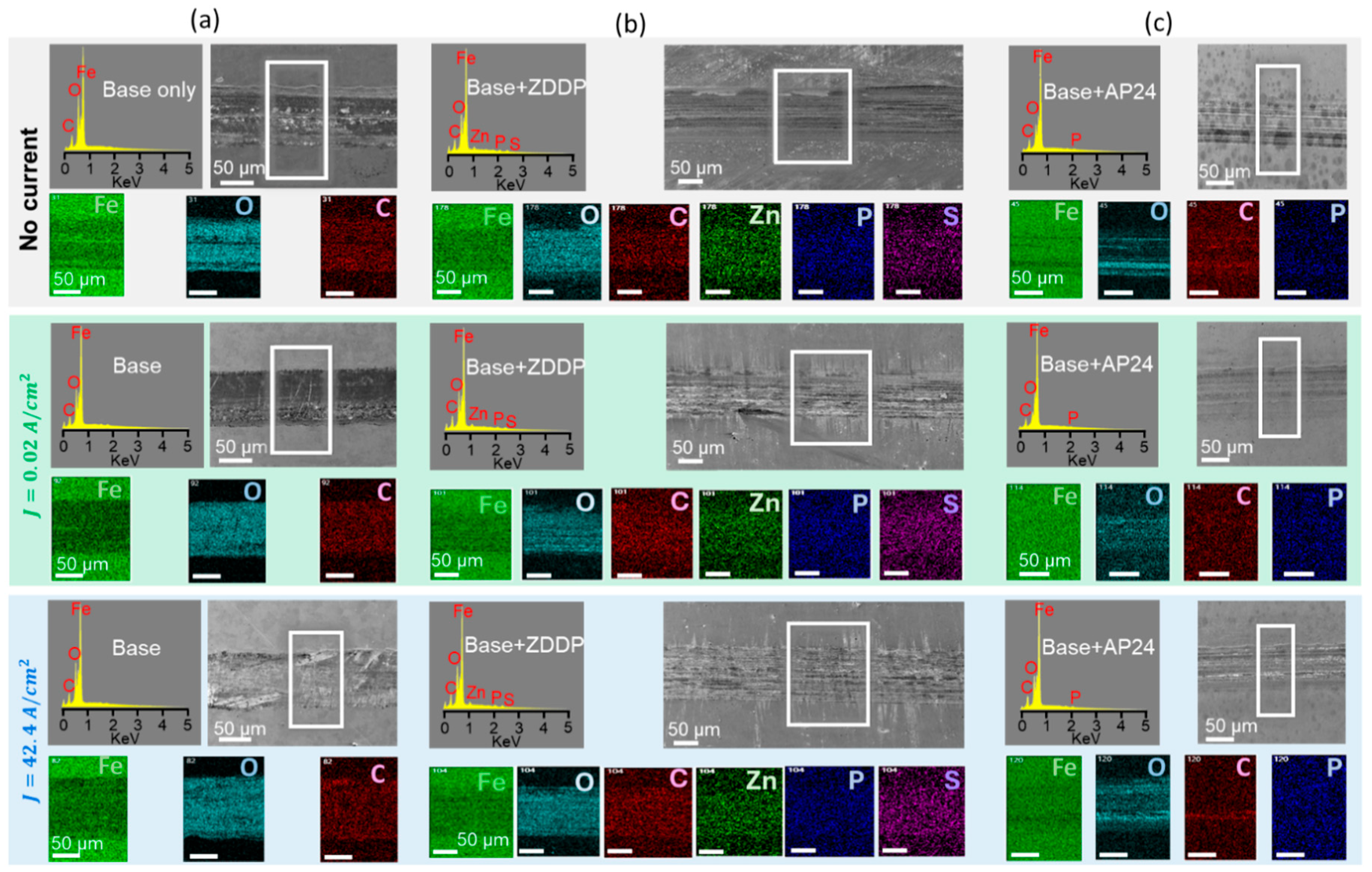
Figure 7 compares the SEM-EDX analysis results of the wear tracks produced in the three lubricants. In the base oil-only case (Figure 7a), the Fe signal was lower than the surroundings and the oxygen and carbon signals were larger, indicating that the wear track was more oxidized and contained more carbonaceous species than the pristine surface. In the wear track produced in the oil containing ZDDP (Figure 7b), an enhancement in Zn, P, and S signals could be seen. Such enhancements must have originated from thick tribofilms. In the wear track produced in the oil containing AP240L (Figure 7c), the P signal was extremely weak; the enhancement of the P signal compared to the surrounding was barely above the detection limit. The suppression of the iron signal in the wear track was much smaller than the cases observed in Figure 7a,b. These results indicate that the tribofilms formed from AP240L were much thinner than those formed from ZDDP [12]. The O signal was consistent with the iron phosphate network and may have included tribo-oxidation of steel; EDX alone could not separate the contributions from these two.

3.3. Electrical Properties of Intermediate Tribofilms from ZDDP

EIS was used to measure the frequency dependence of the resistance and capacitance of tribofilms at various applied loads, from which the resistivity (ρ), dielectric constant ( ε r ), and tribofilm thickness ( d 0 ) can be extracted [24]. For the fully developed tribofilms after the run-in period, ECR was as low as the values measured before the frictional sliding started. The low ECR means that the fully developed tribofilms were either conductive or local direct contacts between two rough surfaces of 52,100 alloys. Thus, EIS measurements could not be conducted for the fully developed tribofilms. But the intermediate films being formed during the run-in period (thus, not fully developed yet) exhibited relatively high resistance (Figure 4b,c). For those intermediate films, we attempted EIS measurements.
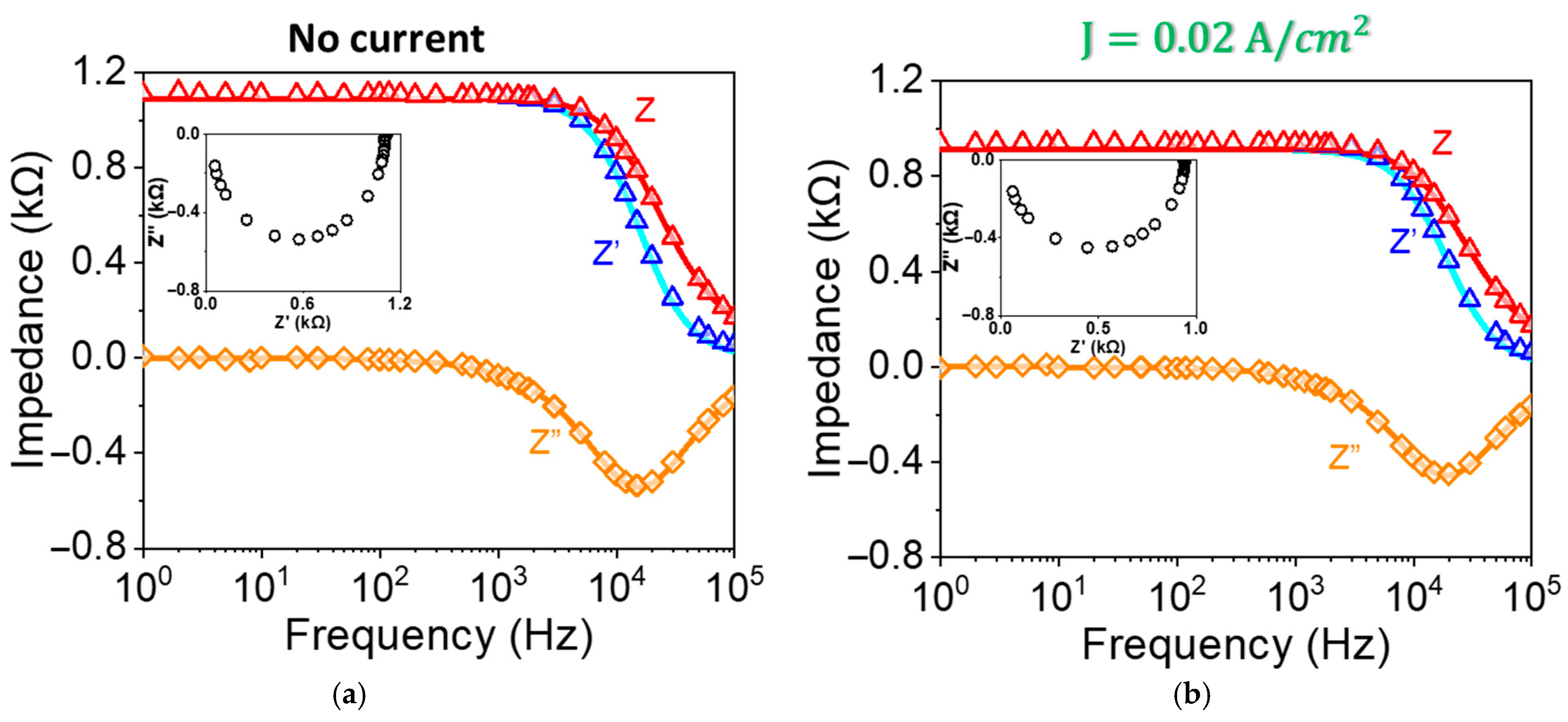
Figure 8 shows the impedance spectra of the intermediate tribofilm formed from ZDDP, measured in situ by holding the contact static during each impedance sweep after the first 10 sliding cycles at a normal load of 0.2 N. The spectra were fitted using a single parallel RC element. Figure 8a corresponds to J = 0 A/cm2, while Figure 8b corresponds to J = 0.02 A/cm2. Symbols show the complex impedance and its components vs. frequency, with Z in red, Z (in-phase) in blue, and Z (quadrature) in orange; insets show the corresponding Nyquist plot ( Z vs. Z ). Solid fits reproduce a narrow semicircle consistent with a single relaxation. Extracted resistance ( R s ) and capacitance ( C s ) values obtained from fitting the spectra in Figure 8 at different normal loads (0.2 N, 0.3 N, and 0.5 N) are summarized in Table 1 and converted to resistivity ( ρ ), dielectric constant ( ε r ), and thickness ( d 0 ) in Table 2 by fitting the R s and C s determined at three different normal loads.
The tribofilm behaved like a parallel RC element with a resistance in the order of tens of kΩ and a capacitance of roughly 15 pF. This corresponds to a characteristic time constant (τ = RC) of less than one microsecond and a relaxation peak (the RC characteristic frequency) of around 104 Hz. Table 2 shows that the intermediate ZDDP tribofilms formed after the first 10 cycles had electrical properties that varied depending on the applied current density. Under zero current, the intermediate film thickness was estimated to be around 4.9 nm, and the film exhibited a resistivity of ~0.6 MΩ × cm and a dielectric constant of ~ 8.1. In comparison, applying a current of 0.02 A/cm2 reduced the film thickness ( d 0 ≈ 2.6 nm), with a higher resistivity ( ρ ≈ 1.4 MΩ × cm) and a reduced dielectric constant ( ε r ≈ 5.1). These trends suggest that even modest electrical current can alter the composition or structure of the nascent ZDDP film, making it thinner and less polarizable.
To the best of our knowledge, these are the first reported electrical properties of an early-stage tribofilm being formed from ZDDP during the run-in period. For reference, multicomponent zinc phosphate glasses measured at room temperature in the kHz band typically show relative permittivity of ε′~7–13 [48,49], and undoped ZnO–P2O5 glass shows AC resistivity in the kHz band of ~0.5–2.6 MΩ × cm at 323 K [50]. In our study, the low-current condition produced a slightly thinner and less polarizable film compared to the no-current case. These findings are consistent with our previous vapor phase lubrication study using α-pinene, where applied current resulted in thinner tribofilms with a reduced dielectric constant [24]. By effectively covering the load-bearing contact spots, these phosphate-based tribofilms function as a stable dielectric barrier, resulting in a single, well-defined electrical relaxation that can be accurately modeled by a parallel RC circuit.
In in situ ECR measurements, AP240L exhibited a rise in electrical contact resistance during the first ten cycles at low current (Figure 4c), which is similar to the ZDDP case, but its tribofilm failed to produce a stable impedance spectrum (Figure S3). For EIS measured in the static condition (i.e., without sliding) to yield a usable frequency dependence, the interface must behave in a linear and time-invariant (LTI) manner throughout the frequency sweep; otherwise, the impedance locus drifts, precluding a unique equivalent-circuit fit [51,52]. The instability of the early-stage film from AP240L during the frequency sweep could mean it is more dynamic than stable, such as an organic layer mixed with trapped oil. Such heterogeneous films are expected to exhibit a broad distribution of relaxation times [53]. Furthermore, ongoing microstructural changes, such as adsorption, squeeze flow, or early phosphate chemistry, during the frequency sweep can alter the response in real time, resulting in unstable spectra across successive sweeps. In contrast, ZDDP rapidly forms inorganic phosphate and sulfur tribofilms much faster or more readily than ashless phosphites [12,54] such as AP240L. Thus, even after sliding ceased, the tribofilms remained largely unchanged, ensuring time-invariant behavior during the EIS sweep and enabling the acquisition of clean, well-defined impedance spectra.
Stable EIS spectra also could not be obtained for tribofilms formed at a current density of 42.4 A/cm2 or after 1000 sliding cycles. Under these conditions, the tribofilms were dominated by a metal-rich layer exhibiting low impedance. The large ohmic current overwhelmed the sinusoidal probe signal, preventing the acquisition of reliable electrical property measurements.

4. Conclusions

This study compared an ashless, sulfur-free phosphite ester (Duraphos AP240L) with ZDDP in current-carrying steel-on-steel boundary lubrication, employing synchronized friction measurements, in situ four-probe electrical contact resistance (ECR), impedance spectroscopy, and wear track profilometry. For ZDDP, the ECR initially increased (103–104 Ω), indicating the formation of a polyphosphate-dominated film, but often lost electrical protection under current (depth ~1 µm), corresponding to a transition toward a depolymerized Zn/Fe-orthophosphate tribofilm (101–102 Ω). Wear performance with ZDDP was variable, influenced by tribochemical polishing of the countersurface and, occasionally, electrical discharge-induced pitting. In contrast, AP240L formed a thin polyphosphate layer at low current, followed by a metal particle-rich layer. At higher currents, rapid oxidation promoted the formation of an iron oxide-rich layer and suppressed phosphorus-based tribofilm formation. AP240L consistently provided a lower friction coefficient (<0.1) and produced smoother, shallower wear tracks (depth < 0.2 µm) compared to ZDDP. These results demonstrate that the ashless phosphite ester offers effective surface protection under electrified conditions. Overall, this work not only provides a methodology for investigating tribochemical behavior under electrified conditions but also highlights the potential of ashless phosphorus additives as alternative tribological additives for industrial applications, such as in electric vehicles, to enhance performance.

Supplementary Materials

The following supporting information can be downloaded at: https://www.mdpi.com/article/10.3390/lubricants14020067/s1, Figure S1: Fitted impedance spectra of five RC test circuits collected across a frequency of 1–105 Hz. Markers show the measured magnitude (Abs) in phase (Re) and quadrature (Im) parts; green markers are the fit residual. Blue font texts give the fitted values ( R FIT ,   C FIT ) . Red text lists the test condition in each panel ( R ref 2 ,   R DUT ,   C DUT ) . All runs used R ref 1 = 100   k Ω ; Figure S2: Vicker’s hardness test results of mirror-polished flat 52100 substrate by QNess Q60A+ automated microindenter at humidity ~60% under different loading forces; Figure S3: Example of lock-in in-phase V X ( f ) and quadrature V Y ( f ) signals showing fluctuations across repeated sweeps (1–105 Hz) at a fixed position and load (0.2 N) on an Duraphos AP240L tribofilm produced within 10 sliding cycles. The resulting “wandering” impedance indicates the interface is not time-invariant; therefore, no unique R C fit is reported for these spectra. Table S1: Fitted R DUT and C DUT with coefficient of determination (R2). References [24,28,55,56,57] are cited in the supplementary materials.

Author Contributions

Conceptualization, S.H.K. and X.H.; Methodology, N.S. and Y.-S.L.; Validation, N.S., Y.-S.L., F.Q., R.Y. and B.K.; Formal analysis, N.S. and Y.-S.L.; Investigation, S.H.K., X.H.; Data curation, N.S., Y.-S.L., F.Q., R.Y. and B.K.; Writing—original draft, N.S., Y.-S.L., S.H.K. and X.H.; Writing—review & editing, S.H.K. and X.H.; Supervision, S.H.K. and X.H.; Project administration, S.H.K.; Funding acquisition, S.H.K. All authors have read and agreed to the published version of the manuscript.

Funding

This work was supported by the National Science Foundation (grant Nos: CMMI-2315343). Fangxin Qu was supported by the Multi-Campus Research Experience for Undergraduate (MC-REU) program of the Penn State College of Engineering.

Data Availability Statement

The original contributions presented in the study are included in the article, further inquiries can be directed to the corresponding author.

Acknowledgments

In this section you can acknowledge any support given which is not covered by the author contribution or funding sections.

Conflicts of Interest

Author Xin He was employed by the Syensqo. All authors declare that the research was conducted in the absence of any commercial or financial relationships that could be construed as a potential conflict of interest.

References

  1. Spikes, H. The History and Mechanisms of ZDDP. Tribol. Lett. 2004, 17, 469–489. [Google Scholar] [CrossRef]
  2. Spikes, H. Mechanisms of ZDDP—An Update. Tribol. Lett. 2025, 73, 38. [Google Scholar] [CrossRef]
  3. Chen, Y.; Jha, S.; Raut, A.; Zhang, W.; Liang, H. Performance Characteristics of Lubricants in Electric and Hybrid Vehicles: A Review of Current and Future Needs. Front. Mech. Eng. 2020, 6, 571464. [Google Scholar] [CrossRef]
  4. He, F.; Xie, G.; Luo, J. Electrical bearing failures in electric vehicles. Friction 2020, 8, 4–28. [Google Scholar] [CrossRef]
  5. Hadden, T.; Jiang, J.W.; Bilgin, B.; Yang, Y.; Sathyan, A.; Dadkhah, H.; Emadi, A. A review of shaft voltages and bearing currents in EV and HEV motors. In Proceedings of the IECON 2016-42nd Annual Conference of the IEEE Industrial Electronics Society, Florence, Italy, 23–26 October 2016; pp. 1578–1583. [Google Scholar] [CrossRef]
  6. Cao-Romero-Gallegos, J.A.; Farfan-Cabrera, L.I.; Erdemir, A.; Pascual-Francisco, J.B. Lubricated sliding wear of gear material under electrification–A new approach to understanding of the influence of shaft currents in the wear of EV transmissions. Wear 2023, 523, 204782. [Google Scholar] [CrossRef]
  7. Farfan-Cabrera, L.I.; Lee, P.; Sanchez, C.; Erdemir, A.; Lee, S. Influence of electricity on the traction and wear characteristics of ZDDP and MoDTC in a low-viscosity oil under different sliding-rolling conditions. Wear 2025, 570, 205938. [Google Scholar] [CrossRef]
  8. Li, Z.; Cai, R.; Nie, X. Experimental Study: Bearing Degradation Caused by Electrical Currents and Voltages at Low Speeds. Lubricants 2025, 13, 175. [Google Scholar] [CrossRef]
  9. Yousuf, A.; Spikes, H.; Guo, L.; Kadiric, A. Influence of Electric Potentials on Surface Damage in Rolling–Sliding Contacts Under Mixed Lubrication. Tribol. Lett. 2025, 73, 45. [Google Scholar] [CrossRef]
  10. Gangopadhyay, A.; Paputa Peck, M.C.; Simko, S.J. Wear Control in a Lubricated Contact Through Externally Applied Electric Current. Tribol. Trans. 2002, 45, 302–309. [Google Scholar] [CrossRef]
  11. Johnson, D.W.; Hils, J.E. Phosphate Esters, Thiophosphate Esters and Metal Thiophosphates as Lubricant Additives. Lubricants 2013, 1, 132–148. [Google Scholar] [CrossRef]
  12. Luiz, J.F.; Spikes, H. Tribofilm Formation, Friction and Wear-Reducing Properties of Some Phosphorus-Containing Antiwear Additives. Tribol. Lett. 2020, 68, 75. [Google Scholar] [CrossRef]
  13. Ali, M.K.A.; Sun, Y.; Zhang, C.; Yu, Q.; Zhao, C.; Zhou, F.; Liu, W. Improving tribological performance of electrified steel interfaces in e-mobility systems using ash-sulfur-less oil additives based on amine salts-phosphoric esters. Tribol. Int. 2025, 205, 110561. [Google Scholar] [CrossRef]
  14. Ogbomo, E.; Bhuiyan, F.H.; Latorre, C.A.; Martini, A.; Ewen, J.P. Effects of surface chemistry on the mechanochemical decomposition of tricresyl phosphate. Phys. Chem. Chem. Phys. 2023, 26, 278–292. [Google Scholar] [CrossRef]
  15. Newcomb, T. A brief review of the rapid transformation of driveline lubricants for hybrid electric and electric vehicles. Front. Mech. Eng. 2023, 9, 1139385. [Google Scholar] [CrossRef]
  16. Nyman, P.; Björklund, P.; Yaghini, N.; Lu, L.; Hopper, E.R.; Hunt, G. Investigating the Failure Mechanism of Wet eMachines in the Presence of Transmission Oils. J. Tribol. 2025, 147, 051111. [Google Scholar] [CrossRef]
  17. Zhu, Z.; Ewen, J.P. Mechanochemistry of phosphate esters with external electric fields. RSC Mechanochem. 2025, 2, 732–744. [Google Scholar] [CrossRef]
  18. García Tuero, A.; Lee, S.; Hernández Battez, A.; Erdemir, A. Tribological Performance of an Automatic Transmission Fluid Additized with a Phosphonium-Based Ionic Liquid Under Electrified Conditions. Lubricants 2025, 13, 209. [Google Scholar] [CrossRef]
  19. Fang, L.; Korres, S.; Lamberti, W.A.; Webster, M.N.; Carpick, R.W. What stress components drive mechanochemistry? A study of ZDDP tribofilm formation. Faraday Discuss 2023, 241, 394–412. [Google Scholar] [CrossRef] [PubMed]
  20. Forbes, E.S. Antiwear and extreme pressure additives for lubricants. Tribology 1970, 3, 145–152. [Google Scholar] [CrossRef]
  21. Barber, R. The preparation of some phosphorus compounds and their comparison as load carrying additives by the four-ball machine. ASLE Trans. 1976, 19, 319–328. [Google Scholar] [CrossRef]
  22. Fu, X.; Sun, L.; Zhou, X.; Li, J.; Fan, B.; Ren, T. Tribochemical behaviors of phosphite esters and their combinations with alkyl amines. Appl. Surf. Sci. 2015, 357, 1163–1170. [Google Scholar] [CrossRef]
  23. Forbes, E.S.; Battersby, J. The Effect of Chemical Structure on the Load-Carrying and Adsorption Properties of Dialkyl Phosphites. ASLE Trans. 1974, 17, 263–270. [Google Scholar] [CrossRef]
  24. Siddique, N.; Li, Y.-S.; Ogrinc, A.L.; Guo, Y.; Yuan, R.; Kim, S.H. Tribology at Electrified Interface: Electron Transport and Chemistry During Polymeric Tribofilm Formation from Adsorbate Molecules by Friction. Tribol. Lett. 2025, 73, 96. [Google Scholar] [CrossRef]
  25. Li, Y.-S.; Jang, S.; Bhuiyan, F.H.; Martini, A.; Kim, S.H. Molecular structure and environment dependence of shear-driven chemical reactions: Tribopolymerization of methylcyclopentane, cyclohexane and cyclohexene on stainless steel. Tribol. Lett. 2023, 71, 49. [Google Scholar] [CrossRef]
  26. Barthel, A.J.; Luo, J.; Hwang, K.S.; Lee, J.-Y.; Kim, S.H. Boundary lubrication effect of organic residue left on surface after evaporation of organic cleaning solvent. Wear 2016, 350–351, 21–26. [Google Scholar] [CrossRef]
  27. He, H.; Qian, L.; Pantano, C.G.; Kim, S.H. Effects of humidity and counter-surface on tribochemical wear of soda-lime-silica glass. Wear 2015, 342–343, 100–106. [Google Scholar] [CrossRef]
  28. Zou, H.; Hastie, T. Regularization and Variable Selection Via the Elastic Net. J. R. Stat. Soc. Ser. B Stat. Methodol. 2005, 67, 301–320. [Google Scholar] [CrossRef]
  29. Barthel, A.J.; Kim, S.H. Lubrication by physisorbed molecules in equilibrium with vapor at ambient condition: Effects of molecular structure and substrate chemistry. Langmuir 2014, 30, 6469–6478. [Google Scholar] [CrossRef]
  30. Lu, X.; Khonsari, M.; Gelinck, E. The Stribeck curve: Experimental results and theoretical prediction. J. Tribol. 2006, 128, 789–794. [Google Scholar] [CrossRef]
  31. Zhang, J.; Meng, Y. Boundary lubrication by adsorption film. Friction 2015, 3, 115–147. [Google Scholar] [CrossRef]
  32. Hsu, S.M.; Gates, R.S. Boundary lubricating films: Formation and lubrication mechanism. Tribol. Int. 2005, 38, 305–312. [Google Scholar] [CrossRef]
  33. Makowska, M.; Kajdas, C.; Grądkowski, M. Interactions of n-Hexadecane with 52100 Steel Surface Under Friction Conditions. Tribol. Lett. 2002, 13, 65–70. [Google Scholar] [CrossRef]
  34. Greenwood, J.A. Constriction resistance and the real area of contact. Br. J. Appl. Phys. 1966, 17, 1621–1632. [Google Scholar] [CrossRef]
  35. Clarke, A.; Weeks, I.J.J.; Evans, H.P.; Snidle, R.W. An investigation into mixed lubrication conditions using electrical contact resistance techniques. Tribol. Int. 2016, 93, 709–716. [Google Scholar] [CrossRef]
  36. Gosvami, N.; Bares, J.; Mangolini, F.; Konicek, A.; Yablon, D.; Carpick, R. Mechanisms of antiwear tribofilm growth revealed in situ by single-asperity sliding contacts. Science 2015, 348, 102–106. [Google Scholar] [CrossRef]
  37. Ueda, M.; Kadiric, A.; Spikes, H. On the Crystallinity and Durability of ZDDP Tribofilm. Tribol. Lett. 2019, 67, 123. [Google Scholar] [CrossRef]
  38. Ueda, M.; Spikes, H. ZDDP Tribofilm Formation and Removal. Tribol. Lett. 2024, 72, 109. [Google Scholar] [CrossRef]
  39. Farfan-Cabrera, L.I.; Hernández-Peña, A.; Resendiz-Calderon, C.D.; Lee, P.; Sanchez, C.; Lee, S.; Erdemir, A. Electrified four-ball testing of ZDDP and MoDTC as additives in low-viscosity synthetic oil. Wear 2025, 571, 205835. [Google Scholar] [CrossRef]
  40. Zhou, Y.; Leonard, D.N.; Guo, W.; Qu, J. Understanding Tribofilm Formation Mechanisms in Ionic Liquid Lubrication. Sci. Rep. 2017, 7, 8426. [Google Scholar] [CrossRef]
  41. Mate, C.M.; Carpick, R.W. Wear. In Tribology on the Small Scale: A Modern Textbook on Friction, Lubrication, and Wear; Oxford University Press: Oxford, UK, 2019; pp. 389–430. [Google Scholar] [CrossRef]
  42. Jiménez, A.E.; Bermúdez, M.D. 2-Friction and wear. In Tribology for Engineers; Davim, J.P., Ed.; Woodhead Publishing: Sawston, UK, 2011; pp. 33–63. [Google Scholar] [CrossRef]
  43. Shimizu, Y.; Spikes, H.A. The Tribofilm Formation of ZDDP Under Reciprocating Pure Sliding Conditions. Tribol. Lett. 2016, 64, 46. [Google Scholar] [CrossRef]
  44. Huynh, K.K.; Tieu, K.A.; Pham, S.T. Synergistic and Competitive Effects between Zinc Dialkyldithiophosphates and Modern Generation of Additives in Engine Oil. Lubricants 2021, 9, 35. [Google Scholar] [CrossRef]
  45. Esmaeili, K.; Wang, L.; Harvey, T.J.; White, N.M.; Holweger, W. Electrical Discharges in Oil-Lubricated Rolling Contacts and Their Detection Using Electrostatic Sensing Technique. Sensors 2022, 22, 392. [Google Scholar] [CrossRef] [PubMed]
  46. Liu, S.; Lv, J.; Jiang, S.; Kuang, L.; Zhao, L.; Liu, C. Correlation between shaft voltage characteristics, electrical discharge behavior and surface damage of motor bearing in EV bench tests. Wear 2025, 582–583, 206344. [Google Scholar] [CrossRef]
  47. Pagkalis, K.; Spikes, H.; Jelita Rydel, J.; Ingram, M.; Kadiric, A. The Influence of Steel Composition on the Formation and Effectiveness of Anti-wear Films in Tribological Contacts. Tribol. Lett. 2021, 69, 75. [Google Scholar] [CrossRef]
  48. Khor, S.F.; Talib, Z.A.; Sidek, H.A.A.; Daud, W.M.; Ng, B.H. Effects of ZnO on Dielectric Properties and Electrical Conductivity of Ternary Zinc Magnesium Phosphate Glasses. Am. J. Appl. Sci. 2009, 6, 1010–1014. [Google Scholar] [CrossRef]
  49. Rao, P.V.; Raju, G.N.; Prasad, P.S.; Satyanarayana, T.; Rao, L.S.; Goumeidane, F.; Iezid, M.; Marltan, W.; Baskaran, G.S.; Veeraiah, N. Role of molybdenum ions in lead zinc phosphate glass system by means of dielectric studies. Mater. Sci.-Pol. 2018, 36, 623–629. [Google Scholar] [CrossRef]
  50. Choudhary, B.P. Electrical and Dielectric Behavior of Zinc Phosphate Glasses. Mater. Today Proc. 2017, 4, 5706–5714. [Google Scholar] [CrossRef]
  51. Lazanas, A.C.; Prodromidis, M.I. Electrochemical Impedance Spectroscopy—A Tutorial. ACS Meas. Sci. Au 2023, 3, 162–193. [Google Scholar] [CrossRef]
  52. Boukamp, B.A. A Linear Kronig-Kramers Transform Test for Immittance Data Validation. J. Electrochem. Soc. 1995, 142, 1885. [Google Scholar] [CrossRef]
  53. Samet, M.; Kallel, A.; Serghei, A. Maxwell-Wagner-Sillars interfacial polarization in dielectric spectra of composite materials: Scaling laws and applications. J. Compos. Mater. 2022, 56, 3197–3217. [Google Scholar] [CrossRef]
  54. Taylor, L.; Spikes, H.; Camenzind, H. Film-Forming Properties of Zinc-Based and Ashless Antiwear Additives. SAE Tech. Pap. 2000, 109, 2095–2105. [Google Scholar] [CrossRef]
  55. Carey, A.A. The Dielectric Constant of Lubrication Oils; Defense Technical Information Center: Belvoir, VA, USA, 1998. [Google Scholar]
  56. Sato, K.; Watanabe, S.; Sasaki, S. High Friction Mechanism of ZDDP Tribofilm Based on in situ AFM Observation of Nano-Friction and Adhesion Properties. Tribol. Lett. 2022, 70, 94. [Google Scholar] [CrossRef]
  57. Kim, S.H. Surface and Interface Analysis: Principles and Applications; John Wiley & Sons: Hoboken, NJ, USA, 2024; Chapter 12. [Google Scholar]
Figure 1. Molecular structures of the additives investigated in this work. (a) dioleyl hydrogen phosphite (Duraphos AP240L) and (b) zinc dialkyldithiophosphate (ZDDP) with secondary branched alkyl substituents.
Lubricants 14 00067 g001
Figure 2. Schematic circuit diagram for real-time ECR measurement with a four-probe arrangement between current source, ball, and substrate while in reciprocating motion.
Lubricants 14 00067 g002
Figure 3. Schematic of the in situ impedance measurement and equivalent circuit.
Lubricants 14 00067 g003
Figure 4. Real-time electrical contact resistance (ECR) (left axis, log scale) and coefficient of friction (COF) (right axis) during reciprocating 52,100/52,100 sliding cycles with (a) base oil only (hydrotreated neutral), (b) base + 1 wt% ZDDP (zinc dialkyl dithiophosphate), and (c) base + 1 wt% AP240L (dioleyl hydrogen phosphite) under current conditions of J = 0 (top), J = 0.02 A/cm2 (middle), and J = 42.4 A/cm2 (bottom).
Lubricants 14 00067 g004
Figure 5. 3D profilometry images of the wear tracks after sliding in (a) base oil only, (b) base + 1 wt% ZDDP, and (c) base + 1 wt% AP240L, without current and under applied current density of 0.02 A/cm2 and 42.4 A/cm2 (as marked on the left).
Lubricants 14 00067 g005
Figure 6. Optical profilometry maps of the ball after sliding in (a) base oil only, (b) base + 1 wt% ZDDP, and (c) base + 1 wt% AP240L. Line color indicates the current condition, with black for 0 A/cm2, green for 0.02 A/cm2, and blue for 42.4 A/cm2.
Lubricants 14 00067 g006
Figure 7. SEM and EDX mapping were performed on the wear tracks after sliding in (a) base oil only, (b) base + 1 wt% ZDDP, and (c) base + 1 wt% AP240L, under no current (top) and an applied current density of J = 0.02 A/cm2 (middle) and J = 42.4 A/cm2 (bottom). The white rectangles indicated the regions analyzed for elemental mapping and the intensity spectrum.
Lubricants 14 00067 g007
Figure 8. Frequency response of the intermediate ZDDP tribofilm after 10 sliding cycles at 0.2 N: (a) J = 0 A/cm2 and (b) J = 0.02 A/cm2.
Lubricants 14 00067 g008
Table 1. Resistance ( R s ) and capacitance ( C s ) of tribofilms formed within 10 cycles from Base oil + ZDDP. Data are reported as mean ± standard deviation, computed from four measurements per condition across three independent experiments.
Current0 A/cm20.02 A/cm2
Load0.2 N0.3 N0.5 N0.2 N0.3 N0.5 N
R s   (kΩ)52 ± 1242 ± 1428 ± 1038 ± 829 ± 926 ± 10
C s   (pF)14.6 ± 0.515.6 ± 0.614.3 ± 0.214.3 ± 0.415.0 ± 0.714.0 ± 1.4
Table 2. The resistivity ( ρ ), dielectric constant ( ε r ), and thickness ( d 0 ) of transient tribofilms produced with ZDDP within 10 cycles. Data are reported as mean ± SEM, computed from four impedance measurements for each current-density condition.
Current DensityZero (No Current)0.02 A/cm2
ρ (MΩ × cm)0.6 ± 0.11.4 ± 0.7
ε r 8.1 ± 0.45.1 ± 0.1
d 0 (nm)4.9 ± 0 .42.6 ± 0.5
Disclaimer/Publisher’s Note: The statements, opinions and data contained in all publications are solely those of the individual author(s) and contributor(s) and not of MDPI and/or the editor(s). MDPI and/or the editor(s) disclaim responsibility for any injury to people or property resulting from any ideas, methods, instructions or products referred to in the content.