Article

Numerical Analysis of Lubrication and Oil Churning Power Loss of High Contact Ratio Internal Gear Pair

1
College of Mechanical Engineering and Automation, Liaoning University of Technology, Jinzhou 121000, China
2
Jinzhou JH Automobile Safety System Co., Ltd., Jinzhou 121010, China
*
Author to whom correspondence should be addressed.
Lubricants 2026, 14(1), 8; https://doi.org/10.3390/lubricants14010008
Submission received: 15 November 2025 / Revised: 18 December 2025 / Accepted: 20 December 2025 / Published: 24 December 2025

Abstract

Planetary gear is the mainstream deceleration transmission device, and its derivative form of high contact ratio internal gear adopts the structure of full internal meshing. While improving the compactness and efficiency of the transmission, it is necessary to focus on its lubrication characteristics and churning power consumption. In this paper, based on the actual meshing state of high contact ratio internal gear, combined with its geometric parameters, motion speed, and pressure bearing state, the Computational Fluid Dynamics (CFD) model is used to analyze the oil distribution during gear motion. According to the oil state, the oil pressure and viscous force on the gear surface are extracted, the churning loss of the gear is calculated, and the influence of different parameters on the churning loss is analyzed. Finally, based on the influence of the oil churning parameters on the lubrication performance, the representative oil churning parameters are selected for the test. The test results are consistent with the results obtained by the simulation analysis, which provides data support for the study of the lubrication of high contact ratio internal gears.

1. Introduction

High contact ratio internal gear is a new type of reducer transmission mode [1]. Compared with the traditional planetary gear transmission, its transmission structure is more compact and the transmission efficiency of the gear is higher. Good oil bath lubrication is an important guarantee for the stable operation of the gear transmission system. Poor lubrication will lead to premature failure of the transmission system. With the increase in speed requirements, the churning loss caused by oil bath lubrication is particularly prominent. Therefore, it is necessary to analyze its churning loss.
Gear churning loss and lubrication have long been focal points of academic research, with numerous scholars conducting experimental and numerical studies. Experimental investigations have laid the groundwork for understanding its loss mechanisms: Chen et al. designed a rotatable test bench to explore oil loss under splash lubrication [2]; Laruelle et al. conducted comprehensive experimental tests on churning losses of spiral bevel gears [3]; and Wang et al. developed a specialized measurement device to identify key factors influencing churning power loss [4]. These experiments provided valuable empirical data but were often limited to specific gear types or operating conditions, lacking generalizability to internal meshing systems with high contact ratios.
Numerical modeling, particularly Computational Fluid Dynamics (CFD), has emerged as a powerful tool for simulating gear lubrication and churning loss. Early numerical studies primarily targeted external gears, planetary gears, or spray lubrication systems: Concli et al. established numerical models for planetary gearbox churning loss [5]; Deng et al. used the Moving Particle Semi-implicit (MPS) method to analyze the effects of rotational speed, viscosity, and oil immersion height on high-speed train gearbox losses [6]; and Guo et al. proposed a numerical framework for predicting gearbox stirring loss factors [7]. Shore et al. specifically investigated the influence of oil immersion height on gear churning loss, providing critical insights into the relationship between lubricant volume and energy dissipation [8], while Zhu et al. developed analytical formulas for predicting churning power loss in orthogonal high contact ratio internal gears under partial oil bath immersion—one of the few studies directly related to internal gears, though limited to partial immersion scenarios and lacking CFD-based flow field analysis [9]. Handschuh et al. further complemented experimental research by developing a method for measuring both churning and windage power losses, highlighting the need to consider multiple loss mechanisms [10], while Jia et al. proposed an analytical model based on energy conversion to estimate spur gear churning power, offering a theoretical basis for loss prediction but not addressing the complex flow dynamics in internal meshing systems [11]. Wang et al. and Liu et al. extended research to mixed lubrication modes and gearboxes with guide plates, respectively [12,13], but their focus on non-internal meshing configurations limits applicability to high contact ratio internal gears.
The application of CFD in gear lubrication has expanded rapidly in recent years, with scholars exploring various modeling strategies and flow phenomena. Mastrone et al. proposed a CFD-based method for gearbox power loss prediction [14]; Mo et al. simulated injection lubrication to analyze the impact of gear speed and injection parameters on oil distribution [15]; and Zhang et al. used Fluent to conduct transient simulations of wind resistance loss in spiral bevel gears [16]. However, these CFD studies predominantly focused on external gears or spray lubrication, with limited attention to oil bath lubrication in internal meshing systems. For example, Zhang et al. [17] and Hu et al. [18] investigated splash lubrication in gearboxes but did not address the specific flow dynamics of high contact ratio internal gears, where the enclosed meshing space and high contact ratio lead to more complex oil–gas interaction and pressure distribution.
Other numerical methods, such as Smooth Particle Hydrodynamics (SPH) and Volume of Fluid (VOF) coupled with the PISO algorithm, have been employed to capture multiphase flow characteristics. Liu et al. used SPH to study oil-immersed lubrication and validated FVM-based jet lubrication models [19,20]; Hu et al. applied the PISO algorithm and VOF model to analyze dynamic oil–gas interfaces in splash-lubricated gearboxes [21,22]; and Liu et al. combined VOF technology with CFD to explore two-phase flow in gear systems [23]. Lu et al. further established a two-phase flow model based on CFD to calculate spiral bevel gear churning loss under splash lubrication [24], but, like previous studies, did not account for the unique geometric features of high contact ratio internal gears. Frosina et al. used CFD to study the internal fluid dynamics of high-pressure external gear pumps [25], demonstrating the potential of CFD for analyzing gear-related flow phenomena but focusing on pumps rather than transmission gears. Despite these advances, research on multiphase flow behavior in high-mesh-ratio internal gears remains scarce. Existing models fail to account for the unique geometric and kinematic characteristics of such gears, resulting in inadequate predictions of oil distribution and churning losses.
Furthermore, specialized CFD studies on internal meshing gears are scarce and limited in scope. Tang et al. established an injection lubrication model for internal meshing gears in aircraft gearboxes [26], but their focus on injection lubrication neglects the oil bath scenario. Gao et al. simulated splash lubrication in planetary gearboxes with rolling bearings [27] but did not address the high contact ratio internal gear configuration. These gaps highlight a critical limitation: while CFD has proven effective for gear lubrication analysis, there is a lack of systematic CFD studies tailored to the oil bath lubrication of high contact ratio internal gears, particularly regarding multiphase flow characteristics, dynamic pressure–velocity field coupling, and the combined effects of key parameters (e.g., rotational speed, oil immersion height) on churning loss.
In summary, although numerous scholars have conducted experimental and numerical studies on oil churning losses in gears, existing research has primarily focused on externally meshed gears, planetary gears, or splash lubrication systems. Systematic and in-depth investigations into oil distribution and churning loss mechanisms under oil bath lubrication for internally meshed gears with high contact ratios remain scarce. Particularly, comprehensive reports on the multiphase flow characteristics, coupled analysis of dynamic pressure and velocity fields, and experimental validation under multiple operating conditions remain scarce. Therefore, this study aims to systematically investigate the lubrication characteristics and oil churning losses of high contact ratio internal gears through a combined approach of CFD numerical simulation and experiments. It analyzes the influence patterns of rotational speed and oil immersion depth, providing theoretical basis and data support for lubrication optimization in such gear systems.
Therefore, this paper presents simulation analysis and experimental research. Section 2 details the CFD theory that provides the foundation for the subsequent simulation analysis. Section 3 develops a fluid simulation model of the high contact ratio internal gear and analyzes its oil distribution from startup to stable operation. Section 4 examines the churning loss in the high contact ratio internal gear and investigates the influence of rotational speed and immersion height. Section 5 selects representative churning parameters for experimental testing and validates the corresponding simulation results.

2. Computational Fluid Dynamics Theory

2.1. Momentum and Energy Control Equations

The internal flow process within the gearbox is governed by the momentum and energy conservation equations. In the computational model, both air and lubricating oil are modeled as incompressible fluids with constant density.
For a unit volume of fluid in a confined space, the rate of change in momentum equals the sum of the pressure gradient, viscous stress, and body forces acting upon it. The mathematical expression for fluid momentum conservation is
ρ u t + u u = p + μ 2 u + ρ g
where ρ is the fluid density; u is the velocity vector; p is the pressure; μ is the dynamic viscosity coefficient; g is the acceleration of gravity; is the gradient operator; 2 u represents the vector Laplacian of velocity.
For a fluid in a closed system, the rate of change in its kinetic and internal energy equals the net rate of heat transfer plus the work performed by body forces, pressure, and viscous dissipation. The mathematical expression for fluid energy conservation is
ρ D D t e + 1 2 u · u = k T + ρ g u p u + τ · u + ρ q ˙
where D D t = t + u · is the derivative of matter; e is the internal energy of the unit mass fluid; k is the thermal conductivity; T is the temperature; τ is the viscous stress tensor; and q ˙ is the external heat source per unit mass.
Assuming the lubricant behaves as an incompressible fluid with constant specific heat, and that the temperature variation within the gearbox is negligible (i.e., nearly isothermal conditions), the internal energy e can be expressed as e = c v T ( c v is the specific heat capacity at constant volume). Under this assumption, the material derivative of internal energy becomes D e D t c v D T D t 0 . Further neglecting external heat sources ( q ˙ = 0 ) and heat conduction ( k T 0 ), the energy conservation Equation (2) simplifies to a kinetic energy balance equation:
ρ D D t 1 2 u 2 = ρ g u p u + τ · u

2.2. Two-Phase Flow Model

The air–lubricant interface in the gearbox evolves in a complex manner over time, necessitating the use of the VOF model to track it. The VOF method is a numerical model for simulating the interface between two immiscible fluids by solving the evolution of their volume fraction.
The volume fraction satisfies the conservation equation. Thus, considering convection and interface compression, the transport equation is given by
α t + α u + α 1 α u c = 0
where α is the volume fraction of the oil phase; u c is the interface compression speed; and α 1 α u c is an artificial compression term used in compressive interface capturing schemes to reduce numerical smearing.
The effective physical parameters of the fluid mixture, specifically the density ρ and viscosity μ , are given by the following volume-fraction-weighted expressions:
ρ = α ρ 1 + 1 α ρ 2
μ = α μ 1 + 1 α μ 2
where ρ 1 , ρ 2 , μ 1 , and μ 2 are the density and dynamic viscosity of the two phases.
The momentum change in the fluid is governed by the standard form of the Navier–Stokes equations, which incorporates the effects of surface tension:
ρ u t + ρ u u = p + μ u + u T + ρ g + σ κ α
where σ κ α represents the surface tension force modeled by the Continuum Surface Force (CSF) model, σ is the surface tension coefficient, and κ is the interface curvature. u T is the transpose of the velocity gradient tensor.
Assuming that the fluid is incompressible, the velocity field satisfies
u = 0
Through the above equations and algorithms, the VOF model can effectively simulate the dynamic behavior of the two-phase flow interface.

2.3. Turbulence Model

The complex turbulent flow within a gearbox, characterized by high-speed gear rotation, intense oil splashing, and intricate air–oil interactions, presents significant challenges for numerical simulation. To accurately capture this flow while maintaining computational efficiency, the Realizable k-ε turbulence model is employed in this study, coupled with Standard Wall Functions (SWF) for near-wall treatment.

2.3.1. Transport Equations

The model is built upon two coupled transport equations that govern the evolution of turbulent kinetic energy k and its dissipation rate ε :
( ρ k ) t + · ρ u k = · μ + μ t σ k k + G k ρ ε
( ρ ε ) t + · ρ u ε = · μ + μ t σ ε ε + ρ C 1 S ε ρ C 2 ε 2 k + ν ε
where G k is the generation of turbulence kinetic energy due to mean velocity gradients, S is the modulus of the mean strain rate tensor, and ν is the kinematic viscosity. The model coefficient C 1 is computed as C 1 = m a x [ 0.43 , η η + 5 ] , with η = S k / ε . The model constants are σ k = 1.0 , σ ε = 1.2 , C 2 = 1.9 .

2.3.2. Variable Turbulent Viscosity

The improvement in Realizable k-ε turbulence lies in the reformulation of turbulent viscosity:
μ t = ρ C μ k 2 ε
where C μ is a variable coefficient that responds to the local flow conditions:
C μ = 1 A 0 + A s k ε U *
where A 0 = 4.0 , U * is a scalar function incorporating both strain and rotation rates and A s depends on the invariants of the strain rate tensor.
This formulation allows C μ to decrease appropriately under strong shear or rotational flows, aligning better with experimental observations. For gear churning simulations, where the flow exhibits both intense localized shear and system-wide rotation, this adaptive behavior is particularly advantageous for predicting turbulence levels and energy dissipation accurately.

2.3.3. Near-Wall Treatment

Direct resolution of the viscous sublayer would require prohibitively fine meshes. Therefore, SWF based on the logarithmic law of the wall are employed:
u + = 1 κ l n ( E y + )
where u + = u / u τ is the dimensionless velocity, u is the mean velocity parallel to the wall at the first off-wall grid point, u τ = τ w / ρ is the friction velocity based on the local wall shear stress, τ w . y + = ρ u τ y / μ is the dimensionless wall distance, κ = 0.4187 is the von Kármán constant, and E = 9.793 is an empirical constant.
The turbulent quantities at the wall-adjacent cells are prescribed as
k = u τ 2 C μ ,    ε = C μ 3 / 4 k 3 / 2 κ y
The mesh is designed such that the first grid point off the wall falls within the logarithmic region ( 30 < y + < 300 ), ensuring the validity of this approach while maintaining computational efficiency.
The Realizable k-ε model combined with standard wall functions offers a balanced framework for simulating the complex, high-Reynolds-number turbulent flow in gearbox lubrication analysis, capturing essential flow physics while maintaining computational tractability.

2.4. Churning Loss

The churning power loss is calculated using the direct integration method. This approach integrates the surface stress on the rotating components based on the wall pressure and velocity fields obtained from the CFD simulation.
Based on Newton’s law of viscosity, the wall shear stress is given by
F v = μ v t n
where v t n is the normal gradient of the wall tangential velocity.
The torque generated by shear stress on the surface of rotating parts:
M s = A F v r d A = A μ v t n r d A
where r is the rotation radius and A is the oil immersion surface area.
Pressure acts vertically on the gear surface and its contribution to the resistance torque depends on the component of the pressure force in the gear rotation direction. The pressure vector p = p n (where n is the unit normal vector of the microelement surface, pointing to the fluid side; the negative sign indicates that the pressure direction points to the gear surface) and the position vector of the microelement surface relative to the rotation center is r . The torque generated by the pressure on the microelement surface is d M p = r × p and the magnitude of the torque is
d M p = r · p c o s θ
where θ is the angle between the pressure vector p and the gear rotation tangential direction ( θ [ 0 ° ,   180 ° ] ). When the pressure component is consistent with the rotation direction, c o s θ > 0 and the torque is positive (hindering rotation); otherwise, it is negative.
Integrating over the entire oil-immersed surface, the total pressure torque is
M p = A p · r c o s θ d A
The resistance torque during oil churning comprises the combined contributions from shear stress and the pressure differential:
M = M s + M p
The product of resistance moment and angular velocity is power loss of the gear:
P = M · ω
where ω is the rotational angular velocity.

3. Modeling and Lubrication Analysis

3.1. Geometric Model

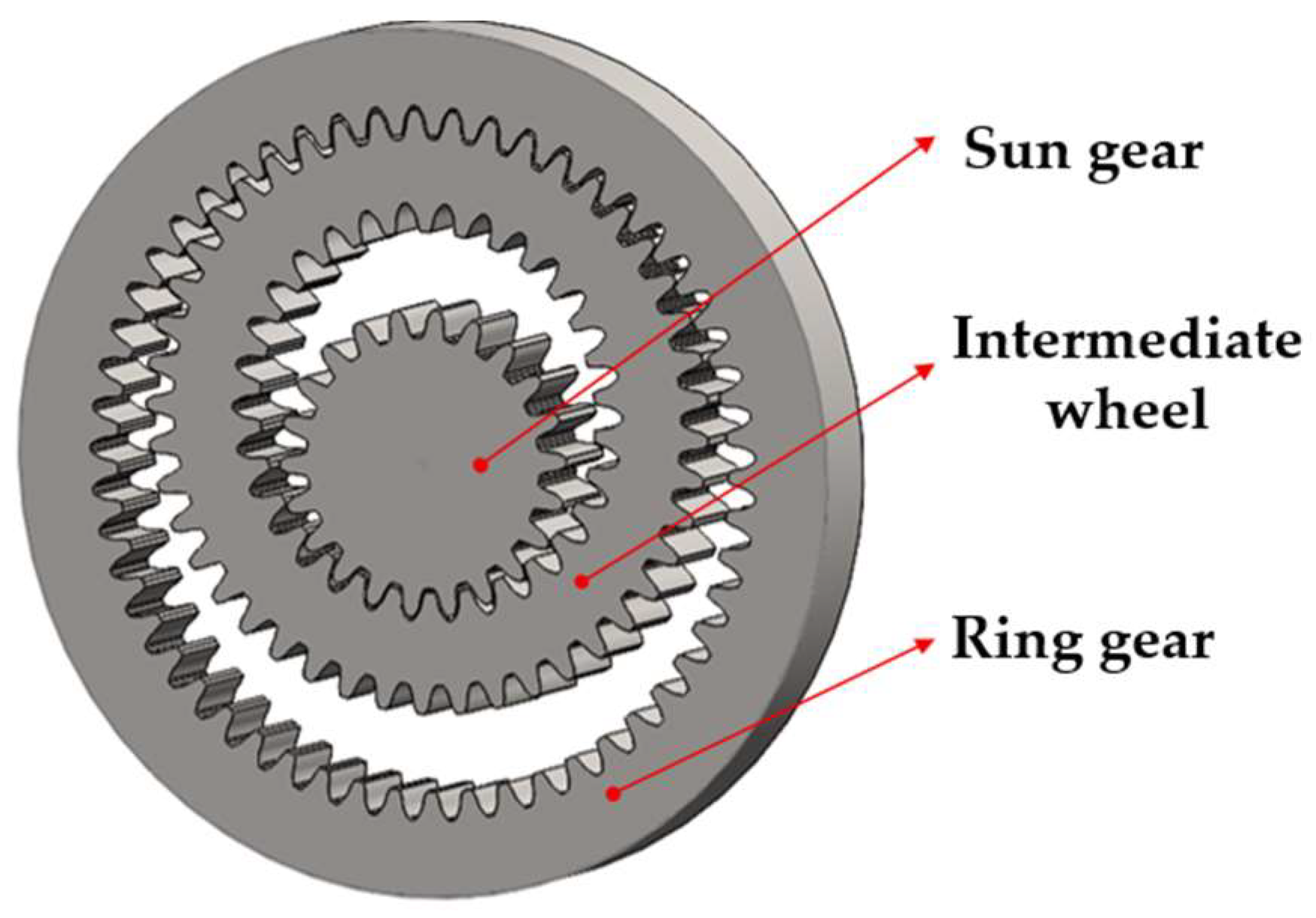
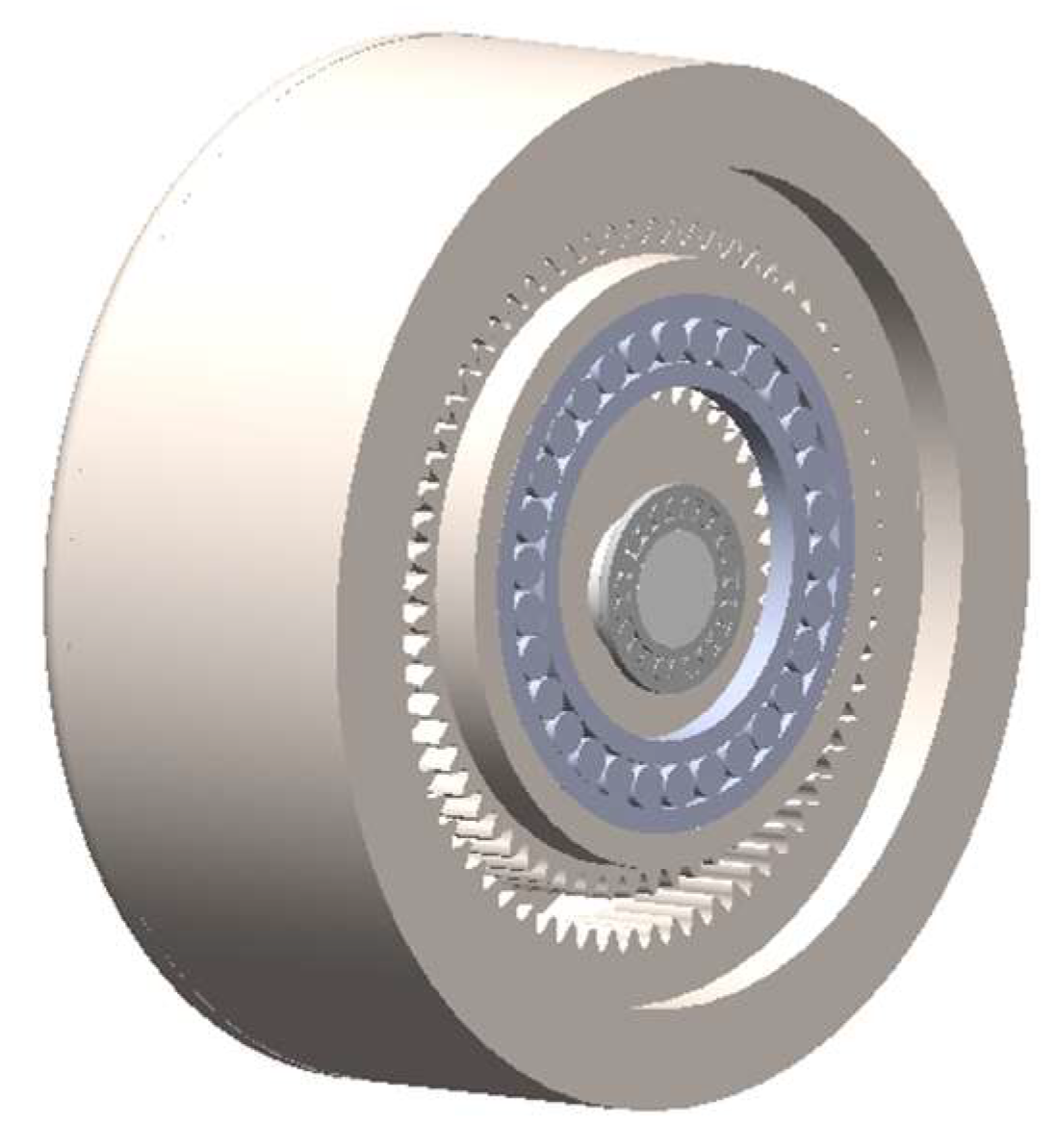
The geometric model of the internal gear with high contact ratio is established. The parameters are shown in Table 1. The three sets of gears are assembled in three dimensions. The planetary gear train is shown in Figure 1 and the overall gearbox structure is shown in Figure 2.

3.2. Numerical Modeling Methodology

3.2.1. Computational Domain and Meshing

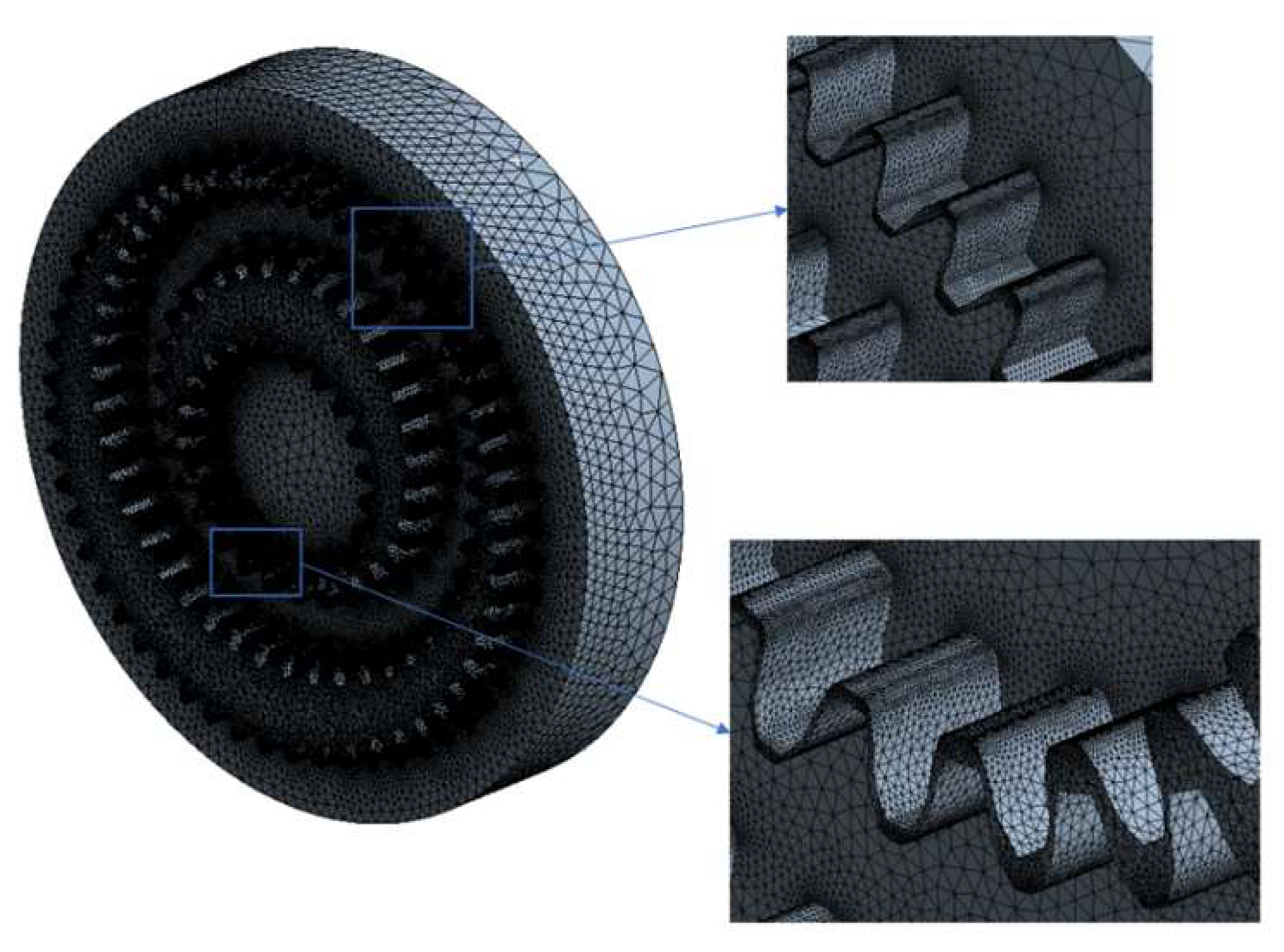
Set the material properties for the gear as follows: the density is  7.85 × 10 6   k g / m m 3 , the Young’s modulus is 2.1 × 10 5   M P a , and the Poisson’s ratio is 0.3. Then, perform grid partitioning, where the fluid domain encompasses the entire gearbox interior containing the planetary gear set and the surrounding air–oil mixture. To accurately resolve the complex flow physics, a multiscale mesh strategy is implemented. The mesh is adaptively refined in critical regions: the gear tooth meshing zones, the near-wall boundary layers where viscous effects dominate, and the anticipated regions of oil–air interface evolution. Conversely, mesh elements are coarsened in less critical areas away from the interfaces to maintain computational efficiency. Following verification of mesh independence, the final model comprised a total of 5,589,599 mesh elements. This results in a hybrid, non-uniform mesh topology, as shown in Figure 3.

3.2.2. Motion Modeling via Dynamic Mesh

To accurately simulate the complex compound motion of the planetary gear train (simultaneous spin and revolution), the transient dynamic mesh technique coupled with User-Defined Functions (UDFs) is employed.
The rigid-body motion of each rotating component is precisely prescribed. To handle the complex kinematics of the planetary motion, User-Defined Functions (UDFs) written in C language are utilized in conjunction with the DEFINE_CG_MOTION macro within the solver. These UDFs specify the time-dependent translational and rotational velocities for the center of gravity of each moving component.
Significant mesh deformation occurs during gear rotation. To maintain mesh quality and numerical stability, a combined mesh smoothing and local remeshing strategy is used. When mesh distortion exceeds a specified threshold, local cell remeshing is triggered.

3.2.3. Solver Settings and Computational Models

This study employs ANSYS Fluent 2023 R2 as the CFD solver. The analysis is configured as a pressure-based, transient simulation. The acceleration due to gravity is set to −9.81 m/s2 in the global Y-direction, influencing the initial oil distribution and subsequent splashing behavior.
The Pressure-Implicit with Splitting of Operators (PISO) scheme is selected for pressure–velocity coupling [28]. The PISO algorithm is particularly advantageous for the present simulation, which involves transient flows, moving meshes, and a sharp, evolving interface. Its additional corrector step provides enhanced stability and convergence for flows with strong interphase coupling and property discontinuities.
To capture the sharp, time-evolving interface between the lubricating oil and the air within the gearbox, the VOF multiphase model is employed. The Realizable k-ε turbulence model (detailed in Section 2.3) is selected and coupled with the VOF model.
The gearbox housing walls are treated as stationary, no-slip boundaries. The initial oil level, defining the volume fraction field for the oil phase, is set using the Patch initialization method corresponding to the specified immersion heights (The oil immersion height shall be measured relative to the centerline of the sun gear, h = −20 mm, 0 mm, +20 mm). Spatial discretization for momentum, turbulent kinetic energy, turbulent dissipation rate, and volume fraction is performed using the Second-Order Upwind scheme to improve accuracy.
Time Step Determination: A transient time step of Δ t = 2 × 10 5   s was employed. This value was determined through a preliminary convergence study to achieve a balance between computational efficiency and resolution of the dynamic flow structures. Although the implicit VOF formulation allows for time steps exceeding the classical CFL limit, the selected step size conservatively maintained a maximum Courant number (Co) below 0.5 in the critical interface regions throughout the simulation, thereby ensuring high temporal accuracy for interface tracking in the high-speed rotating flow.
A total of 20,000 time steps were calculated to ensure the flow developed fully from startup and reached a statistically steady or periodically stable state for subsequent analysis.

3.3. Lubrication Analysis

To systematically investigate the effects of rotational speed and oil immersion depth on lubrication characteristics, this study selected three representative rotational speeds ( 1000 ,   2000 ,   3000   r p m ) and three oil immersion heights (h = −20, 0, +20 mm). The rotational speed range covers typical operating conditions from low-to-medium to high speeds. The negative immersion (h = −20 mm) represents a shallow oil bath where the sun gear center is above the oil surface. The zero immersion (h = 0 mm) corresponds to the oil level at the gear centerline. The positive immersion (h = +20 mm) reflects a deeper oil bath, ensuring full lubrication of the tooth engagement zone. These parameter selections aim to reveal the evolution patterns of oil phase distribution and churning losses under different operating conditions.

3.3.1. Lubricating Oil Distribution at Different Speeds

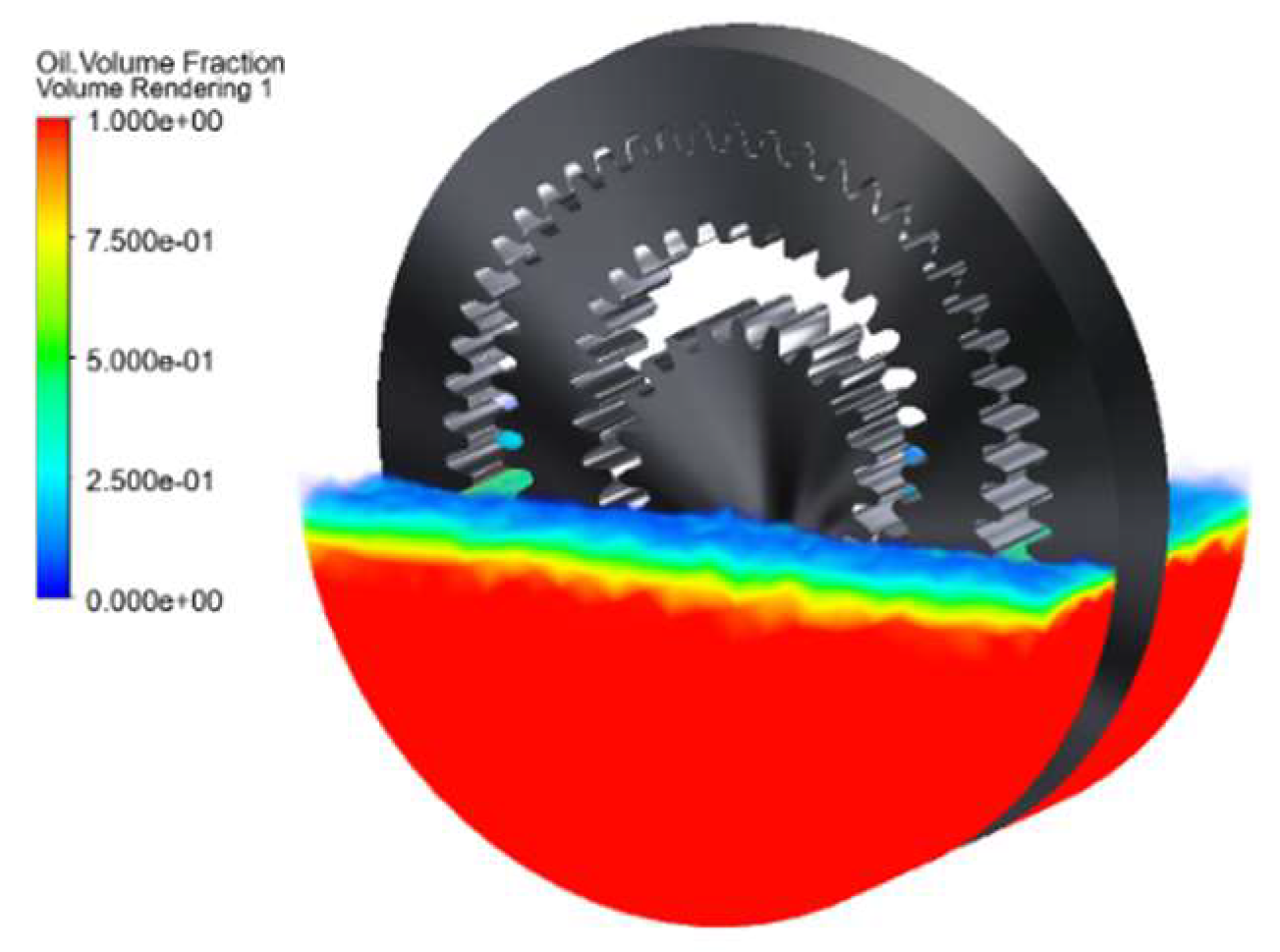
The lubricant is specified as SAE 80W-90 gear oil. Its key properties at the operating temperature are density ρ o i l = 875   k g / m 3 and dynamic viscosity μ o i l = 0.12   P a · s . The rotational speed n is given in revolutions per minute ( r p m ) for clarity in the context of gear operation, while the corresponding angular velocity ω ( r a d / s ) is used for theoretical calculations ( ω = 2 π n / 60 ). The initial oil immersion height of the lubricating oil is set to h = 20   m m . The initial oil immersion height is shown in Figure 4. The distribution of lubricating oil at 1000   r p m , 2000   r p m , and 3000   r p m was analyzed.
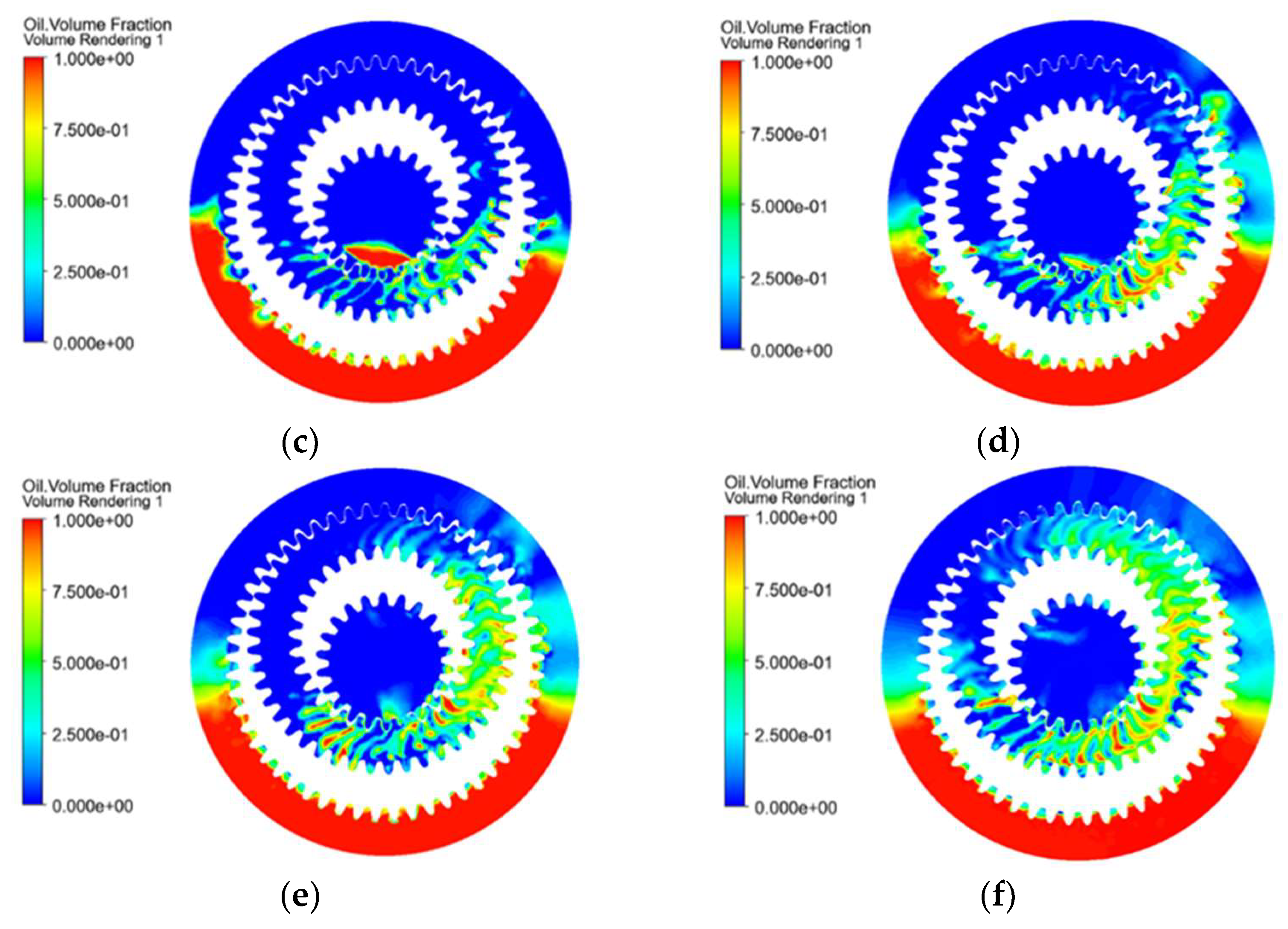
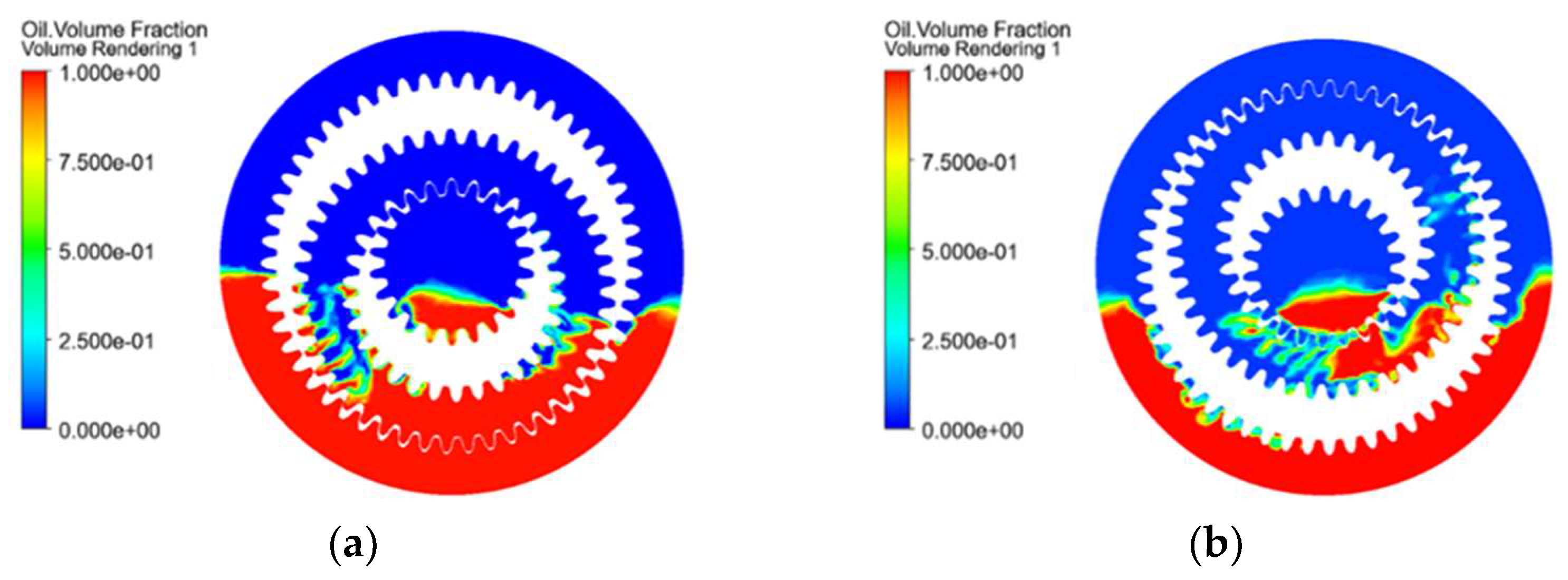
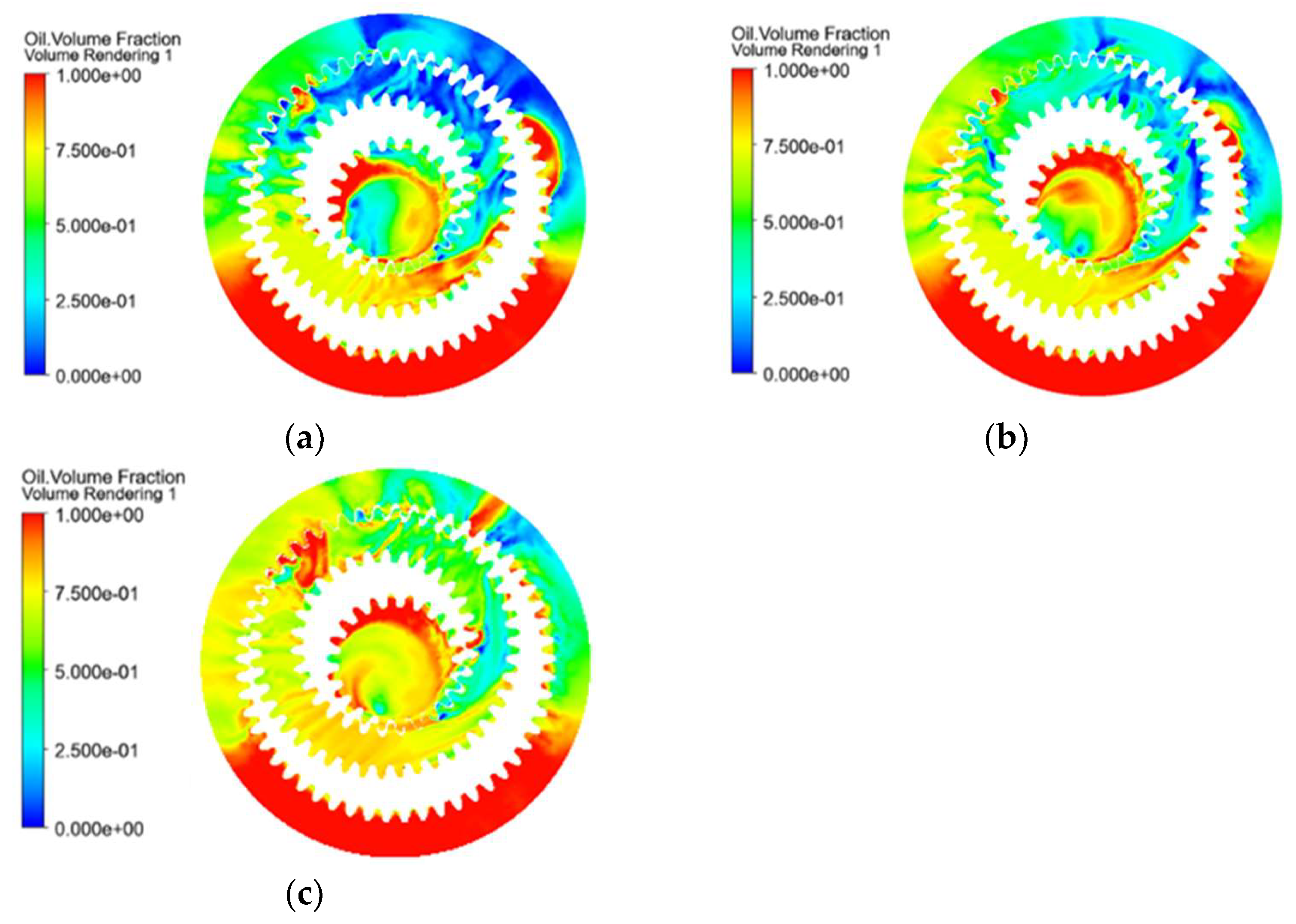
The simulated evolutions of the oil volume fraction distribution at different time instants, corresponding to a sun gear speed of 1000 rpm, are presented in Figure 5a–f. During the initial transient phase of gear operation, the oil is primarily entrained within the gear mesh zone due to viscous drag, resulting in a region of high oil concentration around the engaging tooth surfaces. This initial flow is highly localized, with oil in the inter-tooth spaces forming a confined stream under the combined effects of surface extrusion and shear; its presence is largely restricted to the immediate vicinity of the line of action and the root-to-top transition zones. As centrifugal forces grow with sustained rotation, the lubricant overcomes cohesive and adhesive forces, leading to a pattern of radial dispersal. When the speed is increased to 2000   r p m and 3000   r p m , this fundamental sequence of entrainment followed by dispersal is maintained. However, the associated increase in system dynamic pressure significantly intensifies the oil splashing and atomization processes. After several complete operational cycles, the oil phase distribution attains a dynamic equilibrium. Figure 6a–c show the steady state contours of oil volume fraction for the three different speeds analyzed.

3.3.2. Lubricating Oil Distribution at Different Immersion Heights

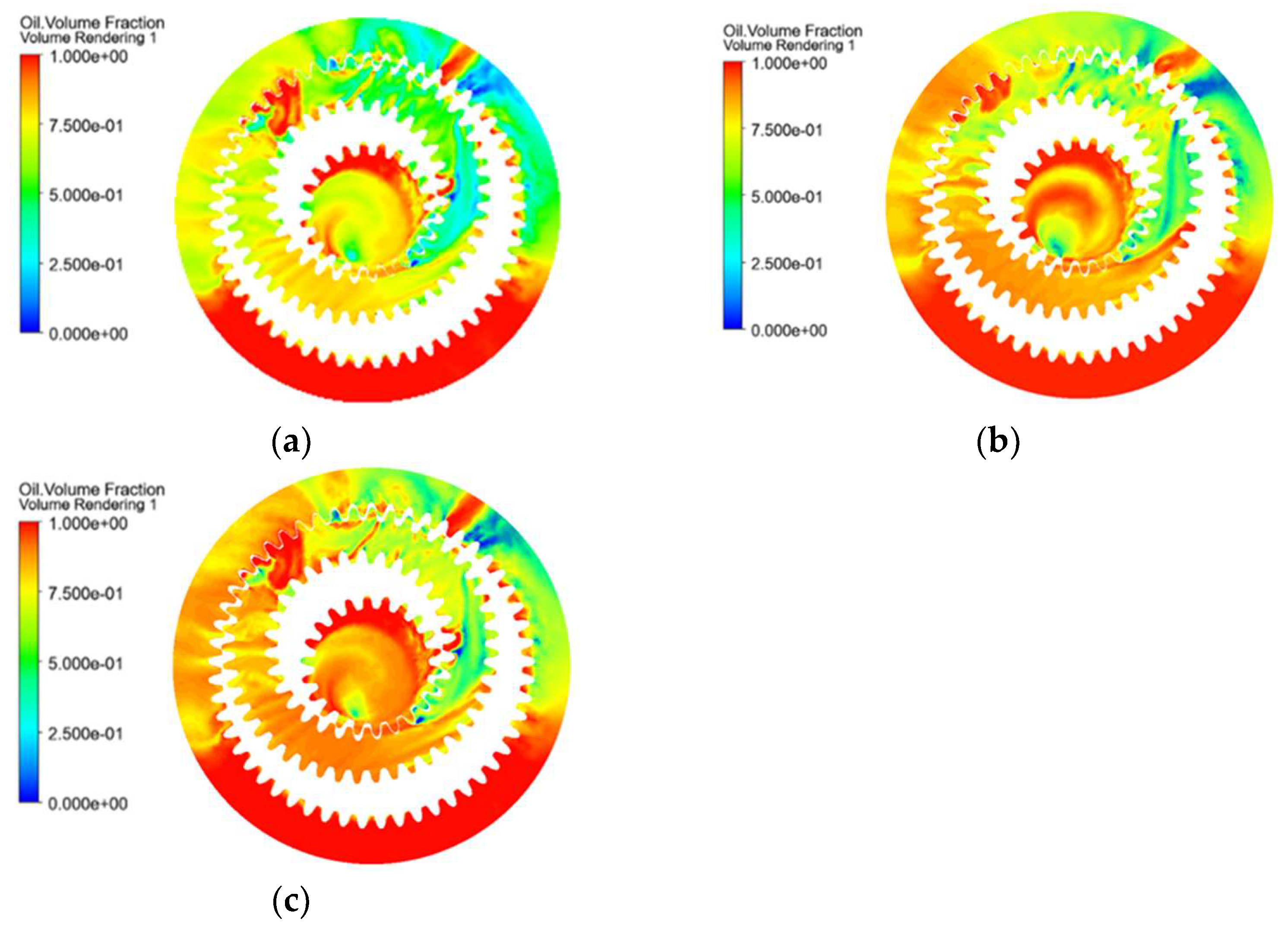
The rotation of the gear in the fluid domain is also affected by the depth of the oil. The gear speed is set to 1000   r p m and the distribution of the lubricating oil under different oil immersion heights is analyzed. The distribution of lubricating oil with immersion height h = 20   m m has been analyzed above. The dynamic response characteristics of the gear transmission system under deep oil level conditions are basically the same as those under shallow oil level conditions. Figure 7a–c are the oil distribution cloud maps under the steady state of 1000 rpm at different oil immersion heights. After the gear system reaches dynamic balance, the oil distribution is more stable under the condition of deep oil level.

4. Oil Churning Loss Analysis of High Contact Ratio Internal Gear Transmission

4.1. Analysis of Oil Churning Pressure Field

In the gear transmission system, the tooth surface pressure and oil velocity play a decisive role in the splash behavior of lubricating oil. Through the above analysis, it can be seen that the gear system can achieve good lubrication effect when the speed is 1000   r p m and the oil immersion height h = 20   m m . Here, the pressure field and velocity field are analyzed in detail.
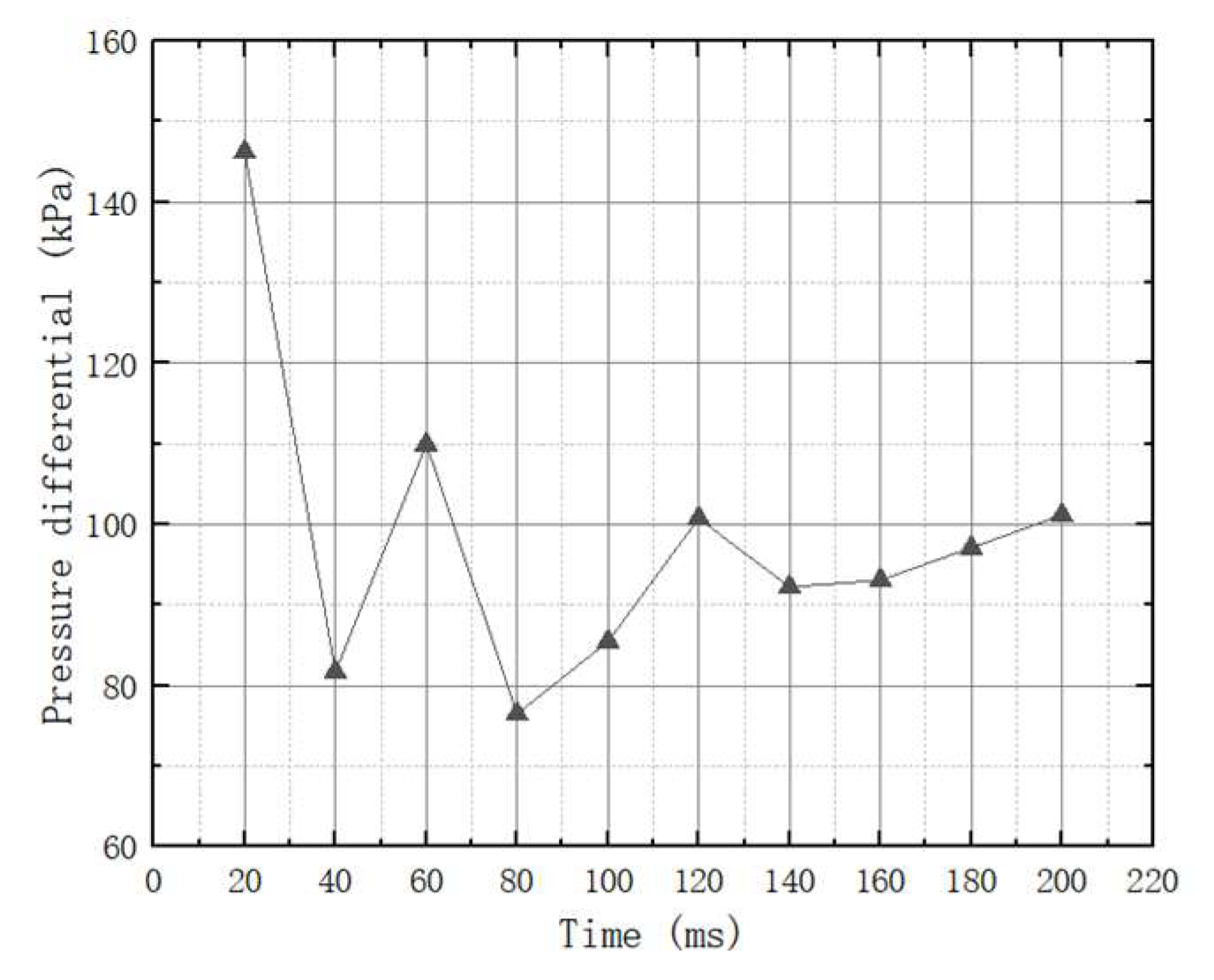
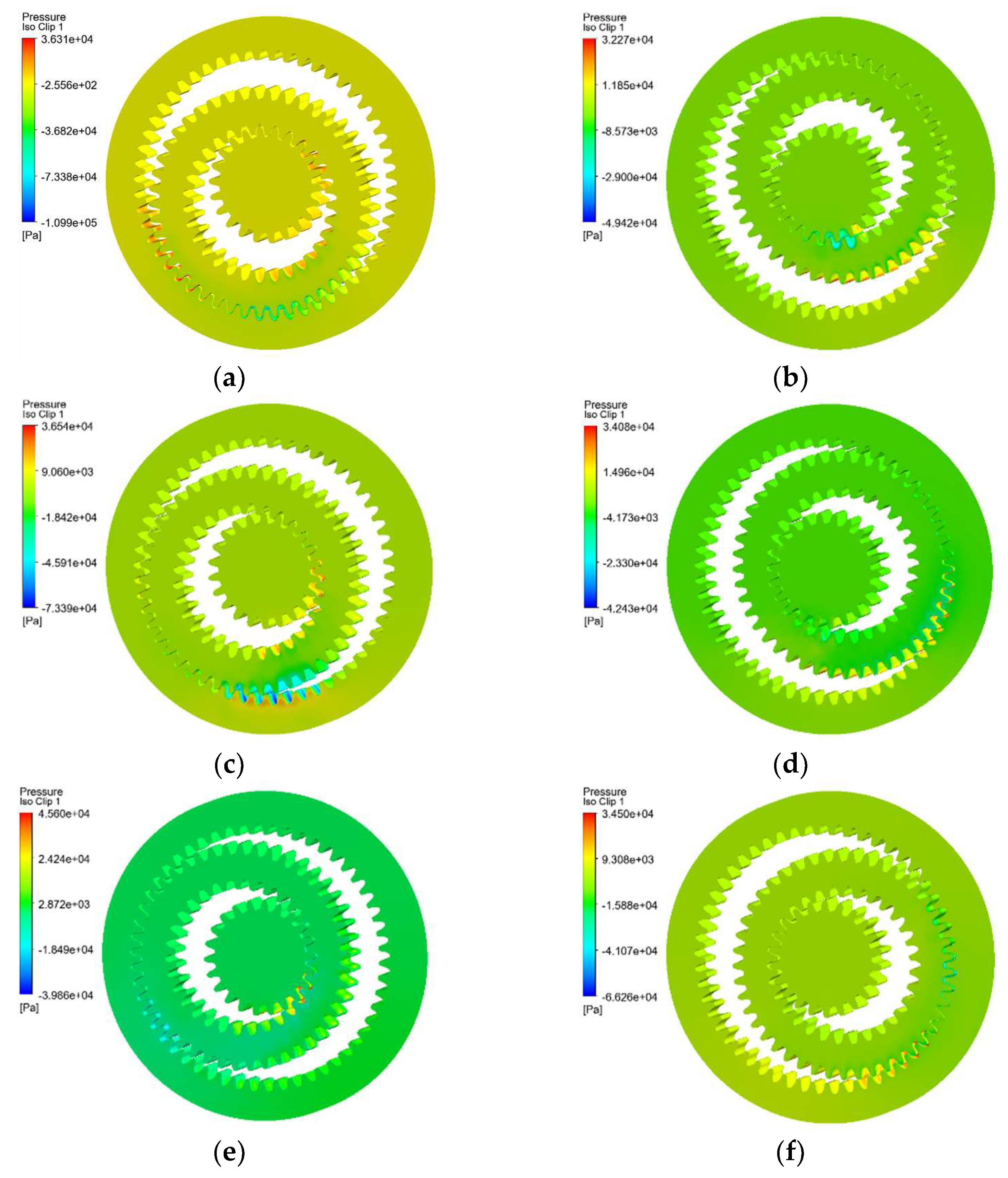
Figure 8a–f show the pressure field distribution of the planetary gear train at different times. During the initial oil churning process, the dynamic response of the lubricating medium shows significant unsteady characteristics. When the system enters the dynamic equilibrium stage, the pressure field distribution shows a stable characteristic: a high-pressure state of fluid dynamics is formed at the inlet of the meshing zone, while the outlet zone maintains a persistent low-pressure area. The line chart of the overall pressure difference in the gear system with time is shown in Figure 9. In the initial stage of the operation of the oil mixing system, the pressure difference in the system shows significant fluctuation due to the strong transient adjustment process of the oil flow. As the operation enters a stable stage, the flow field gradually balances and the pressure difference also decreases and tends to be stable.
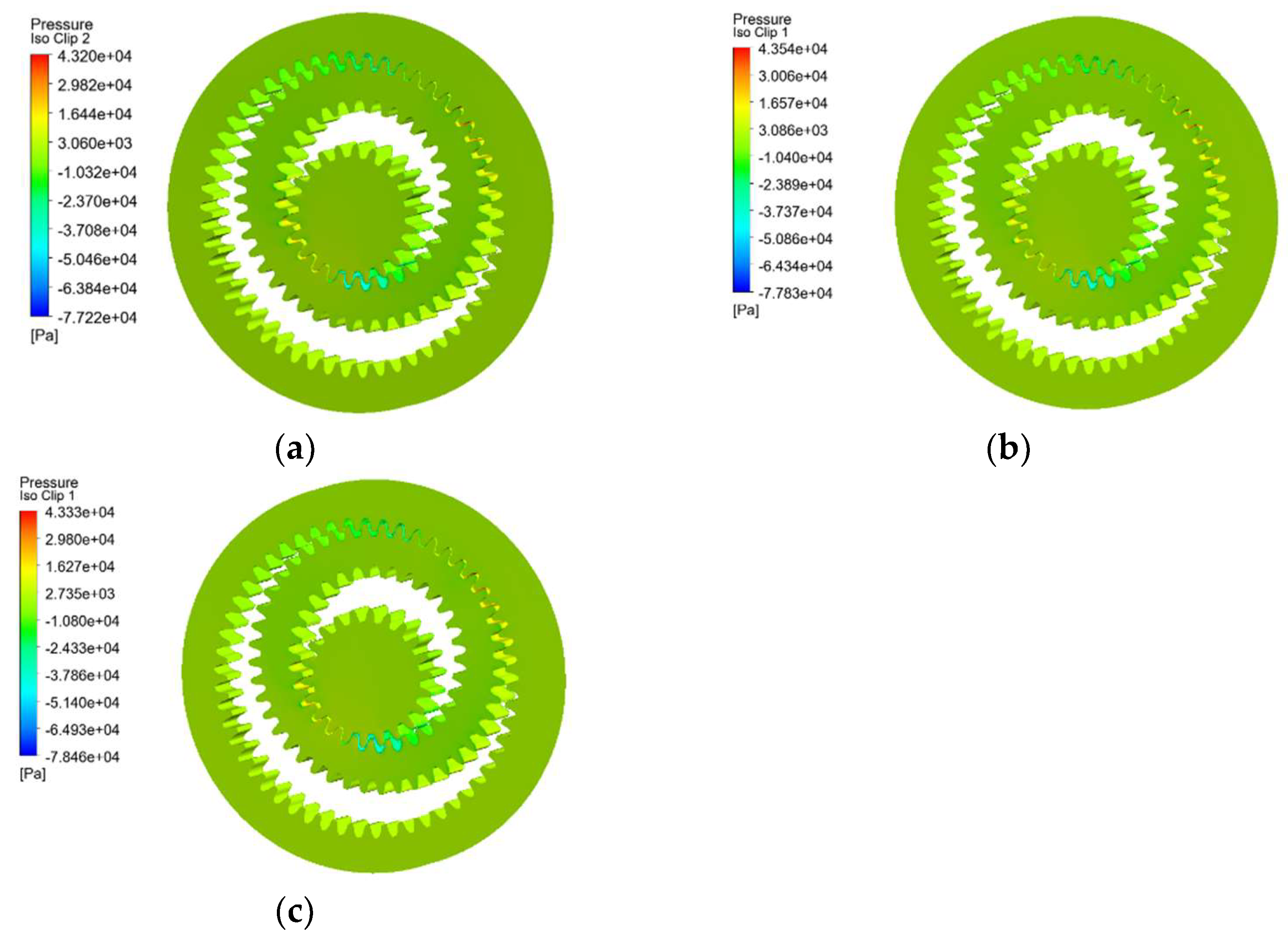
To accurately capture the transient multiphase flow characteristics, after the gear system is relatively stable, the tooth surface pressure is tracked by the VOF multiphase flow model at the same phase in different periods. Figure 10a–c show the distribution of the overall pressure field of the planetary gear train under the same phase angle in different periods. The numerical simulation results show that the gear system presents similar pressure field distribution characteristics under the corresponding working conditions of periodic phase: the pressure is concentrated in the tooth surface area, the pressure load in the tooth side region presents a weak gradient characteristic, and the pressure difference is almost negligible. This phenomenon confirms that the churning loss of the gear system is less affected by the tooth side area and the loss is almost negligible when the friction force is ignored.
The pressure nephogram of the gear tooth surface reveals a pronounced pressure concentration in the meshing zone. The significant pressure gradient in this region indicates that it is the primary source of the pressure differential. Through the quantitative analysis of the three groups of pressure field distribution cloud maps, the data showed a high degree of consistency: the maximum positive pressure values were 43.20   k P a , 43.54   k P a , and 43.33   k P a and the maximum negative pressure values reached 77.22   k P a , 77.83   k P a , and 78.46   k P a . The corresponding pressure difference amplitudes were 120.42   k P a , 121.37   k P a , and 121.79   k P a . This strict numerical reproducibility confirms that the system has reached dynamic equilibrium and validates the formation of a stable, repeatable pressure boundary layer in the lubricant. These findings provide reference data for studying the dynamic lubrication characteristics of gear systems under this operating condition.

4.2. Analysis of Stirring Oil Velocity Field

The velocity field presented in the following analysis, obtained directly from the transient VOF simulation, represents the mixture velocity of the air–oil two-phase fluid. This is the primary velocity variable solved by the governing conservation equations for the mixture phase.
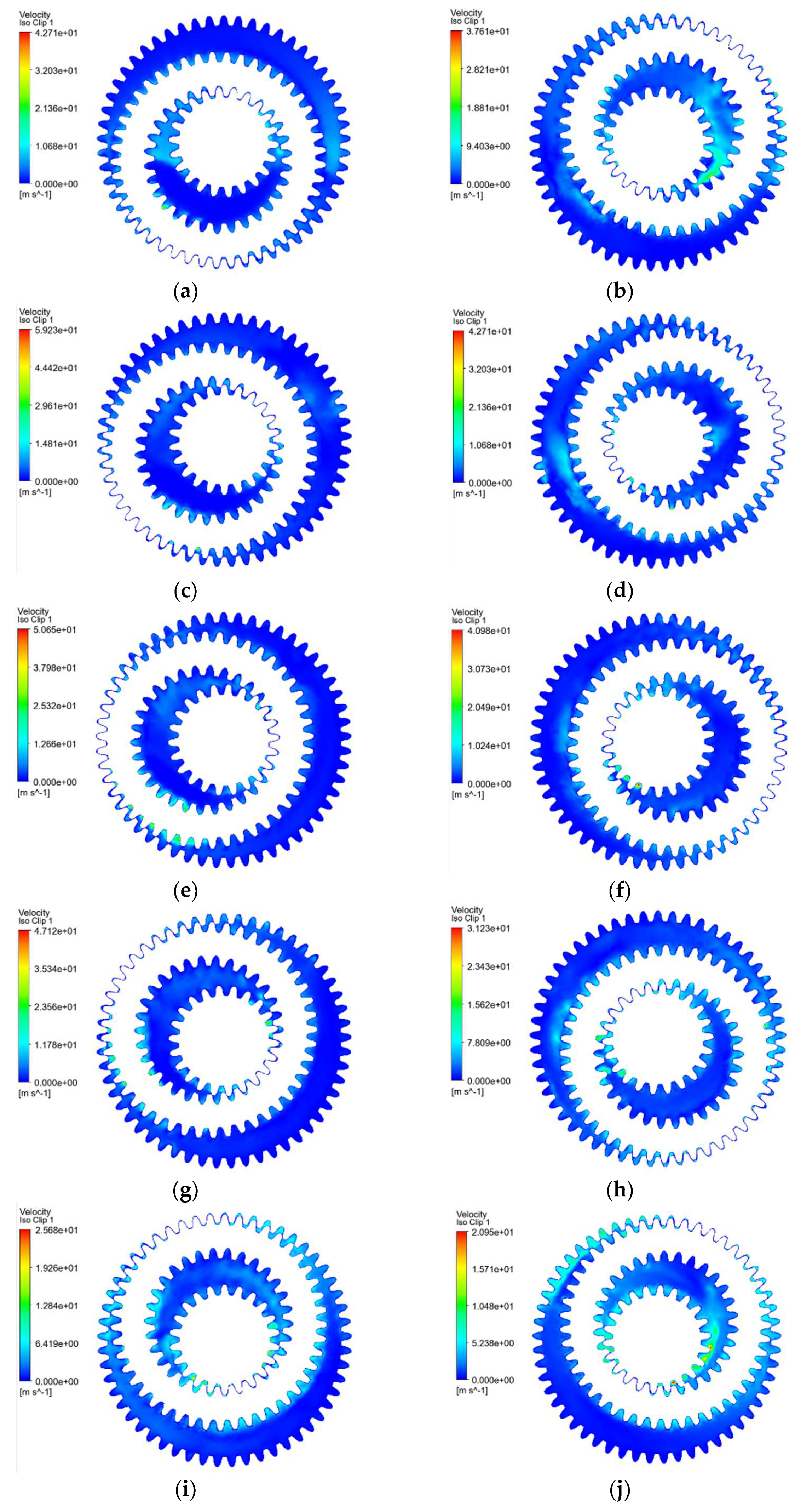
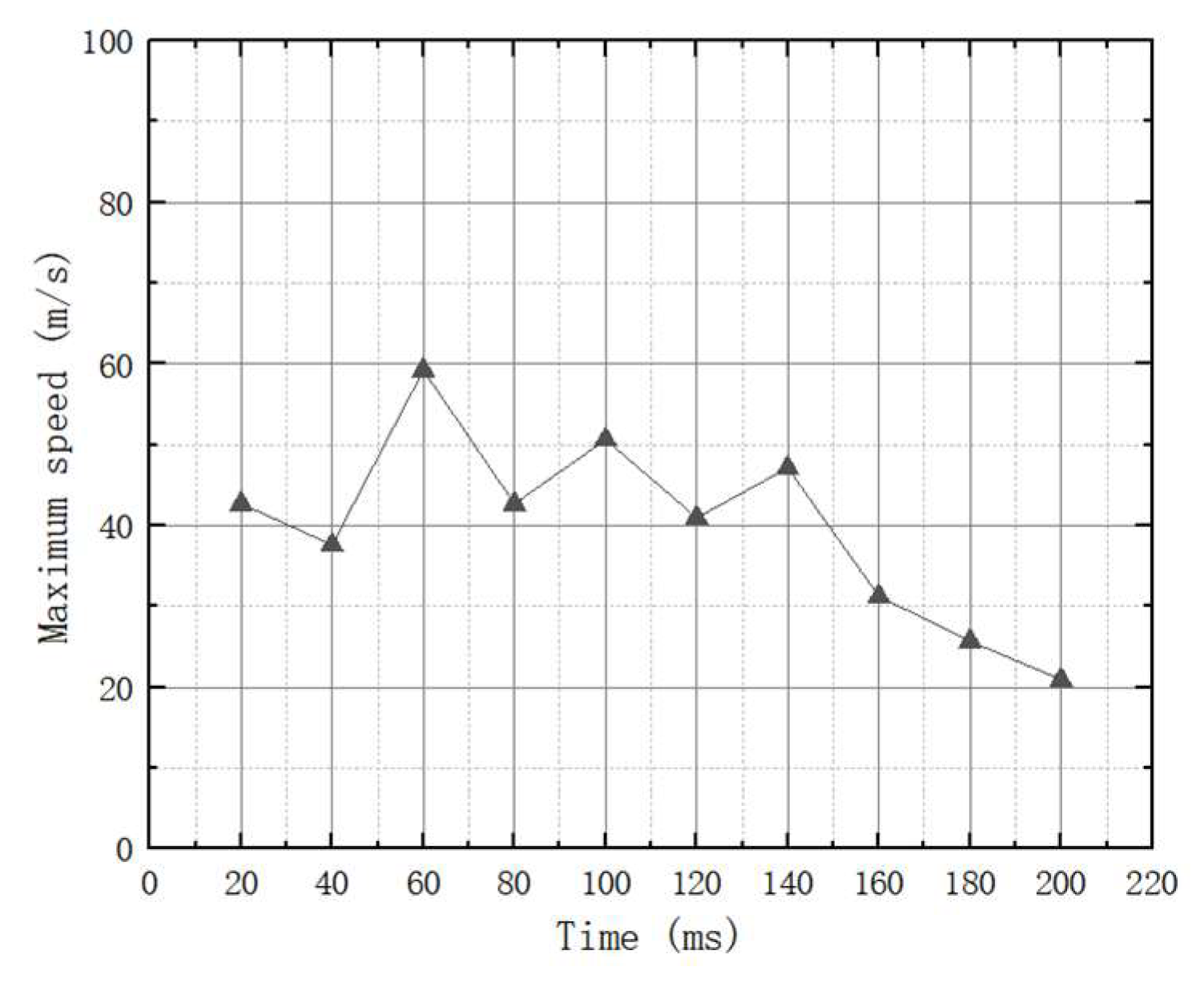
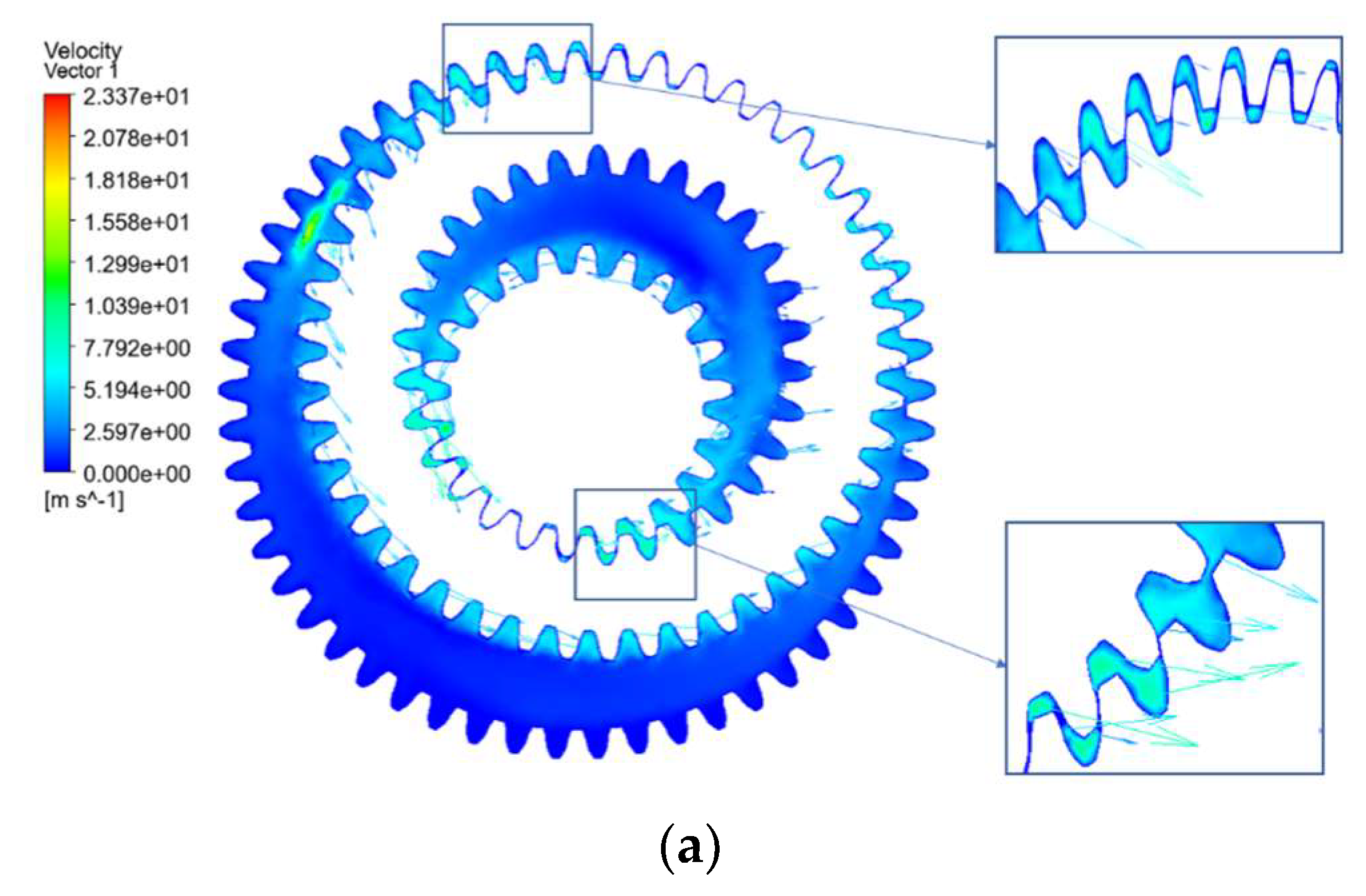
In the process of oil churning lubrication, the mechanism of power loss is mainly due to the kinetic energy dissipation effect during oil movement. Since the velocity gradient generated by the oil in the shear flow directly determines the strength of the kinetic energy loss, the degree of churning loss can be effectively quantified by monitoring the distribution characteristics of the oil velocity. The oil velocity distribution at different moments is shown in Figure 11a–j and Figure 12 is the maximum velocity line chart of the planetary gear train.
It can be seen that in the initial stirring stage of the gear pair meshing transmission, due to the incomplete establishment of the lubricating oil film, the complex dynamic interaction characteristics between the gear working face and the lubricating medium are presented. The local velocity field at the leading edge of the contact zone changes drastically in a short time and the generation of this transient velocity peak will significantly increase the shear torque. During this process, the oil’s turbulence intensity increases sharply. As operation continues, the lubricating boundary layer progressively develops, ultimately evolving into a statistically steady turbulent field governed by the balance of fluid dynamic and viscous forces.
After approximately 10 cycles of operation, the velocity field transitions from a startup transient to a periodically repeating state. In this state, the flow exhibits cyclic fluctuations synchronized with gear rotation. As shown in Figure 13a–c, this is illustrated by the maximum mixture velocities extracted from three different, representative cycles (10 T, 12 T, and 14 T), which span from approximately 21.3   m / s to 24.4   m / s .
In the oil churning lubrication system, the distribution of the oil velocity field shows significant spatial heterogeneity. The highest oil velocities are concentrated in the gear mesh zone. The meshing region acts as a core zone for oil agitation due to the severe turbulence generated by flow separation and the intense shear layers arising from the sudden geometric change in the interacting tooth profiles. Under the action of viscous shear, the oil within the boundary layer attached to the tooth surface exhibits a velocity profile that satisfies the no-slip condition at the wall. The velocity increases across the boundary layer, influenced by the gear’s rotation, strong centrifugal forces, and the local pressure field, and does not uniformly match the pitch line velocity.

4.3. Flow Field Analysis of High Contact Ratio Internal Gear Churning Oil Under Different Working Conditions

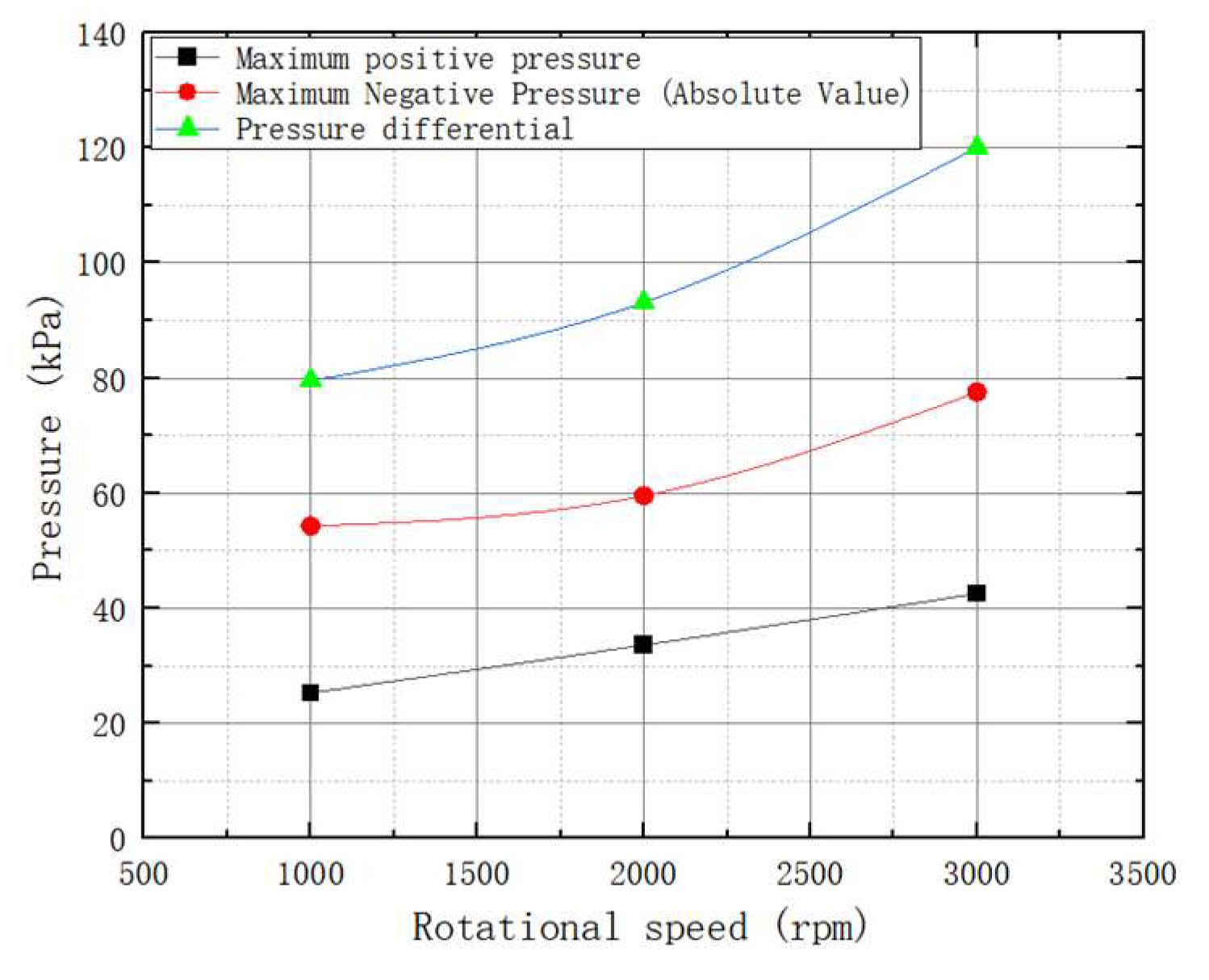
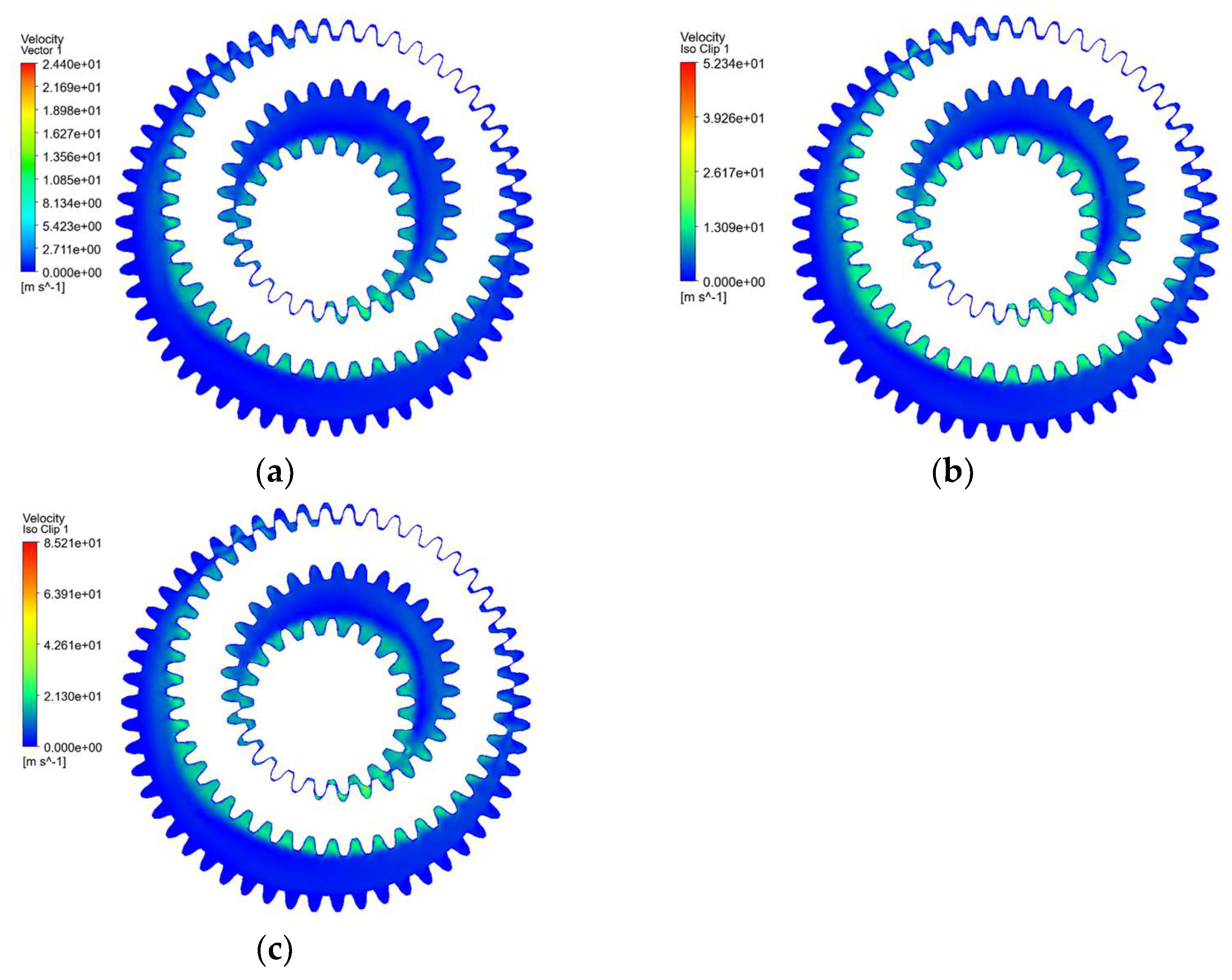
In order to study the pressure and velocity distribution of the pinion system under different working conditions, the velocity field and pressure field of the gear system under different rotational speeds and different oil immersion heights are analyzed. The pressure field under the condition of 1000   r p m , 2000   r p m , 3000   r p m and immersion height h = 20   m m was analyzed. According to the CFD simulation results, the system pressure under different speed conditions is shown in Figure 14. As rotational speed increases, the positive and negative pressure peaks exhibit a growing trend and the overall system pressure difference changes substantially. This indicates that rotational speed has a marked influence on the tooth surface pressure distribution.
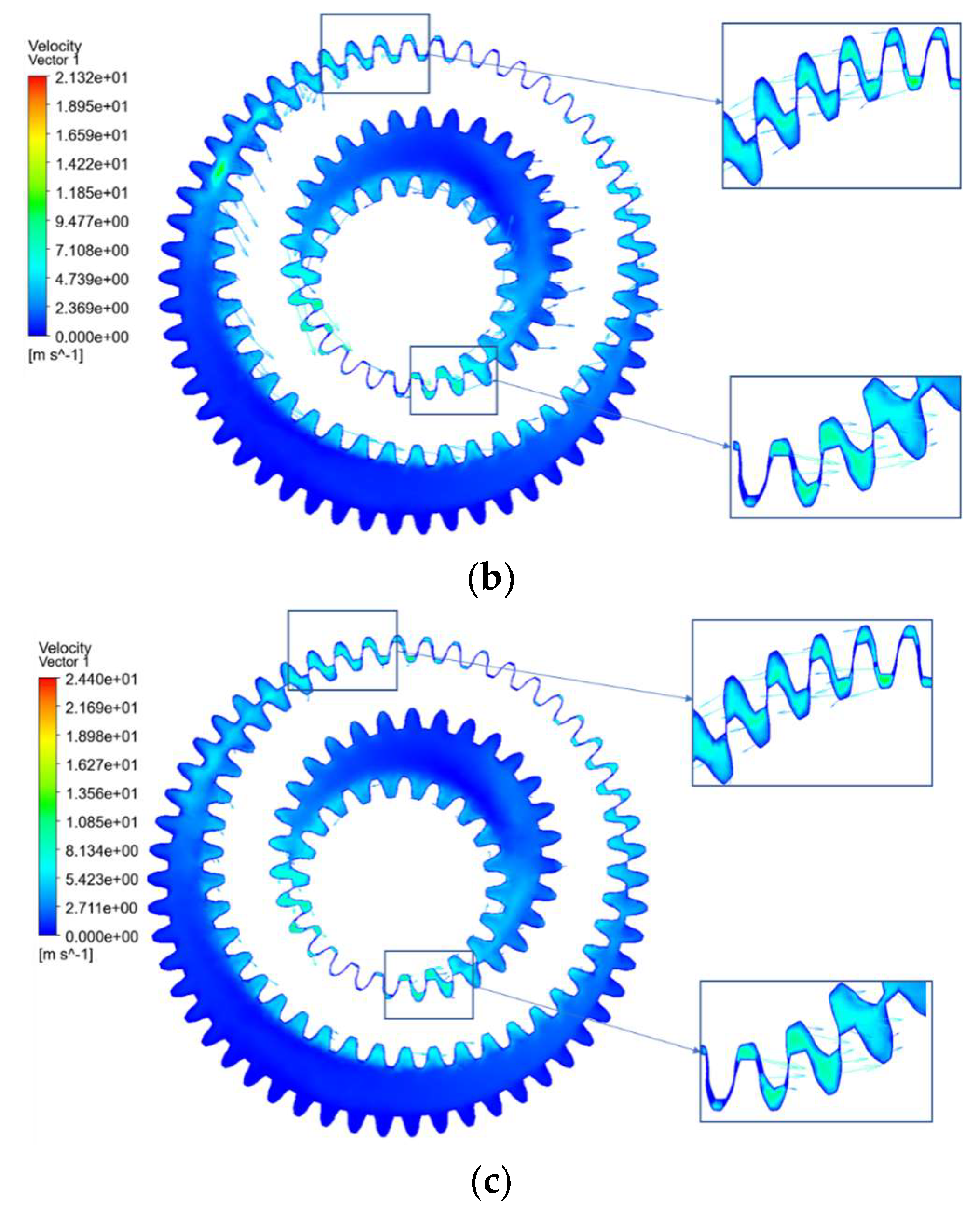
The velocity field under the speed of 1000   r p m , 2000   r p m and 3000   r p m and the depth of oil immersion h = 20   m m are analyzed. According to the CFD simulation results, the velocity field distribution of the extracted oil is shown in Figure 15a–c. Compared to higher rotational speeds, the oil velocity in the gear mesh zone decreases significantly at lower rotational speeds, indicating that rotational speed has a pronounced effect on oil flow velocity.
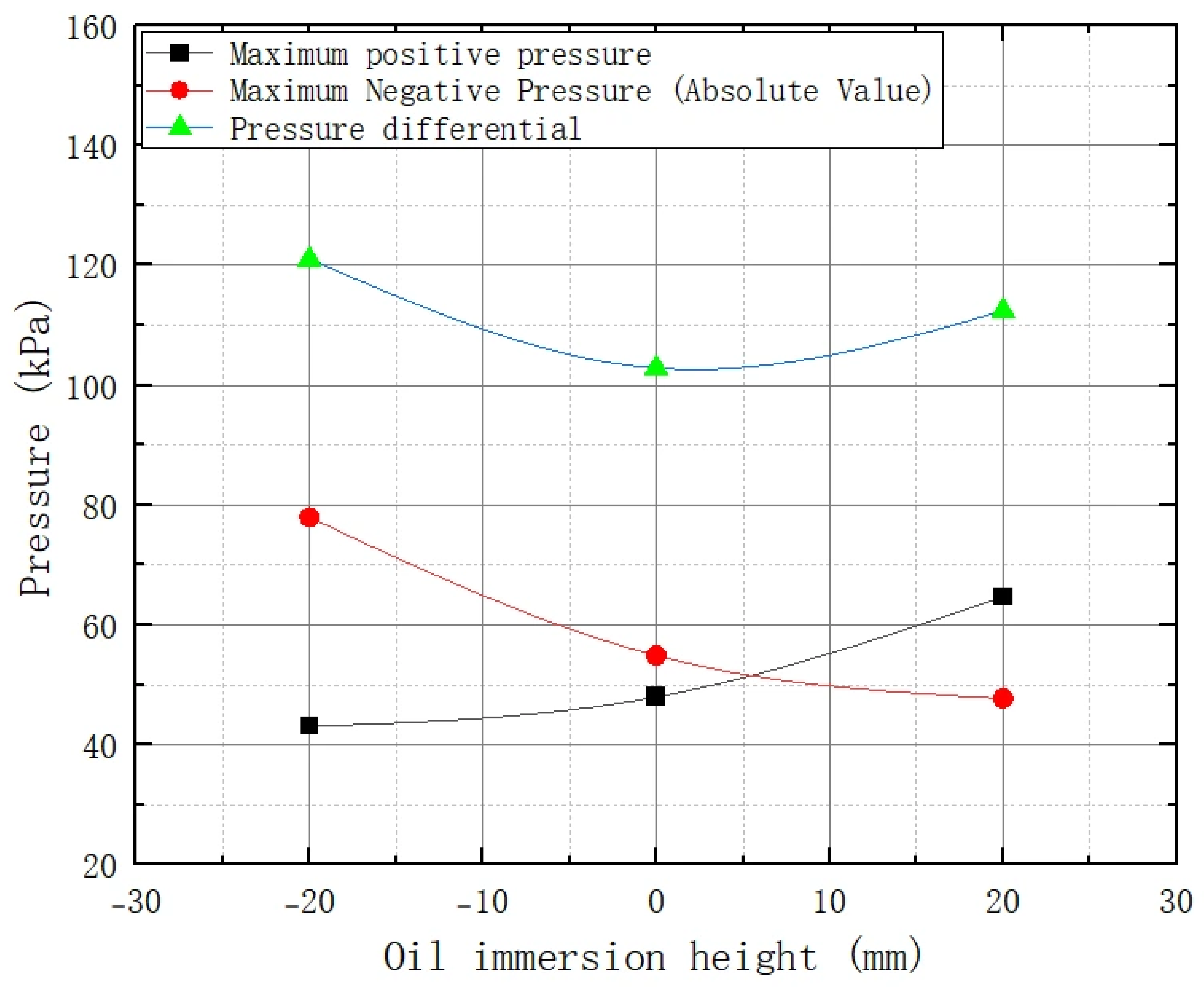
The pressure field under the speed of 1000   r p m and the depth of oil immersion of h = 20   m m , h = 0   m m , and h = 20   m m were analyzed. Figure 16 shows that as the immersion depth increases, the peak positive pressure in the system rises while the magnitude of the peak negative pressure decreases. However, when compared to the effect of rotational speed (Figure 14), the influence of immersion depth on the absolute pressure levels and their difference is less pronounced. Therefore, within the studied parameter range, rotational speed is identified as the dominant factor governing the pressure field intensity.
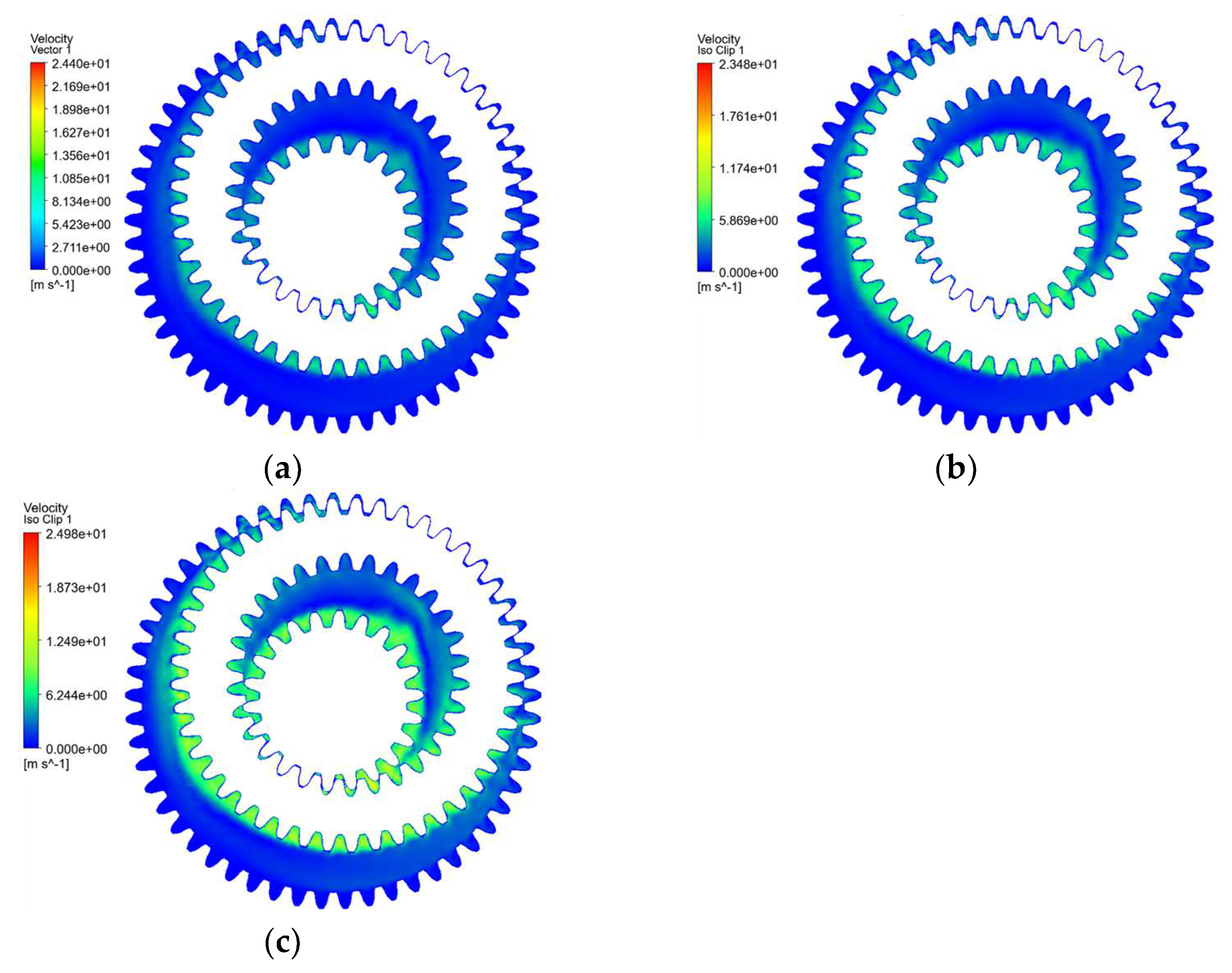
The velocity field is analyzed. According to the CFD simulation results, the velocity field distribution of the extracted oil is shown in Figure 17a–c. As the oil immersion height increases, the maximum fluid velocity within the gearbox shows no significant change. However, the range of high-velocity fluid expands, with a notable acceleration in fluid velocity within the gear mesh area and a slight decrease in the fluid velocity within the mesh entry zone. This indicates that oil immersion height exerts a certain influence on the overall fluid flow velocity.

4.4. Analysis of Oil Loss Due to Agitation

In the lubrication process of gear transmission system, the hydrodynamic force presents nonlinear dynamic characteristics. In the initial transient stage of the motion, due to the insufficient formation of the lubricating oil film and the drastic change in the interfacial flow field, the system will show obvious instantaneous resistance torque peak phenomenon. As the motion state continues and the lubrication interface evolves into a stable hydrodynamic lubrication regime, the time domain characteristics of the resistance torque gradually stabilize, demonstrating periodic steady state fluctuation characteristics. In view of this phenomenon, multi-cycle measured signals in the continuous operation state were processed by periodic averaging. According to Equation (19), the average churning resistance torque varying with speed was obtained, enabling precise determination of the effective torque value under dynamic conditions.
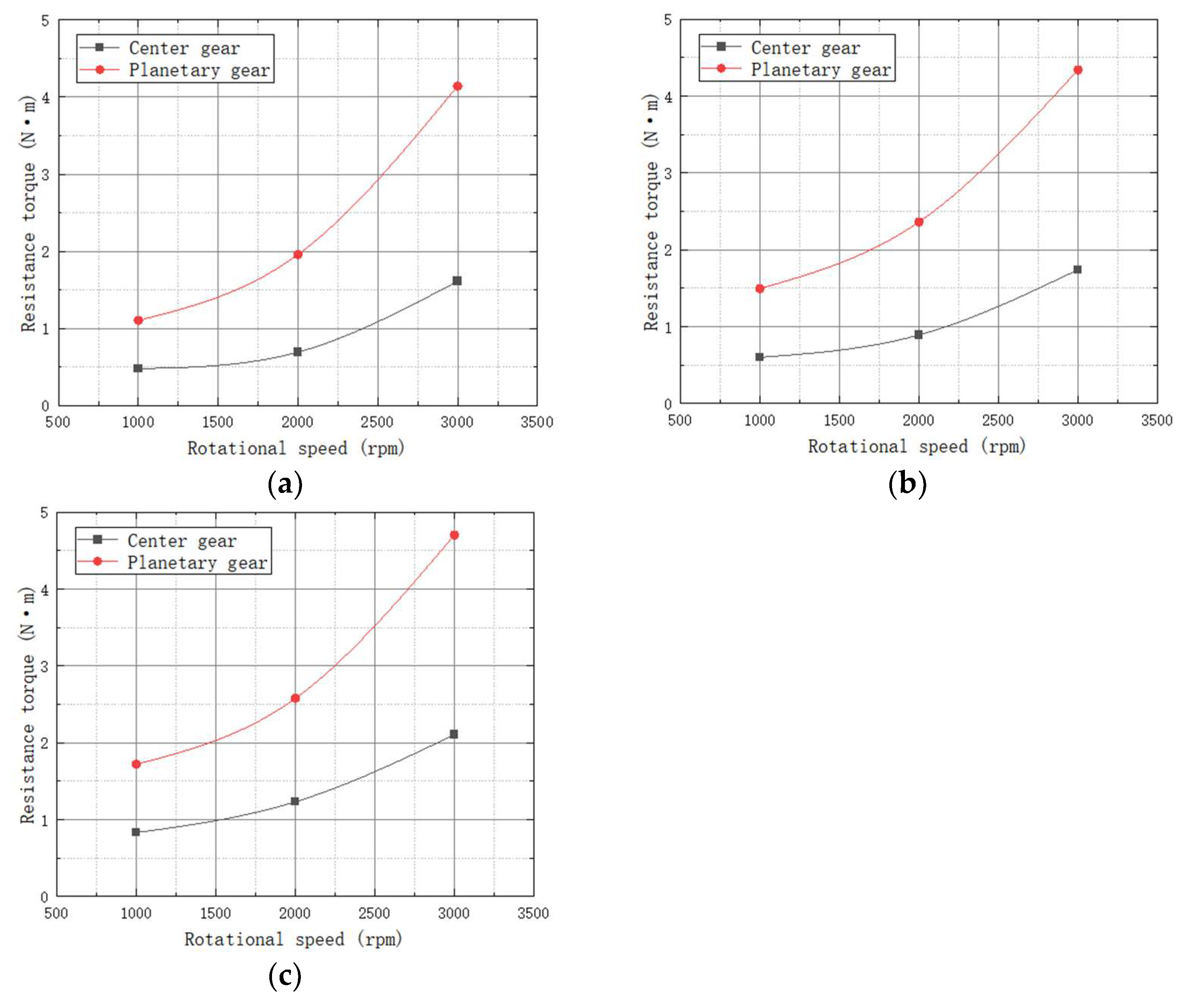
Figure 18a–c show the resistance torque during gear operation at different oil immersion heights. As the oil level rises, the gear comes into more complete contact with the oil, increasing the viscous force exerted by the oil and leading to a significant rise in rotational resistance. Further analysis reveals that at a fixed oil volume, the faster the gear speed, the more intense the oil agitation and the more rapid power loss increases. At the same rotational speed, the greater the oil immersion height, the larger the area of oil agitated and the higher the energy consumption. The diagram also shows that due to the complex motion of the planetary ring gear and its larger contact area and radius of motion with the fluid, the resistance torque it experiences is significantly greater.
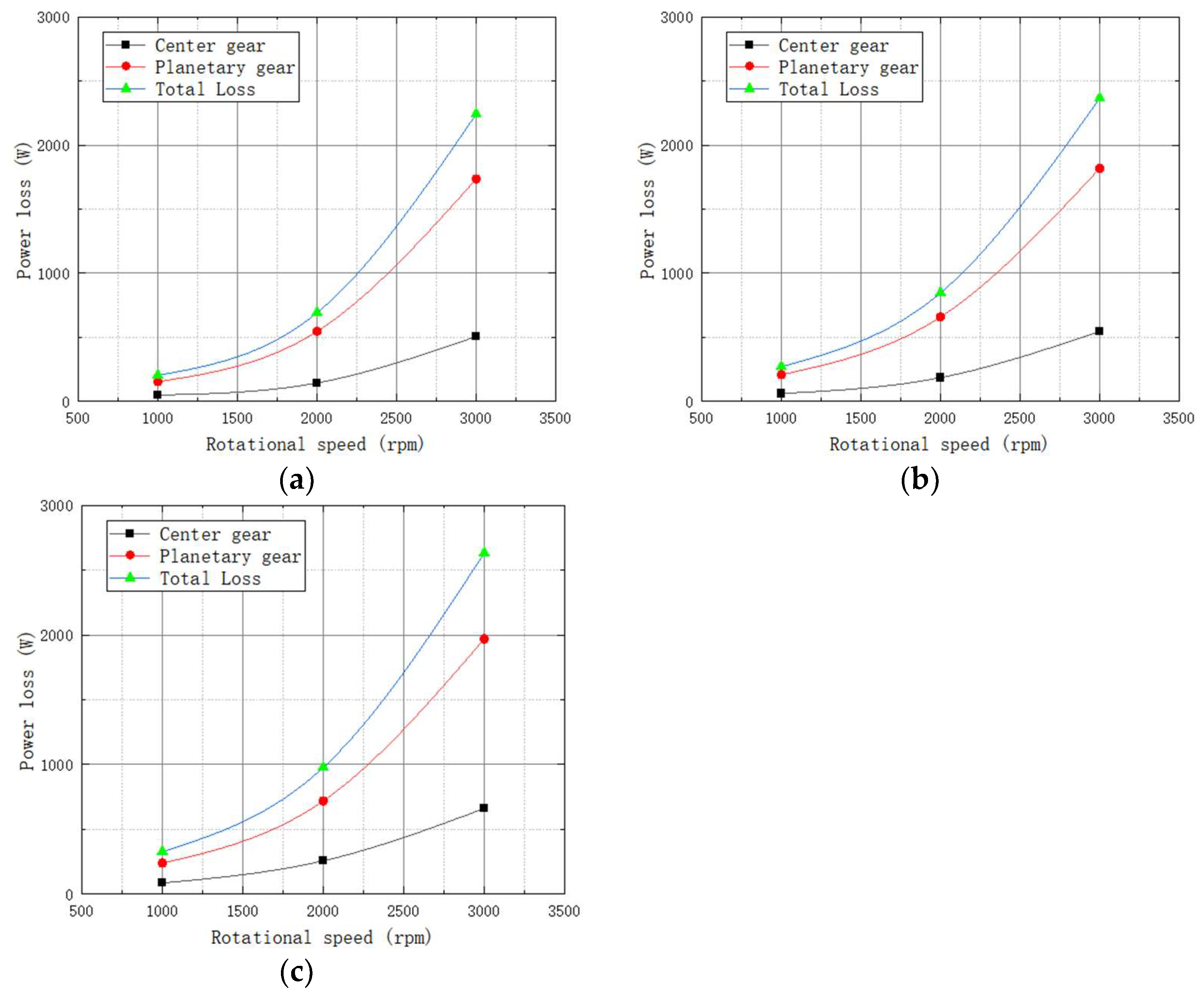
According to the calculation of the churning resistance moment and Formula (20), the churning power loss of each gear and the overall power loss of the system are shown in Figure 19a–c. In gear transmission systems, the immersion height of lubricating oil significantly impacts churning power loss: as immersion height increases, the contact area between gear pairs and oil expands, intensifying viscous resistance and splashing effects, leading to a marked rise in churning power loss. Similarly, when immersion height remains constant, increased rotational speed exacerbates oil turbulence and shear forces, likewise causing a noticeable increase in churning losses. Comparing the influence degree of the two factors, the change in rotational speed has a more prominent effect on the power loss of churning oil and the increase in power dissipation caused by it exceeds the influence of the change in immersion height. The results show that the optimization of speed should be given priority to control the churning loss under high-speed conditions.

5. Experimental Verification and Discussion

5.1. Experimental Verification

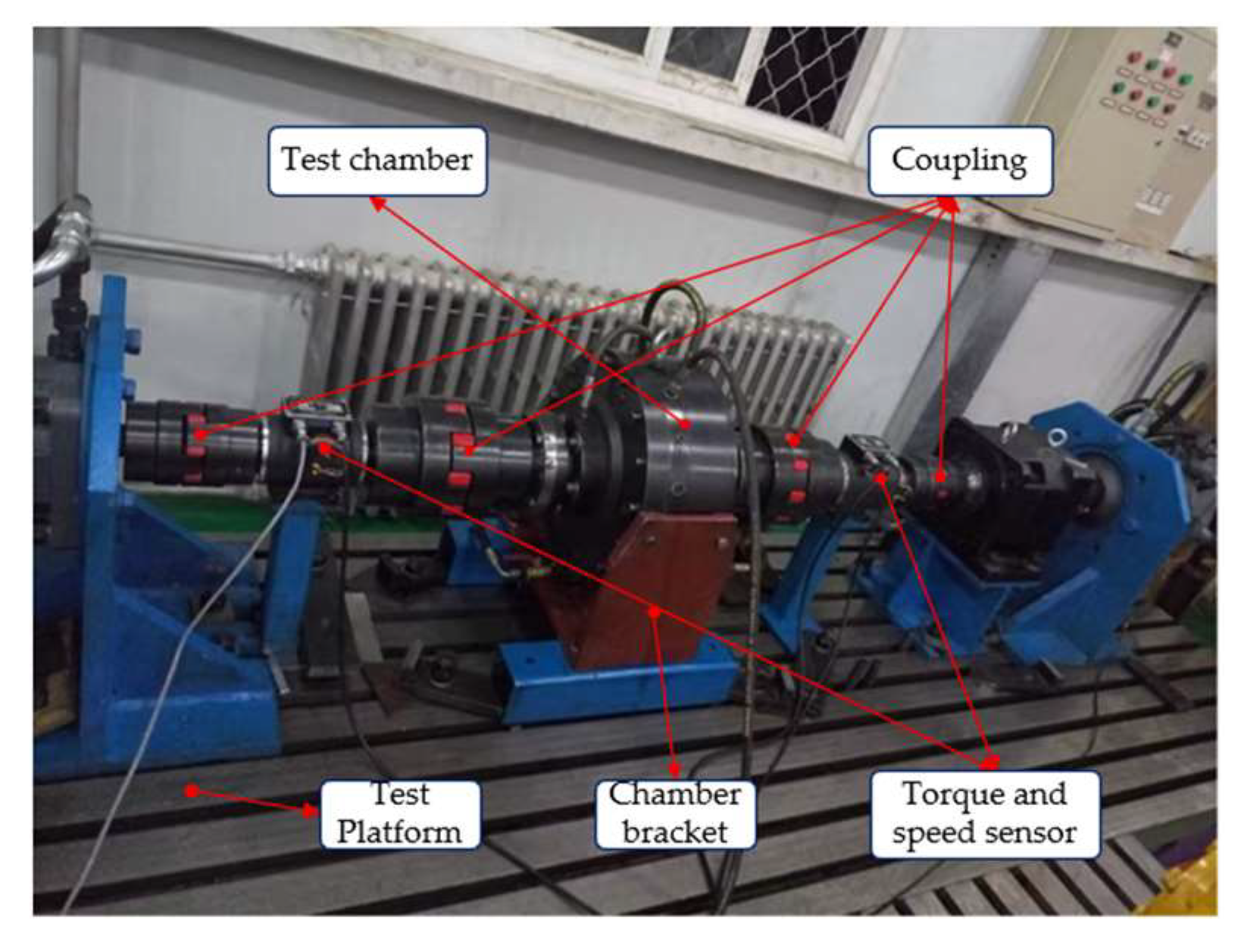
To verify the simulation results, a gear churning test bench was built. The overall structure of the test bench is shown in Figure 20.
Guided by the aforementioned pressure and velocity field conditions, experiments were conducted at rotational speeds of 1000, 2000, and 3000 r p m and oil immersion heights of h = −20, 0, and 20 m m to validate the simulation accuracy.
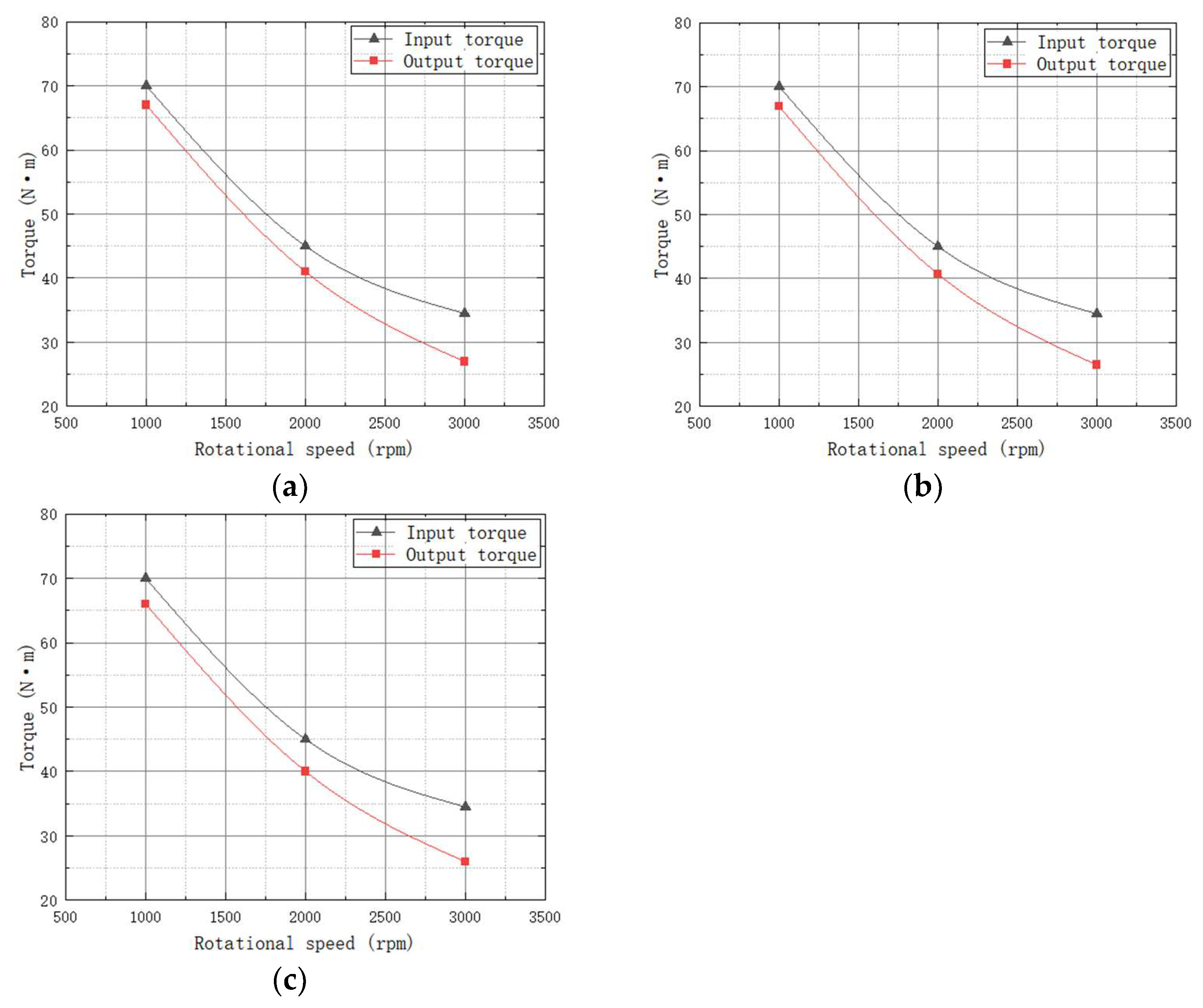
The lubricating oil was filled at h = 20   m m to start the test and the corresponding speed and torque were recorded after three different speeds were stabilized. Then, the lubricating oil is filled to h = 0   m m and h = 20   m m , respectively, and the corresponding speed and torque are recorded after three different speeds are stabilized. Figure 21a–c show the input and output torque changes recorded by the torque sensor.
With the increase in rotational speed, the input torque and output torque of the system show a downward trend (consistent with the power–torque relationship P = T ω ), but the torque difference (i.e., churning power loss torque) gradually increases. This is because higher rotational speeds intensify oil turbulence and shear forces, leading to increased energy consumption. Thus, although the transmission torque decreases with speed, the energy loss caused by churning is amplified, resulting in a larger torque difference.
At greater oil immersion heights, the gear is submerged deeper, increasing its contact area with the oil. During high-speed rotation, this causes more oil to splash and be squeezed, resulting in more pronounced hydraulic damping and energy dissipation. Simultaneously, the inertial effects of the oil intensify, further amplifying torque loss. Consequently, although the trend in torque variation resembles that of negative immersion conditions, the increase in torque loss becomes more pronounced at high rotational speeds due to the substantial rise in both the volume and momentum of oil participating in the interaction.
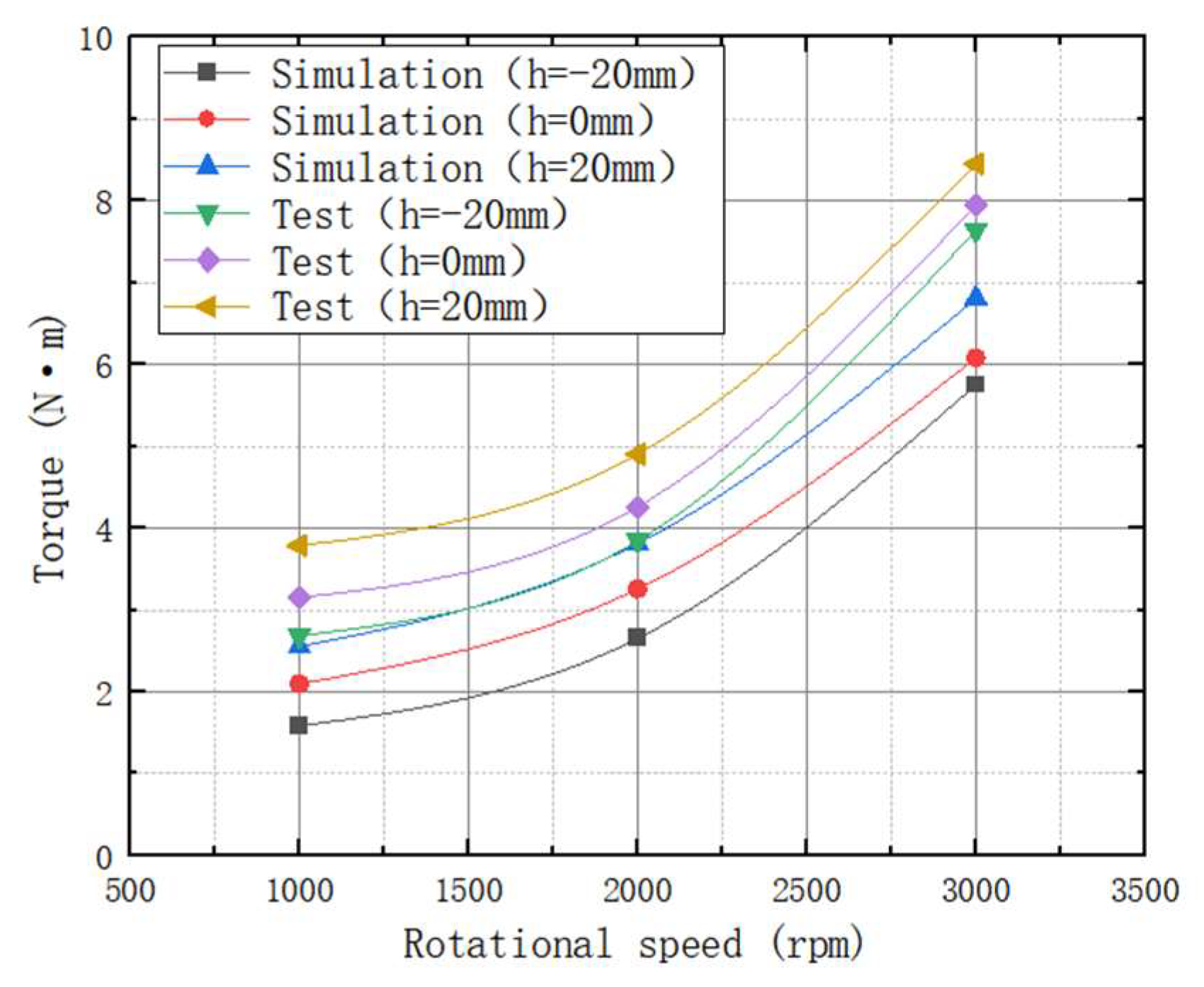
As shown in Figure 22, the energy dissipation characteristics of the gear system exhibit a pronounced dual-parameter coupling effect: increasing oil immersion height expands the lubrication interface, enhancing viscous shear forces and thereby intensifying energy dissipation. Meanwhile, elevated rotational speeds amplify this power loss mechanism by intensifying the turbulent effects. This parameter sensitivity stems from the synergistic effect of oil viscous resistance and inertial force on kinetic energy conversion and its dynamic balance relationship directly determines the energy efficiency characteristics of the transmission system.

5.2. Comprehensive Discussion: Mechanistic Analysis of Simulation–Experiment Discrepancy

Figure 22 compares the simulated churning torque loss with the experimentally measured total system torque loss. The observed quantitative differences, particularly the increasing deviation at higher rotational speeds, warrant a detailed mechanistic analysis.
The CFD model developed in this study quantifies the churning power loss arising from macroscopic gear–lubricant interactions. The predicted trends—increasing loss with both rotational speed and immersion depth—are consistent with established fluid dynamics principles for geared systems [5,6,8].
However, the experimentally measured total power loss encompasses significant additional components not modeled in the current CFD framework:
  • Elastohydrodynamic Lubrication (EHL) Friction Loss: This is the most consequential unmodeled component. The power dissipation from shear within the microscopic lubricant film at meshing tooth contacts is highly sensitive to sliding velocity and contact pressure [29,30]. The progressive increase in Figure 22 discrepancy with speed is a direct signature of this mechanism’s growing dominance.
  • Other Mechanical Losses: Bearing friction, seal drag, and other parasitic losses within the train drive are integrated into the experimental measurement.
  • Model Assumptions: The simulation’s isothermal, constant-viscosity assumption neglects viscous heating effects, which could lower actual oil viscosity and churning resistance.
Despite these quantitative deviations, the strong correlation in parametric trends robustly validates the CFD model’s core capability: accurately predicting how the macroscopic churning loss component responds to changes in rotational speed and oil immersion depth for this specific gear geometry. This provides a reliable tool for optimizing these parameters.


6. Conclusions

This study systematically investigated the oil distribution and churning power loss in oil bath lubrication for high contact ratio internal gears through a combined approach of CFD numerical simulation and experimental testing. The main contributions and conclusions are as follows:
  • A transient VOF-turbulence coupled CFD model suitable for high contact ratio internal gear systems has been established, effectively simulating the evolution of oil distribution from startup to steady state. Simulations indicate that as rotational speed increases, centrifugal diffusion of the oil intensifies, forming a significant gas-oil two-phase shear flow, which is a major source of churning losses.
  • This study reveals the coupled influence mechanism of rotational speed and oil immersion height on oil churning losses in high contact ratio internal gear pairs: at low speeds (≤1000 rpm), oil immersion height is the dominant factor; at high speeds (≥2000 rpm), rotational speed exerts a more significant impact. This indicates that under high-speed operating conditions, optimizing the speed ratio proves more effective in controlling losses than reducing the oil level.
  • A high contact ratio internal gear oil churning test rig was constructed. Experimental results demonstrate that the simulated and experimentally measured loss trends exhibit high consistency, validating the reliability of the CFD model in predicting parameter influence patterns. The discrepancy in absolute values clearly indicates that, within the measured total system losses, particularly under high-speed operating conditions, significant contributions originate from microscopic EHL friction losses on gear surfaces, in addition to macroscopic oil churning losses.
  • This study analyzes the macro-scale oil churning loss component, whose findings provide direct guidance for lubrication design in high contact ratio internal gear transmission systems. Furthermore, the analysis of total loss composition indicates that achieving precise prediction and optimization of system efficiency in the future requires developing multiscale research methods that integrate macro-scale flow field analysis with micro-scale EHL friction losses.

Author Contributions

Conceptualization, X.C.; methodology, Z.G.; software, Z.G.; validation, X.C. and Z.G.; formal analysis, J.S.; investigation, J.S.; resources, X.C.; data curation, J.S.; writing—original draft preparation, Z.G.; writing—review and editing, X.C.; visualization, J.S.; supervision, X.C.; project administration, X.C.; funding acquisition, X.C. All authors have read and agreed to the published version of the manuscript.

Funding

This research was funded by the Natural Science Foundation Project of Liaoning Province (Grant No. 2025-MS-161), 2024 Fundamental Research Project (No. LJ212410154002) of the Educational Department of Liaoning Province, Basic Scientific Research Key Project of the Education Department of Liaoning Province (No. LJKZ0603), and Doctoral Research Start-up Fund Project of Liaoning Province (No.2022-BS-308).

Data Availability Statement

These data were from simulations and actual experiments.

Acknowledgments

We would like to express our appreciation for the support provided by the research community, which has been instrumental in facilitating this work.

Conflicts of Interest

Author Jia Shen was employed by the company Jinzhou JH Automobile Safety System Co., Ltd. The remaining authors declare that the research was conducted in the absence of any commercial or financial relationships that could be construed as a potential conflict of interest.

References

  1. Chu, X.; Shang, Z.; Dong, S. Tooth profile design and meshing characteristics analysis of internal meshing gears based on variable center meshing line. Proc. Inst. Mech. Eng. Part C J. Mech. Eng. Sci. 2024, 238, 8542–8560. [Google Scholar] [CrossRef]
  2. Chen, S.; Matsumoto, S. Influence of Relative Position of Gears and Casing Wall Shape of Gear Box on Churning Loss under Splash Lubrication Condition—Some New Ideas. Tribol. Trans. 2016, 59, 993–1004. [Google Scholar] [CrossRef]
  3. Laruelle, S.; Fossier, C.; Changenet, C.; Ville, F.; Koechlin, S. Experimental investigations and analysis on churning losses of splash lubricated spiral bevel gears. Mech. Ind. 2017, 18, 412. [Google Scholar] [CrossRef]
  4. Wang, B.; Zhou, Y.; Wang, P. Design of Gear Churning Power Loss Measurement Device. MATEC Web Conf. 2017, 95, 04009. [Google Scholar] [CrossRef]
  5. Concli, F.; Gorla, C. Numerical modeling of the churning power losses in planetary gearboxes: An innovative partitioning-based meshing methodology for the application of a computational effort reduction strategy to complex gearbox configurations. Lubr. Sci. 2017, 29, 455–474. [Google Scholar] [CrossRef]
  6. Deng, X.; Wang, S.S.; Wang, S.K.; Wang, J.; Liu, Y.; Dou, Y.; He, G.; Qian, L. Lubrication mechanism in gearbox of high-speed railway trains. J. Adv. Mech. Des. Syst. Manuf. 2020, 14, JAMDSM0054. [Google Scholar] [CrossRef]
  7. Guo, D.; Chen, F.; Liu, J.; Wang, Y.; Wang, X. Numerical Modeling of Churning Power Loss of Gear System Based on Moving Particle Method. Tribol. Trans. 2020, 63, 182–193. [Google Scholar] [CrossRef]
  8. Shore, J.F.; Kolekar, A.S.; Ren, N.; Kadiric, A. An Investigation into the Influence of Viscosity on Gear Churning Losses by Considering the Effective Immersion Depth. Tribol. Trans. 2023, 66, 906–919. [Google Scholar] [CrossRef]
  9. Zhu, X.; Dai, Y. Development of an analytical model to predict the churning power losses of an orthogonal face gear. Eng. Sci. Technol. Int. J. 2023, 41, 101383. [Google Scholar] [CrossRef]
  10. Handschuh, M.; Guner, A.; Kahraman, A. An experimental investigation of windage and oil churning power losses of gears and discs. Proc. Inst. Mech. Eng. Part J J. Eng. Tribol. 2023, 237, 163–177. [Google Scholar] [CrossRef]
  11. Jia, F.; Wang, B.; Fu, Y. A Novel Prediction Model for Churning Power Loss of Spur Gear. Lubr. Sci. 2024, 36, 645–655. [Google Scholar] [CrossRef]
  12. Wang, L.; Liu, Y.; Zhang, K.; Yao, Y.; Shao, S.; He, K. Study of Lubrication Performance and Churning Loss under Mixed Lubrication Mode in Gearbox. Lubricants 2024, 12, 283. [Google Scholar] [CrossRef]
  13. Liu, Y.; Shao, S.; Zhang, K.; Yao, Y.; Wang, X. Investigation of characteristics of splash lubrication and churning power loss in gearboxes with a guide plate. Tribol. Int. 2024, 198, 109875. [Google Scholar] [CrossRef]
  14. Mastrone, M.N.; Concli, F. Power Losses of Spiral Bevel Gears: An Analysis Based on Computational Fluid Dynamics. Front. Mech. Eng. 2021, 7, 655266. [Google Scholar] [CrossRef]
  15. Mo, S.; Zou, Z.; Feng, Z.; Dang, H.; Gao, H.; Cao, X. Research on lubrication characteristics of asymmetric helical gear based on CFD method. Lubr. Sci. 2020, 32, 309–320. [Google Scholar] [CrossRef]
  16. Zhang, Y.; Li, L.; Zhao, Z. Optimal Design of Computational Fluid Dynamics: Numerical Calculation and Simulation Analysis of Windage Power Losses in the Aviation. Processes 2021, 9, 1999. [Google Scholar] [CrossRef]
  17. Zhang, Q.; Zhen, F.; Jiang, M.; Chen, S. Analysis and verification of splash lubrication for electric vehicle gearbox. Int. J. Heavy Veh. Syst. 2022, 29, 627. [Google Scholar] [CrossRef]
  18. Hu, S.; Gong, W.; Gui, P. Numerical study on the churning power loss of spiral bevel gears at splash lubrication system. Lubr. Sci. 2024, 36, 259–276. [Google Scholar] [CrossRef]
  19. Liu, H.; Arfaoui, G.; Stanic, M.; Montigny, L.; Jurkschat, T.; Lohner, T.; Stahl, K. Numerical modelling of oil distribution and churning gear power losses of gearboxes by smoothed particle hydrodynamics. Proc. Inst. Mech. Eng. Part J J. Eng. Tribol. 2019, 233, 74–86. [Google Scholar] [CrossRef]
  20. Liu, H.; Link, F.; Lohner, T.; Stahl, K. Computational fluid dynamics simulation of geared transmissions with injection lubrication. Proc. Inst. Mech. Eng. Part C J. Mech. Eng. Sci. 2019, 233, 7412–7422. [Google Scholar] [CrossRef]
  21. Hu, X.; Jiang, Y.; Luo, C.; Feng, L.; Dai, Y. Churning power losses of a gearbox with spiral bevel geared transmission. Tribol. Int. 2019, 129, 398–406. [Google Scholar] [CrossRef]
  22. Hu, X.; Li, P.; Wu, M. Influence of the Dynamic Motion of a Splash-Lubricated Gearbox on Churning Power Losses. Energies 2019, 12, 3225. [Google Scholar] [CrossRef]
  23. Liu, H.; Dai, Y.; Jia, J.; Zhu, X. CFD Investigation into Flow Characteristics of a Special Splash Lubrication in Light Helicopters. Aerospace 2022, 9, 482. [Google Scholar] [CrossRef]
  24. Lu, F.; Wang, M.; Bao, H.; Huang, W.; Zhu, R. Churning power loss of the intermediate gearbox in a helicopter under splash lubrication. Proc. Inst. Mech. Eng. Part J J. Eng. Tribol. 2022, 236, 49–58. [Google Scholar] [CrossRef]
  25. Frosina, E.; Senatore, A.; Rigosi, M. Study of a High-Pressure External Gear Pump with a Computational Fluid Dynamic Modeling Approach. Energies 2017, 10, 1113. [Google Scholar] [CrossRef]
  26. Tang, P.; Li, Z.; Hou, X.; Li, L.; Xi, R.; Chen, Y. Influence of Oil Injection Lubrication Parameters of High-Speed Internal Meshing Gear Based on the Computational Fluid Dynamics. Lubricants 2024, 12, 390. [Google Scholar] [CrossRef]
  27. Gao, S.; Hou, X.; Ma, C.; Yang, Y.; Li, Z.; Yin, R.; Zhu, R. Transient Simulation Analysis of Needle Roller Bearing in Oil Jet Lubrication and Planetary Gearbox Lubrication Conditions Based on Computational Fluid Dynamics. Lubricants 2024, 12, 39. [Google Scholar] [CrossRef]
  28. Issa, R.I. Solution of the implicitly discretised fluid flow equations by operator-splitting. J. Comput. Phys. 1986, 62, 40–65. [Google Scholar] [CrossRef]
  29. Xu, H.; Kahraman, A. Prediction of friction-related power losses of hypoid gear pairs. Proc. Inst. Mech. Eng. Part K J. Multi-Body Dyn. 2007, 221, 387–400. [Google Scholar] [CrossRef]
  30. Li, S.; Kahraman, A. A spur gear mesh interface damping model based on elastohydrodynamic contact behaviour. Int. J. Powertrains 2011, 1, 4–21. [Google Scholar] [CrossRef]
Figure 1. Geometric model of gear.
Lubricants 14 00008 g001
Figure 2. Gearbox model.
Lubricants 14 00008 g002
Figure 3. Grid cell model and local view.
Lubricants 14 00008 g003
Figure 4. Initial oil immersion height.
Lubricants 14 00008 g004
Figure 5. Lubricating oil distribution at each moment when the driving wheel speed is 1000 rpm: (a) 1/2 T, (b) 1 T, (c) 2 T, (d) 3 T, (e) 4 T, and (f) 5 T.
Lubricants 14 00008 g005aLubricants 14 00008 g005b
Figure 6. Oil distribution in steady state at different speeds: (a) 1000 rpm, (b) 2000 rpm, and (c) 3000 rpm.
Lubricants 14 00008 g006
Figure 7. Oil distribution in steady state at different speeds: (a) h = −20 mm, (b) h = 0 mm, and (c) h = 20 mm.
Lubricants 14 00008 g007
Figure 8. Pressure field distribution of planetary gear train at different times: (a) 20 ms, (b) 40 ms, (c) 60 ms, (d) 80 ms, (e) 100 ms, and (f) 120 ms.
Lubricants 14 00008 g008
Figure 9. Planetary gear train pressure difference line chart.
Lubricants 14 00008 g009
Figure 10. Pressure field distribution of planetary gear train in steady state: (a) 10 T, (b) 12 T, and (c) 14 T.
Lubricants 14 00008 g010
Figure 11. Pressure field distribution of planetary gear trains at different times: (a) 20 ms, (b) 40 ms, (c) 60 ms, (d) 80 ms, (e) 100 ms, (f) 120 ms, (g) 140 ms, (h) 160 ms, (i) 180 ms, and (j) 200 ms.
Lubricants 14 00008 g011
Figure 12. Maximum speed curve of planetary gear train.
Lubricants 14 00008 g012
Figure 13. Oil velocity distribution cloud at different times: (a) 10 T, (b) 12 T, and (c) 14 T.
Lubricants 14 00008 g013aLubricants 14 00008 g013b
Figure 14. Pressure and pressure difference curve of planetary gear train.
Lubricants 14 00008 g014
Figure 15. Oil velocity distribution cloud at different times: (a) 1000 rpm, (b) 2000 rpm, and (c) 3000 rpm.
Lubricants 14 00008 g015
Figure 16. Pressure and pressure difference curve of planetary gear train at different oil immersion heights.
Lubricants 14 00008 g016
Figure 17. Oil velocity distribution under different immersion height: (a) h = −20 mm, (b) h = 0 mm, (c) h = 20 mm.
Lubricants 14 00008 g017
Figure 18. Oil churning resistance torque of gears at different oil immersion heights: (a) h = −20 mm, (b) h = 0 mm, and (c) h = 20 mm.
Lubricants 14 00008 g018
Figure 19. The churning loss under different oil immersion heights: (a) h = −20 mm, (b) h = 0 mm, and (c) h = 20 mm.
Lubricants 14 00008 g019
Figure 20. High Contact Ratio Internal Gear Drive Oil Churning Lubrication Test Rig.
Lubricants 14 00008 g020
Figure 21. Input torque and output torque at different oil immersion heights: (a) h = −20 mm, (b) h = 0 mm, and (c) h = 20 mm.
Lubricants 14 00008 g021
Figure 22. Comparison of torque loss.
Lubricants 14 00008 g022
Table 1. Gear parameters table.
Parameters TypeSun GearIntermediate Wheel Inner ToothIntermediate Wheel External ToothRing Gear
Tooth number22304553
Modulus(mm)2
Pressure angle (°)20
Tooth width (mm)30
Disclaimer/Publisher’s Note: The statements, opinions and data contained in all publications are solely those of the individual author(s) and contributor(s) and not of MDPI and/or the editor(s). MDPI and/or the editor(s) disclaim responsibility for any injury to people or property resulting from any ideas, methods, instructions or products referred to in the content.