3.1. Coating Macroscopic Morphology
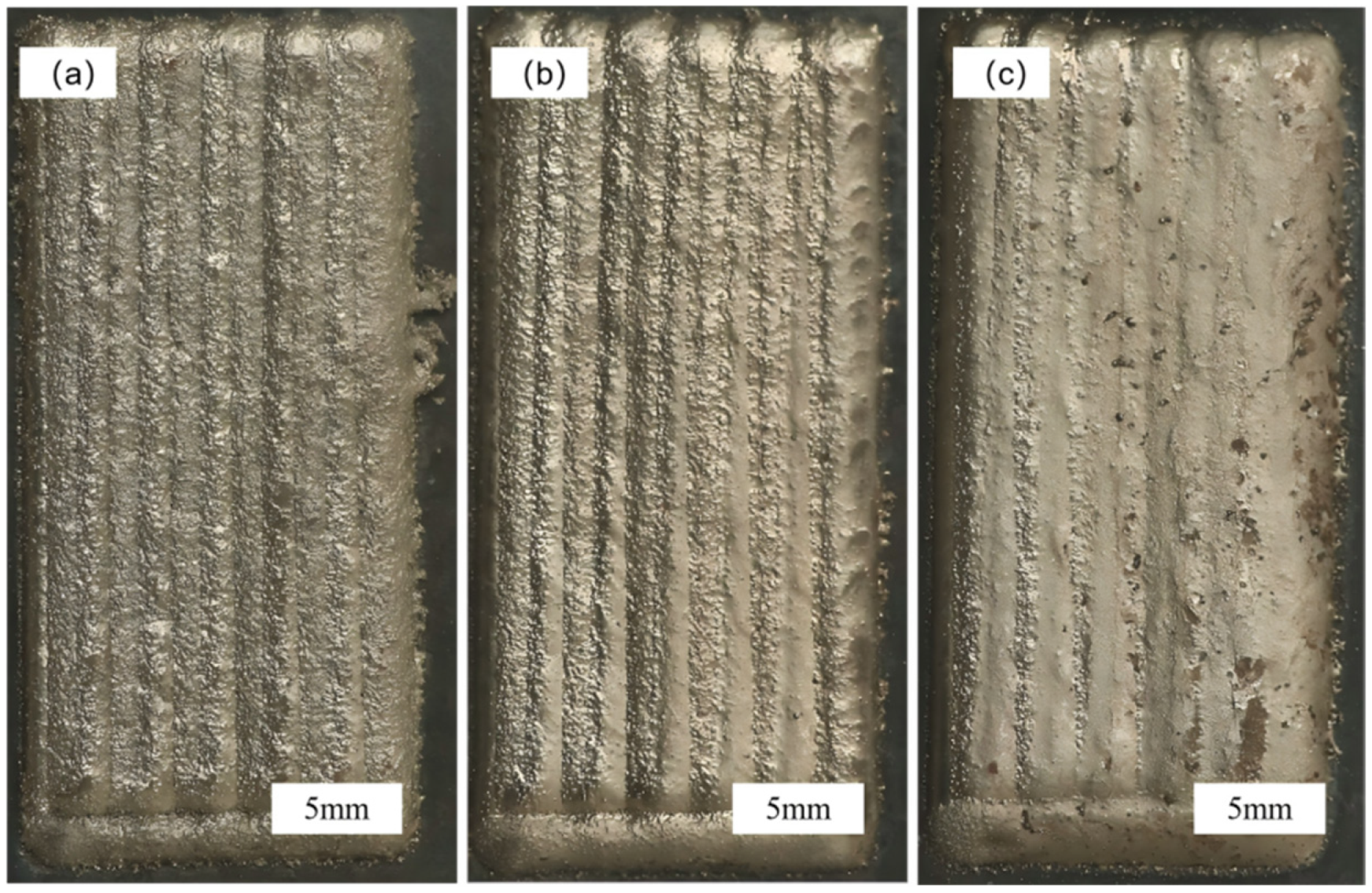
At a laser power of 1000 W, insufficient energy supply restricts the melting, flow, and solidification processes of the molten pool. This results in a large temperature gradient within the pool and accelerated solidification rates, preventing the cladding material from spreading adequately. Consequently, the clad layer exhibits a rough surface with numerous unmelted particles remaining. Insufficient energy prevents complete and uniform fusion of the cladding material, resulting in poor thickness uniformity of the clad layer [
10]. The thickness of the cladding layer is 2.20 mm. Distinct, irregular striated textures form, and the metallurgical bonding interface becomes discontinuous and prone to poor bonding. Macroscopically, this manifests as slag inclusion at the edges (e.g., the raised side of the specimen in
Figure 2a).
Figure 2b shows the clad layer at 1400 W power. The thickness of the cladding layer is 2.39 mm. Improved energy matching provides the molten pool with adequate energy, enabling thorough melting and enhanced flow characteristics. The cladding material spreads more uniformly within the molten pool, and the temperature field during solidification becomes more stable. Compared with the 1000 W operating condition, the macroscopic unevenness is reduced and the stripe texture becomes more regular. Energy promotes metallurgical bonding between the clad layer and substrate, reducing interlayer defects and enhancing clad layer density [
11]. However, minor localized protrusions persist due to subtle variations in energy distribution, though the overall morphology remains superior to lower power settings.
Figure 2c shows the clad layer at 1800 W power. The thickness of the cladding layer is 2.69 mm. At high power inputs, increased energy causes excessive melt pool temperatures and flow rates, intensifying material evaporation and spatter. This leads to surface composition inhomogeneity and ablation defects (evident as localized dark burn areas in the image).
Rapid solidification due to excessive energy input can concentrate thermal stresses, increasing the risk of cracking in the clad layer. Furthermore, the surface undergoes repeated melting-solidification cycles, resulting in reduced flatness, blurred grain structure, and degraded macroscopic quality.
Laser power comprehensively influences cladding layer quality—from micro-metallurgical bonding to macro-surface morphology—by regulating the molten pool’s energy state (temperature, fluidity, solidification rate). An optimal power range exists where the cladding layer achieves good density, flatness, and bonding strength. Both excessively high and low power levels can cause morphological and performance defects.
3.3. Hardness Analysis
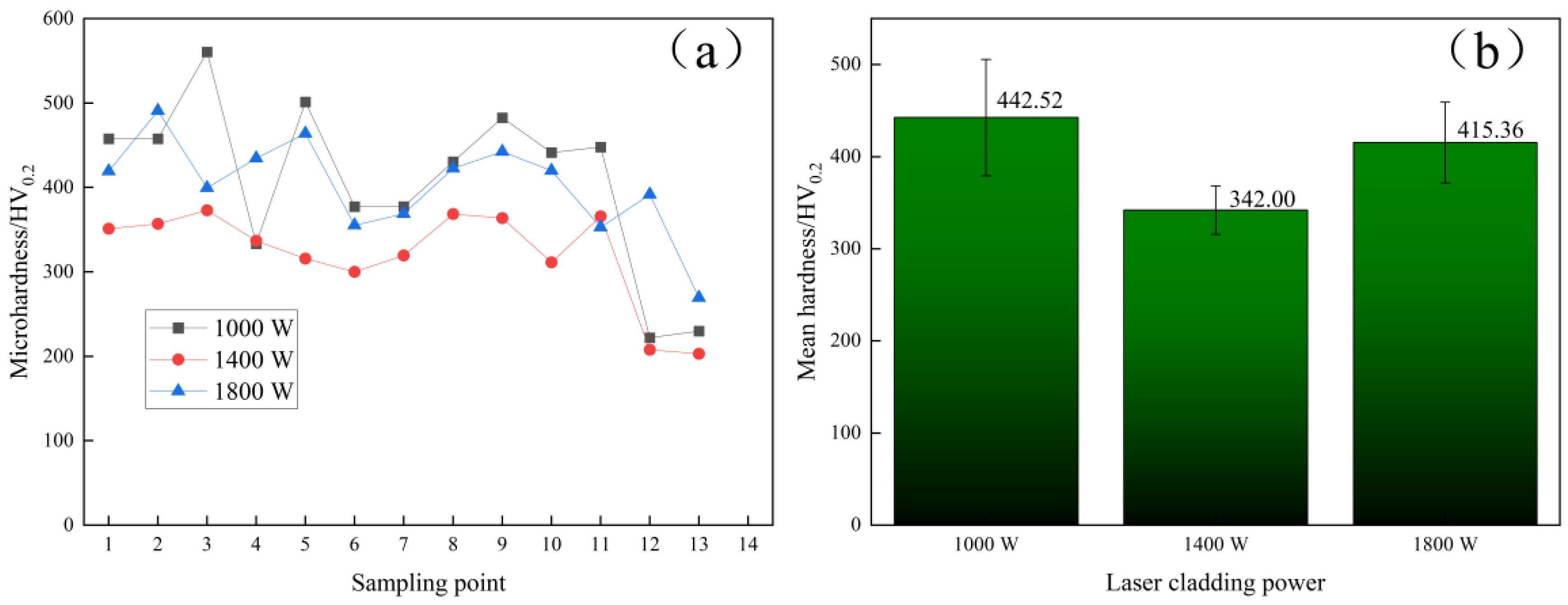
The hardness values measured at different laser powers are shown in
Figure 5. The hardness distribution across the cross-section in
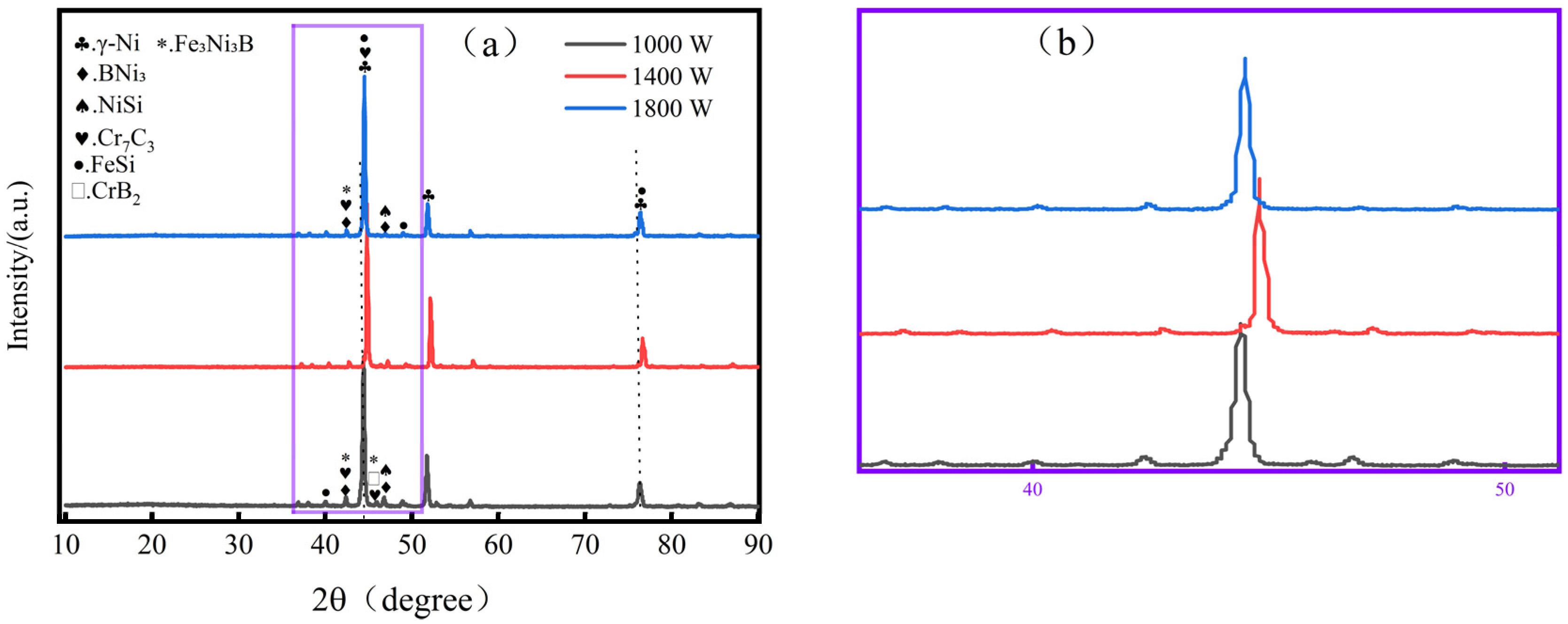
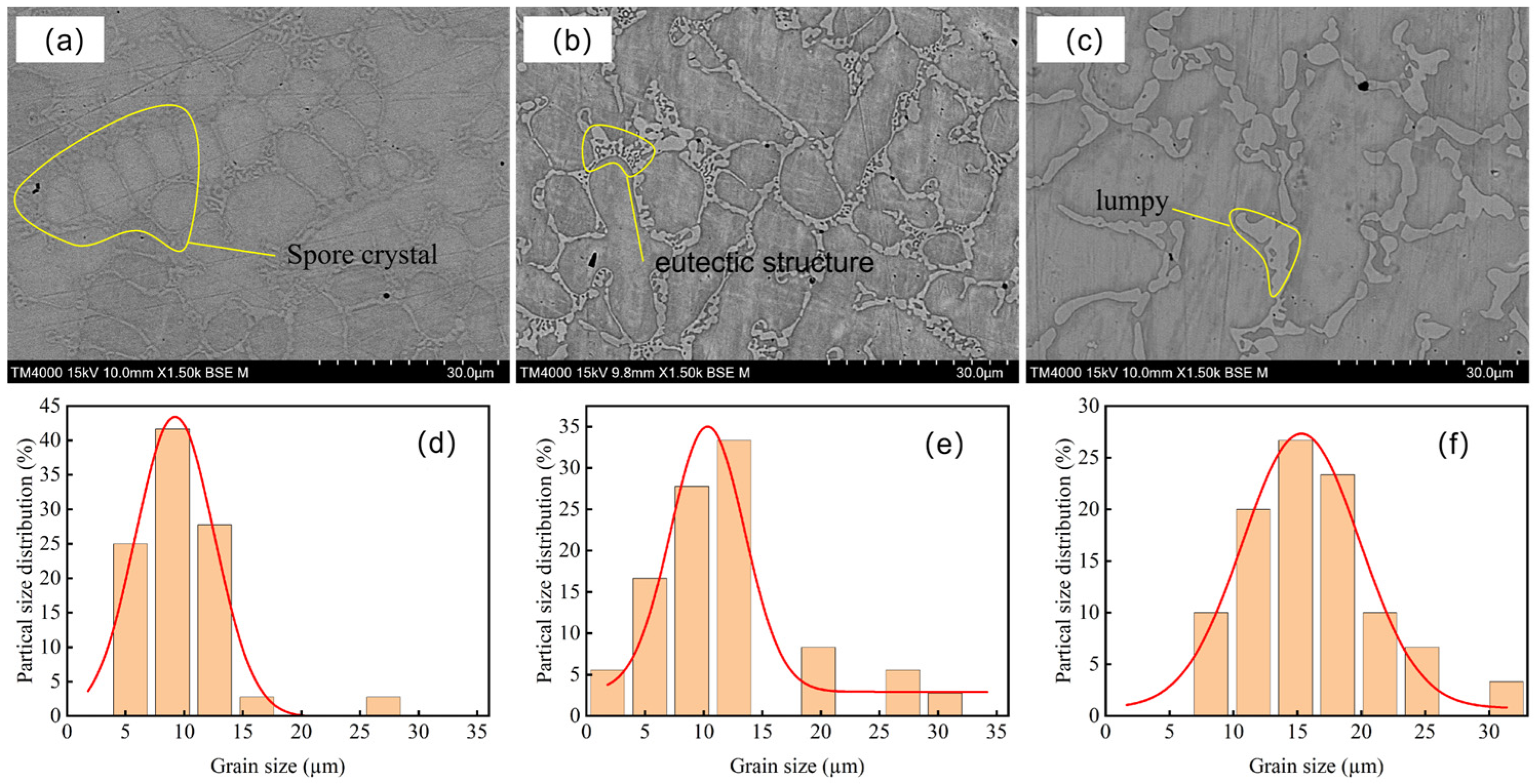
Figure 5a correlates strongly with the aforementioned phase composition (XRD analysis) and microstructural evolution patterns (SEM observation), collectively revealing the strengthening and softening mechanisms of laser-clad Ni25: At 1000 W power, the cladding layer exhibits the highest average hardness (442.52 HV as shown in
Figure 5b) but with significant hardness fluctuations. The high hardness originates from grain refinement strengthening and second-phase dispersion strengthening [
19]. At 1000 W, rapid cooling forms a uniform fine γ-Ni dendritic structure (grain refinement strengthening), while BNi
3, BFe
3Ni
3, CrB
2, Cr
7C
3, and other hard phases are dispersed finely between dendrites (dispersion strengthening that strongly impedes dislocation motion). The hardness variation stems from microstructural compositional inhomogeneity, where indentation measurements may occur in softer γ-Ni solid solution regions or in inter-dendritic zones enriched with hard phases. This non-uniformity poses potential risks to coating consistency and service reliability [
20,
21]. When power was increased to 1400 W, the average hardness of the cladding layer decreased significantly to 342.00 HV. However, the cross-sectional hardness remained relatively stable with minimal fluctuation. This hardness reduction primarily resulted from significant grain growth in γ-Ni, which diminished the fine-grain strengthening effect. Although XRD analysis indicated that the solution strengthening from increased B solubility in γ-Ni was insufficient to counteract the softening effect of grain coarsening, Hardness homogenization benefited from the typical microstructure observed via SEM: “γ-Ni dendrites and continuous eutectic network.” The harder eutectic structure (γ-Ni and hard phases) formed a continuous network surrounding softer γ-Ni primary dendrites, creating a more uniform composite structure at the micro-scale and reducing hardness variations across different locations. When power was further increased to 1800 W, the average hardness of the cladding layer recovered to 415.36 HV, with a corresponding increase in the heat-affected zone hardness. The primary factor driving this hardness recovery in the cladding layer was a shift in the second-phase strengthening mechanism. XRD analysis revealed decomposition of metastable Cr
7C
3, while SEM observation showed coarse, blocky, hard phases (e.g., CrB
2) forming at grain boundaries. Although such blocky phases are detrimental to toughness, their high hardness effectively resisted indentation. Simultaneously, Cr and C atoms released from Cr
7C
3 decomposition re-dissolved into γ-Ni, imparting potential solid solution strengthening that counteracted the softening effect of further γ-Ni grain coarsening [
22]. The increased hardness in the heat-affected zone was associated with secondary hardening of the substrate. The extremely high heat input of 1800 W subjected the base material’s HAZ to thorough thermal cycling, potentially inducing microstructural transformations such as carbide precipitation or tempered martensite formation. Comprehensive phase, morphology, and hardness analyses reveal that laser power modulates the solidification pathway, phase composition, and microstructure of the Ni25 cladding layer through controlled thermal cycling, thereby determining hardness properties. No single parameter yields optimal performance across all metrics: For uniform performance and adequate toughness reserves (coarse γ-Ni typically offers superior toughness), 1400 W is the ideal choice; Although hardness increases at 1800 W, it is accompanied by excessive grain coarsening and blocky phases, which may negatively impact toughness and wear resistance. Therefore, in practical applications, the process must be finely optimized between 1000 W and 1400 W based on service conditions (such as exposure to impact loads or pure abrasive wear) to achieve the optimal balance of hardness, toughness, and uniformity.
3.4. Friction and Wear Analysis
As a key parameter for evaluating material wear resistance, the average coefficient of friction of Ni25 clad layers prepared at different laser powers exhibits systematic variations, closely correlated with hardness, microstructure, and phase composition evolution.
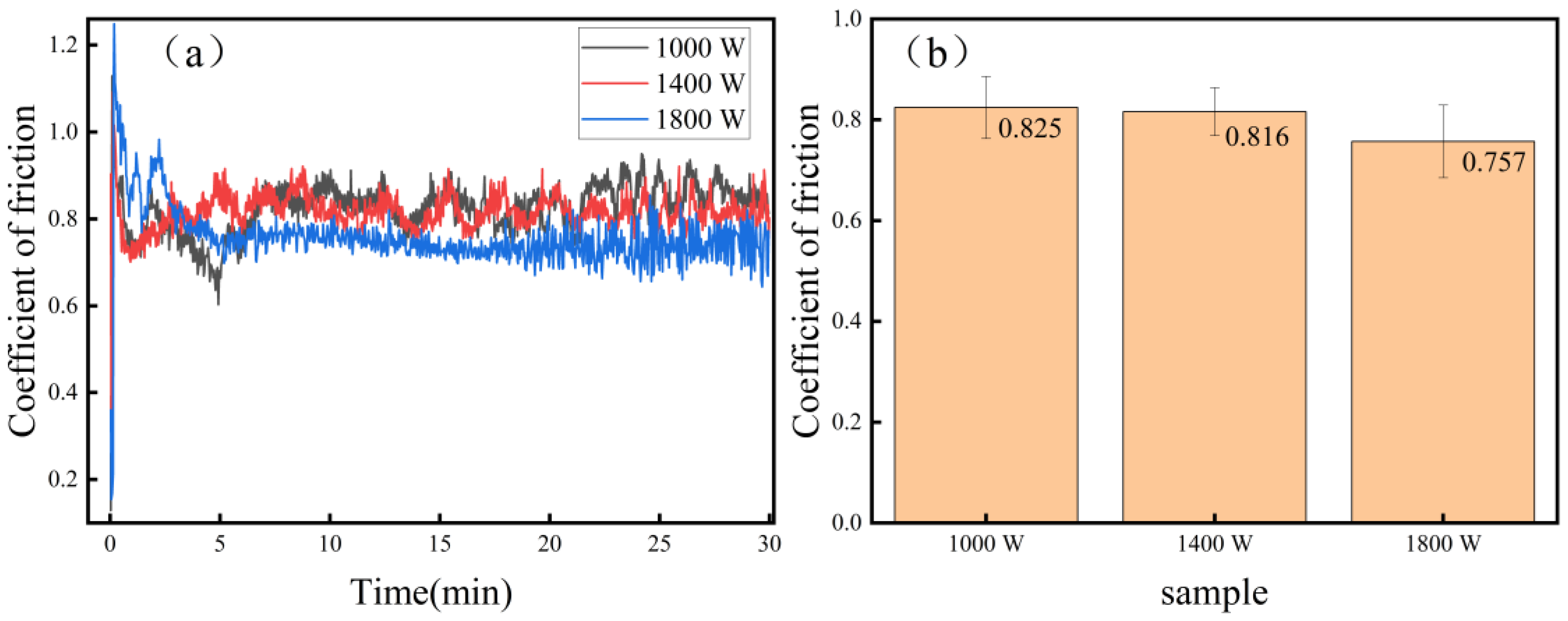
The influence of laser power on the tribological behavior of the cladding layer is shown in
Figure 6.The test results indicate (
Figure 6b) that as the laser power increased from 1000 W to 1800 W, the average friction coefficient of the cladding layer first decreased significantly and then slightly increased. Specifically, it reached a maximum of 0.825 at 1000 W, slightly decreased to 0.816 at 1400 W, and dropped to its lowest at 1800 W, with an average of 0.757. At the same time, the variability of the friction coefficient (expressed as the standard deviation) also exhibited a regular pattern: the standard deviation was smallest at 1400 W (0.048), indicating the most stable friction process, whereas it was greater at 1000 W (0.062) and 1800 W (0.072), reflecting relatively significant fluctuations in the friction process. Correlation analysis indicates that although the clad layer exhibits the highest hardness (442.52 HV) at 1000 W, it also possesses the highest friction coefficient. The core reason lies in its microstructural inhomogeneity—during friction, softer γ-Ni matrix regions undergo plastic deformation and wear first. In addition to the microstructural inhomogeneity discussed above, the relatively poor macroscopic surface roughness of the 1000 W coating (as evidenced in
Figure 2) likely contributed to its elevated friction coefficient. The rough surface would reduce the effective contact area, increase local contact pressure, and promote mechanical interlocking, all of which can lead to higher frictional resistance and exacerbate the detrimental effects of microstructural heterogeneity. Protruding hard-phase particles are prone to spalling or fracturing under shear forces. These detached hard-phase particles act as third-body abrasives within the friction pair, triggering severe abrasive wear. This leads to increased friction force and coefficient, with wear mechanisms dominated by abrasive wear and brittle spalling. Consequently, the layer exhibits high hardness but poor friction resistance. At 1400 W power, the cladding layer exhibits the lowest average hardness (342.00 HV) but a reduced friction coefficient compared to the 1000 W condition. This improvement stems from its uniform “γ-Ni dendrite and continuous eutectic network” microstructure, which creates a gentle gradient in micro-mechanical properties across the friction surface. During wear, the material undergoes uniform and stable plastic flow and removal, preventing violent spalling of hard phases and reducing the tendency for abrasive wear. The wear mechanism shifts to predominantly adhesive wear and uniform fatigue wear. Although the hardness is lower, the improved microstructural uniformity enhances friction performance. At 1800 W power, the cladding layer achieves the lowest friction coefficient, attributed to its unique microstructure: The coarse γ-Ni matrix, while reducing hardness, undergoes sufficient plastic deformation during friction to form a smoother friction surface, increase effective contact area, and reduce contact stress [
23]. Coarse, blocky, hard phases distributed along grain boundaries effectively support loads and prevent severe seizure of the friction pair. Due to their large size and minimal interface with the matrix, they are less prone to spalling compared to the fine hard phases observed at 1000 W. Simultaneously, the plastic deformation layer of coarse γ-Ni grains or potentially formed oxides may function similarly to a lubricating film. The wear mechanism combines mild abrasive wear with plastic deformation, achieving a low friction coefficient. The relationship between “Process-Structure-Performance-Tribological Behavior” reveals that at 1000 W, the microstructure consists of fine γ-Ni dendrites and dispersed hard phases, with phase characteristics including coexisting multiple hard phases and the presence of Cr
7C
3. This results in high hardness but poor uniformity, leading to a high friction coefficient. The core influencing factors are rapid cooling under low heat input and microstructural inhomogeneity. At 1400 W, the microstructure comprises coarse γ-Ni dendrites and a continuous eutectic network; phase characteristics include γ-Ni lattice distortion with increased solubility, low but uniform hardness, and a moderate friction coefficient. The core influencing factor is elemental diffusion and microstructural homogenization under moderate heat input. At 1800 W, the microstructure consists of coarse irregular γ-Ni and blocky hard phases at grain boundaries. Phase characteristics include decomposition of Cr
7C
3 and predominant stable borides, with moderate hardness and good uniformity, and a low friction coefficient. The core influencing factors are phase decomposition and excessive grain growth under high heat input. Based on these findings, the following engineering application recommendations are proposed: For applications requiring high hardness and resistance to severe abrasive wear, select the 1000 W process. This is suitable for conditions involving plowing by hard particles, but note the risk of localized failure due to performance non-uniformity. For balanced performance, stability, and fatigue wear resistance, the 1400 W process is optimal. It suits friction components subjected to moderate impact or alternating loads. Its uniform microstructure ensures stable performance and good toughness, while the moderate friction coefficient facilitates smooth operation. For applications demanding low friction coefficients and anti-adhesive wear resistance, the 1800 W grade excels. It is suitable for scenarios with stringent requirements for motion smoothness and friction force. However, caution is advised regarding the potential negative impacts of coarse microstructure and blocky hard particles on relative impact toughness and fatigue strength.
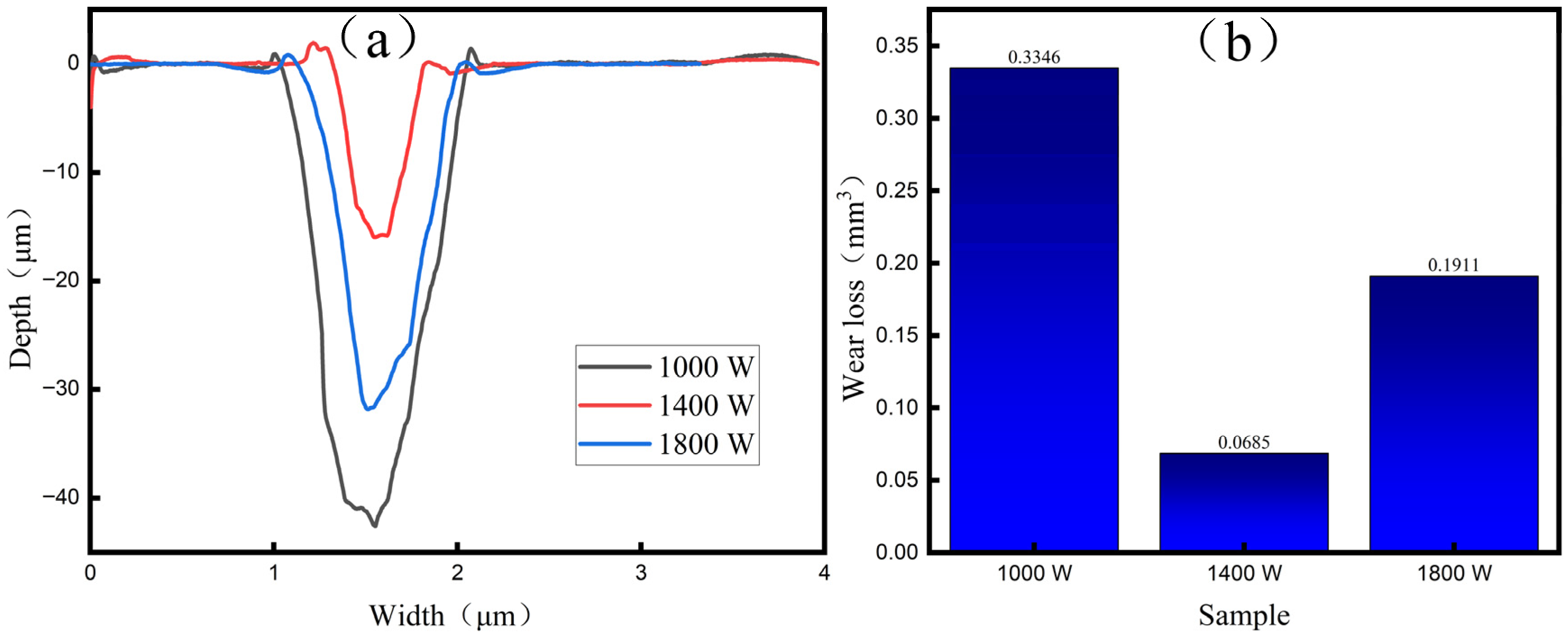
By integrating hardness, coefficient of friction, and wear volume data (where wear volume serves as the most direct indicator of material wear resistance), we can make a final assessment of the performance of the Ni25 cladding layer under three power parameters: 1000 W, 1400 W, and 1800 W. The wear volume data, as shown in
Figure 7 (0.3346 mm
3 at 1000 W, 0.0685 mm
3 at 1400 W, and 0.1911 mm
3 at 1800 W), is highly consistent with the aforementioned microstructure and coefficient of friction analysis. 0.0685 mm
3 at 1400 W, and 0.1911 mm
3 at 1800 W) is highly consistent with the previously analyzed microstructure and friction coefficient data. In the comprehensive wear resistance evaluation, although the cladding layer at 1000 W exhibited the highest hardness (442.52 HV), it also showed the greatest wear volume and poorest wear resistance. The core reason lies in its non-uniform microstructure—during friction, the interface between the hard phases and the γ-Ni matrix becomes a weak point [
24,
25]. The hard phases are prone to exfoliation under shear forces. The detached hard-phase particles act as abrasives, intensifying three-body abrasive wear and leading to rapid material loss [
26,
27]. This demonstrates that high hardness does not equate to high wear resistance; microstructural stability is crucial. Although the cladding layer at 1400 W power exhibited the lowest hardness (342.00 HV), its wear volume was significantly lower than the other two processes, demonstrating the best wear resistance. This is attributed to its uniform microstructure of “γ-Ni dendrites and continuous eutectic network,” which forms a stable, unified anti-wear structure [
28]. During wear, the material undergoes coordinated, gradual plastic deformation and minor abrasion, preventing localized brittle spalling [
26,
29]. Despite lower hardness, this uniform wear mechanism significantly slows material loss. At 1800 W power, the cladding layer exhibits increased hardness (415.36 HV) and the lowest friction coefficient (0.757), but its wear rate is intermediate and wear resistance is inferior to the 1400 W process. Its advantage lies in coarse, blocky hard phases effectively bearing loads to reduce friction coefficients. The disadvantage is that large γ-Ni grains render the substrate excessively soft. Under sustained loads, the soft substrate is prone to gradual wear due to plastic creep and fatigue [
30].
At a power of 1000 W (
Figure 8a), the worn surface exhibits composite characteristics resulting from the combined effects of fatigue wear and abrasive wear. Morphologically, typical parallel plow grooves and large flake-like spalling pits can be observed. This phenomenon originates from the microstructure formed under relatively low laser power: although the hard phases (such as carbides and borides) are dispersedly distributed, the solid solution strengthening of the γ-Ni matrix is limited, and the interface bonding between the hard phases and the matrix may be relatively weak. Under cyclic frictional loading, microcracks easily initiate around the hard phases, leading to their detachment. The detached hard particles act as abrasives, exacerbating the plowing effect on the surface (forming plow grooves), while the pits left by the fallen hard phases and the fatigue damage of the matrix together result in the flake-like spalling of the material.
When the power is increased to 1400 W (
Figure 8b), the wear morphology changes significantly. The surface plow grooves largely disappear, and the wear mechanism becomes dominated by fatigue wear. This is characterized by dense microcracks and the small spall fragments resulting from them. This transition corresponds to an optimized microstructure: moderate heat input allows the γ-Ni matrix to achieve sufficient solid solution strengthening, the hard phases bond firmly with the matrix, and they are distributed in a continuous eutectic network. This uniform and tough microstructure enables the material to resist abrasive cutting during friction, with the failure mode shifting to progressive fatigue spalling of the matrix under cyclic stress, thereby exhibiting optimal wear resistance.
At a high power of 1800 W (
Figure 8c), the worn surface is still primarily dominated by fatigue wear, but the morphology differs, with deeper cracks and relatively large block-like spalling observed. Combined with XRD analysis, it is evident that excessive heat input causes the decomposition of the key strengthening phase Cr
7C
3, and the γ-Ni grains coarsen significantly. This weakens the overall strength of the coating and its resistance to fatigue crack propagation. Cracks are more likely to initiate and propagate at coarse grain boundaries or softened matrix regions, leading to larger-scale material spalling and, consequently, lower wear resistance compared to the coating under 1400 W conditions.
Once substrate support weakens, the blocky hard phases may also detach. The decision matrix constructed based on the above analysis (integrating key performance indicators such as average hardness, hardness uniformity, average friction coefficient, wear rate, and overall wear resistance ranking) reveals that 1000 W exhibits high hardness but poor uniformity, a high friction coefficient, significant wear, and ranks 3rd in wear resistance. It is only suitable for applications with low toughness requirements and wear conditions dominated by light cutting; 1400 W exhibits low hardness but excellent uniformity, a moderate friction coefficient, extremely low wear volume (approximately 1/5 of 1000 W and 1/3 of 1800 W), and ranks first in wear resistance. It is the preferred choice for most wear-resistant components and is suitable for conditions involving abrasive wear, adhesive wear, and fatigue wear; 1800 W: medium hardness, good uniformity, lowest friction coefficient, moderate wear rate, and second-highest wear resistance.
3.5. Corrosion Resistance Analysis
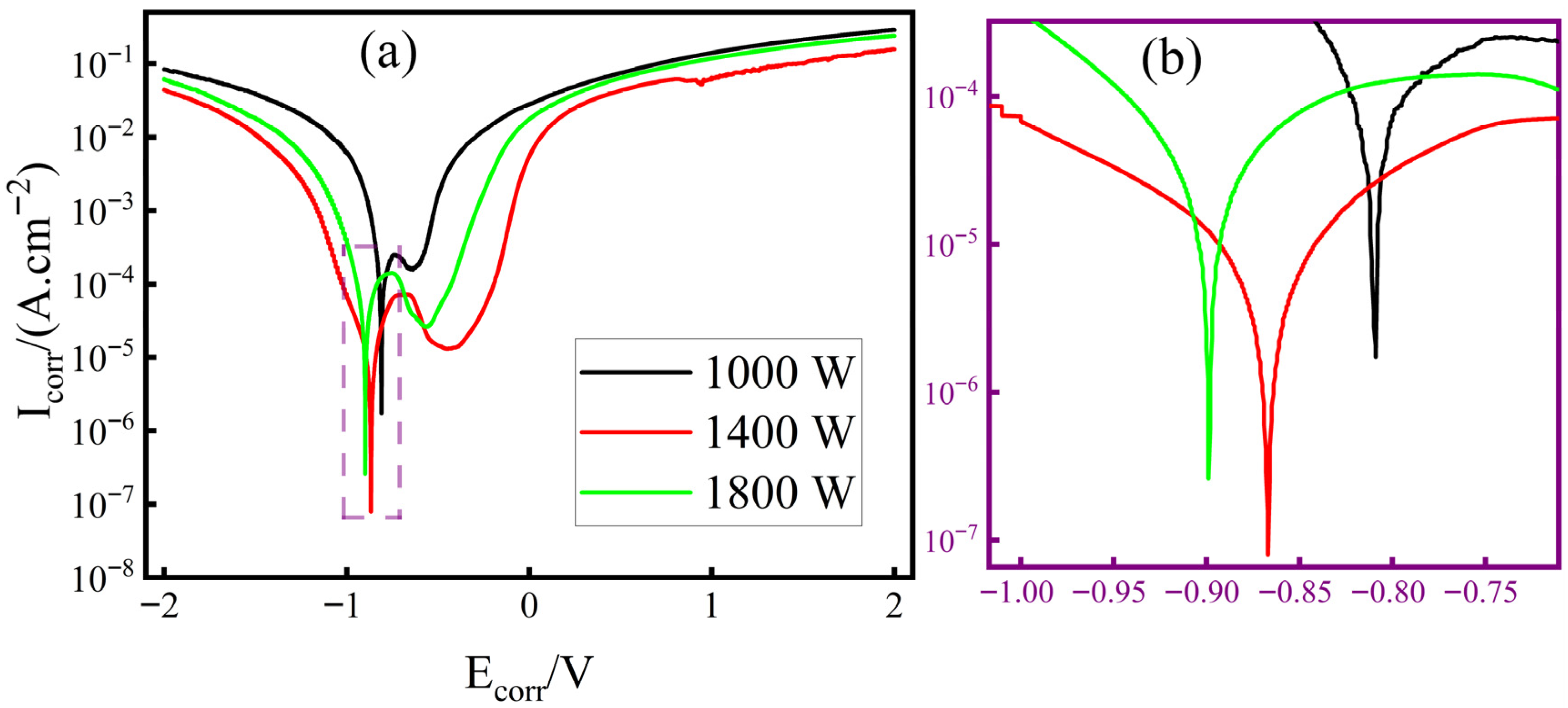
The self-corrosion potential (Ecorr) and self-corrosion current density (Icorr) are key electrochemical parameters for evaluating a material’s corrosion resistance. A higher (more positive) Ecorr indicates that the material is thermodynamically less prone to corrosion, while a lower Icorr signifies a slower corrosion kinetic rate and better corrosion resistance [
31]. The electrochemical test results for the Ni25 cladding layer at three power levels (1000 W, 1400 W, 1800 W) are shown in
Table 2.
As shown in
Figure 9, regarding corrosion susceptibility, as the power increased from 1000 W to 1800 W, Ecorr gradually shifted negatively, indicating that clad layers prepared at higher power exhibit increased thermodynamic susceptibility to corrosion. Regarding corrosion rate, the Icorr of the clad layer at 1400 W power is the lowest, being nearly one order of magnitude lower than those at 1000 W and 1800 W. This key metric clearly indicates that the 1400 W clad layer exhibits the slowest corrosion rate and the most outstanding corrosion resistance. Analyzing the correlation mechanism between corrosion resistance and microstructure reveals that the optimal corrosion resistance at 1400 W power stems primarily from its uniform, continuous “γ-Ni dendrite and eutectic network” microstructure—the uniform γ-Ni solid solution matrix facilitates the formation of a complete, dense, and well-adhered passivation film (e.g., Cr
2O
3) [
32], while simultaneously minimizing microstructural inhomogeneity. This structure reduces the driving force and number of micro-galvanic corrosion cells forming between the γ-Ni matrix (anode) and hard phases (cathode, e.g., borides, carbides). Consequently, the corrosive medium struggles to identify distinct weak points for selective attack, significantly lowering the overall corrosion rate. At 1000 W power, the cladding layer exhibits the poorest corrosion resistance. The highest Icorr stems from its poorest microstructural uniformity, where fine γ-Ni dendrites and numerous dispersed hard phases form a vast array of microscopic galvanic cells. Within the corrosive medium, the γ-Ni matrix rapidly corrodes as the anode, resulting in extremely high corrosion currents; at 1800 W power, the cladding layer’s corrosion resistance falls between the two extremes. While the coarse γ-Ni grains theoretically reduce grain boundary density, benefiting corrosion resistance, the coarse, block-like hard phases at grain boundaries form macroscale galvanic couples with the matrix. These locally strong cathodic phases accelerate corrosion of the surrounding anodic matrix [
33]. Simultaneously, decomposition of Cr
7C
3 may reduce solid solution Cr content, hindering passivation film formation—consistent with the most negative Ecorr at this power level.


 ,
,