
Review

Optical Variability of HBLs on Diverse Timescales
by
Ileana Andruchow
1,2,*,
Ezequiel J. Marchesini
3 and
Florencia L. Vieyro
1,2
1
Instituto Argentino de Radioastronomía, CONICET-CICPBA-UNLP, Villa Elisa CC51894, Buenos Aires, Argentina
2
Facultad de Ciencias Astronómicas y Geofísicas, Universidad Nacional de La Plata, La Plata B1900FWA, Paseo del Bosque, Argentina
3
Osservatorio di Astrofisica e Scienza dello Spazio, Istituto Nazionale di Astrofisica, via P. Gobetti 93/3, 40129 Bologna, Italy
*
Author to whom correspondence should be addressed.
Galaxies 2026, 14(3), 54; https://doi.org/10.3390/galaxies14030054
Submission received: 15 March 2026 / Revised: 12 April 2026 / Accepted: 16 April 2026 / Published: 20 May 2026

Abstract

Since their discovery almost 60 years ago, BL Lac objects have been defined by their strong optical variability and their classification in the spectral energy distribution scheme. High-synchrotron-peaked BL Lacs (HBLs) are those whose synchrotron component peaks at frequencies higher than UV/X-rays. Historically, optical variability studies have focused mostly on their counterparts, low-synchrotron-peaked BL Lacs (LBLs), since HBLs have shown weaker optical variability. However, a population-wide study of HBL optical variability is still lacking, and it remains unclear whether HBLs are intrinsically less optically variable as a class or whether this reflects observational biases. Only a handful of HBL sources have been studied extensively due to their strong variability and reported periodicity. These sources have motivated several theoretical models, often conflicting, to explain the optical variability when present. Nevertheless, understanding the connection between the apparent weaker optical variability and the emission processes of HBLs remains a challenge. In this work, we review the current state of knowledge on this topic, with the expectation that upcoming optical monitoring observatories, such as the Vera C. Rubin, will provide new insights into the optical emission (and variability) mechanisms in HBLs.

1. Introduction

Blazars constitute a subclass of active galactic nuclei (AGN) whose relativistic jets are oriented at small angles to the line of sight [1]. Based on their optical spectra, they are divided into two main classes [2]: flat-spectrum radio quasars (FSRQs), which display broad optical emission lines, and BL Lac objects (named after the blazar prototype BL Lacertae) whose optical spectra are featureless, i.e., present weak or absent emission lines [3,4]. Both classes emit strongly across the entire electromagnetic spectrum. Since BL Lac objects are particularly strong emitters in the radio and X-ray bands, these two spectral windows became the natural basis for early systematic searches, giving rise to two empirical categories: radio-selected BL Lacs (RBLs) and X-ray-selected BL Lacs (XBLs) [5].
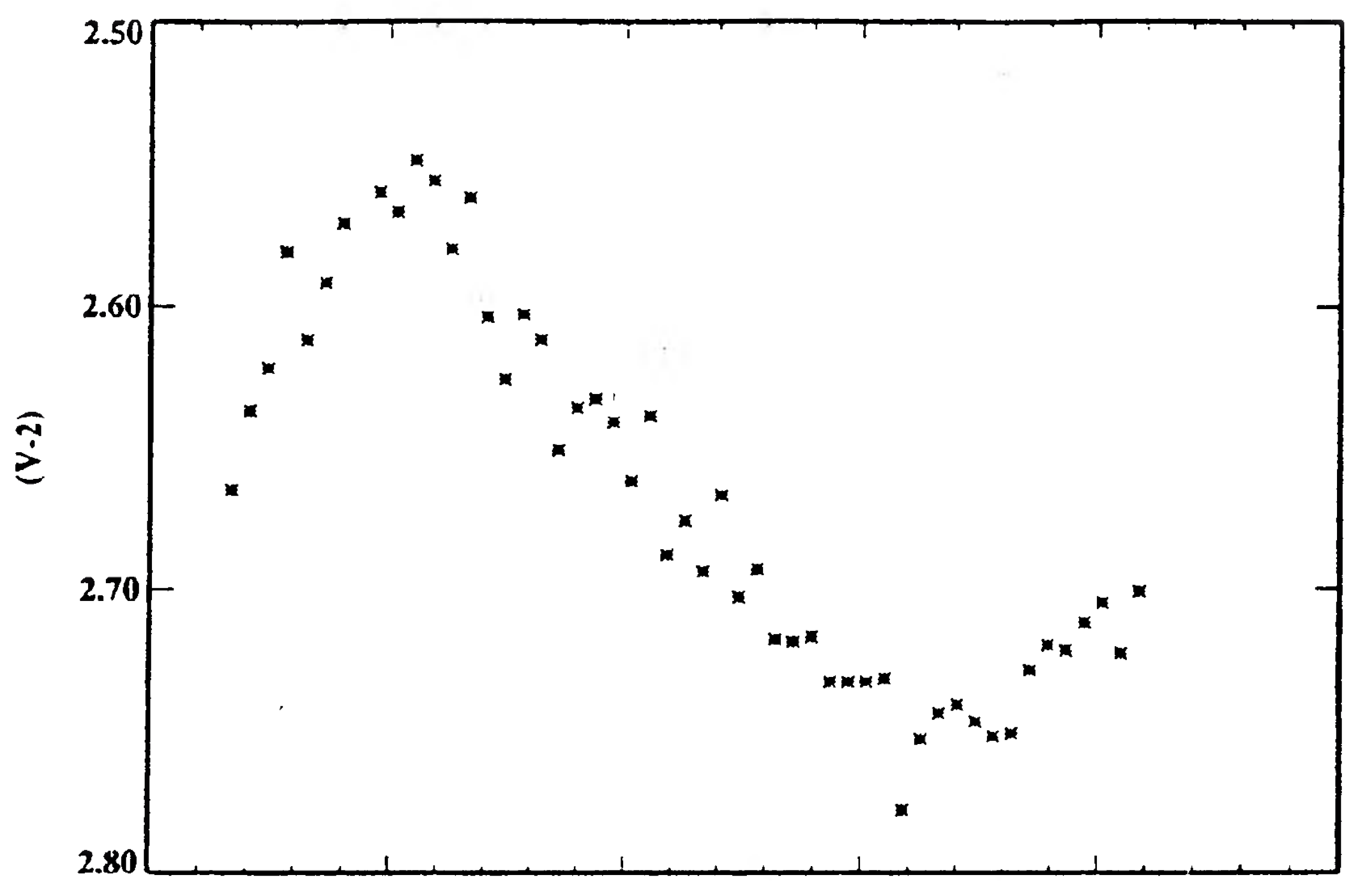
Strong optical variability has been associated with blazars from the very earliest observations on record: the prototype source BL Lacertae was itself long misidentified as a galactic variable star [6]. From the moment the class was recognized as such and named [7,8,9], rapid variability in both optical flux and polarization was established as one of its defining observational properties [10,11]. The most extreme cases were distinguished from ordinary quasi-stellar objects (QSOs) by their particularly violent optical behavior, which led to the early designation of such sources as Optically Violent Variable objects, or OVVs [9]. Dedicated monitoring campaigns subsequently revealed that optical variability in BL Lac objects can occur on timescales as short as minutes [12,13]. We show one of the first microvariability detection on a blazar, reported by Carini et al. [14], in Figure 1.
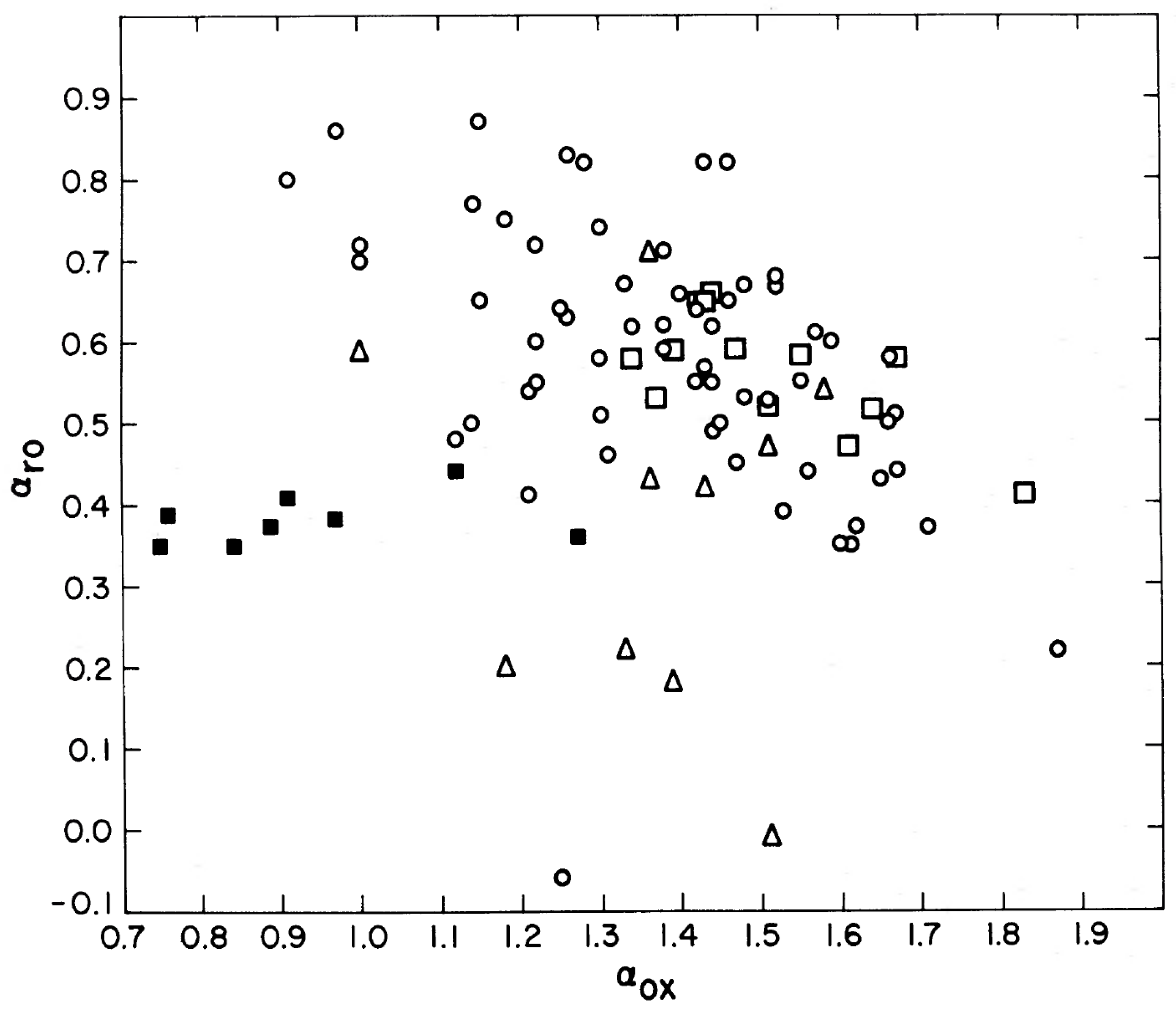
However, it soon became clear that variability, although often present, was not uniform nor common among all BL Lac sources [15,16]. Indeed, Stocke et al. [5] found, on a sample of eight blazars, that XBLs showed smaller variability amplitude in both optical flux and polarization degree when compared to RBLs. This was the first hint that the XBL/RBL classification was not only empirical but also physical: there were intrinsic differences between the two categories. This was the precursor to the current synchrotron-peak classification. We show the main result of the work by Stocke et al. in Figure 2.
High-synchrotron-peaked BL Lacs, or HBLs, are BL Lac objects whose synchrotron emission reaches its maximum at higher energies than other BL Lacs, particularly at ν 10 15 Hz, i.e., at ultraviolet and higher energies. HBLs, indeed, are the largest population of extragalactic sources detected at high energies, particularly in the TeV range [17]. This category exists in contrast to low-synchrotron-peaked BL Lacs, or LBLs, whose synchrotron emission reaches its maximum at optical or infrared bands.
The groundwork for the BL Lac classification into HBL and LBL was introduced by Giommi & Padovani [18], who then expanded on their conclusions in following works [19,20]. Firstly they suggested dividing BL Lac sources according to whether the radio-to-X-ray spectral index α r x is greater than 0.75 (LBLs) or not (HBLs). They later proposed instead classifying these sources directly according to the position in the spectrum of their synchrotron peak [21]. This method became the standard after the publication of the first Fermi-LAT AGN Catalog [22], in which the Fermi collaboration included the generalization to simply “High/Low Synchrotron Peaked” (HSP and LSP, respectively) in order to include flat spectrum radio quasars. Naturally, most XBLs became HBLs, and RBLs became LBLs, with little overlap (see, e.g., [3,23]).
The physical reason why HBLs can maintain high-energy electrons that sustain such an energetic synchrotron process, while LBLs cannot, is usually interpreted as being related to the jet power and the external radiation field. Generally, HBLs are characterized by low intrinsic power and a weak or absent external radiation field, as evidenced by their lower bolometric luminosity and featureless optical spectra [24]. Thus, in this context, radiative cooling of electrons in HBLs is less dramatic than in LBLs. This allows particles to reach energies high enough to produce synchrotron emission in the X-ray band. In LBLs and FSRQs, by contrast, the jet is more powerful and there is evidence for external radiation fields from the broad line region and accretion disk. In the blazar sequence interpretation [24,25], these fields lead to efficient inverse Compton cooling (i.e., External Compton), which can limit the maximum energy of the emitting electrons and shift the synchrotron peak to lower frequencies. There are, however, alternative models, which explain this difference solely by an intrinsically lower maximum electron energy in LBLs and FSRQs, independently of radiative cooling [26,27], so that the relative role of Compton losses in shaping the observed sequence remains under debate.
The HBL/LBL classification allowed for a more consistent comparison between the two subclasses. In two of the biggest optical variability studies on HBLs to date, Heidt et al. [28,29] found that HBLs presented smaller Duty Cycles than LBLs over a sample of 67 sources, statistically strengthening previous claims that HBLs are intrinsically less variable than LBLs. Romero et al. [30] found similar results on a smaller sample at microvariability timescales, which they attributed to the presence of stronger magnetic fields in HBLs, which could prevent the formation of small inhomogeneities within the jet.
The lack of statistically significant and homogeneous samples has been a persistent limitation in optical variability studies of HBLs, with most analyses focusing on only a handful of sources. Studies such as those of Heidt et al. are rare, mainly due to the difficulties in allocating continuous observation time at ground telescopes at a regular rate. Variability in HBLs is often studied in exceptional cases, such as strong flaring episodes, or in particularly well-monitored objects such as PKS 2155-304 (e.g., [31,32]). However, the current consensus is that, in contrast to low-energy-peaked BL Lac objects (LBLs), HBLs appear to exhibit weaker variability on average, and their variability amplitudes are typically lower when present (e.g., [23,29]).
In this work, we attempt to review the current state of the art in optical variability of HBLs in the hope that newly developed facilities (such as the Vera Rubin Observatory [33,34]) will shed new light on what remains, to date, a remarkably underexplored topic. Variability detection techniques have improved greatly over time; we review the strengths and limitations of each method, the statistics involved, and the optical flux variability reported for HBLs in Section 2. In some cases, particularly among LBL sources, periodicity has been detected, leading to proposals of supermassive binary black hole systems at the heart of these AGNs [35] or the rotation of the relativistic jet [36]; in Section 3 we summarize the handful of HBL sources for which optical periodicity has been reported. Blazars in general, and HBLs in particular, are also known to show strong and variable optical polarization, Section 4 reviews the available literature on optical polarization variability in HBLs. Finally, half a century of observational constraints have motivated the development of several theoretical models to explain the origin of optical variability in HBLs; we outline these models in Section 5.

2. Variability Studies

2.1. Statistical Tests

One of the most important issues with respect to the variability in blazars, in general, is the statistical tools used to estimate it. The tools used must take into account the error in measurements, the temporal cadence, and the presence of outliers. The latter is especially important nowadays, when data collected through large surveys are increasingly available, rendering visual inspection of the data really challenging.
The variability of blazars occurs on time scales ranging from hours to years in a (usually, see Section 3) non-periodic mode, with light curve amplitudes that can range from a few tenths to several magnitudes. This type of behavior is explained by the concurrence of different phenomena occurring simultaneously at the sources ([37] and references therein). Therefore, it is crucial to characterize each of these compounds with the utmost rigor (i.e., different amplitudes at distinct scales and diverse frequencies).
Light curves of AGNs are also affected by red noise, a component that has to be taken into account especially in long time scales. All AGN show intrinsically stochastic variability, which can be characterized by its Power Spectral Density (PSD), which describes how the variance of a light curve is distributed as a function of temporal frequency. This density follows a power law,
P ( ν ) ν β .
If β = 0 , then the power is equal at all frequencies, which is true for white noise. When β 1 , power increases with the inverse of frequency, meaning that it increases at longer periods. This implies that long-timescale stochastic fluctuations can dominate the observed signal, which then appear as prominent peaks in periodograms, resembling quasi-periodic signals. To properly identify quasi-periodic signals red noise should be accounted for [38,39,40].
In the optical band, light curves are constructed through differential photometry against non-variable stars in the field. Then, diverse statistical methods are used to estimate whether a source is variable or not by comparing the science and control light curves [41]. The same tool can be applied to the different time scales analyzed. In this regard, it should be noted that care must be taken when choosing the field stars used to construct the light curves to avoid spurious variability results (e.g., [42]).
Many studies on short-term variability use the F and C tests (e.g., [43,44,45,46]), which compare the ratio of the scatter and the variances of the two curves, respectively. The C test was introduced by Jang and Miller [47] and generalized by Romero et al. [30]. Even though it is not a properly defined test, it has become very useful for quick variability detections in optical data [48]. Some authors have criticized the use of C due to it being ill-defined and conservative [49] and instead suggested the use of the more canonical F-test [50]. At the same time, the F-test has been criticized for reporting too many false positives [51].
The standard procedure to compare two light curves was proposed by Howell et al. [41]. They proposed a method based on the F test, but that was later also generalized to the C test. These methods are based on the ratios of variances and standard deviations of the differential light curves:
C = σ B L C Γ σ K C ,
and,
F = σ B L C 2 Γ 2 σ K C 2 ,
where σ B L C and σ K C are the standard deviations of the target-comparison star curve and of the control-comparison stars curve, respectively. The latter light curve can be constructed from any pair of non-variable stars in the blazar field and is representative of the uncertainty for any given time-series of data.
In the case of test C, a source is classified as variable with a confidence level 99.5 % if C is greater than a critical value of 2.576 . Test F assumes that the errors in the light curves are normally distributed. A given light curve is classified as variable if F exceeds a certain critical value that depends on the number of degrees of freedom in the curves ( N 1 , where N is the number of points in the curves) and for a required confidence level.
Howell et al. also introduced the Γ weighting factor, which accounts for differences in magnitude between the blazar and the field stars used to construct the light curves; the use of this factor is mandatory to avoid false positives [41].
Another widely used variability test when light curves are densely populated is the well-known χ 2 . In this test, a constant behavior model is used as the null hypothesis:
χ 2 = 1 N 1 i = 1 N S i S S e r r 2 ,
where S i are individual magnitudes, S average value, and S err are individual errors, in a curve with N points.
Currently, many of the stars in the fields of various blazars have published values of their magnitudes in the standard Johnson–Cousins photometric system (e.g., [52,53,54]). This allows us to determine the standard magnitude of the blazar in each image and thus to build light curves in standard magnitudes or flux units (e.g., mJy). This makes it possible to use a larger set of statistical tests to analyze its variability. With standard photometry, it is no longer necessary to statistically compare the science-comparison light curve against a comparison-control light curve. The differential photometry technique is mandatory only to avoid false positives due to artifacts generated by instrumental effects and/or sky conditions.
Several estimators are usually employed to characterize light curves in a quantitative way. To obtain a fairly accurate estimate of the true (i.e., unaffected by measurement errors) amplitude of the variation, a useful estimator is the variability amplitude [28] that compares the maximum amplitude observed with the average value of the measurement errors:
A = ( S max S min ) 2 2 S err 2 .
Here, S max and S min are the maximum and minimum values observed, and S err is the average of the measurement errors.
Another estimator of the variability amplitude is the Fractional Variability, which is calculated as the square root of the excess of the fractional variation:
F var = σ 2 S err 2 S 2 ,
where σ 2 is the variance of the data points [55,56].
The Modulation Index [57], in turn, is often used to estimate the strength of the observed variations:
m [ % ] = 100 σ / S .
One challenge in variability studies is the acquisition of homogeneous data samples. This is because it is not always possible to monitor sources over a long period of time using the same instruments and/or data collected using the same criteria (different observers) and with a good temporal cadence. In this regard, it is important to note that the most appropriate test to use, the one that yields the most reliable results, will depend largely on the rigor with which the observations are treated mainly on the accurate evaluation of systematic errors, and on the number of points on the curves. For a discussion of this last point, see Sokolovsky et al. [58].

2.2. Observational Monitoring Campaigns

The last version of The Roma-BZCAT Multifrequency Catalog of Blazars [59] lists 1059 BL Lac type blazars (data up to 2022). Taking into account only these objects, the average optical magnitude (R band) is greater than 18.14 mag, with 62 % of the BL Lacs with magnitude weaker than that value. Given the composition of this catalog and the fact that LBLs and HBLs are jointly considered in the BL Lacs sample, these values should be considered as having lower limits in magnitude. Furthermore, the Third Catalog of HSP blazars (3HSP) [60] lists 2013 blazars with a frequency of the synchrotron peak ν syn > 10 15 Hz. Using data in the SLOAN https://www.sdss.org/ r band from the approximately 1200 sources in this catalog with observations made by the Panoramic Survey Telescope and Rapid Response System (Pan-STARRS or PS1 https://outerspace.stsci.edu/spaces/PANSTARRS/overview, accessed date 15 April 2026), the mean value for the magnitudes is 18.82 mag, with 76 % of the sample having a r m a g value weaker than this mean value. Therefore, a small number of sources are bright enough in the optical bands to enable observational tracking from Earth. This is mainly due to the fact that large telescopes are not used in the observational monitoring of these sources, with typical sizes of telescopes used in these studies ranging from less than 1 and up to 2.5 m.
Several groups began almost three decades ago and are still making efforts to carry out optical monitoring dedicated to characterizing the variability of blazars in general. In all of these, HBL-type blazars are listed. Some of the most relevant and persistent ones over time are
  • Whole Earth Blazar Telescope (WEBT) https://www.oato.inaf.it/blazars/webt/ (accessed date 15 April 2026): this collaboration coordinates global observing campaigns using telescopes around the globe in order to obtain light curves with 24 h continuous monitoring. The sample involves 14 FSRQs and 15 BL Lacs, of which five are classified as HBLs.
  • Tuorla blazar monitoring program optical light curves https://tuorlablazar.utu.fi/ (accessed date 15 April 2026): Initially motivated as a campaign to follow 31 blazars in the northern hemisphere detected in VHE, the program has now expanded to southern declinations and currently monitors 209 sources (including TeV blazars, Fermi, and other AGNs), of which 56 are HBLs.
  • Small and Moderate Aperture Research Telescope (SMART) http://www.astro.yale.edu/smarts/glast/home.php (accessed date 15 April 2026): This program performs follow-up observations of sources detected by Fermi-LAT that are visible from Cerro Tololo, Chile, in the optical and infrared bands. It provides magnitude values for 107 blazars, using images taken between 2008 and 2017. Nine of these blazars are the HBL type.
  • Multifrequency Studies of Blazar Variability (Heidelberg) https://www.lsw.uni-heidelberg.de/projects/extragalactic/ (accessed date 15 April 2026): This project performs multifrequency study of blazars, where simultaneous monitoring was carried out from radio to gamma rays with optical observations. The list of blazars includes 92 objects, of which 28 are HBLs.
  • Ground-based Observational Support of the Fermi Gamma-ray Space Telescope at the University of Arizona https://james.as.arizona.edu/~psmith/Fermi/ (accessed date 15 April 2026): To support the Fermi-LAT observations in GeV, photopolarimetric monitoring of 80 blazars was carried out, including 10 HBLs.
  • Optical Polarimetric Monitoring of Blazars (RoboPol) https://robopol.physics.uoc.gr/ (accessed date 15 April 2026): A project monitoring the optical R-band magnitude and linear polarization of a sample of 222 AGNs, most of which are blazars. In particular, 42 are classified as HBL blazars.
Other groups of researchers conducted follow-up campaigns of blazars in the optical range, which involve HBL objects. There are several publications that compile their results, several of which are mentioned in the following sections (e.g., [43,61,62,63,64]).
Currently, surveys, such as the All-Sky Automated Survey for SuperNovae (ASAS-SN) [65,66], which scans the extragalactic sky visible from Hawaii roughly once every five nights in the V-band, and the Zwicky Transient Facility (ZTF) [67], which scans the entire Northern sky every two days, offer the possibility to obtain light curves of blazars with a good temporal cadence.
On the other hand, online tools are available to the community like the Markarian Multiwavelength Data Center (MMDC) https://mmdc.am/ (accessed date 15 April 2026), which allows retrieval of observational data at all wavelengths of blazars taken from 1998 date and modeling of SED using different models. The MMDC works with the data available on the Firmamento https://firmamento.nyuad.nyu.edu/home (accessed date 15 April 2026) platform, dedicated to study the behavior of blazars.

2.3. Optical Variability on Different Time Scales

Variability in flux is one of the main observational characteristics of blazars, occurring at all wavelengths and on different timescales. This variability is typically non-periodic and occurs simultaneously over a wide range of timescales. Its presence implies an upper limit on the size of the emitting region, R. Since the observed variability timescale cannot be shorter than the light-crossing time of the emitting region, it must satisfy
R < c Δ t δ ( 1 + z ) ,
where c is the speed of light, Δ t is the observed variability timescale, δ is the Doppler factor and z is the redshift. The presence of the Doppler factor accounts for relativistic time contraction in the observer frame, while the redshift term corrects for cosmological time dilation.
Blazars are known to be one of the few extragalactic sources in which very short-scale variabilities, on the order of hours, are detected. These variabilities are called Intranight Variability (INV), also known as microvariabilities. According to Equation (7), this short time scale implies that Doppler factors are excessively high or that the sizes of the emitting region are really small. The second alternative is more plausible than the first one, which involves values of Doppler factor above 50. This highlights the importance of obtaining reliable observational results, as they determine the size of the emitting region.
The INVs are also well known to occur in an irregular manner (i.e., not present in all monitoring runs). To estimate whether a particular type of blazar has a higher incidence of variable sources at these scales, the Duty Cycle (DC) of variability is calculated [30]. It is defined as
D C = 100 i = 1 n N i ( 1 / Δ t i ) i = 1 n ( 1 / Δ t i ) ,
where N i is equal to 1 if the blazar is variable and 0 if not, and Δ t i = Δ t ( i , o b s ) ( 1 + z ) 1 is the total time elapsed monitoring the source redshift corrected. It should be noted that, since the value of z is unknown for many BL Lac-type blazars, the DC represents a minimum estimate.
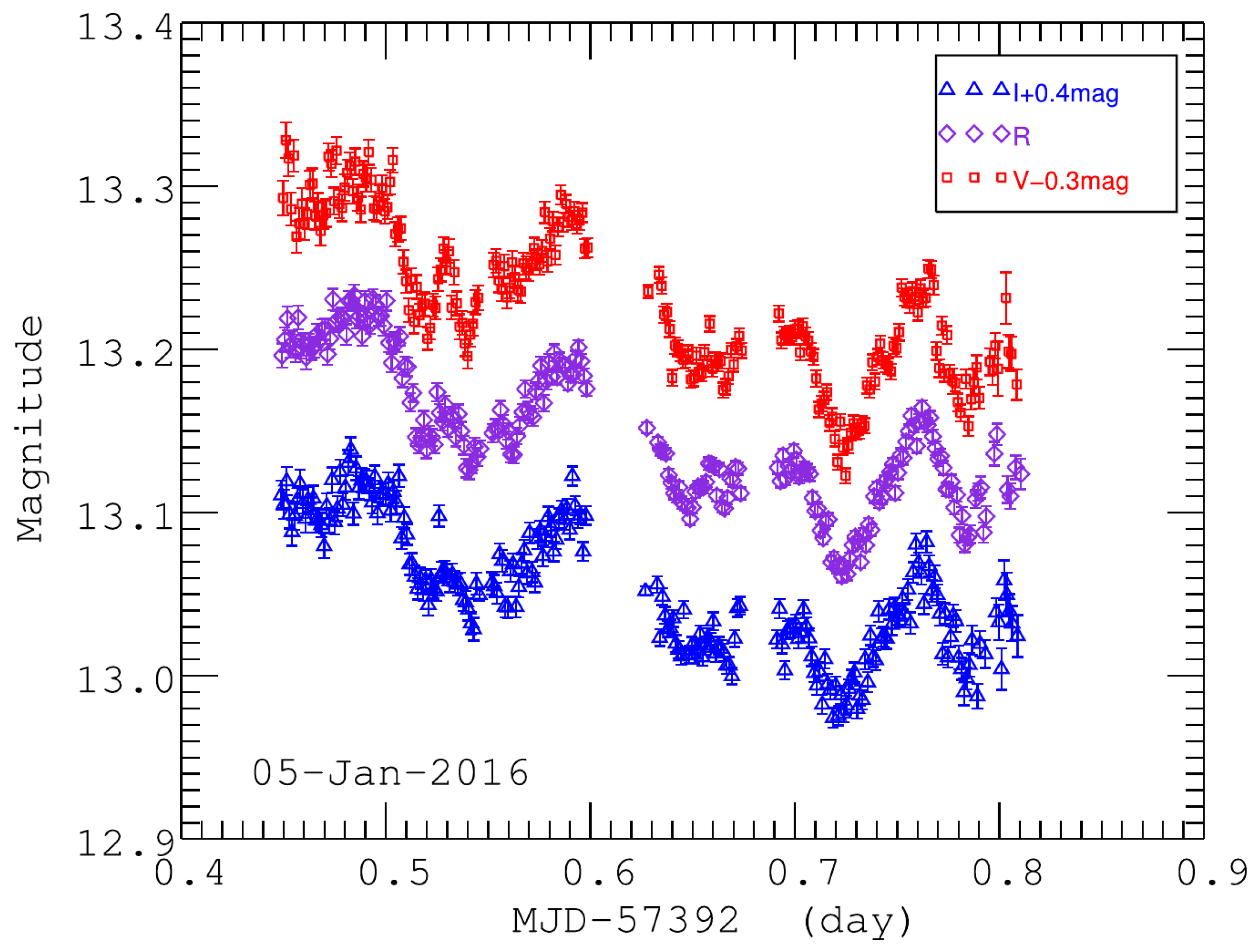
When studying microvariability (INV) on HBLs, typically nonsignificant variability is reported. The DCs reported are always less than 25 % (e.g., [43,61,68]) and typically around 10 % [69,70,71,72]. An example of the results of this type of variability can be seen in the work of Agarwal et al. [64]. They followed PG 1553+113 over 28 nights in the B, V, R, and I bands between 2016 and 2019 with good sampling. The object was found to be non-variable on all nights and in all filters. Adding data from the literature, they were able to calculate the DC based on 74 nights, obtaining 10%, which means that variability was found in only 8 out of 74 monitoring nights. In Figure 3 an example of INV is shown: the light curve for source S5 0716+714 for the night of 5 January 2016. Statistical studies conducted on samples of objects cataloged as XBLs in the 1990s (now mostly HBLs) showed that no changes in optical magnitude in less than 1.3 days were detected with a high confidence level [29,30].
When detected, the amplitude of the variability tends to be low: for times less than 8 hours, Δ m is typically less than 0.10 mag. It is also worth mentioning that there is no correlations between the incidence of INVs and the flux rate of the source. This result should be treated with caution, as it was obtained using a well-sampled but very small number of sources [68]. It should be recalled that only a couple of dozen (or even fewer) HBLs were reported in the literature with campaigns that monitored the optical flux variability. This number is even lower for INVs.
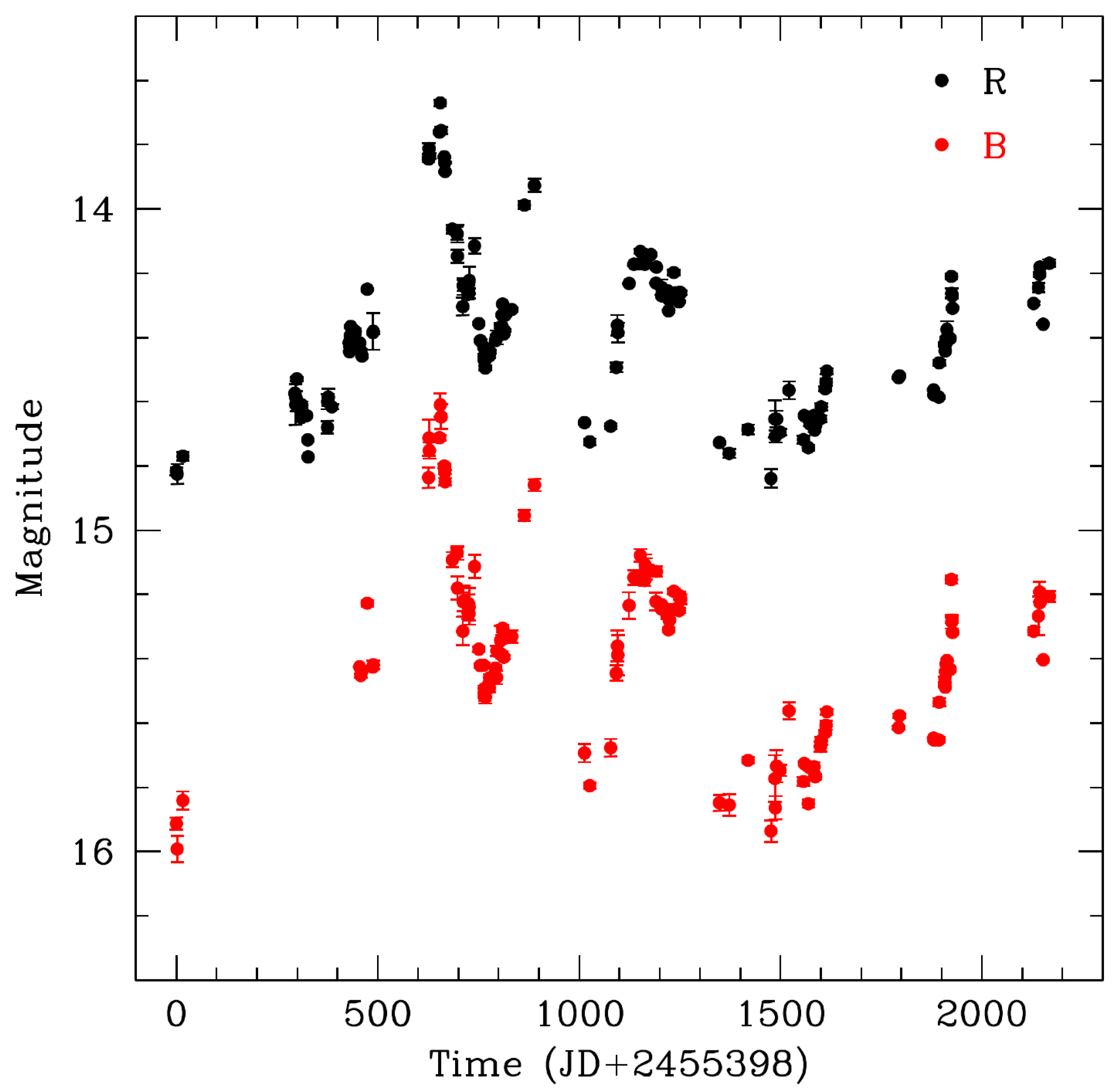
Extending the analysis of light curves to timescales ranging from days to months, known as inter-day variability or short-term variability (STV), all HBLs studied are found to be variable. This variability is characterized by being erratic, with flare-type events of varying duration and amplitude from event to event (e.g., [74,75]). The differences in magnitude are less than 1 mag, with the most common value around 0.2 mag in periods of less than a month [76]. For example, a well-monitored HBL blazar, 1ES 1959+650, did not show any INV in 38 light curves spread from 2010 to 2016 [77]. When the same data were analyzed searching for STV, in the five light curves corresponding to each annual observation season, variability was detected with amplitudes from 0.2 up to 0.9 mag in about 7 months. STVs occurred with flare-like characteristics in 2012 and 2013. Furthermore, using data from an international collaboration of observatories and based on 44 nights over 380 days (between 2009 and 2010), this blazar exhibited a variability of about 1 mag over 290 days [78]. In Figure 4 the light curves in R and B bands for 1ES 1959+650 are shown. These curves reveal the complex and erratic structure of flux variability during the period 2010 to 2016.
Another example of this behavior is reported in the source PKS 2155-304. This blazar is one of the most studied due to its high brightness and because it exhibits extreme characteristics in its very high-energy flux [79]. In a recent study by Weiss et al. [80], amplitude variations of ∼0.7 mag were found throughout 2023, while in the same time period, but in 2024, the amplitudes of the STVs were half that, of ∼0.35 mag. In particular, for the year 2023, variations of 0.6 mag were reported between July and mid-August with increasing brightness, followed by variations of 0.15 mag over three nights in mid-September, with the source becoming fainter.
This type of behavior has also been noticed for another well-known HBL, MrK 421. In this case, several flare-like features with an amplitude of 0.2 mag were reported over a period of 100 days between 2005 and 2006 [81].
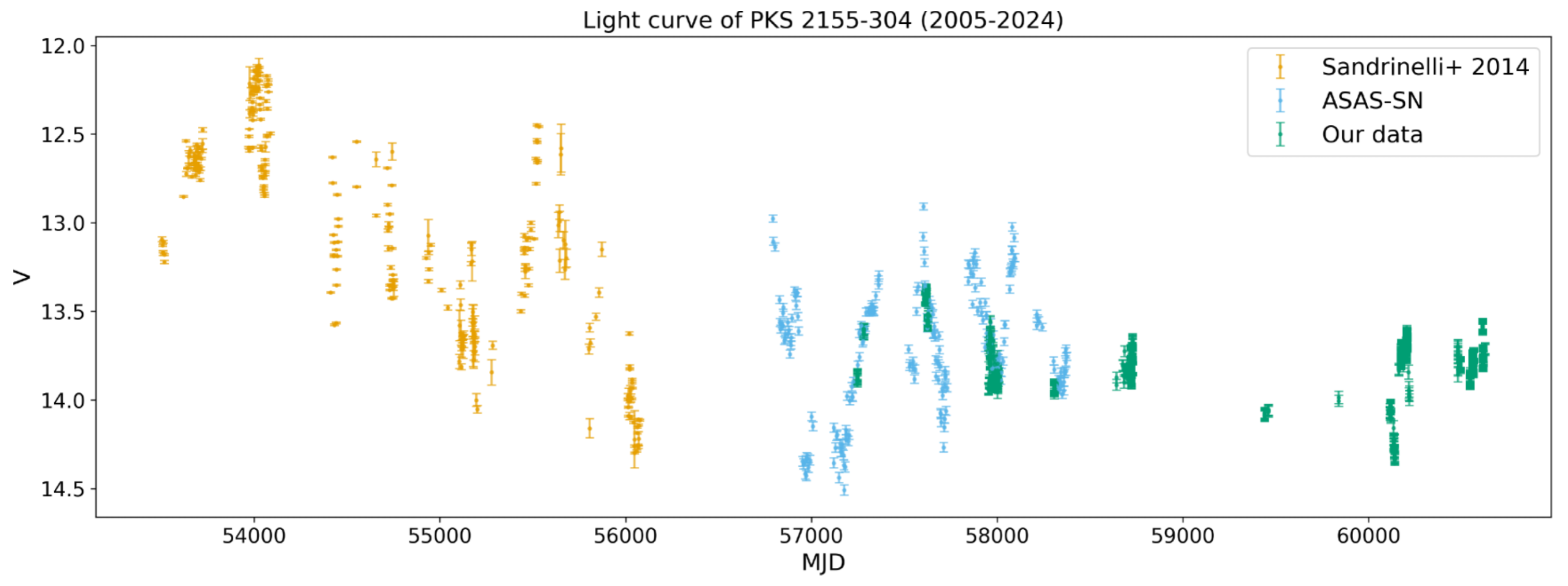
Finally, on long time scales, LTVs, year scales, all monitored HBLs are also variable, with typical amplitudes between 1 and 2 mag (e.g., [74,82]). However, greater amplitudes have also been obtained. This is the case for PKS 2155-304, which reached values of Δ R = 2.41 mag [62]. The time span over which these variations occur is several years. For example, the source 1ES 0806+524 became weaker by 0.8 mag in R band in 8.1 years. As in STVs, LTVs show complex structures in which changes in flux over the years are superimposed with shorter-duration flare-type features of a smaller amplitude. Figure 5 showed the light curve in the V band over two decades for the blazar PKS 2155-304.
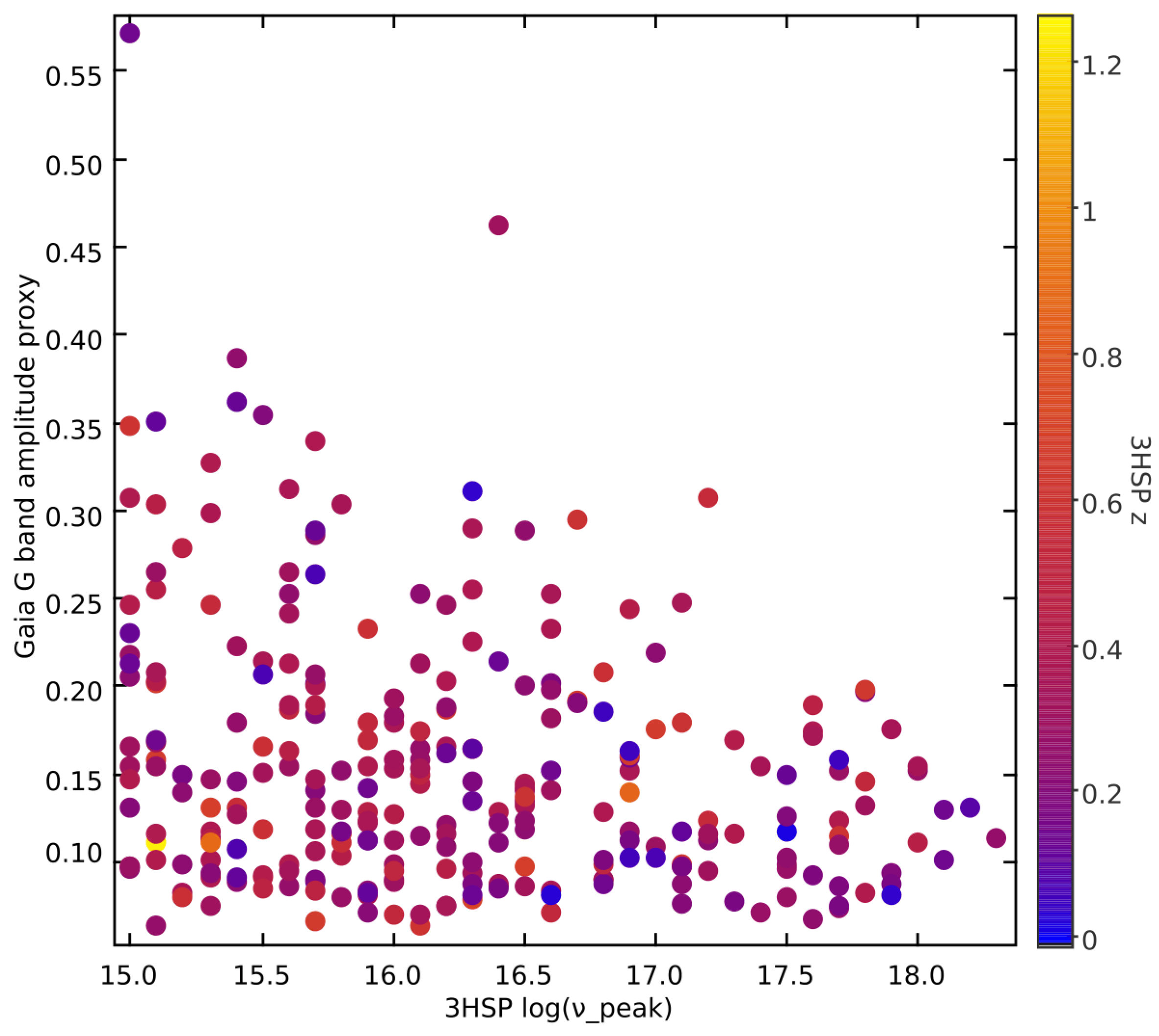
The contrast in variability properties between HBLs and LBLs has been discussed regularly in the literature e.g., [83], yet there is still no consistent explanation for the behavior of HBLs as a population. To illustrate this difference, we performed a simple crossmatch between the 3HSP catalog [60] and the Gaia catalogue of Large Amplitude Variables [LAVs] [84]. Using a 1 arcsec search radius, we identified 719 3HSP sources included in the LAV catalog. We filtered out objects not listed in BZCat [59], ensuring that only confirmed BL Lac objects are included. These confirmed BL Lac sources amount to 306 sources. The results are shown in Figure 6. At first glance, the amplitude of variability appears to decrease with increasing synchrotron peak frequency, declining by approximately ∼50% between log ( ν peak ) 15 and ∼18. We also include confirmed redshift values to assess potential biases related to distance, although no obvious trend is observed. Several physical mechanisms could potentially explain this behavior (see Section 5), but these have not yet been tested using statistically large samples. This simple cross-match already illustrates the potential of population-level analyses.
Another distinctive feature of variability at all temporal scales in the optical band is that, when follow-ups have been performed using different filters (e.g., BVRI from the Johnson–Cousins system), a tendency of greater amplitudes of variation toward shorter wavelengths is observed [76,85,86].
In cases where variability has been detected, it is possible to study how color behaves in relation to the brightness of the source. This could be a good tool that provides information about the nature of variability: changes in flux are reflected in the colors and, consequently, in the spectral changes (e.g., [45,87,88]). In this sense, globally, three behaviors can be identified: Redder When Brighter (RWB), Bluer When Brighter (BWB), and just steady. Some population studies have been conducted in this regard, and HBLs report BWB behavior, especially on monthly scales. This behavior is general to the entire class of blazars (e.g., [89]).
In general, among blazars and in particular those of the BL Lac type, HBLs are the least variable. At all timescales, the incidence of variability events is lower, and the reported amplitudes for the flux change are smaller than in the rest of the blazars. It should be noted that the reported behavior of HBL variability has a statistical bias, as there are still few sources on which dedicated studies have been carried out. Another important aspect to keep in mind is that the monitoring is not usually evenly spaced over time, so the results obtained should be taken with caution.

3. Search for Quasi-Periodicities

The search for periodicity in the light curves in the whole electromagnetic spectrum has always been a main driver for variability studies in blazars. In particular, there are several cases of LBLs with known periodicities, generally ascribed to the presence of a supermassive black hole driving the AGN process [90]. Although HBLs have also been the aim of periodicity searches, only a few of them have yielded significant results. In the following, we list what to the best of our knowledge has been done in periodicity searches on HBLs.

3.1. PKS 2155-304

Maybe the first HBL to be the chosen for a periodicity search was PKS 2155-304. There is plenty of historical data, since already in 1979, Griffiths et al. [91] published a 100-year-long light curve using the Harvard Observatory photographic plate collection. In 1993, Urry et al. [92] found, in a subset of ∼5 days of optical and UV data (the full set covering ∼1 month), a plausible period of either ∼0.7 days, or ∼1.5 days (the first harmonic). The optical and UV data were correlated. However, they state that the significance of such periods is unclear, given that they sampled the source for five cycles at best [93], and that red noise (see also Section 2) could produce the same peaks in such sparsely sampled data. Moreover, a similar study on the same object, which included better and more extensive sampling, did not show any evidence of periodicity [94]. This will become a theme in upcoming studies of periodicity for PKS 2155-304.
A few years later, a new set of possible periods was found by Fan & Lin [95]. They analyzed a set of post-1977 data compiled from the literature, to which they applied firstly the Jurkevich [96] method to find period candidates and then an F-test to assess the significance of such candidates. They found that periods of less than 4 years were not significant enough, while periods of 4.16 ± 0.2 and 7.0 ± 0.16 were plausible. To further assess this, they also applied a Discrete Correlation Function (DCF) test on to the data, finding similar results (4.20 ± 0.2 and 7.31 ± 0.16, respectively). However, the data spans a range of, at best, 3 cycles, so again the significance of these periods is unclear.
In the past 15 years, however, a series of contradicting results have been published regarding the detection of periodicity in PKS 2155-304. There have been several claims of detected periods of ∼1 year [32,88,97,98,99], and claims of no periodicity at all [80,100,101]. The issue of whether periodicity is or is not detected in this source is still under debate. However, we do note a certain trend: all works that did not model the red noise to account for it found strong evidence of periodicity, while all works that did model the red noise found no significant period at all. The only exception to this rule is the work by Zheng et al. [99], which modeled the red noise and found a period of ∼1 year on the data of the ASAS-SN database [66]. Recently, Weiss et al. [80] performed a periodicity analysis over an extended data set, which included the data used by Zheng et al. and did not find any periodicity either. Perhaps PKS 2155-304, being a historic prototype of an HBL object, should be the core of a dedicated campaign in the near future.

3.2. PG 1553+113

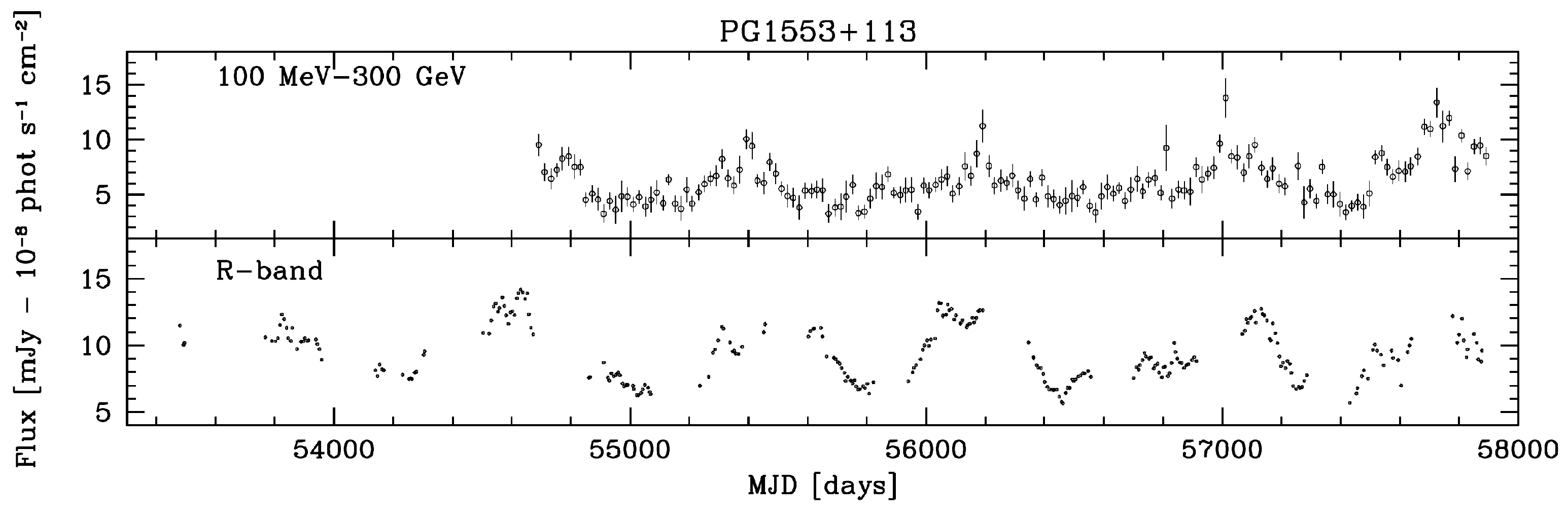
A ∼2-year period was found for PG 1553+113 in 2014, with the Fermi-LAT γ -ray telescope [102] at the same time it was being monitored in the optical band [103]. This motivated a dedicated work using several publicly available optical databases, which could effectively correlate the optical light curve to the periodic γ -ray curve [104]. The red noise was somewhat considered in this analysis, since the Monte Carlo simulations to assess significance used the same Power Spectral Density (PSD) as the data. Several posterior works confirmed the same result, both in optical and γ -rays, and they are all consistent with each other in reporting a period of ∼2 years [64,101,105,106,107]. The only exceptions are a handful of works whose covered data range and/or sampling does not allow to search for yearly like periods. Nonetheless, in all these cases, a strong periodic signal consistent with either harmonics (∼22 years) or sub-harmonics (∼0.5 years) is still reported [82,108]. We show the light curve from Sandrinelli et al. in Figure 7.
There are several models that try to explain why this periodic behavior is present in the multiwavelength emission of PG 1553+113. They can be roughly divided into two types: intrinsic changes in the emission process itself or geometric models such as jet precession. While many of these scenarios might be related to the presence of a binary SMBH system at the core of the AGN, periodicity can also arise from single-SMBH processes, such as Lense–Thirring precession, which is driven by the misalignment between the black hole spin and the disk angular momentum see, e.g., [109,110].
Intrinsic changes in the emission process could arise due to magnetic reconnection enhancing the emission periodically [111,112,113], due to accretion having phases of over- and under-flow [104,112], or due to the accretion disk presenting inhomogeneities [108]. Given that these processes depend on local plasma densities and particle acceleration efficiencies, all these models are expected to be chromatic, i.e., having different effects at different wavelengths.
Geometric models, particularly those involving precession, invoke a change in the observed flux due to variations in the Doppler factor, δ . For an optical thin emitting region, the observed flux F ν scales with δ 3 + α , where α is the spectral index [114]. Since the amplitude depends on the local slope of the SED, variability may appear chromatic if comparing regions with different spectral indices. In addition, a frequency shift, ν o b s = δ ν , might cause the SED peak to move across the observation band. However, within energy ranges where the spectral index remains relatively constant, such as the gamma-ray window observed by Fermi-LAT, these variations can appear quasi-achromatic. Very recently, Madero & Domínguez [115] analyzed 17 years of Fermi-LAT data and found that the periodic variations in PG 1553+133 are indeed achromatic within that waveband, which favors the hypothesis of a jet-precession scenario. A somewhat more complex jet-precession model requires two separate jets, one per SMBH, if the masses involved are relatively similar, which creates essentially two active nuclei on the same galaxy [116].

3.3. Other Sources

A handful of other HBLs were targeted for periodicity studies, with discouraging results. Optical periodicity analyses of Mrk 421 have yielded consistently inconclusive or marginal results. A period of ∼1.4 years was claimed in 2014 [117], but without considering red noise. A similar analysis, partially considering red noise, found no periodicity instead [118]. Later, again, a significant period of ∼1.4 years was found, but the authors dismissed it due to the expected false alarm rate [82]. Finally, the most recent work to date on Mrk 421 [119] found no periodicity on TESS light curves at monthly timescales. The candidate ∼1.4-year period remains, thus, under debate.
Mrk 501 became an interesting target for periodicity studies after early reports of possible periodic behavior at TeV energies [120]. The observational evidence for optical periodicity in this blazar remains, however, inconclusive. Several monitoring studies found no statistically significant periodic signal in the optical band [82,121], while several others reported candidate quasi-periodicities [122,123,124]. These correspond to timescales of ∼1, ∼0.6 and ∼5 years, respectively. However, the reported periods are not mutually consistent, and their statistical robustness remains uncertain because red-noise modeling is limited or method-dependent in these works, and the inferred periods generally do not coincide with each other or with periodicities reported at other wavelengths.
For three more HBL sources, we found very few references regarding their optical periodicity. For 1ES 1959+650, there is an analysis of a ∼16 year R-band light curve that finds a period of ∼1.5 years [125]. The statistical treatment is sound, including red noise and proper significance assessment, but it remains without confirmation by independent studies.
The only optical periodicity search for 1ES 2344+514 finds a period of ∼5.5 years on 10 years of data, which again covers too few cycles and is thus a marginal detection [124]. Finally, 1ES 1426+42.8 displayed a possible ∼1 h quasi-periodic oscillation [126], possibly linked to magnetic reconnection processes. To be confirmed by independent studies.
As mentioned above, studies seeking periodicities in the HBL light curves are scarce, and a dedicated monitoring campaign on a larger sample would prove useful to better understand if these processes are indeed a sign of binary systems or not, and how common they are among the HBL population. In principle, the fraction of binary systems in HBLs should not be different from any other AGN population, so a complete and precise fraction of binarism among HBLs would be an indicator of how common binary systems are among other AGNs as well.

4. Optical Linear Polarization Behavior

As the mechanism responsible for low-energy emission at optical frequencies is synchrotron radiation, this emission is intrinsically polarized [114]. The polarization observed across the entire spectrum in blazars is linear, including at optical wavelengths. This polarized emission also appears to be variable in terms of both the degree of polarization P and the polarization angle EVPA (electric vector position angle). And this variation also occurs erratically and at all temporal scales. The polarization signature in blazars is of significant importance, since its value depends on the conditions of the magnetic field along the jet [127]. In particular, optical polarization can determine the structure and evolution of the magnetic field at PC scales. Furthermore, optical polarization is a powerful tool that is being used to associate GeV emitting sources detected with Fermi-LAT that have not been identified [128,129].
Since the 1990s, studies have been conducted that address this issue from a population perspective. However, the number of sources monitored with good sampling at all time scales is still lower than in optical flux monitoring.
One of the first published studies analyzed a sample of 37 sources cataloged at that time as XBLs [130]. In this work, polarization behavior was used to effectively identify 15 sources with BL Lac objects. In these objects, the value of P did not exceed 10%, with 44% of XBLs having values of P < 4% (underlining the difference with those classified as RBLs, which systematically reported higher values of P as high as 40%). This same result was obtained by Andruchow et al. [131], where a sample of 18 blazars (10 RBLs and 8 XBLs) was systematically monitored over a period of 2 years. The study focused particularly on short-scale variability. In this regard, not only did the XBLs turn out to be the ones with the lowest degree of polarization, but also they were the least variable.
In recent years, several efforts have been made to better understand optical polarization signatures. Several studies have been conducted using data obtained with the aforementioned RoboPol and the Steward Observatory Blazar Monitoring Program https://james.as.arizona.edu/~psmith/Fermi/ (accessed date 15 April 2026). Both programs focus on the observation of blazars detected in γ -rays. Of the list of monitored objects, a small number of sources are HBLs. Therefore, the results obtained provide an insight into the polarization behavior.
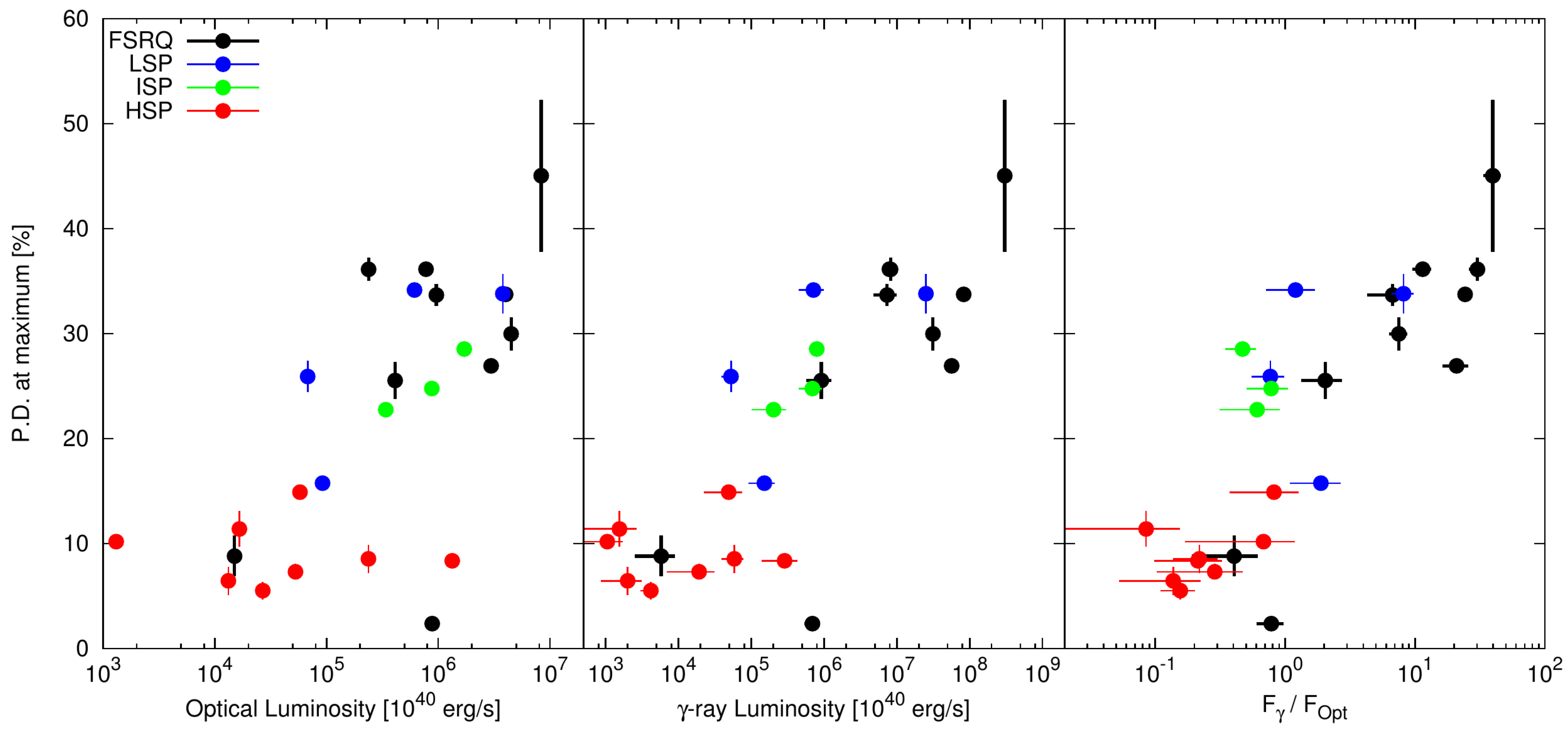
HBLs are blazars with the lowest degree of polarization, barely exceeding 10%, as reported in early studies. Changes in the maximum value for the degree of polarization, P m a x , are typically from ∼0.05% to ∼12.5% (e.g., [132,133,134,135]). An exceptional case is PKS 2155-304, which reached a P m a x = 19.1% [136]; however, this value occurred only once, and its average P value remained well below 10%. To visualize this, Figure 8 shows the distribution of the degree of polarization with respect to optical and gamma fluxes for different classes of blazars. At short and long time scales, all HBLs showed variable polarization with low amplitudes that varied from object to object [137,138]. Another typical feature of P variability is that it occurs erratically and aperiodically. No significant correlations are detected between optical flux and polarization [135,139]. For example, in 2013, the blazar MrK 421 reached its maximum brightness reported to date ( R = 11.29 mag), and approximately one month later, the value of P reached its maximum ( P = 11 % ) [134]. During the same monitoring period, in 2015, the blazar reached its lowest brightness ( R = 17.7 mag . ), and during this period, the reported polarization was high, with an average of 6.5%. In general, it can be observed that blazars, those with lower luminosity, and HBLs have smaller variations in flux, color, and P[%] [89]. Also, at the optical band, the value of P is observed to increase with energy [140], and there is also a certain dependence on the amplitude of the variation of P at short time scales [141]. Extreme variations in the degree of polarization have also been detected on 70-minute timescales in the source [H89] 0323+022; the polarization value varied from 2% to 9%, then dropped to ∼5% [142]. It should be noted that these measurements have relatively high errors and that the authors mention the presence of clouds throughout the night; this, combined with the fact that this blazar has a detectable extended host galaxy, may mean that the detected variability was not of the reported amplitude, but rather smaller (see, e.g., [143]).
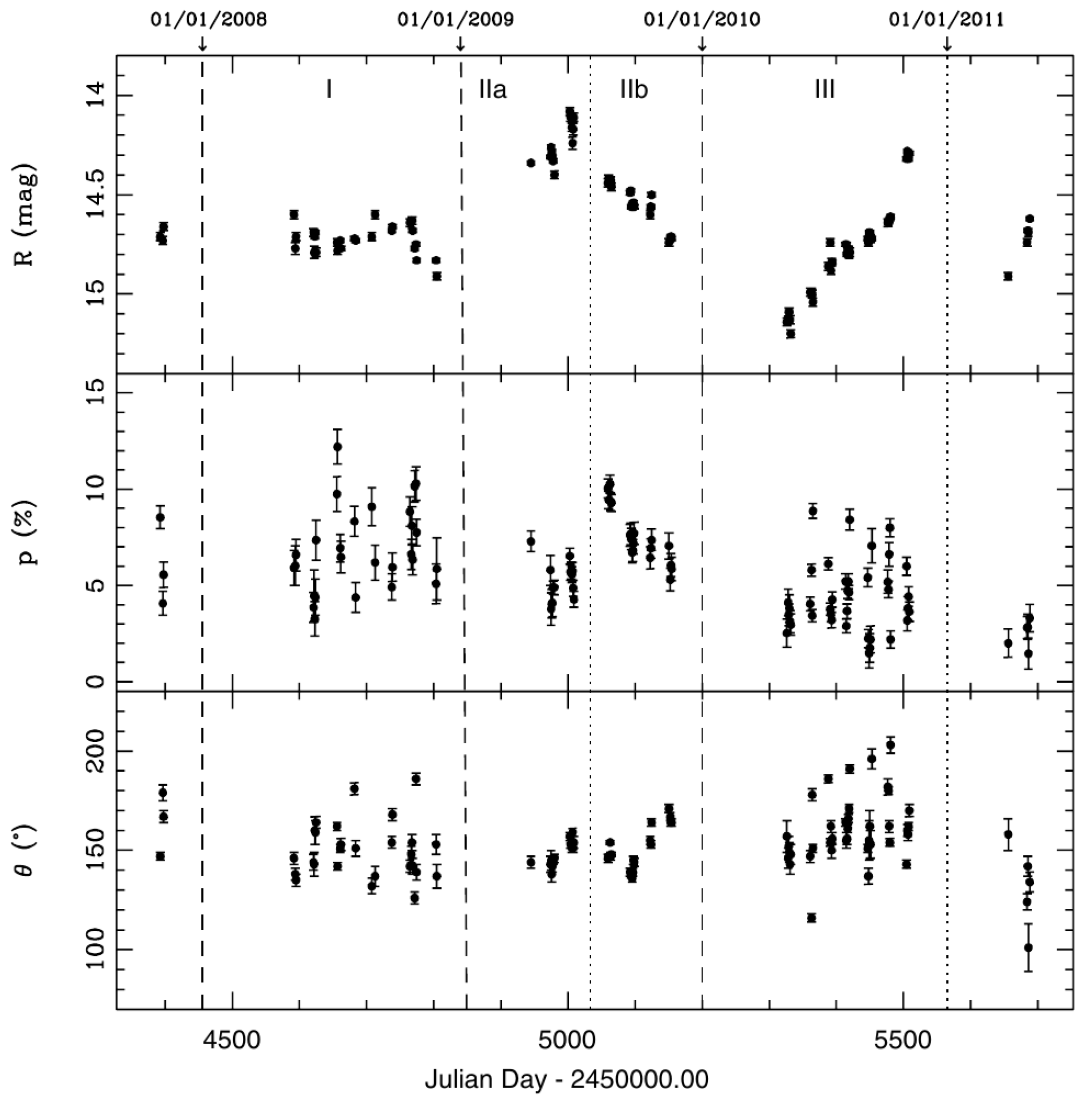
Temporal variation is also observed in EVPA. This is not necessarily related to variations in P and occurs on temporal scales from days to months [144]. HBLs seem to have a preferred direction. That is, defining EVPA rotation as any significant continuous change, HBLs generally do not exhibit rotation. For example, this is the case for PG 1553+113, whose EVPA remained between 90° and 120° throughout 2020 to 2021. Similar values were obtained in 2009 [132]. In some cases, such as in MrK 421, over a monitoring period covering 20 years of observations, some minor rotations were detected, which were in both directions and with rates of change (degrees/day) that differed from one to another [138,145]. Most rotations show no systematic behavior with optical flux. This behavior is contrary to that of FSRQ-type blazars, which exhibit random EVPA distributions. Figure 9 shows an example of the variations in polarization on annual scales together with the optical flux for the BL Lac object 1ES 1959+650.
Recently, polarization values have begun to be obtained at high energies, particularly in X-rays at 2–8 keV based on data obtained with the Imaging X-Ray Polarimetry Explorer (IXPE). To date, X-ray polarization has been detected in only a handful of HBL blazars; a list of the most well-known and widely studied objects is as follows: Mrk 501 [147], Mrk 421 [148], 1ES 1959+650 [149,150,151], PG 1553+113 [152], 1ES 0229+200 [153], PKS 2155−304 [154], [H89] 1426+428 [155], 1ES 1101-232 [156]. It is observed that the values of the degree of polarization in X-rays are consistently higher than at lower energies (optical and radio waves), and values as high as 31 % have been measured for P X . It was also found that both the degree of polarization and the EVPA are variable with time. Further observations are needed to characterize this behavior more thoroughly (see, for example, [157]). These polarization measurements must be complemented with measurements at lower energies to obtain parameters that allow the emission mechanisms to be successfully modeled. The dynamic physical conditions of blazars can be estimated using the variation in polarization.

5. Emission and Variability Models for HBL Blazars

In this section, we discuss the main classes of models that can account for the multi-wavelength emission observed in high-frequency-peaked BL Lac objects (HBLs), with particular emphasis on how these models explain the observed variability. The simultaneous modeling of the spectral energy distribution (SED) and the temporal behavior of the source provides important constraints on the particle populations, radiative processes, and physical structure of relativistic jets.

5.1. Leptonic Models

The simplest and most widely used framework for modeling the SEDs of blazars is the stationary one-zone SSC model. In this scenario, electrons are accelerated up to relativistic energies in a single homogeneous region of the jet and radiate synchrotron emission from radio to X-ray energies and interact with their own synchrotron photons via inverse-Compton scattering (SSC) to produce γ -rays in the GeV–TeV range [158]. A limitation of the one-zone approximation arises from the compactness of the emission region. In such a region, synchrotron radiation at radio frequencies is typically self-absorbed, preventing the model from reproducing the low-frequency radio spectrum, which likely originates from larger regions of the jet.
In particular, for HBLs, this mechanism is especially relevant because external photon fields are typically weak or absent, making SSC the dominant process responsible for the high-energy emission. One-zone SSC models have been widely successful in reproducing the time-averaged SEDs of many HBLs e.g., [159].
Whereas stationary SSC models are useful for describing time-averaged states of blazars, they are less suitable for explaining rapid variability such as short-timescale flares. In these cases, time-dependent models are required.
The observed SED of some sources cannot be satisfactorily reproduced by a pure SSC scenario. An additional contribution from External Compton (EC) scattering may then be invoked, in which relativistic electrons upscatter photons originating outside the jet [160,161].
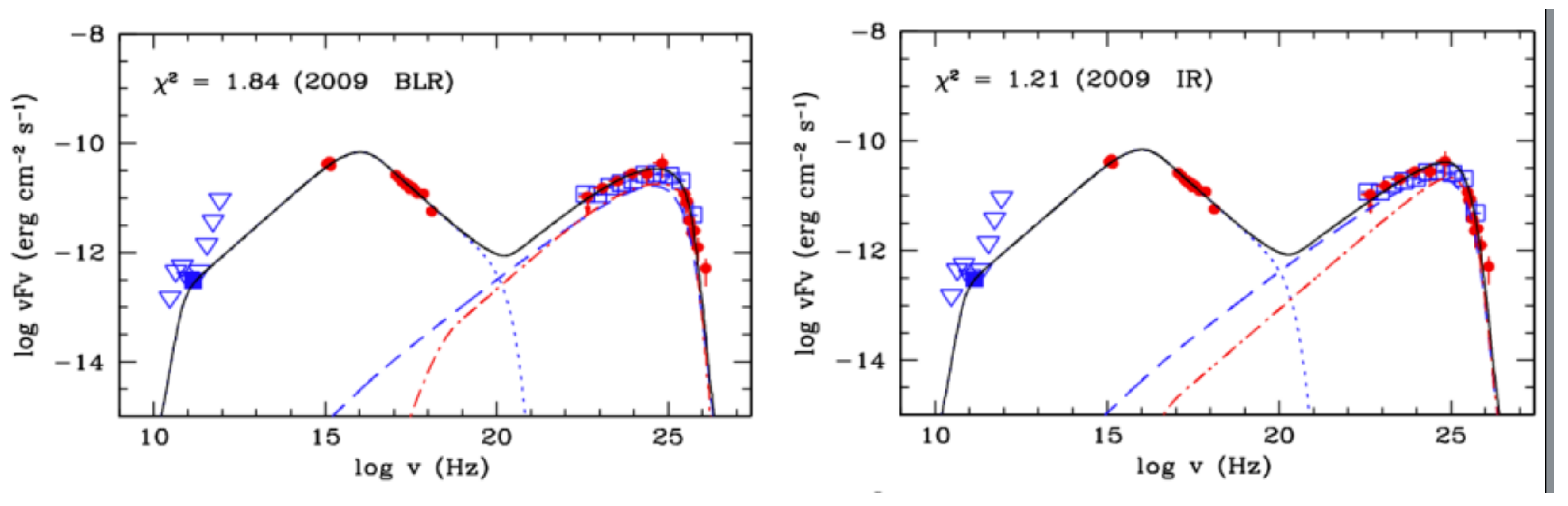
While EC emission is generally less important in HBLs than in other types of blazars, it may still play a role in more luminous sources. For example, pure SSC models failed to reproduce the broadband SED of PKS 1424+240 during its 2009 high state, shown without requiring extremely large Doppler factors. In Figure 10 we show the SED of PKS 1424+24 modeled with an additional EC with seed photons from the IR torus or the BLR (from [162]), including the EC component results in parameter values more consistent with those typically inferred for BL Lac objects [162,163].

5.2. Lepto-Hadronic Models

Although leptonic models successfully reproduce the SEDs of many HBLs e.g., [164], there is growing observational and theoretical motivation to consider the presence of relativistic hadrons in blazar jets. Blazars, and HBLs in particular, have long been proposed as potential sources of ultra-high-energy cosmic rays (UHECRs) and are also candidate sites for the production of high-energy astrophysical neutrinos [165,166]. Within this context, lepto-hadronic models provide a natural framework that links the acceleration of hadrons in relativistic jets with the production of γ -rays and neutrinos.
In lepto-hadronic scenarios, the low-energy component of the SED (including optical emission) is still attributed to synchrotron radiation from relativistic electrons. The high-energy emission, however, can arise from several hadronic processes.
The most simple way to include protons is considering their interaction with the magnetic field to be responsible for the high-energy bump in the SED [167]. These models are often known as proton synchrotron. Proton cooling times are long, which naturally disfavors minute-scale variability; short TeV flares are an important constraint on pure hadronic models [168,169].
Lepto-hadronic models alleviate the apparent tension of uncorrelated variability at different energy bands observed in some sources. For example, 1ES 1959+650 showed strong X-ray variability without clear correlated variations with optical/UV or TeV emission [170,171,172]. In these models, the optical emission is of leptonic origin, while the high-energy component is produced by the proton component. As a result, optical variations does not necessarily imply changes in the proton distribution, allowing the γ -ray component to remain relatively stable [173].
The presence of protons can also lead to photohadronic cascades: high-energy photons can be produced by hadronic interactions, such as photomeson production or Bethe–Heitler pair production. These processes inject secondary particles (including electron–positron pairs, charged pions, and muons) that can also contribute significantly to the observed γ -ray emission [168,174,175]. While these channels of emission have a more significant contribution for LBLs, which have higher luminosities than HBLs [176], there are some cases in which they can be relevant for HBLs. For example, high-energy emission from proton and muon synchrotron and pγ-induced cascades can reproduce stationary and low-state SEDs of HBLs like PKS 2155-304 and Mrk 421 [169].

5.3. Multi-Zone and Structured-Jet Models

Single-zone models usually cannot explain complex variability patterns observed across different energy bands. For this reason, multi-zone and structured-jet scenarios have been proposed, where different regions of the jet contribute to the observed emission with distinct physical conditions.
In particular, there is compelling evidence showing a difference between the relatively modest bulk Lorentz factors inferred from parsec-scale VLBI measurements of radiogalaxies, extended to HBL jets through the unification model, and the much higher Lorentz factors required to explain TeV emission and its variability e.g., [177]. This has motivated a family of models in which the jet contains at least two distinct dynamical components: a fast and highly relativistic one, and a more slower one (mildly relativistic in some cases).
For example, in two-zone SSC models, the emission originates from two regions characterized by different conditions, such as the electron populations, the magnetic fields, and Lorentz factors. Usually, one zone represents the relatively steady component of the jet emission, while a second, more compact region, is responsible for short timescale variability, as transient events.
The spine–sheath model also belongs to this category. These transverse jet structures were first proposed to explain the emission from radiogalaxies [178,179], and were later applied to BL Lac objects, e.g., [180]. These models invoke a two-component jet, with a relativistic inner spine surrounded by a slower, mildly relativistic sheath or layer. In this configuration, photons produced in one region can be target for anisotropic IC scattering in the other. In this geometry, rapid variability may originate in the fast spine, while the more extended sheath may produce a less variable component. This structure is also supported by polarization measurements in several HBLs, as Mrk 421, Mrk 501, and 1ES 1959+650 e.g., [181].
To account for extremely rapid TeV variability, alternative scenarios have been proposed in which compact emitting regions move relativistically within the larger-scale jet. One such example is the jet-in-a-jet model, where small relativistic substructures or mini-jets are produced within the main jet flow, effectively boosting the observed emission and allowing variability on very short timescales [182].
Furthermore, longitudinally stratified jet models also consider inhomogeneous jets with spatially varying Lorentz factors and physical conditions along the jet symmetry axis. These models can account for multiwavelength emission in HBLs and also for the uncorrelated variability between different energy bands e.g., [183,184].
In addition to the internal lepto-hadronic jet zones, relativistic protons escaping the jet and interacting with CMB/EBL photons can produce line-of-sight cascades. These have been proposed for extreme-HBLs with very hard intrinsic spectrum in the X-ray and VHE γ -ray, and slowly varying TeV spectra [168,185,186]. Some sources show this extreme behavior only during flaring states, such as Mkn 421, Mkn 501, while others, such as 1ES 0229+200, show persistent extreme behavior in different states. While the internal zone can vary rapidly, this model predicts an attenuated rapid variability at TeV energies due to propagation times and extended cascade zones; it is consistent with the relative steadiness of many extreme-HBLs and also with multi-component flares [187].

5.4. Particle Acceleration Mechanisms

The rapid and multiwavelength variability observed in HBLs is likely related to the regions where the jet energy is dissipated and the mechanisms behind particle acceleration. Several scenarios have been proposed to explain both the acceleration of relativistic particles and the resulting variability observed in the emitted radiation. The most widely discussed mechanisms include shock acceleration, magnetic reconnection, and stochastic acceleration in turbulent environments.

5.4.1. Shock-in-Jet Models

Variability on the minute scale at TeV energies in a few blazars, in particular in Mrk 501, implies a very compact γ -ray emitting region. In shock-in-jet models, disturbances propagating along the relativistic jet produce shocks that accelerate particles through diffusive shock acceleration [188,189]. The non-thermal particles then produce the broadband emission observed in blazars.
In this context, variability is explained by changes in the shock properties, such as its strength, speed, or particle injection rate, and the consequent changes in the electron energy distribution. Shock-in-jet models have been used to interpret variability in BL Lac objects, including sources that exhibit transitions between IBL and HBL [37,190].

5.4.2. Magnetic Reconnection Scenarios

Magnetic reconnection has been proposed as an alternative mechanism for particle acceleration in magnetically dominated regions of relativistic jets e.g., [191,192]. In this scenario, magnetic field lines of opposed polarity reconnect, rapidly converting magnetic energy into particle kinetic energy. The formation of compact reconnection layers or plasmoids can accelerate particles to very high energies on short timescales. Such processes are often invoked to explain extremely rapid variability observed in some blazars, particularly at TeV-energies [79].

5.4.3. Turbulence and Stochastic Acceleration

The detection of HBLs at energies above TeV also suggests that the particle energy distributions may be harder than the standard power-law index of ∼2, predicted by diffusive shock acceleration. Particle acceleration driven by turbulent processes within the jet has been proposed as a promising mechanism capable of producing harder spectra, with particle indices of ∼1.5 under certain conditions [193]. In turbulence-dominated environments, particles gain energy through stochastic interactions with magnetic irregularities, leading to second-order Fermi acceleration. Multiple turbulent cells contribute to the observed radiation. The superposition of emission from many small regions can naturally produce stochastic variability patterns and complex flare structures.
Stochastic acceleration can also produce log-parabolic spectra of particles. Such spectral shapes have been used to model several blazars and have been interpreted as evidence for stochastic acceleration processes, as is the case for Mrk 421 [194].

5.4.4. Recollimation Shocks

Recollimation shocks can form when a relativistic jet interacts with the surrounding medium. The external pressure of the ambient matter forces the expanding flow to reconverge, producing localized regions of enhanced particle acceleration and magnetic field compression [195,196,197].
In this scenario, different particle populations may occupy regions with distinct magnetic field configurations and radiative cooling timescales, providing a natural explanation for the variability and polarization observed at different spectral bands in HBLs. This model has been applied to several HBLs and extreme-HBLs e.g., [198,199].

5.5. Variability on Different Timescales

As discussed throughout this work, HBLs show multiwavelength variability on a wide range of timescales, and in particular at optical bands. Within the theoretical framework described above, the physical mechanisms responsible for variability can be summarized as
  • INV (minutes–hours): likely associated with very compact emitting regions (e.g., turbulent cells) and rapid particle acceleration processes (magnetic reconnection events, shocks in jets, etc).
  • STV (days–months): usually attributed to changes in the physical conditions of the emitting region, such as the magnetic field strength and configuration, particle density and injection. Multi-zone and structure-zone are very successful in reproducing this behavior.
  • LTV (years): probably related to global changes in the accretion flow, which can modify the jet power and structure, and also geometrical effects, such as changes in the jet orientation or precession.

6. Summary

The results of optical variability studies of HBL populations compiled to date have several statistical biases. Firstly, the sample studied is small (limitations in flux, use of small telescopes, few HBLs observed, etc.). In addition, the temporal sampling in the observed sources is irregular and unevenly spaced. This is particularly important since the detected variations occur erratically and simultaneously at different timescales. Moreover, at INV, different surveys use different statistical tests to analyze variability, which means that non-comparable samples of results may be obtained. This is most notable in the case of HBLs, given their low variability amplitudes, which in turn generate a not negligible number of contradictory results depending on the statistics used.
Another source of bias arises from fact that dedicated monitoring campaigns are triggered when objects are passing through a flare, especially those that occur at high energies, GeV or TeV. This may bias the observed variability properties to those associated to active states.
In order to completely characterize the optical flux of HBLs and confirm the trends identified so far, it is essential to carry out long-term, systematic monitoring campaigns on a sample with the largest number of sources. This requires a great deal of effort, but is critical for obtaining significant population statistics. For instance, a population analysis on periodicities in HBLs, could give new insights for a long unresolved debate on specific sources and could be used as proxy to binary populations within other AGNs, at least at the redshifts associated to HBLs.
Even today, there is still debate about the most complete sample of genuine HBLs. Although the 3HSP catalog compiles around 2000 sources, Giommi et al. [200] show that it has completeness issues. In this sense, the latest method for selecting HBL blazars is observational SED modeling, with all the work that this involves. HBLs are extremely rare objects in the universe, but they are of utmost importance since they constitute by far the largest population of high-energy emitting sources.
The variable nature of the flux from these sources is used as a tool to construct AGNs catalogs using large surveys such as GAIA https://www.cosmos.esa.int/web/gaia/dr3 (accessed date 15 April 2026) [201]. This will provide an even larger number of sources from which to search for HBL-type blazars. In the near future, this number is expected to grow significantly with the data obtained by the LSST camera at the Vera Rubin Observatory https://rubinobservatory.org/.
The large datasets produced by these surveys will provide an unprecedented opportunity to study the optical variability properties of HBLs. The combination of optical monitoring with simultaneous multiwavelength observations, will be essential for reducing the degeneracy of theoretical models. Ultimately, such studies will help to better understand particle acceleration mechanisms and emission in relativistic jets operating under some of the most extreme physical conditions found in the universe.

Author Contributions

Conceptualization, I.A., E.J.M. and F.L.V.; methodology, I.A. and E.J.M.; formal analysis, F.L.V.; writing—review and editing, I.A., E.J.M. and F.L.V.; funding acquisition, I.A. All authors have read and agreed to the published version of the manuscript.

Funding

The present work was partially supported by grant 11/G178 from the Universidad Nacional de La Plata, Argentina.

Data Availability Statement

The data presented in this study were derived from the following resources available in the public domain: The 3HSP catalogue (https://www.ssdc.asi.it/3hsp/, accessed date 15 April 2026), and the Gaia DR3 repository (https://www.cosmos.esa.int/web/gaia/dr3, accessed date 15 April 2026).

Acknowledgments

The authors would like to thank Sergio A. Cellone for his comments and discussions.

Conflicts of Interest

The authors declare no conflicts of interest.

References

  1. Blandford, R.D.; Rees, M.J. Some comments on radiation mechanisms in Lacertids. In Proceedings of the BL Lac Objects, Pittsburgh, PA, USA, 24–26 April 1978; Wolfe, A.M., Ed.; University of Pittsburgh Press: Pittsburgh, PA, USA, 1978; pp. 328–341. [Google Scholar]
  2. Stickel, M.; Padovani, P.; Urry, C.M.; Fried, J.W.; Kuehr, H. The complete sample of 1 Jansky BL Lacertae objects. I-Summary properties. Astrophys. J. 1991, 374, 431–439. [Google Scholar] [CrossRef]
  3. Urry, C.M.; Padovani, P. Unified Schemes for Radio-Loud Active Galactic Nuclei. Publ. Astron. Soc. Pac. 1995, 107, 803. [Google Scholar] [CrossRef]
  4. Antonucci, R. Unified models for active galactic nuclei and quasars. Annu. Rev. Astron. Astrophys. 1993, 31, 473–521. [Google Scholar] [CrossRef]
  5. Stocke, J.T.; Liebert, J.; Schmidt, G.; Gioia, I.M.; Maccacaro, T.; Schild, R.E.; Maccagni, D.; Arp, H.C. Optical and radio properties of X-ray selected BL Lacertae objects. Astrophys. J. 1985, 298, 619–629. [Google Scholar] [CrossRef] [PubMed]
  6. Hoffmeister, C. 354 neue Veränderliche. Astron. Nachrichten 1929, 236, 233. [Google Scholar] [CrossRef]
  7. Schmitt, J.L. BL Lac identified as a Radio Source. Nature 1968, 218, 663. [Google Scholar] [CrossRef]
  8. Stein, W.A.; O’Dell, S.L.; Strittmatter, P.A. The BL Lacertae objects. Annu. Rev. Astron. Astrophys. 1976, 14, 173–195. [Google Scholar] [CrossRef]
  9. Angel, J.R.P.; Stockman, H.S. Optical and infrared polarization of active extragalactic objects. Annu. Rev. Astron. Astrophys. 1980, 18, 321–361. [Google Scholar] [CrossRef]
  10. Kinman, T.D. Photoelectric magnitudes and polarization data for possible BL Lacertae objects. Astrophys. J. 1976, 205, 1–5. [Google Scholar] [CrossRef]
  11. Wills, D.; Wills, B.J.; Breger, M.; Hsu, J.C. Optical polarimetry of quasi-stellar and BL Lac objects. Astron. J. 1980, 85, 1555–1558. [Google Scholar] [CrossRef]
  12. Miller, H.R.; Carini, M.T.; Goodrich, B.D. Detection of microvariability for BL Lacertae objects. Nature 1989, 337, 627–629. [Google Scholar] [CrossRef]
  13. Carini, M.T.; Miller, H.R. The Detection of Microvariability in the Blazar 3C 66A. Bull. Am. Astron. Soc. 1991, 23, 1420. [Google Scholar]
  14. Carini, M.T.; Miller, H.R.; Noble, J.C.; Goodrich, B.D. The timescales of the optical variability of blazars. III. OJ 287 and BL Lacertae. Astron. J. 1992, 104, 15–27. [Google Scholar] [CrossRef]
  15. Miller, H.R.; McGimsey, B.Q.; Williamon, R.M. A recent photometric investigation of BL Lacertae object, B2 1101+38. Astrophys. J. 1977, 217, 382–384. [Google Scholar] [CrossRef]
  16. Giommi, P.; Barr, P.; Garilli, B.; Maccagni, D.; Pollock, A.M.T. A Study of BL Lacertae–Type Objects with EXOSAT. I. Flux Correlations, Luminosity, Variability, and Spectral Variability. Astrophys. J. 1990, 356, 432. [Google Scholar] [CrossRef]
  17. Wakely, S.P.; Horan, D. TeVCat: An online catalog for Very High Energy Gamma-Ray Astronomy. Int. Cosm. Ray Conf. 2008, 3, 1341–1344. [Google Scholar]
  18. Giommi, P.; Padovani, P. BL Lac reunification. Mon. Not. R. Astron. Soc. 1994, 268, L51–L54. [Google Scholar] [CrossRef][Green Version]
  19. Padovani, P.; Giommi, P. The connection between x-ray- and radio-selected BL Lacertae objects. Astrophys. J. 1995, 444, 567–581. [Google Scholar] [CrossRef]
  20. Giommi, P.; Ansari, S.G.; Micol, A. Radio to X-ray energy distribution of BL Lacertae objects. Astron. Astrophys. Suppl. 1995, 109, 267–291. [Google Scholar]
  21. Fossati, G.; Maraschi, L.; Celotti, A.; Comastri, A.; Ghisellini, G. A unifying view of the spectral energy distributions of blazars. Mon. Not. R. Astron. Soc. 1998, 299, 433–448. [Google Scholar] [CrossRef]
  22. Abdo, A.A.; Ackermann, M.; Ajello, M.; Allafort, A.; Antolini, E.; Atwood, W.B.; Axelsson, M.; Baldini, L.; Ballet, J.; Barbiellini, G.; et al. The First Catalog of Active Galactic Nuclei Detected by the Fermi Large Area Telescope. Astrophys. J. 2010, 715, 429–457. [Google Scholar] [CrossRef]
  23. Nieppola, E.; Tornikoski, M.; Valtaoja, E. Spectral energy distributions of a large sample of BL Lacertae objects. Astron. Astrophys. 2006, 445, 441–450. [Google Scholar] [CrossRef]
  24. Ghisellini, G.; Righi, C.; Costamante, L.; Tavecchio, F. The Fermi blazar sequence. Mon. Not. R. Astron. Soc. 2017, 469, 255–266. [Google Scholar] [CrossRef]
  25. Ghisellini, G.; Celotti, A.; Fossati, G.; Maraschi, L.; Comastri, A. A theoretical unifying scheme for gamma-ray bright blazars. Mon. Not. R. Astron. Soc. 1998, 301, 451–468. [Google Scholar] [CrossRef]
  26. Giommi, P.; Padovani, P.; Polenta, G.; Turriziani, S.; D’Elia, V.; Piranomonte, S. A simplified view of blazars: Clearing the fog around long-standing selection effects. Mon. Not. R. Astron. Soc. 2012, 420, 2899–2911. [Google Scholar] [CrossRef]
  27. Padovani, P.; Giommi, P.; Rau, A. The discovery of high-power high synchrotron peak blazars. Mon. Not. R. Astron. Soc. 2012, 422, L48–L52. [Google Scholar] [CrossRef]
  28. Heidt, J.; Wagner, S.J. Statistics of optical intraday variability in a complete sample of radio-selected BL Lacertae objects. Astron. Astrophys. 1996, 305, 42. [Google Scholar] [CrossRef]
  29. Heidt, J.; Wagner, S.J. Intraday variability in X-ray selected BL Lacertae objects. Astron. Astrophys. 1998, 329, 853–862. [Google Scholar] [CrossRef]
  30. Romero, G.E.; Cellone, S.A.; Combi, J.A. Optical microvariability of southern AGNs. Astron. Astrophys. Suppl. 1999, 135, 477–486. [Google Scholar] [CrossRef]
  31. Aharonian, F.; Akhperjanian, A.G.; Anton, G.; Barres de Almeida, U.; Bazer-Bachi, A.R.; Becherini, Y.; Behera, B.; Benbow, W.; Bernlöhr, K.; Boisson, C.; et al. Simultaneous multiwavelength observations of the second exceptional γ-ray flare of PKS 2155-304 in July 2006. Astron. Astrophys. 2009, 502, 749–770. [Google Scholar] [CrossRef]
  32. Chevalier, J.; Sanchez, D.A.; Serpico, P.D.; Lenain, J.P.; Maurin, G. Variability studies and modelling of the blazar PKS 2155-304 in the light of a decade of multi-wavelength observations. Mon. Not. R. Astron. Soc. 2019, 484, 749–759. [Google Scholar] [CrossRef]
  33. Ivezić, Ž.; Kahn, S.M.; Tyson, J.A.; Abel, B.; Acosta, E.; Allsman, R.; Alonso, D.; AlSayyad, Y.; Anderson, S.F.; Andrew, J.; et al. LSST: From Science Drivers to Reference Design and Anticipated Data Products. Astrophys. J. 2019, 873, 111. [Google Scholar] [CrossRef]
  34. Raiteri, C.M.; Carnerero, M.I.; Balmaverde, B.; Bellm, E.C.; Clarkson, W.; D’Ammando, F.; Paolillo, M.; Richards, G.T.; Villata, M.; Yoachim, P.; et al. Blazar Variability with the Vera C. Rubin Legacy Survey of Space and Time. Astrophys. J. Suppl. 2022, 258, 3. [Google Scholar] [CrossRef]
  35. Sillanpää, A.; Haarala, S.; Valtonen, M.J. Evidence for long time scale periodicity in OJ 287. Rep. Ser. Dep. Phys. Sci. Univ. Turku. 1986, 107. [Google Scholar]
  36. Rieger, F.M. On the Geometrical Origin of Periodicity in Blazar-type Sources. Astrophys. J. Lett. 2004, 615, L5–L8. [Google Scholar] [CrossRef]
  37. Raiteri, C.M. The variability of blazars throughout the electromagnetic spectrum. Astron. Astrophys. Rev. 2025, 33, 8. [Google Scholar] [CrossRef]
  38. Press, W.H. Flicker noises in astronomy and elsewhere. Comments Astrophys. 1978, 7, 103–119. [Google Scholar]
  39. Vaughan, S. A simple test for periodic signals in red noise. Astron. Astrophys. 2005, 431, 391–403. [Google Scholar] [CrossRef]
  40. Vaughan, S.; Uttley, P.; Markowitz, A.G.; Huppenkothen, D.; Middleton, M.J.; Alston, W.N.; Scargle, J.D.; Farr, W.M. False periodicities in quasar time-domain surveys. Mon. Not. R. Astron. Soc. 2016, 461, 3145–3152. [Google Scholar] [CrossRef]
  41. Howell, S.B.; Mitchell, K.J.; Warnock, A., III. Statistical error analysis in CCD time-resolved photometry with applications to variable stars and quasars. Astron. J. 1988, 95, 247–256. [Google Scholar] [CrossRef]
  42. Cellone, S.A.; Romero, G.E.; Araudo, A.T. Extremely violent optical microvariability in blazars: Fact or fiction? Mon. Not. R. Astron. Soc. 2007, 374, 357–364. [Google Scholar] [CrossRef]
  43. Goyal, A.; Joshi, S.; Karthick, C.; Sagar, R.; Wiita, P.J.; Anupama, G.C.; Sahu, D.K. Rapid optical variability of TeV blazars. Mon. Not. R. Astron. Soc. 2011, 416, 101–117. [Google Scholar] [CrossRef]
  44. Gupta, A.C.; Agarwal, A.; Mishra, A.; Gaur, H.; Wiita, P.J.; Gu, M.F.; Kurtanidze, O.M.; Damljanovic, G.; Uemura, M.; Semkov, E.; et al. Multiband optical variability of the blazar OJ 287 during its outbursts in 2015-2016. Mon. Not. R. Astron. Soc. 2017, 465, 4423–4433. [Google Scholar] [CrossRef]
  45. Agarwal, A.; Gupta, A.C.; Bachev, R.; Strigachev, A.; Semkov, E.; Wiita, P.J.; Fan, J.H.; Pandey, U.S.; Boeva, S.; Spassov, B. Multiband optical variability of the blazar S5 0716+714 in outburst state during 2014-2015. Mon. Not. R. Astron. Soc. 2016, 455, 680–690. [Google Scholar] [CrossRef]
  46. Roy, A.; Gupta, A.C.; Chitnis, V.R.; Cellone, S.A.; Raiteri, C.M.; Romero, G.E.; Wiita, P.J.; Chatterjee, A.; Combi, J.A.; Liao, M.; et al. Study of Variability in Long-term Multiwavelength Optical Lightcurves of Blazar AO 0235+164. Astrophys. J. Suppl. 2023, 265, 14. [Google Scholar] [CrossRef]
  47. Jang, M.; Miller, H.R. The Microvariability of Selected Radio-Quiet and Radio-Loud QSOs. Astron. J. 1997, 114, 565–574. [Google Scholar] [CrossRef] [PubMed]
  48. Andruchow, I.; Cellone, S.A.; Romero, G.E.; Dominici, T.P.; Abraham, Z. Microvariability in the optical polarization of 3C 279. Astron. Astrophys. 2003, 409, 857–865. [Google Scholar] [CrossRef]
  49. de Diego, J.A. Testing Tests on Active Galactic Nucleus Microvariability. Astron. J. 2010, 139, 1269–1282. [Google Scholar] [CrossRef]
  50. Marchesini, E.J.; Andruchow, I.; Cellone, S.A.; Combi, J.A.; Zibecchi, L.; Martí, J.; Romero, G.E.; Muñoz-Arjonilla, A.J.; Luque-Escamilla, P.; Sánchez-Sutil, J.R. Optical flux behaviour of a sample of Fermi blazars. Astron. Astrophys. 2016, 591, A21. [Google Scholar] [CrossRef]
  51. Zibecchi, L.; Andruchow, I.; Cellone, S.A.; Carpintero, D.D. Microvariability in AGNs: Study of different statistical methods - II. Light curves from simulated images. Mon. Not. R. Astron. Soc. 2020, 498, 3013–3022. [Google Scholar] [CrossRef]
  52. Smith, P.S.; Jannuzi, B.T.; Elston, R. UBVRI Photometry of Stars in the Fields of X-Ray Selected BL Lacertae Objects. Astrophys. J. Suppl. 1991, 77, 67. [Google Scholar] [CrossRef]
  53. Villata, M.; Raiteri, C.M.; Lanteri, L.; Sobrito, G.; Cavallone, M. BVR photometry of comparison stars in selected blazar fields. I. Photometric sequences for 10 BL Lacertae objects. Astron. Astrophys. Suppl. 1998, 130, 305–310. [Google Scholar] [CrossRef]
  54. Fiorucci, M.; Tosti, G.; Rizzi, N. VRI Photometry of Stars in the Fields of 16 Blazars. Publ. Astron. Soc. Pac. 1998, 110, 105–110. [Google Scholar] [CrossRef]
  55. Edelson, R.; Turner, T.J.; Pounds, K.; Vaughan, S.; Markowitz, A.; Marshall, H.; Dobbie, P.; Warwick, R. X-Ray Spectral Variability and Rapid Variability of the Soft X-Ray Spectrum Seyfert 1 Galaxies Arakelian 564 and Ton S180. Astrophys. J. 2002, 568, 610–626. [Google Scholar] [CrossRef] [PubMed]
  56. Vaughan, S.; Edelson, R.; Warwick, R.S.; Uttley, P. On characterizing the variability properties of X-ray light curves from active galaxies. Mon. Not. R. Astron. Soc. 2003, 345, 1271–1284. [Google Scholar] [CrossRef]
  57. Quirrenbach, A.; Kraus, A.; Witzel, A.; Zensus, J.A.; Peng, B.; Risse, M.; Krichbaum, T.P.; Wegner, R.; Naundorf, C.E. Intraday variability in compact extragalactic radio sources. I. VLA observations. Astron. Astrophys. Suppl. 2000, 141, 221–256. [Google Scholar] [CrossRef]
  58. Sokolovsky, K.V.; Gavras, P.; Karampelas, A.; Antipin, S.V.; Bellas-Velidis, I.; Benni, P.; Bonanos, A.Z.; Burdanov, A.Y.; Derlopa, S.; Hatzidimitriou, D.; et al. Comparative performance of selected variability detection techniques in photometric time series data. Mon. Not. R. Astron. Soc. 2017, 464, 274–292. [Google Scholar] [CrossRef]
  59. Massaro, E.; Maselli, A.; Leto, C.; Marchegiani, P.; Perri, M.; Giommi, P.; Piranomonte, S. The 5th edition of the Roma-BZCAT. A short presentation. Astrophys. Space Sci. 2015, 357, 75. [Google Scholar] [CrossRef]
  60. Chang, Y.L.; Arsioli, B.; Giommi, P.; Padovani, P.; Brandt, C.H. The 3HSP catalogue of extreme and high-synchrotron peaked blazars. Astron. Astrophys. 2019, 632, A77. [Google Scholar] [CrossRef]
  61. Romero, G.E.; Cellone, S.A.; Combi, J.A.; Andruchow, I. Optical microvariability of EGRET blazars. Astron. Astrophys. 2002, 390, 431–438. [Google Scholar] [CrossRef]
  62. Sandrinelli, A.; Covino, S.; Treves, A. Long and short term variability of seven blazars in six near-infrared/optical bands. Astron. Astrophys. 2014, 562, A79. [Google Scholar] [CrossRef]
  63. Marchesini, E.J.; Masetti, N.; Chavushyan, V.; Cellone, S.A.; Andruchow, I.; Bassani, L.; Bazzano, A.; Jiménez-Bailón, E.; Landi, R.; Malizia, A.; et al. Looking for blazars in a sample of unidentified high-energy emitting Fermi sources. Astron. Astrophys. 2016, 596, A10. [Google Scholar] [CrossRef]
  64. Agarwal, A.; Mihov, B.; Andruchow, I.; Cellone, S.A.; Anupama, G.C.; Agrawal, V.; Zola, S.; Slavcheva-Mihova, L.; Özdönmez, A.; Ege, E.; et al. Multi-band behaviour of the TeV blazar PG 1553+113 in optical range on diverse timescales. Flux and spectral variations. Astron. Astrophys. 2021, 645, A137. [Google Scholar] [CrossRef]
  65. Shappee, B.J.; Prieto, J.L.; Grupe, D.; Kochanek, C.S.; Stanek, K.Z.; De Rosa, G.; Mathur, S.; Zu, Y.; Peterson, B.M.; Pogge, R.W.; et al. The Man behind the Curtain: X-Rays Drive the UV through NIR Variability in the 2013 Active Galactic Nucleus Outburst in NGC 2617. Astrophys. J. 2014, 788, 48. [Google Scholar] [CrossRef]
  66. Kochanek, C.S.; Shappee, B.J.; Stanek, K.Z.; Holoien, T.W.S.; Thompson, T.A.; Prieto, J.L.; Dong, S.; Shields, J.V.; Will, D.; Britt, C.; et al. The All-Sky Automated Survey for Supernovae (ASAS-SN) Light Curve Server v1.0. Publ. Astron. Soc. Pac. 2017, 129, 104502. [Google Scholar] [CrossRef]
  67. Bellm, E.C.; Kulkarni, S.R.; Graham, M.J.; Dekany, R.; Smith, R.M.; Riddle, R.; Masci, F.J.; Helou, G.; Prince, T.A.; Adams, S.M.; et al. The Zwicky Transient Facility: System Overview, Performance, and First Results. Publ. Astron. Soc. Pac. 2019, 131, 018002. [Google Scholar] [CrossRef]
  68. Howard, E.S.; Webb, J.R.; Pollock, J.T.; Stencel, R.E. Microvariability and Long-Term Variability of Four Blazars. Astron. J. 2004, 127, 17–23. [Google Scholar] [CrossRef]
  69. Andruchow, I.; Cellone, S.A.; Romero, G.E. The incidence of short time scale variability on different types of Blazars. In Proceedings of the Revista Mexicana de Astronomia y Astrofisica Conference Series, Mazatlán, Mexico, 12–15 October 2014; Volume 44, p. 95. [Google Scholar]
  70. Paliya, V.S.; Stalin, C.S.; Ajello, M.; Kaur, A. Intra-night Optical Variability Monitoring of Fermi Blazars: First Results from 1.3 m J. C. Bhattacharya Telescope. Astrophys. J. 2017, 844, 32. [Google Scholar] [CrossRef]
  71. Pandian, K.S.U.; Natarajan, A.; Stalin, C.S.; Pandey, A.; Muneer, S.; Natarajan, B. Intra-night optical variability monitoring of γ-ray emitting blazars. J. Astrophys. Astron. 2022, 43, 48. [Google Scholar] [CrossRef]
  72. Zibecchi, L.; Andruchow, I.; Marchesini, E.J.; Cellone, S.A.; Combi, J.A. Optical monitoring in southern blazars. Analysis of variability and spectral colour behaviours. Mon. Not. R. Astron. Soc. 2024, 535, 3262–3282. [Google Scholar] [CrossRef]
  73. Xu, J.; Hu, S.; Webb, J.R.; Bhatta, G.; Jiang, Y.; Chen, X.; Alexeeva, S.; Li, Y. Statistical Analysis of Microvariability Properties of the Blazar S5 0716+714. Astrophys. J. 2019, 884, 92. [Google Scholar] [CrossRef]
  74. Kapanadze, B.Z. Optical R-band variability of seven X-ray-selected BL Lacertae objects. Mon. Not. R. Astron. Soc. 2009, 398, 832–840. [Google Scholar] [CrossRef][Green Version]
  75. Gaur, H.; Gupta, A.C.; Strigachev, A.; Bachev, R.; Semkov, E.; Wiita, P.J.; Peneva, S.; Boeva, S.; Slavcheva-Mihova, L.; Mihov, B.; et al. Optical flux and spectral variability of blazars. Mon. Not. R. Astron. Soc. 2012, 425, 3002–3023. [Google Scholar] [CrossRef]
  76. Meng, N.; Zhang, X.; Wu, J.; Ma, J.; Zhou, X. Multi-color Optical Monitoring of 10 Blazars from 2005 to 2011. Astrophys. J. Suppl. 2018, 237, 30. [Google Scholar] [CrossRef]
  77. Zhang, Y.H.; Li, J.C. Optical variability of the high synchrotron energy peaked blazar 1ES 1959+650 on various time-scales. Mon. Not. R. Astron. Soc. 2017, 469, 1682–1690. [Google Scholar] [CrossRef][Green Version]
  78. Gaur, H.; Gupta, A.C.; Strigachev, A.; Bachev, R.; Semkov, E.; Wiita, P.J.; Peneva, S.; Boeva, S.; Kacharov, N.; Mihov, B.; et al. Quasi-simultaneous two-band optical variability of the blazars 1ES 1959+650 and 1ES 2344+514. Mon. Not. R. Astron. Soc. 2012, 420, 3147–3162. [Google Scholar] [CrossRef]
  79. Aharonian, F.; Akhperjanian, A.G.; Bazer-Bachi, A.R.; Behera, B.; Beilicke, M.; Benbow, W.; Berge, D.; Bernlöhr, K.; Boisson, C.; Bolz, O.; et al. An Exceptional Very High Energy Gamma-Ray Flare of PKS 2155-304. Astrophys. J. Lett. 2007, 664, L71–L74. [Google Scholar] [CrossRef]
  80. Weiss, J.L.; Andruchow, I.; Marchesini, E.J.; Cellone, S.; Zibecchi, L.; Varela, J.P.; Mammana, L.; Jofré, E.; Petrucci, R. PKS 2155-304: Long-Term Optical Photometric Monitoring and Variability Analysis. Mon. Not. R. Astron. Soc. 2026, 547, stag416. [Google Scholar] [CrossRef]
  81. Horan, D.; Acciari, V.A.; Bradbury, S.M.; Buckley, J.H.; Bugaev, V.; Byrum, K.L.; Cannon, A.; Celik, O.; Cesarini, A.; Chow, Y.C.K.; et al. Multiwavelength Observations of Markarian 421 in 2005-2006. Astrophys. J. 2009, 695, 596–618. [Google Scholar] [CrossRef]
  82. Nilsson, K.; Lindfors, E.; Takalo, L.O.; Reinthal, R.; Berdyugin, A.; Sillanpää, A.; Ciprini, S.; Halkola, A.; Heinämäki, P.; Hovatta, T.; et al. Long-term optical monitoring of TeV emitting blazars. I. Data analysis. Astron. Astrophys. 2018, 620, A185. [Google Scholar] [CrossRef]
  83. Ulrich, M.H.; Maraschi, L.; Urry, C.M. Variability of Active Galactic Nuclei. Annu. Rev. Astron. Astrophys. 1997, 35, 445–502. [Google Scholar] [CrossRef]
  84. Mowlavi, N.; Rimoldini, L.; Evans, D.W.; Riello, M.; De Angeli, F.; Palaversa, L.; Audard, M.; Eyer, L.; Garcia-Lario, P.; Gavras, P.; et al. Large-amplitude variables in Gaia Data Release 2. Multi-band variability characterization. Astron. Astrophys. 2021, 648, A44. [Google Scholar] [CrossRef]
  85. Kapanadze, B.Z. Catalog and Statistical Study of X-Ray Selected BL Lacertae Objects. Astron. J. 2013, 145, 31. [Google Scholar] [CrossRef][Green Version]
  86. Ozdonmez, A.; Er, H.; Tekkesinoglu, M.; Ege, E.; Kenger, M.E.; Ozkesen, I.C.; Polatoğlu, A. Characterizing Multiband Optical Emission and Variability of 1ES 1215+303 on Diverse Timescales. Astrophys. J. 2025, 979, 56. [Google Scholar] [CrossRef]
  87. Raiteri, C.M.; Villata, M.; Larionov, V.M.; Pursimo, T.; Ibrahimov, M.A.; Nilsson, K.; Aller, M.F.; Kurtanidze, O.M.; Foschini, L.; Ohlert, J.; et al. WEBT and XMM-Newton observations of 3C 454.3 during the post-outburst phase. Detection of the little and big blue bumps. Astron. Astrophys. 2007, 473, 819–827. [Google Scholar] [CrossRef][Green Version]
  88. Zhang, B.K.; Zhao, X.Y.; Wang, C.X.; Dai, B.Z. Optical quasi-periodic oscillation and color behavior of blazar PKS 2155-304. Res. Astron. Astrophys. 2014, 14, 933–941. [Google Scholar] [CrossRef]
  89. Ikejiri, Y.; Uemura, M.; Sasada, M.; Ito, R.; Yamanaka, M.; Sakimoto, K.; Arai, A.; Fukazawa, Y.; Ohsugi, T.; Kawabata, K.S.; et al. Photopolarimetric Monitoring of Blazars in the Optical and Near-Infrared Bands with the Kanata Telescope. I. Correlations between Flux, Color, and Polarization. Publ. Astron. Soc. Jpn. 2011, 63, 639. [Google Scholar] [CrossRef]
  90. Sillanpaa, A.; Haarala, S.; Valtonen, M.J.; Sundelius, B.; Byrd, G.G. OJ 287 - Binary pair of supermassive black holes. Astrophys. J. 1988, 325, 628–634. [Google Scholar] [CrossRef] [PubMed]
  91. Griffiths, R.E.; Tapia, S.; Briel, U.; Chaisson, L. Optical and X-ray properties of the newly discovered BL Lac object PKS 2155-304 (=H 2155-304). Astrophys. J. 1979, 234, 810–817. [Google Scholar] [CrossRef]
  92. Urry, C.M.; Maraschi, L.; Edelson, R.; Koratkar, A.; Krolik, J.; Madejski, G.; Pian, E.; Pike, G.; Reichert, G.; Treves, A.; et al. Multiwavelength Monitoring of the BL Lacertae Object PKS 2155-304. I. The IUE Campaign. Astrophys. J. 1993, 411, 614. [Google Scholar] [CrossRef]
  93. Smith, P.S.; Hall, P.B.; Allen, R.G.; Sitko, M.L. Intensive Optical Monitoring of the BL Lacertae Object PKS 2155-304. Astrophys. J. 1992, 400, 115. [Google Scholar] [CrossRef]
  94. Carini, M.T.; Miller, H.R. The Optical Variability of PKS 2155-304. Astrophys. J. 1992, 385, 146. [Google Scholar] [CrossRef]
  95. Fan, J.H.; Lin, R.G. Optical Variability and Periodicity Analysis for Blazars. I. Light Curves for Radio-selected BL Lacertae Objects. Astrophys. J. 2000, 537, 101–122. [Google Scholar] [CrossRef]
  96. Jurkevich, I. A Method of Computing Periods of Cyclic Phenomena. Astrophys. Space Sci. 1971, 13, 154–167. [Google Scholar] [CrossRef]
  97. Sandrinelli, A.; Covino, S.; Treves, A. Quasi-periodicities of the BL Lacertae Object PKS 2155-304. Astrophys. J. Lett. 2014, 793, L1. [Google Scholar] [CrossRef]
  98. Sandrinelli, A.; Covino, S.; Dotti, M.; Treves, A. Quasi-periodicities at Year-like Timescales in Blazars. Astron. J. 2016, 151, 54. [Google Scholar] [CrossRef]
  99. Zheng, Q.; Zhang, X.G.; Yuan, Q.R. About 300 days Optical Quasi-periodic Oscillations in the Long-term Light Curves of the Blazar PKS 2155-304. Res. Astron. Astrophys. 2022, 22, 085024. [Google Scholar] [CrossRef]
  100. Kastendieck, M.A.; Ashley, M.C.B.; Horns, D. Long-term optical variability of PKS 2155-304. Astron. Astrophys. 2011, 531, A123. [Google Scholar] [CrossRef]
  101. Covino, S.; Landoni, M.; Sandrinelli, A.; Treves, A. Looking at Blazar Light-curve Periodicities with Gaussian Processes. Astrophys. J. 2020, 895, 122. [Google Scholar] [CrossRef]
  102. Ackermann, M.; Ajello, M.; Albert, A.; Atwood, W.B.; Baldini, L.; Ballet, J.; Barbiellini, G.; Bastieri, D.; Becerra Gonzalez, J.; Bellazzini, R.; et al. Multiwavelength Evidence for Quasi-periodic Modulation in the Gamma-Ray Blazar PG 1553+113. Astrophys. J. Lett. 2015, 813, L41. [Google Scholar] [CrossRef]
  103. Raiteri, C.M.; Stamerra, A.; Villata, M.; Larionov, V.M.; Acosta-Pulido, J.A.; Arévalo, M.J.; Arkharov, A.A.; Bachev, R.; Benítez, E.; Bozhilov, V.V.; et al. The WEBT campaign on the BL Lac object PG 1553+113 in 2013. An analysis of the enigmatic synchrotron emission. Mon. Not. R. Astron. Soc. 2015, 454, 353–367. [Google Scholar] [CrossRef]
  104. Ackermann, M.; Ajello, M.; Atwood, W.B.; Baldini, L.; Ballet, J.; Barbiellini, G.; Bastieri, D.; Becerra Gonzalez, J.; Bellazzini, R.; Bissaldi, E.; et al. The Third Catalog of Active Galactic Nuclei Detected by the Fermi Large Area Telescope. Astrophys. J. 2015, 810, 14. [Google Scholar] [CrossRef]
  105. Sandrinelli, A.; Covino, S.; Treves, A.; Holgado, A.M.; Sesana, A.; Lindfors, E.; Ramazani, V.F. Quasi-periodicities of BL Lacertae objects. Astron. Astrophys. 2018, 615, A118. [Google Scholar] [CrossRef]
  106. Dhiman, V.; Gupta, A.C.; Gaur, H.; Wiita, P.J. Multiband variability of the TeV blazar PG 1553+113 with XMM-Newton. Mon. Not. R. Astron. Soc. 2021, 506, 1198–1208. [Google Scholar] [CrossRef]
  107. Rico, A.; Domínguez, A.; Peñil, P.; Ajello, M.; Buson, S.; Adhikari, S.; Movahedifar, M. Singular spectrum analysis of Fermi-LAT blazar light curves: A systematic search for periodicity and trends in the time domain. Astron. Astrophys. 2025, 697, A35. [Google Scholar] [CrossRef]
  108. Adhikari, S.; Peñil, P.; Westernacher-Schneider, J.R.; Domínguez, A.; Ajello, M.; Buson, S.; Rico, A.; Zrake, J. Constraining the PG 1553+113 Binary Hypothesis: Interpreting Hints of a New, 22 yr Period. Astrophys. J. 2024, 965, 124. [Google Scholar] [CrossRef]
  109. Caproni, A.; Mosquera Cuesta, H.J.; Abraham, Z. Observational Evidence of Spin-induced Precession in Active Galactic Nuclei. Astrophys. J. Lett. 2004, 616, L99–L102. [Google Scholar] [CrossRef]
  110. Liska, M.; Hesp, C.; Tchekhovskoy, A.; Ingram, A.; van der Klis, M.; Markoff, S. Formation of precessing jets by tilted black hole discs in 3D general relativistic MHD simulations. Mon. Not. R. Astron. Soc. 2018, 474, L81–L85. [Google Scholar] [CrossRef]
  111. Cavaliere, A.; Tavani, M.; Vittorini, V. Blazar Jets Perturbed by Magneto-gravitational Stresses in Supermassive Binaries. Astrophys. J. 2017, 836, 220. [Google Scholar] [CrossRef]
  112. Tavani, M.; Cavaliere, A.; Munar-Adrover, P.; Argan, A. The Blazar PG 1553+113 as a Binary System of Supermassive Black Holes. Astrophys. J. 2018, 854, 11. [Google Scholar] [CrossRef]
  113. Zhang, H.; Yan, D.; Zhang, L.; Tang, N. Evidence for magneto-gravitational processes in supermassive black hole binary PG 1553+113. Mon. Not. R. Astron. Soc. 2025, 537, 2380–2386. [Google Scholar] [CrossRef]
  114. Blandford, R.D.; Königl, A. Relativistic jets as compact radio sources. Astrophys. J. 1979, 232, 34–48. [Google Scholar] [CrossRef]
  115. Madero, E.; Domínguez, A. Coexistence of Chromatic Flares and an Achromatic QPO in the Gamma-ray Blazar PG 1553+113. arXiv 2026, arXiv:2603.04527. [Google Scholar] [CrossRef]
  116. Huang, S.; Yin, H.; Hu, S.; Chen, X.; Jiang, Y.; Alexeeva, S.; Wang, Y. The X-Ray Outburst of PG 1553+113: A Precession Effect of Two Jets in the Supermassive Black Hole Binary System. Astrophys. J. 2021, 922, 222. [Google Scholar] [CrossRef]
  117. Chen, X.; Hu, S.M.; Guo, D.F.; Du, J.J. Optical variability of Mrk 421. Astrophys. Space Sci. 2014, 349, 909–917. [Google Scholar] [CrossRef]
  118. Sandrinelli, A.; Covino, S.; Treves, A.; Lindfors, E.; Raiteri, C.M.; Nilsson, K.; Takalo, L.O.; Reinthal, R.; Berdyugin, A.; Fallah Ramazani, V.; et al. Gamma-ray and optical oscillations of 0716+714, MRK 421, and BL Lacertae. Astron. Astrophys. 2017, 600, A132. [Google Scholar] [CrossRef]
  119. Tripathi, A.; Wiita, P.J.; Smith, K.L. Probable quasi-periodic oscillations in the TESS observations of blazars in the Swift X-ray Survey. Mon. Not. R. Astron. Soc. 2026, 545, staf2211. [Google Scholar] [CrossRef]
  120. Hayashida, N.; Hirasawa, H.; Ishikawa, F.; Lafoux, H.; Nagano, M.; Nishikawa, D.; Ouchi, T.; Ohoka, H.; Ohnishi, M.; Sakaki, N.; et al. Observations of TeV Gamma Ray Flares from Markarian 501 with the Telescope Array Prototype. Astrophys. J. Lett. 1998, 504, L71–L74. [Google Scholar] [CrossRef]
  121. Taylor, G.L.; Wagner, S.J.; Wierzcholska, A.; Zacharias, M. Not so Swift: 20 years of multi-wavelength observations of Mrk 421 and Mrk 501. Astron. Astrophys. 2026, 706, A366. [Google Scholar] [CrossRef]
  122. Bhatta, G. Characterizing Long-term Optical Variability Properties of γ-Ray-bright Blazars. Astrophys. J. 2021, 923, 7. [Google Scholar] [CrossRef]
  123. Magallanes-Guijón, G.; Mendoza, S. A Supermassive Binary Black Hole Candidate in Mrk 501. Galaxies 2024, 12, 30. [Google Scholar] [CrossRef]
  124. Otero-Santos, J.; Peñil, P.; Acosta-Pulido, J.A.; Becerra González, J.; Raiteri, C.M.; Carnerero, M.I.; Villata, M. Multiwavelength periodicity search in a sample of γ-ray bright blazars. Mon. Not. R. Astron. Soc. 2023, 518, 5788–5807. [Google Scholar] [CrossRef]
  125. Dong, F.T.; Gai, N.; Tang, Y.; Wang, Y.F.; Yi, T.F. Evidence of Quasi-periodic Oscillation in the Optical Band of the Blazar 1ES 1959+650. Res. Astron. Astrophys. 2022, 22, 115001. [Google Scholar] [CrossRef]
  126. Chang, X.; Xiong, D.R.; Yi, T.F.; Liu, C.X.; Bhatta, G.; Xu, J.R.; Gong, Y.L. Optical intraday variability analysis for the BL Lacertae object 1ES 1426+42.8. Mon. Not. R. Astron. Soc. 2024, 533, 120–130. [Google Scholar] [CrossRef]
  127. Wills, B.J.; Wills, D.; Breger, M.; Antonucci, R.R.J.; Barvainis, R. A Survey for High Optical Polarization in Quasars with Core-dominant Radio Structure: Is There a Beamed Optical Continuum? Astrophys. J. 1992, 398, 454. [Google Scholar] [CrossRef]
  128. Liodakis, I.; Blinov, D. Probing the unidentified Fermi blazar-like population using optical polarization and machine learning. Mon. Not. R. Astron. Soc. 2019, 486, 3415–3422. [Google Scholar] [CrossRef]
  129. Mandarakas, N.; Blinov, D.; Liodakis, I.; Kouroumpatzakis, K.; Zezas, A.; Panopoulou, G.V.; Myserlis, I.; Angelakis, E.; Hovatta, T.; Kiehlmann, S.; et al. Search for AGN counterparts of unidentified Fermi-LAT sources with optical polarimetry. Demonstration of the technique. Astron. Astrophys. 2019, 623, A61. [Google Scholar] [CrossRef]
  130. Jannuzi, B.T.; Smith, P.S.; Elston, R. The Optical Polarization Properties of X-Ray–selected BL Lacertae Objects. Astrophys. J. 1994, 428, 130. [Google Scholar] [CrossRef]
  131. Andruchow, I.; Romero, G.E.; Cellone, S.A. Polarization microvariability of BL Lacertae objects. Astron. Astrophys. 2005, 442, 97–107. [Google Scholar] [CrossRef]
  132. Andruchow, I.; Combi, J.A.; Muñoz-Arjonilla, A.J.; Romero, G.E.; Cellone, S.A.; Martí, J. Polarization and photometric observations of the gamma-ray blazar PG 1553+113. Astron. Astrophys. 2011, 531, A38. [Google Scholar] [CrossRef]
  133. Itoh, R.; Nalewajko, K.; Fukazawa, Y.; Uemura, M.; Tanaka, Y.T.; Kawabata, K.S.; Madejski, G.M.; Schinzel, F.K.; Kanda, Y.; Shiki, K.; et al. Systematic Study of Gamma-ray-bright Blazars with Optical Polarization and Gamma-Ray Variability. Astrophys. J. 2016, 833, 77. [Google Scholar] [CrossRef]
  134. Fraija, N.; Benítez, E.; Hiriart, D.; Sorcia, M.; López, J.M.; Mújica, R.; Cabrera, J.I.; de Diego, J.A.; Rojas-Luis, M.; Salazar-Vázquez, F.A.; et al. Long-term Optical Polarization Variability and Multiwavelength Analysis of Blazar Mrk 421. Astrophys. J. Suppl. 2017, 232, 7. [Google Scholar] [CrossRef]
  135. Rajput, B.; Pandey, A.; Stalin, C.S.; Mathew, B. Study of correlation between optical flux and polarization variations in BL Lac objects. Mon. Not. R. Astron. Soc. 2022, 517, 3236–3256. [Google Scholar] [CrossRef]
  136. Rajput, B.; Shah, Z.; Stalin, C.S.; Sahayanathan, S.; Rakshit, S. Correlation between optical and γ-ray flux variations in BL Lacs. Mon. Not. R. Astron. Soc. 2021, 504, 1772–1786. [Google Scholar] [CrossRef]
  137. Itoh, R.; Uemura, M.; Fukazawa, Y.; Kawabata, K. Polarimetric Monitoring of Jets with Kanata Telescope. Galaxies 2018, 6, 16. [Google Scholar] [CrossRef]
  138. Otero-Santos, J.; Acosta-Pulido, J.A.; Becerra González, J.; Raiteri, C.M.; Carnerero, M.I.; Castro Segura, N.; González-Martín, O.; Luashvili, A. Variability and evolution of the optical polarization of a sample of gamma-ray blazars. Mon. Not. R. Astron. Soc. 2023, 523, 4504–4519. [Google Scholar] [CrossRef]
  139. Shkodkina, E.A.; Savchenko, S.S.; Morozova, D.A.; Jorstad, S.G.; Borman, G.A.; Grishina, T.S.; Kopatskaya, E.N.; Larionova, E.G.; Vasilyev, A.A.; Troitskiy, I.S.; et al. Polarization Studies in Different Blazar Types. I. Correlation Between Optical Brightness and Polarization Degree. Res. Astron. Astrophys. 2025, 25, 065010. [Google Scholar] [CrossRef]
  140. Bharathan, A.M.; Stalin, C.S.; Sahayanathan, S.; Wani, K.; Mandal, A.K.; Chatterjee, R.; Joshi, S.; Pandey, J.C.; Mathew, B.; Agrawal, V.K. Simultaneous X-Ray and Optical Polarization Observations of the Blazar Mrk 421. Astrophys. J. 2024, 975, 185. [Google Scholar] [CrossRef]
  141. Marscher, A.P.; Jorstad, S.G. Frequency and Time Dependence of Linear Polarization in Turbulent Jets of Blazars. Galaxies 2021, 9, 27. [Google Scholar] [CrossRef]
  142. Feigelson, E.D.; Bradt, H.; McClintock, J.; Remillard, R.; Urry, C.M.; Tapia, S.; Geldzahler, B.; Johnston, K.; Romanishin, W.; Wehinger, P.A.; et al. H0323+022: A New BL Lacertae Object with Extremely Rapid Variability. Astrophys. J. 1986, 302, 337. [Google Scholar] [CrossRef]
  143. Andruchow, I.; Combi, J.A.; Cellone, S.A.; Romero, G.E.; Martí, J.; Luque-Escamilla, P.; Muñoz-Arjonilla, A.J.; Sánchez-Sutil, J.R. Optical observations of TeV Blazars: First results. Bol. De La Asoc. Argent. De Astron. La Plata Argent. 2008, 51, 317–320. [Google Scholar]
  144. Blinov, D.; Pavlidou, V. The RoboPol Program: Optical Polarimetric Monitoring of Blazars. Galaxies 2019, 7, 46. [Google Scholar] [CrossRef]
  145. Blinov, D.; Pavlidou, V.; Papadakis, I.; Kiehlmann, S.; Panopoulou, G.; Liodakis, I.; King, O.G.; Angelakis, E.; Baloković, M.; Das, H.; et al. RoboPol: First season rotations of optical polarization plane in blazars. Mon. Not. R. Astron. Soc. 2015, 453, 1669–1683. [Google Scholar] [CrossRef]
  146. Sorcia, M.; Benítez, E.; Hiriart, D.; López, J.M.; Cabrera, J.I.; Mújica, R.; Heidt, J.; Agudo, I.; Nilsson, K.; Mommert, M. Long-term Optical Polarization Variability of the TeV Blazar 1ES 1959+650. Astrophys. J. Suppl. 2013, 206, 11. [Google Scholar] [CrossRef][Green Version]
  147. Liodakis, I.; Marscher, A.P.; Agudo, I.; Berdyugin, A.V.; Bernardos, M.I.; Bonnoli, G.; Borman, G.A.; Casadio, C.; Casanova, V.; Cavazzuti, E.; et al. Polarized blazar X-rays imply particle acceleration in shocks. Nature 2022, 611, 677–681. [Google Scholar] [CrossRef]
  148. Di Gesu, L.; Donnarumma, I.; Tavecchio, F.; Agudo, I.; Barnounin, T.; Cibrario, N.; Di Lalla, N.; Di Marco, A.; Escudero, J.; Errando, M.; et al. The X-Ray Polarization View of Mrk 421 in an Average Flux State as Observed by the Imaging X-Ray Polarimetry Explorer. Astrophys. J. Lett. 2022, 938, L7. [Google Scholar] [CrossRef]
  149. Errando, M.; Liodakis, I.; Marscher, A.P.; Marshall, H.L.; Middei, R.; Negro, M.; Peirson, A.L.; Perri, M.; Puccetti, S.; Rabinowitz, P.L.; et al. Detection of X-Ray Polarization from the Blazar 1ES 1959+650 with the Imaging X-Ray Polarimetry Explorer. Astrophys. J. 2024, 963, 5. [Google Scholar] [CrossRef]
  150. Chen, C.T.J.; Liodakis, I.; Middei, R.; Kim, D.E.; Di Gesu, L.; Di Marco, A.; Ehlert, S.R.; Errando, M.; Negro, M.; Jorstad, S.G.; et al. X-Ray and Multiwavelength Polarization of Mrk 501 from 2022 to 2023. Astrophys. J. 2024, 974, 50. [Google Scholar] [CrossRef]
  151. Pacciani, L.; Kim, D.E.; Middei, R.; Marshall, H.L.; Marscher, A.P.; Liodakis, I.; Agudo, I.; Jorstad, S.G.; Poutanen, J.; Errando, M.; et al. X-Ray Polarization of the High-synchrotron-peak BL Lacertae Object 1ES 1959+650 during Intermediate and High X-Ray Flux States. Astrophys. J. 2025, 983, 78. [Google Scholar] [CrossRef]
  152. Middei, R.; Perri, M.; Puccetti, S.; Liodakis, I.; Di Gesu, L.; Marscher, A.P.; Rodriguez Cavero, N.; Tavecchio, F.; Donnarumma, I.; Laurenti, M.; et al. IXPE and Multiwavelength Observations of Blazar PG 1553+113 Reveal an Orphan Optical Polarization Swing. Astrophys. J. Lett. 2023, 953, L28. [Google Scholar] [CrossRef]
  153. Ehlert, S.R.; Liodakis, I.; Middei, R.; Marscher, A.P.; Tavecchio, F.; Agudo, I.; Kouch, P.M.; Lindfors, E.; Nilsson, K.; Myserlis, I.; et al. X-Ray Polarization of the BL Lacertae Type Blazar 1ES 0229+200. Astrophys. J. 2023, 959, 61. [Google Scholar] [CrossRef]
  154. Kouch, P.M.; Liodakis, I.; Middei, R.; Kim, D.E.; Tavecchio, F.; Marscher, A.P.; Marshall, H.L.; Ehlert, S.R.; Di Gesu, L.; Jorstad, S.G.; et al. IXPE observation of PKS 2155-304 reveals the most highly polarized blazar. Astron. Astrophys. 2024, 689, A119. [Google Scholar] [CrossRef]
  155. Hu, X.K.; Li, J.X.; Yu, Y.W.; Lian, J.S.; Deng, W.; Zhang, H.M.; Zhang, J. X-Ray Polarization of the High-synchrotron-peaked BL Lac H 1426+428. Astrophys. J. 2025, 986, 182. [Google Scholar] [CrossRef]
  156. Hu, X.K.; Zhang, J.; Xie, F.; Wang, X.G. X-Ray Polarization and Spectral Variations in an Extreme High-synchrotron-peaked Blazar 1ES 1101-232. Astrophys. J. 2026, 997, 362. [Google Scholar] [CrossRef]
  157. Marscher, A.P.; Di Gesu, L.; Jorstad, S.G.; Kim, D.E.; Liodakis, I.; Middei, R.; Tavecchio, F. X-ray Polarization of Blazars and Radio Galaxies Measured by the Imaging X-ray Polarimetry Explorer. Galaxies 2024, 12, 50. [Google Scholar] [CrossRef]
  158. Konigl, A. Relativistic jets as X-ray and gamma-ray sources. Astrophys. J. 1981, 243, 700–709. [Google Scholar] [CrossRef]
  159. Sol, H.; Zech, A. Blazars at Very High Energies: Emission Modelling. Galaxies 2022, 10, 105. [Google Scholar] [CrossRef]
  160. Dermer, C.D.; Schlickeiser, R. Model for the High-Energy Emission from Blazars. Astrophys. J. 1993, 416, 458. [Google Scholar] [CrossRef]
  161. Sikora, M.; Begelman, M.C.; Rees, M.J. Comptonization of Diffuse Ambient Radiation by a Relativistic Jet: The Source of Gamma Rays from Blazars? Astrophys. J. 1994, 421, 153. [Google Scholar] [CrossRef] [PubMed]
  162. Kang, S.J.; Zheng, Y.G.; Wu, Q.; Chen, L. On the origin of the soft photons of the high-synchrotron-peaked blazar PKS 1424+240. Mon. Not. R. Astron. Soc. 2016, 461, 1862–1867. [Google Scholar] [CrossRef]
  163. Cerruti, M.; Benbow, W.; Chen, X.; Dumm, J.P.; Fortson, L.F.; Shahinyan, K. Luminous and high-frequency peaked blazars: The origin of the γ-ray emission from PKS 1424+240. Astron. Astrophys. 2017, 606, A68. [Google Scholar] [CrossRef]
  164. Ghisellini, G.; Tavecchio, F. Canonical high-power blazars. Mon. Not. R. Astron. Soc. 2009, 397, 985–1002. [Google Scholar] [CrossRef]
  165. Giacinti, G.; Kachelrieß, M.; Kalashev, O.; Neronov, A.; Semikoz, D.V. Unified model for cosmic rays above 1017 eV and the diffuse gamma-ray and neutrino backgrounds. Phys. Rev. D 2015, 92, 083016. [Google Scholar] [CrossRef]
  166. Petropoulou, M.; Dimitrakoudis, S.; Padovani, P.; Mastichiadis, A.; Resconi, E. Photohadronic origin of γ -ray BL Lac emission: Implications for IceCube neutrinos. Mon. Not. R. Astron. Soc. 2015, 448, 2412–2429. [Google Scholar] [CrossRef]
  167. Aharonian, F.A. TeV gamma rays from BL Lac objects due to synchrotron radiation of extremely high energy protons. New Astron. 2000, 5, 377–395. [Google Scholar] [CrossRef]
  168. Cerruti, M.; Zech, A.; Boisson, C.; Inoue, S. A hadronic origin for ultra-high-frequency-peaked BL Lac objects. Mon. Not. R. Astron. Soc. 2015, 448, 910–927. [Google Scholar] [CrossRef]
  169. Zech, A.; Cerruti, M.; Mazin, D. Expected signatures from hadronic emission processes in the TeV spectra of BL Lacertae objects. Astron. Astrophys. 2017, 602, A25. [Google Scholar] [CrossRef]
  170. Tagliaferri, G.; Foschini, L.; Ghisellini, G.; Maraschi, L.; Tosti, G.; Albert, J.; Aliu, E.; Anderhub, H.; Antoranz, P.; Baixeras, C.; et al. Simultaneous Multiwavelength Observations of the Blazar 1ES 1959+650 at a Low TeV Flux. Astrophys. J. 2008, 679, 1029–1039. [Google Scholar] [CrossRef] [PubMed]
  171. Gaur, H.; Gupta, A.C.; Bachev, R.; Strigachev, A.; Semkov, E.; Wiita, P.J.; Gu, M.; Ibryamov, S. Multi-Band Intra-Night Optical Variability of BL Lacertae. Galaxies 2017, 5, 94. [Google Scholar] [CrossRef]
  172. Kapanadze, B.; Dorner, D.; Vercellone, S.; Romano, P.; Hughes, P.; Aller, M.; Aller, H.; Reynolds, M.; Kapanadze, S.; Tabagari, L. The second strong X-ray flare and multifrequency variability of 1ES 1959+650 in 2016 January-August. Mon. Not. R. Astron. Soc. 2018, 473, 2542–2564. [Google Scholar] [CrossRef]
  173. Goswami, P.; Zacharias, M.; Zech, A.; Chandra, S.; Boettcher, M.; Sushch, I. The variety of extreme blazars in the AstroSat view. Astron. Astrophys. 2024, 682, A134. [Google Scholar] [CrossRef]
  174. Mannheim, K.; Biermann, P.L. Photomeson production in active galactic nuclei. Astron. Astrophys. 1989, 221, 211–220. [Google Scholar]
  175. Mastichiadis, A.; Kirk, J.G. Self-consistent particle acceleration in active galactic nuclei. Astron. Astrophys. 1995, 295, 613. [Google Scholar]
  176. Mücke, A.; Protheroe, R.J.; Engel, R.; Rachen, J.P.; Stanev, T. BL Lac objects in the synchrotron proton blazar model. Astropart. Phys. 2003, 18, 593–613. [Google Scholar] [CrossRef]
  177. Henri, G.; Saugé, L. The Bulk Lorentz Factor Crisis of TeV Blazars: Evidence for an Inhomogeneous Pileup Energy Distribution? Astrophys. J. 2006, 640, 185–195. [Google Scholar] [CrossRef]
  178. Sol, H.; Pelletier, G.; Asseo, E. Two-flow model for extragalactic radio jets. Mon. Not. R. Astron. Soc. 1989, 237, 411–429. [Google Scholar] [CrossRef]
  179. Celotti, A.; Ghisellini, G.; Chiaberge, M. Large-scale jets in active galactic nuclei: Multiwavelength mapping. Mon. Not. R. Astron. Soc. 2001, 321, L1–L5. [Google Scholar] [CrossRef]
  180. Ghisellini, G.; Tavecchio, F.; Chiaberge, M. Structured jets in TeV BL Lac objects and radiogalaxies. Implications for the observed properties. Astron. Astrophys. 2005, 432, 401–410. [Google Scholar] [CrossRef]
  181. Piner, B.G.; Pant, N.; Edwards, P.G. The Jets of TeV Blazars at Higher Resolution: 43 GHz and Polarimetric VLBA Observations from 2005 to 2009. Astrophys. J. 2010, 723, 1150–1167. [Google Scholar] [CrossRef]
  182. Giannios, D.; Uzdensky, D.A.; Begelman, M.C. Fast TeV variability in blazars: Jets in a jet. Mon. Not. R. Astron. Soc. 2009, 395, L29–L33. [Google Scholar] [CrossRef]
  183. Potter, W.J.; Cotter, G. Synchrotron and inverse-Compton emission from blazar jets - I. A uniform conical jet model. Mon. Not. R. Astron. Soc. 2012, 423, 756–765. [Google Scholar] [CrossRef]
  184. Potter, W.J.; Cotter, G. Synchrotron and inverse-Compton emission from blazar jets - IV. BL Lac type blazars and the physical basis for the blazar sequence. Mon. Not. R. Astron. Soc. 2013, 436, 304–314. [Google Scholar] [CrossRef][Green Version]
  185. Mücke, A.; Protheroe, R.J. A proton synchrotron blazar model for flaring in Markarian 501. Astropart. Phys. 2001, 15, 121–136. [Google Scholar] [CrossRef]
  186. Zheng, Y.G.; Kang, T. Evidence for Secondary Emission as the Origin of Hard Spectra in TeV Blazars. Astrophys. J. 2013, 764, 113. [Google Scholar] [CrossRef]
  187. Dong, Q.; Zheng, Y.G.; Yang, C.Y. Two components model for TeV γ-ray emission from extreme high-energy BL Lac objects. Astrophys. Space Sci. 2021, 366, 36. [Google Scholar] [CrossRef]
  188. Blandford, R.D.; Ostriker, J.P. Particle acceleration by astrophysical shocks. Astrophys. J. Lett. 1978, 221, L29–L32. [Google Scholar] [CrossRef]
  189. Marscher, A.P.; Gear, W.K. Models for high-frequency radio outbursts in extragalactic sources, with application to the early 1983 millimeter-to-infrared flare of 3C 273. Astrophys. J. 1985, 298, 114–127. [Google Scholar] [CrossRef]
  190. Böttcher, M.; Baring, M.G. Multi-wavelength Variability Signatures of Relativistic Shocks in Blazar Jets. Astrophys. J. 2019, 887, 133. [Google Scholar] [CrossRef]
  191. Sironi, L.; Spitkovsky, A. Relativistic Reconnection: An Efficient Source of Non-thermal Particles. Astrophys. J. Lett. 2014, 783, L21. [Google Scholar] [CrossRef]
  192. Guo, F.; Liu, Y.H.; Daughton, W.; Li, H. Particle Acceleration and Plasma Dynamics during Magnetic Reconnection in the Magnetically Dominated Regime. Astrophys. J. 2015, 806, 167. [Google Scholar] [CrossRef]
  193. Asano, K.; Takahara, F.; Kusunose, M.; Toma, K.; Kakuwa, J. Time-dependent Models for Blazar Emission with the Second-order Fermi Acceleration. Astrophys. J. 2014, 780, 64. [Google Scholar] [CrossRef]
  194. Massaro, E.; Perri, M.; Giommi, P.; Nesci, R.; Verrecchia, F. Log-parabolic spectra and particle acceleration in blazars. II. The BeppoSAX wide band X-ray spectra of Mkn 501. Astron. Astrophys. 2004, 422, 103–111. [Google Scholar] [CrossRef]
  195. Daly, R.A.; Marscher, A.P. The Gasdynamics of Compact Relativistic Jets. Astrophys. J. 1988, 334, 539. [Google Scholar] [CrossRef]
  196. Gómez, J.L.; Martí, J.M.; Marscher, A.P.; Ibáñez, J.M.; Alberdi, A. Hydrodynamical Models of Superluminal Sources. Astrophys. J. Lett. 1997, 482, L33–L36. [Google Scholar] [CrossRef]
  197. Bromberg, O.; Levinson, A. Recollimation and Radiative Focusing of Relativistic Jets: Applications to Blazars and M87. Astrophys. J. 2009, 699, 1274–1280. [Google Scholar] [CrossRef]
  198. Hervet, O.; Williams, D.A.; Falcone, A.D.; Kaur, A. Probing an X-Ray Flare Pattern in Mrk 421 Induced by Multiple Stationary Shocks: A Solution to the Bulk Lorentz Factor Crisis. Astrophys. J. 2019, 877, 26. [Google Scholar] [CrossRef]
  199. Sciaccaluga, A.; Costa, A.; Tavecchio, F.; Bodo, G.; Coppi, P.; Boula, S. The polarization of the synchrotron radiation from a recollimated jet: Application to high-energy BL Lacs. Astron. Astrophys. 2025, 699, A296. [Google Scholar] [CrossRef]
  200. Giommi, P.; Chang, Y.L.; Turriziani, S.; Glauch, T.; Leto, C.; Verrecchia, F.; Padovani, P.; Penacchioni, A.V.; Arneodo, F.; Barres de Almeida, U.; et al. Open Universe survey of Swift-XRT GRB fields: Flux-limited sample of HBL blazars. Astron. Astrophys. 2020, 642, A141. [Google Scholar] [CrossRef]
  201. Carnerero, M.I.; Raiteri, C.M.; Rimoldini, L.; Busonero, D.; Licata, E.; Mowlavi, N.; Lecoeur-Taïbi, I.; Audard, M.; Holl, B.; Gavras, P.; et al. Gaia Data Release 3. The first Gaia catalogue of variable AGN. Astron. Astrophys. 2023, 674, A24. [Google Scholar] [CrossRef]
Figure 1. One of the first detection of optical microvariability on a blazar, on BL Lac. The source-comparison light curve displays a change of about 0.35 magnitudes in an one hour and a half. Figure reproduce with permission from Carini et al. [14], ©AAS. Reproduced with permission.
Galaxies 14 00054 g001
Figure 2. First evidence of physical differences between XBLs and RBLs. These two categories occupy different areas of the α r o vs. α o x plane, i.e., the plane defined by the spectral indices between radio and optical, and optical and X−rays, respectively. XBLs are plotted with filled squares, while RBLs are open squares. QSOs are plotted with open circles, and other X−ray selected AGN are plotted with triangles. Figure reproduce with permission from Stocke et al., ApJ, 1985 [5].
Galaxies 14 00054 g002
Figure 3. Example of INV light curves for V (squares), R (rhombus) and I (triangles) bands for the source S5 0716+714. Figure reproduce with permission from Xu et al. [73], ©AAS. Reproduced with permission.
Galaxies 14 00054 g003
Figure 4. Light curves in the R and B bands for 1ES 1959+650, period 2010-2016. Figure reproduce with permission from Zhang et al., MNRAS, 2017 [77].
Galaxies 14 00054 g004
Figure 5. Historical light curve spanning nearly two decades for PKS 2155−304, combining data from different observations in the optical band. Figure reproduce from Weiss et al., MNRAS, 2026 [80].
Galaxies 14 00054 g005
Figure 6. Results of a naive crossmatch between the 3HSP Catalog [60] and the Gaia Catalog of Large Amplitude Variables [84]. We included 306 sources that lie within 1 arcsecond of the 3HSP position and that are also classified as BL Lacs in BZCat [59]. The x-axis shows the logarithm of the synchrotron peak frequency, ν p e a k , and the y-axis the Gaia G band amplitude proxy, which is an estimation of the amplitude of variability detected by Gaia in the G band. We note that there is no apparent redshift correlation and that the amplitude of variability seems to decrease with increasing frequency.
Galaxies 14 00054 g006
Figure 7. Historical light curve spanning 12 years, PG 1553+113. Upper panel: 100 MeV to 300 GeV data from Fermi−LAT, with bins of 20 days. Lower panel: optical R band data from several observatories, with bins of 7 days. Figure from Sandrinelli et al. 2018 [105], reproduced with permission ©ESO.
Galaxies 14 00054 g007
Figure 8. Relationship between maximum optical polarization values and optical flux, gamma flux, and the ratio between optical and gamma flux for different types of blazars. Figure reproduce from Itoh et al., Galaxies, 2018 [137].
Galaxies 14 00054 g008
Figure 9. Variability of optical flux, polarization degree, and EVPA for 1ES 1959+650 over time, from October 2007 to October 2018. Figure reproduce with permission from Sorcia et al., ApJS, 2013 [146].
Galaxies 14 00054 g009
Figure 10. SED of PKS 1424+240 in the high-state of 2009. The dotted, dashed, dot–dashed and solid lines represent the synchrotron, synchrotron self-Compton (SSC), external photon (EC) and total emission, respectively. The left and right panels correspond to soft photons from the BLR and IR-torus, respectively. Figure reproduce from Kang et al., MNRAS, 2016 Kang et al. [162].
Galaxies 14 00054 g010
Disclaimer/Publisher’s Note: The statements, opinions and data contained in all publications are solely those of the individual author(s) and contributor(s) and not of MDPI and/or the editor(s). MDPI and/or the editor(s) disclaim responsibility for any injury to people or property resulting from any ideas, methods, instructions or products referred to in the content.