

Communication

Long-Lived Merger Signatures in the Perseus Cluster and a Candidate Remnant Interpretation

Department of the Air Force, Washington, DC 20330, USA
Galaxies 2026, 14(3), 52; https://doi.org/10.3390/galaxies14030052
Submission received: 28 March 2026 / Revised: 2 May 2026 / Accepted: 15 May 2026 / Published: 18 May 2026
(This article belongs to the Topic Dark Matter, Dark Energy and Cosmological Anisotropy)

Abstract

Weak-lensing observations of the Perseus Cluster now indicate a massive sub-halo associated with NGC 1264 and a connecting mass bridge in a system long treated as a benchmark relaxed cool-core cluster. Perseus is also known from X-ray observations to host large-scale gas sloshing and an ancient cold front extending to several hundred kiloparsecs. This paper uses Perseus as a motivation for a narrower population question: do nominally relaxed clusters retain merger history information in residual mass–gas offsets after the obvious signatures of an active merger have faded? A candidate remnant stress–energy interpretation is introduced as one possible covariant language for such a long-lived structure, but the empirical test does not require acceptance of that interpretation. The work then carries out a literature-based pilot test using the cold front outer radius as an independent merger history proxy, published mass–gas or gas tracer offsets for relaxed/cool-core systems, and a separate control cohort of actively dissociative mergers. The resulting three-regime comparison separates young active mergers, relaxed low-offset systems, and relaxed systems with sourced offsets above 5 kpc. For all seven Regime 3 (relaxed, offset > 5 kpc) systems with vetted cold front/history proxies and sourced mass–gas offset measurements, the directional rank-order association has the predicted sign, ρ s = 0.68 , with p one-sided 0.047 ( p two-sided 0.094 , N = 7 ). The one-sided statistic crosses the conventional 5 % threshold. The sample mixes lensing–X-ray centroid offsets, BCG/X-ray peak offsets, and weak-lensing sub-halo separations, and the result is not a decisive population detection: it is a suggestive directional signal in a small heterogeneous archival pilot. Its significance is that a framework-derived directional diagnostic, specified before the sample was assembled, is non-zero in the predicted sense and can now be tested with a homogeneous weak-lensing/X-ray/SZ survey.

1. Introduction

The Λ CDM model has been extraordinarily successful at reproducing the large-scale structure of the universe, the cosmic microwave background power spectrum, and the baryon acoustic oscillation scale [1]. In cluster applications, the dominant gravitating component is usually treated as collisionless and, after sufficient relaxation, effectively history-independent: the gross mass distribution is expected to be well described by the present potential and phase-space configuration without requiring explicit knowledge of remote merger history [2,3,4].
The collisionless part of this picture is well supported. The Bullet cluster demonstrated at 8 σ significance that the mass centroid traced by gravitational lensing separates from the gas centroid during an active merger, following the galaxies rather than the ram-pressure-decelerated intracluster medium [5]. This result has been reinforced by later work on dissociative and otherwise disturbed merging systems [6,7].
The second part of the picture is subtler. Effective history independence is not a formal postulate of Λ CDM, but it is a common working expectation in the interpretation of apparently relaxed systems. At the same time, X-ray studies have shown that past perturbations can leave long-lived signatures even in cool-core clusters whose inner morphology appears regular. Sloshing cold fronts in “relaxed” clusters are generally interpreted as consequences of subcluster passages [6,8,9]. For Perseus specifically, large-scale gas motions and an ancient cold front have been argued to preserve a record of merger activity on multi-Gyr timescales [10,11]; more recent simulations find plausible scenarios in which the large front is roughly 6– 8.5 Gyr old [12]. The broader lesson is that cluster history can remain observationally relevant long after the most violent phase of a merger has ended.
What makes recent work by HyeongHan et al. [13] distinctive is that the long-lived signature is not traced only by the gas. They report a dark matter sub-halo of mass M 200 = ( 1 . 70 0.59 + 0.73 ) × 10 14 M at greater than 5 σ significance in the Perseus Cluster (Abell 426), located approximately 430 kpc west of the cluster core and centered on NGC 1264, together with a connecting mass bridge at greater than 3 σ significance. Perseus has for decades served as a reference system for relaxed cool-core clusters because of its bright central X-ray emission, well-defined cool core, and prominent but apparently ordered sloshing structure [14]. HyeongHan et al. associate the mass bridge and sub-halo with an off-axis major merger approximately five billion years ago [13].
Five billion years is several crossing times for a cluster of Perseus’s mass ( M 200 6 × 10 14 M , r 200 2 Mpc , σ v 1300 km s 1 , giving t cross r 200 / σ v 1.5 Gyr ). That does not by itself falsify collisionless dark matter or standard merger physics, because survival times depend on orbital geometry, repeated passages, projection, and the thermodynamic response of the gas [12,13,15]. Even so, a coherent sub-halo and bridge of this scale in a benchmark cool-core cluster make Perseus an unusually sharp test case for the question of how strongly ancient merger history can persist in a system that is often described as relaxed.
The purpose of this paper is accordingly narrow and empirical. Section 2 frames the Perseus result as a motivation for re-examining effective history independence in nominally relaxed clusters and defines the residual lensing–gas offset diagnostic. Section 3 presents remnant stress–energy as a candidate interpretation rather than an established consequence. Section 4 executes a literature-based pilot test of the predicted association between independent merger history proxies and surviving mass–gas offsets, while using actively dissociative mergers as a separate control regime.

2. Effective History Independence and Perseus

In idealized N-body pictures, major merger remnants tend to mix and virialize on timescales of order a few crossing times, but the details depend strongly on mass ratio, impact parameter, and the thermodynamic response of the gas [2,3,6]. Perseus should be treated neither as a trivial example of relaxation nor as a single-object disproof of standard structure formation, but as a system probing how far history retention can remain visible in a cluster that looks relatively ordered in its core.
The existing Perseus literature already points in this direction. Large-scale sloshing motions extending well beyond the core [10] and an ancient cold front at ∼700 kpc argued to preserve a multi-Gyr record of merger activity [11,12] show that cluster history can remain observationally relevant long after the most violent phase of a merger. What HyeongHan et al. [13] add is weak-lensing evidence that this signature extends into the reconstructed mass distribution: a dark matter sub-halo of ( 1 . 70 0.59 + 0.73 ) × 10 14 M at > 5 σ , located approximately 430 kpc west of the cluster core and centered on NGC 1264, together with a connecting mass bridge, attributed to an off-axis major merger ∼5 Gyr ago. At Perseus’s mass scale, t cross 1.5 Gyr , so five billion years corresponds to roughly three crossing times—long enough that a simple history-independent reading of “relaxed” becomes nontrivial, though conventional off-axis merger scenarios remain viable [12,13,15].
To make history retention quantitative and testable, define the lensing–gas centroid offset as
Δ x x lens x gas ,
where x lens is the projected total mass centroid from weak and strong lensing and x gas is the X-ray or Sunyaev–Zel’dovich (SZ) gas centroid. After controlling for the set P of observable instantaneous merger parameters, the residual
Δ x res Δ x f ( P )
isolates any offset component that cannot be attributed to the current dynamical state. Let H denote an independent merger history proxy measured separately from the lensing and gas data. The null and directional alternative tested in Section 4 are whether Δ x res H is zero or positive. Perseus motivates but does not by itself establish this test: its cool-core status and regular central morphology coexist with a mass bridge and sub-halo whose scale and persistence point toward a gap in standard relaxation language.

3. A Remnant Stress–Energy Interpretation

This section presents the remnant stress–energy picture as a candidate interpretation, not as a result established by Perseus alone. The claim is conditional: if this construction provides useful phenomenological language for coarse-grained history retention, Perseus is a natural place where its predictions should appear.
One way to interpret the Perseus substructure is to window the baryonic, gravitating stress–energy as
G μ ν + g μ ν Λ = 8 π G ( x ) T μ ν SM + T μ ν nl ,
where ( x ) [ 0 , 1 ] is a smooth scalar window function that takes the value 1 inside the active interaction region and falls smoothly to 0 outside across the decoherence boundary layer [16,17,18]. The windowed term ( x ) T μ ν SM encodes the fact that baryonic interactions are locally instantiated and cease when matter delocalizes. The non-local term T μ ν nl = T μ ν comp + T μ ν Rem is required by the contracted Bianchi identity. Because the Leibniz rule gives
μ T μ ν SM = μ T μ ν SM
and the right-hand side is nonzero in the boundary layer, where μ 0 , a compensating term satisfying μ T μ ν nl = ( μ ) T μ ν SM must exist to maintain μ G μ ν = 0 globally. This structure is directly analogous to the surface stress–energy in the Israel junction conditions [19], and is not an exotic addition: it is a smooth generalization of boundary stress–energy constructions already present in classical GR [20]. Neither T μ ν comp nor T μ ν Rem carries a window factor, because both must be nonzero precisely where 0 .
The compensator T μ ν comp is the boundary-layer term sourced by ( μ ) T μ ν SM , expected to be macroscopically negligible for ordinary weakly localized matter. In an intense merger event, however, the baryonic localization may be sufficiently non-adiabatic that the compensator does not average away completely. Spatial and temporal coarse-graining over scales larger than the microscopic coherence length then yields a slowly varying large-scale residual:
T μ ν comp coarse T μ ν Rem .
When the compensator is regular and oscillatory, this average vanishes, and no remnant survives.1 When localization is sufficiently intense—as during a major cluster merger—the average yields a nonzero T μ ν Rem , analogous to the effective delocalized stress–energy retained by an open quantum subsystem after a strong interaction [18].

3.1. Properties of T μ ν Rem

Four phenomenological working properties characterize the remnant, intended as assumptions rather than independently established results.
Approximate conservation. After the interaction epoch ends, μ T μ ν Rem 0 : the remnant behaves as a long-lived, independently conserved contribution.
Approximate pressureless form. In a phase-incoherent coarse-grained ensemble, off-diagonal and pressure components average to zero, leaving only the energy density component [22]:
T μ ν Rem ρ Rem u μ u ν , p Rem 0 .
The equation of state w 0 matches cold dark matter in the cosmological sense, used here as a kinematic approximation rather than a claim about a specific microscopic species. The remnant does not support pressure gradients, hydrostatic equilibrium, or ram pressure forces: it is gravitationally active but thermally inert.
Negligible thermal coupling: The coupling of T μ ν Rem to ram pressure, radiative cooling, and electromagnetic interactions is negligible; it is modeled as a covariant bookkeeping structure rather than a dynamical fluid.
Relation to known GR constructions: In the sharp-window limit, T μ ν comp reduces to surface stress–energy on a thin hypersurface, recovering the Israel junction conditions [19] exactly, and the smooth window generalization is structurally identical to the flux balance laws of dynamical horizons [20].

3.2. Physical Interpretation of Perseus

In this picture, a major merger imprints a long-lived gravitational contribution that need not track the thermal relaxation of the gas. The baryonic sector re-equilibrated because it couples to pressure and radiative cooling; the seeded T μ ν Rem did not because it is globally conserved, pressureless, and thermally inert. The  2 × 10 14 M sub-halo and mass bridge reported by HyeongHan et al. [13] five billion years after the originating merger are not taken as proof of the remnant framework, but as the kind of observational configuration in which such an approach becomes astrophysically interesting.
The sub-halo projected separation of ∼430 kpc is the datum that makes Perseus particularly of note with regard to merger dynamics. However, this separation is the projected distance between an identified mass concentration and the cluster core, geometrically distinct from the global lensing–X-ray centroid shifts compiled by Shan et al., which measure cluster-wide mass asymmetry rather than the displacement of a discrete sub-component [7]. Its relevance is physical rather than homogeneous centroid statistical evidence. Perseus shows that a nominally relaxed cool-core system can retain a > 5 σ mass substructure at ∼430 kpc after roughly three crossing times, a fact that is informative regardless of whether the remnant picture or conventional merger dynamics provides the correct explanation.

4. A Pilot Observational Test with Dissociative Merger Controls

The question addressed in this section is intentionally narrow: within systems that are not undergoing an obvious active merger, does an independently measured merger history proxy correlate with a residual mass–gas offset? The test is not a global test of Λ CDM, and it is not intended to replace detailed MHD simulations of the intracluster medium. It is a diagnostic test of a working assumption commonly made when nominally relaxed clusters are interpreted as history-independent after their present morphology is specified.
Let H denote an independently measured merger history proxy and let Δ x res denote a residual projected mass–gas offset after the present dynamical state has been restricted to the relaxed/cool-core class. The two hypotheses are
history-independent null : Δ x res H 0 ,
remnant history alternative : Δ x res H > 0 .
The alternative is directional: older merger history proxies should be associated with larger surviving offsets. This is why the pilot reports a one-sided rank-order statistic as the primary diagnostic, while also giving the two-sided value for transparency.

4.1. Cold Front Radius as the History Proxy

The proxy used here is the outer radius of a sloshing cold front, r CF , out . Simulations and observations of cool-core sloshing show that cold fronts propagate outward over time after a perturbing subcluster passage; larger cold front radii therefore encode older perturbations in a way that is measured from X-ray thermodynamic structures, independently of the lensing centroid or sub-halo observable [6,8,9,11,12]. For calibration, I map the cold front radius to a normalized age-like coordinate,
t proxy = 7.25 Gyr r CF , out 700 kpc = 1.04 Gyr r CF , out 100 kpc .
The normalization follows from the Perseus simulations of Bellomi et al., which found a Perseus cold front at r CF , out 700  kpc with an age range of 6–8.5 Gyr [12]. Equation (9) is not a universal cold front clock; it is an illustrative monotonic coordinate. The statistical tests discussed below use the rank ordering of r CF , out , not the absolute values of t proxy .

4.2. Sample Construction

The pilot combines three kinds of published information. The Shan et al. [7] compilation is used in two distinct ways. First, it supplies the archetypal homogeneous catalog of projected lensing–X-ray centroid offsets for strong-lensing clusters, providing the primary offset metric for the four systems in the strict Shan-centroid-only check. Second, it defines a natural candidate pool for future remnant history searches: systems with published mass–gas offsets but no accepted cold front, sloshing, or simulation-calibrated history proxy in the present pass. In the present pilot, only systems with both a sourced offset measurement and a vetted cold front/history proxy are plotted or used in statistics; the remaining Shan systems are retained in the Supplementary Table as future survey candidates. Shan et al. report that offsets above approximately 10 arcsec are typically significant; the angular-to-physical conversion is redshift-dependent (∼2–3 kpc nearby, ∼10–15 kpc at z∼0.3). The 5 kpc dashed boundary in Figure 1 is a visual regime boundary and does not represent a uniform measurement uncertainty.
In addition, the cold front literature provides r CF , out measurements for relaxed/cool-core systems [9,23,24,25,26,27,28,29,30,31,32,33]. Next, Perseus is added using the HyeongHan et al. weak-lensing sub-halo separation and the large-scale Perseus cold front literature [11,12,13]. Within the strict Shan centroid/cold front check, the four systems with both Shan et al. reported centroid offsets and vetted cold front/history proxies are A2204 (outer cold front at ∼65 kpc; [34]), PKS0745-191 (outer sloshing cold fronts within ∼100 kpc;  [35]), Abell 2390 (outer cold-front-associated feature at ∼246 kpc; [36]), and MS1455+2232 (outer X-ray sloshing cold front at ∼425 kpc confirmed via Chandra;  [37]). Abell 2142 is not part of the Shan et al. sample. It is retained as a heterogeneous pilot point using the Liu et al. [38] weak-lensing/substructure and X-ray core–edge context: Liu et al. identify a northwest weak-lensing excess associated with a galaxy substructure and describe it as lying approximately 5 arcmin ahead of the northwest edge of the central X-ray core, corresponding to an offset scale of ∼583 kpc at the cluster redshift. This is not a global lensing–X-ray centroid offset and is therefore marked as heterogeneous in the source table; it is distinct from the Shan centroid offset metric used for the four strict Shan centroid systems.
For clarity, I also include a small control cohort of actively dissociative mergers: the Bullet Cluster, Abell 2146-A, and the Musket Ball Cluster. These systems demonstrate that large mass–gas offsets are expected during active or recently dissociative mergers, where ram pressure separates the collisional gas from collisionless mass tracers [5,7,39,40,41,42,43,44]. They are not included in the relaxed cluster rank-order statistic2.

4.3. Three-Regime Pilot Result

Figure 1 summarizes the pilot sample in two coordinate systems: offset versus cold front radius and offset versus the normalized history proxy. The plot is deliberately simple. It does not fit a power law and does not treat the active merger controls as part of the relaxed sequence. Instead, it separates the data into three observational regimes:
  • Active mergers, where large offsets are already expected from ongoing dissociation;
  • Relaxed/cool-core systems with sourced offsets 5  kpc;
  • Relaxed/cool-core systems with resolved offsets above 5 kpc.
The visual point is that the relaxed sample does not collapse onto a single near-zero-offset population. Low-offset systems occupy a low-offset band, while Perseus and the other resolved offset systems occupy a distinct sequence at larger history-proxy values3.
The primary directional check is deliberately restricted to seven Regime 3 systems with sourced offset measurements above 5 kpc and vetted cold front/history proxies: A2566, PKS0745-191, A2390, MS1455+2232, A1201, Perseus, and A2142. The offset metrics are heterogeneous (gas–centroid offsets, BCG/X-ray peak offsets, and substructure offsets), but the history proxy, r CF , out , is common to all. The Spearman correlation for Regime 3 is:
ρ s = 0.68 , p one-sided 0.047 , p two-sided 0.094 ( N = 7 ) .
The one-sided statistic crosses the conventional 5 % threshold. Because the offset metrics in the N = 7 set are heterogeneous, I also report the strict four-object Shan centroid offset Spearman correlation (A2204, PKS0745-191, A2390, MS1455+2232):4
ρ s = 0.40 , p one-sided 0.30 , p two-sided 0.60 ( N = 4 ) .
This check is not a Regime 3 subset: A2204 lies below the 5 kpc regime boundary and is plotted as a Regime 2 point. Its inclusion here reflects metric homogeneity, not membership in the resolved offset Regime 3 sequence. The strict Shan-only subset is too small to be probative on its own; it is reported for metric homogeneity transparency and to show explicitly how the result changes when only Shan et al. centroid offset systems with vetted cold front/history proxies are retained5.

4.4. Interpretation and Limitations

Several limitations are important. First, the sample is archival and heterogeneous: the seven Regime 3 systems span three different offset metrics (Shan et al. lensing–X-ray centroid offsets for three clusters; BCG/X-ray peak offsets for A2566 and A1201; and weak-lensing sub-halo or substructure separations for Perseus and A2142). The cold front history proxy is common to all, but the offsets are not. This heterogeneity is why the strict four-object Shan-only check, Equation (11), is also reported. It intentionally includes low-offset Regime 2 objects with available offset and cold front proxy data, while excluding heterogeneous Regime 3 systems whose offsets are not global centroid measurements. Second, Figure 1 uses only sourced offset values; systems without a sourced measurement are retained in the Supplementary Table as future candidates and are not plotted or used in statistics. Third, the most significant rank inversion in the N = 7 set is Abell 1201: its cold front radius (∼500 kpc) is the third largest, but its BCG/X-ray peak offset (∼11 kpc) is the second smallest in Regime 3, possibly reflecting different physical quantities captured by a BCG/X-ray peak offset versus a global lensing–gas centroid shift. Fourth, Perseus and A2142 use geometrically distinct offset definitions (projected sub-halo–core separation and weak-lensing substructure–X-ray core–edge scale respectively) that are not directly comparable to a global centroid shift. Fifth, the MS1455+2232 offset (≈11 kpc at z = 0.258 ) approaches the Shan et al. centroid precision at that redshift. These differences are why the result is framed as a pilot and why Figure 1 emphasizes regimes, not a fitted law.
The relevant conclusion is therefore modest but concrete. The data now show how to test the remnant history idea with existing observables, and the preliminary direction of the relaxed cluster sequence is not the near-zero association one would expect if long-time relaxed systems fully erased their merger history offset information, although the heterogeneous sample is too small to draw a population-level conclusion. A decisive test would require a homogeneous sample with common weak-lensing reconstructions, common X-ray/SZ gas centroid definitions, cold front or simulation-based history proxies, and explicit regression against present-state disturbance parameters. The present communication supplies the pilot construction and the first archival check of that program.

5. Discussion

The analysis should be read as a diagnostic pilot rather than as a claim that conventional cluster physics has been exhausted. Detailed MHD simulations with gravity remain the natural baseline for modeling the ionized gas in Perseus and in cool-core clusters generally. The value of the present test is different: it asks whether nominally relaxed clusters retain a mass-tracing residual correlated with an independently measured history proxy.
This distinction matters because Perseus is not a simple system. It contains AGN-driven cavities, shocks, ripples, metallicity structure, large-scale sloshing, and now a weak-lensing sub-halo and mass bridge  [10,11,12,13,14]. None of these features is ignored in the present framing. They are the reason Perseus is useful: it is an apparently relaxed cool-core cluster that nevertheless preserves multiple signatures of a long dynamical history.
The remnant stress–energy construction in Section 3 is therefore best understood as a candidate language for history retention, not as a required replacement for collisionless dark matter, plasma physics, or MHD modeling. The empirical claim is narrower: once obviously active mergers are separated from the sample, relaxed clusters do not all sit in a single near-zero-offset regime. The pilot identifies a non-zero relaxed cluster regime that is worth testing with a homogeneous observational pipeline.
The main weakness of the present study is the heterogeneity of the archival sample. The strongest future test would use a common weak-lensing analysis, common gas centroid definitions from X-ray/SZ data, a consistent cold front or simulation-based history proxy, and explicit controls for centroid shift, concentration, ellipticity, projected substructure, and line-of-sight geometry. A null result in such a sample would sharply limit the phenomenological value of the remnant interpretation. A confirmed positive association would show that cluster assembly history remains gravitationally observable beyond what present-state relaxation classifications alone capture.

6. Conclusions

Perseus is a useful stress test for relaxed cluster language. It is a cool-core system with a regular central X-ray morphology, but it also contains a large-scale sloshing structure, an ancient cold front, and a recently reported weak-lensing sub-halo and mass bridge. Those facts motivate a specific population question: do apparently relaxed clusters retain gravitationally detectable merger history information?
This work addresses that question by executing a pilot test composed of a literature-based sample of relaxed/cool-core clusters with cold front history proxies and mass–gas offset information. It adds a separate active merger control cohort and presents the result as a three-regime comparison. Using all seven Regime 3 systems with reported offset measurements and vetted cold front/history proxies, the directional rank-order check gives ρ s = 0.68 , with  p one-sided 0.047 and p two-sided 0.094 ( N = 7 ), crossing the conventional 5 % one-sided threshold. A four-object Shan centroid/cold front check gives ρ s = 0.40 ( N = 4 ). This strict check includes A2204 because it has both a Shan et al. centroid offset and a vetted cold front proxy, but A2204 remains a Regime 2 point and is excluded from the primary N = 7 Regime 3 statistic because its offset is below 5 kpc. The sourced low-offset systems occupy the compact-to-moderate cold front radius portion of the diagram, while the sourced Regime 3 systems occupy a distinct non-zero sequence. The Shan et al. catalog provides a natural sample for extending this test to systems with measured lensing–X-ray offsets but no accepted cold front proxy in the present pass [7].
This is not yet a decisive population detection. The sample is small, heterogeneous, and mixed-metric, and Perseus itself uses a sub-halo separation rather than a global centroid offset. The result is nevertheless no longer merely programmatic. It identifies a concrete, testable diagnostic and shows how the remnant history picture can be falsified or supported by a homogeneous weak-lensing/X-ray/SZ survey. Either outcome would improve the interpretation of long-lived merger signatures in nominally relaxed clusters.

Supplementary Materials

The following supporting information can be downloaded at: https://www.mdpi.com/article/10.3390/galaxies14030052/s1. Table S1: Three-regime pilot source data recording the cluster name, redshift, regime assignment, cold front history proxy, normalized history-proxy coordinate, offset value, offset metric, and source notes for all plotted and candidate systems (perseus_three_regime_source_data.csv).

Funding

This research received no external funding. The APC was funded by the author.

Data Availability Statement

This study uses a literature-based pilot sample assembled from previously published observational and simulation results. No new telescope observations were obtained. The literature pilot table (perseus_three_regime_source_data.csv) records the cluster name, redshift, regime assignment, cold front history proxy, normalized history proxy coordinate, offset value, offset metric, and source notes for each plotted or retained system. The table and the figure are supplied as Supplementary Materials.

Acknowledgments

The author thanks the authors of HyeongHan et al. for a careful observational and simulation study that opens an important window on the merger history of Perseus and Genna Hackett for careful proofreading and scrutiny of this work.

Conflicts of Interest

The author declares no conflict of interest. The views expressed herein are those of the author alone and do not represent those of the Department of the Air Force or the United States Government. No official endorsement by the aforementioned entities or their devolved components should be construed, implied, or attached to this work.

Notes

1
This vanishing condition is established formally in a companion paper [21].
2
The resulting Supplementary Dataset provided with this work records the cluster name, redshift, regime assignment, r CF , out , normalized history-proxy coordinate, offset value, offset metric, and the sources used for the cold front and offset quantities. This file includes candidate systems with offsets but no confirmed cold front proxies as future targets (e.g., A586, A963, MS1358, MS2137, and A209).
3
The history proxy is measured from X-ray cold front structure independently of the offset observable, avoiding the most serious circularity problem.
4
Cold front proxy sources: A2204 outer cold front at ∼65 kpc from Chen et al. (2017) [34]; PKS0745-191 outer sloshing spiral within ∼100 kpc, Sanders et al. (2014) [35]; Abell 2390 outer cold-front-associated feature at ∼246 kpc, Sonkamble et al. (2015) [36]; and MS1455+2232 outer cold front at ∼425 kpc confirmed via Chandra, Giacintucci et al. (2024) [37].
5
This strict Shan centroid/cold front set is not identical to the primary Regime 3 statistic. A2204 is included in the strict Shan check because it has both a Shan et al. lensing–X-ray centroid offset and a vetted cold front proxy, but its sourced offset is below the 5 kpc Regime 3 boundary. It is therefore plotted as a Regime 2 low-offset system and excluded by construction from the primary N = 7 Regime 3 rank statistic. Conversely, several Regime 3 systems used in the primary statistic are excluded from the strict Shan check because their offset metrics are heterogeneous rather than Shan et al. global centroid offsets. The strict Shan check is therefore a metric homogeneity diagnostic, not a replacement for the Regime 3 pilot statistic.

References

  1. Aghanim, N. et al. [Planck Collaboration] Planck 2018 results. VI. Cosmological parameters. Astron. Astrophys. 2020, 641, A6. [Google Scholar] [CrossRef]
  2. Springel, V.; White, S.D.M.; Jenkins, A.; Frenk, C.S.; Yoshida, N.; Gao, L.; Navarro, J.; Thacker, R.; Croton, D.; Helly, J.; et al. Simulations of the formation, evolution and clustering of galaxies and quasars. Nature 2005, 435, 629–636. [Google Scholar] [CrossRef]
  3. Binney, J.; Tremaine, S. Galactic Dynamics, 2nd ed.; Princeton University Press: Princeton, NJ, USA, 2008. [Google Scholar]
  4. Mantz, A.B.; Allen, S.W.; Morris, R.G.; Schmidt, R.W.; Applegate, D.E.; Kelly, P.L.; von der Linden, A. Cosmology and astrophysics from relaxed galaxy clusters—I. Sample selection. Mon. Not. R. Astron. Soc. 2015, 449, 199–219. [Google Scholar] [CrossRef]
  5. Clowe, D.; Bradač, M.; Gonzalez, A.H.; Markevitch, M.; Randall, S.W.; Jones, C.; Zaritsky, D. A direct empirical proof of the existence of dark matter. Astrophys. J. Lett. 2006, 648, L109–L113. [Google Scholar] [CrossRef]
  6. Markevitch, M.; Vikhlinin, A. Shocks and cold fronts in galaxy clusters. Phys. Rep. 2007, 443, 1–53. [Google Scholar] [CrossRef]
  7. Shan, H.; Qin, B.; Fort, B.; Tao, C.; Wu, X.P.; Zhao, H. Offset between dark matter and ordinary matter: Evidence from a sample of 38 lensing clusters of galaxies. Mon. Not. R. Astron. Soc. 2010, 406, 1134–1139. [Google Scholar] [CrossRef]
  8. Ascasibar, Y.; Markevitch, M. The origin of cold fronts in the cores of relaxed galaxy clusters. Astrophys. J. 2006, 650, 102–127. [Google Scholar] [CrossRef]
  9. Ghizzardi, S.; Rossetti, M.; Molendi, S. Cold fronts in galaxy clusters. Astron. Astrophys. 2010, 516, A32. [Google Scholar] [CrossRef]
  10. Simionescu, A.; Werner, N.; Urban, O.; Allen, S.W.; Ichinohe, Y.; Zhuravleva, I. Large-scale motions in the Perseus galaxy cluster. Astrophys. J. 2012, 757, 182. [Google Scholar] [CrossRef]
  11. Walker, S.A.; ZuHone, J.; Fabian, A.; Sanders, J. The split in the ancient cold front in the Perseus cluster. Nat. Astron. 2018, 2, 292–296. [Google Scholar] [CrossRef]
  12. Bellomi, E.; ZuHone, J.A.; Weinberger, R.; Walker, S.; Zhuravleva, I.; Ruszkowski, M.; Markevitch, M. On the origin of the ancient, large-scale cold front in the Perseus cluster of galaxies. Astrophys. J. 2024, 974, 234. [Google Scholar] [CrossRef]
  13. HyeongHan, K.; Jee, M.J.; Lee, W.; ZuHone, J.; Zhuravleva, I.; Kang, W.; Hwang, H.S. Direct evidence of a major merger in the Perseus cluster. Nat. Astron. 2025, 9, 925–931. [Google Scholar] [CrossRef]
  14. Fabian, A.C.; Sanders, J.S.; Taylor, G.B.; Allen, S.W.; Crawford, C.S.; Johnstone, R.M.; Iwasawa, K. A very deep Chandra observation of the Perseus cluster: Shocks, ripples and conduction. Mon. Not. R. Astron. Soc. 2006, 366, 417–428. [Google Scholar] [CrossRef]
  15. Vaezzadeh, I.; Roediger, E.; Cashmore, C.; Hunt, M.; ZuHone, J.; Forman, W.; Jones, C.; Kraft, R.; Nulsen, P.; Su, Y.; et al. Resilience of sloshing cold fronts against subsequent minor mergers. Mon. Not. R. Astron. Soc. 2022, 514, 518–534. [Google Scholar] [CrossRef]
  16. Zurek, W.H. Decoherence, einselection, and the quantum origins of the classical. Rev. Mod. Phys. 2003, 75, 715–775. [Google Scholar] [CrossRef]
  17. Joos, E.; Zeh, H.D.; Kiefer, C.; Giulini, D.; Kupsch, J.; Stamatescu, I.O. Decoherence and the Appearance of a Classical World in Quantum Theory, 2nd ed.; Springer: Berlin/Heidelberg, Germany, 2003. [Google Scholar]
  18. Breuer, H.P.; Petruccione, F. The Theory of Open Quantum Systems; Oxford University Press: Oxford, UK, 2002. [Google Scholar]
  19. Israel, W. Singular hypersurface shells in general relativity. Nuovo C. B 1966, 44, 1–14. [Google Scholar] [CrossRef]
  20. Ashtekar, A.; Krishnan, B. Dynamical horizons and their properties. Phys. Rev. D. 2003, 68, 104030. [Google Scholar] [CrossRef]
  21. Hackett, S.W. Windowed Quantum Field Theory: Domain-Restricted Actions, Standard Model Recovery, and the Vanishing of Delocalized Stress-Energy. Symmetry 2026, 18, 822. [Google Scholar] [CrossRef]
  22. Parker, L.; Toms, D. Quantum Field Theory in Curved Spacetime: Quantized Fields and Gravity; Cambridge University Press: Cambridge, UK, 2009. [Google Scholar]
  23. Markevitch, M.; Ponman, T.J.; Nulsen, P.E.J.; Bautz, M.W.; Burke, D.J.; David, L.P.; Davis, D.; Donnelly, R.H.; Forman, W.R.; Jones, C.; et al. Chandra observation of Abell 2142: Survival of dense subcluster cores in a merger. Astrophys. J. 2000, 541, 542–549. [Google Scholar] [CrossRef]
  24. Blanton, E.L.; Randall, S.W.; Clarke, T.E.; Sarazin, C.L.; McNamara, B.R.; Douglass, E.M.; McDonald, M. A very deep Chandra observation of A2052: Bubbles, shocks, and sloshing. Astrophys. J. 2011, 737, 99. [Google Scholar] [CrossRef]
  25. Markevitch, M.; Vikhlinin, A.; Mazzotta, P. Nonhydrostatic gas in the core of the relaxed galaxy cluster A1795. Astrophys. J. Lett. 2001, 562, L153–L156. [Google Scholar] [CrossRef]
  26. Clarke, T.E.; Blanton, E.L.; Sarazin, C.L. Chandra observation of the complex cooling core in Abell 2029. Astrophys. J. 2004, 616, 178–191. [Google Scholar] [CrossRef]
  27. Durret, F.; Lima Neto, G.B.; Forman, W. An XMM-Newton observation of the cooling flow cluster Abell 85. Astron. Astrophys. 2005, 432, 809–821. [Google Scholar] [CrossRef]
  28. Johnstone, R.M.; Allen, S.W.; Fabian, A.C.; Sanders, J.S. Chandra observations of Abell 2199. Mon. Not. R. Astron. Soc. 2002, 336, 299–308. [Google Scholar] [CrossRef]
  29. Million, E.T.; Werner, N.; Simionescu, A.; Allen, S.W. A deep Chandra observation of the Ophiuchus cluster. Mon. Not. R. Astron. Soc. 2010, 407, 2046–2062. [Google Scholar] [CrossRef]
  30. Werner, N.; Zhuravleva, I.; Canning, R.E.A.; Allen, S.W.; King, A.; Sanders, J.S.; Simionescu, A. Deep Chandra study of the truncated cool core of the Ophiuchus cluster. Mon. Not. R. Astron. Soc. 2016, 460, 2752–2764. [Google Scholar] [CrossRef]
  31. Sanders, J.S.; Fabian, A.C.; Russell, H.R.; Walker, S.A. Deep Chandra observations of the Centaurus cluster. Mon. Not. R. Astron. Soc. 2016, 460, 1898–1911. [Google Scholar] [CrossRef]
  32. Rossetti, M.; Eckert, D.; De Grandi, S.; Gastaldello, F.; Ghizzardi, S.; Roediger, E.; Molendi, S. Abell 2142 at large scales: An extreme case for sloshing? Astron. Astrophys. 2013, 556, A44. [Google Scholar] [CrossRef]
  33. Walker, S.A.; Fabian, A.C.; Sanders, J.S.; George, M.R. Large-scale gas sloshing out to half the virial radius in RXJ2014.8-2430. Mon. Not. R. Astron. Soc. Lett. 2014, 441, L31–L35. [Google Scholar] [CrossRef]
  34. Chen, H.; Jones, C.; Andrade-Santos, F.; ZuHone, J.A.; Li, Z. Gas sloshing in Abell 2204: Constraining the properties of the magnetized intracluster medium. Astrophys. J. 2017, 838, 38. [Google Scholar] [CrossRef]
  35. Sanders, J.S.; Fabian, A.C.; Taylor, G.B.; Allen, S.W.; Crawford, C.S.; Johnstone, R.M.; Russell, H.R. Feedback, scatter and structure in the core of the PKS 0745-191 galaxy cluster. Mon. Not. R. Astron. Soc. 2014, 440, 2026–2037. [Google Scholar] [CrossRef]
  36. Sonkamble, S.S.; Vagshette, N.D.; Pawar, P.K.; Patil, M.K. X-ray sloshing and cold fronts in the galaxy cluster Abell 2390. Astrophys. Space Sci. 2015, 359, 21. [Google Scholar] [CrossRef]
  37. Giacintucci, S.; Venturi, T.; Markevitch, M.; Brunetti, G.; Clarke, T.E.; Kale, R. Are radio minihalos confined by cold fronts in galaxy clusters? Minihalos and large-scale sloshing in A3444 and MS 1455.0+2232. Astrophys. J. 2024, 964, 150. [Google Scholar] [CrossRef]
  38. Liu, A.; Yu, H.; Diaferio, A.; Tozzi, P.; Hwang, H.S.; Umetsu, K.; Okabe, N.; Yang, L.L. Inside a Beehive: The Multiple Merging Processes in the Galaxy Cluster Abell 2142. Astrophys. J. 2018, 863, 102. [Google Scholar] [CrossRef]
  39. Mastropietro, C.; Burkert, A. Simulating the Bullet Cluster. Mon. Not. R. Astron. Soc. 2008, 389, 967–988. [Google Scholar] [CrossRef]
  40. Russell, H.R.; van Weeren, R.J.; Edge, A.C.; McNamara, B.R.; Sanders, J.S.; Fabian, A.C.; Baum, S.A.; Canning, R.E.A.; Donahue, M.; O’Dea, C.P. Shock fronts, gas stripping, and the early-stage merger in Abell 2146. Mon. Not. R. Astron. Soc. 2011, 417, L1–L5. [Google Scholar] [CrossRef][Green Version]
  41. Coleman, J.E.; King, L.J.; Oguri, M.; Russell, H.R.; Canning, R.E.A.; Leonard, A.; Santana, R.; White, J.A.; Baum, S.A.; Clowe, D.I.; et al. The mass distribution of the unusual merging cluster Abell 2146 from strong lensing. Mon. Not. R. Astron. Soc. 2017, 464, 2469–2479. [Google Scholar] [CrossRef]
  42. Dawson, W.A.; Wittman, D.; Jee, M.J.; Gee, P.; Hughes, J.P.; Tyson, J.A.; Schmidt, S.; Thorman, P.; Bradač, M.; Miyazaki, S.; et al. Discovery of a Dissociative Galaxy Cluster Merger with Large Physical Separation. Astrophys. J. Lett. 2012, 747, L42. [Google Scholar] [CrossRef]
  43. Dawson, W.A. The Dynamics of Merging Clusters: A Monte Carlo Solution Applied to the Bullet and Musket Ball Clusters. Astrophys. J. 2013, 772, 131. [Google Scholar] [CrossRef]
  44. Fischer, M.S. Simulations of Dark Matter with Frequent and Rare Self-Interactions. Ph.D. Thesis, Universität Hamburg, Hamburg, Germany, 2022. [Google Scholar]
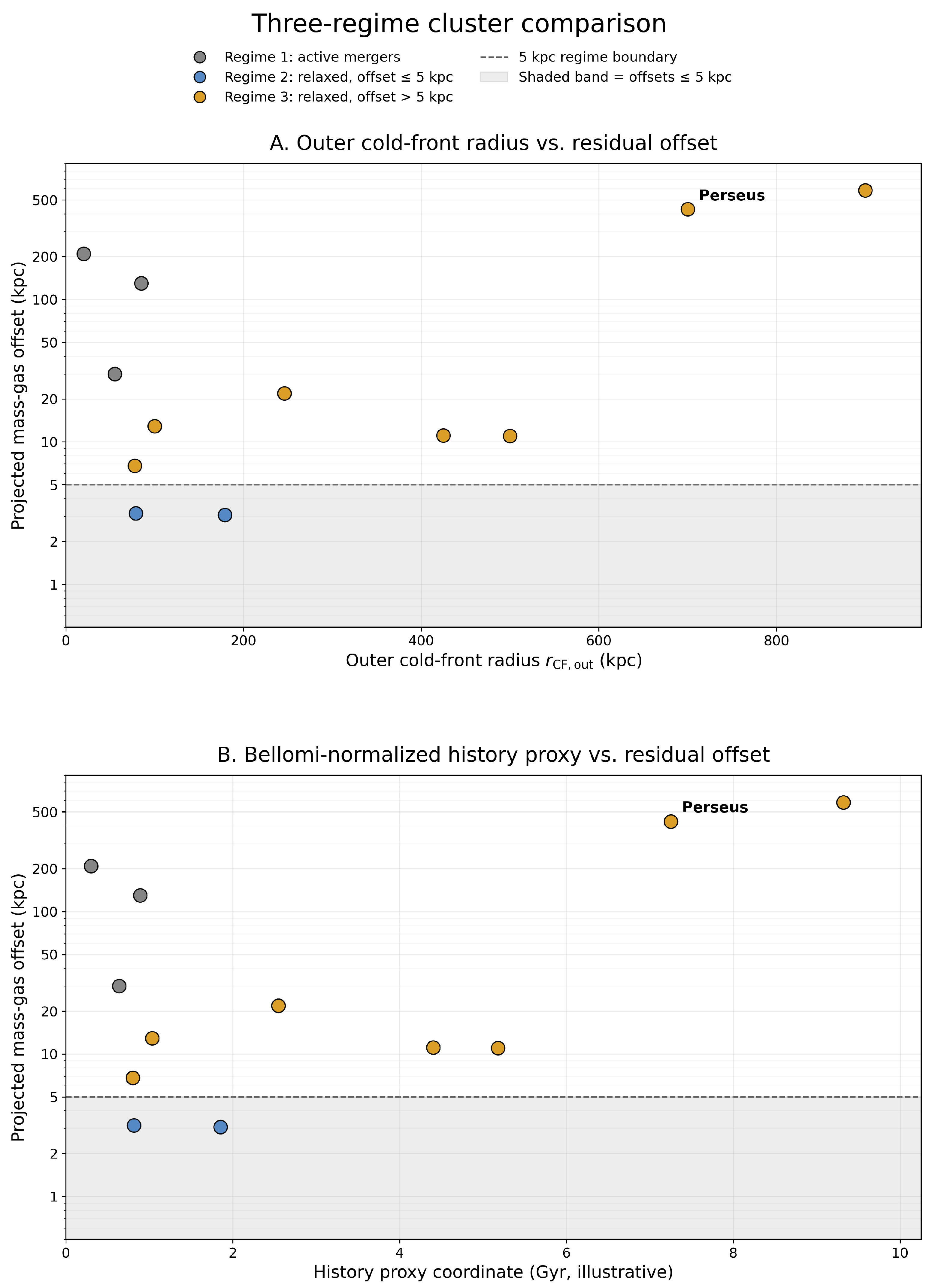
Figure 1. Three-regime pilot comparison using sourced offset values only. Panel (A) shows projected mass–gas offset versus outer cold front radius. Panel (B) shows the same offsets against the Bellomi-normalized history-proxy coordinate from Equation (9). Gray points are active merger controls: Bullet Cluster, Abell 2146-A, and Musket Ball. Blue points are relaxed/cool-core systems with sourced offsets 5 kpc: A2204 and RXJ1720.1+2638. Orange points are relaxed/cool-core systems with sourced offsets > 5 kpc: A2566, PKS0745-191, A2390, MS1455+2232, A1201, Perseus, and A2142. The 5 kpc dashed line is a visual regime boundary, not a uniform measurement uncertainty. The Regime 3 statistic is mixed-metric: it combines Shan et al. centroid offsets, BCG–X-ray peak offsets, and weak-lensing substructure separations, as detailed in the source table. Active merger controls are shown at contextual early-time positions and are not included in the relaxed cluster rank statistics.
Galaxies 14 00052 g001
Disclaimer/Publisher’s Note: The statements, opinions and data contained in all publications are solely those of the individual author(s) and contributor(s) and not of MDPI and/or the editor(s). MDPI and/or the editor(s) disclaim responsibility for any injury to people or property resulting from any ideas, methods, instructions or products referred to in the content.


