Review

Gamma Cassiopeiae: History and Mystery

by
Olga A. Tsiopa
1,*,†,
Alexander F. Kholtygin
2,† and
Petr K. Tsiopa
3,†
1
Pulkovo Observatory, 196140 St. Petersburg, Russia
2
St. Petersburg University, 198504 St. Petersburg, Russia
3
ITMO University, 197101 St. Petersburg, Russia
*
Author to whom correspondence should be addressed.
These authors contributed equally to this work.
Galaxies 2026, 14(3), 43; https://doi.org/10.3390/galaxies14030043
Submission received: 6 April 2026 / Revised: 21 April 2026 / Accepted: 27 April 2026 / Published: 8 May 2026

Abstract

The history of observations of gamma Cassiopeiae ( γ Cas) is presented, including references to Soviet-era papers that have not been translated into English. The current state of knowledge is discussed. Particular attention is paid to the period of significant changes in the system’s characteristics during the 1930s and 1940s.

1. Introduction

γ Cas stands as one of the most enigmatic and pivotal objects in stellar astrophysics. For hundreds of years, people living in the Northern Hemisphere have been observing this star in the beautiful constellation of Cassiopeiae.
γ Cas is the prototype of the Be star class. The emission lines in the spectra of Be stars form in an extended, circumstellar decretion disc. Disc formation is explained by discrete ejections of material in the equatorial region of the central star [1]. This process is driven by a combination of strong radiative pressure and low effective surface gravity at equatorial latitudes, a direct consequence of rapid rotation near the critical velocity where the outward centrifugal force balances the inward gravitational force.
Interferometric studies of γ Cas [2] confirmed that the H α emission region is a Keplerian disc. The discs of Be stars in general, and of γ Cas in particular, are highly unstable. Their sizes, masses, and densities are subject to significant variations, up to the point of nearly complete disappearance. The dramatic history of γ Cas’s disc, including episodes of its nearly total dissipation, is presented in [3]. A defining characteristic of γ Cas is its powerful X-ray emission, discovered in 1976 [4], which exceeds that of typical Be stars by two to three orders of magnitude.
This paper chronicles the observational history of γ Cas, from its early classification as a simple Be star to its modern identification as the defining member of a subclass of hard X-ray-emitting binaries. We trace the evolution of its study across the electromagnetic spectrum, highlighting key discoveries that have been instrumental in constraining the physical mechanisms driving its unique behavior. A particular focus is given to the long-debated origin of its unique hard X-ray emission, synthesizing multi-wavelength evidence to present the modern consensus that attributes this phenomenon to accretion onto a white dwarf companion mediated by a strong magnetic field. This review concludes by integrating these advancements to present a coherent narrative of how our understanding has developed.

2. Spectroscopic and Photometric Studies

Angelo Francesco Ignazio Baldassarre Secchi (1818–1878) was the first to obtain spectra of γ Cas [5] (see Figure 1). He was the director of the Collegio Romano Observatory and a Jesuit priest. One may remember his name (Secchi) alongside Schiaparelli as a discoverer of canals (Italian “canali”) on Mars’s surface. Secchi observed spectra of more than 4000 bright stars and used to be called the Father of Astrophysics.
Quantitative spectrophotometric studies advanced significantly with the work of Barber [6], who presented observations conducted at Lick Observatory in the 1940–1941 period. This study provided a comparative analysis of data from several institutions, including the University of Michigan and the Norman Lockyer Observatory. A key photometric parameter derived for γ Cas during this era was the absolute gradient ϕ , defined as follows (e.g., [7,8]):
ϕ = 0.922 × d m λ d ( 1 / λ ) ,
where m λ is the photographic stellar magnitude. This gradient was calculated using two wavelengths (4240 Å in the blue and 6510 Å in the red) selected for their freedom from significant absorption or emission features. The absolute gradient ϕ determines the color temperature of the star.
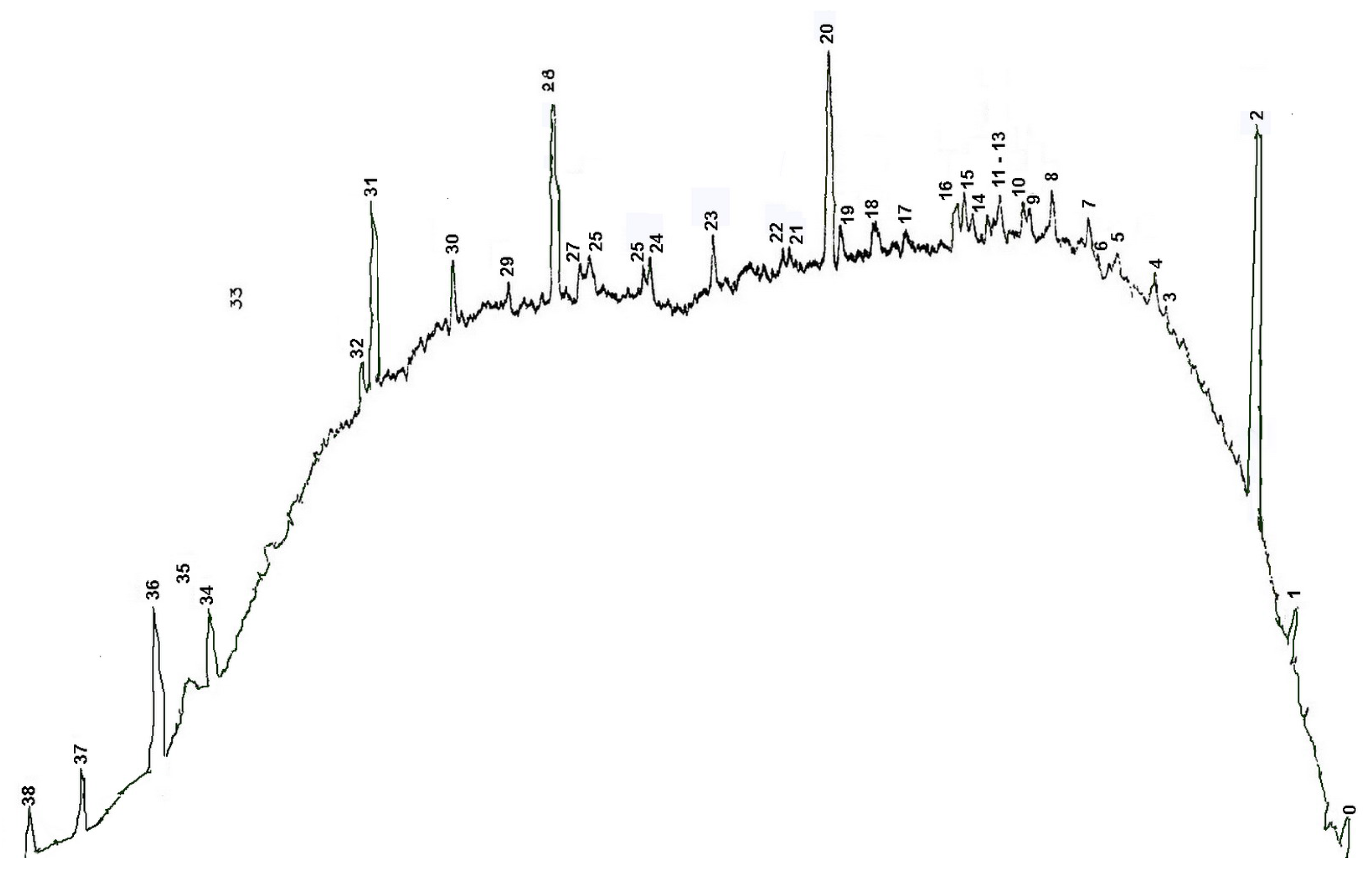
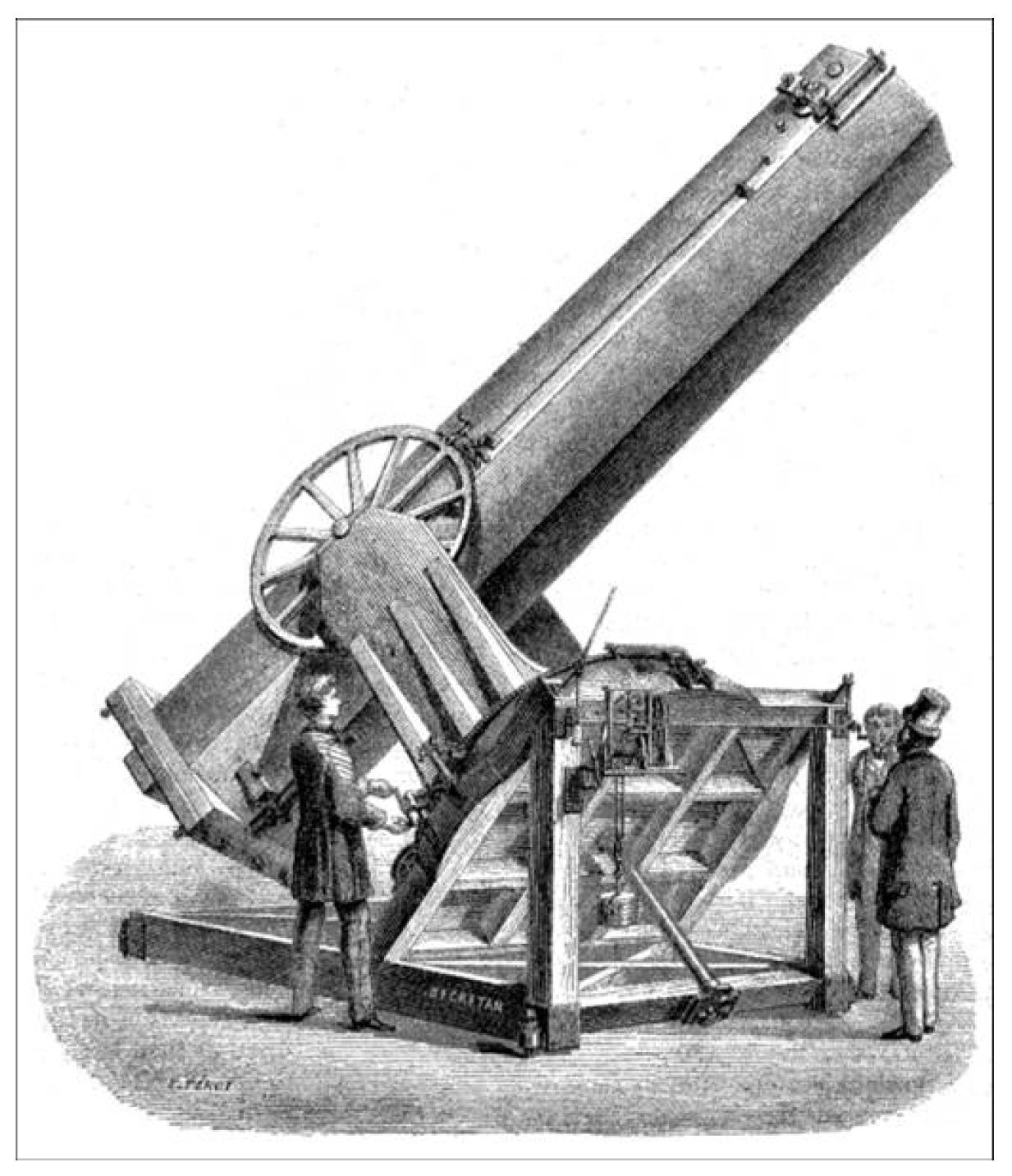
David Belorizky obtained spectra of γ Cas in the Observatoire de Marseille in 1937. He used the fabulous telescope equipped with a mirror designed by Jean Bernard Léon Foucault (https://commons.wikimedia.org/wiki/File:Lanature1873_telescope_foucault.png (accessed on 21 April 2026)) (see Figure 2). The results obtained on 8 October 1937 with the Chalonge microphotometer were published fifteen years later [9] (see Figure 3). A list of the strongest lines in the spectra is given in Table 1.
Baldwin [10] analyzed the spectroscopic variations in γ Cas during the 1936–1937 period using the spectra obtained with a one-prism spectrograph on the 37.5 inch reflector of the University of Michigan Observatory. The emission lines underwent a distinct three-stage cycle. In the first stage, emission lines of H, Fe II, and Si II are double-peaked with components approaching each other; central absorption is present but weakening; and violet components are stronger than red ones ( R / V < 1 ). In the second stage, central absorption disappears; emission lines become single and narrow; and He I shows broad, shallow absorption with central emission. H and Fe II became single by early May 1937, He I did so around 20 May, while Si II remained double-peaked until mid-June. At stage 3, emission lines become double again and separate; by late 1937, the red components are stronger than violet ones ( R / V > 1 ).
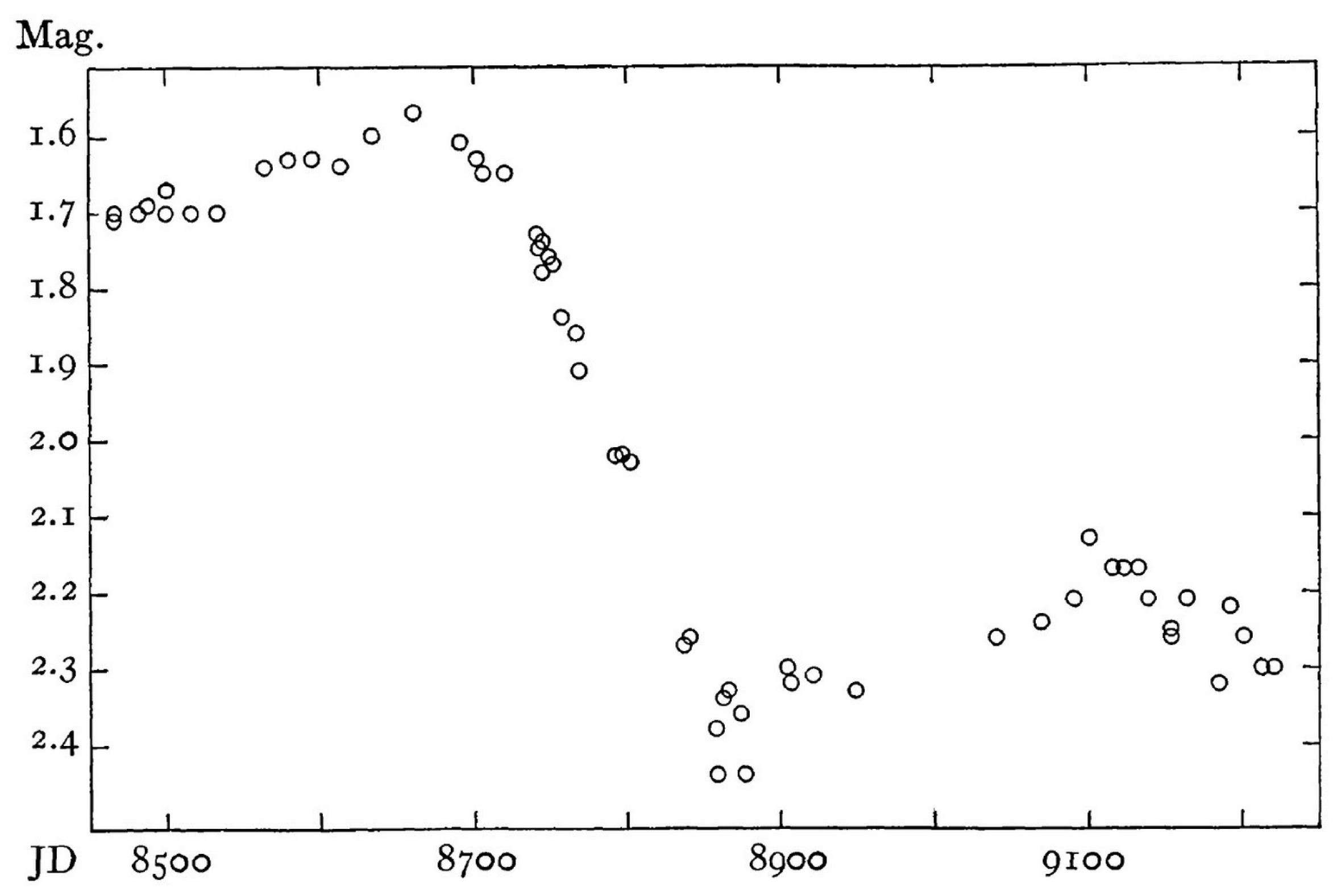
The second paper by Baldwin [11] continues an analysis of a series of 70 spectrograms obtained between 23 March 1935 and 24 October 1938 of the Michigan Observatory’s spectra. The author investigated a correlation of the spectral and photometric variations of γ Cas [12], as shown in Figure 4. The star brightened to a maximum in May 1937 at the start of the single-line phase and then rapidly declined to a minimum at its end. The color temperature dropped from ∼16,000 K in the 1926–1927 period to ∼9000 K in 1937. The star became cooler during brightening.
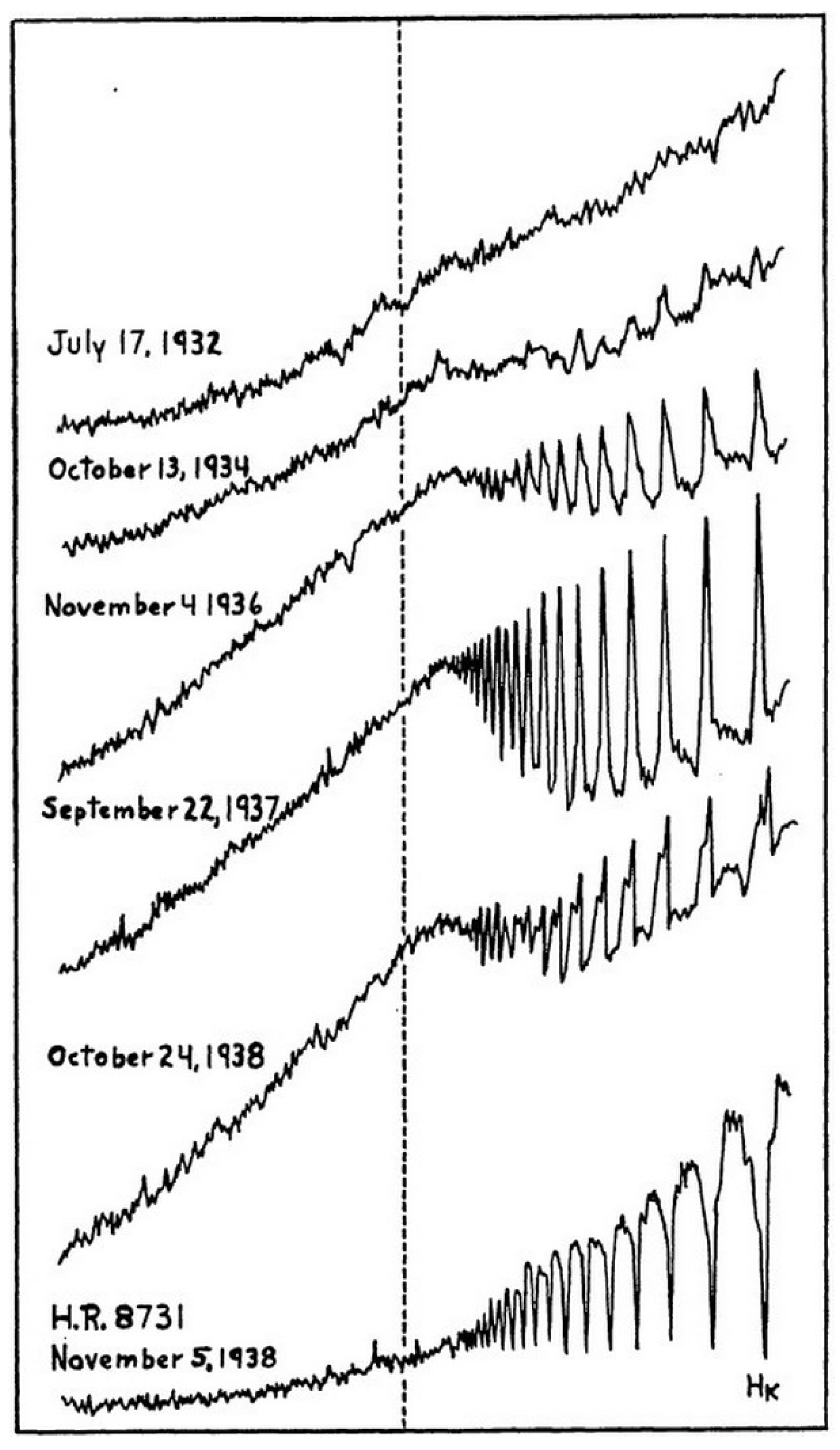
The mechanisms of the emission line formation in the spectra of γ Cas were investigated by Baldwin [13] using the spectrograms obtained with the 37.5-inch reflector of the University of Michigan Observatory. These spectrograms are partly presented in Figure 5. The author identified ionization followed by recombination as the most likely mechanism for strong emission features.
Heard [14,15] documented the spectral variations of γ Cas in the 1936–1938 period based on spectrograms taken at the David Dunlap Observatory.
Finally, the dramatic spectral and photometric changes of γ Cas between 1929 and 1942 were chronicled by Edwards [16] based on observations from the Norman Lockyer Observatory.
Detailed observations of Balmer and Helium lines were held in Crimea first at the Simeiz observatory, which is situated at the beautiful “Koshka (Cat)” mountain, and later at the Crimean observatory situated in the middle of the Crimea peninsula.
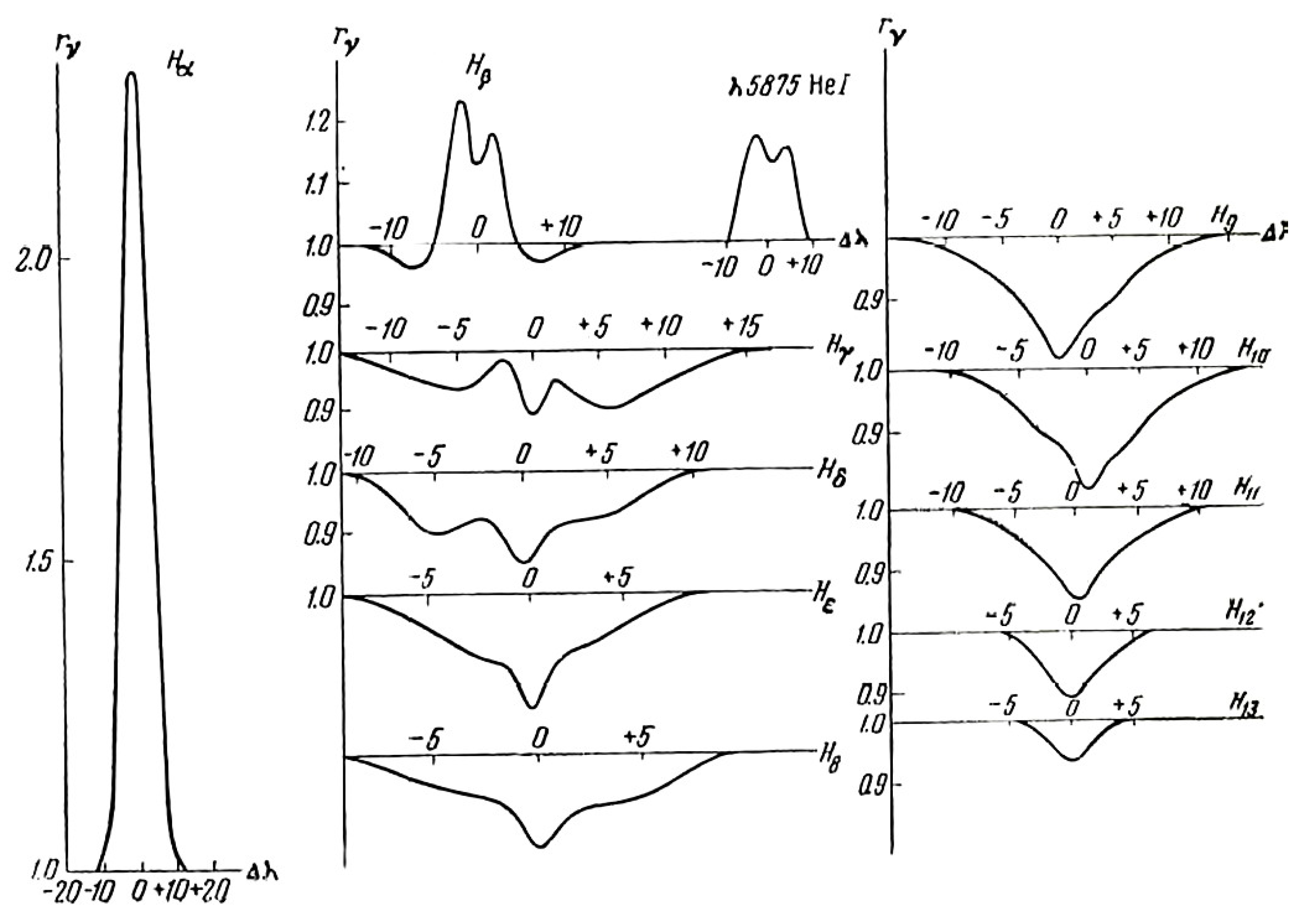
The data were obtained with the 1.22 m reflector of the Crimean observatory in the 1940–1941 and 1952–1956 periods. The variability in line profiles in the spectra of γ Cas was investigated by an academician of the Soviet Union Academy of Sciences, A.A. Boyarchuk, and his colleagues (see [17] and the references therein). Examples of Balmer and He I line profiles are presented in Figure 6. The spectrum of γ Cas obtained by Gase [18] at the Simeiz Observatory in 1941 differs significantly from the star’s spectra in 1940. Weak emission is observed only in the H α line profile, while the other lines in the spectrum are detected only in absorption.
A detailed analysis of ultraviolet (UV) and visual spectra of γ Cas, obtained via rocket and Orbiting Astronomical Observatory (OAO) observations, is presented by Bohlin [19].

3. Models

The first realistic model for the line formation in Be stars was proposed by Struve [20]. He assumed that all Be stars rotate nearly to the critical velocity and due to the rotational instabilities, the matter is ejected at the equator. Thus, a flattened envelope around the star (similar to the Saturn’s rings) is formed.
Baldwin [21] analyzed the spectral and photometric changes of γ Cas from 1911 to 1941, including the star’s rapid increase in brightness to an apparent magnitude of up to 1.57 in 1937. The author interpreted these brightness changes as a result of the star’s radius increasing from 8.3 to 18 solar radii. He pointed out that while the spectrum of the star generally matched black-body radiation, analysis of its strong hydrogen emission lines revealed a major excess of ultraviolet radiation, contradicting a simple black-body model.
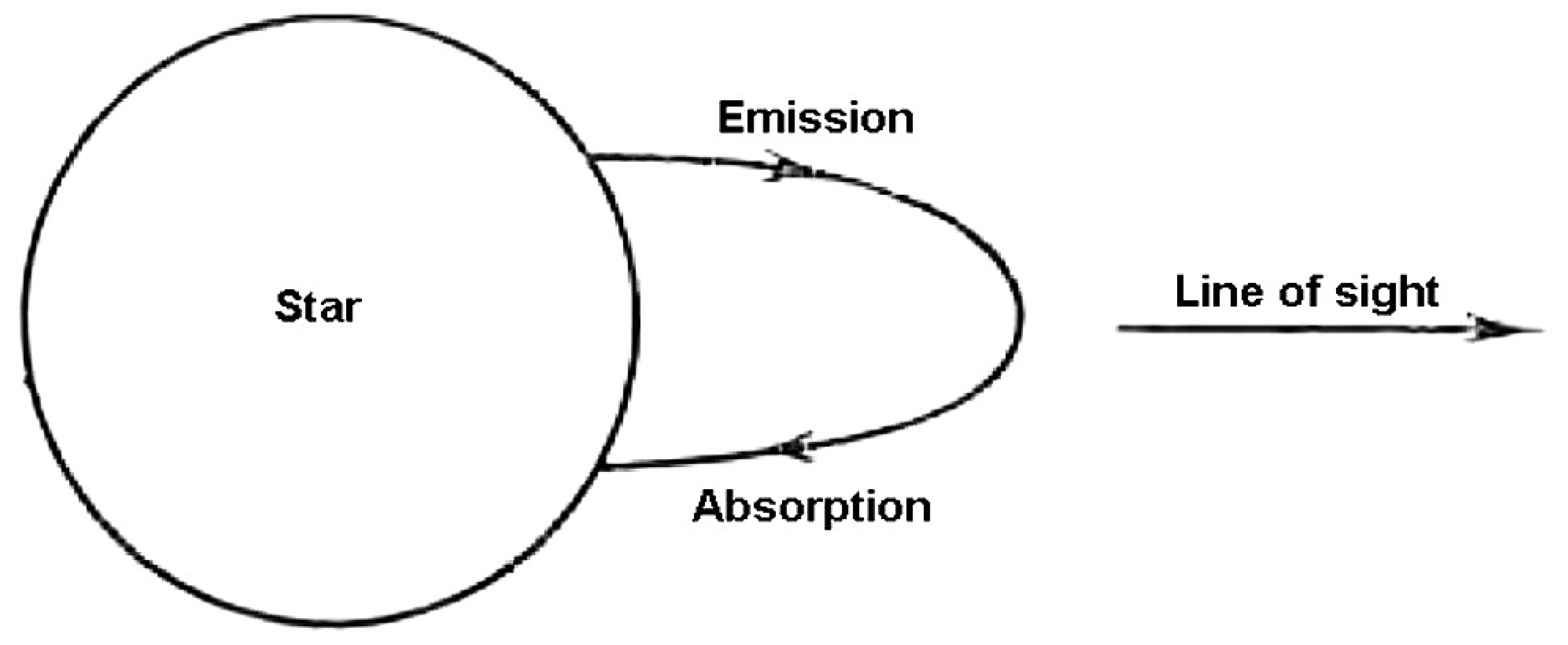
The authors of [7] interpreted the 1941 spectral observations of γ Cas as evidence of discrete ejections of the stellar material. The model for the formation of the line profiles proposed in [7] is illustrated in Figure 7. According to this model, the ejected hot material radiates and cools until it reaches a state of equilibrium with the star’s radiation. Once cooled, this material falls back onto the stellar surface.
The emission components of a spectral line profile, which form in the ejected material, are blue-shifted. In contrast, the absorption components, arising from the absorption of photospheric radiation in the infalling gas clouds, are red-shifted. Both the emission and absorption components are superimposed onto a broad photospheric absorption line, thereby creating the complete, observed line profile.
The first photometric observations of γ Cas were made in the 19th century. The light curves can be found in the following references: [23] (1844–1898); [24] (1915–1980); [25] (1936–1941); [26] (1967–1990).
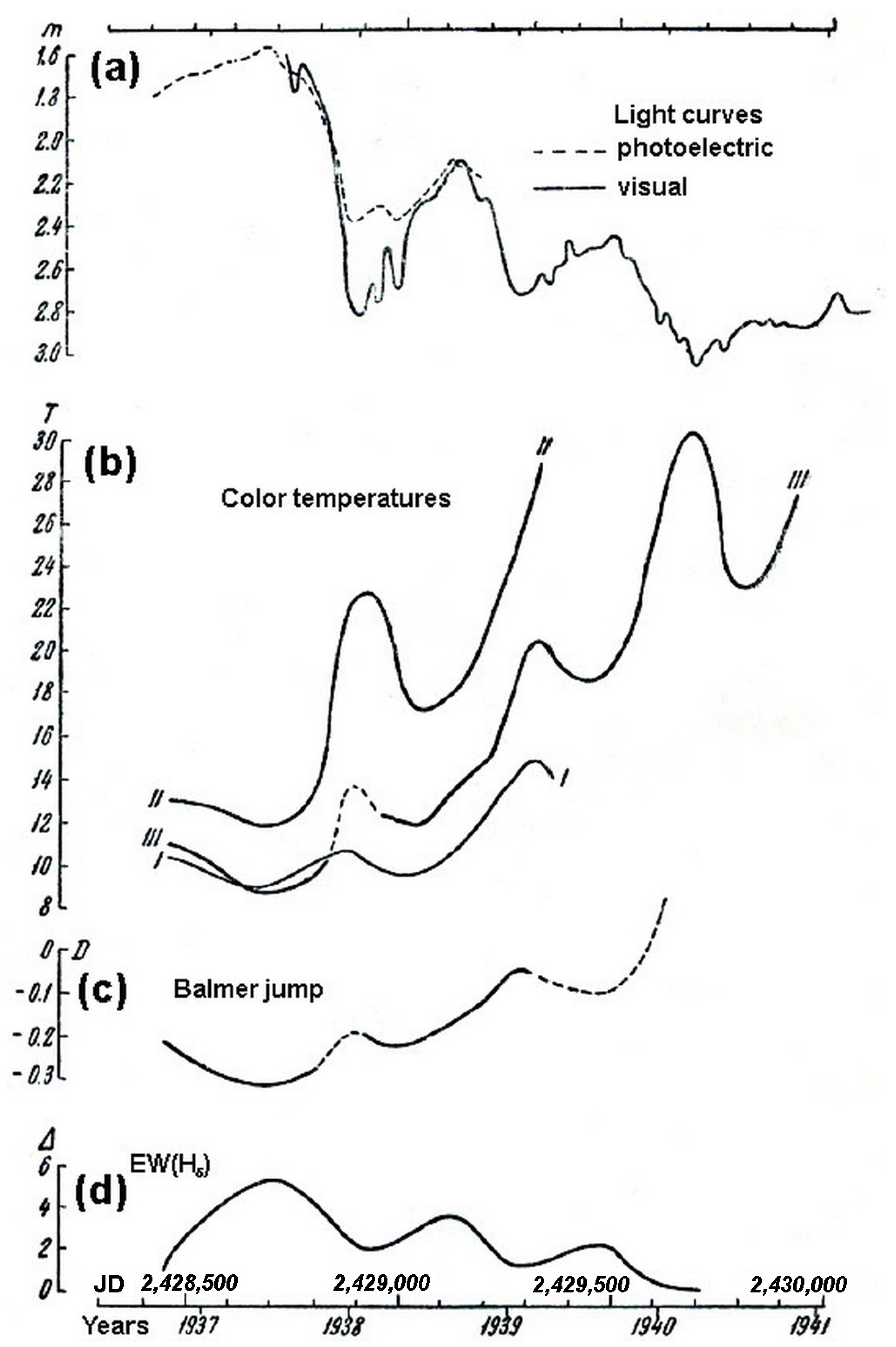
As γ Cas is a very popular object, many other references could also be mentioned. For example, a paper by a professor of Leningrad State University, V.G. Gorbatskii [25], published in 1949 in Russian only, should be mentioned. The brightness, the color temperatures, the Balmer jump and EW(H δ ) variations during the dramatic events in the 1936–1939 period taken from this paper are presented in Figure 8a–d. The behavior of the line profile variability was described by the model proposed by V.G. Gorbatskii in 1975 [27]. According to this model, the envelope is composed of two hundred separate clouds revolving around the star.
The models of Boyarchuk and Gorbatskii discussed above are now primarily of historical interest. Nevertheless, the concepts introduced in these models have seen further development. The assumption in the model of discrete mass-loss episodes in Be stars [7] has observational support [1].
Similarly, the idea proposed by [27] concerning the inhomogeneity of Be star envelopes has also been advanced. It is now considered well-established that the radiatively driven winds of OB and WR stars are highly clumped [28]. The expanding envelopes of supernovae are also known to be inhomogeneous [29].
According to our current understanding, γ Cas, like other Be stars, is a rapidly rotating star surrounded by a viscous, Keplerian decretion disc [30,31]. However, many details of its disc’s formation and evolution are still not fully understood.

4. Mystery

Despite more than two centuries of study on this topic, the nature of γ Cas is enigmatic in many respects. The mysterious events that occurred in 1936 and 1940 causing the star’s visual magnitude to rise to 1.5 and subsequently fall to nearly 3.0 (see Figure 8 and Figure 1 in the paper by Doazan et al. [24]) remain unexplained. Apart from its rotational and orbital periods, the variability of γ Cas exhibits irregularity on all observed timescales, from hours to years.
A key enigmatic problem in our understanding of the nature of the star is the interpretation of the historically anomalous spectroscopic episodes of γ Cas in the 1932–1942 period. Hummel [32] proposed a two-phase model including the disc turning between a shell stage and a subsequent disc stage. The rare and extreme “spectacular variations” in the emission line spectra of γ Cas and 59 Cygni with similar spectral changes are caused by a temporarily tilted circumstellar disc.
Instead of a disc in the star’s equatorial plane, the authors suggest a Keplerian disc that is tilted and whose nodal line precesses. Due to precession, the apparent inclination of the disc to the line of sight changes cyclically. This creates a sequence of changing shell phases (disc seen edge-on, broad lines) and single-peak phases (disc seen pole-on, narrow lines), while the star’s own rotation axis and projected rotational velocity v sin i remain constant. The model successfully reproduces the observed variations in the line width, profile shapes, and the V/R ratio changes, ruling out changes in disc size or scale height. As a possible cause for the tilt changes, the author suggests a temporary external perturbation, supposedly a companion star in a non-coplanar orbit.
Baade et al. [3] used Hummel’s hypothesis to propose their own explanation of the episodes in the 1932–1942 period in the disc turning paradigm. The authors insist that Struve’s law, stating that discs are equatorial, can be temporarily violated. In their opinion, the best explanation for these events is an assumption that the entire disc plane rotates in space, driven by gravitational interaction with a low-mass companion. During the period mentioned, the R/V emission-peak separations varied by a factor of two, implying that the disc aspect angle changed dramatically. Authors do not provide a precession period for γ Cas. They argue that its historical variability is better explained by a large-amplitude tilting of the disc plane, possibly driven by binary interactions, which is not characterized by a simple, persistent precession period.
Single-peak stages of γ Cas with single-peaked emission lines correspond to a disc turned. Shell stages with narrow absorption lines correspond to a disc viewed edge-on. The disc likely rotates in such a way that the line of sight does not pass through its optically dense regions. Since the disc is quite thin in the direction perpendicular to its plane, the rotation angle is likely not very large.
The authors supposed that the anomalous events in the 1932–1942 period may be explained by von Zeipel–Lidov–Kozai oscillations [33] or resonant tilt instabilities. The proposed explanation faces open questions: Why do such events occur so rarely? What is the role of the initial misalignment between disc and orbit? And is it possible to detect such events in progress with modern interferometry and/or polarimetry?
Current models suggest γ Cas is a hierarchical triple system [34,35], comprising a close Aa and Ab binary and a distant Ac companion. The parameters for these components are summarized in Table 2. However, the situation with the third component is quite uncertain to date.
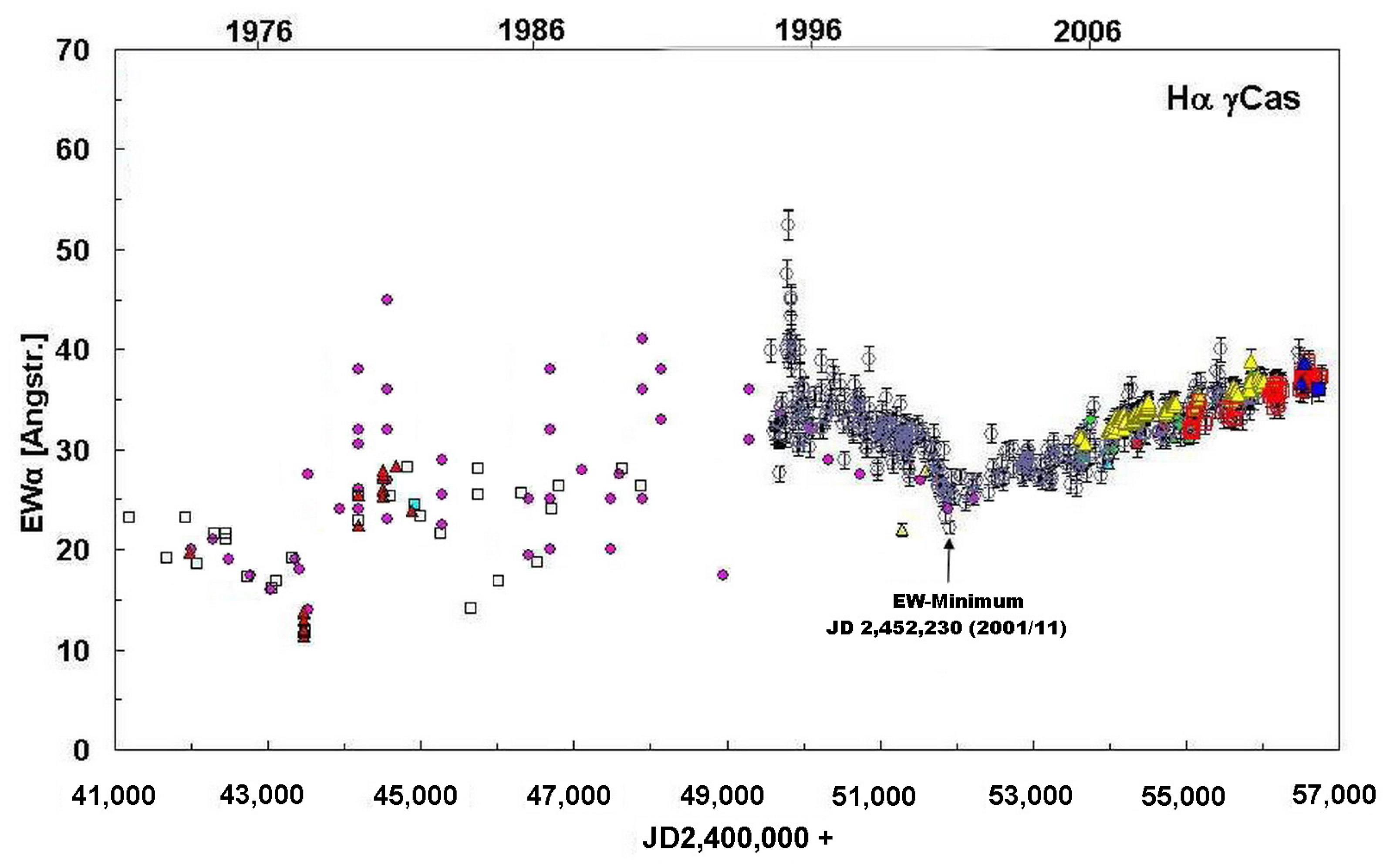
Long-term observational data are crucial for refining the parameters of γ Cas. As an example, the results of long-term H α equivalent width monitoring are presented in Figure 9.
γ Cas is a prototype of the gamma Cas type variables. The γ Cas variables exhibit irregular optical brightness variations with periods on the order of decades and amplitudes of approximately one magnitude. Over 1500 known variables of this type are listed in the AAVSO Variable Star Index (https://heasarc.gsfc.nasa.gov/w3browse/all/aavsovsx.html (accessed on 21 April 2026)). In the General Catalogue of Variable Stars [45] (http://www.sai.msu.su/gcvs/gcvs/ (accessed on 21 April 2026)), these stars are designated with the type ‘GCAS’.
Later when the strong X-ray emission was discovered from gamma Cas and some other stars of this type, the subclass of gamma Cas analogs was distinguished [41]. γ Cas analogs constitute a small group (26–28 objects) of Be stars of early subtypes [46]. They are distinguished by anomalously hard and intense X-ray emission. There are two components of X-ray emission: soft and hard. The soft one (0.2–2 keV) may be generated in a decretion disc or at the surface of the Be star itself. The hard X-ray component (>4 keV) is more variable and is connected with an accretion on the white dwarf. The details of the accretion processes and Fe K α line formation are discussed by Rauw [47,48].
The role of the mysterious third component in the behavior of γ Cas may also be very important, especially because we still do not know the eccentricity of its orbit.
The origin of the X-ray emission from γ Cas analogs remains enigmatic [49]. To date, three main hypotheses exist to explain the powerful X-ray emission from both γ Cas itself and its analogs.
The first hypothesis involves accretion onto a compact companion in a binary system: either a Be star with a neutron star (Be + NS) [50] or with a white dwarf (Be + WD) [51]. However, the Be + NS scenario struggles to account for the observed intensities of the fluorescent Fe K α emission lines, which are predicted to be too low [47]. A problem with the Be + WD scenario is that it requires a mass-loss rate from the Be star that is higher than what is typically observed for γ Cas analogs [52].
A further challenge for accretion-based models is the flaring nature of the X-ray light curve [53]. To explain this variability, a scenario involving the interaction of local magnetic fields with the decretion disc has been proposed [54]. In this model, the X-ray emission consists of two components: a slowly varying baseline flux corresponding to a minimal level of activity, and superimposed rapid flares with durations from 10 s to 10 min [55]. While this scenario qualitatively explains the pattern of the light curve, detailed quantitative calculations of the expected X-ray flux are still lacking.
Langer et al. [56] suggested that in Be + sdO/sdB binary systems, the X-ray emission of γ Cas analogs could arise from the collision of the subdwarf companion’s wind with the Be star’s disc. Yet, the X-ray luminosity generated by this mechanism is predicted to be several orders of magnitude lower than the typical luminosity of γ Cas [52]. Furthermore, observations of γ Cas with the CHARA Array interferometer found no evidence for an O or B subdwarf companion [57].
Consequently, the authors of [57] conclude that the only viable candidate for the companion is a white dwarf. Gies et al. [58] further postulated that γ Cas itself and all its analogs are Be + WD binary systems. However, the role of the hypothesized third component in the γ Cas analogs in producing its X-ray emission remains unclear.

5. Conclusions

The review of the γ Cas research presented in this paper demonstrates that the ideas expressed many years ago remain largely relevant. Their use in new studies of the star helps to understand its nature. γ Cas continues to serve as a cosmic laboratory for studying the physics of massive X-ray binary and multiple systems.
The use of long-baseline interferometry and the study of the spectral and photometric variability of γ Cas at high temporal resolution will help answer the question of the mechanisms of formation, replenishment, evolution, and dissipation of the circumstellar decretion discs and the influence of the stellar companions in binary and multiple Be star systems on these processes. In summary, 159 years after Secchi’s initial observations, the nature of γ Cas remains mysterious.

Funding

This research was funded by RSF grant number 23-22-0090.

Institutional Review Board Statement

Not applicable.

Informed Consent Statement

Not applicable.

Data Availability Statement

Most data and codes are publicly available. Spectra are available upon request.

Acknowledgments

Our gratitude goes to the referees for remarks that helped to improve this work. We are indebted to Anatoly Miroshnichenko for sending us the papers we did not have any access and for many suggestions that improved the manuscript.

Conflicts of Interest

The authors declare no conflicts of interest. The funders had no role in the design of the study; in the collection, analyses, or interpretation of the data; in the writing of the manuscript; or in the decision to publish the results.

References

  1. Labadie-Bartz, J.; Chojnowski, S.D.; Whelan, D.G.; Pepper, J.; McSwain, M.V.; Borges Fernandes, M.; Wisniewski, J.P.; Stringfellow, G.S.; Carciofi, A.C.; Siverd, R.J.; et al. Outbursts and Disk Variability in Be Stars. Astron. J. 2018, 155, 53. [Google Scholar] [CrossRef]
  2. Mourard, D.; Bosc, I.; Labeyrie, A.; Koechlin, L.; Saha, S. The rotating envelope of the hot star gamma Cassiopeiae resolved by optical interferometry. Nature 1989, 342, 520–522. [Google Scholar] [CrossRef]
  3. Baade, D.; Labadie-Bartz, J.; Rivinius, T.; Carciofi, A.C. The historical active episodes of the disks around γ Cassiopeiae (B0.5 IVe) and 59 Cygni (B1 IVe) revisited. Astron. Astrophys. 2023, 678, A47. [Google Scholar] [CrossRef]
  4. Jernigan, J.G. Gamma Cassiopeiae. IAU Circ. 1976, 2900, 2. [Google Scholar]
  5. Secchi, A. Schreiben des Herrn Prof. Secchi, Directors der Sternwarte des Collegio Romano, an den Herausgeber. Astron. Nachrichten 1866, 68, 63. [Google Scholar] [CrossRef]
  6. Barber, D.R. Spectrophotometric observations of γ cassiopeiae. Publ. Astron. Soc. Pac. 1946, 58, 363–366. [Google Scholar] [CrossRef][Green Version]
  7. Boyarchuk, A.A. Spectrophotometric observations of gamma Cassiopeia. Izv. Ordena Tr. Krasn. Znam. Krymskoj Astrofiz. Obs. 1956, 16, 143. [Google Scholar]
  8. Greaves, W.M.H. The Photometry of the Continuous Spectrum. Mon. Not. R. Astron. Soc. 1948, 108, 131. [Google Scholar] [CrossRef][Green Version]
  9. Belorizky, D. Sur le Spectre d’émission de gamma Cassiopeiae. J. Obs. 1952, 35, 13. [Google Scholar]
  10. Baldwin, R.B. The Spectrum of γ Cassiopeiae in the Photographic Region. Astrophys. J. 1938, 87, 573. [Google Scholar] [CrossRef]
  11. Baldwin, R.B. The Spectrum of γ Cassiopeiae in the Photographic Region. Astrophys. J. 1939, 89, 255. [Google Scholar] [CrossRef]
  12. Huffer, C.M. Photoelectric Measures of γ Cassiopeiae. Astrophys. J. 1939, 89, 139. [Google Scholar] [CrossRef]
  13. Baldwin, R.B. Note on the Origin of Emission in γ Cassiopeiae. Astrophys. J. 1939, 90, 204. [Google Scholar] [CrossRef]
  14. Heard, J.F. Gamma Cassiopeiae. J. R. Astron. Soc. Can. 1937, 31, 60. [Google Scholar]
  15. Heard, J.F. The spectrum of gamma Cassiopeiae. Commun. David Dunlap Obs. 1938, 2, 353. [Google Scholar]
  16. Edwards, D.L. Gamma Cassiopeiae. Vistas Astron. 1956, 2, 1470–1476. [Google Scholar] [CrossRef]
  17. Boyarchuk, A.A. Spectrophotometric observations of gamma Cassiopeiae in 1956. Izv. Ordena Tr. Krasn. Znam. Krymskoj Astrofiz. Obs. 1958, 18, 55. [Google Scholar]
  18. Gase, V.F. The spectrum of gamma Cassiopeia in 1940 and 1941. Izv. Ordena Tr. Krasn. Znam. Krymskoj Astrofiz. Obs. 1947, 1, 59. [Google Scholar]
  19. Bohlin, R.C. Ultraviolet and Visual Spectra of Gamma Cassiopeiae. Astrophys. J. 1970, 162, 571. [Google Scholar] [CrossRef]
  20. Struve, O. On the Origin of Bright Lines in Spectra of Stars of Class B. Astrophys. J. 1931, 73, 94. [Google Scholar] [CrossRef]
  21. Baldwin, R.B. The Story of Gamma Cassiopeiae. Sky Tel. 1942, 1, 5. [Google Scholar]
  22. Boyarchuk, A.A. Gamma Cassiopeiae in 1941. Izv. Ordena Tr. Krasn. Znam. Krymskoj Astrofiz. Obs. 1958, 20, 118. [Google Scholar]
  23. Edwards, D.L. Changes in γ Cassiopeiae during the past 100 years. Mon. Not. R. Astron. Soc. 1944, 104, 283–291. [Google Scholar] [CrossRef][Green Version]
  24. Doazan, V.; Franco, M.; Rusconi, L.; Sedmak, G.; Stalio, R. The long-term variations of γ Cas in the visual. Astron. Astrophys. 1983, 128, 171–180. [Google Scholar]
  25. Gorbatskii, V.G. Astron. Zhurnal 1949, 5, 309. [Google Scholar]
  26. Telting, J.H.; Waters, L.B.F.M.; Persi, P.; Dunlop, S.R. Long-term changes in emission line and continuum spectrum of the Be star Gamma Cassopeiae: H-beta V/R and IR continuum flux variations. Astron. Astrophys. 1993, 270, 355–368. [Google Scholar]
  27. Gorbatskii, V.G. Structure of the envelopes of Be stars. Sov. Astron. Lett. 1975, 1, 62. [Google Scholar]
  28. Antokhin, I.I.; Kholtygin, A.F.; Cherepashchuk, A.M. The ionization state and possible ragged structured of the atmospheres of Wolf-Rayet stars. Astron. Zhurnal 1988, 65, 558–570. [Google Scholar]
  29. Chugai, N.N.; Utrobin, V.P. Disparity between H α and H β in SN 2008 in: Inhomogeneous external layers of type IIP supernovae? Astron. Lett. 2014, 40, 111–119. [Google Scholar] [CrossRef]
  30. Rivinius, T.; Carciofi, A.C.; Martayan, C. Classical Be stars. Rapidly rotating B stars with viscous Keplerian decretion disks. Astron. Astrophys. Rev. 2013, 21, 69. [Google Scholar] [CrossRef]
  31. Vieira, R.G.; Carciofi, A.C.; Bjorkman, J.E.; Rivinius, T.; Baade, D.; Rímulo, L.R. The life cycles of Be viscous decretion discs: Time-dependent modelling of infrared continuum observations. Mon. Not. R. Astron. Soc. 2017, 464, 3071–3089. [Google Scholar] [CrossRef]
  32. Hummel, W. On the spectacular variations of Be stars. Evidence for a temporarily tilted circumstellar disk. Astron. Astrophys. 1998, 330, 243–252. [Google Scholar]
  33. Ito, T.; Ohtsuka, K. The Lidov-Kozai Oscillation and Hugo von Zeipel. Monogr. Environ. Earth Planets 2019, 7, 1–113. [Google Scholar] [CrossRef]
  34. Mamajek, E. Gamma Cassiopeiae and HR 266: A Massive Septuplet Illuminating the IC 59 and IC 63 Nebulae at d = 168 pc. J. Double Star Obs. 2017, 13, 264–267. [Google Scholar]
  35. Tokovinin, A.A. MSC—A catalogue of physical multiple stars. Astron. Astrophys. Suppl. Ser. 1997, 124, 75–84. [Google Scholar] [CrossRef]
  36. Henry, G.W.; Smith, M.A. Rotational and Cyclical Variability in γ Cassiopeiae. II. Fifteen Seasons. Astrophys. J. 2012, 760, 10. [Google Scholar] [CrossRef]
  37. Nemravová, J.; Harmanec, P.; Koubský, P.; Miroshnichenko, A.; Yang, S.; Šlechta, M.; Buil, C.; Korčáková, D.; Votruba, V. Properties and nature of Be stars. 29. Orbital and long-term spectral variations of γ Cassiopeiae. Astron. Astrophys. 2012, 537, A59. [Google Scholar] [CrossRef]
  38. Tokovinin, A. Inner and Outer Orbits in 13 Resolved Hierarchical Stellar Systems. Astron. J. 2021, 161, 144. [Google Scholar] [CrossRef]
  39. Gontcharov, G.A.; Andronova, A.A.; Titov, O.A. New astrometric binaries among HIPPARCOS stars. Astron. Astrophys. 2000, 355, 1164–1167. [Google Scholar]
  40. Nazé, Y.; Rauw, G.; Czesla, S.; Smith, M.A.; Robrade, J. Velocity monitoring of γ Cas stars reveals their binarity status. Mon. Not. R. Astron. Soc. 2022, 510, 2286–2304. [Google Scholar] [CrossRef]
  41. Smith, M.A.; Lopes de Oliveira, R.; Motch, C. A Census of the Class of X-ray Active γ Cas Stars. In Proceedings of the Bright Emissaries: Be Stars as Messengers of Star-Disk Physics; Sigut, T.A.A., Jones, C.E., Eds.; Astronomical Society of the Pacific: San Francisco, CA, USA, 2016; Volume 506, p. 299. [Google Scholar]
  42. Sigut, T.A.A.; Jones, C.E. The Thermal Structure of the Circumstellar Disk Surrounding the Classical Be Star γ Cassiopeiae. Astrophys. J. 2007, 668, 481–491. [Google Scholar] [CrossRef]
  43. Zorec, J.; Frémat, Y.; Cidale, L. On the evolutionary status of Be stars. I. Field Be stars near the Sun. Astron. Astrophys. 2005, 441, 235–248. [Google Scholar] [CrossRef]
  44. Pollmann, E.; Vollmann, W.; Henry, G.W. Long-term monitoring of Halpha emission strength and photometric V magnitude of gamma Cas. Inf. Bull. Var. Stars 2014, 6109, 1. [Google Scholar]
  45. Samus, N.N.; Kazarovets, E.V.; Durlevich, O.V.; Kireeva, N.N.; Pastukhova, E.N. General catalogue of variable stars: Version GCVS 5.1. Astron. Rep. 2017, 61, 80–88. [Google Scholar] [CrossRef]
  46. Kholtygin, A.F.; Ryspaeva, E.B.; Moiseeva, A.; Burlak, M.; Yakunin, I.; Tsiopa, O. Stars like Gamma Cassiopeia: Close to us and Enigmatic. In Proceedings of the Multifaceted Universe: Theory and Observations-2000, Belgrade, Serbia, 28 August–1 September 2022; p. 44. [Google Scholar]
  47. Rauw, G. Fluorescent Fe K line emission of γ Cas stars. I. Do γ Cas stars host propelling neutron stars? Astron. Astrophys. 2024, 682, A179. [Google Scholar] [CrossRef]
  48. Rauw, G. Fluorescent Fe K line emission of γ Cas stars: II. Predictions for magnetic interactions and white-dwarf accretion scenarios. Astron. Astrophys. 2025, 703, A188. [Google Scholar] [CrossRef]
  49. Nazé, Y. Going Forward to Unveil the Nature of γ Cas Analogs. Galaxies 2025, 13, 8. [Google Scholar] [CrossRef]
  50. Postnov, K.; Oskinova, L.; Torrejón, J.M. A propelling neutron star in the enigmatic Be-star γ Cassiopeia. Mon. Not. R. Astron. Soc. Lett. 2017, 465, L119–L123. [Google Scholar] [CrossRef]
  51. Murakami, T.; Koyama, K.; Inoue, H.; Agrawal, P.C. X-Ray Spectrum from Gamma Cassiopeiae. Astrophys. J. Lett. 1986, 310, L31. [Google Scholar] [CrossRef]
  52. Rauw, G. X-Ray Emission of Massive Stars and Their Winds. In Handbook of X-Ray and Gamma-Ray Astrophysics; Bambi, C., Sangangelo, A., Eds.; Springer Nature: Singapore, 2022; p. 108. [Google Scholar] [CrossRef]
  53. Parmar, A.N.; Israel, G.L.; Stella, L.; White, N.E. The X-ray time variability and spectrum of gamma Cassiopeiae (X 0053+604). Astron. Astrophys. 1993, 275, 227–235. [Google Scholar]
  54. Smith, M.A.; Lopes de Oliveira, R.; Motch, C. The X-ray emission of the γ Cassiopeiae stars. Adv. Space Res. 2016, 58, 782–808. [Google Scholar] [CrossRef]
  55. Smith, M.A.; Robinson, R.D.; Corbet, R.H.D. A Multiwavelength Campaign on γ Cassiopeiae. I. The Case for Surface X-Ray Flaring. Astrophys. J. 1998, 503, 877–893. [Google Scholar] [CrossRef]
  56. Langer, N.; Baade, D.; Bodensteiner, J.; Greiner, J.; Rivinius, T.; Martayan, C.; Borre, C.C. γ Cas stars: Normal Be stars with discs impacted by the wind of a helium-star companion? Astron. Astrophys. 2020, 633, A40. [Google Scholar] [CrossRef]
  57. Klement, R.; Rivinius, T.; Gies, D.R.; Baade, D.; Mérand, A.; Monnier, J.D.; Schaefer, G.H.; Lanthermann, C.; Anugu, N.; Kraus, S.; et al. The CHARA Array Interferometric Program on the Multiplicity of Classical Be Stars: New Detections and Orbits of Stripped Subdwarf Companions. Astrophys. J. 2024, 962, 70. [Google Scholar] [CrossRef]
  58. Gies, D.R.; Wang, L.; Klement, R. Gamma Cas Stars as Be+White Dwarf Binary Systems. Astrophys. J. Lett. 2023, 942, L6. [Google Scholar] [CrossRef]
Figure 1. Angelo Francesco Ignazio Baldassarre Secchi.
Galaxies 14 00043 g001
Figure 2. J.B.L. Foucault operated his 80 cm silver-on-glass reflector at Marseille Observatory.
Galaxies 14 00043 g002
Figure 3. A spectrum of γ Cas obtained by Belorizky [9] on 8–9 October 1937. The axis of abscissa is the wavelength from 3686 to 5016 Å. The axis of ordinate is a value of m λ in relative units.
Galaxies 14 00043 g003
Figure 4. Photoelectric light curve of γ Cas. Adapted from [12].
Galaxies 14 00043 g004
Figure 5. Microphotometer tracings of the spectrum of γ Cas in the wavelength range 3545 –3750 Å. The spectrum of the B4 IIIpe star, HR 8731, is shown for comparison. Adapted from [13].
Galaxies 14 00043 g005
Figure 6. Profiles of Balmer lines and the He I 5876 line obtained with the 122 cm telescope of the Crimean observatory at a dispersion of 23.4 Å/mm in the region of the H γ line.
Galaxies 14 00043 g006
Figure 7. Circulation of matter in the γ Cas envelope by Boyarchuk [22].
Galaxies 14 00043 g007
Figure 8. Changes in the observed characteristics of γ Cas. The behavior of the color temperature in the intervals of I— λ = 3100 Å–3600 Å, II— λ = 3650 Å–4600 Å, and III— λ = 4300 Å–4600 Å. Adapted from [25].
Galaxies 14 00043 g008
Figure 9. Long-term monitoring of the H α equivalent width in γ Cas from August 1971 to December 2014. Adapted from [44].
Galaxies 14 00043 g009
Table 1. Line identification in the spectra of γ Cas in Figure 3.
nLinenLinenLine
2H β 20H γ 31H8
4He I 4713.1325Fe II 4173.435Si II 3856.0
7Fe II 4629.328H δ 36H9
8Fe II 4583.830He I 4026.237H10
16He I 4471.531H ε 38H11
Table 2. Parameters of the γ Cas system.
ComponentAaAbRef.AcRef.
P rot , d 1.215811 ± 0.000030 [36]
P orb , d 203.65 ± 0.13 [37] 60 year[38]
a, au 1.6 [37]≥46[39]
Mass, M 13 0.98 [40] 8.33 [35,39]
Radius, R 10[40]
T eff , kk28[41]
L, L 3.4 × 10 4 [42]
V sin i , km s 1 432[43]
i   ( ° )45[40]
Disclaimer/Publisher’s Note: The statements, opinions and data contained in all publications are solely those of the individual author(s) and contributor(s) and not of MDPI and/or the editor(s). MDPI and/or the editor(s) disclaim responsibility for any injury to people or property resulting from any ideas, methods, instructions or products referred to in the content.