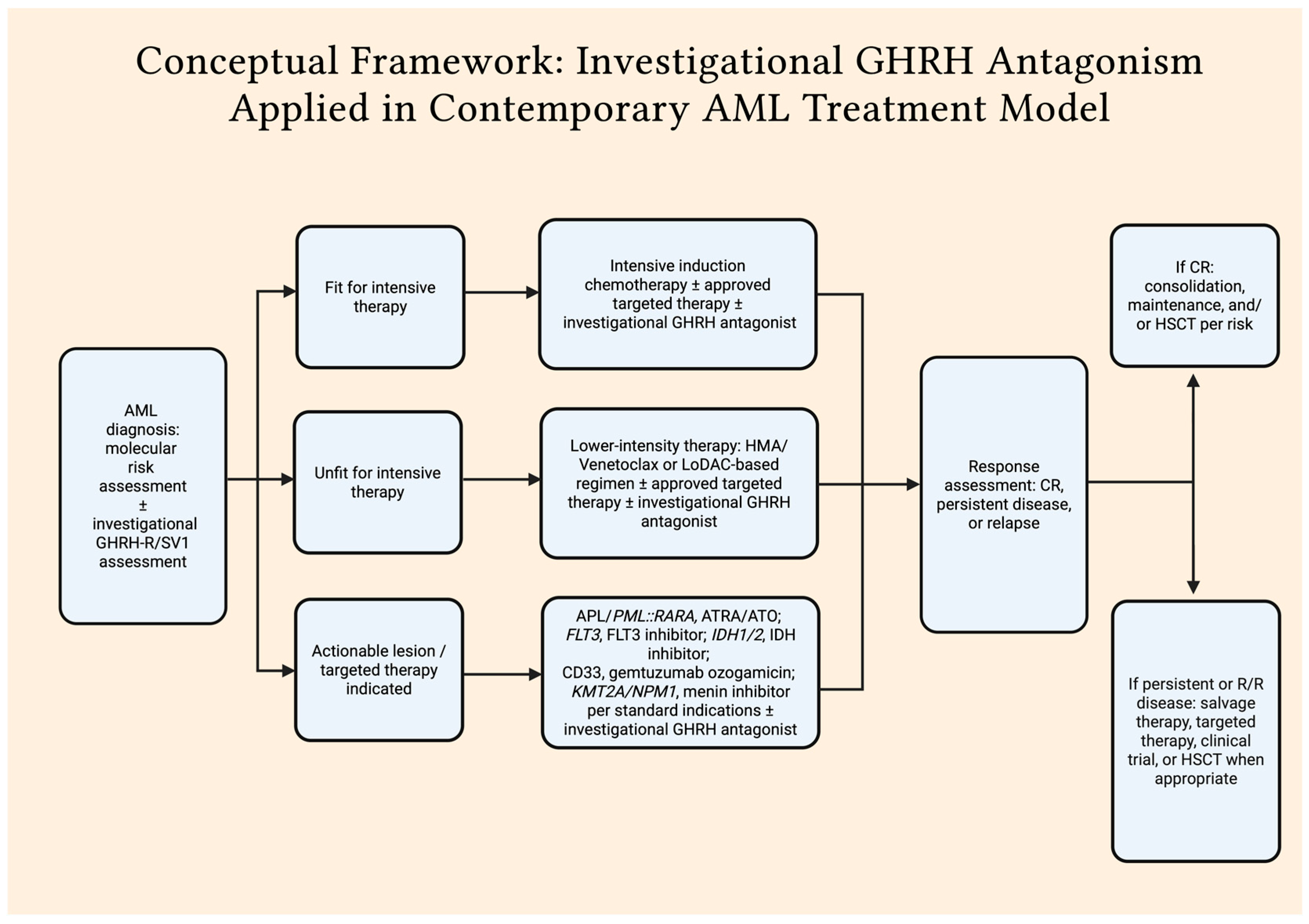

Hormone-Driven Growth Signaling as a Therapeutic Target in Acute Myeloid Leukemia: Implications for Drug-Resistant Disease

Abstract
1. Introduction
2. GHRH and Cancer: Impetus for Targeted Therapy in Acute Myeloid Leukemia

| Cancer Model and Notable GHRH Antagonist(s) | Pathway Affected | Observed Effects | Citation |
|---|---|---|---|
| AML/APL/Drug-Resistant Sublines MIA-602 | MEK/ERK 1/2 PI3K/Akt | Anti-Proliferative, Apoptotic, Decreased Cell Survival, Inhibited ERK and AKT Signaling | [16,57,58,59,60] |
| Non-Small Cell Lung Carcinoma, Pancreatic Cancer, Gastric Cancer, Colon Cancer, Breast Cancer, Ovarian Cancer, Prostatic Cancer, Glioblastoma AVR-352, AVR-353 | PAK1/STAT3, cAMP/cAMP response element-binding protein, Cyclin D1/D2, CDK4 and CDK6, and p27kip1 | Anti-proliferative, Apoptotic, Decreased cell survival, Anti-tumorigenic, Cell cycle arrest, Inhibited PAK1/STAT3 | [56] |
| Small and Non-Small Cell Lung Carcinomas MIA-602 | cAMP/cAMP response element-binding protein, Cyclin D1/D2, CDK4 and CDK6. STAT3/PAK1 and p27kip1 | Decreased cell survival, Apoptotic, Anti-proliferative, Cell cycle arrest, Inhibited STAT3/PAK1, Anti-tumorigenic | [34] |
| Mammary Cancer, Prostatic Cancer, Pancreatic Cancer MZ-5-156 | GHRH-induced cAMP release VIP-induced cAMP release | Rapid and sustained cAMP- release inhibition with delayed cell responsiveness for several hours post-treatment | [39] |
| Retinoblastoma MIA-602 | MEK/ERK 1/2 Caspase 3 | Apoptotic, Anti-proliferative, Inhibited ERK signaling, Upregulated Caspase 3 | [43] |
| Epithelial Ovarian Cancer JV-1-36 MZ-5-156 | IGF-II | Anti-tumorigenic, Anti-proliferative, Decreased serum GH, Competitively inhibited GHRH-R and decreased IGF-II mRNA | [44] |
| Colon Cancer MZ-4-71 | IGF-II | Apoptotic, Anti-proliferative, Decreased IGF-II mRNA and total IGF-II production | [45] |
| Pancreatic Cancer MZ-4-71 MZ-5-156 | IGF-II | Anti-proliferative, Anti-tumorigenic, Reduced IGF-I mRNA and IGF-II production | [42] |
| Androgen-Independent Prostatic Cancer JMR-132 | MEK/ERK 1/2 PI3K/Akt | Apoptotic, Anti-proliferative, Inhibited ERK and AKT signaling, Anti-tumorigenic | [41] |
| Triple-Negative Breast Cancer MIA-602 | INF-γ, IL-1α, IL-4, IL-6, IL-8, IL-10, TNF-α | Reduced expression of inflammatory cytokines | [36] |
| Glioblastoma, Breast Carcinoma, Small Cell Lung Carcinoma, Non-Small Cell Lung Carcinoma MZ-5-156 | hTRT modulation | Anti-tumorigenic, Decreased telomerase activity, Decreased hTRT gene expression | [46] |
| Non-Hodgkin’s Lymphoma MZ-5-156 MZ-J-7-138 | IGF-I | Anti-tumorigenic, Anti-proliferative, Apoptotic, Decreased serum IGF-I and IGF-1 mRNA expression, Decreased bFGF production | [51] |
| Glioblastoma, Estrogen-Independent Breast Cancer, Clear Cell Ovarian Cancer MIA-602 | Metalloprotease-2 and metalloprotease 9, caveolin-1, E-cadherin, NF-κB, β-catenin | Reduced cell viability, Decreased cell adhesion, Lowered tumor cell invasiveness, Inhibited cell motility, Decreased metastatic potential | [37] |
| Renal Adenocarcinoma MZ-4-71 | GH, IGF-1, IGF-II, | Anti-tumorigenic, Lowered GH, IGF-I, IGF-II levels, Anti-proliferative | [47] |
| Androgen-Sensitive Prostate Cancer, Androgen-Independent Prostate Cancer JV-1-38 | VEGF, IGF-I/II | Anti-tumorigenic, Modulated expression of IGF-I/II and VEGF, Decreasing mRNA and production of growth factors. | [40] |
| Gastric Cancer MIA-602 | PAK1-STAT3/NF-κB | Anti-tumorigenic, Anti-proliferative, Decreased cell viability, Lowered serum GHRH levels, Downregulated PAK1-STAT3/NF-κB axis signaling | [48] |
| Estrogen-Independent Breast Carcinoma JV-1-36 | GH/IGF-independent mechanism, yet to be elucidated | Anti-tumorigenic, Reduced metastatic incidence, Anti-proliferative | [38] |
| Osteosarcoma MZ-4-71 | GH, IGF-I | Anti-tumorigenic, Anti-proliferative, Reduced serum IGF-1 and serum GH | [49] |
| Neuroendocrine Lung Non-Small Cell Carcinoma JV-1-36 | VEGF | Reduced VEGF production, Anti-proliferative | [35] |
| Endometrial Adenocarcinoma, Colorectal Adenocarcinoma, Prostatic Cancers, Renal Cell Carcinoma, Diffuse Mixed B Cell Lymphoma MIA-602 | GH-independent growth inhibition MEK/ERK 1/2 PI3K/Akt | Anti-proliferative, Anti-tumorigenic, Inhibited ERK and AKT signaling | [50] |
3. GHRH Receptor-Targeted Therapy in AML and APL: Pre-Clinical Efficacy of MIA-602 in Drug-Resistant Leukemia
4. Implications for Drug-Resistance in AML
5. Limitations and Translational Barriers
6. Conclusions
Author Contributions
Funding
Institutional Review Board Statement
Informed Consent Statement
Data Availability Statement
Conflicts of Interest
Abbreviations
| GHRH | Growth Hormone-Releasing Hormone |
| AML | Acute Myeloid Leukemia |
| GHRH-R | Growth Hormone-Releasing Hormone Receptor |
| APL | Acute Promyelocytic Leukemia |
| ATRA | All-Trans-Retinoic Acid |
| ATO | Arsenic Trioxide |
| IGF-I | Insulin-Like Growth Factor 1 |
| SV | Splice Variant |
| pGHRH-R | Pituitary Growth Hormone-Releasing Hormone |
| RAA | ATRA/ATO Resistance |
| ELN | European LeukemiaNet |
| NCCN | National Comprehensive Cancer Network |
| FLT3 | Fms-Like Tyrosine Kinase 3 |
| FLT3-L | Fms-Like Tyrosine Kinase 3-Ligand |
| FLT3-ITD | Fms-Like Tyrosine Kinase 3 In-Frame Internal Tandem Duplication |
| FLT3-TKD | Fms-Like Tyrosine Kinase 3 Tyrosine Kinase Domain |
| R/R | Relapsed or Refractory |
| OS | Overall Survival |
| TFA | Trifluoroacetic Acid |
| MIA-602 (Ac) | Acetate Salt Form of MIA-602 |
| HMA | Hypomethylating Agent |
| LoDAC | Low-Dose Cytarabine |
| PML | Promyelocytic Leukemia |
| HSCT | Hematopoietic Stem Cell Transplant |
| PKA | Protein Kinase A |
| GPCR | G Protein-Coupled Receptor |
| AKT | Protein Kinase B |
| PI3K | Phosphoinositide 3-Kinase |
| cAMP | Cyclic Adenosine Monophosphate |
| IDH 1/2 | Isocitrate Dehydrogenase 1/2 |
| CBF | Core Binding Factor |
| NPM1 | Nucleophosmin 1 |
| KMT2A | Lysine Methyltransferase 2A |
References
- Hoffman, R.; Benz, E.J., Jr.; Silberstein, L.E.; Heslop, H.E.; Weitz, J.I.; Salama, M.E. (Eds.) Hematology: Basic Principles and Practice, 8th ed.; Elsevier: Philidelphia, PA, USA, 2022. [Google Scholar]
- DiNardo, C.D.; Erba, H.P.; Freeman, S.D.; Wei, A.H. Acute myeloid leukaemia. Lancet 2023, 401, 2073–2086. [Google Scholar] [CrossRef] [PubMed]
- Khoury, J.D.; Solary, E.; Abla, O.; Akkari, Y.; Alaggio, R.; Apperley, J.F.; Bejar, R.; Berti, E.; Busque, L.; Chan, J.K.C.; et al. The 5th edition of the World Health Organization Classification of Haematolymphoid Tumours: Myeloid and Histiocytic/Dendritic Neoplasms. Leukemia 2022, 36, 1703–1719. [Google Scholar] [CrossRef] [PubMed]
- Arber, D.A.; Orazi, A.; Hasserjian, R.P.; Borowitz, M.J.; Calvo, K.R.; Kvasnicka, H.M.; Wang, S.A.; Bagg, A.; Barbui, T.; Branford, S.; et al. International Consensus Classification of Myeloid Neoplasms and Acute Leukemias: Integrating morphologic, clinical, and genomic data. Blood 2022, 140, 1200–1228. [Google Scholar] [CrossRef] [PubMed]
- Falini, B.; Martelli, M.P. Comparison of the International Consensus and 5th WHO edition classifications of adult myelodysplastic syndromes and acute myeloid leukemia. Am. J. Hematol. 2023, 98, 481–492. [Google Scholar] [CrossRef] [PubMed]
- Xiao, W.; Nardi, V.; Stein, E.; Hasserjian, R.P. A practical approach on the classifications of myeloid neoplasms and acute leukemia: WHO and ICC. J. Hematol. Oncol. 2024, 17, 56. [Google Scholar] [CrossRef] [PubMed]
- Chen, X.; Patkar, N.; Tembhare, P.; Papagudi, S.; Yeung, C.; Kanagal Shamanna, R.; Gujral, S.; Wood, B.; Naresh, K.N. Fifth edition WHO classification: Myeloid neoplasms. J. Clin. Pathol. 2025, 78, 335–345. [Google Scholar] [CrossRef] [PubMed]
- Hemminki, K.; Zitricky, F.; Forsti, A.; Kontro, M.; Gjertsen, B.T.; Severinsen, M.T.; Juliusson, G. Age-specific survival in acute myeloid leukemia in the Nordic countries through a half century. Blood Cancer J. 2024, 14, 44. [Google Scholar] [CrossRef] [PubMed]
- Dohner, H.; Weisdorf, D.J.; Bloomfield, C.D. Acute Myeloid Leukemia. N. Engl. J. Med. 2015, 373, 1136–1152. [Google Scholar] [CrossRef] [PubMed]
- Döhner, H.; DiNardo, C.D.; Appelbaum, F.R.; Craddock, C.; Dombret, H.; Ebert, B.L.; Fenaux, P.; Godley, L.A.; Hasserjian, R.P.; Larson, R.A.; et al. Genetic risk classification for adults with AML receiving less-intensive therapies: The 2024 ELN recommendations. Blood 2024, 144, 2169–2173. [Google Scholar] [CrossRef] [PubMed]
- Dohner, H.; Wei, A.H.; Appelbaum, F.R.; Craddock, C.; DiNardo, C.D.; Dombret, H.; Ebert, B.L.; Fenaux, P.; Godley, L.A.; Hasserjian, R.P.; et al. Diagnosis and management of AML in adults: 2022 recommendations from an international expert panel on behalf of the ELN. Blood 2022, 140, 1345–1377. [Google Scholar] [CrossRef]
- Wei, A.H.; Loo, S.; Daver, N. How I treat patients with AML using azacitidine and venetoclax. Blood 2025, 145, 1237–1250. [Google Scholar] [CrossRef] [PubMed]
- Shimony, S.; Stahl, M.; Stone, R.M. Acute Myeloid Leukemia: 2025 Update on Diagnosis, Risk-Stratification, and Management. Am. J. Hematol. 2025, 100, 860–891. [Google Scholar] [CrossRef] [PubMed]
- Jimenez, J.J.; Chale, R.S.; Abad, A.C.; Schally, A.V. Acute promyelocytic leukemia (APL): A review of the literature. Oncotarget 2020, 11, 992–1003. [Google Scholar] [CrossRef] [PubMed]
- Hillestad, L.K. Acute promyelocytic leukemia. Acta Medica Scand. 1957, 159, 189–194. [Google Scholar] [CrossRef]
- Gaumond, S.I.; Abdin, R.; Costoya, J.; Schally, A.V.; Jimenez, J.J. Exploring the role of GHRH antagonist MIA-602 in overcoming Doxorubicin-resistance in acute myeloid leukemia. Oncotarget 2024, 15, 248–254. [Google Scholar] [CrossRef] [PubMed]
- Granata, R. Peripheral activities of growth hormone-releasing hormone. J. Endocrinol. Investig. 2016, 39, 721–727. [Google Scholar] [CrossRef] [PubMed]
- Guillemin, R.; Brazeau, P.; Bohlen, P.; Esch, F.; Ling, N.; Wehrenberg, W.B. Growth hormone-releasing factor from a human pancreatic tumor that caused acromegaly. Science 1982, 218, 585–587. [Google Scholar] [CrossRef] [PubMed]
- Frohman, L.A.; Szabo, M. Ectopic production of growth hormone-releasing factor by carcinoid and pancreatic islet tumors associated with acromegaly. Prog. Clin. Biol. Res. 1981, 74, 259–271. [Google Scholar] [PubMed]
- Kiaris, H.; Chatzistamou, I.; Papavassiliou, A.G.; Schally, A.V. Growth hormone-releasing hormone: Not only a neurohormone. Trends Endocrinol. Metab. 2011, 22, 311–317. [Google Scholar] [CrossRef] [PubMed]
- Schally, A.V.; Cai, R.; Zhang, X.; Sha, W.; Wangpaichitr, M. The development of growth hormone-releasing hormone analogs: Therapeutic advances in cancer, regenerative medicine, and metabolic disorders. Rev. Endocr. Metab. Disord. 2025, 26, 385–396. [Google Scholar] [CrossRef] [PubMed]
- Kahan, Z.; Arencibia, J.M.; Csernus, V.J.; Groot, K.; Kineman, R.D.; Robinson, W.R.; Schally, A.V. Expression of growth hormone-releasing hormone (GHRH) messenger ribonucleic acid and the presence of biologically active GHRH in human breast, endometrial, and ovarian cancers. J. Clin. Endocrinol. Metab. 1999, 84, 582–589. [Google Scholar] [CrossRef]
- Halmos, G.; Szabo, Z.; Dobos, N.; Juhasz, E.; Schally, A.V. Growth hormone-releasing hormone receptor (GHRH-R) and its signaling. Rev. Endocr. Metab. Disord. 2025, 26, 343–352. [Google Scholar] [CrossRef] [PubMed]
- Schulz, S.; Rocken, C.; Schulz, S. Immunocytochemical localisation of plasma membrane GHRH receptors in human tumours using a novel anti-peptide antibody. Eur. J. Cancer 2006, 42, 2390–2396. [Google Scholar] [CrossRef] [PubMed]
- Havt, A.; Schally, A.V.; Halmos, G.; Varga, J.L.; Toller, G.L.; Horvath, J.E.; Szepeshazi, K.; Koster, F.; Kovitz, K.; Groot, K.; et al. The expression of the pituitary growth hormone-releasing hormone receptor and its splice variants in normal and neoplastic human tissues. Proc. Natl. Acad. Sci. USA 2005, 102, 17424–17429. [Google Scholar] [CrossRef] [PubMed]
- Rekasi, Z.; Czompoly, T.; Schally, A.V.; Halmos, G. Isolation and sequencing of cDNAs for splice variants of growth hormone-releasing hormone receptors from human cancers. Proc. Natl. Acad. Sci. USA 2000, 97, 10561–10566. [Google Scholar] [CrossRef] [PubMed]
- Cong, Z.; Zhou, F.; Zhang, C.; Zou, X.; Zhang, H.; Wang, Y.; Zhou, Q.; Cai, X.; Liu, Q.; Li, J.; et al. Constitutive signal bias mediated by the human GHRHR splice variant 1. Proc. Natl. Acad. Sci. USA 2021, 118, e2106606118. [Google Scholar] [CrossRef] [PubMed]
- Pozsgai, E.; Schally, A.V.; Hocsak, E.; Zarandi, M.; Rick, F.; Bellyei, S. The effect of a novel antagonist of growth hormone releasing hormone on cell proliferation and on the key cell signaling pathways in nine different breast cancer cell lines. Int. J. Oncol. 2011, 39, 1025–1032. [Google Scholar] [CrossRef] [PubMed]
- Kiaris, H.; Chatzistamou, I.; Schally, A.V.; Halmos, G.; Varga, J.L.; Koutselini, H.; Kalofoutis, A. Ligand-dependent and -independent effects of splice variant 1 of growth hormone-releasing hormone receptor. Proc. Natl. Acad. Sci. USA 2003, 100, 9512–9517. [Google Scholar] [CrossRef] [PubMed]
- Vijayakumar, A.; Yakar, S.; Leroith, D. The intricate role of growth hormone in metabolism. Front. Endocrinol. 2011, 2, 32. [Google Scholar] [CrossRef] [PubMed]
- Schally, A.V.; Varga, J.L.; Engel, J.B. Antagonists of growth-hormone-releasing hormone: An emerging new therapy for cancer. Nat. Clin. Pract. Endocrinol. Metab. 2008, 4, 33–43. [Google Scholar] [CrossRef] [PubMed]
- Cui, T.; Jimenez, J.J.; Block, N.L.; Badiavas, E.V.; Rodriguez-Menocal, L.; Vila Granda, A.; Cai, R.; Sha, W.; Zarandi, M.; Perez, R.; et al. Agonistic analogs of growth hormone releasing hormone (GHRH) promote wound healing by stimulating the proliferation and survival of human dermal fibroblasts through ERK and AKT pathways. Oncotarget 2016, 7, 52661–52672. [Google Scholar] [CrossRef] [PubMed]
- Gesmundo, I.; Pedrolli, F.; Cai, R.; Sha, W.; Schally, A.V.; Granata, R. Growth hormone-releasing hormone and cancer. Rev. Endocr. Metab. Disord. 2025, 26, 443–456. [Google Scholar] [CrossRef] [PubMed]
- Schally, A.V.; Wang, H.; He, J.; Cai, R.; Sha, W.; Popovics, P.; Perez, R.; Vidaurre, I.; Zhang, X. Agonists of growth hormone-releasing hormone (GHRH) inhibit human experimental cancers in vivo by down-regulating receptors for GHRH. Proc. Natl. Acad. Sci. USA 2018, 115, 12028–12033. [Google Scholar] [CrossRef] [PubMed]
- Sacewicz, M.; Lawnicka, H.; Siejka, A.; Stepien, T.; Krupinski, R.; Komorowski, J.; Stepien, H. Inhibition of proliferation, VEGF secretion of human neuroendocrine tumor cell line NCI-H727 by an antagonist of growth hormone-releasing hormone (GH-RH) in vitro. Cancer Lett. 2008, 268, 120–128. [Google Scholar] [CrossRef] [PubMed]
- Perez, R.; Schally, A.V.; Vidaurre, I.; Rincon, R.; Block, N.L.; Rick, F.G. Antagonists of growth hormone-releasing hormone suppress in vivo tumor growth and gene expression in triple negative breast cancers. Oncotarget 2012, 3, 988–997. [Google Scholar] [CrossRef] [PubMed]
- Bellyei, S.; Schally, A.V.; Zarandi, M.; Varga, J.L.; Vidaurre, I.; Pozsgai, E. GHRH antagonists reduce the invasive and metastatic potential of human cancer cell lines in vitro. Cancer Lett. 2010, 293, 31–40. [Google Scholar] [CrossRef] [PubMed]
- Chatzistamou, I.; Schally, A.V.; Varga, J.L.; Groot, K.; Busto, R.; Armatis, P.; Halmos, G. Inhibition of growth and metastases of MDA-MB-435 human estrogen-independent breast cancers by an antagonist of growth hormone-releasing hormone. Anticancer Drugs 2001, 12, 761–768. [Google Scholar] [CrossRef] [PubMed]
- Csernus, V.; Schally, A.V.; Groot, K. Antagonistic analogs of growth hormone releasing hormone (GHRH) inhibit cyclic AMP production of human cancer cell lines in vitro. Peptides 1999, 20, 843–850. [Google Scholar] [CrossRef] [PubMed]
- Letsch, M.; Schally, A.V.; Busto, R.; Bajo, A.M.; Varga, J.L. Growth hormone-releasing hormone (GHRH) antagonists inhibit the proliferation of androgen-dependent and -independent prostate cancers. Proc. Natl. Acad. Sci. USA 2003, 100, 1250–1255. [Google Scholar] [CrossRef] [PubMed]
- Rick, F.G.; Schally, A.V.; Szalontay, L.; Block, N.L.; Szepeshazi, K.; Nadji, M.; Zarandi, M.; Hohla, F.; Buchholz, S.; Seitz, S. Antagonists of growth hormone-releasing hormone inhibit growth of androgen-independent prostate cancer through inactivation of ERK and Akt kinases. Proc. Natl. Acad. Sci. USA 2012, 109, 1655–1660. [Google Scholar] [CrossRef] [PubMed]
- Szepeshazi, K.; Schally, A.V.; Groot, K.; Armatis, P.; Hebert, F.; Halmos, G. Antagonists of growth hormone-releasing hormone (GH-RH) inhibit in vivo proliferation of experimental pancreatic cancers and decrease IGF-II levels in tumours. Eur. J. Cancer 2000, 36, 128–136. [Google Scholar] [CrossRef] [PubMed]
- Chu, W.K.; Law, K.S.; Chan, S.O.; Yam, J.C.; Chen, L.J.; Zhang, H.; Cheung, H.S.; Block, N.L.; Schally, A.V.; Pang, C.P. Antagonists of growth hormone-releasing hormone receptor induce apoptosis specifically in retinoblastoma cells. Proc. Natl. Acad. Sci. USA 2016, 113, 14396–14401. [Google Scholar] [CrossRef] [PubMed]
- Chatzistamou, I.; Schally, A.V.; Varga, J.L.; Groot, K.; Armatis, P.; Busto, R.; Halmos, G. Antagonists of growth hormone-releasing hormone and somatostatin analog RC-160 inhibit the growth of the OV-1063 human epithelial ovarian cancer cell line xenografted into nude mice. J. Clin. Endocrinol. Metab. 2001, 86, 2144–2152. [Google Scholar] [CrossRef]
- Szepeshazi, K.; Schally, A.V.; Groot, K.; Armatis, P.; Halmos, G.; Herbert, F.; Szende, B.; Varga, J.L.; Zarandi, M. Antagonists of growth hormone-releasing hormone (GH-RH) inhibit IGF-II production and growth of HT-29 human colon cancers. Br. J. Cancer 2000, 82, 1724–1731. [Google Scholar] [CrossRef] [PubMed]
- Kiaris, H.; Schally, A.V. Decrease in telomerase activity in U-87MG human glioblastomas after treatment with an antagonist of growth hormone-releasing hormone. Proc. Natl. Acad. Sci. USA 1999, 96, 226–231. [Google Scholar] [CrossRef] [PubMed]
- Jungwirth, A.; Schally, A.V.; Pinski, J.; Groot, K.; Armatis, P.; Halmos, G. Growth hormone-releasing hormone antagonist MZ-4-71 inhibits in vivo proliferation of Caki-I renal adenocarcinoma. Proc. Natl. Acad. Sci. USA 1997, 94, 5810–5813. [Google Scholar] [CrossRef] [PubMed]
- Gan, J.; Ke, X.; Jiang, J.; Dong, H.; Yao, Z.; Lin, Y.; Lin, W.; Wu, X.; Yan, S.; Zhuang, Y.; et al. Growth hormone-releasing hormone receptor antagonists inhibit human gastric cancer through downregulation of PAK1-STAT3/NF-kappaB signaling. Proc. Natl. Acad. Sci. USA 2016, 113, 14745–14750. [Google Scholar] [CrossRef] [PubMed]
- Braczkowski, R.; Schally, A.V.; Plonowski, A.; Varga, J.L.; Groot, K.; Krupa, M.; Armatis, P. Inhibition of proliferation in human MNNG/HOS osteosarcoma and SK-ES-1 Ewing sarcoma cell lines in vitro and in vivo by antagonists of growth hormone-releasing hormone: Effects on insulin-like growth factor II. Cancer 2002, 95, 1735–1745. [Google Scholar] [CrossRef] [PubMed]
- Zarandi, M.; Cai, R.; Kovacs, M.; Popovics, P.; Szalontay, L.; Cui, T.; Sha, W.; Jaszberenyi, M.; Varga, J.; Zhang, X.; et al. Synthesis and structure-activity studies on novel analogs of human growth hormone releasing hormone (GHRH) with enhanced inhibitory activities on tumor growth. Peptides 2017, 89, 60–70. [Google Scholar] [CrossRef] [PubMed]
- Keller, G.; Schally, A.V.; Groot, K.; Toller, G.L.; Havt, A.; Koster, F.; Armatis, P.; Halmos, G.; Zarandi, M.; Varga, J.L.; et al. Effective treatment of experimental human non-Hodgkin’s lymphomas with antagonists of growth hormone-releasing hormone. Proc. Natl. Acad. Sci. USA 2005, 102, 10628–10633. [Google Scholar] [CrossRef] [PubMed]
- Izdebski, J.; Pinski, J.; Horvath, J.E.; Halmos, G.; Groot, K.; Schally, A.V. Synthesis and biological evaluation of superactive agonists of growth hormone-releasing hormone. Proc. Natl. Acad. Sci. USA 1995, 92, 4872–4876. [Google Scholar] [CrossRef] [PubMed]
- Zarandi, M.; Kovacs, M.; Horvath, J.E.; Toth, K.; Halmos, G.; Groot, K.; Nagy, A.; Kele, Z.; Schally, A.V. Synthesis and in vitro evaluation of new potent antagonists of growth hormone-releasing hormone (GH-RH). Peptides 1997, 18, 423–430. [Google Scholar] [CrossRef] [PubMed]
- Stephanou, A.; Knight, R.A.; Lightman, S.L. Production of a growth hormone-releasing hormone-like peptide and its mRNA by human lymphocytes. Neuroendocrinology 1991, 53, 628–633. [Google Scholar] [PubMed]
- Khorram, O.; Garthwaite, M.; Golos, T. The influence of aging and sex hormones on expression of growth hormone-releasing hormone in the human immune system. J. Clin. Endocrinol. Metab. 2001, 86, 3157–3161. [Google Scholar] [CrossRef]
- Cai, R.; Zhang, X.; Wang, H.; Cui, T.; Halmos, G.; Sha, W.; He, J.; Popovics, P.; Vidaurre, I.; Zhang, C.; et al. Synthesis of potent antagonists of receptors for growth hormone-releasing hormone with antitumor and anti-inflammatory activity. Peptides 2022, 150, 170716. [Google Scholar] [CrossRef] [PubMed]
- Jimenez, J.J.; DelCanto, G.M.; Popovics, P.; Perez, A.; Vila Granda, A.; Vidaurre, I.; Cai, R.Z.; Rick, F.G.; Swords, R.T.; Schally, A.V. A new approach to the treatment of acute myeloid leukaemia targeting the receptor for growth hormone-releasing hormone. Br. J. Haematol. 2018, 181, 476–485. [Google Scholar] [CrossRef] [PubMed]
- Chale, R.S.; Rodriguez, M.; Almeida, S.M.; Sclatter, S.; Singaready, A.; Schally, A.V.; Jimenez, J.J. Synergistic effects of MIA-602 and its potential for use in ATRA/ATO Resistant APL. Cancer Res. 2023, 83, 385. [Google Scholar] [CrossRef]
- Chale, R.S.; Almeida, S.M.; Rodriguez, M.; Jozic, I.; Gaumond, S.I.; Schally, A.V.; Jimenez, J.J. The Application of GHRH Antagonist as a Treatment for Resistant APL. Cancers 2023, 15, 3104. [Google Scholar] [CrossRef] [PubMed]
- Chale, R.; Singareddy, A.; Sclater, S.; Almeida, S.; Lens, A.; Schally, A.; Jimenez, J. AML-438 K562: An In-Vitro AML Model for Studying Synergistic Effects of Doxorubicin & MIA-602. Clin. Lymphoma Myeloma Leuk. 2022, 22, S251. [Google Scholar] [CrossRef]
- Perez-Stable, C.; de las Pozas, A.; Wangpaichitr, M.; Sha, W.; Wang, H.; Cai, R.; Schally, A.V. Growth Hormone-Releasing Hormone (GHRH) Antagonist Peptides Combined with PI3K Isoform Inhibitors Enhance Cell Death in Prostate Cancer. Cancers 2025, 17, 1643. [Google Scholar] [CrossRef] [PubMed]
- Dekant, W.; Dekant, R. Mammalian toxicity of trifluoroacetate and assessment of human health risks due to environmental exposures. Arch. Toxicol. 2023, 97, 1069–1077. [Google Scholar] [CrossRef] [PubMed]
- Costoya, J.; Costoya, E.; Wangpaichitr, M.; Sha, W.; Jimenez, J.J. Abstract 4537: Modified acetate salt form of GHRH-antagonist retains anti-leukemic activity against acute myelogenous leukemia. Cancer Res. 2026, 86, 4537. [Google Scholar] [CrossRef]
- Ishii, H.; Yano, S. New Therapeutic Strategies for Adult Acute Myeloid Leukemia. Cancers 2022, 14, 2806. [Google Scholar] [CrossRef] [PubMed]
- Roskoski, R., Jr. The role of small molecule Flt3 receptor protein-tyrosine kinase inhibitors in the treatment of Flt3-positive acute myelogenous leukemias. Pharmacol. Res. 2020, 155, 104725. [Google Scholar] [CrossRef] [PubMed]
- Jalte, M.; Abbassi, M.; El Mouhi, H.; Daha Belghiti, H.; Ahakoud, M.; Bekkari, H. FLT3 Mutations in Acute Myeloid Leukemia: Unraveling the Molecular Mechanisms and Implications for Targeted Therapies. Cureus 2023, 15, e45765. [Google Scholar] [CrossRef] [PubMed]
- Kiyoi, H.; Naoe, T.; Yokota, S.; Nakao, M.; Minami, S.; Kuriyama, K.; Takeshita, A.; Saito, K.; Hasegawa, S.; Shimodaira, S.; et al. Internal tandem duplication of FLT3 associated with leukocytosis in acute promyelocytic leukemia. Leukemia Study Group of the Ministry of Health and Welfare (Kohseisho). Leukemia 1997, 11, 1447–1452. [Google Scholar] [CrossRef] [PubMed]
- Kumar, N.M.; Nathany, S.; Swaminathan, A.; Yadav, C.; Kothari, A.; Garg, P.; Panda-Rastogi, N.; Dua, V.; Danewa, A.; Bhargava, R. FLT3: A narrative review. Cancer Res. Stat. Treat. 2025, 8, 66–74. [Google Scholar] [CrossRef] [PubMed]
- Levis, M.; Small, D. FLT3: ITDoes matter in leukemia. Leukemia 2003, 17, 1738–1752. [Google Scholar] [CrossRef] [PubMed]
- Perrone, S.; Ottone, T.; Zhdanovskaya, N.; Molica, M. How acute myeloid leukemia (AML) escapes from FMS-related tyrosine kinase 3 (FLT3) inhibitors? Still an overrated complication? Cancer Drug Resist. 2023, 6, 223–238. [Google Scholar] [CrossRef] [PubMed]
- Choudhary, C.; Brandts, C.; Schwable, J.; Tickenbrock, L.; Sargin, B.; Ueker, A.; Bohmer, F.D.; Berdel, W.E.; Muller-Tidow, C.; Serve, H. Activation mechanisms of STAT5 by oncogenic Flt3-ITD. Blood 2007, 110, 370–374. [Google Scholar] [CrossRef] [PubMed]
- Takahashi, S. Downstream molecular pathways of FLT3 in the pathogenesis of acute myeloid leukemia: Biology and therapeutic implications. J. Hematol. Oncol. 2011, 4, 13. [Google Scholar] [CrossRef] [PubMed]
- Rataj, J.; Gorecki, L.; Muthna, D.; Sorf, A.; Krystof, V.; Klener, P.; Ceckova, M.; Rezacova, M.; Korabecny, J. Targeting FMS-like tyrosine kinase 3 (FLT3) in acute myeloid leukemia: Novel molecular approaches and therapeutic challenges. Biomed. Pharmacother. 2025, 182, 117788. [Google Scholar] [CrossRef] [PubMed]
- Kennedy, V.E.; Smith, C.C. FLT3 Mutations in Acute Myeloid Leukemia: Key Concepts and Emerging Controversies. Front. Oncol. 2020, 10, 612880. [Google Scholar] [CrossRef] [PubMed]
- Stone, R.M.; Mandrekar, S.J.; Sanford, B.L.; Laumann, K.; Geyer, S.; Bloomfield, C.D.; Thiede, C.; Prior, T.W.; Dohner, K.; Marcucci, G.; et al. Midostaurin plus Chemotherapy for Acute Myeloid Leukemia with a FLT3 Mutation. N. Engl. J. Med. 2017, 377, 454–464. [Google Scholar] [CrossRef] [PubMed]
- Dhillon, S. Gilteritinib: First Global Approval. Drugs 2019, 79, 331–339. [Google Scholar] [CrossRef] [PubMed]
- Erba, H.P.; Montesinos, P.; Kim, H.-J.; Patkowska, E.; Vrhovac, R.; Žák, P.; Wang, P.-N.; Mitov, T.; Hanyok, J.; Kamel, Y.M.; et al. Quizartinib plus chemotherapy in newly diagnosed patients with FLT3-internal-tandem-duplication-positive acute myeloid leukaemia (QuANTUM-First): A randomised, double-blind, placebo-controlled, phase 3 trial. Lancet 2023, 401, 1571–1583. [Google Scholar] [CrossRef] [PubMed]
- Costoya, J.; Gaumond, S.I.; Chale, R.S.; Schally, A.V.; Jimenez, J.J. A novel approach for the treatment of AML, through GHRH antagonism: MIA-602. Rev. Endocr. Metab. Disord. 2025, 26, 483–491. [Google Scholar] [CrossRef] [PubMed]

Disclaimer/Publisher’s Note: The statements, opinions and data contained in all publications are solely those of the individual author(s) and contributor(s) and not of MDPI and/or the editor(s). MDPI and/or the editor(s) disclaim responsibility for any injury to people or property resulting from any ideas, methods, instructions or products referred to in the content. |
© 2026 by the authors. Licensee MDPI, Basel, Switzerland. This article is an open access article distributed under the terms and conditions of the Creative Commons Attribution (CC BY) license.
Share and Cite
Costoya, J.; Jimenez, J.J. Hormone-Driven Growth Signaling as a Therapeutic Target in Acute Myeloid Leukemia: Implications for Drug-Resistant Disease. J. Pers. Med. 2026, 16, 331. https://doi.org/10.3390/jpm16060331
Costoya J, Jimenez JJ. Hormone-Driven Growth Signaling as a Therapeutic Target in Acute Myeloid Leukemia: Implications for Drug-Resistant Disease. Journal of Personalized Medicine. 2026; 16(6):331. https://doi.org/10.3390/jpm16060331
Chicago/Turabian StyleCostoya, Joel, and Joaquin J. Jimenez. 2026. "Hormone-Driven Growth Signaling as a Therapeutic Target in Acute Myeloid Leukemia: Implications for Drug-Resistant Disease" Journal of Personalized Medicine 16, no. 6: 331. https://doi.org/10.3390/jpm16060331
APA StyleCostoya, J., & Jimenez, J. J. (2026). Hormone-Driven Growth Signaling as a Therapeutic Target in Acute Myeloid Leukemia: Implications for Drug-Resistant Disease. Journal of Personalized Medicine, 16(6), 331. https://doi.org/10.3390/jpm16060331