Review

Hormone-Driven Growth Signaling as a Therapeutic Target in Acute Myeloid Leukemia: Implications for Drug-Resistant Disease

by
Joel Costoya
1,* and
Joaquin J. Jimenez
1,2,*
1
Department of Biochemistry and Molecular Biology, Miller School of Medicine, University of Miami, Miami, FL 33136, USA
2
Dr. Phillip Frost Department of Dermatology and Cutaneous Surgery, Miller School of Medicine, University of Miami, Miami, FL 33136, USA
*
Authors to whom correspondence should be addressed.
J. Pers. Med. 2026, 16(6), 331; https://doi.org/10.3390/jpm16060331 (registering DOI)
Submission received: 7 May 2026 / Revised: 11 June 2026 / Accepted: 17 June 2026 / Published: 20 June 2026
(This article belongs to the Section Personalized Medicine in Pharmacy)

Abstract

Growth hormone-releasing hormone (GHRH) antagonists have displayed anti-neoplastic activity against a multitude of cancers in vitro, as well as in vivo, via xenografted tumors in nude mice. Following a successful demonstration of GHRH antagonists treating non-Hodgkin’s lymphoma and the discovery of GHRH mRNA and peptide products in immune cells, GHRH antagonism was explored in acute myeloid leukemia (AML), a disease characterized by a malignant expansion of immature myeloid progenitors, and poor 5-year survival. Targeted therapies have yielded breakthroughs in treatment response and overall survival, such as all-trans retinoic acid/arsenic trioxide (ATRA/ATO) for acute promyelocytic leukemia (APL), or FLT3 inhibitors, IDH inhibitors, and menin inhibitors for AML harboring actionable genetic lesions. However, therapeutic resistance remains a major barrier to durable remission. GHRH receptor (GHRH-R) has been reported in several experimental models of AML, including drug-resistant sublines. Significant time- and dose-dependent reduction in leukemic growth was observed in vitro and in vivo following MIA-602 treatment. FLT3 inhibitor resistance has been associated with activation of PI3K/AKT, ERK/MAPK, inflammatory, stromal, and apoptotic escape pathways. The documented effects of GHRH-R antagonism raise the possibility that it could influence signaling networks relevant to therapeutic resistance in AML. This hypothesis remains speculative; to date no studies have stratified AML by FLT3 status in the context of GHRH-R expression or GHRH antagonism, and there is currently no evidence that MIA-602 directly alters FLT3 receptor signaling or inhibitor sensitivity.

1. Introduction

AML is a highly heterogenous hematological malignancy characterized by a series of aberrations to genetic programs responsible for the proliferation, maturation, and survival of myeloid progenitor cells during the process of hematopoiesis [1]. Clonal expansion of immature myelocytic cells occurs in the bone marrow, crowding out other blood cell populations and eventually spreading into the peripheral blood and throughout the body. Concurrently, bone marrow dysfunction develops, often resulting in patients presenting emergently with various associated cytopenias and transfusion dependency [1,2]. A primary diagnostic criterion for AML is a myeloblast count of 20% or higher found in the peripheral blood or bone marrow, although there are several cases of specific cytogenetic abnormalities such as AML with RUNX1::RUNX1T1 fusions, CBFB::MYH11 fusions, PML::RARA fusions, RBM15::MRTFA fusions, DEK::NUP214 fusions, and AML with KMT2A rearrangements, MECOM rearrangements, NUP98 rearrangements, or AML with NPM1 mutations, that serve as exceptions to the typical blast percentage rule [3,4,5]. The diagnostic work-up for a suspected AML incorporates morphological evaluation of the blasts, assisted by flow cytometric immunophenotyping to help confirm the identity of specific AML subtypes and establish baseline measurements for minimal residual disease tracking. Furthermore, pertinent diagnostic and prognostic information ought to be extracted from genetic studies like karyotyping, fluorescence in situ hybridization and next-generation sequencing, as genomic annotation usually will be most indicative of treatment outcomes and will help guide selecting optimal therapeutic regimens [1,2,6,7].
The prognosis for AML is usually poor, and in addition to its classification, is largely influenced by patient characteristics such as any existing co-morbidities and age. Despite continuous improvement in AML therapies there still remain significant hurdles to achieving complete remission post-therapy, as a large fraction of patients experience relapse [1]. According to the SEER U.S. database, amongst adult populations, AML is the most prevalent leukemia, exhibiting a five-year survival rate of 31.7% [8]. Induction therapy for newly diagnosed AML aims to achieve complete remission through intense chemotherapy regimens, most commonly using the “7 + 3” approach, consisting of administering daunorubicin for 3 days and cytarabine for 7 days. For patients deemed unable to withstand more intense chemotherapy regimens, there are less-intense chemotherapeutic alternatives which are attempted in order to induce and maintain remission. The standard-of-care chemotherapeutic regimen combines a hypomethylating agent and venetoclax and is administered continuously with dose adjustments to minimize toxicity and allow for greater marrow recovery between cycles [2,9,10,11,12]. If during the initial work-up, the patient is discovered to have a treatable molecularly defined subset of AML, such as mutated fms-like tyrosine kinase 3 (FLT3), mutated isocitrate dehydrogenase 1/2 (IDH1/2), core-binding factor (CBF) AML, and Nucleophosmin 1 (NPM1)/Lysine Methyltransferase 2A (KMT2A) rearranged AML, then the front-line treatment strategies may be modified to incorporate targeted agents that capitalize on the vulnerabilities of the underlying biology. Organized with respect to the aforementioned genetic lesions, one could expect FLT3 inhibitors, IDH 1/2 inhibitors, gemtuzumab ozogamicin, or menin inhibitors, to be deployed alongside standard chemotherapy regimens. Currently, the only FDA-approved front-line therapies for patients eligible for intensive chemotherapy are FLT3 inhibitors and gemtuzumab ozogamicin, an antibody-drug conjugate targeting CD33. In the case of patients who are ineligible for intensive chemotherapy, their therapeutic regimen could include an FLT3 inhibitor in the case of FLT3-mutated AML. If the patient has an IDH1 mutation, ivosidenib is now incorporated into their treatment plan as a monotherapy or in combination with a hypomethylating agent and/or venetoclax. To our knowledge, no FDA approvals have been given regarding IDH2 inhibitors as a front-line therapeutic; however, enasidenib is available in relapsed/or refractory (R/R) cases. At present, menin inhibitors are only FDA-approved to treat KMT2A-rearranged or NPM1-mutated AML in the relapsed/refractory setting; however, studies are underway exploring these targeted therapies in combination with front-line treatment regimens in patients eligible for intense chemotherapy and in the non-eligible setting where they are instead combined with hypomethylating agents and venetoclax. Patients suspected of having acute promyelocytic leukemia (APL) are to be started immediately on all-trans retinoic acid (ATRA) and then combined with arsenic trioxide (ATO) once it is confirmed they possess a PML::RARA fusion gene. These patients would forgo cytotoxic therapy unless considered “high risk” and in need of cytoreductive measures. Following remission, treatment is continued with consolidation chemotherapy and, in some cases, allogeneic hematopoietic stem cell transplantation [13]. Within the evolving framework of AML management, addressing therapeutic resistance remains a critical factor for achieving durable remissions and improving patient outcomes.
Advancements in diagnostic modalities have not only guided therapeutic strategies and the development of targeted drug therapies but also facilitated a shift towards precision medicine. A well-known example is found with the use of ATRA and ATO to treat APL, a rare variant of AML [14]. First described in 1957 by Hillestad as having a rapidly fatal course and considered the ‘most malignant form of acute leukemia’ [15] APL now has the most favorable prognosis of all AML. As with other subtypes of AML, acquired resistance remains a significant barrier to long-term disease-free survival, driven by the emergence of leukemic clones with the capacity to circumvent or tolerate these differentiating agents. Pre-clinical evidence of MIA-602 has shown significant anti-neoplastic activity against drug-resistant analogs of both AML and APL whilst mitigating peripheral toxicities. Interestingly, when administered in combination with currently used therapeutic agents, a potent synergistic effect was noted [16]. Here, we review and organize the pre-clinical evidence surrounding the GHRH-R antagonist “MIA-602”, as an investigational approach in AML and APL models, with emphasis on drug-resistant disease biology. Rather than imply established clinical efficacy, further mechanistic study of GHRH-R antagonism’s reported anti-neoplastic effects in AML may generate testable hypotheses for future AML studies due to overlapping biological signaling, implicated in resistance to targeted therapies like that of FLT3 inhibitors.

2. GHRH and Cancer: Impetus for Targeted Therapy in Acute Myeloid Leukemia

GHRH was first fully isolated and characterized in 1982, with early evidence of its existence within animal hypothalamic extracts spanning back more than half a century [17,18]. Interestingly, studying secretions of pancreatic islet tumors associated with acromegaly led to the elucidation of GHRH’s 40- and 44-amino acid isoforms, allowing for its full structural analysis and bioactivity probing [19]. Subsequent investigation across various animal species, as well as humans, confirmed the hypothalamus to be the primary site of its biogenesis. For several decades GHRH was viewed rather restrictively as a regulator of the pituitary GH/hepatic insulin-like growth factor 1 (IGF-1) axis, despite owing its discovery to ectopic tumoral productions. The recent literature points to GHRH being a much more pleiotropic peptide, exerting growth factor-like effects in a vast number of peripheral tissues, calling into question its identity being perhaps more than just that of a neuroendocrine hormone responsible for the release of GH from the pituitary [20,21]. Indeed, many extrahypothalamic tissues are known to synthesize GHRH, capable of acting in an autocrine/paracrine manner, logically implying the presence of GHRH-R activity. In corroboration, both GHRH-R and its splice variants (SVs) have been documented throughout various tissue types. The same phenomenon has been shown to occur in pathological states of varying cancers [21,22].
GHRH-R is a class B G protein-coupled receptor (GPCR) pertaining to the secretin-like sub-family, including but not limited to glucagon, glucagon-like peptides, pituitary adenylate cyclase-activating polypeptides, secretin, and vasoactive intestinal peptides. GHRH-R is composed of seven transmembrane helices with three intracellular and three extracellular loops, most highly expressed in the somatotrophs of the anterior pituitary gland (pGHRH-R), in line with its physiological role as a neuroendocrine hormone receptor [23]. To date, four SVs of GHRH-R have been documented in a multitude of both normal and neoplastic tissues, with SV1 acting as the main variant responsible for GHRH’s bioactivity and prime oncological target [24,25]. SV1 while largely similar to full-length GHRH-R lacks a portion of its extracellular domain as the result of an intron splicing event in where a fragment of intron 3 replaces the first three exons, and as such the first 89 amino acids are exchanged for a distinct 25-long amino acid sequence. The changes occurring near the N-termini of these receptors account for the difference in signaling observed between SV1 and its full-length counterpart [26,27]. Namely, GHRH-R is more Gs/cyclic adenosine monophosphate (cAMP)-dominant and responsible for inducing GH synthesis and release upon ligand stimulation, while SV1 displays more bias towards ß-arrestin signaling, consequentially exerting its mitogenic effects primarily through this pathway [23,27]. While still canonically capable of activating the cAMP/protein kinase A (PKA) cascade, SV1’s ß-arrestin bias promotes oncogenesis via increases in MAPK, ERK1/2, and PKA activity subsequent to arrestin recruitment [23,27,28]. In addition, it should be mentioned SV1 has been demonstrated to promote growth both via a ligand-dependent and ligand-independent manner [29].
Canonically, GHRH binding to GHRH-R activates the GPCR leading to increased cAMP, which activates PKA causing sodium channel-induced membrane depolarization followed by a calcium influx and subsequent GH secretion [23,30]. Concurrently, activated PKA signals CREB, a cAMP response element transcription factor, accompanied by cofactors such as p300 and CREB-binding protein to bind to cAMP response elements along the GH promoter region stimulating its transcription. GHRH-R can also activate phospholipase C yielding diacylglycerol and inositol triphosphate, of which the latter can increase intracellular calcium and lead to GH secretion similar to that induced by cAMP/PKA signaling [23]. Another notable pathway affected by GHRH-R activation is the protein kinase C-dependent stimulation of MAPK/ERK which ultimately leads to cell growth and proliferation [23].
Originally, the mechanism of action behind GHRH’s growth factor-like behavior was thought to arise from endocrine stimulation of IGF-I/II production through the pit-GH/hepatic-IGF axis, eliciting IGF-I/II’s potent mitogenic effects of enhanced cell growth, proliferation, and cellular survival. Although in vitro experimentation, naturally devoid of the pit-GH/hepatic-IGF axis, has shown GHRH to promote biogenesis of IGF-I/II in an autocrine/paracrine manner [31]. Additionally, GHRH-R activation has been shown to significantly stimulate growth independent of IGF signaling, relying on activation of MEK/ERK ½ and PI3K/AKT through alternative pathways [32]. The current rationale for how GHRH directly exerts its mitogenic effects in the absence of its endocrine signaling has been narrowed down to two main mechanisms. The first would be local production of GHRH by peripheral tissues which upon release from their originating cell can either self-induce, or stimulate nearby cells to synthesize and excrete GH, which then would, in an autocrine/paracrine manner, promote IGF-I/II production and form a potent GHRH- or IGF-stimulatory loop. This autocrine/paracrine stimulatory loop is of great importance given these hormones’ independent abilities to promote cell growth, survival, differentiation, and the physiological role they play in tissue-specific processes. Secondly, across various tissue types direct GHRH-R stimulation can modulate pathways including but not limited to those that control inflammation, motility, cell cycle dynamics, and angiogenesis, which can also serve as enhancers or promotors of mitogenic signaling [21,23,33]. Apart from GHRH’s canonical role in physiology, these signaling pathways can be used aberrantly by cancer cells for the purposes of promoting tumorigenesis and malignancy as shown across various cancer types experimentally. Therefore, direct GHRH autocrine/paracrine hormonal action has become increasingly relevant in the field of cancer, as exemplified by GHRH antagonists, synthetic analogs of this peptide hormone with GHRH-R antagonistic activity [33].
Engineered in hopes of creating novel anti-neoplastic agents, GHRH antagonists have since proved to be remarkably successful in the pre-clinical setting against a plethora of cancers, such as lung [34,35], breast [36,37,38], prostate [39,40,41], pancreas [42], retina [43], ovary [44], colon [45], brain [37,46], kidney [47], stomach [48], bone [49], endometrium [50], and lymphoma [51]. The mechanism by which GHRH antagonists function as anti-neoplastic agents is three-fold and is reliant upon competitive binding of the GHRH-R and its SVs, mainly SV1, such that the synthetic GHRH analog functionally antagonizes the receptors preventing their activation and allowing for subsequent inhibition of their downstream signaling [33]. Indirectly, GHRH antagonists can cause a decrease in available systemic GH and IGF-I/II, well-known tumorigenic agents, and thus prevent further oncogenic signaling that would be permissive for the growth and spread of malignancy throughout the body. Of particular relevance, the degree of endocrine suppression of the pituitary GH/hepatic IGF axis varies greatly depending on which GHRH antagonist is used, such that of the newest GHRH antagonists, some have displayed significantly weaker endocrine suppressive activity, whilst others have demonstrated far greater suppression. Currently no significant adverse health effects have been noted from the use of this anti-hormone targeted therapy in pre-clinical animal modeling, yet long-term safety data, as well as feasibility of use in a clinical setting remains unknown given the fact that GHRH antagonism has yet to be realized in human clinical trials [21,33]. On the other hand, GHRH antagonists can exhibit their anti-neoplastic activity on cancerous tissue by directly binding to GHRH receptors, forming a receptor blockade, and preventing tumor-derived GHRH from binding to its cognate receptor, diminishing the mitogenic effects of GHRH-R stimulation as well as subsequent tumoral IGF production that would have occurred as a result of GHRH-R activation, effectively cutting out two stimulatory loops in one. Another outcome of direct tumoral GHRH-R antagonism which adds to their efficacy as anti-neoplastic agents involves the inhibition of alternative downstream signaling, caused, unlike GH/IGF production, by tumor-derived GHRH/GHRH-R which otherwise would result in tumoral progression [23,33]. This is explained in more detail in the following text.
GHRH antagonists, in addition to inhibiting the MEK/ERK ½ and PI3K/AKT pathways [31], have also been shown to regulate telomeric activity [46], attenuate epithelial–mesenchymal transition and cellular motility pathways [37], modulate inflammatory cytokines [36], interfere with angiogenic factors [35,40], downregulate PAK-1/STAT3 [48], hinder release of cAMP [39] and impede cell cycle progression pathways [34], increase pro-apoptotic mechanisms [43] and decrease cell proliferation and tumorigenesis [16], resulting in their success as anti-cancer agents. Progressive optimization of these peptide hormone analogs has since produced increasingly potent oncolytic agents with decreased cytotoxicity in off-target tissues [34,50,52,53]. The use of GHRH antagonists against various cancer models is briefly summarized in Table 1.
Bioactive GHRH peptides and the expression of GHRH mRNA was confirmed in monocytes, B and T cell lymphocytes in primary samples of peripheral blood mononuclear cells [54]. It was also observed that the myeloid cell lines U937 and HL-60 displayed expression of GHRH mRNA, with U937 expressing a 2-fold increase in GHRH mRNA in comparison to primary monocytes [55]. Another study showed significant efficacy in treating experimental non-Hodgkin’s lymphoma both in vitro and in vivo using GHRH antagonists MZ-5-156 and MZ-J-7-138 [51]. Unlike MZ-5-156, despite having no inhibitory effect on hepatic IGF-I production or serum IGF-I, MZ-J-7-138 showed significantly stronger anti-tumoral effects likely owed to its higher binding affinity and direct GHRH-R interactions [51]. These findings spurred investigation into utilization of a newer GHRH antagonist MIA-602 as a possible therapeutic agent against AML.
MIA-602 represents one of the more recent iterations of the GHRH antagonists, specifically hailing from the Miami (MIA) series. Synthesis of these peptides occurs via solid-phase peptide methodology and tert-butoxycarbonyl(Boc)-chemistry. They are subsequently purified via elution from their synthesis resin using a trifluoroacetic acid (TFA) solvent system leading to formation of peptide salts. Finally analytical HPLC is utilized to achieve maximal purity (>95%), as previously described [50]. The “MIA” GHRH antagonists were developed by improving upon the peptide backbone of earlier “MZ-J” and “JMR” series antagonists, designed to enhance receptor binding affinity, bioavailability, tumor growth inhibition, and resistance to proteolytic degradation. These modifications came in the form of introducing N-terminal lipidation, further addition of non-natural amino acid substitutions, and conformational restrictions, whilst retaining some previous alterations to the peptide backbone such as the incorporation of D-Arg2, homoarginine9, histidine11,20, α-aminobutyric acid15, and norleucine27 due to observation that maintaining these changes preserved the core antagonistic activity, and conferred greater tumor inhibition, binding, and chemical stability in prior antagonists [50]. From a large pool of similar “MIA” antagonists, MIA-602 was chosen due to it showing one of the greatest receptor binding affinities, and anti-cancer activity both in vitro and in vivo. In contrast to earlier GHRH antagonists, MIA-602 exhibited substantially weaker endocrine GH suppression, suggesting the observed anti-neoplastic effects are working primarily through direct receptor antagonism and through systemic endocrine suppression to a much lesser degree [50].
The current newest class of GHRH antagonists belonging to the “AVR” series were developed following the introduction of several additional modifications to the MIA-602 scaffold and produced using solid-phase methodology and a 9-fluorenylmethoxycarbonyl (Fmoc) synthetic strategy as opposed to earlier Boc chemistry from the MIA series [56]. The result of adding fluorination to the N-terminal cap, adding a lipidic moiety to the C-terminus, fluorinating aromatic residues, and optimizing cationic residue placement yielded GHRH antagonists with ~2–4.5× higher binding affinities, and significantly greater anti-neoplastic activity in vitro and in vivo, of which AVR-352 and AVR-353 were the most notable when compared directly to MIA-602. Conversely, these AVR series antagonists exhibited greater GH endocrine suppression, successfully demonstrating this activity both in vivo and in vitro when compared with the prior generation MIA-602 [56]. These same AVR antagonists so far have been investigated for their anti-cancer activity against lung, gastric, pancreatic, colorectal, breast, glioblastoma, ovarian, and prostate cancer. Furthermore, these AVR series GHRH antagonists showed significantly greater anti-inflammatory activity than that of MIA-602 or methyl prednisolone in an in-mouse lung inflammatory model as measured by reduced expression of inflammation-associated cytokines [56]. However, due to the AVR antagonists’ limited primary data in comparison to the comparatively more robust literature documenting MIA-602’s pre-clinical efficacy, and the significantly greater endocrine GH suppression observed in these newer series peptides unlike their more unimodal predecessor, we will focus on the application of GHRH antagonism as it relates to AML using MIA-602 as the object of study.
Table 1. Use of GHRH antagonists against various cancer models.
Cancer Model and Notable GHRH Antagonist(s)Pathway AffectedObserved EffectsCitation
AML/APL/Drug-Resistant Sublines

MIA-602
MEK/ERK 1/2

PI3K/Akt
Anti-Proliferative, Apoptotic, Decreased Cell Survival, Inhibited ERK and AKT Signaling[16,57,58,59,60]
Non-Small Cell Lung Carcinoma, Pancreatic Cancer, Gastric Cancer, Colon Cancer, Breast Cancer, Ovarian Cancer, Prostatic Cancer, Glioblastoma

AVR-352, AVR-353
PAK1/STAT3, cAMP/cAMP response element-binding protein, Cyclin D1/D2, CDK4 and CDK6, and p27kip1Anti-proliferative, Apoptotic, Decreased cell survival, Anti-tumorigenic, Cell cycle arrest, Inhibited PAK1/STAT3[56]
Small and Non-Small Cell Lung Carcinomas

MIA-602
cAMP/cAMP response element-binding protein, Cyclin D1/D2, CDK4 and CDK6. STAT3/PAK1 and p27kip1Decreased cell survival, Apoptotic, Anti-proliferative, Cell cycle arrest, Inhibited STAT3/PAK1, Anti-tumorigenic [34]
Mammary Cancer, Prostatic Cancer, Pancreatic Cancer

MZ-5-156
GHRH-induced cAMP release

VIP-induced cAMP release
Rapid and sustained cAMP- release inhibition with delayed cell responsiveness for several hours post-treatment[39]
Retinoblastoma

MIA-602
MEK/ERK 1/2

Caspase 3
Apoptotic, Anti-proliferative, Inhibited ERK signaling, Upregulated Caspase 3[43]
Epithelial Ovarian Cancer

JV-1-36
MZ-5-156
IGF-IIAnti-tumorigenic, Anti-proliferative, Decreased serum GH, Competitively inhibited GHRH-R and decreased IGF-II mRNA[44]
Colon Cancer

MZ-4-71
IGF-IIApoptotic, Anti-proliferative, Decreased IGF-II mRNA and total IGF-II production[45]
Pancreatic Cancer

MZ-4-71
MZ-5-156
IGF-IIAnti-proliferative, Anti-tumorigenic, Reduced IGF-I mRNA and IGF-II production[42]
Androgen-Independent Prostatic Cancer

JMR-132
MEK/ERK 1/2

PI3K/Akt
Apoptotic, Anti-proliferative, Inhibited ERK and AKT signaling, Anti-tumorigenic [41]
Triple-Negative
Breast Cancer

MIA-602
INF-γ, IL-1α, IL-4, IL-6, IL-8, IL-10, TNF-αReduced expression of inflammatory cytokines[36]
Glioblastoma, Breast Carcinoma, Small Cell Lung Carcinoma, Non-Small Cell Lung Carcinoma

MZ-5-156
hTRT modulationAnti-tumorigenic, Decreased telomerase activity, Decreased hTRT gene expression[46]
Non-Hodgkin’s Lymphoma

MZ-5-156
MZ-J-7-138
IGF-I Anti-tumorigenic, Anti-proliferative, Apoptotic, Decreased serum IGF-I and IGF-1 mRNA expression, Decreased bFGF production[51]
Glioblastoma, Estrogen-Independent Breast Cancer, Clear Cell Ovarian Cancer

MIA-602
Metalloprotease-2 and metalloprotease 9, caveolin-1, E-cadherin, NF-κB, β-cateninReduced cell viability, Decreased cell adhesion, Lowered tumor cell invasiveness, Inhibited cell motility, Decreased metastatic potential[37]
Renal Adenocarcinoma

MZ-4-71
GH, IGF-1, IGF-II, Anti-tumorigenic, Lowered GH, IGF-I, IGF-II levels, Anti-proliferative [47]
Androgen-Sensitive Prostate Cancer, Androgen-Independent Prostate Cancer

JV-1-38
VEGF, IGF-I/IIAnti-tumorigenic, Modulated expression of IGF-I/II and VEGF, Decreasing mRNA and production of growth factors.[40]
Gastric Cancer

MIA-602
PAK1-STAT3/NF-κBAnti-tumorigenic, Anti-proliferative, Decreased cell viability, Lowered serum GHRH levels, Downregulated PAK1-STAT3/NF-κB axis signaling[48]
Estrogen-Independent Breast Carcinoma

JV-1-36
GH/IGF-independent mechanism, yet to be elucidatedAnti-tumorigenic, Reduced metastatic incidence, Anti-proliferative[38]
Osteosarcoma

MZ-4-71
GH, IGF-IAnti-tumorigenic, Anti-proliferative, Reduced serum IGF-1 and serum GH[49]
Neuroendocrine Lung Non-Small Cell Carcinoma

JV-1-36
VEGFReduced VEGF production, Anti-proliferative[35]
Endometrial Adenocarcinoma, Colorectal Adenocarcinoma, Prostatic Cancers, Renal Cell Carcinoma, Diffuse Mixed B Cell Lymphoma

MIA-602
GH-independent growth inhibition

MEK/ERK 1/2

PI3K/Akt
Anti-proliferative, Anti-tumorigenic, Inhibited ERK and AKT signaling[50]

3. GHRH Receptor-Targeted Therapy in AML and APL: Pre-Clinical Efficacy of MIA-602 in Drug-Resistant Leukemia

In lieu of the prior evidence, Jimenez et al. sought to examine the presence of pGHRH-R and cancer-related SV1 variant in established AML cell lines, K-562, THP-1, KG-1, and KG-1α. KG-1 gave no evidence of having either receptor, and THP-1 showed only pGHRH-R, whilst K-562 and KG-1α showed the presence of both the pGHRH-R and SV1 isoforms [57]. All cell lines, including U937 in a later study, were incubated with increasing concentrations of MIA-602 ranging from 0.05 μmol/L to 5 μmol/L in vitro and were assessed for the impact on cell viability and proliferation, as well as effect on apoptosis at 24 and 48 h post-therapy. The results indicate that MIA-602 at 5 μmol/L produced a significant dose- and time-dependent reduction in cell proliferation, cellular viability, and induced pro-apoptotic pathways increasing overall apoptosis, KG-1 being an exception to this [57].
Additionally, U937, KG-1α, and K-562 cells were cultured to create doxorubicin-selected derivatives. Both non- and doxorubicin-resistant clones were treated in vitro with MIA-602 alone or combined with doxorubicin at varying concentrations ranging from 0.05 to 5 μmol/L and 0.005 to 0.05 μg/mL respectively [16]. Of note, combination therapy showed significant synergy, with potent anti-neoplastic effects realized at the maximal concentration of 5 μmol/L and 0.05 μg/mL respectively. Doxorubicin-resistant clones subjected to MIA-602 monotherapy still showed significant time- and dose-dependent cancer-inhibition, representing a novel therapeutic modality functioning independent of traditional chemotherapeutic mechanisms [16].
Xenografted tumors by s.c injection of the KG-1α, K-562, and THP-1 lines in athymic nude mice were all confirmed to still express either pGHRH-R or SV1 receptors by both Western blot analysis and immunohistochemistry staining. MIA-602 was then administered s.c. at a dose of 10 μg twice per day, for a month, yielding significant tumor volume reductions and a prolonging of tumoral doubling times [57]. Subsequent work utilized doxorubicin-resistant K-562 cells xenografted into athymic nude mice to model chemotherapy-resistance in tumors in vivo and were subject to treatment by s.c. injection with 10 μg of MIA-602 twice per day, for a month. MIA-602 therapy resulted in a significant reduction in average tumor volume compared to the control group. Upon examination of gross anatomy, no visible changes due to cytotoxic effects were seen in treated animals, and the native organs and body mass presented the same as untreated, non-tumor-bearing mice [16].
These findings in AML models prompted investigation into whether GHRH antagonism could similarly overcome resistance mechanisms in APL, particularly in the context of ATRA/ATO resistance (RAA) [59]. The promyelocytic leukemia cell line NB4 was chosen to model APL and had the presence of GHRH-R verified by Western blot analysis in the parental cell line, and ATRA/ATO-resistant subline. The effect of MIA-602 treatment in vitro on cellular proliferation, cell survival, and apoptosis was measured with increasing concentrations of the antagonist ranging from 0.05 to 5 μmol/L at the 24 and 48 h mark. NB4 and NB4-RAA showed the highest anti-neoplastic effects at the maximal dose, 48 h post-therapy. MIA-602 treatment caused a significant dose- and time-dependent reduction in both cellular survival and cell proliferation rates, whilst vastly increasing the number of apoptotic cells [59]. Following this both NB4 and NB4-RAA cells were xenografted into athymic nude mice by s.c. injection to study MIA-602’s effects on APL and ATRA/ATO-resistant APL in vivo. The tumor-bearing mice were given MIA-602 at a dose of 10 μg twice per day, for 30 days. This resulted in significant average tumor volume reduction in both NB4 and NB4-RAA tumors after MIA-602 therapy. There were no visible sequelae of any cytotoxic effects on peripheral tissues upon macroscopic examination, and there were also no significant differences between the weight of organs, or of the bodyweight of treated mice and non-tumor-bearing mice [59].
Recently, a more clinically aligned acetate salt form of MIA-602, MIA-602 (Ac), was formulated in order to circumvent unexpected issues associated with the synthetic methodology of this peptide that prevented subsequent translation into human studies. The chemical process required for cleaving this peptide from its synthesis resin uses a solvent containing TFA during elution. This introduces residual TFA to the peptide formulation and was deemed not acceptable for human studies given potential subcutaneous toxicity from residual TFA exposure. To ameliorate this, the peptides can be passed through a carbonate ion-exchange resin column, and dilute acetic acid is added to the resulting elute prior to lyophilization. This yields MIA-602 (Ac) and removes the previous concerns for toxicity related to TFA burden [61,62]. MIA-602 (Ac) was tested against hormone-sensitive prostate cancer, castration-resistant prostate cancer, and neuroendocrine prostate cancer models in vitro and retained biological activity and signaling effects comparable to its TFA formulation suggesting preserved pharmacodynamics and therapeutic potential [61].
Similarly to previous investigative work evaluating MIA-602 against AML models, MIA-602 (Ac) was tested against K-562 and its doxorubicin-resistant analog, as well as NB4 and NB4-RAA such that retention of previous anti-leukemic efficacy could be measured. K562 and its anthracycline-resistant analog, as well as NB4 and NB4-RAA were cultured with increasing doses of MIA-602 (Ac) ranging from 0.05 to 5 µmol/L, measuring cell viability at both 24 h and 48 h post-therapy, as done in previous experiments. As seen with MIA-602 in the past, MIA-602 (Ac) monotherapy maintained a significant dose- and time-dependent anti-leukemic effect across both non- and drug-resistant AML/APL analogs in vitro [63]. Of note, the evidence for MIA-602 (Ac) as a therapeutic modality in AML is entirely pre-clinical.

4. Implications for Drug-Resistance in AML

Our current understanding of leukemogenesis is that it occurs as a series of genetic mutations that are acquired and propagate across hematopoietic stem cells and progenitor cells, which afford these now leukemic cells an irregular and pathological capacity to self-renew and generate neoplastic clones. These leukemogenic events include but are not limited to modifications in tumor suppressor genes, RNA splicing, cytokine signaling pathways, epigenetic regulators, transcription factors and their cognate receptors, chromosomal structures, metabolic enzymes, and nucleoplasmin shuttle proteins as is the case for AML [1]. It is also known that identification of recurrent mutations and genomic abnormalities can impact prognostic assessment and carry crucial therapeutic value, making it standard practice during the diagnosis and classification of AML [13,64]. However, due to the heterogenous nature and the phenotypic continuum of presenting leukemias, this might still come with incongruencies between leukemic pathobiology and molecular signatures. Typically, screening for genetic aberrations, as recommended by the European LeukemiaNet (ELN) and National Comprehensive Cancer Network (NCCN), seeks to rapidly define actionable lesions like FLT3 and NPM1 mutations and is supplemented by broader myeloid next-generation sequencing panels that capture genes such as IDH1/2, TP53, RUNX1, and CEBPA serving to further guide AML classification, risk-stratification, and therapeutic management [11]. Notably, the 2022 5th edition W.H.O. classification on myeloid neoplasms references the prevalence of ASXL1, DNMT3A, and TET2 mutations in over half of patients with myeloproliferative neoplasms, which can subsequently develop into AML [3]. These molecular markers are consistent with pre-malignant clonal hematopoiesis and can be used as information to further monitor the disease through next-generation sequencing techniques, although their role in AML is still under investigation and of much debate [3]. Of the previously mentioned lesions, FLT3 mutations have emerged as a critical focal point for both risk-stratification and targetable intervention.
The FLT3 gene encodes a type III receptor tyrosine kinase and bears similar homology to other receptors of its same class, namely KIT, platelet-derived growth factor receptor, and colony-stimulating factor 1 receptor. Although its ligand (FLT3-L) has been identified in several tissues, the receptor is more localized and is highly expressed on the surface of both hematopoietic stem cells, and progenitor cells [65]. FLT3 has been demonstrated to be essential for the proper functioning of hematopoiesis, governing the maturation and production of blood cells, unsurprisingly being one of the most common mutations seen in AML. The incidence rate of FLT3 mutations sits at ~ 30% of AML overall. The most prevalent FLT3 aberration is the in-frame internal tandem duplication (FLT3-ITD) presenting in approximately 20–30% of AML overall, or as a point mutation in the tyrosine kinase domain of FLT3 (FLT3-TKD) occurring in about 5–10% of AML cases overall [66,67,68]. Such alterations lead constitutive activation of the receptor, uncontrolled proliferation, and enhanced survival of leukemic cells, with FLT3-ITD variants usually meaning a poorer patient prognosis and a higher incidence of relapse [69]. The prognostic influence of FLT3-TKD mutations still remain to be fully elucidated and are not considered in risk assessments set forth by the ELN [11,68]. FLT3 mutations are found at the time of AML diagnosis or can even arise/disappear once at relapse. Additionally, FLT3 are heterogenous mutations varying from patient to patient due to differences in point mutations for FLT3-TKD or by the allelic burden and varied duplication lengths found in FLT3-ITD variants obviating potential differences in patient outcomes [70]. Despite patient variability and its potential to skew the efficacy of FDA-approved FLT3-inhibitors, targeting of FLT3 receptors has led to significant clinical breakthroughs in the treatment of AML [70]. The result of this, in the most recent ELN 2022 guidelines, has been a re-classification of FLT3-ITD mutations without adverse-risk genetic lesions from the adverse-risk category to that of intermediate risk, irrespective of allelic ratio and/or the presence of an NPM1 co-mutation, reflecting the effectiveness of FLT3 inhibitors and the improvements seen in overall survival (OS) and relapse rates of patients [11]. FLT3 signaling is known to stimulate the PI3K/AKT/mTOR and RAS/MAPK/ERK1/2 and JAK/STAT5 pathways [71,72,73]. Once mutated, the constitutively activated receptor permits unregulated growth signaling to drive leukemogenesis by suppressing apoptotic signals, enhancing cellular growth and proliferation, whilst simultaneously skewing differentiation programs halting cells in progenitor-like states, greatly expanding leukemic blasts throughout the peripheral blood and bone marrow [66].
The clinical efficacy of FLT3 inhibition as a viable therapeutic target has been validated by its widespread success, and several FDA-approved pharmaceutical agents including Midostaurin-based therapy in newly diagnosed FLT3-mutated AML [73,74,75]. Gilteritinib is indicated as a monotherapy for R/R FLT3-ITD or FLT3-TKD mutated AML [76]. Gilteritinib, a type I inhibitor like Midostaurin, is capable of inhibiting both active and inactive conformations of FLT3 yet differs significantly from previous generation inhibitors in that it is not as broad a multi-kinase inhibitor and is therefore a “cleaner” therapeutic agent. Gilteritinib can act against a wide breadth of FLT3 mutations and conformational states with superior selectivity conferring it partial capacity to circumvent intrinsic FLT3 inhibitor resistance [74]. The newest FDA-approved FLT3 inhibitor is an even more selective second-generation type II inhibitor, only capable of binding to FLT3 in its inactive confirmation thus exhibiting the highest efficacy against FLT3-ITD AML whilst failing often to inhibit FLT3-TKD mutations, known as Quizartinib. As such, Quizartinib-based approaches are notoriously vulnerable to therapeutic resistance via FLT3-TKD mutations [68,73]. Quizartinib is FDA-approved for newly diagnosed FLT3-ITD AML during induction, consolidation, and maintenance regimens [77]. Despite advancements made in FLT3 inhibitor-based approaches with drugs like Gilteritinib and Quizartinib, resistance to FLT3 inhibitors, especially in a refractory setting, remains of upmost concern. Currently responses seen in patients are often transient and ultimately lead to relapse [68,73].
Resistance to FLT3 inhibitors can occur via intrinsic mechanisms such as secondary FLT3 mutations arising de novo, resulting in an altered FLT3 receptor shape or diminished kinase activity, in turn worsening the drug binding kinetics or intended inhibition of signaling by the administered drugs. Alternatively, inherent sub-clonal expansion of leukemic blasts capable of sustaining off-target pathway signaling resulting in parallel or downstream activation of PI3K/AKT/mTOR, RAS/MAPK/ERK1/2, or JAK/STAT5 signaling independent of FLT3 receptor involvement can serve as a route for intrinsic resistance [70,73,74]. In contrast, resistance can be extrinsic, as exemplified by the bone marrow microenvironment. In response to chemotherapy, mesenchymal stromal cells may produce compensatory surges of FLT3-ligand, outcompeting FLT3 inhibitors, and thus permitting pro-survival signaling in leukemic blasts and providing a way for leukemic cells to survive. On the other hand, FLT3 inhibitor efficacy can be extrinsically lowered through secretion of other growth factors by marrow stromal cells in response to chemotherapy, which can be capable of stimulating the PI3K/AKT, MAPK/ERK or JAK/STAT pathways and effectively overcoming suppressive signaling [66,73].
To our knowledge, the current literature does not present any direct evidence showing MIA-602 or GHRH antagonists with capability to modulate FLT3 receptor phosphorylation, FLT3-ITD/FLT3-TKD signaling, or reverse FLT3-inhibitor resistance specifically. The rationale for discussing FLT3-mutated AML is not that MIA-602 directly targets FLT3, but instead to highlight the convergence of several downstream or parallel survival pathways modulated by GHRH antagonism, such as PI3K/AKT, RAS/RAF/MEK/ERK, STAT-family signaling, inflammatory cytokine signaling, and apoptosis escape which are also pathways implicated in FLT3-inhibitor resistance [57,59]. GHRH antagonists when viewed in this light could plausibly serve as a potential resistance modifying strategy to lower or alter an FLT3-mutated AML’s capacity to resist therapeutic intervention. Yet, the evidence while hypothetical and needing further experimental validation, could prove useful given the demand for novel therapeutic modalities and pharmaceutical answers to drug-resistant disease. Continuous efforts in the development of GHRH antagonists have yielded increasingly potent anti-neoplastic agents with highly favorable toxicity profiles, increasing their potential for future implementation as a novel therapeutic modality [50].
Unlike FLT3 inhibitors, GHRH antagonists have yet to be explored in the context of clinical trials, although preliminary data has found bioactive GHRH-R in nine out of nine primary samples from AML patients, supporting further investigation for translational feasibility from animal to human investigations [57]. The AML of each patient was classified as follows: 1—AML with t(9;11)(p22;q23) MLLT3::KMT2A and t(4;15)(p31;q22) TMEM154::RASGRF1; 2—AML with IDH1 (132R/C) and DNMT3A mutations; 3—AML minimally differentiated with trisomy 13; 4—AML with NRAS and TET2 mutations; 5—AML with NPM1 mutation; 6—AML with FLT3-ITD; 7—AML with NRAS mutation; 8—AML with IDH2 (140R/Q) mutation; and 9—AML with CSF3R and TET2 mutations [57]. The detection of GHRH-R in all nine samples does offer support for further investigation of GHRH-R receptor expression across more clinical AML subtypes; however, due to the limited sample size and heterogenous molecular profiles, the data does not reveal much as to the role GHRH antagonism would play at large, nor does it establish anti-leukemic activity specific to FLT3-mutated AML. Future studies should compare FLT3-ITD, FLT3-TKD, and FLT3-wild-type AML clinical samples versus established FLT3-mutated cell lines such as MOLM-13 and MV4-11 alongside FLT3-wild-type controls all stratified by GHRH-R/SV1 expression. In addition, they should compare functional readouts of phosphorylated signaling mediators such as p-FLT3, p-STAT5, p-AKT, and p-ERK, release of leukemogenic cytokines, stromal factors, or expression of proteins related to apoptosis. This experimental set-up could help facilitate understanding resistance in FLT3-mutated AML biology, might apply to resistance more broadly, and could even demonstrate pathway modulation due to overlapping signaling networks.

5. Limitations and Translational Barriers

Although various in vitro and in vivo models of AML, including APL, in addition to clinical samples, have indicated the presence of GHRH-R and revealed MIA-602 to produce a significant time- and dose-dependent reduction in cellular proliferation, cell survival, and xenograft tumoral growth, the evidence is inherently limited. The evidence base is largely reliant on data derived from established leukemia cell lines, their drug-selected resistant sublines, and subcutaneous xenograft models in immunodeficient mice, thus constraining the models and likely not fully capturing AML clonal heterogeneity, immune interactions, marrow niche biology, or pharmacological complexities associated with treatment administration and efficacy. The data recorded thus far should serve as an initial proof of principle of GHRH-R anti-cancer activity under these designed experimental parameters and are not generalizable to broader AML biology, FLT3-mutated AML modulatory capacity, or ability of GHRH antagonists to address therapeutic resistance across AML subtypes [57,59,78].
Another relevant limitation to this work is the current incomplete characterization of GHRH-R and SV1 expression across defined clinically defined AML subsets. The prevalence of GHRH-R/SV1 expression, the clinical significance once targeted, and correlational biological data from large, reputable sources are ill-defined, and as of now, largely speculative until reproducibly measured and widely reported throughout the literature. The only available clinical data was encouraging but limited by sample size and heterogenous leukemic biology. Future studies should characterize GHRH-R and SV1 expression across larger AML cohorts stratified by clinically relevant genetic features, including FLT3-ITD, FLT3-TKD, FLT3-wild-type, NPM1, IDH1/2, TP53, RAS-pathway alterations, KMT2A rearrangements, and R/R disease state. Receptor detection only will not suffice, genetic knockdown studies, ligand-competition studies, rescue experiments, and direct pharmacodynamic read outs are also necessary in order to more accurately assess GHRH antagonism’s functional relevance in AML.
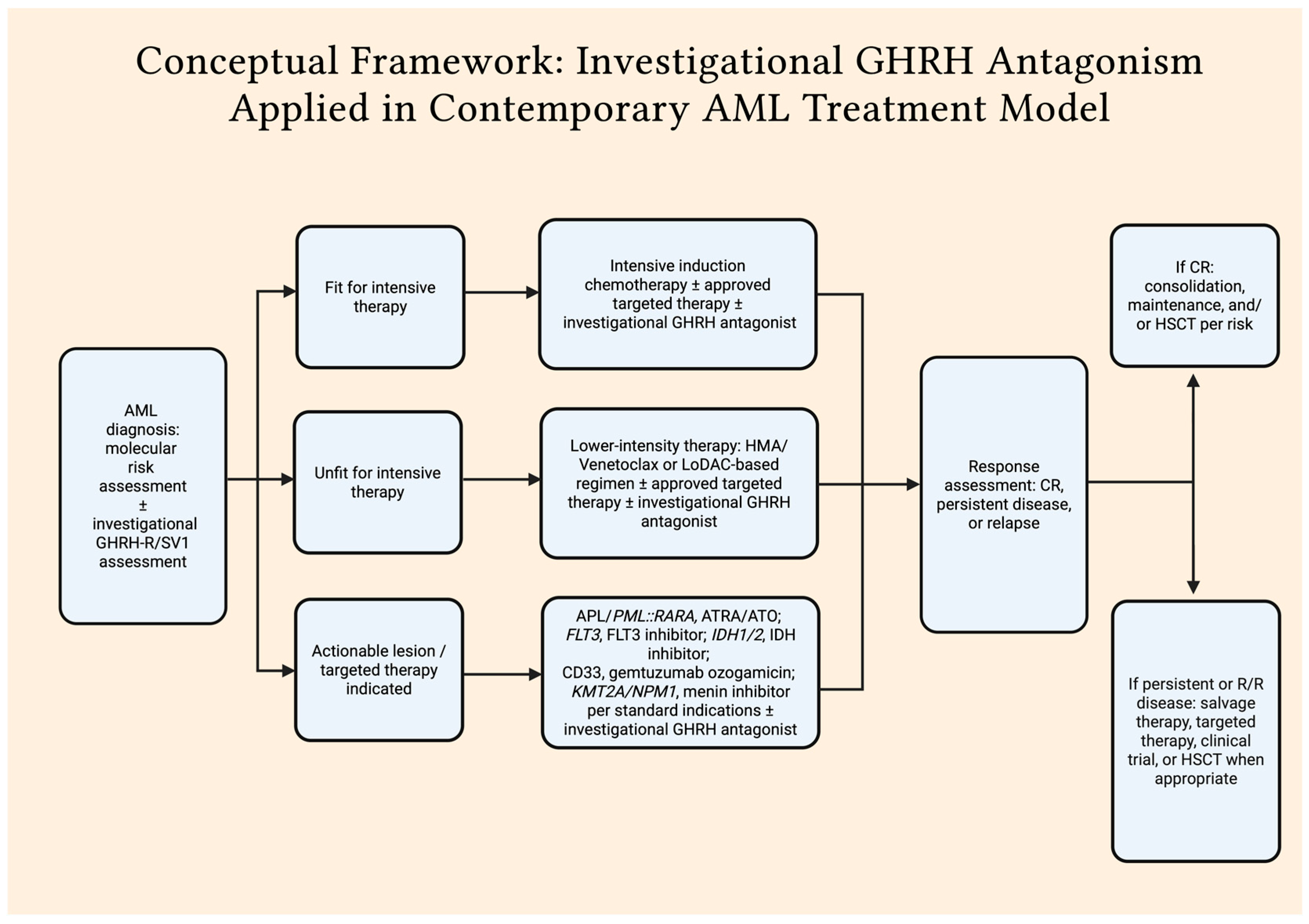
Lastly, although animal proof-of-concept studies might not have shown overt treatment-associated toxicity, human pharmacological and safety data for MIA-602 is currently unavailable. Future translational studies should look to prioritize patient-derived xenograft AML models, normal CD34-positive hematopoietic toxicity assays, and molecularly stratified testing across FLT3-mutated versus FLT3-wild-type models. Direct biochemical and functional readouts including p-FLT3, p-STAT5, p-AKT, p-ERK, apoptotic markers, stromal-rescue assays, and receptor-dependence studies will be needed to determine whether GHRH-R/SV1 antagonism modifies resistance-associated signaling. Figure 1 provides a conceptual framework for the potential investigational GHRH-R/SV1 assessment and treatment decision point inclusions within a contemporary AML treatment model.

6. Conclusions

As it stands, evidence regarding the application of GHRH antagonists, such as MIA-602, to AML remains pre-clinical and supports continued investigation. MIA-602 has demonstrated anti-leukemic activity against in vitro AML and APL models, as well as animal xenograft models in vivo, and their drug-resistant sublines. However, the therapeutic potential of GHRH antagonists, as they relate to broader AML subtypes is not yet fully understood, and key translational parameters such as pharmacokinetic studies, dose optimization, safety, and clinical efficacy remain to be established.
Biomolecular pathways implicated in FLT3 inhibitor resistance can involve PI3K/AKT, MAPK/ERK, and JAK/STAT signaling, as well as inflammatory cytokine modulation, microenvironmental stromal interactions, and aberrant apoptotic signaling networks. Several of these pathways share similar signaling networks to those reported by studies on MIA-602 and other GHRH antagonists. To date, no GHRH antagonist has been evaluated in FLT3-stratified AML models. No published evidence directly demonstrates GHRH antagonists possessing the ability to modulate FLT3 activation, FLT3-ITD/TKD signaling, or resistance to FLT3 inhibitors. Accordingly, GHRH antagonists should not be framed as an FLT3-targeted therapy. The potential relevance of MIA-602 to FLT3-mutated AML remains indirect and hypothesis generating. GHRH antagonists might serve as a resistance modifying strategy, due to shared overlap and potential modulation of signaling networks implicated in FLT3 inhibitor resistance.
Due to the absence of correlative clinical data, formal toxicology reports, and larger studies defining how GHRH signaling presents across larger FLT3-mutated AML cohorts, its clinical relevance remains uncertain. Future studies on GHRH antagonism should define GHRH-R/SV1 expression across molecularly annotated AML subtypes, and test MIA-602 against both FLT3-mutated and FLT3-wild-type AML models. Comparing direct biochemical and functional readouts between these groups across signaling networks implicated in FLT3 inhibitor resistance could clarify whether GHRH-R/SV1 antagonism has relevance for future AML resistance-aimed research. In the end, until more is known regarding AML-specific clinical efficacy, human pharmacokinetics, optimal dosing schedules, and drug safety data is formalized, GHRH antagonists like MIA-602 should be regarded as a hypothesis-generating pre-clinical research direction, rather than an established therapeutic modality for AML.

Author Contributions

Conceptualization, J.C. and J.J.J.; investigation, J.C. and J.J.J.; data curation, J.C. and J.J.J.; writing—original draft preparation, J.C. and J.J.J.; writing—review and editing, J.C. and J.J.J.; visualization, J.C. and J.J.J.; supervision, J.J.J.; project administration, J.J.J. All authors have read and agreed to the published version of the manuscript.

Funding

This research received no external funding.

Institutional Review Board Statement

Not applicable.

Informed Consent Statement

Not applicable.

Data Availability Statement

No new data were created or analyzed in this study. Data sharing is not applicable to this article.

Conflicts of Interest

The authors declare no conflicts of interest.

Abbreviations

The following abbreviations are used in this manuscript:
GHRHGrowth Hormone-Releasing Hormone
AMLAcute Myeloid Leukemia
GHRH-RGrowth Hormone-Releasing Hormone Receptor
APLAcute Promyelocytic Leukemia
ATRAAll-Trans-Retinoic Acid
ATOArsenic Trioxide
IGF-IInsulin-Like Growth Factor 1
SVSplice Variant
pGHRH-RPituitary Growth Hormone-Releasing Hormone
RAAATRA/ATO Resistance
ELNEuropean LeukemiaNet
NCCNNational Comprehensive Cancer Network
FLT3Fms-Like Tyrosine Kinase 3
FLT3-LFms-Like Tyrosine Kinase 3-Ligand
FLT3-ITDFms-Like Tyrosine Kinase 3 In-Frame Internal Tandem Duplication
FLT3-TKDFms-Like Tyrosine Kinase 3 Tyrosine Kinase Domain
R/RRelapsed or Refractory
OSOverall Survival
TFATrifluoroacetic Acid
MIA-602 (Ac)Acetate Salt Form of MIA-602
HMAHypomethylating Agent
LoDACLow-Dose Cytarabine
PMLPromyelocytic Leukemia
HSCTHematopoietic Stem Cell Transplant
PKAProtein Kinase A
GPCRG Protein-Coupled Receptor
AKTProtein Kinase B
PI3KPhosphoinositide 3-Kinase
cAMPCyclic Adenosine Monophosphate
IDH 1/2Isocitrate Dehydrogenase 1/2
CBFCore Binding Factor
NPM1Nucleophosmin 1
KMT2ALysine Methyltransferase 2A

References

  1. Hoffman, R.; Benz, E.J., Jr.; Silberstein, L.E.; Heslop, H.E.; Weitz, J.I.; Salama, M.E. (Eds.) Hematology: Basic Principles and Practice, 8th ed.; Elsevier: Philidelphia, PA, USA, 2022. [Google Scholar]
  2. DiNardo, C.D.; Erba, H.P.; Freeman, S.D.; Wei, A.H. Acute myeloid leukaemia. Lancet 2023, 401, 2073–2086. [Google Scholar] [CrossRef] [PubMed]
  3. Khoury, J.D.; Solary, E.; Abla, O.; Akkari, Y.; Alaggio, R.; Apperley, J.F.; Bejar, R.; Berti, E.; Busque, L.; Chan, J.K.C.; et al. The 5th edition of the World Health Organization Classification of Haematolymphoid Tumours: Myeloid and Histiocytic/Dendritic Neoplasms. Leukemia 2022, 36, 1703–1719. [Google Scholar] [CrossRef] [PubMed]
  4. Arber, D.A.; Orazi, A.; Hasserjian, R.P.; Borowitz, M.J.; Calvo, K.R.; Kvasnicka, H.M.; Wang, S.A.; Bagg, A.; Barbui, T.; Branford, S.; et al. International Consensus Classification of Myeloid Neoplasms and Acute Leukemias: Integrating morphologic, clinical, and genomic data. Blood 2022, 140, 1200–1228. [Google Scholar] [CrossRef] [PubMed]
  5. Falini, B.; Martelli, M.P. Comparison of the International Consensus and 5th WHO edition classifications of adult myelodysplastic syndromes and acute myeloid leukemia. Am. J. Hematol. 2023, 98, 481–492. [Google Scholar] [CrossRef] [PubMed]
  6. Xiao, W.; Nardi, V.; Stein, E.; Hasserjian, R.P. A practical approach on the classifications of myeloid neoplasms and acute leukemia: WHO and ICC. J. Hematol. Oncol. 2024, 17, 56. [Google Scholar] [CrossRef] [PubMed]
  7. Chen, X.; Patkar, N.; Tembhare, P.; Papagudi, S.; Yeung, C.; Kanagal Shamanna, R.; Gujral, S.; Wood, B.; Naresh, K.N. Fifth edition WHO classification: Myeloid neoplasms. J. Clin. Pathol. 2025, 78, 335–345. [Google Scholar] [CrossRef] [PubMed]
  8. Hemminki, K.; Zitricky, F.; Forsti, A.; Kontro, M.; Gjertsen, B.T.; Severinsen, M.T.; Juliusson, G. Age-specific survival in acute myeloid leukemia in the Nordic countries through a half century. Blood Cancer J. 2024, 14, 44. [Google Scholar] [CrossRef] [PubMed]
  9. Dohner, H.; Weisdorf, D.J.; Bloomfield, C.D. Acute Myeloid Leukemia. N. Engl. J. Med. 2015, 373, 1136–1152. [Google Scholar] [CrossRef] [PubMed]
  10. Döhner, H.; DiNardo, C.D.; Appelbaum, F.R.; Craddock, C.; Dombret, H.; Ebert, B.L.; Fenaux, P.; Godley, L.A.; Hasserjian, R.P.; Larson, R.A.; et al. Genetic risk classification for adults with AML receiving less-intensive therapies: The 2024 ELN recommendations. Blood 2024, 144, 2169–2173. [Google Scholar] [CrossRef] [PubMed]
  11. Dohner, H.; Wei, A.H.; Appelbaum, F.R.; Craddock, C.; DiNardo, C.D.; Dombret, H.; Ebert, B.L.; Fenaux, P.; Godley, L.A.; Hasserjian, R.P.; et al. Diagnosis and management of AML in adults: 2022 recommendations from an international expert panel on behalf of the ELN. Blood 2022, 140, 1345–1377. [Google Scholar] [CrossRef]
  12. Wei, A.H.; Loo, S.; Daver, N. How I treat patients with AML using azacitidine and venetoclax. Blood 2025, 145, 1237–1250. [Google Scholar] [CrossRef] [PubMed]
  13. Shimony, S.; Stahl, M.; Stone, R.M. Acute Myeloid Leukemia: 2025 Update on Diagnosis, Risk-Stratification, and Management. Am. J. Hematol. 2025, 100, 860–891. [Google Scholar] [CrossRef] [PubMed]
  14. Jimenez, J.J.; Chale, R.S.; Abad, A.C.; Schally, A.V. Acute promyelocytic leukemia (APL): A review of the literature. Oncotarget 2020, 11, 992–1003. [Google Scholar] [CrossRef] [PubMed]
  15. Hillestad, L.K. Acute promyelocytic leukemia. Acta Medica Scand. 1957, 159, 189–194. [Google Scholar] [CrossRef]
  16. Gaumond, S.I.; Abdin, R.; Costoya, J.; Schally, A.V.; Jimenez, J.J. Exploring the role of GHRH antagonist MIA-602 in overcoming Doxorubicin-resistance in acute myeloid leukemia. Oncotarget 2024, 15, 248–254. [Google Scholar] [CrossRef] [PubMed]
  17. Granata, R. Peripheral activities of growth hormone-releasing hormone. J. Endocrinol. Investig. 2016, 39, 721–727. [Google Scholar] [CrossRef] [PubMed]
  18. Guillemin, R.; Brazeau, P.; Bohlen, P.; Esch, F.; Ling, N.; Wehrenberg, W.B. Growth hormone-releasing factor from a human pancreatic tumor that caused acromegaly. Science 1982, 218, 585–587. [Google Scholar] [CrossRef] [PubMed]
  19. Frohman, L.A.; Szabo, M. Ectopic production of growth hormone-releasing factor by carcinoid and pancreatic islet tumors associated with acromegaly. Prog. Clin. Biol. Res. 1981, 74, 259–271. [Google Scholar] [PubMed]
  20. Kiaris, H.; Chatzistamou, I.; Papavassiliou, A.G.; Schally, A.V. Growth hormone-releasing hormone: Not only a neurohormone. Trends Endocrinol. Metab. 2011, 22, 311–317. [Google Scholar] [CrossRef] [PubMed]
  21. Schally, A.V.; Cai, R.; Zhang, X.; Sha, W.; Wangpaichitr, M. The development of growth hormone-releasing hormone analogs: Therapeutic advances in cancer, regenerative medicine, and metabolic disorders. Rev. Endocr. Metab. Disord. 2025, 26, 385–396. [Google Scholar] [CrossRef] [PubMed]
  22. Kahan, Z.; Arencibia, J.M.; Csernus, V.J.; Groot, K.; Kineman, R.D.; Robinson, W.R.; Schally, A.V. Expression of growth hormone-releasing hormone (GHRH) messenger ribonucleic acid and the presence of biologically active GHRH in human breast, endometrial, and ovarian cancers. J. Clin. Endocrinol. Metab. 1999, 84, 582–589. [Google Scholar] [CrossRef]
  23. Halmos, G.; Szabo, Z.; Dobos, N.; Juhasz, E.; Schally, A.V. Growth hormone-releasing hormone receptor (GHRH-R) and its signaling. Rev. Endocr. Metab. Disord. 2025, 26, 343–352. [Google Scholar] [CrossRef] [PubMed]
  24. Schulz, S.; Rocken, C.; Schulz, S. Immunocytochemical localisation of plasma membrane GHRH receptors in human tumours using a novel anti-peptide antibody. Eur. J. Cancer 2006, 42, 2390–2396. [Google Scholar] [CrossRef] [PubMed]
  25. Havt, A.; Schally, A.V.; Halmos, G.; Varga, J.L.; Toller, G.L.; Horvath, J.E.; Szepeshazi, K.; Koster, F.; Kovitz, K.; Groot, K.; et al. The expression of the pituitary growth hormone-releasing hormone receptor and its splice variants in normal and neoplastic human tissues. Proc. Natl. Acad. Sci. USA 2005, 102, 17424–17429. [Google Scholar] [CrossRef] [PubMed]
  26. Rekasi, Z.; Czompoly, T.; Schally, A.V.; Halmos, G. Isolation and sequencing of cDNAs for splice variants of growth hormone-releasing hormone receptors from human cancers. Proc. Natl. Acad. Sci. USA 2000, 97, 10561–10566. [Google Scholar] [CrossRef] [PubMed]
  27. Cong, Z.; Zhou, F.; Zhang, C.; Zou, X.; Zhang, H.; Wang, Y.; Zhou, Q.; Cai, X.; Liu, Q.; Li, J.; et al. Constitutive signal bias mediated by the human GHRHR splice variant 1. Proc. Natl. Acad. Sci. USA 2021, 118, e2106606118. [Google Scholar] [CrossRef] [PubMed]
  28. Pozsgai, E.; Schally, A.V.; Hocsak, E.; Zarandi, M.; Rick, F.; Bellyei, S. The effect of a novel antagonist of growth hormone releasing hormone on cell proliferation and on the key cell signaling pathways in nine different breast cancer cell lines. Int. J. Oncol. 2011, 39, 1025–1032. [Google Scholar] [CrossRef] [PubMed]
  29. Kiaris, H.; Chatzistamou, I.; Schally, A.V.; Halmos, G.; Varga, J.L.; Koutselini, H.; Kalofoutis, A. Ligand-dependent and -independent effects of splice variant 1 of growth hormone-releasing hormone receptor. Proc. Natl. Acad. Sci. USA 2003, 100, 9512–9517. [Google Scholar] [CrossRef] [PubMed]
  30. Vijayakumar, A.; Yakar, S.; Leroith, D. The intricate role of growth hormone in metabolism. Front. Endocrinol. 2011, 2, 32. [Google Scholar] [CrossRef] [PubMed]
  31. Schally, A.V.; Varga, J.L.; Engel, J.B. Antagonists of growth-hormone-releasing hormone: An emerging new therapy for cancer. Nat. Clin. Pract. Endocrinol. Metab. 2008, 4, 33–43. [Google Scholar] [CrossRef] [PubMed]
  32. Cui, T.; Jimenez, J.J.; Block, N.L.; Badiavas, E.V.; Rodriguez-Menocal, L.; Vila Granda, A.; Cai, R.; Sha, W.; Zarandi, M.; Perez, R.; et al. Agonistic analogs of growth hormone releasing hormone (GHRH) promote wound healing by stimulating the proliferation and survival of human dermal fibroblasts through ERK and AKT pathways. Oncotarget 2016, 7, 52661–52672. [Google Scholar] [CrossRef] [PubMed]
  33. Gesmundo, I.; Pedrolli, F.; Cai, R.; Sha, W.; Schally, A.V.; Granata, R. Growth hormone-releasing hormone and cancer. Rev. Endocr. Metab. Disord. 2025, 26, 443–456. [Google Scholar] [CrossRef] [PubMed]
  34. Schally, A.V.; Wang, H.; He, J.; Cai, R.; Sha, W.; Popovics, P.; Perez, R.; Vidaurre, I.; Zhang, X. Agonists of growth hormone-releasing hormone (GHRH) inhibit human experimental cancers in vivo by down-regulating receptors for GHRH. Proc. Natl. Acad. Sci. USA 2018, 115, 12028–12033. [Google Scholar] [CrossRef] [PubMed]
  35. Sacewicz, M.; Lawnicka, H.; Siejka, A.; Stepien, T.; Krupinski, R.; Komorowski, J.; Stepien, H. Inhibition of proliferation, VEGF secretion of human neuroendocrine tumor cell line NCI-H727 by an antagonist of growth hormone-releasing hormone (GH-RH) in vitro. Cancer Lett. 2008, 268, 120–128. [Google Scholar] [CrossRef] [PubMed]
  36. Perez, R.; Schally, A.V.; Vidaurre, I.; Rincon, R.; Block, N.L.; Rick, F.G. Antagonists of growth hormone-releasing hormone suppress in vivo tumor growth and gene expression in triple negative breast cancers. Oncotarget 2012, 3, 988–997. [Google Scholar] [CrossRef] [PubMed]
  37. Bellyei, S.; Schally, A.V.; Zarandi, M.; Varga, J.L.; Vidaurre, I.; Pozsgai, E. GHRH antagonists reduce the invasive and metastatic potential of human cancer cell lines in vitro. Cancer Lett. 2010, 293, 31–40. [Google Scholar] [CrossRef] [PubMed]
  38. Chatzistamou, I.; Schally, A.V.; Varga, J.L.; Groot, K.; Busto, R.; Armatis, P.; Halmos, G. Inhibition of growth and metastases of MDA-MB-435 human estrogen-independent breast cancers by an antagonist of growth hormone-releasing hormone. Anticancer Drugs 2001, 12, 761–768. [Google Scholar] [CrossRef] [PubMed]
  39. Csernus, V.; Schally, A.V.; Groot, K. Antagonistic analogs of growth hormone releasing hormone (GHRH) inhibit cyclic AMP production of human cancer cell lines in vitro. Peptides 1999, 20, 843–850. [Google Scholar] [CrossRef] [PubMed]
  40. Letsch, M.; Schally, A.V.; Busto, R.; Bajo, A.M.; Varga, J.L. Growth hormone-releasing hormone (GHRH) antagonists inhibit the proliferation of androgen-dependent and -independent prostate cancers. Proc. Natl. Acad. Sci. USA 2003, 100, 1250–1255. [Google Scholar] [CrossRef] [PubMed]
  41. Rick, F.G.; Schally, A.V.; Szalontay, L.; Block, N.L.; Szepeshazi, K.; Nadji, M.; Zarandi, M.; Hohla, F.; Buchholz, S.; Seitz, S. Antagonists of growth hormone-releasing hormone inhibit growth of androgen-independent prostate cancer through inactivation of ERK and Akt kinases. Proc. Natl. Acad. Sci. USA 2012, 109, 1655–1660. [Google Scholar] [CrossRef] [PubMed]
  42. Szepeshazi, K.; Schally, A.V.; Groot, K.; Armatis, P.; Hebert, F.; Halmos, G. Antagonists of growth hormone-releasing hormone (GH-RH) inhibit in vivo proliferation of experimental pancreatic cancers and decrease IGF-II levels in tumours. Eur. J. Cancer 2000, 36, 128–136. [Google Scholar] [CrossRef] [PubMed]
  43. Chu, W.K.; Law, K.S.; Chan, S.O.; Yam, J.C.; Chen, L.J.; Zhang, H.; Cheung, H.S.; Block, N.L.; Schally, A.V.; Pang, C.P. Antagonists of growth hormone-releasing hormone receptor induce apoptosis specifically in retinoblastoma cells. Proc. Natl. Acad. Sci. USA 2016, 113, 14396–14401. [Google Scholar] [CrossRef] [PubMed]
  44. Chatzistamou, I.; Schally, A.V.; Varga, J.L.; Groot, K.; Armatis, P.; Busto, R.; Halmos, G. Antagonists of growth hormone-releasing hormone and somatostatin analog RC-160 inhibit the growth of the OV-1063 human epithelial ovarian cancer cell line xenografted into nude mice. J. Clin. Endocrinol. Metab. 2001, 86, 2144–2152. [Google Scholar] [CrossRef]
  45. Szepeshazi, K.; Schally, A.V.; Groot, K.; Armatis, P.; Halmos, G.; Herbert, F.; Szende, B.; Varga, J.L.; Zarandi, M. Antagonists of growth hormone-releasing hormone (GH-RH) inhibit IGF-II production and growth of HT-29 human colon cancers. Br. J. Cancer 2000, 82, 1724–1731. [Google Scholar] [CrossRef] [PubMed]
  46. Kiaris, H.; Schally, A.V. Decrease in telomerase activity in U-87MG human glioblastomas after treatment with an antagonist of growth hormone-releasing hormone. Proc. Natl. Acad. Sci. USA 1999, 96, 226–231. [Google Scholar] [CrossRef] [PubMed]
  47. Jungwirth, A.; Schally, A.V.; Pinski, J.; Groot, K.; Armatis, P.; Halmos, G. Growth hormone-releasing hormone antagonist MZ-4-71 inhibits in vivo proliferation of Caki-I renal adenocarcinoma. Proc. Natl. Acad. Sci. USA 1997, 94, 5810–5813. [Google Scholar] [CrossRef] [PubMed]
  48. Gan, J.; Ke, X.; Jiang, J.; Dong, H.; Yao, Z.; Lin, Y.; Lin, W.; Wu, X.; Yan, S.; Zhuang, Y.; et al. Growth hormone-releasing hormone receptor antagonists inhibit human gastric cancer through downregulation of PAK1-STAT3/NF-kappaB signaling. Proc. Natl. Acad. Sci. USA 2016, 113, 14745–14750. [Google Scholar] [CrossRef] [PubMed]
  49. Braczkowski, R.; Schally, A.V.; Plonowski, A.; Varga, J.L.; Groot, K.; Krupa, M.; Armatis, P. Inhibition of proliferation in human MNNG/HOS osteosarcoma and SK-ES-1 Ewing sarcoma cell lines in vitro and in vivo by antagonists of growth hormone-releasing hormone: Effects on insulin-like growth factor II. Cancer 2002, 95, 1735–1745. [Google Scholar] [CrossRef] [PubMed]
  50. Zarandi, M.; Cai, R.; Kovacs, M.; Popovics, P.; Szalontay, L.; Cui, T.; Sha, W.; Jaszberenyi, M.; Varga, J.; Zhang, X.; et al. Synthesis and structure-activity studies on novel analogs of human growth hormone releasing hormone (GHRH) with enhanced inhibitory activities on tumor growth. Peptides 2017, 89, 60–70. [Google Scholar] [CrossRef] [PubMed]
  51. Keller, G.; Schally, A.V.; Groot, K.; Toller, G.L.; Havt, A.; Koster, F.; Armatis, P.; Halmos, G.; Zarandi, M.; Varga, J.L.; et al. Effective treatment of experimental human non-Hodgkin’s lymphomas with antagonists of growth hormone-releasing hormone. Proc. Natl. Acad. Sci. USA 2005, 102, 10628–10633. [Google Scholar] [CrossRef] [PubMed]
  52. Izdebski, J.; Pinski, J.; Horvath, J.E.; Halmos, G.; Groot, K.; Schally, A.V. Synthesis and biological evaluation of superactive agonists of growth hormone-releasing hormone. Proc. Natl. Acad. Sci. USA 1995, 92, 4872–4876. [Google Scholar] [CrossRef] [PubMed]
  53. Zarandi, M.; Kovacs, M.; Horvath, J.E.; Toth, K.; Halmos, G.; Groot, K.; Nagy, A.; Kele, Z.; Schally, A.V. Synthesis and in vitro evaluation of new potent antagonists of growth hormone-releasing hormone (GH-RH). Peptides 1997, 18, 423–430. [Google Scholar] [CrossRef] [PubMed]
  54. Stephanou, A.; Knight, R.A.; Lightman, S.L. Production of a growth hormone-releasing hormone-like peptide and its mRNA by human lymphocytes. Neuroendocrinology 1991, 53, 628–633. [Google Scholar] [PubMed]
  55. Khorram, O.; Garthwaite, M.; Golos, T. The influence of aging and sex hormones on expression of growth hormone-releasing hormone in the human immune system. J. Clin. Endocrinol. Metab. 2001, 86, 3157–3161. [Google Scholar] [CrossRef]
  56. Cai, R.; Zhang, X.; Wang, H.; Cui, T.; Halmos, G.; Sha, W.; He, J.; Popovics, P.; Vidaurre, I.; Zhang, C.; et al. Synthesis of potent antagonists of receptors for growth hormone-releasing hormone with antitumor and anti-inflammatory activity. Peptides 2022, 150, 170716. [Google Scholar] [CrossRef] [PubMed]
  57. Jimenez, J.J.; DelCanto, G.M.; Popovics, P.; Perez, A.; Vila Granda, A.; Vidaurre, I.; Cai, R.Z.; Rick, F.G.; Swords, R.T.; Schally, A.V. A new approach to the treatment of acute myeloid leukaemia targeting the receptor for growth hormone-releasing hormone. Br. J. Haematol. 2018, 181, 476–485. [Google Scholar] [CrossRef] [PubMed]
  58. Chale, R.S.; Rodriguez, M.; Almeida, S.M.; Sclatter, S.; Singaready, A.; Schally, A.V.; Jimenez, J.J. Synergistic effects of MIA-602 and its potential for use in ATRA/ATO Resistant APL. Cancer Res. 2023, 83, 385. [Google Scholar] [CrossRef]
  59. Chale, R.S.; Almeida, S.M.; Rodriguez, M.; Jozic, I.; Gaumond, S.I.; Schally, A.V.; Jimenez, J.J. The Application of GHRH Antagonist as a Treatment for Resistant APL. Cancers 2023, 15, 3104. [Google Scholar] [CrossRef] [PubMed]
  60. Chale, R.; Singareddy, A.; Sclater, S.; Almeida, S.; Lens, A.; Schally, A.; Jimenez, J. AML-438 K562: An In-Vitro AML Model for Studying Synergistic Effects of Doxorubicin & MIA-602. Clin. Lymphoma Myeloma Leuk. 2022, 22, S251. [Google Scholar] [CrossRef]
  61. Perez-Stable, C.; de las Pozas, A.; Wangpaichitr, M.; Sha, W.; Wang, H.; Cai, R.; Schally, A.V. Growth Hormone-Releasing Hormone (GHRH) Antagonist Peptides Combined with PI3K Isoform Inhibitors Enhance Cell Death in Prostate Cancer. Cancers 2025, 17, 1643. [Google Scholar] [CrossRef] [PubMed]
  62. Dekant, W.; Dekant, R. Mammalian toxicity of trifluoroacetate and assessment of human health risks due to environmental exposures. Arch. Toxicol. 2023, 97, 1069–1077. [Google Scholar] [CrossRef] [PubMed]
  63. Costoya, J.; Costoya, E.; Wangpaichitr, M.; Sha, W.; Jimenez, J.J. Abstract 4537: Modified acetate salt form of GHRH-antagonist retains anti-leukemic activity against acute myelogenous leukemia. Cancer Res. 2026, 86, 4537. [Google Scholar] [CrossRef]
  64. Ishii, H.; Yano, S. New Therapeutic Strategies for Adult Acute Myeloid Leukemia. Cancers 2022, 14, 2806. [Google Scholar] [CrossRef] [PubMed]
  65. Roskoski, R., Jr. The role of small molecule Flt3 receptor protein-tyrosine kinase inhibitors in the treatment of Flt3-positive acute myelogenous leukemias. Pharmacol. Res. 2020, 155, 104725. [Google Scholar] [CrossRef] [PubMed]
  66. Jalte, M.; Abbassi, M.; El Mouhi, H.; Daha Belghiti, H.; Ahakoud, M.; Bekkari, H. FLT3 Mutations in Acute Myeloid Leukemia: Unraveling the Molecular Mechanisms and Implications for Targeted Therapies. Cureus 2023, 15, e45765. [Google Scholar] [CrossRef] [PubMed]
  67. Kiyoi, H.; Naoe, T.; Yokota, S.; Nakao, M.; Minami, S.; Kuriyama, K.; Takeshita, A.; Saito, K.; Hasegawa, S.; Shimodaira, S.; et al. Internal tandem duplication of FLT3 associated with leukocytosis in acute promyelocytic leukemia. Leukemia Study Group of the Ministry of Health and Welfare (Kohseisho). Leukemia 1997, 11, 1447–1452. [Google Scholar] [CrossRef] [PubMed]
  68. Kumar, N.M.; Nathany, S.; Swaminathan, A.; Yadav, C.; Kothari, A.; Garg, P.; Panda-Rastogi, N.; Dua, V.; Danewa, A.; Bhargava, R. FLT3: A narrative review. Cancer Res. Stat. Treat. 2025, 8, 66–74. [Google Scholar] [CrossRef] [PubMed]
  69. Levis, M.; Small, D. FLT3: ITDoes matter in leukemia. Leukemia 2003, 17, 1738–1752. [Google Scholar] [CrossRef] [PubMed]
  70. Perrone, S.; Ottone, T.; Zhdanovskaya, N.; Molica, M. How acute myeloid leukemia (AML) escapes from FMS-related tyrosine kinase 3 (FLT3) inhibitors? Still an overrated complication? Cancer Drug Resist. 2023, 6, 223–238. [Google Scholar] [CrossRef] [PubMed]
  71. Choudhary, C.; Brandts, C.; Schwable, J.; Tickenbrock, L.; Sargin, B.; Ueker, A.; Bohmer, F.D.; Berdel, W.E.; Muller-Tidow, C.; Serve, H. Activation mechanisms of STAT5 by oncogenic Flt3-ITD. Blood 2007, 110, 370–374. [Google Scholar] [CrossRef] [PubMed]
  72. Takahashi, S. Downstream molecular pathways of FLT3 in the pathogenesis of acute myeloid leukemia: Biology and therapeutic implications. J. Hematol. Oncol. 2011, 4, 13. [Google Scholar] [CrossRef] [PubMed]
  73. Rataj, J.; Gorecki, L.; Muthna, D.; Sorf, A.; Krystof, V.; Klener, P.; Ceckova, M.; Rezacova, M.; Korabecny, J. Targeting FMS-like tyrosine kinase 3 (FLT3) in acute myeloid leukemia: Novel molecular approaches and therapeutic challenges. Biomed. Pharmacother. 2025, 182, 117788. [Google Scholar] [CrossRef] [PubMed]
  74. Kennedy, V.E.; Smith, C.C. FLT3 Mutations in Acute Myeloid Leukemia: Key Concepts and Emerging Controversies. Front. Oncol. 2020, 10, 612880. [Google Scholar] [CrossRef] [PubMed]
  75. Stone, R.M.; Mandrekar, S.J.; Sanford, B.L.; Laumann, K.; Geyer, S.; Bloomfield, C.D.; Thiede, C.; Prior, T.W.; Dohner, K.; Marcucci, G.; et al. Midostaurin plus Chemotherapy for Acute Myeloid Leukemia with a FLT3 Mutation. N. Engl. J. Med. 2017, 377, 454–464. [Google Scholar] [CrossRef] [PubMed]
  76. Dhillon, S. Gilteritinib: First Global Approval. Drugs 2019, 79, 331–339. [Google Scholar] [CrossRef] [PubMed]
  77. Erba, H.P.; Montesinos, P.; Kim, H.-J.; Patkowska, E.; Vrhovac, R.; Žák, P.; Wang, P.-N.; Mitov, T.; Hanyok, J.; Kamel, Y.M.; et al. Quizartinib plus chemotherapy in newly diagnosed patients with FLT3-internal-tandem-duplication-positive acute myeloid leukaemia (QuANTUM-First): A randomised, double-blind, placebo-controlled, phase 3 trial. Lancet 2023, 401, 1571–1583. [Google Scholar] [CrossRef] [PubMed]
  78. Costoya, J.; Gaumond, S.I.; Chale, R.S.; Schally, A.V.; Jimenez, J.J. A novel approach for the treatment of AML, through GHRH antagonism: MIA-602. Rev. Endocr. Metab. Disord. 2025, 26, 483–491. [Google Scholar] [CrossRef] [PubMed]
Figure 1. Conceptual framework of a contemporary AML treatment model with the inclusion of GHRH antagonist-based therapy. GHRH-R and SV1, denoting splice variant 1, the principal tumor-associated GHRH-R variant implicated in GHRH bioactivity, would be assessed during AML diagnosis work-up. Use of GHRH antagonist would later be considered during standard-of-care AML therapy regimens. GHRH antagonists shown here are currently at the pre-clinical stage and not established AML therapy. AML, acute myeloid leukemia; GHRH-R, growth hormone-releasing hormone receptor; SV1, splice variant 1; CR, complete remission; R/R, relapsed or refractory; HSCT, hematopoietic stem cell transplantation; HMA, hypomethylating agent; LoDAC, low-dose cytarabine; APL, acute promyelocytic leukemia; PML, promyelocytic leukemia; ATRA, all-trans retinoic acid; ATO, arsenic trioxide; FLT3, fms-like tyrosine kinase 3; IDH1/2, isocitrate dehydrogenase 1/2; KMT2A, lysine methyltransferase 2A; NPM1, nucleophosmin 1. Created in BioRender. Costoya, J. (2026), https://BioRender.com/c44h727 (accessed on 15 June 2026).
Jpm 16 00331 g001
Disclaimer/Publisher’s Note: The statements, opinions and data contained in all publications are solely those of the individual author(s) and contributor(s) and not of MDPI and/or the editor(s). MDPI and/or the editor(s) disclaim responsibility for any injury to people or property resulting from any ideas, methods, instructions or products referred to in the content.