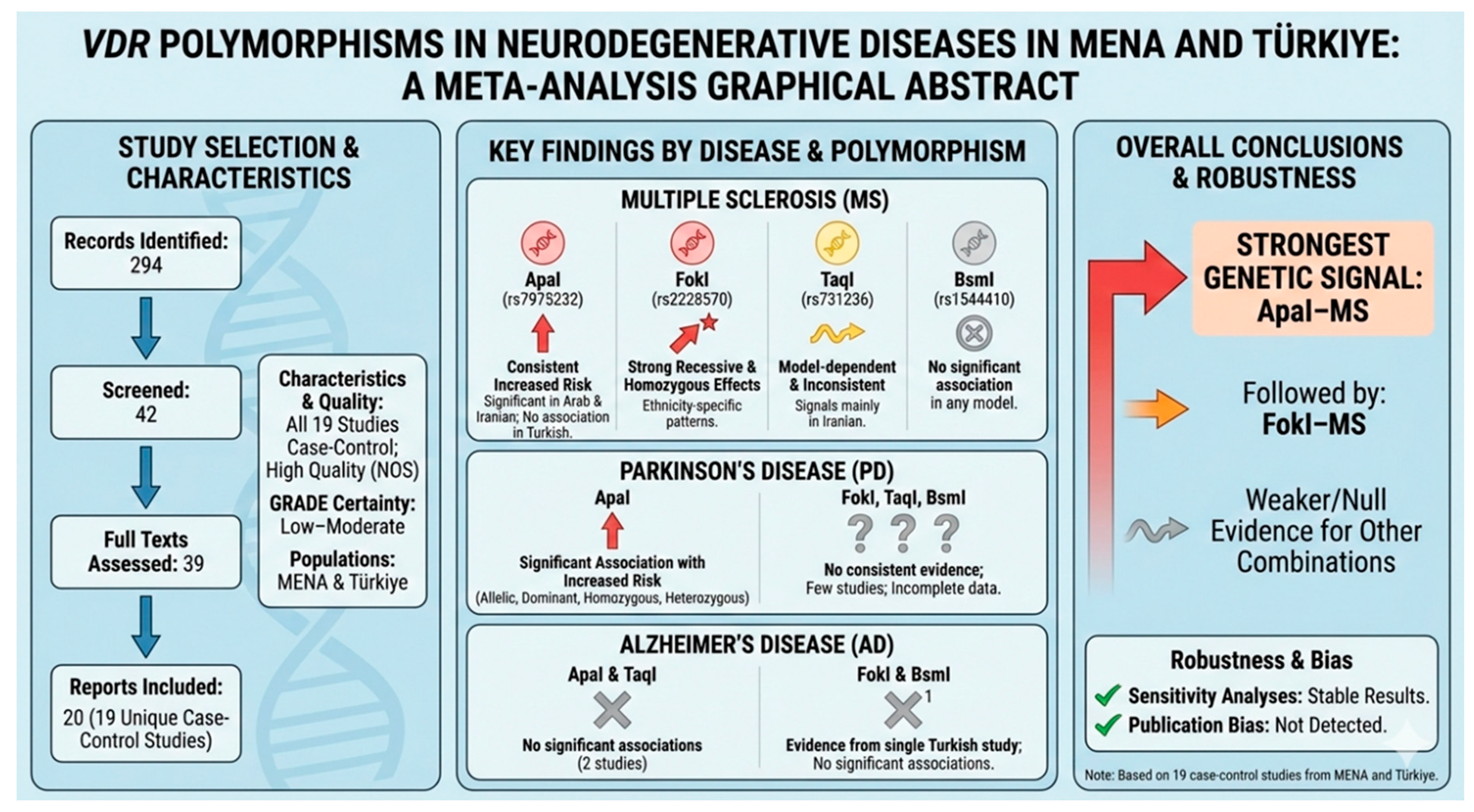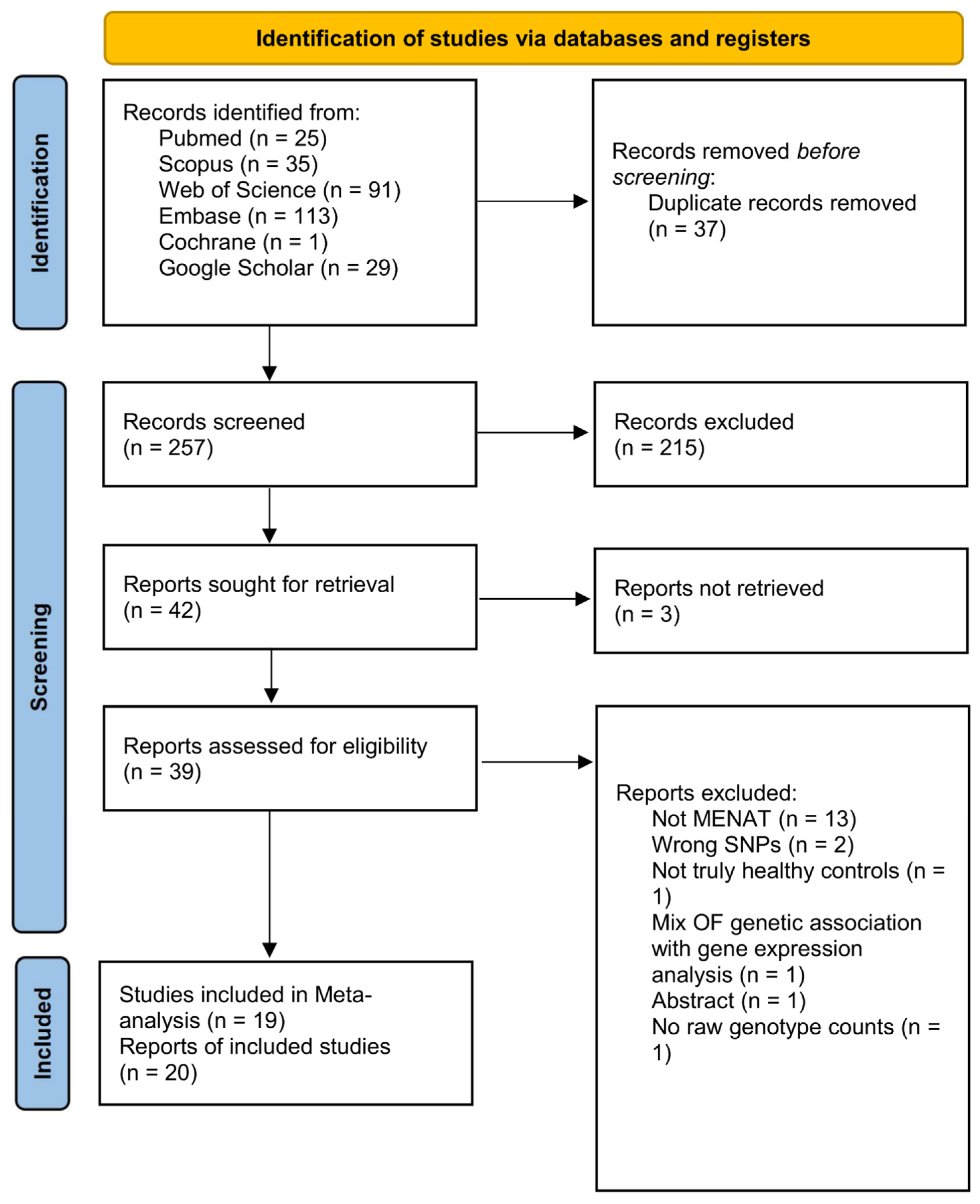

Associations of Vitamin D Receptor (ApaI, FokI, TaqI, BsmI) Polymorphisms with Neurodegenerative Diseases in the Middle East, North Africa and Turkiye (MENA&T) Region: A Systematic Review and Meta-Analysis Toward Population-Specific Precision Medicine

 ,
,  ,
,  , ,
, ,  and
and 
Abstract
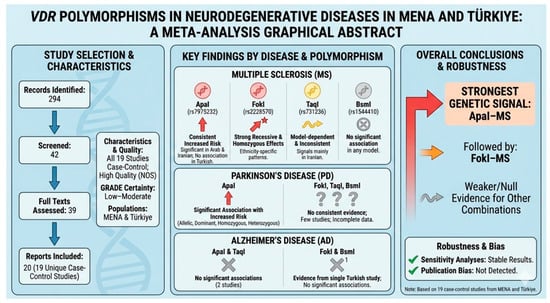
1. Introduction
2. Materials and Methods
2.1. Search Strategy and Eligibility Criteria
2.2. Data Extraction and Quality of Evidence
2.3. Genetic Models
2.4. Outcomes
2.5. Statistical Analysis
3. Results
3.1. ApaI (rs7975232) Polymorphism and Risk of MS
3.2. FokI (rs2228570) Polymorphism and Risk of MS
3.3. TaqI (rs731236) Polymorphism and Risk of MS
3.4. BsmI (rs1544410) Polymorphism and Risk of MS
3.5. Vitamin D Receptor Polymorphisms and Risk of PD and AD: Exploratory Analyses
4. Discussion
5. Conclusions
Supplementary Materials
Author Contributions
Funding
Institutional Review Board Statement
Informed Consent Statement
Data Availability Statement
Conflicts of Interest
Abbreviations
| AD | Alzheimer’s Disease |
| ALS | Amyotrophic Lateral Sclerosis |
| CI | Confidence Interval |
| CNS | Central Nervous System |
| EAE | Experimental Autoimmune Encephalomyelitis |
| GRADE | Grading of Recommendations Assessment, Development, and Evaluation |
| GWAS | Genome-Wide Association Study |
| HWE | Hardy–Weinberg Equilibrium |
| MENA&T | Middle East, North Africa, and Türkiye |
| MS | Multiple Sclerosis |
| NOS | Newcastle-Ottawa Scale |
| OR | Odds Ratio |
| PD | Parkinson’s Disease |
| PRISMA | Preferred Reporting Items for Systematic Reviews and Meta-Analyses |
| PROSPERO | International Prospective Register of Systematic Reviews |
| SNP | Single-Nucleotide Polymorphism |
| VDR | Vitamin D Receptor |
References
- Scheltens, P.; De Strooper, B.; Kivipelto, M.; Holstege, H.; Chételat, G.; Teunissen, C.E.; Cummings, J.; van der Flier, W.M. Alzheimer’s disease. Lancet 2021, 397, 1577–1590. [Google Scholar] [CrossRef] [PubMed]
- Ascherio, A.; Munger, K.L. Epidemiology of Multiple Sclerosis: From Risk Factors to Prevention—An Update. Semin. Neurol. 2016, 36, 103–114. [Google Scholar] [CrossRef] [PubMed]
- Littlejohns, T.J.; Henley, W.E.; Lang, I.A.; Annweiler, C.; Beauchet, O.; Chaves, P.H.; Fried, L.; Kestenbaum, B.R.; Kuller, L.H.; Langa, K.M.; et al. Vitamin D and the risk of dementia and Alzheimer disease. Neurology 2014, 83, 920–928. [Google Scholar] [CrossRef]
- Theodoratou, E.; Tzoulaki, I.; Zgaga, L.; Ioannidis, J.P. Vitamin D and multiple health outcomes: Umbrella review of systematic reviews and meta-analyses of observational studies and randomised trials. BMJ 2014, 348, g2035. [Google Scholar] [CrossRef]
- Autier, P.; Boniol, M.; Pizot, C.; Mullie, P. Vitamin D status and ill health: A systematic review. Lancet Diabetes Endocrinol. 2014, 2, 76–89. [Google Scholar] [CrossRef] [PubMed]
- Jehan, F.; d’Alésio, A.; Garabédian, M. Exons and functional regions of the human vitamin D receptor gene around and within the main 1a promoter are well conserved among mammals. J. Steroid Biochem. Mol. Biol. 2007, 103, 361–367. [Google Scholar] [CrossRef]
- Agliardi, C.; Guerini, F.R.; Bolognesi, E.; Zanzottera, M.; Clerici, M. VDR Gene Single Nucleotide Polymorphisms and Autoimmunity: A Narrative Review. Biology 2023, 12, 916. [Google Scholar] [CrossRef]
- Panza, F.; La Montagna, M.; Lampignano, L.; Zupo, R.; Bortone, I.; Castellana, F.; Sardone, R.; Borraccino, L.; Dibello, V.; Resta, E.; et al. Vitamin D in the development and progression of alzheimer’s disease: Implications for clinical management. Expert Rev. Neurother. 2021, 21, 287–301. [Google Scholar] [CrossRef]
- Kundu, N.C.; Kundu, A.; Khalil, M.I.; Joy, K.; Sen, M.; Hasan, Z.; Sahabuddin, M.; Rafi, M.A.; Hasan, M.J. A case-control study on vitamin D receptor gene polymorphisms in patients with Parkinson’s disease in Bangladesh. Sci. Rep. 2025, 15, 12333. [Google Scholar] [CrossRef]
- Elkama, A.; Orhan, G.; Karahalil, B. Association of vitamin D receptor polymorphisms with vitamin D and calcium levels in Turkish multiple sclerosis patients. Neurodegener. Dis. Manag. 2022, 12, 323–331. [Google Scholar] [CrossRef]
- Imani, D.; Razi, B.; Motallebnezhad, M.; Rezaei, R. Association between vitamin D receptor (VDR) polymorphisms and the risk of multiple sclerosis (MS): An updated meta-analysis. BMC Neurol. 2019, 19, 339. [Google Scholar] [CrossRef]
- Sheikhi, A.; Nabiuni, M.; Zia, S.; Sadeghi, M.; Brühl, A.B.; Brand, S. Association of VDR Polymorphisms (FokI, ApaI, and TaqI) with Susceptibility to Lumbar Disc Herniation: Systematic Review, Meta-Analysis, Trial Sequential Analysis, and Transcriptional Prediction. Medicina 2025, 61, 882. [Google Scholar] [CrossRef] [PubMed]
- Salimi, S.; Eskandari, F.; Rezaei, M.; Sandoughi, M. Vitamin D Receptor rs2228570 and rs731236 Polymorphisms are Susceptible Factors for Systemic Lupus Erythematosus. Adv. Biomed. Res. 2019, 8, 48. [Google Scholar] [CrossRef]
- Liu, N.; Zhang, T.; Ma, L.; Wei, W.; Li, Z.; Jiang, X.; Sun, J.; Pei, H.; Li, H. Vitamin D Receptor Gene Polymorphisms and Risk of Alzheimer Disease and Mild Cognitive Impairment: A Systematic Review and Meta-Analysis. Adv. Nutr. 2021, 12, 2255–2264. [Google Scholar] [CrossRef]
- Machuron, F.; Dessalles, R.; Ribet, L.; Bentouhami, H.; Escutnaire, J.; Brusselaers, N.; Durand-Dubief, M. Vitamin D Nutritional Status in the Middle East and North Africa Region: A Systematic Review and Meta-analysis. Curr. Dev. Nutr. 2025, 9, 107577. [Google Scholar] [CrossRef]
- Al-Eitan, L.; Darabseh, S. VDR gene variants FokI and ApaI: Factors associated with susceptibility to multiple sclerosis. PLoS ONE 2025, 20, e0332473. [Google Scholar] [CrossRef]
- Pistono, C.; Osera, C.; Monti, M.C.; Boiocchi, C.; Mallucci, G.; Cuccia, M.; Montomoli, C.; Bergamaschi, R.; Pascale, A. Vitamin D receptor and its influence on multiple sclerosis risk and severity: From gene polymorphisms to protein expression. Immuno 2022, 2, 469–481. [Google Scholar] [CrossRef]
- Lasoń, W.; Jantas, D.; Leśkiewicz, M.; Regulska, M.; Basta-Kaim, A. The vitamin D receptor as a potential target for the treatment of age-related neurodegenerative diseases such as Alzheimer’s and Parkinson’s diseases: A narrative review. Cells 2023, 12, 660. [Google Scholar] [CrossRef]
- Eyles, D.W. Vitamin D: Brain and Behavior. JBMR Plus 2021, 5, e10419. [Google Scholar] [CrossRef] [PubMed]
- Máčová, L.; Kancheva, R.; Bičíková, M. Molecular Regulation of the CNS by Vitamin D. Physiol. Res. 2023, 72, S339–S356. [Google Scholar] [CrossRef]
- Al-Temaimi, R.A.; Al-Enezi, A.; Al-Serri, A.; Alroughani, R.; Al-Mulla, F. The Association of Vitamin D Receptor Polymorphisms with Multiple Sclerosis in a Case-Control Study from Kuwait. PLoS ONE 2015, 10, e0142265. [Google Scholar] [CrossRef]
- Yu, X.H.; Lu, H.M.; Li, J.; Su, M.Z.; Li, X.M.; Jin, Y. Association between 25(OH) vitamin D and multiple sclerosis: Cohort, shared genetics, and Causality. Nutr. J. 2024, 23, 151. [Google Scholar] [CrossRef] [PubMed]
- Wang, Y.; Marling, S.J.; Zhu, J.G.; Severson, K.S.; DeLuca, H.F. Development of experimental autoimmune encephalomyelitis (EAE) in mice requires vitamin D and the vitamin D receptor. Proc. Natl. Acad. Sci. USA 2012, 109, 8501–8504. [Google Scholar] [CrossRef] [PubMed]
- Pandit, L.; Ramagopalan, S.V.; Malli, C.; D’Cunha, A.; Kunder, R.; Shetty, R. Association of vitamin D and multiple sclerosis in India. Mult. Scler. 2013, 19, 1592–1596. [Google Scholar] [CrossRef]
- Bulan, B.; Hoscan, A.Y.; Keskin, S.N.; Cavus, A.; Culcu, E.A.; Isik, N.; List, E.O.; Arman, A. Vitamin D Receptor Polymorphisms Among the Turkish Population are Associated with Multiple Sclerosis. Balk. J. Med. Genet. 2022, 25, 41–50. [Google Scholar] [CrossRef] [PubMed]
- Evatt, M.L.; Delong, M.R.; Khazai, N.; Rosen, A.; Triche, S.; Tangpricha, V. Prevalence of vitamin d insufficiency in patients with Parkinson disease and Alzheimer disease. Arch. Neurol. 2008, 65, 1348–1352. [Google Scholar] [CrossRef]
- Lv, L.; Tan, X.; Peng, X.; Bai, R.; Xiao, Q.; Zou, T.; Tan, J.; Zhang, H.; Wang, C. The relationships of vitamin D, vitamin D receptor gene polymorphisms, and vitamin D supplementation with Parkinson’s disease. Transl. Neurodegener. 2020, 9, 34. [Google Scholar] [CrossRef]
- Rissardo, J.P.; Caprara, A.L.F. The Role of Vitamin D in Parkinson’s Disease: Evidence from Serum Concentrations, Supplementation, and VDR Gene Polymorphisms. NeuroSci 2025, 6, 130. [Google Scholar] [CrossRef]
- Wang, X.; Shen, N.; Lu, Y.; Tan, K. Vitamin D receptor polymorphisms and the susceptibility of Parkinson’s disease. Neurosci. Lett. 2019, 699, 206–211. [Google Scholar] [CrossRef]
- Fullard, M.E.; Duda, J.E. A Review of the Relationship Between Vitamin D and Parkinson Disease Symptoms. Front. Neurol. 2020, 11, 454. [Google Scholar] [CrossRef]
- Zheng, Z.; Chen, M.; Feng, S.; Zhao, H.; Qu, T.; Zhao, X.; Ruan, Q.; Li, L.; Guo, J. VDR and deubiquitination control neuronal oxidative stress and microglial inflammation in Parkinson’s disease. Cell Death Discov. 2024, 10, 150. [Google Scholar] [CrossRef] [PubMed]
- Calvello, R.; Cianciulli, A.; Nicolardi, G.; De Nuccio, F.; Giannotti, L.; Salvatore, R.; Porro, C.; Trotta, T.; Panaro, M.A.; Lofrumento, D.D. Vitamin D Treatment Attenuates Neuroinflammation and Dopaminergic Neurodegeneration in an Animal Model of Parkinson’s Disease, Shifting M1 to M2 Microglia Responses. J. Neuroimmune Pharmacol. 2017, 12, 327–339. [Google Scholar] [CrossRef] [PubMed]
- Alshahawy, R.Z.; Safwat, S.M.; El-Kholy, S.S.; El-Basiony, S.F.; El-Desouky, S.; Helmi, S.M. Vitamin D and omega-3 fatty acids attenuate MSG-induced neurodegeneration by modulating tau pathology, neuroinflammation, and VDR expression in rats. Sci. Rep. 2025, 15, 20187. [Google Scholar] [CrossRef]
- Savran, Z.; Baltaci, S.B.; Aladag, T.; Mogulkoc, R.; Baltaci, A.K. Vitamin D and Neurodegenerative Diseases Such as Multiple Sclerosis (MS), Parkinson’s Disease (PD), Alzheimer’s Disease (AD), and Amyotrophic Lateral Sclerosis (ALS): A Review of Current Literature. Curr. Nutr. Rep. 2025, 14, 77. [Google Scholar] [CrossRef]
- Balion, C.; Griffith, L.E.; Strifler, L.; Henderson, M.; Patterson, C.; Heckman, G.; Llewellyn, D.J.; Raina, P. Vitamin D, cognition, and dementia: A systematic review and meta-analysis. Neurology 2012, 79, 1397–1405. [Google Scholar] [CrossRef] [PubMed]
- Huang, Y.; Chen, Y.; Wu, Y.; Wu, Y.; Dai, X.; Feng, J.; Li, X. Association of vitamin D with risk of dementia: A dose-response meta-analysis of observational studies. Front. Neurol. 2025, 16, 1649841. [Google Scholar] [CrossRef]
- Gao, J.; Teng, J.; Liu, Z.; Cai, M.; Xie, A. Association between vitamin D receptor polymorphisms and susceptibility to Parkinson’s disease: An updated meta-analysis. Neurosci. Lett. 2020, 720, 134778. [Google Scholar] [CrossRef]
- Palacios, C.; Gonzalez, L. Is vitamin D deficiency a major global public health problem? J. Steroid Biochem. Mol. Biol. 2014, 144, 138–145. [Google Scholar] [CrossRef]
- Chakhtoura, M.; Rahme, M.; Chamoun, N.; El-Hajj Fuleihan, G. Vitamin D in the Middle East and North Africa. Bone Rep. 2018, 8, 135–146. [Google Scholar] [CrossRef] [PubMed]
- Wang, W.; Li, Y.; Meng, X. Vitamin D and neurodegenerative diseases. Heliyon 2023, 9, e12877. [Google Scholar] [CrossRef]
- Gatto, N.M.; Paul, K.C.; Sinsheimer, J.S.; Bronstein, J.M.; Bordelon, Y.; Rausch, R.; Ritz, B. Vitamin D receptor gene polymorphisms and cognitive decline in Parkinson’s disease. J. Neurol. Sci. 2016, 370, 100–106. [Google Scholar] [CrossRef]
- Khoury, S.J.; Tintore, M. Multiple sclerosis in the Middle East and North Africa region. Mult. Scler. J. Exp. Transl. Clin. 2020, 6, 2055217319895540. [Google Scholar] [CrossRef] [PubMed]
- Hassab, A.H.; Deif, A.H.; Elneely, D.A.; Tawadros, I.M.; Fayad, A.I. Protective association of VDR gene polymorphisms and haplotypes with multiple sclerosis patients in Egyptian population. Egypt. J. Med. Hum. Hum. Genet. 2019, 20, 4. [Google Scholar] [CrossRef]
- Haussler, M.R.; Livingston, S.; Sabir, Z.L.; Haussler, C.A.; Jurutka, P.W. Vitamin D Receptor Mediates a Myriad of Biological Actions Dependent on Its 1,25-Dihydroxyvitamin D Ligand: Distinct Regulatory Themes Revealed by Induction of Klotho and Fibroblast Growth Factor-23. JBMR Plus 2021, 5, e10432. [Google Scholar] [CrossRef]
- Uitterlinden, A.G.; Fang, Y.; van Meurs, J.B.; van Leeuwen, H.; Pols, H.A. Vitamin D receptor gene polymorphisms in relation to Vitamin D related disease states. J. Steroid Biochem. Mol. Biol. 2004, 89–90, 187–193. [Google Scholar] [CrossRef] [PubMed]
- Li, C.; Qi, H.; Wei, S.; Wang, L.; Fan, X.; Duan, S.; Bi, S. Vitamin D receptor gene polymorphisms and the risk of Parkinson’s disease. Neurol. Sci. 2015, 36, 247–255. [Google Scholar] [CrossRef]
- Page, M.J.; McKenzie, J.E.; Bossuyt, P.M.; Boutron, I.; Hoffmann, T.C.; Mulrow, C.D.; Shamseer, L.; Tetzlaff, J.M.; Akl, E.A.; Brennan, S.E.; et al. The PRISMA 2020 statement: An updated guideline for reporting systematic reviews. BMJ 2021, 372, n71. [Google Scholar] [CrossRef] [PubMed]
- Chandler, J.; Cumpston, M.; Li, T.; Page, M.J.; Welch, V. Cochrane handbook for systematic reviews of interventions. Hoboken Wiley 2019, 4, 14651858. [Google Scholar]
- Moher, D.; Liberati, A.; Tetzlaff, J.; Altman, D.G. Preferred reporting items for systematic reviews and meta-analyses: The PRISMA statement. PLoS Med. 2009, 6, e1000097. [Google Scholar] [CrossRef]
- Wells, G.A.; Shea, B.; O’Connell, D.; Peterson, J.; Welch, V.; Losos, M.; Tugwell, P. The Newcastle-Ottawa Scale (NOS) for Assessing the Quality of Nonrandomised Studies in Meta-Analyses. 2000. Available online: https://www.researchgate.net/publication/261773681_The_Newcastle-Ottawa_Scale_NOS_for_Assessing_the_Quality_of_Non-Randomized_Studies_in_Meta-Analysis (accessed on 20 December 2025).
- Zhang, Y.; Alonso-Coello, P.; Guyatt, G.H.; Yepes-Nuñez, J.J.; Akl, E.A.; Hazlewood, G.; Pardo-Hernandez, H.; Etxeandia-Ikobaltzeta, I.; Qaseem, A.; Williams, J.W., Jr.; et al. GRADE Guidelines: 19. Assessing the certainty of evidence in the importance of outcomes or values and preferences-Risk of bias and indirectness. J. Clin. Epidemiol. 2019, 111, 94–104. [Google Scholar] [CrossRef]
- Guyatt, G.H.; Oxman, A.D.; Vist, G.E.; Kunz, R.; Falck-Ytter, Y.; Alonso-Coello, P.; Schünemann, H.J. GRADE: An emerging consensus on rating quality of evidence and strength of recommendations. BMJ 2008, 336, 924–926. [Google Scholar] [CrossRef]
- Ben-Selma, W.; Ben-Fredj, N.; Chebel, S.; Frih-Ayed, M.; Aouni, M.; Boukadida, J. Age- and gender-specific effects on VDR gene polymorphisms and risk of the development of multiple sclerosis in Tunisians: A preliminary study. Int. J. Immunogenet. 2015, 42, 174–181. [Google Scholar] [CrossRef]
- Yucel, F.E.; Kamıslı, O.; Acar, C.; Sozen, M.; Tecellioğlu, M.; Ozcan, C. Analysis of Vitamin D Receptor Polymorphisms in Patients with Familial Multiple Sclerosis. Med. Arch. 2018, 72, 58–61. [Google Scholar] [CrossRef]
- Gezen-Ak, D.; Dursun, E.; Ertan, T.; Hanağasi, H.; Gürvit, H.; Emre, M.; Eker, E.; Oztürk, M.; Engin, F.; Yilmazer, S. Association between vitamin D receptor gene polymorphism and Alzheimer’s disease. Tohoku J. Exp. Med. 2007, 212, 275–282. [Google Scholar] [CrossRef]
- Mosavi, R.; Arababadi, M.K.; Hassanshahi, G.; Azin, H.; Araste, M.; Salehabad, V.A.; Vazirinejad, R.; Pourali, R.; Hakimi, H.; Kennedy, D. Association of a polymorphism within intron 8 but not exon 9 of the vitamin D receptor in patients with multiple sclerosis of southeastern iranian ethnicity. Lab. Med. 2013, 44, 215–219. [Google Scholar] [CrossRef]
- Moosavi, E.; Rafiei, A.; Yazdani, Y.; Eslami, M.; Saeedi, M. Association of serum levels and receptor genes BsmI, TaqI and FokI polymorphisms of vitamin D with the severity of multiple sclerosis. J. Clin. Neurosci. 2021, 84, 75–81. [Google Scholar] [CrossRef]
- Kamisli, O.; Acar, C.; Sozen, M.; Tecellioglu, M.; Yücel, F.E.; Vaizoglu, D.; Özcan, C. The association between vitamin D receptor polymorphisms and multiple sclerosis in a Turkish population. Mult. Scler. Relat. Disord. 2018, 20, 78–81. [Google Scholar] [CrossRef]
- Gezen-Ak, D.; Alaylıoğlu, M.; Genç, G.; Gündüz, A.; Candaş, E.; Bilgiç, B.; Atasoy, İ.L.; Apaydın, H.; Kızıltan, G.; Gürvit, H.; et al. GC and VDR SNPs and Vitamin D Levels in Parkinson’s Disease: The Relevance to Clinical Features. Neuromolecular Med. 2017, 19, 24–40. [Google Scholar] [CrossRef]
- Abdollahzadeh, R.; Fard, M.S.; Rahmani, F.; Moloudi, K.; Kalani, B.S.; Azarnezhad, A. Predisposing role of vitamin D receptor (VDR) polymorphisms in the development of multiple sclerosis: A case-control study. J. Neurol. Sci. 2016, 367, 148–151. [Google Scholar] [CrossRef]
- Khorram Khorshid, H.R.; Gozalpour, E.; Saliminejad, K.; Karimloo, M.; Ohadi, M.; Kamali, K. Vitamin D Receptor (VDR) Polymorphisms and Late-Onset Alzheimer’s Disease: An Association Study. Iran. J. Public. Health 2013, 42, 1253–1258. [Google Scholar]
- Abdollahzadeh, R.; Moradi Pordanjani, P.; Rahmani, F.; Mashayekhi, F.; Azarnezhad, A.; Mansoori, Y. Association of VDR gene polymorphisms with risk of relapsing-remitting multiple sclerosis in an Iranian Kurdish population. Int. J. Neurosci. 2018, 128, 505–511. [Google Scholar] [CrossRef]
- Narooie-Nejad, M.; Moossavi, M.; Torkamanzehi, A.; Moghtaderi, A.; Salimi, S. Vitamin D Receptor Gene Polymorphism and the Risk of Multiple Sclerosis in South Eastern of Iran. J. Mol. Neurosci. 2015, 56, 572–576. [Google Scholar] [CrossRef]
- Gezen-Ak, D.; Dursun, E.; Bilgiç, B.; Hanağasi, H.; Ertan, T.; Gürvit, H.; Emre, M.; Eker, E.; Ulutin, T.; Uysal, O.; et al. Vitamin D receptor gene haplotype is associated with late-onset Alzheimer’s disease. Tohoku J. Exp. Med. 2012, 228, 189–196. [Google Scholar] [CrossRef]
- Abdelwahab, N.R.; Mabrouk, R.R.; Zakaria, N.M.; Abdel Nasser, A.; Mostafa, A.A.; Wahba, N.S. Vitamin D receptor gene polymorphism in Egyptian multiple sclerosis patients. Egypt. J. Immunol. 2024, 31, 44–54. [Google Scholar] [CrossRef]
- Fahmy, E.M.; Elawady, M.E.; Sharaf, S.; Heneidy, S.; Ismail, R.S. Vitamin D receptor gene polymorphisms and idiopathic Parkinson disease: An Egyptian study. Egypt. J. Neurol. Psychiatry Neurosurg. 2021, 57, 102. [Google Scholar] [CrossRef]
- Cakina, S.; Ocak, O.; Ozkan, A.; Yucel, S.; Karaman, H.I.O. Vitamin D receptor gene polymorphisms in multiple sclerosis disease: A case-control study. Rev. Romana Med. Lab. 2018, 26, 489–495. [Google Scholar] [CrossRef]
- Narooie-Nejad, M.; Moossavi, M.; Torkamanzehi, A.; Moghtaderi, A. Positive association of vitamin D receptor gene variations with multiple sclerosis in South East Iranian population. Biomed. Res. Int. 2015, 2015, 427519. [Google Scholar] [CrossRef]
- Ghaseminejad-Raeini, A.; Ghaderi, A.; Sharafi, A.; Nematollahi-Sani, B.; Moossavi, M.; Derakhshani, A.; Sarab, G.A. Immunomodulatory actions of vitamin D in various immune-related disorders: A comprehensive review. Front. Immunol. 2023, 14, 950465. [Google Scholar] [CrossRef]
- Chen, X.L.; Zhang, M.L.; Zhu, L.; Peng, M.L.; Liu, F.Z.; Zhang, G.X.; Wang, L.M.; Zhao, J. Vitamin D receptor gene polymorphisms and the risk of multiple sclerosis: An updated meta-analysis. Microb. Pathog. 2017, 110, 594–602. [Google Scholar] [CrossRef]
- Balasooriya, N.N.; Elliott, T.M.; Neale, R.E.; Vasquez, P.; Comans, T.; Gordon, L.G. The association between vitamin D deficiency and multiple sclerosis: An updated systematic review and meta-analysis. Mult. Scler. Relat. Disord. 2024, 90, 105804. [Google Scholar] [CrossRef]
- Smolders, J.; Damoiseaux, J.; Menheere, P.; Hupperts, R. Vitamin D as an immune modulator in multiple sclerosis, a review. J. Neuroimmunol. 2008, 194, 7–17. [Google Scholar] [CrossRef]
- Higgins, J.P.; Thompson, S.G.; Deeks, J.J.; Altman, D.G. Measuring inconsistency in meta-analyses. BMJ 2003, 327, 557–560. [Google Scholar] [CrossRef] [PubMed]
- Sohani, Z.N.; Meyre, D.; de Souza, R.J.; Joseph, P.G.; Gandhi, M.; Dennis, B.B.; Norman, G.; Anand, S.S. Assessing the quality of published genetic association studies in meta-analyses: The quality of genetic studies (Q-Genie) tool. BMC Genet. 2015, 16, 50. [Google Scholar] [CrossRef] [PubMed]
- Ioannidis, J.P.; Boffetta, P.; Little, J.; O’Brien, T.R.; Uitterlinden, A.G.; Vineis, P.; Balding, D.J.; Chokkalingam, A.; Dolan, S.M.; Flanders, W.D.; et al. Assessment of cumulative evidence on genetic associations: Interim guidelines. Int. J. Epidemiol. 2008, 37, 120–132. [Google Scholar] [CrossRef]
- Holick, M.F. Vitamin D deficiency. N. Engl. J. Med. 2007, 357, 266–281. [Google Scholar] [CrossRef]
- Badawi, A.; Arora, P.; Sadoun, E.; Al-Thani, A.A.; Thani, M.H. Prevalence of vitamin d insufficiency in qatar: A systematic review. J. Public. Health Res. 2012, 1, 229–235. [Google Scholar] [CrossRef]
- Rosenberg, N.A.; Pritchard, J.K.; Weber, J.L.; Cann, H.M.; Kidd, K.K.; Zhivotovsky, L.A.; Feldman, M.W. Genetic structure of human populations. Science 2002, 298, 2381–2385. [Google Scholar] [CrossRef] [PubMed]




| Study (Author, Year) | Country | Ethnicity | Study Design | Disease | Cases (n) | Controls (n) | Mean Age (Cases/Controls) | Sex (M/F) Cases/Controls | SNPs Investigated | Diagnostic Criteria | Genotyping Method |
|---|---|---|---|---|---|---|---|---|---|---|---|
| Ben-Selma et al., 2015 [53] | Tunisia | Arab | Case–control | Multiple sclerosis | 60 | 114 | Not reported explicitly. Men: 43.31 years Women: 35.81 years/Men: 37 years Women: 33 years | 22/38; 47/67 | TaqI, ApaI | MS diagnosis based on MRI, CSF & evoked potentials; formal criteria not specified | PCR-RFLP |
| Yucel et al., 2018 [54] | Turkey | Turkish | Case–control | Multiple sclerosis | 29 | 120 | 33.7 ± 10.7 years/33.1 ± 8.5 years | 8/21; 59/61 | TaqI, ApaI, FokI | MS diagnosis: criteria not specified | TaqMan SNP Assay |
| Gezen-Ak et al., 2007 [55] | Turkey | Turkish | Case–control | Alzheimer’s disease | 104 | 109 | 75.1 ± 5.7 years/73.6 ± 7.3 years | Not reported | ApaI, TaqI | DSM-IV criteria for late-onset AD | PCR-RFLP |
| Mosavi et al., 2013 [56] | Iran | Iranian | Case–control | Multiple sclerosis | 100 | 100 | 40 ± 9 years/40 ± 7 years | 41/59; 40/60 | ApaI, TaqI | RRMS diagnosed using McDonald criteria (MRI, CSF, evoked potentials) | PCR-RFLP |
| Moosavi et al., 2021 [57] | Iran | Iranian | Case–control | Multiple sclerosis | 160 | 162 | 34.3 ± 8.3 years/35.4 ± 7.9 years | 45/115; 54/108 | FokI, BsmI, TaqI | MS was diagnosed according to the McDonald criteria | PCR-RFLP |
| Abdollahzadeh et al., 2018 [62] | Iran | Iranian | Case–control | Multiple sclerosis | 118 | 124 | 37.8 ± 2.5/38.2 ± 3.6 | 36/82; 39/85 | FokI, TaqI, ApaI, BsmI, | Relapsing–remitting MS diagnosed according to McDonald criteria | PCR-RFLP |
| Kamisli et al., 2018 [58] | Turkey | Turkish | Case–control | Multiple sclerosis | 167 | 146 | 39.96 ± 9.46/33.81 ± 7.12 | 46/121; 58/88 | TaqI, FokI, ApaI | Multiple sclerosis was diagnosed according to the McDonald criteria | TaqMan SNP Assay |
| Alaylıoğlu et al., 2017 [59] | Turkey | Turkish | Case–control | Parkinson’s disease | 382 | 242 | 61.7 ± 11.4/64.6 ± 10.3 | 221/161; 118/124 | TaqI, ApaI, BsmI, FokI, | Parkinson’s disease was diagnosed according to the UK Parkinson’s Disease Society Brain Bank criteria | PCR-RFLP + LightSNiP |
| Narooie-Nejad et al., 2015 [63] | Iran | Iranian | Case–control | Multiple sclerosis | 113 | 122 | 32.4 ± 8.9/30.8 ± 10.2 | 25/88; 28/94 | TaqI, ApaI | Multiple sclerosis was diagnosed according to the McDonald criteria | PCR-RFLP |
| Abdollahzadeh et al., 2016 [60] | Iran | Iranian | Case–control | Multiple sclerosis | 160 | 150 | 35.9 ± 2.3/36.8 ± 1.8 | 40/120; 38/112 | ApaI, BsmI, FokI, TaqI | Relapsing–remitting MS diagnosed according to McDonald criteria | PCR-RFLP |
| Hassab et al., 2019 [43] | Egypt | Arab | Case–control | Multiple sclerosis | 50 | 50 | 30 ± 8 years/32 ± 11 years | 22/28; 18/32 | FokI, BsmI, ApaI, TaqI | Multiple sclerosis was diagnosed according to the McDonald criteria | PCR–RFLP |
| Al-Temaimi et al., 2015 [21] | Kuwait | Arab | Case–control | Multiple sclerosis | 50 | 50 | 33.44 ± 9.63 years/28.68 ± 7.98 years | 17/33; 19/31 | TaqI, BsmI, ApaI, FokI | Multiple sclerosis (RRMS/SPMS) diagnosed in a specialist MS clinic; formal criteria not explicitly stated | TaqMan SNP Assay |
| AL-Eitan et al., 2025 [16] | Jordan | Arab | Case–control | Multiple sclerosis | 218 | 200 | 35.70 ± 10.20 years/27.08 ± 6.19 years | 71/147; 62/138 | FokI, BsmI, TaqI, ApaI | Multiple sclerosis was diagnosed according to the McDonald criteria | MassARRAY |
| Khorshid et al., 2013 [61] | Iran | Iranian | Case–control | Alzheimer’s disease | 145 | 162 | 78.55 ± 7.80 years/77.14 ± 6.95 years | 63/91; 63/99 | TaqI, ApaI | Late-onset Alzheimer’s disease was diagnosed according to DSM-IV criteria | PCR–RFLP |
| Dursun et al., 2013 [64] | Turkey | Turkish | Case–control | Alzheimer’s disease | 108 | 115 | 74 ± 4.2 years/75.2 ± 6.8 years | Not reported | BsmI, FokI | Late-onset Alzheimer’s disease was diagnosed according to DSM-IV criteria | PCR–RFLP |
| Abdelwahab et al., 2024 [65] | Egypt | Arab | Case–control | Multiple sclerosis | 50 | 50 | Median age cases: 30 years (IQR 23.75–36.0); controls: age-matched (18–40 years) | 9/41; 15/35 | FokI, ApaI, BsmI | Relapsing–remitting MS diagnosed according to McDonald criteria (2017) | TaqMan SNP Assay |
| Fahmy et al., 2021 [66] | Egypt | Arab | Case–control | Parkinson disease | 50 | 50 | 60.8 ± 5.0 years/61.4 ± 5.7 years | 34/16; 32/18 | FokI, Apal | Idiopathic Parkinson’s disease diagnosed according to MDS clinical diagnostic criteria (2015) | TaqMan PCR |
| Cakina et al., 2018 [67] | Turkey | Turkish | Case–control | Multiple sclerosis | 70 | 70 | 44.4 ± 11.2 years/38.2 ± 9.5 years | 19/51; 22/48 | ApaI, BsmI, TaqI | Multiple sclerosis was diagnosed according to the Revised McDonald Criteria | PCR–RFLP |
| Bulan et al., 2022 [25] | Turkey | Turkish | Case–control | Multiple sclerosis | 271 | 203 | Not reported | Not reported | FokI, BsmI, TaqI | Multiple sclerosis was diagnosed according to the McDonald criteria | PCR–RFLP |
| Study (Author, Year) | Selection | Comparability | Exposure | Total | Number of Stars | Quality Judgement |
|---|---|---|---|---|---|---|
| Ben-Selma et al., 2015 [53] | ✩✩✩✩ | ✩ | ✩✩ | ✩✩✩✩✩✩✩ | 7 | High |
| Yucel et al., 2018 [54] | ✩✩✩✩ | ✩ | ✩✩ | ✩✩✩✩✩✩✩ | 7 | High |
| Gezen-Ak et al., 2007 [55] | ✩✩✩✩ | ✩ | ✩✩ | ✩✩✩✩✩✩✩ | 7 | High |
| Mosavi et al., 2013 [56] | ✩✩✩✩ | ✩✩ | ✩✩ | ✩✩✩✩✩✩✩✩ | 8 | High |
| Moosavi et al., 2021 [57] | ✩✩✩✩ | ✩✩ | ✩✩ | ✩✩✩✩✩✩✩✩ | 8 | High |
| Abdollahzadeh et al., 2018 [62] | ✩✩✩✩ | ✩ | ✩✩ | ✩✩✩✩✩✩✩ | 7 | High |
| Kamisli et al., 2018 [58] | ✩✩✩✩ | ✩ | ✩✩ | ✩✩✩✩✩✩✩ | 7 | High |
| Alaylıoğlu et al., 2017 [59] | ✩✩✩✩ | ✩ | ✩✩ | ✩✩✩✩✩✩✩ | 7 | High |
| Narooie-Nejad et al., 2015 [63] | ✩✩✩✩ | ✩ | ✩✩ | ✩✩✩✩✩✩✩ | 7 | High |
| Abdollahzadeh et al., 2016 [60] | ✩✩✩✩ | ✩ | ✩✩ | ✩✩✩✩✩✩✩ | 7 | High |
| Hassab et al., 2019 [43] | ✩✩✩✩ | ✩✩ | ✩✩ | ✩✩✩✩✩✩✩✩ | 8 | High |
| Al-Temaimi et al., 2015 [21] | ✩✩✩✩ | ✩✩ | ✩✩ | ✩✩✩✩✩✩✩✩ | 8 | High |
| AL-Eitan et al., 2025 [16] | ✩✩✩✩ | ✩✩ | ✩✩ | ✩✩✩✩✩✩✩✩ | 8 | High |
| Khorshid et al., 2013 [61] | ✩✩✩✩ | ✩ | ✩✩ | ✩✩✩✩✩✩✩ | 7 | High |
| Dursun et al., 2013 [64] | ✩✩✩✩ | ✩ | ✩✩ | ✩✩✩✩✩✩✩ | 7 | High |
| Abdelwahab et al., 2024 [65] | ✩✩✩✩ | ✩✩ | ✩✩ | ✩✩✩✩✩✩✩✩ | 8 | High |
| Fahmy et al., 2021 [66] | ✩✩✩✩ | ✩ | ✩✩ | ✩✩✩✩✩✩✩ | 7 | High |
| Cakina et al., 2018 [67] | ✩✩✩✩ | ✩ | ✩✩ | ✩✩✩✩✩✩✩ | 7 | High |
| Bulan et al., 2022 [25] | ✩✩✩✩ | ✩ | ✩✩ | ✩✩✩✩✩✩✩ | 7 | High |
| Polymorphism | Genetic Model | OR (95% CI) | p -Value | Heterogeneity (I2) | p -Value (Egger’s Test) |
|---|---|---|---|---|---|
| FokI | Allelic | 1.28 (1.00–1.63) | 0.0521 | 66.0% | 0.2230 |
| Dominant | 1.27 (0.96–1.66) | 0.0916 | 56.5% | 0.0759 | |
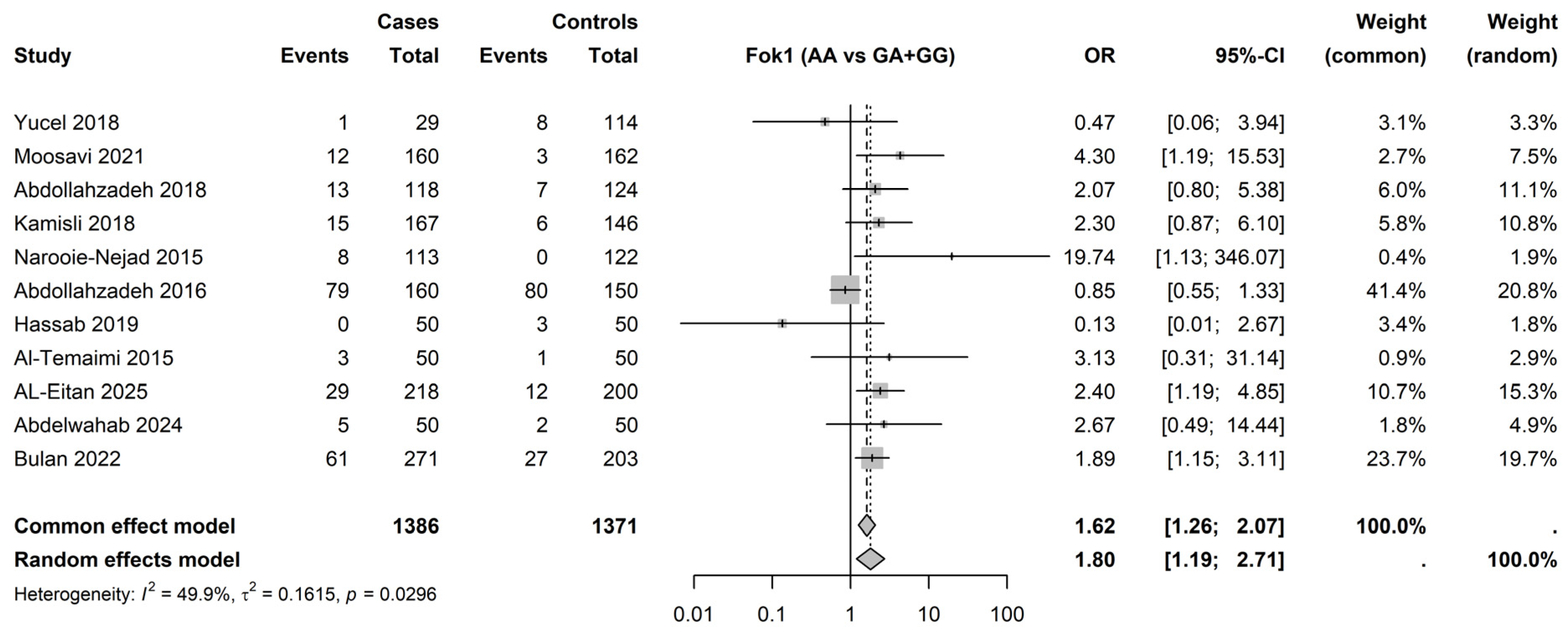
| Recessive | 1.80 (1.19–2.71) | 0.0055 | 49.9% | 0.3772 | |
| Homozygous | 2.04 (1.37–3.04) | 0.0004 | 40.6% | 0.9629 | |
| Heterozygous | 1.17 (0.91–1.50) | 0.2120 | 45.7% | 0.1480 | |
| BsmI | Allelic | 1.02 (0.81–1.29) | 0.8479 | 71.1% | 0.517 |
| Dominant | 1.02 (0.78–1.33) | 0.8952 | 57.4% | 0.6129 | |
| Recessive | 1.18 (0.84–1.64) | 0.3345 | 53.3% | 0.3340 | |
| Homozygous | 1.14 (0.71–1.84) | 0.5855 | 65.0% | 0.3543 | |
| Heterozygous | 1.00 (0.80–1.25) | 0.9838 | 27.6% | 0.6335 | |
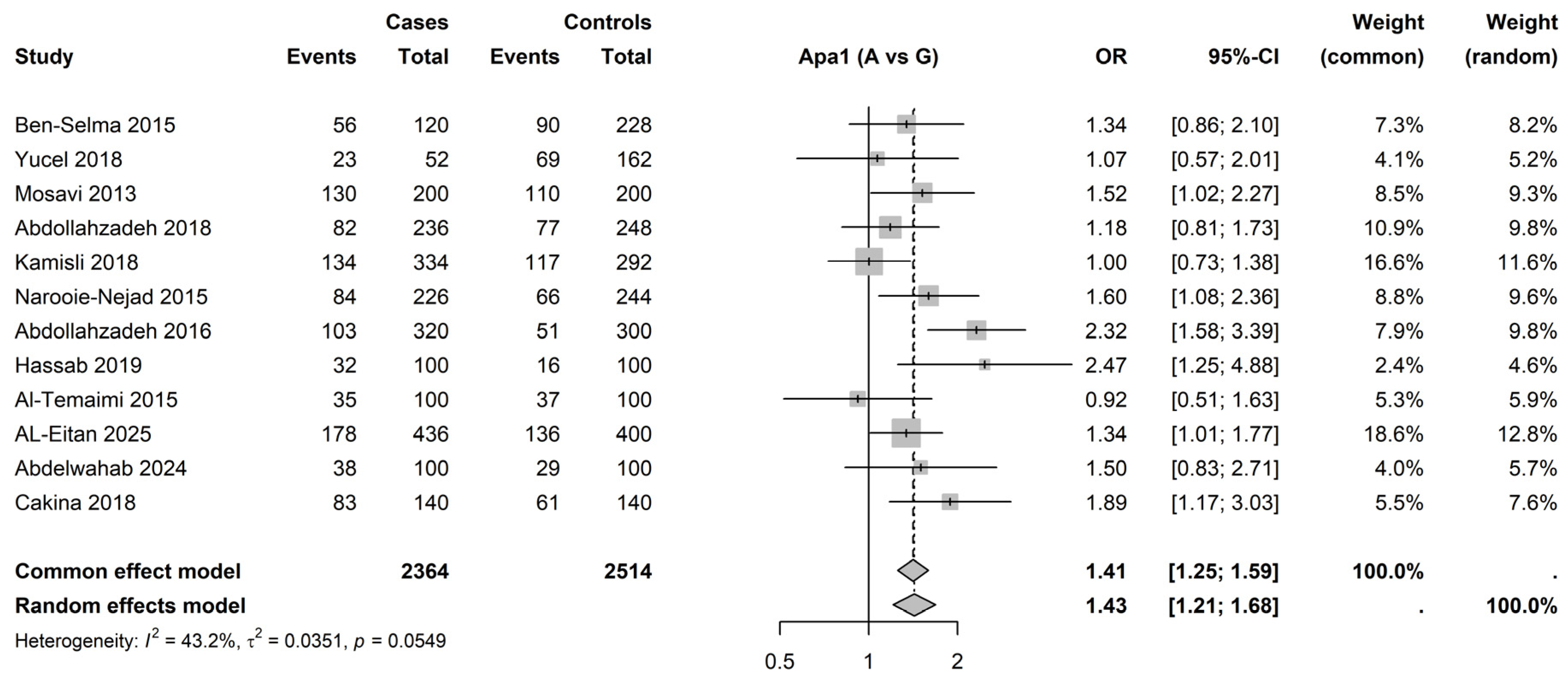
| ApaI | Allelic | 1.43 (1.21–1.68) | <0.0001 | 43.2% | 0.5648 |
| Dominant | 1.67 (1.31–2.14) | <0.0001 | 52.0% | 0.0817 | |
| Recessive | 1.41 (1.11–1.78) | 0.0044 | 11.8% | 0.9214 | |
| Homozygous | 1.91 (1.33–2.75) | 0.0005 | 41.9% | 0.2527 | |
| Heterozygous | 1.61 (1.25–2.06) | 0.0002 | 48.5% | 0.0329 | |
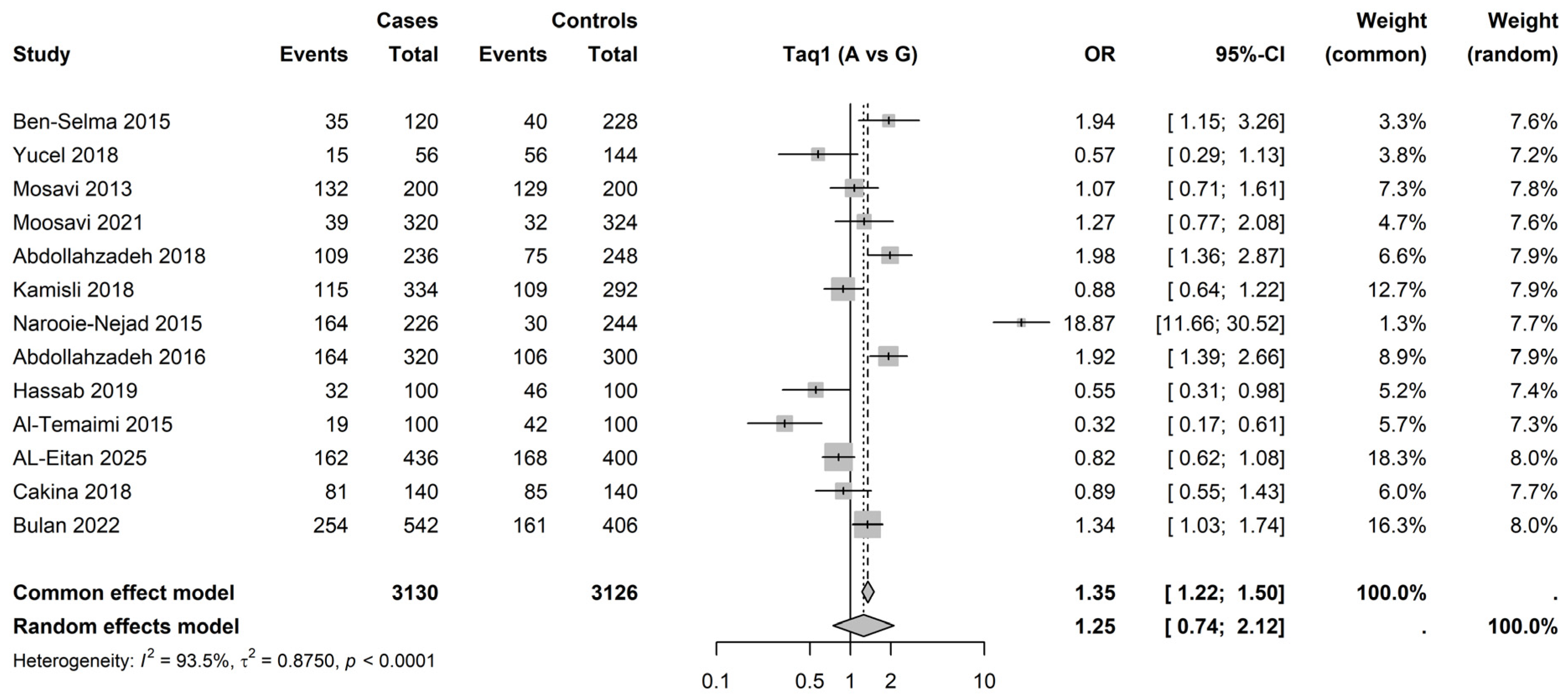
| TaqI | Allelic | 1.25 (0.74–2.12) | 0.3990 | 93.5% | 0.9145 |
| Dominant | 1.41 (0.75–2.65) | 0.2824 | 89.3% | 0.755 | |
| Recessive | 1.24 (0.54–2.86) | 0.6074 | 81.2% | 0.9610 | |
| Homozygous | 1.42 (0.46–4.42) | 0.5433 | 86.7% | 0.9972 | |
| Heterozygous | 1.41 (0.86–2.29) | 0.1725 | 82.1% | 0.58 |
| Ethnicity | Polymorphism | Genetic Model | OR (95% CI) | p -Value | I2 (%) |
|---|---|---|---|---|---|
| Arabs | FokI | Allelic | 1.02 [0.61–1.72] | 0.9427 | 68.2 |
| Dominant | 0.95 [0.57–1.58] | 0.8325 | 55.4 | ||
| Recessive | 2.20 [1.19–4.05] | 0.0114 | 15.7 | ||
| Homozygous | 2.23 [1.19–4.16] | 0.0123 | 30.5 | ||
| Heterozygous | 0.91 [0.63–1.31] | 0.6037 | 19.9 | ||
| BsmI | Allelic | 0.84 [0.62–1.13] | 0.2426 | 41.8 | |
| Dominant | 0.82 [0.60–1.11] | 0.2030 | 0 | ||
| Recessive | 0.76 [0.27–2.13] | 0.5953 | 55.6 | ||
| Homozygous | 0.71 [0.26–1.96] | 0.5107 | 52.4 | ||
| Heterozygous | 0.85 [0.61–1.18] | 0.3243 | 0 | ||
| ApaI | Allelic | 1.37 [1.12–1.67] | 0.0019 | 17.9 | |
| Dominant | 1.63 [1.17–2.27] | 0.0039 | 27.5 | ||
| Recessive | 1.29 [0.80–2.09] | 0.2931 | 17.5 | ||
| Homozygous | 1.65 [1.07–2.53] | 0.0232 | 0 | ||
| Heterozygous | 1.68 [1.10–2.56] | 0.0157 | 42.7 | ||
| TaqI | Allelic | 0.74 [0.36–1.52] | 0.4149 | 85.3 | |
| Dominant | 0.75 [0.33–1.73] | 0.5017 | 82.3 | ||
| Recessive | 0.60 [1.18–2.03] | 0.4142 | 61.9 | ||
| Homozygous | 0.55 [0.09–3.15] | 0.4982 | 70 | ||
| Heterozygous | 0.86 [0.42–1.75] | 0.6751 | 74.2 | ||
| Iranian | FokI | Allelic | 1.47 [1.01–2.15] | 0.0458 | 72.6 |
| Dominant | 1.60 [1.21–2.12] | 0.0011 | 25.4 | ||
| Recessive | 2.22 [0.80–6.17] | 0.1266 | 72.6 | ||
| Homozygous | 2.63 [0.86–7.99] | 0.0887 | 68.2 | ||
| Heterozygous | 1.43 [1.07–1.90] | 0.0163 | 2.7 | ||
| BsmI | Allelic | 1.15 [0.72–1.82] | 0.5550 | 84.6 | |
| Dominant | 1.16 [0.65–2.07] | 0.6056 | 81.4 | ||
| Recessive | 1.27 [0.64–2.55] | 0.4956 | 66.2 | ||
| Homozygous | 1.30 [0.48–3.54] | 0.6044 | 78.8 | ||
| Heterozygous | 1.11 [0.69–1.79] | 0.6788 | 70.7 | ||
| ApaI | Allelic | 1.61 [1.22–2.12] | 0.0008 | 50.9 | |
| Dominant | 2.04 [1.16–3.60] | 0.0134 | 70.6 | ||
| Recessive | 1.86 [1.07–3.23] | 0.0277 | 39.2 | ||
| Homozygous | 3.87 [1.54–9.69] | 0.0039 | 58.9 | ||
| Heterozygous | 1.83 [1.09–3.07] | 0.0229 | 68.2 | ||
| TaqI | Allelic | 2.49 [0.91–6.83] | 0.0766 | 95.8 | |
| Dominant | 3.46 [1.07–11.14] | 0.0378 | 92.2 | ||
| Recessive | 3.33 [0.70–15.95] | 0.1315 | 87.7 | ||
| Homozygous | 6.31 [0.86–46.04] | 0.0693 | 88.7 | ||
| Heterozygous | 2.87 [1.21–6.78] | 0.0165 | 85.4 | ||
| Turkish | FokI | Allelic | 1.26 [0.69–2.29] | 0.4462 | 72.6 |
| Dominant | 1.27 [0.63–2.57] | 0.5103 | 75 | ||
| Recessive | 1.86 [1.21–2.86] | 0.0050 | 0 | ||
| Homozygous | 2.00 [1.27–3.15] | 0.0029 | 31.6 | ||
| Heterozygous | 1.19 [0.61–2.31] | 0.6098 | 73.4 | ||
| BsmI | Allelic | 1.11 [0.88–1.39] | 0.3800 | 0 | |
| Dominant | 1.07 [0.77–1.50] | 0.6894 | 0 | ||
| Recessive | 1.26 [0.83–1.91] | 0.2765 | 0 | ||
| Homozygous | 1.26 [0.79–2.01] | 0.3231 | 0 | ||
| Heterozygous | 1.00 [0.70–1.44] | 0.9787 | 0 | ||
| ApaI | Allelic | 1.25 [0.83–1.89] | 0.2838 | 58.6 | |
| Dominant | 1.40 [0.76–2.58] | 0.2748 | 57 | ||
| Recessive | 1.20 [0.79–1.83] | 0.3892 | 0 | ||
| Homozygous | 1.45 [0.73–2.85] | 0.2871 | 41.9 | ||
| Heterozygous | 1.35 [0.76–2.40] | 0.3031 | 41.6 | ||
| TaqI | Allelic | 0.96 [0.69–1.32] | 0.7790 | 62.4 | |
| Dominant | 1.02 [0.78–1.34] | 0.8771 | 0 | ||
| Recessive | 1.00 [0.53–1.87] | 0.9927 | 68.5 | ||
| Homozygous | 0.82 [0.36–1.89] | 0.6409 | 68.3 | ||
| Heterozygous | 0.99 [0.74–1.32] | 0.9471 | 0 |
Disclaimer/Publisher’s Note: The statements, opinions and data contained in all publications are solely those of the individual author(s) and contributor(s) and not of MDPI and/or the editor(s). MDPI and/or the editor(s) disclaim responsibility for any injury to people or property resulting from any ideas, methods, instructions or products referred to in the content. |
© 2026 by the authors. Licensee MDPI, Basel, Switzerland. This article is an open access article distributed under the terms and conditions of the Creative Commons Attribution (CC BY) license.
Share and Cite
Kalam, A.A.; Roshanuddin, J.; Gattu Linga, B.; Ibrahim, F.E.; Hamdan, R.; Farrell, T.; BU Shurbak, Z.S.; Mohamed, W.M.Y.; Al-Dewik, N. Associations of Vitamin D Receptor (ApaI, FokI, TaqI, BsmI) Polymorphisms with Neurodegenerative Diseases in the Middle East, North Africa and Turkiye (MENA&T) Region: A Systematic Review and Meta-Analysis Toward Population-Specific Precision Medicine. J. Pers. Med. 2026, 16, 277. https://doi.org/10.3390/jpm16060277
Kalam AA, Roshanuddin J, Gattu Linga B, Ibrahim FE, Hamdan R, Farrell T, BU Shurbak ZS, Mohamed WMY, Al-Dewik N. Associations of Vitamin D Receptor (ApaI, FokI, TaqI, BsmI) Polymorphisms with Neurodegenerative Diseases in the Middle East, North Africa and Turkiye (MENA&T) Region: A Systematic Review and Meta-Analysis Toward Population-Specific Precision Medicine. Journal of Personalized Medicine. 2026; 16(6):277. https://doi.org/10.3390/jpm16060277
Chicago/Turabian StyleKalam, Ahmed Abo, Jameela Roshanuddin, BalaSubramani Gattu Linga, Faisal E. Ibrahim, Rand Hamdan, Thomas Farrell, Zeena Saeed BU Shurbak, Wael M. Y. Mohamed, and Nader Al-Dewik. 2026. "Associations of Vitamin D Receptor (ApaI, FokI, TaqI, BsmI) Polymorphisms with Neurodegenerative Diseases in the Middle East, North Africa and Turkiye (MENA&T) Region: A Systematic Review and Meta-Analysis Toward Population-Specific Precision Medicine" Journal of Personalized Medicine 16, no. 6: 277. https://doi.org/10.3390/jpm16060277
APA StyleKalam, A. A., Roshanuddin, J., Gattu Linga, B., Ibrahim, F. E., Hamdan, R., Farrell, T., BU Shurbak, Z. S., Mohamed, W. M. Y., & Al-Dewik, N. (2026). Associations of Vitamin D Receptor (ApaI, FokI, TaqI, BsmI) Polymorphisms with Neurodegenerative Diseases in the Middle East, North Africa and Turkiye (MENA&T) Region: A Systematic Review and Meta-Analysis Toward Population-Specific Precision Medicine. Journal of Personalized Medicine, 16(6), 277. https://doi.org/10.3390/jpm16060277