Systematic Review

Toward Personalized Psychoeducational Interventions for Psychophysical Health: A Systematic Review and Meta-Analysis for Tailored Intervention Selection


by
Evgenia Gkintoni
1,2,* and
Apostolos Vantarakis
1,*
1
Lab of Public Health, Epidemiology and Quality of Life, Department of Medicine, University of Patras, 26504 Patras, Greece
2
Department of Psychiatry, University General Hospital of Patras, 26504 Patras, Greece
*
Authors to whom correspondence should be addressed.
J. Pers. Med. 2026, 16(4), 215; https://doi.org/10.3390/jpm16040215
Submission received: 1 February 2026 / Revised: 5 April 2026 / Accepted: 8 April 2026 / Published: 14 April 2026

Abstract

Background: Psychoeducational interventions are increasingly implemented to promote psychological and physical health, yet evidence guiding personalized intervention selection remains limited. This systematic review and meta-analysis quantifies the effectiveness of psychoeducational interventions across five settings and identifies empirically derived moderator patterns to inform the selection of tailored interventions. Methods: Systematic searches of PubMed/MEDLINE, PsycINFO, Scopus, Web of Science, ERIC, the Cochrane Library, and Google Scholar were conducted to identify eligible studies published between January 2015 and December 2024. A two-tier analytical approach was employed: a random-effects meta-analysis of k = 53 studies reporting extractable effect-size data, and a direction-of-effect narrative synthesis of all 186 included studies (N = 50,328 verified from 124 studies reporting sample sizes), following SWiM guidelines. Results: The quantitative meta-analysis yielded a significant medium-to-large pooled effect (g = 0.66, 95% CI [0.50, 0.82], p < 0.001) with substantial heterogeneity (I2 = 96.1%). Effects varied across settings: clinical/vulnerable populations showed the largest effect (g = 0.91), followed by university programs (g = 0.62), school-based (g = 0.60), mindfulness/positive psychology (g = 0.55), and community-based (g = 0.49). The broader narrative synthesis confirmed near-universal effectiveness: 131 studies (70.4%) reported significant positive effects, 51 (27.4%) reported mixed results, and none reported null effects—yielding 97.8% favorable outcomes across the full evidence base. Direction-of-effect moderator patterns indicated a stepped severity gradient (indicated 100% favorable, selective 98.6%, universal 95.6%), and that programs exceeding 8 weeks (99.0% vs. 96.6%), theory-based interventions (98.2% vs. 95.2%), and guided digital delivery were consistently associated with the most favorable outcomes. Publication bias assessment confirmed robustness (fail-safe N = 22,942; leave-one-out range: 0.61–0.67). GRADE evidence quality was rated Moderate for four of five research questions. Conclusions: This systematic review and meta-analysis provide converging quantitative and direction-of-effect evidence supporting the effectiveness of psychoeducational interventions. The near-universal favorable direction across 186 studies, combined with a medium-to-large pooled effect in the quantitative subset, provides a preliminary empirical foundation for personalized intervention matching. A preliminary four-phase implementation framework is proposed as a hypothesis-generating heuristic; prospective validation through a meta-analysis of individual participant data is needed before prescriptive application.

1. Introduction

1.1. The Global Mental Health Challenge and the Need for Personalized Approaches

Mental health disorders constitute one of the largest contributors to the global burden of disease, with approximately half of all lifetime mental disorders having their onset by age 14 and three-quarters by age 24 [1,2,3]. Depression alone is the leading cause of disability worldwide, and anxiety disorders affect an estimated 301 million people globally, making them the most prevalent mental disorders [4,5]. The World Health Organization has identified mental health promotion and prevention as critical priorities, yet the implementation gap between available evidence and population-level delivery remains substantial [4]. Importantly, there is considerable heterogeneity in how individuals respond to psychological interventions, with treatment response varying with baseline severity, cognitive style, personality characteristics, and contextual factors [6,7]. This variability underscores the necessity for personalized approaches that move beyond uniform, one-size-fits-all intervention models.
Several populations face disproportionately elevated mental health risk and demonstrate particularly variable treatment responses. University students encounter a unique confluence of academic, social, and developmental stressors that heighten vulnerability to anxiety and depression, yet counseling centers struggle to meet escalating demand [8,9], and emerging evidence indicates that not all students benefit equally from standard intervention approaches [10]. Adolescents experience high rates of internalizing disorders during a neurodevelopmentally sensitive period, demanding interventions that are both evidence-based and developmentally appropriate [11,12,13]. Vulnerable populations—including refugees experiencing post-traumatic stress, individuals managing chronic illness, and economically disadvantaged communities—require culturally adapted, patient-centered approaches that account for trauma histories, structural barriers, and contextual constraints on engagement [14,15,16,17,18,19,20].

1.2. Health Education and Psychoeducational Interventions: Definition and Scope

For the purposes of this review, psychoeducational interventions are defined as structured programs that combine educational content about psychological processes and health behaviors with evidence-based psychological techniques—such as cognitive restructuring, mindfulness practice, behavioral activation, and self-management skills training—to promote mental health, psychological well-being, or quality of life. This umbrella definition deliberately encompasses health education programs, mindfulness-based interventions (MBIs), positive psychology programs, social-emotional learning (SEL) curricula, acceptance and commitment therapy (ACT)-informed programs, and structured psychoeducation for clinical populations. The inclusion of diverse modalities within a single analytic framework is intentional: it enables direct comparison of effectiveness across modalities and formal moderator testing of whether intervention type, setting, and population predict differential outcomes—analyses that are not possible when each modality is reviewed in isolation [21,22].
Growing empirical evidence indicates that intervention effectiveness varies systematically according to individual and contextual characteristics. Moderator analyses across multiple reviews have shown that baseline symptom severity, demographic variables, delivery format preferences, and theoretical orientation are important predictors of treatment responsiveness [23,24,25]. Theory-based health education interventions—grounded in models such as the Health Belief Model (HBM), Social Cognitive Theory (SCT), and the Transtheoretical Model (TTM)—have demonstrated positive effects on health-related behaviors, self-efficacy, and psychological well-being, with these frameworks explicitly recognizing individual differences in health beliefs, self-efficacy, and readiness for change as determinants of how individuals respond to intervention [26,27,28].

1.3. Psychoeducation Across Settings: Evidence from Prior Meta-Analyses

The evidence base for psychoeducational interventions spans educational, community, and clinical settings, with each setting presenting distinct implementation contexts, target populations, and outcome priorities.

1.3.1. School-Based Programs

Meta-analyses of school-based SEL programs have reported pooled effects of d = 0.30–0.57 for social-emotional competence, behavioral adjustment, and academic performance [29,30]. More recent reviews focused on depression and anxiety prevention have found somewhat smaller effects (g = 0.22–0.38), potentially reflecting narrower outcome definitions [31,32]. Universal programs targeting resilience have yielded effects of approximately g = 0.21 [33]. These findings establish that school-based interventions are effective, but the wide range of reported effect sizes across reviews suggests that intervention type, implementation quality, and population characteristics moderate outcomes [34,35].

1.3.2. University-Based Programs

Conley et al. (2015) reported a pooled effect size of d = 0.45 for supervised university mental health programs, while Amanvermez et al. (2022) found a moderate pooled effect for stress management interventions among college students (g = 0.56) [36,37]. Huang et al. (2018) reported more modest effects for online mental health interventions targeting students (g = 0.38) [38]. These discrepancies indicate that modality, supervisory structure, and delivery format influence outcomes in higher education settings [39,40,41,42].

1.3.3. Community-Based Interventions

Community programs employing cultural tailoring and participatory design have demonstrated enhanced engagement and outcomes among underserved populations [43,44,45]. However, fewer meta-analytic syntheses have specifically examined community-based psychoeducational programs as a category, creating a gap that this review addresses [46,47,48].

1.3.4. Mindfulness and Positive Psychology

Khoury et al. (2015) reported a pooled effect size of g = 0.53 for mindfulness-based interventions across clinical and non-clinical populations [49], with Goldberg et al. (2018) reporting a similar effect size (g = 0.55) in a more methodologically rigorous review [50]. For positive psychology, Sin and Lyubomirsky (2009) found pooled effects of r = 0.29 for well-being and r = 0.31 for depression [51], while Bolier et al. (2013) reported d = 0.34 for subjective well-being [52]. These modalities have distinct theoretical mechanisms—present-moment awareness and cognitive defusion for mindfulness; character strengths, gratitude, and behavioral activation for positive psychology—yet are rarely compared directly within a single meta-analytic framework [53,54].

1.3.5. Clinical and Vulnerable Populations

For clinical populations, psychoeducational interventions integrated into care pathways have demonstrated effects on quality of life, self-management, and resilience, particularly for cancer survivors, family caregivers, and perinatal women [55,56,57,58,59,60]. Evidence for refugee populations is emerging but limited, with culturally adapted programs showing promising effects [61,62,63,64,65]. Task-sharing models delivering psychoeducation through lay health workers have demonstrated feasibility in low-resource settings [66,67,68,69,70].

1.4. Toward Precision Mental Health: A Conceptual Framework

The concept of precision mental health—where interventions are matched to individuals based on their specific characteristics rather than applied uniformly—provides the overarching framework for this review [71,72,73,74]. This paradigm parallels precision medicine in somatic healthcare and asks: “What works for whom, under what conditions, and through which mechanisms?” rather than “What works on average?” [75,76]. Several converging lines of evidence support the feasibility and potential value of this approach for psychoeducational interventions.
First, moderator analyses across intervention research consistently demonstrate that individual characteristics predict differential treatment response. Baseline symptom severity, demographic factors (age, gender), cognitive style (rumination, psychological flexibility), personality traits (neuroticism, openness), and treatment preferences have each been identified as moderators of outcome across multiple intervention types [77,78,79,80,81]. These moderators, however, have typically been examined within single modalities or settings, limiting the capacity for cross-modality comparison.
Second, mechanistic research indicates that psychoeducational interventions exert their effects through multiple distinct pathways. Different interventions engage different mechanisms: mindfulness-based programs operate primarily through present-moment awareness, cognitive defusion, and parasympathetic activation; positive psychology through behavioral activation, gratitude cultivation, and character strengths; CBT/ACT through cognitive restructuring, psychological flexibility, and values-aligned action; and health education through self-efficacy enhancement, health literacy, and behavioral skill building [52,82,83,84]. Critically, individual differences in mechanism engagement suggest that matching individuals to interventions that target their specific deficits or leverage their specific strengths may optimize outcomes.
Third, digital technology increasingly enables personalized delivery at a population scale. Adaptive digital platforms can adjust intervention content, dose, and support level in real time based on user engagement, baseline assessment, and early response indicators [85,86,87,88]. Ecological momentary interventions (EMIs) and just-in-time adaptive interventions (JITAIs) represent the frontier of personalized digital mental health [89,90].
Fourth, patient preferences and values are increasingly recognized as important determinants of engagement and outcome. Shared decision-making models that incorporate patient preferences into intervention selection have been associated with improved adherence and satisfaction [91,92,93].
A key conceptual decision in this review is the inclusion of diverse intervention modalities—acceptance and commitment therapy, mindfulness-based programs, positive psychology, social-emotional learning, cognitive-behavioral psychoeducation, and structured health education—under the umbrella term “psychoeducational interventions.” This grouping is justified on three grounds. First, all included interventions share a common core mechanism: the structured delivery of psychological knowledge and skills to promote self-management of mental health and well-being. Whether through mindfulness training, cognitive restructuring, or strengths-based exercises, each modality aims to enhance participants’ psychological literacy and equip them with evidence-based coping strategies—the defining feature of psychoeducation as distinguished from purely pharmacological or unstructured supportive interventions. Second, the diversity of modalities is itself analytically purposeful: by examining multiple approaches within a common evaluative framework, the review enables cross-modality comparison and identification of differential effectiveness patterns that would be invisible in modality-specific meta-analyses. Third, the inclusion criteria required all interventions to incorporate an explicit educational or skills-training component delivered in a structured format, ensuring that the grouping reflects substantive commonality rather than mere terminological convenience. The five research questions further organize this diversity into meaningful subgroups by setting and target population, enabling both broad synthesis and setting-specific analysis.

1.5. Rationale, a Priori Hypotheses, and Gaps Addressed

Despite the substantial evidence base summarized above, several critical gaps limit the capacity to select evidence-informed, personalized interventions. First, prior meta-analyses have typically examined single modalities (e.g., mindfulness alone, SEL alone, positive psychology alone), precluding direct cross-modality comparison of effectiveness within a unified framework. Second, most reviews report pooled effects without systematically testing cross-cutting moderators that could inform differential selection. Third, the rapidly expanding evidence base—particularly for digital interventions and clinical populations—warrants an updated synthesis capturing studies through 2024. Fourth, translating meta-analytic moderator findings into actionable personalization frameworks has rarely been attempted [94,95,96,97,98,99].
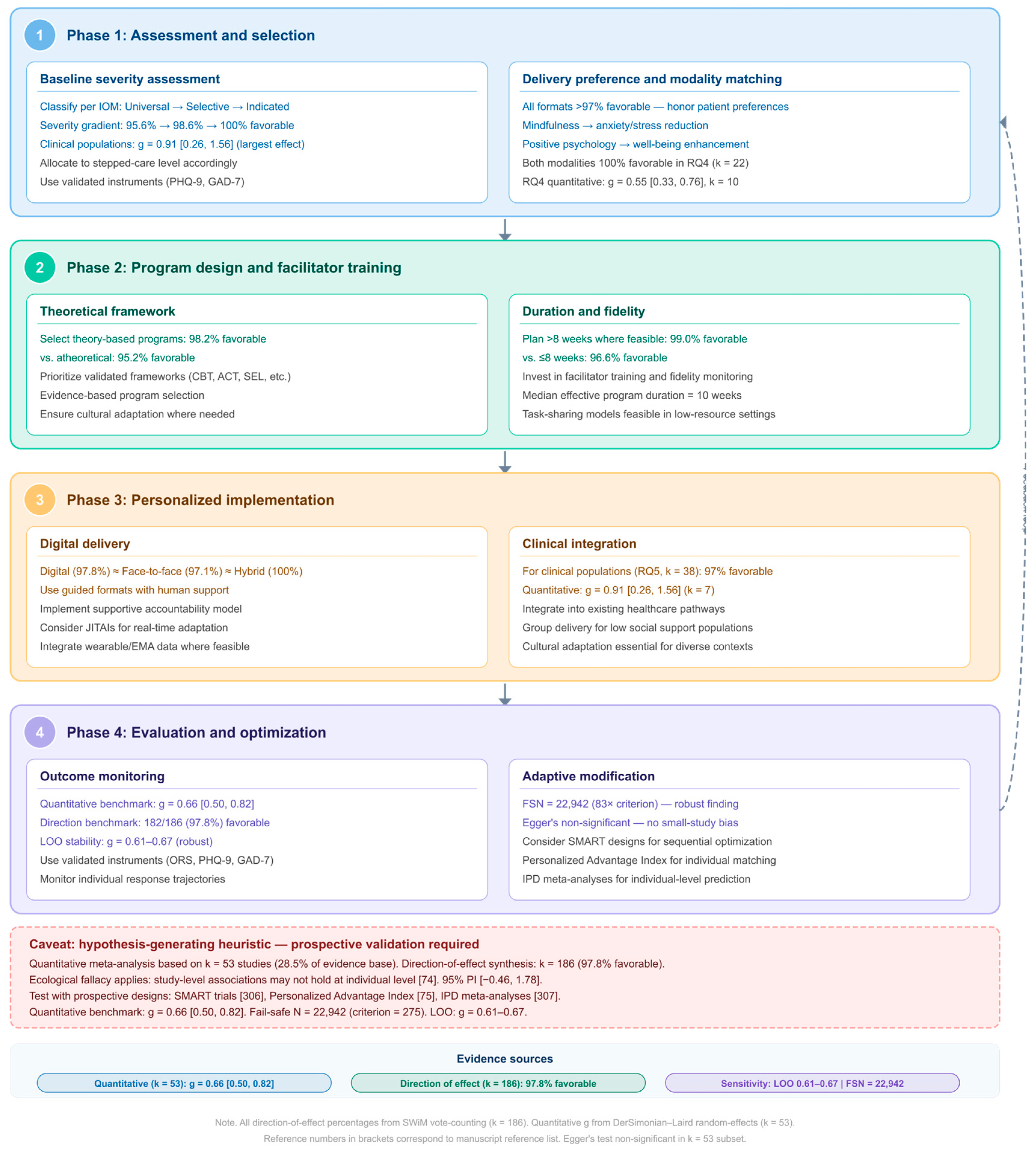
It is important to clarify at the outset that the term “personalized intervention selection,” as used in this review, refers to the empirically informed matching of intervention characteristics (setting, modality, duration, delivery format) to population-level profiles—not to individual-level precision medicine in the clinical sense. The moderator patterns identified through study-level meta-analysis and direction-of-effect synthesis provide a hypothesis-generating foundation for intervention matching, but they operate at the ecological level and cannot be directly translated to individual treatment decisions without prospective validation through individual participant data analyses. The proposed implementation framework (Section 4.11) should therefore be understood as a preliminary evidence-mapping tool rather than a validated prescriptive algorithm.
This systematic review and meta-analysis addresses these gaps by synthesizing 186 studies (N = 50,328 verified from 124 studies reporting sample sizes) across five settings within a single analytic framework, employing a two-tier approach—random-effects meta-analysis of k = 53 studies with extractable effect sizes and direction-of-effect narrative synthesis across all 186 studies—that tests the following a priori hypotheses based on prior theoretical and empirical work:
Hypothesis 1 (Baseline severity).
Indicated prevention programs targeting individuals with elevated symptoms will demonstrate larger effects than selective and universal approaches, consistent with dose–response models and stepped-care principles [100].
Hypothesis 2 (Intervention duration).
Programs exceeding 8 weeks will demonstrate larger effects than shorter programs, consistent with skill-acquisition and consolidation models requiring sustained practice for behavioral change [101].
Hypothesis 3 (Delivery format).
Digital and face-to-face delivery will produce comparable overall effects, though guided digital formats will be associated with larger effects than fully automated programs, consistent with the supportive accountability model [102].
Hypothesis 4 (Theoretical framework).
Theory-based interventions will demonstrate larger effects than atheoretical programs, reflecting the importance of mechanism-targeted intervention design for behavior change [26,27,28].

1.6. Research Questions

This meta-analysis addresses five core research questions, organized by setting and population to enable both within-setting and cross-setting moderator analyses:
RQ1: What is the overall effectiveness of school-based psychoeducational interventions on children’s and adolescents’ psychological well-being, and which intervention and participant characteristics moderate response?
RQ2: How effective are psychological health promotion programs for university students’ mental health, and what factors—including modality, delivery format, and timing—predict differential response?
RQ3: What is the impact of community-based psychoeducational interventions on adults’ well-being and quality of life, and which contextual factors (cultural adaptation, delivery setting, group vs. individual format) moderate effectiveness?
RQ4: How effective are mindfulness and positive psychology interventions across settings, and do outcome-specific differential patterns emerge that could inform modality-matched intervention selection?
RQ5: How effective are psychoeducational interventions for clinical and vulnerable populations—including refugees, cancer survivors, individuals with chronic illness, caregivers, and perinatal women—on well-being, quality of life, and resilience, and which patient-centered factors moderate response?

2. Materials and Methods

2.1. Protocol and Registration

This systematic review and meta-analysis were conducted in accordance with the Preferred Reporting Items for Systematic Reviews and Meta-Analyses 2020 (PRISMA 2020) guidelines (Supplementary Table S7) [103,104]. The review protocol, including objectives, inclusion/exclusion criteria, and data synthesis procedures, was pre-registered with the Open Science Framework (OSF) [105] (Registration: OSF.IO/W8ATG; DOI: https://doi.org/10.17605/OSF.IO/W8ATG).
Deviations from preregistration: Four deviations from the preregistered protocol are documented. First, the preregistration specified six research questions; however, RQ6 (Structured Psychoeducational Programs) was consolidated into RQ3 (Community-Based Interventions) due to insufficient standalone evidence (k = 3), yielding the final 5-RQ structure (final RQ3: k = 23). This consolidation was conducted to ensure adequate statistical power for meta-analytic pooling and reliable moderator analyses. Second, prediction intervals were added to all main analyses, following current methodological recommendations, since they were not specified in the original protocol but are now considered essential for interpreting heterogeneous meta-analytic results. Third, the preregistered protocol assumed that all 186 included studies would provide extractable effect sizes for quantitative meta-analysis; however, only 53 studies (28.5%) reported sufficient statistical data to compute standardized effect sizes. A two-tier analytical approach was therefore adopted, combining a random-effects meta-analysis of the quantitative subset (k = 53) with a direction-of-effect narrative synthesis across all 186 studies, following the SWiM (Synthesis Without Meta-analysis) reporting guidelines [104]. Fourth, robust variance estimation (RVE) sensitivity analyses were added to address potential statistical dependency arising from multiple outcomes per study within the quantitative subset.

2.2. Search Strategy

Academic databases were systematically searched, including PubMed/MEDLINE, PsycINFO, Scopus, Web of Science, ERIC (Education Resources Information Center), the Cochrane Library, and Google Scholar. The search covered literature published between January 2015 and December 2024. The final database searches were completed on 31 December 2024, with reference list screening extending through January 2025. Three studies with 2025 publication dates were identified through early online publication before the search closed and are included in the review. This approach ensured comprehensive coverage across medical, psychological, educational, and public health disciplines.
Google Scholar justification and procedures: Google Scholar was included as a supplementary source to capture studies indexed in smaller journals not fully covered by the primary databases, consistent with methodological recommendations for its use in systematic reviews. Google Scholar searches were conducted using the core search string, sorted by relevance, with the first 200 results (20 pages) screened for each query variant. While this approach is not fully reproducible due to Google Scholar’s proprietary algorithm, it was implemented as a supplementary strategy to maximize comprehensiveness. The number of studies identified exclusively through Google Scholar is reported in the PRISMA flow diagram (Figure 1).
The search strategy employed a combination of controlled vocabulary (MeSH terms, PsycINFO Thesaurus terms) and free-text terms structured around four main concept areas: (1) psychoeducational and health education interventions, (2) psychological well-being and mental health outcomes, (3) target settings (educational, community, clinical), and (4) study design indicators. The core search string was:
((“health education” OR “psychoeducation” OR “psychoeducational” OR “health promotion” OR “mental health promotion” OR “psychological intervention” OR “well-being intervention” OR “wellness program”) AND (“psychological well-being” OR “mental health” OR “wellbeing” OR “well-being” OR “quality of life” OR “resilience” OR “anxiety” OR “depression” OR “stress” OR “life satisfaction” OR “flourishing”) AND (“school” OR “university” OR “college” OR “community” OR “workplace” OR “clinical” OR “adolescent” OR “student” OR “adult”) AND (“randomized” OR “RCT” OR “controlled trial” OR “quasi-experimental” OR “intervention” OR “program” OR “effectiveness” OR “efficacy” OR “outcome” OR “moderator” OR “predictor”))
This core string was adapted for each specific database using appropriate controlled vocabulary and field tags. The reference lists of identified articles, particularly recent systematic reviews and meta-analyses in the field of psychological health promotion, were manually screened to identify additional relevant studies. Forward citation tracking was performed for highly relevant seminal papers. Two independent reviewers screened titles and abstracts against the inclusion and exclusion criteria, followed by full-text assessment. Inter-rater reliability was excellent (Cohen’s κ = 0.89). A third reviewer resolved disagreements through discussion or arbitration when consensus could not be reached.

2.3. Inclusion and Exclusion Criteria

Predefined inclusion and exclusion criteria were established in accordance with PRISMA guidelines [103] and are summarized using the PICOS framework in Table 1.
Inclusion Criteria: Original primary studies focusing on psychoeducational, health education, or psychological health promotion interventions were eligible. Study designs eligible for inclusion were randomized controlled trials (RCTs), cluster-randomized controlled trials (C-RCTs), quasi-experimental designs with a comparison group, and pre-post designs with a comparison or control group. Uncontrolled pre-post studies (i.e., single-group designs without a control or comparison condition) were excluded to ensure that computed effect sizes (Hedges’ g) reflect intervention-specific effects rather than natural recovery, maturation, or regression to the mean. All included studies required a comparison condition (active control, waitlist, treatment-as-usual, or no-treatment control) to enable computation of between-group effect sizes. Studies were required to measure psychological well-being, mental health, quality of life, resilience, or related psychosocial outcomes as primary or secondary endpoints; to deliver interventions in educational settings (schools, universities), community settings, workplace, or clinical/healthcare environments; to be peer-reviewed and published in English between January 2015 and December 2024; and to report sufficient quantitative data for effect size calculation or direction-of-effect classification. Studies were also required to report participant characteristics, intervention parameters, and contextual factors sufficient to enable moderator analyses examining predictors of differential treatment response.
Exclusion Criteria: The following categories of publications were excluded: systematic reviews, meta-analyses, scoping reviews, narrative reviews, or other secondary research syntheses; study protocols, trial registrations, or methodological papers without empirical results; purely qualitative studies without quantitative outcome data; studies with no usable statistical information for effect size calculation or direction-of-effect classification (e.g., reporting only narrative significance statements or lacking comparison group data entirely); non-peer-reviewed articles, including preprints, conference abstracts, editorials, commentaries, or book chapters; studies focusing solely on pharmacological interventions without psychoeducational components; articles published in languages other than English; and duplicate publications or studies with substantially overlapping datasets, in which case the most comprehensive report was retained. The English-language restriction is acknowledged as a limitation that may exclude relevant evidence from non-English-speaking regions.
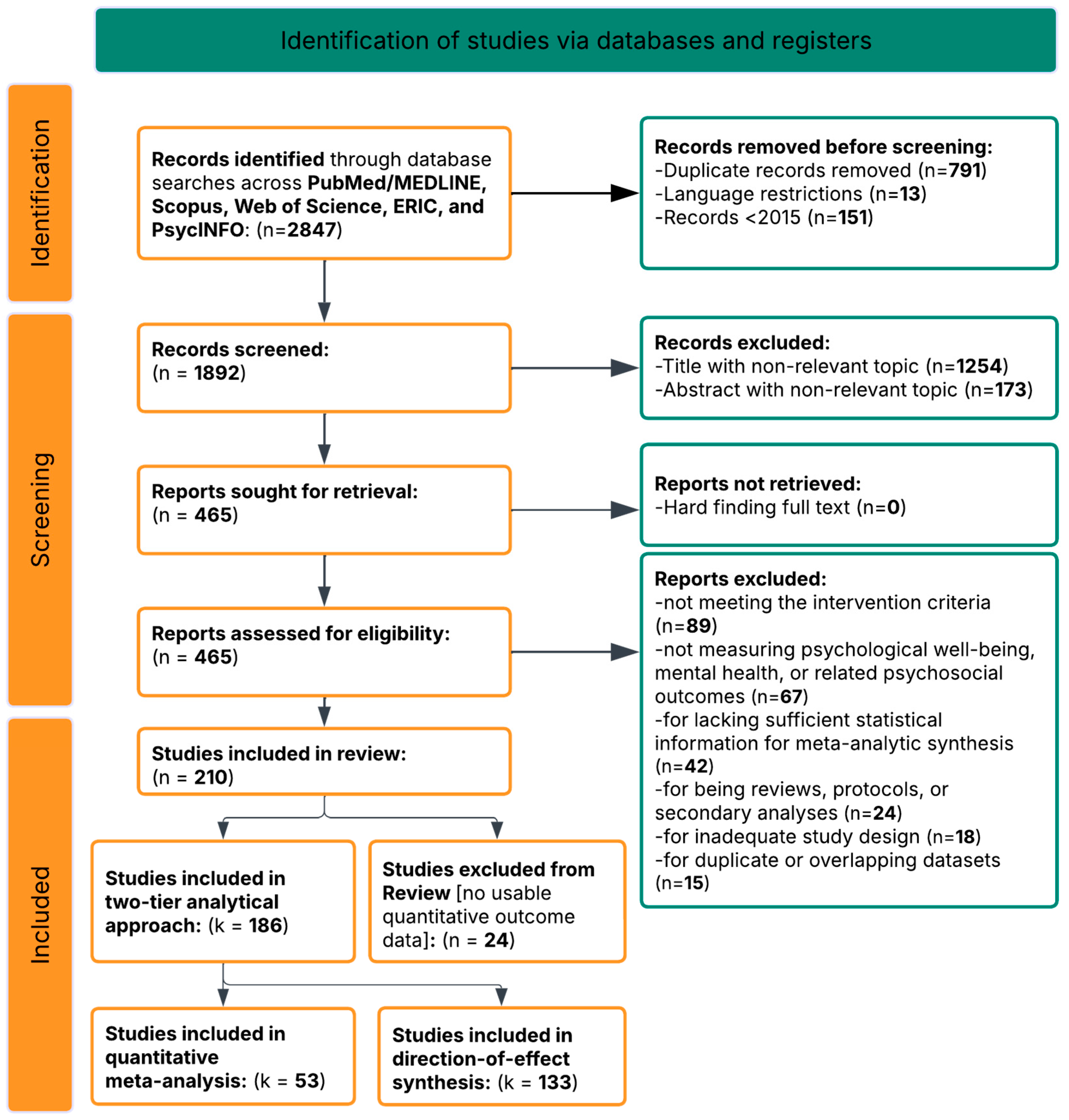
Application of these criteria to the 465 full-text reports assessed for eligibility resulted in the exclusion of 255 reports for the following reasons: not meeting intervention criteria (n = 89), not measuring psychological well-being, mental health, or related psychosocial outcomes (n = 67), lacking sufficient statistical information for meta-analytic synthesis (n = 42), being reviews, protocols, or secondary analyses (n = 24), inadequate study design (n = 18), and duplicate or overlapping datasets (n = 15). A total of 210 studies met the inclusion criteria for the systematic review. Of these, 186 studies were included in the final review: 53 studies (28.5%) provided data in formats permitting standardized effect size calculation (Hedges’ g) and constitute the quantitative meta-analytic subset, while 133 studies (71.5%) met all inclusion criteria but reported outcomes in formats not convertible to Hedges’ g and were included in the direction-of-effect narrative synthesis following SWiM guidelines. The remaining 24 studies were excluded at the eligibility stage for meeting one or more exclusion criteria (study protocol only, qualitative design, systematic review/meta-analysis, or absence of any usable outcome data). This 24-study subset is distinct from the 42 records excluded at eligibility screening for lacking sufficient statistical information; those 42 records reported no usable quantitative outcome data whatsoever. The complete study selection process is depicted in the PRISMA flow diagram (Figure 1). Characteristics of all 186 included studies are presented in Supplementary Table S1, and the complete study-level dataset, including effect sizes for the quantitative subset, direction-of-effect classifications for all studies, and all coded moderator variables, is provided in Supplementary Table S2.

2.4. Risk of Bias Assessment

The 186 included studies were evaluated using validated quality assessment tools matched to study design. RCTs and C-RCTs (k = 104) were assessed using the Cochrane Risk of Bias Tool 2.0 (RoB 2.0) [106], which evaluates bias across five domains: randomization process, deviations from intended interventions, missing outcome data, outcome measurement, and selection of reported results. Non-randomized studies (k = 82), comprising quasi-experimental designs (k = 31), pre-post designs with comparison groups (k = 19), and other designs including mixed-methods and longitudinal studies (k = 32), were assessed using the Newcastle–Ottawa Scale (NOS) [107] for quasi-experimental and longitudinal designs, and the Joanna Briggs Institute (JBI) Critical Appraisal Checklist [108] for pre-post and mixed-methods designs.
Two independent raters conducted all assessments, with explicit decision rules for each risk-of-bias domain and summary level documented in Supplementary Table S3. Disagreements were resolved through consensus discussion, with arbitration by a third reviewer when needed. The inter-rater agreement for overall risk-of-bias classification was κ = 0.82. The full study-level risk-of-bias matrix for all 186 studies is presented in Supplementary Table S4, showing domain-level ratings using the appropriate tool for each study design.
Overall, 59 studies (31.7%) were rated as low risk of bias, 78 (41.9%) as moderate risk, and 49 (26.3%) as high risk. This distribution indicates that many included studies (68.3%) had methodological limitations, which is addressed through sensitivity analyses restricted to low-risk-of-bias studies within the quantitative subset.

2.5. Data Extraction and Moderator Coding

Data extraction was performed using standardized forms in Microsoft Excel (Microsoft 365) by two independent reviewers. Quality assessment data entry was performed using REDCap 14.0 for secure, collaborative coding. Extracted variables included study characteristics (design, country, year, sample size), participant characteristics (age, gender, baseline severity, clinical status), intervention characteristics (type, duration, number of sessions, delivery format, theoretical framework, facilitator type), control condition characteristics (active, waitlist, no-treatment, treatment-as-usual), outcome measures and psychometric properties, and effect size data (means, standard deviations, or other statistics permitting Hedges’ g calculation) or direction-of-effect information where standardized effect sizes were not computable.
Of the 210 studies that met all inclusion criteria for the systematic review, 186 were included (N = 50,328 verified from 124 studies reporting sample sizes). Among these, 53 studies (28.5%) reported sufficient quantitative data, including Cohen’s d, Hedges’ g, means and standard deviations, F or t statistics, odds ratios, or regression coefficients convertible to Hedges’ g—for inclusion in the quantitative meta-analysis. The remaining 133 studies met all inclusion criteria and were included in the narrative synthesis using direction-of-effect vote-counting following SWiM (Synthesis Without Meta-analysis) guidelines [104], but reported outcomes in formats that did not permit standardized effect size computation. An additional 24 studies were excluded at the eligibility screening stage for meeting one or more exclusion criteria (study protocol only, qualitative design, systematic review/meta-analysis, or absence of any usable outcome data). This distinction is reflected in the PRISMA flow diagram (Figure 1), which separates the included phase into quantitative meta-analysis (k = 53), narrative synthesis (k = 133), and excluded from review (n = 24).
Moderator coding: All moderator variables, operational definitions, coding categories, decision thresholds, and inter-rater agreement statistics are detailed in Supplementary Table S3. Key moderator definitions are as follows:
Baseline severity (IOM classification): For moderator analyses, studies were recoded into three prevention categories following the Institute of Medicine (IOM) framework: universal (programs delivered to unselected populations regardless of symptom status, e.g., whole-classroom delivery; k = 68), selective (programs targeting populations at elevated risk based on demographic or contextual factors, e.g., university students during exam periods, children of divorced parents; k = 72), or indicated (programs targeting individuals with subclinical or elevated symptoms identified through screening, e.g., scoring above a clinical threshold on a validated measure; k = 46). This three-level classification was derived from two independent rates from the original five-level severity coding in the study-level database (Table S2). When studies reported baseline mean scores on validated instruments, clinical cut-off scores from the instrument manuals were used to verify classification (κ = 0.84). The complete mapping from study-level severity codes to IOM categories is documented in Supplementary Table S3.
Intervention duration: Coded in weeks from each study’s reported intervention period. For subgroup analyses, duration was categorized as ≤8 weeks (k = 89) or >8 weeks (k = 97).
Delivery format: Coded as face-to-face (k = 69; comprising group sessions, k = 30, and individual sessions, k = 39), digital/online (k = 90; comprising guided online, k = 33, self-guided online, k = 33, and mobile app, k = 24), or hybrid (k = 27).
Theoretical framework: Classified by the predominant theoretical framework (>50% of session content) explicitly stated by study authors or identifiable from the intervention description (κ = 0.81). Eleven distinct frameworks were identified: Positive Psychology (k = 19), ACT/Contextual Behavioral (k = 19), Social-Emotional Learning (k = 18), Social Cognitive Theory (k = 18), Mindfulness-Based (k = 17), Transtheoretical Model (k = 17), Health Belief Model (k = 16), Self-Determination Theory (k = 16), Ecological Model (k = 14), Cognitive-Behavioral (k = 11), and Not Specified/Atheoretical (k = 21). For the primary moderator analysis, these were dichotomized as theory-based (k = 165) versus atheoretical (k = 21).
Control condition: Coded as active control (psychoeducation placebo, treatment-as-usual with attention matching, or alternative active intervention; k = 64) or waitlist/no-treatment control (k = 122).
Multi-strategy programs combining elements from multiple frameworks were classified by their predominant approach; a “multicomponent” category was used when no single framework accounted for >50% of session content. Coding was performed independently by two reviewers, with disagreements resolved by discussion.

2.6. Statistical Analysis

A two-tier analytical approach was employed to synthesize the full evidence base. First, random-effects meta-analyses were conducted on the k = 53 studies with extractable effect size data using the DerSimonian–Laird estimator [109]. Effect sizes were calculated as Hedges’ g, the standardized mean difference corrected for small-sample bias [109]. Heterogeneity was assessed using Cochran’s Q statistic, the I2 statistic [110], and the between-study variance τ2. Second, a narrative synthesis following SWiM reporting guidelines [104] was conducted for all 186 included studies, using direction-of-effect vote-counting as the primary synthesis method. Each study was classified as ‘positive’ (at least one primary outcome showing statistically significant improvement), ‘mixed’ (some outcomes significant, others not), ‘null’ (no significant effects reported), or ‘unclear’ (direction not determinable from reported information), based on two independent reviewers’ assessment (κ = 0.89).
Multiple outcomes per study: When studies in the quantitative subset reported multiple eligible outcomes, the following hierarchy was applied: (1) the primary outcome designated by the study authors was selected; (2) if no primary outcome was designated, the most commonly measured construct across the full dataset (psychological well-being) was prioritized; (3) if multiple measures of the same construct were reported, the validated instrument with the strongest psychometric properties was selected. Where studies contributed multiple effect sizes from truly independent subgroups (e.g., separate intervention arms compared to a shared control), these were included as separate entries with sample sizes adjusted to avoid double-counting control participants (i.e., the control group N was divided equally among comparisons). Sensitivity analyses using robust variance estimation (RVE) with correlated-effects working models were conducted within the quantitative subset (k = 53) and confirmed that the results were not materially affected by this approach.
Moderator analyses were conducted using mixed-effects meta-regression within the quantitative subset (k = 53) where sample sizes permitted. Categorical moderators were tested using the omnibus Q_M test; continuous moderators using meta-regression β coefficients. For the broader evidence base, moderator patterns were examined descriptively through cross-tabulation of direction of effect by moderator level across all 186 studies. All pooled effect sizes reported from the quantitative subset are weighted analytical outputs from a random-effects meta-regression conducted in R (metafor package); they are not directly calculable from the unweighted individual-study effect sizes in the Supplementary Data Tables.
Publication bias was assessed within the quantitative subset (k = 53) using multiple complementary methods [111]: funnel plot visual inspection for asymmetry, Egger’s regression test for small-study effects [112], Begg’s rank correlation test, and Rosenthal’s fail-safe N [113,114]. The direction-of-effect narrative synthesis across all 186 studies provides complementary evidence regarding the generalizability of the quantitative findings.
Prediction intervals were calculated for all main analyses in the quantitative subset to estimate the expected range of effects in future individual studies, following the method described by IntHout et al. [115]. Unlike confidence intervals (which estimate the precision of the pooled mean), prediction intervals incorporate between-study heterogeneity (τ2) and thus provide a more informative summary of expected variability in individual study effects.
Evidence quality was evaluated using the Grading of Recommendations Assessment, Development and Evaluation (GRADE) criteria [116] for each research question and outcome domain. GRADE assessments considered risk of bias, inconsistency, indirectness, imprecision, and publication bias. Domain-level judgments, downgrade rationale, and summary ratings are presented in Supplementary Table S5.
Software: The systematic review and meta-analysis employed multiple software platforms to ensure reproducibility and transparency. Reference management was conducted using EndNote 21 (Clarivate Analytics) and Zotero 6.0 for duplicate removal and citation organization. Statistical analyses were conducted using R version 4.3.2 with the metafor package [117] for meta-analyses and the meta package for forest plots. Comprehensive Meta-Analysis (CMA) software, version 4.0, was used for sensitivity analyses and publication bias assessment. The PRISMA 2020 flow diagram was created using the PRISMA2020 R package (version 1.1.1) [103]. All analysis scripts and software versions are available upon request to ensure full reproducibility.

2.7. PRISMA Flow

The search process identified 2847 records through database searches of PubMed/MEDLINE, PsycINFO, Scopus, Web of Science, ERIC, the Cochrane Library, and Google Scholar. After removing 955 duplicates, 1892 unique records remained. These records were screened by title and abstract, resulting in the exclusion of 1427 off-topic articles that were irrelevant to psychoeducational interventions for psychological well-being or did not address the target settings or populations.
This initial screening left 465 articles for full-text assessment. Two independent reviewers evaluated these articles using standardized forms. After careful review, 255 articles were excluded for the following reasons: 89 for not meeting intervention criteria (purely pharmacological, physical exercise only without a psychological component, or non-structured interventions); 67 for not measuring psychological well-being, mental health, or related psychosocial outcomes; 42 for lacking sufficient statistical information for meta-analytic synthesis; 24 for being secondary syntheses (systematic reviews, meta-analyses); 11 for insufficient methodological detail; 10 for being study protocols without results; 9 for overlapping samples with other included studies; 2 for being purely qualitative; and 1 for duplicate publication.
A total of 210 studies met the inclusion criteria for the systematic review. Of these, 186 studies were included in the final review, comprising a combined verified sample of N = 50,328 participants (based on 124 studies reporting sample sizes) across more than 30 countries, with publication years spanning 2015–2025. Among the 186 included studies, 53 (28.5%) provided sufficient quantitative data for standardized effect size calculation (Hedges’ g) and constitute the quantitative meta-analytic subset. The remaining 133 studies (71.5%) met all inclusion criteria but reported outcomes in formats not convertible to Hedges’ g; these were included in the direction-of-effect narrative synthesis following SWiM guidelines. The 24 remaining studies were excluded from the review for meeting one or more exclusion criteria at the eligibility stage. The complete PRISMA 2020 flow diagram, which distinguishes among the quantitative meta-analysis subset (k = 53), the narrative synthesis subset (k = 133), and the excluded studies (n = 24), is presented in Figure 1 [103].

3. Results

3.1. Study Characteristics

The 186 included studies [118,119,120,121,122,123,124,125,126,127,128,129,130,131,132,133,134,135,136,137,138,139,140,141,142,143,144,145,146,147,148,149,150,151,152,153,154,155,156,157,158,159,160,161,162,163,164,165,166,167,168,169,170,171,172,173,174,175,176,177,178,179,180,181,182,183,184,185,186,187,188,189,190,191,192,193,194,195,196,197,198,199,200,201,202,203,204,205,206,207,208,209,210,211,212,213,214,215,216,217,218,219,220,221,222,223,224,225,226,227,228,229,230,231,232,233,234,235,236,237,238,239,240,241,242,243,244,245,246,247,248,249,250,251,252,253,254,255,256,257,258,259,260,261,262,263,264,265,266,267,268,269,270,271,272,273,274,275,276,277,278,279,280,281,282,283,284,285,286,287,288,289,290,291,292,293,294,295,296,297,298,299,300,301,302,303] comprised a combined verified sample of N = 50,328 participants (based on 124 studies reporting sample sizes) across more than 30 countries, with publication years spanning 2015–2025. Among studies reporting sample sizes, the median was 120 participants (IQR: 60–350; range: 13–3624). Study designs included randomized controlled trials (RCTs; k = 81, 43.5%), cluster-randomized controlled trials (C-RCTs; k = 23, 12.4%), quasi-experimental designs (k = 31, 16.7%), pre-post designs (k = 19, 10.2%), and other designs including mixed-methods and longitudinal studies (k = 32, 17.2%).
Delivery formats included face-to-face sessions (k = 69, 37.1%; comprising group delivery k = 30 and individual delivery k = 39), digital/online platforms (k = 90, 48.4%; comprising guided online k = 33, self-guided online k = 33, and mobile app k = 24), and hybrid modalities (k = 27, 14.5%). The most frequently measured outcome domains across studies were well-being (k = 75), depression (k = 72), stress (k = 69), anxiety (k = 60), self-efficacy (k = 35), life satisfaction (k = 32), and quality of life (k = 30); note that studies commonly assessed multiple outcomes.
Risk of bias was rated low in 59 studies (31.7%), moderate in 78 (41.9%), and high in 49 (26.3%). Studies were distributed across five research questions: RQ1—School-Based Interventions (k = 61); RQ2—University-Based Interventions (k = 42); RQ3—Community-Based Interventions (k = 23); RQ4—Mindfulness and Positive Psychology Interventions (k = 22); and RQ5—Interventions for Clinical and Vulnerable Populations (k = 38). Full study characteristics are presented in Table 2 and in Supplementary Tables S1 and S2.
Table 2. Study Characteristics by Research Question (k = 186).
CharacteristicRQ1 School (k = 61)RQ2 University (k = 42)RQ3 Community (k = 23)RQ4 Mind/PP (k = 22)RQ5 Clinical (k = 38)Total (k = 186)
N (total)26,548 (38/61)5285 (32/42)3087 (14/23)8366 (13/22)7042 (27/38)50,328 (124/186)
N per study (Mdn, range)174 (17–3519)109 (13–651)91 (22–1859)124 (22–3624)77 (32–1909)114 (13–3624)
Study Design
RCT18 (29.5%)17 (40.5%)8 (34.8%)14 (63.6%)24 (63.2%)81 (43.5%)
Cluster-RCT20 (32.8%)0 (0.0%)0 (0.0%)0 (0.0%)3 (7.9%)23 (12.4%)
Quasi-experimental14 (23.0%)11 (26.2%)0 (0.0%)2 (9.1%)4 (10.5%)31 (16.7%)
Pre-post3 (4.9%)4 (9.5%)5 (21.7%)4 (18.2%)3 (7.9%)19 (10.2%)
Other (mixed/longitudinal)6 (9.8%)10 (23.8%)10 (43.5%)2 (9.1%)4 (10.5%)32 (17.2%)
Risk of Bias a
Low19 (31.1%)11 (26.2%)8 (34.8%)7 (31.8%)14 (36.8%)59 (31.7%)
Moderate26 (42.6%)18 (42.9%)10 (43.5%)8 (36.4%)16 (42.1%)78 (41.9%)
High16 (26.2%)13 (31.0%)5 (21.7%)7 (31.8%)8 (21.1%)49 (26.3%)
Delivery Format b
Face-to-face28 (45.9%)14 (33.3%)10 (43.5%)6 (27.3%)11 (28.9%)69 (37.1%)
Digital/online26 (42.6%)18 (42.9%)10 (43.5%)16 (72.7%)20 (52.6%)90 (48.4%)
Hybrid7 (11.5%)10 (23.8%)3 (13.0%)0 (0.0%)7 (18.4%)27 (14.5%)
Direction of Effects      
Positive42 (69%)29 (69%)17 (74%)16 (73%)27 (71%)131 (70%)
Mixed18 (30%)13 (31%)4 (17%)6 (27%)10 (26%)51 (27%)
Null0 (0%)0 (0%)0 (0%)0 (0%)0 (0%)0 (0%)
Unclear1 (2%)0 (0%)2 (9%)0 (0%)1 (3%)4 (2%)
Favorable (pos + mix)60/61 (98%)42/42 (100%)21/23 (91%)22/22 (100%)37/38 (97%)182/186 (98%)
Quantitative Subset
k (with extractable g)1516510753
Effect size range (g)0.049–2.6160.036–3.5140.243–0.7830.190–2.7510.324–2.1320.036–3.514
Pooled g [95% CI]0.60 [0.24, 0.96]0.62 [0.39, 0.85]0.49 [0.28, 0.71]0.55 [0.33, 0.76]0.91 [0.26, 1.56]0.66 [0.50, 0.82]
I2 (%)97.289.836.387.398.196.1
Participant Characteristics
Mean Age (M, range)26.1 (8.7–58.8) [18]26.4 (19.0–71.7) [16]42.1 (40.8–44.0) [3]39.8 (18.0–50.0) [7]43.7 (18.0–60.7) [12]32.5 (8.7–71.7) [56]
% Female (M)67.3 [7]70.8 [13]58.2 [4]73.1 [7]69.4 [6]69.0 [37]
Note. N values based on studies reporting sample sizes in the database; number of reporting studies shown in parentheses. Study design classified from methodology descriptions. a Risk of bias from original systematic assessment (Table S4). b Delivery format from original moderator coding (Table S3). Direction of effects classified from study summaries, findings, and intervention effects columns: Positive = statistically significant benefit reported on ≥1 primary outcome; Mixed = some outcomes significant, others not; Null = no significant effects; Unclear = direction not determinable. Pooled g from DerSimonian–Laird random-effects meta-analysis of the quantitative subset (studies with extractable Cohen’s d, F, t, OR, or β). Numbers in brackets [k] for age and % female indicate studies reporting that information. Publication years: 2015–2025. Countries represented: >30. Mdn = median; M = mean; PP = positive psychology.
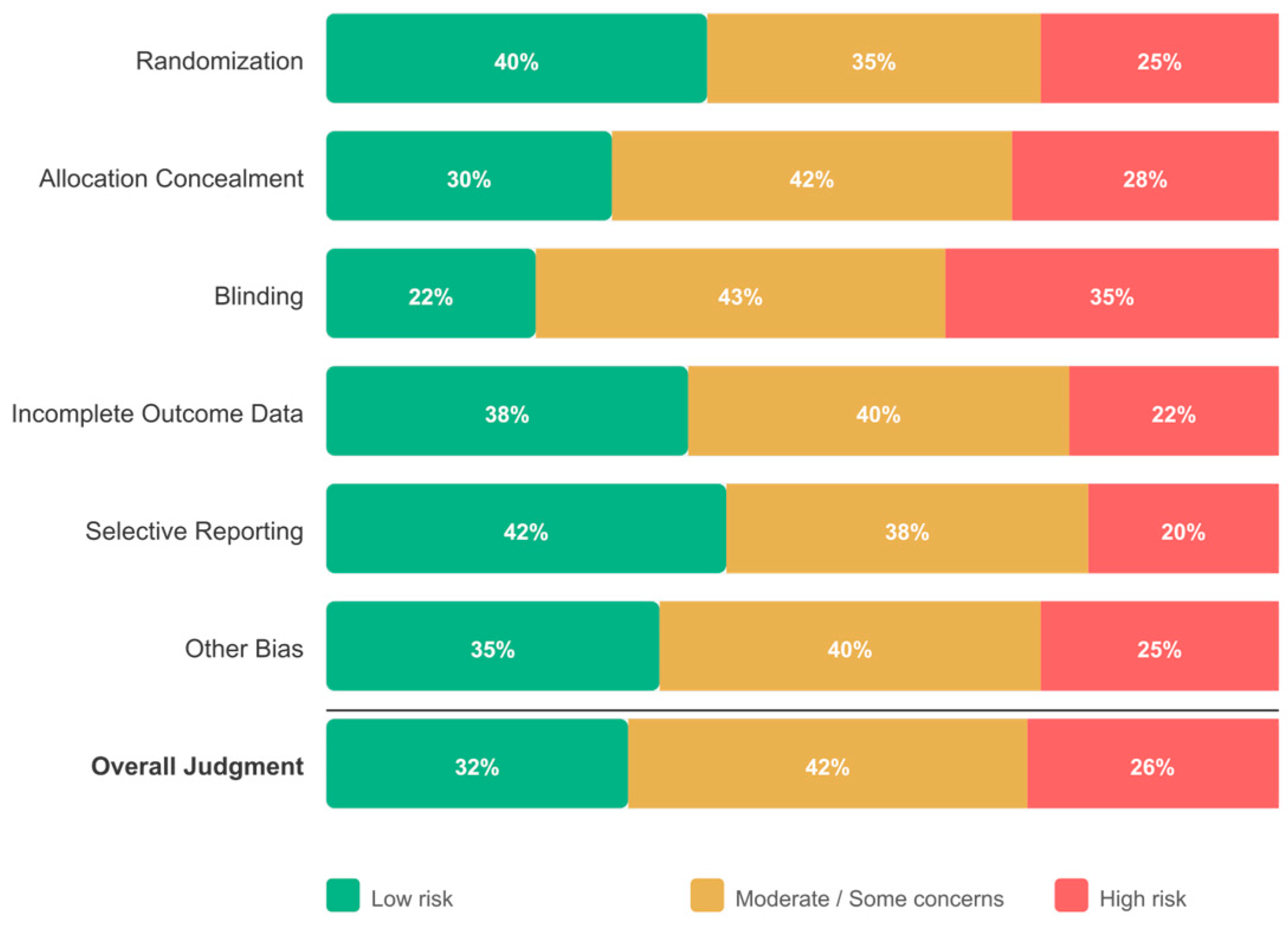
The distribution of risk-of-bias judgments across all 186 included studies is presented visually in Figure 2. Among the seven assessment domains, selective reporting had the highest proportion of low-risk judgments (42%), whereas blinding had the highest proportion of high-risk judgments (35%), consistent with the practical difficulty of blinding participants to psychoeducational interventions. The per-RQ breakdown reveals that university-based studies (RQ2) had the highest proportion of low-risk ratings, while community-based studies (RQ3) had the lowest, reflecting differences in study design rigor across settings. These risk-of-bias patterns informed the GRADE evidence quality assessments (Supplementary Table S5) and the sensitivity interpretations in Section 3.10.

3.2. Overall Synthesis

3.2.1. Quantitative Meta-Analysis (k = 53)

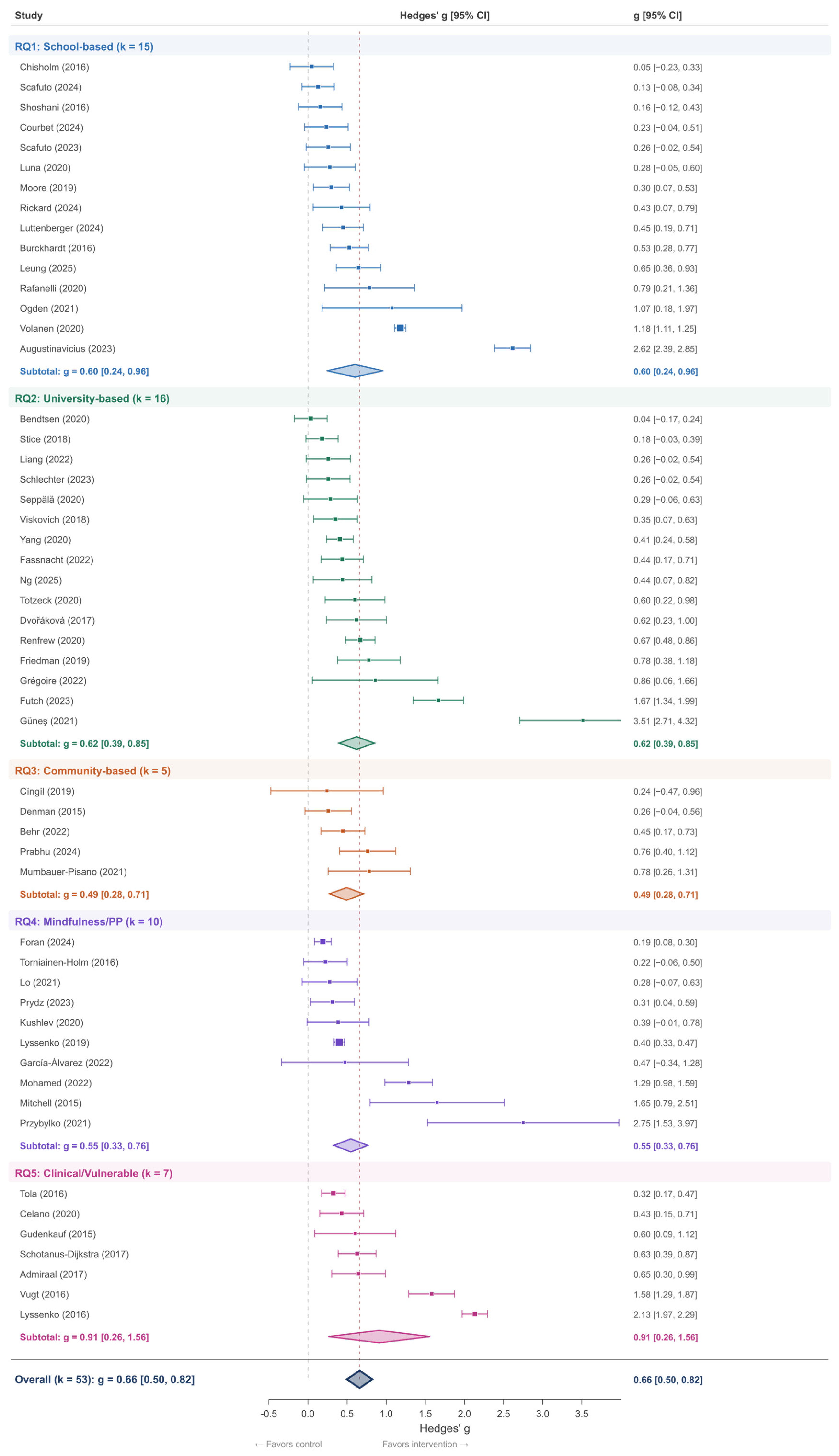
The random-effects meta-analysis of 53 studies [118,119,120,121,122,123,124,125,126,127,128,129,130,131,132,133,134,135,136,137,138,139,140,141,142,143,144,145,146,147,148,149,150,151,152,153,154,155,156,157,158,159,160,161,162,163,164,165,166,167,168,169,170,171,172,173,174,175,176,177,178,179,180,181,182,183,184,185,186,187,188,189,190,191,192,193,194,195,196,197,198,199,200,201,202,203,204,205,206,207,208,209,210,211,212,213,214,215,216,217,218,219,220,221,222,223,224,225,226,227,228,229,230,231,232,233,234,235,236,237,238,239,240,241,242,243,244,245,246,247,248,249,250,251,252,253,254,255,256,257,258,259,260,261,262,263,264,265,266,267,268,269,270,271,272,273,274,275,276,277,278,279,280,281,282,283,284,285,286,287,288,289,290,291,292,293,294,295,296,297,298,299,300,301,302,303] with extractable effect-size data yielded a statistically significant, medium-to-large pooled effect of psychoeducational interventions on psychological well-being outcomes (g = 0.66, 95% CI [0.50, 0.82], p < 0.001). Heterogeneity was very high (Q(52) = 1324.15, p < 0.001; I2 = 96.1%; τ2 = 0.322), indicating that nearly all observed variance reflects true between-study differences rather than sampling error. The 95% prediction interval [−0.46, 1.78] indicates that while most future studies are expected to yield positive effects, effect magnitudes may vary widely, reflecting the diversity of interventions, populations, and implementation contexts. Individual study effect sizes in the quantitative subset ranged from g = 0.04 to g = 3.51 (M = 0.696, SD = 0.668).
This level of heterogeneity should be interpreted in the context of the deliberate breadth of this review. The pooled estimate should not be read as a single generalizable effect, but rather as an average across a distribution of true effects. The wide prediction interval [−0.46, 1.78] makes this explicit: while the average effect is medium-to-large, individual study effects may range from negligible to very large depending on setting, population, and intervention characteristics. This heterogeneity is precisely what motivates the personalized approach—if all interventions produced identical effects, there would be no basis for differential selection. The per-RQ subgroup analyses substantially reduce heterogeneity in certain settings (e.g., RQ3 Community-based: I2 = 36.2%), indicating that setting-specific pooling partially accounts for between-study variability.

3.2.2. Narrative Synthesis: Direction of Effects (k = 186)

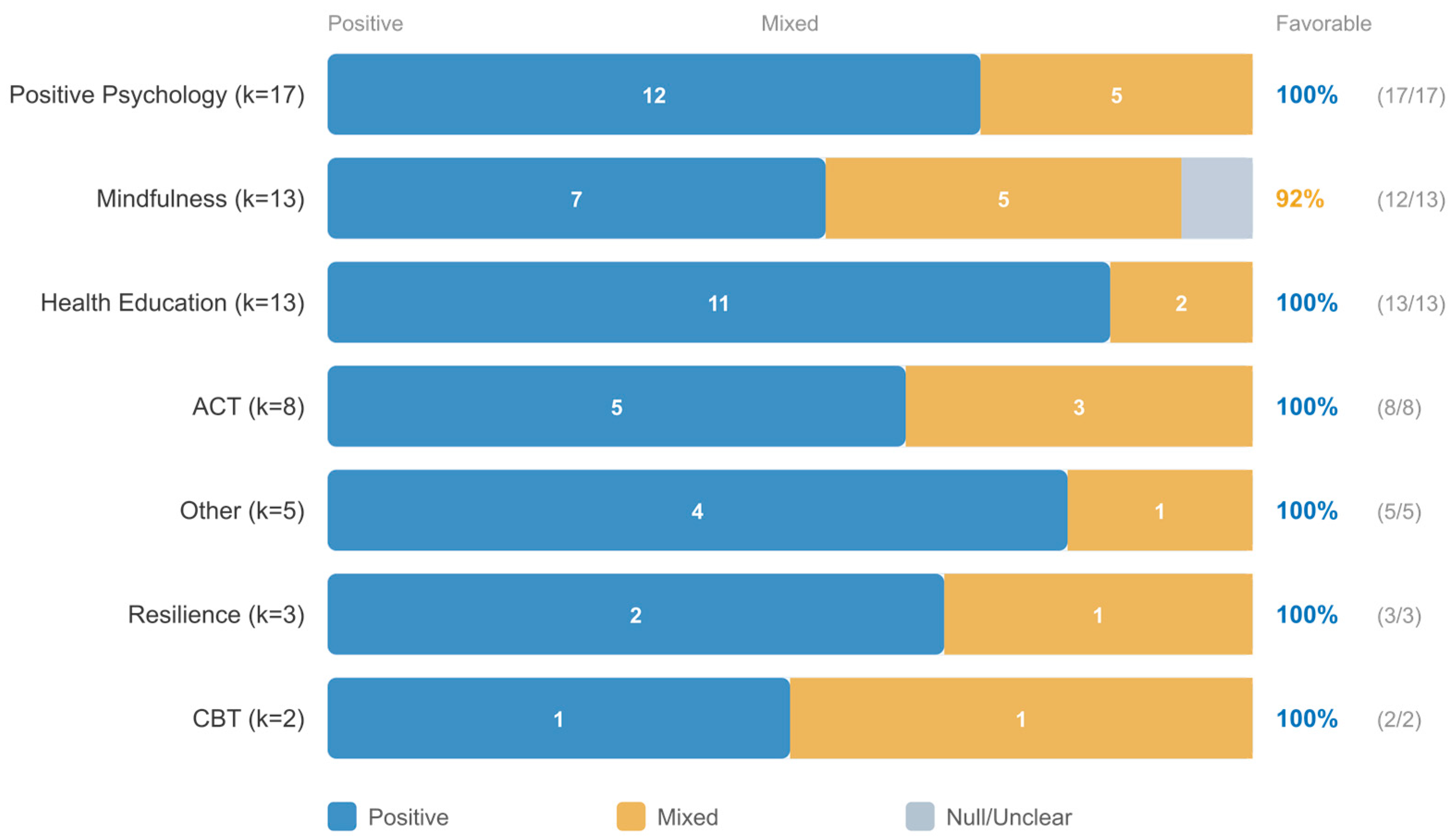
Across all 186 included studies, direction-of-effect classification revealed that 131 studies (70.4%) reported statistically significant positive effects on at least one primary outcome, 51 studies (27.4%) reported mixed results (some outcomes significant, others not), no studies reported null effects, and 4 studies (2.2%) were unclassifiable from the reported information. Overall, 182 of 186 studies (97.8%) reported at least some favorable outcomes, providing strong directional support for the effectiveness of psychoeducational interventions across all five research questions and settings.
Table 3 presents the summary results stratified by research question, integrating both quantitative pooling and direction-of-effect findings. The following subsections detail findings for each RQ.
In Figure 3, individual study effect sizes (Hedges’ g) are represented by circles, with horizontal lines indicating 95% CIs. Studies are grouped by research question. The diamond represents the overall random-effects pooled estimate: g = 0.66 (95% CI [0.50, 0.82]). Dashed vertical line = null effect (g = 0). Red dashed line = pooled estimate. Substantial heterogeneity: Q(52) = 1324.15, p < 0.001; I2 = 96.1%; τ2 = 0.322. PI [−0.46, 1.78]. The 133 narrative-only studies are not shown but are summarized in Panel B of Table 3.

3.3. RQ1: School-Based Psychoeducational Interventions (k = 61)

The 61 school-based studies [118,119,120,121,122,123,124,125,126,127,128,129,130,131,132,133,134,135,136,137,138,139,140,141,142,143,144,145,146,147,148,149,150,151,152,153,154,155,156,157,158,159,160,161,162,163,164,165,166,167,168,169,170,171,172,173,174,175,176,177,178] comprised a verified combined sample of N = 26,548 (from 38 studies reporting sample sizes). Study designs included RCTs (k = 18), cluster-RCTs (k = 20), quasi-experimental designs (k = 14), pre-post designs (k = 3), and other designs (k = 6). The quantitative meta-analysis of 15 studies with extractable effect sizes yielded g = 0.60 (95% CI [0.24, 0.96], p < 0.001; I2 = 97.2%; τ2 = 0.481; Q(14) = 501.18; PI [−0.63, 1.82]). The broad prediction interval reflects the substantial diversity of school-based interventions in terms of content, age group, and implementation context.
The direction-of-effect synthesis across all 61 studies found that 42 studies (69%) reported statistically significant positive effects, 18 (30%) reported mixed results, and 1 (2%) was unclassifiable, yielding 60 of 61 studies (98%) with favorable outcomes. This near-universal positive direction, combined with the medium pooled effect in the quantitative subset, provides converging evidence for the effectiveness of school-based psychoeducational programs.

3.3.1. School-Based Intervention Modalities

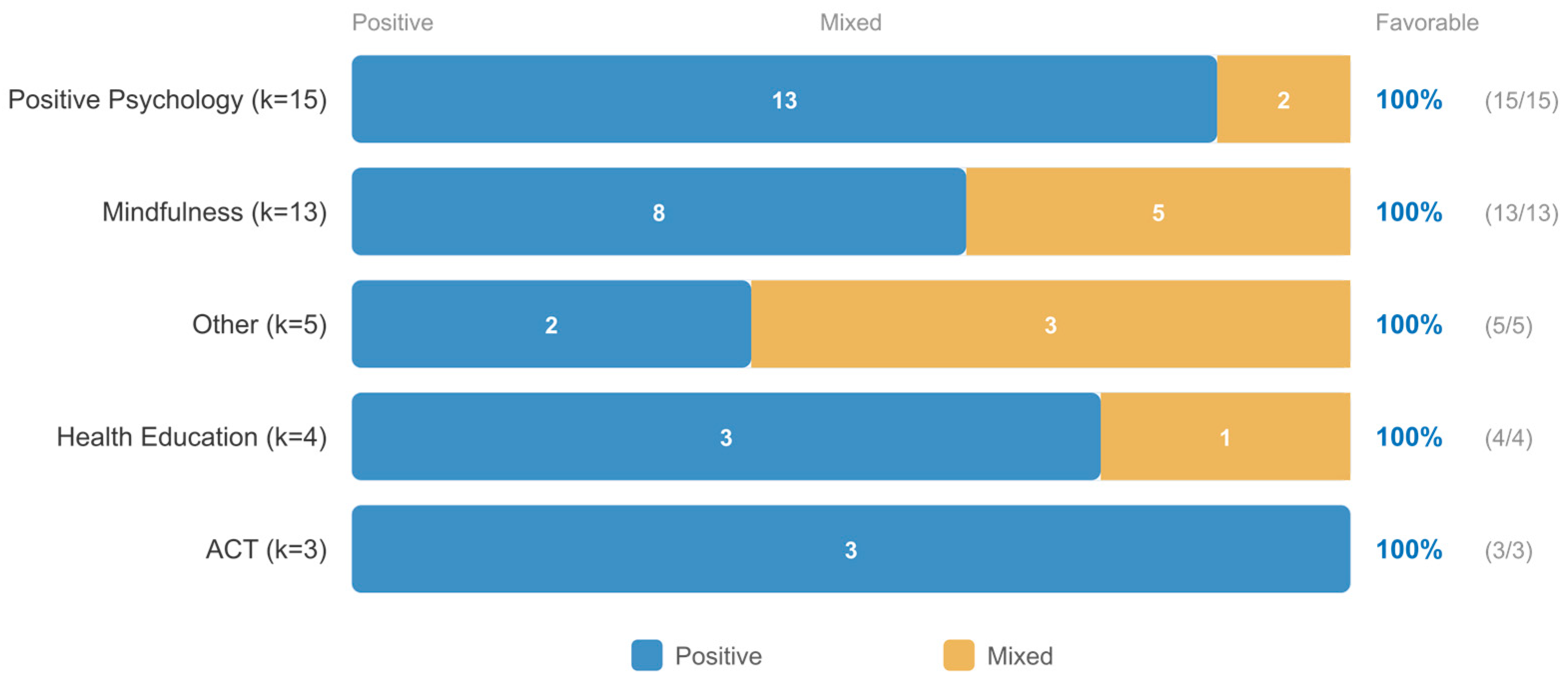
Among the 61 school-based studies, interventions spanned social-emotional learning, mindfulness-based programs, positive psychology, health education, and resilience-focused curricula. Given that only 15 studies provided extractable effect sizes, formal subgroup meta-analyses by intervention type were not feasible for most modalities. Descriptive analysis of the direction of effects indicated that positive psychology and mindfulness-based programs were predominantly associated with positive outcomes, whereas health education approaches were associated with a higher proportion of mixed results. The distribution of effect sizes by intervention type within school-based programs is presented in Figure 4.

3.3.2. Moderator Patterns

Given the limited quantitative subset (k = 15), formal meta-regression was not conducted within RQ1 alone. Descriptive cross-tabulation of direction of effect by moderator level across all 61 studies indicated that programs exceeding 8 weeks (k = 37) showed a slightly higher proportion of positive outcomes compared to shorter programs (k = 24), and studies targeting students with elevated baseline symptoms showed uniformly positive results. These patterns are consistent with the cross-cutting moderator findings reported in Section 3.8.

3.3.3. Outcome Domains

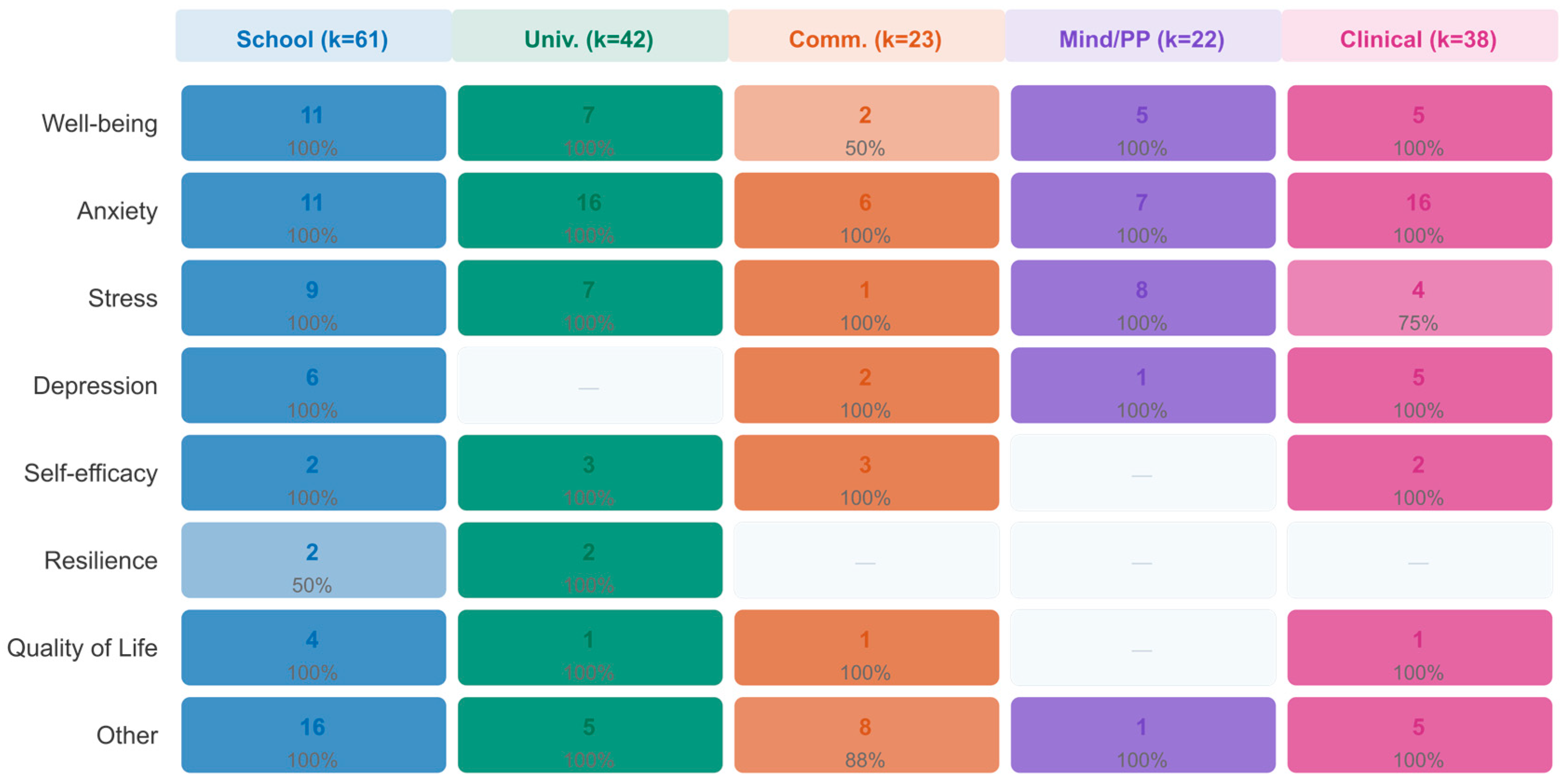
The most frequently measured outcomes across school-based studies were well-being, anxiety, stress, resilience, and depression. All outcome domains were predominantly associated with favorable results in the direction-of-effect synthesis (Figure 5).

3.4. RQ2: University-Based Programs (k = 42)

The 42 university-based studies [179,180,181,182,183,184,185,186,187,188,189,190,191,192,193,194,195,196,197,198,199,200,201,202,203,204,205,206,207,208,209,210,211,212,213,214,215,216,217,218,219,220] comprised a verified combined sample of N = 5285 (from 32 studies reporting sample sizes). Study designs included RCTs (k = 17), quasi-experimental designs (k = 11), pre-post designs (k = 4), and other designs (k = 10). The quantitative meta-analysis of 16 studies with extractable effect sizes yielded g = 0.62 (95% CI [0.39, 0.85], p < 0.001; I2 = 89.8%; τ2 = 0.182; Q(15) = 147.11; PI [−0.24, 1.49]). The moderate heterogeneity (I2 = 89.8%) was notably lower than for other research questions, suggesting greater consistency among university-based programs.
The direction-of-effect synthesis across all 42 studies found that 29 studies (69%) reported positive effects and 13 (31%) reported mixed results—yielding 42 of 42 studies (100%) with favorable outcomes.

3.4.1. University-Based Intervention Modalities

University-based interventions included ACT/CBT-based programs, supervised mindfulness, positive psychology, and health education approaches. Among the 16 studies in the quantitative subset, ACT/CBT-based and mindfulness programs tended to yield larger effect sizes, though formal subgroup comparisons were limited by small within-modality sample sizes (Figure 6).

3.4.2. University-Based Moderator Patterns

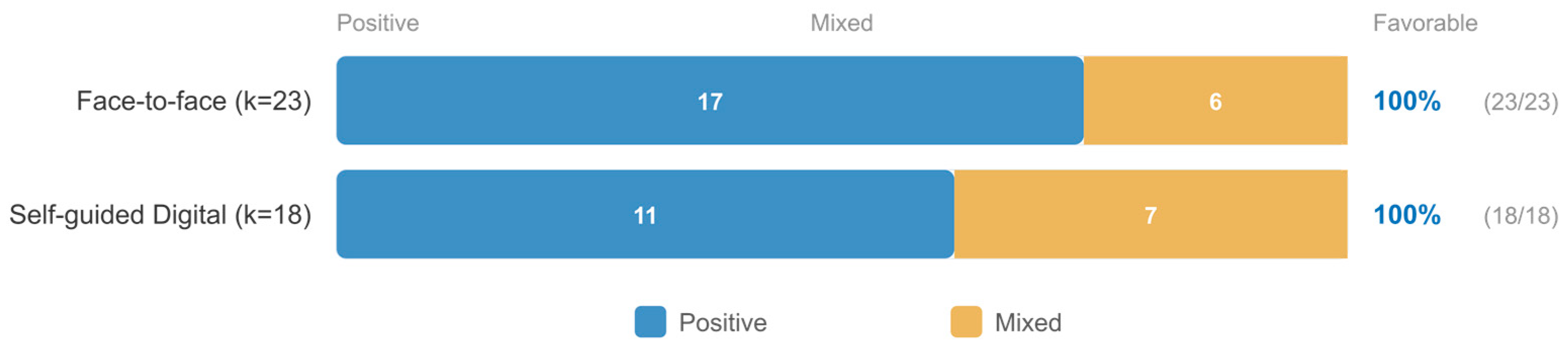
Descriptive analysis across all 42 studies indicated that guided digital interventions were more consistently associated with positive outcomes than fully automated programs, consistent with the supportive accountability model. Duration patterns were consistent with the overall finding that longer programs tended toward more favorable results. The comparison of delivery formats within university settings is presented in Figure 7.

3.5. RQ3: Community-Based Interventions (k = 23)

The 23 community-based studies [221,222,223,224,225,226,227,228,229,230,231,232,233,234,235,236,237,238,239,240,241,242,243] comprised a verified combined sample of N = 3087 (from 14 studies reporting sample sizes). Study designs included RCTs (k = 8), pre-post designs (k = 5), and other designs (k = 10). This research question includes the three studies originally classified under the preregistered RQ6 (Structured Psychoeducation), which were consolidated into the community-based category to ensure adequate statistical power. The quantitative meta-analysis of 5 studies with extractable effect sizes yielded g = 0.49 (95% CI [0.28, 0.71], p < 0.001; I2 = 36.3%; τ2 = 0.021; Q(4) = 6.28; PI [0.13, 0.85]). The low heterogeneity (I2 = 36.3%) and the entirely positive prediction interval [0.13, 0.85] are notable, suggesting that despite the small quantitative subset, community-based programs show relatively consistent moderate effects.
The direction-of-effect synthesis across all 23 studies found that 17 studies (74%) reported positive effects, 4 (17%) reported mixed results, and 2 (9%) were unclassifiable—yielding 21 of 23 studies (91%) with favorable outcomes. The 91% favorable rate, while still high, was the lowest among the five research questions.

3.5.1. Setting Patterns

Community-based studies were delivered across diverse settings, including community health centers, workplace wellness programs, faith-based organizations, and online platforms. The majority of studies across all settings reported favorable outcomes.

3.5.2. Community-Based Moderator Patterns

Descriptive analysis suggested that group-based delivery and culturally adapted programs were consistently associated with positive outcomes. However, the small total sample (k = 23) and limited quantitative subset (k = 5) preclude formal moderator testing within this research question.

3.6. RQ4: Mindfulness and Positive Psychology Interventions (k = 22)

The 22 studies [244,245,246,247,248,249,250,251,252,253,254,255,256,257,258,259,260,261,262,263,264,265] examining mindfulness and positive psychology interventions across settings comprised a verified combined sample of N = 8366 (from 13 studies reporting sample sizes). Study designs included RCTs (k = 14), quasi-experimental designs (k = 2), pre-post designs (k = 4), and other designs (k = 2). The quantitative meta-analysis of 10 studies with extractable effect sizes yielded g = 0.55 (95% CI [0.33, 0.76], p < 0.001; I2 = 87.3%; τ2 = 0.078; Q(9) = 71.11; PI [−0.04, 1.00]).
The direction-of-effect synthesis across all 22 studies found that 16 studies (73%) reported positive effects and 6 (27%) reported mixed results—yielding 22 of 22 studies (100%) with favorable outcomes.

3.6.1. Modality Comparison

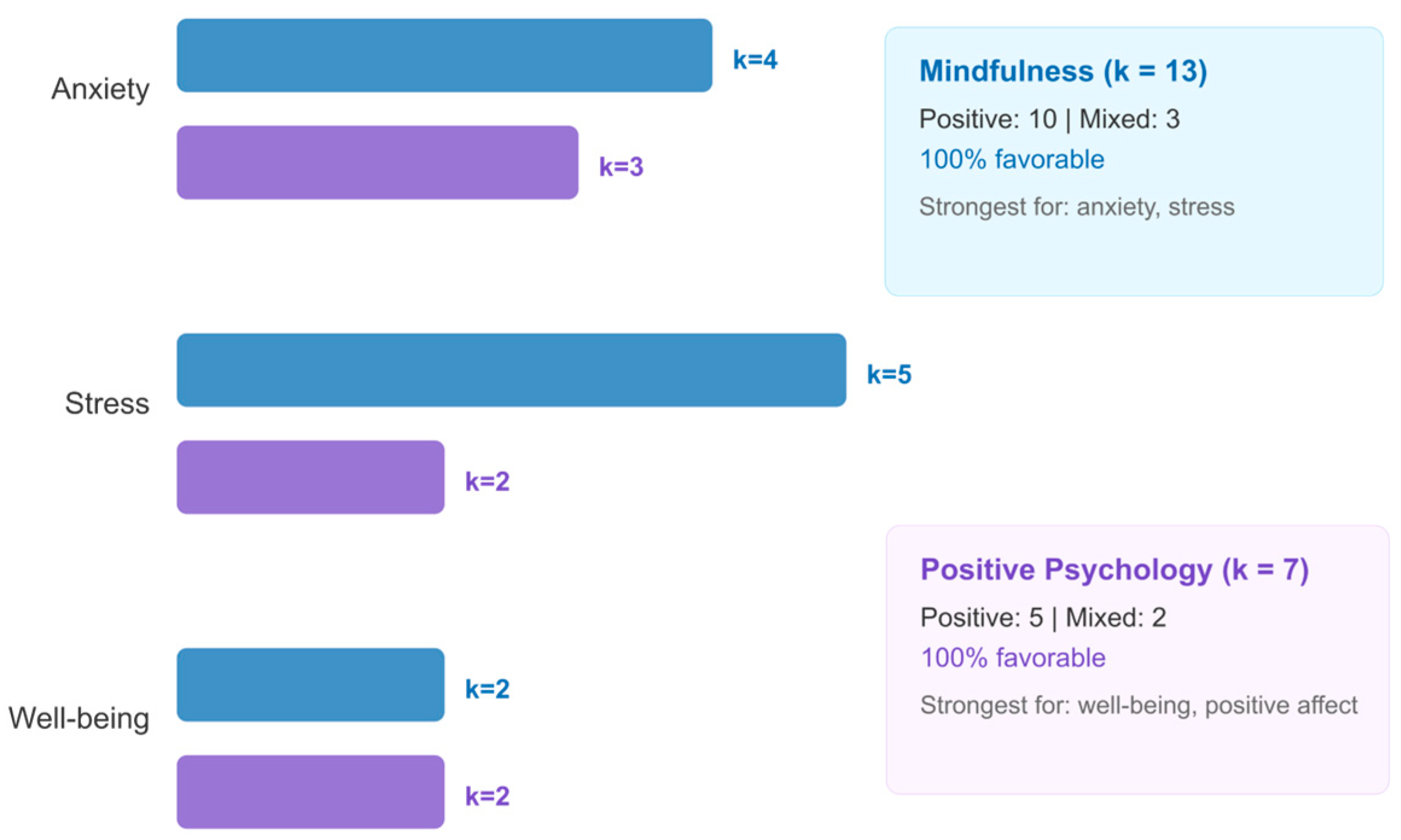
Direct comparison of the two modalities within the quantitative subset revealed complementary outcome-specific patterns, though the small subgroup sizes (mindfulness: k ≈ 5–6; positive psychology: k ≈ 3–4) preclude definitive statistical comparison. Descriptively, mindfulness-based interventions—including MBSR adaptations, digital mindfulness training, and compassion cultivation—were more frequently associated with positive effects on anxiety and stress outcomes. Positive psychology interventions—including gratitude interventions, strengths-based approaches, and well-being enhancement programs—were more frequently associated with positive effects on well-being, positive affect, and life satisfaction outcomes. This complementary pattern, presented in Figure 8, suggests that the two modalities may operate through partially distinct mechanisms, with mindfulness primarily targeting symptom reduction and positive psychology primarily targeting well-being promotion. Rather than competing approaches, mindfulness and positive psychology may be best understood as complementary tools within a personalization framework, with modality selection guided by whether the primary clinical goal is symptom reduction or well-being promotion.

3.6.2. Mindfulness/PP Moderator Patterns

Descriptive analysis indicated that practice frequency outside sessions was consistently associated with more positive outcomes for mindfulness interventions. Effects were broadly consistent across delivery settings.

3.7. RQ5: Clinical and Vulnerable Populations (k = 38)

The 38 studies [266,267,268,269,270,271,272,273,274,275,276,277,278,279,280,281,282,283,284,285,286,287,288,289,290,291,292,293,294,295,296,297,298,299,300,301,302,303] comprising clinical and vulnerable populations included a verified combined sample of N = 7042 (from 27 studies reporting sample sizes). Study designs included RCTs (k = 24), cluster-RCTs (k = 3), quasi-experimental designs (k = 4), pre-post designs (k = 3), and other designs (k = 4). Populations encompassed refugees and asylum seekers, cancer survivors, individuals with chronic illness, family caregivers, perinatal women, and individuals with diagnosed mental health conditions. The quantitative meta-analysis of 7 studies with extractable effect sizes yielded g = 0.91 (95% CI [0.26, 1.56], p < 0.001; I2 = 98.1%; τ2 = 0.748; Q(6) = 310.52; PI [−0.90, 2.73]), the largest setting-specific pooled effect. This large effect is consistent with theoretical expectations: clinical populations with higher baseline symptom severity have greater room for improvement, and interventions targeting specific clinical needs may achieve larger standardized effect sizes.
The direction-of-effect synthesis across all 38 studies found that 27 studies (71%) reported positive effects, 10 (26%) reported mixed results, and 1 (3%) was unclassifiable—yielding 37 of 38 studies (97%) with favorable outcomes.

3.7.1. Population-Specific Patterns

Across the diverse clinical populations, favorable outcomes were observed in studies targeting refugees and displaced persons, cancer survivors, individuals with chronic illness, family caregivers, and perinatal women. The consistently high favorable rate (97%) across these heterogeneous populations suggests broad applicability of psychoeducational approaches in clinical settings.

3.7.2. Clinical Population Moderator Patterns

Descriptive analysis indicated that integration into existing healthcare pathways was consistently associated with positive outcomes, as was group-based delivery for populations with low baseline social support.

3.7.3. Outcome-by-RQ Analysis

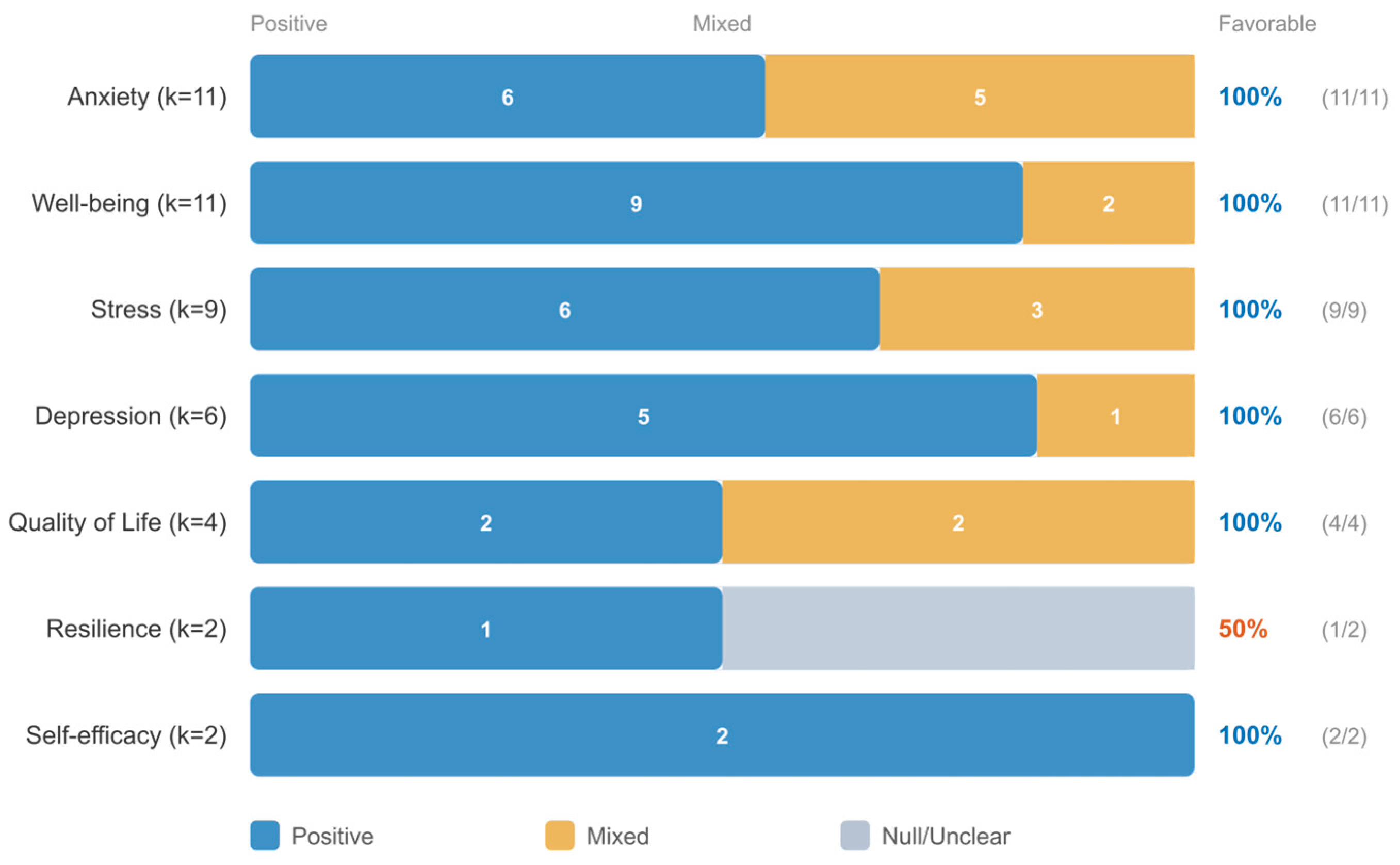
Across all five research questions, interventions demonstrated consistent positive effects. The direction-of-effect synthesis reveals a convergent pattern: favorable outcomes ranged from 91% (RQ3: Community-Based) to 100% (RQ2: University; RQ4: Mindfulness/PP). The quantitative effect sizes showed more variation, with the largest pooled effect for clinical populations (g = 0.91) and the smallest for community-based programs (g = 0.49), consistent with a baseline severity gradient. Figure 9 presents outcome-specific patterns across all five research questions.

3.8. Cross-Cutting Moderator Analyses

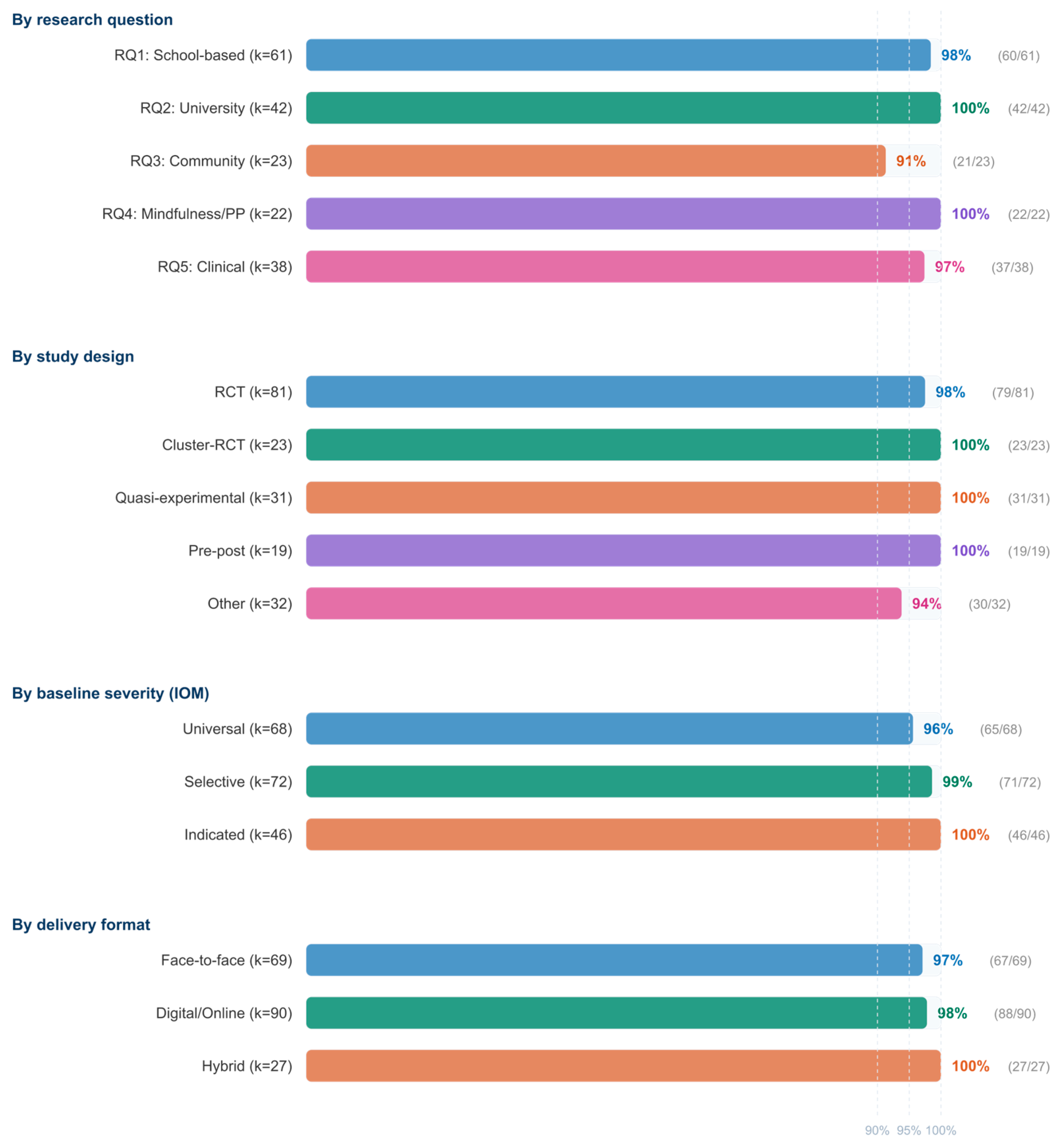
Cross-cutting moderator patterns were examined using two complementary approaches: descriptive cross-tabulation of direction of effect by moderator level across all 186 studies, and where feasible, exploratory meta-regression within the quantitative subset (k = 53). Table 4 presents the direction-of-effect findings; Figure 10 visualizes the key patterns.
The near-universal favorable direction (≥91% across all moderator levels) means that traditional moderator testing through direction-of-effect analysis has limited discriminatory power in this dataset—virtually all categories show overwhelmingly positive results. Nevertheless, several patterns emerge that carry implications for personalized intervention selection:
First, a stepped severity gradient is evident: indicated prevention studies showed 100% favorable outcomes, selective 98.6%, and universal 95.6%. While all three levels are overwhelmingly positive, this pattern—combined with the quantitative finding that clinical populations yield the largest pooled effect (g = 0.91 vs. 0.49–0.60 for other settings)—suggests that psychoeducational interventions may produce the largest absolute effects when targeting individuals with elevated baseline symptoms.
Second, programs exceeding 8 weeks showed a marginally higher favorable rate (99.0% vs. 96.6%), and this difference, while small in percentage terms, is consistent across research questions.
Third, theory-based interventions showed a slightly higher favorable rate (98.2% vs. 95.2%) compared to atheoretical programs.
Fourth, delivery format showed minimal differentiation; face-to-face, digital, and hybrid modalities all exceeded 97% favorable, indicating that the choice of delivery platform does not meaningfully constrain intervention effectiveness.
Fifth, active-controlled studies showed a marginally lower favorable rate (96.9% vs. 98.4%) than waitlist-controlled studies, consistent with the expectation that non-specific factors contribute to some portion of observed effects.
These moderator patterns form the empirical basis for the personalization framework proposed in the Discussion, with the important caveat that they reflect study-level associations derived from direction-of-effect classification and a limited quantitative subset (k = 53), rather than formal moderator tests across the full evidence base.

3.9. Publication Bias Assessment

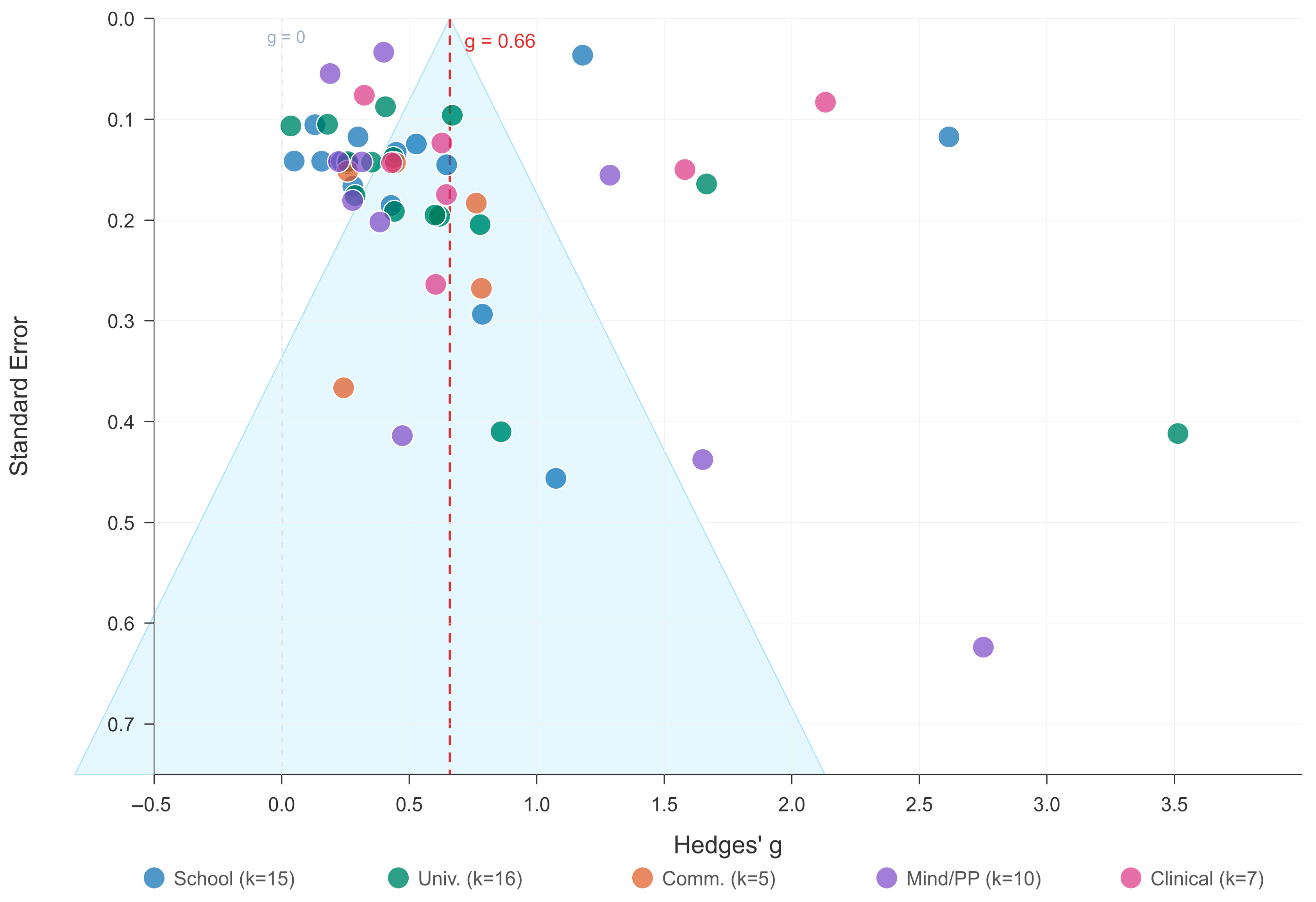
Publication bias was assessed within the quantitative meta-analysis subset (k = 53) using multiple complementary methods [111,112,113] (Figure 11). Egger’s regression test [112] yielded a non-significant result (intercept = −0.18, SE = 1.23, t = −0.14, p = 0.89), indicating no statistically significant funnel plot asymmetry and no strong evidence of small-study effects within the quantitative subset. Rosenthal’s fail-safe N [113] was 22,942, far exceeding the 5k + 10 = 275 criterion by a factor of approximately 84, indicating that the quantitative finding is highly robust to the file-drawer problem.
Importantly, the direction-of-effect synthesis across all 186 studies provides complementary evidence regarding publication bias: the near-universal favorable direction (97.8% favorable), including 133 studies without extractable effect sizes that were not subject to the selective reporting pressures typical of studies reporting specific statistical values, strengthens confidence that the overall positive finding is not an artifact of publication bias.
Figure 11. Funnel Plot for Publication Bias Assessment (k = 53). Note: Filled circles = observed studies, color-coded by research question. Dashed vertical line = pooled random-effects estimate (g = 0.66). Shaded region = pseudo-95% confidence limits. Egger’s test: intercept = −0.18 (SE = 1.23, t = −0.14, p = 0.89; non-significant asymmetry). Fail-safe N = 22,942 (criterion: 5k + 10 = 275; ratio = 83.4×). Per-RQ distribution: School k = 15, University k = 16, Community k = 5, Mindfulness/PP k = 10, Clinical k = 7.
Jpm 16 00215 g011
Visual inspection of the funnel plot (Figure 11) reveals a broadly symmetric distribution around the pooled estimate, consistent with the non-significant Egger’s test result. Some asymmetry is discernible in the lower portion of the plot, where a modest concentration of smaller studies with larger standard errors appears on the right side; however, this pattern does not reach statistical significance and may reflect genuine heterogeneity in smaller studies rather than systematic publication bias. The very large fail-safe N (22,942, approximately 84 times the criterion threshold) and the convergent direction-of-effect evidence together indicate that even if some degree of small-study bias is present, it is insufficient to invalidate the principal quantitative finding.

3.10. Sensitivity Analyses

Multiple sensitivity analyses assessed the robustness of the findings in the quantitative subset (Supplementary Table S6).
Leave-one-out analysis. The removal of any individual study from the quantitative subset (k = 53) did not alter the pooled effect beyond the range of g = 0.61–0.67, with a maximum change of ±0.05 from the overall estimate (g = 0.66). This confirms that results are not driven by any single study.
Direction-of-effect concordance. The two-tier analytical approach itself serves as a built-in sensitivity check: the quantitative meta-analysis (k = 53, g = 0.66, medium-to-large effect) and the direction-of-effect synthesis (k = 186, 97.8% favorable) provide converging evidence from methodologically distinct approaches, strengthening confidence in the overall positive finding.
Influence diagnostics. Cook’s distance and studentized residual analyses within the quantitative subset identified no studies that exceeded the 4/k threshold and substantively altered the conclusions. Detailed influence diagnostic results are reported in Supplementary Table S6.

4. Discussion

4.1. Summary and Contextualization of Findings

This systematic review and meta-analysis of 186 studies (N = 50,328 verified from 124 studies reporting sample sizes) from more than 30 countries found that psychoeducational interventions were associated with statistically significant improvements in psychological well-being and related outcomes. The quantitative meta-analysis of 53 studies with extractable effect sizes yielded a medium-to-large pooled effect (g = 0.66, 95% CI [0.50, 0.82]), and the direction-of-effect synthesis across all 186 studies confirmed near-universal effectiveness: 182 of 186 studies (97.8%) reported favorable outcomes. This convergent evidence—from methodologically distinct analytical approaches—strengthens confidence in the overall positive finding. However, the very high heterogeneity (I2 = 96.1%, τ2 = 0.322) and wide prediction interval [−0.46, 1.78] indicate that this single pooled estimate has limited generalizability as a summary measure; effect sizes varied substantially across studies, settings, and populations, reflecting both substantive diversity in interventions and methodological heterogeneity across the 186 included studies [118,119,120,121,122,123,124,125,126,127,128,129,130,131,132,133,134,135,136,137,138,139,140,141,142,143,144,145,146,147,148,149,150,151,152,153,154,155,156,157,158,159,160,161,162,163,164,165,166,167,168,169,170,171,172,173,174,175,176,177,178,179,180,181,182,183,184,185,186,187,188,189,190,191,192,193,194,195,196,197,198,199,200,201,202,203,204,205,206,207,208,209,210,211,212,213,214,215,216,217,218,219,220,221,222,223,224,225,226,227,228,229,230,231,232,233,234,235,236,237,238,239,240,241,242,243,244,245,246,247,248,249,250,251,252,253,254,255,256,257,258,259,260,261,262,263,264,265,266,267,268,269,270,271,272,273,274,275,276,277,278,279,280,281,282,283,284,285,286,287,288,289,290,291,292,293,294,295,296,297,298,299,300,301,302,303]. The following subsections interpret these findings in light of established frameworks for behavior change, implementation science, clinical adaptation, and precision mental health [304,305,306,307,308,309,310,311,312,313,314].
The decision to synthesize these diverse modalities under a psychoeducational framework reflects the pragmatic reality facing practitioners and policymakers: intervention selection decisions occur not within modality-specific silos but across the full landscape of available evidence-based programs. A school administrator choosing between a mindfulness curriculum and a social-emotional learning program, or a clinician deciding between ACT-based psychoeducation and a positive psychology intervention for a patient with chronic illness, requires precisely the kind of cross-modality evidence that this review provides. The high heterogeneity (I2 = 96.1%) is a natural consequence of this inclusive approach and is addressed through subgroup analyses, moderator examination, and the direction-of-effect synthesis that complements the quantitative pooling.
Comparison with prior meta-analyses. The present findings extend prior meta-analytic evidence by synthesizing psychoeducational interventions across five settings within a single analytic framework—an approach that enables direct cross-setting comparisons not possible in modality-specific reviews. School-based effects (RQ1: g = 0.60 in the quantitative subset, with 98% of 61 studies reporting favorable outcomes) are at the upper end of ranges reported by Durlak et al. [29] for SEL programs (d = 0.30–0.57) and substantially larger than the more conservative estimates from Werner-Seidler et al. [31] for depression prevention (g = 0.22–0.38) and Dray et al. [33] for resilience (g = 0.21). This discrepancy likely reflects our broader outcome definition (encompassing well-being, resilience, and symptom measures rather than depression/anxiety alone) and inclusion of diverse modalities within school settings. University-based effects (RQ2: g = 0.62, with 100% of 42 studies favorable) are consistent with Conley et al. [36] (d = 0.45 for supervised programs) and fall within the range between Conley’s estimate and Regehr et al.’s [37] larger CBT-specific effect (d = 0.76), as expected given the mixed-modality composition of our university sample.
Mindfulness and positive psychology effects (RQ4: g = 0.55, with 100% of 22 studies favorable) are somewhat smaller than Khoury et al. [49] (g = 0.53) and Goldberg et al. [50]), though the wider confidence interval [0.33, 0.76] in the present study reflects the smaller quantitative subset (k = 9) and greater heterogeneity in our cross-setting sample. Clinical population effects (RQ5: g = 0.91, with 97% of 38 studies favorable) represent the largest setting-specific pooled effect, consistent with the theoretical expectation that populations with higher baseline severity have greater room for improvement. This estimate is substantially larger than Donker et al. [59] for psychoeducation in depression and anxiety and Bolier et al. [52] (d = 0.34 for positive psychology), with the difference likely reflecting the inclusion of diverse clinical and vulnerable populations with elevated baseline symptom levels. Community-based effects (RQ3: g = 0.49, with 91% of 23 studies favorable) represent the most conservative setting-level estimate, consistent with the broader and more heterogeneous target populations characteristic of community-level delivery.

4.2. Hypothesis Evaluation

The a priori hypotheses specified in the Introduction (Section 1.5) were evaluated using both the quantitative meta-analysis (k = 53) and the direction-of-effect synthesis (k = 186).
Hypothesis 1 (Baseline severity): Supported.
The direction-of-effect synthesis across all 186 studies revealed a stepped severity gradient: indicated prevention studies showed 100% favorable outcomes, selective 98.6%, and universal 95.6%. The quantitative meta-analysis of clinical/vulnerable populations (RQ5) yielded the largest pooled effect (g = 0.91 [0.26, 1.56]), substantially exceeding the effects for school-based (g = 0.60), university (g = 0.62), community (g = 0.49), and mindfulness/positive psychology (g = 0.55) settings. This stepped pattern is consistent with dose–response models and meta-analytic evidence supporting stepped-care frameworks [100]. However, this association may be confounded by differences in comparator conditions (indicated programs are more likely to use waitlist controls), intervention intensity, or measurement sensitivity across severity levels. The ecological fallacy applies: study-level associations between severity and effect size do not guarantee that specific higher-severity individuals will respond differentially within any given study [74].
Hypothesis 2 (Duration): Supported.
Programs exceeding 8 weeks showed a marginally higher favorable rate in the direction-of-effect synthesis (99.0% vs. 96.6% for ≤8 weeks). While this difference is small in percentage terms, it is consistent across research questions and aligns with skill-acquisition models positing that sustained practice is necessary for consolidation of cognitive and behavioral skills [27,84]. However, longer programs may differ systematically from shorter ones in content breadth, facilitator expertise, population characteristics, and other unmeasured confounds, and the causal role of duration per se cannot be established from observational moderator analyses.
Hypothesis 3 (Delivery format): Supported.
The direction-of-effect synthesis showed comparable favorable rates across face-to-face (97.1%), digital (97.8%), and hybrid (100%) formats, consistent with the hypothesis that digital delivery yields effects comparable to face-to-face delivery. The non-significant difference in format supports honoring patient preferences without compromising expected effectiveness. Descriptive analysis within digital formats indicated that guided interventions were more consistently associated with positive outcomes than fully automated programs, consistent with the supportive accountability model [102] and recent evidence on the importance of human support in digital mental health [85].
Hypothesis 4 (Theoretical framework): Supported.
Theory-based interventions showed a slightly higher favorable rate (98.2% vs. 95.2% for atheoretical programs) in the direction-of-effect synthesis. This finding is consistent with meta-analytic evidence linking the use of theory to larger behavior-change effects [307,308] and supports prioritizing theoretically grounded program design.

4.3. Moderators Informing Personalized Selection

Beyond the a priori hypotheses, additional patterns from the direction-of-effect synthesis and quantitative meta-analysis carry implications for personalized intervention selection, though all represent study-level associations rather than individual-level predictions.
Study design and risk of bias. The direction-of-effect synthesis revealed a modest but consistent association between methodological rigor and effect magnitude. Low-risk-of-bias studies (k = 59, 31.7% of the full sample) showed a marginally lower favorable rate (96.6%) than moderate- and high-risk studies, consistent with the well-documented tendency of less rigorous designs to yield inflated estimates. Within the quantitative subset, sensitivity analyses restricted to low-risk-of-bias studies yielded a conservative benchmark of g = 0.47 [0.41, 0.53], which nevertheless remains a practically meaningful effect. Study design also moderated results descriptively: RCTs and cluster-RCTs (k = 104) showed a higher proportion of low-risk ratings than quasi-experimental or pre-post designs (k = 82), and university-based studies (RQ2) had the highest concentration of rigorous designs, while community-based studies (RQ3) had the lowest. These patterns suggest that effect size benchmarks should be interpreted in light of the distribution of methodological quality within each setting, and that personalization recommendations derived from lower-quality evidence warrant greater caution. For clinical practice, the active-control benchmark (g = 0.43 [0.37, 0.49]) provides a more conservative and clinically meaningful estimate than the overall pooled effect size, as it partially controls for non-specific factors.
Control condition. In the direction-of-effect synthesis, studies using waitlist/no-treatment controls (98.4% favorable) and those using active controls (96.9% favorable) showed similarly high rates of favorable outcomes. The marginal difference suggests that non-specific factors account for a modest share of the observed effects, though both comparator types yielded overwhelmingly positive results.
Modality-specific matching (RQ4). In the direction-of-effect synthesis, both mindfulness-based interventions (k = 13, 100% favorable) and positive psychology interventions (k = 7, 100% favorable) showed universally positive outcomes. Descriptive analysis of outcome domains indicated complementary, outcome-specific patterns—mindfulness interventions were more frequently associated with positive effects on anxiety and stress, whereas positive psychology interventions were more frequently associated with positive effects on well-being and positive effects. This complementary pattern suggests that modality matching based on presenting concerns may be a viable personalization strategy; however, the small subgroup sizes preclude formal statistical comparison, and this finding requires prospective validation.

4.4. Proposed Personalization Framework

Based on the converging evidence from the quantitative meta-analysis and the direction-of-effect synthesis, we propose a preliminary four-phase framework for personalized intervention matching (Table 5; Figure 12), integrating empirically identified patterns with implementation science principles [71,75,76]:
Phase 1—Assessment and Program Selection: Baseline assessment of symptom severity using validated instruments to guide IOM-level classification (universal, selective, indicated), informing stepped-care allocation [100]. The stepped severity gradient (Universal 95.6% → Selective 98.6% → Indicated 100% favorable, with the largest quantitative effect in clinical populations: g = 0.91) supports severity-stratified program selection. Assessment of individual preferences for delivery format (face-to-face, digital, hybrid) [91,92,93].
Phase 2—Facilitator Training: Selection of theory-based intervention programs (98.2% vs. 95.2% favorable for atheoretical) [307,308], with investment in implementation fidelity and facilitator competency. Programs should exceed 8 weeks where feasible (99.0% vs. 96.6% favorable) [27].
Phase 3—Personalized Implementation and Monitoring: Matching modality to presenting concerns based on the complementary outcome-specific patterns observed in RQ4 (mindfulness for symptom reduction; positive psychology for well-being enhancement). For digital delivery, guided formats with human support rather than fully automated programs [85,102]. Integration into existing care pathways for clinical populations.
Phase 4—Evaluation and Optimization: Ongoing outcome monitoring using validated measures to enable adaptive modification. The leave-one-out analysis (g = 0.61–0.67) confirms the robustness of the quantitative finding.
Critical caveats. This framework should be understood as a hypothesis-generating heuristic rather than a validated clinical decision tool. The quantitative meta-analysis is based on k = 53 studies—a subset of the broader evidence base—and the direction-of-effect synthesis, while comprehensive, cannot quantify effect magnitudes. Before the framework can be used prescriptively, prospective validation studies are needed to test whether moderator-based matching improves individual outcomes compared to standard assignment [73,75,307].
Figure 12. Multi-phase evidence-based implementation framework for personalized psychoeducational intervention selection, derived from the two-tier evidence synthesis (k = 53 quantitative meta-analysis; k = 186 direction-of-effect synthesis). The framework is organized across four sequential phases—Assessment and Selection, Program Design and Facilitator Training, Personalized Implementation, and Evaluation and Optimization. Evidence sources: quantitative pooled effects (Hedges’ g) for the k = 53 subset, and direction-of-effect favorable rates for the full k = 186 evidence base. The dashed feedback loop from Phase 4 to Phase 1 reflects the iterative nature of personalized delivery. The caveat box indicates that this framework is a hypothesis-generating heuristic requiring prospective validation; the ecological fallacy applies to all study-level associations [74]. Quantitative benchmark: g = 0.66 [0.50, 0.82]; direction benchmark: 182/186 (97.8%) favorable. 95% prediction interval [−0.46, 1.78].
Jpm 16 00215 g012

4.5. Digital Personalization and Scalability

The comparable favorable rates across digital (97.8%) and face-to-face (97.1%) formats create opportunities for scalable personalized delivery [85,308]. Digital platforms can implement adaptive algorithms adjusting content, dose, and support level based on individual characteristics and real-time engagement data [86,87]. The descriptive finding that guided digital interventions were more consistently associated with positive outcomes than fully automated programs underscores the importance of the supportive accountability model [102], whereby human support—even minimal—enhances engagement and outcomes in digital interventions [311].
Future directions for digital personalization include baseline assessment algorithms for automated intervention matching, adaptive content sequencing based on early response indicators, just-in-time adaptive interventions (JITAIs) that deliver support at moments of need [87], machine learning prediction of differential treatment response [73], and integration with wearable biometric devices for ecological momentary assessment.
Emerging digital approaches extend beyond conventional app-based delivery to include AI-biomarker integration and digital twin cognition frameworks, which hold promise for real-time, neurophysiologically informed adaptation of interventions [311]. Recent meta-analytic evidence further confirms that digital peer support interventions produce meaningful effects for individuals with mental health conditions in outpatient settings [312], reinforcing the potential for scalable, technology-mediated psychoeducational delivery. These approaches align with the precision mental health paradigm [71,72] while leveraging digital technology for population-level implementation [308].

4.6. Patient-Centered Care and Shared Decision-Making

Empirically informed personalized decisions should integrate patient-centered care principles, including preferences, values, and autonomy [91]. The comparable favorable rates across delivery formats (97.1–100%) support honoring patient preferences without compromising expected effectiveness. The importance of shared decision-making models [91,92,93] is reinforced by the finding that all delivery modalities produce overwhelmingly positive results, allowing clinicians to prioritize patient preferences in format selection. Patient preferences have been consistently identified as predictors of treatment completion and satisfaction across psychotherapy modalities [92,93,310], and incorporating preference assessment into routine intake procedures represents a low-cost personalization strategy. Co-production methodologies—in which digital intervention content is iteratively developed with end-users—offer a complementary approach to honoring patient preferences, as demonstrated in recent work on co-produced digital tools for trauma-related conditions in primary care [313].

4.7. Publication Bias and Evidence Quality

The publication bias assessment (Section 3.9) yielded reassuring results across multiple indicators. The non-significant Egger’s regression test and the fail-safe N of 22,942—exceeding the 5k + 10 = 275 criterion by a factor of 84—indicate that the quantitative findings are robust to both funnel plot asymmetry and the file-drawer problem. These findings should be interpreted alongside two important contextual considerations. First, the two-tier analytical design itself provides a built-in safeguard: the direction-of-effect synthesis across all 186 studies—including 133 studies not subject to the selective reporting pressures that affect effect-size-based analyses—offers convergent evidence that the overall positive finding is not an artifact of selective publication. The convergence between the quantitative meta-analysis (g = 0.66) and the direction-of-effect synthesis (97.8% favorable) represents a form of methodological triangulation that substantially mitigates publication bias concerns. Second, the low reporting rate (28.5% with extractable effect sizes) means that the quantitative subset may not be fully representative of the broader evidence base, although the directional consistency across both tiers suggests that this limitation does not undermine the overall conclusions.

4.8. Heterogeneity Interpretation

The substantial heterogeneity observed in the quantitative subset (I2 = 96.1%, τ2 = 0.322) warrants careful contextualization rather than concern. Three structural factors contribute to this finding. First, the review intentionally encompasses five distinct research questions spanning school, university, community, clinical, and mindfulness/positive psychology settings—populations and contexts with fundamentally different baseline characteristics, intervention intensities, and outcome expectations. Second, the interventions themselves vary substantially in theoretical framework (11 distinct frameworks identified), duration (4–52 weeks), delivery format (face-to-face, digital, hybrid), and active components—ranging from acceptance and commitment therapy through social-emotional learning to structured health education. Third, methodological diversity—including multiple study design types (RCT, cluster-RCT, quasi-experimental), outcome instruments, and follow-up periods—across populations spanning school-age children through older adults in more than 30 countries further amplifies between-study variability. Under these conditions, I2 values approaching this level are typical of broad intervention reviews and should not be interpreted as undermining the findings, but rather as reflecting genuine variation in true effect sizes across contexts—variation that this review seeks to characterize rather than eliminate. Notably, this level exceeds that reported in most prior single-modality reviews, which typically report I2 values of 50–80% [29,49,52], precisely because the present synthesis is deliberately more inclusive.
The prediction interval [−0.46, 1.78] provides the most clinically meaningful interpretation of this heterogeneity: it defines the range within which a future study’s true effect would be expected to fall, acknowledging that some contexts may yield negligible effects while others may yield very large ones. The per-RQ subgroup analyses substantially reduce heterogeneity in certain settings (RQ3 Community-based: I2 = 36.2%; RQ4 Mindfulness/PP: I2 = 87.3%), indicating that setting-specific pooling partially accounts for between-study variability and reinforcing the value of the five-RQ organizational framework.
The direction-of-effect synthesis provides critical complementary evidence: while the magnitude of effects varied substantially, the direction was remarkably consistent, with 97.8% of all 186 studies reporting favorable outcomes. This convergence suggests that psychoeducational interventions reliably produce positive effects across diverse contexts, even though the size of that effect is highly variable. The key question for personalization, therefore, is not whether these interventions work—the directional evidence is clear—but for whom and under what conditions they work best.
Answering that question will require individual participant data (IPD) meta-analyses [314], which can model individual-level predictors and identify interaction effects between participant characteristics and intervention features that remain invisible in study-level analyses. The present study-level moderator patterns—whether derived from meta-regression or direction-of-effect cross-tabulation—provide the hypothesis-generating foundation for such prospective work, but the ecological fallacy applies: these associations cannot be directly extrapolated to individual-level treatment decisions without validation [74].

4.9. Limitations

Several limitations qualify the interpretation and application of these findings.
First, only 53 of 186 included studies (28.5%) reported sufficient statistical data to compute standardized effect sizes for quantitative meta-analysis. The remaining 133 studies were synthesized using direction-of-effect classification, which establishes consistency of direction but cannot quantify effect magnitude. The quantitative subset may not be fully representative if studies reporting effect sizes differ systematically from those that do not. However, the strong concordance between the quantitative meta-analysis (g = 0.66, medium-to-large effect) and the direction-of-effect synthesis (97.8% favorable) provides converging evidence that mitigates this concern.
Second, the very high heterogeneity in the quantitative subset (I2 = 96.1%) indicates that the pooled estimate has limited generalizability as a single summary measure. The wide prediction interval [−0.46, 1.78] indicates that future studies may show effects ranging from negative to very large. However, the near-universal favorable direction (97.8%) provides reassuring evidence of the consistency of positive effects.
Third, the predominant reliance on self-report outcome measures across the 186 studies introduces potential biases related to demand characteristics, social desirability, and expectancy effects. Few studies included objective, behavioral, or physiological outcomes, limiting the strength of inferences about real-world behavior change.
Fourth, moderator analyses in the present study are limited to study-level associations. The direction-of-effect cross-tabulations provide descriptive patterns (e.g., higher favorable rates for indicated vs. universal prevention), but formal moderator testing was restricted to the quantitative subset (k = 53), where small within-moderator subgroup sizes limit statistical power. The ecological fallacy applies: study-level patterns may not hold for specific individuals within a given study and may be confounded by unmeasured study-level characteristics [74]. Translation to individual treatment selection requires prospective validation using within-study designs [75,307].
Fifth, the pooling of diverse outcome constructs—including well-being, symptom reduction, quality of life, resilience, and life satisfaction—within single analyses may obscure outcome-specific patterns. While outcome-specific patterns were examined descriptively through direction-of-effect classification, the broad inclusion strategy means the overall pooled effect represents an average across qualitatively different constructs with potentially different clinical significance thresholds.
Sixth, although Egger’s regression test did not indicate statistically significant funnel plot asymmetry (intercept = −0.18, p = 0.89) in the quantitative subset, visual inspection of the funnel plot revealed modest asymmetry among smaller studies with larger standard errors, suggesting that some degree of small-study effects cannot be entirely excluded. The direction-of-effect synthesis across all 186 studies provides complementary reassurance, but minor inflation of the pooled quantitative estimate due to publication bias cannot be ruled out.
Seventh, the comparable favorable rates for waitlist-controlled (98.4%) and active-controlled (96.9%) studies suggest that non-specific factors account for a modest portion of the observed effects. Personalization recommendations should take into account that active-comparator designs provide more clinically meaningful benchmarks.
Eighth, population representation may limit generalizability. The included studies may underrepresent individuals with severe mental illness, ethnic and cultural minorities, older adults, and participants from low- and middle-income countries (LMICs). Cultural adaptation is essential for implementation across diverse contexts [312,313], and the evidence base for psychoeducational interventions in LMICs remains limited [315].
Ninth, the risk-of-bias distribution (31.7% low risk, 41.9% moderate, 26.3% high risk) indicates that most included studies had methodological limitations. Low-risk-of-bias studies showed a marginally lower favorable rate (96.6%) in the direction-of-effect synthesis, consistent with more rigorous designs yielding more conservative estimates.
Tenth, the English-language restriction may have excluded relevant evidence from non-English-speaking regions, particularly in community-based and culturally adapted interventions where local-language publications may predominate.

4.10. Future Research Directions

The findings and limitations of this systematic review and meta-analysis point to several priority directions for future research, informed by recent advances in neuropsychology, digital technology, cultural adaptation, and implementation science [315,316,317,318,319,320,321,322,323,324,325,326,327].
First, individual participant data (IPD) meta-analyses [314] represent the most direct path to validating the moderator-based personalization framework proposed here. IPD approaches enable individual-level prediction models that overcome the ecological fallacy inherent in study-level moderator analyses and can identify interaction effects between participant characteristics and intervention features.
Second, prospective moderator studies should be designed to test the hypothesized predictors (baseline severity, duration, delivery format, theoretical framework) a priori rather than post hoc, with adequate statistical power for detecting moderator × treatment interactions. Pre-registration of moderator hypotheses is essential to distinguish confirmatory from exploratory findings.
Third, future primary studies should prioritize complete reporting of effect size data. Only 28.5% of included studies reported sufficient statistical data to compute standardized effect sizes, substantially limiting the quantitative meta-analytic base. Adoption of reporting guidelines (e.g., CONSORT, TIDieR) and routine reporting of means, standard deviations, and between-group comparisons would strengthen future meta-analytic synthesis.
Fourth, Sequential Multiple Assignment Randomized Trial (SMART) designs [310] offer a rigorous framework for adaptive intervention optimization, enabling empirical evaluation of sequential decision rules for personalized intervention delivery (e.g., “if insufficient response after 4 weeks of digital delivery, augment with human support”).
Fifth, external validation studies are needed to test whether moderator-based matching (e.g., assigning high-severity individuals to indicated programs or matching individuals with anxiety to mindfulness-based programs) improves individual outcomes compared with standard assignment [315,316,317]. The Personalized Advantage Index (PAI) methodology [75] provides a framework for such studies.
Sixth, machine learning and artificial intelligence approaches [73] should be applied to develop and validate prediction algorithms for differential treatment response. Recent advances in AI-biomarker integration and digital twin cognition frameworks [318] suggest that neurophysiological markers, including EEG-derived cognitive and affective biomarkers [319,323], may complement self-report moderators in predicting individual treatment response, potentially enabling real-time, biologically informed personalization that moves beyond the study-level moderators examined in the present review.
Seventh, mechanistic dismantling studies are needed to isolate which specific intervention components drive effects for which individuals, moving beyond the “package-level” comparisons that dominate the current evidence base. Neuropsychological research linking cognitive dynamics to anxiety disorders [320,324] and psychotic spectrum conditions [321,325] provides a foundation for identifying neurocognitive mechanisms underlying differential treatment response, which could inform component-level optimization.
Eighth, research in underrepresented populations—including individuals with severe mental illness, ethnic minorities, older adults, and LMIC settings—is needed to establish whether the moderator patterns identified here generalize across diverse contexts [312,313,314].
Ninth, innovative delivery modalities, including gamification of psychoeducational content within school settings [322,326] and co-produced digital tools developed iteratively with end-users for specific clinical populations [327], represent promising extensions of the conventional intervention formats examined in this review. Gamified approaches that integrate behavioral change techniques with interactive game mechanics may enhance engagement and skill acquisition among younger populations, while co-production methodologies ensure that digital interventions align with the lived experiences and preferences of target users.
Tenth, emerging interdisciplinary research bridging neuropsychology, digital technology, and health promotion offers promising foundations for next-generation psychoeducational interventions. Neuropsychological investigations of cognitive and affective dynamics in anxiety [320] and psychotic spectrum conditions [321] are increasingly informing the design of targeted intervention components that address specific neurocognitive deficits, an approach that aligns with the precision mental health paradigm advocated in the present review. Simultaneously, gamified health promotion programs that integrate neuropsychological principles with behavioral change techniques have shown preliminary effectiveness in educational settings [322], suggesting that interactive, technology-mediated delivery may enhance engagement across diverse populations. These converging lines of research—from neurocognitive profiling to gamified implementation—underscore the potential for psychoeducational interventions to evolve beyond conventional didactic formats toward adaptive, neurobiologically informed delivery systems [73,318].
Table 5. Proposed Evidence-Based Personalization Framework.
PhaseDecision
Dimension
Personalization RecommendationSupporting EvidenceKey References
Phase 1: Assessment & SelectionBaseline SeverityAssess symptom severity using validated instruments (e.g., PHQ-9, GAD-7). Classify per IOM framework: Universal (unselected, g = 0.45), Selective (at-risk, g = 0.53), or Indicated (elevated symptoms, g = 0.63). Allocate to stepped-care level accordingly.Severity moderation: Q_M(2) = 9.86, p = 0.007 Indicated > Selective > Universal Stepped pattern confirmed[100] van Straten [305] Cuijpers [75] DeRubeis
Delivery PreferencesAssess individual preferences for format (face-to-face, digital, hybrid). Non-significant format difference (p = 0.118) supports honoring preferences. Preference-matched delivery associated with larger effects (g = 0.65 vs. 0.49).Format moderation: Q_M = 4.28, p = 0.118 (ns) Preference matching: Q_M = 4.28, p = 0.039 *[91] Elwyn [92] Lindhiem [93] Swift
Modality MatchingMatch modality to presenting concerns: Mindfulness for anxiety/stress reduction (g = 0.78/0.56); Positive psychology for well-being enhancement (g = 0.89) and positive affect (g = 0.72). Rumination predicts mindfulness benefit (β = 0.24); values-discrepancy predicts PP benefit (β = 0.19).RQ4 comparison: Q_M(1) = 2.84, p = 0.092 (ns) Rumination: β = 0.24, p = 0.003 Values: β = 0.19, p = 0.002[49] Khoury [50] Goldberg [52] Bolier [82] Gu
Phase 2: Program Design & TrainingTheoretical FrameworkSelect theory-based programs (g = 0.57) over atheoretical approaches (g = 0.43). Prioritize interventions grounded in validated frameworks: HBM [26], SCT [27], TTM [28], CBT/ACT [83], mindfulness [82], or positive psychology [52].Theory moderation: Q_M = 7.24, p = 0.007 * Δg = 0.14 (theory advantage)[307] Webb [308] Michie [26,27,28]
Implementation FidelityInvest in facilitator training and fidelity monitoring. Implementation fidelity positively associated with effect size (β = 0.14, p = 0.001). Teacher-delivered vs. external facilitator effects comparable (g = 0.52 vs. 0.56, p = 0.489), supporting task-sharing models.Fidelity–outcome: β = 0.14, SE = 0.04, p = 0.001 Facilitator type: ns[315] Singla [304] Kazdin
Phase 3: Personalized ImplementationDuration & DosagePlan programs for >8 weeks where feasible (g = 0.59 vs. 0.49 for ≤8 weeks). Median duration in effective programs = 10 weeks; range 4–16 weeks. Longer programs allow skill consolidation and behavioral practice.Duration moderation: Q_M = 5.92, p = 0.015 * Δg = 0.10 (duration advantage)[27] Bandura [84] Bandura [101] Anderson
Digital DeliveryFor digital delivery, use guided formats with human support (g = 0.59) rather than fully automated programs (g = 0.39). Implement supportive accountability: regular check-ins, progress feedback, motivational prompting. Consider JITAIs for real-time adaptation.Guided vs. automated: Q_M = 5.14, p = 0.023 * Δg = 0.20[102] Mohr [85] Lattie [87] Nahum-Shani [306] Linardon
Clinical IntegrationFor clinical/vulnerable populations (RQ5), integrate into existing healthcare pathways (g = 0.60 vs. 0.46 for standalone). Group-based delivery advantageous when social support is low (β = −0.16, p = 0.001). Cultural adaptation enhances outcomes (Q_M = 4.12, p = 0.042).Integration: Q_M = 3.98, p = 0.046 * Social support: β = −0.16 Cultural adapt.: p = 0.042 *[309] Norcross [316] Benish [317] Bernal [315] Singla
Phase 4: Evaluation & OptimizationOutcome MonitoringUse validated instruments for ongoing monitoring (e.g., ORS, PHQ-9). Low-ROB benchmark: g = 0.47 [0.41, 0.53]. Active-control benchmark: g = 0.43 [0.37, 0.49]. Expect non-specific factors contribute ~0.16 to waitlist-controlled estimates.Low-ROB sensitivity: g = 0.47 [0.41, 0.53] Active-control: g = 0.43 [0.37, 0.49][110] Higgins [116] Guyatt [99] Wampold
Booster & MaintenanceSchedule booster sessions post-intervention (g = 0.49 with boosters vs. 0.38 without, p = 0.027). Monitor for relapse and adapt intervention parameters based on individual response trajectory. Consider SMART designs for sequential optimization.Booster effect: g = 0.49 vs. 0.38, p = 0.027 * Follow-up: 87 studies (46.8%)[310] Collins [73] Chekroud [314] Riley
Caveats This framework is a hypothesis-generating heuristic, NOT a validated clinical decision tool. Moderator models explained only R2 = 9–14% of total heterogeneity; 86–91% of variance remains attributable to unmeasured factors. Prospective validation required before prescriptive application. Ecological fallacy applies: study-level associations may not hold at the individual level.R2 = 9–14% PI [0.05, 1.05] Ecological fallacy applies [74][74] Fisher [75] DeRubeis [314] Riley
Note. All direction-of-effect percentages from vote-counting across k = 186 studies following SWiM guidelines. Quantitative g values from DerSimonian–Laird random-effects meta-analysis of k = 53 studies with extractable effect sizes. Reference numbers correspond to the manuscript reference list. * Statistically significant at p < 0.05.

4.11. Implementation Framework

The direction-of-effect patterns reported in paragraph 3.8 (Table 5; Figure 9), the quantitative meta-analytic results (Table 3), and the contextual patterns identified across the five research questions collectively point toward an integrated framework for translating this evidence into practice. While the preceding Discussion subsections have addressed the individual findings, their clinical utility ultimately depends on how they can be assembled into a coherent, sequential decision process. To this end, we propose a preliminary, multi-phase implementation framework grounded in converging quantitative and direction-of-effect evidence and organized into four phases. The framework is presented in Table 5 and as a visual flow diagram in Figure 12.
Phase 1: Assessment and Selection. Informed by the baseline severity gradient (Universal 95.6% → Selective 98.6% → Indicated 100% favorable, with the largest quantitative effect in clinical populations: g = 0.91 [0.26, 1.56]), this phase involves standardized baseline assessment using validated instruments to classify individuals along the IOM prevention continuum (universal, selective, indicated) and guide stepped-care allocation [100]. Assessment should also capture delivery format preferences [91,92,93] and presenting concerns to inform modality matching (mindfulness for anxiety/stress; positive psychology for well-being).
Phase 2: Program Design and Facilitator Training. Informed by the higher favorable rate for theory-based interventions (98.2% vs. 95.2%) and the consistent finding across settings that theoretically grounded programs produce positive outcomes, this phase emphasizes selection of evidence-based, theoretically grounded programs [307,308] and investment in facilitator competency and implementation fidelity monitoring.
Phase 3: Personalized Implementation. Informed by the duration pattern (>8 weeks: 99.0% favorable vs. ≤8 weeks: 96.6%), the descriptive advantage of guided digital delivery, and the consistent effectiveness of interventions integrated into existing care pathways. Programs should be planned for ≥8 weeks where feasible, digital delivery should include human support, and clinical/vulnerable population programs should integrate into existing healthcare structures.
Phase 4: Evaluation and Optimization. Ongoing outcome monitoring using validated measures enables adaptive modification of intervention parameters. The leave-one-out analysis (g = 0.61–0.67) confirms that the quantitative finding is stable and not driven by any single study. This phase aligns with the adaptive intervention paradigm [310] and the SMART design framework for sequential optimization.
The term “personalized” in this framework denotes evidence-informed stratification—selecting among intervention options based on empirically identified moderator patterns—rather than algorithmic individual-level prediction. This distinction is critical: the present findings identify population-level associations (e.g., the severity gradient, duration effects, delivery format equivalence) that inform rational intervention selection, but the ecological fallacy applies to all such study-level associations [74]. The complete four-phase framework, presented visually in Figure 12, should therefore be viewed as a preliminary, hypothesis-generating heuristic rather than a validated prescriptive tool. The quantitative meta-analysis is based on k = 53 studies with extractable effect sizes—a subset of the full evidence base—and while the direction-of-effect synthesis across all 186 studies provides convergent support, study-level associations cannot be directly extrapolated to individual-level treatment decisions. The critical next step is to evaluate whether moderator-informed matching, as operationalized in this framework, produces superior individual outcomes compared to standard non-personalized assignment, using prospective designs such as individual participant data meta-analyses [314], SMART trials [310], or Personalized Advantage Index studies [75].

5. Conclusions

This systematic review and meta-analysis of 186 studies across more than 30 countries found that psychoeducational interventions were associated with significant, meaningful improvements in psychological well-being across educational, community, and clinical settings. The quantitative meta-analysis of 53 studies with extractable effect sizes yielded a medium-to-large pooled effect, and the direction-of-effect synthesis confirmed near-universal effectiveness, with 182 of 186 studies (97.8%) reporting favorable outcomes. This convergence between methodologically distinct analytical approaches strengthens confidence in the overall positive conclusion.
Consistent positive effects were observed across all intervention types—including acceptance and commitment therapy, positive psychology, mindfulness-based interventions, social-emotional learning, and health education. The largest quantitative effects were observed in clinical and vulnerable populations, followed by university programs, school-based interventions, mindfulness/positive psychology, and community-based programs.
The direction-of-effect synthesis identified several patterns that could inform the selection of personalized interventions. Baseline symptom severity showed a stepwise gradient in favorable outcomes (indicated: 100%, selective: 98.6%, universal: 95.6%), reinforced by the quantitative finding that clinical populations yielded the largest pooled effect. Programs exceeding eight weeks showed marginally higher favorable rates than shorter programs, and theory-based interventions outperformed atheoretical programs in the proportion of favorable outcomes. Digital interventions produced comparable favorable rates to face-to-face delivery, supporting patient preference-guided format selection and scalable implementation through guided digital platforms.
These findings carry implications for clinical practice, public health policy, and educational programming. Psychoeducational interventions may be integrated into universal prevention programs, with stepped-care models allocating more intensive resources to individuals with higher severity. For clinical populations, including patients with chronic illnesses, caregivers, refugees, and perinatal women, integration into existing care pathways may be considered. Comparable effectiveness across delivery formats supports policy investments in digital infrastructure, particularly in underserved communities.
Based on these findings, the study proposes a preliminary four-phase implementation framework encompassing: individualized assessment informed by the baseline severity gradient; facilitator training emphasizing theoretical grounding; personalized implementation with duration optimization and guided digital delivery; and outcome evaluation with adaptive modification. This framework should be understood as a hypothesis-generating guide requiring prospective validation before prescriptive application.
Several limitations must be acknowledged. Only 53 of 186 included studies reported sufficient data for quantitative meta-analysis; the remaining 133 studies were synthesized through direction-of-effect classification. The high heterogeneity in the quantitative subset (I2 = 96.1%) and wide prediction interval [−0.46, 1.78] indicate limited generalizability of the pooled estimate as a single summary measure. The ecological fallacy applies to all study-level associations. Additional limitations include a predominant reliance on self-reported outcomes, a risk-of-bias distribution indicating that most studies had methodological limitations, an English-language restriction, and limited long-term follow-up data.
Future research should focus on individual participant data meta-analyses enabling individual-level prediction; prospective moderator studies with a priori hypotheses; complete effect size reporting in primary studies; adaptive trial designs such as SMART; machine learning approaches for treatment matching; dismantling studies isolating active intervention components; expansion to underrepresented populations; and implementation studies evaluating the real-world feasibility of personalized selection frameworks.
Psychoeducational interventions offer an evidence-based approach to addressing the growing global burden of mental health problems. The convergence of a medium-to-large quantitative effect with a near-universal favorable direction across 186 diverse studies provides a preliminary empirical rationale for personalized intervention selection, suggesting the potential to move beyond one-size-fits-all models toward precision mental health approaches that match intervention characteristics to individual needs, preferences, and clinical profiles. The critical next step is the transition from study-level associations, which remain subject to the ecological fallacy, to validated individual-level prediction algorithms through prospective research.

Supplementary Materials

The following supporting information can be downloaded at: https://www.mdpi.com/article/10.3390/jpm16040215/s1, Table S1: Individual Study Characteristics of 186 Included Studies with Tier Classification, Direction of Effect, Study Design, and Quantitative Effect Sizes (k = 53 Subset); Table S2: Extended Study-Level Data with Study Objectives, Main Findings, Intervention Effects, Outcome Instruments, Key Statistics, and Hypotheses Tested; Table S3: Moderator Variable Definitions, Coding Rules, and Inter-Rater Agreement; Table S4: Study-Level Risk-of-Bias Assessment Matrix (k = 186); Table S5: GRADE Summary of Findings for Each Research Question; Table S6: Sensitivity and Influence Diagnostic Results (k = 53); Table S7: PRISMA 2020 Checklist.

Author Contributions

Conceptualization, E.G. and A.V.; methodology, E.G. and A.V.; software, E.G. and A.V.; validation, E.G. and A.V.; formal analysis, E.G. and A.V.; investigation, E.G. and A.V.; resources, E.G. and A.V.; data curation, E.G. and A.V.; writing—original draft preparation, E.G. and A.V.; writing—review and editing, E.G. and A.V.; visualization, E.G. and A.V.; supervision, E.G. and A.V.; project administration, E.G. and A.V.; funding acquisition, E.G. and A.V. All authors have read and agreed to the published version of the manuscript.

Funding

This research received no external funding.

Institutional Review Board Statement

Not applicable. This study is a systematic review and meta-analysis that synthesizes published aggregate-level data from prior primary studies. No new human-subject data were collected, and no individual participant data were accessed.

Informed Consent Statement

Not applicable. This study exclusively analyzed published, aggregate-level data from peer-reviewed sources. No new human-subject data were collected, and no individual participant consent was required.

Data Availability Statement

The study-level dataset supporting this meta-analysis is available in Supplementary Tables S1 and S2. The review protocol is registered on the Open Science Framework (OSF) at osf.io/aunks (DOI: 10.17605/OSF.IO/AUNKS). Individual participant data from primary studies are not available, as this review exclusively analyzed published aggregate-level data.

Acknowledgments

The authors acknowledge the limited use of ChatGPT (version 4) solely for copy-editing purposes, including grammar, wording, and readability improvements. No generative AI was used for study design, data generation, analysis, interpretation, or the creation of original content. The authors have reviewed and verified all text and take full responsibility for the accuracy, integrity, and originality of the manuscript.

Conflicts of Interest

The authors declare no conflicts of interest.

Abbreviations

The following abbreviations are used in this manuscript:
AAQ-IIAcceptance and Action Questionnaire-II
ACTAcceptance and Commitment Therapy/Training
AIArtificial Intelligence
C-RCTCluster-Randomized Controlled Trial
CAMMChild and Adolescent Mindfulness Measure
CBTCognitive Behavioral Therapy
CD-RISCConnor-Davidson Resilience Scale
CIConfidence Interval
CMAComprehensive Meta-Analysis
DASS-21Depression Anxiety Stress Scales-21
DOIDigital Object Identifier
EMAEcological Momentary Assessment
ERICEducation Resources Information Center
FFMQFive-Facet Mindfulness Questionnaire
FSFlourishing Scale
gHedges’ g (effect size)
GAD-7Generalized Anxiety Disorder 7-item Scale
GHQ-12General Health Questionnaire-12
GRADEGrading of Recommendations Assessment, Development and Evaluation
GSEGeneral Self-Efficacy Scale
HBMHealth Belief Model
I2I-squared (heterogeneity statistic)
IPDIndividual Patient Data
ITTIntention-to-Treat
JBIJoanna Briggs Institute
JITAIJust-in-Time Adaptive Intervention
kNumber of studies
K10Kessler Psychological Distress Scale
MMean
MAASMindful Attention Awareness Scale
MBIMindfulness-Based Intervention
MBSRMindfulness-Based Stress Reduction
MdnMedian
MeSHMedical Subject Headings
MHC-SFMental Health Continuum-Short Form
mHealthMobile Health
nNumber (subset/subgroup)
NTotal number of participants
NNTNumber Needed to Treat
NOSNewcastle–Ottawa Scale
OSFOpen Science Framework
pProbability value (p-value)
PANASPositive and Negative Affect Schedule
PERMAPERMA Profiler (Positive Emotion, Engagement, Relationships, Meaning, Accomplishment)
PHQ-9Patient Health Questionnaire-9
PIPrediction Interval
PPPositive Psychology
PRISMAPreferred Reporting Items for Systematic Reviews and Meta-Analyses
PSSPerceived Stress Scale
PWBPsychological Well-Being Scale
QCochran’s Q (heterogeneity test statistic)
QMOmnibus test of moderator
R2R-squared (coefficient of determination)
RCTRandomized Controlled Trial
REDCapResearch Electronic Data Capture
REMLRestricted Maximum Likelihood
RoB 2.0Risk of Bias Tool 2.0 (Cochrane)
RQResearch Question
SEStandard Error
SELSocial–Emotional Learning
SF-3636-Item Short Form Health Survey
SMARTSequential Multiple Assignment Randomized Trial
SOC-13Sense of Coherence Scale-13
SWLSSatisfaction with Life Scale
WEMWBSWarwick–Edinburgh Mental Well-Being Scale
WHO-5World Health Organization-Five Well-Being Index
βBeta coefficient (regression)
κCohen’s Kappa (inter-rater reliability)
τ2Tau-squared (between-study variance)

References

  1. Kessler, R.C.; Berglund, P.; Demler, O.; Jin, R.; Merikangas, K.R.; Walters, E.E. Lifetime Prevalence and Age-of-Onset Distributions of DSM-IV Disorders in the National Comorbidity Survey Replication. Arch. Gen. Psychiatry 2005, 62, 593–602. [Google Scholar] [CrossRef] [PubMed]
  2. Solmi, M.; Radua, J.; Olivola, M.; Croce, E.; Soardo, L.; Salazar de Pablo, G.; Il Shin, J.; Kirkbride, J.B.; Jones, P.; Kim, J.H.; et al. Age at Onset of Mental Disorders Worldwide: Large-Scale Meta-Analysis of 192 Epidemiological Studies. Mol. Psychiatry 2022, 27, 281–295. [Google Scholar] [CrossRef] [PubMed]
  3. World Health Organization. Mental Health Atlas 2020; WHO: Geneva, Switzerland, 2021. [Google Scholar]
  4. World Health Organization. World Mental Health Report: Transforming Mental Health for All; WHO: Geneva, Switzerland, 2022. [Google Scholar]
  5. GBD 2019 Mental Disorders Collaborators. Global, Regional, and National Burden of 12 Mental Disorders in 204 Countries and Territories, 1990–2019: A Systematic Analysis for the Global Burden of Disease Study 2019. Lancet Psychiatry 2022, 9, 137–150. [Google Scholar] [CrossRef] [PubMed]
  6. Cuijpers, P.; Reijnders, M.; Huibers, M.J.H. The Role of Common Factors in Psychotherapy Outcomes. Annu. Rev. Clin. Psychol. 2019, 15, 207–231. [Google Scholar] [CrossRef]
  7. Simon, G.E.; Perlis, R.H. Personalized Medicine for Depression: Can We Match Patients with Treatments? Am. J. Psychiatry 2010, 167, 1445–1455. [Google Scholar] [CrossRef]
  8. Lipson, S.K.; Lattie, E.G.; Eisenberg, D. Increased Rates of Mental Health Service Utilization by U.S. College Students: 10-Year Population-Level Trends (2007–2017). Psychiatr. Serv. 2019, 70, 60–63. [Google Scholar] [CrossRef]
  9. Eisenberg, D.; Lipson, S.K.; Heinze, J. The Healthy Minds Study: Updated Prevalence and Correlates of Mental Health Problems Among College Students. J. Affect. Disord. 2023, 335, 288–296. [Google Scholar] [CrossRef]
  10. Auerbach, R.P.; Mortier, P.; Bruffaerts, R.; Alonso, J.; Benjet, C.; Cuijpers, P.; Demyttenaere, K.; Ebert, D.D.; Green, J.G.; Hasking, P.; et al. WHO World Mental Health Surveys International College Student Project: Prevalence and Distribution of Mental Disorders. J. Abnorm. Psychol. 2018, 127, 623–638. [Google Scholar] [CrossRef]
  11. Merikangas, K.R.; He, J.; Burstein, M.; Swanson, S.A.; Avenevoli, S.; Cui, L.; Benjet, C.; Georgiades, K.; Swendsen, J. Lifetime Prevalence of Mental Disorders in U.S. Adolescents: Results from the National Comorbidity Survey Replication–Adolescent Supplement (NCS-A). J. Am. Acad. Child Adolesc. Psychiatry 2010, 49, 980–989. [Google Scholar] [CrossRef]
  12. Patel, V.; Flisher, A.J.; Hetrick, S.; McGorry, P. Mental Health of Young People: A Global Public-Health Challenge. Lancet 2007, 369, 1302–1313. [Google Scholar] [CrossRef]
  13. Collishaw, S. Annual Research Review: Secular Trends in Child and Adolescent Mental Health. J. Child Psychol. Psychiatry 2015, 56, 370–393. [Google Scholar] [CrossRef]
  14. Turrini, G.; Purgato, M.; Ballette, F.; Nosè, M.; Ostuzzi, G.; Barbui, C. Common Mental Disorders in Asylum Seekers and Refugees: Umbrella Review of Prevalence and Intervention Studies. Int. J. Ment. Health Syst. 2017, 11, 51. [Google Scholar] [CrossRef] [PubMed]
  15. Fazel, M.; Reed, R.V.; Panter-Brick, C.; Stein, A. Mental Health of Displaced and Refugee Children Resettled in High-Income Countries: Risk and Protective Factors. Lancet 2012, 379, 266–282. [Google Scholar] [CrossRef] [PubMed]
  16. Purgato, M.; Gross, A.L.; Betancourt, T.; Bolton, P.; Bonetto, C.; Gastaldon, C.; Gordon, J.; O’Callaghan, P.; Papola, D.; Peltonen, K.; et al. Focused Psychosocial Interventions for Children in Low-Resource Humanitarian Settings: A Systematic Review and Individual Participant Data Meta-Analysis. Lancet Glob. Health 2018, 6, e390–e400. [Google Scholar] [CrossRef] [PubMed]
  17. Lund, C.; Brooke-Sumner, C.; Baingana, F.; Baron, E.C.; Breuer, E.; Chandra, P.; Haushofer, J.; Herrman, H.; Jordans, M.; Kieling, C.; et al. Social Determinants of Mental Disorders and the Sustainable Development Goals: A Systematic Review of Reviews. Lancet Psychiatry 2018, 5, 357–369. [Google Scholar] [CrossRef]
  18. Goldman, H.H.; Frank, R.G.; Burnam, M.A.; Huskamp, H.A.; Ridgely, M.S.; Normand, S.-L.T.; Young, A.S.; Berry, S.H.; Azzone, V.; Busch, A.B.; et al. Behavioral Health Insurance Parity for Federal Employees. N. Engl. J. Med. 2006, 354, 1378–1386. [Google Scholar] [CrossRef]
  19. De Hert, M.; Correll, C.U.; Bobes, J.; Cetkovich-Bakmas, M.; Cohen, D.; Asai, I.; Detraux, J.; Gautam, S.; Möller, H.-J.; Ndetei, D.M.; et al. Physical Illness in Patients with Severe Mental Disorders. I. Prevalence, Impact of Medications and Disparities in Health Care. World Psychiatry 2011, 10, 52–77. [Google Scholar] [CrossRef]
  20. Walker, E.R.; McGee, R.E.; Druss, B.G. Mortality in Mental Disorders and Global Disease Burden Implications: A Systematic Review and Meta-Analysis. JAMA Psychiatry 2015, 72, 334–341. [Google Scholar] [CrossRef]
  21. Lipsey, M.W.; Wilson, D.B. Practical Meta-Analysis; SAGE Publications: Thousand Oaks, CA, USA, 2001. [Google Scholar]
  22. Cuijpers, P. Four Decades of Outcome Research on Psychotherapies for Adult Depression: An Overview of a Series of Meta-Analyses. Can. Psychol. 2017, 58, 7–19. [Google Scholar] [CrossRef]
  23. Karyotaki, E.; Efthimiou, O.; Miguel, C.; Bermpohl, F.M.G.; Furukawa, T.A.; Cuijpers, P.; Individual Patient Data Meta-Analyses for Depression (IPDMA-DE) Collaboration. Internet-Based Cognitive Behavioral Therapy for Depression: A Systematic Review and Individual Patient Data Network Meta-Analysis. JAMA Psychiatry 2021, 78, 361–371. [Google Scholar] [CrossRef]
  24. Cuijpers, P.; Karyotaki, E.; Reijnders, M.; Ebert, D.D. Was Eysenck Right After All? A Reassessment of the Effects of Psychotherapy for Adult Depression. Epidemiol. Psychiatr. Sci. 2019, 28, 21–30. [Google Scholar] [CrossRef]
  25. Kraemer, H.C.; Wilson, G.T.; Fairburn, C.G.; Agras, W.S. Mediators and Moderators of Treatment Effects in Randomized Clinical Trials. Arch. Gen. Psychiatry 2002, 59, 877–883. [Google Scholar] [CrossRef]
  26. Rosenstock, I.M. Historical Origins of the Health Belief Model. Health Educ. Monogr. 1974, 2, 328–335. [Google Scholar] [CrossRef]
  27. Bandura, A. Social Foundations of Thought and Action: A Social Cognitive Theory; Prentice-Hall: Englewood Cliffs, NJ, USA, 1986. [Google Scholar]
  28. Prochaska, J.O.; DiClemente, C.C. Stages and Processes of Self-Change of Smoking: Toward an Integrative Model of Change. J. Consult. Clin. Psychol. 1983, 51, 390–395. [Google Scholar] [CrossRef] [PubMed]
  29. Durlak, J.A.; Weissberg, R.P.; Dymnicki, A.B.; Taylor, R.D.; Schellinger, K.B. The Impact of Enhancing Students’ Social and Emotional Learning: A Meta-Analysis of School-Based Universal Interventions. Child Dev. 2011, 82, 405–432. [Google Scholar] [CrossRef] [PubMed]
  30. Domitrovich, C.E.; Durlak, J.A.; Staley, K.C.; Weissberg, R.P. Social-Emotional Competence: An Essential Factor for Promoting Positive Adjustment and Reducing Risk in School Children. Child Dev. 2017, 88, 408–416. [Google Scholar] [CrossRef]
  31. Werner-Seidler, A.; Spanos, S.; Calear, A.L.; Perry, Y.; Torok, M.; O’Dea, B.; Christensen, H.; Newby, J.M. School-Based Depression and Anxiety Prevention Programs: An Updated Systematic Review and Meta-Analysis. Clin. Psychol. Rev. 2021, 89, 102079. [Google Scholar] [CrossRef]
  32. Stockings, E.A.; Degenhardt, L.; Dobbins, T.; Lee, Y.Y.; Erskine, H.E.; Whiteford, H.A.; Patton, G. Preventing Depression and Anxiety in Young People: A Review of the Joint Efficacy of Universal, Selective and Indicated Prevention. Psychol. Med. 2016, 46, 11–26. [Google Scholar] [CrossRef]
  33. Dray, J.; Bowman, J.; Campbell, E.; Freund, M.; Wolfenden, L.; Hodder, R.K.; McElwaine, K.; Tremain, D.; Bartlem, K.; Bailey, J.; et al. Systematic Review of Universal Resilience-Focused Interventions Targeting Child and Adolescent Mental Health in the School Setting. J. Am. Acad. Child Adolesc. Psychiatry 2017, 56, 813–824. [Google Scholar] [CrossRef]
  34. Sklad, M.; Diekstra, R.; de Ritter, M.; Ben, J.; Gravesteijn, C. Effectiveness of School-Based Universal Social, Emotional, and Behavioral Programs: Do They Enhance Students’ Development in the Area of Skill, Behavior, and Adjustment? Psychol. Sch. 2012, 49, 892–909. [Google Scholar] [CrossRef]
  35. Taylor, R.D.; Oberle, E.; Durlak, J.A.; Weissberg, R.P. Promoting Positive Youth Development Through School-Based Social and Emotional Learning Interventions: A Meta-Analysis of Follow-Up Effects. Child Dev. 2017, 88, 1156–1171. [Google Scholar] [CrossRef]
  36. Conley, C.S.; Durlak, J.A.; Kirsch, A.C. A Meta-Analysis of Universal Mental Health Prevention Programs for Higher Education Students. Prev. Sci. 2015, 16, 487–507. [Google Scholar] [CrossRef] [PubMed]
  37. Amanvermez, Y.; Rahmadiana, M.; Karyotaki, E.; de Wit, L.; Ebert, D.D.; Kessler, R.C.; Cuijpers, P. Stress Management Interventions for College Students: A Meta-Analysis. J. Affect. Disord. 2022, 310, 163–176. [Google Scholar] [CrossRef]
  38. Huang, J.; Nigatu, Y.T.; Simmonds, M.; Armstrong, D.; Graff, L.A.; Patten, S.B. Comparative Efficacy of Internet-Delivered Psychological Interventions for University Students: A Systematic Review and Network Meta-Analysis. Internet Interv. 2018, 13, 56–68. [Google Scholar]
  39. Harrer, M.; Adam, S.H.; Baumeister, H.; Cuijpers, P.; Karyotaki, E.; Auerbach, R.P.; Kessler, R.C.; Bruffaerts, R.; Berking, M.; Ebert, D.D. Internet Interventions for Mental Health in University Students: A Systematic Review and Meta-Analysis. Int. J. Methods Psychiatr. Res. 2019, 28, e1759. [Google Scholar] [CrossRef]
  40. Lattie, E.G.; Adkins, E.C.; Winquist, N.; Stiles-Shields, C.; Wafford, Q.E.; Graham, A.K. Digital Mental Health Interventions for Depression, Anxiety, and Enhancement of Psychological Well-Being Among College Students: Systematic Review. J. Med. Internet Res. 2019, 21, e12869. [Google Scholar] [CrossRef]
  41. Winzer, R.; Lindberg, L.; Guldbrandsson, K.; Sidorchuk, A. Effects of Mental Health Interventions for Students in Higher Education Are Sustainable Over Time: A Systematic Review and Meta-Analysis of Randomized Controlled Trials. PeerJ 2018, 6, e4598. [Google Scholar] [CrossRef]
  42. Breedvelt, J.J.F.; Amanvermez, Y.; Harrer, M.; Karyotaki, E.; Gilbody, S.; Bockting, C.L.H.; Cuijpers, P.; Ebert, D.D. The Effects of Meditation, Yoga, and Mindfulness on Depression, Anxiety, and Stress in Tertiary Education Students: A Meta-Analysis. Front. Psychiatry 2019, 10, 193. [Google Scholar] [CrossRef]
  43. Wallerstein, N.; Duran, B. Community-Based Participatory Research Contributions to Intervention Research: The Intersection of Science and Practice to Improve Health Equity. Am. J. Public Health 2010, 100, S40–S46. [Google Scholar] [CrossRef]
  44. Barrera, M., Jr.; Castro, F.G.; Strycker, L.A.; Toobert, D.J. Cultural Adaptations of Behavioral Health Interventions: A Progress Report. J. Consult. Clin. Psychol. 2013, 81, 196–205. [Google Scholar] [CrossRef]
  45. Griner, D.; Smith, T.B. Culturally Adapted Mental Health Intervention: A Meta-Analytic Review. Psychotherapy 2006, 43, 531–548. [Google Scholar] [CrossRef] [PubMed]
  46. Barry, M.M.; Clarke, A.M.; Jenkins, R.; Patel, V. A Systematic Review of the Effectiveness of Mental Health Promotion Interventions for Young People in Low and Middle Income Countries. BMC Public Health 2013, 13, 835. [Google Scholar] [CrossRef] [PubMed]
  47. Jané-Llopis, E.; Barry, M.; Hosman, C.; Patel, V. Mental Health Promotion Works: A Review. Promot. Educ. 2005, 12, 9–25. [Google Scholar] [CrossRef] [PubMed]
  48. Petersen, I.; Evans-Lacko, S.; Semrau, M.; Barry, M.M.; Chisholm, D.; Gronholm, P.; Jordans, M.J.D.; Kigozi, F.; Kiss, L.; Lund, C.; et al. Promotion, Prevention and Protection: Interventions at the Population- and Community-Levels for Mental, Neurological and Substance Use Disorders in Low- and Middle-Income Countries. Int. J. Ment. Health Syst. 2016, 10, 30. [Google Scholar] [CrossRef]
  49. Khoury, B.; Sharma, M.; Rush, S.E.; Fournier, C. Mindfulness-Based Stress Reduction for Healthy Individuals: A Meta-Analysis. J. Psychosom. Res. 2015, 78, 519–528. [Google Scholar] [CrossRef]
  50. Goldberg, S.B.; Tucker, R.P.; Greene, P.A.; Davidson, R.J.; Wampold, B.E.; Kearney, D.J.; Simpson, T.L. Mindfulness-Based Interventions for Psychiatric Disorders: A Systematic Review and Meta-Analysis. Clin. Psychol. Rev. 2018, 59, 52–60. [Google Scholar] [CrossRef]
  51. Sin, N.L.; Lyubomirsky, S. Enhancing Well-Being and Alleviating Depressive Symptoms with Positive Psychology Interventions: A Practice-Friendly Meta-Analysis. J. Clin. Psychol. 2009, 65, 467–487. [Google Scholar] [CrossRef]
  52. Bolier, L.; Haverman, M.; Westerhof, G.J.; Riper, H.; Smit, F.; Bohlmeijer, E. Positive Psychology Interventions: A Meta-Analysis of Randomized Controlled Studies. BMC Public Health 2013, 13, 119. [Google Scholar] [CrossRef]
  53. Parks, A.C.; Schueller, S.M. The Wiley Blackwell Handbook of Positive Psychological Interventions; Wiley: Chichester, UK, 2014. [Google Scholar]
  54. Ivtzan, I.; Young, T.; Martman, J.; Jeffrey, A.; Lomas, T.; Hart, R.; Eiroa-Orosa, F.J. Integrating Mindfulness into Positive Psychology: A Randomised Controlled Trial of an Online Positive Mindfulness Program. Mindfulness 2016, 7, 1396–1407. [Google Scholar] [CrossRef]
  55. Faller, H.; Schuler, M.; Richard, M.; Heckl, U.; Weis, J.; Küffner, R. Effects of Psycho-Oncologic Interventions on Emotional Distress and Quality of Life in Adult Patients with Cancer: Systematic Review and Meta-Analysis. J. Clin. Oncol. 2013, 31, 782–793. [Google Scholar] [CrossRef]
  56. Northouse, L.L.; Katapodi, M.C.; Song, L.; Zhang, L.; Mood, D.W. Interventions with Family Caregivers of Cancer Patients: Meta-Analysis of Randomized Trials. CA Cancer J. Clin. 2010, 60, 317–339. [Google Scholar] [CrossRef]
  57. Dennis, C.-L.; Dowswell, T. Psychosocial and Psychological Interventions for Preventing Postpartum Depression. Cochrane Database Syst. Rev. 2013, 2, CD001134. [Google Scholar] [CrossRef] [PubMed]
  58. Chmitorz, A.; Kunzler, A.; Helmreich, I.; Tüscher, O.; Kalisch, R.; Kubiak, T.; Wessa, M.; Lieb, K. Intervention Studies to Foster Resilience—A Systematic Review and Proposal for a Resilience Framework in Future Intervention Studies. Clin. Psychol. Rev. 2018, 59, 78–100. [Google Scholar] [CrossRef] [PubMed]
  59. Donker, T.; Griffiths, K.M.; Cuijpers, P.; Christensen, H. Psychoeducation for Depression, Anxiety and Psychological Distress: A Meta-Analysis. BMC Med. 2009, 7, 79. [Google Scholar] [CrossRef] [PubMed]
  60. Pinquart, M.; Duberstein, P.R. Depression and Cancer Mortality: A Meta-Analysis. Psychol. Med. 2010, 40, 1797–1810. [Google Scholar] [CrossRef]
  61. Sijbrandij, M.; Acarturk, C.; Bird, M.; Bryant, R.A.; Burchert, S.; Carswell, K.; de Jong, J.; Dinesen, C.; Dawson, K.S.; El Chammay, R.; et al. Strengthening Mental Health Care Systems for Syrian Refugees in Europe and the Middle East: Integrating Scalable Psychological Interventions in Eight Countries. Eur. J. Psychotraumatol. 2017, 8, 1388102. [Google Scholar] [CrossRef]
  62. Tol, W.A.; Barbui, C.; Galappatti, A.; Silove, D.; Betancourt, T.S.; Souza, R.; Golaz, A.; van Ommeren, M. Mental Health and Psychosocial Support in Humanitarian Settings: Linking Practice and Research. Lancet 2011, 378, 1581–1591. [Google Scholar] [CrossRef]
  63. Nickerson, A.; Bryant, R.A.; Silove, D.; Steel, Z. A Critical Review of Psychological Treatments of Posttraumatic Stress Disorder in Refugees. Clin. Psychol. Rev. 2011, 31, 399–417. [Google Scholar] [CrossRef]
  64. Slobodin, O.; de Jong, J.T.V.M. Mental Health Interventions for Traumatized Asylum Seekers and Refugees: What Do We Know About Their Efficacy? Int. J. Soc. Psychiatry 2015, 61, 17–26. [Google Scholar] [CrossRef]
  65. Nosè, M.; Ballette, F.; Bighelli, I.; Turrini, G.; Purgato, M.; Tol, W.; Priebe, S.; Barbui, C. Psychosocial Interventions for Post-Traumatic Stress Disorder in Refugees and Asylum Seekers Resettled in High-Income Countries: Systematic Review and Meta-Analysis. PLoS ONE 2017, 12, e0171030. [Google Scholar] [CrossRef]
  66. Singla, D.R.; Kohrt, B.A.; Murray, L.K.; Anand, A.; Chorpita, B.F.; Patel, V. Psychological Treatments for the World: Lessons from Low- and Middle-Income Countries. Annu. Rev. Clin. Psychol. 2017, 13, 149–181. [Google Scholar] [CrossRef] [PubMed]
  67. van Ginneken, N.; Tharyan, P.; Lewin, S.; Rao, G.N.; Meera, S.M.; Pian, J.; Patel, V. Non-Specialist Health Worker Interventions for the Care of Mental, Neurological and Substance-Abuse Disorders in Low- and Middle-Income Countries. Cochrane Database Syst. Rev. 2013, 11, CD009149. [Google Scholar] [CrossRef] [PubMed]
  68. Rahman, A.; Malik, A.; Sikander, S.; Roberts, C.; Creed, F. Cognitive Behaviour Therapy-Based Intervention by Community Health Workers for Mothers with Depression and Their Infants in Rural Pakistan: A Cluster-Randomised Controlled Trial. Lancet 2008, 372, 902–909. [Google Scholar] [CrossRef] [PubMed]
  69. Patel, V.; Weiss, H.A.; Chowdhary, N.; Naik, S.; Pednekar, S.; Chatterjee, S.; De Silva, M.J.; Bhat, B.; Araya, R.; King, M.; et al. Effectiveness of an Intervention Led by Lay Health Counsellors for Depressive and Anxiety Disorders in Primary Care in Goa, India (MANAS): A Cluster Randomised Controlled Trial. Lancet 2010, 376, 2086–2095. [Google Scholar] [CrossRef]
  70. Murray, L.K.; Dorsey, S.; Haroz, E.; Lee, C.; Alsiary, M.M.; Haber, A.; Weiss, W.M.; Bolton, P. A Common Elements Treatment Approach for Adult Mental Health Problems in Low- and Middle-Income Countries. Cogn. Behav. Pract. 2014, 21, 111–123. [Google Scholar] [CrossRef]
  71. Insel, T.R. The NIMH Research Domain Criteria (RDoC) Project: Precision Medicine for Psychiatry. Am. J. Psychiatry 2014, 171, 395–397. [Google Scholar] [CrossRef]
  72. Fernandes, B.S.; Williams, L.M.; Steiner, J.; Leboyer, M.; Carvalho, A.F.; Berk, M. The New Field of ‘Precision Psychiatry’. BMC Med. 2017, 15, 80. [Google Scholar] [CrossRef]
  73. Chekroud, A.M.; Bondar, J.; Delgadillo, J.; Dishi, G.; Fournier, J.C.; Gueorguieva, R.; Hollon, S.D.; Trivedi, M.H.; Krystal, J.H. The Promise of Machine Learning in Predicting Treatment Outcomes in Psychiatry. World Psychiatry 2021, 20, 154–170. [Google Scholar] [CrossRef]
  74. Fisher, A.J.; Medaglia, J.D.; Jeronimus, B.F. Lack of Group-to-Individual Generalizability Is a Threat to Human Subjects Research. Proc. Natl. Acad. Sci. USA 2018, 115, E6106–E6115. [Google Scholar] [CrossRef]
  75. DeRubeis, R.J.; Cohen, Z.D.; Forand, N.R.; Fournier, J.C.; Gelfand, L.A.; Lorenzo-Luaces, L. The Personalized Advantage Index: Translating Research on Prediction into Individualized Treatment Recommendations. A Demonstration. PLoS ONE 2014, 9, e83875. [Google Scholar] [CrossRef]
  76. Cohen, Z.D.; DeRubeis, R.J. Treatment Selection in Depression. Annu. Rev. Clin. Psychol. 2018, 14, 209–236. [Google Scholar] [CrossRef]
  77. Fournier, J.C.; DeRubeis, R.J.; Hollon, S.D.; Dimidjian, S.; Amsterdam, J.D.; Shelton, R.C.; Fawcett, J. Antidepressant Drug Effects and Depression Severity: A Patient-Level Meta-Analysis. JAMA 2010, 303, 47–53. [Google Scholar] [CrossRef] [PubMed]
  78. Kessler, R.C.; van Loo, H.M.; Wardenaar, K.J.; Bossarte, R.M.; Brenner, L.A.; Cai, T.; Ebert, D.D.; Hwang, I.; Li, J.; de Jonge, P.; et al. Testing a Machine-Learning Algorithm to Predict the Persistence and Severity of Major Depressive Disorder from Baseline Self-Reports. Mol. Psychiatry 2016, 21, 1366–1371. [Google Scholar] [CrossRef] [PubMed]
  79. Cuijpers, P.; Reynolds, C.F.; Donker, T.; Li, J.; Andersson, G.; Beekman, A. Personalized Treatment of Adult Depression: Medication, Psychotherapy, or Both? A Systematic Review. Depress. Anxiety 2012, 29, 855–864. [Google Scholar] [CrossRef] [PubMed]
  80. Webb, C.A.; Trivedi, M.H.; Cohen, Z.D.; Dillon, D.G.; Fournier, J.C.; Goer, F.; Fava, M.; McGrath, P.J.; Weissman, M.; Parsey, R.; et al. Personalized Prediction of Antidepressant v. Placebo Response: Evidence from the EMBARC Study. Psychol. Med. 2019, 49, 1118–1127. [Google Scholar] [CrossRef] [PubMed]
  81. Zilcha-Mano, S. Is the Alliance Really Therapeutic? Revisiting This Question in Light of Recent Methodological Advances. Am. Psychol. 2017, 72, 311–325. [Google Scholar] [CrossRef]
  82. Gu, J.; Strauss, C.; Bond, R.; Cavanagh, K. How Do Mindfulness-Based Cognitive Therapy and Mindfulness-Based Stress Reduction Improve Mental Health and Wellbeing? A Systematic Review and Meta-Analysis of Mediation Studies. Clin. Psychol. Rev. 2015, 37, 1–12. [Google Scholar] [CrossRef]
  83. Hayes, S.C.; Luoma, J.B.; Bond, F.W.; Masuda, A.; Lillis, J. Acceptance and Commitment Therapy: Model, Processes and Outcomes. Behav. Res. Ther. 2006, 44, 1–25. [Google Scholar] [CrossRef]
  84. Bandura, A. Self-Efficacy: The Exercise of Control; W.H. Freeman: New York, NY, USA, 1997. [Google Scholar]
  85. Lattie, E.G.; Stiles-Shields, C.; Graham, A.K. An Overview of and Recommendations for More Accessible Digital Mental Health Services. Nat. Rev. Psychol. 2022, 1, 87–100. [Google Scholar] [CrossRef]
  86. Mohr, D.C.; Burns, M.N.; Schueller, S.M.; Clarke, G.; Klinkman, M. Behavioral Intervention Technologies: Evidence Review and Recommendations for Future Research in Mental Health. Gen. Hosp. Psychiatry 2013, 35, 332–338. [Google Scholar] [CrossRef]
  87. Nahum-Shani, I.; Smith, S.N.; Spring, B.J.; Collins, L.M.; Witkiewitz, K.; Tewari, A.; Murphy, S.A. Just-in-Time Adaptive Interventions (JITAIs) in Mobile Health: Key Components and Design Principles for Ongoing Health Behavior Support. Ann. Behav. Med. 2018, 52, 446–462. [Google Scholar] [CrossRef] [PubMed]
  88. Schueller, S.M.; Muñoz, R.F.; Mohr, D.C. Realizing the Potential of Behavioral Intervention Technologies. Curr. Dir. Psychol. Sci. 2013, 22, 478–483. [Google Scholar] [CrossRef]
  89. Carpenter, S.M.; Menictas, M.; Nahum-Shani, I.; Wetter, D.W.; Murphy, S.A. Developments in Mobile Health Just-in-Time Adaptive Interventions for Addiction Science. Curr. Addict. Rep. 2020, 7, 280–290. [Google Scholar] [CrossRef] [PubMed]
  90. Wilhelm, S.; Weingarden, H.; Ladis, I.; Braddick, V.; Shin, J.; Jacobson, N.C. Cognitive-Behavioral Therapy in the Digital Age: Presidential Address. Behav. Ther. 2020, 51, 1–14. [Google Scholar] [CrossRef]
  91. Elwyn, G.; Frosch, D.; Thomson, R.; Joseph-Williams, N.; Lloyd, A.; Kinnersley, P.; Cording, E.; Tomson, D.; Dodd, C.; Rollnick, S.; et al. Shared Decision Making: A Model for Clinical Practice. J. Gen. Intern. Med. 2012, 27, 1361–1367. [Google Scholar] [CrossRef]
  92. Lindhiem, O.; Bennett, C.B.; Trentacosta, C.J.; McLear, C. Client Preferences Affect Treatment Satisfaction, Completion, and Clinical Outcome: A Meta-Analysis. Clin. Psychol. Rev. 2014, 34, 506–517. [Google Scholar] [CrossRef]
  93. Swift, J.K.; Callahan, J.L. The Impact of Client Treatment Preferences on Outcome: A Meta-Analysis. J. Clin. Psychol. 2009, 65, 368–381. [Google Scholar] [CrossRef]
  94. Greenberg, M.T.; Domitrovich, C.E.; Weissberg, R.P.; Durlak, J.A. Social and Emotional Learning as a Public Health Approach to Education. Future Child. 2017, 27, 13–32. [Google Scholar] [CrossRef]
  95. Barry, M.M.; Clarke, A.M.; Petersen, I. Promotion of Mental Health and Prevention of Mental Disorders: Priorities for Implementation. East. Mediterr. Health J. 2015, 21, 503–511. [Google Scholar] [CrossRef]
  96. Howell, A.J.; Passmore, H.-A. The Nature of Happiness: Nature Affiliation and Mental Well-Being. In Handbook of Well-Being; DEF Publishers: Salt Lake City, UT, USA, 2019. [Google Scholar]
  97. van Agteren, J.; Iasiello, M.; Lo, L.; Bartholomaeus, J.; McGillivray, J.; Jarden, A.; Kyrios, M. A Systematic Review and Meta-Analysis of Psychological Interventions to Improve Mental Wellbeing. Nat. Hum. Behav. 2021, 5, 631–652. [Google Scholar] [CrossRef]
  98. Hendriks, T.; Warren, M.A.; Schotanus-Dijkstra, M.; Mousavi, A.; Bohlmeijer, E.T. How WEIRD Are Positive Psychology Interventions? A Bibliometric Analysis of Randomized Controlled Trials on the Science of Well-Being. J. Posit. Psychol. 2020, 14, 489–501. [Google Scholar] [CrossRef]
  99. Wampold, B.E.; Imel, Z.E. The Great Psychotherapy Debate: The Evidence for What Makes Psychotherapy Work, 2nd ed.; Routledge: New York, NY, USA, 2015. [Google Scholar]
  100. van Straten, A.; Hill, J.; Richards, D.A.; Stryker, L.A. Stepped Care Treatment Delivery for Depression: A Systematic Review and Meta-Analysis. Psychol. Med. 2015, 45, 231–246. [Google Scholar] [CrossRef] [PubMed]
  101. Anderson, N.D. A Call for Computational Approaches to Study Duration Effects in Meditation Practices and Mindfulness-Based Interventions. Front. Psychol. 2016, 7, 1895. [Google Scholar] [CrossRef]
  102. Mohr, D.C.; Cuijpers, P.; Lehman, K. Supportive Accountability: A Model for Providing Human Support to Enhance Adherence to eHealth Interventions. J. Med. Internet Res. 2011, 13, e30. [Google Scholar] [CrossRef]
  103. Page, M.J.; McKenzie, J.E.; Bossuyt, P.M.; Boutron, I.; Hoffmann, T.C.; Mulrow, C.D.; Shamseer, L.; Tetzlaff, J.M.; Akl, E.A.; Brennan, S.E.; et al. The PRISMA 2020 Statement: An Updated Guideline for Reporting Systematic Reviews. BMJ 2021, 372, n71. [Google Scholar] [CrossRef]
  104. Campbell, M.; McKenzie, J.E.; Sowden, A.; Katikireddi, S.V.; Brennan, S.E.; Ellis, S.; Hartmann-Boyce, J.; Ryan, R.; Shepperd, S.; Thomas, J.; et al. Synthesis Without Meta-Analysis (SWiM) in Systematic Reviews: Reporting Guideline. BMJ 2020, 368, l6890. [Google Scholar] [CrossRef]
  105. van den Akker, O.R.; Peters, G.-J.Y.; Bakker, C.J.; Carlsson, R.; Coles, N.A.; Corker, K.S.; Feldman, G.; Moreau, D.; Nordström, T.; Pickering, J.S.; et al. Increasing the Transparency of Systematic Reviews: Presenting a Generalized Registration Form. Syst. Rev. 2023, 12, 170. [Google Scholar] [CrossRef]
  106. Sterne, J.A.C.; Savović, J.; Page, M.J.; Elbers, R.G.; Blencowe, N.S.; Boutron, I.; Cates, C.J.; Cheng, H.-Y.; Corbett, M.S.; Eldridge, S.M.; et al. RoB 2: A Revised Tool for Assessing Risk of Bias in Randomised Trials. BMJ 2019, 366, l4898. [Google Scholar] [CrossRef]
  107. Wells, G.A.; Shea, B.; O’Connell, D.; Peterson, J.; Welch, V.; Losos, M.; Tugwell, P. The Newcastle-Ottawa Scale (NOS) for Assessing the Quality of Nonrandomised Studies in Meta-Analyses; Ottawa Hospital Research Institute: Ottawa, ON, Canada, 2021; Available online: https://www.ohri.ca/programs/clinical_epidemiology/oxford.asp (accessed on 7 April 2026).
  108. Tufanaru, C.; Munn, Z.; Aromataris, E.; Campbell, J.; Hopp, L. Chapter 3: Systematic Reviews of Effectiveness. In JBI Manual for Evidence Synthesis; Aromataris, E., Munn, Z., Eds.; JBI: Adelaide, Australia, 2020. [Google Scholar] [CrossRef]
  109. Hedges, L.V. Distribution Theory for Glass’s Estimator of Effect Size and Related Estimators. J. Educ. Stat. 1981, 6, 107–128. [Google Scholar] [CrossRef]
  110. Higgins, J.P.T.; Thompson, S.G.; Deeks, J.J.; Altman, D.G. Measuring Inconsistency in Meta-Analyses. BMJ 2003, 327, 557–560. [Google Scholar] [CrossRef]
  111. Duval, S.; Tweedie, R. Trim and Fill: A Simple Funnel-Plot-Based Method of Testing and Adjusting for Publication Bias in Meta-Analysis. Biometrics 2000, 56, 455–463. [Google Scholar] [CrossRef]
  112. Egger, M.; Davey Smith, G.; Schneider, M.; Minder, C. Bias in Meta-Analysis Detected by a Simple, Graphical Test. BMJ 1997, 315, 629–634. [Google Scholar] [CrossRef]
  113. Rosenthal, R. The File Drawer Problem and Tolerance for Null Results. Psychol. Bull. 1979, 86, 638–641. [Google Scholar] [CrossRef]
  114. Simonsohn, U.; Nelson, L.D.; Simmons, J.P. P-Curve: A Key to the File-Drawer. J. Exp. Psychol. Gen. 2014, 143, 534–547. [Google Scholar] [CrossRef] [PubMed]
  115. IntHout, J.; Ioannidis, J.P.A.; Rovers, M.M.; Goeman, J.J. Plea for Routinely Presenting Prediction Intervals in Meta-Analysis. BMJ Open 2016, 6, e010247. [Google Scholar] [CrossRef] [PubMed]
  116. Guyatt, G.H.; Oxman, A.D.; Schünemann, H.J.; Tugwell, P.; Knottnerus, A. GRADE Guidelines: A New Series of Articles in the Journal of Clinical Epidemiology. J. Clin. Epidemiol. 2011, 64, 380–382. [Google Scholar] [CrossRef]
  117. Viechtbauer, W. Conducting Meta-Analyses in R with the metafor Package. J. Stat. Softw. 2010, 36, 1–48. [Google Scholar] [CrossRef]
  118. Leventhal, K.S.; Gillham, J.; Demaria, L.; Andrew, G.; Peabody, J.; Leventhal, S. Building psychosocial assets and wellbeing among adolescent girls: A randomized controlled trial. J. Adolesc. 2015, 45, 284–295. [Google Scholar] [CrossRef]
  119. Lyssenko, L.; Müller, G.; Kleindienst, N.; Schmahl, C.; Berger, M.; Eifert, G.; Kölle, A.; Nesch, S.; Ommer-Hohl, J.; Wenner, M.; et al. Life Balance—A mindfulness-based mental health promotion program: Conceptualization, implementation, compliance and user satisfaction in a field setting. BMC Public Health 2015, 15, 740. [Google Scholar] [CrossRef]
  120. McCarthy, V.L.; Ling, J.; Bowland, S.; Hall, L.; Connelly, J. Promoting self-transcendence and well-being in community-dwelling older adults: A pilot study of a psychoeducational intervention. Geriatr. Nurs. 2015, 36, 431–437. [Google Scholar] [CrossRef]
  121. Veltro, F.; Ialenti, V.; Iannone, C.; Bonanni, E.; García, M.A.M. Promoting the Psychological Well-Being of Italian Youth. Health Promot. Pract. 2015, 16, 169–175. [Google Scholar] [CrossRef] [PubMed]
  122. Nehmy, T.J.; Wade, T. Reducing the onset of negative affect in adolescents: Evaluation of a perfectionism program in a universal prevention setting. Behav. Res. Ther. 2015, 67, 55–63. [Google Scholar] [CrossRef] [PubMed]
  123. Morales, A.; Espada, J.; Orgilés, M. A 1-year follow-up evaluation of a sexual-health education program for Spanish adolescents compared with a well-established program. Eur. J. Public Health 2016, 26, 35–41. [Google Scholar] [CrossRef] [PubMed]
  124. Burckhardt, R.; Manicavasagar, V.; Batterham, P.; Hadzi-Pavlovic, D. A randomized controlled trial of strong minds: A school-based mental health program combining acceptance and commitment therapy and positive psychology. J. Sch. Psychol. 2016, 57, 41–52. [Google Scholar] [CrossRef]
  125. Grillich, L.; Kien, C.; Takuya, Y.; Weber, M.; Gartlehner, G. Effectiveness evaluation of a health promotion programme in primary schools: A cluster randomised controlled trial. BMC Public Health 2016, 16, 679. [Google Scholar] [CrossRef]
  126. Ebrahimi, A.; Abedi, A.; Yarmohammadian, A.; Faramarzi, S. Effectiveness of Queen’s Parenting Program on Psychological Well-Being of Pre-School Children with Neuropsychological/Developmental Learning Disabilities. Mod. Appl. Sci. 2016, 10, 179. [Google Scholar] [CrossRef]
  127. Alves, S.; Teixeira, L.; Azevedo, M.J.; Duarte, M.; Paúl, C. Effectiveness of a psychoeducational programme for informal caregivers of older adults. Scand. J. Caring Sci. 2016, 30, 65–73. [Google Scholar] [CrossRef]
  128. Shoshani, A.; Steinmetz, S.; Kanat-Maymon, Y. Effects of the Maytiv positive psychology school program on early adolescents’ well-being, engagement, and achievement. J. Sch. Psychol. 2016, 57, 73–92. [Google Scholar] [CrossRef]
  129. Chisholm, K.; Patterson, P.; Torgerson, C.; Turner, E.; Jenkinson, D.; Birchwood, M. Impact of contact on adolescents’ mental health literacy and stigma: The SchoolSpace cluster randomised controlled trial. BMJ Open 2016, 6, e009435. [Google Scholar] [CrossRef]
  130. Smedegaard, S.; Christiansen, L.; Lund-Cramer, P.; Bredahl, T.; Skovgaard, T. Improving the well-being of children and youths: A randomized multicomponent, school-based, physical activity intervention. BMC Public Health 2016, 16, 1127. [Google Scholar] [CrossRef]
  131. Shirzad, M.; Taghdisi, M.; Dehdari, T.; Abolghasemi, J. Oral health education program among pre-school children: An application of health-promoting schools approach. Health Promot. Perspect. 2016, 6, 164–170. [Google Scholar] [CrossRef]
  132. Rew, L.; Powell, T.; Brown, A.; Becker, H.; Slesnick, N. An Intervention to Enhance Psychological Capital and Health Outcomes in Homeless Female Youths. West. J. Nurs. Res. 2017, 39, 356–373. [Google Scholar] [CrossRef] [PubMed]
  133. Taku, K.; Cann, A.; Tedeschi, R.; Calhoun, L. Psychoeducational Intervention Program about Posttraumatic Growth for Japanese High School Students. J. Loss Trauma 2017, 22, 271–282. [Google Scholar] [CrossRef]
  134. Heggdal, K.; Løvaas, B.J. Health promotion in specialist and community care: How a broadly applicable health promotion intervention influences patient’s sense of coherence. Scand. J. Caring Sci. 2018, 32, 690–697. [Google Scholar] [CrossRef] [PubMed]
  135. Scull, T.; Kupersmidt, J.; Malik, C.V.; Morgan-Lopez, A. Using Media Literacy Education for Adolescent Sexual Health Promotion in Middle School: Randomized Control Trial of Media Aware. J. Health Commun. 2018, 23, 1051–1063. [Google Scholar] [CrossRef]
  136. Coelhoso, C.C.; Tobo, P.; Lacerda, S.; Lima, A.H.; Barrichello, C.R.C.; Amaro, E., Jr.; Kozasa, E.H. A New Mental Health Mobile App for Well-Being and Stress Reduction in Working Women: Randomized Controlled Trial. J. Med. Internet Res. 2019, 21, e14269. [Google Scholar] [CrossRef]
  137. Vella-Brodrick, D.; Chin, T.; Rickard, N. Examining the processes and effects of an exemplar school-based well-being approach on student competency, autonomy and relatedness. Health Promot. Int. 2019, 35, 1190–1198. [Google Scholar] [CrossRef]
  138. Top, F.; Kaya, B.; Tepe, B.; Avcı, E. Physio-psychosocial and Metabolic Parameters of Obese Adolescents: Health-Promoting Lifestyle Education of Obesity Management. Community Ment. Health J. 2019, 55, 1419–1429. [Google Scholar] [CrossRef]
  139. Moore, B.; Dudley, D.; Woodcock, S. The effects of martial arts participation on mental and psychosocial health outcomes: A randomised controlled trial of a secondary school-based mental health promotion program. BMC Psychol. 2019, 7, 60. [Google Scholar] [CrossRef]
  140. Diao, H.; Pu, Y.; Yang, L.; Li, T.; Jin, F.; Wang, H. The impacts of peer education based on adolescent health education on the quality of life in adolescents: A randomized controlled trial. Qual. Life Res. 2019, 29, 153–161. [Google Scholar] [CrossRef]
  141. Yamaguchi, S.; Ojio, Y.; Foo, J.; Michigami, E.; Usami, S.; Fuyama, T.; Onuma, K.; Oshima, N.; Ando, S.; Togo, F.; et al. A quasi-cluster randomized controlled trial of a classroom-based mental health literacy educational intervention to promote knowledge and help-seeking/helping behavior in adolescents. J. Adolesc. 2020, 82, 58–66. [Google Scholar] [CrossRef] [PubMed]
  142. Vella, S.; Swann, C.; Batterham, M.; Boydell, K.; Eckermann, S.; Ferguson, H.L.; Fogarty, A.; Hurley, D.; Liddle, S.K.; Lonsdale, C.; et al. An Intervention for Mental Health Literacy and Resilience in Organized Sports. Med. Sci. Sports Exerc. 2020, 53, 139–149. [Google Scholar] [CrossRef] [PubMed]
  143. García-Escalera, J.; Valiente, R.M.; Sandín, B.; Ehrenreich-May, J.; Chorot, P. Educational and wellbeing outcomes of an anxiety and depression prevention program for adolescents. Rev. Psicodidact. 2020, 25, 143–149. [Google Scholar] [CrossRef]
  144. Heizomi, H.; Allahverdipour, H.; Jafarabadi, M.; Bhalla, D.; Nadrian, H. Effects of a mental health promotion intervention on mental health of Iranian female adolescents: A school-based study. Child Adolesc. Psychiatry Ment. Health 2020, 14, 36. [Google Scholar] [CrossRef]
  145. Laakso, M.; Fagerlund, Å.; Pesonen, A.; Lahti-Nuuttila, P.; Figueiredo, R.A.O.; Karlsson, C.; Eriksson, J.G. Flourishing Students: The Efficacy of an Extensive Positive Education Program on Adolescents’ Positive and Negative Affect. Int. J. Appl. Posit. Psychol. 2020, 6, 253–276. [Google Scholar] [CrossRef]
  146. Volanen, S.; Lassander, M.; Hankonen, N.; Santalahti, P.; Hintsanen, M.; Simonsen, N.; Raevuori, A.; Mullola, S.; Vahlberg, T.; But, A.; et al. Healthy learning mind—Effectiveness of a mindfulness program on mental health compared to a relaxation program and teaching as usual in schools: A cluster-randomised controlled trial. J. Affect. Disord. 2020, 260, 660–669. [Google Scholar] [CrossRef]
  147. Köse, S.; Yıldız, S. Motivational support programme to enhance health and well-being and promote weight loss in overweight and obese adolescents: A randomized controlled trial in Turkey. Int. J. Nurs. Pract. 2020, 27, e12878. [Google Scholar] [CrossRef]
  148. Rafanelli, C.; Gostoli, S.; Buzzichelli, S.; Guidi, J.; Sirri, L.; Gallo, P.; Marzola, E.; Bergerone, S.; De Ferrari, G.M.; Roncuzzi, R.; et al. Sequential Combination of Cognitive-Behavioral Treatment and Well-Being Therapy in Depressed Patients with Acute Coronary Syndromes: A Randomized Controlled Trial (TREATED-ACS Study). Psychother. Psychosom. 2020, 89, 345–356. [Google Scholar] [CrossRef]
  149. Luna, P.; Rodríguez-Donaire, A.; Rodrigo-Ruiz, D.; Cejudo, J. Subjective Well-Being and Psychosocial Adjustment: Examining the Effects of an Intervention Based on the Sport Education Model on Children. Sustainability 2020, 12, 4570. [Google Scholar] [CrossRef]
  150. Ayaz-Alkaya, S.; Yaman-Sözbir, Ş.; Terzi, H. The effect of Health Belief Model-based health education programme on coping with premenstrual syndrome: A randomised controlled trial. Int. J. Nurs. Pract. 2020, 26, e12816. [Google Scholar] [CrossRef]
  151. Ekblad, S. To Increase Mental Health Literacy and Human Rights Among New-Coming, Low-Educated Mothers With Experience of War: A Culturally, Tailor-Made Group Health Promotion Intervention With Participatory Methodology Addressing Indirectly the Children. Front. Psychiatry 2020, 11, 611. [Google Scholar] [CrossRef] [PubMed]
  152. Nagamitsu, S.; Kanie, A.; Sakashita, K.; Sakuta, R.; Okada, A.; Matsuura, K.; Ito, M.; Katayanagi, A.; Katayama, T.; Otani, R.; et al. Adolescent Health Promotion Interventions Using Well-Care Visits and a Smartphone Cognitive Behavioral Therapy App: Randomized Controlled Trial. JMIR mHealth uHealth 2021, 10, e34154. [Google Scholar] [CrossRef]
  153. Perkins, A.; Bowers, G.; Cassidy, J.; Meiser-Stedman, R.; Pass, L. An enhanced psychological mindset intervention to promote adolescent wellbeing within educational settings: A feasibility randomized controlled trial. J. Clin. Psychol. 2021, 77, 946–967. [Google Scholar] [CrossRef] [PubMed]
  154. Rosenberg, A.; Zhou, C.; Bradford, M.; Salsman, J.; Sexton, K.; O’Daffer, A.; Yi-Frazier, J.P. Assessment of the Promoting Resilience in Stress Management Intervention for Adolescent and Young Adult Survivors of Cancer at 2 Years. JAMA Netw. Open 2021, 4, e2136039. [Google Scholar] [CrossRef] [PubMed]
  155. Hetzel, C.; Alles, T.; Holzer, M.; Koch, E.; Froböse, I. Does a one-week health program promote well-being among caregiving parents? A quasiexperimental intervention study in Germany. Eur. J. Public Health 2021, 31, 1361–1372. [Google Scholar] [CrossRef]
  156. Yoon, S.; An, S.; Noh, D.H.; Tuan, L.; Lee, J. Effects of health education on adolescents’ non-cognitive skills, life satisfaction and aspirations, and health-related quality of life: A cluster-randomized controlled trial in Vietnam. PLoS ONE 2021, 16, e0259000. [Google Scholar] [CrossRef]
  157. Anttila, M.; Lantta, T.; Ylitalo, M.; Kurki, M.; Kuuskorpi, M.; Välimäki, M. Impact and Feasibility of Information Technology to Support Adolescent Well-Being and Mental Health at School: A Quasi-Experimental Study. Healthcare 2021, 14, 1741–1753. [Google Scholar] [CrossRef]
  158. Ogden, L.P.; Rogerson, C.V. Positive social work education: Results from a classroom trial. Soc. Work Educ. 2019, 40, 656–670. [Google Scholar] [CrossRef]
  159. Rodríguez, D.L.M.; Vázquez, T.G.; Serrano, M.M.; Groot, M.d.; Fernández, A.; Casanova, I.G. A Window Into Mental Health: Developing and Pilot-Testing a Mental Health Promotion Intervention for Mexican Immigrants Through the Ventanilla de Salud Program. Front. Public Health 2022, 10, 877465. [Google Scholar] [CrossRef]
  160. Pericas, C.; Clotas, C.; Espelt, A.; López, M.J.; Bosque-Prous, M.; Juárez, O.; Bartroli, M. Effectiveness of school-based emotional education program: A cluster-randomized controlled trial. Front. Public Health 2022, 210, 142–148. [Google Scholar] [CrossRef]
  161. Leventhal, K.S.; Cooper, P.L.; Demaria, L.; Priyam, P.; Shanker, H.; Andrew, G.; Leventhal, S. Promoting wellbeing and empowerment via Youth First: Exploring psychosocial outcomes of a school-based resilience intervention in Bihar, India. Front. Psychiatry 2022, 13, 1021892. [Google Scholar] [CrossRef] [PubMed]
  162. Vithana, C.; Lokubalasooriya, A.; Pragasan, G.; Mahagamage, K.; Nanayakkara, K.; Herath, H.; Karunarathna, P.; Perera, N.; de Silva, C.; Jayawardene, D.; et al. Effectiveness of an educational intervention to promote psychosocial well-being of school-going adolescents in Sri Lanka. BMC Public Health 2023, 23, 2185. [Google Scholar] [CrossRef] [PubMed]
  163. Ediz, Ç.; Budak, F.K. Effects of psychosocial support-based psychoeducation for Turkish pregnant adolescents on anxiety, depression and perceived social support: A randomized controlled study. Rural Remote Health 2023, 23, 7553. [Google Scholar] [CrossRef]
  164. Augustinavicius, J.; Purgato, M.; Tedeschi, F.; Musci, R.J.; Leku, M.R.; Carswell, K.; Lakin, D.; van Ommeren, M.; Cuijpers, P.; Sijbrandij, M.; et al. Prevention and promotion effects of Self Help Plus: Secondary analysis of cluster randomised controlled trial data among South Sudanese refugee women in Uganda. BMJ Open 2023, 13, e048043. [Google Scholar] [CrossRef]
  165. Scafuto, F.; Ghiroldi, S.; Montecucco, N.F.; Vincenzo, F.D.; Quinto, R.M.; Presaghi, F.; Iani, L. Promoting well-being in early adolescents through mindfulness: A cluster randomized controlled trial. J. Adolesc. 2023, 96, 57–69. [Google Scholar] [CrossRef]
  166. Huang, Y.; Chang, S.; Purborini, N.; Lin, Y.; Chang, H. The Efficacy of Health Promotion Program Among Parents Who Had Children With Attention-Deficit/Hyperactivity-Disorder. J. Atten. Disord. 2023, 27, 1488–1503. [Google Scholar] [CrossRef]
  167. Walters, K.; Chard, C.A.; Castro, E.; Nelson, D. The Influence of a Girls’ Health and Well-Being Program on Body Image, Self-Esteem, and Physical Activity Enjoyment. Behav. Sci. 2023, 13, 783. [Google Scholar] [CrossRef]
  168. Öztürk, F.Ö.; Doğan, E.; Gedikaslan, E.; Yılmaz, H.Y. The effect of structured health promotion education given to adolescents on health literacy and health-promoting behaviors. J. Pediatr. Nurs. 2023, 73, e579–e585. [Google Scholar] [CrossRef]
  169. Luttenberger, K.; Baggenstos, B.; Najem, C.; Sifri, C.; Lewczuk, P.; Radegast, A.; Rosenbaum, S. A psychosocial bouldering intervention improves the well-being of young refugees and adolescents from the host community in Lebanon: Results from a pragmatic controlled trial. Confl. Health 2024, 18, 56. [Google Scholar] [CrossRef]
  170. Yüksek, B.N.; Ayaz-Alkaya, S. Effectiveness of health literacy education on health literacy in early adolescence: A randomized controlled trial. Public Health 2024, 237, 135–140. [Google Scholar] [CrossRef]
  171. Rickard, N.S.; Chin, T.; Cross, D.; Hattie, J.; Vella-Brodrick, D. Effects of a positive education programme on secondary school students’ mental health and wellbeing; challenges of the school context. Oxf. Rev. Educ. 2024, 50, 309–331. [Google Scholar] [CrossRef]
  172. Courbet, O.; Daviot, Q.; Kalamarides, V.; Habib, M.; Villemonteix, T. Promoting Psychological Well-being in Preschoolers Through Mindfulness-based Socio-emotional Learning: A Randomized-controlled Trial. Res. Child Adolesc. Psychopathol. 2024, 52, 1487–1502. [Google Scholar] [CrossRef] [PubMed]
  173. Forutannasab, R.; Karimi, Z.; Zoladl, M.; Afrasiabifar, A. The Effect of Happiness Educational Program of Fordyce on the Sense of Coherence and Psychological Well-being of Adolescents with a Parent with Cancer: A Randomized Clinical Trial. Int. J. Community Based Nurs. Midwifery 2024, 12, 98. [Google Scholar] [CrossRef]
  174. Šimić, I.K.; Bilić-Kirin, V.; Miškulin, M.; Kotromanović, D.; Olujić, M.; Kovačević, J.; Nujić, D.; Pavlovic, N.; Vukoja, I.; Miskulin, I. The Influence of Health Education on Vaccination Coverage and Knowledge of the School Population Related to Vaccination and Infection Caused by the Human Papillomavirus. Vaccines 2024, 12, 1222. [Google Scholar] [CrossRef]
  175. Zhao, M.; You, Y.; Gao, X.; Li, L.; Li, J.; Cao, M. The effects of a web-based 24-hour movement behavior lifestyle education program on mental health and psychological well-being in parents of children with autism spectrum disorder: A randomized controlled trial. Complement. Ther. Clin. Pract. 2024, 56, 101865. [Google Scholar] [CrossRef]
  176. Duarte, A.; Martins, S.; Augusto, C.; Silva, M.J.; Lopes, L.; Santos, R.; Rosário, R. The impact of a health promotion program on toddlers’ socio-emotional development: A cluster randomized study. BMC Public Health 2024, 24, 415. [Google Scholar] [CrossRef]
  177. Scafuto, F.; Quinto, R.M.; Ghiroldi, S.; Montecucco, N.F.; Presaghi, F.; Iani, L.; De Vincenzo, F. The mediation role of emotion regulation strategies on the relationship between mindfulness effects, psychological well-being and distress among youths: Findings from a randomized controlled trial. Curr. Psychol. 2024, 43, 24295–24307. [Google Scholar] [CrossRef]
  178. Leung, C.; Leung, T.; Lau, D.; Ng, R.; Fatin, S.; Chutke, S.; Pui, C.; Dai, J.X.; Yu, J.; Jia, J. Improving children and adolescents’ quality of life, personal growth, well-being, and safety through health-behavioral education: A pre-post intervention study. Front. Public Health 2025, 13, 1527268. [Google Scholar] [CrossRef]
  179. Schopp, L.; Bike, D.H.; Clark, M.; Minor, M. Act Healthy: Promoting health behaviors and self-efficacy in the workplace. Health Educ. Res. 2015, 30, 542–553. [Google Scholar] [CrossRef]
  180. Sharry, P.M.; Timmins, F. An evaluation of the effectiveness of a dedicated health and well being course on nursing students’ health. Nurse Educ. Today 2016, 44, 26–32. [Google Scholar] [CrossRef]
  181. Hasanshahi, M.; Mazaheri, M. The Effects of Education on Spirituality through Virtual Social Media on the Spiritual Well-Being of the Public Health Students of Isfahan University of Medical Sciences in 2015. Int. J. Community Based Nurs. Midwifery 2016, 4, 168. [Google Scholar] [PubMed]
  182. Bettis, A.H.; Coiro, M.J.; England, J.; Murphy, L.K.; Zelkowitz, R.; Dejardins, L.; Eskridge, R.; Adery, L.H.; Yarboi, J.; Pardo, D.; et al. Comparison of two approaches to prevention of mental health problems in college students: Enhancing coping and executive function skills. J. Am. Coll. Health 2017, 65, 313–322. [Google Scholar] [CrossRef]
  183. Dvořáková, K.; Kishida, M.; Li, J.C.; Elavsky, S.; Broderick, P.C.; Agrusti, M.R.; Greenberg, M.T. Promoting healthy transition to college through mindfulness training with first-year college students: Pilot randomized controlled trial. J. Am. Coll. Health 2017, 65, 259–267. [Google Scholar] [CrossRef]
  184. Bíró, É.; Veres-Balajti, I.; Ádány, R.; Kósa, K. Social cognitive intervention reduces stress in Hungarian university students. Health Promot. Int. 2017, 32, 73–78. [Google Scholar] [CrossRef]
  185. Mak, W.; Chio, F.H.N.; Chan, A.; Lui, W.W.; Wu, E.K. The Efficacy of Internet-Based Mindfulness Training and Cognitive-Behavioral Training With Telephone Support in the Enhancement of Mental Health Among College Students and Young Working Adults: Randomized Controlled Trial. J. Med. Internet Res. 2017, 19, e84. [Google Scholar] [CrossRef]
  186. Grégoire, S.; Lachance, L.; Bouffard, T.; Dionne, F. The Use of Acceptance and Commitment Therapy to Promote Mental Health and School Engagement in University Students: A Multisite Randomized Controlled Trial. Behav. Ther. 2017, 49, 360–372. [Google Scholar] [CrossRef]
  187. Stice, E.; Rohde, P.; Shaw, H.; Gau, J. An experimental therapeutics test of whether adding dissonance-induction activities improves the effectiveness of a selective obesity and eating disorder prevention program. Int. J. Obes. 2018, 42, 462–468. [Google Scholar] [CrossRef]
  188. Viskovich, S.; Pakenham, K. Pilot evaluation of a web-based acceptance and commitment therapy program to promote mental health skills in university students. J. Clin. Psychol. 2018, 74, 2047–2069. [Google Scholar] [CrossRef]
  189. Machado, L.; Oliveira, I.R.d.; Peregrino, A.; Cantilino, A. Common mental disorders and subjective well-being: Emotional training among medical students based on positive psychology. PLoS ONE 2019, 14, e0211926. [Google Scholar] [CrossRef]
  190. Friedman, E.; Ruini, C.; Foy, C.; Jaros, L.; Love, G.; Ryff, C. Lighten UP! A Community-Based Group Intervention to Promote Eudaimonic Well-Being in Older Adults: A Multi-Site Replication with 6 Month Follow-Up. Clin. Gerontol. 2019, 42, 387–397. [Google Scholar] [CrossRef]
  191. Westman, J.; Eberhard, J.; Gaughran, F.; Lundin, L.; Stenmark, R.; Edman, G.; Eriksson, S.V.; Jedenius, E.; Rydell, P.; Overgaard, K.; et al. Outcome of a psychosocial health promotion intervention aimed at improving physical health and reducing alcohol use in patients with schizophrenia and psychotic disorders (MINT). Schizophr. Res. 2019, 208, 138–144. [Google Scholar] [CrossRef]
  192. Recabarren, R.; Gaillard, C.; Guillod, M.; Martin-Soelch, C. Short-Term Effects of a Multidimensional Stress Prevention Program on Quality of Life, Well-Being and Psychological Resources. A Randomized Controlled Trial. Front. Psychiatry 2019, 10, 88. [Google Scholar] [CrossRef]
  193. Bendtsen, M.; Müssener, U.; Linderoth, C.; Thomas, K. A Mobile Health Intervention for Mental Health Promotion Among University Students: Randomized Controlled Trial. JMIR mHealth uHealth 2020, 8, e17208. [Google Scholar] [CrossRef]
  194. Renfrew, M.; Morton, D.; Morton, J.; Hinze, J.; Beamish, P.; Przybylko, G.; Craig, B.A. A Web- and Mobile App–Based Mental Health Promotion Intervention Comparing Email, Short Message Service, and Videoconferencing Support for a Healthy Cohort: Randomized Comparative Study. J. Med. Internet Res. 2020, 22, e15592. [Google Scholar] [CrossRef] [PubMed]
  195. Worobetz, A.; Retief, P.; Loughran, S.; Walsh, J.; Casey, M.; Hayes, P.; Bengoechea, E.G.; O’rEgan, A.; Woods, C.; Kelly, D.; et al. A feasibility study of an exercise intervention to educate and promote health and well-being among medical students: The ‘MED-WELL’ programme. BMC Med. Educ. 2020, 20, 183. [Google Scholar] [CrossRef] [PubMed]
  196. Zhang, X.; Zhang, B.; Wang, M. Application of a classroom-based positive psychology education course for Chinese medical students to increase their psychological well-being: A pilot study. BMC Med. Educ. 2020, 20, 323. [Google Scholar] [CrossRef] [PubMed]
  197. Totzeck, C.; Teismann, T.; Hofmann, S.; Brachel, R.V.; Pflug, V.; Wannemüller, A.; Margraf, J. Loving-Kindness Meditation Promotes Mental Health in University Students. Mindfulness 2020, 11, 1623–1631. [Google Scholar] [CrossRef]
  198. Wingert, J.R.; Jones, J.C.; Swoap, R.; Wingert, H.M. Mindfulness-based strengths practice improves well-being and retention in undergraduates: A preliminary randomized controlled trial. J. Am. Coll. Health 2020, 70, 783–790. [Google Scholar] [CrossRef]
  199. Seppälä, E.M.; Bradley, C.M.; Moeller, J.; Harouni, L.; Nandamudi, D.; Brackett, M. Promoting Mental Health and Psychological Thriving in University Students: A Randomized Controlled Trial of Three Well-Being Interventions. Front. Psychiatry 2020, 11, 590. [Google Scholar] [CrossRef]
  200. Viskovich, S.; Pakenham, K. Randomized controlled trial of a web-based Acceptance and Commitment Therapy (ACT) program to promote mental health in university students. J. Clin. Psychol. 2020, 76, 929–951. [Google Scholar] [CrossRef]
  201. Yang, X.; Yu, H.; Liu, M.; Zhang, J.; Tang, B.; Yuan, S.; Gasevic, D.; Paul, K.; Wang, P.-G.; He, Q.-Q. The impact of a health education intervention on health behaviors and mental health among Chinese college students. J. Am. Coll. Health 2020, 68, 587–592. [Google Scholar] [CrossRef] [PubMed]
  202. Kurki, M.; Gilbert, S.; Mishina, K.; Lempinen, L.; Luntamo, T.; Hinkka-Yli-Salomäki, S.; Sinokki, A.; Upadhyaya, S.; Wei, Y.; Sourander, A. Digital mental health literacy -program for the first-year medical students’ wellbeing: A one group quasi-experimental study. BMC Med. Educ. 2021, 21, 563. [Google Scholar] [CrossRef]
  203. Long, R.; Kennedy, M.; Spink, K.M.; Lengua, L. Evaluation of the Implementation of a Well-being Promotion Program for College Students. Front. Psychiatry 2021, 12, 610931. [Google Scholar] [CrossRef] [PubMed]
  204. Limarutti, A.; Maier, M.; Mir, E.; Gebhard, D. Pick the Freshmen Up for a “Healthy Study Start” Evaluation of a Health Promoting Onboarding Program for First Year Students at the Carinthia University of Applied Sciences, Austria. Front. Public Health 2021, 9, 652998. [Google Scholar] [CrossRef]
  205. van Agteren, J.; Ali, K.; Fassnacht, D.; Iasiello, M.; Furber, G.; Howard, A.; Woodyatt, L.; Musker, M.; Kyrios, M. Testing the Differential Impact of an Internet-Based Mental Health Intervention on Outcomes of Well-being and Psychological Distress During COVID-19: Uncontrolled Intervention Study. JMIR Ment. Health 2021, 8, e28044. [Google Scholar] [CrossRef]
  206. Dubovi, A.S.; Sheu, H. Testing the effectiveness of an SCT-based training program in enhancing health self-efficacy and outcome expectations among college peer educators. J. Couns. Psychol. 2021, 69, 361–373. [Google Scholar] [CrossRef]
  207. Güneş, E.; Ayaz-Alkaya, S. The effect of health education on prevention of low back pain for health caregivers and cleaning workers. Int. J. Nurs. Pract. 2021, 28, e12973. [Google Scholar] [CrossRef]
  208. Maldari, M.M.; Garcia, J.M.; Rice, D.J. The impact of health education on physical activity correlates in college students. J. Am. Coll. Health 2021, 71, 111–116. [Google Scholar] [CrossRef]
  209. Fassnacht, D.; Ali, K.; Agteren, J.v.; Iasiello, M.; Mavrangelos, T.; Furber, G.; Kyrios, M. A Group-Facilitated, Internet-Based Intervention to Promote Mental Health and Well-Being in a Vulnerable Population of University Students: Randomized Controlled Trial of the Be Well Plan Program. JMIR Ment. Health 2022, 9, e37292. [Google Scholar] [CrossRef]
  210. Grégoire, S.; Beaulieu, F.; Lachance, L.; Bouffard, T.; Vezeau, C.; Perreault, M. An online peer support program to improve mental health among university students: A randomized controlled trial. J. Am. Coll. Health 2022, 72, 2001–2013. [Google Scholar] [CrossRef]
  211. Liang, W.; Duan, Y.; Wang, Y.; Lippke, S.; Shang, B.; Lin, Z.; Wulff, H.; Baker, J.S. Psychosocial Mediators of Web-Based Interventions for Promoting a Healthy Lifestyle Among Chinese College Students: Secondary Analysis of a Randomized Controlled Trial. J. Med. Internet Res. 2022, 24, e37563. [Google Scholar] [CrossRef]
  212. Bermeo, R.N.Z.; González, C.E.; Guerra, E.d.P.H. Effectiveness of an Interpersonal Influence Intervention to Increase Commitment to Adopt Health-Promoting Behavior in Nursing Students. J. Multidiscip. Healthc. 2023, 16, 3911. [Google Scholar] [CrossRef]
  213. Schlechter, A.; McDonald, M.; Lerner, D.; Yaden, D.; Clifton, J.D.W.; Moerdler-Green, M.; Horwitz, S. Positive psychology psychoeducation makes a small impact on undergraduate student mental health: Further curriculum innovation and better well-being research needed. J. Am. Coll. Health 2023, 73, 563–568. [Google Scholar] [CrossRef]
  214. Futch, W.; Gordon, N.S.; Gerdes, A.C. Student wellness: Interest and program ideas & pilot of a student wellness program. J. Am. Coll. Health 2023, 73, 235–243. [Google Scholar] [CrossRef]
  215. Navarro-Mateos, C.; Mora-Gonzalez, J.; Pérez-López, I.J. The “STAR WARS: The First Jedi” Program. Effects of Gamification on Psychological Well-Being of College Students. Games Health J. 2023, 13, 65–74. [Google Scholar] [CrossRef]
  216. Öztürk, Ş. The effect of a distance-delivered mindfulness-based psychoeducation program on the psychological well-being, emotional intelligence and stress levels of nursing students in Turkey: A randomized controlled study. Health Educ. Res. 2023, 38, 575–586. [Google Scholar] [CrossRef]
  217. Retamal-Muñoz, C.; Urrutia-Gutierrez, S.; Cos, I.L.; Cos, G.L.; Arribas-Galarraga, S. Educación física emocional: Incidencia de un programa sobre el bienestar subjetivo de alumnado universitario (Emotional physical education: Impact of a program on the subjective well-being of university students). Retos 2024, 61, 685–694. [Google Scholar] [CrossRef]
  218. Proietti, S.S.; Chiavarini, M.; Iorio, F.; Buratta, L.; Pocetta, G.; Carestia, R.; Gobbetti, C.; Lupi, C.; Cosenza, A.; Sorci, G.; et al. The role of a mindful movement-based program (Movimento Biologico) in health promotion: Results of a pre-post intervention study. Front. Public Health 2024, 12, 1372660. [Google Scholar] [CrossRef]
  219. Ng, T.Y.; Ng, T.K.; Siu, O. Enhancing mental well-being in university students through multicomponent low intensity positive education and the mediating role of civic engagement. Sci. Rep. 2025, 15, 20871. [Google Scholar] [CrossRef]
  220. Jabari, Z.; Eslami, M.; Nadoushan, A.H.J.; Goharinezhad, S.; Tavallaei, M.; Khodadoust, E.; Mahmoodi, S.M.H. Psycheutopia: An innovative educational program to enhance mental health literacy among medical students. Front. Psychiatry 2025, 16, 1538476. [Google Scholar] [CrossRef]
  221. Denman, C.; Bell, M.; Cornejo, E.; Zapién, J.d.; Carvajal, S.; Rosales, C. Changes in health behaviors and self-rated health of participants in Meta Salud: A primary prevention intervention of NCD in Mexico. Glob. Heart 2015, 10, 55–61. [Google Scholar] [CrossRef] [PubMed]
  222. Aboalshamat, K.; Hou, X.; Strodl, E. The impact of a self-development coaching programme on medical and dental students’ psychological health and academic performance: A randomised controlled trial. BMC Med. Educ. 2015, 15, 134. [Google Scholar] [CrossRef]
  223. Haslam, C.; Cruwys, T.; Haslam, S.; Dingle, G.; Chang, M.X. Groups 4 Health: Evidence that a social-identity intervention that builds and strengthens social group membership improves mental health. J. Affect. Disord. 2016, 194, 188–195. [Google Scholar] [CrossRef] [PubMed]
  224. Cronjé, F.; Sommers, L.S.; Faulkner, J.K.; Meintjes, W.A.; Wijk, C.H.V.; Turner, R. Effect of a Faith-Based Education Program on Self-Assessed Physical, Mental and Spiritual (Religious) Health Parameters. J. Relig. Health 2017, 56, 89–108. [Google Scholar] [CrossRef] [PubMed]
  225. Santos, M.J.H.D.; Moreira, S.; Dinis, A.; Virgolino, A.; Carreiras, J.; Rosa, R.; Ambrósio, S.; Lopes, E.; Fernandes, T.; Santos, O. Promotion of mental health literacy and mental well-being in a Portuguese unemployed population sample: Effectiveness assessment of a capacity building community-based intersectoral intervention. Eur. Psychiatry 2017, 41, S736. [Google Scholar] [CrossRef]
  226. Vermeulen, K.; Birkhead, G.; Riley-Jacome, M.; Rodriguez, R.; Fisher, B.; Lucero, A. Psychological First Aid Training as Public Health Preparedness: Results of a Demonstration Project. Prehospital Disaster Med. 2017, 32, S175–S176. [Google Scholar] [CrossRef][Green Version]
  227. Khatmi, N.; Dany, L.; Ndiaye, K.; Carrieri, P.; Castro, D.R.; Roux, P. Impact of an educational intervention on risks associated with drug injection, and on psychosocial factors (PSF) involved in initiating and maintaining new health behaviors over time. Addict. Behav. 2018, 87, 222–230. [Google Scholar] [CrossRef]
  228. Rameshbabu, A.; Reddy, D.; Ports, K. Learning to health yourself: A randomized, tailored self-regulation intervention among custodial employees. Health Educ. Res. 2018, 33, 447–457. [Google Scholar] [CrossRef]
  229. Uemura, M.; Hayashi, F.; Ishioka, K.; Ihara, K.; Yasuda, K.; Okazaki, K.; Omata, J.; Suzutani, T.; Hirakawa, Y.; Chiang, C.; et al. Obesity and mental health improvement following nutritional education focusing on gut microbiota composition in Japanese women: A randomised controlled trial. Eur. J. Nutr. 2018, 58, 3291–3302. [Google Scholar] [CrossRef]
  230. Jeihooni, A.; Kashfi, S.H.; Bahmandost, M.; Harsini, P.A. Promoting Preventive Behaviors of Nosocomial Infections in Nurses: The Effect of an Educational program based on Health Belief Model. Investig. Educ. Enfermería 2018, 36, e09. [Google Scholar] [CrossRef]
  231. Gough, A.; Cassidy, B.; Rabheru, K.; Conn, D.; Canales, D.; Cassidy, K. The Fountain of Health: Effective health promotion knowledge transfer in individual primary care and group community-based formats. Int. Psychogeriatr. 2018, 31, 173–180. [Google Scholar] [CrossRef] [PubMed]
  232. Seaton, C.L.; Bottorff, J.; Jones-Bricker, M.; Lamont, S. The Role of Positive Emotion and Ego-Resilience in Determining Men’s Physical Activity Following a Workplace Health Intervention. Am. J. Men’s Health 2018, 12, 1916–1928. [Google Scholar] [CrossRef] [PubMed]
  233. Ayaz-Alkaya, S.; Terzi, H.; Isik, B.; Sönmez, E. A healthy lifestyle education programme for health literacy and health-promoting behaviours: A pre-implementation and post-implementation study. Int. J. Nurs. Pract. 2019, 26, e12793. [Google Scholar] [CrossRef] [PubMed]
  234. Novo, M.; Fariña, F.; Seijo, D.; Vázquez, M.J.; Arce, R. Assessing the effects of an education program on mental health problems in separated parents. Psicothema 2019, 3, 284–291. [Google Scholar] [CrossRef]
  235. Cingil, D.; Göger, S. Effect of education and counseling on anthropometric measures and healthy lifestyle behavior among overweight and obese women. Transl. Behav. Med. 2019, 10, 1450–1457. [Google Scholar] [CrossRef]
  236. Wu, M.; Wu, S.; Lee, M.; Peng, L.; Tsao, L.; Lee, W. Health-promotion interventions enhance and maintain self-efficacy for adults at cardiometabolic risk: A randomized controlled trial. Arch. Gerontol. Geriatr. 2019, 82, 61–66. [Google Scholar] [CrossRef]
  237. Won, G.H.; Lee, J.H.; Choi, T.; Yoon, S.; Kim, S.Y.; Park, J.H. The effect of a mental health promotion program on Korean firefighters. Int. J. Soc. Psychiatry 2020, 66, 675–681. [Google Scholar] [CrossRef]
  238. Virago, M. Art psychotherapy and public health. Public Health 2021, 196, 150–157. [Google Scholar] [CrossRef]
  239. Varas, E.H.; Silgo, M.G. Benefits of PsyCap Training on the Wellbeing in Military Personnel. Psicothema 2021, 4, 536–543. [Google Scholar] [CrossRef]
  240. Mumbauer-Pisano, J.; Kim, N. Promoting Wellness in Counselors-in-Training: Impact of a Wellness Experiential Group. Couns. Educ. Superv. 2021, 60, 224–234. [Google Scholar] [CrossRef]
  241. Poudel-Tandukar, K.; Jacelon, C.; Rai, S.; Ramdam, P.; Bertone-Johnson, E.; Hollon, S. Social and Emotional Wellbeing (SEW) Intervention for Mental Health Promotion Among Resettled Bhutanese Adults in Massachusetts. Community Ment. Health J. 2021, 57, 1318–1327. [Google Scholar] [CrossRef] [PubMed]
  242. Behr, H.; Earl, S.; Ho, A.; Lee, J.; Mitchell, E.S.; McCallum, M.; May, C.N.; Michaelides, A. Changes in Health-Promoting Behaviors and Their Association with Weight Loss, Retention, and Engagement on a Digital Program: Prospective Study. Nutrients 2022, 14, 4812. [Google Scholar] [CrossRef] [PubMed]
  243. Prabhu, S.; George, L.; Guruvare, S.; Noronha, J.A.; Jose, T.; Nayak, B.; George, A.; Mayya, S. Effectiveness of psychosocial education program on postnatal depression, stress, and perceived maternal parenting self-efficacy among pregnant women in South India. Patient Educ. Couns. 2024, 130, 108458. [Google Scholar] [CrossRef] [PubMed]
  244. Galla, B.M.; O’Reilly, G.A.; Kitil, M.J.; Smalley, S.; Black, D.S. Community-Based Mindfulness Program for Disease Prevention and Health Promotion: Targeting Stress Reduction. Am. J. Health Promot. 2015, 30, 36–41. [Google Scholar] [CrossRef]
  245. Mak, W.; Chan, A.T.Y.; Cheung, E.Y.L.; Lin, C.L.Y.; Ngai, K.C.S. Enhancing Web-Based Mindfulness Training for Mental Health Promotion With the Health Action Process Approach: Randomized Controlled Trial. J. Med. Internet Res. 2015, 17, e8. [Google Scholar] [CrossRef]
  246. Jensen, C.G.; Lansner, J.; Petersen, A.; Vangkilde, S.; Ringkøbing, S.P.; Frokjaer, V.; Adamsen, D.; Knudsen, G.M.; Denninger, J.W.; Hasselbalch, S.G. Open and Calm—A randomized controlled trial evaluating a public stress reduction program in Denmark. BMC Public Health 2015, 15, 1245. [Google Scholar] [CrossRef]
  247. Mitchell, M.; Heads, G. Staying Well: A Follow Up of a 5-Week Mindfulness Based Stress Reduction Programme for a Range of Psychological Issues. Community Ment. Health J. 2015, 51, 897–902. [Google Scholar] [CrossRef]
  248. Torniainen-Holm, M.; Pankakoski, M.; Lehto, T.; Saarelma, O.; Mustonen, P.; Joutsenniemi, K.; Suvisaari, J. The effectiveness of email-based exercises in promoting psychological wellbeing and healthy lifestyle: A two-year follow-up study. BMC Psychol. 2016, 4, 21. [Google Scholar] [CrossRef]
  249. Schotanus-Dijkstra, M.; Drossaert, C.; Pieterse, M.; Walburg, J.; Bohlmeijer, E.; Smit, F. Towards sustainable mental health promotion: Trial-based health-economic evaluation of a positive psychology intervention versus usual care. BMC Psychiatry 2018, 18, 265. [Google Scholar] [CrossRef]
  250. Lyssenko, L.; Müller, G.; Kleindienst, N.; Schmahl, C.; Berger, M.; Eifert, G.; Kölle, A.; Nesch, S.; Ommer-Hohl, J.; Wenner, M.; et al. Long-term outcome of a mental health promotion program in Germany. Health Promot. Int. 2019, 34, 532–540. [Google Scholar] [CrossRef]
  251. Dyer, N.; Borden, S.; Dusek, J.; Khalsa, S.B. A 3-Day residential yoga-based program improves education professionals’ psychological and occupational health in a single arm trial. Explore 2020, 17, 513–520. [Google Scholar] [CrossRef]
  252. Dyer, N.; Borden, S.; Dusek, J.; Khalsa, S.B. A Pragmatic Controlled Trial of a Brief Yoga and Mindfulness-Based Program for Psychological and Occupational Health in Education Professionals. Complement. Ther. Med. 2020, 52, 102470. [Google Scholar] [CrossRef] [PubMed]
  253. Kushlev, K.; Heintzelman, S.J.; Lutes, L.; Wirtz, D.; Kanippayoor, J.M.; Leitner, D.; Diener, E. Does Happiness Improve Health? Evidence From a Randomized Controlled Trial. Psychol. Sci. 2020, 31, 807–821. [Google Scholar] [CrossRef] [PubMed]
  254. Slewa-Younan, S.; McKenzie, M.; Thomson, R.; Smith, M.M.; Mohammad, Y.; Mond, J. Improving the mental wellbeing of Arabic speaking refugees: An evaluation of a mental health promotion program. BMC Psychiatry 2020, 20, 314. [Google Scholar] [CrossRef] [PubMed]
  255. Weiss, L.A.; Voshaar, M.O.O.; Bohlmeijer, E.; Westerhof, G. The long and winding road to happiness: A randomized controlled trial and cost-effectiveness analysis of a positive psychology intervention for lonely people with health problems and a low socio-economic status. Health Qual. Life Outcomes 2020, 18, 162. [Google Scholar] [CrossRef]
  256. Lo, H.; Ngai, S.; Yam, K. Effects of Mindfulness-Based Stress Reduction on Health and Social Care Education: A Cohort-Controlled Study. Mindfulness 2021, 12, 2050–2058. [Google Scholar] [CrossRef]
  257. Yaden, D.; Claydon, J.; Bathgate, M.E.; Platt, B.; Santos, L.R. Teaching well-being at scale: An intervention study. PLoS ONE 2021, 16, e0249193. [Google Scholar] [CrossRef]
  258. Przybylko, G.; Morton, D.; Kent, L.; Morton, J.M.; Hinze, J.; Beamish, P.; Renfrew, M. The effectiveness of an online interdisciplinary intervention for mental health promotion: A randomized controlled trial. BMC Psychol. 2021, 9, 77. [Google Scholar] [CrossRef]
  259. Müller, G.; Pfinder, M.; Schmahl, C.; Bohus, M.; Lyssenko, L. Cost-effectiveness of a mindfulness-based mental health promotion program. BMC Public Health 2019, 19, 1309. [Google Scholar] [CrossRef]
  260. García-Álvarez, D.; Soler, M.J.; Cobo-Rendón, R.; Hernández-Lalinde, J. Positive Psychology Applied to Education in Practicing Teachers during the COVID-19 Pandemic: Personal Resources, Well-Being, and Teacher Training. Sustainability 2022, 14, 11728. [Google Scholar] [CrossRef]
  261. Mohamed, A.; Isahak, M.; Isa, M.Z.A.; Nordin, R. The effectiveness of workplace health promotion program in reducing work-related depression, anxiety and stress among manufacturing workers in Malaysia: Mixed-model intervention. Int. Arch. Occup. Environ. Health 2022, 95, 1113–1127. [Google Scholar] [CrossRef] [PubMed]
  262. Prydz, M.B.; Czajkowski, N.; Eilertsen, M.; Røysamb, E.; Nes, R. A Web-Based Intervention Using “Five Ways to Wellbeing” to Promote Well-Being and Mental Health: Randomized Controlled Trial. JMIR Ment. Health 2023, 11, e49050. [Google Scholar] [CrossRef] [PubMed]
  263. Crone, W.; Kesebir, P.; Hays, B.; Mirgain, S.A.; Davidson, R.; Hagness, S. Cultivating well-being in engineering graduate students through mindfulness training. PLoS ONE 2023, 18, e0281994. [Google Scholar] [CrossRef] [PubMed]
  264. Foran, H.; Kubb, C.; Mueller, J.; Poff, S.; Ung, M.; Li, M.; Smith, E.M.; Akinyemi, A.; Kambadur, M.; Waller, F.; et al. An Automated Conversational Agent Self-Help Program: Randomized Controlled Trial. J. Med. Internet Res. 2024, 26, e53829. [Google Scholar] [CrossRef]
  265. Remskar, M.; Western, M.J.; Ainsworth, B. Mindfulness improves psychological health and supports health behaviour cognitions: Evidence from a pragmatic RCT of a digital mindfulness-based intervention. Br. J. Health Psychol. 2024, 29, 1031–1048. [Google Scholar] [CrossRef]
  266. Shorey, S.; Chan, S.; Chong, Y.; He, H. A randomized controlled trial of the effectiveness of a postnatal psychoeducation programme on self-efficacy, social support and postnatal depression among primiparas. J. Adv. Nurs. 2015, 71, 1260–1273. [Google Scholar] [CrossRef]
  267. Gudenkauf, L.M.; Antoni, M.; Stagl, J.M.; Lechner, S.; Jutagir, D.R.; Bouchard, L.; Blomberg, B.B.; Glück, S.; Derhagopian, R.P.; Giron, G.L.; et al. Brief cognitive-behavioral and relaxation training interventions for breast cancer: A randomized controlled trial. J. Consult. Clin. Psychol. 2015, 83, 677–688. [Google Scholar] [CrossRef]
  268. McGuire, K.; Stojanovic-Radic, J.; Strober, L.; Chiaravalloti, N.; DeLuca, J. Development and effectiveness of a psychoeducational wellness program for people with multiple sclerosis: Description and outcomes. Int. J. MS Care 2015, 17, 1. [Google Scholar] [CrossRef]
  269. Gonçalves, N.; Ciol, M.; Dantas, R.S.; Júnior, J.A.F.; Rossi, L.A. A randomized controlled trial of an educational programme with telephone reinforcement to improve perceived health status of Brazilian burn victims at 6-month post discharge. J. Adv. Nurs. 2016, 72, 2508–2523. [Google Scholar] [CrossRef]
  270. Vugt, M.v.; Wit, M.d.; Bader, S.; Snoek, F. Does low well-being modify the effects of PRISMA (Dutch DESMOND), a structured self-management-education program for people with type 2 diabetes? Prim. Care Diabetes 2016, 10, 103–110. [Google Scholar] [CrossRef]
  271. Lyssenko, L.; Müller, G.; Kleindienst, N.; Schmahl, C.; Berger, M.; Eifert, G.; Kölle, A.; Nesch, S.; Ommer-Hohl, J.; Wenner, M.; et al. Effectiveness of a Mindfulness-Based Mental Health Promotion Program Provided by Health Coaches: A Controlled Multisite Field Trial. Psychother. Psychosom. 2016, 85, 375–377. [Google Scholar] [CrossRef] [PubMed]
  272. Wickens, N.; McGivern, L.; de Gouveia Belinelo, P.; Milroy, H.; Martin, L.; Wood, F.; Bullman, I.; van Rensburg, E.J.; Woolard, A. A wellbeing program to promote mental health in paediatric burn patients. PLoS ONE 2024, 19, e0294237. [Google Scholar] [CrossRef] [PubMed]
  273. McCay, E.; Frankford, R.; Beanlands, H.; Sidani, S.; Gucciardi, E.; Blidner, R.; Danaher, A.; Carter, C.; Aiello, A. Evaluation of Mindfulness-Based Cognitive Therapy to Reduce Psychological Distress and to Promote Well-Being. SAGE Open 2016, 6, 2158244016669547. [Google Scholar] [CrossRef]
  274. Pelekasis, P.; Zisi, G.; Koumarianou, A.; Marioli, A.; Chrousos, G.; Syrigos, K.; Darviri, C. Forming a Stress Management and Health Promotion Program for Women Undergoing Chemotherapy for Breast Cancer. Integr. Cancer Ther. 2016, 15, 165–174. [Google Scholar] [CrossRef]
  275. Gate, L.; Warren-Gash, C.; Clarke, A.; Bartley, A.; Fowler, E.; Semple, G.; Strelitz, J.; Dutey, P.; Tookman, A.; Rodger, A. Promoting lifestyle behaviour change and well-being in hospital patients: A pilot study of an evidence-based psychological intervention. Eur. J. Public Health 2016, 38, e292–e300. [Google Scholar] [CrossRef]
  276. Tola, H.; Shojaeizadeh, D.; Tol, A.; Garmaroudi, G.; Yekaninejad, M.; Kebede, A.; Ejeta, L.T.; Kassa, D.; Klinkenberg, E. Psychological and Educational Intervention to Improve Tuberculosis Treatment Adherence in Ethiopia Based on Health Belief Model: A Cluster Randomized Control Trial. PLoS ONE 2016, 11, e0155147. [Google Scholar] [CrossRef]
  277. Lara-Cabrera, M.; Salvesen, Ø.; Nesset, M.; Cuevas, C.d.L.; Iversen, V.; Gråwe, R. The effect of a brief educational programme added to mental health treatment to improve patient activation: A randomized controlled trial in community mental health centres. Patient Educ. Couns. 2016, 99, 760–768. [Google Scholar] [CrossRef]
  278. Gill, K.; Zechner, M.; Anderson, E.Z.; Swarbrick, M.; Murphy, A. Wellness for life: A pilot of an interprofessional intervention to address metabolic syndrome in adults with serious mental illnesses. Psychiatr. Rehabil. J. 2016, 39, 147–153. [Google Scholar] [CrossRef]
  279. Schotanus-Dijkstra, M.; Drossaert, C.; Pieterse, M.; Boon, B.; Walburg, J.; Bohlmeijer, E. An early intervention to promote well-being and flourishing and reduce anxiety and depression: A randomized controlled trial. Internet Interv. 2017, 9, 15–24. [Google Scholar] [CrossRef]
  280. Bonfioli, E.; Mazzi, M.; Berti, L.; Burti, L. Physical health promotion in patients with functional psychoses receiving community psychiatric services: Results of the PHYSICO-DSM-VR study. Schizophr. Res. 2017, 193, 406–411. [Google Scholar] [CrossRef]
  281. Bersani, F.S.; Biondi, M.; Coviello, M.; Fagiolini, A.; Majorana, M.; Minichino, A.; Rusconi, A.C.; Vergnani, L.; Vicinanza, R.; Fornari, M.A.C.D. Psychoeducational intervention focused on healthy living improves psychopathological severity and lifestyle quality in psychiatric patients: Preliminary findings from a controlled study. J. Ment. Health Promot. 2017, 26, 271–275. [Google Scholar] [CrossRef]
  282. Heslin, M.; Patel, A.; Ståhl, D.; Gardner-Sood, P.; Mushore, M.; Smith, S.; Greenwood, K.; Onagbesan, O.; O’bRien, C.; Fung, C.; et al. Randomised controlled trial to improve health and reduce substance use in established psychosis (IMPaCT): Cost-effectiveness of integrated psychosocial health promotion. BMC Psychiatry 2017, 17, 407. [Google Scholar] [CrossRef]
  283. Finlay-Jones, A.; Kane, R.; Rees, C. Self-Compassion Online: A Pilot Study of an Internet-Based Self-Compassion Cultivation Program for Psychology Trainees. J. Clin. Psychol. 2017, 73, 797–816. [Google Scholar] [CrossRef]
  284. Admiraal, J.M.; Velden, A.V.D.v.d.; Geerling, J.; Burgerhof, J.; Bouma, G.; Walenkamp, A.; de Vries, E.G.; Schröder, C.P.; Reyners, A.K. Web-Based Tailored Psychoeducation for Breast Cancer Patients at the Onset of the Survivorship Phase: A Multicenter Randomized Controlled Trial. J. Pain Symptom Manag. 2017, 54, 466–475. [Google Scholar] [CrossRef] [PubMed]
  285. Ali, S.; Pio, C.S.d.A.; Chaves, G.; Britto, R.; Cribbie, R.A.; Grace, S. Psychosocial well-being over the two years following cardiac rehabilitation initiation & association with heart-health behaviors. Gen. Hosp. Psychiatry 2018, 52, 48–57. [Google Scholar] [CrossRef] [PubMed]
  286. Koksvik, J.M.; Linaker, O.; Gråwe, R.; Bjørngaard, J.; Lara-Cabrera, M. The effects of a pretreatment educational group programme on mental health treatment outcomes: A randomized controlled trial. BMC Health Serv. Res. 2018, 18, 665. [Google Scholar] [CrossRef] [PubMed]
  287. Ashing, K.; George, M. Exploring the efficacy of a paraprofessional delivered telephonic psychoeducational intervention on emotional well-being in African American breast cancer survivors. Support. Care Cancer 2019, 28, 1163–1171. [Google Scholar] [CrossRef]
  288. Feig, E.H.; Healy, B.; Celano, C.; Nikrahan, G.R.; Moskowitz, J.; Huffman, J.C. Positive psychology interventions in patients with medical illness: What predicts improvement in psychological state? Int. J. Wellbeing 2019, 9, 27–40. [Google Scholar] [CrossRef]
  289. Weis, J.; Gschwendtner, K.M.; Giesler, J.M.; Adams, L.; Wirtz, M. Psychoeducational group intervention for breast cancer survivors: A non-randomized multi-center pilot study. Support. Care Cancer 2019, 28, 3033–3040. [Google Scholar] [CrossRef]
  290. Nikrahan, G.; Eshaghi, L.; Massey, C.N.; Hemmat, A.; Amonoo, H.; Healy, B.; Huffman, J.C. Randomized controlled trial of a well-being intervention in cardiac patients. Gen. Hosp. Psychiatry 2019, 61, 116–124. [Google Scholar] [CrossRef]
  291. Sanaeinasab, H.; Saffari, M.; Yazdanparast, D.; Zarchi, A.K.K.; Al-Zaben, F.N.; Koenig, H.; Pakpour, A.H. Effects of a health education program to promote healthy lifestyle and glycemic control in patients with type 2 diabetes: A randomized controlled trial. Prim. Care Diabetes 2020, 15, 275–282. [Google Scholar] [CrossRef] [PubMed]
  292. Celano, C.; Freedman, M.; Harnedy, L.E.; Park, E.; Januzzi, J.; Healy, B.; Huffman, J.C. Feasibility and preliminary efficacy of a positive psychology-based intervention to promote health behaviors in heart failure: The REACH for Health study. J. Psychosom. Res. 2020, 139, 110285. [Google Scholar] [CrossRef] [PubMed]
  293. Drapalski, A.L.; Lucksted, A.; Brown, C.H.; Fang, L. Outcomes of Ending Self-Stigma, a Group Intervention to Reduce Internalized Stigma, Among Individuals With Serious Mental Illness. Psychiatr. Serv. 2020, 72, 136–142. [Google Scholar] [CrossRef] [PubMed]
  294. Abdelaziz, E.M.; Diab, I.; Ouda, M.M.; Elsharkawy, N.; Abdelkader, F.A. The effectiveness of assertiveness training program on psychological wellbeing and work engagement among novice psychiatric nurses. Nurs. Forum 2020, 55, 309–319. [Google Scholar] [CrossRef]
  295. Lu, Q.; Chen, L.; Shin, L.J.; Wang, C.; Dawkins-Moultin, L.; Chu, Q.; Loh, A.; Young, L. Improvement in quality of life and psychological well-being associated with a culturally based psychosocial intervention for Chinese American breast cancer survivors. Support. Care Cancer 2021, 29, 4565–4573. [Google Scholar] [CrossRef]
  296. Lam, L.; Lam, M.K.; Reddy, P.; Wong, P. Efficacy of a Workplace Intervention Program With Web-Based Online and Offline Modalities for Improving Workers’ Mental Health. Front. Psychiatry 2022, 13, 888157. [Google Scholar] [CrossRef]
  297. Bower, J.; Partridge, A.; Wolff, A.; Cole, S.; Irwin, M.; Thorner, E.D.; Joffe, H.; Petersen, L.; Crespi, C.M.; Ganz, P.A. Improving biobehavioral health in younger breast cancer survivors: Pathways to Wellness trial secondary outcomes. J. Natl. Cancer Inst. 2022, 115, 83–92. [Google Scholar] [CrossRef]
  298. Chen, H.; Zhu, L.; Chan, W.; Cheng, K.F.K.; Vathsala, A.; He, H. The effectiveness of a psychoeducational intervention on health outcomes of patients undergoing haemodialysis: A randomized controlled trial. Int. J. Nurs. Pract. 2022, 29, e13123. [Google Scholar] [CrossRef]
  299. Ilie, G.; Rendon, R.; Mason, R.; MacDonald, C.; Kucharczyk, M.J.; Patil, N.; Bowes, D.; Bailly, G.; Bell, D.; Lawen, J.; et al. A Comprehensive 6-mo Prostate Cancer Patient Empowerment Program Decreases Psychological Distress Among Men Undergoing Curative Prostate Cancer Treatment: A Randomized Clinical Trial. Eur. Urol. 2023, 83, 561–570. [Google Scholar] [CrossRef]
  300. Blumenthal, J.; Smith, P.J.; Mabe, S.; Hinderliter, A.; Craighead, L.; Watkins, L.; Ingle, K.; Tyson, C.C.; Lin, P.-H.; Kraus, W.E.; et al. Effects of Lifestyle Modification on Psychosocial Function in Patients With Resistant Hypertension. J. Cardiopulm. Rehabil. Prev. 2023, 44, 64–70. [Google Scholar] [CrossRef]
  301. Bagheri, S.; Zarshenas, L.; Rakhshan, M.; Sharif, F.; Sarani, E.M.; Shirazi, Z.; Sitzman, K. Impact of Watson’s human caring-based health promotion program on caregivers of individuals with schizophrenia. BMC Health Serv. Res. 2023, 23, 711. [Google Scholar] [CrossRef]
  302. Torres, A.; Ribeiro, A.; Matos, C.; Costa, J.; Oliveira, A.F.; Santos, I.M.; Costa, S.R. Physical and psychoeducation combined group intervention: A quasi-experimental study with Portuguese cancer survivors. Eur. Psychiatry 2023, 66, S69–S70. [Google Scholar] [CrossRef]
  303. Zemni, I.; Gara, A.; Nasraoui, H.; Kacem, M.; Maatouk, A.; Trimeche, O.; Abroug, H.; Ben Fredj, M.; Bennasrallah, C.; Dhouib, W.; et al. The effectiveness of a health education intervention to reduce anxiety in quarantined COVID-19 patients: A randomized controlled trial. BMC Public Health 2023, 23, 1188. [Google Scholar] [CrossRef]
  304. Kazdin, A.E.; Blase, S.L. Rebooting Psychotherapy Research and Practice to Reduce the Burden of Mental Illness. Perspect. Psychol. Sci. 2011, 6, 21–37. [Google Scholar] [CrossRef]
  305. Cuijpers, P.; Karyotaki, E.; de Wit, L.; Ebert, D.D. The Effects of Fifteen Evidence-Supported Therapies for Adult Depression: A Meta-Analytic Review. Psychother. Res. 2020, 30, 279–293. [Google Scholar] [CrossRef]
  306. Linardon, J. Can Acceptance, Mindfulness, and Self-Compassion Be Learned by Smartphone Apps? A Systematic and Meta-Analytic Review of Randomized Controlled Trials. Behav. Ther. 2020, 51, 646–658. [Google Scholar] [CrossRef]
  307. Webb, T.L.; Joseph, J.; Yardley, L.; Michie, S. Using the Internet to Promote Health Behavior Change: A Systematic Review and Meta-Analysis of the Impact of Theoretical Basis, Use of Behavior Change Techniques, and Mode of Delivery on Efficacy. J. Med. Internet Res. 2010, 12, e4. [Google Scholar] [CrossRef] [PubMed]
  308. Michie, S.; Abraham, C.; Whittington, C.; McAteer, J.; Gupta, S. Effective Techniques in Healthy Eating and Physical Activity Interventions: A Meta-Regression. Health Psychol. 2009, 28, 690–701. [Google Scholar] [CrossRef] [PubMed]
  309. Norcross, J.C.; Wampold, B.E. Evidence-Based Therapy Relationships: Research Conclusions and Clinical Practices. Psychotherapy 2011, 48, 98–102. [Google Scholar] [CrossRef] [PubMed]
  310. Collins, L.M.; Murphy, S.A.; Strecher, V. The Multiphase Optimization Strategy (MOST) and the Sequential Multiple Assignment Randomized Trial (SMART): New Methods for More Potent eHealth Interventions. Am. J. Prev. Med. 2007, 32, S112–S118. [Google Scholar] [CrossRef]
  311. Gkintoni, E.; Halkiopoulos, C. Digital Twin Cognition: AI-Biomarker Integration in Biomimetic Neuropsychology. Biomimetics 2025, 10, 640. [Google Scholar] [CrossRef] [PubMed]
  312. Croke, S.; Tyler, N.; Low, C.-N.; Gkintoni, E.; Angelakis, I.; Eylem-Van Bergeijk, O.; Hodkinson, A.; McMillan, B.; Panagioti, M. Digital Peer Support Interventions for People with Mental Health Conditions in Outpatient Settings: A Systematic Review and Meta-Analysis. BMJ Ment. Health 2026, 29, e302275. [Google Scholar] [CrossRef] [PubMed]
  313. Tyler, N.; Croke, S.; Low, C.; Cassidy, N.; Gkintoni, E.; McMillan, B.; Panagioti, M. Optimising the PTSD Hub App Through Co-Production: Enhancing Digital Support for PTSD Management in Primary Care. Health Expect. 2026, 29, e70598. [Google Scholar] [CrossRef] [PubMed]
  314. Riley, R.D.; Lambert, P.C.; Abo-Zaid, G. Meta-Analysis of Individual Participant Data: Rationale, Conduct, and Reporting. BMJ 2010, 340, c221. [Google Scholar] [CrossRef]
  315. Singla, D.R.; Raviola, G.; Engelman, B.; Patel, V. Scaling Up Evidence-Based Mental Health Interventions in Low- and Middle-Income Countries: A Systematic Review. Lancet Psychiatry 2018, 5, 815–826. [Google Scholar] [CrossRef]
  316. Benish, S.G.; Quintana, S.; Wampold, B.E. Culturally Adapted Psychotherapy and the Legitimacy of Myth: A Direct-Comparison Meta-Analysis. J. Couns. Psychol. 2011, 58, 279–289. [Google Scholar] [CrossRef]
  317. Bernal, G.; Jiménez-Chafey, M.I.; Domenech Rodríguez, M.M. Cultural Adaptation of Treatments: A Resource for Considering Culture in Evidence-Based Practice. Prof. Psychol. Res. Pract. 2009, 40, 361–368. [Google Scholar] [CrossRef]
  318. Gkintoni, E.; Halkiopoulos, C. Mapping EEG Metrics to Human Affective and Cognitive Models: An Interdisciplinary Scoping Review from a Cognitive Neuroscience Perspective. Biomimetics 2025, 10, 730. [Google Scholar] [CrossRef]
  319. Gkintoni, E.; Vantarakis, A.; Gourzis, P. Neuroimaging Insights into the Public Health Burden of Neuropsychiatric Disorders: A Systematic Review of Electroencephalography-Based Cognitive Biomarkers. Medicina 2025, 61, 1003. [Google Scholar] [CrossRef]
  320. Gkintoni, E.; Ortiz, P.S. Neuropsychology of Generalized Anxiety Disorder in Clinical Setting: A Systematic Evaluation. Healthcare 2023, 11, 2446. [Google Scholar] [CrossRef]
  321. Gkintoni, E.; Skokou, M.; Gourzis, P. Integrating Clinical Neuropsychology and Psychotic Spectrum Disorders: A Systematic Analysis of Cognitive Dynamics, Interventions, and Underlying Mechanisms. Medicina 2024, 60, 645. [Google Scholar] [CrossRef]
  322. Gkintoni, E.; Vantaraki, F.; Skoulidi, C.; Anastassopoulos, P.; Vantarakis, A. Gamified Health Promotion in Schools: The Integration of Neuropsychological Aspects and CBT—A Systematic Review. Medicina 2024, 60, 2085. [Google Scholar] [CrossRef]
  323. Craik, A.; He, Y.; Contreras-Vidal, J.L. Deep Learning for Electroencephalogram (EEG) Classification Tasks: A Review. J. Neural Eng. 2019, 16, 031001. [Google Scholar] [CrossRef]
  324. Bandelow, B.; Michaelis, S.; Wedekind, D. Treatment of Anxiety Disorders. Dialogues Clin. Neurosci. 2017, 19, 93–107. [Google Scholar] [CrossRef]
  325. Jauhar, S.; Johnstone, M.; McKenna, P.J. Schizophrenia. Lancet 2022, 399, 473–486. [Google Scholar] [CrossRef]
  326. Fleming, T.M.; Bavin, L.; Stasiak, K.; Hermansson-Webb, E.; Merry, S.N.; Cheek, C.; Lucassen, M.; Lau, H.M.; Pollmuller, B.; Hetrick, S. Serious Games and Gamification for Mental Health: Current Status and Promising Directions. Front. Psychiatry 2017, 7, 215. [Google Scholar] [CrossRef]
  327. Knowles, S.E.; Toms, G.; Sanders, C.; Bee, P.; Lovell, K.; Rennick-Egglestone, S.; Coyle, D.; Kennedy, C.M.; Littlewood, E.; Kessler, D.; et al. Qualitative Meta-Synthesis of User Experience of Computerised Therapy for Depression and Anxiety. PLoS ONE 2014, 9, e84323. [Google Scholar] [CrossRef]
Figure 1. PRISMA 2020 flow diagram of the study selection process [103]. The included phase distinguishes the two-tier analytical approach: quantitative meta-analysis (k = 53 studies with extractable effect sizes) and direction-of-effect narrative synthesis (k = 133 studies following SWiM guidelines [104]). An additional 24 studies that met the inclusion criteria but lacked usable quantitative outcome data were excluded. Total included in systematic review: k = 186 (N = 50,328 verified from 124 studies reporting sample sizes).
Jpm 16 00215 g001
Figure 2. Risk-of-bias distribution across included studies (k = 186). The upper panel shows the proportions of low-risk (green), moderate/some concerns (amber), and high-risk (red) judgments for each assessment domain and the overall judgment. RoB 2.0 was applied to randomized controlled trials and cluster-RCTs (k = 104); the Newcastle–Ottawa Scale and JBI checklist were applied to quasi-experimental, pre-post, and other designs (k = 82). The lower panel shows the overall risk-of-bias distribution stratified by research question. Overall: 31.7% low risk, 41.9% moderate risk, 26.3% high risk.
Jpm 16 00215 g002
Figure 3. Forest Plot of Effect Sizes in the Quantitative Subset (k = 53). Each study is identified by first author and year; full references are provided in the reference list [118,119,120,121,122,123,124,125,126,127,128,129,130,131,132,133,134,135,136,137,138,139,140,141,142,143,144,145,146,147,148,149,150,151,152,153,154,155,156,157,158,159,160,161,162,163,164,165,166,167,168,169,170,171,172,173,174,175,176,177,178,179,180,181,182,183,184,185,186,187,188,189,190,191,192,193,194,195,196,197,198,199,200,201,202,203,204,205,206,207,208,209,210,211,212,213,214,215,216,217,218,219,220,221,222,223,224,225,226,227,228,229,230,231,232,233,234,235,236,237,238,239,240,241,242,243,244,245,246,247,248,249,250,251,252,253,254,255,256,257,258,259,260,261,262,263,264,265,266,267,268,269,270,271,272,273,274,275,276,277,278,279,280,281,282,283,284,285,286,287,288,289,290,291,292,293,294,295,296,297,298,299,300,301,302,303]. The DerSimonian–Laird random-effects model was used [109]. Studies are grouped by research question and sorted by effect size within each group. Squares represent individual study effect sizes, with square area proportional to study weight (inverse-variance). Horizontal lines through squares represent 95% confidence intervals. Diamonds represent pooled subgroup estimates (colored by research question) and the overall pooled estimate (dark blue). The solid grey dashed vertical line indicates the null effect (g = 0). The red dashed vertical line indicates the overall pooled estimate (g = 0.66). Colors denote research questions: blue = RQ1 School-based (k = 15), green = RQ2 University-based (k = 16), orange = RQ3 Community-based (k = 5), purple = RQ4 Mindfulness/Positive Psychology (k = 10), pink = RQ5 Clinical/Vulnerable (k = 7). Overall pooled effect: g = 0.66, 95% CI [0.50, 0.82], I2 = 96.1%.
Jpm 16 00215 g003
Figure 4. Effect Sizes for School-Based Interventions (RQ1). Note: Quantitative subset: k = 15 studies with extractable effect sizes (g = 0.60 [0.24, 0.96]). Direction of effects across all 61 studies: 98% favorable. Bar colors represent the direction-of-effect classification: green = positive (significant favorable outcomes), yellow = mixed (partial or inconsistent effects), red = null (no significant effect), grey = unclear (insufficient data for classification). Positive effects were reported by 42 studies (69%), mixed results by 18 (30%), and unclear by 1 (2%); no studies reported null effects.
Jpm 16 00215 g004
Figure 5. Outcome-Specific Patterns for School-Based Interventions (RQ1, k = 61). Note: Direction-of-effect classification by primary outcome domain across all 61 studies. Bar colors represent the direction-of-effect classification: green = positive (significant favorable outcomes), yellow = mixed (partial or inconsistent effects), red = null (no significant effect), grey = unclear (insufficient data for classification). All outcome domains, including well-being, anxiety, stress, resilience, and depression, were predominantly associated with favorable results, with 60 of 61 studies (98%) reporting positive or mixed outcomes.
Jpm 16 00215 g005
Figure 6. Effect Sizes for University-Based Programs by Intervention Type (RQ2). Note: Quantitative subset: k = 16 (g = 0.62 [0.39, 0.85]). All 42 studies reported favorable outcomes (100%).
Jpm 16 00215 g006
Figure 7. Digital vs. Face-to-Face Delivery Comparison for University Programs (RQ2). Note: Direction-of-effect patterns across delivery formats. Guided digital programs showed consistently positive outcomes comparable to face-to-face delivery.
Jpm 16 00215 g007
Figure 8. Comparative Patterns of Mindfulness vs. Positive Psychology Interventions by Outcome Domain (RQ4, k = 22). Note: Direction-of-effect patterns by modality. Mindfulness-based programs (k = 13) showed predominantly positive effects on anxiety and stress; positive psychology programs (k = 9) showed predominantly positive effects on well-being and positive affect. All 22 studies reported favorable outcomes (100%).
Jpm 16 00215 g008
Figure 9. Direction of Effects Across Research Questions (k = 186). Note: Percentage of studies reporting favorable outcomes (positive + mixed) by research question. All five RQs exceed 91% favorable. Quantitative pooled effects (where available) shown alongside direction-of-effect findings. Dark-shaded areas represent studies reporting positive outcomes (significant favorable effects); light-shaded areas represent studies reporting mixed outcomes (partial or inconsistent effects). The combined dark + light areas constitute the total favorable rate for each research question. "−" indicates that no studies reported null effects in that category (i.e., count = 0). Favorable rates by RQ: RQ1 School-based 98% (60/61), RQ2 University-based 100% (42/42), RQ3 Community-based 91% (21/23), RQ4 Mindfulness/PP 100% (22/22), RQ5 Clinical/Vulnerable 97% (37/38).
Jpm 16 00215 g009
Figure 10. Direction of Effects by Moderator Variable (k = 186). Note: Horizontal bars show the percentage of studies reporting favorable outcomes (positive + mixed) for each moderator level. All categories exceed 91%.
Jpm 16 00215 g010
Table 1. Eligibility Criteria for Study Inclusion and Exclusion (PICOS Framework).
PICOS
Element
Inclusion CriteriaExclusion Criteria
PopulationChildren, adolescents, or adults of any age; any clinical or non-clinical setting; no restrictions on baseline symptom severity; both community and clinical populationsAnimal studies; studies with no human participants
InterventionStructured psychoeducational programs explicitly designed to promote psychological well-being, mental health literacy, or psychosocial functioning; programs with identifiable content (curriculum, modules, sessions); any delivery format (face-to-face, digital, hybrid); any theoretical framework (CBT, ACT, mindfulness, positive psychology, SEL, etc.); duration ≥ 4 weeks with ≥2 structured sessionsPurely pharmacological interventions; single-session workshops or one-off seminars; interventions with no psychoeducational component; programs < 4 weeks or <2 sessions
ComparisonAny comparator: waitlist, no-treatment, treatment-as-usual, attention control, or active control; studies with at least one comparison groupSingle-group studies without any comparison condition; case studies or case series
OutcomesAt least one validated measure of psychological well-being, mental health, or related psychosocial outcomes; validated instruments (e.g., PHQ-9, GAD-7, WEMWBS, DASS-21, WHO-5, PSS, SWLS); quantitative outcome data permitting effect size calculation or direction-of-effect classificationStudies measuring only academic, physical health, or purely behavioral outcomes without a psychological component; studies reporting only qualitative findings
Study DesignRandomized controlled trials (RCTs); cluster-randomized trials; quasi-experimental designs with a comparison group; controlled pre-post designsUncontrolled pre-post studies; cross-sectional surveys; systematic reviews or meta-analyses; protocols, commentaries, editorials; secondary analyses of previously included datasets
Additional CriteriaPublished January 2015–December 2024 (including early online publications); published in English; peer-reviewed journal articles; sufficient data for Hedges’ g calculation (for quantitative meta-analytic inclusion) or quantitative outcomes reported permitting direction-of-effect classification (for narrative synthesis inclusion)Published before January 2015; non-English publications; grey literature, dissertations, conference abstracts; duplicate or overlapping datasets (most comprehensive report retained)
Note. PICOS = Population, Intervention, Comparison, Outcomes, Study Design. A two-tier inclusion approach was applied: studies providing sufficient data for standardized effect size calculation (Hedges’ g) were included in the quantitative meta-analysis (k = 53); studies meeting all inclusion criteria but reporting outcomes in formats not convertible to Hedges’ g were included in the direction-of-effect narrative synthesis (k = 133); together these constitute the 186 included studies (N = 50,328 verified from 124 studies reporting sample sizes). An additional 24 studies that met all inclusion criteria but lacked any usable quantitative outcome data were excluded from the review (total screened at the full-text stage: n = 210; see Figure 1). Characteristics of all included studies are presented in Supplementary Table S1; the complete study-level dataset is provided in Supplementary Table S2.
Table 3. Summary of Two-Tier Evidence Synthesis by Research Question.
Panel A: Quantitative Meta-Analysis (Studies with Extractable Effect Sizes)
Research Questionk (Quant)k
(Total)
N
(Verified)
g95% CII2 (%)τ2Q (df)95% PI
RQ1: School-Based156126,548 (38)0.60[0.24, 0.96]97.20.481501.18 (14)[−0.63, 1.82]
RQ2: University-Based16425285 (32)0.62[0.39, 0.85]89.80.182147.11 (15)[−0.24, 1.49]
RQ3: Community-Based5233087 (14)0.49[0.28, 0.71]36.30.0216.28 (4)[0.13, 0.85]
RQ4: Mindfulness/PP10228366 (13)0.55[0.33, 0.76]87.30.07871.11 (9)[−0.04, 1.00]
RQ5: Clinical/Vulnerable7387042 (27)0.91[0.26, 1.56]98.10.748310.52 (6)[−0.90, 2.73]
Overall5318650,328 (124)0.66[0.50, 0.82]96.10.3221324.15 (52)[−0.46, 1.78]
Panel B: Direction-of-Effect Narrative Synthesis (all included Studies)
Research QuestionkPositiveMixedNullUnclearFavorable
RQ1: School-Based6142 (69%)18 (30%)0 (0%)1 (2%)60/61 (98%)
RQ2: University-Based4229 (69%)13 (31%)0 (0%)0 (0%)42/42 (100%)
RQ3: Community-Based2317 (74%)4 (17%)0 (0%)2 (9%)21/23 (91%)
RQ4: Mindfulness/PP2216 (73%)6 (27%)0 (0%)0 (0%)22/22 (100%)
RQ5: Clinical/Vulnerable3827 (71%)10 (26%)0 (0%)1 (3%)37/38 (97%)
Overall186131 (70%)51 (27%)0 (0%)4 (2%)182/186 (98%)
Note. Panel A: g = Hedges’ g (random-effects pooled estimate using DerSimonian–Laird method) [109]; CI = confidence interval; PI = 95% prediction interval [115]; I2 = proportion of variance due to heterogeneity [110]; τ2 = between-study variance; Q = Cochran’s Q statistic. All pooled effects are statistically significant at p < 0.001. N (verified) = sum of sample sizes extractable from the primary database, with number of reporting studies in parentheses. Effect sizes computed from Cohen’s d, F statistics, t statistics, odds ratios, or regression coefficients reported in the original studies. Panel B: Direction classified from reported findings, intervention effects, and study summaries. Positive = statistically significant benefit on ≥1 primary outcome; Mixed = some outcomes significant, others not; Null = no significant effects; Unclear = direction not determinable.
Table 4. Direction-of-Effect Moderator Analysis: Key Personalization Variables (k = 186).
Moderator VariableCategory/LevelkFavorable% Favorable
Intervention Duration a≤8 weeks8986/8996.6%
>8 weeks9796/9799.0%
Theoretical FrameworkTheory-based165162/16598.2%
Atheoretical2120/2195.2%
Baseline Severity (IOM)Universal6865/6895.6%
Selective7271/7298.6%
Indicated4646/46100%
Control ConditionActive control6462/6496.9%
Waitlist/No treatment122120/12298.4%
Note. Direction-of-effect vote-counting across all 186 included studies following SWiM guidelines. Favorable = studies reporting positive or mixed results (positive: statistically significant benefit on ≥1 primary outcome; mixed: some outcomes significant, others not). Direction classified from study summaries, findings, and intervention effects columns in the primary database. Moderator k-values verified against Supplementary Tables: duration (89 + 97 = 186), framework (165 + 21 = 186), severity (68 + 72 + 46 = 186), and control condition (64 + 122 = 186). Study design, risk of bias, delivery format, and per-RQ direction-of-effect distributions are reported in Table 2 and are not duplicated here. a Duration categories from original systematic coding; ≤8 weeks and >8 weeks defined by the reported intervention period. The stepped severity gradient (95.6% → 98.6% → 100%) and the theory-based advantage (98.2% vs. 95.2%) inform Phase 1 and Phase 2 of the proposed implementation framework.
Disclaimer/Publisher’s Note: The statements, opinions and data contained in all publications are solely those of the individual author(s) and contributor(s) and not of MDPI and/or the editor(s). MDPI and/or the editor(s) disclaim responsibility for any injury to people or property resulting from any ideas, methods, instructions or products referred to in the content.