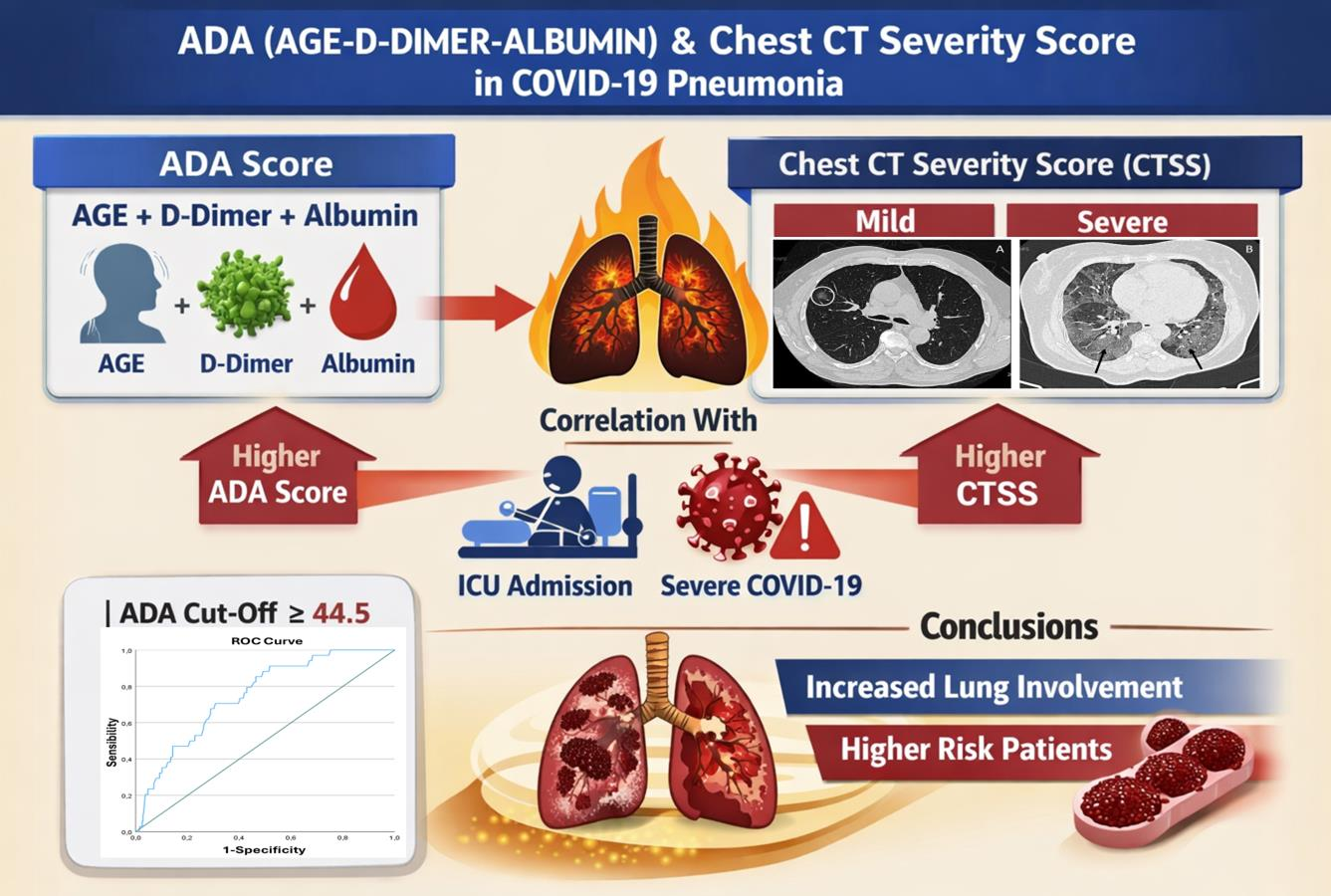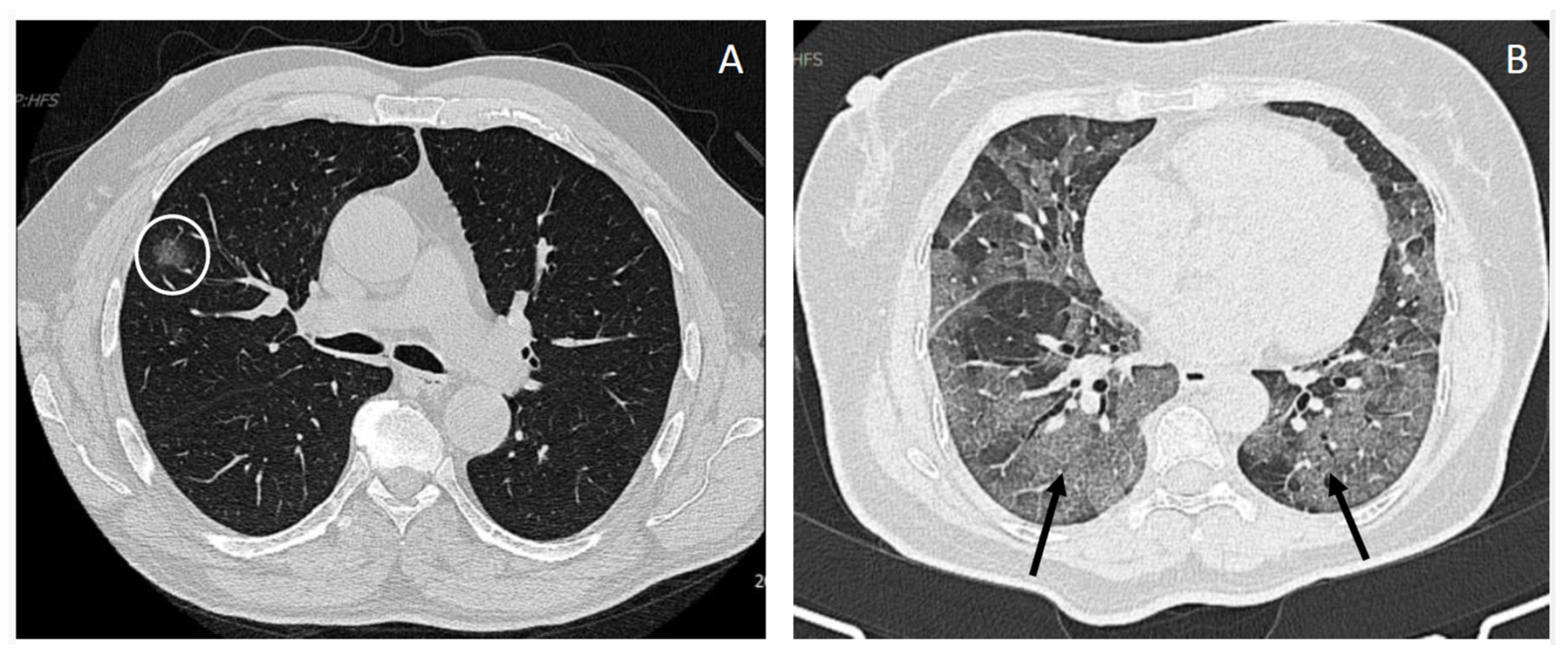

Association Between ADA (Age–D-dimer–Albumin) Score and Chest CT Severity Score in COVID-19 Pneumonia

 , , , , ,
  and
and
Abstract
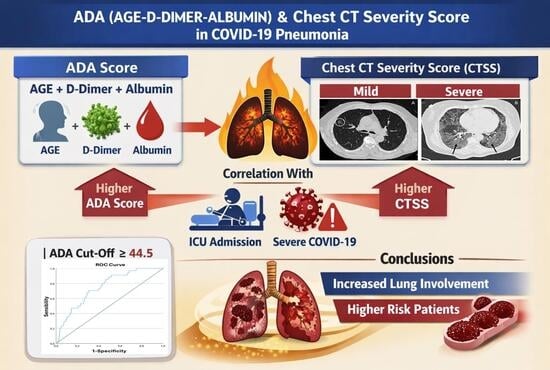
1. Introduction
2. Materials and Methods
2.1. Study Design and Population
2.2. CT Protocol and Image Analysis
2.3. Statistical Analysis
3. Results
4. Discussion
5. Conclusions
Author Contributions
Funding
Institutional Review Board Statement
Informed Consent Statement
Data Availability Statement
Conflicts of Interest
References
- Violi, F.; Pignatelli, P.; Vestri, A.R.; Spagnoli, A.; Cipollone, F.; Ceccarelli, G.; Oliva, A.; Amitrano, M.; Pirro, M.; Taliani, G.; et al. The ADA (Age-D-Dimer-Albumin) Score to Predict Thrombosis in SARS-CoV-2. Thromb. Haemost. 2022, 122, 1567–1572. [Google Scholar] [CrossRef]
- Malgaj Vrečko, M.; Aleš Rigler, A.; Večerić-Haler, Ž. Coronavirus Disease 2019-Associated Thrombotic Microangiopathy: Literature Review. Int. J. Mol. Sci. 2022, 23, 11307. [Google Scholar] [CrossRef] [PubMed]
- Zhang, T.; Li, Z.; Mei, Q.; Walline, J.H.; Zhang, Z.; Liu, Y.; Zhu, H.; Du, B. Cardiovascular outcomes in long COVID-19: A systematic review and meta-analysis. Front Cardiovasc Med. 2025, 12, 1450470. [Google Scholar] [CrossRef]
- Thondapu, V.; Montes, D.; Rosovsky, R.; Dua, A.; McDermott, S.; Lu, M.T.; Ghoshhajra, B.; Hoffmann, U.; Gerhard-Herman, M.D.; Hedgire, S. Venous thrombosis, thromboembolism, biomarkers of inflammation, and coagulation in coronavirus disease 2019. J. Vasc. Surg. Venous Lymphat. Disord. 2021, 9, 835–844.e4. [Google Scholar] [CrossRef]
- Jenner, W.J.; Gorog, D.A. Incidence of thrombotic complications in COVID-19: On behalf of ICODE: The International COVID-19 Thrombosis Biomarkers Colloquium. J. Thromb. Thrombolysis 2021, 52, 999–1006. [Google Scholar] [CrossRef]
- Abou-Ismail, M.Y.; Diamond, A.; Kapoor, S.; Arafah, Y.; Nayak, L. The hypercoagulable state in COVID-19: Incidence, pathophysiology, and management. Thromb. Res. 2020, 194, 101–115. [Google Scholar] [CrossRef]
- Chi, G.; Violi, F.; Pignatelli, P.; Vestri, A.; Spagnoli, A.; Loffredo, L.; Hernandez, A.F.; Hull, R.D.; Cohen, A.T.; Harrington, R.A.; et al. External validation of the ADA score for predicting thrombosis among acutely ill hospitalized medical patients from the APEX Trial. J. Thromb. Thrombolysis 2023, 55, 211–221. [Google Scholar] [CrossRef]
- Abbasi, B.; Akhavan, R.; Khameneh, A.G.; Zandi, B.; Farrokh, D.; Rad, M.P.; Laein, A.F.; Darvish, A.; Bijan, B. Evaluation of the relationship between inpatient COVID-19 mortality and chest CT severity score. Am. J. Emerg. Med. 2021, 45, 458–463. [Google Scholar] [CrossRef] [PubMed]
- Younus, S.; Maqsood, H.; Sattar, A.; Younas, A.; Shakeel, H.A. A novel chest CT severity score in COVID-19 and its correlation with severity and prognosis of the lung disease: A retrospective cohort study. Ann. Med. Surg. 2022, 82, 104692. [Google Scholar] [CrossRef]
- Yang, R.; Li, X.; Liu, H.; Zhen, Y.; Zhang, X.; Xiong, Q.; Luo, Y.; Gao, C.; Zeng, W. Chest CT Severity Score: An Imaging Tool for Assessing Severe COVID-19. Radiol. Cardiothorac. Imaging 2020, 2, e200047. [Google Scholar] [CrossRef] [PubMed]
- Li, K.; Fang, Y.; Li, W.; Pan, C.; Qin, P.; Zhong, Y.; Liu, X.; Huang, M.; Liao, Y.; Li, S. CT image visual quantitative evaluation and clinical classification of coronavirus disease (COVID-19). Eur. Radiol. 2020, 30, 4407–4416. [Google Scholar] [CrossRef]
- Lin, Q.; Wu, L.; Lin, W.; Zhu, L.; Hu, Y.; Lin, G.; Lin, J.; Tu, H. Correlation between chest CT severity score and laboratory indicators in patients with Coronavirus disease 2019 (COVID-19). Int. J. Clin. Pract. 2021, 75, e14907. [Google Scholar] [CrossRef] [PubMed]
- Inamdar, A.V. Correlation of chest CT severity score with D-dimer levels in patients with COVID-19. Eur. Heart J. 2021, 42, ehab724.1285. [Google Scholar] [CrossRef]
- Aziz-Ahari, A.; Keyhanian, M.; Mamishi, S.; Mahmoudi, S.; Bastani, E.E.; Asadi, F.; Khaleghi, M. Chest CT severity score: Assessment of COVID-19 severity and short-term prognosis in hospitalized Iranian patients. Wien. Med. Wochenschr. 2022, 172, 77–83. [Google Scholar] [CrossRef]
- Jayachandran, A.K.; Nelson, V.; Shajahan, M.E. Chest CT severity score as a predictor of mortality and short-term prognosis in COVID-19. J. Fam. Med. Prim. Care 2022, 11, 4363–4367. [Google Scholar] [CrossRef]
- Majrashi, N.A.; Alhulaibi, R.A.; Nammazi, I.H.; Alqasi, M.H.; Alyami, A.S.; Ageeli, W.A.; Abuhadi, N.H.; Kharizy, A.A.; Khormi, A.M.; Ghazwani, M.G.; et al. A Systematic Review of the Relationship between Chest CT Severity Score and Laboratory Findings and Clinical Parameters in COVID-19 Pneumonia. Diagnostics 2023, 13, 2223. [Google Scholar] [CrossRef] [PubMed]
- Francone, M.; Iafrate, F.; Masci, G.M.; Coco, S.; Cilia, F.; Manganaro, L.; Panebianco, V.; Andreoli, C.; Colaiacomo, M.C.; Zingaropoli, M.A.; et al. Chest CT score in COVID-19 patients: Correlation with disease severity and short-term prognosis. Eur. Radiol. 2020, 30, 6808–6817. [Google Scholar] [CrossRef] [PubMed]
- Farghaly, S.; Makboul, M. Correlation between age, sex, and severity of Coronavirus disease-19 based on chest computed tomography severity scoring system. Egypt. J. Radiol. Nucl. Med. 2021, 52, 23. [Google Scholar] [CrossRef]
- Zakariaee, S.S.; Salmanipour, H.; Naderi, N.; Kazemi-Arpanahi, H.; Shanbehzadeh, M. Association of chest CT severity score with mortality of COVID-19 patients: A systematic review and meta-analysis. Clin. Transl. Imaging 2022, 10, 663–676. [Google Scholar] [CrossRef]
- Kreuziger, L.B.; Kwon, T.; Kasthuri, R.S.; Wahid, L.; Miller, P.J.; Enders, K.; Wahed, A.S.; Anstrom, K.J.; Wang, T.Y.; Ortel, T.L. High-risk subgroups were not identified to benefit from thromboprophylaxis after hospitalization for COVID-19. Res Pract Thromb Haemost. 2024, 8, 102417. [Google Scholar] [CrossRef]
- World Health Organization. Clinical Management of COVID-19: Living Guideline; WHO: Geneva, Switzerland, 2020; Available online: https://iris.who.int/handle/10665/331446[M18.1][EM18.2 (accessed on 1 January 2026).
- World Health Organization. Clinical Management of COVID-19: Living Guideline; WHO: Geneva, Switzerland, 2021; Available online: https://iris.who.int/handle/10665/349321 (accessed on 1 January 2026).
- World Health Organization. Clinical Management of COVID-19: Living Guideline; WHO: Geneva, Switzerland, 2025; Available online: https://www.who.int/publications/i/item/B09467 (accessed on 1 January 2026).
- Pan, F.; Ye, T.; Sun, P.; Gui, S.; Liang, B.; Li, L.; Zheng, D.; Wang, J.; Hesketh, R.L.; Yang, L.; et al. Time Course of Lung Changes at Chest CT during Recovery from Coronavirus Disease 2019 (COVID-19). Radiology 2020, 295, 715–721. [Google Scholar] [CrossRef]
- Cangemi, R.; Casciaro, M.; Rossi, E.; Calvieri, C.; Bucci, T.; Calabrese, C.M.; Taliani, G.; Falcone, M.; Palange, P.; Bertazzoni, G.; et al. Platelet activation is associated with myocardial infarction in patients with pneumonia. J. Am. Coll. Cardiol. 2014, 64, 1917–1925. [Google Scholar] [CrossRef]
- Wang, L.; Yang, L.; Bai, L.; Huang, Z.; Peng, Y. Association between D-dimer level and chest CT severity score in patients with SARS-COV-2 pneumonia. Sci. Rep. 2021, 11, 11636. [Google Scholar] [CrossRef]
- Cojocaru, D.C.; Mitu, F.; Leon, M.M.; Dima-Cozma, L.C.; Adam, C.A.; Cumpăt, C.M.; Negru, R.D.; Maștaleru, A.; Onofrei, V. Beyond the Acute Phase: Long-Term Impact of COVID-19 on Functional Capacity and Prothrombotic Risk-A Pilot Study. Medicina 2023, 60, 51. [Google Scholar] [CrossRef] [PubMed]
- Ranucci, M.; Baryshnikova, E.; Anguissola, M.; Pugliese, S.; Falco, M.; Menicanti, L. The Long Term Residual Effects of COVID-Associated Coagulopathy. Int J Mol Sci. 2023, 24, 5514. [Google Scholar] [CrossRef]
- Stojanovic, M.; Djuric, M.; Nenadic, I.; Bojic, S.; Andrijevic, A.; Popovic, A.; Pesic, S. Vascular Complications of Long COVID-From Endothelial Dysfunction to Systemic Thrombosis: A Systematic Review. Int J Mol Sci. 2025, 27, 433. [Google Scholar] [CrossRef] [PubMed]
- Elmokadem, A.H.; Bayoumi, D.; El-Morsy, A.; Ehab, A.; Abo-Hedibah, S.A. Relationship of the pulmonary disease severity scoring with thromboembolic complications in COVID-19. Emerg. Radiol. 2022, 29, 9–21. [Google Scholar] [CrossRef] [PubMed]
- Brüggemann, R.A.G.; Spaetgens, B.; Gietema, H.A.; Brouns, S.H.; Stassen, P.M.; Magdelijns, F.J.; Rennenberg, R.J.; Henry, R.M.; Mulder, M.M.; van Bussel, B.C.; et al. The prevalence of pulmonary embolism in patients with COVID-19 and respiratory decline: A three-setting comparison. Thromb. Res. 2020, 196, 486–490. [Google Scholar] [CrossRef]
- Afrakhteh, H.; Sasani, M.R.; Molavi Vardanjani, H.; Bordbar, M.; Shadzi, M. External validation of CT-based severity scoring systems to determine prognosis of pneumonia caused by COVID-19 virus: A multicentric cohort study. Egypt J Radiol Nucl Med. 2025, 56, 205. [Google Scholar] [CrossRef]
- Babar, M.; Jamil, H.; Mehta, N.; Moutwakil, A.; Duong, T.Q. Short- and Long-Term Chest-CT Findings after Recovery from COVID-19: A Systematic Review and Meta-Analysis. Diagnostics 2024, 14, 621. [Google Scholar] [CrossRef]
- Han, Y.; Wang, Z.; Li, X.; Zhong, Z. Differences in chest imaging between Omicron and non-Omicron coronavirus disease 2019 (COVID-19) patients: A systematic review and meta-analysis. BMC Infect Dis. 2025, 25, 631. [Google Scholar] [CrossRef] [PubMed]
- Loffredo, L.; Di Castelnuovo, A.; Chiariello, G.A.; Pignatelli, P.; Violi, F. Full versus prophylactic-intermediate doses of anticoagulants in COVID-19: A meta-analysis. Haematologica 2022, 107, 1933–1939. [Google Scholar] [CrossRef] [PubMed]
- Gea, J.; Roca, J.; Torres, A.; Agustí, A.G.N.; Wagner, P.D.; Rodriguez-Roisin, R. Mechanisms of abnormal gas exchange in patients with pneumonia. Anesthesiology 1991, 75, 782–789. [Google Scholar] [CrossRef]
- Levin, K.P.; Hanusa, B.H.; Rotondi, A.; Singer, D.E.; Coley, C.M.; Marrie, T.J.; Kapoor, W.N.; Fine, M.J. Arterial blood gas and pulse oximetry in initial management of patients with community-acquired pneumonia. J. Gen. Intern. Med. 2001, 16, 590–598. [Google Scholar] [CrossRef]
- Loffredo, L.; Pignatelli, P.; Pirro, M.; Ceccarelli, G.; Oliva, A.; Maggio, E.; Cancelli, F.; D’aRdes, D.; Amitrano, M.; Zicari, A.M.; et al. Association between PaO2/FiO2 ratio and thrombotic events in COVID-19 patients. Intern. Emerg. Med. 2023, 18, 889–895. [Google Scholar] [CrossRef]
- Estenssoro, E.; Dubin, A. Síndrome de distrés respiratorio agudo [Acute respiratory distress syndrome]. Medicina 2016, 76, 235–241. (In Spanish) [Google Scholar] [PubMed]
- Ibrahim, A.S.; Akkari, A.-R.M.; Raza, T.; Hassan, I.F.; Akbar, A.; Alatoum, I. Epidemiological and Clinical Profiles of Patients with Acute Respiratory Distress Syndrome Admitted to Medical Intensive Care in Qatar: A Retrospective Analysis of the Data Registry for the Year 2015. Qatar Med. J. 2019, 2019, 3. [Google Scholar] [CrossRef]
- Çolak, A.; Yılmaz, C.; Toprak, B.; Aktoğu, S. Procalcitonin and CRP as Biomarkers in Discrimination of Community-acquired Pneumonia and Exacerbation of COPD. J. Med. Biochem. 2017, 36, 122–126. [Google Scholar] [CrossRef]
- Póvoa, P.; Almeida, E.; Moreira, P.; Fernandes, A.; Mealha, R.; Aragão, A.; Sabino, H. C-reactive protein as an indicator of sepsis. Intensive Care Med. 1998, 24, 1052–1056. [Google Scholar] [CrossRef]
- Mukamal, K.J.; Pai, J.K.; O’Meara, E.S.; Tracy, R.P.; Psaty, B.M.; Kuller, L.H.; Newman, A.B.; Yende, S.; Curhan, G.C.; Siscovick, D.S.; et al. CRP gene variation and risk of community-acquired pneumonia. Respirology 2010, 15, 160–164. [Google Scholar] [CrossRef]
- Jensen, A.V.; Egelund, G.B.; Andersen, S.B.; Petersen, P.T.; Benfield, T.; Faurholt-Jepsen, D.; Rohde, G.; Ravn, P. The impact of blood glucose on community-acquired pneumonia: A retrospective cohort study. ERJ Open Res. 2017, 3, 00114–02016. [Google Scholar] [CrossRef] [PubMed]
- Marik, P.E.; Bellomo, R. Stress hyperglycemia: An essential survival response! Crit. Care 2013, 17, 305. [Google Scholar] [CrossRef]
- Chou, C.Y.; Wang, S.-M.; Liang, C.-C.; Chang, C.-T.; Liu, J.-H.; Wang, I.-K.; Hsiao, L.-C.; Muo, C.-H.; Huang, C.-C.; Wang, R.-Y.; et al. Risk of pneumonia among patients with chronic kidney disease in outpatient and inpatient settings: A nationwide population-based study. Medicine 2014, 93, e174. [Google Scholar] [CrossRef]
- Pant, A.; Prasai, A.; Rauniyar, A.K.; Adhikary, L.; Basnet, K.; Khadka, T. Pneumonia in Patients with Chronic Kidney Disease Admitted to Nephrology Department of a Tertiary Care Center: A Descriptive Cross-sectional Study. JNMA J. Nepal. Med. Assoc. 2021, 59, 1000–1003. [Google Scholar] [CrossRef]
- Violi, F.; Pastori, D.; Cangemi, R.; Pignatelli, P.; Loffredo, L. Hypercoagulation and Antithrombotic Treatment in Coronavirus 2019: A New Challenge. Thromb Haemost 2020, 120, 949–956. [Google Scholar] [CrossRef] [PubMed]
- Violi, F.; Ceccarelli, G.; Loffredo, L.; Alessandri, F.; Cipollone, F.; D’ardes, D.; D’Ettorre 2, G.; Pignatelli, P.; Venditti, M.; Mastroianni, C.M.; et al. Albumin Supplementation Dampens Hypercoagulability in COVID-19: A Preliminary Report. Thromb. Haemost. 2021, 121, 102–105. [Google Scholar] [CrossRef] [PubMed]



| N = 350 | |||||||
|---|---|---|---|---|---|---|---|
| Low CTSS | High CTSS | p | Low CTSS | High CTSS | p | ||
| Male | 144/316 (45.6%) | 10/34 (29.4%) | 0.071 | ICU | 14/241 (5.8%) | 12/25 (48.0%) | <0.001 |
| Age | 63 ± 18 | 73 ± 15 | 0.002 | CV Thrombotic Event | 37/315 (11.8%) | 11/34 (32.4%) | <0.001 |
| Obesity | 9/48 (18.8%) | 3/8 (37.5%) | 0.231 | GFR | 69.5 ± 28.3 | 56.9 ± 24.7 | 0.039 |
| Dyslipidemia | 8/48 (16.7%) | 3/7 (42.9%) | 0.106 | Length of Stay | 20 ± 22 | 27 ± 12 | 0.132 |
| Hypertension | 141/290 (48.6%) | 18/33 (54.6%) | 0.757 | Albumin | 38.0 ± 6.2 | 32.5 ± 4.4 | <0.001 |
| Diabetes | 36/199 (18.1%) | 11/30 (36.7%) | 0.019 | D-dimer | 1183 ± 1241 | 2639 ± 1518 | <0.001 |
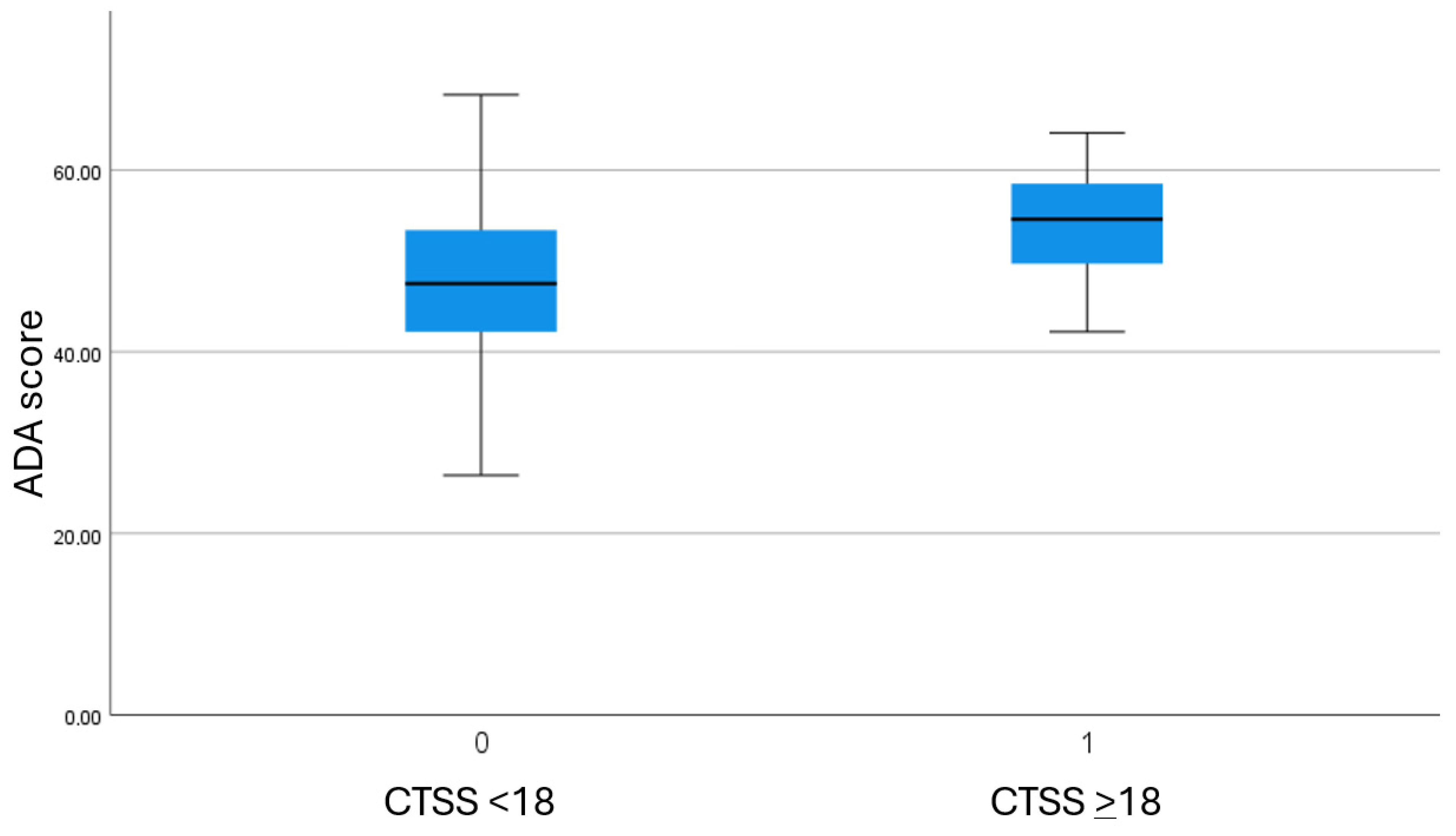
| Active Smoking | 19/140 (13.6%) | 2/22 (9.1%) | 0.561 | ADA Score | 47.7 ± 8.0 | 54.4 ± 5.8 | <0.001 |
| Former Smoking | 13/137 (9.5%) | 2/18 (11.1%) | 0.827 | CTSS | 7.8 ± 5.4 | 19.3 ± 1.5 | <0.001 |
| Coronary Artery Disease | 32/269 (11.9%) | 5/26 (19.2%) | 0.281 | Bronchiectasis | 98/258 (38.0%) | 23/32 (71.9%) | <0.001 |
| Heart Failure | 26/203 (12.8%) | 10/30 (33.3%) | 0.004 | Honeycombing | 1/293 (0.3%) | 0/33 (0.0%) | 0.737 |
| Peripheral Arterial Disease | 39/243 (16.1%) | 5/25 (20.0%) | 0.612 | Pleural Traction | 12/293 (4.1%) | 4/33 (12.1%) | 0.043 |
| Atrial Fibrillation | 24/290 (8.3%) | 5/33 (15.2%) | 0.190 | Parenchymal bands | 145/293 (49.5%) | 23/33 (69.7%) | 0.028 |
| Transient Ischemic Attack/Stroke | 14/270 (5.2%) | 1/26 (3.8%) | 0.766 | Pleural Effusion | 20/294 (6.8%) | 9/34 (26.5%) | <0.001 |
| Chronic Obstructive Pulmonary Disease | 29/290 (10.0%) | 6/32 (18.8%) | 0.131 | Embolism | 2/294 (0.7%) | 0/34 (0.0%) | 0.630 |
| Dementia | 22/240 (9.2%) | 1/25 (4.0%) | 0.383 | Diffuse Multifocal Involvement | 141/259 (54.4%) | 2/34 (5.9%) | <0.001 |
| Cancer in the Last 5 Years | 17/243 (7.0%) | 5/24 (20.8%) | 0.003 | Lymphonodes Involvement | 30/293 (10.2%) | 10/34 (29.4%) | 0.001 |
| Death | 26/286 (9.1%) | 10/33 (30.3%) | <0.001 | ||||
| N = 266 | |||
|---|---|---|---|
| Exp(B) | 95% CI | p | |
| ADA Score | 1.116 | 1.027–1.212 | 0.009 |
| ICU | 8.719 | 2.994–25.390 | <0.001 |
| CTSS | |||
|---|---|---|---|
| N | Correlation | p | |
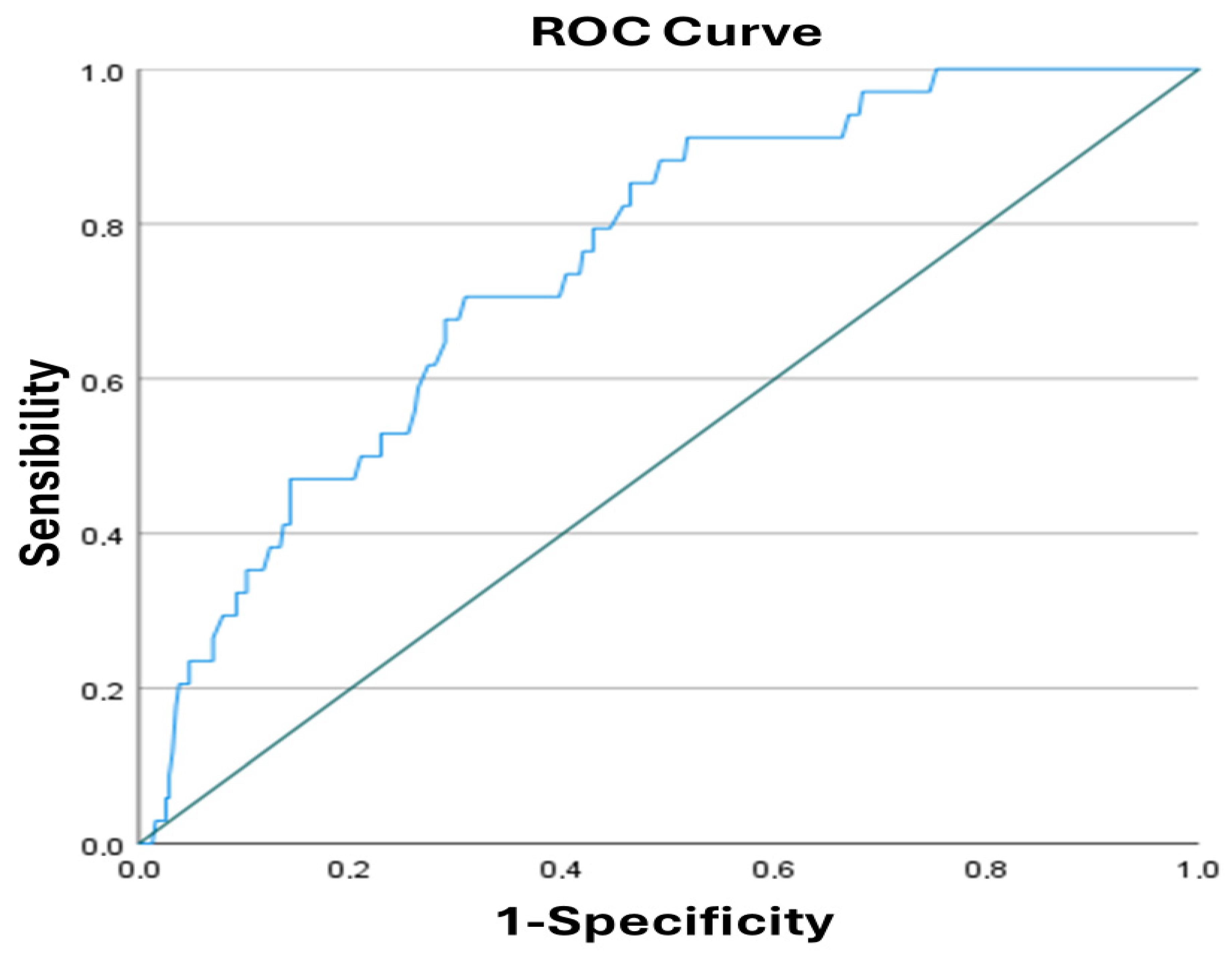
| ADA Score ° | 349 | 0.323 ** | <0.001 |
| P/F Ratio ° | 350 | −0.479 ** | <0.001 |
| SpO2 ° | 280 | −0.134 * | 0.025 |
| Respiratory Rate °° | 127 | 0.302 ** | <0.001 |
| pO2 ° | 308 | −0.225 ** | <0.001 |
| GFR ° | 201 | −0.171 * | 0.015 |
| Glycemia °° | 318 | 0.245 ** | <0.001 |
| TnThs ° | 191 | 0.055 | 0.447 |
| NT-pro BNP ° | 22 | 0.228 | 0.307 |
| CRP ° | 333 | 0.128 ** | 0.020 |
| N = 251 | |||
|---|---|---|---|
| ADA Score | β coeff: 0.276 | 95% CI: 0.041–0.402 | p = 0.017 |
| GFR | β coeff: −0.219 | 95% CI: −0.095–−0.001 | p = 0.045 |
| Respiratory Rate | β coeff: 0.203 | 95% CI: −0.029–0.735 | p = 0.069 |
| CRP | β coeff: −0.226 | 95% CI: −0.077–−0.001 | p = 0.044 |
Disclaimer/Publisher’s Note: The statements, opinions and data contained in all publications are solely those of the individual author(s) and contributor(s) and not of MDPI and/or the editor(s). MDPI and/or the editor(s) disclaim responsibility for any injury to people or property resulting from any ideas, methods, instructions or products referred to in the content. |
© 2026 by the authors. Licensee MDPI, Basel, Switzerland. This article is an open access article distributed under the terms and conditions of the Creative Commons Attribution (CC BY) license.
Share and Cite
Maggio, E.; Bonito, G.; Oliva, A.; Mastroianni, C.M.; Vezza, R.; Pugliese, F.; Violi, F.; Ricci, P.; Loffredo, L.; Pignatelli, P. Association Between ADA (Age–D-dimer–Albumin) Score and Chest CT Severity Score in COVID-19 Pneumonia. J. Pers. Med. 2026, 16, 102. https://doi.org/10.3390/jpm16020102
Maggio E, Bonito G, Oliva A, Mastroianni CM, Vezza R, Pugliese F, Violi F, Ricci P, Loffredo L, Pignatelli P. Association Between ADA (Age–D-dimer–Albumin) Score and Chest CT Severity Score in COVID-19 Pneumonia. Journal of Personalized Medicine. 2026; 16(2):102. https://doi.org/10.3390/jpm16020102
Chicago/Turabian StyleMaggio, Enrico, Giacomo Bonito, Alessandra Oliva, Claudio Maria Mastroianni, Riccardo Vezza, Francesco Pugliese, Francesco Violi, Paolo Ricci, Lorenzo Loffredo, and Pasquale Pignatelli. 2026. "Association Between ADA (Age–D-dimer–Albumin) Score and Chest CT Severity Score in COVID-19 Pneumonia" Journal of Personalized Medicine 16, no. 2: 102. https://doi.org/10.3390/jpm16020102
APA StyleMaggio, E., Bonito, G., Oliva, A., Mastroianni, C. M., Vezza, R., Pugliese, F., Violi, F., Ricci, P., Loffredo, L., & Pignatelli, P. (2026). Association Between ADA (Age–D-dimer–Albumin) Score and Chest CT Severity Score in COVID-19 Pneumonia. Journal of Personalized Medicine, 16(2), 102. https://doi.org/10.3390/jpm16020102