
Empowering Healthy Lifestyle Behavior Through Personalized Intervention Portfolios Using a Healthy Lifestyle Recommender System to Prevent and Control Obesity in Young Adults: Pilot Study Protocol from the HealthyW8 Project

 , , ,
, , ,  , , ,
, , ,  , , , , , , , ,
Abstract
1. Introduction
2. Methods
2.1. Study Design
2.2. Population: Inclusion and Exclusion Criteria
2.3. Participants’ Involvement
2.4. Recruitment
2.5. Intervention
2.6. Follow-Up and Data Collection
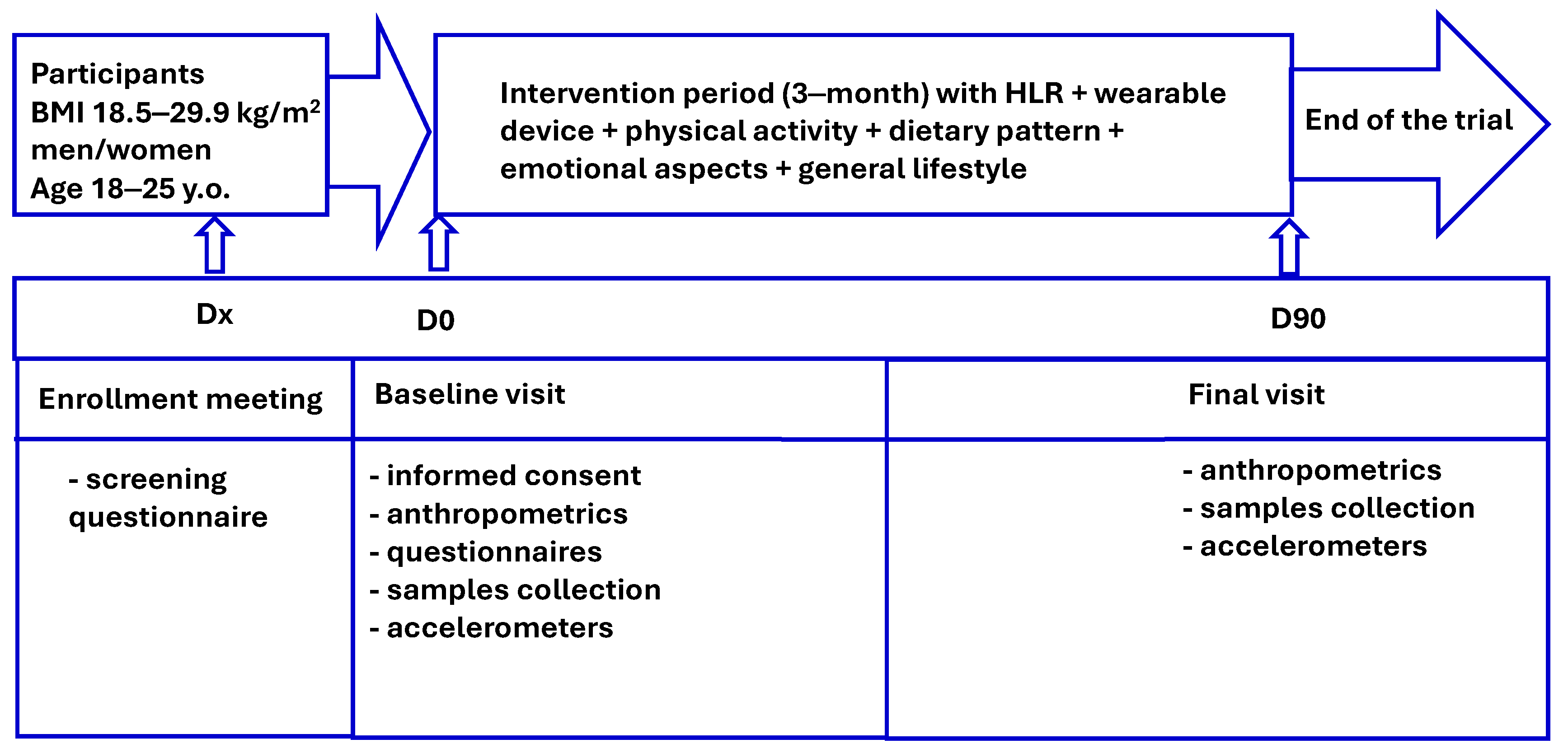
- Enrollment visit (Dx): Informed consent (after receiving written and verbal information about the study’s objectives, risks, and benefits), eligibility assessment (assessed based on anthropometric measurements, and screening questionnaires on general health and lifestyle), and meeting inclusion criteria.
- Baseline visit (Day 0): Anthropometric data, baseline questionnaires, biological samples (blood, urine, and saliva, where applicable), and instructions on using the HLRS platform. Recommendations will be adapted to the previously diagnosed health status, A1c levels or blood pressure of the participant. Participants will receive instructions on using the HLRS platform.
- Final visit (Day 90): Repeat assessments and questionnaires to evaluate changes over the study.
2.7. Outcome Measures and Data Collection
- 24hR (24-Hour Recall): Completed three times to assess dietary intake [27].
- BFI-10 (Big Five Inventory—10 Items): A personality assessment tool [28].
- IPAQ-S (International Physical Activity Questionnaire—Short Form): Measures physical activity levels [29].
- PHQ-9 (Patient Health Questionnaire—9): Evaluates symptoms of depression [30].
- PSQI (Pittsburgh Sleep Quality Index): Assesses sleep quality and disturbances [31].
- WHOQOL (World Health Organization Quality of Life): Assesses quality of life across different domains [34].
3. Statistics
4. Ethics
- Adverse Event (AE): Any untoward medical occurrence in a participant related to study procedures (e.g., blood sampling). AEs may include any unfavorable or unintended symptoms or diseases, regardless of whether they are directly caused by the study procedures.
- Serious Adverse Event (SAE): A severe adverse event includes events that result in the following:
- Death;
- Life-threatening conditions;
- Requirement for inpatient hospitalization or prolonged hospitalization;
- Persistent or significant disability/incapacity;
- Congenital anomalies or birth defects. Serious events may also include medical occurrences that, based on medical judgment, could jeopardize the participant’s health and require intervention to prevent one of the aforementioned outcomes.
- Grade 1 (Mild): Asymptomatic or mild symptoms, no intervention needed.
- Grade 2 (Moderate): Minimal intervention required, may limit daily activities.
- Grade 3 (Severe): Requires significant intervention, may limit self-care.
- Grade 4 (Life-threatening): Urgent intervention needed.
- Grade 5 (Death): Death related to the AE.
5. Data Handling and Storage
6. Dissemination Plan
7. Conclusions
Author Contributions
Funding
Institutional Review Board Statement
Informed Consent Statement
Data Availability Statement
Acknowledgments
Conflicts of Interest
References
- United Nations. Definition of Youth. Available online: https://www.un.org/esa/socdev/documents/youth/fact-sheets/youth-definition.pdf (accessed on 9 May 2025).
- Lanoye, A.; Brown, K.L.; LaRose, J.G. The Transition into Young Adulthood: A Critical Period for Weight Control. Curr. Diabetes Rep. 2017, 17, 114. [Google Scholar] [CrossRef]
- Stanford, F.C.; Taylor, C.; Hoelscher, D.M.; Anderson, C.A.M.; Booth, S.; Deierlein, A.; Fung, T.; Gardner, C.; Giovannucci, E.; Raynor, H.; et al. Dietary Patterns with Ultra-Processed Foods and Growth, Body Composition, and Risk of Obesity: A Systematic Review; U.S. Department of Agriculture, Food and Nutrition Service, Center for Nutrition Policy and Promotion, Nutrition Evidence Systematic Review: Alexandria, VA, USA, 2024. Available online: https://nesr.usda.gov/2025-dietary-guidelines-advisory-committee-systematic-reviews/dietary-patterns-ultraprocessed_growth-obesity (accessed on 9 May 2025).
- Tharrey, M.; Bohn, T.; Klein, O.; Bulaev, D.; Van Beek, J.; Nazare, J.A.; Franco, M.; Malisoux, L.; Perchoux, C. Local retail food environment exposure and diet quality in rural and urban adults: A longitudinal analysis of the ORISCAV-LUX cohort study. Health Place 2024, 87, 103240. [Google Scholar] [CrossRef]
- Jessri, M.; Wolfinger, R.D.; Lou, W.Y.; L’Abbé, M.R. Identification of dietary patterns associated with obesity in a nationally representative survey of Canadian adults: Application of a priori, hybrid, and simplified dietary pattern techniques. Am. J. Clin. Nutr. 2017, 105, 669–684. [Google Scholar] [CrossRef] [PubMed]
- Dixon, H.; Scully, M.; Wakefield, M.; Kelly, B.; Pettigrew, S.; Chapman, K.; Niederdeppe, J. The impact of unhealthy food sponsorship vs. pro-health sponsorship models on young adults’ food preferences: A randomised controlled trial. BMC Public Health 2018, 18, 1399. [Google Scholar] [CrossRef]
- Suorsa, K.; Leskinen, T.; Rovio, S.; Niinikoski, H.; Pentti, J.; Nevalainen, J.; Heinonen, O.J.; Lagström, H.; Jula, A.; Viikari, J.; et al. Weekday and weekend physical activity patterns and their correlates among young adults. Scand. J. Med. Sci. Sports 2023, 33, 2573–2584. [Google Scholar] [CrossRef] [PubMed]
- World Health Organization. Obesity and Overweight. In WHO European Regional Obesity Report 2022; WHO: Copenhagen, Denmark, 2022; Available online: https://www.who.int/news-room/fact-sheets/detail/obesity-and-overweight (accessed on 9 May 2025).
- World Health Organization. WHO Guidelines on Physical Activity and Sedentary Behaviour; WHO: Geneva, Switzerland, 2020; Available online: https://www.who.int/publications/i/item/9789240015128 (accessed on 9 May 2025).
- Blanck, H.M.; Khan, L.K.; Serdula, M.K. Diet and physical activity behavior among users of prescription weight loss medications. Int. J. Behav. Nutr. Phys. Act. 2004, 1, 17. [Google Scholar] [CrossRef] [PubMed]
- NHS-UK Treatment Obesity. Available online: https://www.nhs.uk/conditions/obesity/treatment/ (accessed on 9 May 2025).
- Hebden, L.; Chey, T.; Allman-Farinelli, M. Lifestyle intervention for preventing weight gain in young adults: A systematic review and meta-analysis of RCTs. Obes. Rev. 2012, 13, 692–710. [Google Scholar] [CrossRef]
- Poobalan, A.S.; Aucott, L.S.; Precious, E.; Crombie, I.K.; Smith, W.C. Weight loss interventions in young people (18 to 25 year olds): A systematic review. Obes. Rev. 2010, 11, 580–592. [Google Scholar] [CrossRef]
- Forberger, S.; Reisch, L.A.; van Gorp, P.; Stahl, C.; Christianson, L.; Halimi, J.; De Santis, K.K.; Malisoux, L.; de-Magistris, T.; Bohn, T. ‘Let me recommend…’: Use of digital nudges or recommender systems for overweight and obesity prevention-a scoping review protocol. BMJ Open 2024, 14, e080644. [Google Scholar] [CrossRef]
- Recio-Rodriguez, J.I.; Gómez-Marcos, M.A.; Agudo-Conde, C.; Ramirez, I.; Gonzalez-Viejo, N.; Gomez-Arranz, A.; Salcedo-Aguilar, F.; Rodriguez-Sanchez, E.; Alonso-Domínguez, R.; Sánchez-Aguadero, N.; et al. EVIDENT 3 Study: A randomized, controlled clinical trial to reduce inactivity and caloric intake in sedentary and overweight or obese people using a smartphone application: Study protocol. Medicine 2018, 97, e9633. [Google Scholar] [CrossRef]
- Vlahu-Gjorgievska, E.; Burazor, A.; Win, K.T.; Trajkovik, V. mHealth Apps Targeting Obesity and Overweight in Young People: App Review and Analysis. JMIR mHealth uHealth 2023, 11, e37716. [Google Scholar] [CrossRef] [PubMed]
- Li, Z.; Lu, F.; Wu, J.; Bao, R.; Rao, Y.; Yang, Y.; Wang, H. Usability and Effectiveness of eHealth and mHealth Interventions That Support Self-Management and Health Care Transition in Adolescents and Young Adults with Chronic Disease: Systematic Review. J. Med. Internet Res. 2024, 26, e56556. [Google Scholar] [CrossRef]
- Junkins, Z.; Zahan, N.; Neyens, D. Examining Individuals’ Use of the Internet for Health Care Activities Over Time: Results from the US National Health Interview Survey. JMIR Hum. Factors 2025, 12, e58362. [Google Scholar] [CrossRef]
- Alarie, N.; Kent, L. Physical activity assessment and impact. In Diet and Exercise in Cystic Fibrosis, 1st ed.; Watson, R.R., Ed.; Academic Press: Cambridge, MA, USA, 2015; pp. 299–306. Available online: https://www.sciencedirect.com/science/article/abs/pii/B9780128000519000341?via%3Dihub (accessed on 9 May 2025).
- Laugwitz, B.; Held, T.; Schrepp, M. Construction and evaluation of a user experience questionnaire. In HCI and Usability for Education and Work; Holzinger, A., Ed.; USAB 2008; Lecture Notes in Computer Science; Springer: Berlin/Heidelberg, Germany, 2008; Volume 5298, Available online: https://link.springer.com/chapter/10.1007/978-3-540-89350-9_6 (accessed on 9 May 2025).
- Papadopoulos, P.; Soflano, M.; Connolly, T. A Digital Health Intervention Platform (Active and Independent Management System) to Enhance the Rehabilitation Experience for Orthopedic Joint Replacement Patients: Usability Evaluation Study. JMIR Hum. Factors 2024, 11, e50430. [Google Scholar] [CrossRef]
- Casadei, K.; Kiel, J. Anthropometric measurement. In StatPearls [Internet]; StatPearls Publishing: Treasure Island, FL, USA, 2022. Available online: https://www.ncbi.nlm.nih.gov/books/NBK537315/ (accessed on 9 May 2025).
- Alqaderi, H.; Hegazi, F.; Al-Mulla, F.; Chiu, C.J.; Kantarci, A.; Al-Ozairi, E.; Abu-Farha, M.; Bin-Hasan, S.; Alsumait, A.; Abubaker, J.; et al. Salivary Biomarkers as Predictors of Obesity and Intermediate Hyperglycemia in Adolescents. Front. Public Health 2022, 10, 800373. [Google Scholar] [CrossRef] [PubMed]
- da Silva, C.V.F.; Sade, Y.B.; Scapin, S.M.N.; Leite, P.E.C.; da Silva-Boghossian, C.M.; Santos, E.O. Relevance of obesity and overweight to salivary and plasma proteomes of human young adults from Brazil. Braz. J. Dev. 2022, 8, 13981–14001. [Google Scholar] [CrossRef]
- Vahid, F.; Dessenne, C.; Tur, J.A.; Bouzas, C.; Devaux, Y.; Malisoux, L.; Monserrat-Mesquida, M.; Sureda, A.; Desai, M.S.; Turner, J.D.; et al. Multicomponent (bio)markers for obesity risk prediction: A scoping review protocol. BMJ Open 2024, 14, e083558. [Google Scholar] [CrossRef]
- REDCap. Research Electronic Data Capture. Available online: https://project-redcap.org/ (accessed on 5 May 2025).
- National Cancer Institute. 24-Hour Dietary Recall (24HR) At a Glance; National Cancer Institute: Bethesda, MD, USA, 2014. Available online: https://dietassessmentprimer.cancer.gov/profiles/recall/ (accessed on 9 May 2025).
- Balgiu, B.A. The psychometric properties of the Big Five inventory-10 (BFI-10) including correlations with subjective and psychological well-being. Glob. J. Psychol. Res. New Trends Issues 2018, 8, 61–69. [Google Scholar] [CrossRef]
- Lee, P.H.; Macfarlane, D.J.; Lam, T.H.; Stewart, S.M. Validity of the International Physical Activity Questionnaire Short Form (IPAQ-SF): A systematic review. Int. J. Behav. Nutr. Phys. Act. 2011, 8, 115. [Google Scholar] [CrossRef] [PubMed]
- Kroenke, K.; Spitzer, R.L.; Williams, J.B.; Löwe, B. The Patient Health Questionnaire Somatic, Anxiety, and Depressive Symptom Scales: A systematic review. Gen. Hosp. Psychiatry 2010, 32, 345–359. [Google Scholar] [CrossRef]
- Buysse, D.J.; Reynolds, C.F., 3rd; Monk, T.H.; Berman, S.R.; Kupfer, D.J. The Pittsburgh Sleep Quality Index: A new instrument for psychiatric practice and research. Psychiatry Res. 1989, 28, 193–213. [Google Scholar] [CrossRef]
- Schrepp, M. User Experience Questionnaire Handbook [Internet]. Available online: https://www.ueq-online.org/Material/Handbook.pdf (accessed on 9 May 2025).
- Schrepp, M.; Hinderks, A.; Thomaschewski, J. Applying the User Experience Questionnaire (UEQ) in different evaluation scenarios. In Design, User Experience, and Usability. Theories, Methods, and Tools for Designing the User Experience; Marcus, A., Ed.; DUXU 2014; Lecture Notes in Computer Science; Springer: Cham, Switzerland, 2014; Volume 8517. [Google Scholar]
- World Health Organization. Programme on Mental Health: WHOQOL User Manual, 2012 Revision [Internet]; World Health Organization: Geneva, Switzerland, 1998; Available online: https://iris.who.int/handle/10665/77932 (accessed on 9 May 2025).
- Cui, Q.; Xia, Y.; Wu, Q.; Chang, Q.; Niu, K.; Zhao, Y. Validity of the food frequency questionnaire for adults in nutritional epidemiological studies: A systematic review and meta-analysis. Crit. Rev. Food Sci. Nutr. 2023, 63, 1670–1688. [Google Scholar] [CrossRef] [PubMed]
- Chung, J.; Ahn, S.; Joung, H.; Shin, S. Development of a Semi-Quantitative Food-Frequency Questionnaire for Korean Adults with Obesity. Nutrients 2023, 15, 4848. [Google Scholar] [CrossRef] [PubMed]
- Fernández-Ballart, J.D.; Piñol, J.L.; Zazpe, I.; Corella, D.; Carrasco, P.; Toledo, E.; Perez-Bauer, M.; Martínez-González, M.Á.; Salas-Salvadó, J.; Martín-Moreno, J.M. Relative validity of a semi-quantitative food-frequency questionnaire in an elderly Mediterranean population of Spain. Br. J. Nutr. 2010, 103, 1808–1816. [Google Scholar] [CrossRef] [PubMed]
- Garcia, S.; Vidović, B.; Tijerina, A.; Tur, J.A.; Bouzas, C. Development and Evaluation of the Reliability of a Semi-Quantitative Food Frequency Questionnaire to Assess the Intake in the Serbian Population. Nutrients 2024, 16, 2490. [Google Scholar] [CrossRef]


| Country, Partner | Number of Participants Targeted for Enrollment | Number of Participants Required for Study Conclusion | Recruitment Strategies | Coordinating Entity | Medical Principal Investigator |
|---|---|---|---|---|---|
| Bulgaria, RCNE | 30 | 20 | Using the network of the Regional Cluster North-East, word-of-mouth | RCNE | No |
| Germany, BIPS/DFKI | 30 | 15 | Word-of-mouth, flyer, press release, Instagram | BIPS | No |
| Italy | 101 | 52 | Flyers, word-of-mouth, conferences, social media, institutional website, local press | USG | A medical nutritionist involved in the screening |
| Netherlands | 40 | 20 | Flyers and posters, institutional website and newsletter, social media, word-of-mouth | TU/e | No |
| Portugal | 30 | 15 | Flyers, word-of-mouth, conferences, social media, institutional website, local press | CIAS, UC | No |
| Portugal | 30 | 15 | Flyers, word-of-mouth, conferences, social media, institutional website, local press | UEV | No |
| Spain | 60 | 25 | Flyers, word-of-mouth, conferences, social media, institutional website, local press | CITA | No |
| Spain | 30 | 20 | Word-of-mouth, newspaper advertisement, flyers, physicians, and other healthcare professionals. | IDISBA | Yes |
| The Gamebus Application | Promotes healthy lifestyle behavior, such as physical activity (e.g., walking and step counting), diet (e.g., preparing healthy meals, increasing the consumption of fruits and vegetables), or social participation (e.g., participating in cultural activities). The app uses gamification techniques (e.g., earning points, unlocking levels, competing on leaderboards) to motivate engagement. Developed by the Technical University of Eindhoven, GameBus serves as a prototype health data management platform, enhancing user engagement through mobile health (mHealth) platforms [19]. It includes an REST API based on Java Spring, an open-source web app frontend (using Ionic), and a restricted interface for smartwatches. Additional information can be found at the following website: https://blog.gamebus.eu/. |
| The Nutrida Application and Recipes | Provides personalized weekly meal plans, tailored to preferences, budget, allergies, and caloric requirements. The meal recommendation system is based on the Active Assisted Living (AAL) project, LIFANA, and has been further developed by the Nutrida app, created by NIUM, a University of Luxembourg spin-off (Esch-sur Alzette, Luxembourg), in collaboration with the Luxembourg Institute of Science and Technology (LIST) and the European Federation of the Association of Dieticians (EFAD), which integrates regional recipes into the app. Obtained data will be stored in secure Amazon servers in Europe, subcontracted by NIUM. |
| Wearable Device | Participants use either the Samsung Galaxy Active 2 smartwatch or the Garmin Vivosmart 5 fitness tracker to monitor 24 h movement, step count, sleep, pulse, and heart rate. The Samsung Galaxy Activity 2 smartwatches do not collect sleep data; also, heart rate and pulse are not measured continuously, and it can collect emotional states via the experience sampling method (as well as GPS tracking). Both devices comply with General Data Protection Regulation (GDPR), ensuring data privacy. The final choice of device will depend on the study’s specific requirements, as both collect similar data. |
| Samsung Galaxy Watch Active 2 Experiencer or Garmin Vivosmart 5 App | Data collected through Samsung/Garmin App will be stored, ensuring compliance with GDPR and utilize FHIR (Fast Healthcare Interoperability Resources) for FAIR (Findable, Accessible, Interoperable, and Reusable) data management. |
| Actigraph Accelerometers | Participants will be required to wear an ActiGraph accelerometer (ActiGraph wGT3X-B; ActiGraph LLC, Pensacola, FL, USA) continuously for nine consecutive days to objectively assess their physical activity levels and sedentary behavior. This device will provide detailed data on movement patterns, energy expenditure, and sleep–wake cycles, allowing for a comprehensive analysis of participants’ activity and rest periods. To ensure data accuracy, participants will be instructed on proper device placement and usage. |
| Calendar Web Application | Developed by EU HealthyW8 partner VirTech (Bulgaria), this application enables the study leader to schedule local events and inform participants. The event data is securely stored on servers at LIST, Luxembourg. |
| REDCap (Research Electronic Data Capture), VanDerBilt University (USA) | Used for completing intervention questionnaires. Additional information can be found at the following website: https://project-redcap.org/. The event data is securely stored on servers at LIST, Luxembourg. |
| Country, Partner | Bulgaria, RCNE | Germany, BIPS/DFKI | Italy, USG | Netherlands, TU/e | Portugal, UC | Portugal, UEV | Spain, CITA | Spain, IDISBA |
|---|---|---|---|---|---|---|---|---|
| Length of intervention (months) | 3 | 3 | 1.5 | 1–2 | 3 | 3 | 3 | 3 |
| Length of run-in time | 6 | 6 | 6 | 1 | 2 | 2 | 2 | 2 |
| Gamebus | Yes | Yes | Yes | Yes | Yes | Yes | Yes | Yes |
| Nutrida | Yes | Yes | Yes | Yes | Yes | Yes | Yes | Yes |
| Wearable | Garmin | Samsung | Garmin | Samsung | Samsung | Garmin | Garmin | Garmin |
| Experiencer | No | No | No | Yes | Yes | No | No | No |
| Accelerometer | Yes | Yes | No | No | No | Yes | No | Yes |
| Calendar | Yes | Yes | Yes | No | No | Yes | Yes | Yes |
| Questionnaires | Yes | Yes | Yes | Yes | Yes | Yes | Yes | Yes |
| Biological samples and measures | Yes | No | No | No | No | Yes | No | Yes |
| Marker Class | Marker | Bulgaria, RCNE | Germany, BIPS/DFKI | Italy, USG | Netherlands, TU/e | Portugal, UC | Portugal, UEV | Spain, CITA | Spain, IDISBA |
|---|---|---|---|---|---|---|---|---|---|
| Anthropometrics | Height, weight, BMI | Yes | No | Yes | Yes | Yes | Yes | Yes | Yes |
| Waist and hip circumference and ratio | No | No | Yes | No | Yes | Yes | No | Yes | |
| %body fat | No | No | Yes | No | Yes | Yes | No | Yes | |
| Visceral fat | No | No | No | No | Yes | Yes | No | Yes | |
| Thigh circumference | No | No | Yes | No | Yes | Yes | No | Yes | |
| Clinical | Heart frequency | No | No | No | No | Yes | Yes | No | Yes |
| Blood pressure (systolic and diastolic) | No | No | No | No | Yes | Yes | No | Yes | |
| PA | Accelerometer | Yes | No | No | No | Yes | Yes | No | Yes |
| IPAQ | Yes | Yes | Yes | Yes | Yes | Yes | Yes | Yes | |
| Fitness | Hand grip strength, step-up test | No | No | No | No | No | No | No | No |
| Dietary patterns | FFQ | Yes | Yes | Yes | No | Yes | Yes | Yes | Yes |
| 24 h recall | Yes | Yes | Yes | No * | Yes | Yes | Yes | Yes | |
| Mediterranean eating patterns (MEDAS-14) ** | No | No | Yes | Yes | Yes | Yes | Yes | Yes | |
| General questionnaires | Quality of life (WHOQOL-Bref 26 items) ** | Yes | Yes | Yes | Yes | Yes | Yes | No | Yes |
| UEQ+ (26 items) | Yes | Yes | No | Yes | Yes | Yes | Yes | Yes | |
| Depression (PHQ-9; nine items) ** | Yes | Yes | Yes | No | Yes | Yes | No | Yes | |
| Sleeping patterns (e.g., Pittsburgh Sleep Quality Index) ** | No | Yes | Yes | No | Yes | Yes | No | Yes | |
| Intrinsic motivation (IMI seven items), ** | Yes | No | No | Yes | Yes | Yes | No | Yes | |
| Smoking (Fagerstrom six items) ** | No | Yes | Yes | No | No | No | No | No | |
| Alcohol intake (Audit 10 items) ** | No | Yes | Yes | No | No | No | No | No | |
| Personality traits (BFI-10 scale 10 items) ** | Yes | No | Yes | Yes | Yes | Yes | Yes | Yes | |
| Biomarkers, inflammation | Cytokines (adiponectin, TNF-α, IL6, IL1-β, CRP) | No | No | No | No | No | No | No | Yes |
| Biomarkers, oxidative stress | F2- isoprostanes, malondialdehyde, DNA/RNA breakdown products, antioxidant activity (FRAP, ABTS, MDA) | No | No | No | No | No | No | No | Yes |
| Biomarkers of nutrient intakes | Blood cell counts, albumin, prealbumin, | No | No | No | No | Yes | Yes | No | Yes |
| Glucose metabolism | HbA1c and fasting blood glucose, insulin, HOMA-IR | No | No | No | No | Yes | Yes | No | Yes |
| Lipid profile | Total cholesterol, HDL-C, LDL-C, triglycerides | No | No | No | No | Yes | Yes | No | Yes |
| Urinary markers | Uric acid, urinary creatinine, urinary sodium, | No | No | No | No | Yes | Yes | No | Yes |
| Saliva | Cortisol | No | No | No | No | Yes | Yes | No | Yes |
| HLRS | Nutrida-app: Personalized meal recommender plan (based on age, gender, PA, dietary restrictions, culinary/ cultural personal preferences and local dishes, budget…) | Yes | Yes | Yes | Yes | Yes | Yes | Yes | Yes |
| GameBus: Application that promotes healthy lifestyle through games and tasks linked to Nutrida and smartwatches | Yes | Yes | Yes | Yes | Yes | Yes | Yes | Yes | |
| Smartwatch: To register step count, pulse, sleep quality | Yes | Yes | Yes | No | Yes | Yes | No | Yes | |
| Calendar function to schedule social events for the participants | Yes | Yes | Yes | No | No | No | Yes | No | |
| UEQ+ (26 items) | Yes | Yes | No | Yes | Yes | Yes | Yes | Yes | |
| Open Stakeholder Platform | Health video clips, recipes, lifestyle recommendations | No | No | Yes | Yes | Yes | Yes | No | Yes |
Disclaimer/Publisher’s Note: The statements, opinions and data contained in all publications are solely those of the individual author(s) and contributor(s) and not of MDPI and/or the editor(s). MDPI and/or the editor(s) disclaim responsibility for any injury to people or property resulting from any ideas, methods, instructions or products referred to in the content. |
© 2025 by the authors. Licensee MDPI, Basel, Switzerland. This article is an open access article distributed under the terms and conditions of the Creative Commons Attribution (CC BY) license (https://creativecommons.org/licenses/by/4.0/).
Share and Cite
García, S.; Ródenas-Munar, M.; Bohn, T.; Kemperman, A.; Rodrigues, D.; Evers, S.; Lamy, E.; Pérez-Jiménez, M.; Forberger, S.; Onorati, M.G.; et al. Empowering Healthy Lifestyle Behavior Through Personalized Intervention Portfolios Using a Healthy Lifestyle Recommender System to Prevent and Control Obesity in Young Adults: Pilot Study Protocol from the HealthyW8 Project. J. Pers. Med. 2025, 15, 625. https://doi.org/10.3390/jpm15120625
García S, Ródenas-Munar M, Bohn T, Kemperman A, Rodrigues D, Evers S, Lamy E, Pérez-Jiménez M, Forberger S, Onorati MG, et al. Empowering Healthy Lifestyle Behavior Through Personalized Intervention Portfolios Using a Healthy Lifestyle Recommender System to Prevent and Control Obesity in Young Adults: Pilot Study Protocol from the HealthyW8 Project. Journal of Personalized Medicine. 2025; 15(12):625. https://doi.org/10.3390/jpm15120625
Chicago/Turabian StyleGarcía, Silvia, Marina Ródenas-Munar, Torsten Bohn, Astrid Kemperman, Daniela Rodrigues, Suzan Evers, Elsa Lamy, María Pérez-Jiménez, Sarah Forberger, Maria Giovanna Onorati, and et al. 2025. "Empowering Healthy Lifestyle Behavior Through Personalized Intervention Portfolios Using a Healthy Lifestyle Recommender System to Prevent and Control Obesity in Young Adults: Pilot Study Protocol from the HealthyW8 Project" Journal of Personalized Medicine 15, no. 12: 625. https://doi.org/10.3390/jpm15120625
APA StyleGarcía, S., Ródenas-Munar, M., Bohn, T., Kemperman, A., Rodrigues, D., Evers, S., Lamy, E., Pérez-Jiménez, M., Forberger, S., Onorati, M. G., Devecchi, A., De Magistris, T., Halimi, J., Ivanova, Y., Doychinov, B., Bouzas, C., & Tur, J. A. (2025). Empowering Healthy Lifestyle Behavior Through Personalized Intervention Portfolios Using a Healthy Lifestyle Recommender System to Prevent and Control Obesity in Young Adults: Pilot Study Protocol from the HealthyW8 Project. Journal of Personalized Medicine, 15(12), 625. https://doi.org/10.3390/jpm15120625