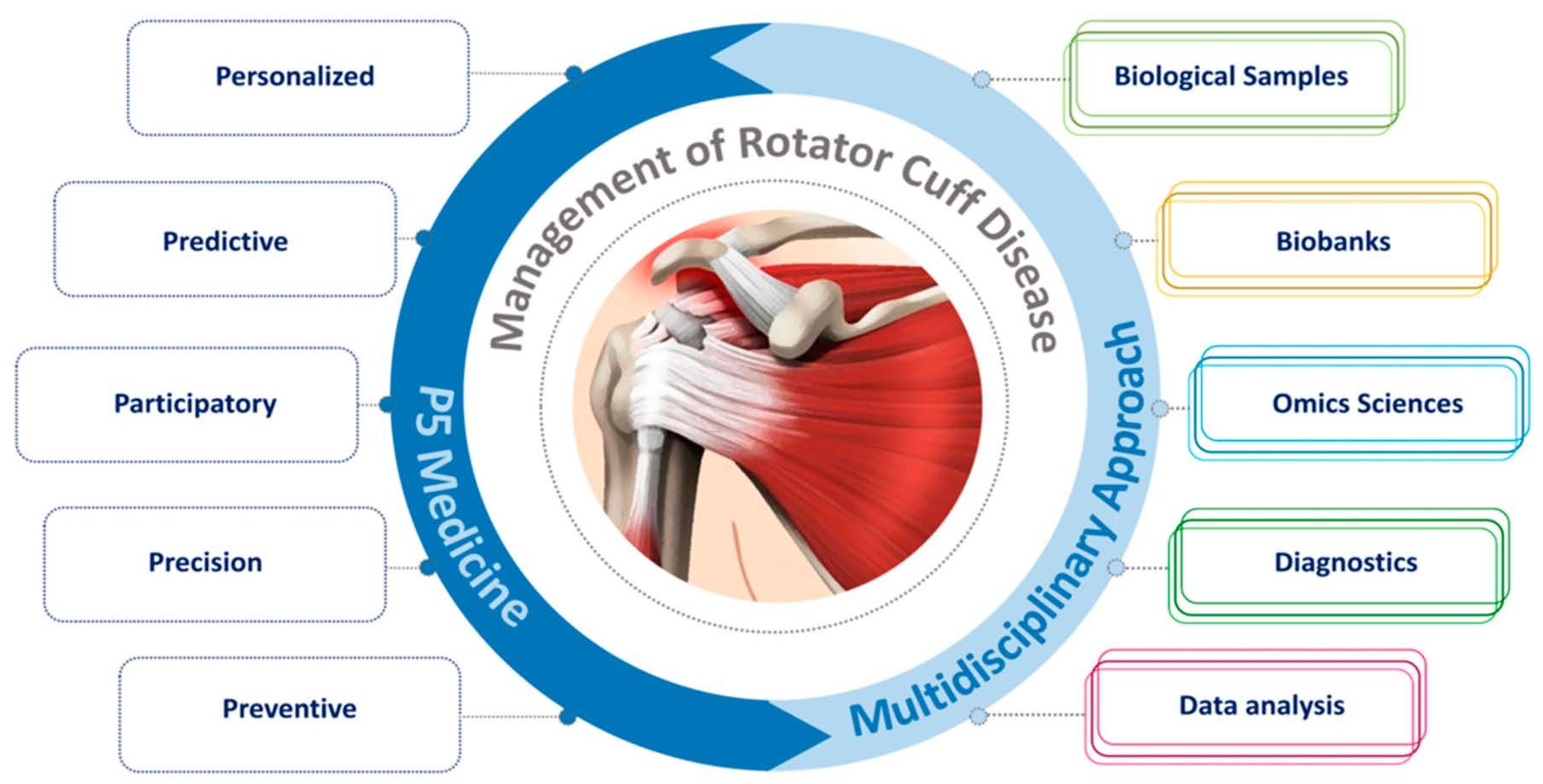

Personalized, Predictive, Participatory, Precision, and Preventive (P5) Medicine in Rotator Cuff Tears

 ,
,  ,
,  ,
,  , ,
, ,  and
and
Abstract
1. Introduction
2. P5 Medicine
3. P5 Medicine in the Management of RC Diseases
3.1. Personalized Medicine
3.2. Predictive Medicine
3.3. Participatory Medicine
3.4. Precision Medicine
3.5. Preventive Medicine
4. Discussion
5. Conclusions
Author Contributions
Funding
Conflicts of Interest
References
- Longo, U.G.; Facchinetti, G.; Marchetti, A.; Candela, V.; Risi Ambrogioni, L.; Faldetta, A.; De Marinis, M.G.; Denaro, V. Sleep disturbance and rotator cuff tears: A systematic review. Medicina (Kaunas) 2019, 55, 453. [Google Scholar] [CrossRef] [Scilit] [PubMed]
- Longo, U.G.; Berton, A.; Papapietro, N.; Maffulli, N.; Denaro, V. Epidemiology, genetics and biological factors of rotator cuff tears. Med. Sport Sci. 2012, 57, 1–9. [Google Scholar] [PubMed]
- Longo, U.G.; Salvatore, G.; Rizzello, G.; Berton, A.; Ciuffreda, M.; Candela, V.; Denaro, V. The burden of rotator cuff surgery in italy: A nationwide registry study. Arch. Orthop. Trauma Surg. 2017, 137, 217–224. [Google Scholar] [CrossRef] [Scilit] [PubMed]
- Carnevale, A.; Longo, U.G.; Schena, E.; Massaroni, C.; Lo Presti, D.; Berton, A.; Candela, V.; Denaro, V. Wearable systems for shoulder kinematics assessment: A systematic review. BMC Musculoskelet. Disord. 2019, 20, 546. [Google Scholar] [CrossRef] [Scilit]
- Salvatore, G.; Longo, U.G.; Candela, V.; Berton, A.; Migliorini, F.; Petrillo, S.; Ambrogioni, L.R.; Denaro, V. Epidemiology of rotator cuff surgery in italy: Regional variation in access to health care. Results from a 14-year nationwide registry. Musculoskelet. Surg. 2019, 104, 329–335. [Google Scholar] [CrossRef] [Scilit]
- Longo, U.G.; Candela, V.; Berton, A.; Salvatore, G.; Guarnieri, A.; DeAngelis, J.; Nazarian, A.; Denaro, V. Genetic basis of rotator cuff injury: A systematic review. BMC Med. Genet. 2019, 20, 149. [Google Scholar] [CrossRef] [Scilit]
- Tuena, C.; Semonella, M.; Fernández-Álvarez, J.; Colombo, D.; Cipresso, P. Predictive Precision Medicine: Towards The Computational Challenge. In P5 Ehealth: An Agenda for the Health Technologies of the Future; Springer: Berlin/Heidelberg, Germany, 2020; pp. 71–86. [Google Scholar]
- Pravettoni, G.; Triberti, S. A “p5” Approach to Healthcare and Health Technology. In P5 Ehealth: An Agenda for the Health Technologies of the Future; Springer: Berlin/Heidelberg, Germany, 2020; pp. 3–17. [Google Scholar]
- Anaya, J.-M.; Duarte-Rey, C.; Sarmiento-Monroy, J.C.; Bardey, D.; Castiblanco, J.; Rojas-Villarraga, A. Personalized medicine. Closing the gap between knowledge and clinical practice. Autoimmun. Rev. 2016, 15, 833–842. [Google Scholar] [CrossRef] [Scilit]
- Longo, U.G.; Berton, A.; Ahrens, P.M.; Maffulli, N.; Denaro, V. Clinical tests for the diagnosis of rotator cuff disease. Sports Med. Arthrosc. Rev. 2011, 19, 266–278. [Google Scholar] [CrossRef] [Scilit]
- Longo, U.G.; Franceschi, F.; Spiezia, F.; Forriol, F.; Maffulli, N.; Denaro, V. Triglycerides and total serum cholesterol in rotator cuff tears: Do they matter? Br. J. Sports Med. 2010, 44, 948–951. [Google Scholar] [CrossRef] [Scilit]
- Longo, U.G.; Franceschi, F.; Ruzzini, L.; Spiezia, F.; Maffulli, N.; Denaro, V. Higher fasting plasma glucose levels within the normoglycaemic range and rotator cuff tears. Br. J. Sports Med. 2009, 43, 284–287. [Google Scholar] [CrossRef] [Scilit]
- Franceschi, F.; Longo, U.G.; Ruzzini, L.; Morini, S.; Battistoni, F.; Dicuonzo, G.; Maffulli, N.; Denaro, V. Circulating substance p levels and shoulder joint contracture after arthroscopic repair of the rotator cuff. Br. J. Sports Med. 2008, 42, 742–745. [Google Scholar] [CrossRef] [Scilit]
- Denaro, V.; Ruzzini, L.; Longo, U.G.; Franceschi, F.; De Paola, B.; Cittadini, A.; Maffulli, N.; Sgambato, A. Effect of dihydrotestosterone on cultured human tenocytes from intact supraspinatus tendon. Knee Surg. Sports Traumatol. Arthrosc. 2010, 18, 971–976. [Google Scholar] [CrossRef] [Scilit]
- Longo, U.G.; Vasta, S.; Maffulli, N.; Denaro, V. Scoring systems for the functional assessment of patients with rotator cuff pathology. Sports Med. Arthrosc. Rev. 2011, 19, 310–320. [Google Scholar] [CrossRef] [Scilit]
- Del Buono, A.; Oliva, F.; Longo, U.G.; Rodeo, S.A.; Orchard, J.; Denaro, V.; Maffulli, N. Metalloproteases and rotator cuff disease. J. Shoulder Elb. Surg. 2012, 21, 200–208. [Google Scholar] [CrossRef] [Scilit]
- Longo, U.G.; Rizzello, G.; Petrillo, S.; Loppini, M.; Maffulli, N.; Denaro, V. Conservative rehabilitation provides superior clinical results compared to early aggressive rehabilitation for rotator cuff repair: A retrospective comparative study. Medicina (Kaunas) 2019, 55, 402. [Google Scholar] [CrossRef] [Scilit]
- Longo, U.G.; Petrillo, S.; Rizzello, G.; Candela, V.; Denaro, V. Deltoid muscle tropism does not influence the outcome of arthroscopic rotator cuff repair. Musculoskelet. Surg. 2016, 100, 193–198. [Google Scholar] [CrossRef] [Scilit]
- Longo, U.G.; Lamberti, A.; Khan, W.S.; Maffulli, N.; Denaro, V. Synthetic augmentation for massive rotator cuff tears. Sports Med. Arthrosc. Rev. 2011, 19, 360–365. [Google Scholar] [CrossRef] [Scilit]
- Maffulli, N.; Longo, U.G.; Loppini, M.; Berton, A.; Spiezia, F.; Denaro, V. Tissue engineering for rotator cuff repair: An evidence-based systematic review. Stem Cells Int. 2012, 2012, 418086. [Google Scholar] [CrossRef] [Scilit]
- Longo, U.G.; Ciuffreda, M.; Locher, J.; Buchmann, S.; Maffulli, N.; Denaro, V. The effectiveness of conservative and surgical treatment for shoulder stiffness: A systematic review of current literature. Br. Med. Bull. 2018, 127, 111–143. [Google Scholar] [CrossRef] [Scilit]
- Longo, U.G.; Franceschi, F.; Berton, A.; Maffulli, N.; Droena, V. Conservative treatment and rotator cuff tear progression. Med. Sport Sci. 2012, 57, 90–99. [Google Scholar]
- Longo, U.G.; Petrillo, S.; Candela, V.; Rizzello, G.; Loppini, M.; Maffulli, N.; Denaro, V. Arthroscopic rotator cuff repair with and without subacromial decompression is safe and effective: A clinical study. BMC Musculoskelet. Disord. 2020, 21, 24. [Google Scholar] [CrossRef] [Scilit] [PubMed]
- Longo, U.G.; Petrillo, S.; Loppini, M.; Candela, V.; Rizzello, G.; Maffulli, N.; Denaro, V. Metallic versus biodegradable suture anchors for rotator cuff repair: A case control study. BMC Musculoskelet. Disord. 2019, 20, 477. [Google Scholar] [CrossRef] [Scilit]
- Shaikh, A.R.; Butte, A.J.; Schully, S.D.; Dalton, W.S.; Khoury, M.J.; Hesse, B.W. Collaborative biomedicine in the age of big data: The case of cancer. J. Med. Internet Res. 2014, 16, e101. [Google Scholar] [CrossRef] [Scilit] [PubMed]
- Gorini, A.; Pravettoni, G. P5 medicine: A plus for a personalized approach to oncology. Nat. Rev. Clin. Oncol. 2011, 8, 444. [Google Scholar] [CrossRef] [Scilit] [PubMed]
- Pravettoni, G.; Gorini, A. A p5 cancer medicine approach: Why personalized medicine cannot ignore psychology. J. Eval. Clin. Pract. 2011, 17, 594–596. [Google Scholar] [CrossRef] [Scilit] [PubMed]
- Maffulli, N.; Margiotti, K.; Longo, U.G.; Loppini, M.; Fazio, V.M.; Denaro, V. The genetics of sports injuries and athletic performance. Muscles Ligaments Tendons J. 2013, 3, 173–189. [Google Scholar] [CrossRef] [Scilit] [PubMed]
- Longo, U.G.; Loppini, M.; Margiotti, K.; Salvatore, G.; Berton, A.; Khan, W.S.; Maffulli, N.; Denaro, V. Unravelling the genetic susceptibility to develop ligament and tendon injuries. Curr. Stem Cell Res. 2015, 10, 56–63. [Google Scholar] [CrossRef] [Scilit]
- Juengst, E.; McGowan, M.L.; Fishman, J.R.; Settersten, R.A. From “personalized” to “precision” medicine: The ethical and social implications of rhetorical reform in genomic medicine. Hastings Cent. Rep. 2016, 46, 21–33. [Google Scholar] [CrossRef] [Scilit]
- Jameson, J.L.; Longo, D.L. Precision medicine—personalized, problematic, and promising. Obstet. Gynecol. Surv. 2015, 70, 612–614. [Google Scholar] [CrossRef] [Scilit]
- Maier, M. Personalized medicine—A tradition in general practice! Eur. J. Gen. Pract. 2019, 25, 63. [Google Scholar] [CrossRef] [Scilit]
- Favalli, V.; Serio, A.; Giuliani, L.P.; Arbustini, E. ‘Precision and personalized medicine’, a dream that comes true? J. Cardiovasc. Med. 2017, 18, e1–e6. [Google Scholar] [CrossRef] [Scilit]
- Ho, D.; Quake, S.R.; McCabe, E.R.; Chng, W.J.; Chow, E.K.; Ding, X.; Gelb, B.D.; Ginsburg, G.S.; Hassenstab, J.; Ho, C.-M. Enabling technologies for personalized and precision medicine. Trends Biotechnol. 2020, 38, 497–518. [Google Scholar] [CrossRef] [Scilit]
- Jarow, J.P. Personalized reproductive medicine: Regulatory considerations. Fertil. Steril. 2018, 109, 964–967. [Google Scholar] [CrossRef] [Scilit]
- Longo, U.G.; Ambrogioni, L.R.; Berton, A.; Candela, V.; Carnevale, A.; Schena, E.; Gugliemelli, E.; Denaro, V. Physical therapy and precision rehabilitation in shoulder rotator cuff disease. Int. Orthop. 2020, 1–11. [Google Scholar] [CrossRef] [Scilit]
- Sebri, V.; Savioni, L. An Introduction to Personalized Ehealth. In P5 Ehealth: An Agenda for the Health Technologies of the Future; Springer: Berlin/Heidelberg, Germany, 2020; pp. 53–70. [Google Scholar]
- Juengst, E.T.; McGowan, M.L. Why does the shift from “personalized medicine” to “precision health” and “wellness genomics” matter? AMA J. Ethics 2018, 20, E881–E890. [Google Scholar]
- Kondylakis, H.; Koumakis, L.; Mazzocco, K.; Tsiknakis, M.; Marias, K. Participatory Aspects of Ict Infrastructures for Cancer Management. In P5 Ehealth: An Agenda for the Health Technologies of the Future; Springer: Berlin/Heidelberg, Germany, 2020; pp. 87–108. [Google Scholar]
- Monzani, D.; Pizzoli, S.F.M. The Prevention of Chronic Diseases through Ehealth: A Practical Overview. In P5 Ehealth: An Agenda for the Health Technologies of the Future; Springer: Berlin/Heidelberg, Germany, 2020; pp. 33–51. [Google Scholar]
- Ameln, D.J.D.; Chadwick, E.K.; Blana, D.; Murgia, A. The stabilizing function of superficial shoulder muscles changes between single-plane elevation and reaching tasks. IEEE Trans. Biomed. Eng. 2019, 66, 564–572. [Google Scholar] [CrossRef] [Scilit]
- Barlow, J.D.; Bishop, J.Y.; Dunn, W.R.; Kuhn, J.E. What factors are predictors of emotional health in patients with full-thickness rotator cuff tears? J. Shoulder Elb. Surg. 2016, 25, 1769–1773. [Google Scholar] [CrossRef] [Scilit]
- Bavan, L.; Surmacz, K.; Beard, D.; Mellon, S.; Rees, J. Adherence monitoring of rehabilitation exercise with inertial sensors: A clinical validation study. Gait Posture 2019, 70, 211–217. [Google Scholar] [CrossRef] [Scilit]
- Bonato, L.L.; Quinelato, V.; Pinheiro, A.d.; Amaral, M.V.G.; de Souza, F.N.; Lobo, J.C.; Aguiar, D.P.; Augusto, L.M.M.; Vieira, A.R.; Salles, J.I.; et al. Esrrb polymorphisms are associated with comorbidity of temporomandibular disorders and rotator cuff disease. Int. J. Oral Maxillofac. Surg. 2016, 45, 323–331. [Google Scholar] [CrossRef] [Scilit]
- Camurcu, Y.; Ucpunar, H.; Ari, H.; Duman, S.; Cobden, A.; Sofu, H. Predictors of allocation to surgery in patients older than 50 years with partial-thickness rotator cuff tear. J. Shoulder Elb. Surg. 2019, 28, 828–832. [Google Scholar] [CrossRef] [Scilit]
- Carbonaro, N.; Lucchesi, I.; Lorusssi, F.; Tognetti, A. Tele-Monitoring and Tele-Rehabilitation of The Shoulder Muscular-Skeletal Diseases Through Wearable Systems. In Proceedings of the 2018 40th Annual International Conference of the IEEE Engineering in Medicine and Biology Society (EMBC), Honolulu, HI, USA, 18–21 July 2018; Volume 2018, pp. 4410–4413. [Google Scholar]
- Chiu, C.H.; Chen, P.; Yeh, W.L.; Chen, A.C.; Chan, Y.S.; Hsu, K.Y.; Lei, K.F. The gelling effect of platelet-rich fibrin matrix when exposed to human tenocytes from the rotator cuff in small-diameter culture wells and the design of a co-culture device to overcome this phenomenon. Bone Jt. Res. 2019, 8, 216–223. [Google Scholar] [CrossRef] [Scilit]
- George, S.Z.; Staud, R.; Borsa, P.A.; Wu, S.S.; Wallace, M.R.; Greenfield, W.H.; Mackie, L.N.; Fillingim, R.B. Biopsychosocial influence on shoulder pain: Rationale and protocol for a pre-clinical trial. Contemp. Clin. Trials 2017, 56, 9–17. [Google Scholar] [CrossRef] [Scilit]
- Jeong, H.Y.; Kim, H.J.; Jeon, Y.S.; Rhee, Y.G. Factors predictive of healing in large rotator cuff tears: Is it possible to predict retear preoperatively? Am. J. Sports Med. 2018, 46, 1693–1700. [Google Scholar] [CrossRef] [Scilit]
- Kang, Y.; Lee, G.Y.; Lee, J.W.; Lee, E.; Kim, B.; Kim, S.J.; Ahn, J.M.; Kang, H.S. Texture analysis of torn rotator cuff on preoperative magnetic resonance arthrography as a predictor of postoperative tendon status. Korean J. Radiol. 2017, 18, 691–698. [Google Scholar] [CrossRef] [Scilit]
- Matcuk, G.R., Jr.; Moin, P.; Cen, S. Shoulder measurements on mri: Statistical analysis of patients without and with rotator cuff tears and predictive modeling. Clin. Anat. 2020, 33, 173–186. [Google Scholar] [CrossRef] [Scilit]
- Zheng, M.; Qian, Z.; Zou, Z.; Peach, C.; Ren, L. Subject-specific finite element modeling of the human shoulder complex part 2: Quantitative evaluation of the effect of rotator cuff tear propagation on glenohumeral joint stability. IEEE Access 2019, 7, 34068–34077. [Google Scholar] [CrossRef] [Scilit]
- Sakamoto, Y.; Kido, A.; Inoue, K.; Sakurai, G.; Hashiuchi, T.; Munemoto, M.; Tanaka, Y. In vivo microstructural analysis of the humeral greater tuberosity in patients with rotator cuff tears using multidetector row computed tomography. BMC Musculoskelet. Disord. 2014, 15, 351. [Google Scholar] [CrossRef] [Scilit]
- Tashjian, R.Z.; Granger, E.K.; Farnham, J.M.; Cannon-Albright, L.A.; Teerlink, C.C. Genome-wide association study for rotator cuff tears identifies two significant single-nucleotide polymorphisms. J. Shoulder Elb. Surg. 2016, 25, 174–179. [Google Scholar] [CrossRef] [Scilit]
- Santurro, A.; Maria Vullo, A.; Borro, M.; Gentile, G.; La Russa, R.; Simmaco, M.; Frati, P.; Fineschi, V. Personalized medicine applied to forensic sciences: New advances and perspectives for a tailored forensic approach. Curr. Pharm. Biotechnol. 2017, 18, 263–273. [Google Scholar] [CrossRef] [Scilit]
- Khoury, M.J.; Gwinn, M.L.; Glasgow, R.E.; Kramer, B.S. A population approach to precision medicine. Am. J. Prev. Med. 2012, 42, 639–645. [Google Scholar] [CrossRef] [Scilit] [PubMed]
- Alonso, S.G.; de la Torre Díez, I.; Zapiraín, B.G. Predictive, personalized, preventive and participatory (4p) medicine applied to telemedicine and ehealth in the literature. J. Med. Syst. 2019, 43, 140. [Google Scholar] [CrossRef] [Scilit] [PubMed]
- World Health Organization. Global Diffusion of Ehealth: Making Universal Health Coverage Achievable: Report of the Third Global Survey on Ehealth; World Health Organization: Geneva, Switzerland, 2017. [Google Scholar]
- de Paiva Azevedo, J.; Delaney, H.; Epperson, M.; Jbeili, C.; Jensen, S.; McGrail, C.; Weaver, H.; Baglione, A.; Barnes, L.E. Gamification of Ehealth Interventions to Increase User Engagement and Reduce Attrition. In Proceedings of the 2019 Systems and Information Engineering Design Symposium (SIEDS), Charlottesville, VA, USA, 26–26 April 2019; pp. 1–5. [Google Scholar]
- Wang, Q.; Markopoulos, P.; Yu, B.; Chen, W.; Timmermans, A. Interactive wearable systems for upper body rehabilitation: A systematic review. J. Neuroeng. Rehabil 2017, 14, 20. [Google Scholar] [CrossRef] [Scilit] [PubMed]
- Triberti, S.; Brivio, E. User-Centered Design Approaches and Methods for p5 Ehealth. In P5 Ehealth: An Agenda for the Health Technologies of the Future; Springer: Berlin/Heidelberg, Germany, 2020; pp. 155–171. [Google Scholar]
- Vicini, P.; Fields, O.; Lai, E.; Litwack, E.; Martin, A.M.; Morgan, T.; Pacanowski, M.; Papaluca, M.; Perez, O.; Ringel, M. Precision medicine in the age of big data: The present and future role of large-scale unbiased sequencing in drug discovery and development. Clin. Pharmacol. Ther. 2016, 99, 198–207. [Google Scholar] [CrossRef] [Scilit] [PubMed]
- Longo, U.G.; Margiotti, K.; Petrillo, S.; Rizzello, G.; Fusilli, C.; Maffulli, N.; De Luca, A.; Denaro, V. Genetics of rotator cuff tears: No association of col5a1 gene in a case-control study. BMC Med. Genet. 2018, 19, 217. [Google Scholar] [CrossRef] [Scilit]
- Maffulli, N.; Longo, U.G.; Berton, A.; Loppini, M.; Denaro, V. Biological factors in the pathogenesis of rotator cuff tears. Sports Med. Arthrosc. Rev. 2011, 19, 194–201. [Google Scholar] [CrossRef] [Scilit]
- Longo, U.G.; Rizzello, G.; Berton, A.; Maltese, L.; Fumo, C.; Khan, W.S.; Denaro, V. Biological strategies to enhance rotator cuff healing. Curr. Stem Cell Res. 2013, 8, 464–470. [Google Scholar] [CrossRef] [Scilit]
- Kinkorová, J. Biobanks in the era of personalized medicine: Objectives, challenges, and innovation. EPMA J. 2016, 7, 4. [Google Scholar] [CrossRef] [Scilit]
- Zumstein, M.A.; Lädermann, A.; Raniga, S.; Schär, M.O. The biology of rotator cuff healing. Orthop. Traumatol. Surg. Res. 2017, 103, S1–S10. [Google Scholar] [CrossRef] [Scilit]
- Dabija, D.I.; Gao, C.; Edwards, T.L.; Kuhn, J.E.; Jain, N.B. Genetic and familial predisposition to rotator cuff disease: A systematic review. J. Shoulder Elb. Surg. 2017, 26, 1103–1112. [Google Scholar] [CrossRef] [Scilit]
- Franceschi, F.; Longo, U.G.; Ruzzini, L.; Rizzello, G.; Maffulli, N.; Denaro, V. Soft tissue tenodesis of the long head of the biceps tendon associated to the roman bridge repair. BMC Musculoskelet. Disord. 2008, 9, 78. [Google Scholar] [CrossRef] [Scilit]
- Franceschi, F.; Longo, U.G.; Ruzzini, L.; Rizzello, G.; Denaro, V. Arthroscopic management of calcific tendinitis of the subscapularis tendon. Knee Surg. Sports Traumatol. Arthrosc. 2007, 15, 1482–1485. [Google Scholar] [CrossRef] [Scilit]
- Longo, U.G.; Franceschi, F.; Spiezia, F.; Marinozzi, A.; Maffulli, N.; Denaro, V. The low-profile roman bridge technique for knotless double-row repair of the rotator cuff. Arch. Orthop. Trauma Surg. 2011, 131, 357–361. [Google Scholar] [CrossRef] [Scilit]
- Franceschi, F.; Longo, U.G.; Ruzzini, L.; Rizzello, G.; Maffulli, N.; Denaro, V. The roman bridge: A “double pulley-suture bridges” technique for rotator cuff repair. BMC Musculoskelet. Disord. 2007, 8, 123. [Google Scholar] [CrossRef] [Scilit]
- Maffulli, N.; Longo, U.G. Conservative management for tendinopathy: Is there enough scientific evidence? Rheumatology (Oxford) 2008, 47, 390–391. [Google Scholar] [CrossRef] [Scilit]
- Longo, U.G.; Berton, A.; Khan, W.S.; Maffulli, N.; Denaro, V. Histopathology of rotator cuff tears. Sports Med. Arthrosc. Rev. 2011, 19, 227–236. [Google Scholar] [CrossRef] [Scilit]
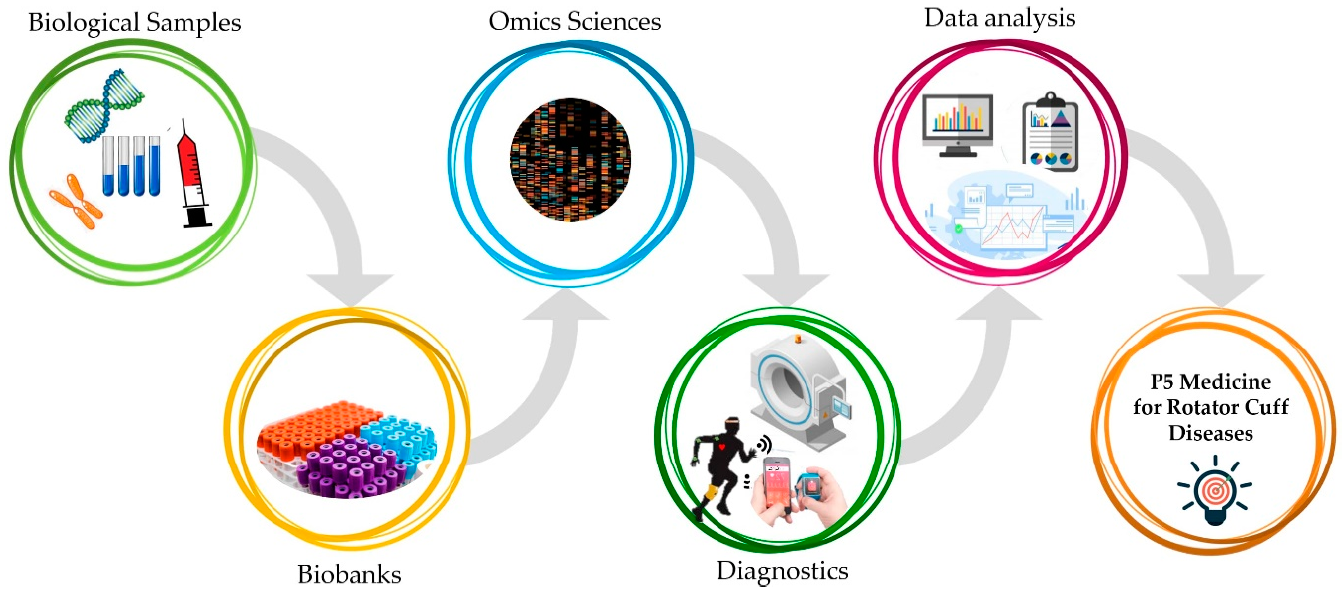

| Approach of P5 Medicine | Definition |
|---|---|
| Personalized | To identify tailored intervention based on the genetic profile of each individual, also considering other factors such as patients’ abilities, contexts, needs, social condition, lifestyle, family history, concomitant therapies, and psychological aspects [8,35,37]. |
| Predictive | To exploit laboratory and genetic tests to predict the onset of a disease, and the deterioration or amelioration of a disease, by applying techniques and methods such as biomedical imaging instruments, artificial intelligence, and machine learning [7]. |
| Participatory | To involve individuals in the management of their health status, strengthening the patients’ empowerment, autonomy, and engagement, and fostering the communication between multiple actors such as patients, doctors, and caregivers [39]. |
| Precision | To classify patients with a disease into subgroups, considering their phenotypic findings, such as biomarkers or genomics [35]. |
| Preventive | To define interventions for a specific pathology or disease before they occur, considering not only biological aspects but also environmental, social, and psychological aspects [40]. |
| First Author, Year of Publication | Personalized | Predictive | Participatory | Precision | Preventive | Main Purpose | Conclusions |
|---|---|---|---|---|---|---|---|
| Ameln, 2018 [41] | To use a musculoskeletal model, comprising a personalized scapulohumeral rhythm, to determine the stabilizing role of RC and selected superficial shoulder muscles as a function of humeral elevation and the plane of elevation. | The RC muscles provide greater compression than shear forces during tasks; the findings can be applied to understand how shear and compressive forces change in populations with abnormal shoulder motion. | |||||
| Barlow, 2016 [42] | To establish factors most predictive of poor emotional health in patients with FTRCTs | Education level, employment status, pain levels, and patient perception of the percentage of shoulder normalcy were most predictive of emotional health in patients with FTRCTs. | |||||
| Bavan, 2019 [43] | Demonstrating treatment fidelity to draw conclusions about the efficacy of rehabilitation interventions in both clinical and research settings | Classification models differentiated well patient exercise activity from non-specific movement by using inertial sensor data. Home rehabilitation could improve patient engagement. | |||||
| Bonato, 2016 [44] | To investigate the association between TMD and RC disease and related genetic aspects. | TMD is a risk factor for RC disease. ESRRB haplotypes and low muscle activity are common biomechanical characteristics in subjects with both diseases. | |||||
| Camurcu, 2019 [45] | To determine the predictive factors for allocation to surgery in patients older than 50 years with symptomatic chronic PTRCT. | Patients with fewer comorbidities and bursal-sided PTRCTs were significantly more likely to undergo surgery. | |||||
| Carbonaro, 2018 [46] | To test a wearable technology-enabled platform for remote rehabilitation. | The proposed approach provides the patient and the therapist with relevant feedback on the quality of personalized rehabilitation. | |||||
| Chiu, 2019 [47] | To develop a screening method for personalized best-fit PRFM to test as many tenocyte/PRFM interactions as possible. | The proposed platform could be used to screen personalized best-fit PRFM preparation protocols according to disease stage and severity. | |||||
| George, 2017 [48] | To test the mechanisms and efficacy of personalized pain interventions matched to genetic and psychological characteristics. | This is a meaningful advance towards personalized or targeted treatments for musculoskeletal pain. | |||||
| Jeong, 2018 [49] | To determine the risk factors related to retear after arthroscopic RC repair, to evaluate whether it is possible to predict the occurrence of retear preoperatively. | Predicting retear preoperatively may help surgeons determine the proper treatment and predict the postoperative prognosis. | |||||
| Kang, 2017 [50] | To evaluate texture data of the torn supraspinatus tendon for prediction of the postoperative tendon state. | Texture analysis may be helpful to predict postoperative tendon state after RC repair. | |||||
| Matcuk, 2019 [51] | To create predictive models to distinguish patients with RC tears from those without. | The proper combination of measurements on shoulder MRIs may be able to separate patients with RC tears from those without. | |||||
| Zheng, 2019 [52] | To evaluate the effects of RC tear propagation on glenohumeral joint stability in a subject-specific finite element model of the shoulder complex. | This type of investigation can predict shoulder biomechanics, and can also be used to improve diagnostic and therapeutic strategies for clinicians. | |||||
| Sakamoto, 2014 [53] | To evaluate the microstructure of the greater tuberosity of the humeral head in patients with RC tears, and to explore individual and regional variance of bone quality in vivo. | The proposed method can help to understand the individual and regional variance in bone quality and may lead to the creation of personalized surgical protocols. | |||||
| Tashjian, 2016 [54] | To identify specific genes or genetic variants associated with rotator cuff tearing by a genome-wide association study. | Identification of potential genes or genetic variants associated with rotator cuff tearing may help in identifying individuals at risk of the development of rotator cuff tearing. |
Publisher’s Note: MDPI stays neutral with regard to jurisdictional claims in published maps and institutional affiliations. |
© 2021 by the authors. Licensee MDPI, Basel, Switzerland. This article is an open access article distributed under the terms and conditions of the Creative Commons Attribution (CC BY) license (http://creativecommons.org/licenses/by/4.0/).
Share and Cite
Longo, U.G.; Carnevale, A.; Massaroni, C.; Lo Presti, D.; Berton, A.; Candela, V.; Schena, E.; Denaro, V. Personalized, Predictive, Participatory, Precision, and Preventive (P5) Medicine in Rotator Cuff Tears. J. Pers. Med. 2021, 11, 255. https://doi.org/10.3390/jpm11040255
Longo UG, Carnevale A, Massaroni C, Lo Presti D, Berton A, Candela V, Schena E, Denaro V. Personalized, Predictive, Participatory, Precision, and Preventive (P5) Medicine in Rotator Cuff Tears. Journal of Personalized Medicine. 2021; 11(4):255. https://doi.org/10.3390/jpm11040255
Chicago/Turabian StyleLongo, Umile Giuseppe, Arianna Carnevale, Carlo Massaroni, Daniela Lo Presti, Alessandra Berton, Vincenzo Candela, Emiliano Schena, and Vincenzo Denaro. 2021. "Personalized, Predictive, Participatory, Precision, and Preventive (P5) Medicine in Rotator Cuff Tears" Journal of Personalized Medicine 11, no. 4: 255. https://doi.org/10.3390/jpm11040255
APA StyleLongo, U. G., Carnevale, A., Massaroni, C., Lo Presti, D., Berton, A., Candela, V., Schena, E., & Denaro, V. (2021). Personalized, Predictive, Participatory, Precision, and Preventive (P5) Medicine in Rotator Cuff Tears. Journal of Personalized Medicine, 11(4), 255. https://doi.org/10.3390/jpm11040255