
Article

Uncertainty, Anxiety and Isolation: Experiencing the COVID-19 Pandemic and Lockdown as a Woman with Polycystic Ovary Syndrome (PCOS)
1
School of Psychology, College of Health and Life Sciences, Aston University, Birmingham B4 7ET, UK
2
Warwickshire Institute for the Study of Diabetes, Endocrinology and Metabolism (WISDEM), University Hospitals Coventry and Warwickshire NHS Trust, Coventry CV2 2DX, UK
3
Centre for Active Living, University Centre Shrewsbury, University of Chester, Shrewsbury SY3 8HQ, UK
4
Centre for Sport, Exercise and Life Sciences, Research Institute for Health & Wellbeing, Coventry University, Coventry CV1 5FB, UK
5
Centre for Exercise & Health, Department of Cardiopulmonary Rehabilitation, University Hospitals Coventry and Warwickshire NHS Trust, Coventry CV2 2DX, UK
6
Warwick Clinical Trials Unit, Warwick Medical School, University of Warwick, Coventry CV4 7AL, UK
7
Centre for Intelligent Healthcare, Coventry University, Coventry CV1 5FB, UK
8
Warwick Medical School, University of Warwick, Coventry CV4 7AL, UK
9
Aston Medical School, College of Health and Life Sciences, Aston University, Birmingham B4 7ET, UK
*
Authors to whom correspondence should be addressed.
Joint senior authors; contributed equally to the manuscript.
J. Pers. Med. 2021, 11(10), 952; https://doi.org/10.3390/jpm11100952
Submission received: 1 September 2021 / Accepted: 17 September 2021 / Published: 25 September 2021
(This article belongs to the Special Issue Chronic Disease Management in the Primary Care)

Abstract

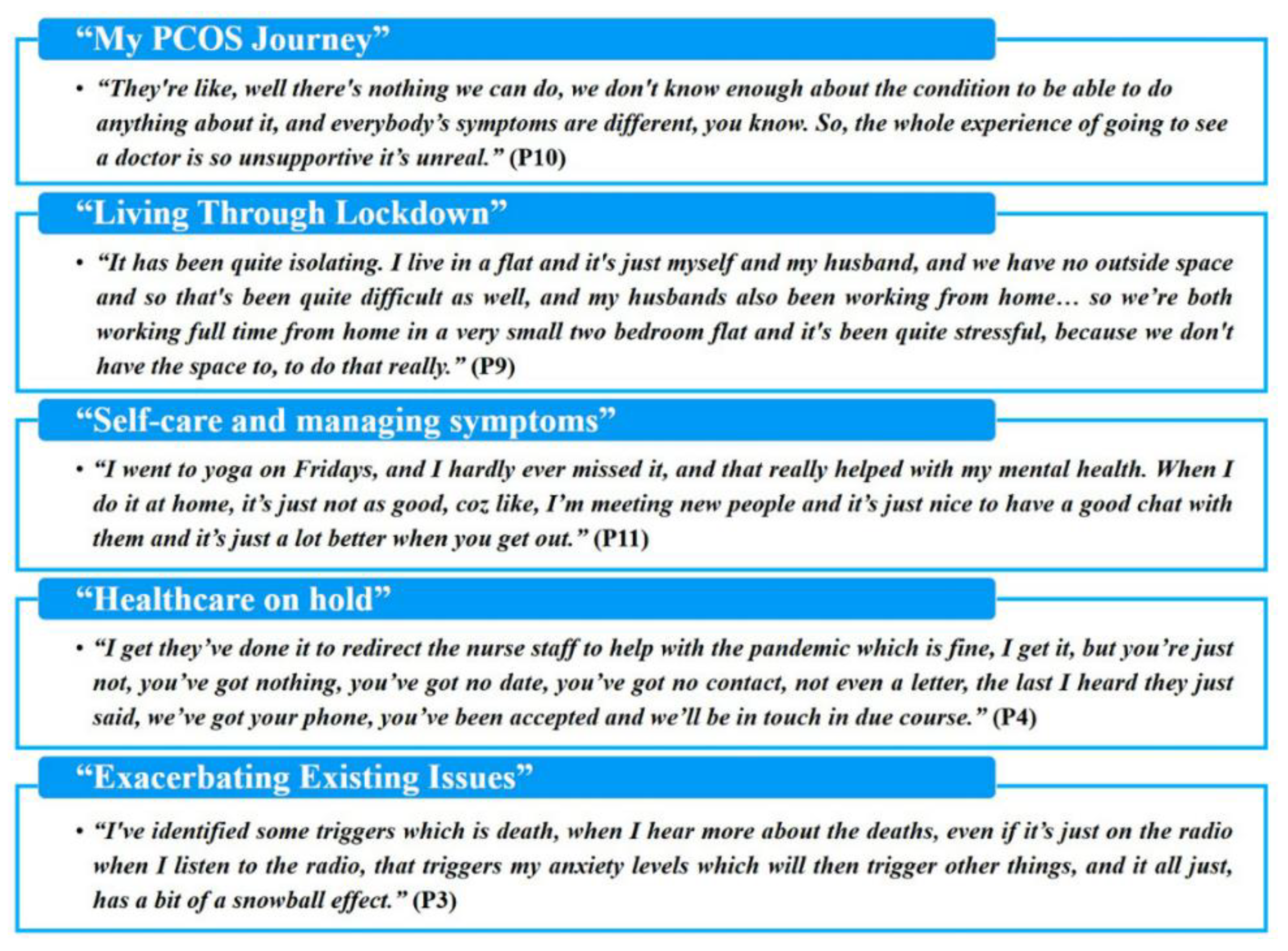
Background: The COVID-19 pandemic and the related lockdown measures presented a significant risk to physical and mental wellbeing in affected populations. Women with polycystic ovary syndrome (PCOS) are predisposed to several cardio-metabolic risk factors which increase the susceptibility to severe COVID-19 and also exhibit increased likelihood of impaired mental health wellbeing. Therefore, these women who usually receive care from multiple primary and specialist healthcare services may be disproportionately impacted by this pandemic and the related restrictions. This study aimed to explore the lived experience of the first UK national lockdown as a woman with PCOS. Methods: As part of a larger cross-sectional study, 12 women with PCOS living in the UK during the first national COVID-19 lockdown were recruited to a qualitative study. Telephone interviews were conducted in June/July of 2020, and data collected were subjected to thematic analysis. Results: Five themes were identified. “My PCOS Journey” describes participants’ experiences of diagnosis, treatment and ongoing management of their PCOS. “Living Through Lockdown” describes the overall experience and impact of the lockdown on all aspects of participants’ lives. “Self-care and Managing Symptoms” describe multiple challenges to living well with PCOS during the lockdown, including lack of access to supplies and services, and disruption to weight management. “Healthcare on Hold” describes the uncertainty and anxiety associated with delays in accessing specialised healthcare for a range of PCOS aspects, including fertility treatment. “Exacerbating Existing Issues” captures the worsening of pre-existing mental health issues, and an increase in health anxiety and feelings of isolation. Conclusion: For the women with PCOS in this study, the COVID-19 pandemic and the first national lockdown was mostly experienced as adding to the pre-existing challenges of living with their condition. The mental health impact experienced by the study participants was increased due to lack of access to their normal support strategies, limitations on healthcare services and uncertainty about their risk of COVID-19.
Keywords: polycystic ovary syndrome; PCOS; COVID-19; lockdown; lived experience; mental health; qualitative study polycystic ovary syndrome; PCOS; COVID-19; lockdown; lived experience; mental health; qualitative study