

Sensing Technologies for Detection of Acetone in Human Breath for Diabetes Diagnosis and Monitoring


Abstract
1. Introduction
2. Human Breath for Diagnosis of Diseases
Volatile Organic Compounds in Breath
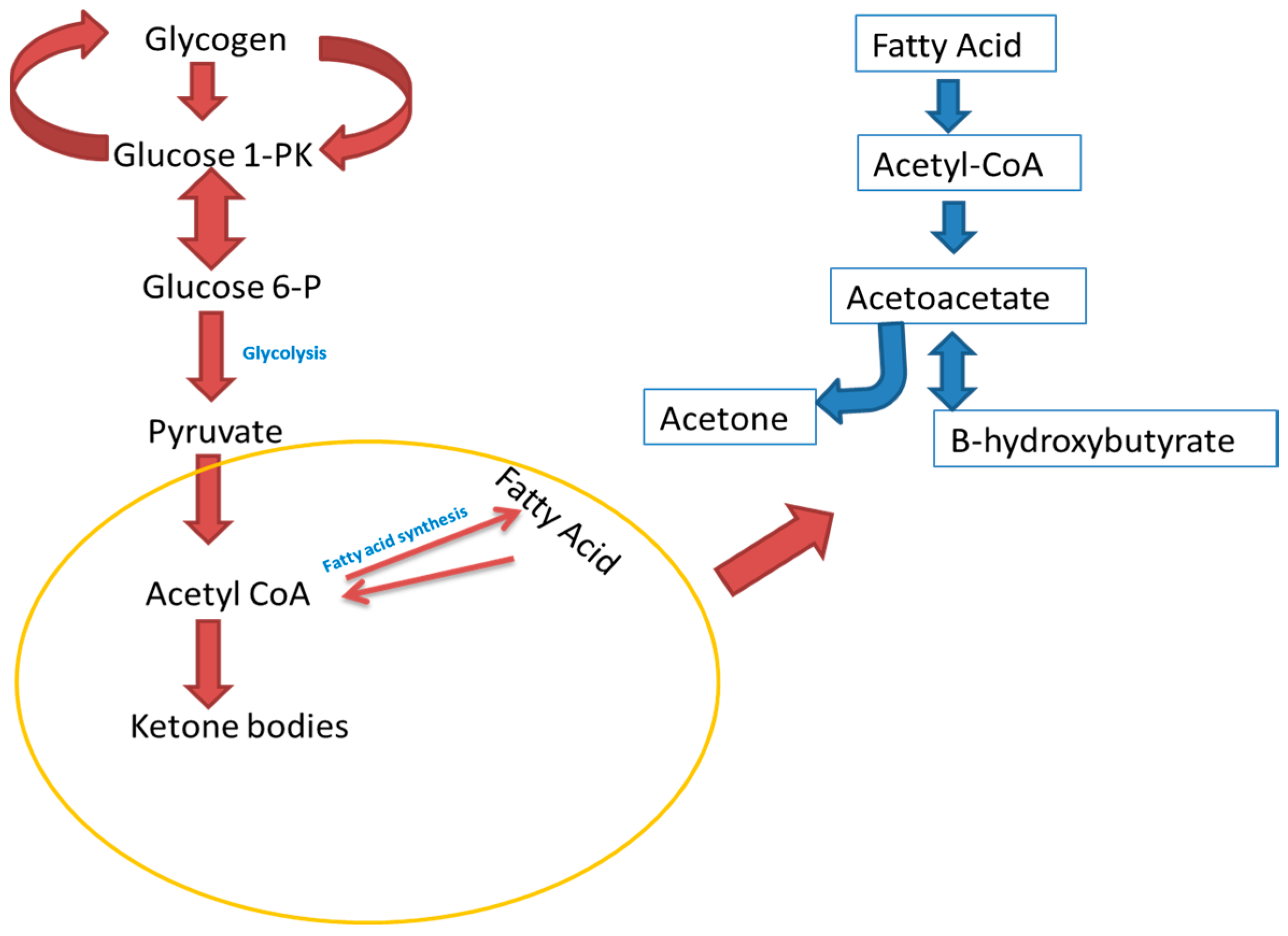
3. Acetone Metabolism
4. Various Techniques Used in Diabetes Monitoring and Diagnosis
5. Nanomaterial-Based Approaches for Detection of Acetone
6. Limitations of Semiconducting Metal Oxides (SMOs)
- sensitivity, a change of measured signal per analyte unit, that is, the slope of a calibration graph;
- selectivity, a characteristic that determines whether a sensor can respond selectively to a single analyte;
- stability, the ability of a sensor to provide reproducible results for a certain period of time. This includes retaining the sensitivity, selectivity, response and recovery time;
- durability, the ability to withstand damage due to temperature, chemical addition and so on;
- response time, the time required for the sensor to respond to a stepped concentration change from zero to a certain concentration value;
- recovery time, the time it takes for the sensor signal to return to its initial value after a stepped concentration change from a certain value to zero;
- room temperature operation and so on, the ability to detect gases at room temperature.
7. Conclusions and Future Perspectives
Acknowledgments
Author Contributions
Conflicts of Interest
References
- Surya, S.; Salam, A.D.; Tomy, D.V.; Carla, B.; Kumar, R.A.; Sunil, C. Diabetes mellitus and medicinal plants—A review. Asian Pac. J. Trop. Dis. 2014, 4, 337–347. [Google Scholar] [CrossRef] [Scilit]
- Karalliedde, J.; Gnudi, L. Diabetes mellitus, a complex and heterogeneous disease, and the role of insulin resistance as a determinant of diabetic kidney disease. Nephrol. Dial. Transplant. 2014, 31, 206–313. [Google Scholar] [CrossRef] [Scilit] [PubMed]
- Deng, C.; Zhang, J.; Yu, X.; Zhang, W.; Zhang, X. Determination of acetone in human breath by gas chromatography-mass spectrometry and solid-phase microextraction with on-fiber derivatization. J. Chromatogr. B Anal. Technol. Biomed. Life Sci. 2004, 810, 269–275. [Google Scholar] [CrossRef]
- Banerjee, M.; Vats, P. Reactive metabolites and antioxidant gene polymorphisms in type 2 diabetes mellitus. RedoxBiol. 2014, 2, 170–177. [Google Scholar]
- Baynes, H.W. Classification, Pathophysiology, Diagnosis and Management of Diabetes Mellitus. J. Diabetes Metab. 2015, 6, 2. [Google Scholar]
- Poretsky, L. Principles of Diabetes Mellitus; Springer: Boston, MA, USA, 2010. [Google Scholar]
- American Diabetes Association. 2. Classification and diagnosis of diabetes. Diabetes Care 2015, 38, S16. [Google Scholar]
- Turner, C.; Walton, C.; Hoashi, S.; Evans, M. Breath acetone concentration decreases with blood glucose concentration in type I diabetes mellitus patients during hypoglycaemic clamps. J. Breath Res. 2009, 3, 046004. [Google Scholar] [CrossRef] [Scilit] [PubMed]
- Lee, J.; Ngo, J.; Blake, D.; Meinardi, S.; Pontello, A.M.; Newcomb, R.; Galassetti, P.R. Improved predictive models for plasma glucose estimation from multi-linear regression analysis of exhaled volatile organic compounds. J. Appl. Physiol. 2009, 107, 155–160. [Google Scholar] [CrossRef] [Scilit] [PubMed]
- Hu, W. Breath ethanol and acetone as indicators of serum glucose levels: An initial report. Ethn. Dis. 2005, 15, 32–34. [Google Scholar]
- Righettoni, M.; Schmid, A.; Amann, A.; Pratsinis, S.E. Correlations between blood glucose and breath components from portable gas sensors and PTR-TOF-MS. J. Breath Res. 2013, 7, 037110. [Google Scholar] [CrossRef] [Scilit] [PubMed]
- Turner, C.; Parekh, B.; Walton, C.; Španěl, P.; Smith, D.; Evans, M. An exploratory comparative study of volatile compounds in exhaled breath and emitted by skin using selected ion flow tube mass spectrometry. Rapid Commun. Mass Spectrom. 2008, 22, 526–532. [Google Scholar] [CrossRef] [Scilit] [PubMed]
- Minh, T.D.; Oliver, S.R.; Ngo, J.; Flores, R.; Midyett, J.; Meinardi, S.; Carlson, M.K.; Rowland, F.S.; Blake, D.R.; Galassetti, P.R. Noninvasive measurement of plasma glucose from exhaled breath in healthy and type 1 diabetic subjects. Am. J. Physiol. Endocrinol. Metab. 2011, 300, E1175. [Google Scholar] [CrossRef] [Scilit] [PubMed]
- Sun, M.; Zhao, X.; Yin, H.; Wang, Z.; Jiang, C.; Liu, W.; Chen, Z.; Yuan, Y.; Li, Y.; Wang, C. Study of breath acetone and its correlations with blood glucose and blood beta-hydroxybutyrate using an animal model with lab-developed type 1 diabetic rats. RSC Adv. 2015, 5, 71002–71010. [Google Scholar] [CrossRef] [Scilit]
- Rydosz, A. A negative correlation between blood glucose and acetone measured in healthy and type 1 diabetes mellitus patient breath. J. Diabetes Sci. Technol. 2015, 9, 881–884. [Google Scholar] [CrossRef] [Scilit] [PubMed]
- Wang, C.; Mbi, A.; Shepherd, M. A study on breath acetone in diabetic patients using a cavity ringdown breath analyzer: Exploring correlations of breath acetone with blood glucose and glycohemoglobin A1C. IEEE Sens. J. 2010, 10, 54–63. [Google Scholar] [CrossRef] [Scilit]
- Semenya, S.; Potgieter, M.; Tshisikhawe, M.; Shava, S.; Maroyi, A. Medicinal utilization of exotic plants by Bapedi traditional healers to treat human ailments in Limpopo province, South Africa. J. Ethnopharmacol. 2012, 144, 646–655. [Google Scholar] [CrossRef] [Scilit] [PubMed]
- Righettoni, M.; Tricoli, A.; Gass, S.; Schmid, A.; Amann, A.; Pratsinis, S.E. Breath acetone monitoring by portable Si: WO3 gas sensors. Anal. Chim. Acta 2012, 738, 69–75. [Google Scholar] [CrossRef] [Scilit] [PubMed]
- Salehi, S.; Nikan, E.; Khodadadi, A.A.; Mortazavi, Y. Highly sensitive carbon nanotubes–SnO2 nanocomposite sensor for acetone detection in diabetes mellitus breath. Sens. Actuators B Chem. 2014, 205, 261–267. [Google Scholar] [CrossRef] [Scilit]
- Xiao, T.; Wang, X.; Zhao, Z.; Li, L.; Zhang, L.; Yao, H.; Wang, J.S.; Li, Z.J. Highly sensitive and selective acetone sensor based on C-doped WO3 for potential diagnosis of diabetes mellitus. Sens. Actuators B Chem. 2014, 199, 210–219. [Google Scholar] [CrossRef] [Scilit]
- Amann, A.; Costello, B.D.L.; Miekisch, W.; Schubert, J.; Buszewski, B.; Pleil, J.; Ratcliffe, N.; Risby, T. The human volatilome: Volatile organic compounds (VOCs) in exhaled breath, skin emanations, urine, feces and saliva. J. Breath Res. 2014, 8, 034001. [Google Scholar] [CrossRef] [Scilit] [PubMed]
- King, J.; Mochalski, P.; Kupferthaler, A.; Unterkofler, K.; Koc, H.; Filipiak, W.; Teschl, S.; Hinterhuber, H.; Amann, A. Dynamic profiles of volatile organic compounds in exhaled breath as determined by a coupled PTR-MS/GC-MS study. Physiol. Meas. 2010, 31, 1169. [Google Scholar] [CrossRef] [Scilit] [PubMed]
- King, J.; Kupferthaler, A.; Frauscher, B.; Hackner, H.; Unterkofler, K.; Teschl, G.; Hinterhuber, H.; Amann, A.; Högl, B. Measurement of endogenous acetone and isoprene in exhaled breath during sleep. Physiol. Meas. 2012, 33, 413. [Google Scholar] [CrossRef] [Scilit] [PubMed]
- Ligor, T.; Ligor, M.; Amann, A.; Ager, C.; Bachler, M.; Dzien, A.; Buszewski, B. The analysis of healthy volunteers’ exhaled breath by the use of solid-phase microextraction and GC-MS. J. Breath Res. 2008, 2, 046006. [Google Scholar] [CrossRef] [Scilit] [PubMed]
- Mazzone, P.J. Analysis of volatile organic compounds in the exhaled breath for the diagnosis of lung cancer. J. Thorac. Oncol. 2008, 3, 774–780. [Google Scholar] [CrossRef] [Scilit] [PubMed]
- Teranishi, R.; Mon, T.R.; Robinson, A.B.; Cary, P.; Pauling, L. Gas chromatography of volatiles from breath and urine. Anal. Chem. 1972, 44, 18–20. [Google Scholar] [CrossRef] [Scilit] [PubMed]
- Minh, T.D.C.; Blake, D.R.; Galassetti, P.R. The clinical potential of exhaled breath analysis for diabetes mellitus. Diabetes Res. Clin. Pract. 2012, 97, 195–205. [Google Scholar] [CrossRef] [Scilit] [PubMed]
- O’hara, M.E.; Clutton-Brock, T.H.; Green, S.; Mayhew, C.A. Endogenous volatile organic compounds in breath and blood of healthy volunteers: Examining breath analysis as a surrogate for blood measurements. J. Breath Res. 2009, 3, 027005. [Google Scholar] [CrossRef] [Scilit] [PubMed]
- Buszewski, B.; Kęsy, M.; Ligor, T.; Amann, A. Human exhaled air analytics: Biomarkers of diseases. Biomed. Chromatogr. 2007, 21, 553–566. [Google Scholar] [CrossRef] [Scilit] [PubMed]
- Worrall, A.D.; Bernstein, J.A.; Angelopoulos, A.P. Portable method of measuring gaseous acetone concentrations. Talanta 2013, 112, 26–30. [Google Scholar] [CrossRef] [Scilit] [PubMed]
- Lourenço, C.; Turner, C. Breath analysis in disease diagnosis: Methodological considerations and applications. Metabolites 2014, 4, 465–498. [Google Scholar] [CrossRef] [Scilit] [PubMed]
- Miekisch, W.; Schubert, J.K.; Noeldge-Schomburg, G.F. Diagnostic potential of breath analysis—Focus on volatile organic compounds. Clin. Chim. Acta 2004, 347, 25–39. [Google Scholar] [CrossRef] [Scilit] [PubMed]
- Probert, C.S.; Khalid, T.; Ahmed, I.; Johnson, E.; Smith, S.; Ratcliffe, N.M. Volatile organic compounds as diagnostic biomarkers in gastrointestinal and liver diseases. J. Gastrointest. Liver Dis. 2009, 18, 337–343. [Google Scholar]
- Marczin, N.; Yacoub, M. Disease Markers in Exhaled Breath: Basic Mechanisms and Clinical Applications; IOS Press: Amsterdam, The Netherlands, 2002. [Google Scholar]
- Phillips, M.; Herrera, J.; Krishnan, S.; Zain, M.; Greenberg, J.; Cataneo, R.N. Variation in volatile organic compounds in the breath of normal humans. J. Chromatogr. B Biomed. Sci. Appl. 1999, 729, 75–88. [Google Scholar] [CrossRef] [Scilit]
- Phillips, M.; Gleeson, K.; Hughes, J.M.B.; Greenberg, J.; Cataneo, R.N.; Baker, L.; McVay, W.P. Volatile organic compounds in breath as markers of lung cancer: A cross-sectional study. Lancet 1999, 353, 1930–1933. [Google Scholar] [CrossRef] [Scilit]
- Poli, D.; Goldoni, M.; Corradi, M.; Acampa, O.; Carbognani, P.; Internullo, E.; Casalini, A.; Mutti, A. Determination of aldehydes in exhaled breath of patients with lung cancer by means of on-fiber-derivatisation SPME–GC/MS. J. Chromatogr. B Anal. Technol. Biomed. Life Sci. 2010, 878, 2643–36451. [Google Scholar] [CrossRef] [Scilit] [PubMed]
- Chen, X.; Xu, F.; Wang, Y.; Pan, Y.; Lu, D.; Wang, P.; Ying, K.; Chen, E.; Zhang, W. A study of the volatile organic compounds exhaled by lung cancer cells in vitro for breath diagnosis. Cancer 2007, 110, 835–844. [Google Scholar] [CrossRef] [Scilit] [PubMed]
- Van den Velde, S.; Nevens, F.; van Steenberghe, D.; Quirynen, M. GC–MS analysis of breath odor compounds in liver patients. J. Chromatogr. B Anal. Technol. Biomed. Life Sci. 2008, 875, 344–348. [Google Scholar] [CrossRef] [Scilit] [PubMed]
- Budavari, S.; O’Neil, M.J.; Smith, A.; Heckelman, P.E. The Merck Index; Merck & Co. Inc.: Rahway, NJ, USA, 1989; p. 104. [Google Scholar]
- Dadamio, J.; Van den Velde, S.; Laleman, W.; Van Hee, P.; Coucke, W.; Nevens, F.; Quirynen, M. Breath biomarkers of liver cirrhosis. J. Chromatogr. B Anal. Technol. Biomed. Life Sci. 2012, 905, 17–22. [Google Scholar] [CrossRef] [Scilit] [PubMed]
- Mathew, T.L.; Pownraj, P.; Abdulla, S.; Pullithadathil, B. Technologies for clinical diagnosis using expired human breath analysis. Diagnostics 2015, 5, 27–60. [Google Scholar] [CrossRef] [Scilit] [PubMed]
- Sun, G.; Kheel, H.; Park, S.; Lee, S.; Park, S.E.; Lee, C. Synthesis of TiO2 nanorods decorated with NiO nanoparticles and their acetone sensing properties. Ceram. Int. 2016, 42, 1063–1069. [Google Scholar] [CrossRef] [Scilit]
- Yamane, N.; Tsuda, T.; Nose, K.; Yamamoto, A.; Ishiguro, H.; Kondo, T. Relationship between skin acetone and blood β-hydroxybutyrate concentrations in diabetes. Clin. Chim. Acta 2006, 365, 325–329. [Google Scholar] [CrossRef] [Scilit] [PubMed]
- Fan, G.; Yang, C.; Lin, C.; Chen, C.; Shih, C. Applications of Hadamard transform-gas chromatography/mass spectrometry to the detection of acetone in healthy human and diabetes mellitus patient breath. Talanta 2014, 120, 386–390. [Google Scholar] [CrossRef] [Scilit] [PubMed]
- Kim, I.; Choi, S.; Kim, S.; Jang, J. Exhaled breath sensors. In Smart Sensors for Health and Environment Monitoring; Springer: Dordrecht, The Netherlands, 2015; pp. 19–49. [Google Scholar]
- Anderson, J.C. Measuring breath acetone for monitoring fat loss. Obesity 2015, 23, 2327–2334. [Google Scholar] [CrossRef] [Scilit] [PubMed]
- Miekisch, W.; Schubert, J.K. From highly sophisticated analytical techniques to life-saving diagnostics: Technical developments in breath analysis. TrAC Trends Anal. Chem. 2006, 25, 665–673. [Google Scholar] [CrossRef] [Scilit]
- Stashenko, E.; Martinez, J.R. Gas Chromatography-Mass Spectrometry. In Advances in Gas Chromatography; InTech: London, UK, 2014. [Google Scholar]
- Ueta, I.; Saito, Y.; Hosoe, M.; Okamoto, M.; Ohkita, H.; Shirai, S.; Tamura, H.; Jinno, K. Breath acetone analysis with miniaturized sample preparation device: In-needle preconcentration and subsequent determination by gas chromatography–mass spectroscopy. J. Chromatogr. B Anal. Technol. Biomed. Life Sci. 2009, 877, 2551–2556. [Google Scholar] [CrossRef] [Scilit] [PubMed]
- Blake, R.S.; Monks, P.S.; Ellis, A.M. Proton-transfer reaction mass spectrometry. Chem. Rev. 2009, 109, 861–896. [Google Scholar] [CrossRef] [Scilit] [PubMed]
- Lindinger, W.; Jordan, A. Proton-transfer-reaction mass spectrometry (PTR–MS): On-line monitoring of volatile organic compounds at pptv levels. Chem. Soc. Rev. 1998, 27, 347–375. [Google Scholar] [CrossRef] [Scilit]
- Zhan, X.; Duan, J.; Duan, Y. Recent developments of proton-transfer reaction mass spectrometry (PTR-MS) and its applications in medical research. Mass Spectrom. Rev. 2013, 32, 143–165. [Google Scholar] [CrossRef] [Scilit] [PubMed]
- Wehinger, A.; Schmid, A.; Mechtcheriakov, S.; Ledochowski, M.; Grabmer, C.; Gastl, G.A.; Amann, A. Lung cancer detection by proton transfer reaction mass-spectrometric analysis of human breath gas. Int. J. Mass Spectrom. 2007, 265, 49–59. [Google Scholar] [CrossRef] [Scilit]
- Smith, D.; Španěl, P. Selected ion flow tube mass spectrometry (SIFT-MS) for on-line trace gas analysis. Mass Spectrom. Rev. 2005, 24, 661–700. [Google Scholar] [CrossRef] [Scilit] [PubMed]
- Sigrist, M.W.; Bartlome, R.; Marinov, D.; Rey, J.M.; Vogler, D.E.; Wachter, H. Trace gas monitoring with infrared laser-based detection schemes. Appl. Phys. B 2008, 90, 289–300. [Google Scholar] [CrossRef] [Scilit]
- Kosterev, A.; Wysocki, G.; Bakhirkin, Y.; So, S.; Lewicki, R.; Fraser, M.; Tittel, F.; Curl, R.F. Application of quantum cascade lasers to trace gas analysis. Appl. Phys. B 2008, 90, 165–176. [Google Scholar] [CrossRef] [Scilit]
- Faist, J.; Capasso, F.; Sivco, D.L.; Sirtori, C.; Hutchinson, A.L.; Cho, A.Y. Quantum cascade laser. Science 1994, 264, 553–555. [Google Scholar] [CrossRef] [Scilit] [PubMed]
- Werle, P. A review of recent advances in semiconductor laser based gas monitors. Spectrochim. Acta Part A Mol. Biomol. Spectrosc. 1998, 54, 197–236. [Google Scholar] [CrossRef] [Scilit]
- Bai, Y.; Bandyopadhyay, N.; Tsao, S.; Slivken, S.; Razeghi, M. Room temperature quantum cascade lasers with 27% wall plug efficiency. Appl. Phys. Lett. 2011, 98, 181102. [Google Scholar] [CrossRef] [Scilit]
- Wagner, T.; Schöning, M.J. Light-addressable potentiometric sensors (LAPS): Recent trends and applications. Compr. Anal. Chem. 2007, 49, 87–128. [Google Scholar]
- Dean, G.; Hafeman, J.; Wallace, P. Light-addressable po-tentiometric sensor for biochemical systems. Science 1988, 240, 1182–1185. [Google Scholar]
- Zhang, Q.; Wang, P.; Li, J.; Gao, X. Diagnosis of diabetes by image detection of breath using gas-sensitive laps. Biosens. Bioelectron. 2000, 15, 249–256. [Google Scholar] [CrossRef] [Scilit]
- Kim, I.; Rothschild, A.; Tuller, H.L. Advances and new directions in gas-sensing devices. Acta Mater. 2013, 61, 974–1000. [Google Scholar] [CrossRef] [Scilit]
- Grote, C.; Pawliszyn, J. Solid-phase microextraction for the analysis of human breath. Anal. Chem. 1997, 69, 587–596. [Google Scholar] [CrossRef] [Scilit] [PubMed]
- Prado, C.; Marín, P.; Periago, J.F. Application of solid-phase microextraction and gas chromatography–mass spectrometry to the determination of volatile organic compounds in end-exhaled breath samples. J. Chromatogr. A 2003, 1011, 125–134. [Google Scholar] [CrossRef] [Scilit]
- Massick, S. Biomedical Optics & Medical Imaging Portable Breath Acetone Measurements Combine Chemistry and Spectroscopy. Available online: http://spie.org/newsroom/0948-portable-breath-acetone-measurements-combine-chemistry-and-spectroscopy?highlight=x2416&SSO=1 (accessed on 6 December 2007).
- King, J.; Kupferthaler, A.; Unterkofler, K.; Koc, H.; Teschl, S.; Teschl, G.; Miekisch, W.; Schubert, J.; Hinterhuber, H.; Amann, A. Isoprene and acetone concentration profiles during exercise on an ergometer. J. Breath Res. 2009, 3, 027006. [Google Scholar] [CrossRef] [Scilit] [PubMed]
- Schwarz, K.; Pizzini, A.; Arendacká, B.; Zerlauth, K.; Filipiak, W.; Schmid, A.; Dzien, A.; Neuner, S.; Lechleitner, M.; Scholl-Bürgi, S.; et al. Breath acetone—Aspects of normal physiology related to age and gender as determined in a PTR-MS study. J. Breath Res. 2009, 3, 027003. [Google Scholar] [CrossRef] [Scilit] [PubMed]
- Mihranyan, A.; Ferraz, N.; Strmme, M. Current status and future prospects of nanotechnology in cosmetics. Prog. Mater. Sci. 2012, 57, 875–910. [Google Scholar] [CrossRef] [Scilit]
- Xu, H.; Wei, Y.; Zhu, L.; Huang, J.; Li, Y.; Liu, F.; Wang, S.; Liu, S. Bifunctional magnetic nanoparticles for analysis of aldehyde metabolites in exhaled breath of lung cancer patients. J. Chromatogr. A 2014, 1324, 29–35. [Google Scholar] [CrossRef] [Scilit] [PubMed]
- Righettoni, M.; Tricoli, A.; Pratsinis, S.E. Si: WO3 sensors for highly selective detection of acetone for easy diagnosis of diabetes by breath analysis. Anal. Chem. 2010, 82, 3581–3587. [Google Scholar] [CrossRef] [Scilit] [PubMed]
- Dai, Z.; Xu, L.; Duan, G.; Li, T.; Zhang, H.; Li, Y.; Wang, Y.; Wang, Y.; Cai, W. Fast-response, sensitivitive and low-powered chemosensors by fusing nanostructured porous thin film and IDEs-microheater chip. Sci. Rep. 2013, 3, 1669. [Google Scholar] [CrossRef] [Scilit] [PubMed]
- Neri, G. First fifty years of chemoresistive gas sensors. Chemosensors 2015, 3, 1–20. [Google Scholar] [CrossRef] [Scilit]
- Dubourg, G.; Segkos, A.; Katona, J.; Radović, M.; Savić, S.; Niarchos, G.; Tsamis, C.; Crnojević-Bengin, V. Fabrication and Characterization of Flexible and Miniaturized Humidity Sensors Using Screen-Printed TiO2 Nanoparticles as Sensitive Layer. Sensors 2017, 17, 1854. [Google Scholar] [CrossRef] [Scilit] [PubMed]
- Wang, C.; Yin, L.; Zhang, L.; Xiang, D.; Gao, R. Metal oxide gas sensors: Sensitivity and influencing factors. Sensors 2010, 10, 2088–2106. [Google Scholar] [CrossRef] [Scilit] [PubMed]
- Hoa, N.D.; Duy, N.V.; El-Safty, S.A.; Hieu, N.V. Meso-/nanoporous semiconducting metal oxides for gas sensor applications. J. Nanomater. 2015, 16, 186. [Google Scholar] [CrossRef] [Scilit]
- Hill, D.; Binions, R. Breath Analysis for Medical Diagnosis. Int. J. Smart Sens. Intell. Syst. 2012, 5. [Google Scholar] [CrossRef] [Scilit]
- Mochalski, P.; Rudnicka, J.; Agapiou, A.; Statheropoulos, M.; Amann, A.; Buszewski, B. Near real-time VOCs analysis using an aspiration ion mobility spectrometer. J. Breath Res. 2013, 7, 026002. [Google Scholar] [CrossRef] [Scilit] [PubMed]
- Xu, M.; Tang, Z.; Duan, Y.; Liu, Y. GC-based techniques for breath analysis: Current status, challenges, and prospects. Crit. Rev. Anal. Chem. 2016, 46, 291–304. [Google Scholar] [CrossRef] [Scilit] [PubMed]
- Chakraborty, S.; Banerjee, D.; Ray, I.; Sen, A. Detection of biomarker in breath: A step towards noninvasive diabetes monitoring. Curr. Sci. 2008, 94, 237–242. [Google Scholar]
- Choi, S.; Lee, I.; Jang, B.; Youn, D.; Ryu, W.; Park, C.O.; Kim, I.D. Selective diagnosis of diabetes using Pt-functionalized WO3 hemitube networks as a sensing layer of acetone in exhaled breath. Anal. Chem. 2013, 85, 1792–1796. [Google Scholar] [CrossRef] [Scilit] [PubMed]
- Righettoni, M.; Amann, A.; Pratsinis, S.E. Breath analysis by nanostructured metal oxides as chemo-resistive gas sensors. Mater. Today 2015, 18, 163–171. [Google Scholar] [CrossRef] [Scilit]
- Xiao, Y.; Lu, L.; Zhang, A.; Zhang, Y.; Sun, L.; Huo, L.; Li, F. Highly enhanced acetone sensing performances of porous and single crystalline ZnO nanosheets: High percentage of exposed (100) facets working together with surface modification with Pd nanoparticles. ACS Appl. Mater. Interfaces 2012, 4, 3797–3804. [Google Scholar] [CrossRef] [Scilit] [PubMed]
- Shin, J.; Choi, S.; Youn, D.; Kim, I. Exhaled VOCs sensing properties of WO3 nanofibers functionalized by Pt and IrO2 nanoparticles for diagnosis of diabetes and halitosis. J. Electroceram. 2012, 29, 106–116. [Google Scholar] [CrossRef] [Scilit]
- Gunawan, P.; Mei, L.; Teo, J.; Ma, J.; Highfield, J.; Li, Q.; Zhong, Z. Ultrahigh sensitivity of Au/1D α-Fe2O3 to acetone and the sensing mechanism. Langmuir 2012, 28, 14090–14099. [Google Scholar] [CrossRef] [Scilit] [PubMed]
- Choi, S.; Ryu, W.; Kim, S.; Cho, H.; Kim, I. Bi-functional co-sensitization of graphene oxide sheets and Ir nanoparticles on p-type Co3O4 nanofibers for selective acetone detection. J. Mater. Chem. B 2014, 2, 7160–7167. [Google Scholar] [CrossRef] [Scilit]
- Choi, S.; Jang, B.; Lee, S.; Min, B.K.; Rothschild, A.; Kim, I. Selective detection of acetone and hydrogen sulfide for the diagnosis of diabetes and halitosis using SnO2 nanofibers functionalized with reduced graphene oxide nanosheets. ACS Appl. Mater. Interfaces 2014, 6, 2588–2597. [Google Scholar] [CrossRef] [Scilit] [PubMed]
- Wongrat, E.; Chanlek, N.; Chueaiarrom, C.; Thupthimchun, W.; Samransuksamer, B.; Choopun, S. Acetone gas sensors based on ZnO nanostructures decorated with Pt and Nb. Ceram. Int. 2017, 43 (Suppl. S1), S566. [Google Scholar] [CrossRef] [Scilit]
- Ma, L.; Ma, S.Y.; Shen, X.F.; Wang, T.T.; Jiang, X.H.; Chen, Q.; Qiang, Z.; Yang, H.M.; Chen, H. PrFeO3 hollow nanofibers as a highly efficient gas sensor for acetone detection. Sens. Actuators B Chem. 2018, 255, 2546–2554. [Google Scholar] [CrossRef] [Scilit]
- Liu, F.; Wang, B.; Yang, X.; Liang, X.; Sun, P.; Chuai, X.; Gao, Y.; Liu, F.; Lu, G. Sub-ppm YSZ-based mixed potential type acetone sensor utilizing columbite type composite oxide sensing electrode. Sens. Actuators B Chem. 2017, 238 (Suppl. C), 928–937. [Google Scholar] [CrossRef] [Scilit]
- Tomer, V.K.; Singh, K.; Kaur, H.; Shorie, M.; Sabherwal, P. Rapid acetone detection using indium loaded WO3/SnO2 nanohybrid sensor. Sens. Actuators B Chem. 2017, 253 (Suppl. C), 703–713. [Google Scholar] [CrossRef] [Scilit]
- Hu, J.; Zou, C.; Su, Y.; Li, M.; Yang, Z.; Ge, M.; Zhang, Y. One-step synthesis of 2D C3N4-tin oxide gas sensors for enhanced acetone vapor detection. Sens. Actuators B Chem. 2017, 253 (Suppl. C), 641–651. [Google Scholar] [CrossRef] [Scilit]
- Navale, S.T.; Yang, Z.B.; Liu, C.; Cao, P.J.; Patil, V.B.; Ramgir, N.S.; Mane, R.S.; Stadler, F.J. Enhanced acetone sensing properties of titanium dioxide nanoparticles with a sub-ppm detection limit. Sens. Actuators B Chem. 2018, 255, 1701–1710. [Google Scholar] [CrossRef] [Scilit]
- Li, S.; Zhang, L.; Zhu, M.; Ji, G.; Zhao, L.; Yin, J.; Bie, Y.-J. Acetone sensing of ZnO nanosheets synthesized using room-temperature precipitation. Sens. Actuators B Chem. 2017, 249 (Suppl. C), 611–623. [Google Scholar] [CrossRef] [Scilit]
- Kim, S.; Park, S.; Park, S.; Lee, C. Acetone sensing of Au and Pd-decorated WO3 nanorod sensors. Sens. Actuators B Chem. 2015, 209, 180–185. [Google Scholar] [CrossRef] [Scilit]
- Liu, H.; Qu, F.; Gong, H.; Jiang, H.; Yang, M. Template-free synthesis of In2O3 nanoparticles and their acetone sensing properties. Mater. Lett. 2016, 182 (Suppl. C), 340–343. [Google Scholar] [CrossRef] [Scilit]
- Horita, T.; Kawada, T.; Sakai, N.; Yokokawa, H.; Dokiya, M. Low temperature fabrication of (Y, Gd, Sm)-doped ceria electrolyte. Solid State Ionics 1996, 86, 1255–1258. [Google Scholar]
- Tomchenko, A.A.; Harmer, G.P.; Marquis, B.T.; Allen, J.W. Semiconducting metal oxide sensor array for the selective detection of combustion gases. Sens. Actuators B Chem. 2003, 93, 126–134. [Google Scholar] [CrossRef] [Scilit]
- Choi, S.; Choi, C.; Kim, S.; Cho, H.; Jeon, S.; Kim, I. Facile synthesis of hierarchical porous WO3 nanofibers having 1D nanoneedles and their functionalization with non-oxidized graphene flakes for selective detection of acetone molecules. RSC Adv. 2015, 5, 7584–7588. [Google Scholar] [CrossRef] [Scilit]
- Cross, R.; De Souza, M.M.; Narayanan, E.S. A low temperature combination method for the production of ZnO nanowires. Nanotechnology 2005, 16, 2188. [Google Scholar] [CrossRef] [Scilit] [PubMed]
- Cao, W.; Duan, Y. Breath analysis: Potential for clinical diagnosis and exposure assessment. Clin. Chem. 2006, 52, 800–811. [Google Scholar] [CrossRef] [Scilit] [PubMed]
- Cho, N.G.; Whitfield, G.C.; Yang, D.J.; Kim, H.; Tuller, H.L.; Kim, I. Facile synthesis of Pt-functionalized SnO2 hollow hemispheres and their gas sensing properties. J. Electrochem. Soc. 2010, 157, J439. [Google Scholar] [CrossRef] [Scilit]
- Ai, Z.; Deng, K.; Wan, Q.; Zhang, L.; Lee, S. Facile microwave-assisted synthesis and magnetic and gas sensing properties of Fe3O4 nanoroses. J. Phys. Chem. C 2010, 114, 6237–6242. [Google Scholar] [CrossRef] [Scilit]
- Kao, K.; Hsu, M.; Chang, Y.; Gwo, S.; Yeh, J.A. A sub-ppm acetone gas sensor for diabetes detection using 10 nm thick ultrathin InN FETs. Sensors 2012, 12, 7157–7168. [Google Scholar] [CrossRef] [Scilit] [PubMed]
- Tao, J.; Batzill, M. Surface science studies of metal oxide gas sensing materials. In Metal Oxide Nanomaterials for Chemical Sensors; Springer: New York, NY, USA, 2013; pp. 35–67. [Google Scholar]
- Traversa, E. Ceramic sensors for humidity detection: The state-of-the-art and future developments. Sens. Actuators B Chem. 1995, 23, 135–156. [Google Scholar] [CrossRef] [Scilit]
- Shankar, P.; Rayappan, J.B.B. Gas sensing mechanism of metal oxides: The role of ambient atmosphere, type of semiconductor and gases-A review. Sci. Lett. J. 2015, 4, 126. [Google Scholar]
- Sun, Y.; Liu, S.; Meng, F.; Liu, J.; Jin, Z.; Kong, L.; Liu, J.H. Metal oxide nanostructures and their gas sensing properties: A review. Sensors 2012, 12, 2610–2631. [Google Scholar] [CrossRef] [Scilit] [PubMed]
- Phanichphant, S. Semiconductor metal oxides as hydrogen gas sensors. Procedia Eng. 2014, 87, 795–802. [Google Scholar] [CrossRef] [Scilit]
- Lu, F.; Liu, Y.; Dong, M.; Wang, X. Nanosized tin oxide as the novel material with simultaneous detection towards CO, H2 and CH4. Sens. Actuators B Chem. 2000, 66, 225–227. [Google Scholar] [CrossRef] [Scilit]
- Ansari, S.G.; Boroojerdian, P.; Sainkar, S.R.; Karekar, R.N.; Aiyer, R.C.; Kulkarni, S.K. Grain size effects on H2 gas sensitivity of thick film resistor using SnO2 nanoparticles. Thin Solid Films 1997, 295, 271–276. [Google Scholar] [CrossRef] [Scilit]
- Tan, O.K.; Zhu, W.; Yan, Q.; Kong, L.B. Size effect and gas sensing characteristics of nanocrystallinex SnO2-(1 − x) α-Fe2O3 ethanol sensors. Sens. Actuators B Chem. 2000, 65, 361–365. [Google Scholar] [CrossRef] [Scilit]
- Michel, C.R.; Mena, E.L.; Martinez, A.H. Grain-size effects on gas response in nanostructured Gd0.9 Ba0.1 CoO3. Talanta 2007, 74, 235–240. [Google Scholar] [CrossRef] [Scilit] [PubMed]
- Bochenkov, V.E.; Sergeev, G.B. Sensitivity, selectivity, and stability of gas-sensitive metal-oxide nanostructures. Metal Oxide Nanostruct. Their Appl. 2010, 3, 31–52. [Google Scholar]
- Shimizu, Y.; Hyodo, T.; Egashira, M. Mesoporous semiconducting oxides for gas sensor application. J. Eur. Ceram. Soc. 2004, 24, 1389–1398. [Google Scholar] [CrossRef] [Scilit]
- Choi, U.; Sakai, G.; Shimanoe, K.; Yamazoe, N. Sensing properties of Au-loaded SnO2–Co3O4 composites to CO and H2. Sens. Actuators B Chem. 2005, 107, 397–401. [Google Scholar] [CrossRef] [Scilit]
- Gong, J.; Chen, Q.; Lian, M.; Liu, N.; Stevenson, R.G.; Adami, F. Micromachinednanocrystalline silver doped SnO2 H2S sensor. Sens. Actuators B Chem. 2006, 114, 32–39. [Google Scholar] [CrossRef] [Scilit]
- Galdikas, A.; Mironas, A.; Šetkus, A. Copper-doping level effect on sensitivity and selectivity of tin oxide thin-film gas sensor. Sens. Actuators B Chem. 1995, 26, 29–32. [Google Scholar] [CrossRef] [Scilit]
- Fryberger, T.B.; Semancik, S. Conductance response of Pd/SnO2 (110) model gas sensors to H2 and O2. Sens. Actuators B Chem. 1990, 2, 305–309. [Google Scholar] [CrossRef] [Scilit]
- Semancik, S.; Fryberger, T.B. Model studies of SnO2-based gas sensors: Vacancy defects and Pd additive effects. Sens. Actuators B Chem. 1990, 1, 97–102. [Google Scholar] [CrossRef] [Scilit]
- Mädler, L.; Roessler, A.; Pratsinis, S.E.; Sahm, T.; Gurlo, A.; Barsan, N.; Weimarb, U. Direct formation of highly porous gas-sensing films by in situ thermophoretic deposition of flame-made Pt/SnO2 nanoparticles. Sens. Actuators B Chem. 2006, 114, 283–295. [Google Scholar] [CrossRef] [Scilit]
- Nakata, S.; Okunishi, H.; Nakashima, Y. Distinction of gases with a semiconductor sensor under a cyclic temperature modulation with second-harmonic heating. Sens. Actuators B Chem. 2006, 119, 556–561. [Google Scholar] [CrossRef] [Scilit]
- Baschirotto, A.; Capone, S.; D’Amico, A.; Di Natale, C.; Ferragina, V.; Ferri, G.; Francioso, L.; Grassi, M.; GuerrinI, N.; Malcovati, P.; et al. A portable integrated wide-range gas sensing system with smart A/D front-end. Sens. Actuators B Chem. 2008, 130, 164–174. [Google Scholar] [CrossRef] [Scilit]
- Röck, F.; Barsan, N.; Weimar, U. Electronic nose: Current status and future trends. Chem. Rev. 2008, 108, 705–725. [Google Scholar] [CrossRef] [Scilit] [PubMed]
- Mwakikunga, B.W. A Field Effect Transistor and a Gas Detector Including a Plurality of Field Effect Transistors. U.S. Patent CN105474006A, 26 May 2014. [Google Scholar]
- Ali, H.; Bensaali, F.; Jaber, F. Novel Approach to Non-Invasive Blood Glucose Monitoring Based on Transmittance and Refraction of Visible Laser Light. IEEE Access 2017, 5, 9163–9174. [Google Scholar] [CrossRef] [Scilit]
- Oliver, N.S.; Toumazou, C.; Cass, A.; Johnston, D.G. Glucose sensors: A review of current and emerging technology. Diabet. Med. 2009, 26, 197–210. [Google Scholar] [CrossRef] [Scilit] [PubMed]
- Arnold, M.A. Non-invasive glucose monitoring. Curr. Opin. Biotechnol. 1996, 7, 46–49. [Google Scholar] [CrossRef] [Scilit]
- Vashist, S.K.; Luppa, P.B.; Yeo, L.Y.; Ozcan, A.; Luong, J.H. Emerging technologies for next-generation point-of-care testing. Trends Biotechnol. 2015, 33, 692–705. [Google Scholar] [CrossRef] [Scilit] [PubMed]

| Technique | Principle | Detection Limit | Advantages | Disadvantages |
|---|---|---|---|---|
| GC–MS | Separate and analyse compounds by MS using chromatographic column (polar or non-polar) | Ppb and ppt levels | Highly selective and sensitive | Preconcentration steps, bulky, long sampling time, need for standards and requires trained operator |
| PTR–MS | Analysis of ionized molecules of target analytes by reaction with H3O+ MS | Low ppb levels | Real-time analysis | Lack of specificity, Narrow range of detectable compounds, bulky and requires trained operator |
| SIFT–MS | Analysis of ions produced by the reaction analytes and precursor ions (H3O+, NO+ or O2+) by quadrupole MS | Low ppb and ppt levels | Real-time, capability of ppt detection, broad range of detection | Cannot identify compounds, bulky and requires trained operator |
| QCL | Electrons are recycled from period to period, containing each time to the gain and the photon emission | Low ppb levels | Real-time analysis, potential for portability and miniaturization | Selectivity required for practical use and currently limited by available technology to reach sufficient specificity |
| LPAS | Analysis of trace gases. It uses the photoacoustic effect, the conversion of light to sound in all materials (solid, liquids and gases) | Ppt–ppb levels | Real-time analysis | Bulky, requires trained operator |
| SMOS-based chemoresistive sensors | Measures resistivity changes based on thinning or thickening the depletion layer of n-type SMOSs and hole accumulation layer of p-type SMOSs around the surface when exposed to oxidizing or reducing ambient gas | Ppm, ppb and ppt levels | Real-time analysis, portable, inexpensive and miniaturization | Relatively low sensitivity and less selectivity |
| Technique | Acetone Concentration | Reference |
|---|---|---|
| GC–MS | 0.049 ppb | [67] |
| 0.22–3.73 ppb | [3] | |
| 06.95–145.99 ppb | [24] | |
| 0.195–0.659 ppm | [54] | |
| PTR–MS | 0.19–1.3 ppm | [67] |
| 50 ppb | [68] | |
| 200–2000 ppb | [69] | |
| SIFT–MS | 1–20 ppm | [8] |
| 293–870 ppb | [69] |
| Material | Sensitivity (Response) (ppm) | Detection Limit (ppm) | Response/Recovery Time (s) | Operating Temperature (°C) | Reference |
|---|---|---|---|---|---|
| ZnO:Pt | 188 | 1000 | 45 | 400 | [89] |
| ZnO:Nb | 224.0 | 1000 | 56 | 400 | [89] |
| PrFeO3 | 234.4 | 500 | 6.1 | 180 | [90] |
| CdNb2O6 | 2 | 10 | 9 | 600 | [91] |
| In/WO3-SnO2 | 66.5 | 50 | 2.12 | 200 | [92] |
| 2D C3N4-SnO2 | 11 | 67 | 7 | 380 | [93] |
| TiO2 | 15.24 | 500 | 9.19 | 270 | [94] |
| 2D ZnOnanosheets | 106.1 | 500 | - | 300 | [95] |
| WO3 decorated with Au and Pd | - | 1000 | 6 | 300 | [96] |
| In2O3 nanoparticle | 21.5 | 1000 | 2 | 250 | [97] |
© 2018 by the authors. Licensee MDPI, Basel, Switzerland. This article is an open access article distributed under the terms and conditions of the Creative Commons Attribution (CC BY) license (http://creativecommons.org/licenses/by/4.0/).
Share and Cite
Saasa, V.; Malwela, T.; Beukes, M.; Mokgotho, M.; Liu, C.-P.; Mwakikunga, B. Sensing Technologies for Detection of Acetone in Human Breath for Diabetes Diagnosis and Monitoring. Diagnostics 2018, 8, 12. https://doi.org/10.3390/diagnostics8010012
Saasa V, Malwela T, Beukes M, Mokgotho M, Liu C-P, Mwakikunga B. Sensing Technologies for Detection of Acetone in Human Breath for Diabetes Diagnosis and Monitoring. Diagnostics. 2018; 8(1):12. https://doi.org/10.3390/diagnostics8010012
Chicago/Turabian StyleSaasa, Valentine, Thomas Malwela, Mervyn Beukes, Matlou Mokgotho, Chaun-Pu Liu, and Bonex Mwakikunga. 2018. "Sensing Technologies for Detection of Acetone in Human Breath for Diabetes Diagnosis and Monitoring" Diagnostics 8, no. 1: 12. https://doi.org/10.3390/diagnostics8010012
APA StyleSaasa, V., Malwela, T., Beukes, M., Mokgotho, M., Liu, C.-P., & Mwakikunga, B. (2018). Sensing Technologies for Detection of Acetone in Human Breath for Diabetes Diagnosis and Monitoring. Diagnostics, 8(1), 12. https://doi.org/10.3390/diagnostics8010012

