1. Introduction
In 2022, 2.3 million women were diagnosed with breast cancer worldwide, with incidence steadily increasing since the mid-2000s [
1,
2]. Breast cancer is the most common cancer in women in the United Kingdom (UK) [
3]. The triennial screening programme for women aged 50–71 aims to support early detection and reduce mortality [
4,
5]. However, screening may contribute to overdiagnosis, overtreatment, and increased anxiety [
6,
7].
Double-reading of digital mammograms remains subject to interpretive variability, occasionally leading to missed diagnoses, false positives and recalls for additional imaging [
8]. These impose patient distress, healthcare burden and opportunity costs [
9,
10]. Interval breast cancers (IBCs), detected between routine mammograms, represent an ongoing challenge to screening programme effectiveness [
11].
Artificial intelligence (AI) refers to computational algorithms that mimic human intelligence in tasks such as learning, pattern recognition and decision-making. AI applications can support mammography reading, malignancy risk prediction, and referral triage [
12,
13]. The UK shortage in the radiology workforce has accelerated interest in mitigation strategies including non-radiologist readers and AI tools for mammography interpretation [
14,
15,
16]. Recent research found that AI-detected breast cancers seemed larger and more invasive by the time of detection by human readers, implying potential to recognise IBCs at an earlier stage. The study also found that mammography interpretation by one human reader and AI resulted in increased breast cancer detection in comparison to double radiologist reading [
17].
Despite AI’s promising applications, successful integration depends critically on patient acceptance, trust, and understanding [
18]. International research suggests patients generally prefer AI as an adjunct rather than a replacement for clinicians [
19,
20,
21].
At present, limited UK-specific research exists on patient perceptions of AI in breast care and clinical decision-making. This study therefore assesses patient and public comfort, concerns, and trust regarding the use of AI in breast imaging and clinical decision-making. We hypothesise that older age, previous cancer diagnosis, and lower comfort with technology will be associated with lower acceptance of AI in breast care.
2. Materials and Methods
A 14-question paper questionnaire written in English was distributed to attendees of two breast clinics in the UK, the Breast Care Unit at Queen’s Hospital, Burton, and the London Breast Institute, Princess Grace Hospital, between August and December 2025.
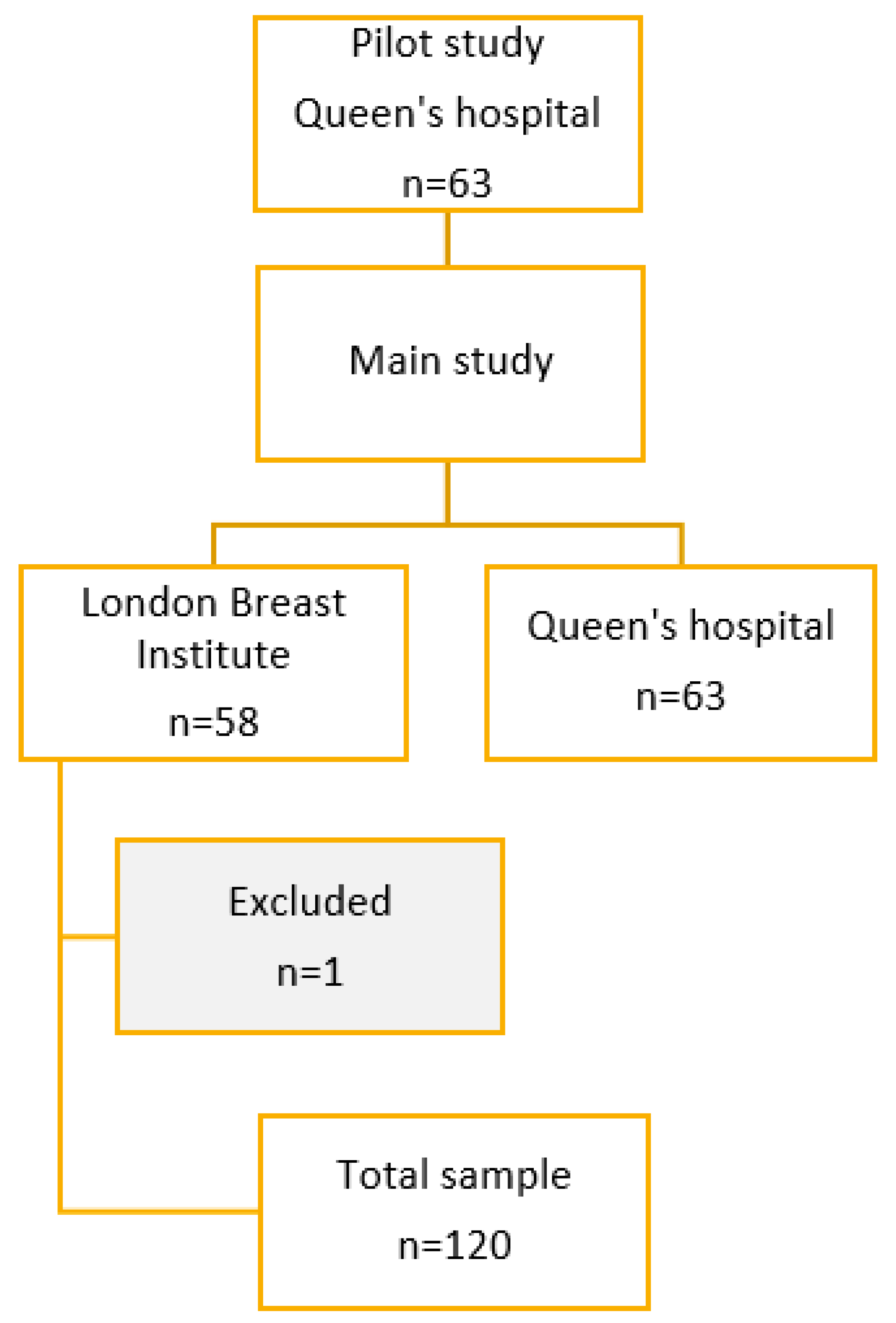
The questionnaire was initially piloted in 63 respondents from Queen’s Hospital, Burton, which were included in the final dataset post-minor revisions (
Figure 1). The optionality of the following demographics questions of age, gender and previous cancer diagnosis were removed.
A formal power calculation was not undertaken. Sample size (n = 120) was determined by pragmatic considerations of clinic attendance during the study period. Multiple-testing correction was not conducted due to the exploratory design of the study.
The hypothesis-generating survey assessed perceptions of AI use in breast care including knowledge of AI, comfort with AI-assisted imaging interpretation, comfort with AI-assisted triage, trust in AI findings, and concerns about AI in clinical care. Demographic data included age, gender, previous cancer diagnosis and familiarity with technology. Majority of questions were single-selection multiple choice questions with few multiple selection questions and few open-response questions. There was no time limit to complete the survey, with an anticipated completion time of 5 min. Patients under 18 years of age and over 85 years of age were excluded. Incomplete questions were excluded, with incomplete being defined as questions for which no response was given, treated as missing data. To address missing data, we used pairwise deletion, in which all available data was used in analyses and missing information was eliminated. This resulted in differing sample sizes across statistical evaluations. This method was selected to minimise the loss of information and to preserve statistical power.
Data were analysed using descriptive statistics, inferential statistics and Pearson’s Chi-square tests with Cramér’s V coefficient. Statistical significance was indicated by a
p-value less than 0.05. Strength of associations were indicated by effect sizes as follows: 0.1 (small); 0.3 (medium), 0.5 (large) at 1 degree of freedom (df) and 0.07 (small); 0.21 (medium), 0.35 (large) at 2 df [
22,
23]. Likert scale responses were condensed to meet Chi-square assumptions (neutral and “don’t know” responses excluded from acceptance vs. non-acceptance analyses), which may have reduced statistical sensitivity [
24]. Responses including very/fairly comfortable with AI use indicated acceptance of AI. Free-text responses were analysed using thematic analysis. Responses were independently coded by two reviewers (authors one and two), and themes were derived iteratively and reflexively through consensus discussion.
This study was reviewed and approved by the institutional board of the London Breast Institute. As the prospective questionnaire was conducted as part of an institutional service evaluation, formal approval from an external Research Ethics Committee was not required, in accordance with UK NHS Health Research Authority (HRA) guidance [
25]. Participation was anonymous and voluntary, and completion of the questionnaire was considered informed consent.
3. Results
3.1. Demographics
A total of 120 participants completed the survey, excluding one survey omitted due to age exclusion criteria. A total of 115 participants provided gender demographic data, with 103 female (89.6%) and 12 male (10.4%) (
Table S1). A total of 73.3% of the participants were patients (
n = 120). Most respondents were between 25 and 74 years of age (90.7%). Eighty-two percent of participants felt comfortable using technology (
Table S1).
Before participating in the survey, most respondents had heard about AI being used in healthcare settings (
Table S2). The majority of participants reported no knowledge of how AI may be used in breast clinics and minimal trust in AI findings. These results align with prior work demonstrating limited awareness as a barrier to adoption.
3.2. Perceptions About AI in Breast Imaging and Clinical Decision-Making
Among the survey population, half accepted AI-assisted mammogram or ultrasound interpretation alongside clinicians. This is consistent with international evidence demonstrating preference for combined AI–radiologist reading (
Table S3). Close to half (44.5%), accepted AI-assisted triage.
Among those that accepted AI-assisted screening (n = 58), 96.6% were comfortable with technology, whereas 2% were uncomfortable with technology. Acceptance (n = 58) was 74.1% in the 46 and over age group; meanwhile, 25.9% accepted in the below-46 age group. Acceptance (n = 59) was greater in participants without a previous breast cancer diagnosis (61%) than those with a diagnosis (25.4%).
Among those that accepted AI-assisted triage (n = 52), 92.3% were comfortable with technology, whereas 7.7% were uncomfortable with technology. Acceptance was 73.1% in the 46 and over age group; meanwhile, 26.9% accepted AI use in the below-46 age group. Acceptance was greater in participants without a previous breast cancer diagnosis (59.6%) than those with a diagnosis (30.8%).
Sixty-nine percent of participants would accept AI use in their future breast care (
Table S3). Among those that accepted (
n = 81), 60.5% were between ages 46 and 74, 56.8% had no previous diagnosis, and 86.4% were comfortable with technology.
Concerns were common, including fear of diagnostic mistakes (73.5%), AI replacing doctors (63.3%), and privacy concerns (39.3%) (
Table S4). This echoes qualitative findings from UK screening-eligible populations. Most participants (78%) reported that clinician confirmation of AI findings would increase comfort, reinforcing that acceptance is conditional on oversight. Participants also reported increased comfort knowing AI had been tested in large trials (42.4%) and if they had more information about how AI works (39.8%).
3.3. Statistical Analysis
Acceptance of AI screening was significantly associated with no previous breast cancer diagnosis (
p = 0.02) and technological comfort (
p < 0.001) but was not associated with age (
p = 0.36) (
Table 1). Comparably, acceptance of AI-assisted triage was significantly associated with technological comfort (
p = 0.008), yet independent of clinical history (
p = 0.32) and age (
p = 0.32) (
Table 2).
3.4. Main Qualitative Themes
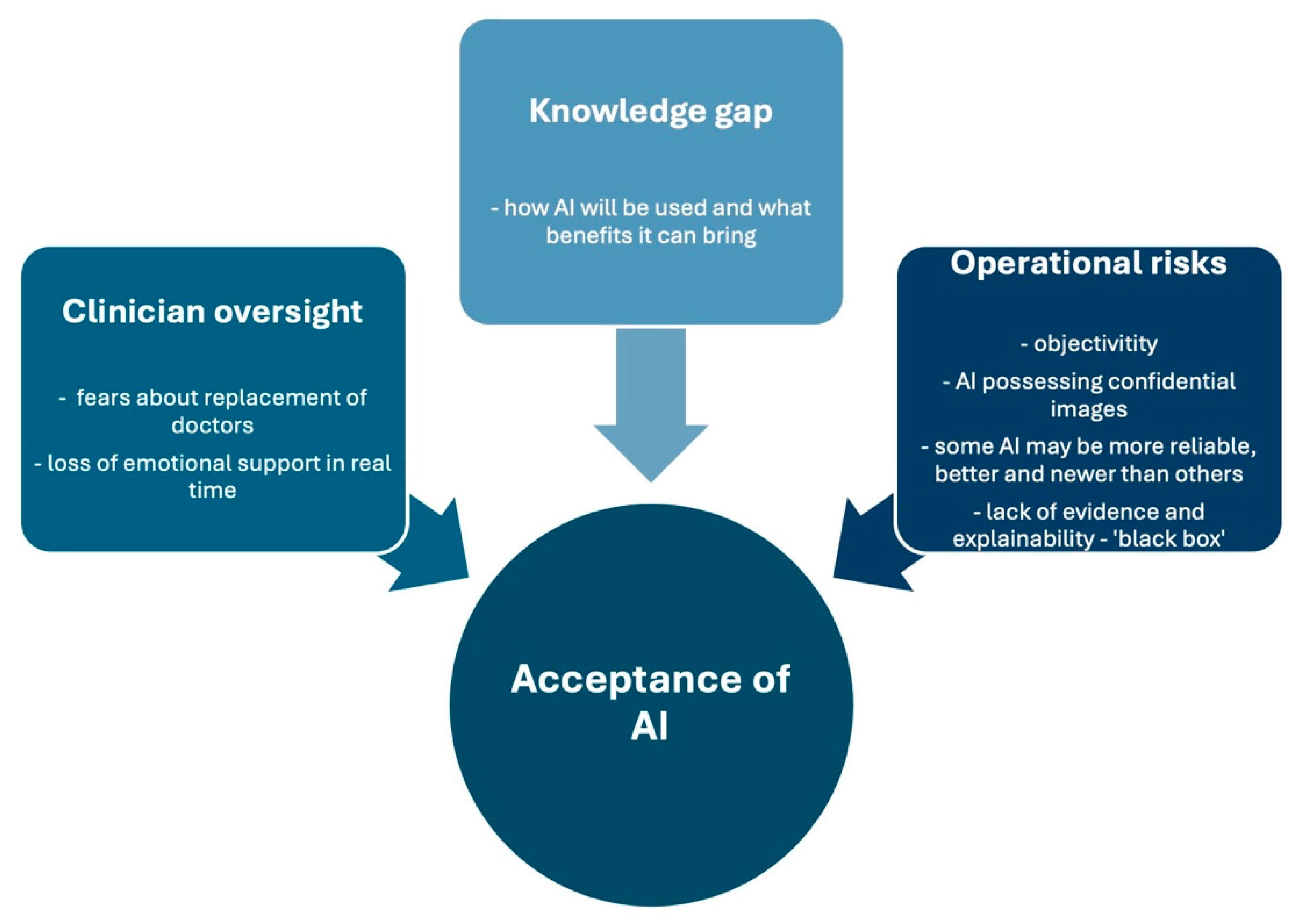
Three qualitative themes emerged: clinician oversight as indispensable, the knowledge gap driving uncertainty, and concerns about operational risks and accountability (
Figure 2). The following section presents the key qualitative findings including patient quotes.
There was significant consensus regarding the importance of doctor involvement in AI programmes, including screening and diagnosis. Participants consistently viewed AI as “a tool to optimise, rather than replace doctor assessment”. There was a perception that AI has a “lack of empathy, discernment and other human attributes.” This underscores the importance of the emotional care provided by clinician engagement. It also highlighted that attendance at breast clinics is proof that “human interaction is imperative to mental wellbeing.” The general sentiment was that human connection, alongside the ability to ask follow-up questions, cannot be provided by AI algorithms.
Our finding that 80% of participants lacked knowledge about AI use in breast clinics, combined with frequent responses of “don’t know”, suggests a critical knowledge gap. The knowledge disparity surrounding AI in breast imaging acts as a barrier to AI acceptance. How AI will be used, what roles it will fill and what benefits it may bring to the current system were noted. Participants expressed a lack of understanding as a cause for uncertainty and ambivalence. One respondent stated, “if I had more information and understood AI, I would have a different outlook, but I don’t know anything about it”. This indicates that education must precede implementation.
Concerns about the accuracy, reliability and accountability of AI were apparent, with participants communicating that AI can make “mistakes” and “errors” and that “all AI is not equal”. This is compounded by the perceived novelty of medical AI programs. There was a general sentiment that research into AI in breast imaging should be undertaken and disseminated. In addition, “cyber-attacks”, “confidentiality”, “objectivity”, “data security” and “data privacy” were among the concerns over operational risks of AI.
4. Discussion
This study provides UK-based evidence on patient and public perceptions of AI integration into breast imaging and clinical decision-making. Overall, receptivity towards AI was substantial, with most participants willing to accept AI in future breast care, half accepting AI-assisted breast imaging and 44.5% accepting AI-assisted triage. However, acceptance was conditional, with strong emphasis on clinician oversight. The strongest predictor of AI acceptance was technological comfort, consistent with research on the “AI divide” and the role of digital literacy in healthcare technology adoption [
26,
27]. The significant association between technological comfort and AI acceptance (
p < 0.001) suggests that general digital literacy programmes may indirectly improve receptivity to AI in healthcare, representing a potentially modifiable factor for increasing acceptance [
28].
Our findings align with international surveys reporting preference for AI as a second reader rather than an autonomous decision-maker, as seen in a 2026 study with 61% of patients opting for mixed AI–radiologist readings [
29]. Studies reported that AI adoption in breast imaging was more readily accepted than AI-assisted triage, which aligns with our findings [
30].
UK qualitative research similarly highlights concerns about errors, the importance of human reassurance and the requirement for further clinical trials [
31]. UK studies also found that women of screening age and above were more likely to have positive views about AI-assisted mammogram reading than younger women, as observed in our study with the majority between ages 46 and 74 [
32].
Age was not significantly associated with AI acceptance and thus was not a predictor in our sample. This may indicate that comfort with technology is more influential than chronological age or reflect sample homogeneity. Further research is required to ascertain whether digital literacy may predict acceptance of AI.
Lack of previous breast cancer diagnosis was significantly associated with AI acceptance yet minimally reported within the existing literature. Some studies had excluded women with current or previous breast cancer diagnoses altogether [
30]. This may imply that previous cancer diagnoses may increase apprehension surrounding AI in breast imaging. Future research should assess the relationship between previous cancer diagnosis and perceptions further.
Concerns about diagnostic errors and accountability relate to the black-box phenomenon, where AI mechanisms are not easily interpretable [
33]. Explainable AI frameworks may improve trust and promote acceptance by increasing transparency and validation [
34,
35,
36].
Overall, our research illustrates AI as a highly functional tool with the potential to significantly enhance breast screening. This study’s findings indicate a strong demand for educational initiatives that should focus on (1) explaining AI’s role as a supportive tool rather than a replacement for clinicians; (2) providing transparent information about validation studies and accuracy rates; and (3) addressing specific concerns about diagnostic errors through clear communication about oversight mechanisms. Recommendations for breast screening programmes include the introduction of these interventions, tailored separately for (1) patients and (2) clinicians, within NHS settings. Implementation strategies include targeted education for healthcare professionals, pre-screening patient–doctor discussions, and digital infographics or decision aids using the NHS application and website.
This study adds to the research about how AI can be introduced for women of different ages and with prior cancer diagnoses, as mentioned in the UK National Screening Committee (NSC) external review [
37]. Following evidence from the review, additional studies on the perceptions of medical students and clinicians are required to inform educational strategies and increase acceptance and future compliance with AI technologies in breast screening.
Limitations include modest sample size, selection bias (clinic attendees may differ from the general screening population), and reduced statistical power from Likert condensation [
38]. The absence of formal questionnaire validation may have reduced the reproducibility of this study and the robustness of the research outcomes. Pairwise deletion also presents limitations including inconsistent sample sizes, reducing external validity. Additionally, we did not adjust for multiple comparisons which may have increased the probability of Type I errors. Nearly 82% of participants were comfortable with technology, possibly biasing results toward greater acceptance of AI-assisted diagnosis and triage. The findings may not apply to those with lower digital literacy. Future studies should use surveys in different languages and incorporate broader demographics, including race and education level, to avoid reinforcing inequities [
39,
40]. Finally, with AI being a rapidly evolving field, the findings reflect the current context and time in which this study was conducted and offer a preliminary insight into the subject matter.
5. Conclusions
We found that while there is meaningful receptivity to AI in breast care, acceptance is not uniform and is moderately influenced by prior clinical experience and familiarity with technology. Limited knowledge remains a key barrier to adoption. Addressing patient and public concerns through transparent communication and patient-centred implementation strategies is critical for effective integration of AI into breast clinics.
Supplementary Materials
The following supporting information can be downloaded at:
https://www.mdpi.com/article/10.3390/diagnostics16091376/s1, Table S1: Participant demographics and baseline characteristics; Table S2: Participant knowledge of AI in any healthcare setting, in breast clinics, and participant trust in AI findings; Table S3: Participant comfort with AI use in breast care; Table S4: Participant concerns and facilitators for AI use in healthcare.
Author Contributions
A.H.: design, analysis, interpretation of data, writing—original and revised drafts, editing; M.R.: design, investigation, data collection, analysis and interpretation of data; K.M.: project administration, conceptualisation, design, investigation, supervision, writing—review and editing; A.R.C.: project administration, design, investigation, data collection, supervision, writing—review and editing. All authors have read and agreed to the published version of the manuscript.
Funding
This research received no external funding.
Institutional Review Board Statement
This study was reviewed and approved by the institutional board of the London Breast Institute (approval code UHDB545, approval date 14 August 2025). As the prospective questionnaire was conducted as part of an institutional service evaluation, formal approval from an external Research Ethics Committee was not required, in accordance with UK NHS Health Research Authority (HRA) guidance.
Informed Consent Statement
Informed consent was obtained from all subjects involved in the study. Participation was anonymous and voluntary, and completion of the questionnaire was considered informed consent. Patients were not directly involved in questionnaire design. Future work should incorporate patient co-development.
Data Availability Statement
The data presented in this study are available upon reasonable request from the corresponding author.
Conflicts of Interest
The authors declare no conflicts of interest.
Abbreviations
The following abbreviations are used in this manuscript:
| AI | Artificial Intelligence |
| Df | Degrees of Freedom |
| HRA | Health Research Authority |
| IBCs | Interval Breast Cancers |
| NSC | National Screening Committee |
| UK | United Kingdom |
References
- Siegel, R.L.; Giaquinto, A.N.; Jemal, A. Cancer statistics, 2024. CA Cancer J. Clin. 2024, 74, 12–49. [Google Scholar] [CrossRef]
- Kim, J.; Harper, A.; McCormack, V.; Sung, H.; Houssami, N.; Morgan, E.; Mutebi, M.; Garvey, G.; Soerjomataram, I.; Fidler-Benaoudia, M.M. Global patterns and trends in breast cancer incidence and mortality across 185 countries. Nat. Med. 2025, 31, 1154–1162. [Google Scholar] [CrossRef]
- Cancer Research UK. Breast Cancer Statistics. 2025. Available online: https://www.cancerresearchuk.org/health-professional/cancer-statistics/statistics-by-cancer-type/breast-cancer (accessed on 1 January 2026).
- Johns, L.; Coleman, D.; Swerdlow, A.; Moss, S.M. Effect of population breast screening on breast cancer mortality up to 2005 in England and Wales: An individual-level cohort study. Br. J. Cancer 2017, 116, 246–252. [Google Scholar] [CrossRef] [PubMed]
- NHS England. Your Guide to NHS Breast Screening. 2025. Available online: https://www.gov.uk/government/publications/breast-screening-helping-women-decide/nhs-breast-screening-helping-you-decide (accessed on 1 January 2026).
- Gøtzsche, P.C.; Jørgensen, K.J. Screening for breast cancer with mammography. Cochrane Database Syst. Rev. 2013, 6, CD001877. [Google Scholar] [CrossRef]
- Jeffers, S.; Pilnick, A.; Armstrong, N. Decisions to decline breast screening and/or breast cancer treatment based on harms of overdiagnosis and overtreatment: A qualitative study. BMJ Open 2024, 14, e089155. [Google Scholar] [CrossRef] [PubMed]
- Taylor, C.R.; Monga, N.; Johnson, C.; Hawley, J.R.; Patel, M. Artificial intelligence applications in breast imaging: Current status and future directions. Diagnostics 2023, 13, 2041. [Google Scholar] [CrossRef] [PubMed]
- Ho, T.H.; Bissell, M.C.S.; Lee, C.I.; Lee, J.M.; Sprague, B.L.; Tosteson, A.N.; Wernli, K.J.; Henderson, L.M.; Kerlikowske, K.; Miglioretti, D.L. Prioritizing screening mammograms for immediate interpretation and diagnostic evaluation on the basis of risk for recall. J. Am. Coll. Radiol. 2023, 20, 299–310. [Google Scholar] [CrossRef]
- Marinovich, M.L.; Wylie, E.; Lotter, W.; Lund, H.; Waddell, A.; Madeley, C.; Pereira, G.; Houssami, N. Artificial intelligence (AI) for breast cancer screening: BreastScreen population-based cohort study of cancer detection. EBioMedicine 2023, 90, 104498. [Google Scholar] [CrossRef]
- Goh, R.S.J.; Chong, B.; Yeo, S.; Neo, S.Y.; Ng, Q.X.; Goh, S.S.N. Current strategies to reducing interval breast cancers: A systematic review. Breast Cancer Targets Ther. 2025, 17, 531–544. [Google Scholar] [CrossRef]
- Chia, J.L.L.; He, G.S.; Ngiam, K.Y.; Hartman, M.; Ng, Q.X.; Goh, S.S.N. Harnessing artificial intelligence to enhance global breast cancer care: A scoping review of applications, outcomes, and challenges. Cancers 2025, 17, 197. [Google Scholar] [CrossRef]
- Dur Karasayar, A.H.; Kulaç, İ.; Kapucuoğlu, N. Advances in breast cancer care: The role of artificial intelligence and digital pathology in precision medicine. Eur. J. Breast Health 2025, 21, 93–100. [Google Scholar] [CrossRef]
- Chen, Y.; James, J.J.; Michalopoulou, E.; Darker, I.T.; Jenkins, J. Performance of radiologists and radiographers in double reading mammograms: The UK National Health Service Breast Screening Program. Radiology 2023, 306, 102–109. [Google Scholar] [CrossRef]
- Kalidindi, S.; Gandhi, S. Workforce crisis in radiology in the UK and the strategies to deal with it: Is artificial intelligence the saviour? Cureus 2023, 15, e43866. [Google Scholar] [CrossRef] [PubMed]
- Achour, N.; Zapata, T.; Saleh, Y.; Pierscionek, B.; Azzopardi-Muscat, N.; Novillo-Ortiz, D.; Morgan, C.; Chaouali, M. The role of AI in mitigating the impact of radiologist shortages: A systematised review. Health Technol. 2025, 15, 489–501. [Google Scholar] [CrossRef] [PubMed]
- van Winkel, S.L.; Peters, J.; Janssen, N.; Kroes, J.; A Loehrer, E.; Gommers, J.; Sechopoulos, I.; de Munck, L.; Teuwen, J.; Broeders, M.; et al. AI as an independent second reader in detection of clinically relevant breast cancers within a population-based screening programme in the Netherlands: A retrospective cohort study. Lancet Digit. Health 2025, 7, e100882. [Google Scholar] [CrossRef]
- Pesapane, F.; Giambersio, E.; Capetti, B.; Monzani, D.; Grasso, R.; Nicosia, L.; Rotili, A.; Sorce, A.; Meneghetti, L.; Carriero, S.; et al. Patients’ perceptions and attitudes to the use of artificial intelligence in breast cancer diagnosis: A narrative review. Life 2024, 14, 454. [Google Scholar] [CrossRef]
- Dembrower, K.; Crippa, A.; Colon, E.; Eklund, M.; Strand, F. Artificial intelligence for breast cancer detection in screening mammography in Sweden: A prospective population-based paired-reader study. Lancet Digit. Health 2023, 5, e703–e711. [Google Scholar] [CrossRef]
- Pesapane, F.; Rotili, A.; Valconi, E.; Agazzi, G.M.; Montesano, M.; Penco, S.; Nicosia, L.; Bozzini, A.; Meneghetti, L.; Latronico, A.; et al. Women’s perceptions and attitudes to the use of AI in breast cancer screening: A survey in a cancer referral centre. Br. J. Radiol. 2023, 96, 20220569. [Google Scholar] [CrossRef]
- Woode, M.E.; De Silva Perera, U.; Degeling, C.; Aquino, Y.S.J.; Houssami, N.; Carter, S.M.; Chen, G. References for the use of artificial intelligence for breast cancer screening in Australia: A discrete choice experiment. Patient 2025, 18, 495–510. [Google Scholar] [CrossRef]
- Dong, K.L. Alternatives to P value: Confidence interval and effect size. Korean J. Anesthesiol. 2016, 69, 555–562. [Google Scholar] [CrossRef] [PubMed]
- Kim, H.-Y. Statistical notes for clinical researchers: Chi-squared test and Fisher’s exact test. Restor. Dent. Endod. 2017, 42, 152–155. [Google Scholar] [CrossRef] [PubMed]
- Contractor, S.; Fox, R. An investigation of the relationship between the number of response categories and scale sensitivity. J. Target. Meas. Anal. Mark. 2011, 19, 23–35. [Google Scholar] [CrossRef][Green Version]
- NHS Health Research Authority. What Approvals and Decisions Do I Need. Available online: https://www.hra.nhs.uk/approvals-amendments/what-approvals-do-i-need/ (accessed on 22 January 2026).
- Wang, C.; Boerman, S.C.; Kroon, A.C.; Möller, J.; de Vreese, C.H. The artificial intelligence divide: Who is the most vulnerable? New Media Soc. 2024, 27, 3867–3889. [Google Scholar] [CrossRef]
- Osonuga, A.; Osonuga, A.A.; Fidelis, S.C.; Osonuga, G.C.; Juckes, J.; Olawade, D.B. Bridging the digital divide: Artificial intelligence as a catalyst for health equity in primary care settings. Int. J. Med. Inform. 2022, 204, 106051. [Google Scholar] [CrossRef]
- van Kessel, R.; Wong, B.L.H.; Clemens, T.; Brand, H. Digital health literacy as a super determinant of health: More than simply the sum of its parts. Internet Interv. 2022, 27, 100500. [Google Scholar] [CrossRef]
- Singh, S.; Crean, R.; O’Driscoll, J.; Cahir, C.; Briody, H.; Bambrick, M.; NiMhuircheartaigh, N.; Hambly, N.; Duke, D.; Mullooly, M.; et al. Patient perceptions and attitudes towards the use of artificial intelligence in the symptomatic breast unit. Eur. Radiol. 2026. [Google Scholar] [CrossRef]
- Gatting, L.; Jones, C.K.; Jamshidi, B.; Kehagia, A.A.; Waller, J. Acceptability of using artificial intelligence in the NHS Breast Screening Programme: A randomized online survey. Mayo Clin. Proc. Digit. Health 2025, 4, 100329. [Google Scholar] [CrossRef]
- Gatting, L.; Ahmed, S.; Meccheri, P.; Newlands, R.; Kehagia, A.A.; Waller, J. Acceptability of artificial intelligence in breast screening: Focus groups with the screening-eligible population in England. BMJ Public Health 2024, 2, e000892. [Google Scholar] [CrossRef]
- Lennox-Chhugani, N.; Chen, Y.; Pearson, V.; Trzcinski, B.; James, J. Women’s attitudes to the use of AI image readers: A case study from a national breast screening programme. BMJ Health Care Inform. 2021, 28, e100293. [Google Scholar] [CrossRef]
- Prince, S.; Savulescu, J. When is black-box AI justifiable to use in healthcare? Big Data Soc. 2025, 12, 20539517251386037. [Google Scholar] [CrossRef]
- Goh, S.; Goh, R.S.J.; Chong, B.; Ng, Q.X.; Koh, G.C.H.; Ngiam, K.Y.; Hartman, M. Challenges in implementing artificial intelligence in breast cancer screening programs: Systematic review and framework for safe adoption. J. Med. Internet Res. 2025, 27, e62941. [Google Scholar] [CrossRef] [PubMed]
- Shifa, N.; Saleh, M.; Akbari, Y.; Al Maadeed, S. A review of explainable AI techniques and their evaluation in mammography for breast cancer screening. Clin. Imaging 2025, 123, 110492. [Google Scholar] [CrossRef]
- Zou, Y.; Miao, P. Explainable AI-enabled hybrid deep learning architecture for breast cancer detection. Front. Immunol. 2025, 16, 1658741. [Google Scholar] [CrossRef]
- UK National Screening Committee. Use of Artificial Intelligence for Mammographic Image Analysis in Breast Cancer Screening: Rapid Review and Evidence Map; National Screening Committee: London, UK, 2022.
- Andrade, C. Sample size and its importance in research. Indian J. Psychol. Med. 2020, 42, 102–103. [Google Scholar] [CrossRef] [PubMed]
- Ameri, S.; Mehran, N.; Margolies, L.R. Patient perception of artificial intelligence in breast imaging: A pilot survey study. Clin. Imaging 2025, 128, 110649. [Google Scholar] [CrossRef]
- Ozcan, B.B.; Dogan, B.E.; Xi, Y.; Knippa, E.E. Patient perception of artificial intelligence use in interpretation of screening mammograms: A survey study. Radiol. Imaging Cancer 2025, 7, e240290. [Google Scholar] [CrossRef] [PubMed]
| Disclaimer/Publisher’s Note: The statements, opinions and data contained in all publications are solely those of the individual author(s) and contributor(s) and not of MDPI and/or the editor(s). MDPI and/or the editor(s) disclaim responsibility for any injury to people or property resulting from any ideas, methods, instructions or products referred to in the content. |