Pregnancy and Peripartum Multidisciplinary Management in Wolfram Syndrome Type 1: A Case Report

Abstract
1. Introduction
2. Case Presentation
2.1. Patient Information and Medical History
2.2. Genetic Testing
2.3. Reproductive Planning and Pregnancy Course
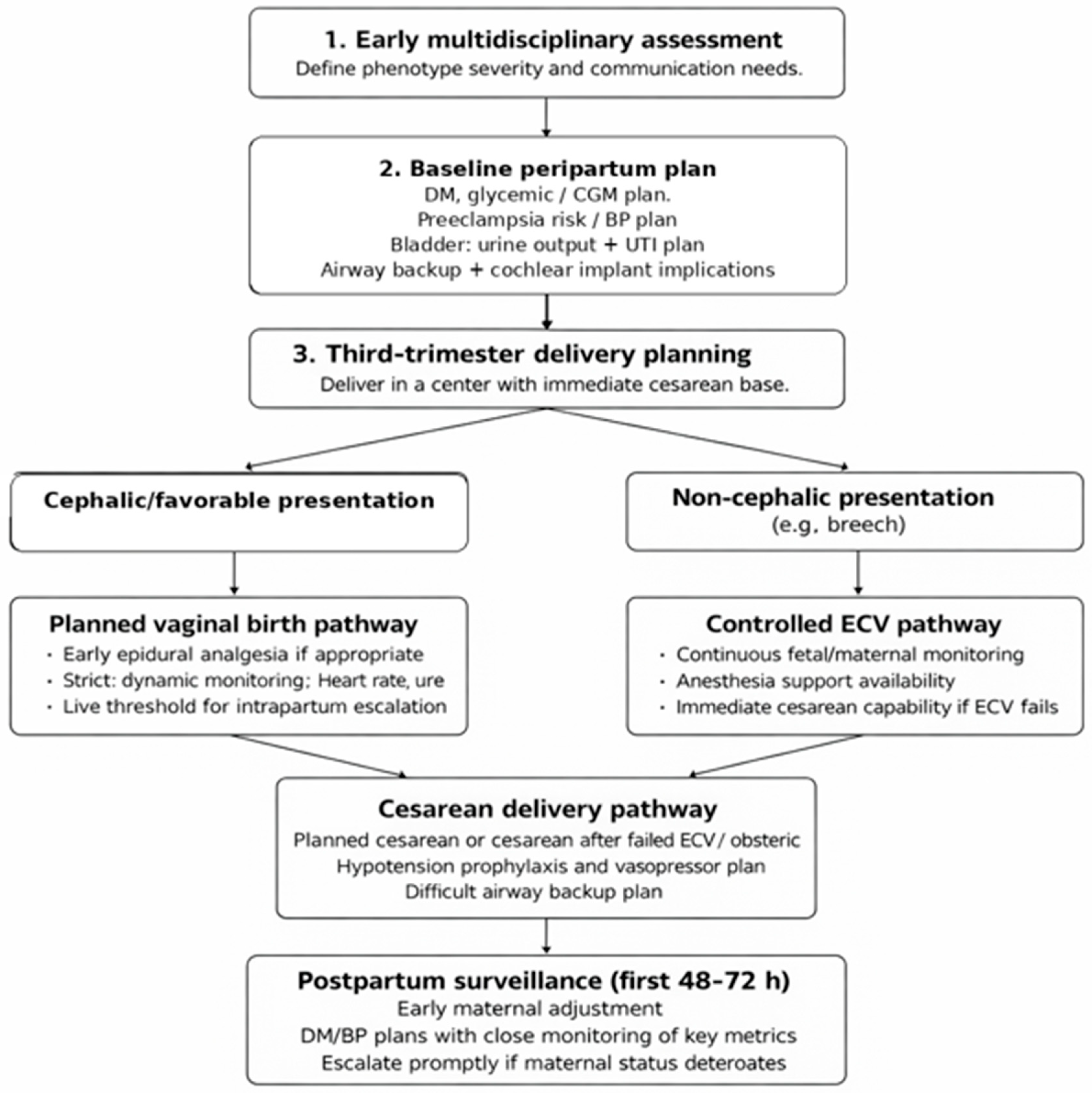
2.4. Preanesthetic Assessment and Peripartum Planning
2.5. Delivery/Cesarean Section and Anesthetic Management: Intraoperative Course
2.6. Postpartum and Follow-Up
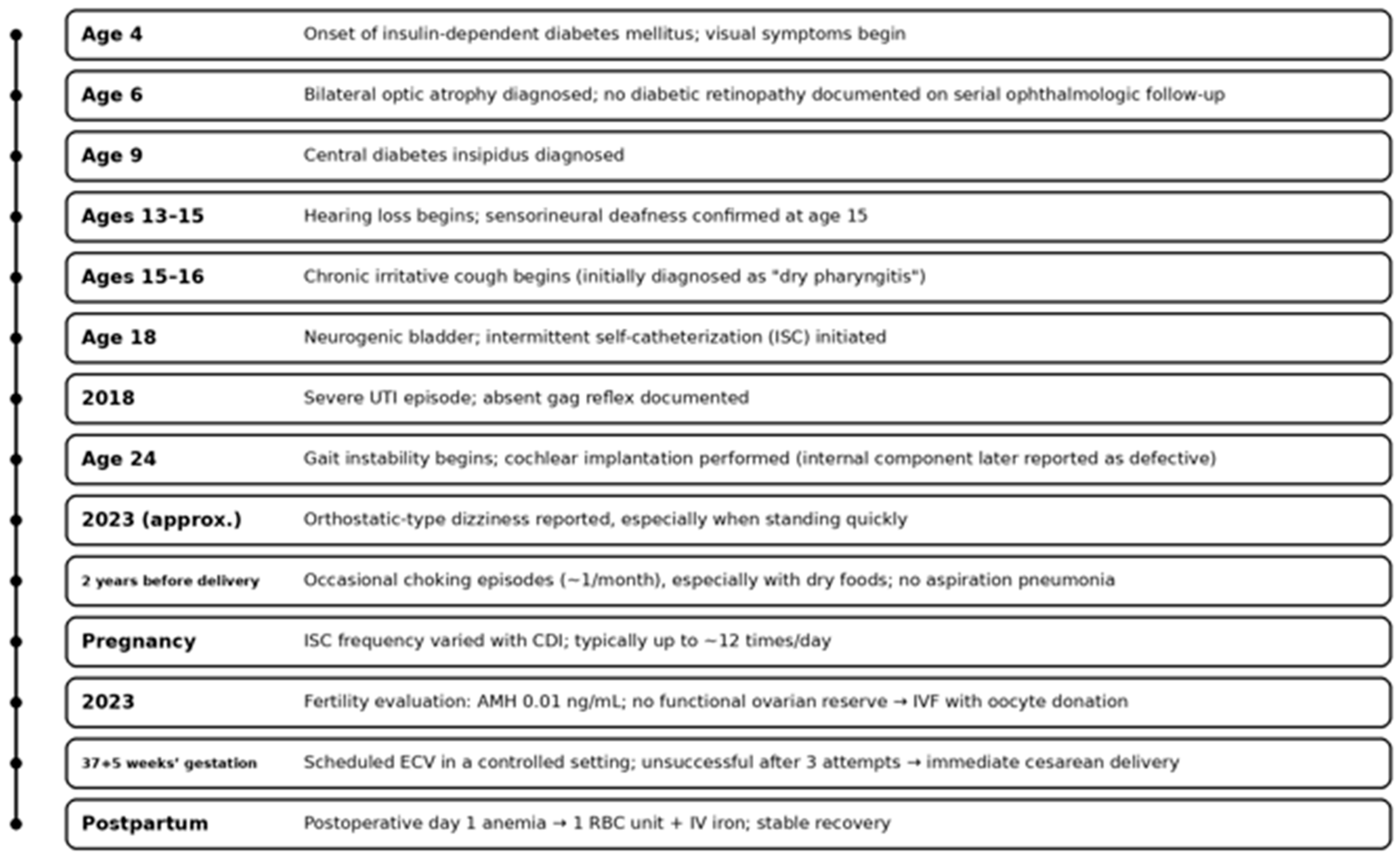
2.7. Case Timeline
3. Discussion
4. Conclusions
Supplementary Materials
Author Contributions
Funding
Institutional Review Board Statement
Informed Consent Statement
Data Availability Statement
Acknowledgments
Conflicts of Interest
References
- Barrett, T.; Tranebjærg, L.; Gupta, R.; McCarthy, L.; Rendtorff, N.D.; Williams, D.; Wright, B.; Dias, R. WFS1 Spectrum Disorder. In GeneReviews® [Internet]; Adam, M.P., Bick, S., Mirzaa, G.M., Pagon, R.A., Wallace, S.E., Amemiya, A., Eds.; University of Washington, Seattle: Seattle, WA, USA, 1993–2026; 24 February 2009 [Updated 1 December 2022]. [Google Scholar]
- Urano, F. Wolfram syndrome: Diagnosis, management, and treatment. Curr. Diab Rep. 2016, 16, 6. [Google Scholar] [CrossRef]
- Lee, E.M.; Verma, M.; Palaniappan, N.; Pope, E.M.; Lee, S.; Blacher, L.; Neerumalla, P.; An, W.; Campbell, T.; Brown, C.; et al. Genotype and clinical characteristics of patients with Wolfram syndrome and WFS1-related disorders. Front. Genet. 2023, 14, 1198171. [Google Scholar] [CrossRef]
- Rigoli, L.; Di Bella, C. Genetic and clinical aspects of Wolfram syndrome 1, a severe neurodegenerative disease. Pediatr. Res. 2018, 83, 921–929. [Google Scholar] [CrossRef]
- de Muijnck, C.; Ten Brink, J.B.; Bergen, A.A.; Boon, C.J.F.; van Genderen, M.M. Delineating Wolfram-like syndrome: A systematic review and discussion of the WFS1-associated disease spectrum. Surv. Ophthalmol. 2023, 68, 641–654. [Google Scholar] [CrossRef]
- Frontino, G.; Delvecchio, M.; Prudente, S.; Sordi, V.D.; Barboni, P.; Di Giamberardino, A.; Rutigliano, A.; Pellegrini, S.; Caretto, A.; Cascavilla, M.L.; et al. SID/SIEDP expert consensus on optimizing clinical strategies for early detection and management of wolfram syndrome. J. Endocrinol. Investig. 2025, 48, 507–525. [Google Scholar] [CrossRef]
- La Valle, A.; Piccolo, G.; Maghnie, M.; d’Annunzio, G. Urinary tract involvement in Wolfram syndrome: A narrative review. Int. J. Environ. Res. Public Health 2021, 18, 11994. [Google Scholar] [CrossRef]
- Wragg, R.; Dias, R.P.; Barrett, T.; McCarthy, L. Bladder dysfunction in Wolfram syndrome is highly prevalent and progresses to megacystis. J. Pediatr. Surg. 2018, 53, 321–325. [Google Scholar] [CrossRef] [PubMed]
- Caretto, A.; Mugnozza, F.S.; Valsecchi, F.; Pedone, E.; Pozzoni, M.; Rosa, S.; Laurenzi, A.; Frontino, G.; Chimienti, R.; Piemonti, L.; et al. Diabetes mellitus and pregnancy in Wolfram syndrome type 1: A case report with review of clinical and pathophysiological aspects. Front. Med. 2025, 12, 1639884. [Google Scholar] [CrossRef] [PubMed]
- Zhang, K.; Cui, X.; Long, Y. Clinical management and obstetric outcome in WFS1 Wolfram syndrome spectrum disorder: A case report and literature review. Taiwan. J. Obstet. Gynecol. 2023, 62, 440–443. [Google Scholar] [CrossRef] [PubMed]
- Esteban-Bueno, G.; Fernández-Martínez, J.L. Gonadal dysfunction in Wolfram syndrome: A prospective study. Diagnostics 2025, 15, 1594. [Google Scholar] [CrossRef]
- Toppings, N.B.; McMillan, J.M.; Au, P.Y.B.; Suchowersky, O.; Donovan, L.E. Wolfram syndrome: A case report and review of clinical manifestations, genetics, pathophysiology, and potential therapies. Case Rep. Endocrinol. 2018, 2018, 9412676. [Google Scholar] [CrossRef]
- American College of Obstetricians and Gynecologists. External cephalic version: ACOG Practice Bulletin No. 221. Obstet. Gynecol. 2020, 135, e203–e212. [Google Scholar] [CrossRef]
- American Society of Anesthesiologists. Statement on Anesthesia Management and Support for External Cephalic Version. Updated 15 October 2025. Available online: https://www.asahq.org/standards-and-practice-parameters/statement-on-anesthesia-management-and-support-for-external-cephalic-version (accessed on 3 March 2026).
- Cass, N.D.; Lindquist, N.R.; Bennett, M.L.; Haynes, D.S. Monopolar electrosurgery with cochlear implants. Laryngoscope 2023, 133, 933–937. [Google Scholar] [CrossRef]
- American College of Obstetricians and Gynecologists’ Committee on Practice Bulletins—Obstetrics. Thromboembolism in pregnancy: ACOG Practice Bulletin No. 196. Obstet. Gynecol. 2018, 132, e1–e17. [Google Scholar] [CrossRef] [PubMed]
- Kinsella, S.M.; Carvalho, B.; Dyer, R.A.; Fernando, R.; McDonnell, N.; Mercier, F.J.; Palanisamy, A.; Sia, A.T.H.; Van de Velde, M.; Vercueil, A.; et al. International consensus statement on the management of hypotension with vasopressors during caesarean section under spinal anaesthesia. Anaesthesia 2018, 73, 71–92. [Google Scholar] [CrossRef] [PubMed]
- Baldeweg, S.E.; Ball, S.; Brooke, A.; Gleeson, H.K.; Levy, M.J.; Prentice, M.; Wass, J.; Society for Endocrinology Clinical Committee. Society for Endocrinology Clinical Guidance: Inpatient management of cranial diabetes insipidus. Endocr. Connect. 2018, 7, G8–G11. [Google Scholar] [CrossRef]
- American College of Obstetricians and Gynecologists. Pregestational diabetes mellitus: ACOG Practice Bulletin No. 201. Obstet. Gynecol. 2018, 132, e228–e248. [Google Scholar] [CrossRef] [PubMed]
- Wyckoff, J.A.; Lapolla, A.; Asias-Dinh, B.D.; Barbour, L.A.; Brown, F.M.; Catalano, P.M.; Corcoy, R.; Di Renzo, G.C.; Drobycki, N.; Kautzky-Willer, A.; et al. Preexisting diabetes and pregnancy: An Endocrine Society and European Society of Endocrinology joint clinical practice guideline. Eur. J. Endocrinol. 2025, 193, G1–G48. [Google Scholar] [CrossRef]
- American Diabetes Association Professional Practice Committee. 15. Management of diabetes in pregnancy: Standards of Care in Diabetes—2025. Diabetes Care 2025, 48, S306–S320. [Google Scholar] [CrossRef]
- Esteban-Bueno, G.; Botella, L.M.; Fernández-Martínez, J.L. Phenotype correlations of neurological manifestations in Wolfram syndrome: Predictive modeling in a Spanish cohort. Diagnostics 2025, 15, 3213. [Google Scholar] [CrossRef]
- American Society of Anesthesiologists Task Force on Obstetric Anesthesia and the Society for Obstetric Anesthesia and Perinatology. Practice guidelines for obstetric anesthesia: An updated report. Anesthesiology 2016, 124, 270–300. [Google Scholar] [CrossRef]
- Royal College of Obstetricians and Gynaecologists. Reducing the Risk of Thrombosis and Embolism During Pregnancy and the Puerperium (Green-Top Guideline No. 37a). 3rd ed. 2015; Amended 2023. Available online: https://www.rcog.org.uk/media/m4mbpjwi/gtg-no37a-2015_amended-2023.pdf (accessed on 3 March 2026).



| Area | Items to Assess | Practical Considerations |
|---|---|---|
| Endocrine assessment | Diabetes mellitus and central diabetes insipidus (CDI) | Protocolized intrapartum and postpartum glycemic control coordinated with Endocrinology; minimize preoperative fasting; adjust fluids and desmopressin according to fluid balance. |
| Fluid balance | Risk of electrolyte disturbances | Urinary catheterization with hourly urine output; close monitoring of hydration status and urine volume. |
| Urologic involvement | Neurogenic bladder, intermittent self-catheterization, recurrent UTI | UTI prevention; strict urine output monitoring; coordinate with Urology when there is relevant history or when complications arise. |
| Neurologic/autonomic assessment | Progressive neurologic involvement, possible dysautonomia | Assess orthostatic symptoms and hemodynamic tolerance; anticipate possible variability in the stress response during labor and surgery. |
| Anesthesia plan | Airway and anesthetic technique | Prefer titratable neuraxial techniques; identify potential difficult airway early; establish a backup plan if general anesthesia is required. |
| Intraoperative monitoring | Hemodynamic and respiratory stability | Actively prevent neuraxial hypotension; monitor respiration during oxygen administration; maintain continuous vital sign surveillance. |
| Implantable devices | Cochlear implant or other devices | Prefer bipolar electrosurgery; if monopolar electrosurgery is required, follow manufacturer and institutional precautions (place the return pad away from the implant and minimize current flow near the head and neck). |
| Communication and support | Severe sensory impairment (deafblindness) | Use an adapted communication plan; provide anticipatory guidance; facilitate partner presence to support communication and reduce anxiety. |
| Postpartum | Thromboembolic and metabolic risk | Risk-based VTE prophylaxis; continued glucose and fluid balance monitoring during the puerperium; multidisciplinary follow-up. |
| Domain | Key Risk/Issue in WS1 | Minimum Monitoring Set | Recommended Actions | Lead Team(s) and Timing |
|---|---|---|---|---|
| Obstetrics/Delivery planning | Breech presentation; need for controlled decision-making; limited WS1 pregnancy evidence. | Maternal–fetal monitoring; ultrasound confirmation of presentation. | Plan ECV in a setting with immediate access to cesarean delivery; pre-briefed contingency plan; shared decision-making. | Obstetrics, Anesthesiology Late third trimester; day of ECV/delivery. |
| Pregestational diabetes mellitus | Glycemic instability during fasting/labor/surgery; postpartum insulin requirement changes. | CGM trends + capillary confirmation per protocol; ketones if clinically indicated. | Standardized intrapartum/perioperative insulin–dextrose protocol; avoid prolonged fasting; prompt treatment of hypo-/hyperglycemia; early postpartum dose adjustment. | Endocrinology, Anesthesiology, Obstetrics, Nursing Admission; intrapartum/intraop; first 24–72 h postpartum. |
| Central diabetes insipidus (CDI) | Dysnatremia risk; dehydration or water intoxication; high urine output confounds fluid balance. | Strict input/output; hourly urine output; clinical volume status; serum sodium/osmolality per protocol. | Individualized desmopressin plan; avoid unnecessary free-water overload; maintain euvolemia; proactive correction strategy for hypo-/hypernatremia; minimize fasting. | Endocrinology, Anesthesiology, Nursing Admission; periop; early postpartum. |
| Urology (neurogenic bladder) | Retention/high residuals; history of severe UTI (2018); complicates CDI/fluid management. | Hourly urine output; urine appearance; temperature/symptoms; urinalysis/culture if symptomatic. | Foley catheter perioperatively with strict output recording; aseptic technique; plan for catheter removal and/or resumption of intermittent self-catheterization (frequency variable in pregnancy, typically up to ~12/day); evaluate for UTI if symptomatic. | Obstetrics, Nursing; Urology as needed Admission; intraop; postpartum. |
| Neurology/autonomic features | Orthostatic symptoms; possible autonomic dysfunction; variable hemodynamic response. | Blood pressure/heart rate trends; symptoms; vigilance after neuraxial anesthesia. | Left uterine displacement; avoid abrupt position changes; vasopressor readiness; individualized second-stage management if reduced expulsive effort. | Anesthesiology, Obstetrics; Neurology as needed Intrapartum/intraop; immediate postpartum. |
| Bulbar symptoms/aspiration risk | Choking history; weak cough; aspiration risk if general anesthesia required. | Respiratory rate, SpO2; capnography when oxygen is administered; airway reflex history. | Prefer neuraxial techniques; if general anesthesia is required, use aspiration precautions and fully awake extubation; postoperative respiratory observation. | Anesthesiology, Obstetrics, Nursing Preop planning; intraop; PACU. |
| Airway management | Potential difficult airway (pregnancy-related changes and craniofacial features); high risk if general anesthesia is required. | Standard airway assessment; equipment checks. | Difficult-airway cart and backup plan available; experienced staff present; avoid general anesthesia when feasible. | Anesthesiology Preop; intraop. |
| Neuromuscular blocking agents (if general anesthesia) | Unpredictable sensitivity/prolonged blockade possible in neurodegenerative context. | Neuromuscular monitoring (train-of-four) if paralytics are used. | Minimize/avoid neuromuscular blocking agents when possible; if required, titrate with train-of-four monitoring; consider avoiding succinylcholine; ensure full reversal and safe extubation criteria. | Anesthesiology Intraop. |
| Hemodynamic management (neuraxial anesthesia) | Neuraxial hypotension affecting uteroplacental perfusion. | Frequent noninvasive blood pressure measurements; symptoms; fetal monitoring. | Prophylaxis for neuraxial hypotension (left tilt, fluid co-load); vasopressor per protocol; titratable technique (e.g., CSE + epidural top-ups). | Anesthesiology, Obstetrics During neuraxial; intraop. |
| Cochlear implant/electrosurgery | Potential device interference/damage; communication limitations. | Device presence documented; OR checklist. | Prefer bipolar electrosurgery; if monopolar electrosurgery is required, follow manufacturer and institutional precautions. | Obstetrics (surgery), OR Nursing, Anesthesiology Intraop. |
| Communication and sensory impairment (deafblindness) | Miscommunication → anxiety and reduced cooperation; perioperative distress. | Confirm preferred communication method; reassess comfort/anxiety. | Pre-brief the patient and partner; allow partner presence when feasible; use agreed communication aids; plan proactive anxiolysis. | Obstetrics, Anesthesiology, Nursing Preop; intraop; postpartum. |
| Thromboprophylaxis | Increased VTE risk (cesarean + reduced mobility/complex comorbidity). | Clinical VTE risk assessment; bleeding monitoring. | Mechanical prophylaxis periop; pharmacologic prophylaxis postpartum per institutional protocol. | Obstetrics, Anesthesiology, Nursing Admission/intraop; postpartum. |
| Postpartum surveillance | Metabolic shifts; bleeding/anemia; urinary management; pain control. | Clinical bleeding/uterine tone; complete blood count, if indicated; glucose trends; urine output; pain scores. | Early detection and treatment of anemia; continue endocrine protocols; transition plan for bladder management; multimodal analgesia and early mobilization. | Obstetrics, Endocrinology, Nursing Recovery unit and ward; first 48–72 h. |
Disclaimer/Publisher’s Note: The statements, opinions and data contained in all publications are solely those of the individual author(s) and contributor(s) and not of MDPI and/or the editor(s). MDPI and/or the editor(s) disclaim responsibility for any injury to people or property resulting from any ideas, methods, instructions or products referred to in the content. |
© 2026 by the authors. Licensee MDPI, Basel, Switzerland. This article is an open access article distributed under the terms and conditions of the Creative Commons Attribution (CC BY) license.
Share and Cite
Esteban-Bueno, G.; Serrano Rodríguez, M.L. Pregnancy and Peripartum Multidisciplinary Management in Wolfram Syndrome Type 1: A Case Report. Diagnostics 2026, 16, 1117. https://doi.org/10.3390/diagnostics16081117
Esteban-Bueno G, Serrano Rodríguez ML. Pregnancy and Peripartum Multidisciplinary Management in Wolfram Syndrome Type 1: A Case Report. Diagnostics. 2026; 16(8):1117. https://doi.org/10.3390/diagnostics16081117
Chicago/Turabian StyleEsteban-Bueno, Gema, and María Luz Serrano Rodríguez. 2026. "Pregnancy and Peripartum Multidisciplinary Management in Wolfram Syndrome Type 1: A Case Report" Diagnostics 16, no. 8: 1117. https://doi.org/10.3390/diagnostics16081117
APA StyleEsteban-Bueno, G., & Serrano Rodríguez, M. L. (2026). Pregnancy and Peripartum Multidisciplinary Management in Wolfram Syndrome Type 1: A Case Report. Diagnostics, 16(8), 1117. https://doi.org/10.3390/diagnostics16081117