Article

Cerebrovascular Reactivity Assessment with Breath-Hold Functional MRI in Patients with Moyamoya Angiopathy: Which Time Period to Analyze?


1
Department of Diagnostic and Interventional Neuroradiology, University Hospital Tuebingen, 72076 Tuebingen, Germany
2
Department of Neurosurgery, University Hospital Tuebingen, 72016 Tuebingen, Germany
3
Moyamoya Center, University Children’s Hospital Zurich, 8008 Zurich, Switzerland
4
Department of Nuclear Medicine, Medical Center—University of Freiburg, Faculty of Medicine, University of Freiburg, 79085 Freiburg, Germany
*
Author to whom correspondence should be addressed.
Diagnostics 2026, 16(6), 904; https://doi.org/10.3390/diagnostics16060904
Submission received: 25 February 2026 / Revised: 16 March 2026 / Accepted: 17 March 2026 / Published: 18 March 2026
(This article belongs to the Special Issue Cerebrovascular Lesions: Diagnosis and Management, 2nd Edition)

Abstract

Background/Objectives: Quantifying cerebrovascular reactivity (CVR) is essential for stroke risk assessment in patients with Moyamoya Angiopathy (MMA). Breath-hold functional MRI (bh-fMRI) is an easily implementable method to assess CVR. Determining the optimal time period of the BOLD signal for analyzing the best bh-fMRI data quality remains an open question. Methods: A retrospective analysis of 46 bh-fMRI data sets of MMA patients was conducted. The percentage BOLD signal changes were evaluated at different time periods (time point of the maximum cerebellar signal peak (TPcereb. max) ± 0 s, TPcereb. max ± 1 s, TPcereb. max ± 2 s, TPcereb. max ± 3 s, TPcereb. max ± 4 s, TPcereb. max ± 5 s). The agreement between the bh-fMRI maps and [15O]water PET maps was independently and consensually rated on a 4-point Likert scale (1 = poor, 2 = moderate, 3 = good, 4 = excellent) and compared with the Friedman test. The inter-rater agreement was calculated separately for each time period using quadratic weighted Cohen’s kappa κw. Results: The selected time period had a significant impact on the agreement between bh-fMRI and [15O]water PET (χ2(5) = 79.448, p < 0.001, W = 0.345). Short time periods of TPcereb.max ± 0 s or TPcereb.max ±1 s demonstrated the highest level of concordance between bh-fMRI and [15O]water PET (median = 3.5 for TPcereb.max ± 0 s; median = 3 for TPcereb.max ± 1 s, modus = 4 in both cases). The agreement between bh-fMRI and [15O]water PET was significantly higher when evaluating time periods of TPcereb.max ± 0 s than when evaluating all time periods ≥ TPcereb. max ± 2 s. The inter-rater agreement was almost perfect for all time periods except one (TPcereb. max ± 1 s). Conclusions: Short time periods should be selected when evaluating CVR with bh-fMRI, as this study suggests a high level of validity in comparison to [15O]water PET.

1. Introduction

Moyamoya Angiopathy (MMA) is a progressive cerebrovascular disease characterized by stenoses of mainly the anterior circulation, while the posterior circulation is often spared, especially in early stages of the angiopathy [1]. Neuroimaging, including hemodynamic assessment, should be conducted regularly to determine the risk of stroke [2,3,4,5,6,7,8,9,10]. This assessment is crucial in establishing whether revascularization surgery is required to prevent ischemic events [2,3,4,5,6,7,8,11]. The diagnostic gold standard to assess the cerebral perfusion reserve capacity (CPR) is acetazolamide (ACZ)-triggered [15O]water PET [8,12,13]. Evaluating cerebrovascular reactivity (CVR) using hypercapnia-triggered functional MRI (fMRI) appears to be a surrogate parameter for CPR and offers wider accessibility [2,3,4,12,13]. CVR is understood to be the local cerebral blood flow change in response to a vasoactive stimulus [3,5,8,12,14,15,16,17,18,19]. The most common vasodilatory stimulus is hypercapnia, which can be achieved through breath-hold periods or by the inhalation of CO2 [2,3,4,5,8,12,14,15,16,17,18,20]. Hypercapnia leads to increased cerebral blood flow, altering the ratio of paramagnetic deoxyhemoglobin to diamagnetic oxyhemoglobin and inducing a Blood-Oxygenation-Level-Dependent (BOLD) signal peak in brain parenchyma with preserved CPR [2,8,14,16]. If CPR is reduced, however, only small or even negative BOLD signal peaks are expected [2,6,8,21]. Negative BOLD signal peaks are known as “steal phenomenon” and are caused by the increased cerebral perfusion in surrounding parenchyma, which is “stolen” from the vascular territory with depleted CPR [2,4,8,16,21,22,23].
Short breath-hold periods have been shown to induce BOLD signal peaks with a full width at half maximum (FWHM) of approximately 15 s [14]. The BOLD signal response is expected with temporal delay to the vasodilatory stimulus [2,8,24,25,26]. It should be noted that these delays can differ regionally, e.g., due to vessel stenoses or blood flow via collateral vessels or between white and grey matter [8,16,27,28,29]. Due to regional temporal delays in the breath-hold-triggered BOLD response, some studies have evaluated the BOLD response over a period of time rather than at a single point, where the largest BOLD signal peak could be missed [4,8,14]. A recent study showed that voxel-wise delay correction improves the agreement between bh-fMRI and the diagnostic standard [15O]water PET [8].
This raises the following question: When implementing a voxel-wise delay correction, is it necessary to evaluate extended time periods of the BOLD response to achieve stable results, or would shorter time periods, or even individual timepoints, be more effective in revealing regional CVR differences?
The objective of this study was therefore to determine the BOLD signal changes for different time periods and to validate the bh-fMRI data in comparison to the diagnostic standard [15O]water PET in MMA patients.

2. Materials and Methods

2.1. Study Design

A retrospective evaluation of bh-fMRI and [15O]water PET data of MMA patients was performed. The study was approved by the institutional ethics committee.

2.2. Patients

The inclusion criteria were as follows: Angiographically diagnosed MMA and the availability of bh-fMRI and [15O]water PET data, acquired no more than six months apart and with no revascularization performed between the scans. Both bh-fMRI and [15O]water PET data were acquired during routine clinical scans. Exclusion criteria comprised known non-vascular cerebral diseases, acute stroke and intracranial hemorrhage. In order to avoid any potential bias, only the first data set was used in cases where multiple data sets were available for a given patient. A power calculation revealed a total sample size of at least 44 patients.

2.3. MRI Data Acquisition and Preprocessing

MR imaging was performed on a 3 T MR Scanner (Magnetom Skyra, Siemens, Erlangen, Germany) by use of a 20-channel head coil. The routine MRI protocol included, among others, a bh-fMRI and a dynamic susceptibility contrast (DSC) MR perfusion sequence. The DSC MR sequence served to process the bh-fMRI data.
DSC MRI data were dynamically acquired using an echo-planar imaging (EPI) sequence with the following parameters: TR = 2340 ms, TE = 30 ms, matrix 128 × 128, slice thickness = 5 mm, 30 slices, FOV = 218 mm, resolution = 1.7 × 1.7 × 5.0 mm, 60 measurements, TA = 1:58 min. A bolus of contrast agent (Gadobutrol, 0.15 mmol/kg of body weight) was administered intravenously at a rate of 3 mL/s and subsequent flushed with 25 mL saline.
The fMRI scan was performed using a T2*-weighted EPI sequence with the following parameters: TR = 3000 ms, TE = 36 ms, matrix 96 × 96, slice thickness = 3 mm, 34 slices in interleaved ascending order, FOV = 245 mm, resolution = 2.6 × 2.6 × 3.0, 181 measurements, TA = 8:10 min.
The breath-hold protocol was initiated with a 60 s period of normal breathing, followed by seven periods of 9 s end-expiratory breath-holding and 60 s of regular breathing, as previously described [8]. The instructions were displayed using a wall-mounted screen and a mirror mounted to the head coil. The breath-hold stimuli were synchronized with the scanner and delivered with Presentation V20.1 (Neurobehavioral Systems, Berkeley, CA, USA).
All DSC MRI and bh-fMRI data were pre-processed using Statistical Parameter Mapping (SPM12) running on MATLAB (R2018b (The MathWorks, Inc., Natick, MA, USA). First, conversion of the DICOM images into NIfTI format was performed. Second, the images were slice-timing corrected and realigned to compensate for head movement, after which these were normalized to Montreal Neurological Institute (MNI) space. Further data processing was performed using in-house scripts written in MATLAB [2,3,4,5,8,14,30,31]. The DSC MRI data were used to calculate voxel-wise bolus arrival times, which were then used to correct the bh-fMRI data [8]. Next, patient compliance in performing the breath-hold paradigm was verified. As initially described by Hauser et al., the cerebellar signal time course was temporally averaged over the seven breath-hold periods [4]. The mean cerebellar signal time course was used as a reference as proposed in previous studies [4,32]. A physiological BOLD response is expected in patients with MMA, because it mostly affects the anterior circulation, and the cerebellum, which is supplied by the posterior circulation, is much less frequently affected [2,3,4,7]. Periods with no cerebellar BOLD signal peak were excluded from the further evaluation [4,8,31]. The remaining periods were averaged [4,8]. Next, the BOLD signal time-course of each voxel was detrended in order to eliminate linear signal trends. The BOLD signal time-course was time-shifted voxel-wise based on the calculated bolus arrival times to correct for hemodynamic delays [8]. To conclude, we calculated the percentage BOLD signal change relative to baseline for each voxel. This was performed by calculating the percentage BOLD signal change at the time point of the maximum cerebellar signal peak (TPcereb. max) ± 0 s, TPcereb. max ± 1 s, TPcereb. max ± 2 s, TPcereb. max ± 3 s, TPcereb. max ± 4 s and TPcereb. max ± 5 s. These time periods of up to 10 s were selected based on a previous study, which described BOLD signal peaks with a FWHM of approximately 15 s following breath-hold periods of 9 s [14], because we intended to cover the main peak with our analysis while avoiding other signal changes, such as so-called recovery peaks that might occur after the steal phenomenon [2]. Next, 120 predefined anatomical volumes of interest (VOIs) were used and the mean percentage BOLD signal change values in these VOIs were color-coded with standardized color scales and overlaid on the normalized standard brains.

2.4. [15O]Water PET Data Acquisition and Preprocessing

PET imaging was performed using a Philips Vereos digital PET/CT system. Two 4-min PET scans were acquired at baseline and following stimulation with ACZ (5-min infusion (10 mL) of a standard dose of 1000 mg). The bolus injection accounted for 291.2 ± 23.7 MBq [15O]water per scan. The time interval between successive scans was 10 min. The ACT infusion commenced immediately after completion of the second baseline scan, while the first post-ACZ scan started 10 min after the beginning of the infusion. Data preprocessing was performed as previously outlined [2,3,8]. CPR maps were generated by calculating the voxel-wise percentage signal change between the mean baseline and post-ACZ maps, following a preciously described approach [33]. Images were obtained by integrating the dynamic PET data over a 60-s interval starting at tracer arrival in the individual patient’s brain [34]. CRP maps were visualized in 32 transaxial slices using a standardized “rainbow” color scale. Display limits were set symmetrically around zero (± [mean value + 2 standard deviations of CPR in cerebellar and PCA territories]). The zero crossing indicating steal phenomenon was indicated by a black bin within the 256-bin scale.

2.5. Data Evaluation and Statistical Analysis

The agreement between the individual color-coded bh-fMRI maps and [15O]water PET maps of each patient was rated independently and consensually by two neuroradiologists (rater A with 23 years of experience, rater B with 3 years of experience) using a 4-point Likert scale (1 = poor agreement, 2 = moderate agreement, 3 = good agreement, 4 = excellent agreement). All maps were presented on a designated workstation.
The inter-rater agreement was calculated separately for all data and for the individual time periods using quadratic weighted Cohen’s kappa κw. Inter-rater agreement was interpreted using the following κw ranges: slight 0–0.20; fair 0.21–0.40; moderate 0.41–0.60; substantial 0.61–0.80 and almost perfect 0.81–1.00 [35].
Modus and median were calculated for all ratings. The Friedman test with Dunn post-hoc tests was used to compare the consensus ratings of the agreement between the bh-fMRI and the [15O]water PET maps. p values below 0.05 were considered significant, and the false discovery rate (FDR) method by Benjamin and Hochberg was used to correct for multiple comparisons. The Kendall’s W effect size was determined for the Friedman test and the effect size r was assessed for the post-hoc tests. Kendall’s W was interpreted using the following ranges: small effect > 0.1; medium effect > 0.3; large effect > 0.5 and the effect size r was understood as follows: small effect > 0.1; medium effect > 0.3; large effect > 0.5 [36].
Due to the considerable time period of six months between the MRI and the [15O]water PET scan, as specified in the inclusion criteria, a supplementary subgroup analysis was conducted for the inter-scan time periods of 0–3 months and 3–6 months. This analysis involved the comparison of the consensus ratings of the agreement between the bh-fMRI and the [15O]water PET maps.

3. Results

In total, 47 data sets fulfilled the inclusion criteria. Forty-five data sets of patients without prior surgery and two data sets of patients with unilateral superficial temporal artery (STA)–middle cerebral artery (MCA) bypass were included. Data of one patient were excluded from further analysis due to incorrect execution of the breath-hold paradigm. The summary of patient data is shown in Table 1.

3.1. Influence of the Evaluated Time Periods of bh-fMRI on Agreement with [15O]Water PET

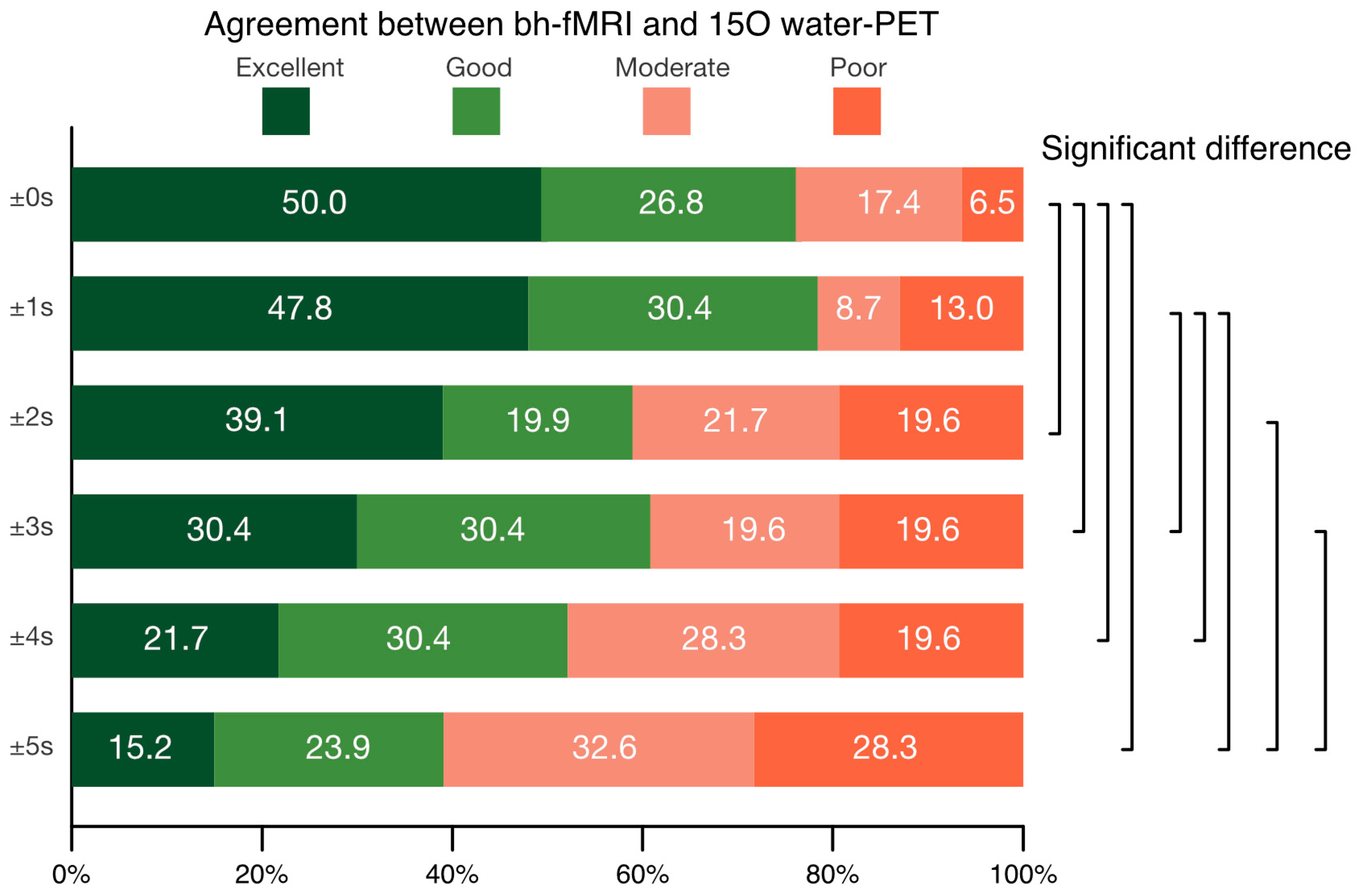
The evaluation of different time periods significantly affects the visual agreement between bh-fMRI and [15O]water PET with medium effect size (χ2(5) = 79.448, p < 0.001, W = 0.345) (see Figure 1).
The evaluation of TPcereb. max ± 0 s yielded the highest agreement between bh-fMRI and [15O]water PET, rated as good to excellent (consensus median = 3.5, modus = 4). The agreement between bh-fMRI and [15O]water PET was significantly higher than that of all other time periods (TPcereb. max ± 0 s vs. TPcereb. max ± 2 s: p = 0.040, r = 0.130; TPcereb. max ± 0 s vs. TPcereb. max ± 3 s: p = 0.013, r = 0.162; TPcereb. max ± 0 s vs. TPcereb. max ± 4 s: p < 0.001, r = 0.218; TPcereb. max ± 0 s vs. TPcereb. max ± 5 s: p < 0.001, r = 0.313), except for time period TPcereb. max ± 1 s (p = 0.676).
Evaluating the time period TPcereb. max ± 1 s yielded an only slightly and non-significantly lower rating (consensual median = 3, modus = 4) than evaluating TPcereb. max ± 0 s and led to a significantly better rating than the evaluation of the time periods TPcereb. max ± 3 s (p = 0.032, r = 0.138), TPcereb. max ± 4 s (p = 0.003, r = 0.194) and TPcereb. max ± 5 s (p < 0.001, r = 0.289).
The evaluation of the time periods TPcereb. max ± 2 s, TPcereb. max ± 3 s and TPcereb. max ± 4 s revealed good agreement between bh-fMRI and [15O]water PET (consensus median = 3; modus = 3 or 4). The time periods TPcereb. max ± 2 s (p = 0.019, r = 0.183) and TPcereb. max ± 3 s (p = 0.019, r = 0.148) showed significantly higher agreement with [15O]water PET than TPcereb. max ± 5 s.
In the subgroup of patients with an interval of 0–3 months between MRI [15O]water and [15O]water PET scan (n = 33), the evaluated time periods also had a significant effect on the agreement between bh-fMRI and [15O]water PET with medium effect size (χ2(5) = 53.535, p < 0.001, W = 0.325). A similar effect was observed in the subgroup of patients with an interval of 3–6 months between the scans (n = 13) (χ2(5) = 26.547, p < 0.001, W = 0.409) (see Supplementary Figure S1). The highest level of agreement between bh-fMRI and [15O]water PET was detected at time periods TPcereb. max ± 0 s and TPcereb. max ± 1 s (inter-scan interval of 0–3 months: consensus median = 3, modus = 4 in both cases, inter-scan interval of 3–6 months: consensus median = 4, modus = 4 in both cases). As the number of patients in the subgroup analysis decreased, the number of significant differences found in the post-hoc analyses decreased accordingly (see Supplementary Figure S1).
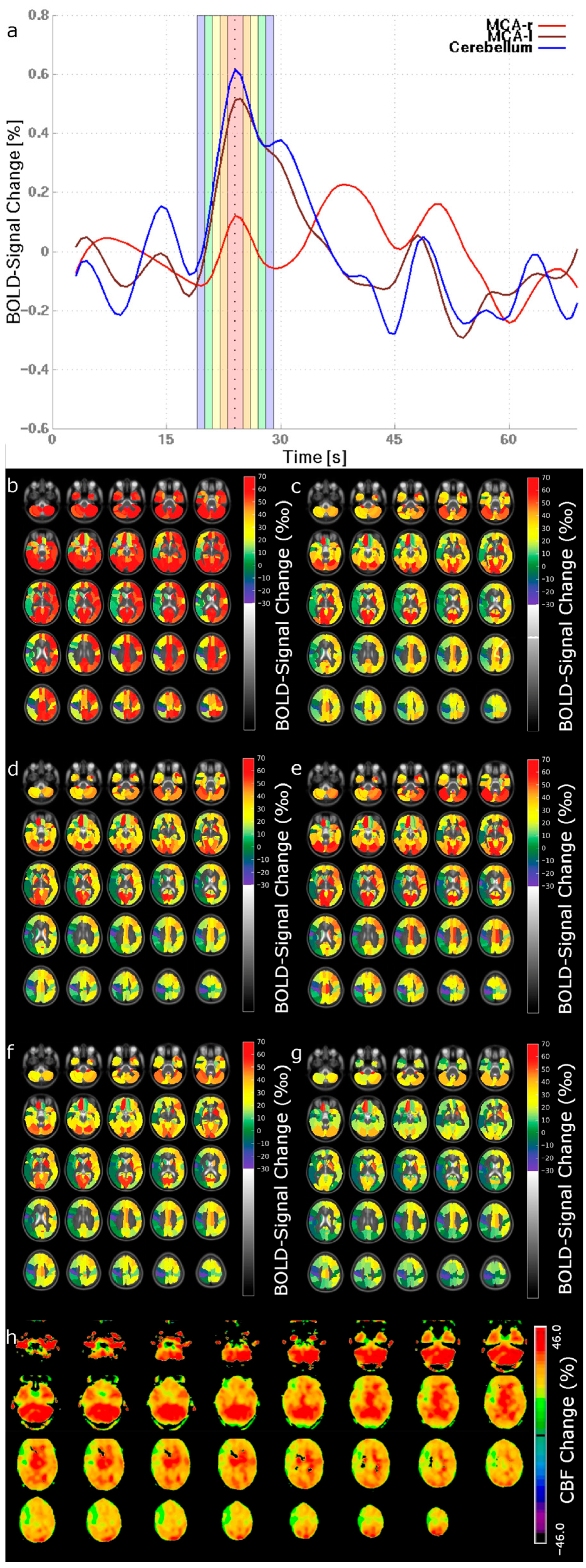
Figure 2 shows exemplary maps of a patient with unilateral MMA. This example illustrates why larger evaluated time periods can lead to a lower level of agreement between bh-fMRI and [15O]water PET: As illustrated, the mean BOLD values in the right MCA territory are positive for short time periods, while they become increasingly negative for larger time periods. This is evident in both the signal time courses and the bh-fMRI maps. At larger evaluated time periods, steal phenomena can be observed in certain brain regions. In contrast, [15O]water PET reveals lower CBF changes on the right than on the left side, but the right hemisphere does not exhibit steal phenomena. Therefore, bh-fMRI maps with shorter evaluated time periods correspond better with the [15O]water PET maps than those with larger time periods. In general, BOLD signal values tend to be positive when evaluating a single time point or a short time period, while longer time periods can lead to smaller and sometimes negative BOLD signal changes with an apparent steal phenomenon. This usually results in a lower visual concordance between bh-fMRI and the [15O]water PET diagnostic standard.

3.2. Inter-Rater Agreement

The inter-rater reliability across all evaluated time periods was almost perfect (κw = 0.828, 95% confidence interval (CI) = 0.785–0.871, p < 0.001). The inter-rater reliability across individual time periods was almost perfect for TPcereb. max ± 0 s (κw = 0.929, 95% CI = 0.872–0.987, p < 0.001), TPcereb. max ± 2 s (κw = 0.901, 95% CI = 0.832–0.970, p < 0.001), TPcereb. max ± 3 s (κw = 0.914, 95% CI = 0.855–0.973, p < 0.001), TPcereb. max ± 4 s (κw = 0.938, 95% CI = 0.889–0.987, p < 0.001) and TPcereb. max ± 5 s (κw = 0.922, 95% CI = 0.870–0.975, p < 0.001) and substantial for TPcereb. max ± 1 s (κw = 0.803, 95% CI = 0.700–0.906, p < 0.001).

4. Discussion

4.1. Motivation of the Study and Main Findings

CVR assessment is necessary in patients with MMA [2,4,9]. Although the prevalence of MMA is relatively low—up to 10.5 per 100,000 in Japan [37,38]—CVR assessment remains highly relevant because it helps guide decisions regarding bypass surgery [2,3,4,5,6,7,11]. [15O]water PET is the diagnostic gold standard for hemodynamic evaluation [8,12,13]. However, bh-fMRI has the advantage of being more easily repeatable due to lower costs and greater availability [2]. Furthermore, CVR assessment is relevant in patients with more prevalent cerebrovascular diseases such as atherosclerotic extracranial and intracranial carotid artery stenosis [17,39,40]. In recent years, CVR has also been increasingly investigated in a variety of other diseases [19,30,31,41,42,43], including small vessel disease [44,45,46,47], neurodegenerative diseases [48,49,50,51,52], traumatic brain injury [53,54], and epilepsy [31] as well as in neurooncology [42,55,56,57,58,59,60]. This also supports the rationale for continued research in CVR assessment and the development of methodical improvements.
The objective of this study was to investigate which time periods should be analyzed when assessing CVR with bh-fMRI.
In order to ensure the appropriate use of bh-fMRI in routine clinical diagnostics, the quality criteria of objectivity, reliability, and validity must be met. While Renger et al. evaluated the reliability of bh-fMRI over different time periods [61], our primary aim was to address the question of validity.
In this study, the validity of bh-fMRI data across different time periods was evaluated by comparing them to the diagnostic standard [15O]water PET. The results of this study indicated that single time points (TPcereb. max ± 0 s) or small time periods of TPcereb. max ± 1 s led to significantly greater agreement with the [15O]water PET, than time periods of ≥TPcereb. max ± 2 s, suggesting that bh-fMRI has greater validity when evaluating periods of shorter duration. This was evident irrespective of the time interval between the bh-fMRI and the [15O]water PET scan. However, it should be mentioned that the effect size of our analysis was medium, indicating variance in patients’ response to the different evaluated time periods.
In our analysis we observed that longer time-periods tend to result in lower CVR values and even steal phenomena, which were not always evident in [15O]water PET. On the one hand, it might be possible that [15O]water PET fails to capture the steal phenomenon. But on the other hand, the underlying reason could be a mathematical phenomenon in which integrating over longer time periods results in negative values. As [15O]water PET is the diagnostic standard in hemodynamic evaluation of patients with MMA [8,12,13], we believe that the negative values are more likely a mathematical artefact than an real steal phenomenon that is not captured with [15O]water PET.
We calculated the inter-rater reliability for each time period separately. Our analysis revealed almost perfect inter-rater reliability except for the TPcereb. max ± 1 s time period, for which categorization as almost perfect was narrowly missed (κw = 0.803 instead of 0.81), suggesting a little more volatility in the TPcereb. max ± 1 s time period compared to the other time periods. Overall, the inter-rater reliability indicates a high level of consistency in interpreting bh-fMRI data.

4.2. Review of Previous Studies on CVR Experiments in MMA

Renger et al. examined healthy participants and analyzed the test–retest reliability of bh-fMRI at different time intervals. Their findings showed excellent overall reproducibility, but shorter time periods resulted in significantly higher test–retest reliability.
In summary, the results of this study and the findings of Renger et al. suggest that shorter time periods lead to greater validity and test–retest reliability of bh-fMRI, while inter-rater reliability appears to be high for all time periods evaluated. For this reason, short time periods are recommended for clinical bh-fMRI evaluation.
It must be emphasized that different post-processing approaches for bh-fMRI data exist [16,41,62]. Our analysis focused on one method, in which the mean BOLD signal change is calculated over a pre-defined time period [2,3,4,5,8,14,30,31]. Other approaches for hypercapnia-triggered bh-fMRI evaluation rely, e.g., on linear regression analysis or its extension with a general linear model (GLM) [16,46,63,64]. The results of this study cannot be directly transferred to other post-processing approaches. Furthermore, this study focused on patients with MMA, where CVR can be severely compromised. The transferability of the results to other diseases is limited.
In this analysis, voxel-wise time delay correction of the BOLD signal was performed, as proposed in recent studies [8,64,65,66]. This step is particularly important when examining patients with MMA, where regional perfusion delays and consecutive BOLD signal delays are to be expected due to vessel stenosis and collateral circulation [8]. After accounting for these perfusion delays, we selected the time point of the cerebellar BOLD signal peak as the reference time point for further analysis. The cerebellum is usually not affected by the disease because it is supplied by the posterior circulation [7,14]. However, it should be noted that, particularly in later stages of the disease, the posterior circulation may also be affected in MMA [67]. As isolated involvement of the posterior circulation is rare, we still consider the cerebellum to be the best region for comparison in MMA. Delay correction based on DSC MRI allowed us to use a uniform evaluation period for the analyses. Without delay correction, the analysis might not have concluded that short time periods are suitable because it would have been highly probable that the maximum signal response would not have been evaluated.

4.3. Limitations

This study has limitations that should be addressed. The most considerable limitation pertained to the comparison between bh-fMRI and [15O]water PET, which was based on a subjective rating by two neuroradiologists. A VOI-by-VOI correlation analysis would have been more objective but was not possible due to the retrospective study design and limited raw data availability. The bh-fMRI and [15O]water PET maps were evaluated in accordance with our standard clinical routine approaches. For this reason, the calculation of CPR in [15O]water PET was performed on a voxel-by-voxel basis, while CVR in the bh-fMRI maps was presented in small anatomical VOIs, resulting in another spatial resolution. This may have had an impact on the rating, as subregional patterns, such as focal areas of steal phenomenon, may have been masked in the bh-fMRI maps due to the averaging of the CVR values while [15O]water PET would detect them with more accuracy. However, we chose this approach because we wanted to improve the way we process bh-fMRI scans in clinical routine. All bh-fMRI scans were analyzed in the same 120 predefined VOIs, so we think it is reasonable to compare the results of the different data processing methods. Additionally, expiratory CO2-sampling was not performed, so the measured BOLD signal changes could not be normalized to CO2 changes and the actual vasodilatory stimulus achieved by each patient. We used the DSC MR data to correct for different blood arrival times in the brain, as recently proposed [8]. It is important to note that DSC MRI does not fully reflect BOLD lag. On the one hand, a gadolinium-based contrast agent does not show the same kinetic behavior as blood. On the other hand, temporal variations in the BOLD response are expected to be the sum of the variability in CVR response onset and the regional differences in blood transit time [23,26,68]. With DSC MRI, we only corrected for blood transit time, rather than delay in vasomotor response, which might be possible with alternative methods such as combined hypercapnic and hyperoxic gas inhalation [28] or with iterative data processing approaches during fMRI with CO2 inhalation [68]. Our approach of implementing a hypercapnia-triggered fMRI setup that could be implemented as easily as possible meant that we were unable to estimate the vasomotor response delay. To ensure optimal comparability with the [15O]water PET data, we used the same color scale for bh-fMRI maps of all patients. However, even among healthy individuals, the same breath-hold periods do not necessarily result in identical changes in CO2 [21,69], so differences in the BOLD signal changes are expected. Therefore, the color-coded scales might not have been optimal for all patients, which could have affected the rating. However, it should be emphasized that we focused particularly on side differences and negative CVR values in the rating because these criteria are clinically relevant and are unaffected by color coding.
The bh-fMRI technique has inherent limitations, such as the need for patient compliance [8,21,41]. To address this limitation, we used the cerebellar signal time course to verify patients’ compliance, as proposed in other studies [2,4,5,8].
In line with previous studies, this study further emphasizes the strong concordance between bh-fMRI and the reference standard [15O]water PET [2,4,8], even when standardized color scales are used. Further research should focus on optimizing the bh-fMRI technique and include, for example, expiratory CO2 sampling for optimal inter-personal comparability.

5. Conclusions

The main finding of this study was that analyzing single time points or short time periods of BOLD signal changes leads to the highest visual agreement between bh-fMRI CVR and [15O]water PET CPR maps in patients with MMA. This indicates that single time points or short time periods should be analyzed in routine clinical bh-fMRI scans of patients with MMA. Future studies should validate the findings with a VOI-by-VOI correlation analysis to the diagnostic standard in other diseases.

Supplementary Materials

The following supporting information can be downloaded at: https://www.mdpi.com/article/10.3390/diagnostics16060904/s1, Figure S1: Subgroup analysis of time periods of 0–3 months (top) and 3–6 months (bottom) between breath-hold fMRI (bh-fMRI) and [15O]water PET scan. The consensus ratings of the agreement between the bh-fMRI and the [15O]water PET maps are shown when evaluating bh-fMRI time periods of ±0 s, ±1 s, ±2 s, ±3 s, ±4 s, and ±5 s around the time point of the maximum cerebellar BOLD signal peak. Significant differences are marked on the right.

Author Contributions

Conceptualization, L.Z. and T.-K.H.; methodology, L.Z., U.K. and T.-K.H.; software, L.Z., U.K. and T.-K.H.; validation, L.Z., C.R., N.K., P.T.M., U.E. and T.-K.H.; formal analysis, L.Z. and T.-K.H.; investigation, L.Z. and T.-K.H.; resources, L.Z., C.R., U.E. and P.T.M.; data curation, L.Z. m P.T.M. and T.-K.H.; writing—original draft preparation, L.Z.; writing—review and editing, U.K., C.R., N.K., P.T.M., U.E. and T.-K.H.; visualization, L.Z. and T.-K.H.; supervision, T.-K.H.; project administration, L.Z. and T.-K.H. All authors have read and agreed to the published version of the manuscript.

Funding

This research received no external funding. Leonie Zerweck is supported by the Medical Faculty Tuebingen (TÜFF program, 3067-0-0) and the Deutsche Forschungsgemeinschaft (DFG) (Grant 572737263).

Institutional Review Board Statement

The study was conducted in accordance with the Declaration of Helsinki and approved by the Institutional Review Board of University Tuebingen (105/2025BO2, date of initial ethical approval 11 March 2025, date of amendment approval 12 February 2026).

Informed Consent Statement

Due to the retrospective study design, retrospective informed consent was obtained from patients who attended follow-up examinations at our hospital. In all other cases, patient consent was waived after consultation with the local Data Protection Officer due to the disproportionate effort required to obtain retrospective consent according to §13(1) Landesdatenschutzgesetz (LDSG)/Art. 5, 6, 9, 89 Datenschutz-Grundverordnung (DSGVO).

Data Availability Statement

In order to safeguard the confidentiality of the participants, the data pertaining to this study are currently withheld from public access. The data can be shared upon request.

Acknowledgments

We acknowledge support from the Open Access Publication Fund of the University of Tuebingen.

Conflicts of Interest

The authors declare no conflicts of interest.

Abbreviations

The following abbreviations are used in this manuscript:
ACZAcetazolamide
bh-fMRIBreath-hold functional MRI
BOLDBlood-Oxygenation-Level-Dependent
CPRCerebral perfusion reserve capacity
CVRCerebrovascular reactivity
DSCDynamic susceptibility contrast
EPIEcho-planar imaging
FDRFalse discovery rate
FWHMFull width at half maximum
GLMGeneral linear model
MCAMiddle cerebral artery
MNI Montreal Neurological Institute
MMAMoyamoya Angiopathy
STASuperficial temporal artery
TPcereb. maxTime point of the maximum cerebellar signal peak

References

  1. Choi, E.J.; Westmacott, R.; Kirkham, F.J.; Robertson, A.; Muthusami, P.; Shroff, M.; Moharir, M.; Williams, T.; Dirks, P.; MacGregor, D.; et al. Fronto-Parietal and White Matter Haemodynamics Predict Cognitive Outcome in Children with Moyamoya Independent of Stroke. Transl. Stroke Res. 2022, 13, 757–773. [Google Scholar] [CrossRef] [PubMed]
  2. Zerweck, L.; Hauser, T.K.; Roder, C.; Blazhenets, G.; Khan, N.; Ernemann, U.; Meyer, P.T.; Klose, U. Evaluation of the cerebrovascular reactivity in patients with Moyamoya Angiopathy by use of breath-hold fMRI: Investigation of voxel-wise hemodynamic delay correction in comparison to [(15)O]water PET. Neuroradiology 2023, 65, 539–550. [Google Scholar] [CrossRef] [PubMed]
  3. Zerweck, L.; Roder, C.; Hauser, T.-K.; Thurow, J.; Mengel, A.; Tatagiba, M.; Khan, N.; Meyer, P.T.; Ernemann, U.; Klose, U. Hemodynamic evaluation of patients with Moyamoya Angiopathy: Comparison of resting-state fMRI to breath-hold fMRI and [15O]water PET. Neuroradiology 2021, 64, 553–563. [Google Scholar] [CrossRef] [PubMed]
  4. Hauser, T.-K.; Seeger, A.; Bender, B.; Klose, U.; Thurow, J.; Ernemann, U.; Tatagiba, M.; Meyer, P.T.; Khan, N.; Roder, C. Hypercapnic BOLD MRI compared to H215O PET/CT for the hemodynamic evaluation of patients with Moyamoya Disease. NeuroImage Clin. 2019, 22, 101713. [Google Scholar] [CrossRef]
  5. Zerweck, L.; Roder, C.; Blazhenets, G.; Martus, P.; Thurow, J.; Haas, P.; Estler, A.; Gohla, G.; Ruff, C.; Selo, N.; et al. MRI-Based Assessment of Risk for Stroke in Moyamoya Angiopathy (MARS-MMA): An MRI-Based Scoring System for the Severity of Moyamoya Angiopathy. Diagnostics 2024, 14, 1437. [Google Scholar] [CrossRef]
  6. Zerweck, L.; Pohmann, R.; Klose, U.; Martirosian, P.; Haas, P.; Ernemann, U.; Khan, N.; Roder, C.; Hauser, T.K.; Hennersdorf, F. Evaluation of the contribution of individual arteries to the cerebral blood supply in patients with Moyamoya angiopathy: Comparison of vessel-encoded arterial spin labeling and digital subtraction angiography. Neuroradiology 2024, 66, 1131–1140. [Google Scholar] [CrossRef]
  7. Dlamini, N.; Shah-Basak, P.; Leung, J.; Kirkham, F.; Shroff, M.; Kassner, A.; Robertson, A.; Dirks, P.; Westmacott, R.; deVeber, G.; et al. Breath-Hold Blood Oxygen Level-Dependent MRI: A Tool for the Assessment of Cerebrovascular Reserve in Children with Moyamoya Disease. AJNR Am. J. Neuroradiol. 2018, 39, 1717–1723. [Google Scholar] [CrossRef]
  8. Zerweck, L.; Klose, U.; Roder, C.; Staber, D.; Renger, E.; Blazhenets, G.; Grundmann-Hauser, K.; Meyer, P.T.; Ernemann, U.; Hauser, T.K. Measuring cerebrovascular reactivity with breath-hold fMRI in patients with Moyamoya angiopathy: MR perfusion based delay correction significantly improves agreement to [(15)O]water PET. Neuroradiology 2025, 67, 2121–2129. [Google Scholar] [CrossRef]
  9. Garbani Nerini, L.; Bellomo, J.; Hobner, L.M.; Stumpo, V.; Colombo, E.; van Niftrik, C.H.B.; Schubert, T.; Kulcsar, Z.; Wegener, S.; Luft, A.; et al. BOLD Cerebrovascular Reactivity and NOVA Quantitative MR Angiography in Adult Patients with Moyamoya Vasculopathy Undergoing Cerebral Bypass Surgery. Brain Sci. 2024, 14, 762. [Google Scholar] [CrossRef]
  10. Sun, L.R.; Vossough, A.; Kossorotoff, M.; Bang, O.Y.; Smith, E.; Phi, J.H.; Dlamini, N.; Steinberg, G.K.; Lehman, L.L.; Lee, S. Moyamoya Across the Lifespan: Current Neurologic Care and Future Directions. Neurology 2025, 104, e213484. [Google Scholar] [CrossRef]
  11. Esposito, G.; Sebok, M.; Amin-Hanjani, S.; Regli, L. Cerebral Bypass Surgery: Level of Evidence and Grade of Recommendation. Acta Neurochir. Suppl. 2018, 129, 73–77. [Google Scholar] [CrossRef]
  12. Fierstra, J.; van Niftrik, C.; Warnock, G.; Wegener, S.; Piccirelli, M.; Pangalu, A.; Esposito, G.; Valavanis, A.; Buck, A.; Luft, A.; et al. Staging Hemodynamic Failure With Blood Oxygen-Level-Dependent Functional Magnetic Resonance Imaging Cerebrovascular Reactivity: A Comparison Versus Gold Standard ((15)O-)H2O-Positron Emission Tomography. Stroke 2018, 49, 621–629. [Google Scholar] [CrossRef]
  13. Sebok, M.; van der Wouden, F.; Mader, C.; Pangalu, A.; Treyer, V.; Fisher, J.A.; Mikulis, D.J.; Hullner, M.; Regli, L.; Fierstra, J.; et al. Hemodynamic Failure Staging With Blood Oxygenation Level-Dependent Cerebrovascular Reactivity and Acetazolamide-Challenged ((15)O-)H(2)O-Positron Emission Tomography Across Individual Cerebrovascular Territories. J. Am. Heart Assoc. 2023, 12, e029491. [Google Scholar] [CrossRef] [PubMed]
  14. Zerweck, L.; Hauser, T.-K.; Roder, C.; Klose, U. Investigation of the BOLD-Based MRI Signal Time Course During Short Breath-Hold Periods for Estimation of the Cerebrovascular Reactivity. SN Compr. Clin. Med. 2020, 2, 1551–1562. [Google Scholar] [CrossRef]
  15. Sobczyk, O.; Fierstra, J.; Venkatraghavan, L.; Poublanc, J.; Duffin, J.; Fisher, J.A.; Mikulis, D.J. Measuring Cerebrovascular Reactivity: Sixteen Avoidable Pitfalls. Front. Physiol. 2021, 12, 665049. [Google Scholar] [CrossRef]
  16. Sleight, E.; Stringer, M.S.; Marshall, I.; Wardlaw, J.M.; Thrippleton, M.J. Cerebrovascular Reactivity Measurement Using Magnetic Resonance Imaging: A Systematic Review. Front. Physiol. 2021, 12, 643468. [Google Scholar] [CrossRef]
  17. Sebok, M.; van Niftrik, C.H.B.; Winklhofer, S.; Wegener, S.; Esposito, G.; Stippich, C.; Luft, A.; Regli, L.; Fierstra, J. Mapping Cerebrovascular Reactivity Impairment in Patients With Symptomatic Unilateral Carotid Artery Disease. J. Am. Heart Assoc. 2021, 10, e020792. [Google Scholar] [CrossRef]
  18. Raghavan, V.; Sobczyk, O.; Sayin, E.S.; Poublanc, J.; Skanda, A.; Duffin, J.; Venkatraghavan, L.; Fisher, J.A.; Mikulis, D.J. Assessment of Cerebrovascular Reactivity Using CO(2)-BOLD MRI: A 15-Year, Single Center Experience. J. Magn. Reson. Imaging 2024, 60, 954–961. [Google Scholar] [CrossRef]
  19. Zvolanek, K.M.; Moore, J.E.; Jarvis, K.; Moum, S.J.; Bright, M.G. Macrovascular blood flow and microvascular cerebrovascular reactivity are regionally coupled in adolescence. J. Cereb. Blood Flow. Metab. 2025, 45, 746–764. [Google Scholar] [CrossRef]
  20. Clements, R.G.; Geranmayeh, F.; Parkinson, N.V.; Montero, M.; Urday, S.; Taran, K.; Caban-Rivera, D.A.; Ingo, C.; Bright, M.G. Multi-echo BOLD fMRI improves cerebrovascular reactivity estimates in stroke. bioRxiv 2026. [Google Scholar] [CrossRef]
  21. Fierstra, J.; Sobczyk, O.; Battisti-Charbonney, A.; Mandell, D.M.; Poublanc, J.; Crawley, A.P.; Mikulis, D.J.; Duffin, J.; Fisher, J.A. Measuring cerebrovascular reactivity: What stimulus to use? J. Physiol. 2013, 591, 5809–5821. [Google Scholar] [CrossRef]
  22. Mutch, W.A.; Mandell, D.M.; Fisher, J.A.; Mikulis, D.J.; Crawley, A.P.; Pucci, O.; Duffin, J. Approaches to brain stress testing: BOLD magnetic resonance imaging with computer-controlled delivery of carbon dioxide. PLoS ONE 2012, 7, e47443. [Google Scholar] [CrossRef] [PubMed]
  23. Poublanc, J.; Han, J.S.; Mandell, D.M.; Conklin, J.; Stainsby, J.A.; Fisher, J.A.; Mikulis, D.J.; Crawley, A.P. Vascular steal explains early paradoxical blood oxygen level-dependent cerebrovascular response in brain regions with delayed arterial transit times. Cerebrovasc. Dis. Extra 2013, 3, 55–64. [Google Scholar] [CrossRef]
  24. Zvolanek, K.M.; Moia, S.; Dean, J.N.; Stickland, R.C.; Caballero-Gaudes, C.; Bright, M.G. Comparing end-tidal CO(2), respiration volume per time (RVT), and average gray matter signal for mapping cerebrovascular reactivity amplitude and delay with breath-hold task BOLD fMRI. Neuroimage 2023, 272, 120038. [Google Scholar] [CrossRef]
  25. Gong, J.; Stickland, R.C.; Bright, M.G. Hemodynamic timing in resting-state and breathing-task BOLD fMRI. Neuroimage 2023, 274, 120120. [Google Scholar] [CrossRef] [PubMed]
  26. Bhogal, A.A.; Philippens, M.E.P.; Siero, J.C.W.; Fisher, J.A.; Petersen, E.T.; Luijten, P.R.; Hoogduin, H. Examining the regional and cerebral depth-dependent BOLD cerebrovascular reactivity response at 7T. NeuroImage 2015, 114, 239–248. [Google Scholar] [CrossRef] [PubMed]
  27. Pinto, J.; Bright, M.G.; Bulte, D.P.; Figueiredo, P. Cerebrovascular Reactivity Mapping Without Gas Challenges: A Methodological Guide. Front. Physiol. 2020, 11, 608475. [Google Scholar] [CrossRef]
  28. Champagne, A.A.; Bhogal, A.A.; Coverdale, N.S.; Mark, C.I.; Cook, D.J. A novel perspective to calibrate temporal delays in cerebrovascular reactivity using hypercapnic and hyperoxic respiratory challenge. Neuroimage 2017, 187, 154–165. [Google Scholar] [CrossRef]
  29. van Niftrik, C.H.; Piccirelli, M.; Bozinov, O.; Pangalu, A.; Valavanis, A.; Regli, L.; Fierstra, J. Fine tuning breath-hold-based cerebrovascular reactivity analysis models. Brain Behav. 2016, 6, e00426. [Google Scholar] [CrossRef]
  30. Zerweck, L.; Klose, U.; Mengel, A.; Hoheisel, T.; Eikemeier, M.; Richter, V.; Joos, N.S.; Ernemann, U.; Bender, B.; Hauser, T.K. Cerebrovascular Reactivity Assessed by Breath-Hold Functional MRI in Patients with Neurological Post-COVID-19 Syndrome-A Pilot Study. Neurol. Int. 2024, 16, 992–1004. [Google Scholar] [CrossRef]
  31. Bosselmann, C.M.; Kegele, J.; Zerweck, L.; Klose, U.; Ethofer, S.; Roder, C.; Grimm, A.M.; Hauser, T.K. Breath-Hold-Triggered BOLD fMRI in Drug-Resistant Nonlesional Focal Epilepsy-A Pilot Study. Clin. Neuroradiol. 2023, 34, 315–324. [Google Scholar] [CrossRef]
  32. Wang, Y.; Wang, L.; Qiao, P.; Sheng, F.; Han, C.; Ye, E.; Lei, Y.; Yan, F.; Chen, S.; Zhu, Y.; et al. Impact of aberrant cerebral perfusion on resting-state functional MRI: A preliminary investigation of Moyamoya disease. PLoS ONE 2017, 12, e0176461. [Google Scholar] [CrossRef]
  33. O’Brien, T.J.; O’Connor, M.K.; Mullan, B.P.; Brinkmann, B.H.; Hanson, D.; Jack, C.R.; So, E.L. Subtraction ictal SPET co-registered to MRI in partial epilepsy: Description and technical validation of the method with phantom and patient studies. Nucl. Med. Commun. 1998, 19, 31–45. [Google Scholar] [CrossRef] [PubMed]
  34. Arigoni, M.; Kneifel, S.; Fandino, J.; Khan, N.; Burger, C.; Buck, A. Simplified quantitative determination of cerebral perfusion reserve with H2(15)O PET and acetazolamide. Eur. J. Nucl. Med. 2000, 27, 1557–1563. [Google Scholar] [CrossRef] [PubMed]
  35. Landis, J.R.; Koch, G.G. The measurement of observer agreement for categorical data. Biometrics 1977, 33, 159–174. [Google Scholar] [CrossRef]
  36. Cohen, J. A power primer. Psychol. Bull. 1992, 112, 155–159. [Google Scholar] [CrossRef] [PubMed]
  37. Cheng, X.; Cao, Y.; Duan, J.; Zhou, M.; Ye, S.; Zhu, Y. Moyamoya disease: Epidemiology, clinical features, pathogenesis, diagnosis and therapeutic interventions. Mol. Biomed. 2025, 6, 76. [Google Scholar] [CrossRef]
  38. Baba, T.; Houkin, K.; Kuroda, S. Novel epidemiological features of moyamoya disease. J. Neurol. Neurosurg. Psychiatry 2008, 79, 900–904. [Google Scholar] [CrossRef]
  39. Hartkamp, N.S.; Bokkers, R.P.; van Osch, M.J.; de Borst, G.J.; Hendrikse, J. Cerebrovascular reactivity in the caudate nucleus, lentiform nucleus and thalamus in patients with carotid artery disease. J. Neuroradiol. 2017, 44, 143–150. [Google Scholar] [CrossRef]
  40. Sebok, M.; Stumpo, V.; Bellomo, J.; Esposito, G.; van Niftrik, C.H.B.; Kulcsar, Z.; Luft, A.R.; Regli, L.; Fierstra, J. Preoperative BOLD cerebrovascular reactivity correlates with intraoperative STA-MCA bypass flow and influences postoperative CVR improvement. Eur. Stroke J. 2025, 10, 1454–1461. [Google Scholar] [CrossRef]
  41. Urback, A.L.; MacIntosh, B.J.; Goldstein, B.I. Cerebrovascular reactivity measured by functional magnetic resonance imaging during breath-hold challenge: A systematic review. Neurosci. Biobehav. Rev. 2017, 79, 27–47. [Google Scholar] [CrossRef]
  42. Iranmahboob, A.; Peck, K.K.; Brennan, N.P.; Karimi, S.; Fisicaro, R.; Hou, B.; Holodny, A.I. Vascular Reactivity Maps in Patients with Gliomas Using Breath-Holding BOLD fMRI. J. Neuroimaging 2016, 26, 232–239. [Google Scholar] [CrossRef]
  43. van Niftrik, C.H.B.; Sebok, M.; Germans, M.R.; Halter, M.; Pokorny, T.; Stumpo, V.; Bellomo, J.; Piccirelli, M.; Pangalu, A.; Katan, M.; et al. Increased Risk of Recurrent Stroke in Symptomatic Large Vessel Disease With Impaired BOLD Cerebrovascular Reactivity. Stroke 2024, 55, 613–621. [Google Scholar] [CrossRef]
  44. Blair, G.W.; Doubal, F.N.; Thrippleton, M.J.; Marshall, I.; Wardlaw, J.M. Magnetic resonance imaging for assessment of cerebrovascular reactivity in cerebral small vessel disease: A systematic review. J. Cereb. Blood Flow. Metab. 2016, 36, 833–841. [Google Scholar] [CrossRef]
  45. Sleight, E.; Stringer, M.S.; Clancy, U.; Arteaga, C.; Jaime Garcia, D.; Hewins, W.; Jochems, A.C.C.; Hamilton, O.K.L.; Manning, C.; Morgan, A.G.; et al. Cerebrovascular Reactivity in Patients With Small Vessel Disease: A Cross-Sectional Study. Stroke 2023, 54, 2776–2784. [Google Scholar] [CrossRef]
  46. Sleight, E.; Stringer, M.S.; Clancy, U.; Arteaga-Reyes, C.; Jaime Garcia, D.; Jochems, A.C.C.; Wiseman, S.; Valdes Hernandez, M.; Chappell, F.M.; Doubal, F.N.; et al. Association of Cerebrovascular Reactivity With 1-Year Imaging and Clinical Outcomes in Small Vessel Disease: An Observational Cohort Study. Neurology 2024, 103, e210008. [Google Scholar] [CrossRef] [PubMed]
  47. Webb, A.J.S.; Birks, J.S.; Feakins, K.A.; Lawson, A.; Dawson, J.; Rothman, A.M.K.; Werring, D.J.; Llwyd, O.; Stewart, C.R.; Thomas, J. Cerebrovascular Effects of Sildenafil in Small Vessel Disease: The OxHARP Trial. Circ. Res. 2024, 135, 320–331. [Google Scholar] [CrossRef] [PubMed]
  48. Alwatban, M.; Murman, D.L.; Bashford, G. Cerebrovascular Reactivity Impairment in Preclinical Alzheimer’s Disease. J. Neuroimaging 2019, 29, 493–498. [Google Scholar] [CrossRef]
  49. Switzer, A.R.; Cheema, I.; McCreary, C.R.; Zwiers, A.; Charlton, A.; Alvarez-Veronesi, A.; Sekhon, R.; Zerna, C.; Stafford, R.B.; Frayne, R.; et al. Cerebrovascular reactivity in cerebral amyloid angiopathy, Alzheimer disease, and mild cognitive impairment. Neurology 2020, 95, e1333–e1340. [Google Scholar] [CrossRef]
  50. Sur, S.; Lin, Z.; Li, Y.; Yasar, S.; Rosenberg, P.; Moghekar, A.; Hou, X.; Kalyani, R.; Hazel, K.; Pottanat, G.; et al. Association of cerebrovascular reactivity and Alzheimer pathologic markers with cognitive performance. Neurology 2020, 95, e962–e972. [Google Scholar] [CrossRef] [PubMed]
  51. Holmes, K.R.; Tang-Wai, D.; Sam, K.; McKetton, L.; Poublanc, J.; Crawley, A.P.; Sobczyk, O.; Cohn, M.; Duffin, J.; Tartaglia, M.C.; et al. Slowed Temporal and Parietal Cerebrovascular Response in Patients with Alzheimer’s Disease. Can. J. Neurol. Sci. 2020, 47, 366–373. [Google Scholar] [CrossRef]
  52. Pelizzari, L.; Lagana, M.M.; Rossetto, F.; Bergsland, N.; Galli, M.; Baselli, G.; Clerici, M.; Nemni, R.; Baglio, F. Cerebral blood flow and cerebrovascular reactivity correlate with severity of motor symptoms in Parkinson’s disease. Ther. Adv. Neurol. Disord. 2019, 12, 1756286419838354. [Google Scholar] [CrossRef]
  53. Batson, C.; Froese, L.; Sekhon, M.; Griesdale, D.; Gomez, A.; Thelin, E.P.; Raj, R.; Aries, M.; Gallagher, C.; Bernard, F.; et al. Impact of Chronological Age and Biological Sex on Cerebrovascular Reactivity in Moderate/Severe Traumatic Brain Injury: A CAnadian High-Resolution Traumatic Brain Injury (CAHR-TBI) Study. J. Neurotrauma 2023, 40, 1098–1111. [Google Scholar] [CrossRef]
  54. Zeiler, F.A.; Ercole, A.; Czosnyka, M.; Smielewski, P.; Hawryluk, G.; Hutchinson, P.J.A.; Menon, D.K.; Aries, M. Continuous cerebrovascular reactivity monitoring in moderate/severe traumatic brain injury: A narrative review of advances in neurocritical care. Br. J. Anaesth. 2020, 124, 440–453. [Google Scholar] [CrossRef]
  55. Muscas, G.; van Niftrik, C.H.B.; Sebok, M.; Seystahl, K.; Piccirelli, M.; Stippich, C.; Weller, M.; Regli, L.; Fierstra, J. Hemodynamic investigation of peritumoral impaired blood oxygenation-level dependent cerebrovascular reactivity in patients with diffuse glioma. Magn. Reson. Imaging 2020, 70, 50–56. [Google Scholar] [CrossRef] [PubMed]
  56. Muscas, G.; van Niftrik, C.H.B.; Sebok, M.; Della Puppa, A.; Seystahl, K.; Andratschke, N.; Brown, M.; Weller, M.; Regli, L.; Piccirelli, M.; et al. Distinct Cerebrovascular Reactivity Patterns for Brain Radiation Necrosis. Cancers 2021, 13, 1840. [Google Scholar] [CrossRef] [PubMed]
  57. Fierstra, J.; van Niftrik, C.; Piccirelli, M.; Bozinov, O.; Pangalu, A.; Krayenbuhl, N.; Valavanis, A.; Weller, M.; Regli, L. Diffuse gliomas exhibit whole brain impaired cerebrovascular reactivity. Magn. Reson. Imaging 2018, 45, 78–83. [Google Scholar] [CrossRef] [PubMed]
  58. Stumpo, V.; Sebok, M.; van Niftrik, C.H.B.; Seystahl, K.; Hainc, N.; Kulcsar, Z.; Weller, M.; Regli, L.; Fierstra, J. Feasibility of glioblastoma tissue response mapping with physiologic BOLD imaging using precise oxygen and carbon dioxide challenge. Magn. Reson. Mater. Phys. Biol. Med. 2022, 35, 29–44. [Google Scholar] [CrossRef]
  59. Sebok, M.; van Niftrik, C.H.B.; Muscas, G.; Pangalu, A.; Seystahl, K.; Weller, M.; Regli, L.; Fierstra, J. Hypermetabolism and impaired cerebrovascular reactivity beyond the standard MRI-identified tumor border indicate diffuse glioma extended tissue infiltration. Neurooncol Adv. 2021, 3, vdab048. [Google Scholar] [CrossRef]
  60. Fierstra, J.; van Niftrik, B.; Piccirelli, M.; Burkhardt, J.K.; Pangalu, A.; Kocian, R.; Valavanis, A.; Weller, M.; Regli, L.; Bozinov, O. Altered intraoperative cerebrovascular reactivity in brain areas of high-grade glioma recurrence. Magn. Reson. Imaging 2016, 34, 803–808. [Google Scholar] [CrossRef]
  61. Renger, E.; Hauser, T.-K.; Klose, U.; Ernemann, U.; Zerweck, L. Assessing and Improving the Reproducibility of Cerebrovascular Reactivity Evaluations in Healthy Subjects Using Short-Breath-Hold fMRI. Diagnostics 2025, 15, 1946. [Google Scholar] [CrossRef]
  62. Urback, A.L.; Metcalfe, A.W.S.; Korczak, D.J.; MacIntosh, B.J.; Goldstein, B.I. Magnetic resonance imaging of cerebrovascular reactivity in healthy adolescents. J. Neurosci. Methods 2018, 306, 1–9. [Google Scholar] [CrossRef] [PubMed]
  63. Liu, P.; De Vis, J.B.; Lu, H. Cerebrovascular reactivity (CVR) MRI with CO2 challenge: A technical review. Neuroimage 2019, 187, 104–115. [Google Scholar] [CrossRef]
  64. Domingos, C.; Esteves, I.; Fouto, A.R.; Ruiz-Tagle, A.; Caetano, G.; Caballero-Gaudes, C.; Figueiredo, P. Cerebrovascular reactivity mapping using breath-hold BOLD-fMRI: Comparison of signal models combined with voxelwise lag optimization. Imaging Neurosci. 2025, 3, IMAG.a.80. [Google Scholar] [CrossRef]
  65. Donahue, M.J.; Strother, M.K.; Lindsey, K.P.; Hocke, L.M.; Tong, Y.; Frederick, B.D. Time delay processing of hypercapnic fMRI allows quantitative parameterization of cerebrovascular reactivity and blood flow delays. J. Cereb. Blood Flow. Metab. 2016, 36, 1767–1779. [Google Scholar] [CrossRef]
  66. Moia, S.; Stickland, R.C.; Ayyagari, A.; Termenon, M.; Caballero-Gaudes, C.; Bright, M.G. Voxelwise optimization of hemodynamic lags to improve regional CVR estimates in breath-hold fMRI. Annu. Int. Conf. IEEE Eng. Med. Biol. Soc. 2020, 2020, 1489–1492. [Google Scholar] [CrossRef]
  67. Bao, X.Y.; Tong, H.Y.; Wang, Q.N.; Wang, X.P.; Gao, G.; Zhang, Q.; Zou, Z.X.; Duan, L. A long-term study of posterior circulation changes after revascularization in patients with moyamoya disease. J. Neurosurg. 2023, 139, 1281–1286. [Google Scholar] [CrossRef]
  68. van Niftrik, C.H.B.; Piccirelli, M.; Bozinov, O.; Pangalu, A.; Fisher, J.A.; Valavanis, A.; Luft, A.R.; Weller, M.; Regli, L.; Fierstra, J. Iterative analysis of cerebrovascular reactivity dynamic response by temporal decomposition. Brain Behav. 2017, 7, e00705. [Google Scholar] [CrossRef] [PubMed]
  69. Bright, M.G.; Murphy, K. Reliable quantification of BOLD fMRI cerebrovascular reactivity despite poor breath-hold performance. Neuroimage 2013, 83, 559–568. [Google Scholar] [CrossRef] [PubMed]
Figure 1. Consensus rating of the agreement between the breath-hold fMRI (bh-fMRI) and the [15O]water PET maps when evaluating bh-fMRI time periods of ±0 s, ±1 s, ±2 s, ±3 s, ±4 s, ±5 s around the time point of the maximum cerebellar BOLD signal peak. Significant differences are marked on the right.
Diagnostics 16 00904 g001
Figure 2. Breath-hold fMRI and [15O]water PET data of one patient with unilateral right-side Moyamoya Angiopathy. (a) shows exemplary mean BOLD signal time courses of three territories (MCA-r = right middle cerebral artery; MCA-l = left middle cerebral artery; cerebellum). The colored bars indicate the evaluated time periods (dotted line = time point of the maximum cerebellar signal peak (TPcereb. max) ± 0 s; red bar = TPcereb. max ± 1 s; orange bar = TPcereb. max ± 2 s; yellow bar = TPcereb. max ± 3 s; green bar = TPcereb. max ± 4 s; blue bar = TPcereb. max ± 5 s). (bg) show the breath-hold fMRI maps for the individual time periods (b = TPcereb. max ± 0; c = TPcereb. max ± 1 s; d = TPcereb. max ± 2 s; e = TPcereb. max ± 3 s; f = TPcereb. max ± 4 s, g = TPcereb. max ± 5 s) and (h) illustrates the maps of the reference method [15O]water PET.
Diagnostics 16 00904 g002
Table 1. Summary of patient data.
Number of patients47 2
Age (median, range)39, 14–64
Female:Male ratio1.5:1
Days between MRI and PET data acquisition (median, range)65, 1–168
Data sets with time period of 0–3 months between MRI and PET data acquisition33
Data sets with time period of 3–6 months between MRI and PET data acquisition13
Number of included data sets46
Data sets without revascularization 44
Data sets after revascularization 2 (unilateral STA-MCA in both cases) 1
1 STA = superficial temporal artery, MCA = middle cerebral artery; 2 47 patients met the inclusion criteria; data sets of 46 patients were evaluated, as one patient performed the breath-hold task incorrectly.
Disclaimer/Publisher’s Note: The statements, opinions and data contained in all publications are solely those of the individual author(s) and contributor(s) and not of MDPI and/or the editor(s). MDPI and/or the editor(s) disclaim responsibility for any injury to people or property resulting from any ideas, methods, instructions or products referred to in the content.