Molecular and Microenvironmental Mechanisms of Malignant Transformation in Benign Salivary Gland Tumors: Implications for Oral Squamous Cell Carcinoma


Abstract
1. Introduction
2. Materials and Methods
2.1. Study Design
2.2. Literature Search Strategy
2.3. Eligibility Criteria
- Published in peer-reviewed scientific journals
- Written in English
- Focused on benign salivary gland tumors and/or their malignant transformation
- Provided clinical, histopathological, molecular, or genetic data relevant to malignant progression
2.4. Data Extraction and Analysis
2.5. Ethical Considerations
3. Results
3.1. Frequency of Malignant Transformation in Benign Salivary Gland Tumors
3.2. Molecular and Genetic Alterations Associated with Malignant Transformation
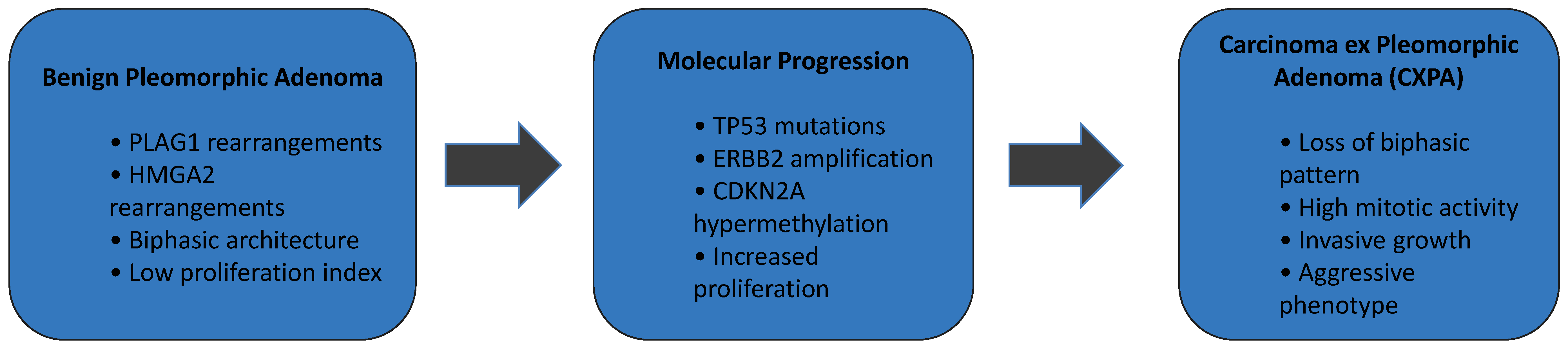
Gene Rearrangements and Mutations
3.3. Epigenetic Alterations
3.4. Histopathological and Clinical Indicators of Malignant Transformation
3.4.1. Clinical Changes
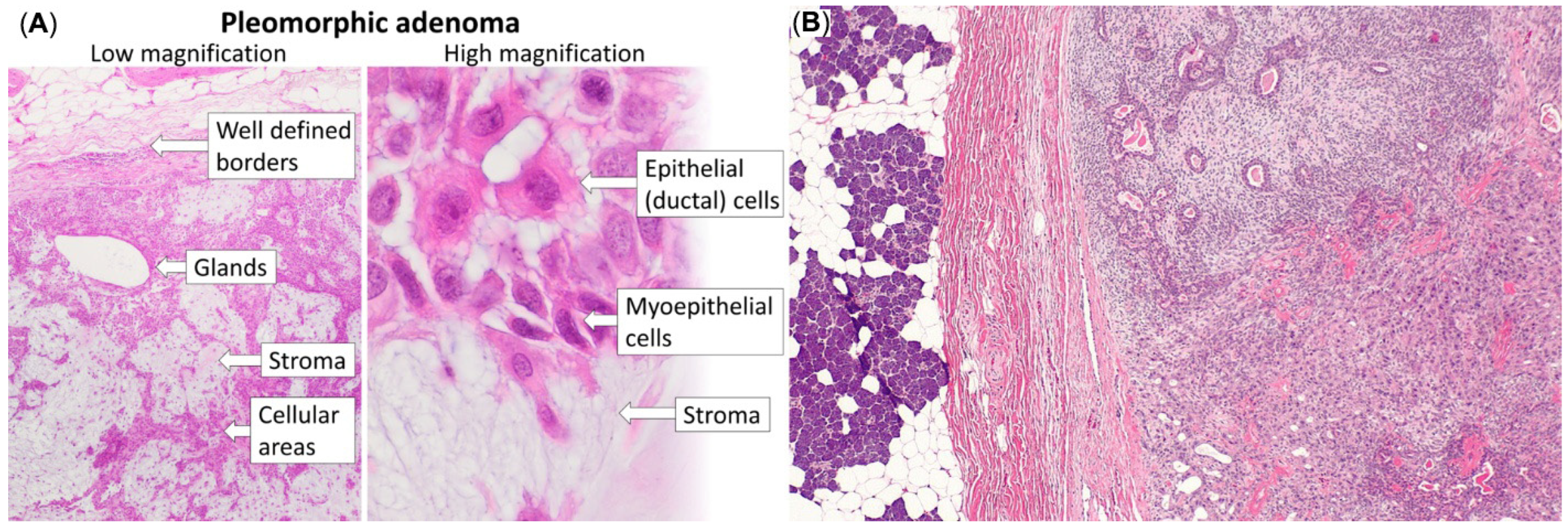
3.4.2. Histological Changes
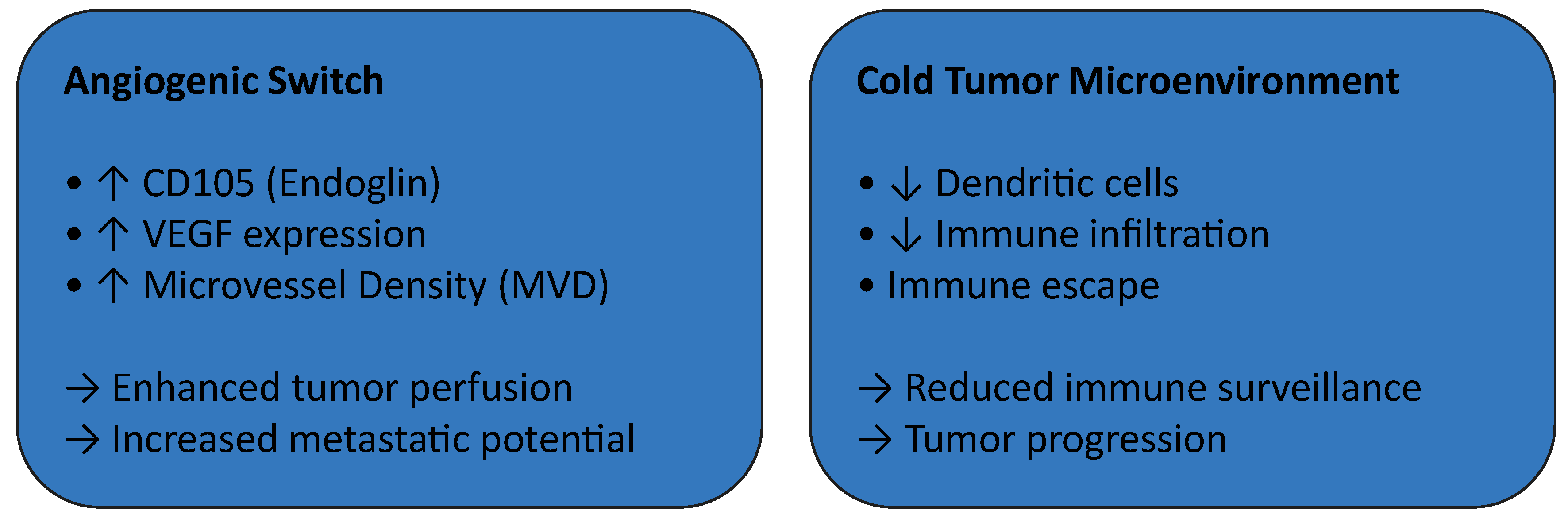
3.5. Angiogenesis and Tumor Microenvironment
4. Discussion
5. Conclusions
Author Contributions
Funding
Institutional Review Board Statement
Informed Consent Statement
Data Availability Statement
Conflicts of Interest
Abbreviations
| ADC | Apparent Diffusion Coefficient |
| APC | Antigen-Presenting Cell |
| BCA | Basal Cell Adenoma |
| CXPA | Carcinoma ex Pleomorphic Adenoma |
| CD105 | Endoglin |
| ERBB2 | Erb-B2 Receptor Tyrosine Kinase 2 (HER2/neu) |
| HMGA2 | High-Mobility-Group AT-Hook 2 |
| MVD | Microvessel Density |
| MGMT | O6-Methylguanine-DNA Methyltransferase |
| OSCC | Oral Squamous Cell Carcinoma |
| PA | Pleomorphic Adenoma |
| PLAG1 | Pleomorphic Adenoma Gene 1 |
| RASSF1A | Ras Association Domain Family Member 1 |
| TGF-β | Transforming Growth Factor Beta |
| TP53 | Tumor Protein p53 |
| VEGF | Vascular Endothelial Growth Factor |
| WHO | World Health Organization |
References
- Cawson, R.A.; Odell, E.W. Essentials of Oral Pathology and Oral Medicine, 8th ed.; Churchill Livingstone: London, UK, 2008; ISBN 978-0443101250. [Google Scholar]
- Neville, B.W.; Damm, D.D.; Allen, C.M.; Chi, A.C. Oral and Maxillofacial Pathology, 4th ed.; Elsevier: St. Louis, MO, USA, 2015; ISBN 978-1455770526. [Google Scholar]
- Speight, P.M.; Barrett, A.W. Salivary gland tumours. Oral Dis. 2002, 8, 229–240. [Google Scholar] [CrossRef] [Scilit]
- Waldron, C.A. Salivary gland tumors. Compendium 1989, 10, 540–542, 544, 546. [Google Scholar] [PubMed]
- Guzzo, M.; Locati, L.D.; Prott, F.J.; Gatta, G.; McGurk, M.; Licitra, L. Major and minor salivary gland tumors. Crit. Rev. Oncol. Hematol. 2010, 74, 134–148. [Google Scholar] [CrossRef] [Scilit] [PubMed]
- Hellquist, H.; Paiva-Correia, A.; Poorten, V.V.; Quer, M.; Hernandez-Prera, J.C.; Andreasen, S.; Zbären, P.; Skalova, A.; Rinaldo, A.; Ferlito, A. Analysis of the clinical relevance of histological classification of benign epithelial salivary gland tumours. Head Neck Pathol. 2019, 36, 1950–1974. [Google Scholar] [CrossRef] [Scilit] [PubMed]
- Andreasen, S.; Bjørndal, K.; Therkildsen, M.H.; Homøe, P. Pleomorphic adenoma of the parotid gland 1985–2010: A Danish nationwide study of incidence, recurrence rate and malignant transformation. Head Neck 2015, 38, E1364–E1369. [Google Scholar] [CrossRef] [Scilit] [PubMed]
- Alshagroud, R.; Kamoh, A.; Popat, S.R.; Brandwein-Weber, M.; Aguirre, A. Metastasizing Pleomorphic Adenoma Case Report and Review of the Literature. Head Neck Pathol. 2017, 11, 487–493. [Google Scholar] [CrossRef] [Scilit] [PubMed] [PubMed Central]
- Kessler, A.T.; Bhatt, A.A. Review of the major and minor salivary glands, part 2: Neoplasms and tumor-like lesions. J. Clin. Imaging Sci. 2018, 8, 48. [Google Scholar] [CrossRef] [Scilit]
- Young, A.; Okuyemi, O.T. Benign Salivary Gland Tumors; StatPearls: Treasure Island, FL, USA, 2023. [Google Scholar] [PubMed]
- Wasserman, J.K.; Dickson, B.C.; Smith, A.; Swanson, D.; Purgina, B.M.; Weinreb, I. Metastasizing pleomorphic adenoma: Recurrent PLAG1/HMGA2 rearrangements and identification of a novel HMGA2-TMTC2 fusion. Am. J. Surg. Pathol. 2019, 43, 815–823. [Google Scholar] [CrossRef] [Scilit]
- Rupp, N.J.; Höller, S.; Brada, M.; Vital, D.; Morand, G.B.; Broglie, M.A.; Huellner, M.W.; Freiberger, S.N. Expanding the clinicopathological spectrum of TGFBR3–PLAG1 rearranged salivary gland neoplasms. Am. J. Surg. Pathol. 2020, 44, 1336–1347. [Google Scholar]
- Katabi, N.; Sukhadia, P.; DiNapoli, S.E.; Weinreb, I.; Hahn, E.; Ghossein, R.; Xu, B. Expanding the histological spectrum of salivary gland neoplasms with HMGA2::WIF1 fusion emphasizing malignant potential. Am. J. Surg. Pathol. 2024, 84, 387–398. [Google Scholar]
- Sowa, P.; Goroszkiewicz, K.; Szydelko, J.; Chechlinska, J.; Pluta, K.; Domka, W.; Misiolek, M.; Scierski, W. A review of selected factors of salivary gland tumour formation and malignant transformation. Int. J. Mol. Sci. 2018, 2018, 2897827. [Google Scholar] [CrossRef] [Scilit]
- Kolary-Siekierska, K.; Niewiadomski, P.; Namieciński, W.; Miłoński, J. Title Expression of FOXO3 and MAPK1 Genes in Patients with Benign Salivary Gland Tumors. J. Clin. Med. 2023, 13, 215. [Google Scholar] [CrossRef] [Scilit] [PubMed] [PubMed Central]
- Dos Santos, E.S.; Ramos, J.C.; Normando, A.G.C.; Mariano, F.V.; Paes Leme, A.F. Epigenetic alterations in salivary gland tumors. Oral Dis. 2020, 26, 1610–1618. [Google Scholar] [CrossRef] [Scilit] [PubMed]
- Kas, K.; Voz, M.L.; Roijer, E.; Aström, A.K.; Meyen, E.; Stenman, G.; Van de Ven, W.J. Promoter swapping between the genes for a novel zinc finger protein and β-catenin in pleomorphic adenomas with t(3;8)(p21;q12). Nat. Genet. 1997, 15, 170–174. [Google Scholar] [CrossRef] [Scilit] [PubMed]
- Nikolic, N.; Carkic, J.; Jacimovic, J.; Jakovljevic, A.; Anicic, B.; Jezdic, Z.; Milasin, J. Methylation of tumour suppressor genes in benign and malignant salivary gland tumours: A systematic review and meta-analysis. Epigenetics 2022, 17, 1661–1676. [Google Scholar] [CrossRef] [Scilit] [PubMed] [PubMed Central]
- Owosho, A.A.; Adesina, O.M.; Odujoko, O.; Akinyemi, H.; Komolafe, A.; Tadros, S.; Bauer, R.; Summersgill, K.F. HMGA2 Immunoexpression is frequent in salivary gland pleomorphic adenoma: Immunohistochemical and molecular analyses of PLAG1 and HMGA2 in 25 cases. Int. J. Clin. Exp. Pathol. 2022, 15, 63–71. [Google Scholar] [PubMed] [PubMed Central]
- Raos, D.; Ulamec, M.; Katusic Bojanac, A.; Bulic-Jakus, F.; Jezek, D.; Sincic, N. Epigenetically inactivated RASSF1A as a tumor biomarker. Bosn. J. Basic Med. Sci. 2021, 21, 386–397. [Google Scholar] [CrossRef] [Scilit] [PubMed] [PubMed Central]
- Stone, S.; Jiang, P.; Dayananth, P.; Tavtigian, S.V.; Katcher, H.; Parry, D.; Peters, G.; Kamb, A. Complex structure and regulation of the P16 (MTS1) locus. Cancer Res. 1995, 55, 2988–2994. [Google Scholar] [PubMed]
- Kaina, B.; Christmann, M.; Naumann, S.; Roos, W.P. MGMT: Key node in the battle against genotoxicity, carcinogenicity and apoptosis induced by alkylating agents. DNA Repair 2007, 6, 1079–1099. [Google Scholar] [CrossRef] [Scilit] [PubMed]
- Dosemane, D.; Khadilkar, M.N.; Chandy, N.; Jayasheelan, S. A presentation of basal cell adenoma: A case report. J. Med. Case Rep. 2024, 18, 483. [Google Scholar] [CrossRef] [Scilit] [PubMed] [PubMed Central]
- Keerthi, R.; Raut, R.P.; Vaibhav, N.; Ghosh, A. Carcinoma ex pleomorphic adenoma: Diagnostic dilemma and treatment protocol. Indian J. Dent. 2014, 5, 157–160. [Google Scholar] [CrossRef] [Scilit] [PubMed]
- Seifert, G. Histopathology of malignant salivary gland tumours. Eur. J. Cancer B Oral Oncol. 1992, 28, 49–56. [Google Scholar] [CrossRef] [Scilit] [PubMed]
- Ellis, G.L.; Auclair, P.L. Tumors of the Salivary Glands; AFIP: Washington DC, USA, 2008.
- Thompson, L. World Health Organization classification of tumours: Pathology and genetics of head and neck tumours. Ear Nose Throat J. 2006, 85, 74. [Google Scholar] [CrossRef] [Scilit] [PubMed]
- Silvers, A.R.; Som, P.M. Salivary glands. Radiol. Clin. N. Am. 1998, 36, 941–966. [Google Scholar] [CrossRef] [Scilit] [PubMed]
- Nagao, T.; Sugano, I.; Ishida, Y.; Tajima, Y.; Furuya, N.; Kondo, Y.; Nagao, K. Mucoepidermoid carcinoma arising in Warthin’s tumour of the parotid gland: Report of two cases with histopathological, ultrastructural and immunohistochemical studies. Histopathology 1998, 33, 379–386. [Google Scholar] [CrossRef] [Scilit] [PubMed]
- Gunduz, M.; Yamanaka, N.; Hotomi, M.; Kuki, K.; Yokoyama, M.; Nakamine, H. Squamous cell carcinoma arising in a Warthin’s tumor. Auris Nasus Larynx 1999, 26, 355–360. [Google Scholar] [CrossRef] [Scilit] [PubMed]
- Fornelli, A.; Eusebi, V.; Pasquinelli, G.; Quattrone, P.; Rosai, J. Merkel cell carcinoma of the parotid gland associated with Warthin tumour: Report of two cases. Histopathology 2001, 39, 342–346. [Google Scholar] [CrossRef] [Scilit] [PubMed]
- Folkman, J. Role of angiogenesis in tumor growth and metastasis. Semin. Oncol. 2002, 29, 15–18. [Google Scholar] [CrossRef] [Scilit] [PubMed]
- Soares, A.B.; Juliano, P.B.; Araujo, V.C.; Metze, K.; Altemani, A. Angiogenic switch during tumor progression of carcinoma ex-pleomorphic adenoma. Virchows Arch. 2007, 451, 65–71. [Google Scholar] [CrossRef] [Scilit] [PubMed]
- Cardoso, S.V.; Souza, K.C.; Faria, P.R.; Eisenberg, A.L.; Dias, F.L.; Loyola, A.M. Assessment of angiogenesis by CD105 antigen in epithelial salivary gland neoplasms with diverse metastatic behavior. BMC Cancer 2009, 9, 391. [Google Scholar] [CrossRef] [Scilit] [PubMed] [PubMed Central]
- Verheul, H.M.; Pinedo, H.M. The role of vascular endothelial growth factor (VEGF) in tumor angiogenesis and early clinical development of VEGF-receptor kinase inhibitors. Clin. Breast Cancer 2000, 1, S80–S84. [Google Scholar] [CrossRef] [Scilit] [PubMed]
- Linxweiler, M.; Wang, J.; Morris, L.G.T. The role of immune surveillance in malignant transformation of benign salivary gland tumors. Oncotarget 2021, 12, 592–595. [Google Scholar] [CrossRef] [Scilit] [PubMed] [PubMed Central]
- Machado, B.A.; Gama-Cuellar, A.G.; Scarini, J.F.; Díaz, K.P.; Mariano, F.V.; Albuquerque-Junior, R.L.C.; Gondak, R. Dendritic cell subpopulations in carcinoma ex-pleomorphic adenoma: A multicenter study. Oral Dis. 2024, 30, 5041–5049. [Google Scholar] [CrossRef] [Scilit] [PubMed]
- Tzanavari, T.; Tasoulas, J.; Vakaki, C.; Mihailidou, C.; Tsourouflis, G.; Theocharis, S. The Role of Adipokines in the Establishment and Progression of Head and Neck Neoplasms. Curr. Med. Chem. 2019, 26, 4726–4748. [Google Scholar] [CrossRef] [Scilit] [PubMed]
- Mat Lazim, N.; Yousaf, A.; Abusalah, M.A.H.; Sulong, S.; Mohd Ismail, Z.I.; Mohamud, R.; Abu-Harirah, H.A.; AlRamadneh, T.N.; Hassan, R.; Abdullah, B. The Epigenesis of Salivary Glands Carcinoma: From Field Cancerization to Carcinogenesis. Cancers 2023, 15, 2111. [Google Scholar] [CrossRef] [Scilit]
- Antony, J.; Gopalan, V.; Smith, R.A.; Lam, A.K. Carcinoma ex pleomorphic adenoma: A comprehensive review of clinical, pathological and molecular data. Head Neck Pathol. 2012, 6, 1–9. [Google Scholar] [CrossRef] [Scilit] [PubMed] [PubMed Central]
- Yin, L.X.; Ha, P.K. Genetic alterations in salivary gland cancers. Cancer 2016, 122, 1822–1831. [Google Scholar] [CrossRef] [Scilit] [PubMed] [PubMed Central]
- Żurek, M.; Fus, Ł.; Niemczyk, K.; Rzepakowska, A. Salivary gland pathologies: Evolution in classification and association with unique genetic alterations. Eur. Arch. Otorhinolaryngol. 2023, 280, 4739–4750. [Google Scholar] [CrossRef] [Scilit] [PubMed] [PubMed Central]



| Molecular/Cellular Mechanism | Carcinoma ex Pleomorphic Adenoma (CXPA) | Oral Squamous Cell Carcinoma (OSCC) | Clinical/Biological Significance |
|---|---|---|---|
| Early oncogenic events | PLAG1 and HMGA2 rearrangements frequently present in pleomorphic adenoma and retained during malignant transformation | Not typically involved in OSCC | Indicates distinct tumor initiation mechanisms |
| TP53 pathway dysregulation | Mutations and loss of p53 activity reported in high-grade CXPA | Very common event in OSCC progression | Promotes genomic instability and tumor progression |
| EGFR signaling activation | EGFR overexpression and downstream MAPK/PI3K signaling activation reported in malignant salivary gland tumors | EGFR activation frequently observed in OSCC | Drives cell proliferation and tumor growth |
| HER2 (ERBB2) amplification | Amplification particularly reported in aggressive CXPA variants | Rare in OSCC | Associated with aggressive tumor phenotype and potential targeted therapy |
| Epigenetic alterations | Promoter hypermethylation of tumor suppressor genes (CDKN2A, RASSF1A) reported during malignant transformation | DNA methylation alterations frequently observed in OSCC | Loss of tumor suppressor activity and deregulated cell cycle |
| Angiogenesis pathways | Increased VEGF expression and elevated CD105-positive microvessel density reported in CXPA | Strong VEGF-driven angiogenesis in OSCC | Facilitates tumor growth and metastatic potential |
| Immune microenvironment alterations | Reduced immune surveillance and dendritic-cell-related immune modulation suggested | Tumor immune evasion mechanisms well described in OSCC | Enables tumor progression and immune escape |
| Tumor invasion mechanisms | Perineural invasion and stromal remodeling reported in CXPA | Common feature in aggressive OSCC | Associated with poor prognosis and local aggressiveness |
Disclaimer/Publisher’s Note: The statements, opinions and data contained in all publications are solely those of the individual author(s) and contributor(s) and not of MDPI and/or the editor(s). MDPI and/or the editor(s) disclaim responsibility for any injury to people or property resulting from any ideas, methods, instructions or products referred to in the content. |
© 2026 by the authors. Licensee MDPI, Basel, Switzerland. This article is an open access article distributed under the terms and conditions of the Creative Commons Attribution (CC BY) license.
Share and Cite
Giasimakopoulos, P.; Mylona, D.; Diafas, A.; Stamoulopoulos, I.; Markou, K. Molecular and Microenvironmental Mechanisms of Malignant Transformation in Benign Salivary Gland Tumors: Implications for Oral Squamous Cell Carcinoma. Diagnostics 2026, 16, 898. https://doi.org/10.3390/diagnostics16060898
Giasimakopoulos P, Mylona D, Diafas A, Stamoulopoulos I, Markou K. Molecular and Microenvironmental Mechanisms of Malignant Transformation in Benign Salivary Gland Tumors: Implications for Oral Squamous Cell Carcinoma. Diagnostics. 2026; 16(6):898. https://doi.org/10.3390/diagnostics16060898
Chicago/Turabian StyleGiasimakopoulos, Panagiotis, Danai Mylona, Aggelos Diafas, Ioannis Stamoulopoulos, and Konstantinos Markou. 2026. "Molecular and Microenvironmental Mechanisms of Malignant Transformation in Benign Salivary Gland Tumors: Implications for Oral Squamous Cell Carcinoma" Diagnostics 16, no. 6: 898. https://doi.org/10.3390/diagnostics16060898
APA StyleGiasimakopoulos, P., Mylona, D., Diafas, A., Stamoulopoulos, I., & Markou, K. (2026). Molecular and Microenvironmental Mechanisms of Malignant Transformation in Benign Salivary Gland Tumors: Implications for Oral Squamous Cell Carcinoma. Diagnostics, 16(6), 898. https://doi.org/10.3390/diagnostics16060898