Validation of NB CE-Chirps in the Diagnosis of Superior Semicircular Canal Dehiscence Syndrome
 , ,
, ,  , , ,
, , ,  and
and
Abstract
1. Introduction
2. Materials and Methods
2.1. Participants
2.2. Recording Procedure
2.2.1. oVEMPs
2.2.2. cVEMPs
2.3. Statistical Analysis
3. Results
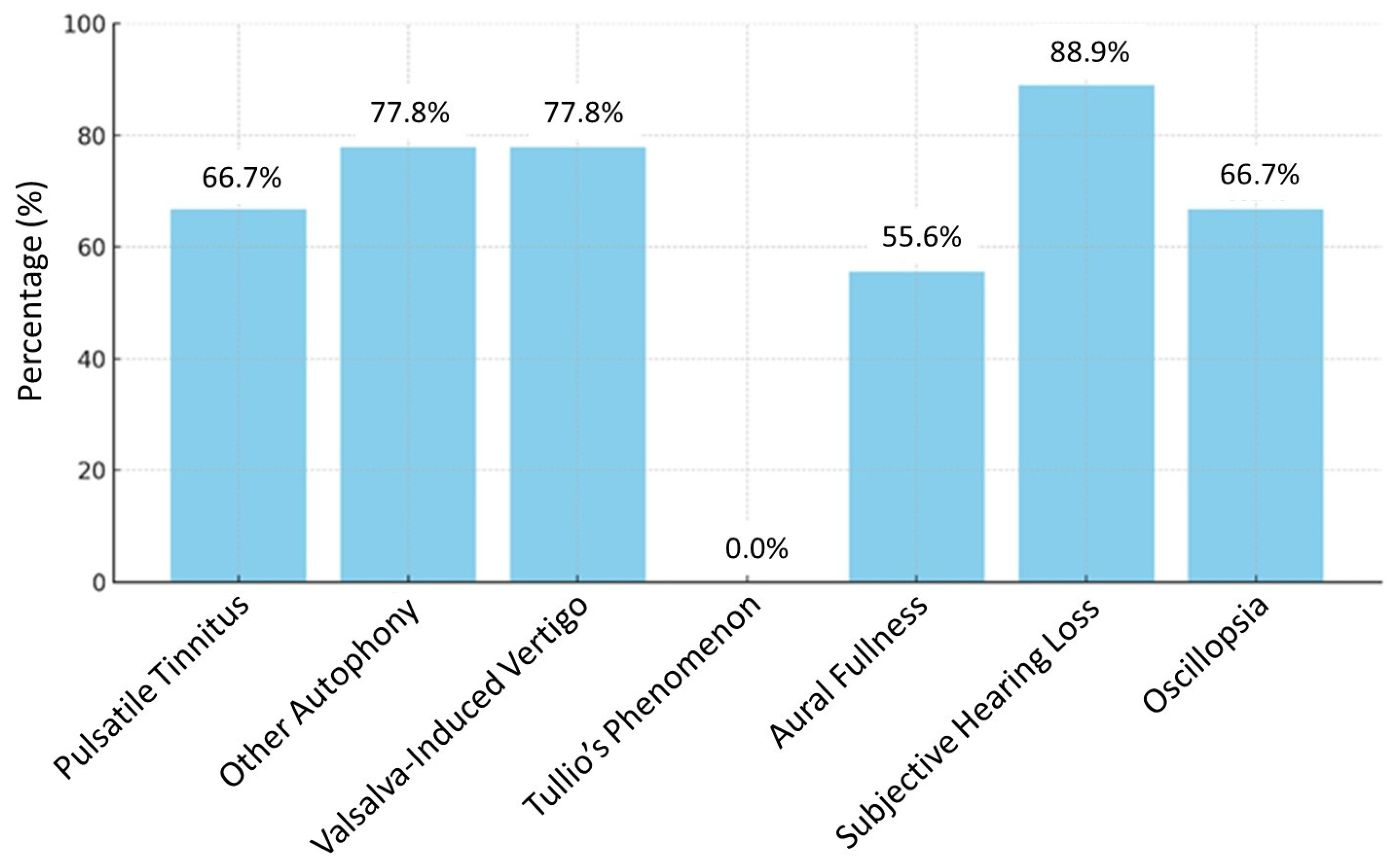
3.1. Prevalence of Key Symptoms Associated with SSCDS
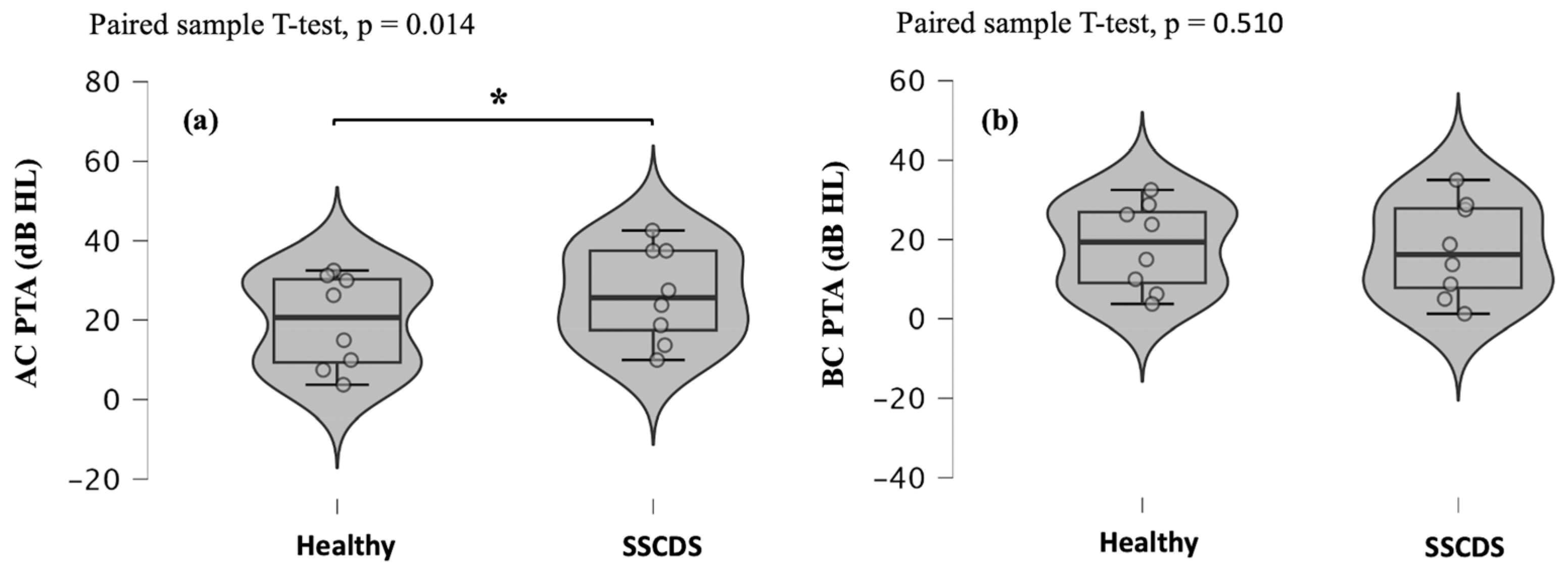
3.2. Comparison of PTAs Obtained in Air and Bone Conduction in Healthy and Pathological Ears
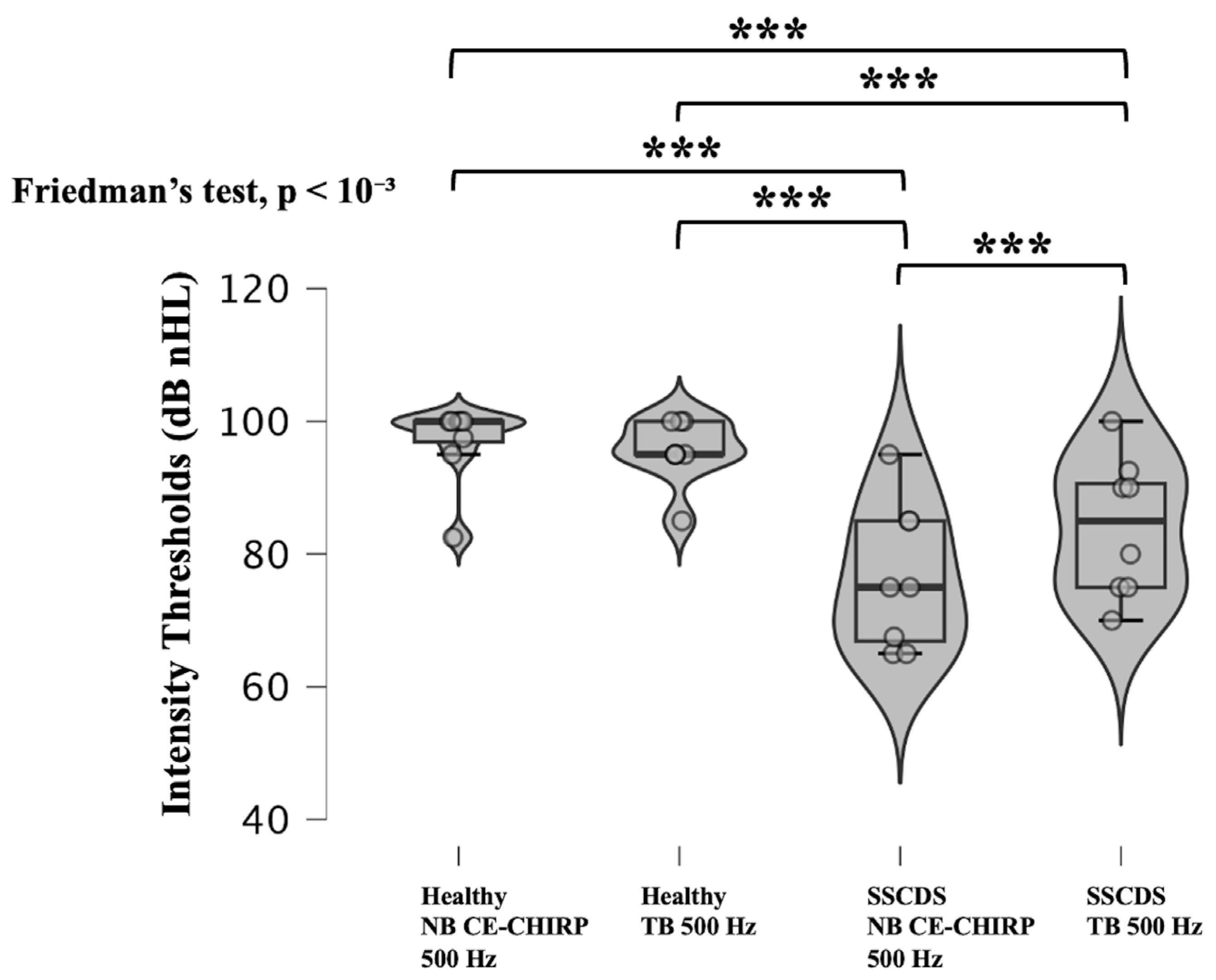
3.3. Comparison of Intensity Thresholds Obtained in Healthy and Pathological Ears Using 500 Hz NB CE-Chirp and 500 Hz TB Stimuli in cVEMPs
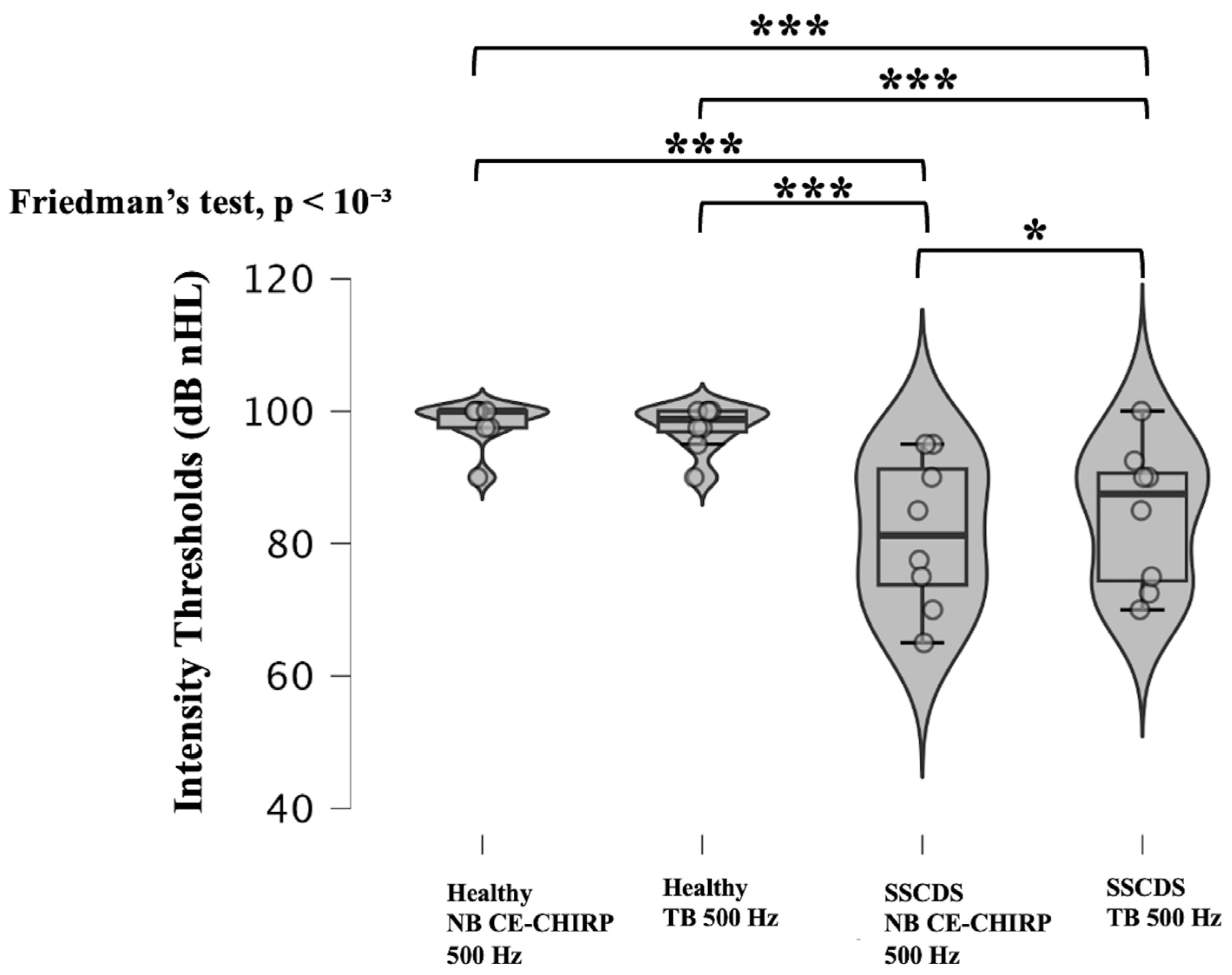
3.4. Comparison of Intensity Thresholds Obtained in Healthy and Pathological Ears Using 500 Hz NB CE-Chirp and 500 Hz TB Stimuli in oVEMPs
3.5. Response Rates at 4000 Hz Using TBs and NB CE-Chirps for cVEMPs
3.6. Evaluation of Response Rates at 4000 Hz Using TB and NB CE-Chirp Stimuli for oVEMPs
4. Discussion
5. Conclusions
Author Contributions
Funding
Institutional Review Board Statement
Informed Consent Statement
Data Availability Statement
Acknowledgments
Conflicts of Interest
Abbreviations
| NB CE-Chirp | Narrow Band Claus Elberling-Chirp |
| SSCDS | Superior Semicircular Canal Dehiscence Syndrome |
| VEMP | Vestibular evoked myogenic potential |
| cVEMP | Cervical vestibular evoked myogenic potential |
| oVEMP | Ocular vestibular evoked myogenic potential |
| TB | Tone Burst |
| Hz | Hertz |
| SCM | Sternocleidomastoid |
| dB HL | Decibel hearing level |
| nHL | Normalized hearing level |
| AC | Air-conducted |
| BC | Bone-conducted |
| PTA | Pure-tone average |
| BTEM | Belly–tendon electrode montage |
| EMG | Electromyography |
References
- Minor, L.B.; Solomon, D.; Zinreich, J.S.; Zee, D.S. Sound- and/or pressure-induced vertigo due to bone dehiscence of the superior semicircular canal. Arch. Otolaryngol. Head Neck Surg. 1998, 124, 249–258. [Google Scholar] [CrossRef] [PubMed]
- Steenerson, K.K.; Crane, B.T.; Minor, L.B. Superior Semicircular Canal Dehiscence Syndrome. Semin. Neurol. 2020, 40, 151–159. [Google Scholar] [CrossRef]
- Ward, B.K.; van de Berg, R.; van Rompaey, V.; Bisdorff, A.; Hullar, T.E.; Welgampola, M.S.; Carey, J.P. Superior semicircular canal dehiscence syndrome: Diagnostic criteria consensus document of the committee for the classification of vestibular disorders of the Bárány Society. J. Vestib. Res. 2021, 31, 131–141. [Google Scholar] [CrossRef]
- Curthoys, I.S.; Burgess, A.M.; Manzari, L.; Pastras, C.J. A Single Fast Test for Semicircular Canal Dehiscence-oVEMP n10 to 4000 Hz-Depends on Stimulus Rise Time. Audiol. Res. 2022, 12, 457–465. [Google Scholar] [CrossRef]
- Fife, T.D.; Colebatch, J.G.; Kerber, K.A.; Brantberg, K.; Strupp, M.; Lee, H.; Walker, M.F.; Ashman, E.; Fletcher, J.; Callaghan, B.; et al. Practice guideline: Cervical and ocular vestibular evoked myogenic potential testing: Report of the Guideline Development, Dissemination, and Implementation Subcommittee of the American Academy of Neurology. Neurology 2017, 89, 2288–2296. [Google Scholar] [CrossRef] [PubMed]
- Rosengren, S.M.; Colebatch, J.G.; Young, A.S.; Govender, S.; Welgampola, M.S. Vestibular evoked myogenic potentials in practice: Methods, pitfalls and clinical applications. Clin. Neurophysiol. Pract. 2019, 4, 47–68. [Google Scholar] [CrossRef]
- Curthoys, I.S.; Manzari, L. A Simple Specific Functional Test for SCD: VEMPs to High Frequency (4000 Hz) Stimuli—Their Origin and Explanation. Front. Neurol. 2020, 11, 612075. [Google Scholar] [CrossRef] [PubMed]
- Colebatch, J.G.; Halmagyi, G.M.; Skuse, N.F. Myogenic potentials generated by a click-evoked vestibulocollic reflex. J. Neurol. Neurosurg. Psychiatry 1994, 57, 190–197. [Google Scholar] [CrossRef] [PubMed]
- Rosengren, S.M.; McAngus Todd, N.P.; Colebatch, J.G. Vestibular-evoked extraocular potentials produced by stimulation with bone-conducted sound. Clin. Neurophysiol. 2005, 116, 1938–1948. [Google Scholar] [CrossRef]
- Çoban, V.K.; Akın Öçal, F.C.; Karaçaylı, C.; Satar, B. Differences in bone conduction ocular vestibular evoked myogenic potentials to 500 Hz narrow band chirp stimulus and 500 Hz tone burst. Auris Nasus Larynx 2021, 48, 590–593. [Google Scholar] [CrossRef]
- Mat, Q.; Duterme, J.P.; Tainmont, S.; Lelubre, C.; Manto, M. Optimizing Ocular Vestibular Evoked Myogenic Potentials with Narrow Band CE-Chirps. Ear Hear. 2021, 42, 1373–1380. [Google Scholar] [CrossRef]
- Mat, Q.; Deggouj, N.; Duterme, J.P.; Tainmont, S.; Lelubre, C.; Manto, M. Using Narrow Band CE-Chirps to Elicit Cervical Vestibular Evoked Myogenic Potentials. Ear Hear. 2022, 43, 941–948. [Google Scholar] [CrossRef]
- Sandhu, J.S.; George, S.R.; Rea, P.A. The effect of electrode positioning on the ocular vestibular evoked myogenic potential to air-conducted sound. Clin. Neurophysiol. 2013, 124, 1232–1236. [Google Scholar] [CrossRef]
- Mat, Q.; Deggouj, N.; Duterme, J.P.; Tainmont, S.; Lelubre, C.; Manto, M. Influence of the Electrode Montage to Detect Ocular Vestibular Evoked Myogenic Potentials. Otol. Neurotol. 2023, 44, e412–e418. [Google Scholar] [CrossRef] [PubMed]
- Rodriguez, A.I.; Thomas, M.L.A.; Fitzpatrick, D.; Janky, K.L. Effects of High Sound Exposure During Air-Conducted Vestibular Evoked Myogenic Potential Testing in Children and Young Adults. Ear Hear. 2018, 39, 269–277. [Google Scholar] [CrossRef]
- Karaçaylı, C.; Akın Öçal, F.C.; Çoban, V.K.; Satar, B. Normative Data of Ocular Vestibular Evoked Myogenic Potentials in Response to Chirp Stimulus. J. Int. Adv. Otol. 2020, 16, 378–381. [Google Scholar] [CrossRef]
- Rosengren, S.M.; Welgampola, M.S.; Colebatch, J.G. Vestibular evoked myogenic potentials: Past, present and future. Clin. Neurophysiol. 2010, 121, 636–651. [Google Scholar] [CrossRef] [PubMed]
- Colebatch, J.G.; Rosengren, S.M.; Welgampola, M.S. Vestibular-evoked myogenic potentials. Handb. Clin. Neurol. 2016, 137, 133–155. [Google Scholar] [CrossRef] [PubMed]
- Papathanasiou, E.S.; Murofushi, T.; Akin, F.W.; Colebatch, J.G. International guidelines for the clinical application of cervical vestibular evoked myogenic potentials: An expert consensus report. Clin. Neurophysiol. 2014, 125, 658–666. [Google Scholar] [CrossRef]
- Ward, B.K.; Carey, J.P.; Minor, L.B. Superior Canal Dehiscence Syndrome: Lessons from the First 20 Years. Front. Neurol. 2017, 8, 177. [Google Scholar] [CrossRef]
- Suresh, K.; Garcia, A.; Nwosu, O.; Bartholomew, R.A.; Song, Y.; Lee, D.J. Symptomatology in Unilateral Versus Bilateral Superior Canal Dehiscence Patients Undergoing Unilateral Surgery. Otolaryngol. Head Neck Surg. 2024, 171, 1505–1510. [Google Scholar] [CrossRef] [PubMed]
- Merchant, S.N.; Rosowski, J.J. Conductive hearing loss caused by third-window lesions of the inner ear. Otol. Neurotol. 2008, 29, 282–289. [Google Scholar] [CrossRef]
- Harte, J.M.; Dau, T.; Favrot, S.; Verhulst, S. Auditory brainstem responses elicited by embedded narrowband chirps. Proc. ISAAR 2007, 1, 211–220. [Google Scholar]
- Park, H.J.; Lee, I.S.; Shin, J.E.; Lee, Y.J.; Park, M.S. Frequency-tuning characteristics of cervical and ocular vestibular evoked myogenic potentials induced by air-conducted tone bursts. Clin. Neurophysiol. 2010, 121, 85–89. [Google Scholar] [CrossRef]
- Singh, N.K.; Barman, A. Characterizing the Effects of Frequency on Parameters of Short Tone-bursts Induced Ocular Vestibular Evoked Myogenic Potentials. J. Indian Speech Lang. Hear. Assoc. 2014, 28, 1–9. [Google Scholar] [CrossRef]
- Curthoys, I.S.; Smith, C.M.; Burgess, A.M.; Dlugaiczyk, J. A Review of Neural Data and Modelling to Explain How a Semicircular Canal Dehiscence (SCD) Causes Enhanced VEMPs, Skull Vibration Induced Nystagmus (SVIN), and the Tullio Phenomenon. Audiol. Res. 2023, 13, 418–430. [Google Scholar] [CrossRef]
- Curthoys, I.S.; Vulovic, V.; Sokolic, L.; Pogson, J.; Burgess, A.M. Irregular primary otolith afferents from the guinea pig utricular and saccular maculae respond to both bone conducted vibration and to air conducted sound. Brain Res. Bull. 2012, 89, 16–21. [Google Scholar] [CrossRef] [PubMed]
- Curthoys, I.S.; Vulovic, V.; Burgess, A.M.; Sokolic, L.; Goonetilleke, S.C. The response of guinea pig primary utricular and saccular irregular neurons to bone-conducted vibration (BCV) and air-conducted sound (ACS). Hear. Res. 2016, 331, 131–143. [Google Scholar] [CrossRef] [PubMed]
- Curthoys, I.S.; Grant, J.W.; Burgess, A.M.; Pastras, C.J.; Brown, D.J.; Manzari, L. Otolithic Receptor Mechanisms for Vestibular-Evoked Myogenic Potentials: A Review. Front. Neurol. 2018, 9, 366. [Google Scholar] [CrossRef] [PubMed]
- Grant, W.; Curthoys, I. Otoliths—Accelerometer and seismometer; Implications in Vestibular Evoked Myogenic Potential (VEMP). Hear. Res. 2017, 353, 26–35. [Google Scholar] [CrossRef]
- Curthoys, I.S. The Anatomical and Physiological Basis of Clinical Tests of Otolith Function. A Tribute to Yoshio Uchino. Front. Neurol. 2020, 11, 566895. [Google Scholar] [CrossRef] [PubMed]
- Kantner, C.; Hapfelmeier, A.; Drexl, M.; Gürkov, R. The effects of rise/fall time and plateau time on ocular vestibular evoked myogenic potentials. Eur. Arch. Otorhinolaryngol. 2014, 271, 2401–2407. [Google Scholar] [CrossRef] [PubMed]
- Makowiec, K.; McCaslin, D.; Hatton, K. A Comparison of Two Recording Montages for Ocular Vestibular Evoked Myogenic Potentials in Patients with Superior Canal Dehiscence Syndrome. J. Am. Acad. Audiol. 2019, 30, 293–301. [Google Scholar] [CrossRef] [PubMed]



| Exclusion Criteria |
|---|
| Not having previously been operated on for SSCDS |
| Additional anomaly to superior semicircular canal dehiscence on a cone beam CT scan of the petrous bone (e.g., dehiscence of another semicircular canal, large vestibular aqueduct, otosclerosis, other ossicular ankylosis, ossicular dislocation or fracture, incomplete ossicular chain, middle ear filling, middle ear mass, major or minor ear aplasia, external auditory canal mass or infection, tympanic membrane perforation, …). |
| Neurological or muscular pathology impairing myogenic responses |
| Previous oculomotor problems |
| Previous otologic surgery |
| Taking ototoxic or myorelaxant medication |
| Type 1 or 2 diabetes mellitus |
| Prevalence Questionnaire |
|---|
| Pulsatile tinnitus, and the affected side |
| Any other form of autophony (e.g., eye movement, footstep sounds, borborygms) |
| Vertigo during Valsalva maneuver |
| Vertigo in response to loud sounds (Tullio’s phenomenon) |
| Ear fullness |
| Oscillopsia |
| Subjective hearing loss |
| Stimulus Type | Pathological Ears (SSCDS) | Healthy Ears |
|---|---|---|
| TB 4000 Hz | 100% (8/8) | 0% (0/8) |
| NB CE-Chirp 4000 Hz | 100% (8/8) | 0% (0/8) |
| Stimulus Type | Pathological Ears (SSCDS) | Healthy Ears |
|---|---|---|
| TB 4000 Hz | 100% (8/8) | 0% (0/8) |
| NB CE-Chirp 4000 Hz | 87.5% (7/8) | 0% (0/8) |
Disclaimer/Publisher’s Note: The statements, opinions and data contained in all publications are solely those of the individual author(s) and contributor(s) and not of MDPI and/or the editor(s). MDPI and/or the editor(s) disclaim responsibility for any injury to people or property resulting from any ideas, methods, instructions or products referred to in the content. |
© 2026 by the authors. Licensee MDPI, Basel, Switzerland. This article is an open access article distributed under the terms and conditions of the Creative Commons Attribution (CC BY) license.
Share and Cite
Mat, Q.; Lelubre, C.; Maniaci, A.; Gargula, S.; Iannella, G.; Lechien, J.R.; Tainmont, S. Validation of NB CE-Chirps in the Diagnosis of Superior Semicircular Canal Dehiscence Syndrome. Diagnostics 2026, 16, 868. https://doi.org/10.3390/diagnostics16060868
Mat Q, Lelubre C, Maniaci A, Gargula S, Iannella G, Lechien JR, Tainmont S. Validation of NB CE-Chirps in the Diagnosis of Superior Semicircular Canal Dehiscence Syndrome. Diagnostics. 2026; 16(6):868. https://doi.org/10.3390/diagnostics16060868
Chicago/Turabian StyleMat, Quentin, Christophe Lelubre, Antonino Maniaci, Stéphane Gargula, Giannicola Iannella, Jerome R. Lechien, and Sophie Tainmont. 2026. "Validation of NB CE-Chirps in the Diagnosis of Superior Semicircular Canal Dehiscence Syndrome" Diagnostics 16, no. 6: 868. https://doi.org/10.3390/diagnostics16060868
APA StyleMat, Q., Lelubre, C., Maniaci, A., Gargula, S., Iannella, G., Lechien, J. R., & Tainmont, S. (2026). Validation of NB CE-Chirps in the Diagnosis of Superior Semicircular Canal Dehiscence Syndrome. Diagnostics, 16(6), 868. https://doi.org/10.3390/diagnostics16060868