Assessment of Fractional Flow Reserve from Coronary CT Angiography Using a Deep Learning-Based Algorithm: A Multicenter Retrospective Study

 , , , , , ,
  ,
,  ,
,
Abstract
1. Introduction
2. Materials and Methods
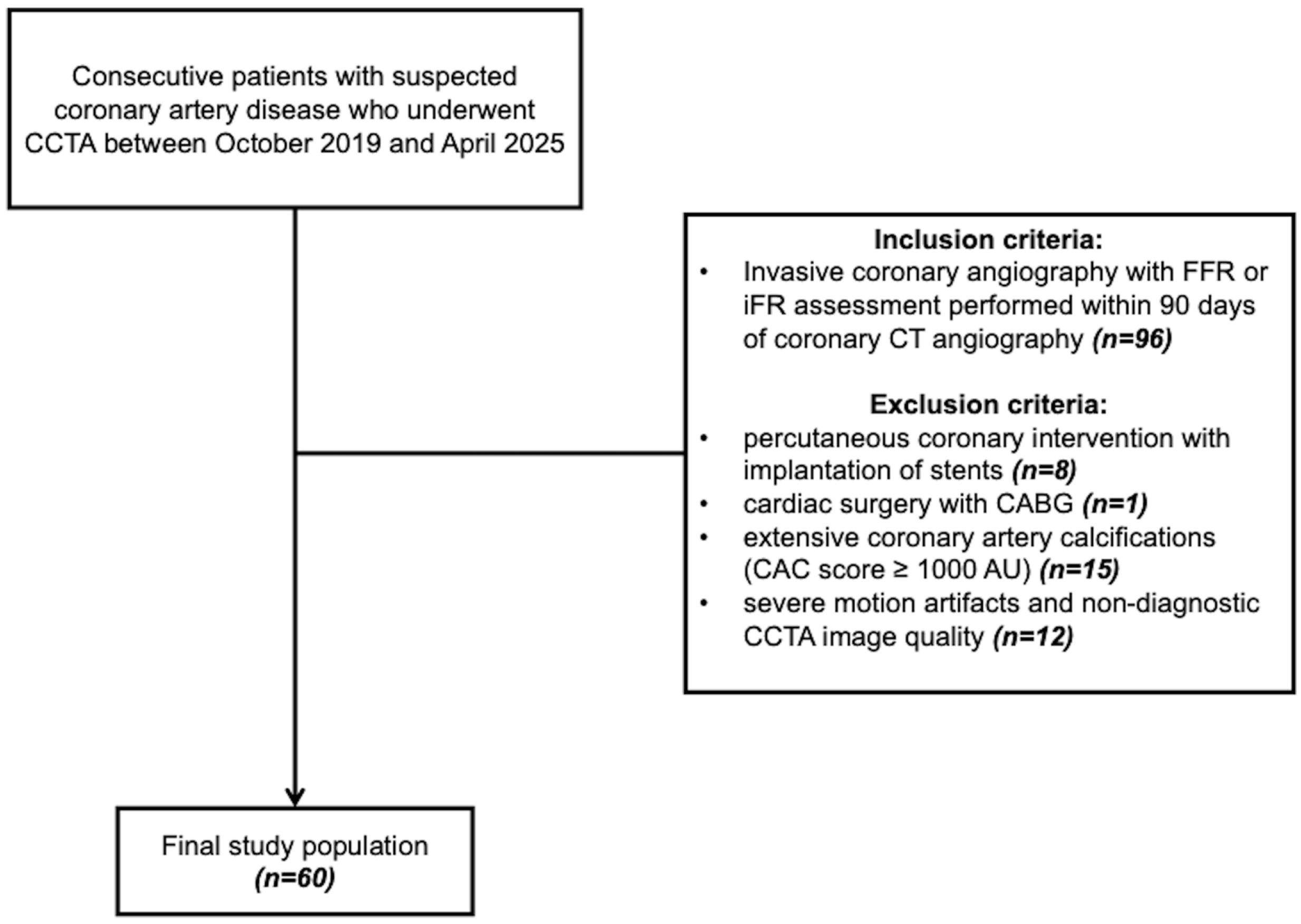
2.1. Patient Population
2.2. Acquisition Protocol and Image Reconstruction
2.3. Deep Learning Based Analysis
2.4. Reference Standard
2.5. Statistical Analysis
3. Results
3.1. Patient Population
3.2. Diagnostic Performance of FFR-CT
3.3. CAD-RADS Agreement
4. Discussion
5. Conclusions
Author Contributions
Funding
Institutional Review Board Statement
Informed Consent Statement
Data Availability Statement
Conflicts of Interest
Abbreviations
| AI | Artificial Intelligence |
| AU | Agatston Units |
| AUC | Area Under The Curve |
| CABG | Coronary Artery Bypass Grafting |
| CAC | Coronary Artery Calcium |
| CAD | Coronary Artery Disease |
| CAD-RADS | Coronary Artery Disease-Reporting and Data System |
| CCTA | Coronary Computed Tomography Angiography |
| CI | Confidence Interval |
| CT | Computed Tomography |
| cMPR | Curved Multiplanar Reconstruction |
| DL | Deep Learning |
| FFR | Fractional Flow Reserve |
| FFR-CT | Coronary Computed Tomography Angiography-derived Fractional Flow Reserve |
| ICA | Invasive Coronary Angiography |
| IQR | Interquartile Range |
| iFR | Instantaneous Wave-free Ratio |
| LAD | Left Anterior Descending Artery |
| LCx | Left Circumflex Artery |
| NPV | Negative Predictive Value |
| PPV | Positive Predictive Value |
| RCA | Right Coronary Artery |
| ROC | Receiver Operating Characteristic |
| SD | Standard Deviation |
References
- Knuuti, J.; Wijns, W.; Saraste, A.; Capodanno, D.; Barbato, E.; Funck-Brentano, C.; Prescott, E.; Storey, R.F.; Deaton, C.; Cuisset, T.; et al. 2019 ESC Guidelines for the diagnosis and management of chronic coronary syndromes. Eur. Heart J. 2020, 41, 407–477. [Google Scholar] [CrossRef]
- Meijboom, W.B.; Meijs, M.F.; Schuijf, J.D.; Cramer, M.J.; Mollet, N.R.; van Mieghem, C.A.; Nieman, K.; van Werkhoven, J.M.; Pundziute, G.; Weustink, A.C.; et al. Diagnostic accuracy of 64-slice computed tomography coronary angiography: A prospective, multicenter, multivendor study. J. Am. Coll. Cardiol. 2008, 52, 2135–2144. [Google Scholar] [CrossRef]
- Tonino, P.A.L.; De Bruyne, B.; Pijls, N.H.J.; Siebert, U.; Ikeno, F.; van’t Veer, M.; Klauss, V.; Manoharan, G.; Engstrøm, T.; Oldroyd, K.G.; et al. Fractional flow reserve versus angiography for guiding percutaneous coronary intervention. N. Engl. J. Med. 2009, 360, 213–224. [Google Scholar] [CrossRef]
- Davies, J.E.; Sen, S.; Dehbi, H.-M.; Al-Lamee, R.; Petraco, R.; Nijjer, S.S.; Bhindi, R.; Lehman, S.J.; Walters, D.; Sapontis, J.; et al. Use of the Instantaneous Wave-free Ratio or Fractional Flow Reserve in PCI. N. Engl. J. Med. 2017, 376, 1824–1834. [Google Scholar] [PubMed]
- Lanzafame, L.R.M.; Bucolo, G.M.; Muscogiuri, G.; Sironi, S.; Gaeta, M.; Ascenti, G.; Booz, C.; Vogl, T.J.; Blandino, A.; Mazziotti, S.; et al. Artificial Intelligence in Cardiovascular CT and MR Imaging. Life 2023, 13, 507. [Google Scholar] [CrossRef] [PubMed]
- D’Angelo, T.; Caudo, D.; Blandino, A.; Albrecht, M.H.; Vogl, T.J.; Gruenewald, L.D.; Gaeta, M.; Yel, I.; Koch, V.; Martin, S.S.; et al. Artificial intelligence, machine learning and deep learning in musculoskeletal imaging: Current applications. J. Clin. Ultrasound 2022, 50, 1414–1431. [Google Scholar] [CrossRef]
- McCollough, C.; Leng, S. Use of artificial intelligence in computed tomography dose optimisation. Ann. ICRP 2020, 49, 113–125. [Google Scholar] [CrossRef] [PubMed]
- Zhang, S.; Zhu, Z.; Yu, Z.; Sun, H.; Sun, Y.; Huang, H.; Xu, L.; Wan, J. Effectiveness of AI for Enhancing Computed Tomography Image Quality and Radiation Protection in Radiology: Systematic Review and Meta-Analysis. J. Med. Internet Res. 2025, 27, e66622. [Google Scholar] [CrossRef]
- Brendel, J.M.; Walterspiel, J.; Hagen, F.; Kübler, J.; Brendlin, A.S.; Afat, S.; Paul, J.-F.; Küstner, T.; Nikolaou, K.; Gawaz, M.; et al. Coronary artery disease detection using deep learning and ultrahigh-resolution photon-counting coronary CT angiography. Diagn. Interv. Imaging 2025, 106, 68–75. [Google Scholar] [CrossRef]
- Verpalen, V.A.; Coerkamp, C.F.; Henriques, J.P.S.; Isgum, I.; Planken, R.N. Automated classification of coronary lesions from coronary computed Tomography angiography scans with an updated deep learning model: ALERT study. Eur. Radiol. 2025, 35, 1543–1551. [Google Scholar] [CrossRef]
- Fairbairn, T.A.; Mullen, L.; Nicol, E.; Lip, G.Y.H.; Schmitt, M.; Shaw, M.; Tidbury, L.; Kemp, I.; Crooks, J.; Burnside, G.; et al. Implementation of a national AI technology program on cardiovascular outcomes and the health system. Nat. Med. 2025, 31, 1903–1910. [Google Scholar] [CrossRef]
- Paul, J.-F.; Rohnean, A.; Giroussens, H.; Pressat-Laffouilhere, T.; Wong, T. Evaluation of a deep learning model on coronary CT angiography for automatic stenosis detection. Diagn. Interv. Imaging 2022, 103, 316–323. [Google Scholar] [CrossRef] [PubMed]
- Mehier, B.; Mahmoudi, K.; Veugeois, A.; Masri, A.; Amabile, N.; Del Giudice, C.; Paul, J.-F. Diagnostic performance of deep learning to exclude coronary stenosis on CT angiography in TAVI patients. Int. J. Cardiovasc. Imaging 2024, 40, 981–990. [Google Scholar] [CrossRef]
- Zreik, M.; van Hamersvelt, R.W.; Wolterink, J.M.; Leiner, T.; Viergever, M.A.; Isgum, I. A Recurrent CNN for Automatic Detection and Classification of Coronary Artery Plaque and Stenosis in Coronary CT Angiography. IEEE Trans. Med. Imaging 2019, 38, 1588–1598. [Google Scholar]
- Szegedy, C.; Vanhoucke, V.; Ioffe, S.; Shlens, J.; Wojna, Z. Rethinking the Inception Architecture for Computer Vision; Computer Vision Foundation: New York, NY, USA, 2016. [Google Scholar]
- Cury, R.C.; Abbara, S.; Achenbach, S.; Agatston, A.; Berman, D.S.; Budoff, M.J.; Dill, K.E.; Jacobs, J.E.; Maroules, C.D.; Rubin, G.D.; et al. CAD-RADS(TM) Coronary Artery Disease—Reporting and Data System. An expert consensus document of the Society of Cardiovascular Computed Tomography (SCCT), the American College of Radiology (ACR) and the North American Society for Cardiovascular Imaging (NASCI). Endorsed by the American College of Cardiology. J. Cardiovasc. Comput. Tomogr. 2016, 10, 269–281. [Google Scholar]
- Escaned, J.; Echavarría-Pinto, M.; Garcia-Garcia, H.M.; van de Hoef, T.P.; de Vries, T.; Kaul, P.; Raveendran, G.; Altman, J.D.; Kurz, H.I.; Brechtken, J.; et al. Prospective Assessment of the Diagnostic Accuracy of Instantaneous Wave-Free Ratio to Assess Coronary Stenosis Relevance: Results of ADVISE II International, Multicenter Study (ADenosine Vasodilator Independent Stenosis Evaluation II). JACC Cardiovasc. Interv. 2015, 8, 824–833. [Google Scholar] [CrossRef] [PubMed]
- De Bruyne, B.; Pijls, N.H.; Kalesan, B.; Barbato, E.; Tonino, P.A.; Piroth, Z.; Jagic, N.; Mobius-Winckler, S.; Rioufol, G.; Witt, N.; et al. Fractional flow reserve-guided PCI versus medical therapy in stable coronary disease. N. Engl. J. Med. 2012, 367, 991–1001. [Google Scholar] [CrossRef]
- Jeremias, A.; Maehara, A.; Généreux, P.; Asrress, K.N.; Berry, C.; De Bruyne, B.; Davies, J.E.; Escaned, J.; Fearon, W.F.; Gould, K.L.; et al. Multicenter core laboratory comparison of the instantaneous wave-free ratio and resting Pd/Pa with fractional flow reserve: The RESOLVE study. J. Am. Coll. Cardiol. 2014, 63, 1253–1261. [Google Scholar] [CrossRef]
- Pham, V.; Picard, F.; Monnot, S.; Garrigoux, P.; Jegou, A.; Dambrin, G.; Paul, J.-F. Validation of a deep learning model for computed tomography-derived fractional flow reserve. Coron. Artery Dis. 2025, 36, 434–436. [Google Scholar] [CrossRef]
- Nørgaard, B.L.; Gaur , S.; Leipsic , J. Influence of Coronary Calcification on the Diagnostic Performance of CT Angiography Derived FFR in Coronary Artery Disease: A Substudy of the NXT Trial. JACC Cardiovasc. Imaging 2015, 8, 1045–1055. [Google Scholar] [CrossRef]
- Bozika, M.; Apostolos, A.; Nastouli, K.-M.; Papafaklis, M.I.; Skalidis, I.; Terentes-Printzios, D.; Karanasos, A.; Koutsogiannis-Korkontzelos, C.; Boliaris, G.; Floropoulos, S.; et al. Clinical Impact of CT-Based FFR in Everyday Cardiology: Bridging Computation and Decision-Making. Biomedicines 2025, 13, 1969. [Google Scholar] [CrossRef]
- Coenen, A.; Kim, Y.-H.; Kruk, M.; Tesche, C.; De Geer, J.; Kurata, A.; Lubbers, M.L.; Daemen, J.; Itu, L.; Rapaka, S.; et al. Diagnostic accuracy of a machine-learning approach to coronary CT angiography-based FFR: A multi-center study. JACC Cardiovasc. Imaging 2018, 11, 1573–1581. [Google Scholar]
- Ma, R.; Fari, R.; van der Harst, P.; De Cecco, C.N.; Stillman, A.E.; Vliegenthart, R.; van Assen, M. Evaluation of pericoronary adipose tissue attenuation on CT. Br. J. Radiol. 2023, 96, 20220885. [Google Scholar] [CrossRef] [PubMed]
- Ren, P.; He, Y.; Zhu, Y.; Zhang, T.; Cao, J.; Wang, Z.; Yang, Z. Motion artefact reduction in coronary CT angiography images with a deep learning method. BMC Med. Imaging 2022, 22, 184. [Google Scholar] [CrossRef] [PubMed]
- Becker , L.M.; Peper , J.; Verhappen , B.J.L.A. Real world impact of added FFR-CT to coronary CT angiography on clinical decision-making and patient prognosis—IMPACT FFR study. Eur. Radiol. 2023, 33, 5465–5475. [Google Scholar] [CrossRef]
- Min, J.K.; Koo , B.K.; Erglis , A. Effect of image quality on diagnostic accuracy of noninvasive fractional flow reserve: Results from the prospective multicenter international DISCOVER-FLOW study. J. Cardiovasc. Comput. Tomogr. 2012, 6, 191–199. [Google Scholar] [CrossRef]
- Ghekiere, O.; Salgado, R.; Buls, N.; Leiner, T.; Mancini, I.; Vanhoenacker, P.; Dendale, P.; Nchimi, A. Image quality in coronary CT Angiography: Challenges and technical solutions. Br. Inst. Radiol. 2017, 90, 20160567. [Google Scholar] [CrossRef]
- Tesche, C.; Otani, K.; De Cecco, C.N.; Coenen, A.; De Geer, J.; Kruk, M.; Kim, Y.-H.; Albrecht, M.H.; Baumann, S.; Renker, M.; et al. Influence of Coronary Calcium on Diagnostic Performance of Machine Learning CT-FFR: Results from Machine Registry. JACC Cardiovasc. Imaging 2020, 13, 760–770. [Google Scholar] [CrossRef]
- Peters, B.; Symons, R.; Oulkadi, S.; Van Breda, A.; Bataille, Y.; Kayaert, P.; Dewilde, W.; De Wilder, K.; Franssen, W.M.A.; Nchimi, A.; et al. Diagnostic performance of a coronary CT angiography-based deep learning model for the prediction of vessel-specific ischemia. Eur. Radiol. 2025. online ahead of print. [Google Scholar] [CrossRef]
- Hampe, N.; van Velzen, S.G.M.; Planken, R.N.; Henriques, J.P.S.; Collet, C.; Aben, J.-P.; Voskuil, M.; Leiner, T.; Išgum, I. Deep learning-based detection of functionally significant stenosis in coronary CT angiography. Front. Cardiovasc. Med. 2022, 9, 964355. [Google Scholar] [CrossRef]
- Lanzafame, L.R.M.; Gulli, C.; Mazziotti, S.; Ascenti, G.; Gaeta, M.; Vogl, T.J.; Yel, I.; Koch, V.; Grünewald, L.D.; Muscogiuri, G.; et al. Chatbots in Radiology: Current Applications, Limitations and Future Directions of ChatGPT in Medical Imaging. Diagnostics 2025, 15, 1635. [Google Scholar] [CrossRef] [PubMed]
- Xaplanteris, P.; Ntalianis, A.; De Bruyne, B.; Strisciuglio, T.; Pellicano, M.; Ciccarelli, G.; Milkas, A.; Barbato, E. Coronary lesion progression as assessed by fractional flow reserve (FFR) and angiography. EuroIntervention 2018, 14, 907–914. [Google Scholar] [CrossRef] [PubMed]
- Sen, S.; Escaned, J.; Malik, I.S.; Mikhail, G.W.; Foale, R.A.; Mila, R.; Tarkin, J.; Petraco, R.; Broyd, C.; Jabbour, R.; et al. Development and validation of a new adenosine-independent index of stenosis severity from coronary wave-intensity analysis: Results of the ADVISE (ADenosine Vasodilator Independent Stenosis Evaluation) study. J. Am. Coll. Cardiol. 2012, 59, 1392–1402. [Google Scholar] [CrossRef] [PubMed]



| Center 1 | Center 2 | ||
|---|---|---|---|
| Scanner model | IQon CT, Philips | Aquilion ONE, Toshiba | |
| Number of detectors (row) | 64, dual layer | 320 | |
| Gantry rotation time (s) | 0.27 | 0.35 | |
| Detector configuration | 64 × 0.625 mm | 320 × 0.5 mm | |
| CAC | Acquisition | Prospective | |
| Tube voltage (kVp) | 120 | ||
| Tube current (mAs) | 40 | ||
| CCTA | Acquisition | Retrospective/Prospective | |
| Tube voltage (kVp) | 120 | ||
| Tube current (mAs) | Weight-based | ||
| Scan trigger mode | Automated bolus tracking | ||
| Matrix size | 512 × 512 | ||
| FOV (mm) | 220–250 | ||
| Slice thickness (mm) | 0.67 | 0.5 | |
| Increment (mm) | 0.34 | 0.25 | |
| Patient Population | |
|---|---|
| Age (years) | 69.5 ± 9.6 |
| Males | 45/60 (75%) |
| Females | 15/60 (25%) |
| Center 1 | 34/60 (56.7%) |
| Center 2 | 26/60 (43.3%) |
| FFR | 37/60 (61.7%) |
| iFR | 23/60 (38.3%) |
| FFR-CT Diagnostic Performance | ||||||
|---|---|---|---|---|---|---|
| AUC | Sensitivity | Specificity | PPV | NPV | Accuracy | |
| Per-patient | 0.935 (0.840–0.982) | 93.2 (81.3–98.6) | 93.7 (69.8–99.8) | 97.6 (85.9–99.6) | 83.3 (62.5–93.7) | 93.3 (83.8–98.1) |
| Per-vessel | 0.902 (0.849–0.941) | 84.5 (72.6–92.6) | 95.9 (90.7–98.7) | 90.7 (80.5–95.8) | 92.8 (87.7–95.9) | 92.2 (87.3–95.7) |
| LAD | 0.932 (0.836–0.981) | 94.1 (80.3–99.3) | 92.3 (74.9–99.0) | 94.1 (80.8–98.4) | 92.3 (75.7–97.9) | 93.3 (83.8–98.1) |
| LCx | 0.830 (0.711–0.915) | 70.0 (34.7–93.3) | 96.0 (86.3–99.5) | 77.8 (45.9–93.5) | 94.1 (86.1–97.6) | 91.7 (81.6–97.2) |
| RCA | 0.846 (0.730–0.926) | 71.4 (41.9–91.6) | 97.8 (88.5–99.9) | 90.9 (58.3–98.6) | 91.8 (83.1–96.3) | 91.7 (81.6–97.2) |
Disclaimer/Publisher’s Note: The statements, opinions and data contained in all publications are solely those of the individual author(s) and contributor(s) and not of MDPI and/or the editor(s). MDPI and/or the editor(s) disclaim responsibility for any injury to people or property resulting from any ideas, methods, instructions or products referred to in the content. |
© 2026 by the authors. Licensee MDPI, Basel, Switzerland. This article is an open access article distributed under the terms and conditions of the Creative Commons Attribution (CC BY) license.
Share and Cite
Lanzafame, L.R.M.; Gulli, C.; Cannizzaro, M.T.; Francaviglia, B.; Chisari, L.M.; Grünewald, L.D.; Koch, V.; Booz, C.; Vogl, T.J.; Saba, L.; et al. Assessment of Fractional Flow Reserve from Coronary CT Angiography Using a Deep Learning-Based Algorithm: A Multicenter Retrospective Study. Diagnostics 2026, 16, 762. https://doi.org/10.3390/diagnostics16050762
Lanzafame LRM, Gulli C, Cannizzaro MT, Francaviglia B, Chisari LM, Grünewald LD, Koch V, Booz C, Vogl TJ, Saba L, et al. Assessment of Fractional Flow Reserve from Coronary CT Angiography Using a Deep Learning-Based Algorithm: A Multicenter Retrospective Study. Diagnostics. 2026; 16(5):762. https://doi.org/10.3390/diagnostics16050762
Chicago/Turabian StyleLanzafame, Ludovica R. M., Claudia Gulli, Maria Teresa Cannizzaro, Bruno Francaviglia, Laura M. Chisari, Leon D. Grünewald, Vitali Koch, Christian Booz, Thomas J. Vogl, Luca Saba, and et al. 2026. "Assessment of Fractional Flow Reserve from Coronary CT Angiography Using a Deep Learning-Based Algorithm: A Multicenter Retrospective Study" Diagnostics 16, no. 5: 762. https://doi.org/10.3390/diagnostics16050762
APA StyleLanzafame, L. R. M., Gulli, C., Cannizzaro, M. T., Francaviglia, B., Chisari, L. M., Grünewald, L. D., Koch, V., Booz, C., Vogl, T. J., Saba, L., Mazziotti, S., & D’Angelo, T. (2026). Assessment of Fractional Flow Reserve from Coronary CT Angiography Using a Deep Learning-Based Algorithm: A Multicenter Retrospective Study. Diagnostics, 16(5), 762. https://doi.org/10.3390/diagnostics16050762