Rationale and Design of the “PRECISION-CT” Study—A Prospective Evaluation of Coronary CTA Integration for Strategy Improvement and Optimization of PCI in Chronic Coronary Syndrome

 ,
,  , and
, and 
Abstract
1. Introduction
2. Materials and Methods
2.1. Study Design and Setting
2.2. Patient Population
2.3. Inclusion Criteria
- •
- Manifest obstructive CAD confirmed on CCTA with functionally significant coronary stenosis >50% or anatomically significant coronary stenosis >90% in one or more coronary vessels and appropriate anatomy for PCI.
- •
- Signed informed consent.
2.4. Exclusion Criteria
- •
- Emergent PCI (e.g., acute coronary syndromes); therefore, CT processing does not delay urgent or emergent care.
- •
- Poor image quality, non-diagnostic or incomplete CCTA datasets.
- •
- No need for PCI despite positive CCTA (as per ICA or invasive physiology like RFR or FFR).
- •
- Left-main disease with >50% diameter stenosis of the left main requiring treatment.
- •
- Age < 18 years.
- •
- Pregnancy.
- •
- Lack of signed informed consent.
2.5. CCTA Acquisition and Analysis
2.6. Randomization and Study Arms
2.7. PCI Procedure and CT-Guided Planning
- •
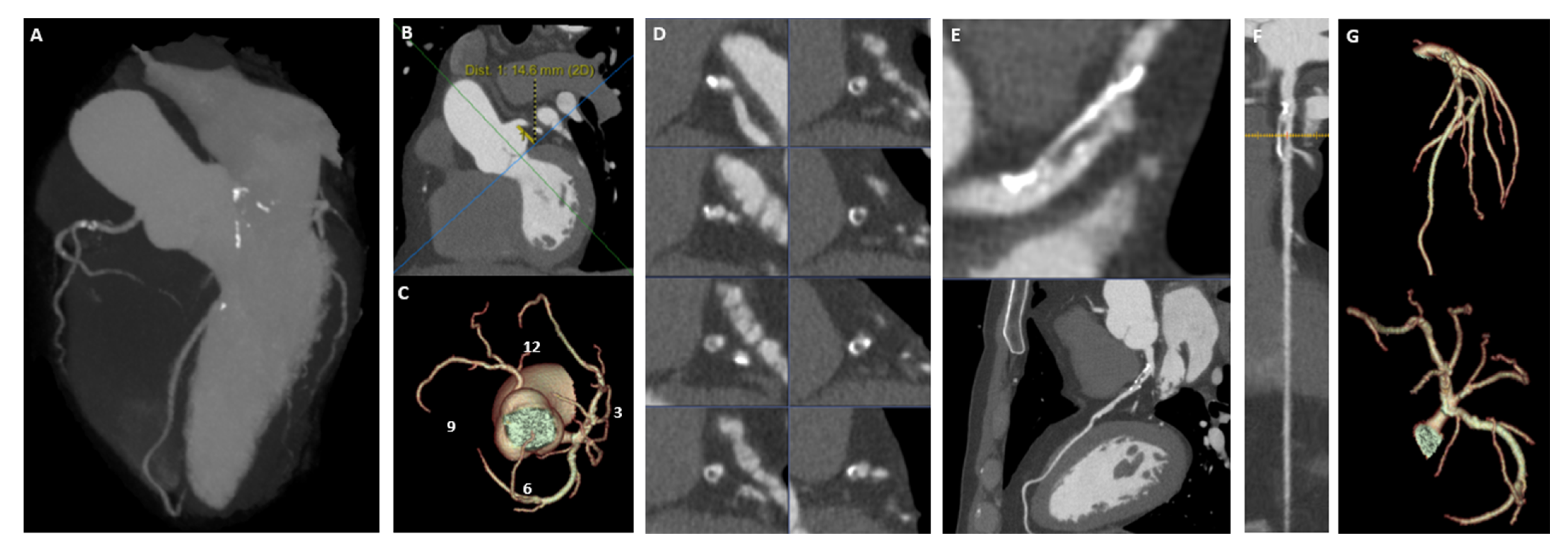
- Maximal Intensity Projection (MIP) images of the coronary tree.
- •
- Exact location and height of coronary ostia.
- •
- Axial images of coronary arteries.
- •
- Multiplanar reformation (MPR) images of coronary arteries.
- •
- Short-axis cross-sectional images.
- •
- Lesion length.
- •
- Bifurcation anatomy and vessel tortuosity, as well as a suggested provisional stenting versus a two-stent approach.
- •
- Calcification burden, including the arc of the calcification in degrees and the calcification length.
- •
- Lesion morphology, including the presence and extent of mixed and non-calcified plaques.
- •
- Optimal C-arm angulation angles.
- •
- The need for lesion preparation (rotational atherectomy or intravascular lithotripsy), choice of guiding catheter, stenting strategy, and projection angles may be adapted accordingly.
2.8. Data Collection
- ▪
- Demographics: age, gender, date of admission, and length of hospitalization.
- ▪
- Indications for CCTA and ICA: typical angina pectoris, atypical angina pectoris, non-anginal chest pain, or presence of dyspnea.
- ▪
- Medical history and cardiovascular risk factors: prior myocardial infarction, hypertension, dyslipidemia, diabetes mellitus, current or prior cigarette smoking, chronic obstructive pulmonary disease, chronic kidney disease, atrial fibrillation, or peripheral artery disease.
- ▪
- Cardiac medications at baseline.
- ▪
- Echocardiographic data: left ventricular ejection fraction (LVEF) or presence of regional wall motion abnormalities.
- ▪
- CCTA data:
- o
- Anatomic lesion location, including segment number and classification into proximal, mid, or distal vessel.
- o
- Ostial involvement and measurement of coronary ostium height from the aortic annulus.
- o
- Takeoff angle of right and left coronary ostia, assessed using clock-face reference.
- o
- Plaque composition (calcified, non-calcified or mixed based on the presence of the calcified content by visual criteria of >80%, 20–80% and <20% calcium content) [12].
- o
- Presence of high-risk plaque features, including: positive remodeling, napkin-ring sign, low attenuation plaque (<30 HU) or spotty calcification [13].
- o
- Total coronary calcium score quantified using the Agatston score.
- ▪
- Invasive procedural data: Comprehensive data from invasive coronary procedures will be collected, including: use of advanced intracoronary imaging (IVUS if necessary), use of physiological assessment (FFR or iFR/RFR if necessary), number of stents implanted, their total length, stent diameters, the use of re-dilation, including the use of scoring balloons and the corresponding pressures, and the use of lesion modification techniques (rotablation or/and intravascular lithotripsy), and bifurcation stenting strategies including provisional versus bifurcation stenting if necessary.
- ▪
- Procedural outcomes and metrics: Final TIMI flow grade, residual stenosis in percentage, procedural success, defined as final TIMI 3 flow with <20% residual stenosis in the treated segment and absence of in-hospital major adverse procedural events, additional procedural metrics included total fluoroscopy time (minutes), radiation exposure (mGy), contrast volume used (ml), and total procedure duration (minutes).
- ▪
- Operator feedback and satisfaction:
- o
- Use of CT-based projections during PCI.
- o
- Prediction of stent dimensions (length and diameter) based on CCTA measurements.
- o
- Prediction of landing zones for stent deployment.
- o
- Satisfaction with CCTA planning (1–5 scale for both primary and secondary operators).
- o
- Perceived benefit of CCTA-derived data on ostial angle, lesion length, plaque quality and projection guidance, helping with reducing procedure time, fluoroscopy exposure and complications.
- o
- Whether CCTA planning helped in avoiding unnecessary PCI or reducing the number of stents required for lesion treatment.
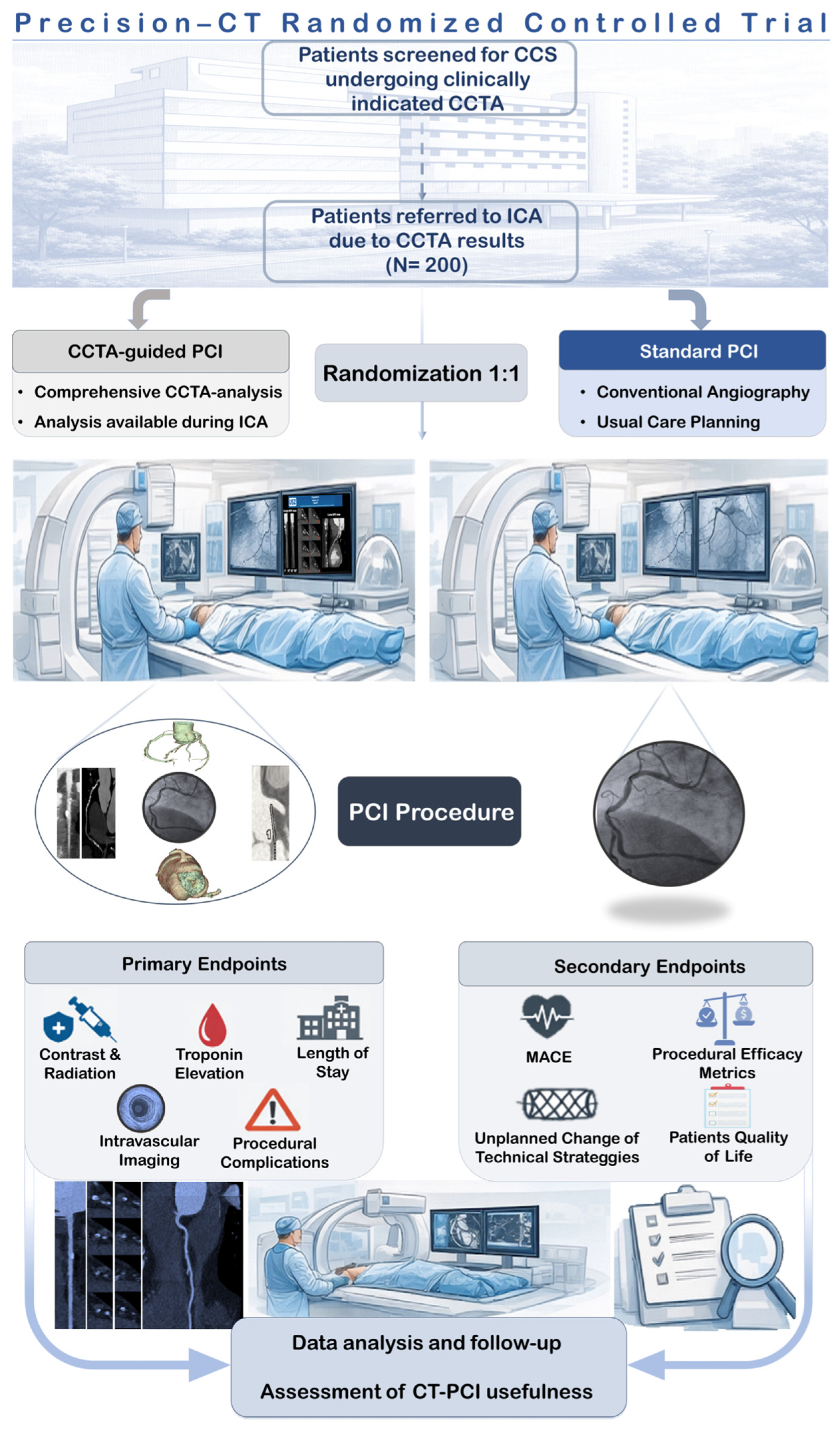
2.9. Study Endpoints
- Need for intravascular imaging (IVUS).
- Occurrence of major procedural complications (perforation, severe dissection, stent malapposition, or under-expansion requiring post-dilatation, main/side branch occlusion).
- Post-procedural high-sensitivity troponin T elevation >5-fold compared to baseline at 24 h.
- Contrast volume > 200 mL as established in prior interventional studies.
- Radiation dose > predefined threshold (estimated effective dose of >16.1 mSv) according to institutional and published reference levels for PCI procedures [14].
2.10. Initial Observational Feasibility Phase
2.11. Statistical Analysis
3. Discussion
4. Conclusions
Supplementary Materials
Author Contributions
Funding
Institutional Review Board Statement
Informed Consent Statement
Data Availability Statement
Acknowledgments
Conflicts of Interest
References
- Vrints, C.; Andreotti, F.; Koskinas, K.C.; Rossello, X.; Adamo, M.; Ainslie, J.; Banning, A.P.; Budaj, A.; Buechel, R.R.; Chiariello, G.A.; et al. 2024 ESC Guidelines for the Management of Chronic Coronary Syndromes. Eur. Heart J. 2024, 45, 3415–3537. [Google Scholar] [CrossRef] [PubMed]
- Korosoglou, G.; Thiele, H.; Silber, S.; Schmitz, T.; Tiefenbacher, C.; Landmesser, U.; Helfen, A.; Nowak, B.; Bernhardt, P.; Baldus, S.; et al. Bedarfs- und leitliniengerechte Diagnostik bei symptomatischer obstruktiver koronarer Herzkrankheit mittels Kardio-CT und MRT. Kardiologie 2023, 17, 406–417. [Google Scholar] [CrossRef]
- Ochs, M.; Breitbart, P.; Sultan, A.; Hell, M.; Schulz-Menger, J.; Lurz, P.; Tillmanns, C.; Tesche, C.; Linke, A.; Achenbach, S.; et al. DGK-Positionspapier zur Schnittbildgebung Teil I: Kardiale Computertomographie zur periprozeduralen Planung und Durchführung von kardialen Interventionen. Kardiologie 2025, 19, 128–146. [Google Scholar] [CrossRef]
- Sandoval, Y.; Leipsic, J.; Collet, C.; Ali, Z.A.; Azzalini, L.; Barbato, E.; Cavalcante, J.L.; Costa, R.A.; Garcia-Garcia, H.M.; Jones, D.A.; et al. Coronary Computed Tomography Angiography to Guide Percutaneous Coronary Intervention: Expert Opinion from a SCAI/SCCT Roundtable. J. Cardiovasc. Comput. Tomogr. 2025, 19, 277–290. [Google Scholar] [CrossRef]
- Serruys, P.W.; Kotoku, N.; Nørgaard, B.; Garg, S.; Nieman, K.; Dweck, M.; Bax, J.; Knuuti, J.; Narula, J.; Perera, D.; et al. Computed Tomographic Angiography in Coronary Artery Disease. EuroIntervention 2023, 18, e1307–e1327. [Google Scholar] [CrossRef] [PubMed] [PubMed Central]
- Shabbir, A.; Attia, A.; Weber, N.M.; Alhassan, M.; Radike, M.; Lane, C.M.; Challa, A.B.; Wamil, M. The Emerging Role of Computed Tomography Coronary Angiography in the Left Main Stem Percutaneous Coronary Intervention. Rev. Cardiovasc. Med. 2025, 26, 37379. [Google Scholar] [CrossRef]
- Kolossváry, M.; Szilveszter, B.; Merkely, B.; Maurovich-Horvat, P. Plaque Imaging with CT—A Comprehensive Review on Coronary CT Angiography Based Risk Assessment. Cardiovasc. Diagn. Ther. 2017, 7, 489–506. [Google Scholar] [CrossRef]
- Douglas, P.S.; Nanna, M.G.; Kelsey, M.D.; Yow, E.; Mark, D.B.; Patel, M.R.; Rogers, C.; Udelson, J.E.; Fordyce, C.B.; Curzen, N.; et al. Comparison of an Initial Risk-Based Testing Strategy vs Usual Testing in Stable Symptomatic Patients with Suspected Coronary Artery Disease: The PRECISE Randomized Clinical Trial. JAMA Cardiol. 2023, 8, 904–914. [Google Scholar] [CrossRef] [PubMed]
- Stalikas, N.; Bouisset, F.; Mizukami, T.; Tajima, A.; Munhoz, D.; Ikeda, K.; Sonck, J.; Wyffels, E.; Wilgenhof, A.; Astudillo, P.; et al. Clinical Utility of Coronary CT Angiography to Guide PCI: A Survey among P4 Investigators. Int. J. Cardiovasc. Imaging 2025. Epub ahead of print. [Google Scholar]
- Lee, S.; Giesen, A.; Mouselimis, D.; Weichsel, L.; Giannopoulos, A.A.; Nunninger, M.; Renker, M.; André, F.; Frey, N.; Korosoglou, G. Composite Cardiac Computed Tomography Angiography Score for Improved Risk Assessment in Chronic Coronary Syndromes. Sci. Rep. 2025, 15, 3089. [Google Scholar] [CrossRef]
- Cury, R.C.; Leipsic, J.; Abbara, S.; Achenbach, S.; Berman, D.; Bittencourt, M.; Budoff, M.; Chinnaiyan, K.; Choi, A.D.; Ghoshhajra, B.; et al. CAD-RADSTM 2.0—2022 Coronary Artery Disease-Reporting and Data System: An Expert Consensus Document of the Society of Cardiovascular Computed Tomography (SCCT), the American College of Cardiology (ACC), the American College of Radiology (ACR), and the North America Society of Cardiovascular Imaging (NASCI). J. Cardiovasc. Comput. Tomogr. 2022, 16, 536–557. [Google Scholar] [CrossRef]
- Gitsioudis, G.; Schüssler, A.; Nagy, E.; Maurovich-Horvat, P.; Buss, S.J.; Voss, A.; Hosch, W.; Hofmann, N.; Kauczor, H.-U.; Giannitsis, E.; et al. Combined Assessment of High-Sensitivity Troponin T and Noninvasive Coronary Plaque Composition for the Prediction of Cardiac Outcomes. Radiology 2015, 276, 73–81. [Google Scholar] [CrossRef]
- Giusca, S.; Schütz, M.; Kronbach, F.; Wolf, D.; Nunninger, P.; Korosoglou, G. Coronary Computer Tomography Angiography in 2021-Acquisition Protocols, Tips and Tricks and Heading beyond the Possible. Diagnostics 2021, 11, 1072. [Google Scholar] [CrossRef]
- Stocker, T.J.; Abdel-Wahab, M.; Möllmann, H.; Deseive, S.; Massberg, S.; Hausleiter, J. Trends and predictors of radiation exposure in percutaneous coronary intervention: The PROTECTION VIII study. EuroIntervention 2022, 18, e324–e332. [Google Scholar] [CrossRef]
- Writing Committee Members; Gulati, M.; Levy, P.D.; Mukherjee, D.; Amsterdam, E.; Bhatt, D.L.; Birtcher, K.K.; Blankstein, R.; Boyd, J.; Bullock-Palmer, R.P.; et al. 2021 AHA/ACC/ASE/CHEST/SAEM/SCCT/SCMR Guideline for the Evaluation and Diagnosis of Chest Pain: A Report of the American College of Cardiology/American Heart Association Joint Committee on Clinical Practice Guidelines. J. Am. Coll. Cardiol. 2021, 78, e187–e285. [Google Scholar] [CrossRef] [PubMed]
- Hong, S.-J.; Kim, B.-K.; Cho, I.; Kim, H.-Y.; Rha, S.-W.; Lee, S.-H.; Park, S.M.; Kim, Y.H.; Chang, H.-J.; Ahn, C.-M.; et al. Effect of Coronary CTA on Chronic Total Occlusion Percutaneous Coronary Intervention: A Randomized Trial. JACC Cardiovasc. Imaging 2021, 14, 1993–2004. [Google Scholar] [CrossRef]
- Jones, D.A.; Beirne, A.-M.; Kelham, M.; Rathod, K.S.; Andiapen, M.; Wynne, L.; Godec, T.; Forooghi, N.; Ramaseshan, R.; Moon, J.C.; et al. Computed Tomography Cardiac Angiography Before Invasive Coronary Angiography in Patients with Previous Bypass Surgery: The BYPASS-CTCA Trial. Circulation 2023, 148, 1371–1380. [Google Scholar] [CrossRef]
- Kumar, S.; Opolski, M.P.; Ahn, J.-M.; Collet, C.; Carvalho, P.E.P.; Jaffer, F.; Werner, G.S.; Leipsic, J.; Kim, B.-K.; Cavalcante, J.; et al. The Role of Coronary Computed Tomography Angiography in Chronic Total Occlusion Percutaneous Coronary Intervention. JACC Cardiovasc. Interv. 2026, 19, 1–14. [Google Scholar] [CrossRef]
- Collet, C.; Onuma, Y.; Andreini, D.; Sonck, J.; Pompilio, G.; Mushtaq, S.; La Meir, M.; Miyazaki, Y.; de Mey, J.; Gaemperli, O.; et al. Coronary Computed Tomography Angiography for Heart Team Decision-Making in Multivessel Coronary Artery Disease. Eur. Heart J. 2018, 39, 3689–3698. [Google Scholar] [CrossRef]
- Chan, Z.; Carvalho, P.E.P.; Cavalcante, J.L.; Lesser, J.; Cheng, V.; Brilakis, E.S.; Sandoval, Y. Left Main Coronary CT-Guided Percutaneous Coronary Intervention: Role of Virtual Planning and Wireless Physiology. JACC Cardiovasc. Interv. 2024, 17, 2952–2954. [Google Scholar] [CrossRef]
- van den Buijs, D.M.F.; Poels, E.M.; Willems, E.; Cottens, D.; Dotremont, K.; De Leener, K.; Meekers, E.; Ferdinande, B.; Vrolix, M.; Dens, J.; et al. Three-Dimensional CT for Preprocedural Planning of PCI for Ostial Right Coronary Artery Lesions: A Randomized Controlled Pilot Trial. Circ. Cardiovasc. Interv. 2025, 18, e013584. [Google Scholar] [CrossRef]
- Valle, J.A.; Tamez, H.; Abbott, J.D.; Moussa, I.D.; Messenger, J.C.; Waldo, S.W.; Kennedy, K.F.; Masoudi, F.A.; Yeh, R.W. Contemporary Use and Trends in Unprotected Left Main Coronary Artery Percutaneous Coronary Intervention in the United States: An Analysis of the National Cardiovascular Data Registry Research to Practice Initiative. JAMA Cardiol. 2019, 4, 100–109. [Google Scholar] [CrossRef]
- Grines, C.L.; Box, L.C.; Mamas, M.A.; Abbott, J.D.; Blankenship, J.C.; Carr, J.G.; Curzen, N.; Kent, W.D.T.; Khatib, Y.; Matteau, A.; et al. SCAI Expert Consensus Statement on Percutaneous Coronary Intervention Without On-Site Surgical Backup. J. Soc. Cardiovasc. Angiogr. Interv. 2023, 2, 100560. [Google Scholar] [CrossRef]
- Andreini, D.; Belmonte, M.; Penicka, M.; Van Hoe, L.; Mileva, N.; Paolisso, P.; Nagumo, S.; Nørgaard, B.L.; Ko, B.; Otake, H.; et al. Impact of Coronary CT Image Quality on the Accuracy of the FFRCT Planner. Eur. Radiol. 2024, 34, 2677–2688. [Google Scholar] [CrossRef]
- Sonck, J.; Nagumo, S.; Norgaard, B.L.; Otake, H.; Ko, B.; Zhang, J.; Mizukami, T.; Maeng, M.; Andreini, D.; Takahashi, Y.; et al. Clinical Validation of a Virtual Planner for Coronary Interventions Based on Coronary CT Angiography. JACC Cardiovasc. Imaging 2022, 15, 1242–1255. [Google Scholar] [CrossRef]
- Shiyovich, A.; Singh, A.; Blair, C.V.; Cardoso, R.; Huck, D.; Peng, G.; Shaw, L.J.; Leipsic, J.A.; Gräni, C.; Antoniades, C.; et al. Photon-Counting Computed Tomography in Cardiac Imaging. JACC Cardiovasc. Imaging 2026, 19, 94–117. [Google Scholar] [CrossRef]


Disclaimer/Publisher’s Note: The statements, opinions and data contained in all publications are solely those of the individual author(s) and contributor(s) and not of MDPI and/or the editor(s). MDPI and/or the editor(s) disclaim responsibility for any injury to people or property resulting from any ideas, methods, instructions or products referred to in the content. |
© 2026 by the authors. Licensee MDPI, Basel, Switzerland. This article is an open access article distributed under the terms and conditions of the Creative Commons Attribution (CC BY) license.
Share and Cite
Moysidis, D.V.; Bogert, N.V.; Giusca, S.; Buechel, R.R.; Giannopoulos, A.A.; Korosoglou, G. Rationale and Design of the “PRECISION-CT” Study—A Prospective Evaluation of Coronary CTA Integration for Strategy Improvement and Optimization of PCI in Chronic Coronary Syndrome. Diagnostics 2026, 16, 715. https://doi.org/10.3390/diagnostics16050715
Moysidis DV, Bogert NV, Giusca S, Buechel RR, Giannopoulos AA, Korosoglou G. Rationale and Design of the “PRECISION-CT” Study—A Prospective Evaluation of Coronary CTA Integration for Strategy Improvement and Optimization of PCI in Chronic Coronary Syndrome. Diagnostics. 2026; 16(5):715. https://doi.org/10.3390/diagnostics16050715
Chicago/Turabian StyleMoysidis, Dimitrios V., Nicolai V. Bogert, Sorin Giusca, Ronny R. Buechel, Andreas A. Giannopoulos, and Grigorios Korosoglou. 2026. "Rationale and Design of the “PRECISION-CT” Study—A Prospective Evaluation of Coronary CTA Integration for Strategy Improvement and Optimization of PCI in Chronic Coronary Syndrome" Diagnostics 16, no. 5: 715. https://doi.org/10.3390/diagnostics16050715
APA StyleMoysidis, D. V., Bogert, N. V., Giusca, S., Buechel, R. R., Giannopoulos, A. A., & Korosoglou, G. (2026). Rationale and Design of the “PRECISION-CT” Study—A Prospective Evaluation of Coronary CTA Integration for Strategy Improvement and Optimization of PCI in Chronic Coronary Syndrome. Diagnostics, 16(5), 715. https://doi.org/10.3390/diagnostics16050715