Article

The Effect of Metacognitive and Emotional Schemas on the Severity of Symptoms in Patients with Fibromyalgia


by
Mehmet Serhat Topaloğlu
1,* and
Meltem Puşuroğlu
2
1
Department of Physical Medicine and Rehabilitation, Faculty of Medicine, Recep Tayyip Erdoğan University, Rize 53100, Türkiye
2
Department of Psychiatry, Faculty of Medicine, Recep Tayyip Erdoğan University, Rize 53100, Türkiye
*
Author to whom correspondence should be addressed.
Diagnostics 2026, 16(5), 696; https://doi.org/10.3390/diagnostics16050696

Submission received: 1 February 2026 / Revised: 23 February 2026 / Accepted: 24 February 2026 / Published: 26 February 2026
(This article belongs to the Section Clinical Diagnosis and Prognosis)

Abstract

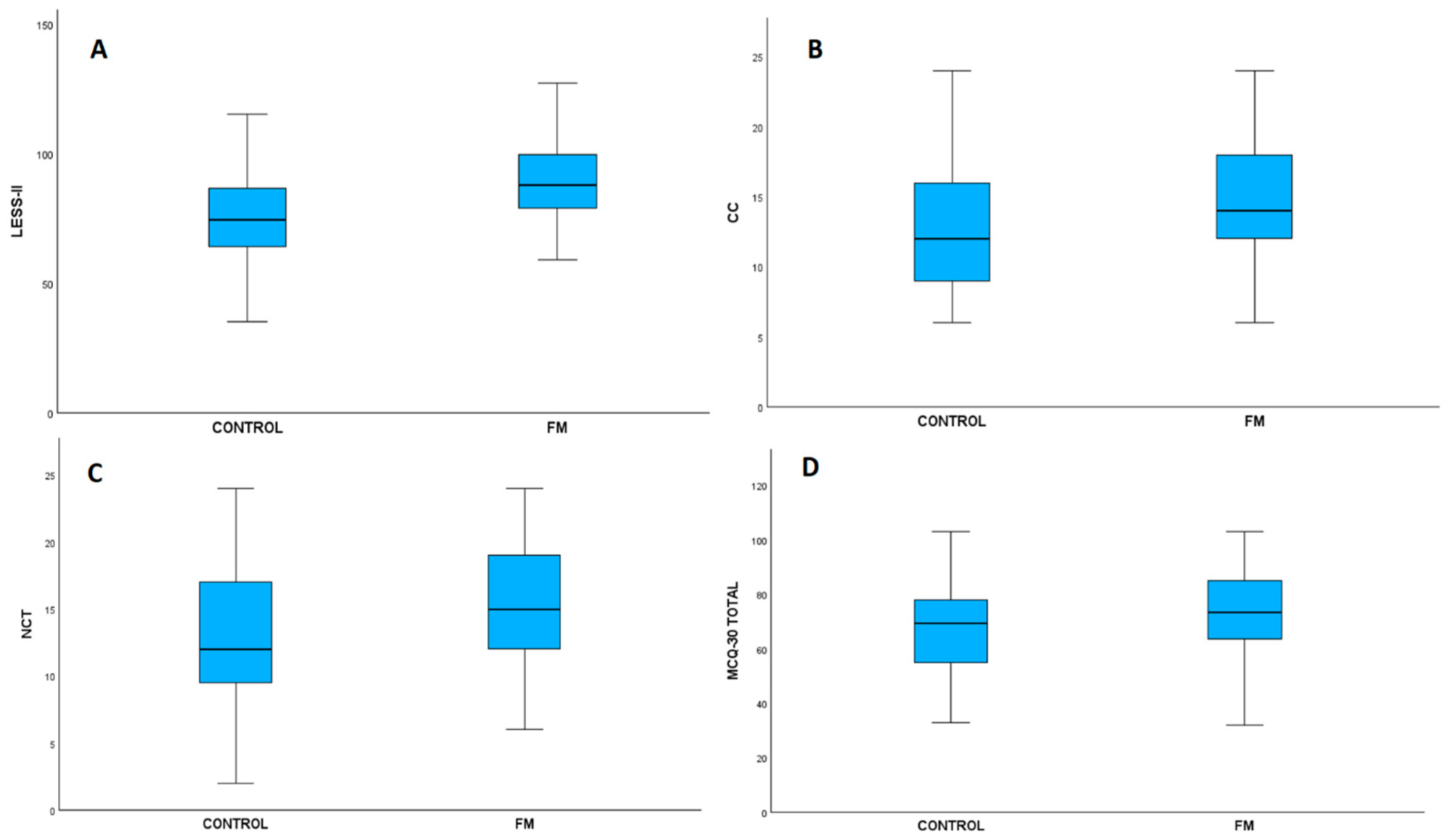
Background/Objectives: The prevalence of mental disorders has increased in fibromyalgia (FM). Therefore, individuals’ pain perception, emotional schemas, and coping strategies are important. Our study aims to examine emotional schemas and metacognitive levels in FM. Methods: The study included 88 FM and 88 healthy controls who consecutively presented to the clinic. All participants completed the Leahy Emotional Schema Scale-II (LESS-II) and the Metacognition Questionnaire-30 (MCQ-30). Patients were also administered the Polysymptomatic Distress scale (PSD) and the Fibromyalgia Impact Questionnaire (FIQ). Results: The study included 88 FM patients and 88 controls. In the study, the LESS-II total score and MCQ-30 score were significantly higher in the patient group compared to the control group (p < 0.05). When examining the factors affecting FIQ severity, LESS-II scores and gender variables were found to be variables predicting FIQ values (p = 0.002, p = 0.002, respectively). When looking at the factors affecting the PSD score, the LESS-II score is a significant variable predicting the PSD score (p = 0.029). Conclusions: This study demonstrated that FM patients have higher levels of negative emotional schemas compared to healthy controls, and that emotional schemas are associated with both FM symptom severity and the impact of the disease on daily life. In particular, that LESS-II scores predict PSD scores and that LESS-II and gender variables predict FIQ scores suggests that symptom burden and functional effects in FM may be closely related to cognitive-emotional processes. The findings support the importance of considering emotional schemas in FM assessment and treatment approaches.
Keywords: fibromyalgia; metacognition; emotions; schemas; chronic pain fibromyalgia; metacognition; emotions; schemas; chronic pain