


Concealed Placental Abruption Complicating Hypertensive Disorders of Pregnancy: Exploring the Role of Point-of-Care Ultrasound
 ,
, 
Abstract
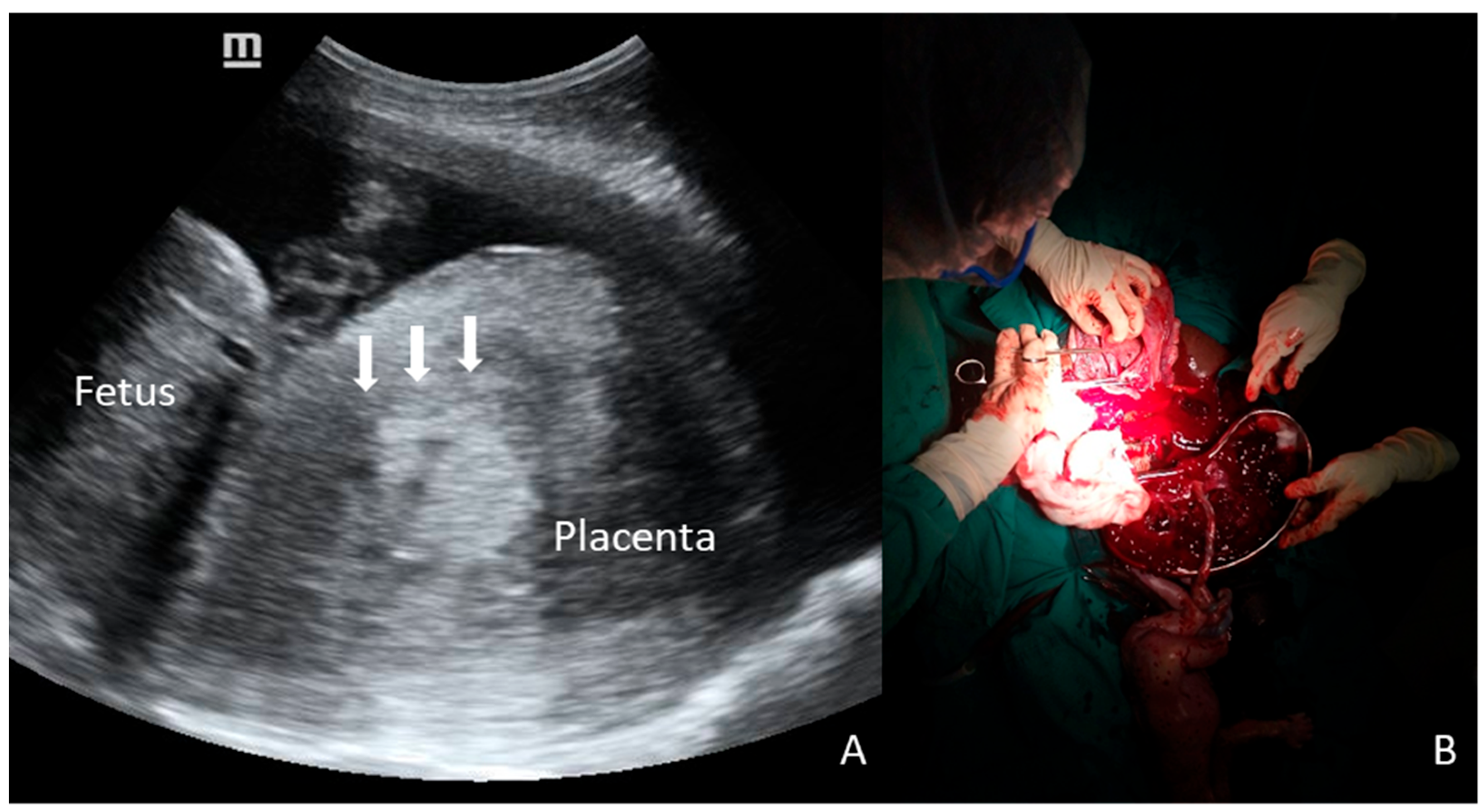
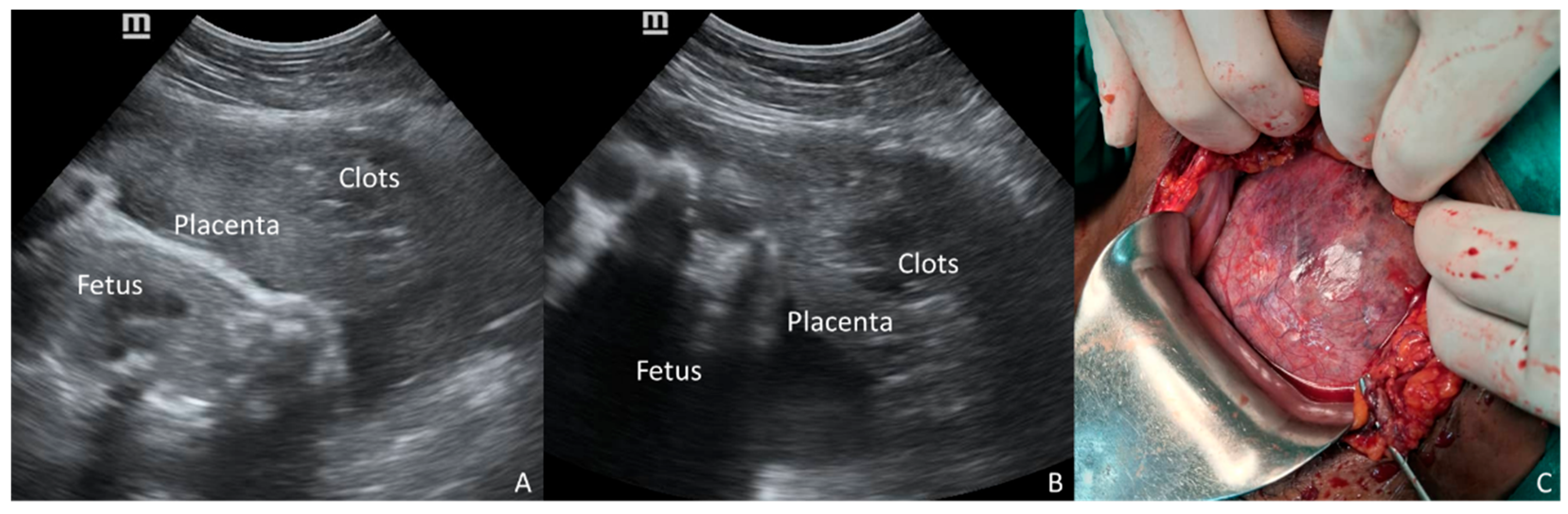
Author Contributions
Funding
Institutional Review Board Statement
Informed Consent Statement
Data Availability Statement
Conflicts of Interest
References
- Oyelese, Y.; Ananth, C.V. Placental abruption. Obstet. Gynecol. 2006, 108, 1005–1016. [Google Scholar] [CrossRef]
- Toivonen, S.; Heinonen, S.; Anttila, M.; Kosma, V.-M.; Saarikoski, S. Reproductive risk factors, Doppler findings, and outcome of affected births in placental abruption: A population-based analysis. Am. J. Perinatol. 2002, 19, 451–460. [Google Scholar] [CrossRef] [PubMed]
- Ananth, C.V.; Lavery, J.A.; Vintzileos, A.M.; Skupski, D.W.; Varner, M.; Saade, G.; Biggio, J.; Williams, M.A.; Wapner, R.J.; Wright, J.D. Severe placental abruption: Clinical definition and associations with maternal complications. Am. J. Obstet. Gynecol. 2016, 214, 272.e1–272.e9. [Google Scholar] [CrossRef]
- Kasai, M.; Aoki, S.; Ogawa, M.; Kurasawa, K.; Takahashi, T.; Hirahara, F. Prediction of perinatal outcomes based on primary symptoms in women with placental abruption. J. Obs. Gynaecol. Res. 2016, 42, 1419–1425. [Google Scholar] [CrossRef] [PubMed]
- Mei, Y.; Lin, Y. Clinical significance of primary symptoms in women with placental abruption. J. Matern. Fetal Neonatal Med. 2018, 31, 2446–2449. [Google Scholar] [CrossRef] [PubMed]
- Tikkanen, M.; Nuutila, M.; Hiilesmaa, V.; Paavonen, J.; Ylikorkala, O. Clinical presentation and risk factors of placental abruption. Acta Obstet. Gynecol. Scand. 2006, 85, 700–705. [Google Scholar] [CrossRef] [PubMed]
- Han, M.; Liu, D.; Zeb, S.; Li, C.; Tong, M.; Li, X.; Chen, Q. Are maternal and neonatal outcomes different in placental abruption between women with and without preeclampsia? Placenta 2019, 84, 32–37. [Google Scholar] [CrossRef] [PubMed]
- Morgan, M.A.; Berkowitz, K.M.; Thomas, S.J.; Reimbold, P.; Quilligan, E.J. Abruptio placentae: Perinatal outcome in normotensive and hypertensive patients. Am. J. Obstet. Gynecol. 1994, 170, 1595–1599. [Google Scholar] [CrossRef] [PubMed]
- Akkaya, H.; Uysal, G.; Yilmaz, G. Comparison of maternal neonatal outcomes of normotensive and hypertensive placental abruptions: A novel approach. Medicine 2019, 98, e14992. [Google Scholar] [CrossRef] [PubMed]
- Ni, S.; Wang, X.; Cheng, X. The comparison of placental abruption coupled with and without preeclampsia and/or intrauterine growth restriction in singleton pregnancies. J. Matern. Fetal Neonatal Med. 2019, 32, 3122–3128. [Google Scholar] [CrossRef] [PubMed]
- van der Zande, J.A.; Rijs, K.; Shamshirsaz, A.A.; Soliman, H.; Franx, A.; Kauling, R.M.; Roos-Hesselink, J.W.; van der Marel, C.D.; Verdonk, K.; Cornette, J.M.J. The role of point-of-care ultrasound (POCUS) in maternal medicine. Best Pract. Res. Clin. Obstet. Gynaecol. 2025, 100, 102599. [Google Scholar] [CrossRef] [PubMed]
- De Robertis, V.; Bilardo, C.M.; Abu-Rustum, R.; Poon, L.C.; Kamel, R.; Manieri Rocha, R.; Syngelaki, A.; Stampalija, T.; Collaborators. ISUOG Practice Guidelines: Point-of-care ultrasound in obstetrics and gynecology. Ultrasound Obstet. Gynecol. 2026, 67, 116–127. [Google Scholar] [CrossRef] [PubMed]
- Glantz, C.; Purnell, L. Clinical utility of sonography in the diagnosis and treatment of placental abruption. J. Ultrasound Med. 2002, 21, 837–840. [Google Scholar] [CrossRef] [PubMed]
- Gobeze, A.A.; Kebede, Z.; Berhan, Y.; Ghosh, B. Clinical Performance of Emergency Surgical Officers in Southern Ethiopia. Ethiop. J. Health Sci. 2016, 26, 463–470. [Google Scholar] [CrossRef] [PubMed] [PubMed Central]
- Kodaira, Y.; Pisani, L.; Boyle, S.; Olumide, S.; Orsi, M.; Adeniji, A.O.; Pisani, E.; Zanette, M.; Putoto, G.; Koroma, M.M. Reliability of ultrasound findings acquired with handheld apparatuses to inform urgent obstetric diagnosis in a high-volume resource-limited setting. Int. J. Gynaecol. Obstet. 2021, 153, 280–286. [Google Scholar] [CrossRef] [PubMed]
Disclaimer/Publisher’s Note: The statements, opinions and data contained in all publications are solely those of the individual author(s) and contributor(s) and not of MDPI and/or the editor(s). MDPI and/or the editor(s) disclaim responsibility for any injury to people or property resulting from any ideas, methods, instructions or products referred to in the content. |
© 2026 by the authors. Licensee MDPI, Basel, Switzerland. This article is an open access article distributed under the terms and conditions of the Creative Commons Attribution (CC BY) license.
Share and Cite
Orsi, M.; Merga, D.; Negera, F.; Shifata, W.; Atomsa, A.; Bobbio, F.; Taye, A. Concealed Placental Abruption Complicating Hypertensive Disorders of Pregnancy: Exploring the Role of Point-of-Care Ultrasound. Diagnostics 2026, 16, 478. https://doi.org/10.3390/diagnostics16030478
Orsi M, Merga D, Negera F, Shifata W, Atomsa A, Bobbio F, Taye A. Concealed Placental Abruption Complicating Hypertensive Disorders of Pregnancy: Exploring the Role of Point-of-Care Ultrasound. Diagnostics. 2026; 16(3):478. https://doi.org/10.3390/diagnostics16030478
Chicago/Turabian StyleOrsi, Michele, Dereje Merga, Firanbon Negera, Wasihun Shifata, Ashenafi Atomsa, Flavio Bobbio, and Admasu Taye. 2026. "Concealed Placental Abruption Complicating Hypertensive Disorders of Pregnancy: Exploring the Role of Point-of-Care Ultrasound" Diagnostics 16, no. 3: 478. https://doi.org/10.3390/diagnostics16030478
APA StyleOrsi, M., Merga, D., Negera, F., Shifata, W., Atomsa, A., Bobbio, F., & Taye, A. (2026). Concealed Placental Abruption Complicating Hypertensive Disorders of Pregnancy: Exploring the Role of Point-of-Care Ultrasound. Diagnostics, 16(3), 478. https://doi.org/10.3390/diagnostics16030478

