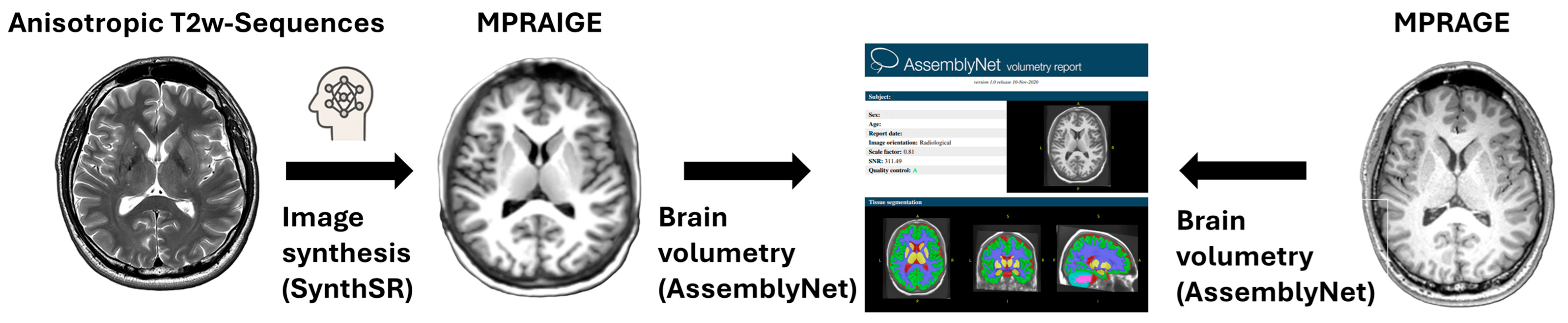
AI-Based Brain Volumetry Without MPRAGE? Evaluation of Synthetic T1-MPRAGE from 2D T2/FLAIR †

 , , , ,
Abstract
1. Introduction
2. Materials and Methods
2.1. Study Population and Magnetic Resonance Imaging
2.2. Image Analysis, Data Preparation, and Artificial Intelligence (AI)-Based Volumetry
3. Results
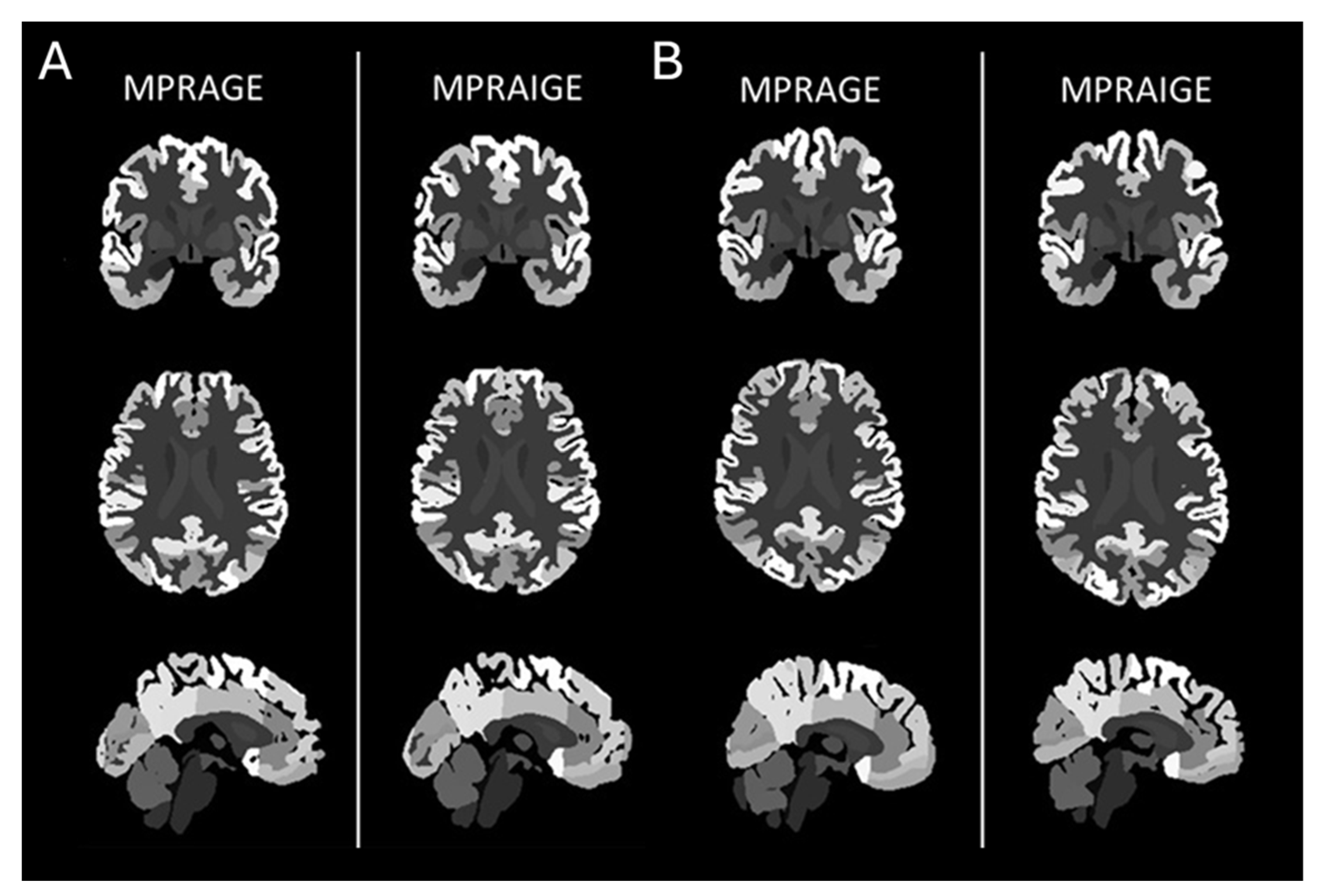
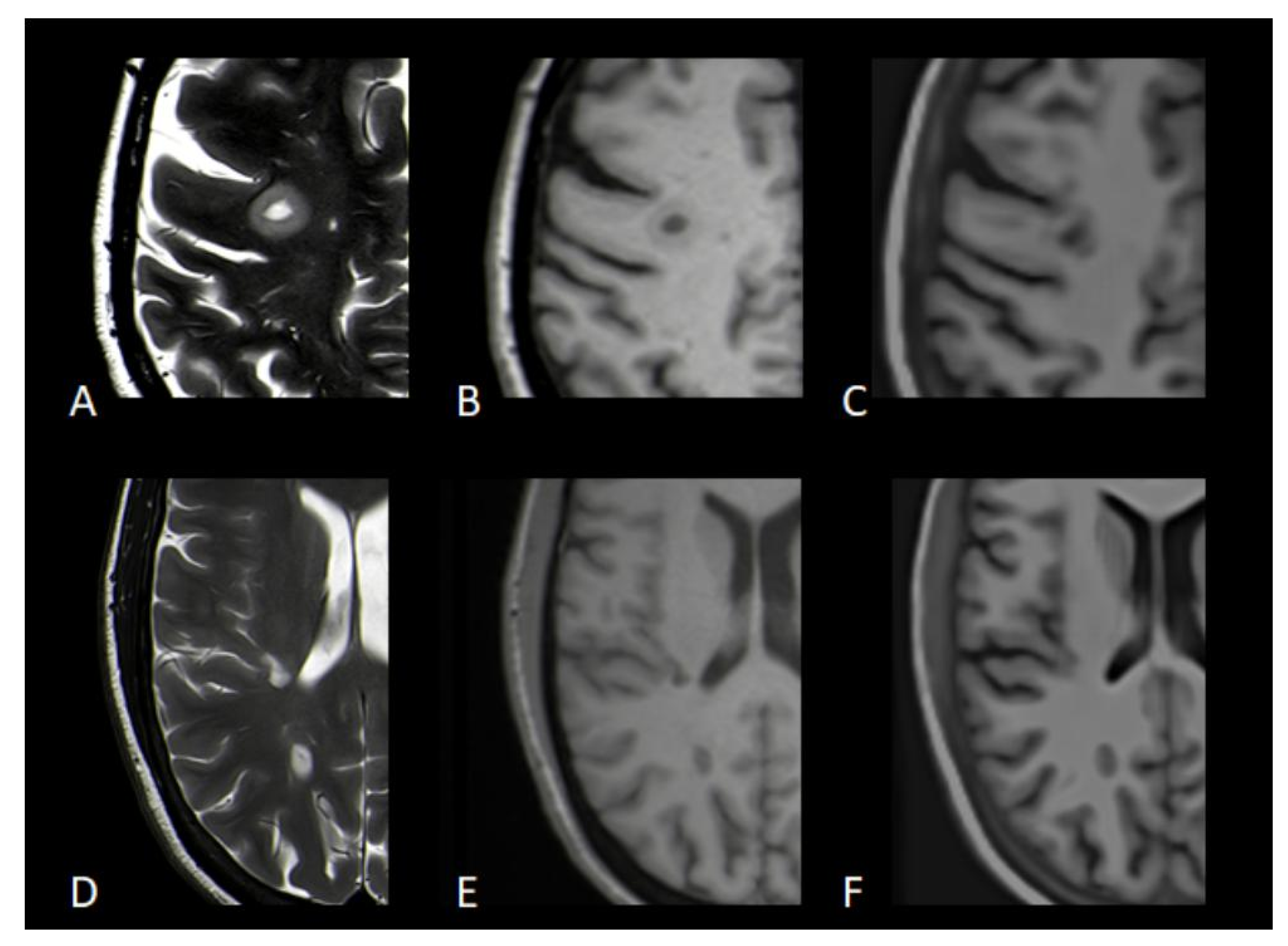
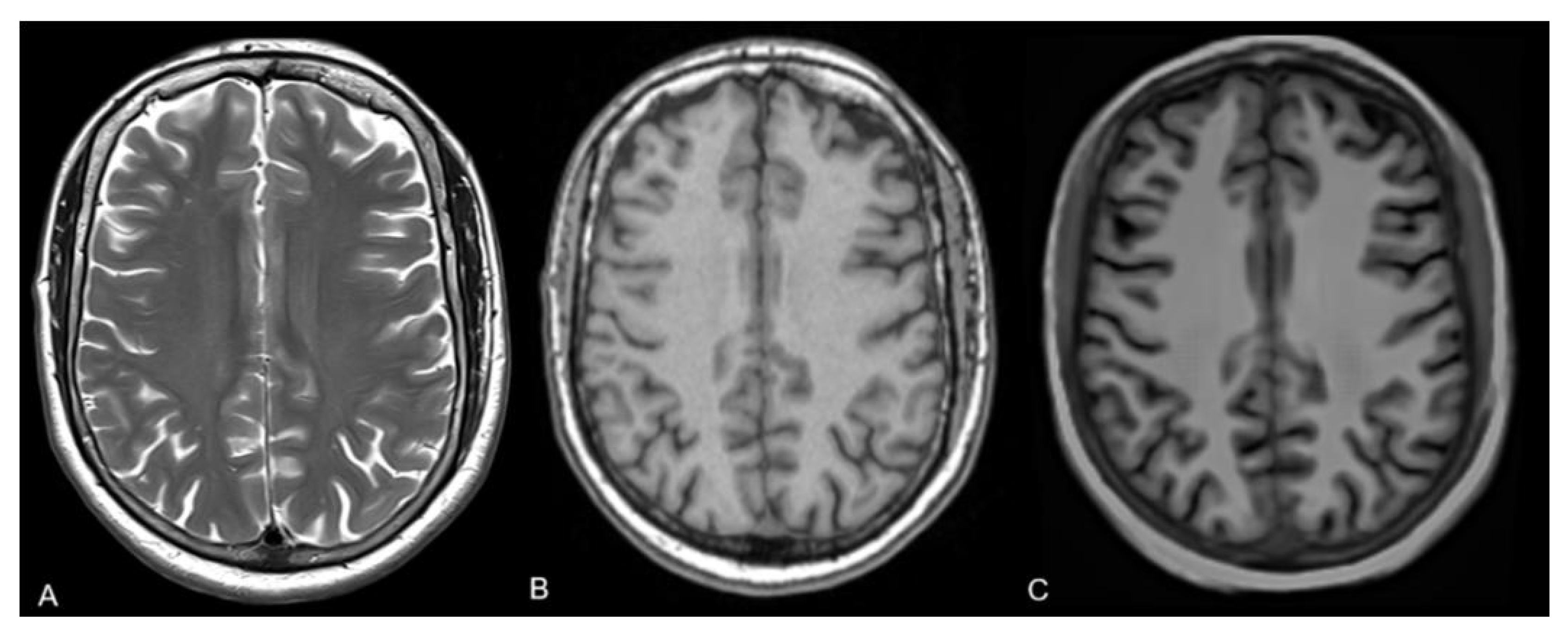
3.1. Generation of Synthetic mprAIge
3.2. Healthy Control Group
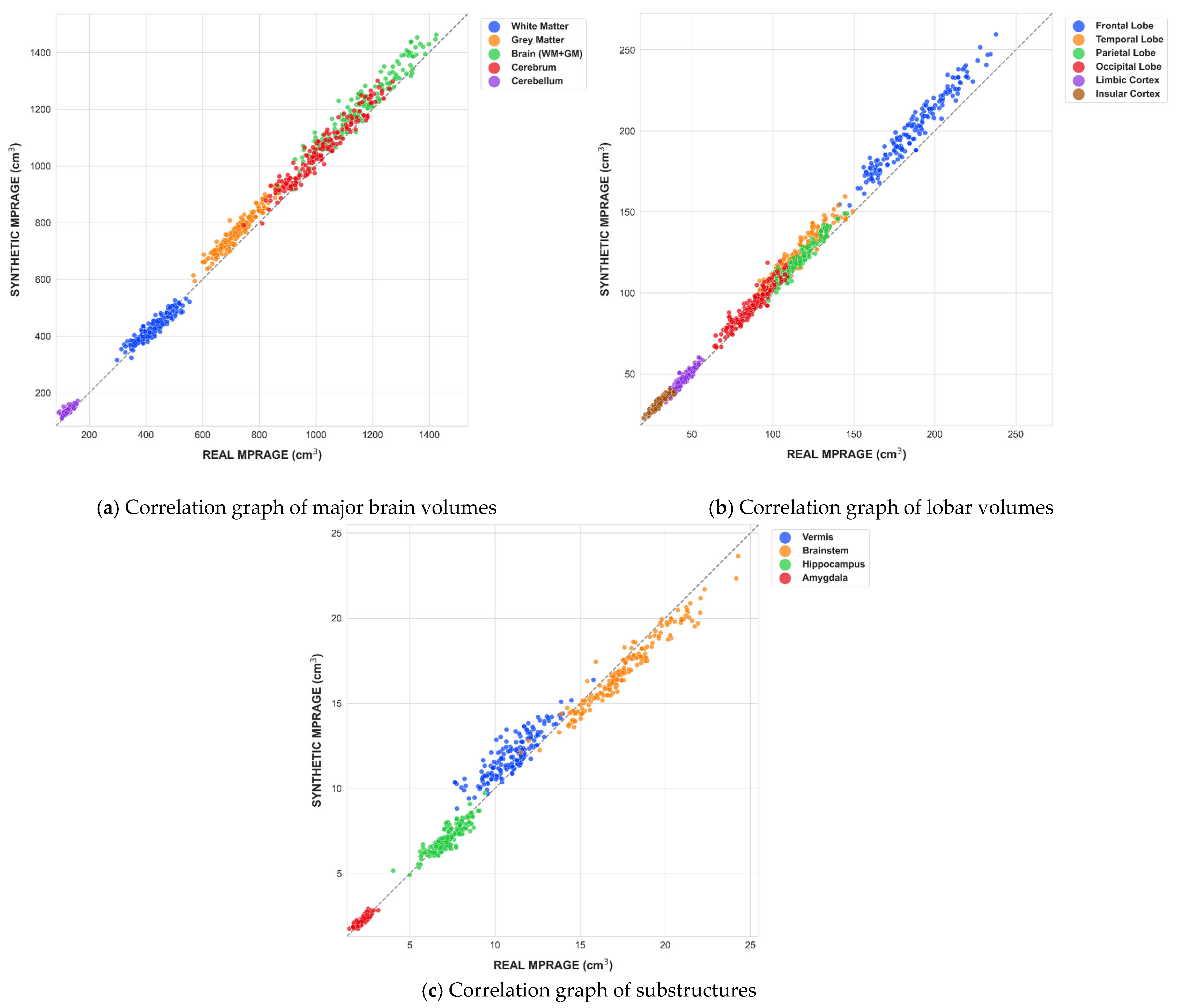
3.2.1. Global Volumetric Analysis
3.2.2. Regional Substructure Analysis
3.2.3. Subcortical Volumetric Analysis
3.3. MS Group
3.3.1. Global Volumetric Analysis
3.3.2. Regional Substructure Analysis
3.3.3. Subcortical Volumetric Analysis
3.4. Statistical Testing
3.4.1. Control Group
3.4.2. MS-Patient Group
4. Discussion
5. Limitations
6. Conclusions
Author Contributions
Funding
Institutional Review Board Statement
Informed Consent Statement
Data Availability Statement
Acknowledgments
Conflicts of Interest
Abbreviations
| AD | Alzheimer’s disease |
| AI | Artificial Intelligence |
| AVD | Average Volume Difference |
| CNN | Convolutional Neural Network |
| FLAIR | Fluid-Attenuated Inversion Recovery |
| GM | Gray Matter |
| GMV | Gray Matter Volume |
| IQR | Interquartile Range |
| MPRAGE | Magnetization-Prepared Rapid Gradient Echo |
| MRI | Magnetic Resonance Imaging |
| MS | Multiple Sclerosis |
| OASIS | Open Access Series of Imaging Studies |
| RMSE | Root Mean Square Error |
| TBV | Total Brain Volume |
| TSE | Turbo Spin Echo |
| WM | White Matter |
| WMH | White Matter Hyperintensities |
| WMV | White Matter Volume |
Appendix A. Detailed Summary of Sequence Parameters
| Sequence | 2D T2w (3.0T) | 2D FLAIR (3.0T) | 3D MPRAGE (3.0T) | 2D T2w (1.5T) | 3D MPRAGE (1.5T) |
| Scanning Sequence | TSE | [TSE, IR] | [GR, IR] | TSE | [GR, IR] |
| Mode | 2D | 2D | 3D | 2D | 3D |
| Slice Thickness (mm) | 3.0 | 3.0 | 1.0 | 3.0 | 1.1 |
| Repetition Time (ms) | 6000 | 8000 | 2300 | 6000 | 1990 |
| Echo Time (ms) | 96 | 87 | 3.20 | 96 | 2.67 |
| Inversion Time (ms) | None | 2370 | 900 | None | None |
| Acquisition Matrix | [0,320,256,0] | [0,320,256,0] | [0,256,256,0] | [0,320,256,0] | [0,256,256,0] |
| Imaging Frequency (MHz) | 123.26 | 123.26 | 123.26 | 63.86 | 63.86 |
| Duration (min:s) | 1:21 | 1:33 | 5:12 | 1:16 | 4:30 |
References
- Iqbal, J.; Cortés Jaimes, D.C.; Makineni, P.; Subramani, S.; Hemaida, S.; Thugu, T.R.; Butt, A.N.; Sikto, J.T.; Kaur, P.; Lak, M.A.; et al. Reimagining Healthcare: Unleashing the Power of Artificial Intelligence in Medicine. Cureus 2023, 15, e44658. [Google Scholar] [CrossRef] [Scilit]
- Kaul, V.; Enslin, S.; Gross, S.A. History of artificial intelligence in medicine. Gastrointest. Endosc. 2020, 92, 807–812. [Google Scholar] [CrossRef] [Scilit]
- Rudolph, J.; Rueckel, J.; Döpfert, J.; Ling, W.X.; Opalka, J.; Brem, C.; Hesse, N.; Ingenerf, M.; Koliogiannis, V.; Solyanik, O.; et al. Artificial intelligence–based rapid brain volumetry substantially improves differential diagnosis in dementia. Alzheimers Dement. Diagn. Assess. Dis. Monit. 2024, 16, e70037. [Google Scholar] [CrossRef] [Scilit]
- Sims, J.R.; Zimmer, J.A.; Evans, C.D.; Lu, M.; Ardayfio, P.; Sparks, J.; Wessels, A.M.; Shcherbinin, S.; Wang, H.; Monkul Nery, E.S.; et al. Donanemab in Early Symptomatic Alzheimer Disease: The TRAILBLAZER-ALZ 2 Randomized Clinical Trial. JAMA 2023, 330, 512–527. [Google Scholar] [CrossRef] [Scilit]
- van Dyck, C.H.; Swanson, C.J.; Aisen, P.; Bateman, R.J.; Chen, C.; Gee, M.; Kanekiyo, M.; Li, D.; Reyderman, L.; Cohen, S.; et al. Lecanemab in Early Alzheimer’s Disease. N. Engl. J. Med. 2023, 388, 9–21. [Google Scholar] [CrossRef] [Scilit]
- Slezáková, D.; Kadlic, P.; Jezberová, M.; Boleková, V.; Valkovič, P.; Minar, M. Brain volume loss in multiple sclerosis is independent of disease activity and might be prevented by early disease-modifying therapy. Neurol. Neurochir. Pol. 2023, 57, 282–288. [Google Scholar] [CrossRef] [Scilit] [PubMed]
- Uher, T.; Krasensky, J.; Malpas, C.; Bergsland, N.; Dwyer, M.G.; Kubala Havrdova, E.; Vaneckova, M.; Horakova, D.; Zivadinov, R.; Kalincik, T. Evolution of Brain Volume Loss Rates in Early Stages of Multiple Sclerosis. Neurol. Neuroimmunol. Neuroinflamm. 2021, 8, e979. [Google Scholar] [CrossRef] [Scilit] [PubMed]
- Mugler, J.P.; Brookeman, J.R. Three-dimensional magnetization-prepared rapid gradient-echo imaging (3D MP RAGE). Magn. Reson. Med. 1990, 15, 152–157. [Google Scholar] [CrossRef] [Scilit] [PubMed]
- Fischl, B.; Salat, D.H.; Busa, E.; Albert, M.; Dieterich, M.; Haselgrove, C.; van der Kouwe, A.; Killiany, R.; Kennedy, D.; Klaveness, S.; et al. Whole brain segmentation: Automated labeling of neuroanatomical structures in the human brain. Neuron 2002, 33, 341–355. [Google Scholar] [CrossRef] [Scilit]
- Keller, S.; Roberts, N. Measurement of brain volume using MRI: Software, techniques, choices and prerequisites. J. Anthropol. Sci. Riv. Antropol. JASS Ist. Ital. Antropol. 2009, 87, 127–151. [Google Scholar]
- Friedlinger, M.; Schad, L.R.; Blüml, S.; Tritsch, B.; Lorenz, W.J. Rapid automatic brain volumetry on the basis of multispectral 3D MR imaging data on personal computers. Comput. Med. Imaging Graph. Off. J. Comput. Med. Imaging Soc. 1995, 19, 185–205. [Google Scholar] [CrossRef] [Scilit] [PubMed]
- Alonso, J.; Pareto, D.; Alberich, M.; Kober, T.; Maréchal, B.; Lladó, X.; Rovira, A. Assessment of brain volumes obtained from MP-RAGE and MP2RAGE images, quantified using different segmentation methods. Magn. Reson. Mater. Phys. Biol. Med. 2020, 33, 757–767. [Google Scholar] [CrossRef] [Scilit]
- Iglesias, J.E.; Billot, B.; Balbastre, Y.; Tabari, A.; Conklin, J.; Gilberto González, R.; Alexander, D.C.; Golland, P.; Edlow, B.L.; Fischl, B. Joint super-resolution and synthesis of 1 mm isotropic MP-RAGE volumes from clinical MRI exams with scans of different orientation, resolution and contrast. NeuroImage 2021, 237, 118206. [Google Scholar] [CrossRef] [Scilit]
- Huang, Y.; Shao, L.; Frangi, A.F. Simultaneous Super-Resolution and Cross-Modality Synthesis of 3D Medical Images Using Weakly-Supervised Joint Convolutional Sparse Coding. 2017, pp. 6070–6079. Available online: https://openaccess.thecvf.com/content_cvpr_2017/html/Huang_Simultaneous_Super-Resolution_and_CVPR_2017_paper.html (accessed on 5 July 2024).
- Du, J.; He, Z.; Wang, L.; Gholipour, A.; Zhou, Z.; Chen, D.; Jia, Y. Super-resolution reconstruction of single anisotropic 3D MR images using residual convolutional neural network. Neurocomputing 2020, 392, 209–220. [Google Scholar] [CrossRef] [Scilit]
- Zhao, C.; Dewey, B.E.; Pham, D.L.; Calabresi, P.A.; Reich, D.S.; Prince, J.L. SMORE: A Self-Supervised Anti-Aliasing and Super-Resolution Algorithm for MRI Using Deep Learning. IEEE Trans. Med. Imaging 2021, 40, 805–817. [Google Scholar] [CrossRef] [Scilit] [PubMed]
- Marcus, D.S.; Wang, T.H.; Parker, J.; Csernansky, J.G.; Morris, J.C.; Buckner, R.L. Open Access Series of Imaging Studies (OASIS): Cross-sectional MRI data in young, middle aged, nondemented, and demented older adults. J. Cogn. Neurosci. 2007, 19, 1498–1507. [Google Scholar] [CrossRef] [Scilit] [PubMed]
- Puonti, O.; Iglesias, J.E.; Van Leemput, K. Fast and sequence-adaptive whole-brain segmentation using parametric Bayesian modeling. NeuroImage 2016, 143, 235–249. [Google Scholar] [CrossRef] [Scilit]
- Manjón, J.V.; Coupé, P. volBrain: An Online MRI Brain Volumetry System. Front. Neuroinform. 2016, 10, 30. [Google Scholar] [CrossRef] [Scilit]
- Khadhraoui, E.; Nickl-Jockschat, T.; Henkes, H.; Behme, D.; Müller, S.J. Automated brain segmentation and volumetry in dementia diagnostics: A narrative review with emphasis on FreeSurfer. Front. Aging Neurosci. 2024, 16, 1459652. [Google Scholar] [CrossRef] [Scilit]
- Coupé, P.; Mansencal, B.; Clément, M.; Giraud, R.; Denis de Senneville, B.; Ta, V.-T.; Lepetit, V.; Manjon, J.V. AssemblyNet: A large ensemble of CNNs for 3D whole brain MRI segmentation. NeuroImage 2020, 219, 117026. [Google Scholar] [CrossRef] [Scilit]
- McKinney, W. Data Structures for Statistical Computing in Python. In Proceedings of the 9th Python in Science Conference, Austin, TX, USA, 28 June–3 July 2010; pp. 56–61. [Google Scholar] [CrossRef] [Scilit]
- R Core Team. R A Language and Environment for Statistical Computing; R Foundation for Statistical Computing: Vienna, Austria, 2020; Available online: https://scirp.org/reference/referencespapers?referenceid=3064798 (accessed on 14 August 2025).
- Mai, Y.; Cao, Z.; Zhao, L.; Yu, Q.; Xu, J.; Liu, W.; Liu, B.; Tang, J.; Luo, Y.; Liao, W.; et al. The role of visual rating and automated brain volumetry in early detection and differential diagnosis of Alzheimer’s disease. CNS Neurosci. Ther. 2024, 30, e14492. [Google Scholar] [CrossRef] [Scilit] [PubMed]
- Temmerman, J.; Vanremoortel, A.; Bjerke, M.; D’Hooghe, M.B.; Nagels, G.; Pauwels, A.; Sima, D.; Smeets, D.; Schependom, J.V.; Wittens, M.M.J.; et al. Real-world brain volumetry in multiple sclerosis: Importance of methodological consistency and clinical relevance of gray matter atrophy. Front. Neurol. 2025, 16, 1637835. [Google Scholar] [CrossRef] [Scilit] [PubMed]
- Singer, L.; Moehle, T.; Lang, S.; Schmidt, M.; Mennecke, A.; Doerfler, A. No MPRAGE? No Volumetry?! Evaluation of a synthetic-T1-MPRAGE from routine anisotropic 2D-T2/FLAIR for AI brain volumetry. Presented at 106th Deutscher Röntgenkongress, Wiesbaden, Germany, 28–30 May 2025. [Google Scholar] [CrossRef] [Scilit]




| Region | MPRAGE (Mean ± SD) | mprAIge (Mean ± SD) | r | RMSE | Diff. % |
|---|---|---|---|---|---|
| White Matter (WM) volume (cm3) | 492.16 ± 46.45 | 493.04 ± 44.69 | 0.95 | 17.01 | −1.92 |
| Grey Matter (GM) volume (cm3) | 807.18 ± 69.50 | 857.09 ± 75.20 | 0.98 | 47.28 | 5.62 |
| Brain (WM+GM) volume (cm3) | 1298.68 ± 113.03 | 1350.90 ± 119.44 | 0.99 | 40.75 | 2.75 |
| Cerebrum total volume (cm3) | 1146.55 ± 102.69 | 1191.73 ± 108.39 | 0.98 | 34.63 | 2.46 |
| Cerebellum total volume (cm3) | 135.64 ± 12.73 | 145.08 ± 12.71 | 0.89 | 9.22 | 5.14 |
| Vermis volume (cm3) | 12.34 ± 1.28 | 12.64 ± 1.24 | 0.92 | 0.64 | 3.21 |
| Brainstem volume (cm3) | 18.91 ± 1.92 | 18.08 ± 2.00 | 0.97 | 0.81 | −3.32 |
| Frontal lobe total volume (cm3) | 210.20 ± 19.81 | 224.66 ± 21.46 | 0.96 | 15.58 | 6.78 |
| Temporal lobe total volume (cm3) | 125.18 ± 12.58 | 137.36 ± 13.35 | 0.97 | 10.33 | 7.81 |
| Parietal lobe total volume (cm3) | 124.62 ± 12.89 | 131.18 ± 13.60 | 0.97 | 6.55 | 4.57 |
| Occipital lobe total volume (cm3) | 93.25 ± 8.26 | 97.35 ± 9.76 | 0.98 | 5.09 | 4.92 |
| Limbic cortex total volume (cm3) | 45.46 ± 4.86 | 47.16 ± 5.45 | 0.98 | 2.27 | 4.15 |
| Insular cortex total volume (cm3) | 32.46 ± 3.69 | 34.72 ± 3.63 | 0.96 | 2.01 | 5.36 |
| Hippocampus total volume (cm3) | 7.67 ± 0.63 | 7.80 ± 0.65 | 0.91 | 0.28 | 1.13 |
| Amygdala total volume (cm3) | 2.27 ± 0.40 | 2.37 ± 0.20 | 0.73 | 0.31 | 4.70 |
| Region | MPRAGE (Mean ± SD) | mprAIge (Mean ± SD) | r | RMSE | Diff. % |
|---|---|---|---|---|---|
| White Matter (WM) volume (cm3) | 424.73 ± 52.58 | 426.53 ± 45.97 | 0.94 | 18.49 | 0.28 |
| Grey Matter (GM) volume (cm3) | 724.95 ± 70.70 | 768.07 ± 75.38 | 0.98 | 46.88 | 6.02 |
| Brain (WM+GM) volume (cm3) | 1149.22 ± 119.30 | 1195.17 ± 120.52 | 0.97 | 53.31 | 3.90 |
| Cerebrum total volume (cm3) | 1009.52 ± 109.90 | 1045.58 ± 111.50 | 0.98 | 40.00 | 3.07 |
| Cerebellum total volume (cm3) | 123.75 ± 11.48 | 136.27 ± 11.18 | 0.86 | 14.18 | 10.35 |
| Vermis volume (cm3) | 11.03 ± 1.38 | 11.74 ± 1.29 | 0.89 | 1.13 | 8.38 |
| Brainstem volume (cm3) | 17.55 ± 2.26 | 16.88 ± 2.09 | 0.98 | 0.83 | −3.68 |
| Frontal lobe total volume (cm3) | 186.55 ± 20.34 | 199.06 ± 22.01 | 0.98 | 14.70 | 7.37 |
| Temporal lobe total volume (cm3) | 116.08 ± 12.39 | 123.17 ± 12.86 | 0.94 | 8.91 | 6.66 |
| Parietal lobe total volume (cm3) | 110.45 ± 12.75 | 115.41 ± 13.50 | 0.98 | 4.92 | 3.59 |
| Occipital lobe total volume (cm3) | 87.72 ± 10.16 | 92.17 ± 10.84 | 0.96 | 5.50 | 5.12 |
| Limbic cortex total volume (cm3) | 42.24 ± 5.17 | 43.96 ± 5.69 | 0.95 | 2.40 | 3.70 |
| Insular cortex total volume (cm3) | 29.46 ± 3.45 | 31.77 ± 3.53 | 0.94 | 2.56 | 7.49 |
| Hippocampus total volume (cm3) | 7.12 ± 0.85 | 6.90 ± 0.78 | 0.89 | 0.41 | −1.92 |
| Amygdala total volume (cm3) | 2.16 ± 0.28 | 2.22 ± 0.25 | 0.88 | 0.14 | 2.09 |
Disclaimer/Publisher’s Note: The statements, opinions and data contained in all publications are solely those of the individual author(s) and contributor(s) and not of MDPI and/or the editor(s). MDPI and/or the editor(s) disclaim responsibility for any injury to people or property resulting from any ideas, methods, instructions or products referred to in the content. |
© 2026 by the authors. Licensee MDPI, Basel, Switzerland. This article is an open access article distributed under the terms and conditions of the Creative Commons Attribution (CC BY) license.
Share and Cite
Singer, L.; Möhle, T.A.; Mennecke, A.; Huhn, K.; Rothhammer, V.; Schmidt, M.A.; Doerfler, A.; Lang, S. AI-Based Brain Volumetry Without MPRAGE? Evaluation of Synthetic T1-MPRAGE from 2D T2/FLAIR. Diagnostics 2026, 16, 317. https://doi.org/10.3390/diagnostics16020317
Singer L, Möhle TA, Mennecke A, Huhn K, Rothhammer V, Schmidt MA, Doerfler A, Lang S. AI-Based Brain Volumetry Without MPRAGE? Evaluation of Synthetic T1-MPRAGE from 2D T2/FLAIR. Diagnostics. 2026; 16(2):317. https://doi.org/10.3390/diagnostics16020317
Chicago/Turabian StyleSinger, Ludwig, Tim Alexius Möhle, Angelika Mennecke, Konstantin Huhn, Veit Rothhammer, Manuel Alexander Schmidt, Arnd Doerfler, and Stefan Lang. 2026. "AI-Based Brain Volumetry Without MPRAGE? Evaluation of Synthetic T1-MPRAGE from 2D T2/FLAIR" Diagnostics 16, no. 2: 317. https://doi.org/10.3390/diagnostics16020317
APA StyleSinger, L., Möhle, T. A., Mennecke, A., Huhn, K., Rothhammer, V., Schmidt, M. A., Doerfler, A., & Lang, S. (2026). AI-Based Brain Volumetry Without MPRAGE? Evaluation of Synthetic T1-MPRAGE from 2D T2/FLAIR. Diagnostics, 16(2), 317. https://doi.org/10.3390/diagnostics16020317