Author Contributions
M.-S.H.: Conceptualization; Investigation, Methodology, Data Curation, Formal analysis, Writing, Visualization, Resources, Validation, and Project administration. J.W.S., J.-H.B., J.-S.K. and K.I.N.: Data Curation, Formal analysis, and Writing; K.I.N.: Data Curation, Formal analysis, and Writing; C.-S.O.: Conceptualization, Investigation, Methodology, Data Curation, Formal analysis, Writing, Resources, Supervision and Project administration. All authors have read and agreed to the published version of the manuscript.
Figure 1.
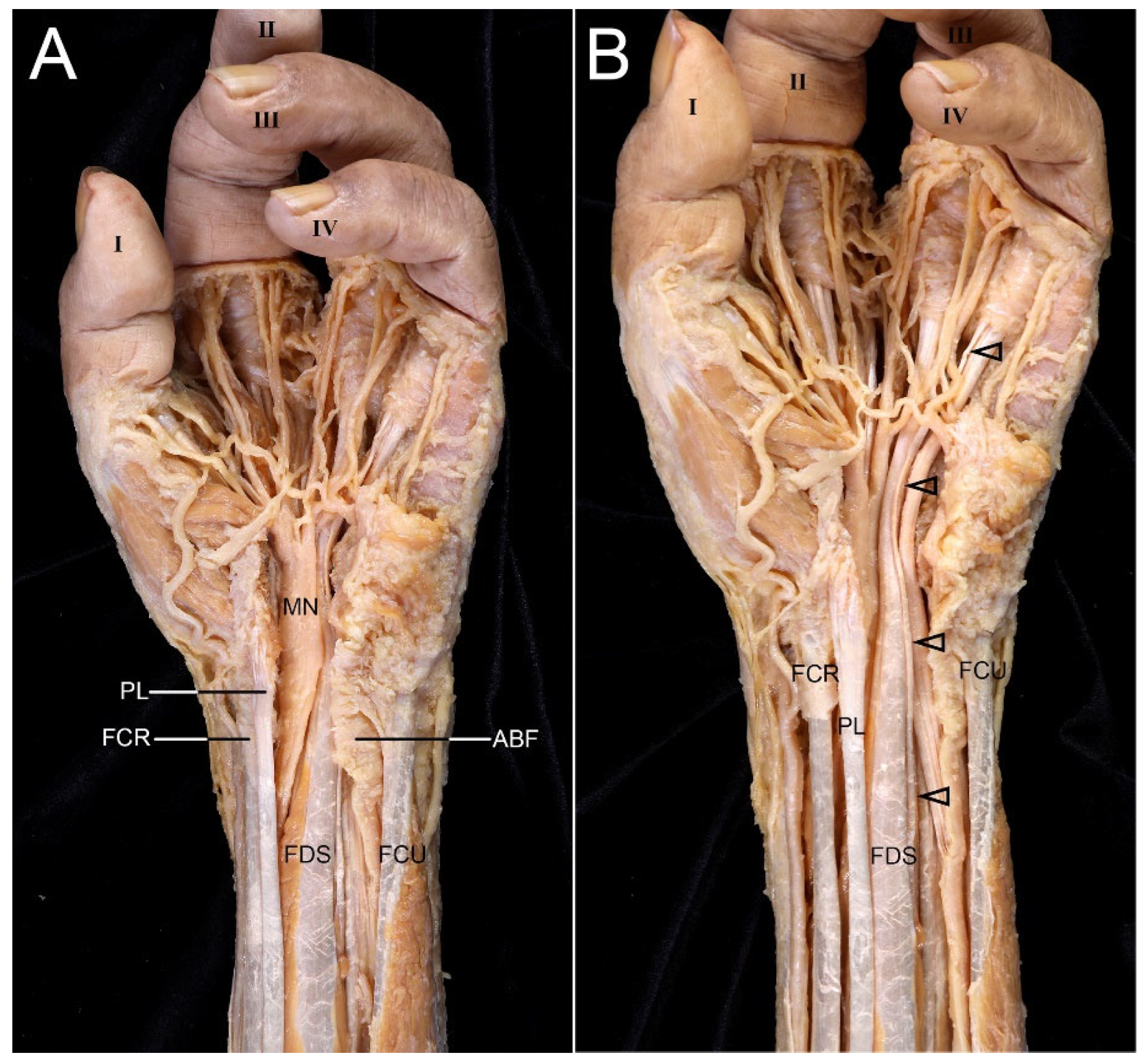
Anatomical findings for the forearm and wrist of the left hand with oligodactyly. The locations and shapes of all forearm muscles appeared normal. (A) The distal antebrachial fascia (ABF) was observed to be thickened. The median nerve (MN) was notably widened from this thickened fascia to the carpal tunnel. Cutting and removing the flexor retinaculum revealed the MN. (B) The tendon (arrowheads) of the flexor digitorum superficialis (FDS) that attached to the fourth digit was small and thin. FCR, flexor carpi radialis; PL, palmaris longus; FCU, flexor carpi ulnaris; I, first digit; II, second digit; III, third digit; IV, fourth digit.
Figure 1.
Anatomical findings for the forearm and wrist of the left hand with oligodactyly. The locations and shapes of all forearm muscles appeared normal. (A) The distal antebrachial fascia (ABF) was observed to be thickened. The median nerve (MN) was notably widened from this thickened fascia to the carpal tunnel. Cutting and removing the flexor retinaculum revealed the MN. (B) The tendon (arrowheads) of the flexor digitorum superficialis (FDS) that attached to the fourth digit was small and thin. FCR, flexor carpi radialis; PL, palmaris longus; FCU, flexor carpi ulnaris; I, first digit; II, second digit; III, third digit; IV, fourth digit.
Figure 2.
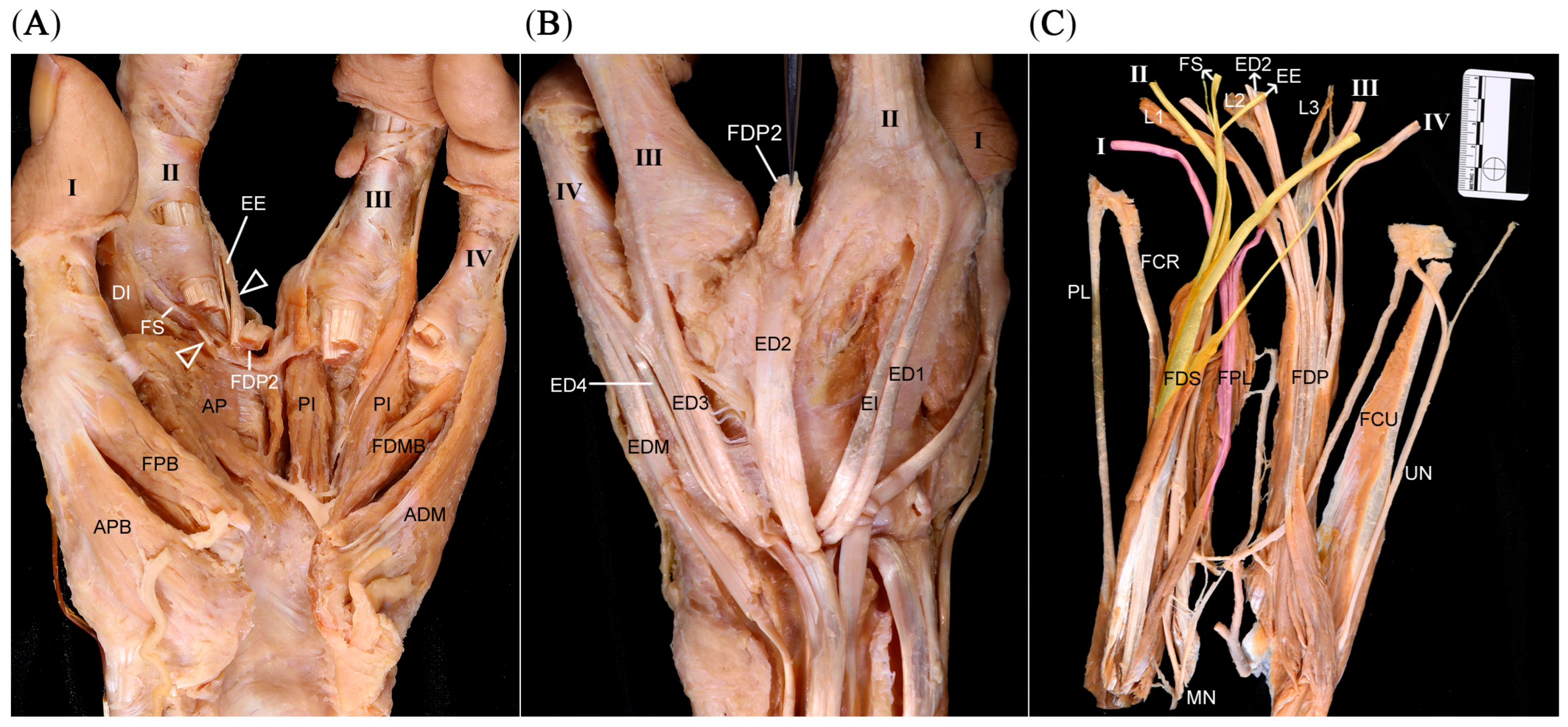
Anatomical findings for the palm of the left hand with oligodactyly. (A) Several tendinous slips (white arrowheads) of the FDS connecting to the second digit were observed. These slips were attached to the extensor expansion (EE) and the fibrous sheaths (FSs) of the metacarpophalangeal joint of the second digit. In the web space between the second and third digits, the second tendon of the flexor digitorum profundus (FDP2) extended dorsally. (B) FDP2 was attached to the extensor digitorum communis (ED) tendon that attached to the second digit (ED2, black arrowheads). (C) Removing the muscles and tendons of the digits and wrist revealed three lumbricals (L1, L2, and L3). The small arrows indicate the structures to which each tendinous slip and tendon connected. A connection (arrow) was observed between the tendons of the flexor pollicis longus (FPL) and the FDP. In panel C, the yellow color indicates the flexor digitorum superficialis (FDS) tendons, and the pink color indicates the flexor digitorum profundus (FDP) tendons. The colors are used solely to facilitate visual distinction. ADM, abductor digiti minimi; AP, adductor pollicis; APB, abductor pollicis brevis; DI, dorsal interosseous, ED1 and ED2, extensor digitorum tendons both attached to the second digit, ED3, extensor digitorum tendon attached to the third digit; ED4, extensor digitorum tendon attached to the fourth digit; EDM, extensor digiti minimi; FDMB, flexor digiti minimi; FPB, flexor pollicis brevis; PI, palmar interosseous; UN, ulnar nerve.
Figure 2.
Anatomical findings for the palm of the left hand with oligodactyly. (A) Several tendinous slips (white arrowheads) of the FDS connecting to the second digit were observed. These slips were attached to the extensor expansion (EE) and the fibrous sheaths (FSs) of the metacarpophalangeal joint of the second digit. In the web space between the second and third digits, the second tendon of the flexor digitorum profundus (FDP2) extended dorsally. (B) FDP2 was attached to the extensor digitorum communis (ED) tendon that attached to the second digit (ED2, black arrowheads). (C) Removing the muscles and tendons of the digits and wrist revealed three lumbricals (L1, L2, and L3). The small arrows indicate the structures to which each tendinous slip and tendon connected. A connection (arrow) was observed between the tendons of the flexor pollicis longus (FPL) and the FDP. In panel C, the yellow color indicates the flexor digitorum superficialis (FDS) tendons, and the pink color indicates the flexor digitorum profundus (FDP) tendons. The colors are used solely to facilitate visual distinction. ADM, abductor digiti minimi; AP, adductor pollicis; APB, abductor pollicis brevis; DI, dorsal interosseous, ED1 and ED2, extensor digitorum tendons both attached to the second digit, ED3, extensor digitorum tendon attached to the third digit; ED4, extensor digitorum tendon attached to the fourth digit; EDM, extensor digiti minimi; FDMB, flexor digiti minimi; FPB, flexor pollicis brevis; PI, palmar interosseous; UN, ulnar nerve.

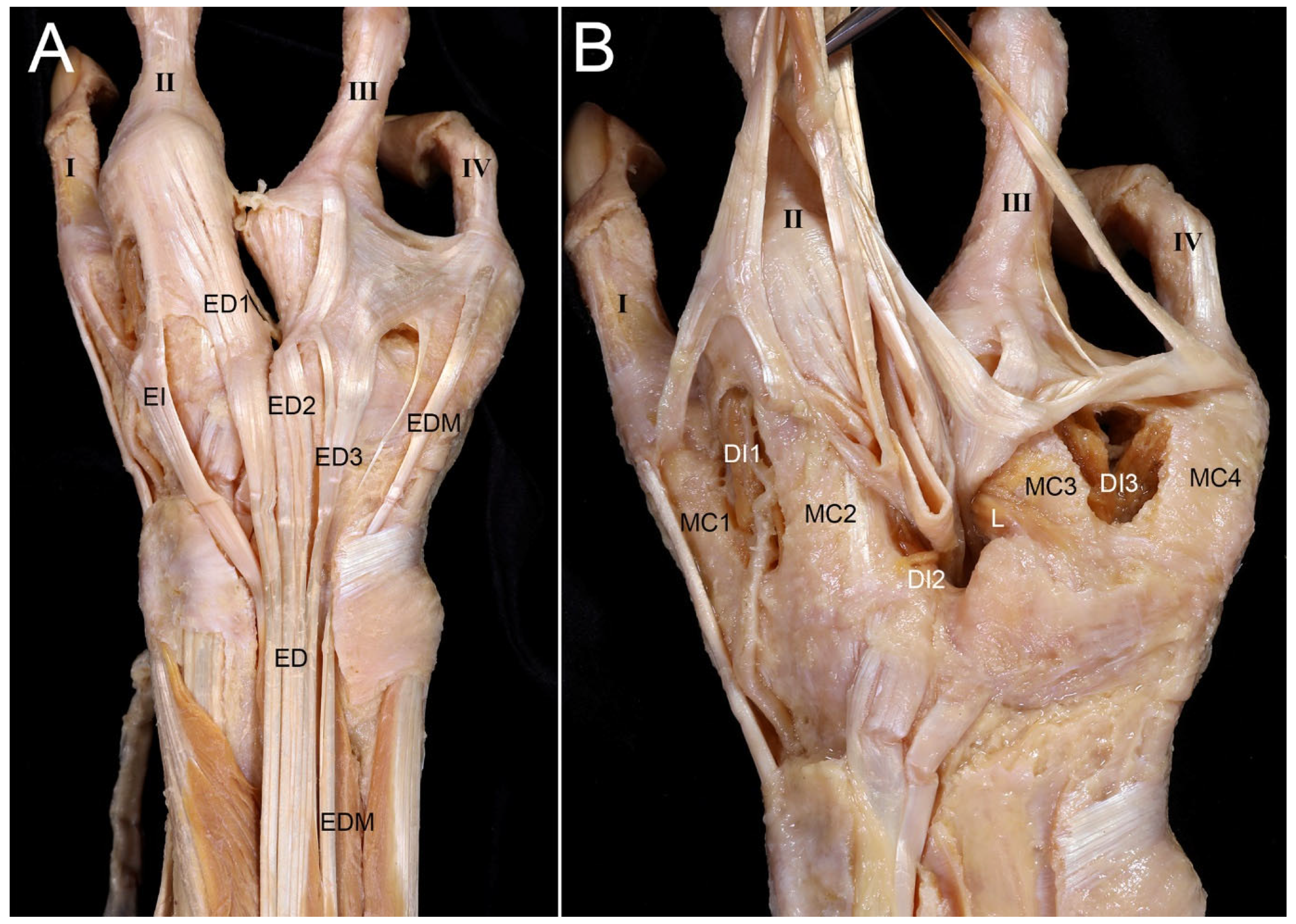
Figure 3.
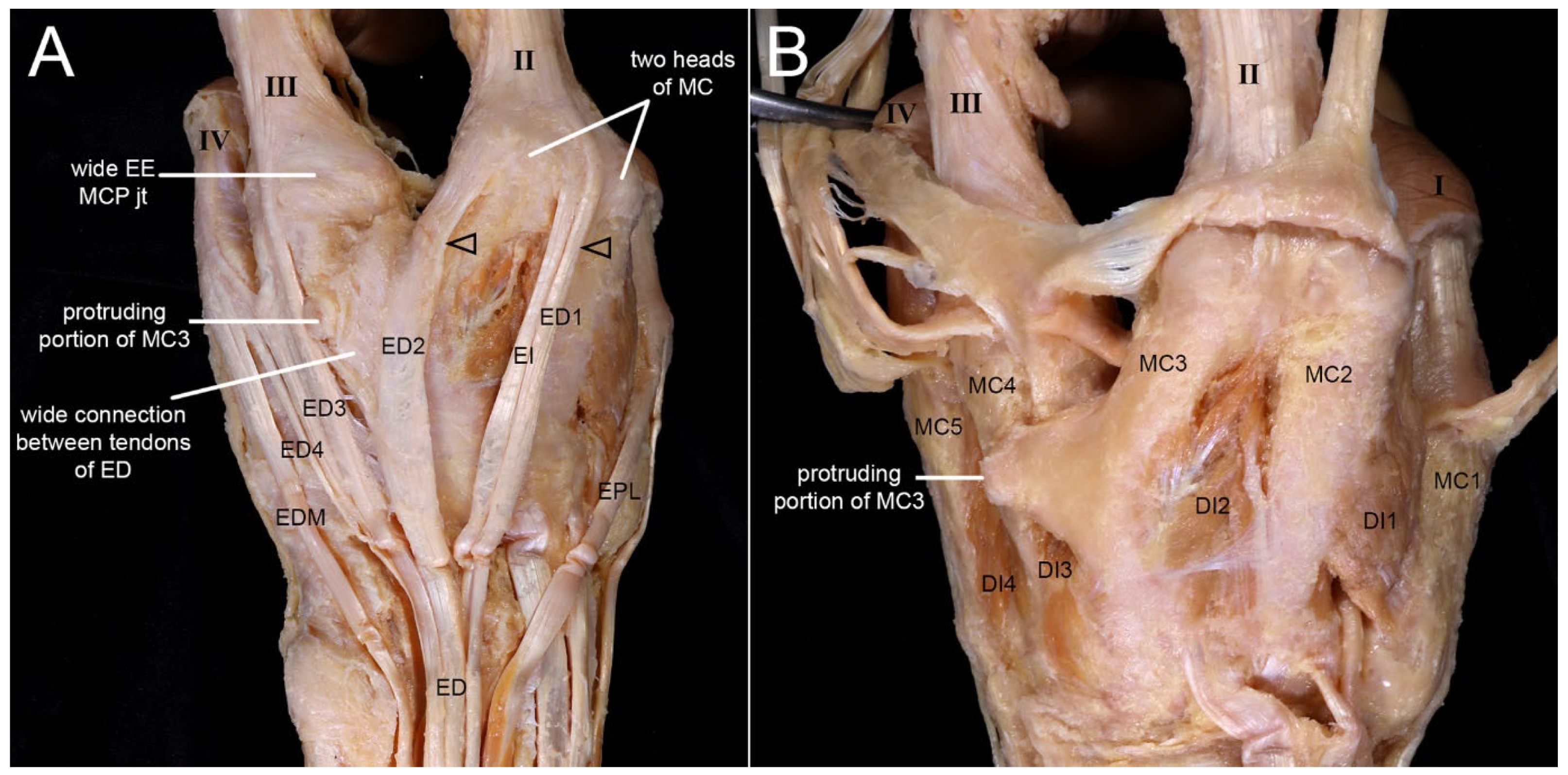
Metacarpal fusion and extensor tendon variations on the dorsum of the left hand with oligodactyly. (A) On the dorsum of the left hand, two metacarpals (second metacarpal [MC2] and third metacarpal [MC3]) joined at the MCP joint that was connected to the second digit. There were four ED tendons, but two tendons (arrowheads) inserted into the second digit. A protruding portion of MC3 was observed. (B) Reflecting the ED tendons on the dorsum allowed all five metacarpals to be identified. The heads of MC2 and MC3 were found to converge at the MCP joint of the second digit. A protruding portion of MC3 formed a transverse attachment with the fourth metacarpal (MC4). There were four dorsal interossei (DI) muscles. However, the third dorsal interosseous (DI3) muscle displayed thin and small muscle fibers, likely due to the protruding portion of MC3.
Figure 3.
Metacarpal fusion and extensor tendon variations on the dorsum of the left hand with oligodactyly. (A) On the dorsum of the left hand, two metacarpals (second metacarpal [MC2] and third metacarpal [MC3]) joined at the MCP joint that was connected to the second digit. There were four ED tendons, but two tendons (arrowheads) inserted into the second digit. A protruding portion of MC3 was observed. (B) Reflecting the ED tendons on the dorsum allowed all five metacarpals to be identified. The heads of MC2 and MC3 were found to converge at the MCP joint of the second digit. A protruding portion of MC3 formed a transverse attachment with the fourth metacarpal (MC4). There were four dorsal interossei (DI) muscles. However, the third dorsal interosseous (DI3) muscle displayed thin and small muscle fibers, likely due to the protruding portion of MC3.
Figure 4.
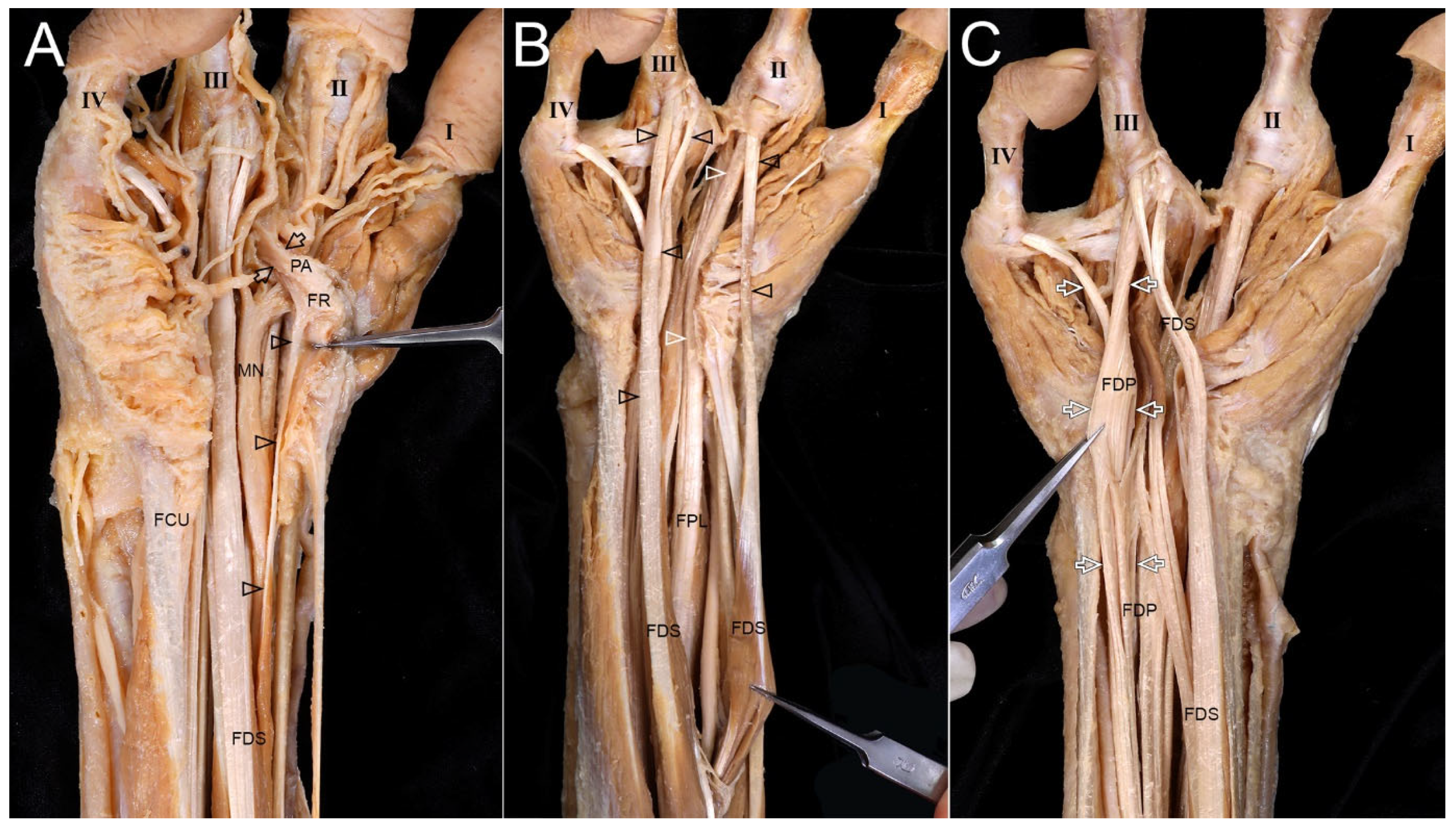
Tendinous slips and connections in the palm of the right hand with oligodactyly. (A) Cutting and reflecting the FR revealed a thin tendon (arrowheads) of the FDS attached to the deep surface of the FR. A portion of the palmar aponeurosis (PA, arrows) was attached to the deep structures, including the lumbrical between MC2 and MC3. (B) The FDS tendons (black arrowheads) attached to the second and third digits. The FPL tendon (white arrowheads) attached to the second digit, and there was no extrinsic tendon attached to the first digit. (C) The FDP tendons (white arrows) attached to the third and fourth digits. Both the FDS and FDP tendons were present for the third digit, while only the FDP tendon was observed attached to the fourth digit.
Figure 4.
Tendinous slips and connections in the palm of the right hand with oligodactyly. (A) Cutting and reflecting the FR revealed a thin tendon (arrowheads) of the FDS attached to the deep surface of the FR. A portion of the palmar aponeurosis (PA, arrows) was attached to the deep structures, including the lumbrical between MC2 and MC3. (B) The FDS tendons (black arrowheads) attached to the second and third digits. The FPL tendon (white arrowheads) attached to the second digit, and there was no extrinsic tendon attached to the first digit. (C) The FDP tendons (white arrows) attached to the third and fourth digits. Both the FDS and FDP tendons were present for the third digit, while only the FDP tendon was observed attached to the fourth digit.
Figure 5.
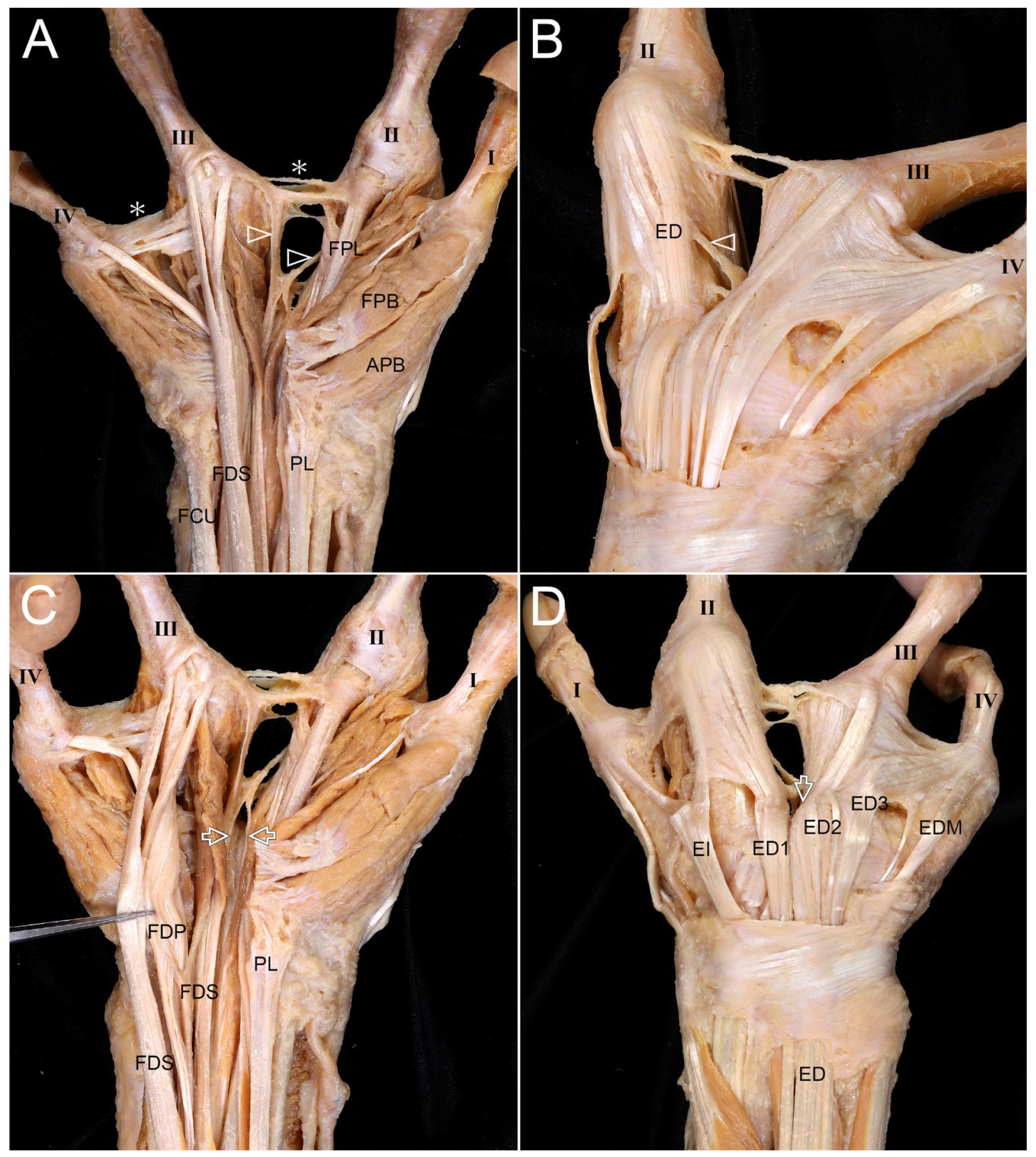
Flexor tendon variations in the palm of the right hand with oligodactyly. (A) Several tendinous slips (white arrowheads) arose from the FDP tendon between MC2 and MC3. Deep transverse metacarpal ligaments (asterisks) were distinctly prominent between the second and third digits and between the third and fourth digits. (B) Another slip (white arrowhead) was attached to the side of the ED tendon attached to the second digit. (C) A tendon of the FDP (arrows) between MC2 and MC3 extended distally and entered the dorsum of the hand. (D) This portion of the FDP tendon (arrow) was then attached to ED2 for the third digit.
Figure 5.
Flexor tendon variations in the palm of the right hand with oligodactyly. (A) Several tendinous slips (white arrowheads) arose from the FDP tendon between MC2 and MC3. Deep transverse metacarpal ligaments (asterisks) were distinctly prominent between the second and third digits and between the third and fourth digits. (B) Another slip (white arrowhead) was attached to the side of the ED tendon attached to the second digit. (C) A tendon of the FDP (arrows) between MC2 and MC3 extended distally and entered the dorsum of the hand. (D) This portion of the FDP tendon (arrow) was then attached to ED2 for the third digit.
Figure 6.
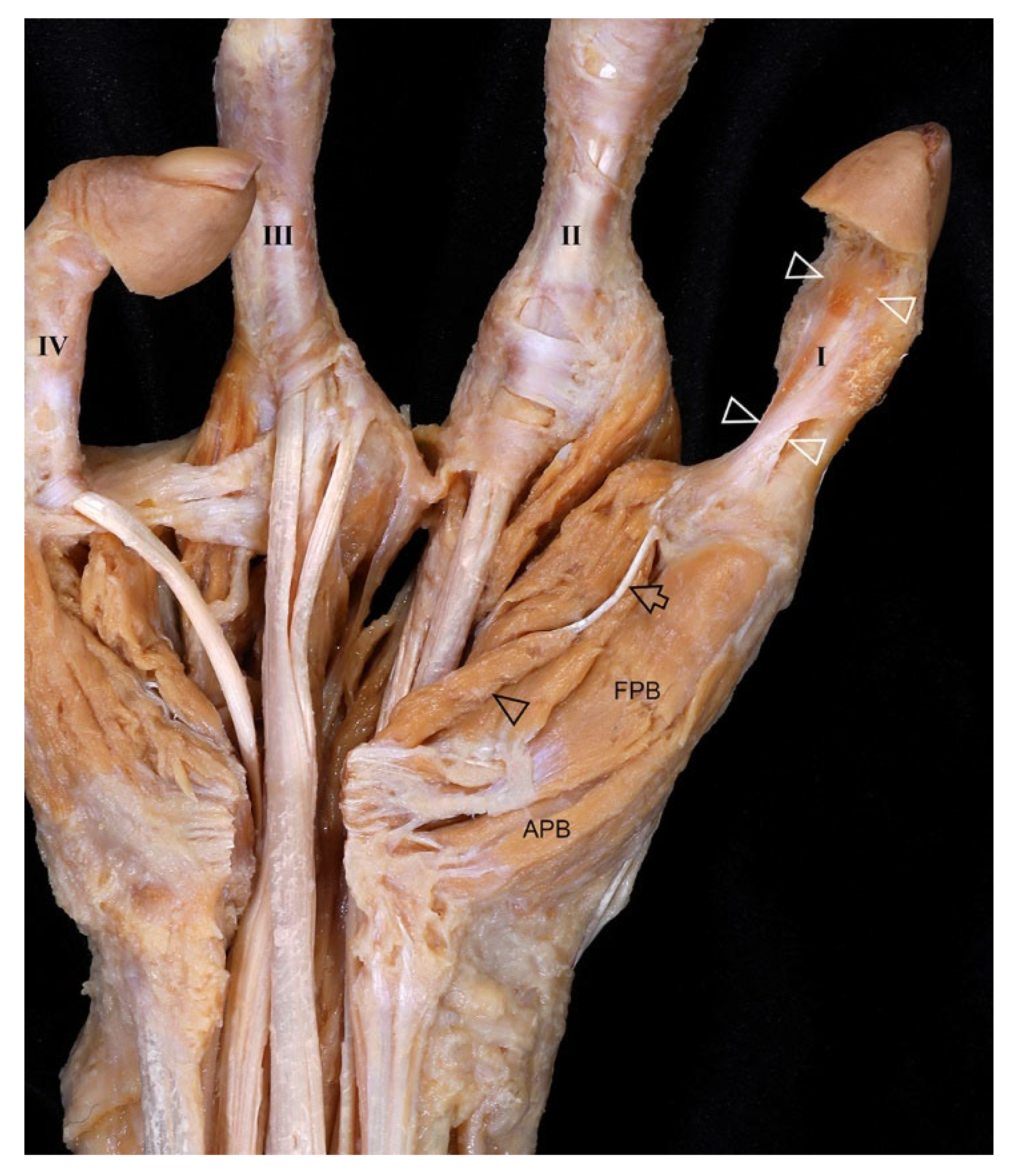
First-digit tendon variations in the palm of the right hand with oligodactyly. A tendon (white arrowheads) attached to the first digit originated at the MCP joint and attached to the distal phalanx, while the FPL tendon extended to the second digit. In addition, a thin and slender muscle bundle (black arrowhead) arose from the FR, forming a long and delicate tendon (arrow) that attached to the MCP joint of the first digit.
Figure 6.
First-digit tendon variations in the palm of the right hand with oligodactyly. A tendon (white arrowheads) attached to the first digit originated at the MCP joint and attached to the distal phalanx, while the FPL tendon extended to the second digit. In addition, a thin and slender muscle bundle (black arrowhead) arose from the FR, forming a long and delicate tendon (arrow) that attached to the MCP joint of the first digit.
Figure 7.
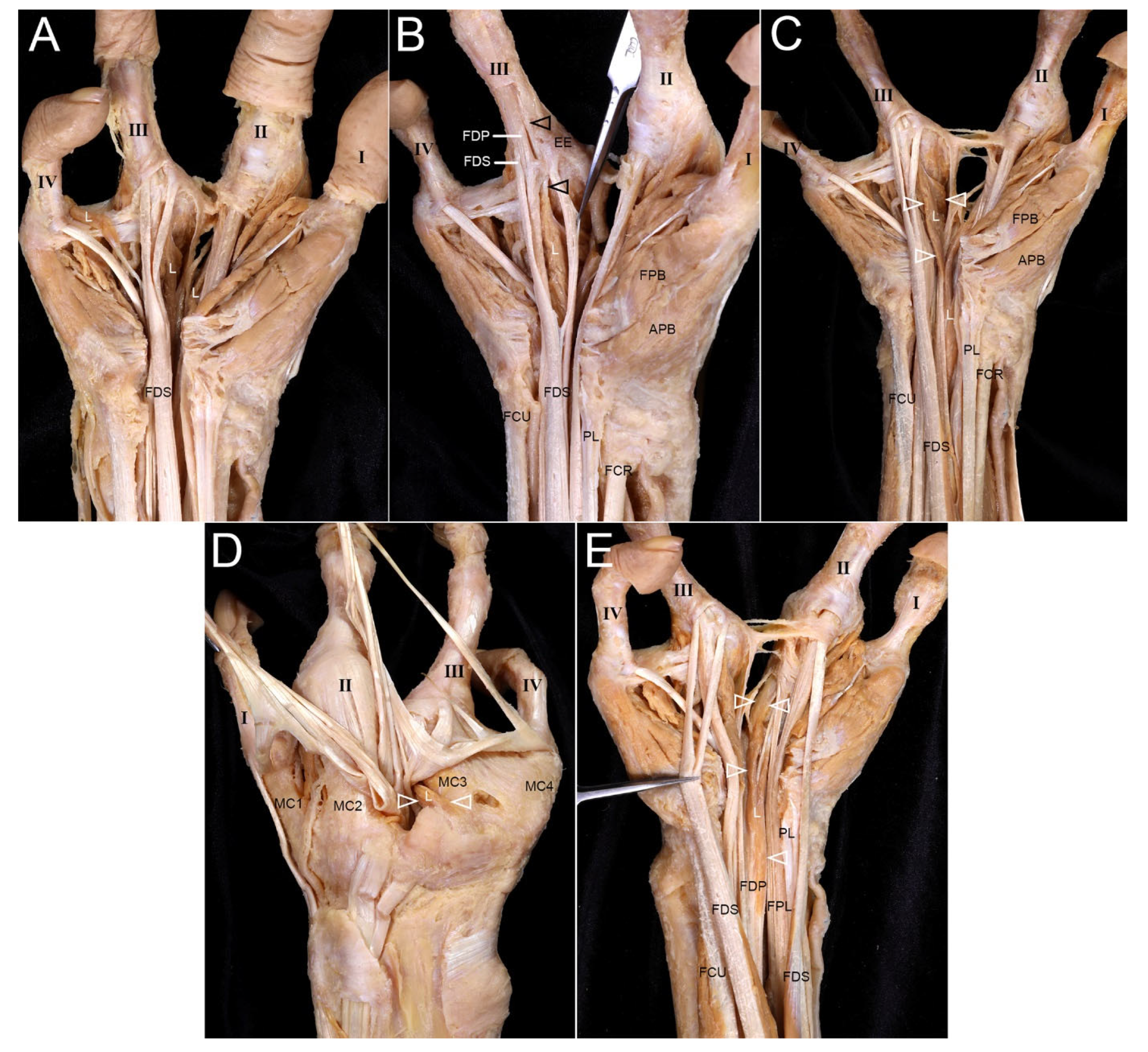
Variations in L (lumbrical muscles) in the right hand with oligodactyly. (A) The right hand contained three lumbrical muscles. (B) One lumbrical originated from the combined tendon of the FDS and FDP in the distal forearm. The lumbrical tendon (arrowheads) formed part of the flexor tendon attached to the third digit and also attached to the EE. (C) The lumbrical (arrowheads) was in a lambda shape, with a portion extending to the dorsum of the hand. (D) On the dorsum, part of the lumbrical (arrowheads) attached to the base of MC3 in an abnormal shape. (E) Another lumbrical (arrowheads) arose from the FDP tendon proximal to the wrist joint.
Figure 7.
Variations in L (lumbrical muscles) in the right hand with oligodactyly. (A) The right hand contained three lumbrical muscles. (B) One lumbrical originated from the combined tendon of the FDS and FDP in the distal forearm. The lumbrical tendon (arrowheads) formed part of the flexor tendon attached to the third digit and also attached to the EE. (C) The lumbrical (arrowheads) was in a lambda shape, with a portion extending to the dorsum of the hand. (D) On the dorsum, part of the lumbrical (arrowheads) attached to the base of MC3 in an abnormal shape. (E) Another lumbrical (arrowheads) arose from the FDP tendon proximal to the wrist joint.
Figure 8.
Anatomical findings for the dorsum of the right hand with oligodactyly. (A) On the dorsum of the hand, the extensor indicis proprius (EI) tendon was divided into two slips that attached to both the first and second digits. There were three ED tendons, with the ED3 tendon for the 4th digit following a curved course. (B) Four metacarpals and three DI muscles were present. The web space between the second and third digits was larger than normal, extending as far as the carpometacarpal joint and becoming deeper. The fascia on the dorsal and side surfaces of the metacarpal bones was distinct and thickened, resembling the EE. The tendons on the dorsum of the hand were retracted distally to reveal the metacarpals and DI muscles. DI1, first dorsal interosseous; DI2, second dorsal interosseous; DI3, third dorsal interosseous; L, lumbrical.
Figure 8.
Anatomical findings for the dorsum of the right hand with oligodactyly. (A) On the dorsum of the hand, the extensor indicis proprius (EI) tendon was divided into two slips that attached to both the first and second digits. There were three ED tendons, with the ED3 tendon for the 4th digit following a curved course. (B) Four metacarpals and three DI muscles were present. The web space between the second and third digits was larger than normal, extending as far as the carpometacarpal joint and becoming deeper. The fascia on the dorsal and side surfaces of the metacarpal bones was distinct and thickened, resembling the EE. The tendons on the dorsum of the hand were retracted distally to reveal the metacarpals and DI muscles. DI1, first dorsal interosseous; DI2, second dorsal interosseous; DI3, third dorsal interosseous; L, lumbrical.
Figure 9.
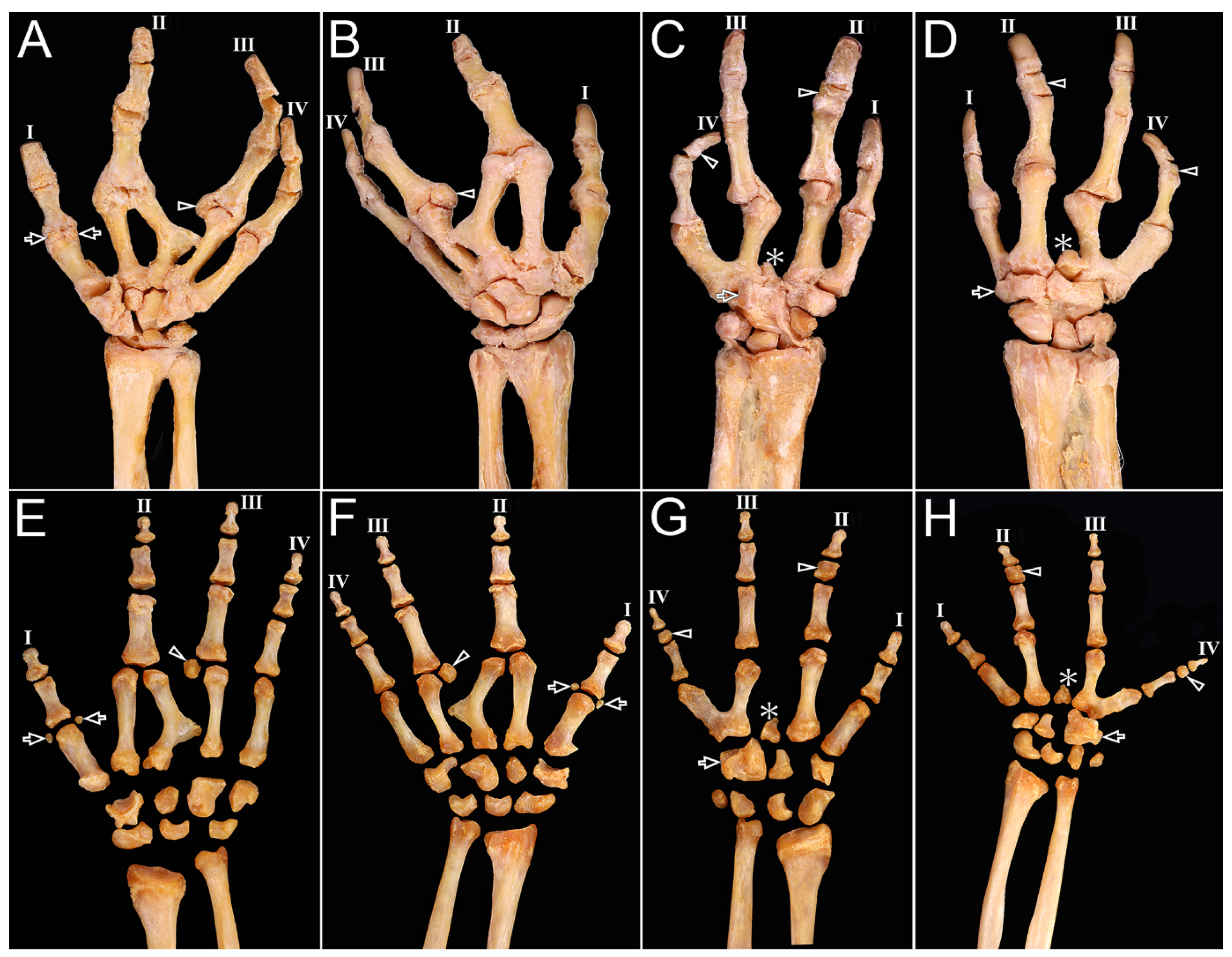
Bones of the left and right hands with oligodactyly. Ventral and dorsal views of the articulations of the left hand (A,B) and right hand (C,D), and of the separated bones of the left hand (E,F) and right hand (G,H). The left hand had five metacarpal bones. MC2 and MC3 joined at the MCP joint, and the third digit had a small bone (arrowhead) at its MCP joint. Two sesamoid bones (arrows) were present at the MCP joint of the first digit. The proximal phalanx of the second digit, which articulated with two metacarpals, was found to be hypertrophied. The carpal bones included seven bones, with the pisiform absent and the presence of variations in shape and size (A,B,E,F). The right hand had four metacarpal bones, with the bases of MC3 and MC4 fused, forming a partial synostosis. A small bone (asterisks) was present between the bases of the metacarpals connected to the second and third digits and the carpal bones, which appeared to be aplasia of the metacarpal shaft. The middle phalanges (arrowheads) of the second and fourth digits were shorter, and did not form the typical shape of long bones. The seven carpal bones of the wrist exhibited atypical morphology, including capitohamate fusion. Unlike in the left hand, the pisiform bone was present and MC2 had a larger-than-normal base (C,D,G,H).
Figure 9.
Bones of the left and right hands with oligodactyly. Ventral and dorsal views of the articulations of the left hand (A,B) and right hand (C,D), and of the separated bones of the left hand (E,F) and right hand (G,H). The left hand had five metacarpal bones. MC2 and MC3 joined at the MCP joint, and the third digit had a small bone (arrowhead) at its MCP joint. Two sesamoid bones (arrows) were present at the MCP joint of the first digit. The proximal phalanx of the second digit, which articulated with two metacarpals, was found to be hypertrophied. The carpal bones included seven bones, with the pisiform absent and the presence of variations in shape and size (A,B,E,F). The right hand had four metacarpal bones, with the bases of MC3 and MC4 fused, forming a partial synostosis. A small bone (asterisks) was present between the bases of the metacarpals connected to the second and third digits and the carpal bones, which appeared to be aplasia of the metacarpal shaft. The middle phalanges (arrowheads) of the second and fourth digits were shorter, and did not form the typical shape of long bones. The seven carpal bones of the wrist exhibited atypical morphology, including capitohamate fusion. Unlike in the left hand, the pisiform bone was present and MC2 had a larger-than-normal base (C,D,G,H).

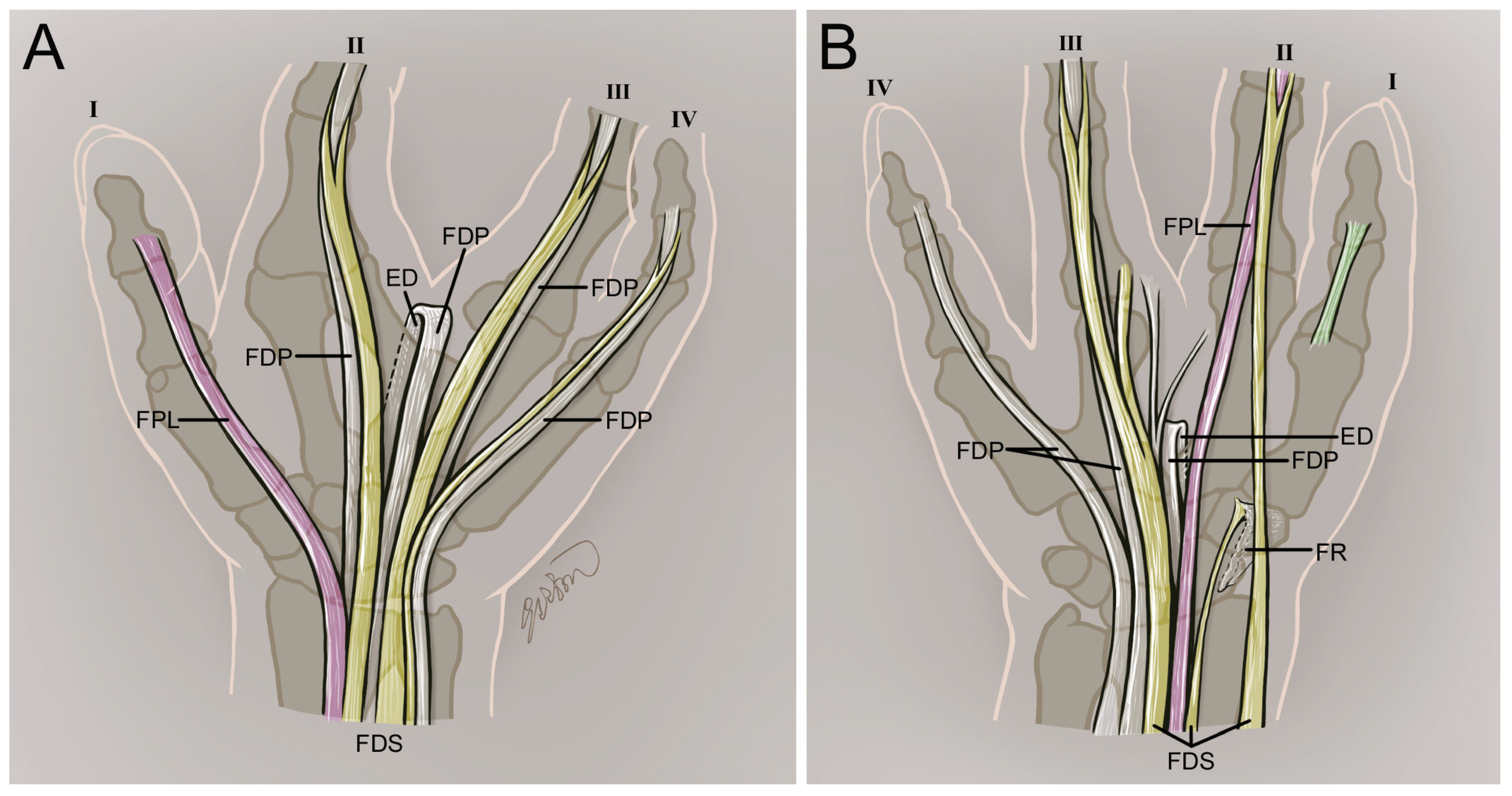
Figure 10.
Schematic summarizing the key tendon and skeletal variations observed in bilateral hand oligodactyly. (A) Left hand demonstrating variations in the FDS, FDP, and FPL tendons, along with metacarpal and phalangeal anomalies. (B) Right hand illustrating altered tendon attachments and metacarpal–carpal variations. FDS tendons are shown in yellow, FDP tendons in white, and the FPL tendon in pink. The tendon supplying the first digit on the right hand is shown in green.
Figure 10.
Schematic summarizing the key tendon and skeletal variations observed in bilateral hand oligodactyly. (A) Left hand demonstrating variations in the FDS, FDP, and FPL tendons, along with metacarpal and phalangeal anomalies. (B) Right hand illustrating altered tendon attachments and metacarpal–carpal variations. FDS tendons are shown in yellow, FDP tendons in white, and the FPL tendon in pink. The tendon supplying the first digit on the right hand is shown in green.
Table 1.
Structural variations in bilateral hand oligodactyly.
Table 1.
Structural variations in bilateral hand oligodactyly.
| | Left | Right |
|---|
| Palmar Aponeurosis | Normal | Attached to the Deep Structures Between MC2 and MC3 |
|---|
| Wrist | ABF thicker at the distal forearm |
| Median nerve | Wider at the carpal tunnel and distal forearm | Normal |
| Radial artery | A distinct branch of the radial artery coursed on the thenar muscles | Normal |
| Forearm muscles | Normal | Normal |
| FDS tendon | 4 | 3 |
| FDP tendon | 4
(attached to the ED tendon) | 3
(attached to the ED tendon) |
| FPL | Normal | connected to the second digit (like an FDP tendon) |
| Intertendinous connection between FPL and FDP | Present | Normally absent |
| PQ | Extended proximally | Normal |
| PI | 3 | 3 |
| Lumbrical | 3 | 3
(abnormal shapes and attachments) |
| Deep transverse metacarpal ligament | Distinct and thick between the second and third digits and between the third and fourth digits |
| ED | 4 | 3 |
| Extensor indicis proprius | Normal | First and second digits |
| Metacarpal | 5 | 4 |
| DI muscles | 4 (first DI had a hypertrophied portion that attached to the radial side of the second digit) | 3 (smaller) |
| Tendon attached to the first digit | Normal | From MCP junction to distal phalanx |
| Carpal bone | 7 (pisiform absent) | 7 (capitohamate fusion) |
| Other | Complicated structures between MC2 and MC3 |



 ,
,