
The Relationship Between Bone Health Status of Post-Menopausal Women with Non-Functional Adrenal Tumours/Mild Autonomous Cortisol Secretion and Their Baseline Morning Adrenocorticotropic Level


Abstract
1. Introduction
Objective
2. Material and Methods
2.1. Study Design
2.2. Study Population
2.3. Study Protocol
2.4. Statistical Analysis
2.5. Ethical Approval
3. Results
3.1. NFATs’ Characterization
3.2. Analysis Depending on ACTH Threshold
3.3. Analysis Depending on ACTH Threshold in Addition to MACS-Positive Profile (Based on Second-Day Cortisol After 1 mg DST)
4. Discussion
4.1. Study-Focused Analysis
4.2. Pathogenic Pathways of Bone Involvement in NFATs/MACS
4.3. The Larger (Non-Osseous) Frame in NFATs/MACS
4.4. Current Limits and Further Expansion
5. Conclusions
Author Contributions
Funding
Institutional Review Board Statement
Informed Consent Statement
Data Availability Statement
Acknowledgments
Conflicts of Interest
Abbreviations
| ACTH | adrenocorticotropic hormone |
| AUC | area under the curve |
| BMI | body mass index |
| BMD | bone mineral density |
| CT | computed tomography |
| CI | confidence interval |
| CLIA | Clinical Laboratory Improvement Amendments |
| DST | dexamethasone suppression test |
| DHEA-S | dehydroepiandrosterone-sulphate |
| DXA | Dual-Energy X-Ray Absorptiometry |
| ECLIA | electrochemiluminescence immunoassay |
| FRAX | Fracture Risk Assessment Tool |
| GLP-1 | glucagon-like peptide-1 agonist |
| HF | 10-year hip fracture risk |
| LTD | largest tumour diameter |
| MOF | 10-year major osteoporotic fracture risk |
| MACS | mild autonomous cortisol secretion |
| M | median |
| N | number of patients |
| NFAT | non-functioning adrenal tumour |
| PTH | parathyroid hormone |
| P1NP | procollagen type 1 N-terminal pro-peptide |
| ROC | receiver operating characteristic |
| RANKL | receptor activator of nuclear factor κβ ligand |
| Q | quartile |
| SD | standard deviation |
| SOp | secondary osteoporosis |
| TBS | trabecular bone score |
| WHO | World Health Organization |
References
- Hofbauer, L.C.; Compston, J.E.; Saag, K.G.; Rauner, M.; Tsourdi, E. Glucocorticoid-induced osteoporosis: Novel concepts and clinical implications. Lancet Diabetes Endocrinol. 2025, 13, 964–979. [Google Scholar] [CrossRef]
- Gregson, C.L.; Armstrong, D.J.; Avgerinou, C.; Bowden, J.; Cooper, C.; Douglas, L.; Edwards, J.; Gittoes, N.J.L.; Harvey, N.C.; Kanis, J.A.; et al. National Osteoporosis Guideline Group (NOGG). The 2024 UK clinical guideline for the prevention and treatment of osteoporosis. Arch. Osteoporos. 2025, 20, 119. [Google Scholar] [CrossRef]
- Dumitru, N.; Carsote, M.; Cocolos, A.; Petrova, E.; Olaru, M.; Dumitrache, C.; Ghemigian, A. The Link Between Bone Osteocalcin and Energy Metabolism in a Group of Postmenopausal Women. Curr. Health Sci. J. 2019, 45, 47–51. [Google Scholar] [CrossRef]
- Mitrica, M.; Vasiliu, O.; Plesa, A.; Sirbu, O.M. Multinodular and vacuolating neuronal tumor. Rom. J. Mil. Med. 2025, 128, 10–16. [Google Scholar] [CrossRef]
- Valea, A.; Ghervan, C.; Morar, A.; Pop, D.D.; Carsote, M.; Albu, S.E.; Georgescu, C.E.; Chiorean, A. Hashimoto’s thyroiditis and breast cancer: Coincidence or correlation? Arch. Balk. Med. Union. 2016, 51, 129–132. [Google Scholar]
- Pipernea, R.; Popa, F.L.; Ciortea, V.M.; Irsay, L.; Ungur, R.A.; Pintea, A.L.; Iliescu, M.G.; Cipăian, R.C.; Stanciu, M. The role of rehabilitation and anabolic treatment in severe osteoporosis associated with significant vitamin D deficiency-case report. Balneo PRM Res. J. 2023, 14, 539. [Google Scholar] [CrossRef]
- Nistor, C.E.; Bugala, N.M.; Daguci, C.; Daguci, L.; Diaconu, O.A.; Rica, A.M. Multiple endocrine neoplasia type 2 syndrome and osteoporosis. Aging Clin. Exp. Res. 2023, 35, S387. [Google Scholar]
- Carsote, M.; Valea, A.; Dumitru, N.; Terzea, D.; Petrova, E.; Albu, S.; Buruiana, A.; Ghemigian, A. Metastases in daily endocrine practice. Arch. Balk. Med. Union. 2016, 51, 476–480. [Google Scholar]
- Popa, F.L.; Boicean, L.C.; Iliescu, M.G.; Stanciu, M. The importance of association between sex steroids deficiency, reduction of bone mineral density and falling risk in men with implications in medical rehabilitation. Balneo PRM Res. J. 2021, 12, 318–322. [Google Scholar] [CrossRef]
- Valea, A.; Carsote, M.; Moldovan, C.; Georgescu, C. Chronic autoimmune thyroiditis and obesity. Arch. Balk. Med. Union. 2018, 53, 64–69. [Google Scholar]
- Owei, L.; Wachtel, H. The Landmark Series: Evaluation and Management of Adrenal Incidentalomas. Ann. Surg. Oncol. 2025, 32, 4712–4719. [Google Scholar] [CrossRef]
- Grazzini, G.; Pradella, S.; De Litteris, F.; Galluzzo, A.; Anichini, M.; Treballi, F.; Bicci, E.; Miele, V. Adrenal Mass Evaluation: Suspicious Radiological Signs of Malignancy. Cancers 2025, 17, 849. [Google Scholar] [CrossRef]
- Zhang, X.; Si, Y.; Shi, X.; Zhang, Y.; Yang, L.; Yang, J.; Zhang, Y.; Leng, J.; Hu, P.; Liu, H.; et al. Differentiation of multiple adrenal adenoma subtypes based on a radiomics and clinico-radiological model: A dual-center study. BMC Med. Imaging 2025, 25, 45. [Google Scholar] [CrossRef]
- Akkus, G.; Aksoydan, U.P.; Odabas, F.; Binokay, H.; Sert, M.; Tetiker, T. Clinical Outcomes of Patients with Adrenal Incidentaloma-Hypertension being a Continuous Risk Factor for the Presence of Comorbidity: A Single Center’s Eight-year Experience. Curr. Med. Imaging 2025, 21, e15734056347340. [Google Scholar] [CrossRef]
- Montalvão, P.V.G.; Mangueira, I.M.; Alves, G.D.M.; Cordeiro, J.V.F.; Costa, M.H.S.; Ravanini, G.A.G. Evaluation of adrenal tumors and analysis of the metabolic profile of patients with incidentaloma. Rev. Col. Bras. Cir. 2025, 51, e20243685. [Google Scholar] [CrossRef]
- Boyraz, A.; Candemir, B.; Akın, Ş.; Candemir, M.; Gülçelik, N.E. Increased cardiovascular risk despite unchanged body composition in non-functional adrenal incidentaloma. Ann. Endocrinol 2025, 86, 101687. [Google Scholar] [CrossRef]
- Nistor, C.E.; Găvan, C.S.; Ciritel, A.A.; Nemes, A.F.; Ciuche, A. The Association of Minimally Invasive Surgical Approaches and Mortality in Patients with Malignant Pleuropericarditis-A 10 Year Retrospective Observational Study. Medicina 2022, 58, 718. [Google Scholar] [CrossRef]
- Siemińska, L.; Siemińska, K.; Marek, B.; Kos-Kudła, B.; Nowak, M.; Głogowska-Szeląg, J.; Kajdaniuk, D. Adrenal tumours and subclinical adrenal hyperfunction. Endokrynol. Pol. 2024, 75, 630–642. [Google Scholar] [CrossRef] [PubMed]
- Nica, S.; Sionel, R.; Maciuca, R.; Csutak, O.; Ciobica, M.L.; Nica, M.I.; Chelu, I.; Radu, I.; Toma, M. Gender-Dependent Associations Between Digit Ratio and Genetic Polymorphisms, BMI, and Reproductive Factors. Rom. J. Mil. Med. 2025, 128, 78–86. [Google Scholar] [CrossRef]
- Preda, E.M.; Constantin, N.; Dragosloveanu, S.; Cergan, R.; Scheau, C. An MRI-Based Method for the Morphologic Assessment of the Anterior Tibial Tuberosity. J. Clin. Med. 2024, 13, 6601. [Google Scholar] [CrossRef] [PubMed]
- Yoshida, Y.; Horiuchi, K.; Otsuki, M.; Okamoto, T. Diagnosis and management of adrenal incidentaloma: Use of clinical judgment and evidence in dialog with the patient. Surg. Today 2024, 54, 1417–1427. [Google Scholar] [CrossRef] [PubMed]
- Favero, V.; Parazzoli, C.; Bernasconi, D.P.; Chiodini, I. Cardiometabolic comorbidities and cardiovascular events in “non-functioning” adrenal incidentalomas: A systematic review and meta-analysis. J. Endocrinol. Investig. 2024, 47, 2929–2942. [Google Scholar] [CrossRef]
- Pelsma, I.C.M.; Fassnacht, M.; Tsagarakis, S.; Terzolo, M.; Tabarin, A.; Sahdev, A.; Newell-Price, J.; Marina, L.; Lorenz, K.; Bancos, I.; et al. Comorbidities in mild autonomous cortisol secretion and the effect of treatment: Systematic review and meta-analysis. Eur. J. Endocrinol. 2023, 189, S88–S101. [Google Scholar] [CrossRef]
- Araujo-Castro, M.; Pascual-Corrales, E.; Lamas, C. Possible, probable, and certain hypercortisolism: A continuum in the risk of comorbidity. Ann. Endocrinol 2023, 84, 272–284. [Google Scholar] [CrossRef]
- Savoie, P.H.; Murez, T.; Neuville, P.; Van Hove, A.; Rocher, L.; Fléchon, A.; Camparo, P.; Ferretti, L.; Branger, N.; Rouprêt, M. French AFU Cancer Committee Guidelines Update 2022–2024: Adrenal tumor-Assessment of an adrenal incidetaloma and oncological management. Prog. Urol. 2022, 32, 1040–1065. [Google Scholar] [CrossRef] [PubMed]
- Braun, L.T.; Vogel, F.; Zopp, S.; Marchant Seiter, T.; Rubinstein, G.; Berr, C.M.; Künzel, H.; Beuschlein, F.; Reincke, M. Whom Should We Screen for Cushing Syndrome? The Endocrine Society Practice Guideline Recommendations 2008 Revisited. J. Clin. Endocrinol. Metab. 2022, 107, e3723–e3730. [Google Scholar] [CrossRef] [PubMed]
- Park, S.S.; Kim, J.H. Recent Updates on the Management of Adrenal Incidentalomas. Endocrinol Metab. 2023, 38, 373–380. [Google Scholar] [CrossRef]
- Wickramarachchi, B.N.; Meyer-Rochow, G.Y.; McAnulty, K.; Conaglen, J.V.; Elston, M.S. Adherence to adrenal incidentaloma guidelines is influenced by radiology report recommendations. ANZ J. Surg. 2016, 86, 483–486. [Google Scholar] [CrossRef]
- Ruiz, A.; Michalopoulou, T.; Megia, A.; Näf, S.; Simón-Muela, I.; Solano, E.; Martínez, L.; Vendrell, J. Accuracy of new recommendations for adrenal incidentalomas in the evaluation of excessive cortisol secretion and follow-up. Eur. J. Clin. Investig. 2019, 49, e13048. [Google Scholar] [CrossRef]
- Bourdeau, I.; El Ghorayeb, N.; Gagnon, N.; Lacroix, A. Management of endocrine disease: Differential diagnosis, investigation and therapy of bilateral adrenal incidentalomas. Eur. J. Endocrinol. 2018, 179, R57–R67. [Google Scholar] [CrossRef]
- Capalbo, M.S.; Deligiannis, N.; Danilowicz, K. Mild autonomic cortisol secretion: Comorbidities and surgical treatment outcomes. Medicina 2025, 85, 1326–1336. [Google Scholar] [PubMed]
- Dragosloveanu, S.; Capitanu, B.S.; Moise, M.N.; Vulpe, D.E.; Josanu, R.; Gherghe, M.E.; Preda, E.M.; Cergan, R.; Scheau, C. Restoring Hip Symmetry and Its Impact on Outcomes: A Case Series on Megaprosthesis Use in Non-Oncological Patients with Complications After Total Hip Arthroplasty. Symmetry 2025, 17, 322. [Google Scholar] [CrossRef]
- Katabami, T.; Asai, S.; Matsuba, R.; Sone, M.; Izawa, S.; Ichijo, T.; Tsuiki, M.; Okamura, S.; Yoshimoto, T.; Otsuki, M.; et al. Changes in clinical features of adrenal Cushing syndrome: A national registry study. Endocr. Connect. 2025, 14, e240684. [Google Scholar] [CrossRef] [PubMed]
- Nistor, C.E.; Gavan, C.S.; Pantile, D.; Tanase, N.V.; Ciuche, A. Cervico-Thoracic Air Collections in COVID-19 Pneumonia Patients-Our Experience and Brief Review. Chirurgia 2022, 117, 317–327. [Google Scholar] [CrossRef]
- Braun, L.T.; Vogel, F.; Nowak, E.; Rubinstein, G.; Zopp, S.; Ritzel, K.; Beuschlein, F.; Reincke, M. Frequency of clinical signs in patients with Cushing’s syndrome and mild autonomous cortisol secretion: Overlap is common. Eur. J. Endocrinol. 2024, 191, 473–479. [Google Scholar] [CrossRef] [PubMed]
- Pedersini, P.; Turroni, S.; Villafañe, J.H. Gut microbiota and physical activity: Is there an evidence-based link? Sci. Total. Environ. 2020, 727, 138648. [Google Scholar] [CrossRef]
- Lou, Y.; Ren, L.; Chen, H.; Zhang, T.; Pan, Q. Unveiling the hidden impact: Subclinical hypercortisolism and its subtle influence on bone health. Aging Med. 2024, 7, 96–102. [Google Scholar] [CrossRef]
- Sandru, F.; Carsote, M.; Dumitrascu, M.C.; Albu, S.E.; Valea, A. Glucocorticoids and Trabecular Bone Score. J. Med. Life 2020, 13, 449–453. [Google Scholar] [CrossRef]
- Chiriac, O.; Capitanu, B.S.; Gherghe, M.E.; Maier, C.; Preda, E.M.; Cergan, R.; Scheau, C. Personalized Rehabilitation Following Total Knee Arthroplasty: Integrating Clinical and Imaging Perspectives. Balneo PRM Res. J. 2025, 16, 843. [Google Scholar] [CrossRef]
- Porr, C.; Harris, D.M.; Vidrighin, A.; Catana, A.; Diaconu, C.; Preda, E.M.; Popa, M.L.; Berghea, E.C. Etoricoxib-Induced Fixed Erythema. J. Clin. Med. 2025, 14, 8504. [Google Scholar] [CrossRef]
- Iwamoto, Y.; Kimura, T.; Morimoto, Y.; Sugisaki, T.; Dan, K.; Iwamoto, H.; Sanada, J.; Fushimi, Y.; Shimoda, M.; Fujii, T.; et al. Development of a prediction model by combining tumor diameter and clinical parameters of adrenal incidentaloma. Endocr. J. 2025, 72, 1115–1125. [Google Scholar] [CrossRef]
- Li, X.; Lan, H.; Lin, X.; Huang, H.; Wen, J.; Chen, G.; Lin, W. Metabolic complications and clinical outcomes of non-functioning adrenal incidentalomas: A systematic review and meta-analysis. BMC Endocr. Disord. 2025, 25, 92. [Google Scholar] [CrossRef]
- Kastelan, D.; Kraljevic, I.; Dusek, T.; Knezevic, N.; Solak, M.; Gardijan, B.; Kralik, M.; Poljicanin, T.; Skoric-Polovina, T.; Kastelan, Z. The clinical course of patients with adrenal incidentaloma: Is it time to reconsider the current recommendations? Eur. J. Endocrinol. 2015, 173, 275–282. [Google Scholar] [CrossRef]
- Bolat Erdogan, H.; Gül, K.; Sahutoglu, T.; Erdogan, V. Oxidative stress, antioxidant capacity, and cardiovascular risk in patients with non-functioning adrenal incidentalomas. Endocr. Connect. 2025, 14, e250259. [Google Scholar] [CrossRef] [PubMed]
- Morelli, V.; Palmieri, S. Adrenal incidentaloma: Differential diagnosis and management strategies. Minerva Endocrinol. 2019, 44, 4–18. [Google Scholar] [CrossRef] [PubMed]
- Sahdev, A. Recommendations for the management of adrenal incidentalomas: What is pertinent for radiologists? Br. J. Radiol. 2017, 90, 20160627. [Google Scholar] [CrossRef]
- Morelli, V.; Scillitani, A.; Arosio, M.; Chiodini, I. Follow-up of patients with adrenal incidentaloma, in accordance with the European society of endocrinology guidelines: Could we be safe? J. Endocrinol. Investig. 2017, 40, 331–333. [Google Scholar] [CrossRef]
- Watari, J.; Vekaria, S.; Lin, Y.; Patel, M.; Kim, H.; Kang, F.; Lubitz, S.; Beninato, T.; Laird, A.M. Radiology report language positively influences adrenal incidentaloma guideline adherence. Am. J. Surg. 2022, 223, 231–236. [Google Scholar] [CrossRef]
- Eldeiry, L.S.; Alfisher, M.M.; Callahan, C.F.; Hanna, N.N.; Garber, J.R. The impact of an adrenal incidentaloma algorithm on the evaluation of adrenal nodules. J. Clin. Transl. Endocrinol. 2018, 13, 39–45. [Google Scholar] [CrossRef] [PubMed]
- Nistor, C.; Ranetti, A.E.; Ciuche, A.; Pantile, D.; Constantin, L.M.; Brincoveanu, R. Betadine in chemical pleurodesis. Farmacia 2014, 62, 897–906. [Google Scholar]
- Hanna, F.W.F.; Issa, B.G.; Sim, J.; Keevil, B.; Fryer, A.A. Management of incidental adrenal tumours. Br. Med. J. 2018, 360, j5674. [Google Scholar] [CrossRef]
- Espiard, S.; Benomar, K.; Loyer, C.; Vahé, C.; Vantyghem, M.C. European recommendations for the management of adrenal incidentalomas: A debate on patients follow-up. Ann. Endocrinol 2018, 79, 45–48. [Google Scholar] [CrossRef]
- Lee, J.-M.; Kim, M.K.; Ko, S.-H.; Koh, J.-M.; Kim, B.-Y.; Kim, S.W.; Kim, S.-K.; Kim, H.J.; Ryu, O.-H.; Park, J.; et al. Clinical Guidelines for the Management of Adrenal Incidentaloma. Endocrinol Metab. 2017, 32, 200–218. [Google Scholar] [CrossRef]
- Inukai, T.; Harai, N.; Nakagawa, Y.; Hosokawa, T.; Antoku, A.; Muroi, Y.; Ogiwara, M.; Tsuchiya, K. Subclinical Cushing’s Disease with High-Molecular-Weight Forms of Adrenocorticotropic Hormone Production. Case Rep. Endocrinol. 2024, 1, 8721614. [Google Scholar] [CrossRef]
- Nistor, C.; Ciuche, A.; Constantinescu, I. Emergency surgical tracheal decompression in a huge retrosternal goiter. Acta Endocrinol. 2017, 13, 370–374. [Google Scholar] [CrossRef]
- Ren, L.P.; Chen, H.; Zhang, T.; Pan, Q. The effect of subclinical hypercortisolism on bone metabolism. Zhonghua Nei Ke Za Zhi 2023, 62, 1135–1138. [Google Scholar] [CrossRef] [PubMed]
- Dumitrascu, T.; Preda, E.; Ionescu, M. Emphysematous cystitis: An unreported complication after pancreaticoduodenectomy. Med. Surg. J. Rev. Med. Chir. 2015, 119, 166–169. [Google Scholar]
- Sconfienza, E.; Tetti, M.; Forestiero, V.; Veglio, F.; Mulatero, P.; Monticone, S. Prevalence of Functioning Adrenal Incidentalomas: A Systematic Review and Meta-analysis. J. Clin. Endocrinol. Metab. 2023, 108, 1813–1823. [Google Scholar] [CrossRef] [PubMed]
- Pizzorno, L.; Pizzorno, J. Subclinical Hypercortisolism: An Important, Unrecognized Dysfunction. Integr. Med. 2022, 21, 8–15. [Google Scholar]
- Amado, A.; Torre, A.; Graça, S.A.R.; Tavares, A.B. Subclinical Cushing’s syndrome: Resection of adrenal incidentaloma. BMJ Case Rep. 2022, 15, e247600. [Google Scholar] [CrossRef]
- Miller, B.S.; Auchus, R.J. Evaluation and Treatment of Patients with Hypercortisolism: A Review. JAMA Surg. 2020, 155, 1152–1159. [Google Scholar] [CrossRef] [PubMed]
- Ivović, M.; Marina, L.V.; Šojat, A.S.; Tančić-Gajić, M.; Arizanović, Z.; Kendereški, A.; Vujović, S. Approach to the Patient with Subclinical Cushing’s Syndrome. Curr. Pharm. Des. 2020, 26, 5584–5590. [Google Scholar] [CrossRef]
- Petramala, L.; Olmati, F.; Concistrè, A.; Russo, R.; Mezzadri, M.; Soldini, M.; De Vincentis, G.; Iannucci, G.; De Toma, G.; Letizia, C. Cardiovascular and metabolic risk factors in patients with subclinical Cushing. Endocrine 2020, 70, 150–163. [Google Scholar] [CrossRef]
- Nistor, C.E.; Pantile, D.; Gavan, C.S.; Ciuche, A. Pneumothorax on COVID-19 patients -retrospective clinical observations. Rom. J. Leg. Med. 2022, 30, 112–116. [Google Scholar] [CrossRef]
- Yilmaz, N.; Avsar, E.; Tazegul, G.; Sari, R.; Altunbas, H.; Balci, M.K. Clinical Characteristics and Follow-Up Results of Adrenal Incidentaloma. Exp. Clin. Endocrinol. Diabetes 2021, 129, 349–356. [Google Scholar] [CrossRef]
- Kanis, J.A.; Cooper, C.; Rizzoli, R.; Reginster, J.Y. Scientific Advisory Board of the European Society for Clinical and Economic Aspects of Osteoporosis and Osteoarthritis (ESCEO); Committees of Scientific Advisors and National Societies of the International Osteoporosis Foundation (IOF). Executive summary of European guidance for the diagnosis and management of osteoporosis in postmenopausal women. Aging Clin. Exp. Res. 2019, 31, 15–17. [Google Scholar] [CrossRef]
- Available online: https://www.fraxplus.org/ (accessed on 8 August 2025).
- Available online: https://www.fraxplus.org/frax-plus (accessed on 8 August 2025).
- Liu, M.S.; Lou, Y.; Chen, H.; Wang, Y.J.; Zhang, Z.W.; Li, P.; Zhu, D.L. Performance of DHEAS as a Screening Test for Autonomous Cortisol Secretion in Adrenal Incidentalomas: A Prospective Study. J. Clin. Endocrinol. Metab. 2022, 107, e1789–e1796. [Google Scholar] [CrossRef]
- Eller-Vainicher, C.; Morelli, V.; Aresta, C.; Salcuni, A.S.; Falchetti, A.; Carnevale, V.; Persani, L.; Scillitani, A.; Chiodini, I. Defining Nonfunctioning Adrenal Adenomas on the Basis of the Occurrence of Hypocortisolism after Adrenalectomy. J. Endocr. Soc. 2020, 4, bvaa079. [Google Scholar] [CrossRef]
- Ahn, S.H.; Kim, J.H.; Cho, Y.Y.; Suh, S.; Kim, B.J.; Hong, S.; Lee, S.H.; Koh, J.M.; Song, K.H. The effects of cortisol and adrenal androgen on bone mass in Asians with and without subclinical hypercortisolism. Osteoporos. Int. 2019, 30, 1059–1069. [Google Scholar] [CrossRef] [PubMed]
- Kim, B.J.; Kwak, M.K.; Ahn, S.H.; Kim, J.S.; Lee, S.H.; Koh, J.M. The association of cortisol and adrenal androgen with trabecular bone score in patients with adrenal incidentaloma with and without autonomous cortisol secretion. Osteoporos. Int. 2018, 29, 2299–2307. [Google Scholar] [CrossRef] [PubMed]
- Cozadd, A.J.; Schroder, L.K.; Switzer, J.A. Fracture Risk Assessment: An Update. J. Bone Jt. Surg. Am. 2021, 103, 1238–1246. [Google Scholar] [CrossRef]
- Elamin Ahmed, H.; Al-Dadah, O. Bone mineral density in fracture neck of femur patients: What’s the significance? World J. Orthop. 2022, 13, 160–170. [Google Scholar] [CrossRef]
- Sebro, R.; Ashok, S.S. A Statistical Approach Regarding the Diagnosis of Osteoporosis and Osteopenia From DXA: Are We Underdiagnosing Osteoporosis? JBMR Plus 2021, 5, e10444. [Google Scholar] [CrossRef] [PubMed]
- Manea, M.M.; Dragos, D.; Ghenu, M.I.; Enache, I.I.; Stoican, I.C.; Ciulavu, C.; Vasiliu, O.; Sirbu, C.A.; Tuta, S. The Neurocardiogenic Impact of Ischemic Stroke: Intricacies of Cardiac Enzymes and the Vegetative System. Rom. J. Mil. Med. 2025, 128, 36–42. [Google Scholar] [CrossRef]
- Zavatta, G.; Di Dalmazi, G. Mild Autonomous Cortisol Secretion (MACS)-Related Osteoporosis. Exp. Clin. Endocrinol. Diabetes 2024, 132, 712–722. [Google Scholar] [CrossRef] [PubMed]
- Jiménez Cassinello, J.M.; Vega-Beyhart, A.; Bernarda Iriarte, M.; Donato, S.; Herrera-Martínez, A.D.; Marazuela, M.; Araujo-Castro, M. Mild autonomous cortisol secretion: Impact on bone health and quality of life. A review. Endocrine 2025, 88, 693–700. [Google Scholar] [CrossRef]
- Pal, R.; Banerjee, M.; Prasad, T.N.; Walia, R.; Bhadada, T.; Singh, J.; Bhadada, S.K. Fracture risk and bone health in adrenal adenomas with mild autonomous cortisol secretion/subclinical hypercortisolism: A systematic review, meta-analysis and meta-regression. J. Bone. Miner. Res. 2024, 39, 885–897. [Google Scholar] [CrossRef]
- Favero, V.; Eller-Vainicher, C.; Morelli, V.; Cairoli, E.; Salcuni, A.S.; Scillitani, A.; Corbetta, S.; Casa, S.D.; Muscogiuri, G.; Persani, L.; et al. Increased Risk of Vertebral Fractures in Patients with Mild Autonomous Cortisol Secretion. J. Clin. Endocrinol. Metab. 2024, 109, e623–e632. [Google Scholar] [CrossRef]
- Nakao, H.; Yokomoto-Umakoshi, M.; Nakatani, K.; Umakoshi, H.; Ogata, M.; Fukumoto, T.; Kaneko, H.; Iwahashi, N.; Fujita, M.; Ogasawara, T.; et al. Adrenal steroid metabolites and bone status in patients with adrenal incidentalomas and hypercortisolism. EBioMedicine 2023, 95, 104733. [Google Scholar] [CrossRef]
- Alkan, S.; Guney, S.C.; Akcura, C.; Ozdemir, N.; Hekimsoy, Z. Should adrenal incidentaloma patients be evaluated for muscle mass, function, and quality? A cross-sectional study. Endocrine 2025, 88, 616–626. [Google Scholar] [CrossRef]
- Nistor, C.E.; Pantile, D.; Stanciu-Gavan, C.; Ciuche, A.; Moldovan, H. Diagnostic and Therapeutic Characteristics in Patients with Pneumotorax Associated with COVID-19 versus Non-COVID-19 Pneumotorax. Medicina 2022, 58, 1242. [Google Scholar] [CrossRef] [PubMed]
- Prinzi, A.; Lombardo, A.M.; Finocchiaro, S.; Galvano, A.; Vella, V.; Frasca, F.; Malandrino, P. Expanding the Clinical Profile of Mild Autonomous Cortisol Secretion: New Diagnostic Markers and Emerging Complications. Endocr. Pr. 2025, S1530-891X(25)01028-6. [Google Scholar] [CrossRef] [PubMed]
- Turan Erdogan, B.; Evranos Ogmen, B.; Sacikara, M.; Aydin, C.; Topaloglu, O.; Ersoy, R.; Cakir, B. The relationship between mild autonomous cortisol secretion and metabolic diseases in cases with adrenal incidentaloma. Endokrynol. Pol. 2025, 76, 172–181. [Google Scholar] [CrossRef] [PubMed]



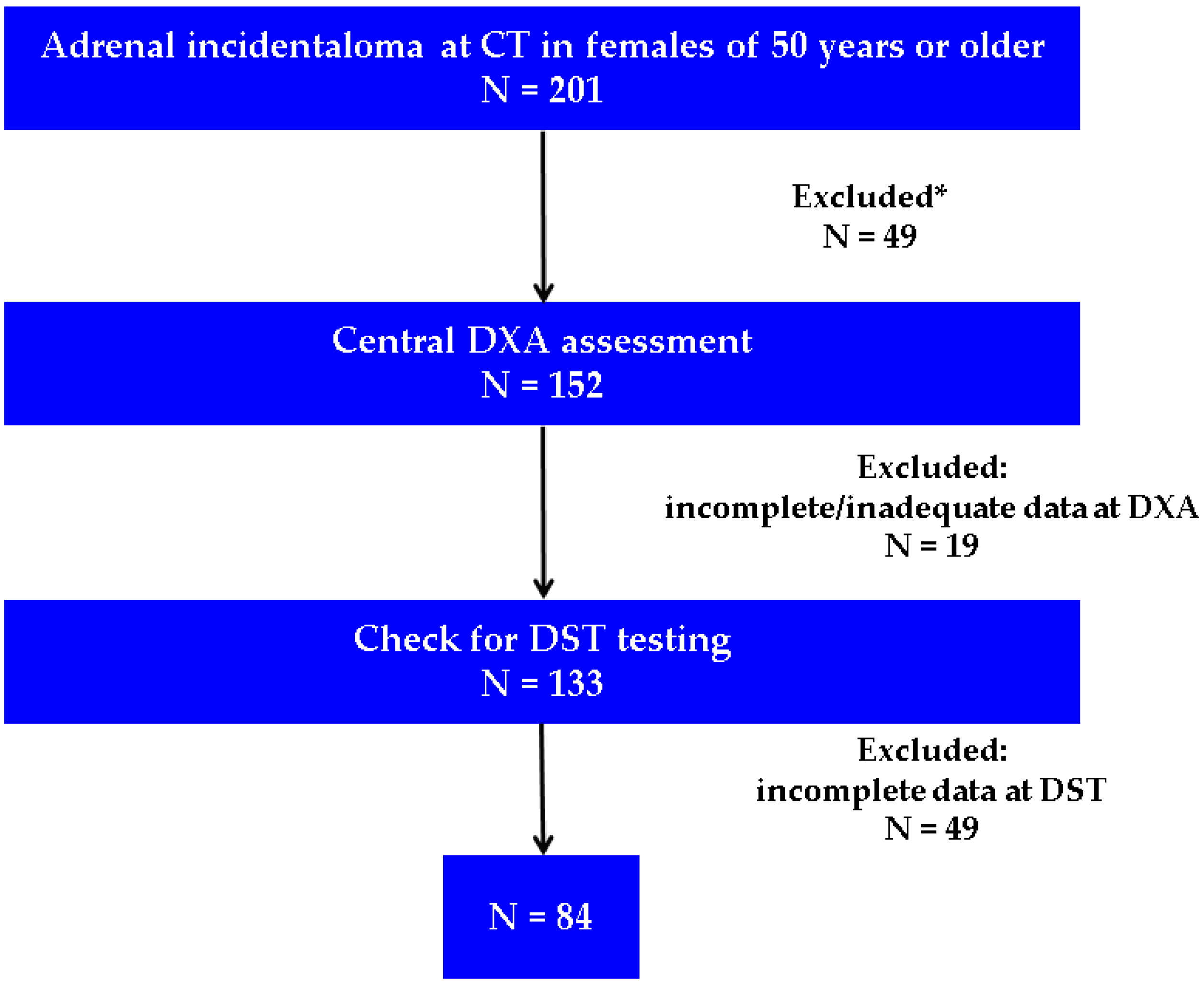
| Inclusion criteria | confirmed menopause |
| age of 50 years or older | |
| written consent during hospitalization (inpatient) | |
| imaging diagnosis of an adrenal incidentaloma | |
| available data (mineral and adrenal metabolism assays, adrenal CT scan, central DXA) within a maximum one-month gap between these assessments | |
| Exclusion criteria | overt (clinically manifested) Cushing’s syndrome |
| Cushing’s disease, suspected/confirmed paraneoplastic Cushing’s syndrome | |
| active endocrine tumours | |
| neuroendocrine neoplasia | |
| multiple endocrine neoplasia syndrome | |
| active thyroid dysfunction [we excluded the patients who did not present a normal value of freeT4 (thyroxine) and TSH (thyroid stimulating hormone)] | |
| bone metabolic conditions | |
| active infectious or inflammatory disorders | |
| chronic kidney disease | |
| type 1 and secondary diabetes mellitus | |
| prior or current exposure to specific anti-osteoporotic drugs | |
| corticotherapy | |
| insulin therapy | |
| GLP-1 medication | |
| bariatric surgery | |
| unilateral or bilateral adrenalectomy | |
| clear and conclusive results of the CT (both adrenal glands), DXA (lumbar, bone mineral density, total hip), and TBS | |
| second-day cortisol following 1 mg DST of less than 5 µg/dL | |
| suspected imaging features of an adrenal malignancy (primary or secondary) | |
| registration time of the cortisol and ACTH assays (baseline) and second-day cortisol (DST) between 6:00 and 7:30 a.m. (for both cortisol and ACTH on the first day and for second-day cortisol) |
| Parameter/Variable | Method/Manufacturer |
|---|---|
| Demographic features (age, years since menopause), comorbidities (type 2 diabetes, hypertension, dyslipidaemia), prior fragility fractures | medical records and evaluation during hospitalization |
| Total calcium, phosphorus, magnesium, total alkaline phosphatase, fasting glucose, creatinine | photometry (Roche) |
| PTH, P1NP, osteocalcin, CrossLaps, cortisol, ACTH | ECLIA (Roche) |
| 25-hydroxyvitamin D | CLIA (DiaSorin) |
| Glycated hemoglobin A1c | turbidimetry (Roche) |
| Central (lumbar, femoral neck, total hip) DXA | GE Lunar Prodigy device |
| Trabecular bone score | TBS iNsight software v3.0 |
| Parameter | Value | Normal Range |
|---|---|---|
| Number of patients (%) | 84 (100%) | |
| Age (years), mean ± SD | 61.49 ± 7.86 | |
| Years since menopause, mean ± SD | 14.23 ± 8.73 | |
| Type 2 diabetes, N (%) | 15 (18.07) | |
| Arterial hypertension, N (%) | 63 (75.00) | |
| Dyslipidemia, N (%) | 66 (78.57) | |
| Body mass index (kg/sqm), mean ± SD | 29.48 ± 5.70 | |
| Fasting glycemia (mg/dL), mean ± SD | 108.60 ± 26.81 | 74–106 |
| Glycated hemoglobin A1c (%), mean ± SD | 6.13 ± 1.22 | 4.8–5.9 |
| Serum creatinine (mg/dL), mean ± SD | 0.79 ± 0.18 | 0.7–1.2 |
| Baseline ACTH (pg/mL), M (Q1, Q3) | 11.89 (7.93, 16.15) | 3–66 |
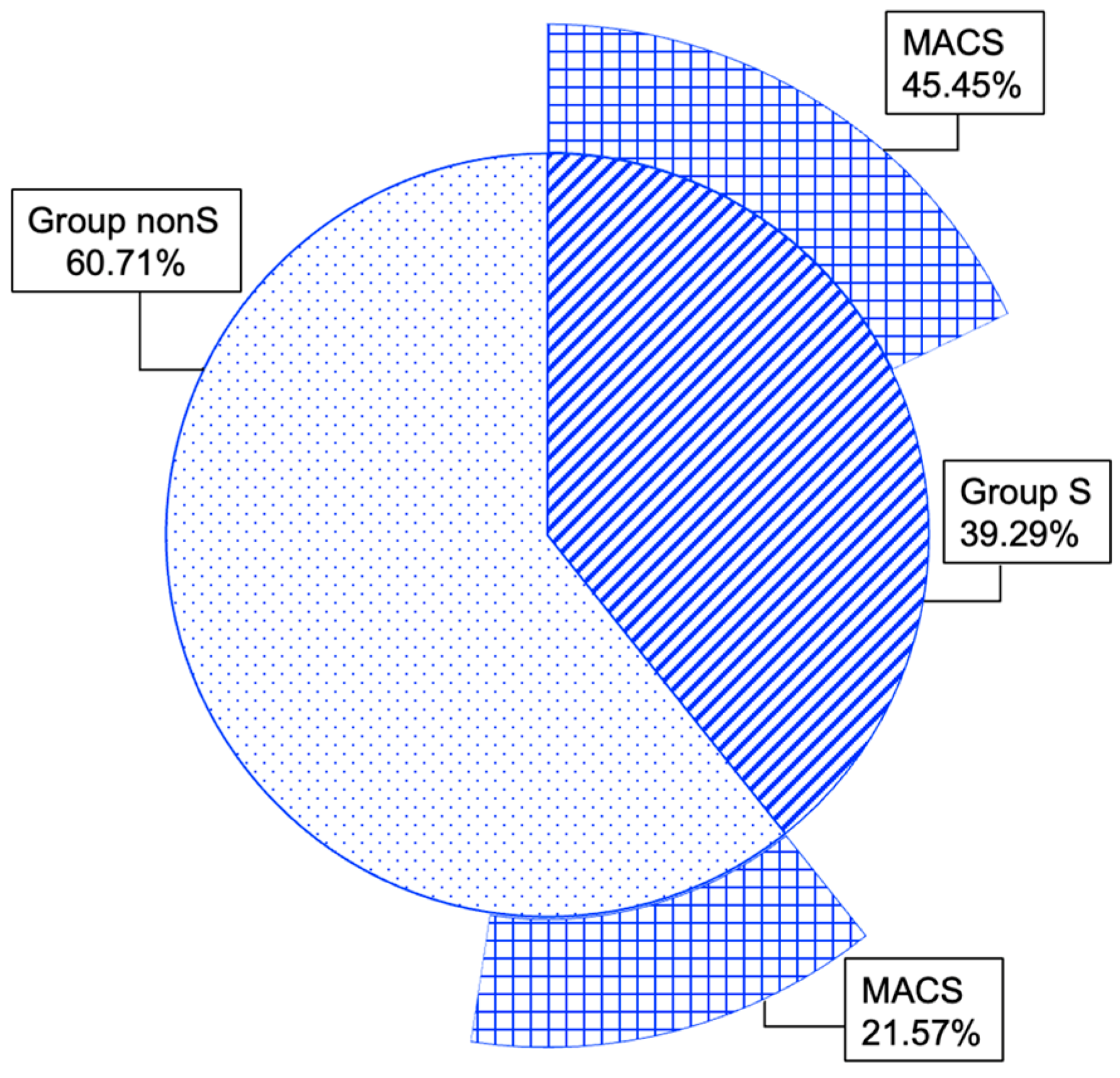
| Suppressed ACTH (group S), N (%) | 33 (39.29) | |
| Morning plasma (baseline) cortisol (µg/dL), median (Q1, Q3) | 13.01 (9.82, 14.96) | 6.2–19.4 |
| Second-day plasma cortisol after 1 mg DST (µg/dL), M (Q1, Q3) | 1.68 (1.04, 2.79) | <1.8 |
| MACS-positive, N (%) | 26 (30.95) | |
| Largest tumour diameter (cm), mean ± SD | 2.25 ± 0.99 | |
| Prevalence of unilateral tumour, N (%) | 55 (65.48) |
| Parameter | Value | Normal Range |
|---|---|---|
| Mineral metabolism | ||
| Total serum calcium (mg/dL), mean ± SD | 9.58 ± 0.49 | 8.4–10.2 |
| Serum ionized calcium (mg/dL), mean ± SD | 4.13 ± 0.28 | 3.9–4.9 |
| Serum phosphorus (mg/dL), mean ± SD | 3.71 ± 0.56 | 2.5–4.5 |
| Serum magnesium (mg/dL), mean ± SD | 1.98 ± 0.20 | 1.6–2.6 |
| 25-hydroxyvitamin D (ng/mL), mean ± SD | 24.90 ± 11.37 | 30–100 |
| PTH (pg/mL), mean ± SD | 45.42 ± 15.22 | 15–65 |
| Bone turnover markers | ||
| Osteocalcin (ng/mL), mean ± SD | 23.31 ± 11.65 | 14–46 |
| Alkaline phosphatase (U/L), mean ± SD | 80.46 ± 31.83 | 35–129 |
| P1NP (ng/mL), mean ± SD | 56.11 ± 22.87 | 20.25–76.31 |
| CrossLaps (ng/mL), mean ± SD | 0.49 ± 0.25 | 0.33–0.782 |
| DXA assessment | ||
| Prevalent fragility fractures, N (%) | 4 (4.76) | |
| Bone impairment, N (%) | 55 (65.48) | |
| Osteoporosis, N (%) | 17 (21.99) | |
| Osteopenia, N (%) | 38 (46.91) | |
| Lumbar BMD (g/sqcm), mean ± SD | 1.066 ± 0.167 | |
| Lumbar T-score (SD), mean ± SD | −1.00 ± 1.39 | >−1 |
| Femoral neck BMD (g/sqcm), mean ± SD | 0.860 ± 0.145 | |
| Femoral neck T-score (SD), mean ± SD | −1.12 ± 1.00 | >−1 |
| Total hip BMD (g/sqcm), mean ± SD | 0.937 ± 0.178 | |
| Total hip T-score (SD), mean ± SD | −0.68 ± 1.18 | >−1 |
| TBS, M (Q1, Q3) | 1.320 (1.230, 1.392) | >1.350 |
| FRAX-based probabilities | ||
| MOF with femoral neck BMD (%), M (Q1, Q3) | 3.90 (2.83, 6.15) | |
| MOF adjusted for lumbar BMD (%), M (Q1, Q3) | 2.95 (2.20, 4.40) | |
| MOF adjusted for diabetes (%), M (Q1, Q3) | 3.50 (3.00, 6.10) | |
| HF with femoral neck BMD (%), M (Q1, Q3) | 0.70 (0.30, 1.78) | |
| HF adjusted for lumbar BMD (%), M (Q1, Q3) | 0.50 (0.20, 1.23) | |
| HF adjusted for diabetes (%), M (Q1, Q3) | 0.60 (0.30, 2.83) | |
| Parameter | Baseline ACTH (pg/mL) | Morning Plasma (Baseline) Cortisol (µg/dL) | Second-Day Plasma Cortisol After 1 mg DST (µg/dL) | Largest Tumour Diameter (cm) | Lumbar BMD (g/sqcm) | Femoral Neck BMD (g/sqcm) | Total Hip BMD (g/sqcm) | MOF with Femoral Neck BMD | MOF Adjusted for Lumbar BMD | MOF Adjusted for Diabetes | HF with Femoral Neck BMD | HF Adjusted for Lumbar BMD | HF Adjusted for Diabetes |
|---|---|---|---|---|---|---|---|---|---|---|---|---|---|
| Baseline ACTH (pg/mL) | r = 0.228 p = 0.039 | r = −0.301 p = 0.024 | r = −0.434 p < 0.001 | r = −0.078 p = 0.527 | r = −0.075 p = 0.578 | r = −0.077 p = 0.600 | r = 0.018 p = 0.903 | r = −0.001 p = 0.997 | r = −0.358 p = 0.280 | r = −0.009 p = 0.950 | r = 0.005 p = 0.976 | r = −0.395 p = 0.258 | |
| Morning plasma (baseline) cortisol (µg/dL) | r = −0.021 p = 0.878 | r = −0.067 p = 0.566 | r = 0.118 p = 0.347 | r = 0.047 p = 0.733 | r = −0.154 p = 0.295 | r = −0.036 p = 0.811 | r = −0.018 p = 0.907 | r = 0.276 p = 0.412 | r = −0.125 p = 0.401 | r = −0.075 p = 0.625 | r = 0.363 p = 0.303 | ||
| Second-day plasma cortisol after 1 mg DST (µg/dL) | r = 0.572 p < 0.001 | r = 0.109 p = 0.461 | r = 0.134 p = 0.428 | r = 0.110 p = 0.500 | r = −0.102 p = 0.591 | r = −0.204 p = 0.287 | r = 0.288 p = 0.452 | r = −0.090 p = 0.635 | r = −0.123 p = 0.526 | r = 0.286 p = 0.493 | |||
| Largest tumour diameter (cm) | r = 0.012 p = 0.923 | r = 0.048 p = 0.739 | r = 0.191 p = 0.209 | r = 0.010 p = 0.951 | r = −0.017 p = 0.913 | r = −0.133 p = 0.696 | r = −0.009 p = 0.952 | r = −0.058 p = 0.714 | r = −0.143 p = 0.693 |
| Parameter | MOF with Femoral Neck BMD | MOF Adjusted for Lumbar BMD | MOF Adjusted for Diabetes | HF with Femoral Neck BMD | HF Adjusted for Lumbar BMD | HF Adjusted for Diabetes |
|---|---|---|---|---|---|---|
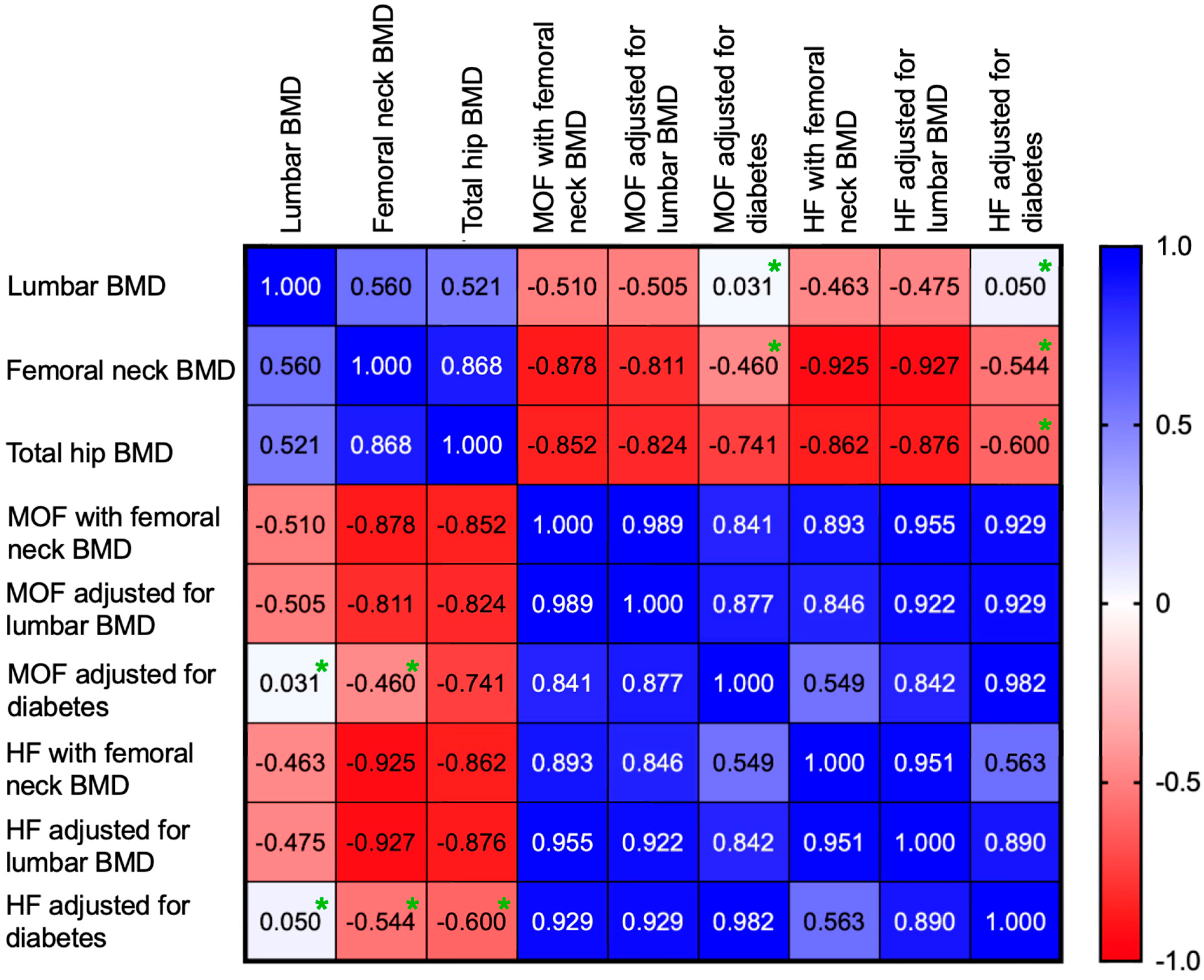
| Lumbar BMD (g/sqcm) | r = −0.510 p < 0.001 | r = −0.505 p < 0.001 | r = 0.031 p = 0.933 | r = −0.463 p < 0.001 | r = −0.475 p < 0.001 | r = 0.050 p = 0.898 |
| Femoral neck BMD (g/sqcm) | r = −0.878 p < 0.001 | r = −0.811 p < 0.001 | r = −0.460 p = 0.181 | r = −0.925 p < 0.001 | r = −0.927 p < 0.001 | r = −0.544 p = 0.130 |
| Total hip BMD (g/sqcm) | r = −0.852 p < 0.001 | r = −0.811 p < 0.001 | r = −0.741 p = 0.057 | r = −0.862 p < 0.001 | r = −0.876 p < 0.001 | r = −0.600 p = 0.208 |
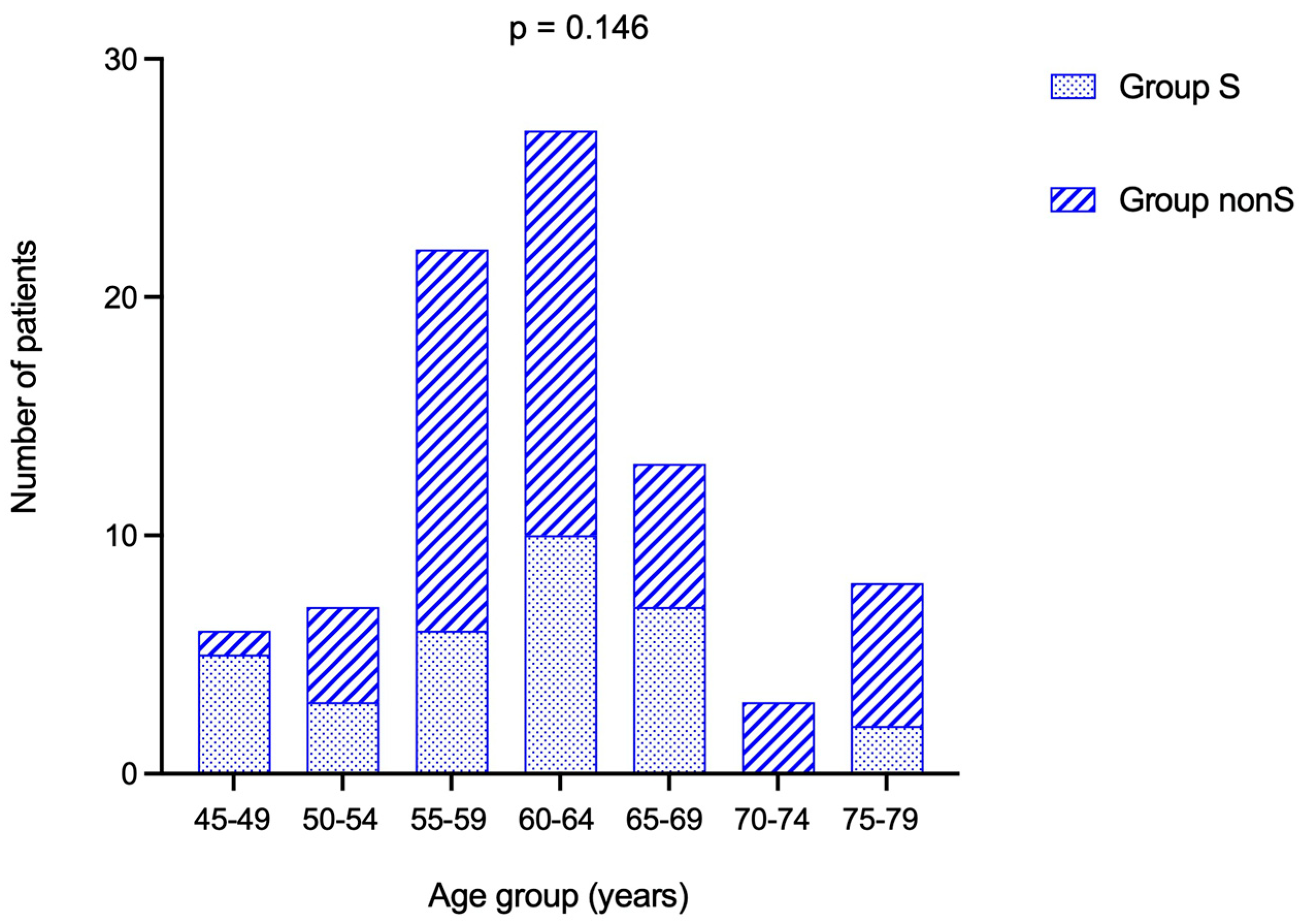
| Age Group (years) N (%) | Group S (N = 33, 39.29%) | Group nonS (N = 51, 60.71%) | p-Value |
|---|---|---|---|
| 45–49 | 5 (15.15) | 1 (1.96) | 0.146 |
| 50–54 | 3 (9.09) | 4 (7.84) | |
| 55–59 | 6 (18.18) | 14 (27.45) | |
| 60–64 | 10 (30.30) | 17 (33.33) | |
| 65–69 | 7 (21.21) | 6 (11.76) | |
| 70–74 | 0 (0.00) | 3 (5.88) | |
| 75–79 | 2 (6.06) | 6 (11.76) |
| Parameter | Group S (N = 33, 39.29%) | Group nonS (N = 51, 60.71%) | p-Value |
|---|---|---|---|
| Age (years), mean ± SD | 60.06 ± 8.63 | 62.41 ± 7.26 | 0.182 |
| Years since menopause, mean ± SD | 13.28 ± 8.72 | 14.91 ± 8.80 | 0.479 |
| Type 2 diabetes mellitus, N (%) | 7 (21.21) | 8 (16.00) | 0.572 |
| Arterial hypertension, N (%) | 25 (75.76) | 38 (74.51) | 0.897 |
| Dyslipidaemia, N (%) | 25 (75.76) | 41 (80.39) | 0.613 |
| Body mass index (kg/sqm), mean ± SD | 28.26 ± 3.96 | 30.46 ± 6.68 | 0.104 |
| Fasting glycaemia (mg/dL), mean ± SD | 106.94 ± 28.34 | 109.68 ± 26.14 | 0.712 |
| Glycated haemoglobin A1c (%), mean ± SD | 6.02 ± 0.93 | 6.21 ± 1.40 | 0.574 |
| Serum creatinine (mg/dL), mean ± SD | 0.75 ± 0.14 | 0.81 ± 0.21 | 0.276 |
| Baseline ACTH (pg/mL), M (Q1, Q3) | 7.37 (6.19, 8.60) | 15.37 (12.30, 20.48) | <0.001 |
| Morning plasma (baseline) cortisol (µg/dL), M (Q1, Q3) | 12.27 (9.48, 14.30) | 13.43 (10.01, 15.97) | 0.163 |
| Second-day plasma cortisol after 1-mg DST (µg/dL), M (Q1, Q3) | 2.08 (1.58, 3.08) | 1.25 (0.94, 2.02) | 0.014 |
| MACS, N (%) | 15 (45.45) | 11 (21.57) | 0.021 |
| Largest tumour diameter (cm), mean ± SD | 2.67 ± 0.98 | 1.98 ± 0.92 | 0.003 |
| Unilateral tumour, N (%) | 20 (60.61) | 35 (68.63) | 0.450 |
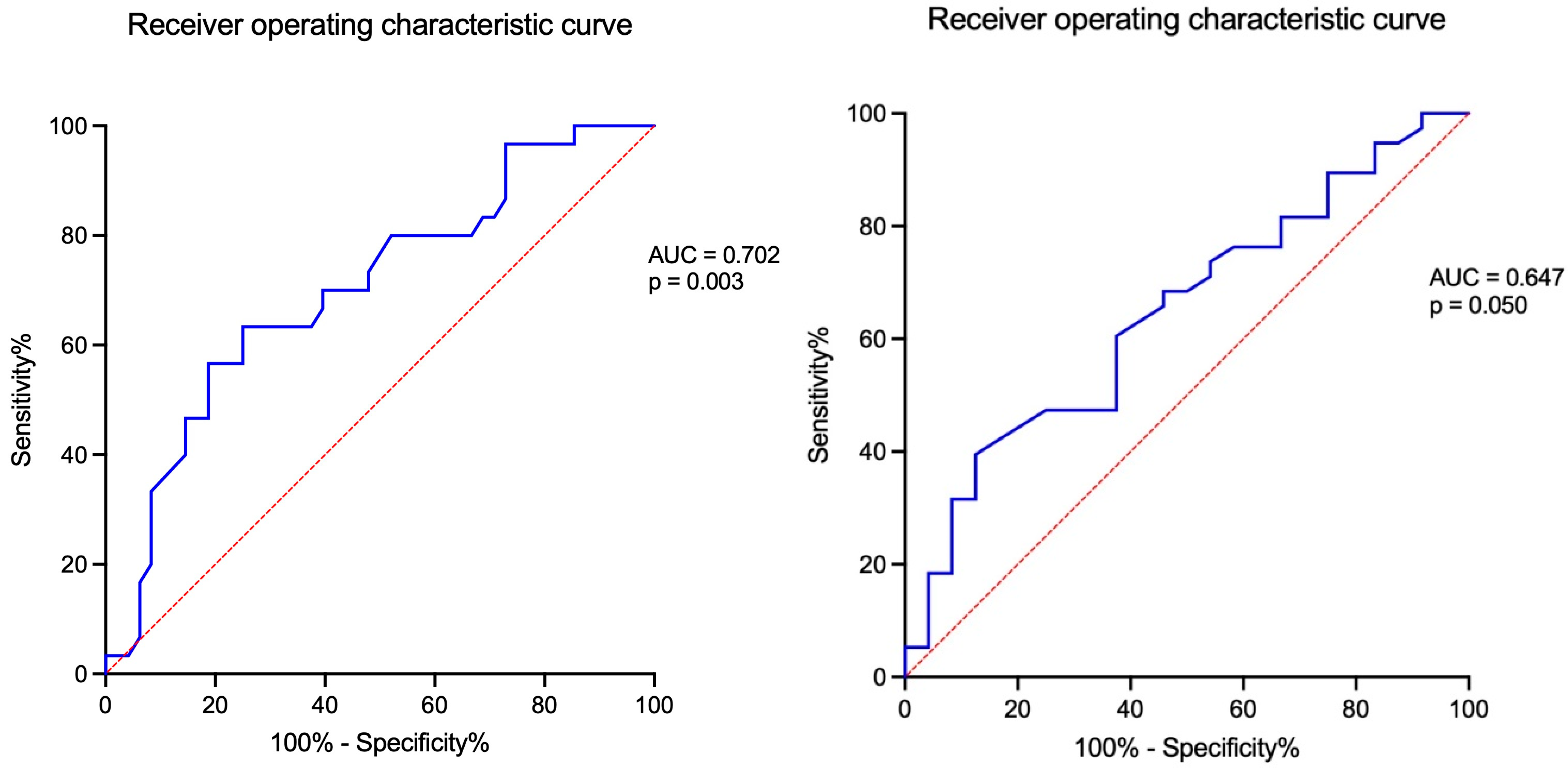
| Cut-off Value Largest Tumour Diameter (cm) for Suppressed ACTH | AUC | Sensitivity (95% CI) | Specificity (95% CI) | Youden Index |
| 2.45 cm | 0.702 | 63.30 (45.51–78.13) | 75.00 (61.22–85.08) | 0.383 |
| Cut-off value of CrossLaps (ng/mL) for suppressed ACTH | AUC | Sensitivity (95% CI) | Specificity (95% CI) | Youden Index |
| 0.32 ng/mL | 0.647 | 87.50 (69.00–95.66) | 39.50 (25.60–55.28) | 0.270 |
| Parameter | Group S (N = 33, 39.29%) | Group nonS (N = 51, 60.71%) | p-Value |
|---|---|---|---|
| Mineral metabolism | |||
| Total serum calcium (mg/dL), mean ± SD | 9.58 ± 0.49 | 9.58 ± 0.49 | 0.990 |
| Serum ionized calcium (mg/dL), mean ± SD | 4.19 ± 0.23 | 4.09 ± 0.31 | 0.191 |
| Serum phosphorus (mg/dL), mean ± SD | 3.72 ± 0.64 | 3.70 ± 0.50 | 0.866 |
| Serum magnesium (mg/dL), mean ± SD | 1.99 ± 0.24 | 1.96 ± 0.17 | 0.557 |
| 25-hydroxyvitamin D (ng/mL), mean ± SD | 23.03 ± 10.07 | 26.21 ± 12.16 | 0.258 |
| PTH (pg/mL), mean ± SD | 41.85 ± 13.81 | 47.84 ± 15.86 | 0.165 |
| Bone turnover markers | |||
| Osteocalcin (ng/mL), mean ± SD | 25.33 ± 14.16 | 22.05 ± 9.77 | 0.294 |
| Alkaline phosphatase (U/L), mean ± SD | 91.15 ± 38.84 | 73.49 ± 24.30 | 0.017 |
| P1NP (ng/mL), mean ± SD | 58.35 ± 29.32 | 55.02 ± 19.54 | 0.661 |
| CrossLaps (ng/mL), mean ± SD | 0.56 ± 0.29 | 0.44 ± 0.22 | 0.050 |
| DXA assessment | |||
| Prevalent fragility fractures, N (%) | 3 (9.09) | 1 (1.96) | 0.295 |
| Bone impairment, N (%) | 22 (66.67) | 33 (64.71) | 0.853 |
| Osteoporosis, N (%) | 8 (24.24) | 9 (18.75) | 0.551 |
| Osteopenia, N (%) | 14 (42.42) | 24 (50.00) | 0.651 |
| Lumbar BMD (g/sqcm), mean ± SD | 1.087 ± 0.173 | 1.052 ± 0.163 | 0.404 |
| Lumbar T-score (SD), mean ± SD | −0.85 ± 1.49 | −1.10 ± 1.33 | 0.453 |
| Femoral neck BMD (g/sqcm), mean ± SD | 0.875 ± 0.155 | 0.851 ± 0.141 | 0.557 |
| Femoral neck T-score (SD), mean ± SD | −1.02 ± 1.17 | −1.18 ± 0.88 | 0.573 |
| Total hip BMD (g/sqcm), mean ± SD | 0.930 ± 0.185 | 0.940 ± 0.177 | 0.846 |
| Total hip T-score (SD), mean ± SD | −0.75 ± 1.40 | −0.63 ± 1.05 | 0.719 |
| TBS, M (Q1, Q3) | 1.337 (1.244, 1.429) | 1.291 (1.199, 1.401) | 0.393 |
| FRAX-based probabilities | |||
| MOF with femoral neck BMD (%), M (Q1, Q3) | 3.60 (2.80, 6.15) | 3.95 (2.93, 6.15) | 0.630 |
| MOF adjusted for lumbar BMD (%), M (Q1, Q3) | 2.80 (2.10, 4.23) | 3.05 (2.30, 4.40) | 0.471 |
| MOF adjusted for diabetes (%), M (Q1, Q3) | 4.40 (3.38, 6.60) | 3.50 (2.00, 7.55) | 0.461 |
| HF with femoral neck BMD (%), M (Q1, Q3) | 0.85 (0.20, 1.95) | 0.65 (0.30, 1.68) | 0.801 |
| HF adjusted for lumbar BMD (%), M (Q1, Q3) | 0.65 (0.18, 1.00) | 0.45 (0.23, 1.35) | 0.520 |
| HF adjusted for diabetes (%), M (Q1, Q3) | 2.10 (0.40, 2.95) | 0.40 (0.20, 3.60) | 0.402 |
| MOF with Femoral Neck BMD-MOF Adjusted for Lumbar BMD p-Value | MOF Adjusted for Lumbar BMD-MOF Adjusted for Diabetes p-Value | MOF Adjusted for Diabetes-MOF Adjusted for Lumbar BMD p-Value | |
| Group S | <0.001 | 0.832 | 0.036 |
| Group nonS | <0.001 | 0.289 | 0.244 |
| HF with femoral neck BMD-HF adjusted for lumbar BMD p-value | HF adjusted for lumbar BMD-HF adjusted for diabetes p-value | HF adjusted for diabetes-HF adjusted for lumbar BMD p-value | |
| Group S | 0.007 | 0.068 | 0.095 |
| Group nonS | 0.111 | 0.439 | 0.300 |
| Baseline ACTH (pg/mL) | Morning Plasma (Baseline) Cortisol (µg/dL) | Second-Day Plasma Cortisol After 1-mg DST (µg/dL) | Largest Tumour Diameter (cm) | Lumbar BMD (g/sqcm) | Femoral Neck BMD (g/sqcm) | Total Hip BMD (g/sqcm) | MOF with Femoral Neck BMD | MOF Adjusted for Lumbar BMD | HF with Femoral Neck BMD | HF Adjusted for Lumbar BMD | |
|---|---|---|---|---|---|---|---|---|---|---|---|
| Group S | |||||||||||
| Baseline ACTH (pg/mL) | r = −0.082 p = 0.649 | r = 0.016 p = 0.942 | r = −0.095 p = 0.942 | r = 0.434 p = 0.024 | r = 0.149 p = 0.510 | r = −0.067 p = 0.791 | r = 0.059 p = 0.803 | r = −0.004 p = 0.987 | r = 0.070 p = 0.769 | r = −0.087 p = 0.730 | |
| Morning plasma (baseline) cortisol (µg/dL) | r = −0.082 p = 0.649 | r = 0.170 p = 0.427 | r = 0.273 p = 0.145 | r = 0.250 p = 0.208 | r = 0.204 p = 0.363 | r = 0.251 p = 0.316 | r = −0.056 p = 0.816 | r = −0.066 p = 0.794 | r = −0.245 p = 0.299 | r = −0.306 p = 0.217 | |
| Second-day plasma cortisol after 1-mg DST (µg/dL) | r = 0.016 p = 0.942 | r = 0.170 p = 0.427 | r = 0.591 p = 0.002 | r = 0.049 p = 0.842 | r = 0.176 p = 0.547 | r = 0.136 p = 0.630 | r = −0.149 p = 0.628 | r = −0.161 p = 0.617 | r = −0.085 p = 0.781 | r = −0.165 p = 0.608 | |
| Largest tumor diameter (cm) | r = −0.095 p = 0.942 | r = 0.273 p = 0.145 | r = 0.591 p = 0.002 | r = 0.027 p = 0.897 | r = 0.052 p = 0.833 | r = 0.093 p = 0.722 | r = −0.042 p = 0.874 | r = −0.048 p = 0.860 | r = −0.153 p = 0.557 | r = −0.245 p = 0.360 | |
| Group nonS | |||||||||||
| Baseline ACTH (pg/mL) | r = 0.315 p = 0.028 | r = −0.146 p = 0.426 | r = −0.395 p = 0.005 | r = −0.185 p = 0.246 | r = −0.172 p = 0.322 | r = −0.229 p = 0.214 | r = −0.177 p = 0.368 | r = −0.252 p = 0.196 | r = −0.195 p = 0.320 | r = −0.165 p = 0.402 | |
| Morning plasma (baseline) cortisol (µg/dL) | r = 0.315 p = 0.028 | r = 0.081 p = 0.664 | r = −0.223 p = 0.137 | r = 0.058 p = 0.724 | r = −0.055 p = 0.759 | r = −0.391 p = 0.033 | r = −0.020 p = 0.923 | r = −0.034 p = 0.868 | r = −0.108 p = 0.593 | r = −0.027 p = 0.893 | |
| Second-day plasma cortisol after 1-mg DST (µg/dL) | r = −0.146 p = 0.426 | r = 0.081 p = 0.664 | r = 0.339 p = 0.067 | r = 0.149 p = 0.440 | r = 0.238 p = 0.274 | r = 0.120 p = 0.566 | r = −0.058 p = 0.826 | r = −0.089 p = 0.736 | r = −0.202 p = 0.437 | r = −0.097 p = 0.710 | |
| Largest tumor diameter (cm) | r = −0.395 p = 0.005 | r = −0.223 p = 0.137 | r = 0.339 p = 0.067 | r = −0.073 p = 0.664 | r = −0.040 p = 0.829 | r = 0.167 p = 0.395 | r = 0.225 p = 0.268 | r = 0.258 p = 0.204 | r = 0.245 p = 0.227 | r = 0.203 p = 0.319 | |
| Parameter | MOF with Femoral Neck BMD | MOF Adjusted for Lumbar BMD | HF with Femoral Neck BMD | HF Adjusted for Lumbar BMD |
|---|---|---|---|---|
| Group S | ||||
| Lumbar BMD (g/sqcm) | r = −0.537 p = 0.021 | r = −0.526 p = 0.025 | r = −0.523 p = 0.026 | r = −0.494 p = 0.037 |
| Femoral neck BMD (g/sqcm) | r = −0.817 p < 0.001 | r = −0.694 p = 0.001 | r = −0.943 p < 0.001 | r = −0.919 p < 0.001 |
| Total hip BMD (g/sqcm) | r = −0.760 p = 0.004 | r = −0.709 p = 0.015 | r = −0.823 p = 0.001 | r = −0.858 p < 0.001 |
| Group nonS | ||||
| Lumbar BMD (g/sqcm) | r = −0.499 p = 0.007 | r = −0.503 p = 0.006 | r = −0.489 p = 0.008 | r = −0.490 p = 0.008 |
| Femoral neck BMD (g/sqcm) | r = −0.911 p < 0.001 | r = −0.862 p < 0.001 | r = −0.894 p < 0.001 | r = −0.935 p < 0.001 |
| Total hip BMD (g/sqcm) | r = −0.869 p < 0.001 | r = −0.842 p < 0.001 | r = −0.770 p < 0.001 | r = −0.841 p < 0.001 |
| Baseline ACTH (pg/mL) | |||
|---|---|---|---|
| Parameter | B ± SE | β | p-Value |
| Constant | 13.65 ± 7.32 | 0.079 | |
| Morning plasma (baseline) cortisol (µg/dL) | 0.06 ± 0.16 | 0.05 | 0.710 |
| MACS | −1.23 ± 2.13 | −0.08 | 0.567 |
| Largest tumour diameter (cm) | −3.07 ± 0.98 | −0.43 | 0.003 |
| Age (years) | −0.01 ± 0.11 | −0.02 | 0.905 |
| BMI (kg/sqm) | 0.21 ± 0.15 | 0.18 | 0.165 |
| Model summary | R Square = 0.225 | 0.016 |
| Group S | Group nonS | |||||||
|---|---|---|---|---|---|---|---|---|
| Parameter | MACS (N = 15, 45.45%) | nonMACS (N = 18, 54.55%) | p-Value | MACS (N = 11, 21.57%) | nonMACS (N = 40, 78.43%) | p-Value | p1-Value | p2-Value |
| Age (years), mean ± SD | 57.80 ± 7.61 | 61.94 ± 9.18 | 0.173 | 63.45 ± 4.63 | 62.13 ± 7.85 | 0.483 | 0.701 | 0.943 |
| Years since menopause, mean ± SD | 48.44 ± 4.95 | 48.81 ± 3.69 | 0.178 | 49.29 ± 3.09 | 48.75 ± 3.60 | 0.934 | 0.254 | 0.973 |
| Type 2 diabetes mellitus, N (%) | 6 (40.00) | 1 (5.56) | 0.030 | 2 (18.18) | 6 (15.38) | 0.999 | 0.395 | 0.413 |
| Arterial hypertension, N (%) | 12 (80.00) | 13 (72.22) | 0.699 | 9 (81.82) | 29 (72.50) | 0.706 | 0.907 | 0.983 |
| Dyslipidaemia, N (%) | 12 (80.00) | 13 (72.00) | 0.699 | 10 (90.91) | 31 (77.50) | 0.428 | 0.614 | 0.744 |
| BMI (kg/sqm), mean ± SD | 30.42 ± 3.96 | 26.74 ± 3.26 | 0.011 | 34.41 ± 5.31 | 29.67 ± 6.71 | 0.091 | 0.090 | 0.098 |
| Fasting glycaemia (mg/dL), mean ± SD | 109 ± 28.76 | 105.51 ± 29.14 | 0.784 | 112.00 ± 34.59 | 109.08 ± 24.27 | 0.839 | 0.852 | 0.685 |
| Glycated haemoglobin A1c (%), mean ± SD | 6.15 ± 0.68 | 5.87 ± 1.80 | 0.493 | 6.51 ± 1.97 | 6.09 ± 1.12 | 0.560 | 0.556 | 0.609 |
| Serum creatinine (mg/dL), mean ± SD | 0.78 ± 0.17 | 0.74 ± 0.13 | 0.478 | 0.89 ± 0.27 | 0.78 ± 0.18 | 0.297 | 0.314 | 0.409 |
| Baseline ACTH (pg/mL), M (Q1, Q3) | 8.00 (6.64, 8.90) | 7.24 (5.87, 8.01) | 0.229 | 14.71 (12.29, 19.51) | 15.65 (12.31, 20.59) | 0.801 | <0.001 | <0.001 |
| Morning plasma (baseline) cortisol (μg/dL), M (Q1, Q3) | 11.58 (8.77, 13.25) | 13.49 (9.63, 15.12) | 0.178 | 12.15 (9.96, 15.92) | 13.92 (9.90, 16.66) | 0.455 | 0.605 | 0.668 |
| Second-day plasma cortisol after 1 mg DST (μg/dL), M (Q1, Q3) | 2.79 (2.18, 3.44) | 1.34 (1.01, 1.64) | <0.001 | 2.80 (1.88, 4.86) | 1.02 (0.83, 1.25) | <0.001 | 0.919 | 0.056 |
| Largest tumour diameter (cm), mean ± SD | 3.12 ± 0.74 | 2.21 ± 0.99 | 0.008 | 2.51 ± 0.96 | 1.84 ± 0.87 | 0.039 | 0.087 | 0.888 |
| Group S | Group nonS | |||||||
|---|---|---|---|---|---|---|---|---|
| Parameter | MACS (N = 15, 45.45%) | nonMACS (N = 18, 54.55%) | p-Value | MACS (N = 11, 21.57%) | nonMACS (N = 40, 78.43%) | p-Value | p1-Value | p2-Value |
| Mineral metabolism | ||||||||
| Total serum calcium (mg/dL), mean ± SD | 9.49 ± 0.47 | 9.65 ± 0.51 | 0.343 | 9.54 ± 0.30 | 0.59 ± 0.53 | 0.735 | 0.731 | 0.650 |
| Serum ionized calcium (mg/dL), mean ± SD | 4.11 ± 0.20 | 4.26 ± 0.24 | 0.105 | 4.19 ± 0.25 | 4.06 ± 0.33 | 0.208 | 0.404 | 0.054 |
| Serum phosphorus (mg/dL), mean ± SD | 3.82 ± 0.62 | 3.64 ± 0.67 | 0.455 | 3.59 ± 0.37 | 3.73 ± 0.53 | 0.361 | 0.314 | 0.609 |
| Serum magnesium (mg/dL), mean ± SD | 1.90 ± 0.26 | 2.06 ± 0.22 | 0.069 | 1.95 ± 0.21 | 1.97 ± 0.17 | 0.746 | 0.651 | 0.088 |
| 25-hydroxyvitamin D (ng/mL), mean ± SD | 24.95 ± 10.60 | 21.36 ± 9.64 | 0.356 | 25.63 ± 13.63 | 26.38 ± 11.93 | 0.883 | 0.897 | 0.163 |
| PTH (pg/mL), mean ± SD | 39.86 ± 10.87 | 42.84 ± 15.35 | 0.653 | 45.66 ± 10.95 | 48.48 ± 17.17 | 0.686 | 0.340 | 0.317 |
| Bone turnover markers | ||||||||
| Osteocalcin (ng/mL), mean ± SD | 23.90 ± 12.63 | 26.24 ± 15.46 | 0.708 | 23.09 ± 12.73 | 21.77 ± 9.05 | 0.790 | 0.897 | 0.238 |
| Alkaline phosphatase (U/L), mean ± SD | 82.14 ± 19.97 | 99.03 ± 49.29 | 0.223 | 71.10 ± 30.64 | 74.14 ± 22.71 | 0.775 | 0.296 | 0.069 |
| P1NP (ng/mL), mean ± SD | 51.28 ± 36.02 | 65.41 ± 21.18 | 0.388 | 52.14 ± 17.74 | 55.94 ± 20.38 | 0.643 | 0.956 | 0.298 |
| CrossLaps (ng/mL), mean ± SD | 0.51 ± 0.32 | 0.60 ± 0.27 | 0.469 | 0.49 ± 0.27 | 0.42 ± 0.21 | 0.473 | 0.922 | 0.022 |
| DXA assessment | ||||||||
| Prevalent fragility fractures, N (%) | 1 (6.67) | 2 (11.11) | 0.999 | 0 (0.00) | 1 (2.50) | 0.999 | 0.382 | 0.225 |
| Bone impairment, N (%) | 9 (60.00) | 13 (72.22) | 0.488 | 7 (63.64) | 26 (65.00) | 0.933 | 0.851 | 0.764 |
| Osteoporosis, N (%) | 3 (20.00) | 5 (27.78) | 0.699 | 2 (18.18) | 7 (18.92) | 0.956 | 0.907 | 0.499 |
| Osteopenia, N (%) | 6 (40.00) | 8 (44.44) | 0.999 | 5 (45.45) | 19 (51.35) | 0.731 | 0.781 | 0.775 |
| Lumbar BMD (g/sqcm), mean ± SD | 1.100 ± 0.168 | 1.078 ± 0.181 | 0.747 | 1.079 ± 0.103 | 1.044 ± 0.179 | 0.445 | 0.733 | 0.539 |
| Lumbar T-score (SD), mean ± SD | −0.65 ± 1.23 | −1.02 ± 1.69 | 0.516 | −0.79 ± 1.23 | −1.19 ± 1.36 | 0.370 | 0.777 | 0.682 |
| Femoral neck BMD (g/sqcm), mean ± SD | 0.893 ± 0.146 | 0.860 ± 0.166 | 0.635 | 0.915 ± 0.085 | 0.829 ± 0.150 | 0.118 | 0.694 | 0.575 |
| Femoral neck T-score (SD), mean ± SD | −0.78 ± 1.19 | −1.23 ± 1.16 | 0.388 | −0.78 ± 0.60 | −1.32 ± 0.93 | 0.115 | 0.996 | 0.798 |
| Total hip BMD (g/sqcm), mean ± SD | 0.961 ± 0.192 | 0.905 ± 0.185 | 0.540 | 0.994 ± 0.083 | 0.922 ± 0.198 | 0.332 | 0.671 | 0.821 |
| Total hip T-score (SD), mean ± SD | −0.53 ± 1.27 | −0.97 ± 1.55 | 0.470 | −0.18 ± 0.70 | −0.79 ± 1.11 | 0.134 | 0.447 | 0.677 |
| TBS, median (Q1, Q3) | 1.354 (1.259, 1.517) | 1.336 (1.229, 1.429) | 0.730 | 1.350 (1.341, 1.358) | 1.280 (1.177, 1.444) | 0.410 | 0.999 | 0.583 |
| FRAX-based probabilities | ||||||||
| MOF with femoral neck BMD (%), M (Q1, Q3) | 3.10 (2.00, 4.10) | 4.90 (3.20, 8.70) | 0.080 | 3.10 (2.70, 4.45) | 4.20 (2.90, 6.20) | 0.318 | 0.699 | 0.772 |
| MOF adjusted for lumbar BMD (%), M (Q1, Q3) | 2.15 (1.50, 2.68) | 3.70 (2.73, 6.30) | 0.021 | 2.40 (2.20, 3.30) | 3.10 (2.30, 4.50) | 0.264 | 0.354 | 0.603 |
| HF with femoral neck BMD (%), M (Q1, Q3) | 0.30 (0.15, 1.55) | 0.90 (0.30, 2.10) | 0.370 | 0.30 (0.20, 0.70) | 0.70 (0.40, 1.90) | 0.107 | 0.898 | 0.942 |
| HF adjusted for lumbar BMD (%), M (Q1, Q3) | 0.20 (0.10, 0.78) | 0.70 (0.20, 1.80) | 0.146 | 0.35 (0.15, 0.55) | 0.50 (0.30, 1.40) | 0.193 | 0.833 | 0.893 |
Disclaimer/Publisher’s Note: The statements, opinions and data contained in all publications are solely those of the individual author(s) and contributor(s) and not of MDPI and/or the editor(s). MDPI and/or the editor(s) disclaim responsibility for any injury to people or property resulting from any ideas, methods, instructions or products referred to in the content. |
© 2026 by the authors. Licensee MDPI, Basel, Switzerland. This article is an open access article distributed under the terms and conditions of the Creative Commons Attribution (CC BY) license.
Share and Cite
Trandafir, A.-I.; Sima, O.-C.; Ionovici, N.; Manda, D.; Costachescu, M.; Carsote, M. The Relationship Between Bone Health Status of Post-Menopausal Women with Non-Functional Adrenal Tumours/Mild Autonomous Cortisol Secretion and Their Baseline Morning Adrenocorticotropic Level. Diagnostics 2026, 16, 180. https://doi.org/10.3390/diagnostics16020180
Trandafir A-I, Sima O-C, Ionovici N, Manda D, Costachescu M, Carsote M. The Relationship Between Bone Health Status of Post-Menopausal Women with Non-Functional Adrenal Tumours/Mild Autonomous Cortisol Secretion and Their Baseline Morning Adrenocorticotropic Level. Diagnostics. 2026; 16(2):180. https://doi.org/10.3390/diagnostics16020180
Chicago/Turabian StyleTrandafir, Alexandra-Ioana, Oana-Claudia Sima, Nina Ionovici, Dana Manda, Mihai Costachescu, and Mara Carsote. 2026. "The Relationship Between Bone Health Status of Post-Menopausal Women with Non-Functional Adrenal Tumours/Mild Autonomous Cortisol Secretion and Their Baseline Morning Adrenocorticotropic Level" Diagnostics 16, no. 2: 180. https://doi.org/10.3390/diagnostics16020180
APA StyleTrandafir, A.-I., Sima, O.-C., Ionovici, N., Manda, D., Costachescu, M., & Carsote, M. (2026). The Relationship Between Bone Health Status of Post-Menopausal Women with Non-Functional Adrenal Tumours/Mild Autonomous Cortisol Secretion and Their Baseline Morning Adrenocorticotropic Level. Diagnostics, 16(2), 180. https://doi.org/10.3390/diagnostics16020180