A Bidirectional C1q/TNF-Related Protein Signature Is Associated with Disease Activity in Behçet’s Disease: A Cross-Sectional Study


Abstract
1. Introduction
2. Materials and Methods
2.1. Study Design and Participants
2.2. Laboratory Measurements
2.3. Statistical Analysis
3. Results
3.1. Participants
3.2. Biomarker Concentrations Across Groups
3.3. A Bidirectional Pattern Differs Between Active and Inactive Disease
3.4. Correlation with Clinical Activity
3.5. Performance of a Composite Index
4. Discussion
5. Conclusions
Author Contributions
Funding
Institutional Review Board Statement
Informed Consent Statement
Data Availability Statement
Acknowledgments
Conflicts of Interest
References
- Yazici, H.; Seyahi, E.; Hatemi, G.; Yazici, Y. Behçet syndrome: A contemporary view. Nat. Rev. Rheumatol. 2018, 14, 107–119. [Google Scholar] [CrossRef] [Scilit] [PubMed]
- International Team for the Revision of the International Criteria for Behçet’s Disease (ITR-ICBD); Davatchi, F.; Assaad-Khalil, S.; Calamia, K.; Crook, J.; Sadeghi-Abdollahi, B.; Schirmer, M.; Tzellos, T.; Zouboulis, C.; Akhlagi, M.; et al. The International Criteria for Behçet’s Disease (ICBD): A collaborative study of 27 countries on the sensitivity and specificity of the new criteria. J. Eur. Acad. Dermatol. Venereol. 2014, 28, 338–347. [Google Scholar] [CrossRef] [Scilit] [PubMed]
- Gül, A. Pathogenesis of Behçet’s disease: Autoinflammatory features and beyond. Semin. Immunopathol. 2015, 37, 413–418. [Google Scholar] [CrossRef] [Scilit] [PubMed]
- Hatemi, G.; Christensen, R.; Bang, D.; Bodaghi, B.; Celik, A.F.; Fortune, F.; Gaudric, J.; Gul, A.; Kötter, I.; Leccese, P.; et al. 2018 update of the EULAR recommendations for the management of Behçet’s syndrome. Ann. Rheum. Dis. 2018, 77, 808–818. [Google Scholar] [CrossRef] [Scilit] [PubMed]
- Bhakta, B.B.; Brennan, P.; James, T.E.; Chamberlain, M.A.; Noble, B.A.; Silman, A.J. Behçet’s disease: Evaluation of a new instrument to measure clinical activity. Rheumatology 1999, 38, 728–733. [Google Scholar] [CrossRef] [Scilit] [PubMed]
- Schäffler, A.; Buechler, C. CTRP family: Linking immunity to metabolism. Trends Endocrinol. Metab. 2012, 23, 194–204. [Google Scholar] [CrossRef] [Scilit] [PubMed]
- Seldin, M.M.; Tan, S.Y.; Wong, G.W. Metabolic function of the CTRP family of hormones. Rev. Endocr. Metab. Disord. 2014, 15, 111–123. [Google Scholar] [CrossRef] [Scilit] [PubMed]
- Schanbacher, C.; Hermanns, H.M.; Lorenz, K.; Wajant, H.; Lang, I. Complement 1q/Tumor Necrosis Factor-Related Proteins (CTRPs): Structure, Receptors and Signaling. Biomedicines 2023, 11, 559. [Google Scholar] [CrossRef] [Scilit] [PubMed]
- Guo, S.; Mao, X.; Liu, J. Multi-faceted roles of C1q/TNF-related proteins family in atherosclerosis. Front. Immunol. 2023, 14, 1253433. [Google Scholar] [CrossRef] [Scilit] [PubMed]
- Lee, Y.H.; Song, G.G. Association of circulating resistin, leptin, adiponectin and visfatin levels with Behçet disease: A meta-analysis. Clin. Exp. Dermatol. 2018, 43, 536–545. [Google Scholar] [CrossRef] [Scilit] [PubMed]
- Evereklioglu, C.; Inalöz, H.S.; Kirtak, N.; Doganay, S.; Bülbül, M.; Ozerol, E.; Er, H.; Ozbek, E. Serum leptin concentration is increased in patients with Behçet’s syndrome and is correlated with disease activity. Br. J. Dermatol. 2002, 147, 331–336. [Google Scholar] [CrossRef] [Scilit] [PubMed]
- Sezen, H.; Okumus, S.; Pehlivan, Y.; Dilli, I.; Tarakcioğlu, M.; Onat, A.M. Visfatin levels in Behcet’s disease. Inflammation 2012, 35, 405–408. [Google Scholar] [CrossRef] [Scilit] [PubMed]
- Türkcü, F.M.; Şahin, A.; Cingü, A.K.; Kaya, S.; Yüksel, H.; Cinar, Y.; Batmaz, İ. Serum omentin, resistin and tumour necrosis factor-α levels in Behcet patients with and without ocular involvement. Graefe’s Arch. Clin. Exp. Ophthalmol. 2015, 253, 1565–1568. [Google Scholar] [CrossRef] [Scilit] [PubMed]
- Kahmini, F.R.; Gholijani, N.; Amirghofran, Z.; Daryabor, G. Single nucleotide polymorphisms rs7799039 and rs2167270 in leptin gene and elevated serum levels of adiponectin predispose Iranians to Behçet’s disease. Cytokine 2023, 162, 156100. [Google Scholar] [CrossRef] [Scilit] [PubMed]
- Kaya, Z.; Aydogdu, M.S.; Ucar, C.; Kaya, M.N.; Zontul, S.; Inanc, E.; Yolbas, S. Asprosin as a Potential Link Between Vascular Inflammation and Disease Activity in Behçet’s Disease. J. Clin. Lab. Anal. 2026, 40, e70216. [Google Scholar] [CrossRef] [Scilit] [PubMed]
- Cantarini, L.; Pucino, V.; Vitale, A.; Talarico, R.; Lucherini, O.M.; Magnotti, F.; De Rosa, V.; Galgani, M.; Alviggi, C.; Marone, G.; et al. Immunometabolic biomarkers of inflammation in Behçet’s disease: Relationship with epidemiological profile, disease activity and therapeutic regimens. Clin. Exp. Immunol. 2016, 184, 197–207. [Google Scholar] [CrossRef] [Scilit] [PubMed]
- Kim, K.Y.; Kim, H.Y.; Kim, J.H.; Lee, C.H.; Kim, D.H.; Lee, Y.H.; Han, S.H.; Lim, J.S.; Cho, D.H.; Lee, M.S.; et al. Tumor necrosis factor-alpha and interleukin-1beta increases CTRP1 expression in adipose tissue. FEBS Lett. 2006, 580, 3953–3960. [Google Scholar] [CrossRef] [Scilit] [PubMed]
- Wang, X.Q.; Liu, Z.H.; Xue, L.; Lu, L.; Gao, J.; Shen, Y.; Yang, K.; Chen, Q.J.; Zhang, R.Y.; Shen, W.F. C1q/TNF-related protein 1 links macrophage lipid metabolism to inflammation and atherosclerosis. Atherosclerosis 2016, 250, 38–45. [Google Scholar] [CrossRef] [Scilit] [PubMed]
- Li, C.; Ying, S.; Wu, X.; Zhu, T.; Zhou, Q.; Zhang, Y.; Liu, Y.; Zhu, R.; Hu, H. CTRP1 aggravates cardiac fibrosis by regulating the NOX2/P38 pathway in macrophages. Cell J. 2022, 24, 732–740. [Google Scholar] [CrossRef] [Scilit] [PubMed]
- Gu, Y.; Hu, X.; Ge, P.B.; Chen, Y.; Wu, S.; Zhang, X.W. CTRP1 aggravates cardiac dysfunction post myocardial infarction by modulating TLR4 in macrophages. Front. Immunol. 2021, 12, 635267. [Google Scholar] [CrossRef] [Scilit] [PubMed]
- Wang, F.; Gong, Z.; Yang, N.; Zhou, G.; Jia, M.; Liu, W.; Zheng, H.; Bi, G.; Feng, Y. Local C1q/TNF-related protein 1 attenuates kidney inflammation and fibrosis by regulating macrophage activation. Am. J. Physiol. Ren. Physiol. 2025, 329, F71–F86. [Google Scholar] [CrossRef] [Scilit] [PubMed]
- Ren, M.; Pan, J.; Yu, X.; Chang, K.; Yuan, X.; Zhang, C. CTRP1 prevents high fat diet-induced obesity and improves glucose homeostasis in obese and STZ-induced diabetic mice. J. Transl. Med. 2022, 20, 449. [Google Scholar] [CrossRef] [Scilit]
- Lei, X.; Seldin, M.M.; Little, H.C.; Choy, N.; Klonisch, T.; Wong, G.W. C1q/TNF-related protein 6 (CTRP6) links obesity to adipose tissue inflammation and insulin resistance. J. Biol. Chem. 2017, 292, 14836–14850. [Google Scholar] [CrossRef] [Scilit]
- Xu, C.; Sarver, D.C.; Lei, X.; Sahagun, A.; Zhong, J.; Na, C.H.; Rudich, A.; Wong, G.W. CTRP6 promotes the macrophage inflammatory response, and its deficiency attenuates LPS-induced inflammation. J. Biol. Chem. 2024, 300, 105566. [Google Scholar] [CrossRef] [Scilit] [PubMed]
- Senthil Kumar, J.; Kempton, E.; Mehboob, M.Z.; Lin, D.; Lei, X. CTRP6 as a negative regulator of anti-inflammatory M2 macrophage polarization. Immunometabolism 2025, 7, e00070. [Google Scholar] [CrossRef] [Scilit] [PubMed]
- Murayama, M.A.; Kakuta, S.; Inoue, A.; Umeda, N.; Yonezawa, T.; Maruhashi, T.; Tateishi, K.; Ishigame, H.; Yabe, R.; Ikeda, S.; et al. CTRP6 is an endogenous complement regulator that can effectively treat induced arthritis. Nat. Commun. 2015, 6, 8483. [Google Scholar] [CrossRef] [Scilit] [PubMed]
- Wan, H.; Zhang, Z.Z.; Yu, X.H.; Liu, D.N.; Min, J.; Zou, J. CTRP12 in cardiovascular and metabolic diseases: Current status and future perspective. Front. Cardiovasc. Med. 2026, 13, 1749963. [Google Scholar] [CrossRef] [Scilit] [PubMed]
- Zhao, B.; Shen, Y. Changes of Serum CTRP12 in Patients With Coronary Artery Disease After the Treatment of Percutaneous Coronary Intervention and Its Relationship With In-Stent Restenosis. Clin. Cardiol. 2026, 49, e70233. [Google Scholar] [CrossRef] [Scilit] [PubMed]
- Aslani, M.R.; Amani, M.; Moghadas, F.; Ghobadi, H. Adipolin and IL-6 Serum Levels in Chronic Obstructive Pulmonary Disease. Adv. Respir. Med. 2022, 90, 391–398. [Google Scholar] [CrossRef] [Scilit] [PubMed]
- Fang, L.; Ohashi, K.; Hayakawa, S.; Ogawa, H.; Otaka, N.; Kawanishi, H.; Takikawa, T.; Ozaki, Y.; Takahara, K.; Tatsumi, M.; et al. Adipolin protects against renal injury via PPARα-dependent reduction of inflammasome activation. iScience 2023, 26, 106591. [Google Scholar] [CrossRef] [Scilit] [PubMed]
- Ge, Y.; Li, M.; Guo, D.; Li, T.; Yu, M.; Leng, Q.; Ding, K. Adipokine CTRP12 Alleviates Experimental Colitis by Participating in Modulating Mesenteric M2 Macrophage Polarization in IL-10 KO Mice. Dig. Dis. Sci. 2026, 71, 2812–2824. [Google Scholar] [CrossRef] [Scilit] [PubMed]
- Shokoohi Nahrkhalaji, A.; Ahmadi, R.; Fadaei, R.; Panahi, G.; Razzaghi, M.; Fallah, S. Higher serum level of CTRP15 in patients with coronary artery disease is associated with disease severity, body mass index and insulin resistance. Arch. Physiol. Biochem. 2022, 128, 276–280. [Google Scholar] [CrossRef] [Scilit] [PubMed]
- Sarver, D.C.; Xu, C.; Aja, S.; Wong, G.W. CTRP14 inactivation alters physical activity and food intake response to fasting and refeeding. Am. J. Physiol. Endocrinol. Metab. 2022, 322, E480–E493. [Google Scholar] [CrossRef] [Scilit] [PubMed]
- Guan, H.; Shi, T.; Liu, M.; Wang, X.; Guo, F. C1QL1/CTRP14 Is Largely Dispensable for Atherosclerosis Formation in Apolipoprotein-E-Deficient Mice. J. Cardiovasc. Dev. Dis. 2022, 9, 341. [Google Scholar] [CrossRef] [Scilit] [PubMed]
- Huang, X.; Zhao, J.; Wang, Q.; Yan, T.; Gou, S.; Zhu, X.; Yang, L.; Ye, F.; Zhang, J.; Wang, Y.; et al. Association between plasma CTRPs with cognitive impairment and neurodegeneration of Alzheimer’s disease. CNS Neurosci. Ther. 2024, 30, e14606. [Google Scholar] [CrossRef] [Scilit] [PubMed]
- Taherian, M.; Almasi, S.; Mehdizadeh, S.; Fazeli, B.; Kalantari, M.; Bayati, P.; Pashangzadeh, S.; Mojtabavi, N. Circulating CTRP5 in rheumatoid arthritis: An exploratory biomarker study. BMC Rheumatol. 2022, 6, 25. [Google Scholar] [CrossRef] [Scilit] [PubMed]
- Hadi Nassar Al-Tamimi, A.H.; Heydari, N.; Mohammadi, S.; Abdolahi, N.; Jafari, S.M. Elevated Serum Levels of CTRP-6 and Asprosin in Systemic Lupus Erythematosus: Association with Oxidative Stress Markers and Clinical Manifestations. Iran. J. Immunol. 2025, 22, 260–266. [Google Scholar] [CrossRef] [Scilit] [PubMed]
- Rasooli Tehrani, A.; Gholipour, S.; Sharifi, R.; Yadegari, S.; Abbasi-Kolli, M.; Masoudian, N. Plasma levels of CTRP-3, CTRP-9 and apelin in women with multiple sclerosis. J. Neuroimmunol. 2019, 333, 576968. [Google Scholar] [CrossRef] [Scilit] [PubMed]
- International Study Group for Behçet’s Disease. Criteria for diagnosis of Behçet’s disease. Lancet 1990, 335, 1078–1080. [Google Scholar] [CrossRef] [Scilit]
- Benjamini, Y.; Hochberg, Y. Controlling the false discovery rate: A practical and powerful approach to multiple testing. J. R. Stat. Soc. Ser. B 1995, 57, 289–300. [Google Scholar] [CrossRef] [Scilit]
- DeLong, E.R.; DeLong, D.M.; Clarke-Pearson, D.L. Comparing the areas under two or more correlated receiver operating characteristic curves: A nonparametric approach. Biometrics 1988, 44, 837–845. [Google Scholar] [CrossRef] [Scilit] [PubMed]
- Al-Husseini, D.J.; Saravani, M.; Nosratzehi, S.; Akbari, H.; Shafiei, A.; Jafari, S.M. Evaluation of Serum CTRP-4 and CTRP-12 Levels in Hashimoto’s Thyroiditis Patients: A Comparative Analysis with a Control Group and Their Correlation with Biochemical Factors. Iran. J. Pathol. 2025, 20, 42–48. [Google Scholar] [CrossRef] [Scilit] [PubMed]



| Variable | Healthy Controls (n = 30) | Inactive BD (n = 30) | Active BD (n = 30) | p |
|---|---|---|---|---|
| Age, years | 42.00 (36.50–43.75) | 41.50 (33.25–45.75) | 41.00 (34.00–47.50) | 0.755 |
| Female/male, n | 13/17 | 9/21 | 15/15 | 0.277 |
| Body mass index, kg/m2 | 24.00 (22.00–25.00) | 23.00 (22.00–23.00) | 22.00 (21.00–23.00) | 0.012 |
| C-reactive protein, mg/L | 2.00 (1.25–3.00) | 2.00 (1.00–3.75) | 6.50 (4.00–17.00) | <0.001 |
| Erythrocyte sedimentation rate, mm/h | 14.00 (7.25–19.75) | 11.00 (7.25–21.50) | 16.50 (9.00–24.75) | 0.486 |
| White blood cells, ×109/L | 7.52 (6.47–8.69) | 7.41 (5.98–10.03) | 7.07 (6.15–9.45) | 0.978 |
| Neutrophil-to-lymphocyte ratio | 1.65 (1.31–2.15) | 2.01 (1.37–2.78) | 1.75 (1.36–2.60) | 0.256 |
| Platelets, ×109/L | 310.50 (261.00–339.25) | 261.00 (234.50–284.50) | 254.50 (225.00–292.75) | 0.003 |
| Albumin, g/dL | 4.80 (4.70–4.97) | 4.63 (4.50–4.90) | 4.60 (4.50–4.70) | 0.002 |
| Disease duration, months | — | 108.00 (48.00–154.00) | 123.00 (98.00–149.00) | 0.499 |
| BDCAF score | — | 1.00 (0.00–1.00) | 7.00 (7.00–8.00) | <0.001 |
| Mucocutaneous involvement, n | 0 | 30 | 30 | — |
| Ever ocular involvement, n | 0 | 14 | 11 | — |
| Ever articular involvement, n | 0 | 4 | 1 | — |
| Ever vascular involvement, n | 0 | 5 | 4 | — |
| Ever neurological involvement, n | 0 | 0 | 4 | — |
| Systemic corticosteroid, n | 0 | 10 | 11 | 1.000 |
| Colchicine, n | 0 | 29 | 29 | 1.000 |
| Azathioprine, n | 0 | 10 | 18 | 0.069 |
| Other conventional immunosuppressant, n | 0 | 0 | 4 | — |
| Any conventional immunosuppressant, n | 0 | 10 | 18 | 0.069 |
| Infliximab, n | 0 | 15 | 10 | 0.295 |
| Adalimumab, n | 0 | 2 | 8 | 0.080 |
| Etanercept, n | 0 | 0 | 1 | 1.000 |
| Any TNF inhibitor, n | 0 | 15 | 16 | 1.000 |
| Biomarker (Unit) | Healthy Controls | Inactive BD | Active BD | KW p | KW q | HC vs. In | HC vs. Act | In vs. Act |
|---|---|---|---|---|---|---|---|---|
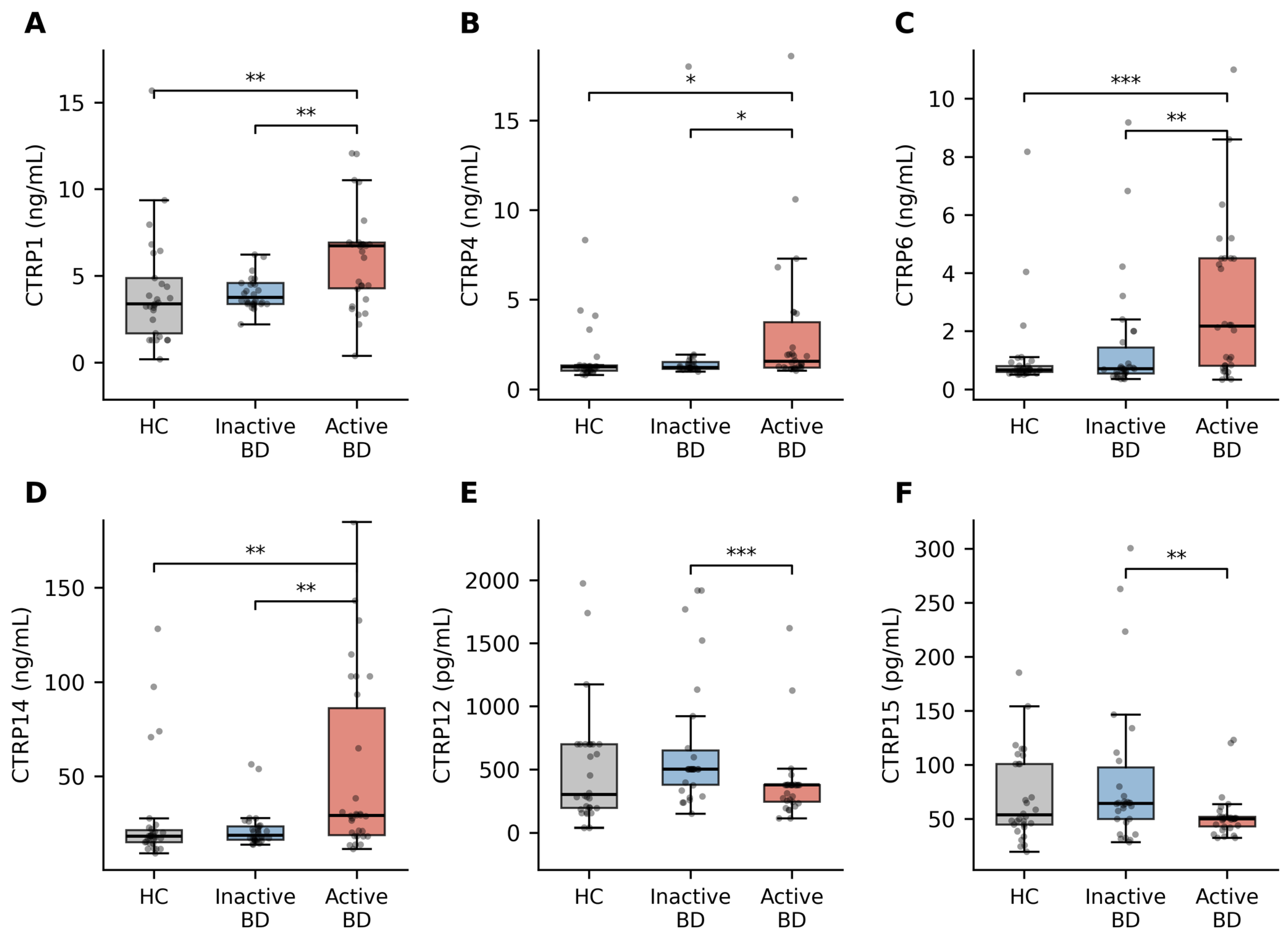
| CTRP1 (ng/mL) | 3.38 (1.70–4.88) | 3.75 (3.38–4.59) | 6.73 (4.29–6.92) | 0.004 | 0.011 | 0.143 | 0.005 | 0.009 |
| CTRP4 (ng/mL) | 1.25 (1.05–1.34) | 1.22 (1.14–1.52) | 1.56 (1.21–3.76) | 0.023 | 0.037 | 0.355 | 0.016 | 0.031 |
| CTRP6 (ng/mL) | 0.67 (0.60–0.81) | 0.71 (0.55–1.44) | 2.17 (0.81–4.51) | 0.001 | 0.005 | 0.888 | <0.001 | 0.003 |
| CTRP9 (ng/mL) | 8.40 (5.35–15.25) | 7.55 (7.12–9.04) | 7.76 (6.11–14.72) | 0.988 | 0.988 | 0.888 | 0.970 | 0.842 |
| CTRP12 (pg/mL) | 301.54 (194.76–700.00) | 501.07 (379.00–651.04) | 375.85 (244.35–376.82) | 0.011 | 0.022 | 0.178 | 0.594 | <0.001 |
| CTRP13 (pg/mL) | 607.75 (268.22–772.41) | 510.50 (507.25–597.28) | 554.37 (431.22–694.70) | 0.307 | 0.351 | 0.160 | 0.496 | 0.301 |
| CTRP14 (ng/mL) | 18.48 (15.35–21.79) | 18.91 (16.70–23.56) | 29.25 (19.11–86.25) | 0.001 | 0.005 | 0.482 | 0.002 | 0.002 |
| CTRP15 (pg/mL) | 53.75 (45.00–101.00) | 64.50 (50.00–97.91) | 50.25 (43.25–52.00) | 0.047 | 0.062 | 0.336 | 0.264 | 0.008 |
| Biomarker (Unit) | Inactive BD | Active BD | p | q | Adjusted OR | 95% CI | Adjusted p | AUC | Cut-Off | Sens., % | Spec., % |
|---|---|---|---|---|---|---|---|---|---|---|---|
| CTRP12 (pg/mL) | 501.07 (379.00–651.04) | 375.85 (244.35–376.82) | <0.001 | 0.004 | 0.27 | 0.11–0.71 | 0.008 | 0.762 (0.631–0.882) | ≤380.00 | 87 | 73 |
| CTRP14 (ng/mL) | 18.91 (16.70–23.56) | 29.25 (19.11–86.25) | 0.002 | 0.007 | 2.73 | 1.16–6.44 | 0.022 | 0.735 (0.596–0.865) | ≥29.00 | 57 | 93 |
| CTRP6 (ng/mL) | 0.71 (0.55–1.44) | 2.17 (0.81–4.51) | 0.003 | 0.009 | 1.74 | 1.13–2.69 | 0.012 | 0.721 (0.586–0.848) | ≥0.81 | 77 | 70 |
| CTRP15 (pg/mL) | 64.50 (50.00–97.91) | 50.25 (43.25–52.00) | 0.008 | 0.015 | 0.37 | 0.14–0.93 | 0.035 | 0.699 (0.557–0.837) | ≤52.00 | 80 | 70 |
| CTRP1 (ng/mL) | 3.75 (3.38–4.59) | 6.73 (4.29–6.92) | 0.009 | 0.015 | 1.79 | 0.88–3.65 | 0.107 | 0.696 (0.545–0.843) | ≥6.42 | 57 | 93 |
| CTRP4 (ng/mL) | 1.22 (1.14–1.52) | 1.56 (1.21–3.76) | 0.031 | 0.041 | 1.45 | 0.88–2.39 | 0.141 | 0.663 (0.516–0.799) | ≥1.86 | 47 | 83 |
| CTRP13 (pg/mL) | 510.50 (507.25–597.28) | 554.37 (431.22–694.70) | 0.301 | 0.344 | 0.53 | 0.19–1.44 | 0.214 | 0.578 (0.424–0.733) | ≥524.86 | 73 | 63 |
| CTRP9 (ng/mL) | 7.55 (7.12–9.04) | 7.76 (6.11–14.72) | 0.842 | 0.842 | 1.05 | 0.64–1.72 | 0.848 | 0.516 (0.364–0.671) | ≤7.30 | 50 | 73 |
| Biomarker | BDCAF | CRP | ESR | NLR | Disease Duration | Age | BMI |
|---|---|---|---|---|---|---|---|
| CTRP1 | +0.28 * | +0.08 | −0.10 | −0.10 | +0.01 | −0.09 | −0.02 |
| CTRP4 | +0.21 | +0.21 | −0.06 | −0.06 | −0.04 | −0.11 | −0.04 |
| CTRP6 | +0.30 * | +0.29 * | +0.07 | −0.03 | +0.02 | −0.05 | +0.05 |
| CTRP9 | +0.02 | −0.01 | −0.13 | −0.02 | −0.15 | +0.06 | −0.05 |
| CTRP12 | −0.32 * | −0.31 * | −0.06 | +0.08 | +0.13 | −0.28 * | +0.21 |
| CTRP13 | +0.05 | +0.16 | +0.12 | +0.16 | −0.02 | +0.00 | −0.16 |
| CTRP14 | +0.38 * | +0.16 | −0.01 | −0.14 | +0.09 | +0.05 | −0.27 * |
| CTRP15 | −0.38 * | −0.25 | −0.10 | +0.21 | −0.03 | −0.23 | +0.21 |
| Metric | Value |
|---|---|
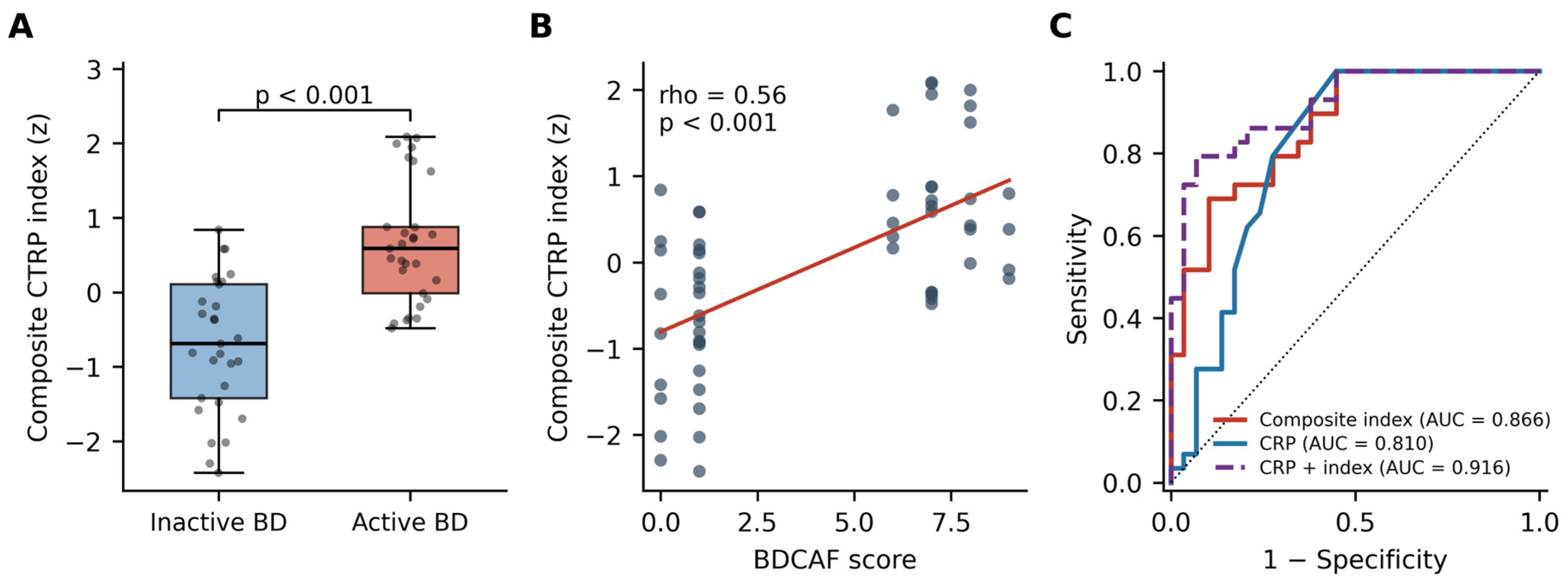
| p value, composite index, active vs. inactive disease | <0.001 |
| Area under the curve, composite index (95% CI) | 0.866 (0.765–0.944) |
| Sensitivity at Youden threshold (0.30), n/N (95% CI) | 20/29, 69% (52–85) |
| Specificity at Youden threshold (0.30), n/N (95% CI) | 26/29, 90% (77–100) |
| Out-of-bag AUC, component selection repeated in each resample (95% CI) | 0.812 (0.649–0.946) |
| Adjusted odds ratio per 1 SD (95% CI) | 9.1 (2.6–31.5) |
| p value, adjusted model | <0.001 |
| Correlation with BDCAF score (rho) | 0.56 |
| Area under the curve, C-reactive protein alone (95% CI) | 0.810 (0.682–0.915) |
| Area under the curve, C-reactive protein + composite index (95% CI) | 0.916 (0.839–0.974) |
| p value for composite index in C-reactive protein-adjusted model | 0.002 |
| ΔAUC, C-reactive protein + index vs. C-reactive protein alone (DeLong) | +0.106 (−0.002 to +0.214), p = 0.055 |
Disclaimer/Publisher’s Note: The statements, opinions and data contained in all publications are solely those of the individual author(s) and contributor(s) and not of MDPI and/or the editor(s). MDPI and/or the editor(s) disclaim responsibility for any injury to people or property resulting from any ideas, methods, instructions or products referred to in the content. |
© 2026 by the authors. Licensee MDPI, Basel, Switzerland. This article is an open access article distributed under the terms and conditions of the Creative Commons Attribution (CC BY) license.
Share and Cite
Karataş, A.; Akkoç, R.F.; Öz, B. A Bidirectional C1q/TNF-Related Protein Signature Is Associated with Disease Activity in Behçet’s Disease: A Cross-Sectional Study. Diagnostics 2026, 16, 3035. https://doi.org/10.3390/diagnostics16183035
Karataş A, Akkoç RF, Öz B. A Bidirectional C1q/TNF-Related Protein Signature Is Associated with Disease Activity in Behçet’s Disease: A Cross-Sectional Study. Diagnostics. 2026; 16(18):3035. https://doi.org/10.3390/diagnostics16183035
Chicago/Turabian StyleKarataş, Ahmet, Ramazan Fazıl Akkoç, and Burak Öz. 2026. "A Bidirectional C1q/TNF-Related Protein Signature Is Associated with Disease Activity in Behçet’s Disease: A Cross-Sectional Study" Diagnostics 16, no. 18: 3035. https://doi.org/10.3390/diagnostics16183035
APA StyleKarataş, A., Akkoç, R. F., & Öz, B. (2026). A Bidirectional C1q/TNF-Related Protein Signature Is Associated with Disease Activity in Behçet’s Disease: A Cross-Sectional Study. Diagnostics, 16(18), 3035. https://doi.org/10.3390/diagnostics16183035