Timepoint-Specific Percentile Reference Curves for C-Reactive Protein and Erythrocyte Sedimentation Rate After Uncomplicated Primary Reverse Shoulder Arthroplasty: A Single-Center Cohort Study



Abstract
1. Introduction
2. Materials and Methods
2.1. Study Design and Setting
2.2. Participants
2.3. Definition of “Uncomplicated”
2.4. Surgical Procedure and Perioperative Protocol
2.5. Variables
2.6. Blood Sampling Protocol and Analytic Denominators
2.7. Outcomes
2.8. Sample Size
2.9. Statistical Analysis
2.10. Within-Patient Change from the Individual Preoperative Baseline
2.11. Missing Data
2.12. Software
3. Results
3.1. Patient Flow and Baseline Characteristics
3.2. Sampling Density and Denominators
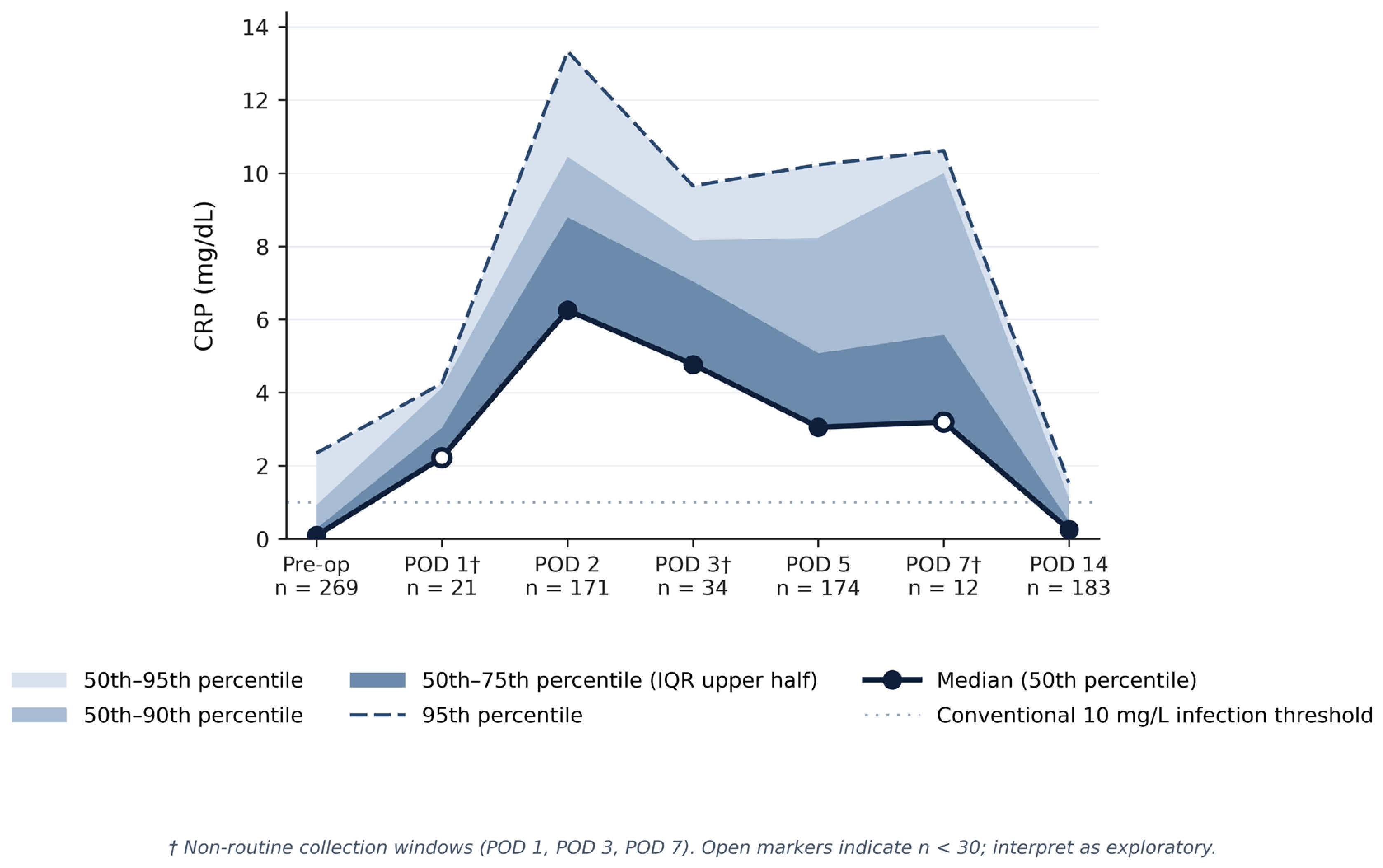
3.3. CRP Trajectory

| Timepoint | n | Median (IQR) | 75th | 90th | 95th | Mean ± SD | Range |
|---|---|---|---|---|---|---|---|
| Pre-op | 269 | 0.09 (0.05–0.29) | 0.29 | 0.93 | 2.34 | 0.43 ± 0.97 | 0.01–8.03 |
| POD 1 † | 21 | 2.22 (0.70–3.04) | 3.04 | 4.13 | 4.25 | 2.12 ± 1.47 | 0.02–4.78 |
| POD 2 | 171 | 6.25 (4.33–8.79) | 8.79 | 10.45 | 13.33 | 6.68 ± 3.27 | 0.03–20.90 |
| POD 3 † | 34 | 4.77 (2.40–7.04) | 7.04 | 8.17 | 9.65 | 5.11 ± 3.68 | 0.98–20.08 |
| POD 5 | 174 | 3.06 (1.66–5.08) | 5.08 | 8.24 | 10.23 | 3.94 ± 3.24 | 0.03–19.77 |
| POD 7 † | 12 | 3.19 (1.24–5.59) | 5.59 | 10.00 | 10.62 | 4.15 ± 3.59 | 0.10–10.98 |
| POD 14 | 183 | 0.25 (0.12–0.48) | 0.48 | 1.11 | 1.53 | 0.54 ± 1.12 | 0.02–12.15 |
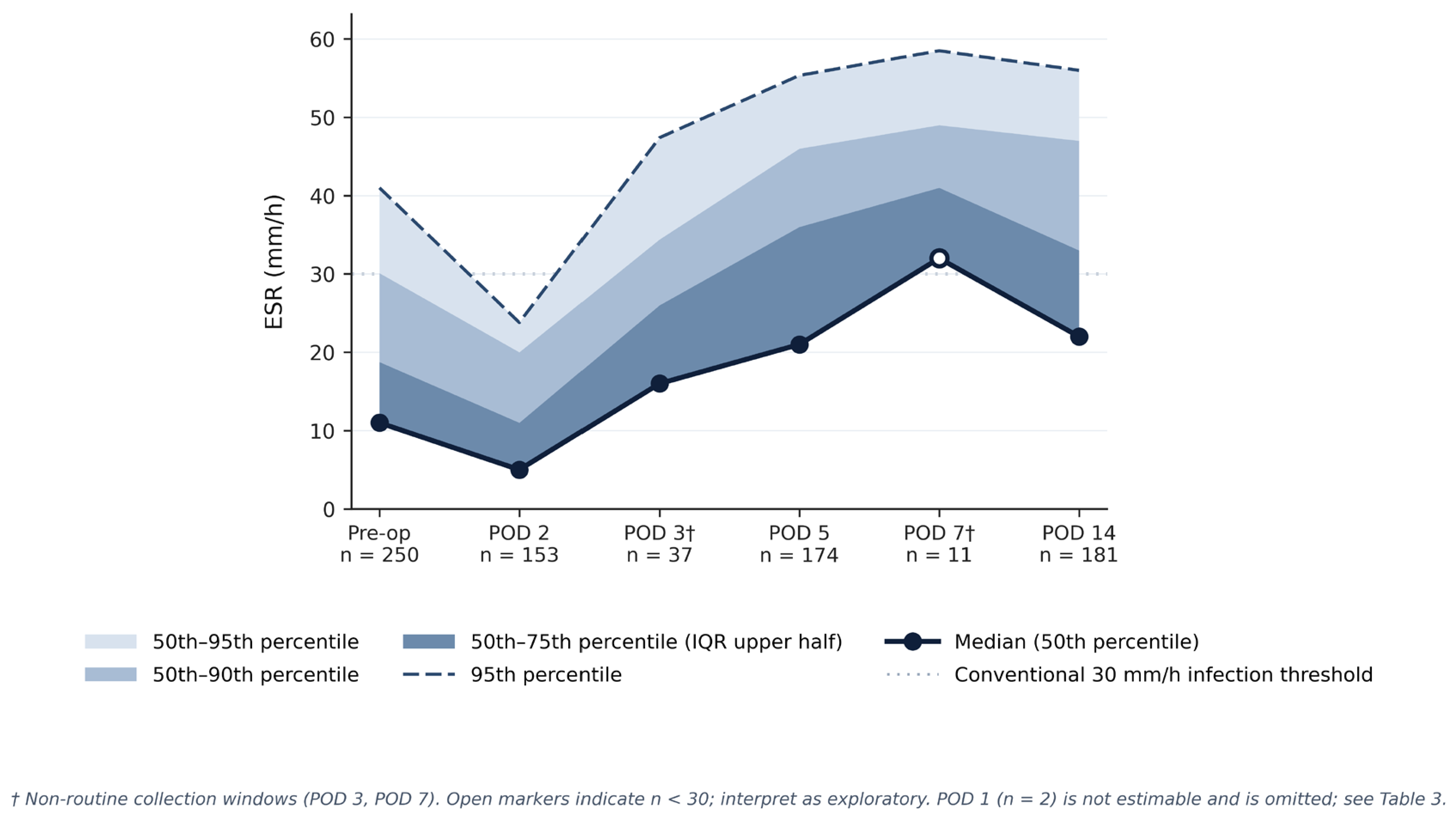
3.4. ESR Trajectory
| Timepoint | n | Median (IQR) | 75th | 90th | 95th | Mean ± SD | Range |
|---|---|---|---|---|---|---|---|
| Pre-op | 250 | 11.00 (5.00–18.75) | 18.75 | 30.10 | 41.00 | 15.20 ± 15.24 | 2.00–91.00 |
| POD 1 †‡ | 2 | NE | NE | NE | NE | NE | 2.00–23.00 |
| POD 2 | 153 | 5.00 (2.00–11.00) | 11.00 | 20.00 | 23.80 | 7.76 ± 7.75 | 2.00–42.00 |
| POD 3 † | 37 | 16.00 (11.00–26.00) | 26.00 | 34.40 | 47.40 | 19.70 ± 14.40 | 2.00–63.00 |
| POD 5 | 174 | 21.00 (10.00–36.00) | 36.00 | 46.00 | 55.35 | 24.13 ± 16.70 | 2.00–71.00 |
| POD 7 † | 11 | 32.00 (16.00–41.00) | 41.00 | 49.00 | 58.50 | 30.09 ± 20.07 | 2.00–68.00 |
| POD 14 | 181 | 22.00 (11.00–33.00) | 33.00 | 47.00 | 56.00 | 23.63 ± 16.32 | 2.00–76.00 |
3.5. Within-Patient Change from Individual Baseline
3.6. Missingness Sensitivity Analysis
3.7. Subgroup Analyses
4. Discussion
4.1. Main Findings
4.2. Comparison with the Literature
4.3. Clinical Implications
4.4. Clinical Application and Caution
4.5. Limitations
4.6. Future Directions
5. Conclusions
Supplementary Materials
Author Contributions
Funding
Institutional Review Board Statement
Informed Consent Statement
Data Availability Statement
Acknowledgments
Conflicts of Interest
References
- Nazzal, E.M.; Herman, Z.J.; Como, M.; Kaarre, J.; Reddy, R.P.; Wagner, E.R.; Klatt, B.A.; Lin, A. Shoulder periprosthetic joint infection: Principles of prevention, diagnosis, and treatment. J. Bone Jt. Surg. Am. 2024, 106, 2265–2275. [Google Scholar] [CrossRef] [Scilit] [PubMed]
- Auñón, A.; Peñarrubia, S.; Luengo-Alonso, G.; Delgado, C.; Gabardo, S.; Calvo, E. Clinical outcomes of one-stage versus two-stage revision for shoulder periprosthetic joint infection: Results from a single institution. Int. Orthop. 2026, 50, 171–177. [Google Scholar] [CrossRef] [Scilit] [PubMed]
- Yerke Hansen, P.; Fomunung, C.; Lavin, A.; Daji, A.; Jackson, G.R.; Sabesan, V.J. Outcomes following revision reverse shoulder arthroplasty for infection. J. Shoulder Elb. Surg. 2024, 33, 2433–2440. [Google Scholar] [CrossRef] [Scilit] [PubMed]
- Mercurio, M.; Castioni, D.; Iannò, B.; Gasparini, G.; Galasso, O. Outcomes of revision surgery after periprosthetic shoulder infection: A systematic review. J. Shoulder Elb. Surg. 2019, 28, 1193–1203. [Google Scholar] [CrossRef] [Scilit] [PubMed]
- Dorrestijn, O.; Smeitink, N.; Hurley, E.T.; Calvo, E.; Rasmussen, J.; Björnsson, H.; Hudek, R. Diagnostics of shoulder periprosthetic joint infections: A global survey. JSES Int. 2026, 10, 101608. [Google Scholar] [CrossRef] [Scilit] [PubMed]
- Sigmund, I.K.; Dietz, M.J.; Sabater-Martos, M.; Palmer, A.J.R.; Cortés-Penfield, N.; The “Serum Marker Workgroup” for the Unified PJI Definition Taskforce. Serum inflammatory markers for the screening and diagnosis of periprosthetic joint infection: A systematic review and meta-analysis. J. Bone Jt. Infect. 2025, 10, 363–376. [Google Scholar] [CrossRef] [Scilit] [PubMed]
- Tat, J.; Tat, J.; Faber, K. Arthroscopic tissue biopsy as a preoperative diagnostic test for periprosthetic shoulder arthroplasty infections: A systematic review and meta-analysis. J. Shoulder Elb. Surg. 2023, 32, 1545–1554. [Google Scholar] [CrossRef] [Scilit] [PubMed]
- Akgün, D.; Wiethölter, M.; Siegert, P.; Danzinger, V.; Minkus, M.; Braun, K.F.; Moroder, P. The role of serum C-reactive protein in the diagnosis of periprosthetic shoulder infection. Arch. Orthop. Trauma Surg. 2022, 142, 1715–1721. [Google Scholar] [CrossRef] [Scilit] [PubMed]
- Zmistowski, B.; Chang, M.; Shahi, A.; Nicholson, T.B.; Abboud, J.; Lazarus, M.; Williams, G.; Parvizi, J.; Namdari, S. Is D-dimer a reliable serum marker for shoulder periprosthetic joint infection? Clin. Orthop. Relat. Res. 2021, 479, 1447–1454. [Google Scholar] [CrossRef] [Scilit] [PubMed]
- Torrens, C.; Santana, F.; Marí, R.; Puig, L.; Alier, A. Serum C-reactive protein in patients undergoing elective shoulder arthroplasty. A prospective study. J. Orthop. Sci. 2017, 22, 858–861. [Google Scholar] [CrossRef] [Scilit] [PubMed]
- Klingebiel, S.; Theil, J.C.; Gosheger, G.; Schneider, K.N.; Timme, M.; Schorn, D.; Liem, D.; Rickert, C. Postoperative trends of serum C-reactive protein levels after primary shoulder arthroplasty—Normal trajectory and influencing factors. J. Clin. Med. 2020, 9, 3893. [Google Scholar] [CrossRef] [Scilit] [PubMed]
- Collins, A.; Levins, J.; Yao, J.; Stenson, J.; Matsen, F., III; Hsu, J. Are high Cutibacterium bacterial loads at the time of revision shoulder arthroplasty associated with more severe clinical signs or symptoms or increased risk of recurrent periprosthetic joint infection? Int. Orthop. 2025, 49, 705–711. [Google Scholar] [CrossRef] [Scilit] [PubMed]
- Frappa, N.; Listopadzki, T.R.; Lutnick, E.; Feng, L.; Crane, J.K.; Duquin, T.R. Assessment of virulence traits in Cutibacterium acnes from shoulder periprosthetic joint infections. J. Shoulder Elb. Surg. 2026, 35, 2382–2391. [Google Scholar] [CrossRef] [Scilit] [PubMed]
- Razi, A.; Ring, D. A systematic review of distinction of colonization and infection in studies that address Cutibacterium acnes and shoulder surgery. J. Shoulder Elb. Surg. 2025, 34, 617–625. [Google Scholar] [CrossRef] [Scilit] [PubMed]
- von Elm, E.; Altman, D.G.; Egger, M.; Pocock, S.J.; Gøtzsche, P.C.; Vandenbroucke, J.P.; STROBE Initiative. The Strengthening the Reporting of Observational Studies in Epidemiology (STROBE) Statement: Guidelines for reporting observational studies. Ann. Intern. Med. 2007, 147, 573–577. [Google Scholar] [CrossRef] [Scilit] [PubMed]
- Garrigues, G.E.; Zmistowski, B.; Cooper, A.M.; Green, A.; ICM Shoulder Group. Proceedings from the 2018 International Consensus Meeting on Orthopedic Infections: The definition of periprosthetic shoulder infection. J. Shoulder Elb. Surg. 2019, 28, S8–S12. [Google Scholar] [CrossRef] [Scilit] [PubMed]
- Kabore, C.; Reda, M.; Mahieu, X.; Thirion, T. The Musculoskeletal Infection Society diagnostic criteria are insufficient to diagnose shoulder periprosthetic infection: A retrospective study case and literature review. Acta Orthop. Belg. 2025, 91, 45–50. [Google Scholar] [CrossRef] [Scilit] [PubMed]
- Berk, A.N.; Hysong, A.A.; Kahan, J.B.; Ifarraguerri, A.M.; Trofa, D.P.; Hamid, N.; Rao, A.J.; Saltzman, B.M. The efficacy of tranexamic acid in primary anatomic and reverse total shoulder arthroplasty: A systematic review and meta-analysis of level I randomized controlled trials. Shoulder Elb. 2024, 16, 481–492. [Google Scholar] [CrossRef] [Scilit] [PubMed]
- Hamada, K.; Yamanaka, K.; Uchiyama, Y.; Mikasa, T.; Mikasa, M. A radiographic classification of massive rotator cuff tear arthritis. Clin. Orthop. Relat. Res. 2011, 469, 2452–2460. [Google Scholar] [CrossRef] [Scilit] [PubMed]
- Larsson, S.; Thelander, U.; Friberg, S. C-reactive protein (CRP) levels after elective orthopedic surgery. Clin. Orthop. Relat. Res. 1992, 275, 237–242. [Google Scholar] [CrossRef] [Scilit]
- White, J.; Kelly, M.; Dunsmuir, R. C-reactive protein level after total hip and total knee replacement. J. Bone Jt. Surg. Br. 1998, 80, 909–911. [Google Scholar] [CrossRef] [Scilit] [PubMed]
- Bilgen, O.; Atici, T.; Durak, K.; Karaeminoğullari, O.; Bilgen, M.S. C-reactive protein values and erythrocyte sedimentation rates after total hip and total knee arthroplasty. J. Int. Med. Res. 2001, 29, 7–12. [Google Scholar] [CrossRef] [Scilit] [PubMed]
- Honsawek, S.; Deepaisarnsakul, B.; Tanavalee, A.; Sakdinakiattikoon, M.; Ngarmukos, S.; Preativatanyou, K.; Bumrungpanichthaworn, P. Relationship of serum IL-6, C-reactive protein, erythrocyte sedimentation rate, and knee skin temperature after total knee arthroplasty: A prospective study. Int. Orthop. 2011, 35, 31–35. [Google Scholar] [CrossRef] [Scilit] [PubMed]
- Pruijn, N.; Heesterbeek, P.J.C.; Susan, S.; Boks, S.S.; van Bokhoven, S.C.; Schreurs, B.W.; Telgt, D.; Dorrestijn, O. The predictive value and reliability of ultrasound-guided synovial aspiration and biopsies for diagnosing periprosthetic shoulder infections. Arch. Orthop. Trauma Surg. 2024, 144, 2983–2992. [Google Scholar] [CrossRef] [Scilit] [PubMed]
- Mahylis, J.M.; Entezari, V.; Karichu, J.; Richter, S.; Derwin, K.A.; Iannotti, J.P.; Ricchetti, E.T. Hemolytic strains of Propionibacterium acnes do not demonstrate greater pathogenicity in periprosthetic shoulder infections. J. Shoulder Elb. Surg. 2018, 27, 1097–1104. [Google Scholar] [CrossRef] [Scilit] [PubMed]
- Tan, T.K.; Tan, P.; Wang, K.; Hau, R. Effect of tranexamic acid on shoulder surgery: An updated meta-analysis of randomized studies. J. Shoulder Elb. Surg. 2024, 33, e97–e108. [Google Scholar] [CrossRef] [Scilit] [PubMed]
- Llombart-Blanco, R.; Mariscal, G.; Khalil, I.; Barrios, C.; Llombart-Ais, R. Influence of smoking on shoulder arthroplasty outcomes: A meta-analysis of postoperative complications. Shoulder Elb. 2026, 18, 11–19. [Google Scholar] [CrossRef] [Scilit] [PubMed]


| Variable | Value (N = 214) |
|---|---|
| Demographics | |
| Age (years) | 78.4 ± 6.3 |
| Age, median [IQR] (years) | 78 [74–83] |
| Age, range (years) | 61–93 |
| Age < 70 years | 18 (8.4%) |
| Sex—Female | 141 (65.9%) |
| Sex—Male | 73 (34.1%) |
| BMI (kg/m2; n = 210) | 24.8 [22.6–27.1] |
| Height (cm; n = 211) | 153.0 [149.0–160.3] |
| Weight (kg; n = 210) | 59.5 [52.1–66.4] |
| Surgery | |
| Side—Right | 143 (66.8%) |
| Side—Left | 71 (33.2%) |
| Diagnosis | |
| CTA | 115 (53.7%) |
| Massive RCT | 62 (29.0%) |
| Primary OA | 34 (15.9%) |
| Other | 3 (1.4%) |
| ASA | |
| ASA 1 | 4 (1.9%) |
| ASA 2 | 98 (45.8%) |
| ASA 3 | 112 (52.3%) |
| ASA 4 | 0 (0.0%) |
| Comorbidity | |
| HTN | 140 (65.4%) |
| DM | 59 (27.6%) |
| CKD | 9 (4.2%) |
| CVD | 54 (25.2%) |
| Cancer (history) | 4 (1.9%) |
| TB (history) | 8 (3.7%) |
| Hepatitis (history) | 4 (1.9%) |
| Lifestyle | |
| Smoking—current/ex | 16 (7.5%) |
| Smoking—never | 198 (92.5%) |
| Anesthesia | |
| Type—GA | 214 (100.0%) |
| Duration (min) | 130.0 [120.0–140.0] |
| Intraop | |
| TXA given | 1 (0.5%) |
| Intraop transfusion | 2 (0.9%) |
| Intake fluid (cc) | 700.0 [600.0–900.0] |
| Implant | |
| Equinoxe Reverse Shoulder (Exactech, Gainesville, FL, USA) | 116 (54.2%) |
| Comprehensive / Trabecular Metal Reverse (Zimmer Biomet, Warsaw, IN, USA) | 84 (39.3%) |
| Delta Xtend (DePuy Synthes, Warsaw, IN, USA) | 9 (4.2%) |
| Agilon (Implantcast, Buxtehude, Germany) | 5 (2.3%) |
| Humeral stem fixation—cementless | 205 (95.8%) |
| Humeral stem fixation—cemented | 9 (4.2%) |
| Glenoid baseplate fixation—cementless | 214 (100.0%) |
| Implant design variants | |
| Augmented glenoid baseplate (within cementless) | 5 (2.3%) |
| Constrained humeral polyethylene liner | 1 (0.5%) |
| Baseline labs | |
| Pre-op CRP (mg/dL) | 0.1 [0.1–0.2] |
| Pre-op ESR (mm/h; n = 213) | 10.0 [5.0–17.0] |
Disclaimer/Publisher’s Note: The statements, opinions and data contained in all publications are solely those of the individual author(s) and contributor(s) and not of MDPI and/or the editor(s). MDPI and/or the editor(s) disclaim responsibility for any injury to people or property resulting from any ideas, methods, instructions or products referred to in the content. |
© 2026 by the authors. Licensee MDPI, Basel, Switzerland. This article is an open access article distributed under the terms and conditions of the Creative Commons Attribution (CC BY) license.
Share and Cite
Lee, J.; Yang, S.G.; Kim, D.S. Timepoint-Specific Percentile Reference Curves for C-Reactive Protein and Erythrocyte Sedimentation Rate After Uncomplicated Primary Reverse Shoulder Arthroplasty: A Single-Center Cohort Study. Diagnostics 2026, 16, 2993. https://doi.org/10.3390/diagnostics16182993
Lee J, Yang SG, Kim DS. Timepoint-Specific Percentile Reference Curves for C-Reactive Protein and Erythrocyte Sedimentation Rate After Uncomplicated Primary Reverse Shoulder Arthroplasty: A Single-Center Cohort Study. Diagnostics. 2026; 16(18):2993. https://doi.org/10.3390/diagnostics16182993
Chicago/Turabian StyleLee, Jaemin, Seung Gyu Yang, and Doo Sup Kim. 2026. "Timepoint-Specific Percentile Reference Curves for C-Reactive Protein and Erythrocyte Sedimentation Rate After Uncomplicated Primary Reverse Shoulder Arthroplasty: A Single-Center Cohort Study" Diagnostics 16, no. 18: 2993. https://doi.org/10.3390/diagnostics16182993
APA StyleLee, J., Yang, S. G., & Kim, D. S. (2026). Timepoint-Specific Percentile Reference Curves for C-Reactive Protein and Erythrocyte Sedimentation Rate After Uncomplicated Primary Reverse Shoulder Arthroplasty: A Single-Center Cohort Study. Diagnostics, 16(18), 2993. https://doi.org/10.3390/diagnostics16182993