Validity of Wearable Inertial Sensors for Postural Sway Analysis: A Systematic Review


 ,
,  , and
, and 
Abstract
1. Introduction
2. Methods
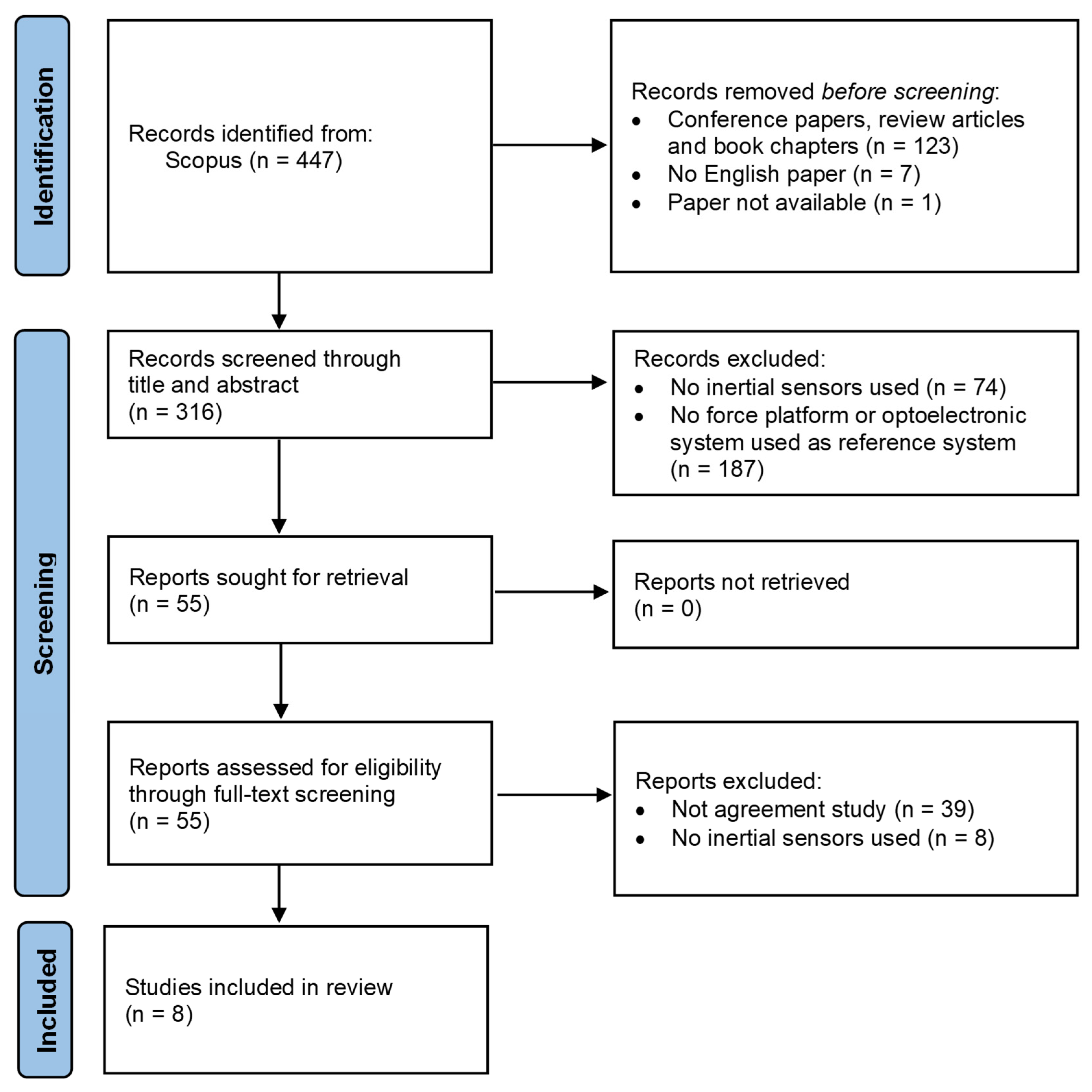
2.1. Search Methodology
2.2. Study Selection
- studies assessing postural sway parameters without the use of wearable inertial sensors;
- studies not including agreement (concurrent validity) analyses;
- studies using wearable inertial sensors for postural sway assessment that did not include comparison with force platforms or OMC systems.
2.3. Risk of Bias Assessment
3. Results
3.1. Risk of Bias Assessment Results
3.2. Wearable Inertial Systems and Sensor Placement
3.3. Postural Sway Tasks
3.4. Signal Processing and Kinematic Reconstruction
3.5. Postural Sway Parameters
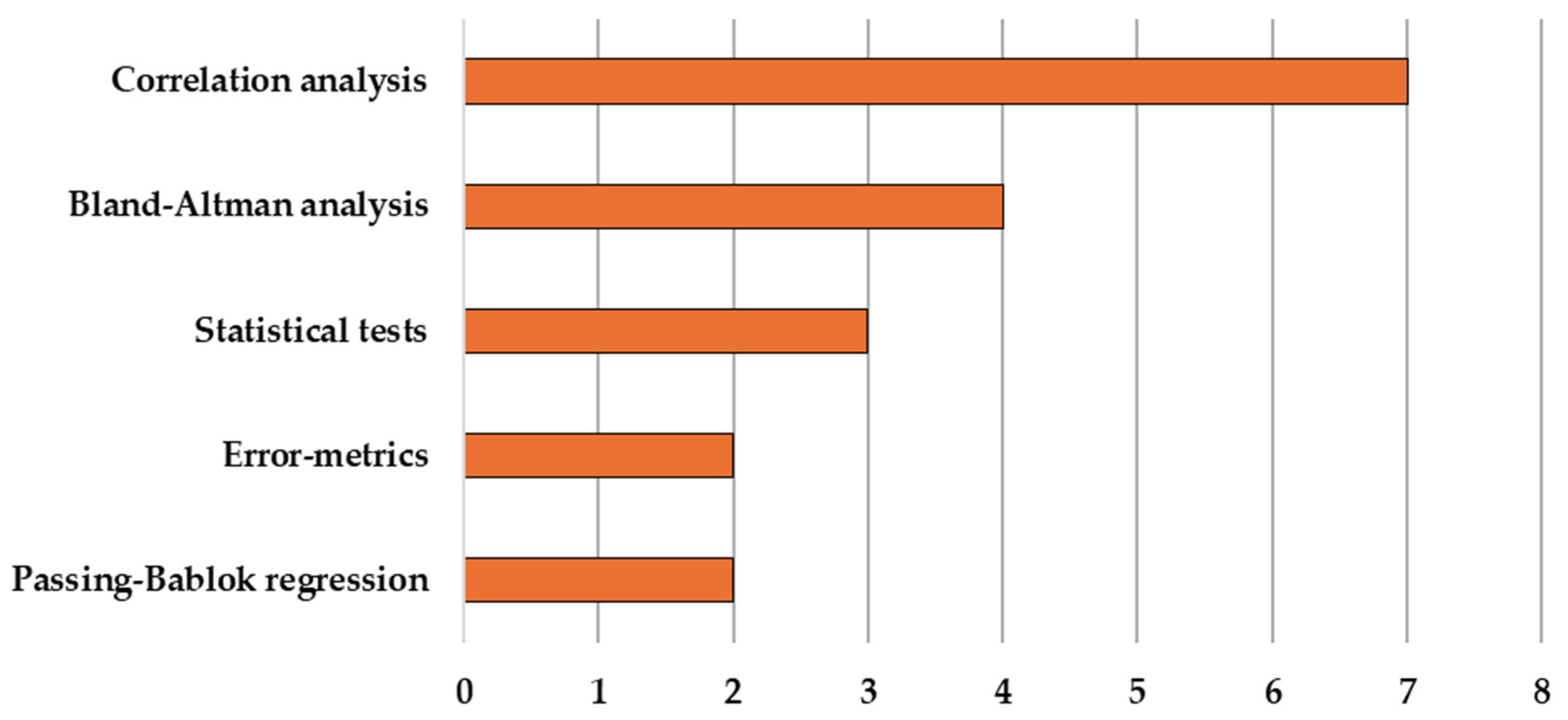
3.6. Validation Tools
4. Conclusions
Supplementary Materials
Author Contributions
Funding
Institutional Review Board Statement
Informed Consent Statement
Data Availability Statement
Conflicts of Interest
Abbreviations
| ANFIS | Adaptive network-based fuzzy inference system |
| AP | Anterior–posterior |
| AUC | Area under curve |
| BA | Bland–Altman |
| BM | Multi-sensor biomechanical model |
| CEA | 95% confidence ellipse area |
| CoG | Center of gravity |
| CoM | Center of mass |
| CoP | Center of pressure |
| DL-EC | Double leg—eyes closed |
| DL-EO | Double leg—eyes open |
| EC | Eyes closed |
| EC-Firm | Eyes closed—firm platform |
| EC-Foam | Eyes closed—foam platform |
| EC-SR | Eyes closed—sway-referenced platform |
| EO | Eyes open |
| EO-Firm | Eyes open—firm platform |
| EO-Foam | Eyes open—foam platform |
| EO-LB | Eyes open—leaning backward |
| EO-LF | Eyes open—leaning forward |
| EO-LL | Eyes open—left leaning |
| EO-RL | Eyes open—right leaning |
| EO-SR | Eyes open—sway-referenced platform |
| ER | Error ratio |
| Free-EO | Free sway—eyes open |
| GA | Genetic algorithm |
| ICC | Intraclass correlation coefficient |
| IMU | Inertial measurement unit |
| LP | Low-pass |
| MAPE | Mean absolute percentage error |
| mCTSIB | Modified Clinical Test of Sensory Interaction on Balance |
| ML | Mediolateral |
| MS-L | Monopodalic stance on the left leg |
| MS-R | Monopodalic stance on the right leg |
| MVELO | Mean sway velocity |
| NN | Neural network |
| NS | Not specified |
| OMC | Optoelectronic motion capture |
| PB | Passing–Bablok |
| PCC | Pearson correlation coefficient |
| PRISMA | Preferred Reporting Items for Systematic Reviews and Meta-Analyses |
| RDIST | Range of the resultant distance |
| RMS-DIST | Root mean square of the resultant distance |
| RMSE | Root mean square error |
| SCC | Spearman correlation coefficient |
| SDI | Strapdown integration |
| SL-EO | Single leg—eyes open |
| SOT | Sensory Organization Test |
| SRV-Firm | Sway-referenced visual surround—firm platform |
| SRV-SR | Sway-referenced visual surround—sway-referenced platform |
| TOTEX | Total path length |
References
- Shumway-Cook, A.; Woollacott, M.H. Motor Control: Translating Research into Clinical Practice; Lippincott Williams & Wilkins: Philadelphia, PA, USA, 2007; ISBN 0-7817-6691-5. [Google Scholar]
- Ivanenko, Y.; Gurfinkel, V.S. Human Postural Control. Front. Neurosci. 2018, 12, 171. [Google Scholar] [CrossRef] [PubMed]
- Chianese, M.; Papallo, S.; Prisco, G.; De Micco, R.; Tessitore, A.; Gargiulo, P.; Esposito, F.; Donisi, L. Exploring Brain Correlates of Muscular Activity and Postural Sway. In Proceedings of the 2025 IEEE International Conference on Metrology for eXtended Reality, Artificial Intelligence and Neural Engineering (MetroXRAINE); IEEE: Piscataway, NJ, USA, 2025; pp. 435–440. [Google Scholar]
- Chiba, R.; Takakusaki, K.; Ota, J.; Yozu, A.; Haga, N. Human Upright Posture Control Models Based on Multisensory Inputs; in Fast and Slow Dynamics. Neurosci. Res. 2016, 104, 96–104. [Google Scholar] [CrossRef] [PubMed]
- Prieto, T.E.; Myklebust, J.B.; Hoffmann, R.G.; Lovett, E.G.; Myklebust, B.M. Measures of Postural Steadiness: Differences between Healthy Young and Elderly Adults. IEEE Trans. Biomed. Eng. 1996, 43, 956–966. [Google Scholar] [CrossRef] [PubMed]
- Błaszczyk, J.W. The Use of Force-Plate Posturography in the Assessment of Postural Instability. Gait Posture 2016, 44, 1–6. [Google Scholar] [CrossRef] [PubMed]
- Winter, D.A. Human Balance and Posture Control during Standing and Walking. Gait Posture 1995, 3, 193–214. [Google Scholar] [CrossRef]
- Liau, B.-Y.; Wu, F.-L.; Lung, C.-W.; Zhang, X.; Wang, X.; Jan, Y.-K. Complexity-Based Measures of Postural Sway during Walking at Different Speeds and Durations Using Multiscale Entropy. Entropy 2019, 21, 1128. [Google Scholar] [CrossRef]
- Suzuki, Y.; Morimoto, H.; Kiyono, K.; Morasso, P.G.; Nomura, T. Dynamic Determinants of the Uncontrolled Manifold during Human Quiet Stance. Front. Hum. Neurosci. 2016, 10, 618. [Google Scholar] [CrossRef] [PubMed]
- Błaszczyk, J.W.; Beck, M.; Szczepańska, J.; Sadowska, D.; Bacik, B.; Juras, G.; Słomka, K.J. Directional Measures of Postural Sway as Predictors of Balance Instability and Accidental Falls. J. Hum. Kinet. 2016, 52, 75–83. [Google Scholar] [CrossRef] [PubMed]
- Allsopp, T.J.; Dornhoffer, J.L. Computerized Dynamic Posturography. In Diagnosis and Treatment of Vestibular Disorders; Springer: Berlin/Heidelberg, Germany, 2026; pp. 103–110. [Google Scholar]
- Meletani, S.; Scataglini, S.; Mandolini, M.; Scalise, L.; Truijen, S. Experimental Comparison between 4D Stereophotogrammetry and Inertial Measurement Unit Systems for Gait Spatiotemporal Parameters and Joint Kinematics. Sensors 2024, 24, 4669. [Google Scholar] [CrossRef] [PubMed]
- Sotirakis, H.; Hatzitaki, V.; Munoz-Martel, V.; Mademli, L.; Arampatzis, A. Center of Pressure Feedback Modulates the Entrainment of Voluntary Sway to the Motion of a Visual Target. Appl. Sci. 2019, 9, 3952. [Google Scholar] [CrossRef]
- Conconi, M.; Pompili, A.; Sancisi, N.; Leardini, A.; Durante, S.; Belvedere, C. New Anatomical Reference Systems for the Bones of the Foot and Ankle Complex: Definitions and Exploitation on Clinical Conditions. J. Foot Ankle Res. 2021, 14, 66. [Google Scholar] [CrossRef] [PubMed]
- Munoz-Martel, V.; Santuz, A.; Ekizos, A.; Arampatzis, A. Neuromuscular Organisation and Robustness of Postural Control in the Presence of Perturbations. Sci. Rep. 2019, 9, 12273. [Google Scholar] [CrossRef] [PubMed]
- Rentz, C.; Kaiser, V.; Jung, N.; Turlach, B.A.; Sahandi Far, M.; Peterburs, J.; Boltes, M.; Schnitzler, A.; Amunts, K.; Dukart, J. Sensor-Based Gait and Balance Assessment in Healthy Adults: Analysis of Short-Term Training and Sensor Placement Effects. Sensors 2024, 24, 5598. [Google Scholar] [CrossRef] [PubMed]
- Scoppa, F.; Gallamini, M.; Belloni, G.; Messina, G. Clinical Stabilometry Standardization: Feet Position in the Static Stabilometric Assessment of Postural Stability. Acta Med. Mediterr. 2017, 33, 707–713. [Google Scholar] [CrossRef]
- Park, J.; Nguyen, V.Q.; Ho, R.L.; Coombes, S.A. The Effect of Chronic Low Back Pain on Postural Control during Quiet Standing: A Meta-Analysis. Sci. Rep. 2023, 13, 7928. [Google Scholar] [CrossRef] [PubMed]
- Andreeva, A.; Melnikov, A.; Skvortsov, D.; Akhmerova, K.; Vavaev, A.; Golov, A.; Draugelite, V.; Nikolaev, R.; Chechelnickaia, S.; Zhuk, D.; et al. Postural Stability in Athletes: The Role of Sport Direction. Gait Posture 2021, 89, 120–125. [Google Scholar] [CrossRef] [PubMed]
- Prisco, G.; Pirozzi, M.A.; Santone, A.; Cesarelli, M.; Esposito, F.; Gargiulo, P.; Amato, F.; Donisi, L. Combining Postural Sway Parameters and Machine Learning to Assess Biomechanical Risk Associated with Load-Lifting Activities. Diagnostics 2025, 15, 105. [Google Scholar] [CrossRef] [PubMed]
- D’Addio, G.; Donisi, L.; Mercogliano, L.; Cesarelli, G.; Bifulco, P.; Cesarelli, M. Potential Biomechanical Overload on Skeletal Muscle Structures in Students During Walk with Backpack. In Proceedings of the XV Mediterranean Conference on Medical and Biological Engineering and Computing—MEDICON 2019; Henriques, J., Neves, N., de Carvalho, P., Eds.; Springer International Publishing: Cham, Switzerland, 2020; pp. 262–266. [Google Scholar]
- Mancini, M.; Horak, F.B. Potential of APDM Mobility Lab for the Monitoring of the Progression of Parkinson’s Disease. Expert Rev. Med. Devices 2016, 13, 455–462. [Google Scholar] [CrossRef] [PubMed]
- Nascimento, L.M.S.; Bonfati, L.V.; Freitas, M.L.B.; Mendes Junior, J.J.A.; Siqueira, H.V.; Stevan, S.L., Jr. Sensors and Systems for Physical Rehabilitation and Health Monitoring—A Review. Sensors 2020, 20, 4063. [Google Scholar] [CrossRef] [PubMed]
- Maher, C.; Szeto, K.; Arnold, J. The Use of Accelerometer-Based Wearable Activity Monitors in Clinical Settings: Current Practice, Barriers, Enablers, and Future Opportunities. BMC Health Serv. Res. 2021, 21, 1064. [Google Scholar] [CrossRef] [PubMed]
- Subramaniam, S.; Faisal, A.I.; Deen, M.J. Wearable Sensor Systems for Fall Risk Assessment: A Review. Front. Digit. Health 2022, 4, 921506. [Google Scholar] [CrossRef] [PubMed]
- Takkouche, B.; Norman, G. PRISMA Statement. Epidemiology 2011, 22, 128. [Google Scholar] [CrossRef]
- Mokkink, L.B.; de Vet, H.C.W.; Prinsen, C.A.C.; Patrick, D.L.; Alonso, J.; Bouter, L.M.; Terwee, C.B. COSMIN Risk of Bias Checklist for Systematic Reviews of Patient-Reported Outcome Measures. Qual. Life Res. 2018, 27, 1171–1179. [Google Scholar] [CrossRef] [PubMed]
- Alberts, J.L.; Hirsch, J.R.; Koop, M.M.; Schindler, D.D.; Kana, D.E.; Linder, S.M.; Campbell, S.; Thota, A.K. Using Accelerometer and Gyroscopic Measures to Quantify Postural Stability. J. Athl. Train. 2015, 50, 578–588. [Google Scholar] [CrossRef] [PubMed]
- Bertolotti, G.M.; Cristiani, A.M.; Colagiorgio, P.; Romano, F.; Bassani, E.; Caramia, N.; Ramat, S. A Wearable and Modular Inertial Unit for Measuring Limb Movements and Balance Control Abilities. IEEE Sens. J. 2016, 16, 790–797. [Google Scholar] [CrossRef]
- Chen, V.C.F.; Chen, S.-W. Establishing the Waist as the Better Location for Attaching a Single Accelerometer to Estimate Center of Pressure Trajectories. Clin. Biomech. 2018, 60, 30–38. [Google Scholar] [CrossRef] [PubMed]
- Ekvall Hansson, E.; Tornberg, Å. Coherence and Reliability of a Wearable Inertial Measurement Unit for Measuring Postural Sway. BMC Res. Notes 2019, 12, 201. [Google Scholar] [CrossRef] [PubMed]
- Suttanon, P.; Kuhaphensaeng, B.; Choawanachan, T.; Prathum, T.; Saelee, P.; Apibantaweesakul, S. Concurrent Validity of a Developed Accelerometry-Based Device for Postural Sway Assessment. Songklanakarin J. Sci. Technol. 2020, 42, 984–990. [Google Scholar]
- Germanotta, M.; Mileti, I.; Conforti, I.; Del Prete, Z.; Aprile, I.; Palermo, E. Estimation of Human Center of Mass Position through the Inertial Sensors-Based Methods in Postural Tasks: An Accuracy Evaluation. Sensors 2021, 21, 601. [Google Scholar] [CrossRef] [PubMed]
- Janc, M.; Sliwinska-Kowalska, M.; Jozefowicz-Korczynska, M.; Marciniak, P.; Rosiak, O.; Kotas, R.; Szmytke, Z.; Grodecka, J.; Zamyslowska-Szmytke, E. A Comparison of Head Movements Tests in Force Plate and Accelerometer Based Posturography in Patients with Balance Problems Due to Vestibular Dysfunction. Sci. Rep. 2021, 11, 19094. [Google Scholar] [CrossRef] [PubMed]
- Vagnini, A.; Furone, R.; Zanotti, G.; Adamo, P.; Temporiti, F.; Gatti, R. Agreement between Inertial Measurement Unit and Optoelectronic System to Measure Postural Sway. Technol. Health Care 2022, 30, 757–762. [Google Scholar] [CrossRef] [PubMed]
- Ates, H.C.; Nguyen, P.Q.; Gonzalez-Macia, L.; Morales-Narváez, E.; Güder, F.; Collins, J.J.; Dincer, C. End-to-End Design of Wearable Sensors. Nat. Rev. Mater. 2022, 7, 887–907. [Google Scholar] [CrossRef] [PubMed]
- Donisi, L.; Jacob, D.; Guerrini, L.; Prisco, G.; Esposito, F.; Cesarelli, M.; Amato, F.; Gargiulo, P. sEMG Spectral Analysis and Machine Learning Algorithms Are Able to Discriminate Biomechanical Risk Classes Associated with Manual Material Liftings. Bioengineering 2023, 10, 1103. [Google Scholar] [CrossRef] [PubMed]
- Prisco, G.; Romano, M.; Esposito, F.; Cesarelli, M.; Santone, A.; Donisi, L.; Amato, F. Capability of Machine Learning Algorithms to Classify Safe and Unsafe Postures during Weight Lifting Tasks Using Inertial Sensors. Diagnostics 2024, 14, 576. [Google Scholar] [CrossRef] [PubMed]
- Donisi, L.; Pagano, G.; Cesarelli, G.; Coccia, A.; Amitrano, F.; D’Addio, G. Benchmarking between Two Wearable Inertial Systems for Gait Analysis Based on a Different Sensor Placement Using Several Statistical Approaches. Measurement 2021, 173, 108642. [Google Scholar] [CrossRef]
- Prisco, G.; Komici, K.; Mercaldo, F.; Donisi, L.; Cesarelli, M.; Guerra, G.; Santone, A. A Machine Learning Approach to Classify Ventilatory Efficiency. In Proceedings of the 2023 IEEE International Conference on Metrology for eXtended Reality, Artificial Intelligence and Neural Engineering (MetroXRAINE); IEEE: Piscataway, NJ, USA, 2023; pp. 646–651. [Google Scholar]
- Lerín-Calvo, A.; Prisco, G.; Fernández-Maza, E.; Núñez-González, M.; Santiago-Lorrio, G.; Donisi, L.; Lerma-Lara, S. Assessing the Validity and Reliability of a Single Lumbar-Mounted IMU System for Gait Analysis. Sensors 2025, 25, 7643. [Google Scholar] [CrossRef] [PubMed]
- Prisco, G.; Cesarelli, G.; Romano, M.; Picillo, M.; Ricciardi, C.; Esposito, F.; Barone, P.; Cesarelli, M.; Donisi, L. Validity of a Novel Algorithm to Compute Spatiotemporal Parameters Based on a Single IMU Placed on the Lumbar Region. Sensors 2025, 25, 5822. [Google Scholar] [CrossRef] [PubMed]
- Donisi, L.; Amitrano, F.; Coccia, A.; Mercogliano, L.; Cesarelli, G.; D’Addio, G. Influence of the Backpack on School Children’s Gait: A Statistical and Machine Learning Approach. In Proceedings of the 8th European Medical and Biological Engineering Conference; Jarm, T., Cvetkoska, A., Mahnič-Kalamiza, S., Miklavcic, D., Eds.; Springer International Publishing: Cham, Switzerland, 2021; pp. 682–688. [Google Scholar]
- Tong, C.Y.; Zhu, R.T.-L.; Ling, Y.T.; Scheeren, E.M.; Lam, F.M.H.; Fu, H.; Ma, C.Z.-H. Muscular and Kinematic Responses to Unexpected Translational Balance Perturbation: A Pilot Study in Healthy Young Adults. Bioengineering 2023, 10, 831. [Google Scholar] [CrossRef] [PubMed]
- Reimann, H.; Bruijn, S.M. The Condition for Dynamic Stability in Humans Walking with Feedback Control. PLoS Comput. Biol. 2024, 20, e1011861. [Google Scholar] [CrossRef] [PubMed]



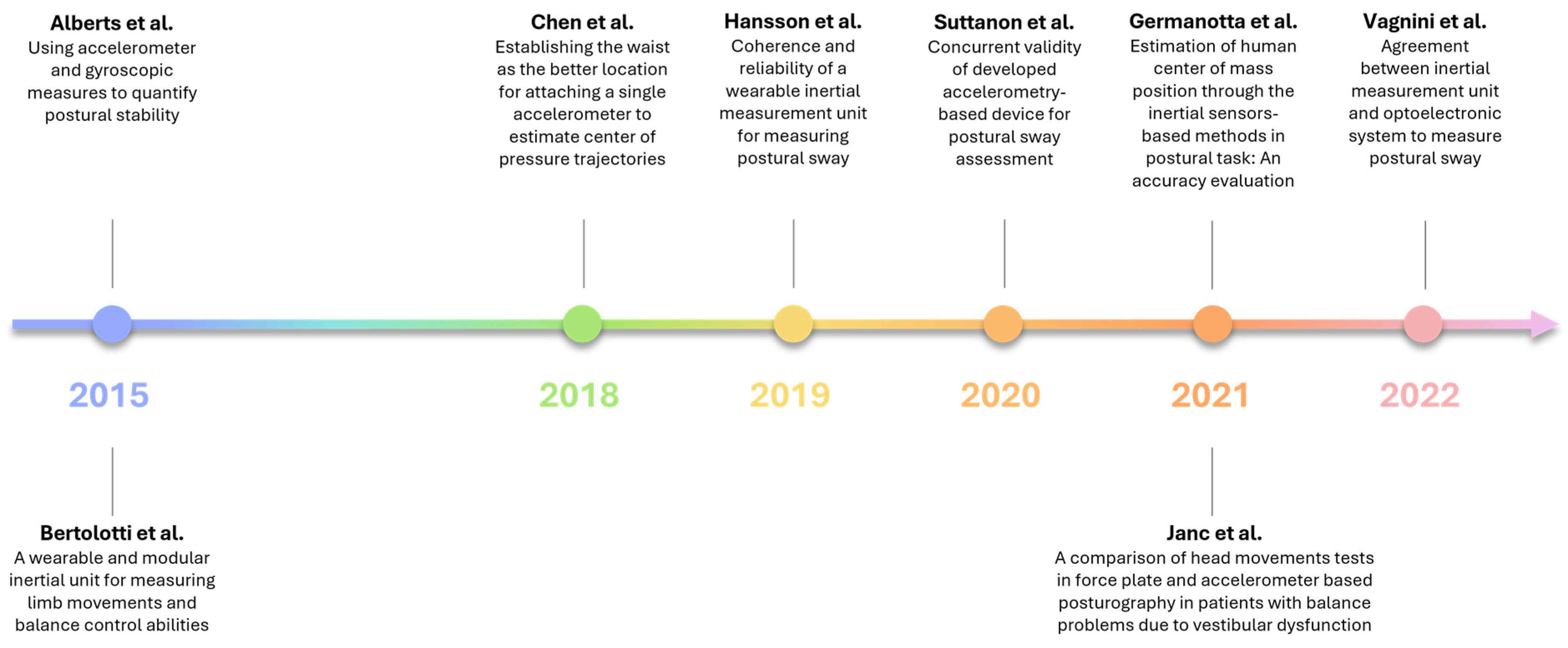
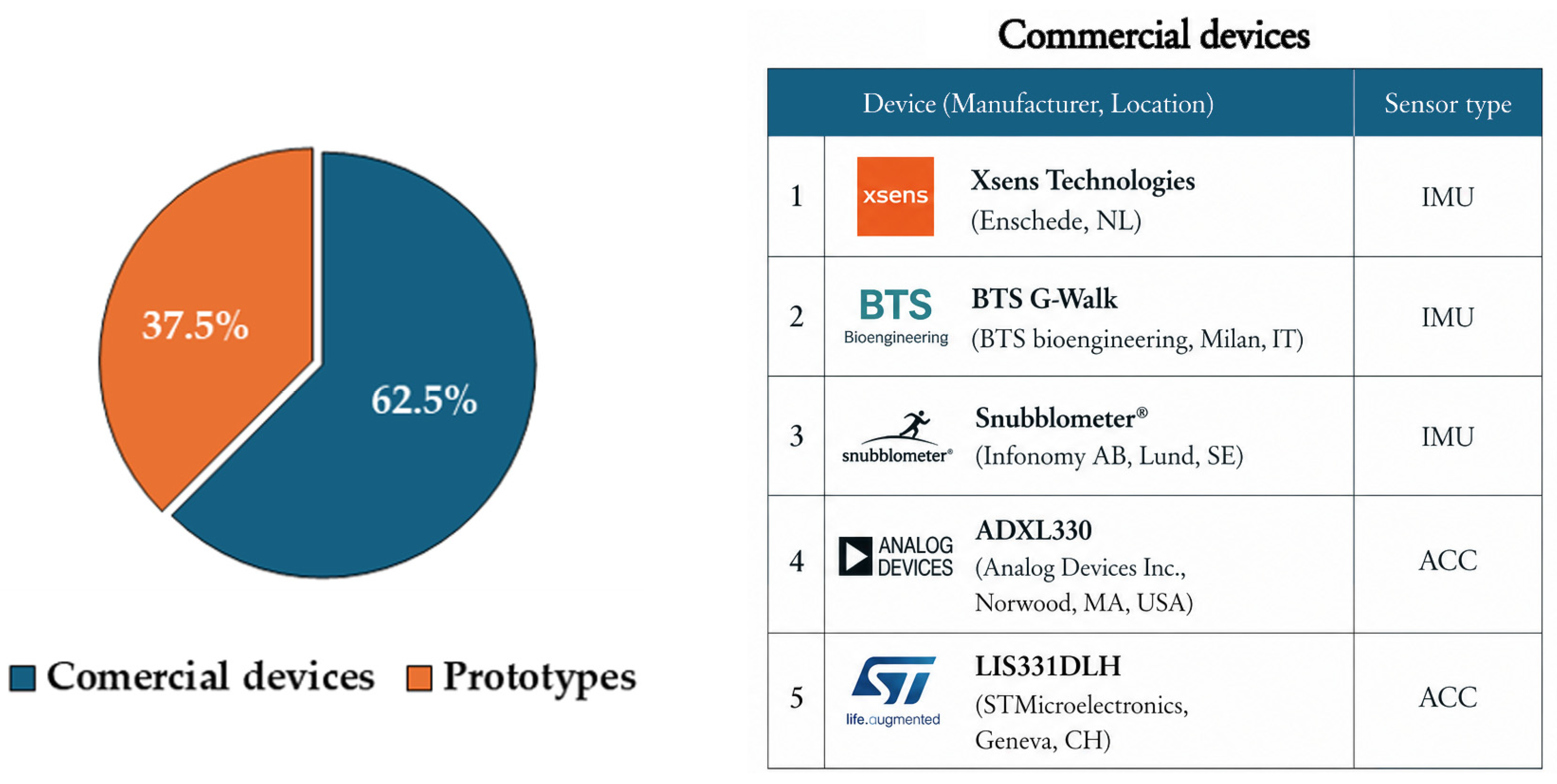
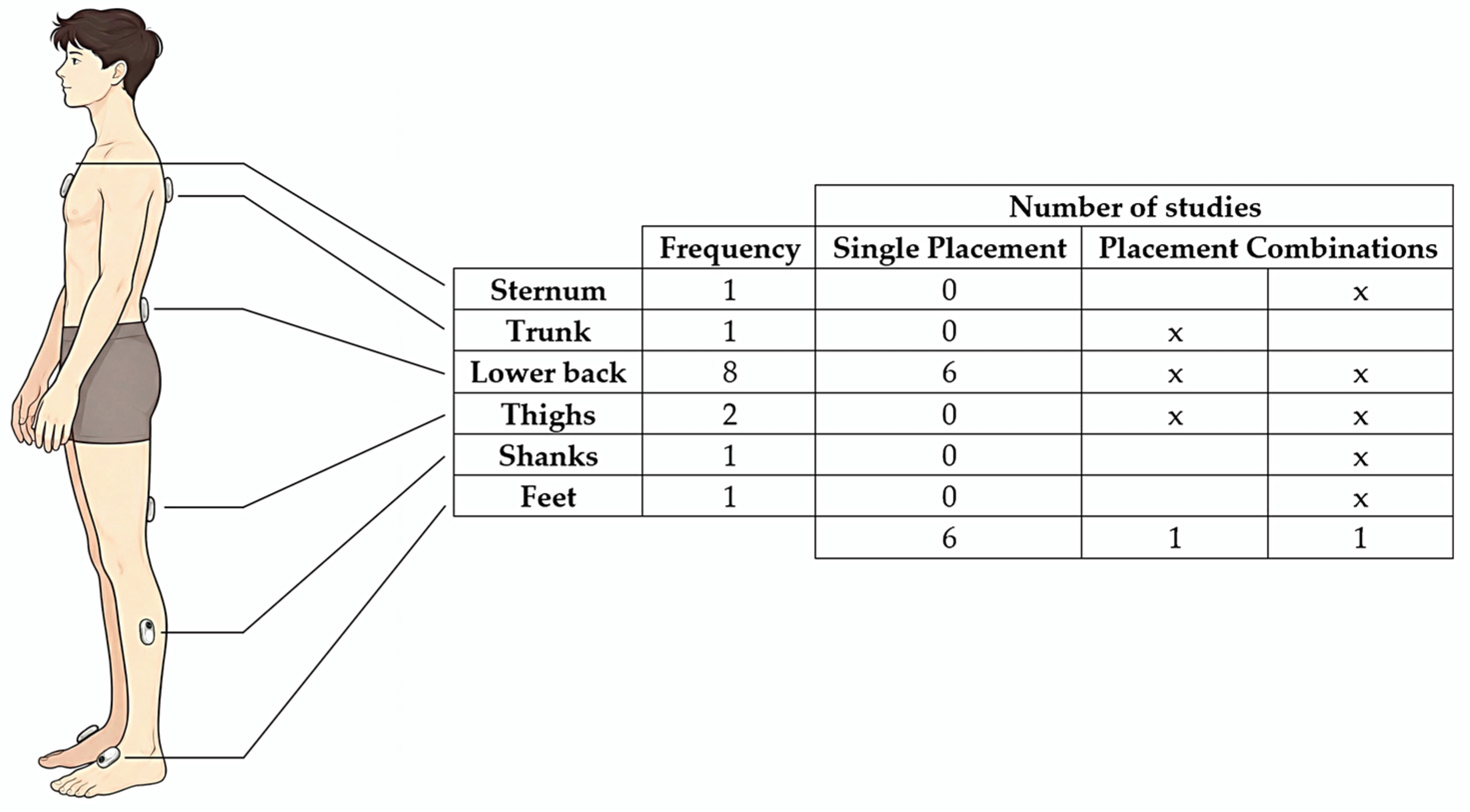
| Study | Scope | Population | Sensor Type (Number/ Positioning) | Gold-Standard System | Algorithm | Postural Sway Parameters | Postural Task | Validation Tool | Results |
|---|---|---|---|---|---|---|---|---|---|
| Alberts et al. (2015) [28] | Evaluating postural stability accuracy using iPad 2s on the lower back by comparing CoG AP sway data to NeuroCom SOT equilibrium scores | 49 healthy subjects | Accelerometer: LIS331DLH, STMicroelectronics, Geneve, CH (1/lower back) | Force platform: Static Balance Master, NeuroCom International Inc., Clackamas, OR, USA | Mathematical model combining a five-knot restricted cubic spline and a sine function | Equilibrium score [%] | EO-Firm EC-Firm SRV-Firm EO-SR EC-SR SRV-SR | BA, MAPE | The two measurement systems showed good agreement with bias between 0.01% (SOT-1) and 6.2% (SOT-5) and MAPE ranging from 5.87% (SOT-5) to 10.42% (SOT-2) |
| Bertolotti et al. (2015) [29] | Validating a prototype IMU on the lower back for balance stability by comparing its measurements to the gold standard force platform, the Nintendo Wii Balance Board | 10 healthy subjects | IMU Prototype (1/lower back) | Force platform: Wii Balance Board, Nintendo, Kyoto, Japan | Inverted pendulum model | RMS-DIST [mm], CEA [mm2], MVELO [mm/s] | EO-Firm EC-Firm EO-Foam EC-Foam | PCC, PB | The prototype demonstrated PCC ranging from moderate (0.598 for EO-Firm) to strong (0.933 for EC-Foam), confirming its validity for balance assessment |
| Chen et al. (2018) [30] | Evaluating accelerometer placement for CoP estimation during balance tasks using three machine-learning algorithms, with results compared to the gold standard force platform measurements | 10 healthy subjects | Accelerometer: ADXL330, Analog Devices Inc., Norwood, MA, USA (3/trunk, lower back and thigh) | Force platform: Mems Technology Corp., New Taipei City, Taiwan | Three machine-learning algorithms for CoP estimation: NN GA ANFIS | CoP trajectory [cm] | AP sway excursion ML sway excursion | PCC, ER | The combined configurations and machine-learning algorithms achieved ER < 15% and PCC > 0.80. The lower back placement and GA showed optimal performance with 7.6% ER and 0.96 PCC |
| Hansson et al. (2019) [31] | Testing the validity of an IMU sensor compared with the gold standard force platform for measuring postural sway | 32 healthy subjects | IMU: Snubblometer®, Infonomy AB, Lund, Sweden (1/lower back) | Force platform: Good Balance™, Metitur Ltd., Jyväskylä, Finland | NS | MVELOAP [mm/s] MVELOML [mm/s] | EO-Firm EC-Firm | Paired t-test, BA, PCC | High correlation (0.71–0.88) was found between the two measurements, but BA analysis revealed systematic bias and poor agreement, with bias ranging from −0.93 to −3.20 |
| Suttanon et al. (2020) [32] | Determining the correlation between an accelerometry-based device and an OMC system to evaluate accelerometer accuracy in postural sway assessment | 20 healthy subjects | Accelerometer: Prototype (1/lower back) | OMC system: Vicon MX 512 M, Vicon Motion Systems, Oxford, UK | Mathematical model based on Kalman filter and trigonometric equations | CoM angleAP [deg] CoM angleML [deg] | EO-Firm EO-LB EO-LF EO-LL EO-RL | PCC, PB | High correlation between OMC analysis and accelerometer prototype in AP (0.982) and ML (0.835) directions was found |
| Germanotta et al. (2021) [33] | Comparing the SDI approach based on a single sensor and a seven-IMU network (BM) compared with an OMC system to determine the best method for measuring CoM dynamics in postural tasks | 15 healthy subjects | IMU: MTw, Xsens Technologies, Enschede, The Netherlands (8/sternum, lower back, feet, shanks and thighs) | OMC system: SMART D500, BTS bioengineering, Milan, Italy | BM and SDI approaches | RDISTAP [mm] RDISTML [mm] TOTEXAP [mm] TOTEXML [mm] CEA [cm2] MVELOAP [mm/s] MVELOML [mm/s] | DL-EO SL-EO AP sway excursion ML sway excursion Free-EO | PCC | The results suggest BM is preferable over SDI for accuracy, as SDI showed lower RMSE values in the AP component (6.1–32.0), but BM performed better in other tasks and exhibited stronger correlations (PCC > 0.98) |
| Janc et al. (2021) [34] | Comparing the results of head shaking posturography performed in accordance with the same task protocol on an IMU device and a standard force platform | 65 healthy subjects | IMU: Prototype (1/lower back) | Force platform: Static Balance Master, NeuroCom International Inc., Clackamas, OR, USA | Orientation estimation using Madgwick quaternion algorithm and inverted pendulum model | Angular sway velocity [deg/s] | EO-Firm EC-Firm EO-Foam EC-Foam | Wilcoxon test, BA, SCC | The IMU exhibited a significant difference in the EO-Firm and EC-Firm, but no difference in the EO-Foam and EC-Foam, with SCC results ranging from moderate to strong (0.60 to 0.98). BA showed good agreement between the two methods |
| Vagnini et al. (2022) [35] | Evaluating the agreement between an IMU and an OMC system in the measurement of postural sway | 15 healthy subjects | IMU: BTS G-Walk, BTS bioengineering, Milan, Italy (1/lower back) | OMC system: Smart-DX, BTS bioengineering, Milan, Italy | Inverted pendulum model | TOTEXAP [mm] TOTEXML [mm] TOTEX [mm] RDISTAP [mm] RDISTML [mm] RMS-DISTAP [mm] RMS-DISTML [mm] MVELOAP [mm/s] MVELOML [mm/s] CEA [mm2] | DL-EO DL-EC MS-L MS-R | ICC, BA, Mann–Whitney test | Excellent-to-good agreement of the IMU for length of TOTEX and MVELO (ICC > 0.9), disagreement for other measures (ICC < 0.75) |
| Study | Protocol Type | Postural Tasks | Number of Tasks and Duration |
|---|---|---|---|
| Alberts et al. [28] | SOT | EO-Firm, EC-Firm, SRV-Firm, EO-SR, EC-SR, SRV-SR | 6 × 20 s |
| Bertolotti et al. [29] | mCTSIB | EO-Firm, EC-Firm, EO-Foam, EC-Foam | 4 × 40 s |
| Chen et al. [30] | Voluntary sway | AP sway excursion, ML sway excursion | 2 × 40 s |
| Hansson et al. [31] | Quiet standing | EO-Firm, EC-Firm | 2 × 30 s |
| Suttanon et al. [32] | Quiet standing & directional leaning | EO-Firm, EO-LB, EO-LF, EO-LL, EO-RL | Not specified |
| Germanotta et al. [33] | Mixed static & dynamic tasks | DL-EO, SL-EO, Free-EO, AP sway excursion, ML sway excursion | Not specified |
| Janc et al. [34] | mCTSIB | EO-Firm, EC-Firm, EO-Foam, EC-Foam | 4 × 30 s |
| Vagnini et al. [35] | Static stance | DL-EO, DL-EC, MS-L, MS-R | 4 × 60 s |
| Study | Signal Pre-Processing | Estimation Approach |
|---|---|---|
| Alberts et al. [28] | 4th-order LP Butterworth filter + sensor orientation offset correction | Nonlinear mixed-effects model (5-knot restricted cubic spline + sine function) |
| Bertolotti et al. [29] | LP filter | Pitch/roll angles projected onto ground via inverted pendulum geometry to estimate CoM displacement |
| Chen et al. [30] | LP filter + downsampling | NN, GA, and ANFIS algorithms trained to predict CoP trajectory from accelerometer signals |
| Hansson et al. [31] | Not reported | Not reported |
| Suttanon et al. [32] | Not reported | Kalman filter applied to reduce angular error and arctan-based trigonometric equations |
| Germanotta et al. [33] | Not reported | SDI: Double integration of pelvis accelerometer signal to estimate CoM displacement BM: Kalman-filtered segment orientations to reconstruct whole-body CoM dynamics |
| Janc et al. [34] | LP filter + downsampling | Madgwick quaternion algorithm estimates orientation |
| Vagnini et al. [35] | 6th-order LP Butterworth filter + linear detrending | Displacement computed from 3-axis accelerometer via trigonometric approach |
| Spatial sway parameter (7) | |||
| Parameter | Definition | Total | Article |
| RMS-DIST | Root mean square distance of CoP/CoM from its mean value | 1 | [29] |
| RMS-DISTAP RMS-DISTML | Root mean square distance of CoP/CoM from its mean value in AP/ML directions | 1 | [35] |
| CEA | Area of the ellipse that contains 95% of the points on the AP and ML CoP/CoM trajectories | 3 | [29,33,35] |
| CoM angleAP CoM angleML | Angle of oscillation calculated between the vertical and the line connecting the ankle joint to the CoM in AP/ML directions | 1 | [32] |
| RDISTAP RDISTML | Excursion between maximum and minimum points of CoM in AP/ML directions | 2 | [33,35] |
| TOTEX | Total length of CoP/CoM trajectory | 1 | [35] |
| TOTEXAP TOTEXML | Length of CoP/CoM trajectory summing consecutive position changes in AP/ML directions | 2 | [33,35] |
| Velocity Parameters (3) | |||
| Parameter | Definition | Total | Article |
| MVELO | Total length of CoP/CoM trajectory divided by duration of test | 1 | [29] |
| MVELOAP MVELOML | Mean velocity of CoP/CoM in AP and ML directions | 3 | [31,33,35] |
| Angular Sway velocity | Change in CoP/CoM oscillation angle divided by duration of test | 1 | [34] |
| Stability Index (1) | |||
| Parameter | Definition | Total | Article |
| Equilibrium Score | Average deviation of CoG for each test in each condition | 1 | [28] |
| Raw Signals/Trajectories (1) | |||
| Parameter | Definition | Total | Article |
| CoP trajectory CoM trajectory | Raw path of the CoP/CoM | 1 | [30] |
Disclaimer/Publisher’s Note: The statements, opinions and data contained in all publications are solely those of the individual author(s) and contributor(s) and not of MDPI and/or the editor(s). MDPI and/or the editor(s) disclaim responsibility for any injury to people or property resulting from any ideas, methods, instructions or products referred to in the content. |
© 2026 by the authors. Licensee MDPI, Basel, Switzerland. This article is an open access article distributed under the terms and conditions of the Creative Commons Attribution (CC BY) license.
Share and Cite
Prisco, G.; Pisani, N.; Romano, M.; Amato, F.; Esposito, F.; Donisi, L. Validity of Wearable Inertial Sensors for Postural Sway Analysis: A Systematic Review. Diagnostics 2026, 16, 2101. https://doi.org/10.3390/diagnostics16132101
Prisco G, Pisani N, Romano M, Amato F, Esposito F, Donisi L. Validity of Wearable Inertial Sensors for Postural Sway Analysis: A Systematic Review. Diagnostics. 2026; 16(13):2101. https://doi.org/10.3390/diagnostics16132101
Chicago/Turabian StylePrisco, Giuseppe, Noemi Pisani, Maria Romano, Francesco Amato, Fabrizio Esposito, and Leandro Donisi. 2026. "Validity of Wearable Inertial Sensors for Postural Sway Analysis: A Systematic Review" Diagnostics 16, no. 13: 2101. https://doi.org/10.3390/diagnostics16132101
APA StylePrisco, G., Pisani, N., Romano, M., Amato, F., Esposito, F., & Donisi, L. (2026). Validity of Wearable Inertial Sensors for Postural Sway Analysis: A Systematic Review. Diagnostics, 16(13), 2101. https://doi.org/10.3390/diagnostics16132101