Epidemic Mitigation and Marginal Mortality Gains Using Self-Testing as a Diagnostic Intervention for Epidemic-Prone Diseases in Africa
Abstract
1. Introduction
2. Materials and Methods
2.1. Model Structure and Specification
2.2. Self-Testing and the Role of Isolation
2.3. Global Sensitivity Analysis
2.4. Number Needed to Self-Test
2.5. Stakeholder Engagement
3. Results
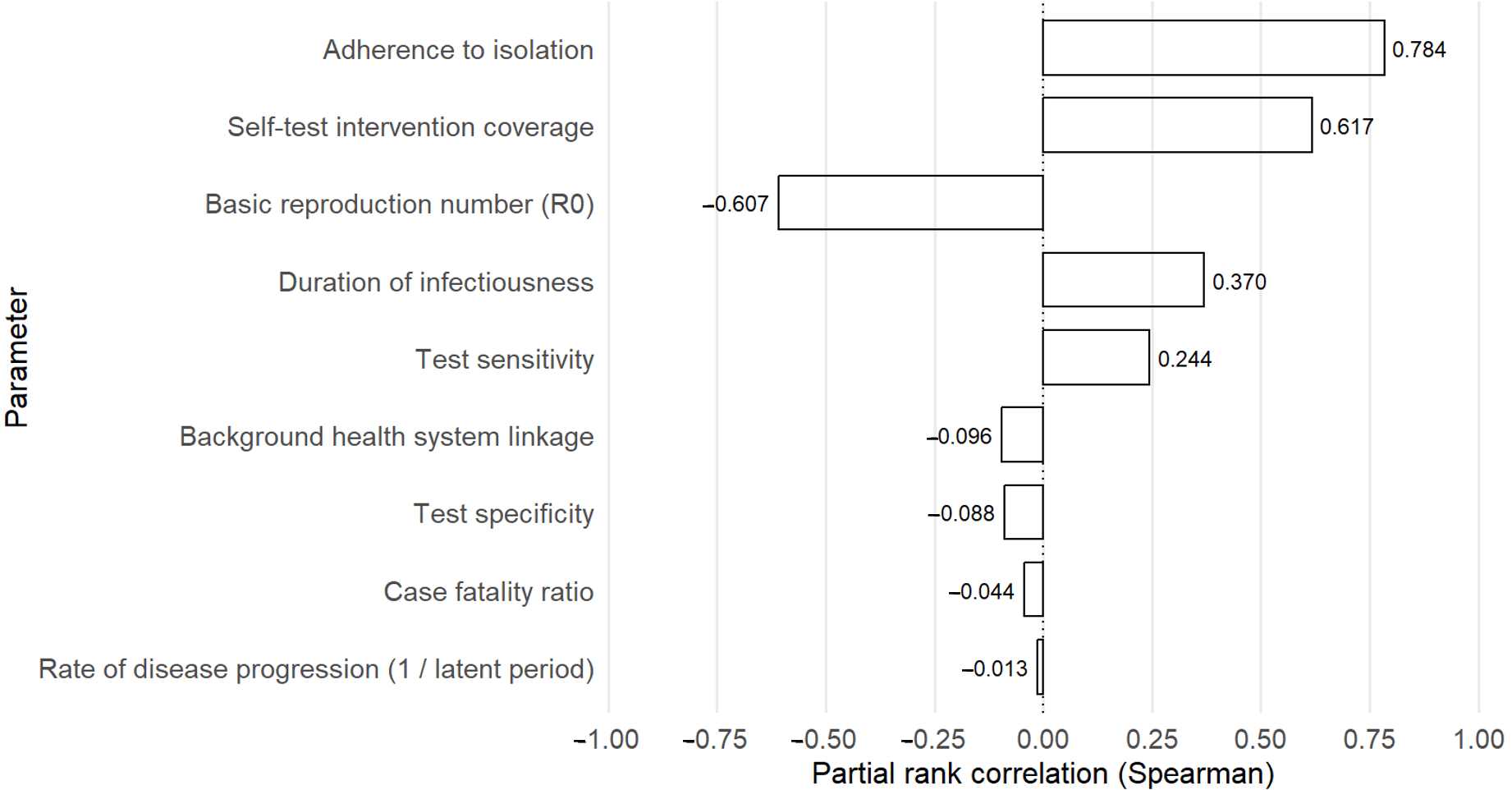
3.1. Global Sensitivity Analysis
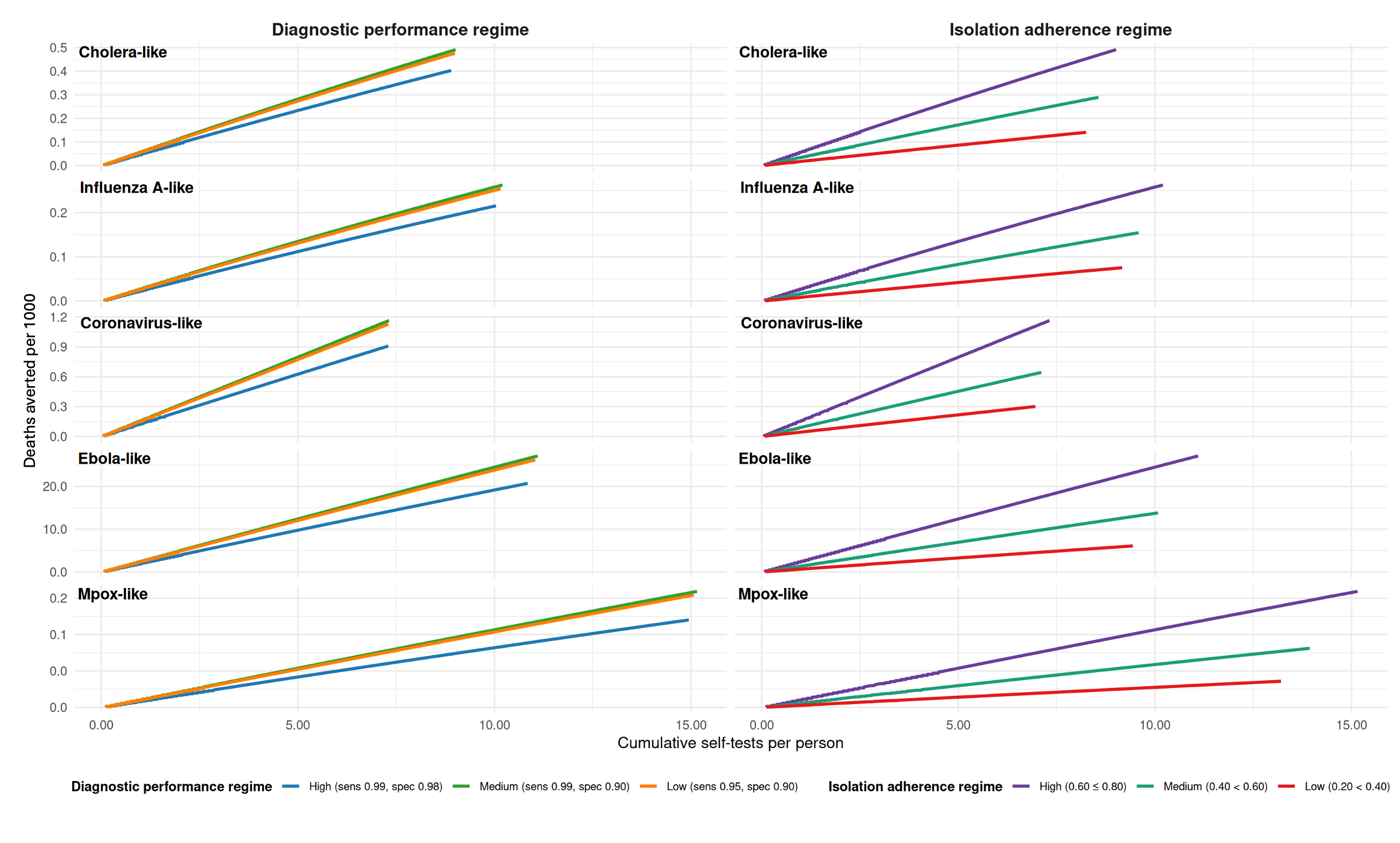
3.2. Marginal-Efficiency Gains
4. Discussion
Limitations
5. Conclusions
Supplementary Materials
Author Contributions
Funding
Institutional Review Board Statement
Informed Consent Statement
Data Availability Statement
Acknowledgments
Conflicts of Interest
Abbreviations
| AU | African Union |
| CFR | Case Fatality Rate |
| COVID-19 | Coronavirus Disease 2019 |
| HCV | Hepatitis C Virus |
| HIV | Human Immunodeficiency Virus |
| IQR | Interquartile Range |
| LHS | Latin Hypercube Sampling |
| NNST | Number Needed to Self-Test |
| PATAT | Propelling Action for Testing and Treating |
| PDxRI | Pathogen Diagnostics Readiness Index |
| PRCC | Partial Rank Correlation Coefficient |
| SEIR | Susceptible–Exposed–Infectious–Recovered |
| SoC | Standard of Care |
| SROC | Summary Receiver Operating Characteristic |
| ST | Self-Testing |
| WHO | World Health Organization |
| WHO Afro | World Health Organization Regional Office for Africa |
References
- African Union; Africa Cemtres for Disease Control and Prevention. Building Testing Capacity for Epidemic-Prone Diseases. Guidance to African Union Member States. Available online: https://aslm.org/resource/building-testing-capacity-for-epidemic-prone-diseases/ (accessed on 1 May 2024).
- African Society for Laboratory Medicine. Advancing Access to Quality Diagnostics in Africa Through AFCAD. Available online: https://aslm.org/wp-content/uploads/2025/08/August-2025-ASLM-LabVoice-010.pdf (accessed on 2 March 2026).
- World Health Organization. Classification of Self-Care Interventions for Health: A Shared Language to Describe the Uses of Self-Care Interventions. Available online: https://iris.who.int/handle/10665/350480 (accessed on 10 October 2024).
- Johnson, C.C.; Kennedy, C.; Fonner, V.; Siegfried, N.; Figueroa, C.; Dalal, S.; Sands, A.; Baggaley, R. Examining the effects of HIV self-testing compared to standard HIV testing services: A systematic review and meta-analysis. J. Int. AIDS Soc. 2017, 20, 21594. [Google Scholar] [CrossRef] [PubMed]
- Witzel, T.C.; Eshun-Wilson, I.; Jamil, M.S.; Tilouche, N.; Figueroa, C.; Johnson, C.C.; Reid, D.; Baggaley, R.; Siegfried, N.; Burns, F.M.; et al. Comparing the effects of HIV self-testing to standard HIV testing for key populations: A systematic review and meta-analysis. BMC Med. 2020, 18, 381. [Google Scholar] [CrossRef] [PubMed]
- Gupta-Wright, A.; Barnabas, R.V.; Ingold, H.; Duneton, P.; Abubakar, I. HIV self-testing: Lessons learnt and priorities for adaptation in a shifting landscape. BMJ Glob. Health 2021, 6, e004418. [Google Scholar] [CrossRef] [PubMed]
- FIND. Hepatitis C Self-Testing: Updates on Country Pilots, WHO Guidance and Products. Available online: https://www.finddx.org/what-we-do/events/hepatitis-c-self-testing-updates-on-country-pilots-who-guidance-and-products/ (accessed on 2 May 2026).
- World Health Organization. Recommendations and Guidance on Hepatitis C Virus Self-Testing. Available online: https://iris.who.int/handle/10665/342803 (accessed on 28 October 2025).
- Goggolidou, P.; Hodges-Mameletzis, I.; Purewal, S.; Karakoula, A.; Warr, T. Self-Testing as an Invaluable Tool in Fighting the COVID-19 Pandemic. J. Prim. Care Community Health 2021, 12, 21501327211047782. [Google Scholar] [CrossRef] [PubMed]
- Boum, Y.; Eyangoh, S.; Okomo, M.-C. Beyond COVID-19; will self-sampling and testing become the norm? Lancet Infect. Dis. 2021, 21, 1194–1195. [Google Scholar] [CrossRef] [PubMed]
- Ciccone, E.J.; Conserve, D.F.; Dave, G.; Hornik, C.P.; Kuhn, M.L.; Herling, J.L.; Song, M.; Alston, S.; Singler, L.; Schmidt, M.D.; et al. At-home testing to mitigate community transmission of SARS-CoV-2: Protocol for a public health intervention with a nested prospective cohort study. BMC Public Health 2021, 21, 2209. [Google Scholar] [CrossRef] [PubMed]
- Sakala, M.; Johnson, C.; Chirombo, J.; Sacks, J.A.; Baggaley, R.; Divala, T. COVID-19 self-testing: Countries accelerating policies ahead of WHO guidelines during pandemics: A Global Survey. medRxiv 2023. [Google Scholar] [CrossRef]
- Ritchey, M.D.; Rosenblum, H.G.; Del Guercio, K.; Humbard, M.; Santos, S.; Hall, J.; Chaitram, J.; Salerno, R.M. COVID-19 Self-Test Data: Challenges and Opportunities—United States, October 31, 2021-June 11, 2022. MMWR Morb. Mortal. Wkly. Rep. 2022, 71, 1005–1010. [Google Scholar] [CrossRef] [PubMed]
- World Health Organization. Use of SARS-CoV-2 Antigen-Detection Rapid Diagnostic Tests for COVID-19 Self-Testing: Interim Guidance. 9 March 2022. Available online: https://iris.who.int/handle/10665/352350 (accessed on 12 March 2023).
- Africa Centres for Disease Control and Prevention. COVID-19 Rapid Antigen Self-Testing: Interim Guidance to African Union Member States. Available online: https://africacdc.org/download/interim-guidance-on-covid-19-rapid-antigen-selftesting-to-african-union-member-states (accessed on 15 October 2024).
- Mina, M.J.; Parker, R.; Larremore, D.B. Rethinking COVID-19 Test Sensitivity—A Strategy for Containment. N. Engl. J. Med. 2020, 383, e120. [Google Scholar] [CrossRef] [PubMed]
- Brümmer, L.E.; Erdmann, C.; Tolle, H.; McGrath, S.; Olaru, I.D.; Katzenschlager, S.; Yerlikaya, S.; Grilli, M.; Pollock, N.R.; Erkosar, B.; et al. The clinical utility and epidemiological impact of self-testing for SARS-CoV-2 using antigen detecting diagnostics: A systematic review and meta-analysis. medRxiv 2022. [Google Scholar] [CrossRef]
- UK Health Security Agency. COVID-19: General Public Testing Behaviours. Available online: https://www.gov.uk/government/publications/lfd-tests-how-and-why-they-were-used-during-the-pandemic/covid-19-general-public-testing-behaviours (accessed on 3 December 2024).
- FIND. Democratizing Access to Testing: Learning, Impact, and Recommendations from a Decentralized Approach in Response to the COVID-19 Pandemic. Available online: https://www.finddx.org/wp-content/uploads/2022/12/20221210_rep_democratizing_testing_FV_EN.pdf (accessed on 1 January 2025).
- World Health Organization Regional Office for Africa. New COVID-19 Rapid Tests a Game Changer for Africa. Available online: https://www.afro.who.int/news/new-covid-19-rapid-tests-game-changer-africa (accessed on 31 October 2025).
- World Health Organization Regional Office for Africa. 2.8 Testing and Laboratory Capacity. Available online: https://www.afro.who.int/sites/default/files/Progress%20report%2021/docs/WHO-AFRO_SPRP_COVID-19_2.8.pdf (accessed on 31 October 2025).
- World Health Organization. A Coordinated Research Roadmap: Immediate Research Next Steps to Contribute to Control the Outbreak. Available online: https://cdn.who.int/media/docs/default-source/blue-print/a-coordinated-research-roadmap-monkeypox-virus-immediate-research-next-steps-to-contribute-to-control-the-outbreak.pdf (accessed on 18 October 2024).
- World Health Organization. Prioritization Pathogens: A Scientific Framework for Epidemic and Pandemic Research Preparedness. Available online: https://cdn.who.int/media/docs/default-source/consultation-rdb/prioritization-pathogens-v6final.pdf (accessed on 12 October 2024).
- World Health Organization. Strengthening Health Emergency Prevention, Preparedness, Response and Resilience. Available online: https://cdn.who.int/media/docs/default-source/emergency-preparedness/who_hepr_wha2023-21051248b.pdf (accessed on 24 June 2025).
- Ogden, N.H.; Acheson, E.S.; Brown, K.; Champredon, D.; Colijn, C.; Diener, A.; Dushoff, J.; Earn, D.J.D.; Gabriele-Rivet, V.; Gangbè, M.; et al. Mathematical modelling for pandemic preparedness in Canada: Learning from COVID-19. Can. Commun. Dis. Rep. 2024, 50, 345–356. [Google Scholar] [CrossRef] [PubMed]
- Uyeki, T.M.; Hui, D.S.; Zambon, M.; Wentworth, D.E.; Monto, A.S. Influenza. Lancet 2022, 400, 693–706. [Google Scholar] [CrossRef] [PubMed]
- Izudi, J.; Bajunirwe, F. Case fatality rate for Ebola disease, 1976–2022: A meta-analysis of global data. J. Infect. Public Health 2024, 17, 25–34. [Google Scholar] [CrossRef] [PubMed]
- Nishiura, H. Case fatality ratio of pandemic influenza. Lancet Infect. Dis. 2010, 10, 443–444. [Google Scholar] [CrossRef] [PubMed]
- Diaz Brochero, C.; Nocua-Báez, L.C.; Cortes, J.A.; Charniga, K.; Buitrago-Lopez, A.; Cucunubá, Z.M. Decoding mpox: A systematic review and meta-analysis of the transmission and severity parameters of the 2022-2023 global outbreak. BMJ Glob. Health 2025, 10, e016906. [Google Scholar] [CrossRef] [PubMed]
- Mitjà, O.; Ogoina, D.; Titanji, B.K.; Galvan, C.; Muyembe, J.-J.; Marks, M.; Orkin, C.M. Monkeypox. Lancet 2023, 401, 60–74. [Google Scholar] [CrossRef] [PubMed]
- Brümmer, L.E.; Katzenschlager, S.; McGrath, S.; Schmitz, S.; Gaeddert, M.; Erdmann, C.; Bota, M.; Grilli, M.; Larmann, J.; Weigand, M.A.; et al. Accuracy of rapid point-of-care antigen-based diagnostics for SARS-CoV-2: An updated systematic review and meta-analysis with meta-regression analyzing influencing factors. PLoS Med. 2022, 19, e1004011. [Google Scholar] [CrossRef] [PubMed]
- Wei, C.; Yan, L.; Li, J.; Su, X.; Lippman, S.; Yan, H. Which user errors matter during HIV self-testing? A qualitative participant observation study of men who have sex with men (MSM) in China. BMC Public Health 2018, 18, 1108. [Google Scholar] [CrossRef] [PubMed]
- Tonen-Wolyec, S.; Sarassoro, A.; Muwonga Masidi, J.; Twite Banza, E.; Nsiku Dikumbwa, G.; Maseke Matondo, D.M.; Kilundu, A.; Kamanga Lukusa, L.; Batina-Agasa, S.; Bélec, L. Field evaluation of capillary blood and oral-fluid HIV self-tests in the Democratic Republic of the Congo. PLoS ONE 2020, 15, e0239607. [Google Scholar] [CrossRef] [PubMed]
- Kumwenda, M.; Indravudh, P.; Johnson, C.; Sinjani, G.; Choko, A.; Nundwe, S.; Mee, P.; Nzawa, R.; Nyirenda, R.; Kandulu, J.; et al. Uptake and performance of blood-based self-testing versus oral fluid-based self-testing in Blantyre district, Malawi. In Proceedings of the 10th IAS Conference on HIV Science (IAS 2019), Mexico City, Mexico, 21 July 2019. [Google Scholar]
- World Health Organization. Guidelines on HIV Self-Testing and Partner Notification: Supplement to Consolidated Guidelines on HIV Testing Services. Available online: https://iris.who.int/handle/10665/251655 (accessed on 4 March 2024).
- Smith, L.E.; Martin, A.F.; Brooks, S.K.; Davies, R.; Stein, M.V.; Amlôt, R.; Marteau, T.M.; Rubin, G.J. Measuring and increasing rates of self-isolation in the context of COVID-19: A systematic review with narrative synthesis. Public Health 2024, 234, 224–235. [Google Scholar] [CrossRef] [PubMed]
- Our World in Data. Official Data Collated by Our World in Data; Our World in Data: Oxford, UK, 2022. [Google Scholar]
- Keeling, M.J.; Rohani, P. Modeling Infectious Diseases in Humans and Animals; Princeton University Press: Princeton, NJ, USA, 2008. [Google Scholar]
- Lau, H.; Khosrawipour, T.; Kocbach, P.; Ichii, H.; Bania, J.; Khosrawipour, V. Evaluating the massive underreporting and undertesting of COVID-19 cases in multiple global epicenters. Pulmonology 2021, 27, 110–115. [Google Scholar] [CrossRef] [PubMed]
- FIND. Pathogen Diagnostics Readiness Index (PDxRI): Assessing Diagnostic Preparedness to Identify Gaps, Guide Investments, and Inform Policy. Available online: https://www.finddx.org/data-and-impact/dashboards/diagnostic-readiness-index/#/ (accessed on 30 January 2026).
- FIND. Target Product Profile for a Rapid Diagnostic Test for Surveillance of Cholera Outbreaks. Available online: https://www.finddx.org/wp-content/uploads/2024/04/20240403_tpp_surveillance_cholera_FV_EN.pdf (accessed on 2 May 2025).
- World Health Organization. Target Product Profiles for Priority Diagnostics to Support Response to the COVID-19 Pandemic v.1.0; World Health Organization: Geneva, Switzerland, 2020. [Google Scholar]
- World Health Organization. Target Product Profile for Zaïre Ebolavirus Rapid, Simple Test to be Used in the Control of the Ebola Outbreak in West Africa. Available online: https://cdn.who.int/media/docs/default-source/blue-print/who_ebola_diagnostics_tpp_oct-2014.pdf (accessed on 12 May 2025).
- World Health Organization. Target Product Profiles for Tests Used for Mpox (Monkeypox) Diagnosis. Available online: https://iris.who.int/handle/10665/371297 (accessed on 2 March 2026).
- Chan, M.C.W.; Lee, N.; Ngai, K.L.K.; Leung, T.F.; Chan, P.K.S. Clinical and Virologic Factors Associated with Reduced Sensitivity of Rapid Influenza Diagnostic Tests in Hospitalized Elderly Patients and Young Children. J. Clin. Microbiol. 2014, 52, 497–501. [Google Scholar] [CrossRef] [PubMed]
- Rohana, H.; Marmur, G.; Azrad, M.; Peretz, A. A new antigen test device for rapid influenza A and B detection. Heliyon 2024, 10, e33979. [Google Scholar] [CrossRef] [PubMed]
- Uyeki, T.M.; Bernstein, H.H.; Bradley, J.S.; Englund, J.A.; File, T.M., Jr.; Fry, A.M.; Gravenstein, S.; Hayden, F.G.; Harper, S.A.; Hirshon, J.M.; et al. Clinical Practice Guidelines by the Infectious Diseases Society of America: 2018 Update on Diagnosis, Treatment, Chemoprophylaxis, and Institutional Outbreak Management of Seasonal Influenzaa. Clin. Infect. Dis. 2018, 68, e1–e47. [Google Scholar] [CrossRef] [PubMed]
- Deb, K. Multi-Objective Optimization Using Evolutionary Algorithms; John Wiley & Sons: Chichester, UK, 2001. [Google Scholar]
- Anderson, R.M.; May, R.M. Infectious Diseases of Humans: Dynamics and Control; Oxford University Press: Oxford, UK, 1991. [Google Scholar]
- Han, A.X.; Girdwood, S.J.; Khan, S.; Sacks, J.A.; Toporowski, A.; Huq, N.; Hannay, E.; Russell, C.A.; Nichols, B.E. Strategies for Using Antigen Rapid Diagnostic Tests to Reduce Transmission of Severe Acute Respiratory Syndrome Coronavirus 2 in Low- and Middle-Income Countries: A Mathematical Modelling Study Applied to Zambia. Clin. Infect. Dis. 2022, 76, 620–630. [Google Scholar] [CrossRef] [PubMed]
- Chowell, G.; Viboud, C.; Simonsen, L.; Merler, S.; Vespignani, A. Perspectives on model forecasts of the 2014–2015 Ebola epidemic in West Africa: Lessons and the way forward. BMC Med. 2017, 15, 42. [Google Scholar] [CrossRef] [PubMed]
- Suchar, V.A.; Aziz, N.; Bowe, A.; Burke, A.; Wiest, M.M. An exploration of the spatiotemporal and demographic patterns of Ebola Virus Disease epidemic in West Africa using open access data sources. Appl. Geogr. 2018, 90, 272–281. [Google Scholar] [CrossRef] [PubMed]
- Indravudh, P.P.; Fielding, K.; Kumwenda, M.K.; Nzawa, R.; Chilongosi, R.; Desmond, N.; Nyirenda, R.; Neuman, M.; Johnson, C.C.; Baggaley, R.; et al. Effect of community-led delivery of HIV self-testing on HIV testing and antiretroviral therapy initiation in Malawi: A cluster-randomised trial. PLoS Med. 2021, 18, e1003608. [Google Scholar] [CrossRef] [PubMed]
- World Health Organization. Distribution Models for Self-Testing. Available online: https://www.who.int/tools/self-testing-implementation-toolkit-for-hiv-hcv-and-syphilis/distribution--models-for-self-testing (accessed on 13 May 2026).
- Tiffany, A.; Dalziel, B.D.; Kagume Njenge, H.; Johnson, G.; Nugba Ballah, R.; James, D.; Wone, A.; Bedford, J.; McClelland, A. Estimating the number of secondary Ebola cases resulting from an unsafe burial and risk factors for transmission during the West Africa Ebola epidemic. PLoS Neglected Trop. Dis. 2017, 11, e0005491. [Google Scholar] [CrossRef] [PubMed]
- Checchi, F.; Eamer, G.; Katshitshi, J.; Robles Dios, L.; Kai, A.; Warsame, A. Effect of a safe and dignified burial intervention on Ebola virus transmission in the eastern Democratic Republic of the Congo, 2018–19: A propensity score analysis. Lancet Glob. Health 2025, 13, e1617–e1626. [Google Scholar] [CrossRef] [PubMed]
- Curran, K.G.; Gibson, J.J. Cluster of Ebola Virus Disease Linked to a Single Funeral—Moyamba District, Sierra Leone, 2014. MMWR Morb. Mortal. Wkly. Rep. 2016, 65, 202–205. [Google Scholar] [CrossRef] [PubMed]
- Paterson, A.; Kabajaasi, O.; Adlard, F.; Dimitrios, K.H.; Cheyne, A.; Ssewankambo, Y.; Kaggwa, D.; Olliaro, P.; Kenya-Mugisha, N.; Rojek, A. Ebola Stigma and Its Impact on Outbreak Control: Lessons from Key Informant Interviews in Central Uganda. Trop. Med. Int. Health 2025, 30, 1006–1017. [Google Scholar] [CrossRef] [PubMed]
- Paterson, A.; Kabajaasi, O.; Gouws, M.; Dimitrios, K.H.; Cheyne, A.; Olliaro, P.; Kenya-Mugisha, N.; Rojek, A. Ebola disease stigma: Mixed methods insights from the 2022 Sudan ebolavirus outbreak. BMJ Open 2025, 15, e107795. [Google Scholar] [CrossRef] [PubMed]
- Wang, Z.; Bennett, R.S.; Roehler, M.; Guillon, G.; Fischl, M.J.; Donadi, M.C.; Makovetz, J.; Holmes, N.; Zaveri, T.; Toolan, E.; et al. Development and Clinical Evaluation of a Rapid Point of Care Test for Ebola Virus Infection in Humans. Viruses 2023, 15, 336. [Google Scholar] [CrossRef] [PubMed]
- Dacombe, R.; Watson, V.; Nyirenda, L.; Madanhire, C.; Simwinga, M.; Chepuka, L.; Johnson, C.; Corbett, L.; Hatzold, K.; Taegtmeyer, M. Regulation of HIV self-testing in Malawi, Zambia and Zimbabwe: A qualitative study with key stakeholders. J. Int. AIDS Soc. 2019, 22, e25229. [Google Scholar] [CrossRef] [PubMed]
- Ingold, H.; Mwerinde, O.; Ross, A.L.; Leach, R.; Corbett, E.L.; Hatzold, K.; Johnson, C.C.; Ncube, G.; Nyirenda, R.; Baggaley, R.C. The Self-Testing AfRica (STAR) Initiative: Accelerating global access and scale-up of HIV self-testing. J. Int. AIDS Soc. 2019, 22, e25249. [Google Scholar] [CrossRef] [PubMed]
- Undelikwo, V.; Shilton, S.; Folayan, M.; Alaba, O.; Reipold, E.; Martínez-Pérez, G. COVID-19 self-testing in Nigeria: Stakeholders opinions and perspective on its value for case detection. PLoS ONE 2022, 18, e0282570. [Google Scholar]
- Ilesanmi, O.S.; Bello, A.E.; Afolabi, A.A. COVID-19 pandemic response fatigue in Africa: Causes, consequences, and counter-measures. Pan Afr. Med. J. 2020, 37, 37. [Google Scholar] [CrossRef]
- Kpanake, L.; Leno, J.P.; Sorum, P.C.; Mullet, E. Acceptability of community quarantine in contexts of communicable disease epidemics: Perspectives of literate lay people living in Conakry, Guinea. Epidemiol. Infect. 2019, 147, e248. [Google Scholar] [CrossRef]
- World Health Organization. Pandemic and Epidemic-Prone Diseases. Available online: https://openwho.org/courses/pandemic-epidemic-diseases (accessed on 30 December 2024).
- FIND. FIND Evaluations of SARS-CoV-2 Ag Tests. Available online: https://www.finddx.org/covid-19/find-evaluations-of-sars-cov-2-assays/find-evaluations-of-sars-cov-2-ag-tests/ (accessed on 29 December 2024).
- International Pandemic Preparedness Secretariat; FIND. Making the Exceptional Routine: Embedding Diagnostic Best Practice to Improve Pandemic Preparedness; International Pandemic Preparedness Secretariat: London, UK; FIND: Geneva, Switzerland, 2023. [Google Scholar]
- He, X.; Lau, E.H.Y.; Wu, P.; Deng, X.; Wang, J.; Hao, X.; Lau, Y.C.; Wong, J.Y.; Guan, Y.; Tan, X.; et al. Temporal dynamics in viral shedding and transmissibility of COVID-19. Nat. Med. 2020, 26, 672–675. [Google Scholar] [CrossRef] [PubMed]
- FIND. FIND Market and Insights Primer: Near-Point of Care Molecular Diagnostics in Low- and Middle-Income Countries. Available online: https://www.finddx.org/wp-content/uploads/2023/06/20230614_rep_find_market_insights_poc_lmics_FV_EN.pdf (accessed on 12 May 2026).
- Reitsma, J.B.; Glas, A.S.; Rutjes, A.W.; Scholten, R.J.; Bossuyt, P.M.; Zwinderman, A.H. Bivariate analysis of sensitivity and specificity produces informative summary measures in diagnostic reviews. J. Clin. Epidemiol. 2005, 58, 982–990. [Google Scholar] [CrossRef] [PubMed]



| Parameter | Plausible Ranges | Rationale |
|---|---|---|
| Disease-specific parameters | ||
| Basic reproduction number, R0 | 1.1 to 10 | Minimum threshold for epidemic propagation (R0 > 1) up to highly transmissible airborne infections (R0 = 10). |
| Case Fatality Rate (CFR) | 1% to 50% | Moderate-severity respiratory infections (e.g., seasonal influenza [26]) to high-severity viral hemorrhagic fevers (e.g., Ebola [27]). |
| Latent period (1/ε) | 1 to 12 days | Considering acute outbreak-potential pathogens only, ranging from short-generation infections (e.g., Influenza A [28]) to longer latent infections (e.g., Mpox [29,30]). |
| Duration of infectiousness (D) | 3 to 21 days | As above. |
| Device-specific parameters | ||
| Sensitivity and specificity of self-testing | Draws from plausible bivariate distribution; specificity capped above at 0.90 | Empirically derived sensitivity–specificity sampling draws from a bivariate random effects model for self-test kits with available accuracy data (N = 91 [31,32,33,34,35]). Specificity capped above at 0.90 to avoid rewarding devices with sub-optimal specificity (peak prevalence will decline with increased false-positive isolation). |
| Behavioral parameters | ||
| Post-test adherence with isolation measures (a) | 0 to 0.8 | Systematic review evidence suggests adherence with post-test isolation clusters well below full adherence [36]. Adherence ranges from 0 up to 0.8 (upper plausible bound for sustained isolation adherence in outbreak settings). |
| Intervention coverage parameters | ||
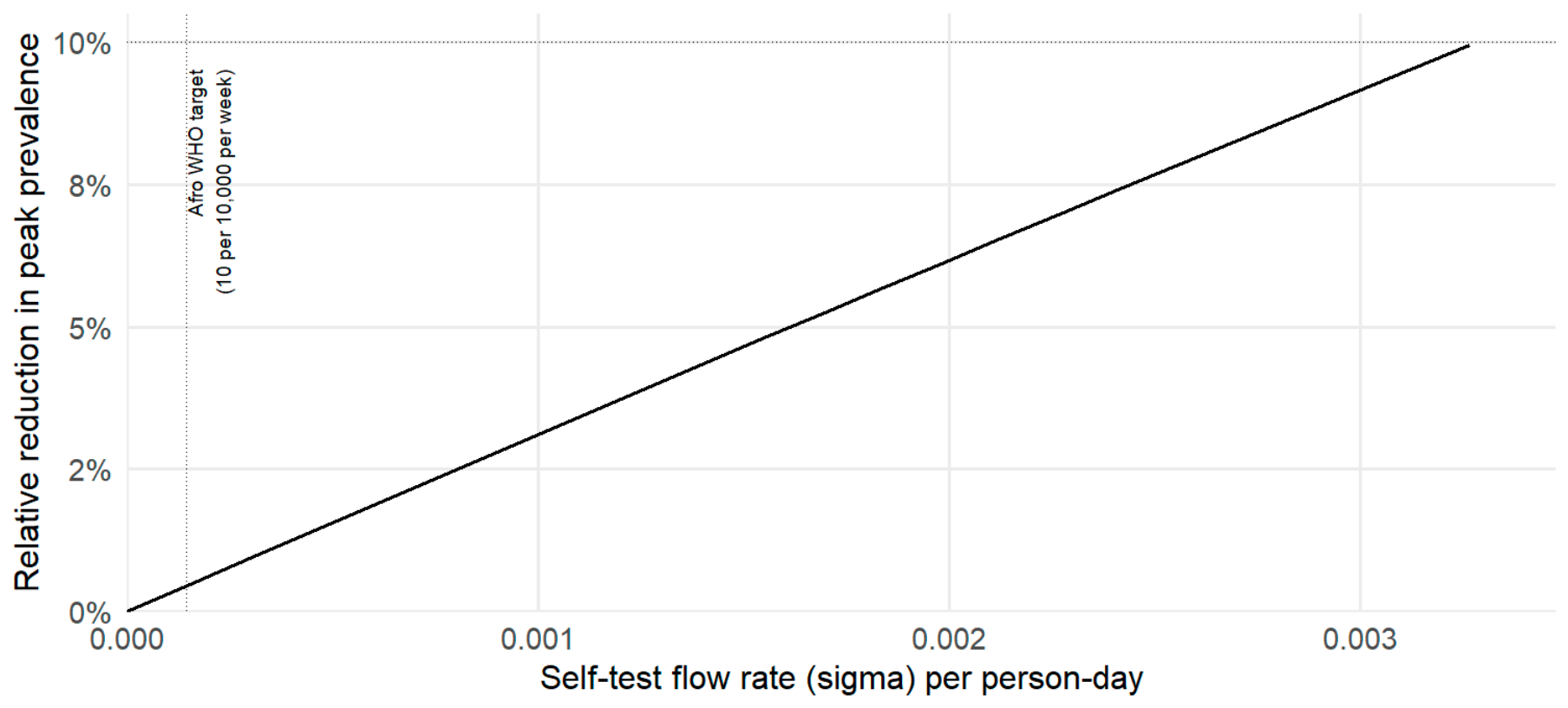
| Per capita rate of self-testing (σ) | 0 to 0.15 per person per day | No testing to the maximum global daily testing conducted during the COVID-19 pandemic (Cyprus on 9 January 2022 at 0.15 per person per day [37]). During the COVID-19 pandemic an overall per capita testing rate of 1.42 × 10⁻⁴ per person-day (10 tests per 10,000 people per week) was identified as the minimum overall testing threshold required to disrupt transmission chains by WHO Afro. Only 16 countries achieved this benchmark by mid-2021 [20]. |
| Health-system context | ||
| Rate at which health system links people into isolation () | 0 to 0.15 | Rate depends on duration of infectiousness (D), as:
At maximum rate (0.15) and maximum duration of infectiousness (21 days), the health system would link 96% people into isolation. At a rate of r = 0.007 corresponding to a minimum duration of infectiousness of 3 days, it would link 2% of infections, a detection rate not unheard of during the early stages of the COVID-19 pandemic [39]. |
| Pathogen Archetypes | Median Number Needed to Self-Test (NNST) to Avert One Death | IQR (25%) | IQR (75%) |
|---|---|---|---|
| Ebola-like | 1512 | 726 | 5430 |
| Coronavirus-like | 22,590 | 11,001 | 74,619 |
| Cholera-like | 55,453 | 28,920 | 182,469 |
| Influenza A-like | 117,231 | 60,529 | 406,948 |
| Mpox-like | 355,708 | 171,447 | 1,268,315 |
Disclaimer/Publisher’s Note: The statements, opinions and data contained in all publications are solely those of the individual author(s) and contributor(s) and not of MDPI and/or the editor(s). MDPI and/or the editor(s) disclaim responsibility for any injury to people or property resulting from any ideas, methods, instructions or products referred to in the content. |
© 2026 by the authors. Licensee MDPI, Basel, Switzerland. This article is an open access article distributed under the terms and conditions of the Creative Commons Attribution (CC BY) license.
Share and Cite
Dunkley, Y.; Corbett, E.L.; Desmond, N.; Indravudh, P.; Arinaminpathy, N. Epidemic Mitigation and Marginal Mortality Gains Using Self-Testing as a Diagnostic Intervention for Epidemic-Prone Diseases in Africa. Diagnostics 2026, 16, 2092. https://doi.org/10.3390/diagnostics16132092
Dunkley Y, Corbett EL, Desmond N, Indravudh P, Arinaminpathy N. Epidemic Mitigation and Marginal Mortality Gains Using Self-Testing as a Diagnostic Intervention for Epidemic-Prone Diseases in Africa. Diagnostics. 2026; 16(13):2092. https://doi.org/10.3390/diagnostics16132092
Chicago/Turabian StyleDunkley, Yasmin, Elizabeth L. Corbett, Nicola Desmond, Pitchaya Indravudh, and Nimalan Arinaminpathy. 2026. "Epidemic Mitigation and Marginal Mortality Gains Using Self-Testing as a Diagnostic Intervention for Epidemic-Prone Diseases in Africa" Diagnostics 16, no. 13: 2092. https://doi.org/10.3390/diagnostics16132092
APA StyleDunkley, Y., Corbett, E. L., Desmond, N., Indravudh, P., & Arinaminpathy, N. (2026). Epidemic Mitigation and Marginal Mortality Gains Using Self-Testing as a Diagnostic Intervention for Epidemic-Prone Diseases in Africa. Diagnostics, 16(13), 2092. https://doi.org/10.3390/diagnostics16132092