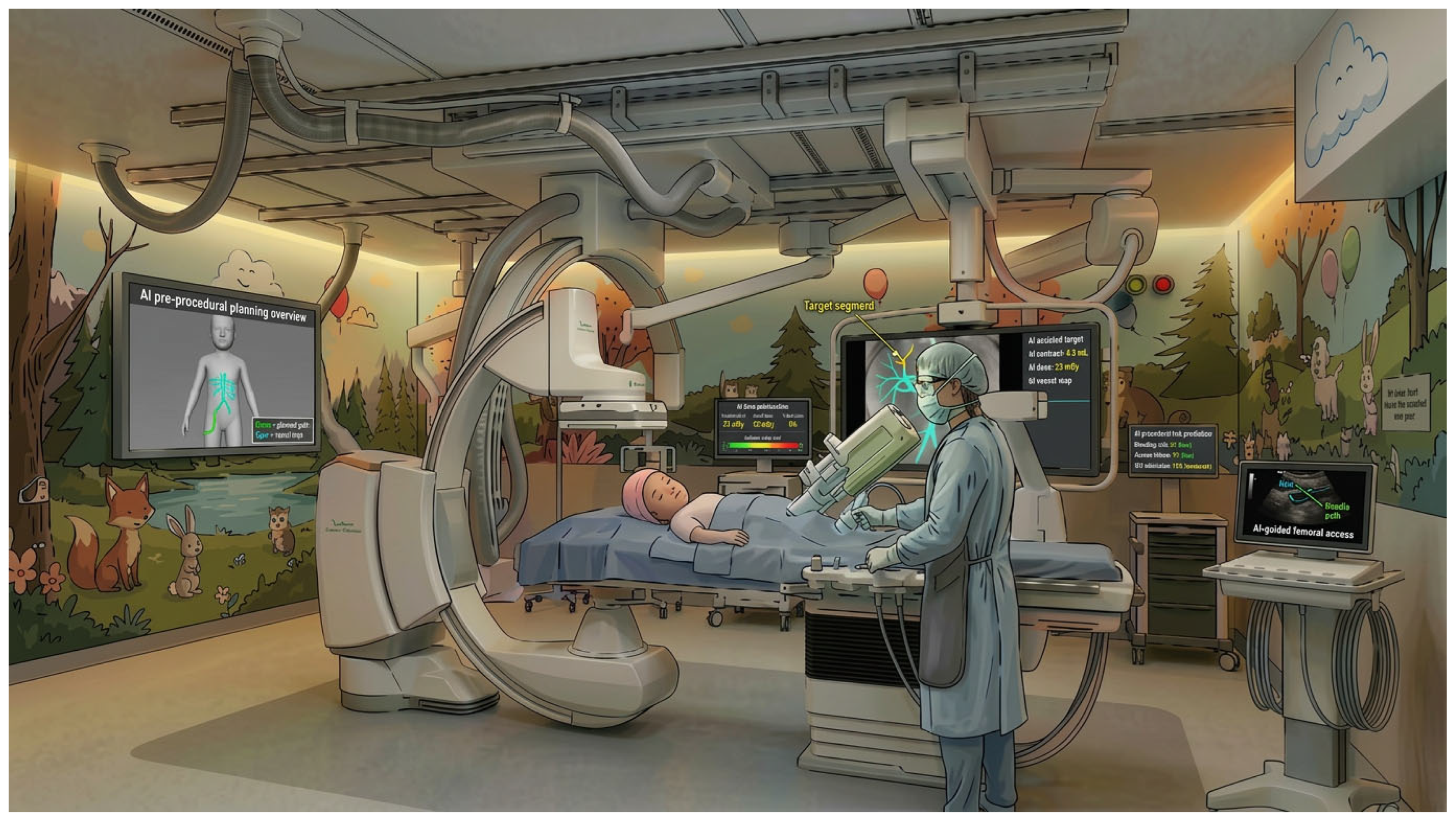
Current State and Future of Artificial Intelligence in Pediatric Interventional Radiology: A Narrative Review

Abstract
1. Introduction
Search Strategy and Selection
2. Current State of AI in PIR
2.1. Overview of Existing AI Technologies
2.2. Challenges in Implementing AI in Pediatric Patients
2.3. Applications of AI in PIR
2.3.1. Image Acquisition and Reconstruction
2.3.2. Image Interpretation and Diagnosis
2.3.3. Procedural Planning and Guidance
2.3.4. Post-Procedure Monitoring and Follow-Up
3. Future Directions
3.1. Emerging AI Technologies
3.2. Potential Impact on Clinical Practice
3.3. AI-Adjacent Robotic and Smart Navigation Systems
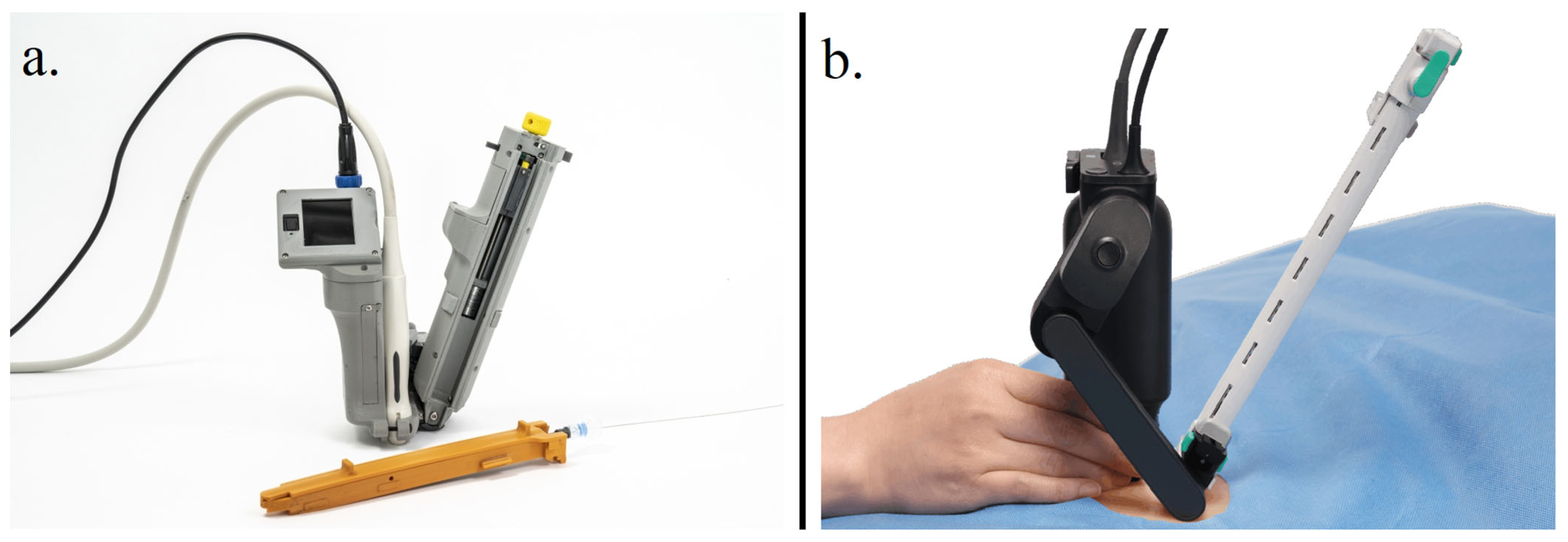
3.4. AI-Enabled Handheld Robotic Ultrasound Guidance for Vascular and Organ Access
- (a)
- Artificial Intelligence Guided Ultrasound Interventional Device (AI-GUIDE), developed to enable non-expert users to perform ultrasound-guided catheterization of deep vessels such as the femoral vein.
- (b)
- Handheld robotic ultrasound-guided needle intervention system by Mendaera Inc., cleared by the United States Food and Drug Administration (510(k)) to assist with needle-based procedures and to reduce user variability and enhance procedural efficiency.
3.5. Research Priorities and Collaborative Studies
4. Conclusions
Funding
Institutional Review Board Statement
Informed Consent Statement
Data Availability Statement
Acknowledgments
Conflicts of Interest
Abbreviations
| ACR | American College of Radiology |
| AI | Artificial Intelligence |
| AI-GUIDE | Artificial Intelligence–Guided Ultrasound Intervention Device |
| AR | Augmented Reality |
| CAD | Computer-Aided Diagnosis |
| CNN | Convolutional Neural Network |
| CT | Computed Tomography |
| DL | Deep Learning |
| DLR | Deep Learning–Based Reconstruction |
| ECG | Electrocardiogram |
| FDA | Food and Drug Administration |
| HUMaN | Handheld Ultrasound System with Magnetic Needle Navigation |
| IR | Interventional Radiology |
| ML | Machine Learning |
| MR | Magnetic Resonance |
| MRI | Magnetic Resonance Imaging |
| PIR | Pediatric Interventional Radiology |
| XAI | Explainable Artificial Intelligence |
References
- Johnson, K.W.; Torres Soto, J.; Glicksberg, B.S.; Shameer, K.; Miotto, R.; Ali, M.; Ashley, E.; Dudley, J.T. Artificial intelligence in cardiology. J. Am. Coll. Cardiol. 2018, 71, 2668–2679. [Google Scholar] [CrossRef] [PubMed]
- Shameer, K.; Johnson, K.W.; Glicksberg, B.S.; Dudley, J.T.; SenGupta, P.P. Machine learning in cardiovascular medicine: Are we there yet? Heart 2018, 104, 1156–1164. [Google Scholar] [CrossRef] [PubMed]
- Desai, S.B.; Pareek, A.; Lungren, M.P. Current and emerging artificial intelligence applications for pediatric interventional radiology. Pediatr. Radiol. 2022, 52, 2173–2177. [Google Scholar] [CrossRef] [PubMed]
- Chang, A.C. Artificial intelligence in pediatric cardiology and cardiac surgery: Irrational hype or paradigm shift? Ann. Pediatr. Cardiol. 2019, 12, 191–194. [Google Scholar] [CrossRef] [PubMed]
- Fuchs, J.; Rabaux-Eygasier, L.; Guerin, F. Artificial intelligence in pediatric liver transplantation: Opportunities and challenges of a new era. Children 2024, 11, 996. [Google Scholar] [CrossRef] [PubMed]
- Pammi, M.; Aghaeepour, N.; Neu, J. Multiomics, artificial intelligence, and precision medicine in perinatology. Pediatr. Res. 2023, 93, 308–315. [Google Scholar] [CrossRef] [PubMed]
- Meek, R.D.; Lungren, M.P.; Gichoya, J.W. Machine learning for the interventional radiologist. Am. J. Roentgenol. 2019, 213, 782–784. [Google Scholar] [CrossRef] [PubMed]
- Al-Sharydah, A.M.; BinShaiq, F.K.; Aloraifi, R.I.; Almefleh, A.A.; Alessa, S.A.; Alobud, A.S.; AlSharidah, A.M.; Bin Dahmash, A.; Al-Aftan, M.S.; Al-Dhaferi, B.F. Procedural software toolkit in the armamentarium of interventional therapies: A review of additive usefulness and current evidence. Diagnostics 2023, 13, 765. [Google Scholar] [CrossRef] [PubMed]
- Abajian, A.; Murali, N.; Savic, L.J.; Laage-Gaupp, F.M.; Nezami, N.; Duncan, J.S.; Schlachter, T.; Lin, M.; Geschwind, J.F.; Chapiro, J. Predicting treatment response to intra-arterial therapies for hepatocellular carcinoma with the use of supervised machine learning-an artificial intelligence concept. J. Vasc. Interv. Radiol. 2018, 29, 850–857.e1. [Google Scholar] [CrossRef] [PubMed]
- Sammer, M.B.K.; Akbari, Y.S.; Barth, R.A.; Blumer, S.L.; Dillman, J.R.; Farmakis, S.G.; Frush, D.P.; Gokli, A.; Halabi, S.S.; Iyer, R.; et al. Use of artificial intelligence in radiology: Impact on pediatric patients, a white paper from the ACR pediatric AI workgroup. J. Am. Coll. Radiol. 2023, 20, 730–737. [Google Scholar] [CrossRef] [PubMed]
- MacDougall, R.D.; McNally, J.S.; Brady, S.L.; Dillman, J.R.; Trout, A.T.; Otero, H.J. Artificial intelligence in paediatric radiology: Future opportunities. Pediatr. Radiol. 2020, 50, 1257–1265. [Google Scholar] [CrossRef] [PubMed]
- Tomaszkiewicz, A.; Kruczek, P.; Szymański, P.; Walczak, K.; Teplicki, P.; Sobczak, A.; Mazela, J. Real-time ultrasound guidance improves neonatal umbilical venous catheter placement efficiency and reduces liver complications. Front. Pediatr. 2025, 13, 1655820. [Google Scholar] [CrossRef] [PubMed]
- Shelmerdine, S.C.; Naidoo, J.; Kelly, B.S.; Laborie, L.B.; Toso, S.; D’Antonoli, T.A.; Arthurs, O.J.; Blumer, S.L.; Ciet, P.; Damasio, M.B.; et al. Artificial intelligence implementation in pediatric radiology for patient safety: A multisociety position statement from the ACR, ESPR, SPR, SLARP, AOSPR, SPIN. J. Am. Coll. Radiol. 2026, 23, 89–101. [Google Scholar] [CrossRef] [PubMed]
- Kazerooni, A.F.; Familiar, A.M.; Aboian, M.; Brüningk, S.C.; Vossough, A.; Linguraru, M.G.; Huang, R.Y.; Hargrave, D.; Peet, A.C.; Resnick, A.C.; et al. Artificial Intelligence for Response Assessment in Pediatric Neuro-Oncology (AI-RAPNO), part 2: Challenges, opportunities, and recommendations for clinical translation. Lancet Oncol. 2025, 26, e607–e618. [Google Scholar] [CrossRef] [PubMed]
- Temple, M.J.; Abruzzo, T.A.; Muñoz, F.G.; Amaral, J.G.; Bogan, K.A.; Gibson, C.; Patel, P.A.; Toh, L.M.; Zhang, J.; Mubarak, W.M.; et al. Fostering research in pediatric interventional radiology: Needs assessment and suggestions for support. Pediatr. Radiol. 2023, 53, 2245–2252. [Google Scholar] [CrossRef] [PubMed]
- Holt, D.B.; El-Bokl, A.; Stromberg, D.; Taylor, M.D. Role of artificial intelligence in congenital heart disease and interventions. J. Soc. Cardiovasc. Angiogr. Interv. 2025, 4, 102567. [Google Scholar] [CrossRef] [PubMed]
- Siemens Healthineers Presents New AI Powered Imaging Chain Optiq AI for Latest Interventional Systems Portfolio. Available online: https://www.siemens-healthineers.com/en-us/press-room/press-releases/ai-powered-imaging-chain-interventional-systems (accessed on 16 March 2026).
- Image Guiding Solutions: Allia IGS Platform and Associated AI-Enabled Applications for Image-Guided Therapies. Available online: https://www.gehealthcare.com/en-us/products/image-guiding-solutions (accessed on 9 June 2026).
- Park, T.; Lee, I.H.; Lee, S.W.; Kong, S.W. Artificial intelligence in pediatric healthcare: Current applications, potential, and implementation considerations. Clin. Exp. Pediatr. 2025, 68, 641. [Google Scholar] [CrossRef] [PubMed]
- Nagayama, Y.; Goto, M.; Sakabe, D.; Emoto, T.; Shigematsu, S.; Oda, S.; Tanoue, S.; Kidoh, M.; Nakaura, T.; Funama, Y.; et al. Radiation Dose Reduction for 80-kVp Pediatric CT Using Deep Learning-Based Reconstruction: A Clinical and Phantom Study. Am. J. Roentgenol. 2022, 219, 315–324. [Google Scholar] [CrossRef] [PubMed]
- Bang, J.Y.; Hough, M.; Hawes, R.H.; Varadarajulu, S. Use of artificial intelligence to reduce radiation exposure at fluoroscopy-guided endoscopic procedures. Am. J. Gastroenterol. 2020, 115, 555–561. [Google Scholar] [CrossRef] [PubMed]
- Zimmermann, J.M.; Vicentini, L.; Van Story, D.; Pozzoli, A.; Taramasso, M.; Lohmeyer, Q.; Maisano, F.; Meboldt, M. Quantification of avoidable radiation exposure in interventional fluoroscopy with eye tracking technology. Investig. Radiol. 2020, 55, 457–462. [Google Scholar] [CrossRef] [PubMed]
- Ayaz, E.; Güçlü, H.; Oktay, A.B. Diagnostic accuracy of convolutional neural network algorithms to distinguish gastrointestinal obstruction on conventional radiographs in a pediatric population. Diagn. Interv. Radiol. 2026, 32, 233–241. [Google Scholar] [CrossRef] [PubMed]
- Behr, T.; Pusch, T.P.; Siegfarth, M.; Hüsener, D.; Mörschel, T.; Karstensen, L. Deep reinforcement learning for the navigation of neurovascular catheters. Curr. Dir. Biomed. Eng. 2019, 5, 5–8. [Google Scholar] [CrossRef]
- Seals, K.; Al-Hakim, R.; Mulligan, P.; Lerrman, E.; Fidelman, N.; Kolli, K.; Kohlbrenner, R.; Kohi, M.; Taylor, A. 03:45 PM Abstract No. 38: The development of a machine learning smart speaker application for device sizing in interventional radiology. J. Vasc. Interv. Radiol. 2019, 30, S20. [Google Scholar] [CrossRef]
- Durand, E.; Eltchaninoff, H. Robotic-assisted percutaneous coronary intervention: The future or the past? EuroIntervention 2024, 20, 19–20. [Google Scholar] [CrossRef] [PubMed]
- Microbot Medical Receives FDA 510(k) Clearance for LIBERTY Endovascular Robotic System. Available online: https://microbotmedical.com (accessed on 16 March 2026).
- Mandhumula, S.R.; Tavallaei, M.A. Robotic Systems in Cardiovascular Interventions: Evolving Platforms and the Path Forward. Methodist Debakey Cardiovasc. J. 2025, 21, 16–34. [Google Scholar] [CrossRef] [PubMed]
- Duan, W.; Akinyemi, T.; Du, W.; Ma, J.; Chen, X.; Wang, F.; Omisore, O.; Luo, J.; Wang, H.; Wang, L. Technical and Clinical Progress on Robot-Assisted Endovascular Interventions: A Review. Micromachines 2023, 14, 197. [Google Scholar] [CrossRef] [PubMed]
- Mendes Pereira, V.; Rice, H.; de Villiers, L.; Sourour, N.; Clarencon, F.; Spears, J.; Tomasello, A.; Hernandez, D.; Cancelliere, N.M.; Liu, X.Y.E.; et al. Evaluation of effectiveness and safety of the CorPath GRX robotic system in endovascular embolization procedures of cerebral aneurysms. J. Neurointerv. Surg. 2024, 16, 405–411. [Google Scholar] [CrossRef] [PubMed]
- Sun, J.; Tang, R.; Zhang, Q.; Liu, J.; Gao, L.; Yang, W.; Chen, X.; Tang, Y. Advancements and challenges in autonomous endovascular interventional robotics: A comprehensive review. iScience 2025, 28, 114024. [Google Scholar] [CrossRef] [PubMed]
- Rolls, A.E.; Riga, C.V.; Bicknell, C.D.; Regan, L.; Cheshire, N.J.; Hamady, M.S. Robot-assisted uterine artery embolization: A first-in-woman safety evaluation of the Magellan System. J. Vasc. Interv. Radiol. 2014, 25, 1841–1848. [Google Scholar] [CrossRef] [PubMed]
- Bravo, J.; Wali, A.R.; Hirshman, B.R.; Gopesh, T.; Steinberg, J.A.; Yan, B.; Pannell, J.S.; Norbash, A.; Friend, J.; Khalessi, A.A.; et al. Robotics and Artificial Intelligence in Endovascular Neurosurgery. Cureus 2022, 14, e23662. [Google Scholar] [CrossRef] [PubMed]
- Brattain, L.J.; Pierce, T.T.; Gjesteby, L.A.; Johnson, M.R.; DeLosa, N.D.; Werblin, J.S.; Gupta, J.F.; Ozturk, A.; Wang, X.; Li, Q.; et al. AI-Enabled, Ultrasound-Guided Handheld Robotic Device for Femoral Vascular Access. Biosensors 2021, 11, 522. [Google Scholar] [CrossRef] [PubMed]
- Kye, S.; Cho, M.; Kim, M.; Berrocal, M.; Vera, J.; Song, T.K.; Bae, S. HUMaN: Handheld Ultrasound System with Magnetic Needle Navigation. Ultrasonography 2026, 45, 151–162. [Google Scholar] [CrossRef] [PubMed]
- Tutkun Şen, H.; Lediju Bell, M.A.; Iordachita, I.; Wong, J.; Kazanzides, P. A Cooperatively Controlled Robot for Ultrasound Monitoring of Radiation Therapy. Rep. U S 2013, 2013, 3071–3076. [Google Scholar] [CrossRef] [PubMed]
- FDA Grants 510(k) Clearance for Focalist Robotic Ultrasound System for Ultrasound Guided Needle Procedures. Available online: https://www.mendaera.com (accessed on 16 March 2026).
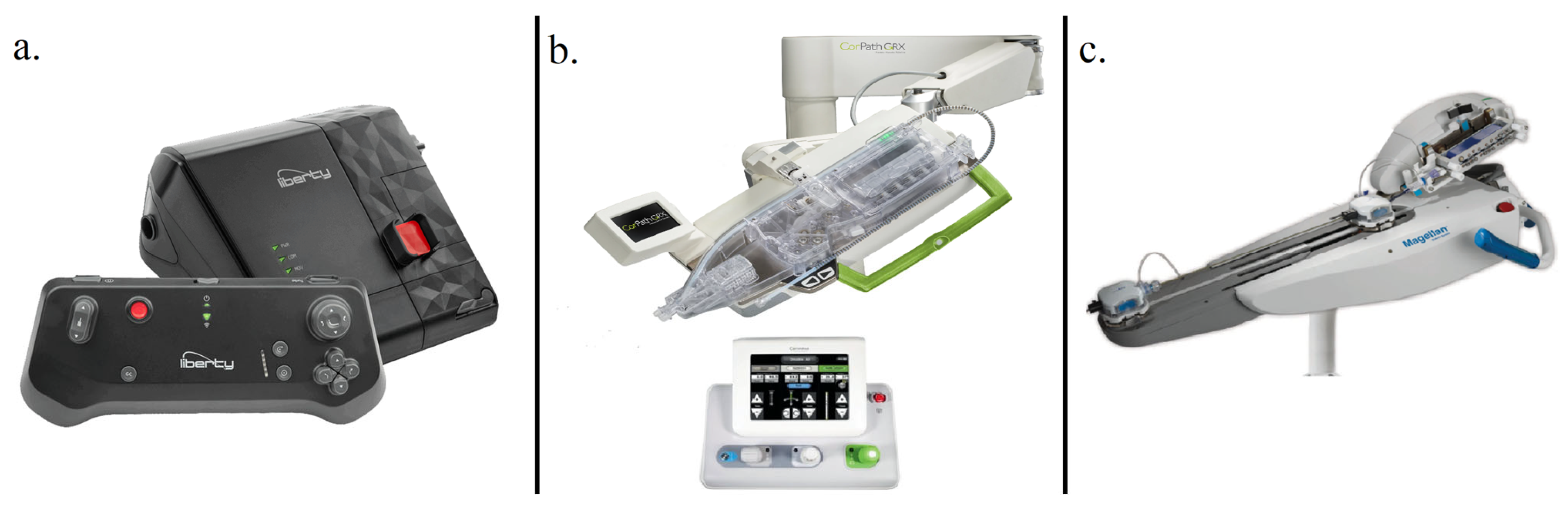


| System | FDA Cleared | Use Type | Operator Position | Evidence Setting | Cost (Reported) | Key Technical Feature | Pediatric Use * | AI Contribution |
|---|---|---|---|---|---|---|---|---|
| LIBERTY [27,28] | Peripheral indication noted in the transarterial review | Single-use endovascular module | Remote, shielded workstation | Porcine model; early peripheral use | “Lower capital barrier” concept only | Table-mounted, single-use, wire/catheter control | None reported | Hardware platform for future AI navigation |
| CorPath GRX [29,30] | PCI and PVI indications summarized | Reusable console, disposable cassette | Remote cockpit outside the field | PCI/PVI; aneurysm embolization | High-cost capital system | Robotic wire/catheter control; automation functions | None reported | Data source for ML-based path planning |
| Magellan [31,32] | Peripheral robotic catheter clearance discussed | Reusable platform, single-use catheters | Remote console | Peripheral uterine chemoembolization | High initial and disposable costs | 6–10-French multi-bend catheters | None reported | Candidate platform for AI-assisted navigation |
| System * | Intended Task | Control Paradigm | US–Needle Relationship | Evidence Setting | AI Contribution |
|---|---|---|---|---|---|
| AI-GUIDE-type device [34] | Automated femoral venous access (porcine) | Operator holds probe; robot drives needle | Clips onto the linear probe; AI localizes the vein | Preclinical porcine central access study | CNN-based vein detection and trajectory planning |
| HUMaN system [35] | Real-time 3D needle guidance | Operator advances needle; system guides visually | Handheld US with magnetic needle tracking overlay | Phantom/preclinical targeting evaluations | EM tracking and real-time registration |
| Cooperative US robot [36] | Stable probe for RT monitoring | Shared human–robot probe control | Robot holds probe; no needle integration | Prototype during radiotherapy monitoring | Force/position sensing; cooperative control algorithm |
| Mendaera Focalist system [37] | Ultrasound-guided needle placement (multiple procedures) | Handheld robot aligns, positions, and tracks the needle | Attaches to probe; guides instrument relative to US | FDA 510(k)-cleared; limited clinical launch | Advanced software for targeting and depth tracking |
Disclaimer/Publisher’s Note: The statements, opinions and data contained in all publications are solely those of the individual author(s) and contributor(s) and not of MDPI and/or the editor(s). MDPI and/or the editor(s) disclaim responsibility for any injury to people or property resulting from any ideas, methods, instructions or products referred to in the content. |
© 2026 by the author. Licensee MDPI, Basel, Switzerland. This article is an open access article distributed under the terms and conditions of the Creative Commons Attribution (CC BY) license.
Share and Cite
Al-Sharydah, A.M. Current State and Future of Artificial Intelligence in Pediatric Interventional Radiology: A Narrative Review. Diagnostics 2026, 16, 1918. https://doi.org/10.3390/diagnostics16121918
Al-Sharydah AM. Current State and Future of Artificial Intelligence in Pediatric Interventional Radiology: A Narrative Review. Diagnostics. 2026; 16(12):1918. https://doi.org/10.3390/diagnostics16121918
Chicago/Turabian StyleAl-Sharydah, Abdulaziz Mohammad. 2026. "Current State and Future of Artificial Intelligence in Pediatric Interventional Radiology: A Narrative Review" Diagnostics 16, no. 12: 1918. https://doi.org/10.3390/diagnostics16121918
APA StyleAl-Sharydah, A. M. (2026). Current State and Future of Artificial Intelligence in Pediatric Interventional Radiology: A Narrative Review. Diagnostics, 16(12), 1918. https://doi.org/10.3390/diagnostics16121918