Article

Phenotypic Heterogeneity in Crohn’s Disease-Associated Intestinal Strictures: An Exploratory Retrospective Cohort Study


1
Department of Internal Medicine, Gastroenterology, Oncology and Palliative Care, Medical Campus Lake Constance, Röntgenstraße 2, 88048 Friedrichshafen, Germany
2
Department of Gastroenterology, Gastrointestinal Oncology, Hepatology, Infectious Diseases and Geriatrics, University Hospital Tübingen, Otfried-Müller-Straße 10, 72076 Tübingen, Germany
*
Author to whom correspondence should be addressed.
Diagnostics 2026, 16(12), 1841; https://doi.org/10.3390/diagnostics16121841 (registering DOI)
Submission received: 1 April 2026 / Revised: 26 May 2026 / Accepted: 12 June 2026 / Published: 14 June 2026
(This article belongs to the Special Issue Diagnosis and Management of Gastrointestinal Inflammatory Disorders)

Abstract

Background: Crohn’s disease-associated intestinal strictures represent a major source of morbidity and frequently require endoscopic or surgical intervention. However, patients with stricturing Crohn’s disease demonstrate substantial clinical heterogeneity regarding disease localization, penetrating complications, systemic manifestations, metabolic alterations, and treatment exposure. This study aimed to explore phenotypic heterogeneity within patients with Crohn’s disease-associated intestinal strictures. Methods: In this retrospective exploratory cohort study, 96 patients with Crohn’s disease-associated intestinal strictures treated at a tertiary referral center between 2014 and 2024 were included. Clinical, structural, metabolic, and treatment-related variables were analyzed. Univariate analyses were performed using chi-square, Fisher’s exact test, Student’s t-test, or Mann–Whitney U test as appropriate. Exploratory multivariable logistic regression models were constructed to explore relationships between different clinical phenotypes and disease-related characteristics, including extraintestinal manifestations (EIMs), smoking status, penetrating disease manifestations, hepatic steatosis, stenosis localization, and abscess formation. Given the limited sample size and event numbers in several subgroup analyses, all multivariable analyses were considered exploratory and hypothesis-generating. Results: The cohort demonstrated a heterogeneous clinical presentation with a high prevalence of perianal disease, penetrating complications, prior intestinal surgery, and biologic therapy exposure. Female sex (OR 4.63, p = 0.044), autoimmune disease (OR 23.5, p = 0.049), rectal stenosis (inverse association; OR 0.08, p = 0.041), and exposure to multiple biologic therapies (OR 20.11, p = 0.036) remained associated with EIMs after multivariable adjustment. Smoking status was associated with anastomotic stenosis (OR 3.16, p = 0.023) and inversely associated with female sex (OR 0.35, p = 0.036). Phenotype-oriented analyses further suggested clustering of penetrating disease manifestations, including associations between intestinal fistulas, perianal fistulas, and abscess formation. Hepatic steatosis demonstrated exploratory associations with intestinal fistulas, intestinal resection, and appendectomy. Several analyses demonstrated wide confidence intervals and should therefore be interpreted cautiously. Conclusions: This exploratory retrospective cohort study highlights the substantial clinical heterogeneity observed among patients with Crohn’s disease-associated intestinal strictures. Different structural, systemic, penetrating, behavioral, and metabolic disease manifestations may indicate potentially overlapping phenotypic patterns within stricturing Crohn’s disease. Given the retrospective design, limited sample size, and exploratory statistical approach, these findings should be interpreted cautiously and require validation in larger prospective studies.

1. Introduction

Crohn’s disease (CD) is a chronic, immune-mediated inflammatory bowel disease characterized by transmural inflammation and progressive structural damage of the intestinal wall. Despite major advances in medical therapy over recent decades, intestinal strictures continue to represent one of the most frequent and clinically relevant complications of CD. They are a major cause of bowel obstruction, impaired quality of life, and repeated need for endoscopic or surgical intervention [1,2]. Epidemiological data consistently demonstrate that fibrostenotic complications account for a substantial proportion of long-term morbidity in patients with CD [3].
The clinical course of Crohn’s disease typically evolves over time. While many patients initially present with an inflammatory disease phenotype, the risk of developing stricturing or penetrating complications increases with disease duration. Longitudinal cohort studies have shown that 30–50% of CD patients develop intestinal strictures within the first decade after diagnosis, often necessitating mechanical intervention [3,4]. Several factors have been associated with an increased risk of stricture formation, including ileal disease location, early age at disease onset, cigarette smoking, prolonged uncontrolled inflammation, and delayed initiation of effective therapy [3,4,5]. In addition, disease-related characteristics such as deep transmural inflammation and recurrent disease flares appear to accelerate fibrotic remodeling of the bowel wall. Together, these observations are consistent with the concept that fibrostenotic Crohn’s disease may reflect cumulative bowel damage over time rather than a distinct disease subtype, underscoring the importance of early risk stratification and timely therapeutic intervention.
From a pathophysiological perspective, Crohn’s disease–associated strictures arise from a complex interaction between chronic inflammation, dysregulated wound-healing responses, progressive intestinal fibrosis and gut microbiota [6]. Persistent inflammatory activity promotes activation of fibroblasts and myofibroblasts, leading to excessive extracellular matrix deposition, smooth muscle hyperplasia, and irreversible architectural remodeling of the bowel wall [7,8,9,10]. Central profibrotic pathways, including transforming growth factor-β-mediated signaling and alterations in matrix turnover, play a key role in this process [7,8]. Importantly, experimental and clinical evidence suggests that fibrogenesis may become partially self-sustaining and continue even after mucosal inflammation has been adequately controlled [10,11].
Clinically and histopathologically, intestinal strictures in CD are heterogeneous. Most lesions display mixed inflammatory and fibrotic components, whereas purely inflammatory or purely fibrotic strictures are relatively uncommon [1,10]. This heterogeneity has direct implications for clinical management. While strictures with a substantial inflammatory component may respond to escalation of anti-inflammatory or biologic therapy, predominantly fibrotic strictures are typically refractory to medical treatment and often require endoscopic or surgical intervention [11,12]. Accurate phenotyping of strictures therefore remains a central challenge in the management of fibrostenosing Crohn’s disease.
Endoscopy plays a key role in the assessment of luminal narrowing and mucosal disease activity but is limited in its ability to evaluate transmural and extramural pathology. As a result, cross-sectional imaging has become integral to the diagnostic workup of patients with suspected or established stricturing disease. Magnetic resonance enterography (MRE), computed tomography enterography (CTE), and intestinal ultrasound allow assessment of stricture location, length, bowel wall thickness, prestenotic dilatation, and surrogate markers of inflammation [13,14]. Among these modalities, MRE and intestinal ultrasound are increasingly preferred due to their high diagnostic accuracy and lack of ionizing radiation [15,16]. Nevertheless, conventional imaging parameters remain insufficient for reliably distinguishing inflammatory from fibrotic tissue, particularly in strictures with mixed features [17].
Current therapeutic strategies for Crohn’s disease-associated strictures include optimization of anti-inflammatory medical therapy, endoscopic interventions, and surgery [18]. Endoscopic balloon dilation offers a bowel-sparing option for selected short strictures and has demonstrated acceptable short-term outcomes, although recurrence and the need for repeat procedures are common [12,19,20]. Surgical management, including resection or strictureplasty, remains definitive for many patients with fibrostenotic disease but is associated with postoperative recurrence and cumulative bowel loss [21,22]. Notably, although the efficacy and safety of anti-TL1A antibodies are currently being evaluated in several ongoing studies, there is still no approved anti-fibrotic therapy specifically targeting intestinal fibrosis, highlighting a major unmet need in the management of Crohn’s disease [23,24].
In addition to structural and penetrating complications, Crohn’s disease has increasingly been associated with systemic metabolic and hepatobiliary manifestations, including hepatic steatosis and biliary disease. Chronic systemic inflammation, cumulative disease burden, intestinal surgery, nutritional alterations, and long-term medical therapy may contribute to these manifestations. Previous studies have demonstrated an increased prevalence of non-alcoholic fatty liver disease (NAFLD) in patients with inflammatory bowel disease, particularly Crohn’s disease, although data specifically addressing stricturing Crohn’s disease phenotypes remain limited [25,26,27].
Although stricturing Crohn’s disease is commonly discussed as a single disease phenotype, patients with intestinal strictures frequently demonstrate substantial clinical heterogeneity regarding disease localization, penetrating complications, systemic manifestations, metabolic alterations, and treatment exposure. However, comprehensive phenotypic characterization within stricturing Crohn’s disease remains insufficiently investigated in real-world cohorts.
Several clinical factors have previously been associated with stricturing Crohn’s disease phenotypes, including ileal disease location, smoking, penetrating disease behavior, prior intestinal surgery, and chronic inflammatory activity [28,29]. In addition, progressive intestinal fibrosis and fibrostenotic remodeling are increasingly recognized as dynamic and heterogeneous processes within Crohn’s disease progression [30]. However, the interaction between systemic, structural, penetrating, behavioral, and metabolic disease domains within patients with established stricturing Crohn’s disease remains insufficiently characterized.
Accordingly, the present study was designed to explore how these systemic, structural, penetrating, behavioral, and metabolic disease domains interact within patients with established stricturing Crohn’s disease.
Therefore, the primary aim of this exploratory retrospective cohort study was not to identify predictors of stricture development, but rather to explore phenotypic heterogeneity within patients with established Crohn’s disease-associated intestinal strictures by analyzing systemic, structural, penetrating, behavioral, and metabolic disease manifestations.

2. Materials and Methods

2.1. Study Design and Patient Population

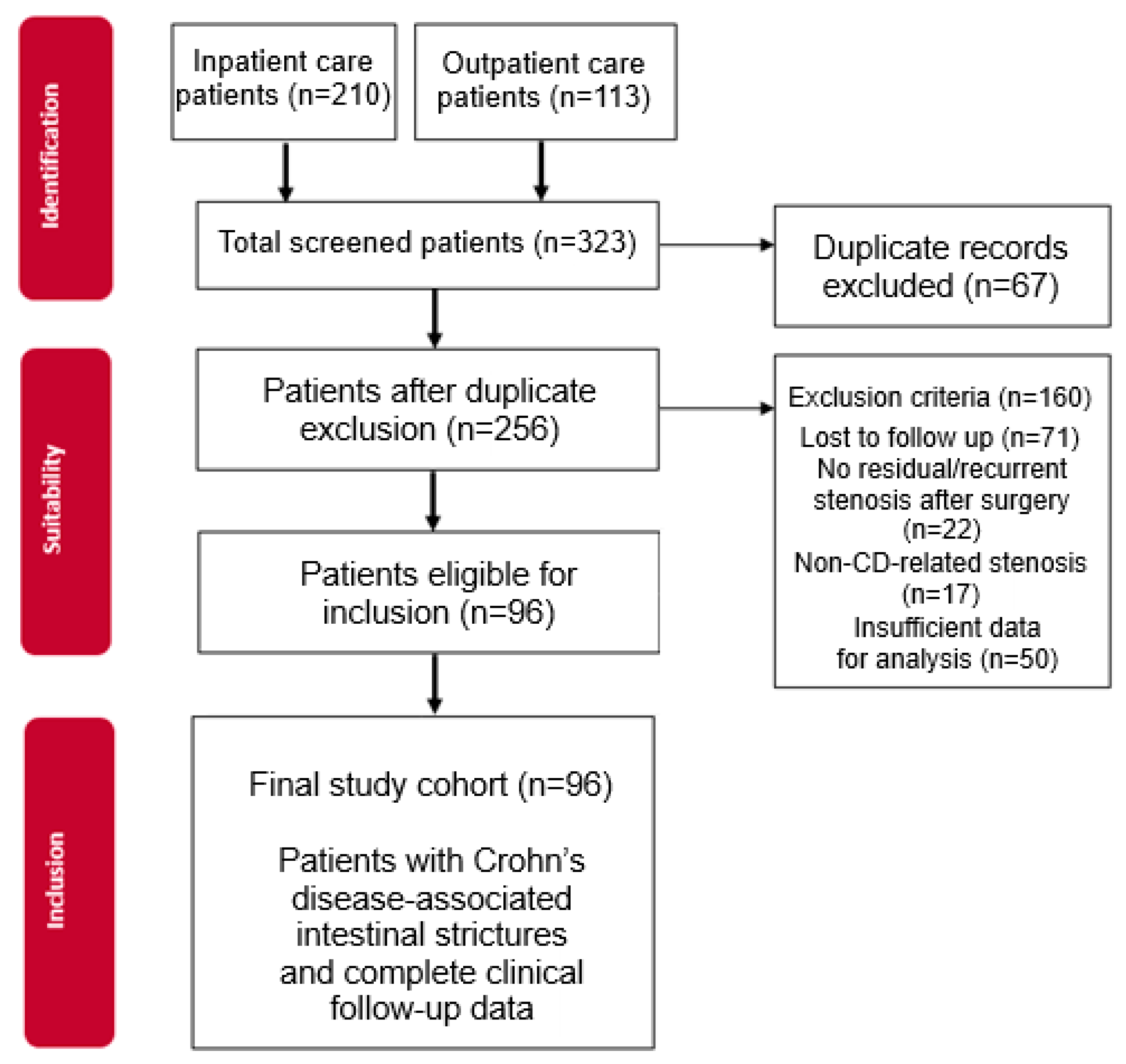
This retrospective cohort study included patients with Crohn’s disease-associated intestinal strictures who were treated at a tertiary referral center between 2014 and 2024. Patients were identified through retrospective screening of institutional electronic medical records, endoscopy reports, radiological databases, and discharge documentation at the University Hospital Tübingen between 2014 and 2024. Initially, all patients with a documented diagnosis of Crohn’s disease and suspected intestinal strictures were screened. Intestinal strictures were defined as persistent luminal narrowing with associated prestenotic dilatation, obstructive symptoms, and/or impaired endoscopic passage documented on endoscopy or cross-sectional imaging, including magnetic resonance enterography (MRE), computed tomography (CT), or intestinal ultrasound. In cases where both endoscopic and radiological data were available, classification was based on the overall clinical assessment documented in the medical records. Patients were excluded if no confirmed intestinal stricture was documented on endoscopy or cross-sectional imaging, if the diagnosis of Crohn’s disease could not be confirmed based on established clinical, radiological, endoscopic, and histopathological criteria, or if clinical data were incomplete. After application of the inclusion and exclusion criteria, 96 patients with confirmed Crohn’s disease-associated intestinal strictures were included in the final analysis. A flow chart illustrating patient selection is provided in Figure 1. Patients without evidence of intestinal strictures or with insufficient clinical data were excluded.

2.2. Data Collection

Clinical, demographic, and treatment-related data were extracted from electronic medical records. The following variables were recorded:
  • Demographic data: age, sex, body mass index (BMI);
  • Disease characteristics: disease duration, disease location, presence of rectal and ileal stenosis;
  • Complications: perianal disease, perianal fistulas, intestinal fistulas, abscess formation;
  • Extraintestinal manifestations (EIMs) and autoimmune diseases;
  • Surgical history: intestinal resection, appendectomy;
  • Imaging findings: hepatic steatosis, cholecystolithiasis;
  • Treatment variables: biologic therapy, number of biologics, specific agents (e.g., infliximab);
  • Lifestyle factors: smoking status.
Extraintestinal manifestations (EIMs) included musculoskeletal, dermatologic, ophthalmologic, and hepatobiliary manifestations documented in the electronic medical records according to established clinical criteria. Autoimmune diseases were defined based on documented physician diagnoses recorded in the institutional medical records and included autoimmune hepatobiliary diseases such as autoimmune hepatitis (AIH), primary biliary cholangitis (PBC), primary sclerosing cholangitis (PSC), and autoimmune pancreatitis (AIP), as well as autoimmune thyroiditis and selected rheumatologic/systemic autoimmune disorders, including rheumatoid arthritis, ankylosing spondylitis, psoriatic arthritis, systemic lupus erythematosus, and Sjögren syndrome. Hepatic steatosis and cholecystolithiasis were assessed based on imaging findings (ultrasound, CT, or MRI). A multivariate model was constructed to assess factors associated with perianal fistulizing disease. Variables included other manifestations of penetrating disease, including intestinal fistulas and abscess formation. Intestinal ulceration was defined as endoscopically documented mucosal ulceration in the affected bowel segment.

2.3. Outcomes

The selected exploratory outcomes were chosen to represent clinically relevant systemic, structural, penetrating, behavioral, and metabolic disease domains within stricturing Crohn’s disease. The primary objective of this study was not to identify predictors of stricture development, but rather to explore associations between different phenotypic manifestations within stricturing Crohn’s disease. These domains were selected to capture clinically relevant dimensions of disease heterogeneity frequently encountered in stricturing Crohn’s disease.
The following outcomes were analyzed using separate models:
  • Extraintestinal manifestations (EIMs);
  • Smoking status;
  • Perianal fistulas;
  • Hepatic steatosis;
  • Stenosis location (rectal and ileal stenosis);
  • Abscess formation.

2.4. Statistical Analysis

Continuous variables are presented as mean ± standard deviation (SD) or median with interquartile range (IQR), depending on data distribution. Categorical variables are expressed as absolute numbers and percentages.
For univariate analyses, comparisons between groups were performed using the chi-square test or Fisher’s exact test for categorical variables, and Student’s t-test or Mann–Whitney U test for continuous variables, as appropriate.
The multivariable analyses were designed as exploratory phenotype-oriented models rather than predictive risk models. Separate regression models were constructed to evaluate clinically relevant systemic, structural, penetrating, behavioral, and metabolic disease domains within stricturing Crohn’s disease. Variables with a p-value < 0.10 in univariate analysis and variables considered clinically relevant were included in the multivariable models. Variable selection was based on clinical relevance, biological plausibility, and statistical significance in univariate analyses. Results of logistic regression analyses are reported as odds ratios (OR) with 95% confidence intervals (CI) and corresponding p-values. To reduce excessive model complexity, the number of variables included in each model was restricted relative to the number of outcome events. Missing data were handled by case-wise exclusion, resulting in minor variations in sample size across analyses.
Given the limited sample size and event numbers in several subgroup analyses, the multivariable analyses should be interpreted cautiously. The models were exploratory and hypothesis-generating, and formal model stability analyses were not performed.

2.5. Ethical Considerations

The study was conducted in accordance with the Declaration of Helsinki and was approved by the local ethics committee (245/2023BO2). Due to the retrospective design, the requirement for informed consent was waived.

3. Results

3.1. Patient Characteristics and Univariate Analysis According to EIM and Smoking Status

A total of 96 patients with Crohn’s disease-associated intestinal strictures were included. Baseline characteristics and univariate comparisons according to extraintestinal manifestations (EIMs) and smoking status are presented in Table 1.
The cohort demonstrated a heterogeneous clinical profile, with a mean age of 60.6 ± 13.1 years and a female proportion of 45.8%. A high prevalence of complicated disease behavior was observed, including perianal disease (48.3%), fistulizing complications, and prior intestinal surgery. Patients with EIMs differed significantly from those without EIMs in several aspects. Female sex was more frequent among patients with EIMs (58.5% vs. 36.4%, p = 0.039). In addition, perianal disease was significantly more prevalent in patients with EIMs (59.2% vs. 34.2%, p = 0.030). Rectal stenosis was significantly less frequent in patients with EIMs (2.4% vs. 23.6%, p = 0.003). Autoimmune diseases were markedly more frequent in patients with EIMs (22.0% vs. 3.6%, p = 0.008).
Therapy-related variables also differed significantly. Patients with EIMs were more likely to receive biologic therapy (65.9% vs. 43.6%, p = 0.039) and to have been exposed to multiple biologics (46.3% vs. 23.6%, p = 0.028). Regarding smoking status, significant differences were observed for sex distribution, with a higher proportion of males among smokers (p = 0.039). Anastomotic stenosis was significantly more frequent in smokers (70.8% vs. 43.8%, p = 0.020).

3.2. Univariate Analysis According to Hepatic Steatosis and Fistulizing Disease

As shown in Table 2, patients with hepatic steatosis demonstrated a trend toward higher age (63.3 ± 12.4 vs. 58.9 ± 13.3 years, p = 0.089). Significant associations were observed for intestinal fistulas (48.6% vs. 19.7%, p = 0.005) and perianal fistulas (74.3% vs. 42.9%, p = 0.025). In addition, ileal stenosis was more common in patients with steatosis (82.9% vs. 62.3%, p = 0.040). Cholecystolithiasis was strongly associated with hepatic steatosis (25.7% vs. 3.3%, p = 0.002). Fistulizing disease was associated with perianal disease, abscess formation, intestinal fistulas, and longer disease duration in univariate analyses. Perianal disease was markedly more frequent in patients with fistulas (72.7% vs. 23.3%, p < 0.001). Similarly, abscess formation was significantly associated with fistulas (81.0% vs. 31.4%, p < 0.001), as were intestinal fistulas (45.8% vs. 14.6%, p = 0.002). Furthermore, longer disease duration (>10 years) was significantly associated with fistula presence (70.8% vs. 43.8%, p = 0.013).

3.3. Univariate Analysis According to Stenosis Location

Table 3 summarizes univariate comparisons according to rectal and ileal stenosis. Rectal stenosis was associated with higher frequencies of perianal disease, perianal fistulas, and abscess formation. Patients with rectal stenosis more frequently had perianal disease (84.6% vs. 41.9%, p = 0.006), perianal fistulas (64.3% vs. 31.7%, p = 0.033), and abscess formation (78.6% vs. 41.5%, p = 0.018). In addition, EIMs were significantly less frequent in patients with rectal stenosis (7.1% vs. 48.8%, p = 0.003). Ileal stenosis was associated with female sex (53.7% vs. 27.6%, p = 0.025) and biologic therapy (61.2% vs. 34.5%, p = 0.025). Hepatic steatosis was also more frequent in patients with ileal stenosis (43.9% vs. 20.7%, p = 0.040).

3.4. Univariate Analysis According to Abscess Formation

Univariate comparisons according to abscess formation are presented in Table 4. Abscesses were strongly associated with perianal disease (78.6% vs. 15.6%, p < 0.001), fistulizing disease (97.1% vs. 29.6%, p < 0.001), and intestinal fistulas (46.7% vs. 15.6%, p = 0.007). Perianal fistulas were also significantly more frequent in patients with abscesses (62.2% vs. 15.6%, p < 0.001). Rectal stenosis was significantly associated with abscess formation (24.4% vs. 3.1%, p = 0.012). Infliximab exposure was more frequent among patients with abscess formation (33.3% vs. 9.4%, p = 0.016).

3.5. Exploratory Multivariate Analysis of Systemic Disease Manifestations

To further characterize systemic disease manifestations within stricturing Crohn’s disease, exploratory multivariable analysis of extraintestinal manifestations (EIMs) was performed. Exploratory multivariable regression analysis was performed to evaluate associations between systemic disease manifestations and clinical disease characteristics within stricturing Crohn’s disease (Table 5). The model included clinically relevant variables identified in univariate analyses and suggested several associations within the exploratory model. Female sex remained associated within the exploratory model with EIMs after multivariable adjustment (OR 4.63, 95% CI 1.04–20.63, p = 0.044). Autoimmune disease remained associated with EIMs after multivariable adjustment, although the wide confidence intervals likely reflect the limited event numbers (OR 23.5, 95% CI 1.02–567.6, p = 0.049). In contrast, rectal stenosis remained inversely associated with EIMs after adjustment, with lower odds of EIMs (OR 0.08, 95% CI 0.01–0.90, p = 0.041). Furthermore, exposure to multiple biologic therapies was associated with EIMs (OR 20.11, 95% CI 1.21–334.3, p = 0.036). Perianal disease did not retain statistical significance in the multivariate model. Given the wide confidence intervals and limited event numbers, these exploratory associations should be interpreted cautiously.

3.6. Exploratory Multivariate Analysis of Smoking-Associated Phenotypes

Multivariate analysis for smoking status identified both demographic and structural variables associated with smoking behavior (Table 6). Female sex remained associated with lower odds of smoking (OR 0.35, 95% CI 0.13–0.93, p = 0.036). In contrast, anastomotic stenosis was associated with smoking (OR 3.16, 95% CI 1.17–8.53, p = 0.023). Cholecystolithiasis showed a trend toward association with smoking (OR 3.22, 95% CI 0.89–11.67, p = 0.076), although this did not reach statistical significance.

3.7. Exploratory Multivariate Analysis of Penetrating Disease Manifestations

To further characterize penetrating disease behavior within the cohort, exploratory analyses of intestinal and perianal fistulas were conducted. Exploratory multivariable regression analysis was performed to evaluate clustering patterns among penetrating disease manifestations within stricturing Crohn’s disease (Table 7). Intestinal fistulas remained associated with perianal fistulas within the exploratory model after multivariable adjustment (OR 11.82, 95% CI 2.96–47.21, p < 0.001). Likewise, abscess formation remained associated with perianal fistulas within the exploratory model (OR 19.54, 95% CI 4.63–82.51, p < 0.001). In contrast, disease duration >10 years was inversely associated with perianal fistulas (OR 0.24, 95% CI 0.07–0.78, p = 0.018). Other variables included in the model did not retain statistical significance after adjustment. Despite statistically significant associations, the exploratory nature of the analyses and limited event numbers warrant cautious interpretation.

3.8. Exploratory Multivariate Analysis of Metabolic and Hepatobiliary Manifestations

To evaluate metabolic and hepatobiliary disease domains within stricturing Crohn’s disease, exploratory multivariable analysis of hepatic steatosis was performed. Exploratory multivariable regression analysis was performed to evaluate associations between metabolic and hepatobiliary manifestations and clinical disease characteristics within stricturing Crohn’s disease (Table 8). Intestinal fistulas remained associated with hepatic steatosis after multivariable adjustment (OR 28.91, 95% CI 1.94–431.4, p = 0.015). Prior intestinal resection was also associated with hepatic steatosis (OR 26.88, 95% CI 1.02–709.0, p = 0.049), as was appendectomy (OR 17.43, 95% CI 1.31–231.8, p = 0.030). Other variables included in the model did not remain statistically significant after adjustment. Given the wide confidence intervals and limited event numbers, these findings should be interpreted cautiously within the exploratory framework of the present analyses.

3.9. Exploratory Multivariate Analysis of Stenosis Localization Patterns

Multivariate logistic regression analyses were performed to identify independent factors associated with rectal and ileal stenosis (Table 9). For rectal stenosis, ileal stenosis was associated with a significantly lower likelihood of rectal involvement (OR 0.18, 95% CI 0.04–0.82, p = 0.027). Extraintestinal manifestations (EIMs) were not significantly associated with rectal stenosis (OR 0.18, 95% CI 0.02–1.67, p = 0.180).
A positive, but not statistically significant association was observed for abscess formation (OR 7.56, 95% CI 0.73–78.80, p = 0.091). Perianal fistulas did not seem to be associated with rectal stenosis (OR 1.77, 95% CI 0.33–9.55, p = 0.506).
For ileal stenosis, female sex was associated with increased odds, reaching borderline statistical significance (OR 2.84, 95% CI 1.02–8.17, p = 0.050). In contrast, rectal stenosis remained inversely associated with ileal stenosis after adjustment (OR 0.17, 95% CI 0.04–0.64, p = 0.009). Biologic therapy showed a positive but non-significant association with ileal stenosis (OR 2.63, 95% CI 0.95–7.28, p = 0.063). Similarly, hepatic steatosis demonstrated a positive trend (OR 2.61, 95% CI 0.87–7.77, p = 0.086), although neither reached statistical significance after adjustment. The observed associations should be interpreted cautiously due to limited subgroup sizes and statistical uncertainty.

3.10. Exploratory Multivariate Analysis of Abscess-Associated Disease Manifestations

Multivariate logistic regression analysis identified several independent factors associated with abscess formation (Table 10). Perianal disease remained associated with abscess formation, demonstrating a markedly increased odds (OR 30.18, 95% CI 2.55–356.7, p = 0.007). Similarly, the presence of any fistula was associated with abscess formation (OR 27.30, 95% CI 1.40–533.3, p = 0.029). Body mass index (BMI > 25 kg/m2) was also associated with abscess formation (OR 23.69, 95% CI 1.23–454.9, p = 0.036). In contrast, infliximab therapy was not associated with abscess formation (OR 1.11, 95% CI 0.12–10.57, p = 0.931). Perianal disease, any fistula, and BMI > 25 kg/m2 remained associated with abscess formation after multivariable adjustment. The wide confidence intervals may reflect the limited number of events and should be interpreted with caution.

4. Discussion

In this retrospective cohort study of patients with Crohn’s disease-associated intestinal strictures, we demonstrate that stricturing disease represents a highly heterogeneous and multifactorial clinical phenotype. Our findings highlight that systemic immune activity, structural complications, behavioral factors, and metabolic alterations interact in a complex manner and contribute to disease expression in distinct but overlapping ways. Intestinal strictures are a major complication of Crohn’s disease, occurring in up to one-third of patients during the disease course and frequently leading to repeated interventions and surgery [31,32]. The pathogenesis of stricture formation is driven by chronic and recurrent inflammation, which induces progressive tissue remodeling characterized by fibroblast activation, extracellular matrix deposition, and smooth muscle cell hyperplasia [32,33]. Importantly, accumulating evidence suggests that fibrotic processes may become partially independent of active inflammation, which explains why anti-inflammatory therapies are often insufficient to prevent or reverse established strictures [32,34]. This concept is particularly relevant when interpreting our findings, as several associations may reflect chronic disease burden rather than acute inflammatory activity.
A central observation of our study is the marked heterogeneity within the stricturing Crohn’s disease population. This aligns with current concepts that Crohn’s disease should be understood as a spectrum of disease phenotypes rather than a single entity [35]. Strictures frequently contain a mixture of inflammatory, fibrotic, and muscular components, as well as the gut microbiota, and their clinical presentation depends on the relative contribution of these processes, which can be detected using MRI or CT enterography [23,36,37].
The inverse association between rectal and ileal stenosis observed in our analysis suggests that disease localization may reflect distinct pathogenic pathways. Previous studies have demonstrated that disease behavior evolves over time and is influenced by genetic susceptibility, environmental factors, and immune responses [35,38]. Our findings are consistent with the hypothesis that stricturing disease is not uniform but consists of location-specific phenotypes with potentially different underlying mechanisms.
Extraintestinal manifestations (EIMs) represent an important component of Crohn’s disease and are reported in up to 40% of patients [39,40]. They are thought to arise from shared immunological pathways between intestinal and extraintestinal tissues, including dysregulated T-cell responses and cytokine signaling [41]. In our cohort, EIMs were associated with autoimmune comorbidities and exposure to multiple biologic therapies, suggesting that they may reflect a subgroup of patients with more severe and systemic disease. This is consistent with previous studies demonstrating that patients with EIMs have a more complicated disease course and are more likely to require treatment escalation [39]. The association between EIMs and systemic immune activation is consistent with the concept of Crohn’s disease as a systemic inflammatory disorder rather than a purely intestinal disease. Interestingly, we observed no strong association between EIMs and certain localized structural features, suggesting that systemic immune activity and local fibrostenotic processes may be partially dissociated.
Smoking is one of the most consistently identified environmental risk factors influencing Crohn’s disease progression. It has been associated with increased disease activity, higher rates of relapse, and a greater need for surgery [4,41]. In our study, smoking was independently associated with anastomotic stenosis, indicating a potential role in postoperative disease recurrence and impaired healing. Mechanistically, smoking affects mucosal immunity, alters cytokine profiles, and influences the intestinal microbiome [41]. These effects may promote both inflammation and fibrosis, thereby contributing to structural complications. The inverse association with female sex observed in our cohort may reflect epidemiological differences in smoking behavior rather than biological effects.
The strong association between fistulas and abscess formation observed in our study underscores the close relationship between penetrating disease behavior and septic complications. These findings are consistent with the concept that stricturing and penetrating disease represent overlapping rather than distinct phenotypes [35,42]. Transmural inflammation plays a central role in the development of fistulas and abscesses, leading to tissue destruction and abnormal connections between intestinal segments or adjacent structures [42]. The observed association between infliximab exposure and abscess formation should be interpreted cautiously, as treatment exposure was assessed retrospectively and may reflect confounding by indication rather than a causal relationship. Infliximab therapy may have been initiated after adequate infection control or in patients with previously treated fistulizing disease. The coexistence of fistulizing and stricturing features in our cohort is consistent with the concept of advanced disease characterized by cumulative structural damage. These findings highlight that different manifestations of penetrating Crohn’s disease frequently co-occur, supporting the concept of a shared underlying pathophysiological mechanism. An important and increasingly recognized aspect of Crohn’s disease is the interaction between metabolic factors and inflammatory pathways. In our study, hepatic steatosis was associated with markers of disease severity, including prior surgery. Hepatic steatosis has been reported in up to 40% of patients with inflammatory bowel disease and may be related to chronic inflammation, altered lipid metabolism, and changes in the gut–liver axis [25,43]. Mesenteric adipose tissue, often referred to as “creeping fat,” plays an active role in Crohn’s disease by secreting pro-inflammatory cytokines and adipokines, thereby contributing to both inflammation and fibrosis [44]. Our findings are consistent with the hypothesis that metabolic alterations are not merely comorbidities but may be integrated into the pathophysiology of fibrostenotic disease.
The exploratory associations observed between hepatic steatosis and selected disease characteristics may reflect the complex interplay between chronic systemic inflammation, cumulative disease burden, intestinal surgery, nutritional alterations, and metabolic dysregulation in Crohn’s disease. Previous studies have demonstrated an increased prevalence of NAFLD and hepatobiliary manifestations in patients with inflammatory bowel disease, particularly Crohn’s disease [25,26,27]. Moreover, disease severity, bowel surgery, and inflammatory burden have previously been associated with hepatic steatosis in IBD cohorts [45,46]. However, data specifically addressing metabolic and hepatobiliary alterations in stricturing Crohn’s disease phenotypes remain limited. Therefore, these findings should primarily be interpreted as exploratory and hypothesis-generating.
The accurate characterization of intestinal strictures remains a major challenge in clinical practice. Endoscopy provides limited information on transmural disease, whereas cross-sectional imaging modalities such as magnetic resonance enterography (MRE) and computed tomography enterography (CTE) allow assessment of bowel wall thickness, enhancement patterns, and extramural complications [13,36].
However, distinguishing between inflammatory and fibrotic components remains difficult, particularly in mixed lesions [36,47]. This limitation has important therapeutic implications, as treatment strategies differ significantly between inflammatory and fibrotic strictures. Emerging imaging techniques and artificial intelligence-based approaches may improve diagnostic accuracy in the future, but further validation is needed. The management of stricturing Crohn’s disease remains challenging and often requires a multidisciplinary approach [48]. While biologic therapies are effective in controlling inflammation, their impact on established fibrosis is limited [49,50]. This may be reflected in the high rates of progression to endoscopic or surgical intervention in patients with strictures. Endoscopic balloon dilation represents an effective bowel-sparing option for selected patients with short and accessible strictures, although recurrence rates remain substantial [35,51]. Surgical resection continues to play a central role in the management of fibrostenotic disease, but is associated with postoperative recurrence and cumulative bowel damage [52]. Recent advances in understanding the molecular mechanisms of fibrosis have identified potential targets for antifibrotic therapies, including pathways involved in fibroblast activation and extracellular matrix remodeling [23,53]. These approaches may represent a promising future direction for the treatment of stricturing Crohn’s disease.
Recent studies increasingly emphasize that fibrostenotic Crohn’s disease represents a heterogeneous and dynamic disease spectrum characterized by varying contributions of chronic inflammation, intestinal fibrosis, penetrating complications, systemic inflammatory manifestations, and metabolic comorbidities. Emerging concepts of phenotype-oriented disease stratification suggest that stricturing Crohn’s disease should no longer be considered a uniform fibrostenotic entity, but rather a multidimensional phenotype with substantial interindividual variability regarding disease behavior, progression, and therapeutic response [48,54]. In this context, the exploratory associations observed in the present study may support the concept of partially overlapping systemic, structural, penetrating, behavioral, and metabolic disease domains within stricturing Crohn’s disease. Recent advances in cross-sectional imaging, fibrosis assessment, and precision medicine approaches further highlight the importance of integrated phenotypic characterization to improve individualized therapeutic decision-making and risk stratification in Crohn’s disease [55]. However, despite increasing recognition of fibrostenotic heterogeneity, clinically validated biomarkers and standardized fibrosis-oriented phenotyping strategies remain limited. Therefore, prospective multicenter studies integrating clinical, imaging, molecular, and translational fibrosis markers are required to better define clinically meaningful fibrostenotic phenotypes and to support future phenotype-oriented management strategies in Crohn’s disease.
Taken together, these findings emphasize that stricturing Crohn’s disease should not be regarded as a uniform disease entity but rather as a multidimensional phenotype requiring individualized diagnostic and therapeutic strategies.
Taken together, the exploratory analyses performed in this study suggest that stricturing Crohn’s disease represents a multidimensional and clinically heterogeneous disease phenotype characterized by overlapping systemic, penetrating, behavioral, structural, and metabolic manifestations. Rather than representing isolated disease domains, these phenotypic patterns may interact within complex clinical trajectories of stricturing Crohn’s disease.
This study has several limitations. First, this was a retrospective single-center cohort study with a relatively limited sample size, which restricts the generalizability of the findings and increases the risk of selection bias. Second, the absence of a non-stricturing Crohn’s disease control cohort limits the ability to investigate predictors specifically associated with stricture development. Third, several exploratory multivariable analyses were performed despite limited event numbers in some subgroup analyses, increasing the possibility of overfitting and model instability. The wide confidence intervals observed in several regression models may further reflect the exploratory nature of the analyses and require cautious interpretation. In addition, missing data resulted in minor variations in sample size across analyses. Finally, the observational design does not permit causal inference. Future prospective multicenter studies with larger cohorts are required to validate these exploratory findings and further investigate phenotype heterogeneity in stricturing Crohn’s disease.

5. Conclusions

In conclusion, stricturing Crohn’s disease represents a heterogeneous and multifactorial phenotype characterized by complex interactions between systemic immune activity, structural complications, behavioral factors, and metabolic alterations. Our findings are consistent with a phenotype-driven approach to disease characterization and highlight the need for improved diagnostic tools and targeted antifibrotic therapies to optimize patient management.

Author Contributions

Conceptualization, S.F. and C.R.W.; methodology, S.F. and J.N.; software, S.F.; validation, S.F. and L.M.; formal analysis, S.F., L.M. and C.R.W.; investigation, S.F., J.N. and C.R.W.; resources, C.R.W.; data curation, S.F., J.N. and C.R.W.; writing—original draft preparation, S.F., J.N., L.M., S.G. and C.R.W.; writing—review and editing, S.F., S.G., N.P.M. and C.R.W.; visualization, S.F. and J.N.; supervision, S.F., N.P.M. and C.R.W.; project administration, S.F. and N.P.M.; All authors have read and agreed to the published version of the manuscript.

Funding

This research received no external funding.

Institutional Review Board Statement

The study was conducted in accordance with the Declaration of Helsinki and was approved by the Ethics Committee of University Hospital Tübingen (protocol code: 407/2017BO2; date of approval: 22 October 2017).

Informed Consent Statement

As the study is retrospective and all patient data has been pseudonymised, the ethics committee has determined that retrospective patient consent is not required.

Data Availability Statement

The data presented in this study are available on request from the corresponding author. The data are not publicly available due to privacy and ethical restrictions.

Acknowledgments

We thank everyone who contributed to this publication. We acknowledge support from the Open Access Publication Fund of the University of Tübingen. The authors have reviewed and edited the output and take full responsibility for the content of this publication.

Conflicts of Interest

The authors declare no conflicts of interest.

Abbreviations

The following abbreviations are used in this manuscript:
BMIBody mass index
CDCrohn’s disease
CIConfidence interval
CTEComputed tomography enterography
EIMsExtraintestinal manifestations
IBDInflammatory bowel disease
MREMagnetic resonance enterography
OROdds ratio

References

  1. Lin, X.; Wang, Y.; Liu, Z.; Lin, S.; Tan, J.; He, J.; Hu, F.; Wu, X.; Ghosh, S.; Chen, M.; et al. Intestinal strictures in Crohn’s disease: A 2021 update. Ther. Adv. Gastroenterol. 2022, 15, 17562848221104951. [Google Scholar] [CrossRef]
  2. Lenti, M.V.; Santacroce, G.; Broglio, G.; Rossi, C.M.; Di Sabatino, A. Recent advances in intestinal fibrosis. Mol. Asp. Med. 2024, 96, 101251. [Google Scholar] [CrossRef]
  3. Thia, K.T.; Sandborn, W.J.; Harmsen, W.S.; Zinsmeister, A.R.; Loftus, E.V., Jr. Risk factors associated with progression to intestinal complications of Crohn’s disease in a population-based cohort. Gastroenterology 2010, 139, 1147–1155. [Google Scholar] [CrossRef]
  4. Cosnes, J.; Gower-Rousseau, C.; Seksik, P.; Cortot, A. Epidemiology and natural history of inflammatory bowel diseases. Gastroenterology 2011, 140, 1785–1794. [Google Scholar] [CrossRef] [PubMed]
  5. Cosnes, J.; Beaugerie, L.; Carbonnel, F.; Gendre, J.P. Smoking cessation and the course of Crohn’s disease: An intervention study. Gastroenterology 2001, 120, 1093–1099. [Google Scholar] [CrossRef]
  6. Watanabe, D.; Kamada, N. Contribution of the Gut Microbiota to Intestinal Fibrosis in Crohn’s Disease. Front. Med. 2022, 9, 826240. [Google Scholar] [CrossRef] [PubMed]
  7. Latella, G.; Rogler, G.; Bamias, G.; Breynaert, C.; Florholmen, J.; Pellino, G.; Reif, S.; Speca, S.; Lawrance, I.C. Results of the 4th scientific workshop of the ECCO (I): Pathophysiology of intestinal fibrosis in IBD. J. Crohn’s Colitis 2014, 8, 1147–1165. [Google Scholar] [CrossRef]
  8. Speca, S.; Giusti, I.; Rieder, F.; Latella, G. Cellular and molecular mechanisms of intestinal fibrosis. World J. Gastroenterol. 2012, 18, 3635–3661. [Google Scholar] [CrossRef] [PubMed]
  9. Malgras, B.; Pautrat, K.; Dray, X.; Pasquier, P.; Valleur, P.; Pocard, M.; Soyer, P. Multidisciplinary management of gastrointestinal fibrotic stenosis in Crohn’s disease. Dig. Dis. Sci. 2015, 60, 1152–1168. [Google Scholar] [CrossRef]
  10. Rieder, F.; Fiocchi, C. Intestinal fibrosis in inflammatory bowel disease—Current knowledge and future perspectives. J. Crohn’s Colitis 2008, 2, 279–290. [Google Scholar] [CrossRef]
  11. Bettenworth, D.; Rieder, F. Medical therapy of stricturing Crohn’s disease: What the gut can learn from other organs—A systematic review. Fibrogenes. Tissue Repair 2014, 7, 5. [Google Scholar] [CrossRef]
  12. Bettenworth, D.; Mucke, M.M.; Lopez, R.; Singh, A.; Zhu, W.; Guo, F.; Matsui, T.; James, T.W.; Herfarth, H.; Goetz, M.; et al. Efficacy of Endoscopic Dilation of Gastroduodenal Crohn’s Disease Strictures: A Systematic Review and Meta-Analysis of Individual Patient Data. Clin. Gastroenterol. Hepatol. 2019, 17, 2514–2522.e8. [Google Scholar] [CrossRef]
  13. Panes, J.; Bouhnik, Y.; Reinisch, W.; Stoker, J.; Taylor, S.A.; Baumgart, D.C.; Danese, S.; Halligan, S.; Marincek, B.; Matos, C.; et al. Imaging techniques for assessment of inflammatory bowel disease: Joint ECCO and ESGAR evidence-based consensus guidelines. J. Crohn’s Colitis 2013, 7, 556–585. [Google Scholar] [CrossRef]
  14. Dal Buono, A.; Faita, F.; Armuzzi, A.; Jairath, V.; Peyrin-Biroulet, L.; Danese, S.; Allocca, M. Assessment of activity and severity of inflammatory bowel disease in cross-sectional imaging techniques: A systematic review. J. Crohn’s Colitis 2025, 19, jjaf023. [Google Scholar] [CrossRef]
  15. Lovett, G.C.; Schulberg, J.D.; Hamilton, A.L.; Wright, E.K.; Sutherland, T.R.; Ross, A.L.; Kamm, M.A. Crohn’s Disease Stricture Response to Treatment Assessed with Magnetic Resonance Imaging and Intestinal Ultrasound: STRIDENT Randomized Trial. Inflamm. Bowel Dis. 2025, 31, 2777–2786. [Google Scholar] [CrossRef]
  16. Hameed, M.; De Kock, I.; Stoker, J.; Taylor, S.A. ESR Essentials: Diagnosis and assessment of treatment response in patients with luminal Crohn’s disease-practice recommendations by the European Society of Gastrointestinal and Abdominal Radiology. Eur. Radiol. 2025, 35, 7484–7496. [Google Scholar] [CrossRef] [PubMed]
  17. Dal Buono, A.; Faita, F.; Peyrin-Biroulet, L.; Danese, S.; Allocca, M. Ultrasound Elastography in Inflammatory Bowel Diseases: A Systematic Review of Accuracy Compared with Histopathological Assessment. J. Crohn’s Colitis 2022, 16, 1637–1646. [Google Scholar] [CrossRef] [PubMed]
  18. Issa, M.T.; Zaman, S.; Mohamedahmed, A.Y.; Hamid, M.; Mostafa, O.; Narayanasamy, S.; Sarma, D.; Peravali, R.; Akingboye, A.; Waterland, P. Management of ileocolic anastomotic strictures in Crohn’s disease: Endoscopic or surgical intervention? A systematic review and meta-analysis. Int. J. Color. Dis. 2025, 40, 162. [Google Scholar] [CrossRef]
  19. Kojima, M.; Miyake, T.; Bamba, S.; Tani, S.; Muramoto, K.; Kaida, S.; Takebayashi, K.; Maehira, H.; Otake, R.; Mori, H.; et al. Risk factors for surgical recurrence and the preventive effect of endoscopic balloon dilatation in postoperative patients with Crohn ‘s disease. BMC Gastroenterol. 2025, 25, 764. [Google Scholar] [CrossRef] [PubMed]
  20. Hong, S.N.; Kim, J.E.; Kim, E.R.; Chang, D.K.; Kim, Y.H. Enteroscopic Balloon Dilation in Small Bowel Stricturing Crohn’s Disease: Long-Term Outcomes and Risk Factors for Surgery in a Single-Center Prospective Observational Study. United Eur. Gastroenterol. J. 2025, 13, 958–970. [Google Scholar] [CrossRef]
  21. Bemelman, W.A.; Warusavitarne, J.; Sampietro, G.M.; Serclova, Z.; Zmora, O.; Luglio, G.; de Buck van Overstraeten, A.; Burke, J.P.; Buskens, C.J.; Colombo, F.; et al. ECCO-ESCP Consensus on Surgery for Crohn’s Disease. J. Crohn’s Colitis 2018, 12, 1–16. [Google Scholar] [CrossRef] [PubMed]
  22. Nasasra, A.; Morrison, T.E.M.; Luberto, A.; Carvello, M.; Williams, K.J.; Davies, J.; Spinelli, A.; Mehta, A.M.; Warusavitarne, J.H. Recurrence rates after strictureplasty for small bowel Crohn’s disease remain high in the era of biologics. Color. Dis. 2024, 27, e17224. [Google Scholar] [CrossRef]
  23. Fousekis, F.S.; Mpakogiannis, K.; Mastorogianni, I.N.; Lianos, G.D.; Christodoulou, D.K.; Katsanos, K.H. Intestinal Fibrosis in Crohn’s Disease: Pathophysiology, Diagnosis, and New Therapeutic Targets. J. Clin. Med. 2025, 14, 4060. [Google Scholar] [CrossRef]
  24. Feagan, B.G.; Sands, B.E.; Siegel, C.A.; Dubinsky, M.C.; Longman, R.S.; Sabino, J.; Laurent, O.; Luo, A.; Lu, J.; Nguyen, D.D.; et al. Safety and efficacy of the anti-TL1A monoclonal antibody tulisokibart for Crohn’s disease: A phase 2a induction trial. Lancet Gastroenterol. Hepatol. 2025, 10, 715–725. [Google Scholar] [CrossRef]
  25. Principi, M.; Iannone, A.; Losurdo, G.; Mangia, M.; Shahini, E.; Albano, F.; Rizzi, S.F.; La Fortezza, R.F.; Lovero, R.; Contaldo, A.; et al. Nonalcoholic Fatty Liver Disease in Inflammatory Bowel Disease: Prevalence and Risk Factors. Inflamm. Bowel Dis. 2018, 24, 1589–1596. [Google Scholar] [CrossRef]
  26. Maresca, R.; Mignini, I.; Varca, S.; Calvez, V.; Termite, F.; Esposto, G.; Laterza, L.; Scaldaferri, F.; Ainora, M.E.; Gasbarrini, A.; et al. Inflammatory Bowel Diseases and Non-Alcoholic Fatty Liver Disease: Piecing a Complex Puzzle Together. Int. J. Mol. Sci. 2024, 25, 3278. [Google Scholar] [CrossRef]
  27. Chao, C.Y.; Battat, R.; Al Khoury, A.; Restellini, S.; Sebastiani, G.; Bessissow, T. Co-existence of non-alcoholic fatty liver disease and inflammatory bowel disease: A review article. World J. Gastroenterol. 2016, 22, 7727–7734. [Google Scholar] [CrossRef]
  28. Rieder, F.; Zimmermann, E.M.; Remzi, F.H.; Sandborn, W.J. Crohn’s disease complicated by strictures: A systematic review. Gut 2013, 62, 1072–1084. [Google Scholar] [CrossRef] [PubMed]
  29. Yoo, J.H.; Holubar, S.; Rieder, F. Fibrostenotic strictures in Crohn’s disease. Intest. Res. 2020, 18, 379–401. [Google Scholar] [CrossRef]
  30. Li, J.; Mao, R.; Kurada, S.; Wang, J.; Lin, S.; Chandra, J.; Rieder, F. Pathogenesis of fibrostenosing Crohn’s disease. Transl. Res. 2019, 209, 39–54. [Google Scholar] [CrossRef] [PubMed]
  31. Torres, J.; Mehandru, S.; Colombel, J.F.; Peyrin-Biroulet, L. Crohn’s disease. Lancet 2017, 389, 1741–1755. [Google Scholar] [CrossRef]
  32. Rieder, F.; Fiocchi, C.; Rogler, G. Mechanisms, Management, and Treatment of Fibrosis in Patients With Inflammatory Bowel Diseases. Gastroenterology 2017, 152, 340–350.e6. [Google Scholar] [CrossRef] [PubMed]
  33. Latella, G.; Di Gregorio, J.; Flati, V.; Rieder, F.; Lawrance, I.C. Mechanisms of initiation and progression of intestinal fibrosis in IBD. Scand. J. Gastroenterol. 2015, 50, 53–65. [Google Scholar] [CrossRef] [PubMed]
  34. D’Haens, G.; Rieder, F.; Feagan, B.G.; Higgins, P.D.R.; Panes, J.; Maaser, C.; Rogler, G.; Lowenberg, M.; van der Voort, R.; Pinzani, M.; et al. Challenges in the Pathophysiology, Diagnosis, and Management of Intestinal Fibrosis in Inflammatory Bowel Disease. Gastroenterology 2022, 162, 26–31. [Google Scholar] [CrossRef] [PubMed]
  35. Bettenworth, D.; Bokemeyer, A.; Baker, M.; Mao, R.; Parker, C.E.; Nguyen, T.; Ma, C.; Panes, J.; Rimola, J.; Fletcher, J.G.; et al. Assessment of Crohn’s disease-associated small bowel strictures and fibrosis on cross-sectional imaging: A systematic review. Gut 2019, 68, 1115–1126. [Google Scholar] [CrossRef]
  36. Rimola, J.; Planell, N.; Rodriguez, S.; Delgado, S.; Ordas, I.; Ramirez-Morros, A.; Ayuso, C.; Aceituno, M.; Ricart, E.; Jauregui-Amezaga, A.; et al. Characterization of inflammation and fibrosis in Crohn’s disease lesions by magnetic resonance imaging. Am. J. Gastroenterol. 2015, 110, 432–440. [Google Scholar] [CrossRef]
  37. Rieder, F.; Ma, C.; Hanzel, J.; Fletcher, J.G.; Baker, M.E.; Wang, Z.; Guizzetti, L.; Shackelton, L.M.; Remillard, J.; Patel, M.; et al. Reliability of CT Enterography for Describing Fibrostenosing Crohn Disease. Radiology 2024, 312, e233038. [Google Scholar] [CrossRef]
  38. Louis, E.; Collard, A.; Oger, A.F.; Degroote, E.; Aboul Nasr El Yafi, F.A.; Belaiche, J. Behaviour of Crohn’s disease according to the Vienna classification: Changing pattern over the course of the disease. Gut 2001, 49, 777–782. [Google Scholar] [CrossRef]
  39. Vavricka, S.R.; Schoepfer, A.; Scharl, M.; Lakatos, P.L.; Navarini, A.; Rogler, G. Extraintestinal Manifestations of Inflammatory Bowel Disease. Inflamm. Bowel Dis. 2015, 21, 1982–1992. [Google Scholar] [CrossRef]
  40. Harbord, M.; Annese, V.; Vavricka, S.R.; Allez, M.; Barreiro-de Acosta, M.; Boberg, K.M.; Burisch, J.; De Vos, M.; De Vries, A.M.; Dick, A.D.; et al. The First European Evidence-based Consensus on Extra-intestinal Manifestations in Inflammatory Bowel Disease. J. Crohn’s Colitis 2016, 10, 239–254. [Google Scholar] [CrossRef]
  41. Berkowitz, L.; Schultz, B.M.; Salazar, G.A.; Pardo-Roa, C.; Sebastian, V.P.; Alvarez-Lobos, M.M.; Bueno, S.M. Impact of Cigarette Smoking on the Gastrointestinal Tract Inflammation: Opposing Effects in Crohn’s Disease and Ulcerative Colitis. Front. Immunol. 2018, 9, 74. [Google Scholar] [CrossRef] [PubMed]
  42. Gecse, K.B.; Bemelman, W.; Kamm, M.A.; Stoker, J.; Khanna, R.; Ng, S.C.; Panes, J.; van Assche, G.; Liu, Z.; Hart, A.; et al. A global consensus on the classification, diagnosis and multidisciplinary treatment of perianal fistulising Crohn’s disease. Gut 2014, 63, 1381–1392. [Google Scholar] [CrossRef]
  43. Lopes, M.A.; Oliveira, E.C.S.; Quaglio, A.E.V.; Santos, A.; Imbrizi, M.; Mendes, L.E.R.; Beraldo, R.F.; Baima, J.P.; Spiller, A.L.; Magro, D.O.; et al. From gut to liver: Exploring the relationship between inflammatory bowel disease and metabolic dysfunction-associated steatotic liver disease. World J. Hepatol. 2025, 17, 109035. [Google Scholar] [CrossRef]
  44. Kredel, L.; Batra, A.; Siegmund, B. Role of fat and adipokines in intestinal inflammation. Curr. Opin. Gastroenterol. 2014, 30, 559–565. [Google Scholar] [CrossRef]
  45. Kodali, A.; Okoye, C.; Klein, D.; Mohamoud, I.; Olanisa, O.O.; Parab, P.; Chaudhary, P.; Mukhtar, S.; Moradi, A.; Hamid, P. Crohn’s Disease is a Greater Risk Factor for Nonalcoholic Fatty Liver Disease Compared to Ulcerative Colitis: A Systematic Review. Cureus 2023, 15, e42995. [Google Scholar] [CrossRef] [PubMed]
  46. Sartini, A.; Gitto, S.; Bianchini, M.; Verga, M.C.; Di Girolamo, M.; Bertani, A.; Del Buono, M.; Schepis, F.; Lei, B.; De Maria, N.; et al. Non-alcoholic fatty liver disease phenotypes in patients with inflammatory bowel disease. Cell Death Dis. 2018, 9, 87. [Google Scholar] [CrossRef] [PubMed]
  47. Jauregui-Amezaga, A.; Rimola, J.; Ordas, I.; Rodriguez, S.; Ramirez-Morros, A.; Gallego, M.; Masamunt, M.C.; Llach, J.; Gonzalez-Suarez, B.; Ricart, E.; et al. Value of endoscopy and MRI for predicting intestinal surgery in patients with Crohn’s disease in the era of biologics. Gut 2015, 64, 1397–1402. [Google Scholar] [CrossRef]
  48. Bettenworth, D.; Baker, M.E.; Fletcher, J.G.; Jairath, V.; Lu, C.; Bemelman, W.; d’Haens, G.; d’Hoore, A.; Dignass, A.; Dotan, I.; et al. A global consensus on the definitions, diagnosis and management of fibrostenosing small bowel Crohn’s disease in clinical practice. Nat. Rev. Gastroenterol. Hepatol. 2024, 21, 572–584. [Google Scholar] [CrossRef]
  49. Sleiman, J.; El Ouali, S.; Qazi, T.; Cohen, B.; Steele, S.R.; Baker, M.E.; Rieder, F. Prevention and Treatment of Stricturing Crohn’s Disease—Perspectives and Challenges. Expert. Rev. Gastroenterol. Hepatol. 2021, 15, 401–411. [Google Scholar] [CrossRef]
  50. Wils, P.; Danese, S.; Peyrin-Biroulet, L. Promising phase II biologics for future Crohn’s disease therapy. Expert. Opin. Investig. Drugs 2023, 32, 495–507. [Google Scholar] [CrossRef]
  51. Moond, V.; Gill, V.J.S.; Malik, S.; Kasture, A.; Parajuli, S.; Soni, S.; Chandan, S.; Broder, A.; Mohan, B.P.; Adler, D. Endoscopic dilation of small-intestine strictures in Crohn’s disease by balloon-assisted enteroscopy: A systematic review and meta-analysis. Ann. Gastroenterol. 2024, 37, 682–694. [Google Scholar] [CrossRef]
  52. Del Gaudio, A.; Parisio, L.; Privitera, G.; Cuccia, G.; Coppola, G.; Laterza, L.; Lopetuso, L.R.; Gasbarrini, A.; Carbone, L.; Papa, A.; et al. Prognostic Significance of Different Endoscopic Scores in Post-Operative Crohn’s Disease and their Role in Patients with Low-Risk Features. Adv. Ther. 2026, 43, 1239–1254. [Google Scholar] [CrossRef]
  53. Lovisa, S.; Vetrano, S. TWISTed fibroblasts: New drivers of intestinal fibrosis in Crohn’s disease. Heliyon 2024, 10, e40604. [Google Scholar] [CrossRef]
  54. Jarmakiewicz-Czaja, S.; Gruszecka, J.; Filip, R. The Diagnosis of Intestinal Fibrosis in Crohn’s Disease-Present and Future. Int. J. Mol. Sci. 2024, 25, 6935. [Google Scholar] [CrossRef]
  55. Ananthakrishnan, A.N. Precision medicine in inflammatory bowel diseases. Intest. Res. 2024, 22, 8–14. [Google Scholar] [CrossRef]
Figure 1. Flow chart illustrating patient identification, exclusion criteria, and final cohort selection.
Diagnostics 16 01841 g001
Table 1. Baseline characteristics and univariate comparisons according to extraintestinal manifestations and smoking status.
VariableTotal
(n = 96)
EIMsNo EIMsp ValueTotal
(n = 80)
SmokerNon-Smokerp Value
Age60.6 (±13.1)60.0 (±8.9)61.0 (±15.6)0.71860.5 (±12.9)61.3 (±12.7)59.4 (13.5)0.266
Female sex44 (45.8)24 (58.5)20 (36.4)0.03940 (50.0)19 (39.6)21 (65.6)0.039
BMI (>25 kg/m2)33 (34.4)12 (29.3)21 (38.2)0.39369 (86.3)40 (83.3)29 (90.6)0.511
smoking48 (60.0)23 (62.2)25 (58.1)0.820
EIMs37 (46.3)23 (47.9)14 (43.8)0.820
Perianal disease42 (48.3)13 (34.2)29 (59.2)0.03034 (46.6)22 (50.0)12 (41.4)0.485
Any fistula48 (70.6)20 (64.5)28 (75.7)0.42440 (69.0)24 (68.6)16 (69.6)1.000
Intestinal fistula29 (51.8)15 (65.2)14 (42.4)0.11124 (51.1)15 (51.7)9 (50.0)1.000
Perianal fistula35 (62.5)11 (47.8)24 (72.7)0.09229 (61.7)19 (65.5)10 (55.6)0.548
Abscess45 (58.4)17 (51.5)28 (63.6)0.35239 (48.8)22 (45.8)17 (53.1)0.649
Rectal stenosis
Ileal stenosis
14 (14.6)1 (2.4)13 (23.6)0.0037 (8.8)4 (8.3)3 (9.4)1.000
67 (69.8)30 (73.2)37 (67.3)0.65458 (72.5)34 (70.8)24 (75.0)0.800
Anastomosis stenosis55 (57.3)23 (56.1)32 (58.2)1.00048 (60.0)34 (70.8)14 (43.8)0.020
Inflammatory stenosis8 (8.3)4 (9.8)4 (7.3)0.7207 (8.8)2 (4.2)5 (15.6)0.109
Stenosis > 10 years55 (57.3)22 (53.7)33 (60.0)0.67744 (55.0)27 (56.3)17 (53.1)0.822
Intestinal resection13 (13.5)5 (12.2)8 (14.5)1.00010 (12.5)6 (12.5)4 (12.5)1.000
Appendectomy22 (22.9)12 (29.3)10 (18.2)0.22721 (26.3)13 (27.1)8 (25.0)1.000
Autoimmune disease11 (11.5)9 (22.0)2 (3.6)0.00810 (12.5)6 (12.5)4(12.5)1.000
Biologic therapy1 (53.1)27 (65.9)24 (43.6)0.03945 (56.3)28 (58.3)17 (53.1)0.654
Multiple biologics32 (33.3)19 (46.3)13 (23.6)0.02827 (33.8)14 (29.2)13 (40.6)0.339
Ustekinumab24 (25.0)14 (34.1)10 (18.2)0.09622 (27.5)13 (27.1)9 (28.1)1.000
Infliximab26 (27.4)14 (35.0)12 (21.8)0.17021 (26.6)15 (31.9)6 (18.8)0.299
Adalimumab32 (33.3)18 (43.9)14 (25.5)0.08027 (33.8)16 (33.3)11 (34.4)1.000
Vedolizumab20 (20.8)9 (22.0)11 (20.0)1.00018 (22.5)10 (20.8)8 (25.0)0.786
Hepatic steatosis35 (36.5)16 (39.0)19 (34.5)0.67431 (38.8)22 (45.8)9 (28.1)0.160
Cholecystolithiasis11 (11.5)3 (7.3)8 (14.5)0.3438 (10.0)2 (4.2)6 (18.8)0.054
Abbreviations: BMI, body mass index; EIMs, extraintestinal manifestations; OR, odds ratio; CI, confidence interval. Percentages are calculated based on available cases for each variable.
Table 2. Baseline characteristics and univariate comparisons according to hepatic steatosis and fistulizing disease.
VariableTotal
(n = 96)
Hepatic
Steatosis
No Hepatic Steatosisp ValueTotal
(n = 80)
FistulaNo Fistulap Value
Age (mean ± SD) 60.6 (±13.1)63.3 (±12.4)58.9 (±13.3)0.08960.5 (±12.9)61.3 (±12.7)59.4 (±13.5)0.266
Female sex44 (45.8)16 (45.7)28 (45.9)1.00044 (45.8)20 (41.7)24 (50.0)0.539
BMI (>25 kg/m2)33 (34.4)14 (40.0)19 (31.1)0.38433 (34.4)19 (39.6)14 (29.2)0.390
smoking48 (60.0)22 (71.0)26 (53.1)0.16048 (60.0)24 (60.0)24 (60.0)1.000
EIMs41 (42.7)16 (45.7)25 (41.0)0.67441 (42.7)20 (41.7)21 (43.8)1.000
Perianal disease42 (48.3)11 (34.4)31 (56.4)0.07442 (48.3)32 (72.7)10 (23.3)<0.001
Any fistula48 (50.0)17 (48.6)31 (50.8)1.000
Intestinal fistula29 (30.2)17 (48.6)12 (19.7)0.00529 (30.2)22 (45.8)7 (14.6)0.002
Perianal fistula35 (62.5)9 (42.9)26 (74.3)0.02535 (36.5)29 (60.4)6 (12.5)<0.001
Abscess45 (58.4)15 (50.0)30 (63.8)0.24745 (58.4)34 (81.0)11 (31.4)<0.001
Rectal stenosis
Ileal stenosis
14 (14.6)3 (8.6)11 (18.0)0.24514 (14.6)9 (18.8)5 (10.4)0.386
67 (69.8)29 (82.9)38 (62.3)0.04067 (69.8)32 (66.7)35 (72.9)0.657
Anastomosis stenosis55 (57.3)22 (62.9)33 (54.1)0.52155 (57.3)28 (58.3)27 (56.3)1.000
Inflammatory stenosis8 (8.3)2 (5.7)6 (9.8)0.7068 (8.3)4 (8.3)4 (8.3)1.000
Stenosis > 10 years55 (57.3)20 (57.1)35 (57.4)1.00055 (57.3)21 (43.8)34 (70.8)0.013
Intestinal resection13 (13.5)8 (22.9)5 (8.2)0.06213 (13.5)8 (16.7)5 (10.4)0.552
Appendectomy22 (22.9)12 (34.3)10 (16.4)0.07622 (22.9)13 (27.1)9 (18.8)0.467
Autoimmune disease11 (11.5)3 (8.6)8 (13.1)0.74111 (11.5)6 (12.5)5 (10.4)1.000
Biologic therapy51 (53.1)20 (57.1)31 (50.8)0.67151 (53.1)23 (47.9)28 (58.3)0.413
Multiple biologics32 (33.3)9 (25.7)23 (37.7)0.26732 (33.3)17 (35.4)15 (31.3)0.829
Ustekinumab24 (25.0)10 (28.6)14 (23.0)0.62624 (25.0)11 (22.9)13 (27.1)0.814
Infliximab26 (27.4)10 (29.4)16 (26.2)0.81226 (27.4)14 (29.2)12 (25.5)0.819
Adalimumab32 (33.3)11 (31.4)21 (34.4)0.82532 (33.3)18 (37.5)14 (29.2)0.516
Vedolizumab20 (20.8)7 (20.0)13 (21.3)1.00020 (20.8)10 (20.8)10 (20.8)1.000
Hepatic steatosis35 (36.5)17 (35.4)18 (37.5)1.000
Cholecystolithiasis11 (11.5)9 (25.7)2 (3.3)0.00211 (11.5)6 (12.5)5 (10.4)1.000
Abbreviations: BMI, body mass index; EIMs, extraintestinal manifestations; OR, odds ratio; CI, confidence interval. Percentages are calculated based on available cases for each variable.
Table 3. Baseline characteristics and univariate comparisons according to rectal stenosis and ileal stenosis.
VariableTotal
(n = 96)
Rectal
Stenosis
No Rectal Stenosisp ValueTotal
(n = 80)
Ileal
Stenosis
No Ileal
Stenosis
p Value
Age60.6 (±13.1)61.7 (±13.6)60.4 (±13.1)0.36860.6 (±13.1)61.5 (±13.1)58.6 (±13.3)0.161
Female sex44 (45.8)6 (42.9)38 (46.3)1.00044 (45.8)36 (53.7)8 (27.6)0.025
BMI (>25 kg/m2)33 (34.4)3 (21.4)30 (36.6)0.36733 (34.4)24 (35.8)9 (31.0)0.815
smoking48 (60.0)4 (57.1)44 (60.3)1.00048 (60.0)34 (58.6)14 (63.6)0.800
EIMs41 (42.7)1 (7.1)40 (48.8)0.00341 (42.7)30 (44.8)11 (37.9)0.654
Perianal disease42 (48.3)11 (84.6)31 (41.9)0.00642 (48.3)28 (46.7)14 (51.9)0.817
Any fistula48 (70.6)9 (100)39 (66.1)0.05048 (70.6)32 (68.1)16 (76.2)0.575
Intestinal fistula29 (30.2)5 (35.7)24 (29.3)0.75429 (30.2)23 (34.3)6 (20.7)0.230
Perianal fistula35 (36.5)9 (64.3)26 (31.7)0.03335 (36.5)23 (34.3)12 (41.4)0.645
Abscess45 (46.9)11 (78.6)34 (41.5)0.01845 (46.9)32 (47.8)13 (44.8)0.827
Intestinal ulceration72 (75.0)14 (100)58 (70.7)0.01872 (75.0)50 (74.6)22 (75.9)1.000
Rectal stenosis
Ileal stenosis
14 (14.6)5 (7.5)9 (31.0)0.005
67 (69.8)5 (35.7)62 (75.6)0.005
Anastomosis stenosis55 (57.3)8 (57.1)47 (57.3)1.00055 (57.3)40 (59.7)15 (51.7)0.506
Inflammatory stenosis8 (8.3)2 (14.3)6 (7.3)0.3308 (8.3)5 (7.5)3 (10.3)0.694
Stenosis > 10 years55 (57.3)8 (57.1)47 (57.3)1.00055 (57.3)37 (55.2)18 (62.1)0.654
Intestinal resection13 (13.5)2 (14.3)11 (13.4)1.00013 (13.5)10 (14.9)3 (10.3)0.748
Appendectomy22 (22.9)1 (7.1)21 (25.6)0.17822 (22.9)19 (28.4)3 (10.3)0.066
Autoimmune disease11 (11.5)1 (7.1)10 (12.2)1.00011 (11.5)8 (11.9)3 (10.3)1.000
Biologic therapy51 (53.1)7 (50.0)44 (53.7)1.00051 (53.1)41 (61.2)10 (34.5)0.025
Multiple biologics32 (33.3)6 (42.9)26 (31.7)0.54132 (33.3)25 (37.3)7 (24.1)0.245
Ustekinumab24 (25.0)3 (21.4)21 (25.6)1.00024 (25.0)18 (26.9)6 (20.7)0.614
Infliximab26 (27.4)6 (42.9)20 (24.7)0.19726 (27.4)20 (30.3)6 (20.7)0.455
Adalimumab32 (33.3)4 (28.6)28 (34.1)0.76832 (33.3)25 (37.3)7 (24.1)0.245
Vedolizumab20 (20.8)3 (21.4)17 (20.7)1.00020 (20.8)16 (23.9)4 (13.8)0.412
Hepatic steatosis35 (36.5)3 (21.4)32 (39.0)0.24535 (36.5)29 (43.9)6 (20.7)0.040
Cholecystolithiasis11 (11.5)3 (21.4)8 (9.8)0.19911 (11.5)9 (13.4)2 (6.9)0.496
Abbreviations: BMI, body mass index; EIMs, extraintestinal manifestations; OR, odds ratio; CI, confidence interval. Percentages may vary slightly across analyses due to missing data and case-wise exclusion.
Table 4. Baseline characteristics and univariate comparisons according to abscess.
VariableTotal (n = 96)AbscessNo Abscessp Value
Age60.6 (±13.1)61.7 (±13.6)60.4 (±13.1)0.368
Female sex35 (45.5)22 (48.9)13 (40.6)0.496
BMI (>25 kg/m2)26 (33.8)19 (42.2)7 (21.9)0.087
Smoking38 (57.6)22 (56.4)16 (59.3)1.000
EIMs33 (42.9)17 (37.8)16 (50.0)0.352
Perianal disease38 (51.4)33 (78.6)5 (15.6)<0.001
Any fistula42 (67.7)34 (97.1)8 (29.6)<0.001
Intestinal fistula26 (33.8)21 (46.7)5 (15.6)0.007
Perianal fistula33 (42.9)28 (62.2)5 (15.6)<0.001
Intestinal ulceration59 (76.6)36 (80.0)23 (71.9)0.426
Rectal stenosis
Ileal stenosis
12 (15.6)11 (24.4)1 (3.1)0.012
53 (68.8)32 (71.1)21 (65.6)0.627
Anastomosis stenosis45 (58.4)30 (66.7)15 (46.9)0.103
Inflammatory stenosis8 (10.4)5 (11.1)3 (9.4)1.000
Stenosis > 10 years47 (61.0)24 (53.3)23 (71.9)0.154
Intestinal resection10 (13.0)7 (15.6)3 (9.4)0.509
Appendectomy20 (26.0)12 (26.7)8 (25.0)1.000
Autoimmune disease10 (13.0)5 (11.1)5 (15.6)0.733
Biologic therapy41 (53.2)25 (55.6)16 (50.0)0.651
Multiple biologics25 (32.5)18 (40.0)7 (21.9)0.138
Ustekinumab20 (26.0)12 (26.7)8 (25.0)1.000
Infliximab18 (23.4)15 (33.3)3 (9.4)0.016
Adalimumab24 (31.2)15 (33.3)9 (28.1)0.803
Vedolizumab17 (22.1)11 (24.4)6 (18.8)0.591
Hepatic steatosis30 (39.0)15 (33.3)15 (46.9)0.247
Cholecystolithiasis10 (13.0)4 (8.9)6 (18.8)0.304
Abbreviations: BMI, body mass index; EIMs, extraintestinal manifestations; OR, odds ratio; CI, confidence interval. Percentages may vary slightly across analyses due to missing data and case-wise exclusion.
Table 5. Multivariate binary regression for EIMs.
VariableOR (95% CI)p Value
Female sex 4.63 (1.04–20.63)0.044
Perianal disease0.04 (0.00–5.41)0.201
Perianal fistula0.37 (0.08–10.60)0.366
Rectal stenosis0.08 (0.01–0.90)0.041
Autoimmune disease23.50 (1.02–567.60)0.049
Biologic therapy1.63 (0.19–14.10)0.657
Multiple biologics20.11 (1.21–334.30)0.036
Ustekinumab4.05 (0.45–36.00)0.210
Adalimumab0.42 (0.05–3.89)0.444
Only variables included in the final exploratory multivariable model are shown.
Table 6. Multivariate binary regression for Smoking.
VariableOR (95% CI)p Value
Female sex 0.35 (0.13–0.93)0.036
Anastomosis stenosis3.16 (1.17–8.53)0.023
Inflammatory stenosis0.22 (0.03–1.39)0.106
Cholecystolithiasis0.21 (0.04–1.18)0.076
Only variables included in the final exploratory multivariable model are shown.
Table 7. Exploratory regression model for penetrating disease manifestations.
VariableOR (95% CI) p Value
Perianal disease0.10 (0.01–4.13)0.221
Small bowel fistula11.82 (2.96–47.21)<0.001
Perianal fistula19.54 (4.63–82.51)<0.001
Stenosis > 10 years0.24 (0.07–0.78)0.018
Abscess1.65 (0.49–5.57)0.422
Only variables included in the final exploratory multivariable model are shown.
Table 8. Multivariate binary regression for Hepatic Steatosis.
VariableOR (95% CI)p Value
Perianal disease0.10 (0.01–4.13)0.221
Intestinal fistula28.91 (1.94–431.40)0.015
Perianal fistula10.01 (0.20–492.20)0.247
Ileal stenosis2.42 (0.43–13.51)0.315
Intestinal resection26.88 (1.02–709.00)0.049
Appendectomy17.43 (1.31–231.80)0.030
Cholecystolithiasis2.36 (0.20–28.39)0.498
Only variables included in the final exploratory multivariable model are shown.
Table 9. Multivariate binary regression for rectal and ileal stenosis.
VariableOR (95% CI) Rectalp ValueVariableOR (95% CI) Ilealp Value
EIM0.18 (0.02–1.67)0.180Female sex2.84 (1.02–8.17)0.050
Ileal stenosis0.18 (0.04–0.82)0.027Rectal stenosis0.17 (0.04–0.64)0.009
Abscess7.56 (0.73–78.80)0.091Biologic therapy2.63 (0.95–7.28)0.063
Perianal fistula1.77 (0.33–9.55)0.506Hepatic steatosis2.61 (0.87–7.77)0.086
Only variables included in the final exploratory multivariable model are shown.
Table 10. Multivariate binary regression for abscess.
VariableOR (95% CI)p Value
BMI > 25 kg/m223.69 (1.23–454.90)0.036
Infliximab1.11 (0.12–10.57)0.931
Perianal disease30.18 (2.55–356.70)0.007
Any fistula27.30 (1.40–533.30)0.029
Only variables included in the final exploratory multivariable model are shown.
Disclaimer/Publisher’s Note: The statements, opinions and data contained in all publications are solely those of the individual author(s) and contributor(s) and not of MDPI and/or the editor(s). MDPI and/or the editor(s) disclaim responsibility for any injury to people or property resulting from any ideas, methods, instructions or products referred to in the content.