


Sinonasal and Pulmonary Computed Tomography Images Before and After Triple-Combination Therapy in a Patient with Cystic Fibrosis Without ΔF508 Mutations

 ,
, 
Abstract
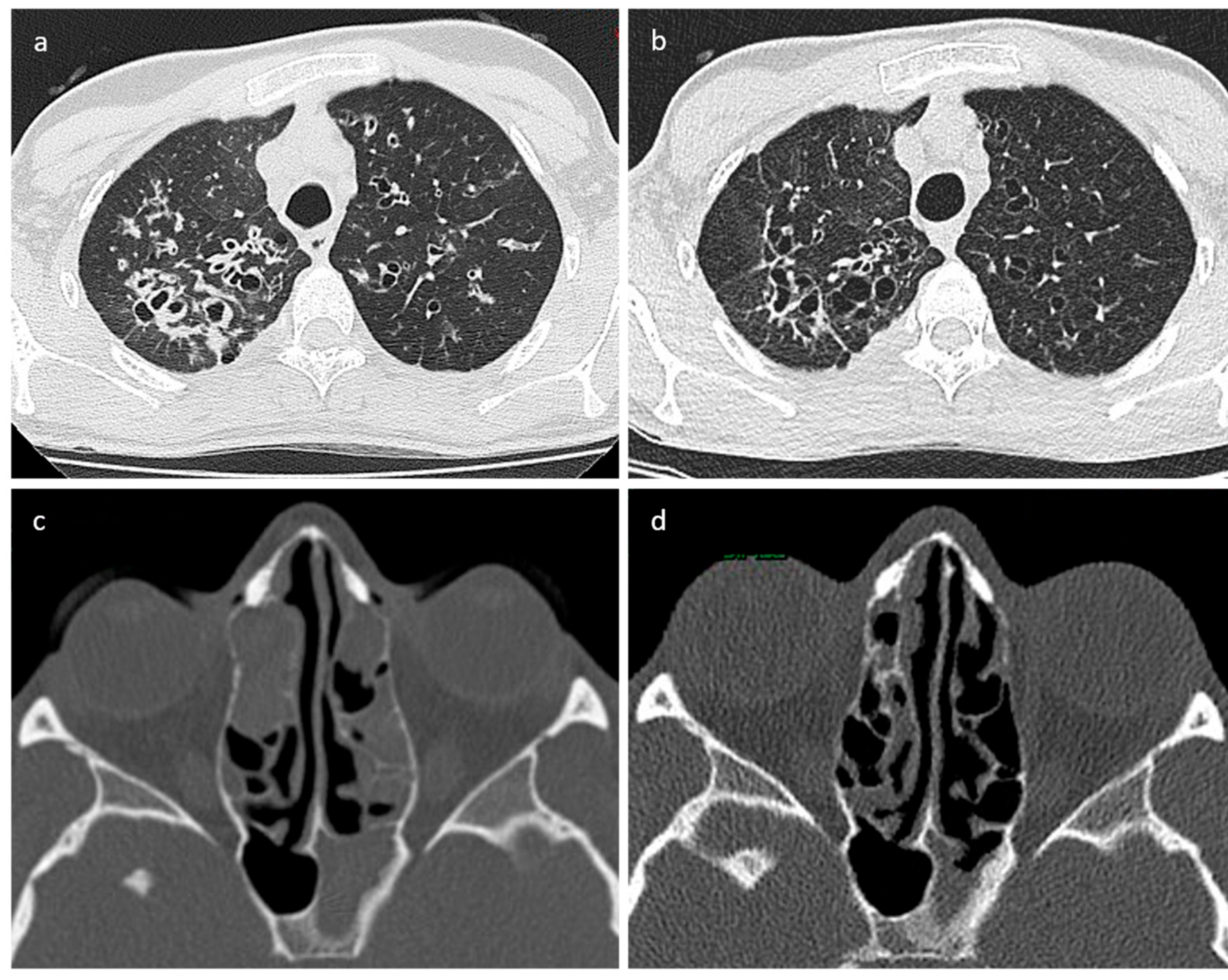
Author Contributions
Funding
Institutional Review Board Statement
Informed Consent Statement
Data Availability Statement
Conflicts of Interest
References
- Grasemann, H.; Ratjen, F. Cystic Fibrosis. N. Engl. J. Med. 2023, 389, 1693–1707. [Google Scholar] [CrossRef]
- Mall, M.A.; Brugha, R.; Gartner, S.; Legg, J.; Moeller, A.; Mondejar-Lopez, P.; Prais, D.; Pressler, T.; Ratjen, F.; Reix, P.; et al. Efficacy and 536 Safety of Elexacaftor/Tezacaftor/Ivacaftor in Children 6 Through 11 Years of Age with Cystic Fibrosis Heterozygous for. Am. J. Respir. Crit. Care Med. 2022, 206, 1361–1369. [Google Scholar] [CrossRef]
- Brody, A.S.; Klein, J.S.; Molina, P.L.; Quan, J.; Bean, J.A.; Wilmott, R.W. High-resolution computed tomography in young patients with cystic fibrosis: Distribution of abnormalities and correlation with pulmonary function tests. J. Pediatr. 2004, 145, 32–38. [Google Scholar] [CrossRef]
- Lund, V.J.; Mackay, I.S. Staging in rhinosinusitus. Rhinology 1993, 31, 183–184. [Google Scholar]
- Sheikh, S.I.; Handly, B.; Ryan-Wenger, N.A.; Hayes, D., Jr.; Kirkby, S.E.; McCoy, K.S.; Lind, M. Novel Computed Tomography Scoring System for Sinus Disease in Adults with Cystic Fibrosis. Ann. Otol. Rhinol. Laryngol. 2016, 125, 838–843. [Google Scholar] [CrossRef] [PubMed]
- Hopkins, C.; Gillett, S.; Slack, R.; Lund, V.J.; Browne, J.P. Psychometric validity of the 22-item Sinonasal Outcome Test. Clin. Otolaryngol. 2009, 34, 447–454. [Google Scholar] [CrossRef]
- Liu, C.M.; Fischer, J.L.; Overdevest, J.B.; Zemke, A.C.; Strand, M.J.; Gudis, D.A.; Kimple, A.J.; Tervo, J.P.; DiMango, E.; Goralski, J.L.; et al. Psychometric validity of the 22-item sinonasal outcome test in cystic fibrosis. J. Cyst. Fibros. 2026, 25, 353–358. [Google Scholar] [CrossRef] [PubMed]
- Boni, A.; d’Aniello, F.; Ubertini, G.; Cappa, M.; Ciciriello, F.; Majo, F.; Cristiani, L.; Alghisi, F.; Montemitro, E.; Bella, S.; et al. Height Velocity in Pediatric Cystic Fibrosis Under Triple CFTR Modulator Therapy: A Real-Life Monocentric Experience. J. Clin. Med. 2025, 14, 5259. [Google Scholar] [CrossRef] [PubMed]
- Dillenhöfer, S.; Schütz, K.; Burkhart, M.; Ellemunter, H.; Kappler, M.; Sieber, S.; Naehrlich, L.; Brinkmann, F.; Sutharsan, S. Long-term impact of elexacaftor/tezacaftor/ivacaftor on small and large airways in people with cystic fibrosis aged ≥6 years: 24-month real-world evidence from the German Cystic Fibrosis Registry. ERJ Open Res. 2026, 12, 00813–02025. [Google Scholar] [CrossRef]
- Hansen, C.M.E.; Zendaky, B.; Zwitserloot, A.M.; van den Bemt, P.M.L.A.; van Boven, J.F.M. Long-Term Adherence to Elexacaftor/Tezacaftor/Ivacaftor in People with Cystic Fibrosis. Pulm. Ther. 2026. Epub ahead of print. [Google Scholar] [CrossRef]
- Zemanick, E.T.; Taylor-Cousar, J.L.; Davies, J.; Gibson, R.L.; Mall, M.A.; McKone, E.F.; McNally, P.; Ramsey, B.W.; Rayment, J.H.; Rowe, S.M.; et al. A Phase 3 Open-Label Study of Elexacaftor/Tezacaftor/Ivacaftor in Children 6 through 11 Years of Age with Cystic Fibrosis and at Least One F508del Allele. Am. J. Respir. Crit. Care Med. 2021, 203, 1522–1532. [Google Scholar] [CrossRef]
- Terlizzi, V.; Lopes-Pacheco, M. Cystic fibrosis: New challenges and perspectives beyond elexacaftor/tezacaftor/ivacaftor. Ther. Adv. Respir. Dis. 2025, 19, 17534666251323194. [Google Scholar] [CrossRef] [PubMed]
- Salvatore, D.; Pepe, A. Cystic Fibrosis Transmembrane Conductance Regulator Modulators in Cystic Fibrosis: A Review of Registry-Based Evidence. J. Clin. Med. 2025, 14, 3978. [Google Scholar] [CrossRef]
- Gifford, A.H.; Taylor-Cousar, J.L.; Davies, J.C.; McNally, P. Update on Clinical Outcomes of Highly Effective Modulator Therapy. Clin. Chest Med. 2022, 43, 677–695. [Google Scholar] [CrossRef] [PubMed]
- Dhôte, T.; Grenet, D.; Reynaud-Gaubert, M.; Chatron, E.; Renaud-Picard, B.; Tissot, A.; Macey, J.; Murris-Espin, M.; Bunel, V.; Sermet-Gaudelus, I.; et al. The impact of progressive expansion of elexacaftor-tezacaftor-ivacaftor availability on lung transplant for cystic fibrosis in France. J. Cyst. Fibros. 2026. Epub ahead of print. [Google Scholar] [CrossRef] [PubMed]
- Hernández-Muñiz, S.; Caballero, P.; Peláez, A.; Solís-García, M.; de Benavides, C.; Collada, J.; Díaz-Lorenzo, I.; Zorzo, C.; Gómez-Punter, R.M.; Girón, R.M. Evolution of Lung Disease Studied by Computed Tomography in Adults with Cystic Fibrosis Treated with Elexacaftor/Tezacaftor/Ivacaftor. J. Imaging 2025, 11, 124. [Google Scholar] [CrossRef]
- Tagliati, C.; Lanni, G.; Battista, D.; Pantano, S.; Ripani, P. Triple combination CFTR modulator therapy reduces the need for endoscopic sinus surgery in adult patients with cystic fibrosis. Clin. Otolaryngol. 2024, 49, 243–246. [Google Scholar] [CrossRef]
- Stapleton, A.L.; Kimple, A.; Goralski, J.L.; Beswick, D.M.; Gupta, A.; Li, D.A.; Branstetter, B.F.; Nouraie, S.M.; Shaffer, A.D.; Senior, B.; et al. Elexacaftor-Tezacaftor-Ivacaftor Improves Sinonasal Outcomes in Young Children with Cystic Fibrosis. Int. Forum Allergy Rhinol. 2025, 15, 706–714. [Google Scholar] [CrossRef]
- Petitjean, M.; Letierce, A.; Bonnel, A.S.; Reix, P.; Deneuville, E.; Stremler, N.; Luscan, R.; Couloigner, V.; Mely, L.; Bessaci, K.; et al. Beyond the Lung. Impact of Elexacaftor/Tezacaftor/Ivacaftor on Sinonasal Disease in Children with Cystic Fibrosis. Int. Forum Allergy Rhinol. 2025, 15, 715–723. [Google Scholar] [CrossRef]
- Beswick, D.M.; Humphries, S.M.; Balkissoon, C.D.; Strand, M.; Vladar, E.K.; Lynch, D.A.; Taylor-Cousar, J.L. Impact of Cystic Fibrosis Transmembrane Conductance Regulator Therapy on Chronic Rhinosinusitis and Health Status: Deep Learning CT Analysis and Patient-reported Outcomes. Ann. Am. Thorac. Soc. 2022, 19, 12–19. [Google Scholar] [CrossRef]
- Beswick, D.M.; Khatiwada, A.; Miller, J.E.; Humphries, S.M.; Wilson, A.; Vladar, E.K.; Lynch, D.A.; Taylor-Cousar, J.L. Impact of highly effective modulator therapy on chronic rhinosinusitis and health status: 2-year follow-up. J. Cyst. Fibros. 2024, 23, 214–218. [Google Scholar] [CrossRef]
- Sheikh, S.; Ho, M.L.; Eisner, M.; Gushue, C.; Paul, G.; Holtzlander, M.; Johnson, T.; McCoy, K.S.; Lind, M. Elexacaftor-Tezacaftor-Ivacaftor Therapy for Chronic Sinus Disease in Cystic Fibrosis. JAMA Otolaryngol. Head Neck Surg. 2023, 149, 1075–1082. [Google Scholar] [CrossRef]
- Tagliati, C.; Pantano, S.; Lanni, G.; Battista, D.; Marcucci, M.; Fogante, M.; Argalia, G.; Paci, E.; Pressanti, G.L.; Ying, M.; et al. Sinus Disease Grading on Computed Tomography Before and After Modulating Therapy in Adult Patients with Cystic Fibrosis. J. Belg. Soc. Radiol. 2022, 106, 57. [Google Scholar] [CrossRef]
- Petit, G.; Coudert, A.; Hermann, R.; Truy, E.; Bonjour, M.; Reix, P.; Ayari, S. Effects of Elexacaftor Tezacaftor Ivacaftor on sinonasal imaging in children with cystic fibrosis. Rhinology 2026, 64, 75–82. [Google Scholar] [CrossRef]
Disclaimer/Publisher’s Note: The statements, opinions and data contained in all publications are solely those of the individual author(s) and contributor(s) and not of MDPI and/or the editor(s). MDPI and/or the editor(s) disclaim responsibility for any injury to people or property resulting from any ideas, methods, instructions or products referred to in the content. |
© 2026 by the authors. Licensee MDPI, Basel, Switzerland. This article is an open access article distributed under the terms and conditions of the Creative Commons Attribution (CC BY) license.
Share and Cite
Tagliati, C.; Campagna, G.; Di Sabatino, M.; Lanni, G.; Battista, D.; Ripani, P. Sinonasal and Pulmonary Computed Tomography Images Before and After Triple-Combination Therapy in a Patient with Cystic Fibrosis Without ΔF508 Mutations. Diagnostics 2026, 16, 1692. https://doi.org/10.3390/diagnostics16111692
Tagliati C, Campagna G, Di Sabatino M, Lanni G, Battista D, Ripani P. Sinonasal and Pulmonary Computed Tomography Images Before and After Triple-Combination Therapy in a Patient with Cystic Fibrosis Without ΔF508 Mutations. Diagnostics. 2026; 16(11):1692. https://doi.org/10.3390/diagnostics16111692
Chicago/Turabian StyleTagliati, Corrado, Giovanna Campagna, Maria Di Sabatino, Giuseppe Lanni, Davide Battista, and Pietro Ripani. 2026. "Sinonasal and Pulmonary Computed Tomography Images Before and After Triple-Combination Therapy in a Patient with Cystic Fibrosis Without ΔF508 Mutations" Diagnostics 16, no. 11: 1692. https://doi.org/10.3390/diagnostics16111692
APA StyleTagliati, C., Campagna, G., Di Sabatino, M., Lanni, G., Battista, D., & Ripani, P. (2026). Sinonasal and Pulmonary Computed Tomography Images Before and After Triple-Combination Therapy in a Patient with Cystic Fibrosis Without ΔF508 Mutations. Diagnostics, 16(11), 1692. https://doi.org/10.3390/diagnostics16111692

