Breathing Out the Truth: What Fractional Exhaled Nitric Oxide Really Tells Us About Pediatric Asthma

 ,
,  , , , , and
Abstract
1. Introduction
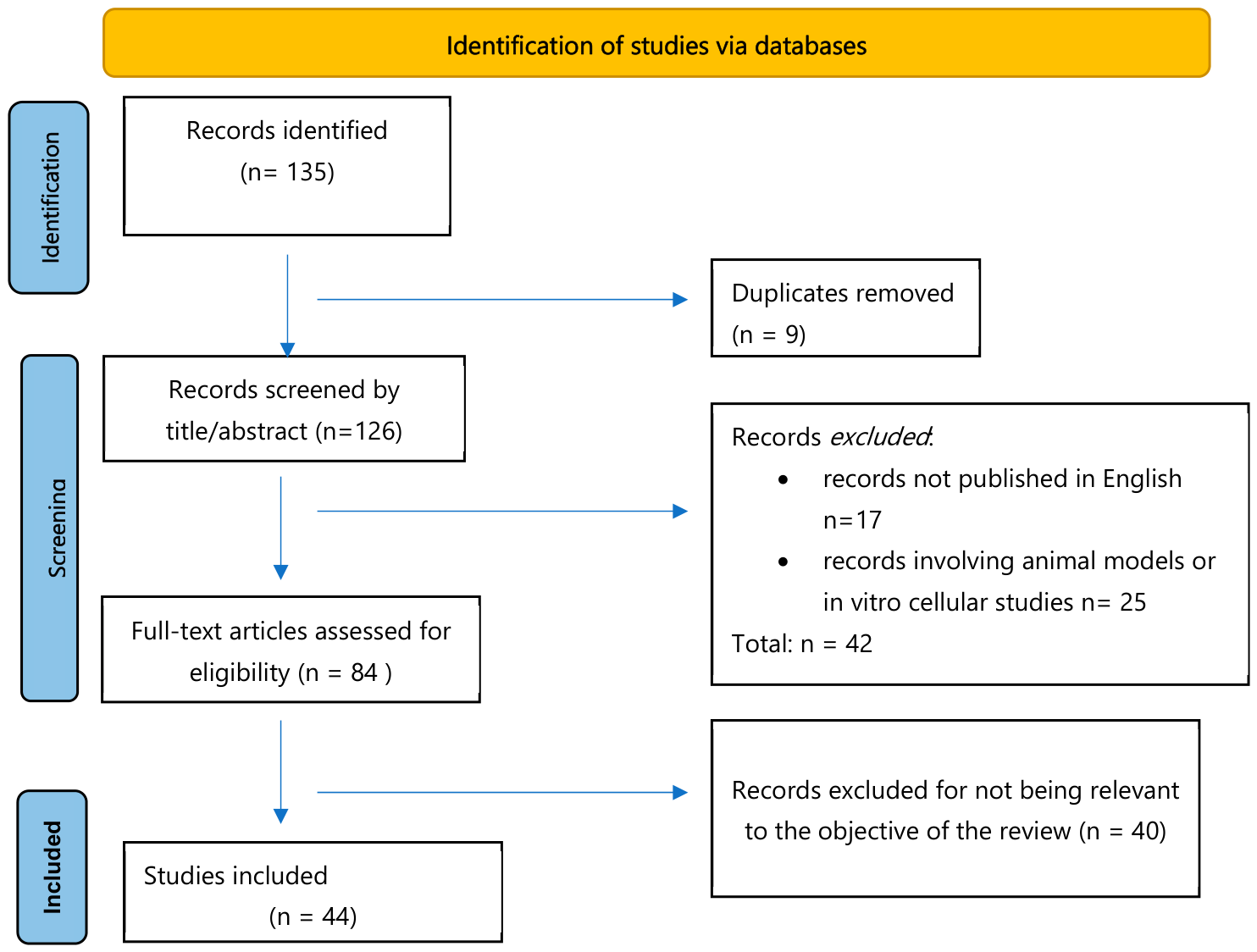
2. Materials and Methods
3. Results

4. Discussion
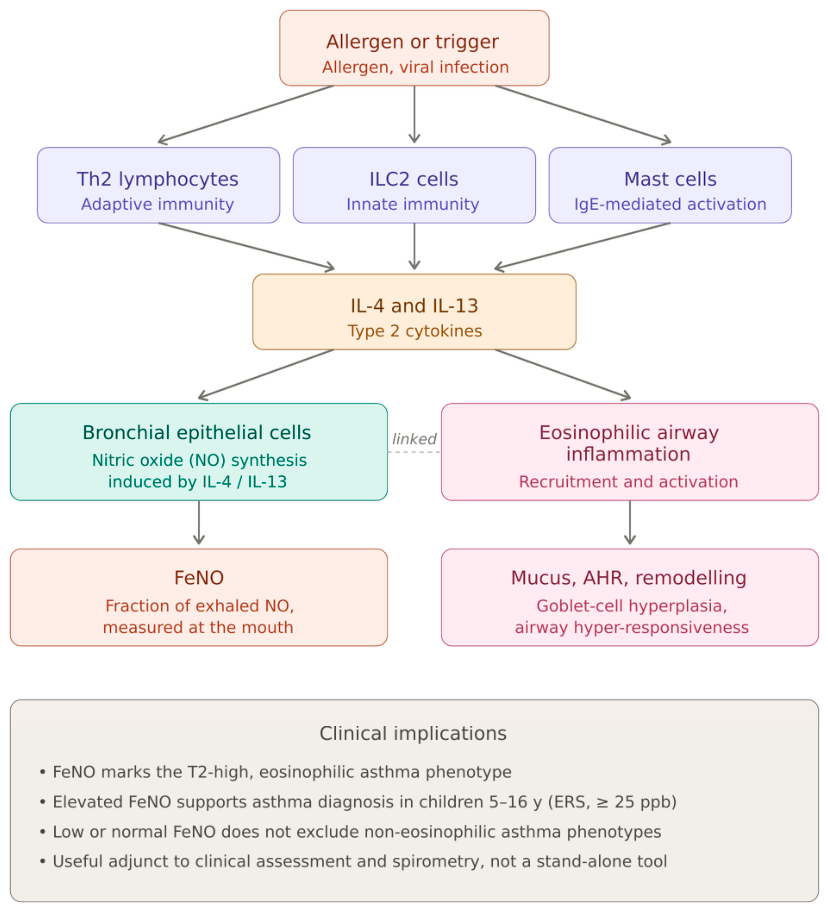
4.1. Biological Rationale of FeNO
4.2. Use of FeNO for Asthma Diagnosis
4.3. FeNO-Guided Therapy
4.4. Use of FeNO in Asthma Monitoring
4.5. Limitations and Clinical Considerations
5. Conclusions
Author Contributions
Funding
Institutional Review Board Statement
Informed Consent Statement
Data Availability Statement
Conflicts of Interest
References
- Global Asthma Network. The Global Asthma Report 2022. Available online: http://globalasthmareport.org (accessed on 1 March 2025).
- Song, P.; Adeloye, D.; Salim, H.; Dos Santos, J.P.; Campbell, H.; Sheikh, A.; Rudan, I. Global, Regional, and National Prevalence of Asthma in 2019: A Systematic Analysis and Modelling Study. J. Glob. Health 2022, 12, 04052. [Google Scholar] [CrossRef]
- Zhao, Y.; Liu, X.; Sun, Y.; Zhang, C.; Shi, Y. The Burden of Childhood Asthma by Age Group, 1990–2019: A Systematic Analysis of Global Burden of Disease 2019 Data. Front. Pediatr. 2022, 10, 880355. [Google Scholar] [CrossRef] [PubMed]
- Serebrisky, D.; Wiznia, A. Pediatric Asthma: A Global Epidemic. Ann. Glob. Health 2019, 85, 6. [Google Scholar] [CrossRef] [PubMed]
- World Health Organization. Asthma. Available online: https://www.who.int/news-room/fact-sheets/detail/asthma (accessed on 1 March 2025).
- Rao, D.R.; Phipatanakul, W. An Overview of Fractional Exhaled Nitric Oxide and Children with Asthma. Expert Rev. Clin. Immunol. 2016, 12, 521–531. [Google Scholar] [CrossRef]
- Murray, C.S.; Foden, P.; Lowe, L.; Durrington, H.; Custovic, A.; Simpson, A. Diagnosis of Asthma in Symptomatic Children Based on Measures of Lung Function: An Analysis of Data from a Population-Based Birth Cohort Study. Lancet Child. Adolesc. Health 2017, 1, 114–123. [Google Scholar]
- Silkoff, P.E.; Lent, A.M.; Busacker, A.A.; Katial, R.K.; Balzar, S.; Strand, M.; Wenzel, S.E. Exhaled Nitric Oxide Identifies the Persistent Eosinophilic Phenotype in Severe Refractory Asthma. J. Allergy Clin. Immunol. 2005, 116, 1249–1255. [Google Scholar] [CrossRef]
- Heijkensköld-Rentzhog, C.; Kalm-Stephens, P.; Nordvall, L.; Malinovschi, A.; Janson, C.; Alving, K.; Borres, M.P. A New Method for Single-Breath Fractional Exhaled Nitric Oxide Measurement with Improved Feasibility in Preschool Children. Pediatr. Allergy Immunol. 2015, 26, 662–667. [Google Scholar] [CrossRef] [PubMed]
- Crater, G.D.; Rickard, K.A.; Jain, N. Successful Fractional Exhaled Nitric Oxide Measurements in Children Aged 4–10 Years Using 6- and 10-Second Exhalation Modes with NIOX VERO. Pulm. Ther. 2017, 3, 139–148. [Google Scholar] [CrossRef]
- Sayão, L.B.; de Britto, M.C.A.; Burity, E.F.; Bezerra, P.G.M.; Sarinho, E.S.C. Exhaled Nitric Oxide as a Diagnostic Tool for Wheezing in Preschool Children. Respir. Med. 2016, 113, 15–21. [Google Scholar] [CrossRef]
- Vilmann, L.; Buchvald, F.; Green, K.; Nielsen, K.G. Fractional Exhaled Nitric Oxide and Multiple Breath Nitrogen Washout in Preschool Healthy and Asthmatic Children. Respir. Med. 2017, 133, 42–47. [Google Scholar] [CrossRef]
- Petsky, H.L.; Kew, K.M.; Chang, A.B. Exhaled Nitric Oxide Levels to Guide Treatment for Children with Asthma. Cochrane Database Syst. Rev. 2016, 11, CD011439. [Google Scholar] [CrossRef]
- Dweik, R.A.; Boggs, P.B.; Erzurum, S.C.; Irvin, C.G.; Leigh, M.W.; Lundberg, J.O.; Olin, A.-C.; Plummer, A.L.; Taylor, D.R. An Official ATS Clinical Practice Guideline: Interpretation of Exhaled Nitric Oxide Levels (FeNO) for Clinical Applications. Am. J. Respir. Crit. Care Med. 2011, 184, 602–615. [Google Scholar]
- Kim, H.B.; Eckel, S.P.; Kim, J.H.; Gilliland, F.D. Exhaled NO: Determinants and Clinical Application in Children with Allergic Airway Disease. Allergy Asthma Immunol. Res. 2016, 8, 12–21. [Google Scholar] [CrossRef]
- Escamilla-Gil, J.M.; Fernandez-Nieto, M.; Acevedo, N. Understanding the Cellular Sources of the Fractional Exhaled Nitric Oxide (FeNO) and Its Role as a Biomarker of Type 2 Inflammation in Asthma. BioMed Res. Int. 2022, 2022, 5753524. [Google Scholar] [CrossRef]
- Papadopoulos, N.G.; Bacharier, L.B.; Jackson, D.J.; Szefler, S.J.; Phipatanakul, W.; Gern, J.E.; Gruchalla, R.S.; Guilbert, T.W.; Kattan, M.; Teach, S.J.; et al. Type 2 Inflammation and Asthma in Children: A Narrative Review. J. Allergy Clin. Immunol. Pract. 2024, 12, 2310–2324. [Google Scholar] [CrossRef] [PubMed]
- Dupont, L.J.; Rochette, F.; Demedts, M.G.; Verleden, G.M. Exhaled Nitric Oxide Correlates with Airway Hyperresponsiveness in Steroid-Naive Patients with Mild Asthma. Am. J. Respir. Crit. Care Med. 1998, 157, 894–898. [Google Scholar] [CrossRef] [PubMed]
- Di Cicco, M.; Peroni, D.G.; Comberiati, P.; Gangi, S.; Pistello, M.; Lodde, B. Application of Exhaled Nitric Oxide (FeNO) in Pediatric Asthma. Curr. Opin. Allergy Clin. Immunol. 2021, 21, 131–138. [Google Scholar] [CrossRef]
- Konradsen, J.R.; Skantz, E.; Nordlund, B.; Lidegran, M.; James, A.; Ono, J.; Ohta, S.; Izuhara, K.; Dahlén, S.E.; Alving, K.; et al. Predicting Asthma Morbidity in Children Using Proposed Markers of Th2-Type Inflammation. Pediatr. Allergy Immunol. 2015, 26, 772–779. [Google Scholar] [CrossRef]
- Tang, S.; Xie, Y.; Yuan, C.; Sun, X.; Cui, Y. Fractional Exhaled Nitric Oxide for the Diagnosis of Childhood Asthma: A Systematic Review and Meta-Analysis. Clin. Rev. Allergy Immunol. 2019, 56, 129–138. [Google Scholar] [CrossRef]
- Wang, Z.; Pianosi, P.; Keogh, K.; Zaiem, F.; Alsawas, M.; Alahdab, F.; Almasri, J.; Mohammed, K.; Larrea-Mantilla, L.; Farah, W.; et al. The Diagnostic Accuracy of Fractional Exhaled Nitric Oxide Testing in Asthma: A Systematic Review and Meta-Analyses. Mayo Clin. Proc. 2018, 93, 191–198. [Google Scholar] [CrossRef]
- Gaillard, E.A.; Kuehni, C.E.; Turner, S.; Goutaki, M.; Holden, K.A.; de Jong, C.C.M.; Lex, C.; Lo, D.K.H.; Lucas, J.S.; Midulla, F.; et al. European Respiratory Society Clinical Practice Guidelines for the Diagnosis of Asthma in Children Aged 5–16 Years. Eur. Respir. J. 2021, 58, 2004173. [Google Scholar] [CrossRef]
- Zhou, J.; Zhao, X.; Zhang, X.; Chen, Z.; Wang, H.; Yuan, W. Values of Fractional Exhaled Nitric Oxide for Cough-Variant Asthma in Children with Chronic Cough. J. Thorac. Dis. 2019, 10, 6616–6623. [Google Scholar] [CrossRef]
- Barański, K.; Zejda, J.E. Screening Accuracy of Fractional Exhaled Nitric Oxide Measurement for Childhood Asthma in a Community Setting. Children 2022, 9. Available online: https://doi.org/10.3390/children9060858.
- Global Initiative for Asthma (GINA). 2025 GINA Strategy Report. Available online: https://ginasthma.org/2025-gina-strategy-report/ (accessed on 15 May 2026).
- Turner, S.; Cotton, S.; Wood, J.; Coutts, J.; Thomas, M.; Murray, C.; Morrow, S.; Simpson, A.; Mukhopadhyay, S.; Bush, A.; et al. Reducing Asthma Attacks in Children Using Exhaled Nitric Oxide (RAACENO) as a Biomarker to Inform Treatment Strategy: A Multicentre, Parallel, Randomised, Controlled, Phase 3 Trial. Lancet Respir. Med. 2022, 10, 584–592. [Google Scholar] [CrossRef]
- Voorend-van Bergen, S.; Vaessen-Verberne, A.A.; Brackel, H.J.; Landstra, A.M.; van den Berg, N.J.; Hop, W.C.; de Jongste, J.C.; Pijnenburg, M.W. Monitoring Strategies in Children with Asthma: A Randomised Controlled Trial. Thorax 2015, 70, 543–550. [Google Scholar] [CrossRef]
- Wang, Z.; Pianosi, P.T.; Keogh, K.A.; Dong, Y.; Zaiem, F.; Alsawas, M.; Farah, W.H.; Murad, M.H. Effectiveness of Fractional Exhaled Nitric Oxide for Asthma Management in Children: A Systematic Review and Meta-Analysis. Pediatr. Pulmonol. 2020, 55, 1936–1948. [Google Scholar] [CrossRef] [PubMed]
- Petsky, H.L.; Li, A.M.; Au, C.T.; Kynaston, J.A.; Turner, C.; Chang, A.B. Management Based on Exhaled Nitric Oxide Levels Adjusted for Atopy Reduces Asthma Exacerbations in Children: A Dual Centre Randomized Controlled Trial. Pediatr. Pulmonol. 2015, 50, 535–543. [Google Scholar] [CrossRef]
- Lu, M.; Wu, B.; Che, D.; Qiao, R.; Gu, H. FeNO and Asthma Treatment in Children: A Systematic Review and Meta-Analysis. Medicine 2015, 94, e347. [Google Scholar] [CrossRef]
- Yang, S.; Park, J.; Lee, Y.K.; Kim, H.; Hahn, Y.S. Association of Longitudinal Fractional Exhaled Nitric Oxide Measurements with Asthma Control in Atopic Children. Respir. Med. 2015, 109, 572–579. [Google Scholar] [CrossRef]
- Kim, J.K.; Jung, J.Y.; Kim, H.; Han, M.Y.; Seo, J.H.; Kim, H.Y.; Kwon, J.W. Combined Use of Fractional Exhaled Nitric Oxide and Bronchodilator Response in Predicting Future Loss of Asthma Control Among Children with Atopic Asthma. Respirology 2017, 22, 466–472. [Google Scholar] [CrossRef]
- Visitsunthorn, N.; Mahawichit, N.; Maneechotesuwan, K. Association Between Levels of Fractional Exhaled Nitric Oxide and Asthma Exacerbations in Thai Children. Respirology 2017, 22, 71–77. [Google Scholar] [CrossRef] [PubMed]
- Hauerslev, M.; Garpvall, K.; Marckmann, M.; Hermansen, M.N.; Hansen, K.S.; Chawes, B.L. Long-Term Predictors of Loss of Asthma Control in School-Aged Well-Controlled Children with Mild to Moderate Asthma: A 5-Year Follow-Up. Pediatr. Pulmonol. 2022, 57, 81–89. [Google Scholar] [CrossRef] [PubMed]
- Cleves, D.; Vargas, P.; Acuña-Cordero, R.; Aguilera-Otalvaro, P.; Camargo, B.; Aristizábal-Duque, R.; Rodríguez-Martínez, C.E. Association Between Fractional Exhaled Nitric Oxide and Therapeutic Adherence to Controller Management in Pediatric Asthma Patients. Pediatr. Pulmonol. 2024, 59, 121–128. Available online: https://doi.org/10.1002/ppul.26723.
- Fielding, S.; Pijnenburg, M.; de Jongste, J.C.; Pike, K.C.; Roberts, G.; Petsky, H.; Chang, A.B.; Fritsch, M.; Frischer, T.; Szefler, S.; et al. Change in FEV1 and Feno Measurements as Predictors of Future Asthma Outcomes in Children. Chest 2019, 155, 331–341. Available online: https://pubmed.ncbi.nlm.nih.gov/30359613/. [CrossRef] [PubMed] [PubMed Central]
- Yoon, J.; Choi, Y.J.; Lee, E.; Cho, H.-J.; Yang, S.-I.; Kim, Y.-H.; Jung, Y.-H.; Seo, J.-H.; Kwon, J.-W.; Kim, H.-B.; et al. Allergic Rhinitis in Preschool Children and the Clinical Utility of FeNO. Allergy Asthma Immunol. Res. 2017, 9, 314–321. [Google Scholar] [CrossRef] [PubMed]
- Sunde, R.B.; Thorsen, J.; Skov, F.; Hesselberg, L.; Kyvsgaard, J.; Følsgaard, N.V.; Schoos, A.M.; Stokholm, J.; Bønnelykke, K.; Chawes, B. Exhaled Nitric Oxide Is Only an Asthma-Relevant Biomarker Among Children with Allergic Sensitization. Pediatr. Allergy Immunol. 2023, 34, e14044. [Google Scholar] [CrossRef]
- Fainardi, V.; Passadore, L.; Labate, M.; Pisi, G.; Esposito, S. An Overview of the Obese-Asthma Phenotype in Children. Int. J. Environ. Res. Public Health 2022, 19, 636. [Google Scholar] [CrossRef]
- Wang, R.; Fowler, S.J.; Turner, S.W.; Drake, S.; Healy, L.; Lowe, L.; Wardman, H.; Bennett, M.; Custovic, A.; Simpson, A.; et al. Defining the normal range of fractional exhaled nitric oxide in children: One size does not fit all. ERJ Open Res. 2022, 8, 00319–2022. [Google Scholar]
- Khatri, S.B.; Iaccarino, J.M.; Barochia, A.; Soghier, I.; Akuthota, P.; Brady, A.; Covar, R.A.; Debley, J.S.; Diamant, Z.; Fitzpatrick, A.M.; et al. Use of Fractional Exhaled Nitric Oxide to Guide the Treatment of Asthma: An Official American Thoracic Society Clinical Practice Guideline. Am. J. Respir. Crit. Care Med. 2021, 204, e97–e109. [Google Scholar] [CrossRef]
- Xiao, J.; Liu, L.; Ali, K.; Wu, S.; Chen, J. Impulse Oscillometry Combined to FeNO in Relation to Asthma Control Among Preschool Children. J. Asthma Allergy 2024, 17, 1015–1025. [Google Scholar]
- Karrasch, S.; Linde, K.; Rücker, G.; Sommer, H.; Meisinger, C.; Peters, H.; Gröschel, A.; Schulz, H. Accuracy of FeNO for Diagnosing Asthma: A Systematic Review. Thorax 2017, 72, 109–116. [Google Scholar] [CrossRef]
- Galant, S.P.; Morphew, T. Adding Oscillometry and Fractional Exhaled Nitric Oxide to Guidelines Potentially Enhances Identification of Exacerbation Risk Factors in Asthmatic Children. Pediatr. Pulmonol. 2025, 60, e27379. [Google Scholar]
- Davis, M.D. The Role of Fractional Exhaled Nitric Oxide and Oscillometry in Pediatric Asthma. Respir. Care 2025, 70, 245–256. Available online: https://doi.org/10.1089/respcare.12674.
- Hu, J.; Fan, Y.; Luo, R.; Li, Q.; Ai, T.; Wang, L. Application of Impulse Oscillometry Combined with Fractional Exhaled Nitric Oxide in Monitoring Asthma Control Levels in Children. J. Asthma Allergy 2025, 18, 391–402. [Google Scholar]

| Ref. | Author, Year | Study Design/Type | Population (Age Range) | Sample Size (n) | Cited in GINA 2025 |
|---|---|---|---|---|---|
| [1] | Global Asthma Network (2022) | Epidemiological report | Children 6–7 years; adolescents 13–14 years | ≈158,000 | Yes |
| [2] | Song et al. (2022) | Systematic analysis/modelling | All ages, global | — | No |
| [3] | Zhao et al. (2022) | Systematic analysis (GBD 2019) | Pediatric, global | — | No |
| [4] | Serebrisky & Wiznia (2019) | Narrative review | Pediatric, global | — | No |
| [5] | WHO (2025) | Fact sheet/public-health source | All ages | — | No |
| [6] | Rao & Phipatanakul (2016) | Narrative review | Pediatric | — | No |
| [7] | Murray et al. (2017) | Population-based birth cohort (MAAS) | Symptomatic school-aged children | 630 | No |
| [8] | Silkoff et al. (2005) | Clinical study | Severe refractory asthma (mainly adult) | — | No |
| [13] | Petsky et al. (2016) | Cochrane systematic review (9 RCTs) | Children with asthma | >1300 | Yes |
| [14] | Dweik et al. — ATS guideline (2011) | Clinical practice guideline | All ages | — | No |
| [15] | Kim et al. (2016) | Narrative review | Children with allergic airway disease | — | No |
| [16] | Escamilla-Gil et al. (2022) | Mechanistic/molecular review | Mixed populations | — | No |
| [17] | Papadopoulos et al. (2024) | Narrative review | Children with asthma | — | No |
| [18] | Dupont et al. (1998) | Clinical study | Adults with mild asthma | — | No |
| [19] | Di Cicco et al. (2021) | Narrative review | Pediatric asthma | — | No |
| [20] | Konradsen et al. (2015) | Prospective cohort | School-aged Swedish children | 96 | No |
| [21] | Tang et al. (2019) | Systematic review/meta-analysis | Pediatric cohorts (8 studies) | 2933 | No |
| [22] | Wang et al. (2018) | Systematic review/meta-analysis | Mixed (43 studies) | 13,747 | No |
| [23] | Gaillard et al., ERS (2021) | Clinical practice guideline | Children 5–16 years | — | No |
| [24] | Zhou et al. (2019) | Cross-sectional clinical study | Children with chronic cough | 115 | No |
| [25] | Barański & Zejda (2022) | Population-based study | Children 6–10 years | 449 | No |
| [26] | GINA Strategy Report (2025) | International strategy/guideline | All ages | — | Yes (source document) |
| [27] | Turner et al.—RAACENO (2022) | Multicentre phase 3 RCT | Children 6–15 years (52 UK centres) | 509 | Yes |
| [28] | Voorend-van Bergen et al.—BATMAN (2015) | Three-arm RCT | Children 4–18 years (Netherlands) | 280 | No |
| [29] | Wang et al. (2020) | Systematic review/meta-analysis (23 RCTs) | Children with asthma | — | No |
| [30] | Petsky et al. (2015) | Dual-centre RCT (atopy-adjusted) | Children with asthma | 63 | No |
| [31] | Lu et al. (2015) | Systematic review/meta-analysis | Children with asthma | 1017 | No |
| [32] | Yang et al. (2015) | Prospective longitudinal cohort | Atopic asthmatic children | 178 | No |
| [33] | Kim et al. (2017) | Prospective cohort | Atopic asthmatic children | 201 | No |
| [34] | Visitsunthorn et al. (2017) | Prospective cohort | Thai children 7–20 years | 70 | No |
| [35] | Hauerslev et al. (2022) | 5-year prospective follow-up | Danish children, mild–moderate asthma | 146 | No |
| [36] | Cleves et al. (2024) | Cross-sectional clinical study | Pediatric asthma, ICS-treated | — | No |
| [37] | Fielding et al. (2019) | Individual-patient-data meta-analysis (7 RCTs) | Children with asthma | 1112 | No |
| [38] | Yoon et al. (2017) | Population-based cross-sectional | Korean preschool children | 933 | No |
| [39] | Sunde et al. (2023) | Two birth cohorts (COPSAC2000 + COPSAC2010) | Children with/without sensitisation | 411 + 700 | No |
| [40] | Fainardi et al. (2022) | Narrative review | Children with obesity-related asthma | — | No |
| [41] | Wang R et al. (2022) | Multicentre cohort (MAAS) | Children— derivation of FeNO normal range | — | No |
| [42] | Khatri et al. — ATS (2021) | Clinical practice guideline | Mixed (adolescents/adults emphasised) | — | No |
| [9] | Heijkensköld-Rentzhog et al. (2015) | Method validation/feasibility | Preschool children | — | No |
| [10] | Crater et al. (2017) | Method validation/feasibility | Children 4–10 years (NIOX VERO) | — | No |
| [12] | Vilmann et al. (2017) | Cross-sectional clinical study | Healthy and asthmatic preschoolers | — | No |
| [11] | Sayão et al. (2016) | Cross-sectional clinical study | Brazilian preschoolers 3–5 years | 458 | No |
| [43] | Xiao et al. (2024) | Prospective observational cohort (IOS + FeNO) | Chinese preschoolers (171 asthmatic + 30 healthy) | 201 | No |
| [44] | Karrasch et al. (2017) | Systematic review | Mixed (paediatric + adult) | — | No |
| [45] | Galant & Morphew (2025) | Retrospective post-hoc analysis (decision-tree algorithm, IOS + FeNO) | Children 4–18 years, moderate-to-severe asthma | — | No (published after GINA cut-off) |
| [46] | Davis M.D. (2025) | Narrative review | Pediatric asthma | — | No (published after GINA cut-off) |
| [47] | Hu et al. (2025) | Retrospective cohort (IOS + FeNO) | Chinese asthmatic children (80 controlled + 123 uncontrolled) | 203 | No (published after GINA cut-off) |
| FeNO Threshold | Age Group/Setting | Clinical Context | Sensitivity/Specificity | Main Confounders/Limitations | Key Reference(s) |
|---|---|---|---|---|---|
| <10–15 ppb | Untreated children, all paediatric ages | Diagnosis (rule-out) | Not formally reported; low likelihood of T2-high eosinophilic asthma | Possible non-eosinophilic phenotype; ICS exposure may suppress values | [6,14] |
| ≥20 ppb | Symptomatic children, paediatric ages | Diagnosis (supportive) | Pooled (8 pediatric cohorts, various thresholds): Se 0.79, Sp 0.81, AUC 0.87; pediatric subgroup at the 20 ppb cut-off: Se 0.78, Sp 0.79 | Influenced by atopy, allergic rhinitis, recent respiratory infection | [14,21,22] |
| 20–29 ppb | Paediatric subgroup, meta-analysis | Diagnosis (improved specificity) | Specificity rising to 0.89 in this range | Sensitivity decreases with rising threshold | [22] |
| ≥ 25 ppb | Children 5–16 years (ERS) | Diagnosis (guideline-recommended) | Supportive of asthma diagnosis (guideline-recommended) | Validated mainly in school-aged children; preschool data limited | [23] |
| ≥25 ppb | Children with chronic cough | Diagnosis of cough-variant asthma | AUC 0.93; Se 84.0%; Sp 97.1% | Modest sample size (n = 115); single-centre data | [24] |
| ≥31 ppb | Thai children 7–20 years | Exacerbation prediction | Se 92.3%, Sp 75.4% at the ≥31 ppb cut-off; NPV 100% at the <20 ppb cut-off | Single-centre cohort; not validated in younger paediatric subgroups | [34] |
| ≥35 ppb + BDR ≥ 12% | Atopic asthmatic children (n = 201) | Prediction of loss of asthma control | Superior prognostic accuracy when combined with bronchodilator response | Combined biomarker; threshold not standalone | [33] |
| ≥35–50 ppb | Children 5–16 years | Diagnosis (high specificity) | Specificity 0.99–1.00 at upper end of range | Low sensitivity at this range; limits use as screening tool | [23] |
| >47 ppb | Atopic asthmatic children, serial measurements | Monitoring/exacerbation prediction | Specificity 96% for future loss of control | Highest recorded value over time; requires repeated measurements | [32] |
| >50/≥25/≥20 ppb (hierarchy) | Children, hierarchical framework according to ICS-treatment status | Diagnosis (supportive) + monitoring | Threshold interpretation stratified by ICS use | Not validated as standalone diagnostic; supportive role only | [26] |
| Height-based > 90th centile | Symptomatic children (MAAS cohort) | Diagnosis (paediatric-specific normative model) | Specificity 96%; PPV 97% for asthma diagnosis | Requires height-adjusted normative data; not yet widely adopted | [41] |
Disclaimer/Publisher’s Note: The statements, opinions and data contained in all publications are solely those of the individual author(s) and contributor(s) and not of MDPI and/or the editor(s). MDPI and/or the editor(s) disclaim responsibility for any injury to people or property resulting from any ideas, methods, instructions or products referred to in the content. |
© 2026 by the authors. Licensee MDPI, Basel, Switzerland. This article is an open access article distributed under the terms and conditions of the Creative Commons Attribution (CC BY) license.
Share and Cite
Mihai, A.; Ioniuc, I.K.; Murgu, A.M.; Lupu, A.; Frăsinariu, O.E.; Spoială, E.-L.; Rosu, E.V.; Revenco, N.; Gavrilovici, C. Breathing Out the Truth: What Fractional Exhaled Nitric Oxide Really Tells Us About Pediatric Asthma. Diagnostics 2026, 16, 1612. https://doi.org/10.3390/diagnostics16111612
Mihai A, Ioniuc IK, Murgu AM, Lupu A, Frăsinariu OE, Spoială E-L, Rosu EV, Revenco N, Gavrilovici C. Breathing Out the Truth: What Fractional Exhaled Nitric Oxide Really Tells Us About Pediatric Asthma. Diagnostics. 2026; 16(11):1612. https://doi.org/10.3390/diagnostics16111612
Chicago/Turabian StyleMihai, Adriana, Ileana Katerina Ioniuc, Alina Mariela Murgu, Ancuta Lupu, Otilia Elena Frăsinariu, Elena-Lia Spoială, Eduard Vasile Rosu, Ninel Revenco, and Cristina Gavrilovici. 2026. "Breathing Out the Truth: What Fractional Exhaled Nitric Oxide Really Tells Us About Pediatric Asthma" Diagnostics 16, no. 11: 1612. https://doi.org/10.3390/diagnostics16111612
APA StyleMihai, A., Ioniuc, I. K., Murgu, A. M., Lupu, A., Frăsinariu, O. E., Spoială, E.-L., Rosu, E. V., Revenco, N., & Gavrilovici, C. (2026). Breathing Out the Truth: What Fractional Exhaled Nitric Oxide Really Tells Us About Pediatric Asthma. Diagnostics, 16(11), 1612. https://doi.org/10.3390/diagnostics16111612