


Ultrasound and Shear Wave Elastography of Lower-Limb Muscles and Aponeurotic Structures in Human Cadavers—A Scoping Review

Abstract
1. Introduction
2. Methods
2.1. Study Design
2.2. Eligibility Criteria
2.3. Search Strategy
2.4. Study Selection
2.5. Data Extraction and Synthesis
3. Results
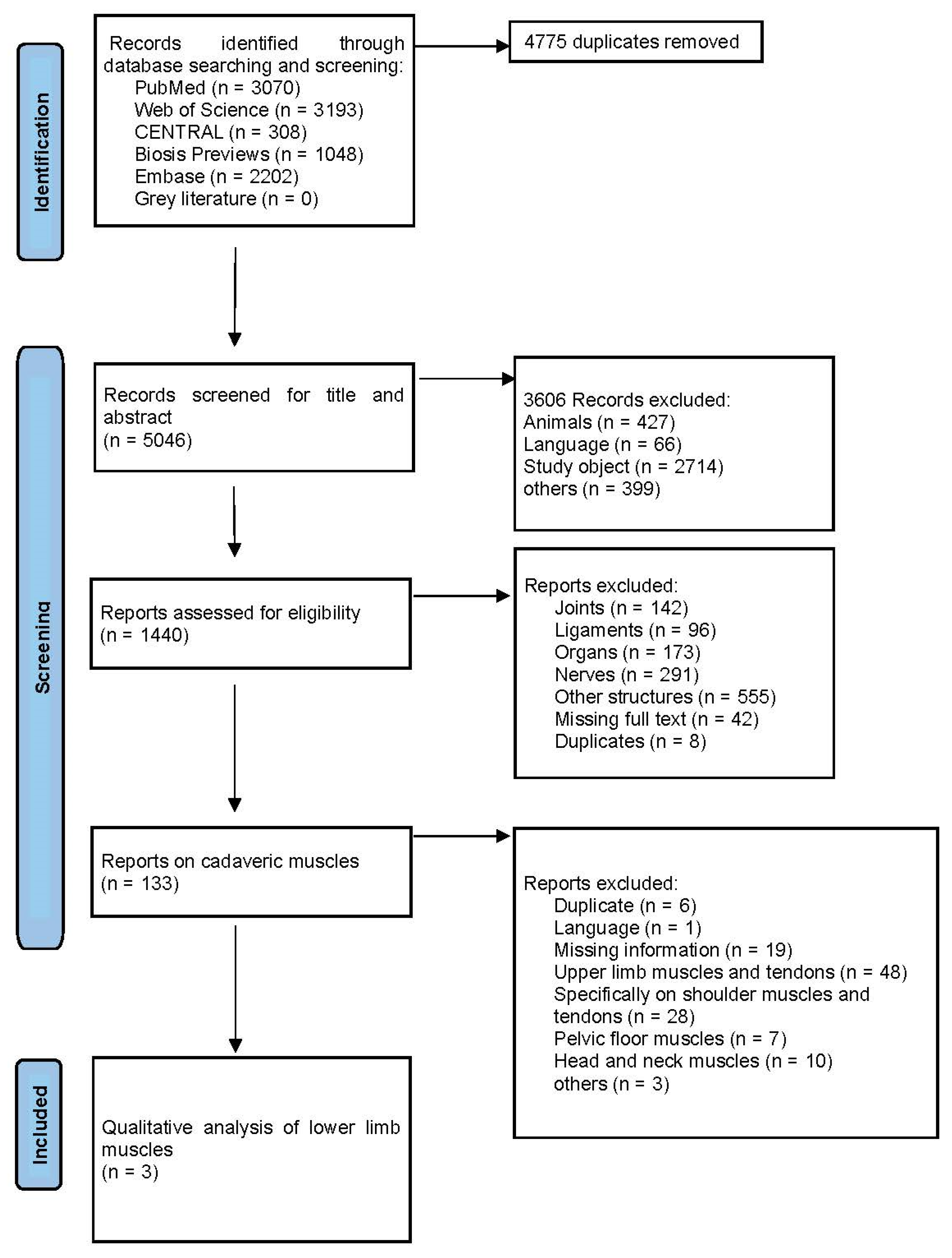
3.1. Search and Selection of Included Studies
3.2. Study Characteristics of Included Studies
3.3. Rectus Femoris and Quadriceps Region
3.4. Hamstrings
3.5. Calf (Gastrocnemius–Soleus Complex)
3.6. Adductors
3.7. Cadaver Type
3.8. B-Mode Ultrasound Visualization and Anatomical Correlation
3.9. Shear Wave Elastography Findings
4. Discussion
5. Conclusions
Supplementary Materials
Author Contributions
Funding
Institutional Review Board Statement
Informed Consent Statement
Data Availability Statement
Conflicts of Interest
Appendix A

| Author (Year) | Title | Sample Size | Investigator | Equipment | Procedure Description | Measurement | Outcome |
|---|---|---|---|---|---|---|---|
| Takuya Kato et al. (2022) [25] | Adductor longus: An anatomical study to better understand groin pain | 9 AL muscles were harvested from Thiel soft-embalmed cadavers (mean age at death: 86 years; range: 73–98 years). | Research team from Sapporo Medical University with expertise in cadaveric biomechanics and shear wave elastography | Shear wave elastography with a linear ultrasound transducer (4–15 MHz) (Aixplorer Ver. 12 and SL15-4; Supersonic Imagine, Aix-en Provence, France) Ultrasound echo pad with a thickness of 30 mm (Echo PAD; Yasojima Proceed Co., Ltd., Kobe, Japan) Custom-built loading device with clamps, pulley, and cable to apply passive loads from 0 to 600 g in 60 g increments | The adductor longus (AL) muscles were meticulously dissected from Thiel-embalmed cadavers, preserving both proximal and distal tendons to maintain physiological fiber orientation and native muscle architecture. Each muscle specimen was mounted on a custom-designed loading apparatus that applied standardized passive tensile loads via a pulley–weight system. The muscle belly was positioned on an echo-absorptive pad to ensure consistent acoustic coupling and to minimize ultrasound reflection artifacts. Shear-wave elastography (SWE) measurements were performed with the ultrasound transducer aligned longitudinally with the muscle fibers, ensuring that shear-wave propagation occurred along the principal mechanical axis of the muscle. Using B-mode imaging, measurements were obtained at three anatomically defined regions along the muscle length: proximal, middle, and distal thirds. Passive loads were applied incrementally from 0 to 600 g in 60 g steps. Each load was maintained for less than 10 s to minimize viscoelastic creep. All measurements were repeated twice to assess test–retest reliability. Following mechanical testing, architectural parameters including muscle length, mass, and anatomical cross-sectional area were recorded for biomechanical correlation analyses. | Muscle shear modulus (kPa) was quantified at each load level using shear-wave elastography at the proximal, middle, and distal regions of the adductor longus. Force–stiffness relationships were derived by plotting shear modulus against applied passive load, allowing calculation of regional stiffness slopes (kPa/g). Test–retest reliability was assessed using intraclass correlation coefficients (ICC). | Across all regions of the adductor longus, shear modulus increased in a highly linear manner with increasing passive load, with coefficients of determination of 0.989 (proximal), 0.986 (middle), and 0.982 (distal). At slack length (0 g load), mean shear modulus values were highest proximally (11.83 ± 3.80 kPa), followed by the middle (10.00 ± 1.95 kPa) and distal regions (7.90 ± 2.00 kPa). The rate of stiffness increase per gram of applied load showed clear regional variation, being greatest proximally (0.056 ± 0.027 kPa/g), intermediate in the mid-region (0.044 ± 0.010 kPa/g), and lowest distally (0.038 ± 0.012 kPa/g). Test–retest reliability was exceptionally high (ICC > 0.99 at all regions). Correlation analyses revealed that baseline shear modulus was independent of muscle architectural parameters, whereas stiffness–load slopes were moderately to strongly associated with the reciprocal of muscle mass and anatomical cross-sectional area, indicating that smaller muscles exhibited proportionally greater stiffness increases under passive tension. Overall, the study demonstrated that the adductor longus exhibits a predictable and regionally consistent linear stiffness–force behaviour under passive loading. These findings validate shear-wave elastography as a reliable surrogate for estimating passive muscle force and provide important biomechanical insights into regional strain susceptibility and the mechanistic basis of adductor-related groin pain. |
| Yasuhide Yoshitake et al. 2015 [23] | The skin acts to maintain muscle shear modulus | 6 lower limbs from 4 Thiel soft-embalmed human cadavers (3 ♂ male, 1 ♀ female; mean age at death: 89.3 ± 7.5 years) | Research team from the National Institute of Fitness and Sports in Kanoya and Sapporo Medical University, with expertise in musculoskeletal biomechanics, anatomy, and shear wave elastography | Ultrasound shear-wave elastography system (AixPlorer Ver. 6.3; Supersonic Imagine, Aix-en-Provence, France) Linear-array ultrasound transducer (4–15 MHz, SL15-4, 50 mm width) Built-in Q-Box™ software v. 6-3 for shear modulus quantification Goniometer for ankle joint angle control Surgical instruments for controlled removal of skin and epimysium | The medial gastrocnemius (MG) muscle was examined in Thiel-embalmed cadavers laid in the prone position on a specially designed bed, with the knees positioned at approximately 170° of extension [180° indicating full extension]. Shear-wave elastography (SWE) measurements were performed at rest with the ultrasound probe aligned longitudinally with the muscle fascicles to ensure accurate propagation of shear waves along the muscle fiber direction. Care was taken to avoid probe-induced compression. Measurements were obtained under three sequential experimental conditions: CONT: intact cadaver with skin and epimysium preserved; SKIN: complete removal of skin and subcutaneous tissue while preserving the epimysium; ALL: subsequent removal of the epimysium, leaving the muscle exposed. For each condition, three SWE images were acquired at 3 s intervals from the same anatomical location on the muscle belly, verified using B-mode imaging. In a second experiment, the effect of probe–fascicle angle on shear modulus was evaluated by positioning the probe either parallel to the fascicles (WO-angle) or obliquely (W-angle) at ankle joint angles of 10°, 20°, and 30° of plantarflexion. | Muscle shear modulus (kPa) was quantified as the spatial average within a circular region of interest (ROI) using SWE. Additionally, the angle between the probe’s transverse imaging axis and the muscle fascicle direction was measured from B-mode images using ImageJ software v1.53 (National Institutes of Health, Bethesda, MD, USA). | Removal of the skin resulted in a significant 50% reduction in medial gastrocnemius shear modulus compared with the intact condition (p < 0.01). No further significant change in shear modulus was observed after removal of the epimysium, indicating that the epimysium contributed minimally to maintaining resting muscle stiffness. Although removal of the skin also reduced pennation angle, controlled experiments demonstrated that changes in probe–fascicle angle accounted for only minor variations in shear modulus (~0.58 kPa per degree), insufficient to explain the large stiffness decrease. The study conclusively showed that skin is the primary tissue responsible for maintaining passive muscle shear modulus, acting as a mechanical constraint that preserves muscle stiffness and architecture. These findings provide important biomechanical insight into muscle–skin interactions and support the clinical relevance of SWE for assessing muscle mechanical properties in aging, injury, surgery, and rehabilitation contexts. |
| Manuel Villanueva et al. 2018 [24] | Proximal ultrasound-guided gastrocnemius recession: A new ultra-minimally invasive surgical technique | Cadaver study: 16 human cadavers (mean age at death: 57 ± 8 years; 11 males, 5 females) Clinical study: 12 patients (23 lower limbs; 6 males, 6 females; mean age: 42 years, range 31–55 years) | Multidisciplinary research team from the Avanfi Institute and Unit for Ultrasound-Guided Surgery (Madrid, Spain), including orthopedic surgeons and podiatrists with extensive expertise in ultrasound-guided minimally invasive procedures | High-resolution ultrasound systems for musculoskeletal and interventional imaging: Alpinion ECube15 ultrasound device (Alpinion Medical Systems, Gyeonggi-do, Republic of Korea) Linear-array transducer (10–17 MHz) Needle Vision Plus™ ultrasound-guidance software Ultrasound-guided surgical instruments: Hook knife V-shaped straight curettes (small and medium) Long needle guides Blunt dissectors | The study was conducted in two phases. In the cadaveric phase, proximal medial gastrocnemius recession was performed under continuous ultrasound guidance to evaluate the feasibility, accuracy, and safety of the technique. The procedure involved selective release of the proximal medial gastrocnemius aponeurosis through a single 1–2 mm skin incision, performed 2–3 cm distal to the popliteal crease. Careful ultrasound identification of adjacent neurovascular structures (sural nerve, saphenous vein, hamstring tendons) was used to prevent iatrogenic injury. In the clinical phase, ultrasound-guided proximal medial gastrocnemius recession was performed in patients with gastrocnemius contracture (ankle dorsiflexion <10° with knee extended), either as a standalone procedure or in combination with other ultrasound-guided interventions. All procedures were performed under local anesthesia with sedation, without tourniquet use or limb ischemia. The surgical approach consisted of transverse ultrasound probe placement, percutaneous creation of a working space beneath the superficial fascia, and controlled medial-to-lateral release of the gastrocnemius aponeurosis using a hook knife under real-time ultrasound visualization. Immediate post-release ankle dorsiflexion was assessed intraoperatively. No sutures were required, and early mobilization was encouraged. | Primary outcomes included: Ankle dorsiflexion range of motion (degrees) measured pre- and post-procedure Pain intensity assessed using the Visual Analog Scale (VAS) Functional outcome assessed using the American Orthopedic Foot and Ankle Society (AOFAS) Ankle-Hindfoot Score Secondary outcomes included complication rates, neurovascular integrity, calf muscle strength, and recovery timeline. | In the cadaver study, effective release of the proximal medial gastrocnemius tendon was achieved in all specimens, with no damage to the saphenous vein, sural nerve, hamstring tendons, or surrounding structures, confirming procedural safety. In the clinical cohort, ankle dorsiflexion increased by a mean of 12° (range 6–18°, p = 0.05) in all treated limbs and was maintained throughout follow-up. Pain levels improved significantly, with mean VAS scores decreasing from 7 (range 5–9) preoperatively to 1 (range 0–2) at 12 months (p = 0.01). Functional outcomes improved markedly, with AOFAS Ankle-Hindfoot Scores increasing from a mean of 25 (range 20–40) preoperatively to 85 at 6 months and 90 at 12 months (p = 0.01). No major complications were observed. Minor complications included transient superficial hematomas and one case of temporary sensory disturbance, which resolved over time. No calf weakness or overlengthening was reported. Overall, the study demonstrated that ultrasound-guided ultraminimally invasive proximal medial gastrocnemius recession is a safe and effective alternative to open surgical techniques. The approach offers significant advantages, including minimal incision size, reduced pain, avoidance of limb ischemia and deep anesthesia, rapid recovery, and high patient satisfaction, supporting its potential role in the modern surgical management of gastrocnemius contracture and associated lower-limb pathologies. |
| Marco V. Narici et al. 1996 [15] | In vivo human gastrocnemius architecture with changing joint angle at rest and during graded isometric contraction | In vivo study: 6 healthy adult males (age: 38.0 ± 8 years; height: 1.76 ± 0.05 m; body mass: 67.8 ± 6.5 kg) Cadaver validation: 1 human cadaver lower limb (62-year-old male) | Multidisciplinary research team from the Consiglio Nazionale delle Ricerche (Italy) and the University of Genova, with expertise in muscle physiology, biomechanics, radiology, and ultrasonography | Real-time B-mode ultrasonography system (Acuson 128XP; Acuson Inc., Mountain View, CA, USA) Linear ultrasound probe (7.5 MHz; 4 cm length) Magnetic resonance imaging (MRI) system (1.5 T; Picker International) for muscle volume and length assessment Electronic goniometer for ankle joint angle measurement Force transducer system for plantar flexion force measurement | The gastrocnemius medialis (GM) muscle architecture was examined in vivo using ultrasonography at rest and during graded voluntary isometric plantar flexion contractions up to maximum voluntary contraction (MVC). Participants were seated with the lower limbs fully extended and the foot secured to a footplate, maintaining a standardized ankle joint angle (≈110° during contraction trials). Ultrasound images were acquired along the median longitudinal axis of the GM, defined from the distal muscle belly to the proximal tendon, ensuring alignment with muscle fascicles. Measurements were obtained at three anatomically defined regions along the muscle length: proximal (P), central (C), and distal (D). For each region, pennation angle, fascicle length, and distance between superficial and deep aponeuroses were measured at rest and during isometric contractions of increasing intensity. To examine the effect of muscle length at rest, ultrasound measurements were repeated while systematically varying ankle joint angle from 90° to 150° in 5° increments. For methodological validation, the same architectural parameters were measured by ultrasound and then directly by anatomical dissection in a cadaver leg positioned identically to the in vivo measurements. | Primary architectural parameters: Pennation angle (degrees) Muscle fascicle length (mm) Distance between aponeuroses (mm) Secondary derived variable: Physiological cross-sectional area (PCSA), calculated from muscle volume, fascicle length, and pennation angle Force–architecture relationships were analyzed across contraction intensities and joint angles. | At rest, increasing ankle joint angle from 90° to 150° resulted in a significant increase in pennation angle (from ~15.8° to ~27.7°) and a concomitant decrease in fascicle length (from ~57.0 to ~34.0 mm), leading to a 51% increase in PCSA. During isometric contraction at a fixed ankle angle (~110°), pennation angle increased markedly from rest to MVC (≈15.5° to ≈33.6°), while fascicle length decreased by approximately 35%, with no significant change in the distance between aponeuroses. This architectural reorganization produced a 34.8% increase in PCSA from rest to MVC. Architectural changes were consistent across proximal, central, and distal regions, indicating homogeneous behaviour along the muscle belly. Ultrasound-derived architectural measurements in the cadaver showed strong agreement with direct anatomical measurements, validating ultrasound as an accurate non-invasive method for assessing muscle architecture. Overall, the study demonstrated that gastrocnemius medialis architecture is highly dependent on both joint angle and contraction intensity. The findings highlighted that cadaver-derived architectural data can only be extrapolated to in vivo conditions when muscle length is carefully matched, establishing a foundational methodological framework for subsequent in vivo ultrasound and biomechanical studies of human muscle function. |
| Simone Moroni et al. 2021 [33] | Anatomical basis of a safe mini-invasive technique for lengthening of the anterior gastrocnemius aponeurosis | 10 fresh-frozen human cadaver specimens (10 donors: 8 males, 2 females; 5 left and 5 right lower limbs) | Multidisciplinary research team including podiatric surgeons with more than 6 years of experience in ultrasound-guided procedures and a clinical anatomist with over 10 years of experience in clinical anatomy and surgery | High-frequency ultrasound system with linear probe (17 MHz; SonoScape Medical Corp., Shenzhen, China Ultrasound-guided surgical instruments: 18-gauge needle and 50-cc syringe (for hydrodissection) V-shaped straight curettes (1–2 mm; 5 cm length) 3 mm hook knife (Acufex®) Buttoned probe Analog goniometer and caliper for ROM and anatomical measurements | All specimens were positioned in the supine decubitus position. Ankle joint range of motion (ROM) was measured with the knee fully extended using an analog goniometer, applying a standardized passive dorsiflexion force (≈2–5 kg). Prior to surgery, detailed sono-anatomical mapping was performed to identify the anterior gastrocnemius muscle aponeurosis, gastro-soleus interval, great saphenous vein, saphenous nerve, sural nerve branches, plantaris tendon, and myotendinous junctions. The ultrasound-guided gastrocnemius intramuscular aponeurosis release (GIAR) was performed through a single mini-portal (~2 mm), located proximal to the distal transection zone at the gastro-soleus medial interval. Hydrodissection was first carried out to create a safe working space between the anterior gastrocnemius aponeurosis and the soleus aponeurosis. Under continuous ultrasound guidance, progressively larger V-shaped curettes were introduced, followed by a retrograde hook knife to selectively transect the anterior gastrocnemius aponeurosis while preserving surrounding neurovascular structures. The plantaris tendon was identified and transected when present. Following completion of the procedure, all specimens underwent careful anatomical dissection to verify the completeness of aponeurosis release and to assess potential iatrogenic damage. | Primary measurements included: Ankle joint ROM (degrees) pre- and post-procedure Length and width of the aponeurotic gap after GIAR Thickness and medio-lateral width of the anterior gastrocnemius aponeurosis Portal length Qualitative assessment focused on the integrity of neurovascular structures (saphenous nerve, sural nerve branches, great saphenous vein). | Complete transection of the anterior gastrocnemius muscle aponeurosis was achieved in 10 out of 10 specimens, with a mean portal length of 2 ± 1 mm. Post-procedure anatomical dissection confirmed no injury to the saphenous nerve, sural nerve branches, great saphenous vein, or surrounding structures. The mean increase in ankle joint ROM after GIAR was 7.9 ± 1.1°, demonstrating effective lengthening of the gastrocnemius unit. The mean aponeurotic gap created by the release measured 12 ± 5 mm, while the mean dorso-ventral thickness of the anterior gastrocnemius aponeurosis was 1.3 ± 0.3 mm and its medio-lateral width 109 ± 11 mm. Overall, the study demonstrated that the ultrasound-guided GIAR technique allows precise, reproducible, and ultra-minimally invasive lengthening of the anterior gastrocnemius aponeurosis with a high safety profile. These findings provide a strong anatomical and methodological foundation for the clinical application of ultrasound-guided gastrocnemius lengthening procedures. |
| Stefano Bianchi et al. 2002 [16] | Central aponeurosis tears of the rectus femoris: sonographic findings | Cadaveric anatomical study: Rectus femoris muscles dissected from embalmed cadavers (bilateral thighs from one cadaver for dissection; axial sections from a second cadaver for US–anatomy correlation) In vivo healthy subjects: 20 healthy volunteers (14 males, 6 females; mean age: 31 years) Bilateral examination (40 thighs) Patient group (retrospective): 17 patients with acute anterior thigh injuries [16 males, 1 female; mean age: 26 years] Follow-up ultrasound available in 5 patients MRI correlation available in 8 patients | Experienced musculoskeletal radiologists from the University Hospital of Geneva and the University of Genoa, with expertise in musculoskeletal ultrasound and MRI, working in consensus for image interpretation | High-resolution B-mode ultrasound systems: HDI 5000 and HDI 3000 (ATL, Bothell, WA, USA) AU-4 Idea (Esaote, Genoa, Italy) Linear-array transducers (5–12 MHz and 10–13 MHz) Magnetic resonance imaging system: 2.0-T MRI scanner (Prestige, Elscint, Haifa, Israel) with pelvic coil | The study was conducted in three complementary phases. In the cadaveric phase, rectus femoris muscles were dissected to define the internal architecture and confirm the presence, orientation, and location of the central aponeurosis. Axial anatomical sections were obtained at proximal, middle, and distal thirds of the muscle and directly compared with corresponding in vitro ultrasound images to validate sonographic anatomy. In the in vivo healthy-subject phase, axial and sagittal ultrasound examinations were performed at the middle third of the rectus femoris with subjects lying supine, knee extended, and quadriceps relaxed. Additional images were obtained during isometric quadriceps contraction (hip flexed approximately 20°) to evaluate dynamic architectural changes. In the retrospective patient phase, ultrasound examinations of patients presenting with acute anterior thigh pain after sprinting or kicking were reviewed. Axial and sagittal scans were obtained with patients supine and the knee slightly flexed. Dynamic ultrasound during moderate muscle contraction was performed, and the contralateral side was examined for comparison. MRI was performed within 10 days of injury when available and used as the reference standard for lesion characterization. | Primary ultrasound assessments included: Visualization and morphology of the central aponeurosis Echogenicity and thickness of the aponeurosis Presence, size, and echotexture of peri-aponeurotic abnormalities Lesions were classified sonographically into three groups based on appearance and extent. MRI findings were used to confirm lesion type and extent when available. | Cadaveric dissection confirmed the central aponeurosis as a sagittally oriented fibrous band located within the proximal two-thirds of the rectus femoris muscle belly. In vitro and in vivo ultrasound consistently depicted the aponeurosis as a curvilinear hyperechoic structure, best visualized in the axial plane. The mean aponeurosis thickness in healthy subjects was approximately 1.5 mm. Ultrasound identified the central aponeurosis in 100% of healthy thighs, with sonographic anatomy closely matching cadaveric and MRI findings. In the injured patient group, three sonographic patterns were identified: Nine small partial tears (irregular hyperechoic areas surrounding an intact central aponeurosis, consistent with hemorrhagic infiltration; Larger partial tears (n = 7): mixed hypoechoic–hyperechoic regions with muscle swelling and globular enlargement, consistent with hematoma and tissue infiltration; Complete myotendinous disruption (n = 1): fluid-filled gap between retracted muscle ends with preservation of aponeurotic continuity. MRI findings, available in eight patients, confirmed the ultrasound-based classification in all cases. Follow-up ultrasound demonstrated hyperechoic, poorly defined regions consistent with fibrotic scar formation around the central aponeurosis. Overall, the study demonstrated that sonography can reliably depict both the normal internal architecture of the rectus femoris and pathological changes involving the central aponeurosis. The strong correlation with MRI findings, combined with low cost and wide availability, supports ultrasound as the first-line imaging modality for diagnosis and follow-up of rectus femoris central aponeurosis injuries. |
| Hiroshi Akima et al. 2022 [20] | Effect of subcutaneous adipose tissue and muscle thicknesses on rectus femoris and vastus intermedius ultrasound echo intensities: a cadaver study | 11 legs from 7 human cadavers fixed using Thiel’s method (4 ♂, 3 ♀ in supine position | Ultrasound measurements performed by a single investigator (KY), highly trained and experienced in musculoskeletal ultrasound imaging. | A real-time B-mode ultrasonography system (LOGIQ e; GE Healthcare, Chicago, IL, USA) with an 8 to 12 MHz linear array probe (width, 3.8 cm). Ultrasound acquisition parameters: Frequency: 10 MHz Gain: 70 dB Imaging depth: 2 or 3 cm Number of focal points: 1 (positioned at the top of the image) | Transverse ultrasound images of the quadriceps femoris were obtained at the anterior mid-thigh of cadavers positioned supine, with the hip and knee joints placed in standardized anatomical alignment. Ultrasound imaging was performed under three sequential experimental models designed to isolate the effects of superficial and deep tissues on echo intensity (EI): Model 1: intact tissues, replicating standard in vivo ultrasound measurements in living humans; Model 2: measurement after complete removal of subcutaneous adipose tissue (SCAT) from the anterior thigh; Model 3: measurement after removal of both SCAT and the rectus femoris (RF), leaving the vastus intermedius (VI) fully exposed. All dissections were performed carefully to avoid deformation of the remaining tissues. Ultrasound images were subsequently analyzed offline to quantify SCAT thickness, RF and VI muscle thickness, and echo intensity values. | Echo intensity (EI; arbitrary units, a.u.) of the rectus femoris and vastus intermedius was quantified using grayscale analysis of B-mode images. Subcutaneous adipose tissue thickness and muscle thicknesses (RF and VI) were measured directly from ultrasound images using image analysis software v1.53 (National Institutes of Health, Bethesda, MD, USA). | In the intact condition (Model 1), SCAT thickness measured 0.36 ± 0.19 cm. Rectus femoris thickness was 0.72 ± 0.42 cm in Model 1 and remained unchanged after SCAT removal in Model 2 (0.69 ± 0.35 cm), indicating preserved RF morphology following superficial tissue removal. Vastus intermedius thickness was consistent across experimental conditions (0.45 ± 0.20 cm in Model 1; 0.45 ± 0.21 cm in Model 2; 0.43 ± 0.22 cm in Model 3), confirming that progressive tissue removal did not alter deeper muscle structure. Rectus femoris echo intensity increased significantly after removal of SCAT, rising from 69.4 ± 20.2 a.u. in Model 1 to 83.7 ± 15.8 a.u. in Model 2, demonstrating marked attenuation of ultrasound signal by superficial adipose tissue. Vastus intermedius echo intensity exhibited a progressive increase with stepwise removal of overlying tissues: EI was not reported for Model 1, increased to 86.1 ± 23.3 a.u. in Model 2, and reached 102.2 ± 21.8 a.u. in Model 3, highlighting the strong dependence of deep muscle EI on the thickness and composition of overlying structures. Multiple regression analyses revealed that SCAT thickness (p = 0.036) and RF thickness (p = 0.001) were significant predictors of RF EI, whereas VI EI was primarily determined by RF thickness (p = 0.035), with no independent contribution from SCAT or VI thickness. Overall, the study demonstrated that removal of superficial anatomical layers leads to substantial and systematic increases in muscle echo intensity. These findings indicate that ultrasound EI cannot be interpreted independently of tissue depth and overlying anatomy, providing essential methodological and interpretative guidance for assessing muscle quality in both research and clinical ultrasound imaging. |
| Alexandre Moraux et al. 2015 [21] | An anatomical study of the indirect tendon of the rectus femoris using ultrasonography | 4 hips from 2 embalmed cadavers (1 male, 1 female; mean age: 67 years) 1 additional formaldehyde-embalmed cadaver hip sectioned for histology 4 additional cadaver hips from 2 formaldehyde-embalmed cadavers (mean age: 70 years) for ultrasound–dissection correlation. In vivo ultrasound study: 20 healthy adult volunteers (13 males, 7 females; age range 19–60 years; mean age 34.1 years) Bilateral examination (40 hips) | Two experienced musculoskeletal radiologists (8 and 2 years of experience), working in consensus for both cadaveric and in vivo ultrasound assessments, with histological validation performed by a senior pathologist (25 years of experience) | High-resolution ultrasound systems: LOGIQ E9 (General Electric, UK) Linear-array transducers (6–15 MHz) Ultrasound-guided spinal needles (21G) for cadaveric validation Microtome and histological equipment for tendon sectioning and analysis Goniometer for probe angulation measurement | The study was conducted in three sequential phases. In the cadaveric anatomical phase, proximal rectus femoris insertions were carefully dissected to define the morphology, course, and anatomical relationships of the indirect tendon. Additional specimens were sectioned into axial oblique slices aligned with the tendon’s long axis, followed by histological analysis to characterize tendon microstructure. In the cadaveric ultrasonographic validation phase, the indirect tendon was identified using ultrasound via a novel lateral approach. Under real-time ultrasound guidance, spinal needles were advanced through the direct tendon into the indirect tendon. Subsequent anatomical dissection along the needle trajectory was performed to verify accurate sonographic localization. In the in vivo ultrasound phase, healthy volunteers were examined in the supine position with the hip in neutral alignment. The indirect tendon was assessed bilaterally using a lateral axial oblique ultrasound approach, with the probe positioned approximately 30° relative to the axial plane, just lateral to the anterior inferior iliac spine (AIIS). Long- and short-axis views were obtained to evaluate tendon visibility, echogenicity, and morphology. | Primary ultrasound measurements included: Visibility of the indirect tendon Tendon length (mm) Tendon width (mm) Tendon thickness (mm) Probe angulation relative to the axial plane (degrees) Secondary qualitative assessments included tendon echogenicity and identification of the hyperechoic fatty space separating the tendon from the lateral iliofemoral ligament. | Anatomical dissection and histological analysis confirmed that the indirect tendon is a thin, flat collagenous structure arising from the posterosuperior acetabular ridge and posterior capsule, extending distally to merge with the direct tendon to form the conjoined tendon. Histology demonstrated dense regular connective tissue with parallel collagen fiber organization. Ultrasound–guided needle placement in cadavers confirmed accurate sonographic depiction of the indirect tendon, with needles located within or immediately adjacent to the tendon in all specimens. In vivo, the indirect tendon was successfully identified in 100% of hips using the lateral ultrasound approach. The tendon appeared as a convex, fibrillar structure beneath the gluteus minimus muscle and was consistently separated from the lateral iliofemoral ligament by a narrow hyperechoic fatty space. Mean indirect tendon dimensions were 33.6 mm in length, 9.88 mm in width, and 4.35 mm in thickness, with a mean probe angulation of 29.7° relative to the axial plane. No significant differences were observed between sides or sexes. Overall, the study demonstrated that the indirect tendon of the rectus femoris—previously considered poorly accessible to ultrasound—can be reliably and reproducibly visualized using a lateral approach. These findings establish a strong anatomical and methodological basis for the clinical ultrasound assessment of proximal rectus femoris injuries, potentially reducing reliance on MRI and enabling earlier diagnosis in sports and musculoskeletal medicine. |
| Taiki Kodesho et al. 2021 [18] | Relationship between shear elastic modulus and passive force of the human rectus femoris at multiple sites: A Thiel soft-embalmed cadaver study | 4 rectus femoris (RF) muscles harvested from Thiel soft-embalmed human cadavers (mean age at death: 81 years; range: 60–98 years) | Research team from Sapporo Medical University and Gunma University with expertise in musculoskeletal biomechanics, anatomy, and ultrasound shear-wave elastography | Ultrasound shear-wave elastography system (Aixplorer Ver. 12; Supersonic Imagine, Aix-en-Provence, France) Linear-array ultrasound transducer (4–15 MHz, SL15-4) Custom-built passive loading device with clamps, pulley, and cable system (Uchida Systems Co., Ltd., Tokyo, Japan) Ultrasound diagnostic echo pad, 30 mm thickness (Echo PAD; Yasojima Proceed Co., Ltd., Japan) Flexible arm to fix and stabilize probe position | Four rectus femoris muscles were carefully dissected from Thiel soft-embalmed cadavers, preserving both the proximal tendon (anterior inferior iliac spine and acetabulum) and the distal tendon (upper margin of the patella). Each specimen was mounted on a custom-built loading apparatus that applied standardized passive tensile loads to the distal tendon via a pulley–weight system, while the proximal tendon was rigidly fixed. Passive loads were increased stepwise from 0 to 600 g in 60 g increments under controlled environmental conditions (room temperature ≈22 °C; humidity ≈40%). An ultrasound echo pad was placed beneath the muscle to ensure consistent acoustic coupling and minimize friction during elongation. The ultrasound transducer was aligned longitudinally with the muscle fibers and secured using a flexible arm to maintain a constant orientation and measurement location throughout the experiment. Shear-wave elastography (SWE) measurements were obtained at three predefined regions along the muscle length: proximal (25%), central (50%), and distal (75%) positions between the proximal origin and distal tendon. For each load level, elastographic images were acquired approximately 5 s after load application to allow stabilization, and measurements were repeated twice. A 1 min rest interval was imposed between successive load applications to minimize creep and hysteresis effects. | Muscle shear elastic modulus (kPa) was quantified from SWE images using a rectangular region of interest (20 mm × 5 mm). Young’s modulus values provided by the SWE system were converted to shear modulus by dividing by three to account for muscle anisotropy assumptions. Force–elasticity relationships were derived by linear regression between applied passive load and shear modulus at each muscle region. Test–retest reliability was assessed using intraclass correlation coefficients (ICC), coefficient of variation (CV), and standard error of measurement (SEM). | At all three measurement sites, shear modulus measured in the longitudinal direction exhibited a strong, near-linear relationship with applied passive force. Mean coefficients of determination (R2) were 0.927 ± 0.081 at the proximal region, 0.978 ± 0.018 at the central region, and 0.942 ± 0.010 at the distal region (all p < 0.01). Shear modulus measurements obtained in the transverse plane did not consistently correlate with passive force, highlighting the anisotropic mechanical behaviour of skeletal muscle and the importance of probe alignment with muscle fibers. Test–retest reliability of longitudinal SWE measurements was excellent across all regions (mean ICC ≥ 0.987), with low coefficients of variation (<2%) and small standard errors of measurement (<0.6 kPa), confirming high measurement reproducibility. Overall, the study demonstrated that shear-wave elastography performed along the longitudinal axis of the rectus femoris can reliably track changes in passive muscle force at proximal, central, and distal sites. These findings provide strong experimental evidence supporting SWE as a valid indirect method for estimating region-specific passive muscle forces in human skeletal muscle and contribute to improved biomechanical understanding of intramuscular heterogeneity relevant to injury risk, rehabilitation, and musculoskeletal modeling. |
| Gonzalo J. Delgado et al. 2002 [22] | Tennis leg: Clinical US study of 141 patients and anatomic investigation of four cadavers with MR imaging and US | Cadaveric anatomical study: 4 non-embalmed fresh-frozen human cadaver legs (4 males; age range at death: 78–86 years; mean age: 80.2 years) Clinical ultrasound study: 141 patients referred with a clinical diagnosis of tennis leg (109 males, 32 females; age range: 22–82 years; mean age: 45 years) | Experienced musculoskeletal radiologists from the University of California, San Diego (UCSD) and Veterans Affairs Medical Center, with expertise in musculoskeletal ultrasound, MRI, and lower-limb anatomy, working in consensus for image interpretation | Ultrasound systems: HDI 5000 and HDI 3000 (Advanced Technology Laboratories, Bothell, WA, USA) Linear-array broadband transducers (4–7.5 MHz and 5–12 MHz) Magnetic resonance imaging system: 1.5-T superconducting MRI scanner (Signa; GE Medical Systems, Milwaukee, WI, USA) Dedicated knee coil | The study consisted of a combined cadaveric anatomical investigation and a retrospective clinical ultrasound analysis. In the cadaveric phase, four fresh-frozen human legs were thawed and examined using both ultrasound and MRI to delineate the anatomy of the posterosuperficial compartment of the calf, with particular emphasis on the plantaris muscle and tendon and their relationship to the gastrocnemius and soleus muscles. Ultrasound examinations were performed in longitudinal and transverse planes, followed by T1-weighted MRI acquisitions in axial, sagittal, and coronal planes. After imaging, specimens were refrozen and either sectioned in planes corresponding to MRI images or dissected to allow direct gross anatomical correlation. In the clinical phase, ultrasound images from 141 patients presenting with acute calf pain consistent with tennis leg were retrospectively reviewed. Examinations were performed with patients in the prone position, using longitudinal and transverse scanning planes. Images were analyzed for integrity of the medial gastrocnemius, soleus, and plantaris musculotendinous units, presence of fluid collections between aponeuroses, and evidence of deep venous thrombosis. The contralateral limb was examined for comparison. | Primary ultrasound assessments included: Presence and location of musculotendinous ruptures Integrity of the medial head of the gastrocnemius, plantaris tendon, and soleus muscle Presence and distribution of fluid collections between aponeuroses Sonographic signs of deep venous thrombosis Findings were categorized based on lesion type and anatomical location | Cadaveric imaging and dissection demonstrated that ultrasound and MRI could reliably distinguish the plantaris musculotendinous unit from surrounding structures and accurately depict its anatomical course relative to the medial gastrocnemius and soleus muscles. In the clinical cohort, ultrasound findings revealed that partial rupture of the medial head of the gastrocnemius muscle at the musculotendinous junction was the most frequent abnormality, observed in 94 of 141 patients (66.7%). Fluid collection between the aponeuroses of the medial gastrocnemius and soleus muscles without demonstrable muscle rupture was identified in 30 patients (21.3%). Isolated rupture of the plantaris tendon was rare, occurring in only 2 patients (1.4%), while partial rupture of the soleus muscle was observed in 1 patient (0.7%). Deep venous thrombosis was identified in 14 patients (9.9%) as an isolated finding and in an additional 7 patients (5.0%) in association with other sonographic abnormalities, underscoring the importance of systematic venous evaluation in patients with suspected tennis leg. Overall, the study demonstrated that abnormalities of the medial gastrocnemius muscle are far more common than injuries to the plantaris tendon in patients with clinical tennis leg. Ultrasound proved to be an effective first-line imaging modality for diagnosis, anatomical differentiation, and exclusion of serious mimics such as deep venous thrombosis, providing a strong anatomical and clinical basis for the modern understanding of tennis leg pathology. |
| D. Tosovic et al. 2016 [19] | Anatomy of the long head of biceps femoris: An ultrasound study | In vivo ultrasound study: 19 healthy young male participants (mean age: 21.6 ± 2.3 years; age range: 18–30 years) Cadaver validation study: 6 lower limbs from 3 embalmed male cadavers (mean age at death: 76 years; range: 65–86 years) | Research team from the University of Queensland (Australia) and the University of Otago (New Zealand), with expertise in anatomy, musculoskeletal ultrasonography, and muscle architecture | Real-time B-mode ultrasound system (Sonoline Antares™; Siemens Medical Solutions, Malvern, PA, USA) Linear-array ultrasound probe (VF10–5; 5–10 MHz) with extended field-of-view imaging capability Flexible tape measure for surface anatomical measurements Digital calipers for cadaveric dissection measurements Standard protractor for pennation angle assessment during dissection | In the in vivo study, participants were positioned prone with the lower limbs extended and in neutral rotation. Ultrasound scans were performed bilaterally along the long head of the biceps femoris (BFlh). The proximal origin (ischial tuberosity), distal insertion (head of the fibula), and the most proximal and distal extents of muscle fiber insertion were identified and marked on the skin. Using these landmarks, total muscle–tendon length, muscle length, proximal musculotendinous junction (MTJ) length, distal MTJ length, and distal free tendon length were measured. Ultrasound images were acquired at four standardized locations along the muscle length—30%, 50%, 70%, and 90% of total muscle length—to assess segmental muscle architecture. At each site, muscle thickness was measured from transverse images, while fascicle length and pennation angle were measured from longitudinal images. Fascicle length was defined as the distance between superficial and deep aponeuroses, and pennation angle as the angle between the superficial aponeurosis and a visible fascicle. In the cadaver validation study, the same ultrasound protocol was applied. Pins were inserted at each measurement site to mark locations for subsequent dissection. Following dissection, architectural parameters were measured directly using calipers and a protractor, allowing comparison between ultrasound-derived and anatomical measurements. | Primary architectural parameters included: – Muscle thickness (mm) Fascicle length (mm) Pennation angle (degrees) Additional measurements included total muscle–tendon length, muscle length, proximal and distal MTJ lengths, distal free tendon length, and fascicle length–to–muscle length ratio (FL/ML). Intra-rater reliability was assessed for repeat scans, repeat image analyses, and repeat dissection measurements using intraclass correlation coefficients (ICC). | Ultrasound revealed that the long head of the biceps femoris exhibits non-uniform architecture along its length. The distal region (90% of muscle length) displayed significantly shorter fascicles and larger pennation angles compared with proximal regions, whereas the proximal region (30% of muscle length) exhibited longer fascicles and smaller pennation angles, indicating greater excursion potential. The middle regions (50% and 70% of muscle length) were significantly thicker than both proximal and distal regions, consistent with a fusiform muscle shape and suggesting a greater contribution to force generation. Intra-rater reliability for ultrasound-derived architectural measurements was good to excellent (ICC generally > 0.80), and reanalysis of ultrasound images showed excellent repeatability for fascicle length and pennation angle (ICC ≈ 0.97). Comparison between ultrasound and cadaveric dissection demonstrated excellent agreement for most architectural parameters, validating ultrasound as an accurate method for assessing BFlh architecture. Pennation angle and MTJ length showed lower agreement, likely due to the complex three-dimensional geometry of these structures. Overall, the study demonstrated that the long head of the biceps femoris is architecturally heterogeneous, with proximal segments better suited for muscle excursion and distal segments optimized for force production. These segmental differences provide a plausible anatomical explanation for the high incidence of strain injuries at the proximal musculotendinous junction and establish a detailed reference for interpreting ultrasound images in both clinical and sports medicine contexts. |
| Eleftherios Kellis et al. 2009 [17] | Validity of architectural properties of the hamstring muscles: Correlation of ultrasound findings with cadaveric dissection | 6 lower limbs from 3 embalmed male human cadavers (mean age at death: 68.3 years; range: 65.4–71.1 years) | Multidisciplinary research team from the Aristotle University of Thessaloniki (Departments of Physical Education and Sport Sciences, Orthopaedics, and Anatomy), with expertise in muscle architecture, biomechanics, and musculoskeletal ultrasonography | Real-time B-mode ultrasound system (SSD-3500; ALOKA, Japan) Linear-array ultrasound probe (10 MHz) Transmission gel for acoustic coupling Digital video-based motion analysis software (Max Traq Lite v2.09; Innovision Systems, Columbiaville, MI, USA) for image digitization High-definition digital camera for cadaveric architectural measurements Precision calipers and tape measure for direct anatomical measurements | The long head of the biceps femoris (BFlh) and the semitendinosus (ST) muscles were examined bilaterally in embalmed cadavers positioned in the anatomical position, with the hip and knee joints fixed at 0° (full extension). Ultrasound scanning was performed along the longitudinal axis of each muscle. The proximal origin at the ischial tuberosity and distal insertions (fibular head for BFlh; gracilis tendon/fascia cruris for ST) were first identified using axial and longitudinal scans and marked on the skin. Continuous ultrasound sweeps were then performed from distal to proximal to visualize the entire muscle length and identify the distal myotendinous junction (MTJ). Standardized ultrasound images were acquired at approximately 10%, 30%, 50%, and 70% of the curved path between the distal MTJ and proximal origin. From mid-belly images, muscle thickness, pennation angle, and fascicle length were measured. When full fascicles were not visible, fascicle length was estimated using trigonometric equations based on pennation angle and muscle thickness. Following ultrasound assessment, cadaveric dissection was performed. The hamstring muscles were carefully removed from their attachments, longitudinally incised along the fiber direction, and architectural parameters were measured directly at locations corresponding to ultrasound measurement sites. Fascicles were teased apart to determine true fascicle length, and pennation angle was measured from high-resolution photographs. | Primary architectural parameters included: Fascicle length (FL, cm) Pennation angle (PA, degrees) Muscle thickness (MT, cm) Additional measurements included: Muscle length (ML, cm) Distal tendon length (DTL, cm) Validity of ultrasound measurements was assessed by comparison with direct dissection using intraclass correlation coefficients (ICC), standard error of measurement (SEM), and smallest detectable difference (SDD). | Ultrasound-derived measurements demonstrated a high level of agreement with direct anatomical measurements for both muscles. For the long head of the biceps femoris, ICC values ranged from 0.905 to 0.992, while for the semitendinosus ICC values ranged from 0.774 to 0.972, indicating good to excellent validity across architectural parameters. Mean ultrasound measurement errors relative to dissection were small: Muscle thickness: 0.09–0.14 cm Pennation angle: 1.01–1.31° Fascicle length: 0.92–1.71 cm No significant differences were observed between ultrasound and dissection for most variables. A small but significant underestimation of semitendinosus fascicle length by ultrasound was detected, attributed to the indirect estimation of fascicle length when full fascicles were not visible. Muscle length and distal tendon length measurements obtained by ultrasound showed high agreement with dissection (ICC > 0.90), although distal biceps femoris tendon length was slightly underestimated by ultrasound. Overall, the study demonstrated that B-mode ultrasound provides a valid and reliable alternative to cadaveric dissection for assessing key architectural properties of the hamstring muscles. These findings support the use of ultrasound for in vivo evaluation of hamstring muscle morphology, with important implications for biomechanics, injury assessment, rehabilitation, and musculoskeletal modeling. |
References
- van Dyk, N.; Whiteley, R.; Bahr, R. Hamstring injury epidemiology in football: A systematic review. Br. J. Sports Med. 2016, 50, 1469–1477. [Google Scholar]
- Balius, R.; Alomar, X.; Pedret, C.; Blasi, M.; Rodas, G.; Pruna, R.; Peña-Amaro, J.; Fernández-Jaén, T. Role of the Extracellular Matrix in Muscle Injuries: Histoarchitectural Considerations for Muscle Injuries. Orthop. J. Sports Med. 2018, 6, 2325967118795863. [Google Scholar] [CrossRef]
- Garg, K. Integrative strategies for accelerated recovery following musculoskeletal injuries. J. Physiol. 2025, 603, 7405–7407. [Google Scholar] [CrossRef]
- von Laßberg, C.; Schneid, J.A.; Graf, D.; Finger, F.; Rapp, W.; Stutzig, N. Longitudinal sequencing in intramuscular coordination: A new hypothesis of dynamic functions in the human rectus femoris muscle. PLoS ONE 2017, 12, e0183204. [Google Scholar] [CrossRef]
- Nakao, G.; Nara, G.; Adachi, R.; Ishiyama, K.; Kozawa, K.; Sekiguchi, K.; Nagaishi, K.; Shiwaku, K.; Hayashi, N.; Mendiguchia, J.; et al. Mechanical interactions between the biceps femoris long and short heads: Implications for T-junction hamstring injuries. Clin. Physiol. Funct. Imaging 2025, 45, e70026. [Google Scholar] [CrossRef] [PubMed]
- Kassarjian, A.; Rodrigo, R.M.; Santisteban, J.M. Intramuscular degloving injuries to the rectus femoris: Findings at MRI. AJR Am. J. Roentgenol. 2014, 202, W475–W480. [Google Scholar] [CrossRef]
- Margenfeld, F.; Zendehdel, A.; Tamborrini, G.; Poilliot, A.; Müller-Gerbl, M. Review of ultrasound-guided labeling: Exploring its potential in teaching cadaveric ligaments during anatomical dissection courses. Int. J. Med. Educ. 2014, 15, 8–14. [Google Scholar] [CrossRef] [PubMed]
- Davis, L.C.; Baumer, T.G.; Bey, M.J.; Holsbeeck, M.V. Clinical utilization of shear wave elastography in the musculoskeletal system. Ultrasonography 2019, 38, 2–12. [Google Scholar] [CrossRef]
- Wang, X.; Zhu, J.; Gao, J.; Hu, Y.; Liu, Y.; Li, W.; Chen, S.; Liu, F. Assessment of ultrasound shear wave elastography within muscles using different region of interest sizes, manufacturers, probes and acquisition angles: An ex vivo study. Quant. Imaging Med. Surg. 2022, 12, 3227–3237. [Google Scholar] [CrossRef]
- Taljanovic, M.S.; Gimber, L.H.; Becker, G.W.; Latt, L.D.; Klauser, A.S.; Melville, D.M.; Gao, L.; Witte, R.S. Shear-Wave Elastography: Basic Physics and Musculoskeletal Applications. Radiographics 2017, 37, 855–870. [Google Scholar] [CrossRef]
- Eby, S.F.; Song, P.; Chen, S.; Chen, Q.; Greenleaf, J.F.; An, K.N. Validation of shear wave elastography in skeletal muscle. J. Biomech. 2016, 49, 2381–2387. [Google Scholar] [CrossRef] [PubMed]
- Bernabei, M.; Lee, S.S.M.; Perreault, E.J.; Sandercock, T.G. Shear wave velocity is sensitive to changes in muscle stress rather than muscle stiffness during passive loading. J. Acoust. Soc. Am. 2022, 151, 2556–2566. [Google Scholar]
- Tricco, A.C.; Lillie, E.; Zarin, W.; O’Brien, K.K.; Colquhoun, H.; Levac, D.; Moher, D.; Peters, M.D.J.; Horsley, T.; Weeks, L.; et al. PRISMA Extension for Scoping Reviews (PRISMA-ScR): Checklist and Explanation. Ann. Intern. Med. 2018, 169, 467–473. [Google Scholar] [CrossRef]
- Bramer, W.M.; Giustini, D.; de Jonge, G.B.; Holland, L.; Bekhuis, T. De-duplication of database search results for systematic reviews in EndNote. J. Med. Libr. Assoc. 2016, 104, 240–243, Erratum in J. Med. Libr. Assoc. 2017, 105, 111. [Google Scholar] [CrossRef]
- Narici, M.V.; Binzoni, T.; Hiltbrand, E.; Fasel, J.; Terrier, F.; Cerretelli, P. In vivo human gastrocnemius architecture with changing joint angle. J. Physiol. 1996, 496, 287–297. [Google Scholar] [CrossRef] [PubMed]
- Bianchi, S.; Martinoli, C.; Abdelwahab, I.F. Central aponeurosis tears of the rectus femoris: Sonographic findings. Skelet. Radiol. 2002, 31, 581–586. [Google Scholar] [CrossRef]
- Kellis, E.; Galanis, N.; Natsis, K.; Kapetanos, G. Validity of architectural properties of the hamstring muscles: Correlation of ultrasound findings with cadaveric dissection. J. Biomech. 2009, 42, 2549–2554. [Google Scholar] [CrossRef]
- Kodesho, T.; Taniguchi, K.; Kato, T.; Mizoguchi, S.; Yamakoshi, Y.; Watanabe, K.; Fujimiya, M.; Katayose, M. Relationship between shear elastic modulus and passive force of the human rectus femoris at multiple sites: A Thiel soft-embalmed cadaver study. J. Med. Ultrason. 2021, 48, 115–121. [Google Scholar] [CrossRef]
- Tosovic, D.; Muirhead, J.C.; Brown, J.M.; Woodley, S.J. Anatomy of the long head of biceps femoris: An ultrasound study. Clin. Anat. 2016, 29, 738–745. [Google Scholar] [CrossRef]
- Akima, H.; Yamamori, K.; Taniguchi, K.; Fujimiya, M.; Katayose, M.; Yoshiko, A.; Tanaka, N. Effect of subcutaneous adipose tissue and muscle thicknesses on ultrasound echo intensity: A cadaver study. J. Ultrasound. 2023, 26, 635–642. [Google Scholar] [CrossRef]
- Moraux, A.; Wawer, R.; Lefevbre, G.; Cotten, H.; Demondion, X.; Cotten, A. An anatomical study of the indirect tendon of the rectus femoris using ultrasonography. Eur. Radiol. 2015, 25, 3614–3619. [Google Scholar] [CrossRef] [PubMed]
- Delgado, G.J.; Chung, C.B.; Lektrakul, N.; Azocar, P.; Botte, M.J.; Coria, D.; Bosch, E.; Resnick, D. Tennis leg: Clinical US study and anatomic investigation. Radiology 2002, 224, 112–119. [Google Scholar] [CrossRef]
- Yoshitake, Y.; Miyamoto, N.; Taniguchi, K.; Katayose, M.; Kanehisa, H. The skin acts to maintain muscle shear modulus. Ultrasound Med. Biol. 2016, 42, 674–682. [Google Scholar] [CrossRef] [PubMed]
- Villanueva, M.; Iborra, Á.; Ruiz, M.D.M.; Sanz-Ruiz, P. Proximal ultrasound-guided gastrocnemius recession. J. Foot Ankle Surg. 2019, 58, 870–876. [Google Scholar] [CrossRef]
- Kato, T.; Taniguchi, K.; Kodesho, T.; Nakao, G.; Yokoyama, Y.; Saito, Y.; Katayose, M. Adductor longus: An anatomical study to better understand groin pain. Clin. Anat. 2022, 35, 777–786. [Google Scholar] [CrossRef]
- Hug, F.; Tucker, K.; Gennisson, J.L.; Tanter, M.; Nordez, A. Elastography for muscle biomechanics: Toward the estimation of individual muscle force. Exerc. Sport. Sci. Rev. 2015, 43, 125–133. [Google Scholar] [CrossRef]
- Miyamoto, N.; Hirata, K.; Kanehisa, H. Passive muscle tension influences shear wave elastography measurements in skeletal muscle. J. Appl. Physiol. 2019, 126, 615–621. [Google Scholar]
- Romano, A.; Staber, D.; Grimm, A.; Kronlage, C.; Marquetand, J. Limitations of Muscle Ultrasound Shear Wave Elastography for Clinical Routine-Positioning and Muscle Selection. Sensors 2021, 21, 8490. [Google Scholar] [CrossRef] [PubMed]
- Ryu, J.; Jeong, W.K. Current status of musculoskeletal application of shear wave elastography. Ultrasonography 2017, 36, 185–197. [Google Scholar] [CrossRef]
- Drakonaki, E.E.; Allen, G.M.; Wilson, D.J. Ultrasound elastography for musculoskeletal applications. Br. J. Radiol. 2012, 85, 1435–1445. [Google Scholar] [CrossRef]
- Ley, C.D.; Valdes, E.M.; Murtagh, C.F.; Power, J.; Drust, B. Shear wave elastography provides reliable assessments of stiffness in the skin, fascia, and both superficial and deep muscle tissues. J. Electromyogr. Kinesiol. 2025, 84, 103050. [Google Scholar] [CrossRef] [PubMed]
- Ranger, B.J.; Moerman, K.M.; Feigin, M.; Herr, H.M.; Anthony, B.W. 3D Ultrasound Shear Wave Elastography for Musculoskeletal Tissue Assessment Under Compressive Load: A Feasibility Study. Ultrason. Imaging 2024, 46, 251–262. [Google Scholar] [CrossRef] [PubMed]
- Moroni, S.; Fernández-Gibello, A.; Nieves, G.C.; Montes, R.; Zwierzina, M.; Vazquez, T.; Garcia-Escudero, M.; Duparc, F.; Moriggl, B.; Konschake, M. Anatomical basis of a safe mini-invasive technique for lengthening of the anterior gastrocnemius aponeurosis. Surg. Radiol. Anat. 2021, 43, 53–61. [Google Scholar] [CrossRef] [PubMed]
Disclaimer/Publisher’s Note: The statements, opinions and data contained in all publications are solely those of the individual author(s) and contributor(s) and not of MDPI and/or the editor(s). MDPI and/or the editor(s) disclaim responsibility for any injury to people or property resulting from any ideas, methods, instructions or products referred to in the content. |
© 2026 by the authors. Licensee MDPI, Basel, Switzerland. This article is an open access article distributed under the terms and conditions of the Creative Commons Attribution (CC BY) license.
Share and Cite
Tilli, F.; Tamborrini, G.; Margenfeld, F. Ultrasound and Shear Wave Elastography of Lower-Limb Muscles and Aponeurotic Structures in Human Cadavers—A Scoping Review. Diagnostics 2026, 16, 1571. https://doi.org/10.3390/diagnostics16101571
Tilli F, Tamborrini G, Margenfeld F. Ultrasound and Shear Wave Elastography of Lower-Limb Muscles and Aponeurotic Structures in Human Cadavers—A Scoping Review. Diagnostics. 2026; 16(10):1571. https://doi.org/10.3390/diagnostics16101571
Chicago/Turabian StyleTilli, Filippo, Giorgio Tamborrini, and Felix Margenfeld. 2026. "Ultrasound and Shear Wave Elastography of Lower-Limb Muscles and Aponeurotic Structures in Human Cadavers—A Scoping Review" Diagnostics 16, no. 10: 1571. https://doi.org/10.3390/diagnostics16101571
APA StyleTilli, F., Tamborrini, G., & Margenfeld, F. (2026). Ultrasound and Shear Wave Elastography of Lower-Limb Muscles and Aponeurotic Structures in Human Cadavers—A Scoping Review. Diagnostics, 16(10), 1571. https://doi.org/10.3390/diagnostics16101571

