From Angiosome to Woundosome: An Interdisciplinary Approach to Personalized Revascularization in Chronic Limb-Threatening Ischemia

 , ,
, ,  , and
, and
Abstract
1. Introduction
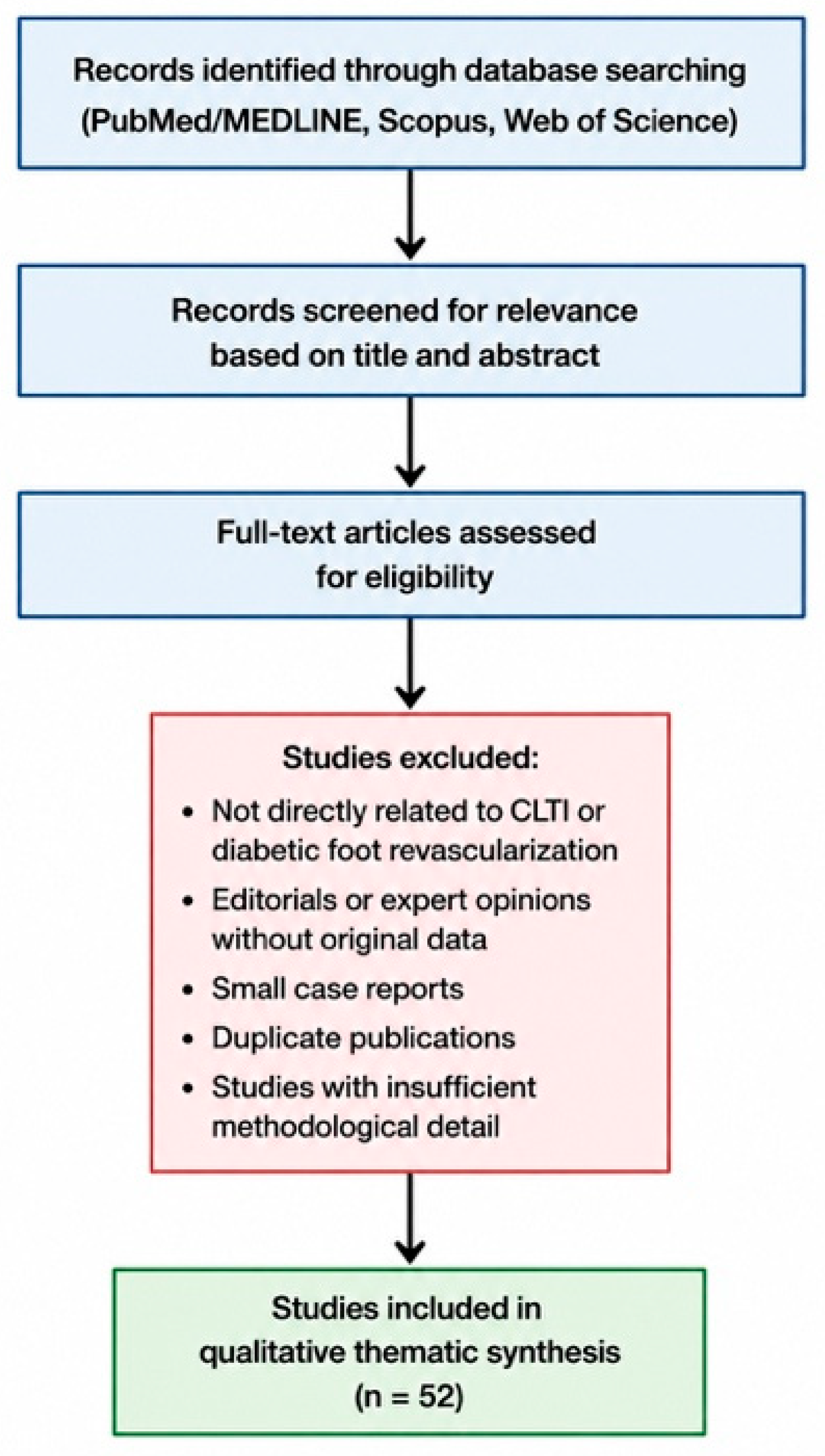
2. Methods
- clinical studies, observational cohort studies, randomized controlled trials, systematic reviews, or meta-analyses;
- investigations that involve patients with CLTI or diabetic foot ulcers;
- studies that evaluate angiosome-guided revascularization, direct versus indirect revascularization strategies or perfusion-related outcomes;
- publications written in English.
- editorials, expert opinions without original data and small case reports;
- studies that were not directly related to lower limb revascularization or wound perfusion;
- duplicate publications or studies with insufficient methodological detail.
3. Results
3.1. Angiosome Anatomy of the Foot
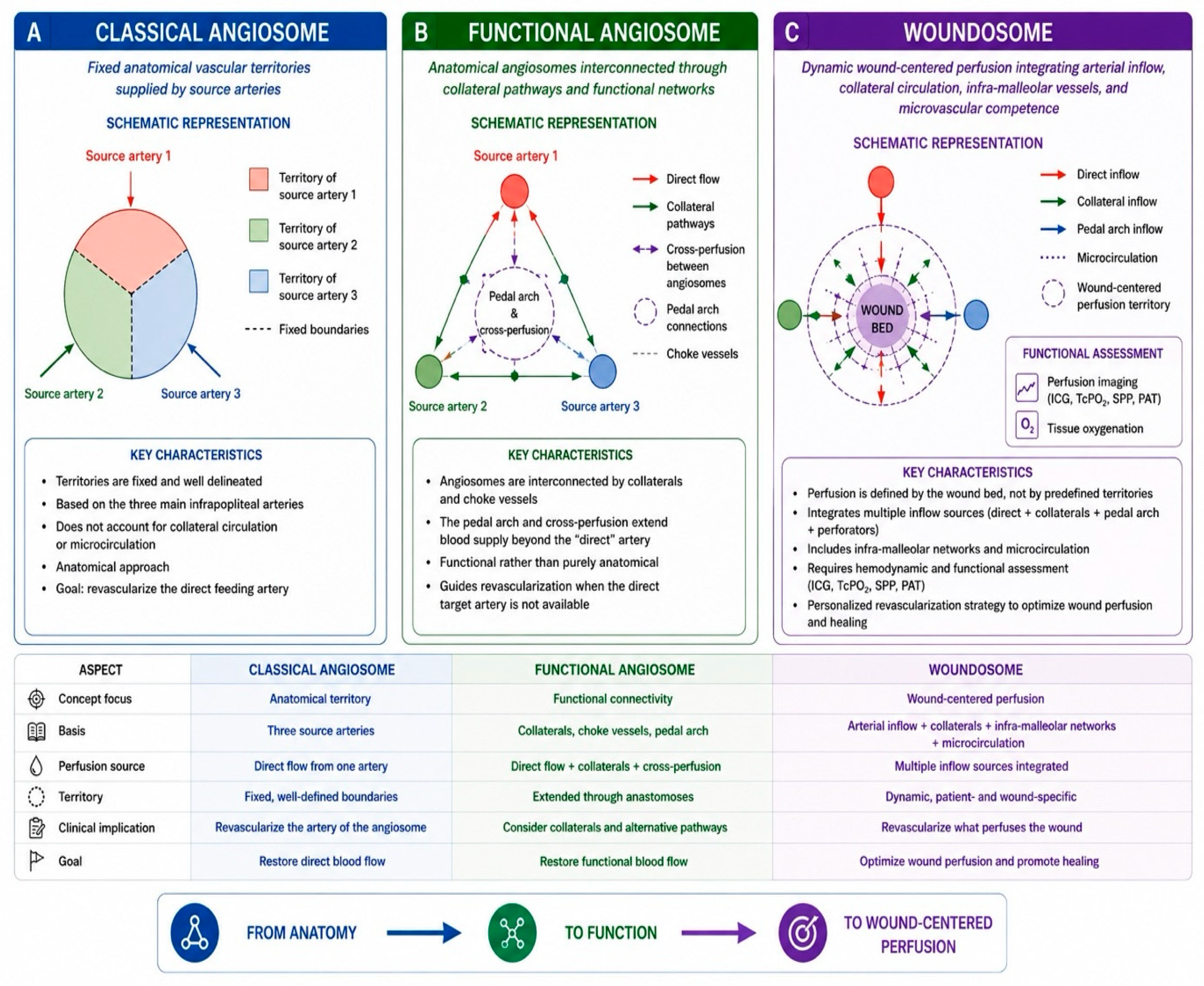
3.2. The Woundosome Concept and Its Implications for Revascularization
Clinical Definition of the Woundosome
3.3. Direct Versus Indirect Revascularization
Clinical Evidence
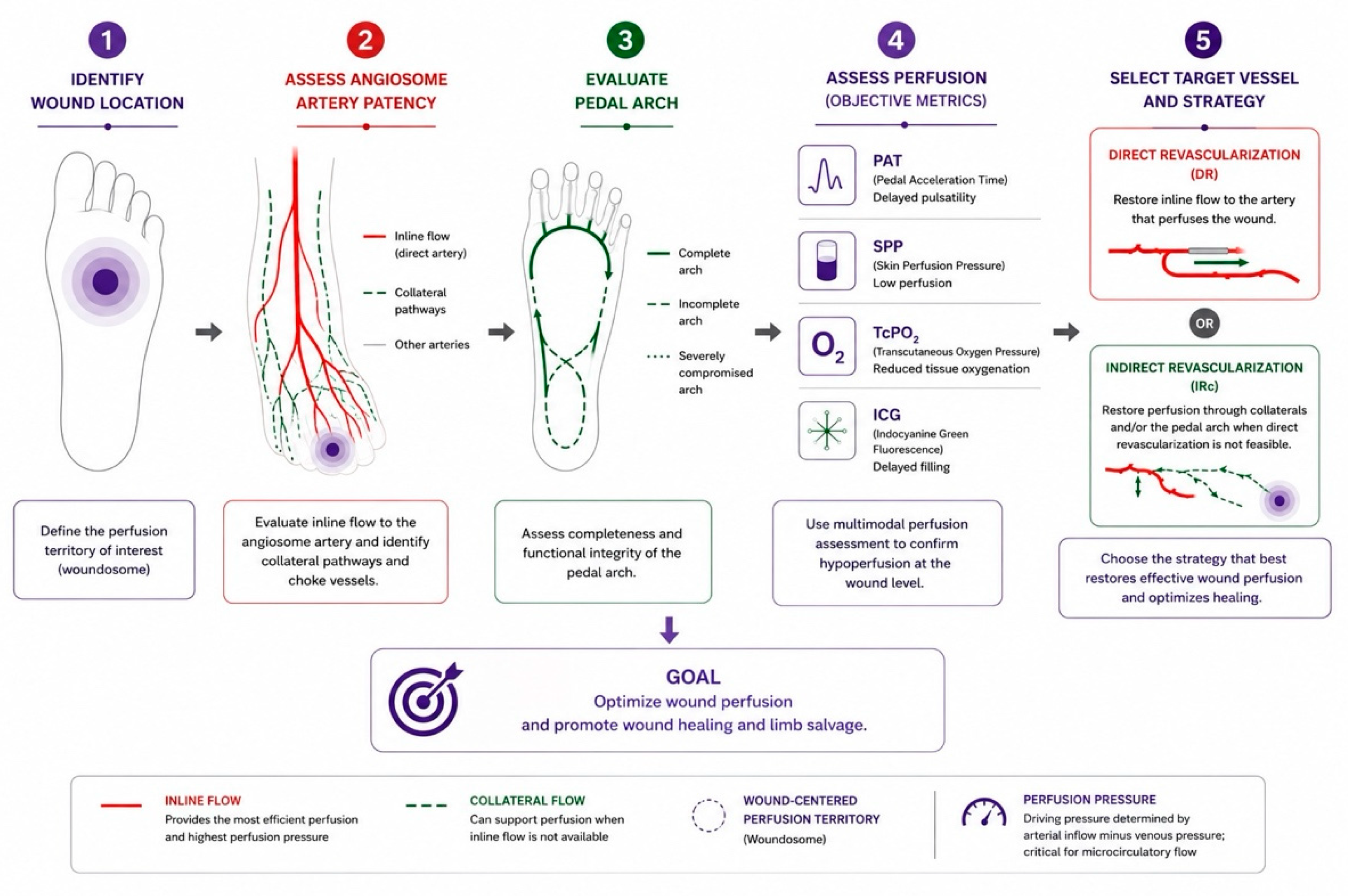
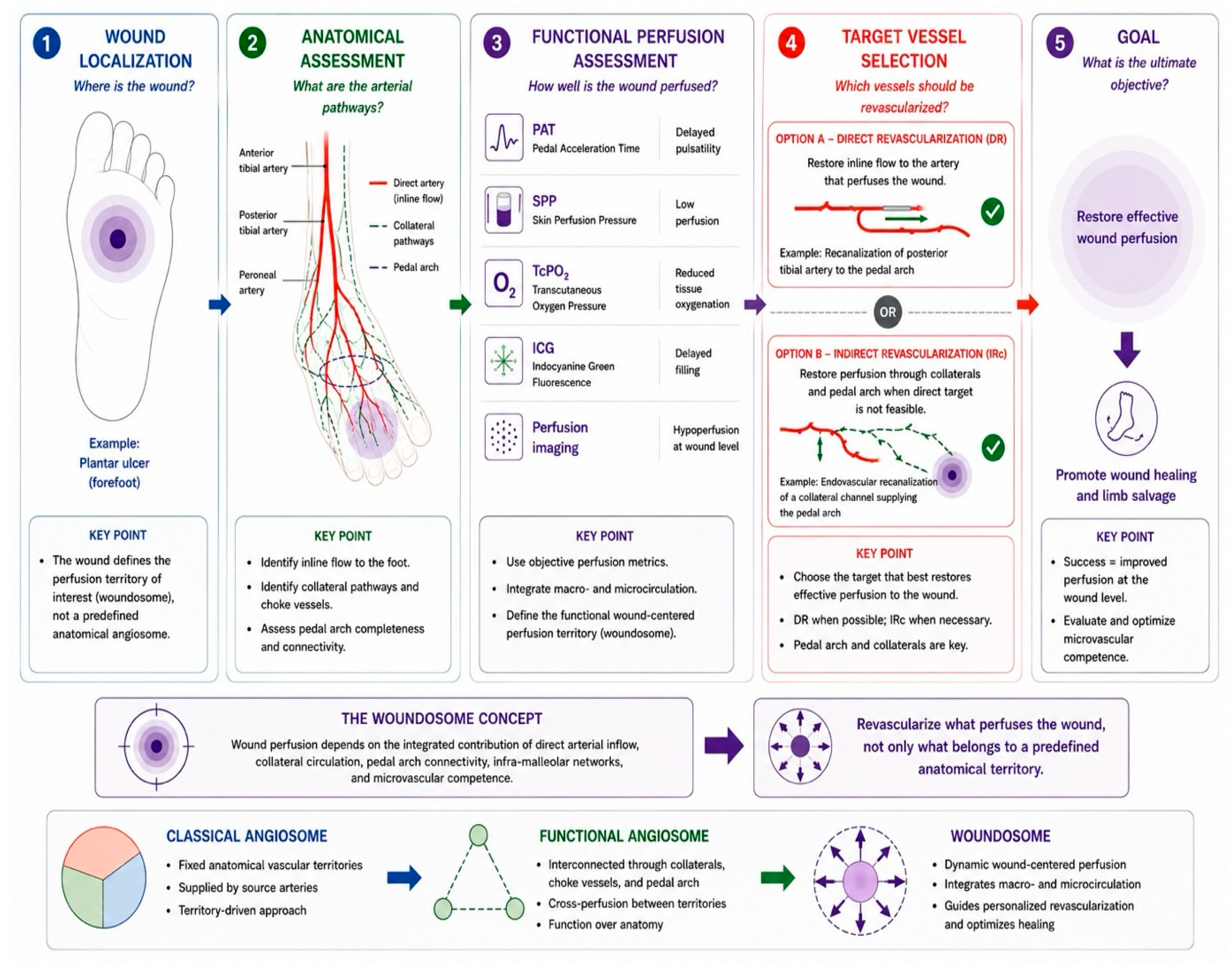
3.4. Angiosome–Woundosome Integrated Perspective
- Wound localization: precise identification of the ulcer or tissue loss location helps define the affected angiosomal territory.
- Angiosome mapping: the source artery supplying the wound-related angiosome should be identified, together with the anatomical feasibility of direct revascularization.
- Assessment of collateral circulation: angiographic evaluation should include collateral pathways and potential cross-perfusion between adjacent angiosomes.
- Technical feasibility of revascularization: lesion characteristics, vessel patency, distal runoff, and the likelihood of successful endovascular or surgical revascularization must be considered.
- Functional perfusion assessment: when available, techniques such as pedal acceleration time (PAT), indocyanine green (ICG) fluorescence angiography, hyperspectral imaging, or other perfusion imaging modalities may help evaluate microcirculatory perfusion of the wound bed.
- Target vessel selection: anatomical vascular mapping and functional perfusion findings should be integrated to identify the artery most likely to restore effective wound perfusion and support wound healing.
4. Discussion
4.1. Limitations
4.2. Contemporary Revascularization Strategies and Functional Perfusion Assessment
4.3. Future Perspectives
5. Conclusions
Author Contributions
Funding
Institutional Review Board Statement
Informed Consent Statement
Data Availability Statement
Acknowledgments
Conflicts of Interest
Abbreviations
| AFS | amputation-free survival |
| ATA | anterior tibial artery |
| BTA | below-the-ankle |
| CLTI | chronic limb-threatening ischemia |
| DCB | drug-coated balloon |
| DFU | diabetic foot ulcer |
| DR | direct revascularization |
| EVT | endovascular therapy |
| GLASS | Global Limb Anatomic Staging System |
| IR | indirect revascularization |
| IRc | indirect revascularization through collateral vessels |
| MAC | medial arterial calcification |
| PAD | peripheral arterial disease |
| PAT | pedal acceleration time |
| PTA | posterior tibial artery |
| SAD | small artery disease |
| SPP | skin perfusion pressure |
| WIfI | Wound, Ischemia, and Foot Infection |
References
- Söderström, M.; Albäck, A.; Biancari, F.; Lappalainen, K.; Lepäntalo, M.; Venermo, M. Angiosome-Targeted Infrapopliteal Endovascular Revascularization for Treatment of Diabetic Foot Ulcers. J. Vasc. Surg. 2013, 57, 427–435. [Google Scholar] [CrossRef]
- Taylor, G.I.; Palmer, J.H. The Vascular Territories (Angiosomes) of the Body: Experimental Study and Clinical Applications. Br. J. Plast. Surg. 1987, 40, 113–141. [Google Scholar] [CrossRef]
- Attinger, C.E.; Evans, K.K.; Bulan, E.; Blume, P.; Cooper, P. Angiosomes of the Foot and Ankle and Clinical Implications for Limb Salvage: Reconstruction, Incisions, and Revascularization. Plast. Reconstr. Surg. 2006, 117, 261S–293S. [Google Scholar] [CrossRef]
- Iida, O.; Nanto, S.; Uematsu, M.; Ikeoka, K.; Okamoto, S.; Dohi, T.; Fujita, M.; Terashi, H.; Nagata, S. Importance of the Angiosome Concept for Endovascular Therapy in Patients with Critical Limb Ischemia. Catheter. Cardiovasc. Interv. 2010, 75, 830–836. [Google Scholar] [CrossRef] [PubMed]
- Tarricone, A.; Gee, A.; de la Mata, K.; Rogers, L.; Wiley, J.; Lavery, L.A.; Krishnan, P. Outcomes for Patients With Chronic Limb-Threatening Ischemia After Direct and Indirect Endovascular and Surgical Revascularization: A Meta-Analysis and Systematic Review. J. Endovasc. Ther. 2026, 33, 56–63. [Google Scholar] [CrossRef]
- Iida, O.; Takahara, M.; Soga, Y.; Yamauchi, Y.; Hirano, K.; Tazaki, J.; Yamaoka, T.; Suematsu, N.; Suzuki, K.; Shintani, Y.; et al. Impact of Angiosome-Oriented Revascularization on Clinical Outcomes in Critical Limb Ischemia Patients without Concurrent Wound Infection and Diabetes. J. Endovasc. Ther. 2014, 21, 607–615. [Google Scholar] [CrossRef] [PubMed]
- Biancari, F.; Juvonen, T. Angiosome-Targeted Lower Limb Revascularization for Ischemic Foot Wounds: Systematic Review and Meta-Analysis. Eur. J. Vasc. Endovasc. Surg. 2014, 47, 517–522. [Google Scholar] [CrossRef]
- Zheng, X.-T.; Zeng, R.-C.; Huang, J.-Y.; Pan, L.-M.; Su, X.; Wu, Z.-H.; Yu, G.-F. The Use of the Angiosome Concept for Treating Infrapopliteal Critical Limb Ischemia through Interventional Therapy and Determining the Clinical Significance of Collateral Vessels. Ann. Vasc. Surg. 2016, 32, 41–49. [Google Scholar] [CrossRef]
- Bosanquet, D.C.; Glasbey, J.C.; Williams, I.M.; Twine, C.P. Systematic review and meta-analysis of direct versus indirect angiosomal revascularisation of infrapopliteal arteries. Eur. J. Vasc. Endovasc. Surg. 2014, 48, 88–97. [Google Scholar] [CrossRef] [PubMed]
- Alexandrescu, V.; Vincent, G.; Azdad, K.; Hubermont, G.; Ledent, G.; Ngongang, C.; Filimon, A.-M. A Reliable Approach to Diabetic Neuroischemic Foot Wounds: Below-the-Knee Angiosome-Oriented Angioplasty. J. Endovasc. Ther. 2011, 18, 376–387. [Google Scholar] [CrossRef]
- Conte, M.S.; Bradbury, A.W.; Kolh, P.; White, J.V.; Dick, F.; Fitridge, R.; Mills, J.L.; Ricco, J.-B.; Suresh, K.R.; Murad, M.H.; et al. Global Vascular Guidelines on the Management of Chronic Limb-Threatening Ischemia. Eur. J. Vasc. Endovasc. Surg. 2019, 58, S1–S109.e33. [Google Scholar] [CrossRef]
- Welling, R.H.A.; Bakker, O.J.; Scheinert, D.; Moll, F.L.; Hazenberg, C.E.; Mustapha, J.A.; de Borst, G.J.; Schmidt, A. Below-the-Knee Retrograde Access for Peripheral Interventions: A Systematic Review. J. Endovasc. Ther. 2018, 25, 345–352. [Google Scholar] [CrossRef] [PubMed]
- Laird, J.R.; Singh, G.D.; Armstrong, E.J. Contemporary Management of Critical Limb Ischemia: The BEST Is Yet to Come. J. Am. Coll. Cardiol. 2016, 67, 1914–1916. [Google Scholar] [CrossRef] [PubMed]
- Meloni, M.; Vas, P.R.J. Peripheral Arterial Disease in Diabetic Foot: One Disease with Multiple Patterns. J. Clin. Med. 2025, 14, 1987. [Google Scholar] [CrossRef] [PubMed]
- Dilaver, N.; Twine, C.P.; Bosanquet, D.C. Editor’s Choice-Direct vs. Indirect Angiosomal Revascularisation of Infrapopliteal Arteries, an Updated Systematic Review and Meta-Analysis. Eur. J. Vasc. Endovasc. Surg. 2018, 56, 834–848. [Google Scholar] [CrossRef]
- Sahebalzamani, E.; Tayebi, P.; Haddad Zavareh, M.S.; Bijani, A.; Hedayati Goudarzi, M.T. Challenging the Angiosome Concept: Delineating Peripheral Arterial Disease Patterns in Diabetic Foot Ulcers. Vascular 2025, 33, 665–670. [Google Scholar] [CrossRef]
- Shirasu, T.; Takagi, H.; Gregg, A.; Kuno, T.; Yasuhara, J.; Kent, K.C.; Clouse, W.D. Predictability of the Global Limb Anatomic Staging System (GLASS) for Technical and Limb Related Outcomes: A Systematic Review and Meta-Analysis. Eur. J. Vasc. Endovasc. Surg. 2022, 64, 32–40. [Google Scholar] [CrossRef]
- Chuter, V.; Schaper, N.; Hinchliffe, R.; Mills, J.; Azuma, N.; Behrendt, C.-A.; Boyko, E.J.; Conte, M.S.; Humphries, M.; Kirksey, L.; et al. Performance of Non-Invasive Bedside Vascular Testing in the Prediction of Wound Healing or Amputation among People with Foot Ulcers in Diabetes: A Systematic Review. Diabetes Metab. Res. Rev. 2024, 40, e3701. [Google Scholar] [CrossRef]
- Moysidis, T.; Patrone, L.; Böckler, D.; Niemöller, K.; Korosoglou, G. The Angiosome and Woundosome Concepts in Guiding Revascularization for Chronic Limb-Threatening Ischemia and Diabetic Foot Ulcers-a Narrative Review. Cardiovasc. Diagn. Ther. 2025, 15, 1227–1241. [Google Scholar] [CrossRef]
- Tange, F.P.; Ferrari, B.R.; van den Hoven, P.; van Schaik, J.; Schepers, A.; van Rijswijk, C.S.P.; van der Meer, R.W.; Putter, H.; Vahrmeijer, A.L.; Hamming, J.F.; et al. Evaluation of the Angiosome Concept Using Near-Infrared Fluorescence Imaging with Indocyanine Green. Ann. Vasc. Surg. 2023, 93, 283–290. [Google Scholar] [CrossRef]
- Hou, X.; Guo, P.; Cai, F.; Lin, Y.; Zhang, J. Angiosome-Guided Endovascular Revascularization for Treatment of Diabetic Foot Ulcers with Peripheral Artery Disease. Ann. Vasc. Surg. 2022, 86, 242–250. [Google Scholar] [CrossRef] [PubMed]
- Kim, S.H.; Lee, S.S. Endovascular Recanalization for Infrapopliteal Artery Disease in Chronic Limb-Threatening Ischemia: A Practical Review. Vasc. Spec. Int. 2025, 41, 39. [Google Scholar] [CrossRef]
- Taylor, G.I.; Corlett, R.J.; Ashton, M.W. The Functional Angiosome: Clinical Implications of the Anatomical Concept. Plast. Reconstr. Surg. 2017, 140, 721–733. [Google Scholar] [CrossRef] [PubMed]
- Alexandrescu, V.; Neville, R.; Kerzmann, A.; Boesmans, E.; Holemans, C.; Nicolaï, G.; Defraigne, J. Applicability of Intentional Topographic Revascularization Following the Angiosome Model in Patients with Chronic Limb-Threatening Ischemia: From Theory, to Current Clinical Challenges. Clin. Surg. 2024, 9, 1–10. [Google Scholar] [CrossRef]
- Huang, T.-Y.; Huang, T.-S.; Wang, Y.-C.; Huang, P.-F.; Yu, H.-C.; Yeh, C.-H. Direct Revascularization With the Angiosome Concept for Lower Limb Ischemia. Medicine 2015, 94, e1427. [Google Scholar] [CrossRef]
- Bekeny, J.C.; Alfawaz, A.; Day, J.; Naz, I.; Attinger, C.E.; Fan, K.L.; Evans, K.K.; Akbari, C.M. Indirect Endovascular Revascularization via Collaterals: A New Classification to Predict Wound Healing and Limb Salvage. Ann. Vasc. Surg. 2021, 73, 264–272. [Google Scholar] [CrossRef]
- Hata, Y.; Iida, O.; Mano, T. Is Angiosome-Guided Endovascular Therapy Worthwhile? Ann. Vasc. Dis. 2019, 12, 315–318. [Google Scholar] [CrossRef]
- Jongsma, H.; Bekken, J.A.; Akkersdijk, G.P.; Hoeks, S.E.; Verhagen, H.J.; Fioole, B. Angiosome-Directed Revascularization in Patients with Critical Limb Ischemia. J. Vasc. Surg. 2017, 65, 1208–1219.e1. [Google Scholar] [CrossRef]
- Kret, M.R.; Cheng, D.; Azarbal, A.F.; Mitchell, E.L.; Liem, T.K.; Moneta, G.L.; Landry, G.J. Utility of Direct Angiosome Revascularization and Runoff Scores in Predicting Outcomes in Patients Undergoing Revascularization for Critical Limb Ischemia. J. Vasc. Surg. 2014, 59, 121–128. [Google Scholar] [CrossRef]
- Popitiu, M.I.; Alexandrescu, V.A.; Clerici, G.; Ionac, S.; Gavrila-Ardelean, G.; Ion, M.G.; Ionac, M.E. Angiosome-Targeted Infrapopliteal Angioplasty: Impact on Clinical Outcomes-An Observational Study. J. Clin. Med. 2024, 13, 883. [Google Scholar] [CrossRef] [PubMed]
- Faglia, E.; Clerici, G.; Losa, S.; Tavano, D.; Caminiti, M.; Miramonti, M.; Somalvico, F.; Airoldi, F. Limb Revascularization Feasibility in Diabetic Patients with Critical Limb Ischemia: Results from a Cohort of 344 Consecutive Unselected Diabetic Patients Evaluated in 2009. Diabetes Res. Clin. Pract. 2012, 95, 364–371. [Google Scholar] [CrossRef]
- Gerassimidis, T.; Karkos, C.D.; Karamanos, D.; Kamparoudis, A. Current Endovascular Management of the Ischaemic Diabetic Foot. Hippokratia 2008, 12, 67–73. [Google Scholar]
- Troisi, N.; Turini, F.; Chisci, E.; Ercolini, L.; Frosini, P.; Lombardi, R.; Falciani, F.; Baggiore, C.; Anichini, R.; Michelagnoli, S. Impact of Pedal Arch Patency on Tissue Loss and Time to Healing in Diabetic Patients with Foot Wounds Undergoing Infrainguinal Endovascular Revascularization. Korean J. Radiol. 2018, 19, 47–53. [Google Scholar] [CrossRef]
- Hinchliffe, R.J.; Forsythe, R.O.; Apelqvist, J.; Boyko, E.J.; Fitridge, R.; Hong, J.P.; Katsanos, K.; Mills, J.L.; Nikol, S.; Reekers, J.; et al. Guidelines on Diagnosis, Prognosis, and Management of Peripheral Artery Disease in Patients with Foot Ulcers and Diabetes (IWGDF 2019 Update). Diabetes Metab. Res. Rev. 2020, 36, e3276. [Google Scholar] [CrossRef]
- Iida, O.; Takahara, M.; Soga, Y.; Yamauchi, Y.; Hirano, K.; Tazaki, J.; Yamaoka, T.; Suematsu, N.; Suzuki, K.; Shintani, Y.; et al. Worse Limb Prognosis for Indirect versus Direct Endovascular Revascularization Only in Patients with Critical Limb Ischemia Complicated with Wound Infection and Diabetes Mellitus. Eur. J. Vasc. Endovasc. Surg. 2013, 46, 575–582. [Google Scholar] [CrossRef] [PubMed]
- Miyake, K.; Kikuchi, S.; Uchida, D.; Doita, T.; Miyagawa, S.; Azuma, N. The Impact of Angiographic Pedal Circulation Status on Wound Healing in Chronic Limb-Threatening Ischemia after Bypass Surgery. J. Vasc. Surg. 2024, 80, 1836–1846. [Google Scholar] [CrossRef]
- Moakes, C.A.; Bradbury, A.W.; Abdali, Z.; Bate, G.R.; Hall, J.; Jarrett, H.; Kelly, L.; Kigozi, J.; Lockyer, S.; Meecham, L.; et al. BASIL-2 Investigators. Vein bypass first vs. best endovascular treatment first revascularisation strategy for chronic limb-threatening ischaemia due to infra-popliteal disease: The BASIL-2 RCT. Health Technol. Assess. 2024, 28, 1–72. [Google Scholar] [CrossRef]
- Alexandrescu, V.A.; Brochier, S.; Schoenen, S.; Antonelli, E.; Azdad, K.; Zekhnini, I.; Nodit, M. Grades of Below-the-Ankle Arterial Occlusive Disease Following the Angiosome Perfusion: A New Morphological Assessment and Correlations with the Inframalleolar GVG Stratification in CLTI Patients. Ann. Vasc. Surg. 2022, 81, 358–377. [Google Scholar] [CrossRef] [PubMed]
- Kim, K.G.; Meshkin, D.H.; Tirrell, A.R.; Bekeny, J.C.; Tefera, E.A.; Fan, K.L.; Akbari, C.M.; Evans, K.K. A Systematic Review and Meta-Analysis of Endovascular Angiosomal Revascularization in the Setting of Collateral Vessels. J. Vasc. Surg. 2021, 74, 1406–1416.e3. [Google Scholar] [CrossRef]
- Serizawa, F.; Nakano, Y.; Hashimoto, M.; Tamate, Y.; Sato, H.; Ohara, M.; Kawamura, K.; Akamatsu, D.; Kamei, T. Distal Bypass Improves Skin Perfusion Pressure at the Whole Foot Regardless of Angiosomes in Patients with Chronic Limb-Threatening Ischemia. Ann. Vasc. Dis. 2024, 17, 150–156. [Google Scholar] [CrossRef] [PubMed]
- Azuma, N.; Uchida, H.; Kokubo, T.; Koya, A.; Akasaka, N.; Sasajima, T. Factors Influencing Wound Healing of Critical Ischaemic Foot after Bypass Surgery: Is the Angiosome Important in Selecting Bypass Target Artery? Eur. J. Vasc. Endovasc. Surg. 2012, 43, 322–328. [Google Scholar] [CrossRef] [PubMed]
- Acín, F.; Varela, C.; López de Maturana, I.; de Haro, J.; Bleda, S.; Rodriguez-Padilla, J. Results of Infrapopliteal Endovascular Procedures Performed in Diabetic Patients with Critical Limb Ischemia and Tissue Loss from the Perspective of an Angiosome-Oriented Revascularization Strategy. Int. J. Vasc. Med. 2014, 2014, 270539. [Google Scholar] [CrossRef] [PubMed]
- Kabra, A.; Suresh, K.R.; Vivekanand, V.; Vishnu, M.; Sumanth, R.; Nekkanti, M. Outcomes of Angiosome and Non-Angiosome Targeted Revascularization in Critical Lower Limb Ischemia. J. Vasc. Surg. 2013, 57, 44–49. [Google Scholar] [CrossRef]
- Alexandrescu, V.-A.; Hubermont, G.; Philips, Y.; Guillaumie, B.; Ngongang, C.; Vandenbossche, P.; Azdad, K.; Ledent, G.; Horion, J. Selective Primary Angioplasty Following an Angiosome Model of Reperfusion in the Treatment of Wagner 1-4 Diabetic Foot Lesions: Practice in a Multidisciplinary Diabetic Limb Service. J. Endovasc. Ther. 2008, 15, 580–593. [Google Scholar] [CrossRef] [PubMed]
- Ferraresi, R.; Ucci, A.; Pizzuto, A.; Losurdo, F.; Caminiti, M.; Minnella, D.; Casini, A.; Clerici, G.; Montero-Baker, M.; Mills, J. A Novel Scoring System for Small Artery Disease and Medial Arterial Calcification Is Strongly Associated With Major Adverse Limb Events in Patients With Chronic Limb-Threatening Ischemia. J. Endovasc. Ther. 2021, 28, 194–207. [Google Scholar] [CrossRef]
- Tun, G.; Woodford, C.; Flanagan, C.; Schneider, P.A.; Conte, M.S.; Gomez-Sanchez, C.M. Validation of Pedal Acceleration Time for the Assessment of Perfusion in Patients with Chronic Limb-Threatening Ischemia. Ann. Vasc. Surg. 2025, 121, 351–359. [Google Scholar] [CrossRef]
- McGinigle, K.L.; Menard, M.T.; Doros, G.; Strong, M.B.; Farber, A.; Conte, M.S. Editor’s Choice-Association Between Anatomical Patterns of Arterial Occlusive Disease and Endovascular Outcomes in the BEST-CLI Trial Supports the Use of the Global Limb Anatomic Staging System. Eur. J. Vasc. Endovasc. Surg. 2026, 71, 284–291. [Google Scholar] [CrossRef]
- Liu, I.H.; Wu, B.; Krepkiy, V.; Ferraresi, R.; Reyzelman, A.M.; Hiramoto, J.S.; Schneider, P.A.; Conte, M.S.; Vartanian, S.M. Pedal Arterial Calcification Score Is Associated with the Risk of Major Amputation in Chronic Limb-Threatening Ischemia. J. Vasc. Surg. 2022, 75, 270–278.e3. [Google Scholar] [CrossRef]
- Kawarada, O.; Fujihara, M.; Higashimori, A.; Yokoi, Y.; Honda, Y.; Fitzgerald, P.J. Predictors of Adverse Clinical Outcomes after Successful Infrapopliteal Intervention. Catheter. Cardiovasc. Interv. 2012, 80, 861–871. [Google Scholar] [CrossRef]
- Watson, N.W.; Mosarla, R.C.; Secemsky, E.A. Endovascular Interventions for Peripheral Artery Disease: A Contemporary Review. Curr. Cardiol. Rep. 2023, 25, 1611–1622. [Google Scholar] [CrossRef]
- Norgren, L.; Hiatt, W.R.; Dormandy, J.A.; Nehler, M.R.; Harris, K.A.; Fowkes, F.G.R.; TASC II Working Group; Bell, K.; Caporusso, J.; Durand-Zaleski, I.; et al. Inter-Society Consensus for the Management of Peripheral Arterial Disease (TASC II). Eur. J. Vasc. 2007, 33, S1–S75. [Google Scholar] [CrossRef] [PubMed]
- Teso, D.; Sommerset, J.; Dally, M.; Feliciano, B.; Vea, Y.; Jones, R.K. Pedal Acceleration Time (PAT): A Novel Predictor of Limb Salvage. Ann. Vasc. Surg. 2021, 75, 189–193. [Google Scholar] [CrossRef] [PubMed]
- Farber, A.; Menard, M.T.; Conte, M.S.; Kaufman, J.A.; Powell, R.J.; Choudhry, N.K.; Hamza, T.H.; Assmann, S.F.; Creager, M.A.; Cziraky, M.J.; et al. Surgery or Endovascular Therapy for Chronic Limb-Threatening Ischemia. N. Engl. J. Med. 2022, 387, 2305–2316. [Google Scholar] [CrossRef]
- de Athayde Soares, R.; Matielo, M.F.; Brochado Neto, F.C.; Veloso de Melo, B.; Maia Pires, A.P.; Tiossi, S.R.; Godoy, M.R.; Sacilotto, R. WIfI Classification Versus Angiosome Concept: A Change in the Infrapopliteal Angioplasties Paradigm. Ann. Vasc. Surg. 2021, 71, 338–345. [Google Scholar] [CrossRef] [PubMed]



| Source Artery | Angiosome | Main Territory | Clinical Relevance |
|---|---|---|---|
| Posterior tibial artery | Medial plantar | Medial plantar instep | Plantar midfoot ulcers |
| Posterior tibial artery | Lateral plantar | Plantar forefoot and lateral plantar foot | Plantar forefoot ulcers |
| Posterior tibial artery | Calcaneal | Plantar heel | Heel ulcers |
| Anterior tibial artery (dorsalis pedis) | Dorsal foot angiosome | Dorsum of the foot and toes | Dorsal ulcers |
| Peroneal artery | Anterolateral ankle | Anterior-lateral ankle | Ankle wounds |
| Peroneal artery | Lateral calcaneal | Lateral heel | Lateral heel ulcers |
| Study | Year | Study Type | Population/Model | Main Concept | Key Findings |
|---|---|---|---|---|---|
| Tarricone et al. [5] | 2026 | Systematic review and meta-analysis | 985 patients with CLTI; analysis of 9 primary studies | DR vs. IR |
|
| Moysidis et al. [19] | 2025 | Narrative review | Patients with CLTI and DFU; analysis of 14 primary studies | Angiosome vs. woundosome concept |
|
| Miyake et al. [36] | 2024 | Single-center retrospective cohort study | 117 limbs (108 patients) with CLTI and foot wounds with bypass surgery (popliteal, crural, or pedal arteries) | Assessing how pedal circulation status, visualized through angiography, and WIfI classification influence graft patency and wound healing. |
|
| Serizawa et al. [40] | 2024 | Prospective multicenter observational study | 29 lower limbs evaluated in 27 patients with CLTI. | Measuring SPP after DR vs. IR to determine if treatment efficacy depends on the angiosome concept |
|
| Sahebalzamani et al. [16] | 2024 | Cross-sectional study | 84 patients (89 lower limbs evaluated) with DFU | Analysis of the validity and clinical applicability of the angiosome concept for DFU |
|
| Tange et al. [20] | 2023 | Prospective cohort study | 52 patients (54 limbs) with lower extremity arterial disease | Used indocyanine green near-infrared fluorescence imaging to measure microvascular flow changes after DR and IR |
|
| Alexandrescu et al. [38] | 2022 | Retrospective analysis | 336 ischemic feet (221 in diabetic patients) with Rutherford 5 CLTI | The introduction and validation of a 4-grade morphological classification (grades A-D) for BTA arterial disease in patients with CLTI |
|
| Kim et al. [39] | 2021 | Systematic review and meta-analysis | 4252 limbs (2231 DR; 1647 IR; 270 IR though collateral vessels) in patients with critical limb ischemia | Comparison of DR, IR, and IRc in treating lower extremity wounds with the angiosome concept. |
|
| Study | Year | Study Design | Population/Model | Revascularization Type | Main Outcomes | Key Findings |
|---|---|---|---|---|---|---|
| Tarricone et al. [5] | 2026 | Systematic review and meta-analysis | 985 CLTI patients from 9 clinical studies | Mixed (EVT and surgical bypass) | AFS, wound healing (6 months), and survival for DR vs. IR compared across studies |
|
| Moysidis et al. [19] | 2025 | Narrative review | Patients with CLTI and DFU | EVT and surgical (bypass) | Comparison of wound healing and limb salvage between the angiosome approach and the woundosome strategy |
|
| Meloni & Vas [14] | 2025 | Review | Patients with ischemic DFU | Surgical bypass, EVT, cell therapy | Relation between three PAD patterns, healing rates and the major amputation risk |
|
| Popitiu et al. [30] | 2024 | Retrospective observational study | 51 patients (51 limbs) with Rutherford 5–6 CLTI | EVT-DCB vs. plain balloon | Ulcer healing, limb salvage, and AFS in DR vs. IR and DCB vs. plain balloon |
|
| Hou et al. [21] | 2022 | Retrospective study | 112 legs in 111 patients with DFU and PAD | EVT-percutaneous transluminal angioplasty/stent | Ulcer healing rate, mean time to healing, survival rate, and major amputation-free survival (AFS) within a 1-year follow-up period. |
|
| Clinical Aspect | Angiosome Concept | Woundosome Concept | Integrated Clinical Implication |
|---|---|---|---|
| Main focus | Anatomical vascular territory | Functional wound perfusion | Combined anatomical-functional assessment |
| Target selection | Source artery to wound angiosome | Effective perfusion to wound bed | Personalized revascularization planning |
| Collateral circulation | Secondary role | Central role | Assessment of collateral reserve |
| Pedal arch | Anatomical continuity | Functional perfusion support | Evaluation of distal perfusion |
| Imaging | Angiography | SPP, TcPO2, PAT, ICG | Multimodal perfusion assessment |
| Clinical objective | Direct arterial reperfusion | Restoration of wound perfusion | Optimization of wound healing and limb salvage |
Disclaimer/Publisher’s Note: The statements, opinions and data contained in all publications are solely those of the individual author(s) and contributor(s) and not of MDPI and/or the editor(s). MDPI and/or the editor(s) disclaim responsibility for any injury to people or property resulting from any ideas, methods, instructions or products referred to in the content. |
© 2026 by the authors. Licensee MDPI, Basel, Switzerland. This article is an open access article distributed under the terms and conditions of the Creative Commons Attribution (CC BY) license.
Share and Cite
Popitiu, M.I.; Patrone, L.; Clerici, G.; Comsa, S.; Gavrila-Ardelean, G.; Kundnani, N.R.; Olariu, N.; Ionac, M.E. From Angiosome to Woundosome: An Interdisciplinary Approach to Personalized Revascularization in Chronic Limb-Threatening Ischemia. Diagnostics 2026, 16, 1557. https://doi.org/10.3390/diagnostics16101557
Popitiu MI, Patrone L, Clerici G, Comsa S, Gavrila-Ardelean G, Kundnani NR, Olariu N, Ionac ME. From Angiosome to Woundosome: An Interdisciplinary Approach to Personalized Revascularization in Chronic Limb-Threatening Ischemia. Diagnostics. 2026; 16(10):1557. https://doi.org/10.3390/diagnostics16101557
Chicago/Turabian StylePopitiu, Mircea Ionut, Lorenzo Patrone, Giacomo Clerici, Serban Comsa, Gloria Gavrila-Ardelean, Nilima Rajpal Kundnani, Nicu Olariu, and Mihai Edmond Ionac. 2026. "From Angiosome to Woundosome: An Interdisciplinary Approach to Personalized Revascularization in Chronic Limb-Threatening Ischemia" Diagnostics 16, no. 10: 1557. https://doi.org/10.3390/diagnostics16101557
APA StylePopitiu, M. I., Patrone, L., Clerici, G., Comsa, S., Gavrila-Ardelean, G., Kundnani, N. R., Olariu, N., & Ionac, M. E. (2026). From Angiosome to Woundosome: An Interdisciplinary Approach to Personalized Revascularization in Chronic Limb-Threatening Ischemia. Diagnostics, 16(10), 1557. https://doi.org/10.3390/diagnostics16101557