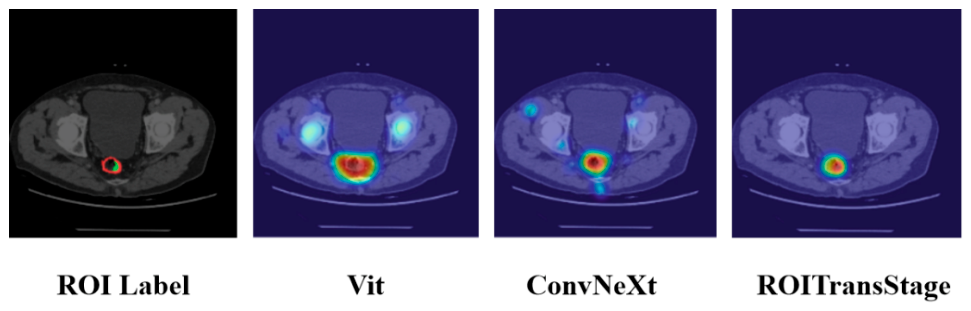
The Diagnostic Value of Deep Learning for Multi-Classification of Rectal Cancer T Staging Based on Regional Attention

 , ,
, ,
Abstract
1. Introduction
2. Materials and Methods
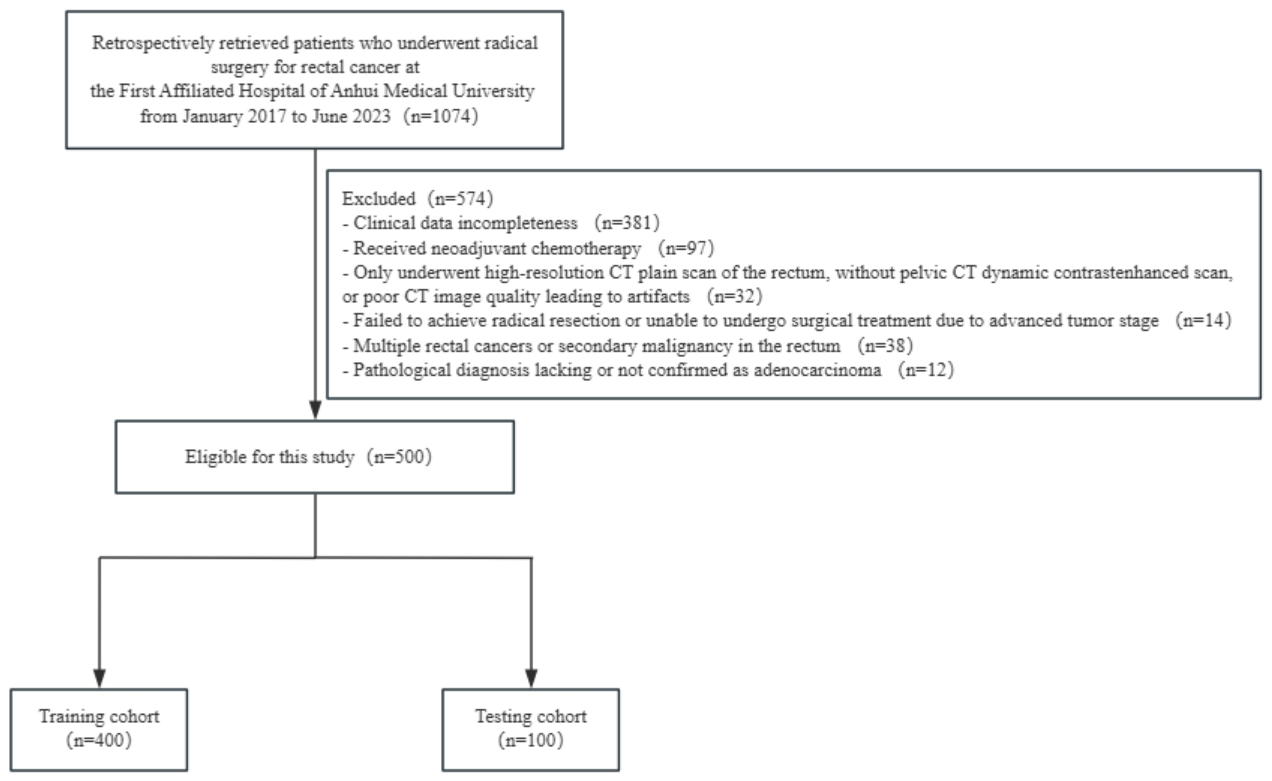
2.1. Patient Selection
2.2. Imaging
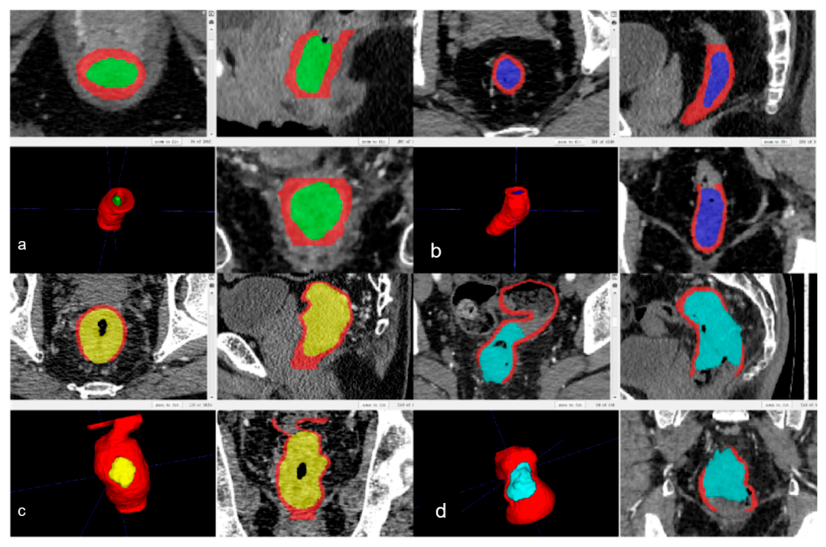
2.3. Data Preprocessing
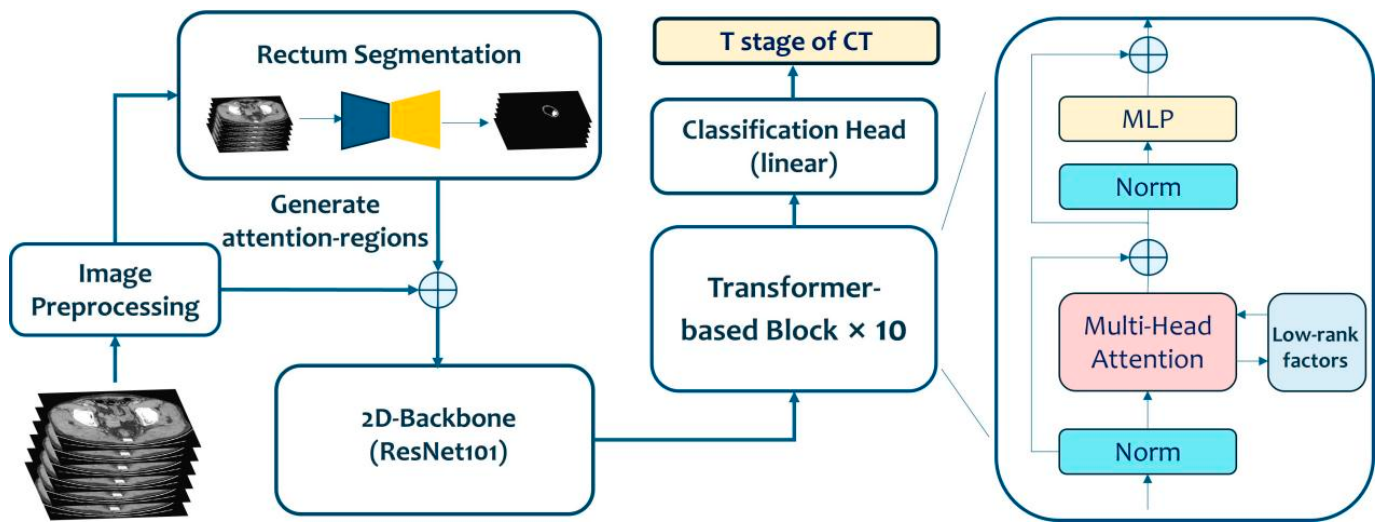
2.4. Construction of Deep Learning Model Based on Regional Attention
2.5. Feature Selection and Radiomics Model Construction
2.6. Construction of the Clinical Baseline Data Model
2.7. Radiomics Feature Processing and Model Development
3. Results
3.1. Sample Details
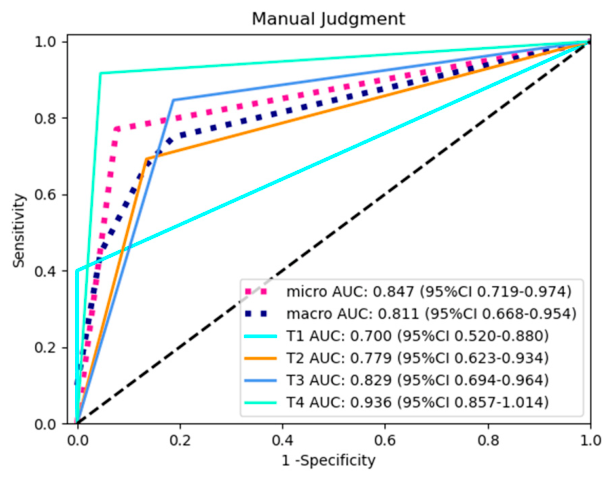
3.2. Predictive Performance of Deep Learning Model for T Staging
3.3. Predictive Performance of the Radiomics Model
3.4. Predictive Performance of the Baseline Clinical Data Model
4. Discussion
Author Contributions
Funding
Institutional Review Board Statement
Informed Consent Statement
Data Availability Statement
Acknowledgments
Conflicts of Interest
Appendix A
Appendix A.1
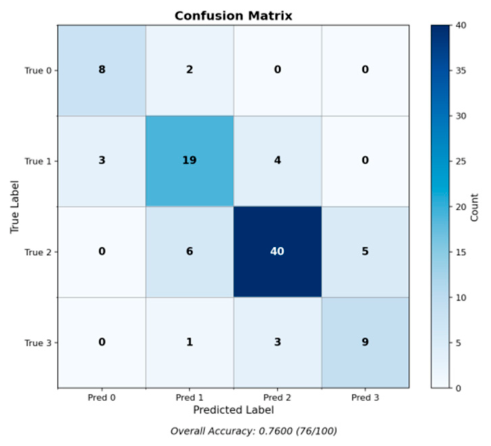
Appendix A.2
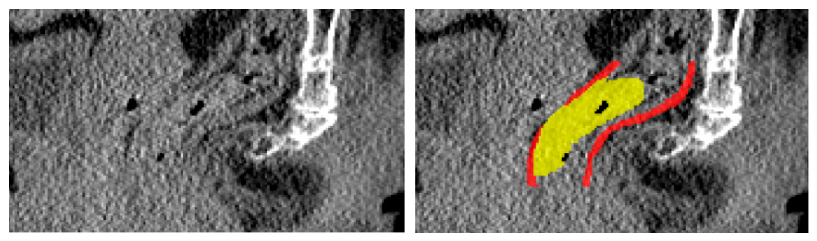
Appendix A.3
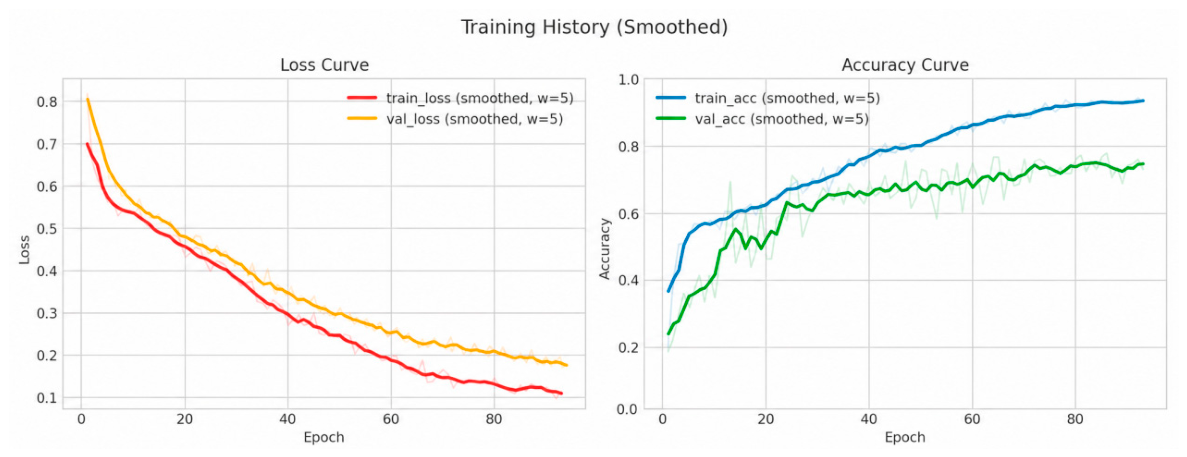
Appendix A.4

Appendix A.5

| Precision | Recall | F1-Score | |
|---|---|---|---|
| T1 | 0.7273 | 0.8 | 0.7619 |
| T2 | 0.6786 | 0.7308 | 0.7037 |
| T3 | 0.8511 | 0.7843 | 0.8163 |
| T4 | 0.6429 | 0.6923 | 0.6667 |
| Macro-Avg | 0.7249 | 0.7518 | 0.7372 |
| Micro-Avg | 0.76 | 0.76 | 0.76 |
References
- Siegel, R.L.; Miller, K.D.; Fuchs, H.E.; Jemal, A. Cancer Statistics, 2021. CA Cancer J. Clin. 2021, 71, 7–33. [Google Scholar] [CrossRef] [PubMed]
- Sung, H.; Ferlay, J.; Siegel, R.L.; Laversanne, M.; Soerjomataram, I.; Jemal, A.; Bray, F. Global Cancer Statistics 2020: GLOBOCAN Estimates of Incidence and Mortality Worldwide for 36 Cancers in 185 Countries. CA Cancer J. Clin. 2021, 71, 209–249. [Google Scholar] [CrossRef]
- Lu, L.; Mullins, C.S.; Schafmayer, C.; Zeissig, S.; Linnebacher, M. A global assessment of recent trends in gastrointestinal cancer and lifestyle-associated risk factors. Cancer Commun. 2021, 41, 1137–1151. [Google Scholar] [CrossRef]
- Kasi, A.; Abbasi, S.; Handa, S.; Al-Rajabi, R.; Saeed, A.; Baranda, J.; Sun, W. Total Neoadjuvant Therapy vs Standard Therapy in Locally Advanced Rectal Cancer: A Systematic Review and Meta-analysis. JAMA Netw. Open 2020, 3, e2030097. [Google Scholar] [CrossRef]
- Sebag-Montefiore, D.; Stephens, R.J.; Steele, R.; Monson, J.; Grieve, R.; Khanna, S.; Quirke, P.; Couture, J.; de Metz, C.; Myint, A.S.; et al. Preoperative radiotherapy versus selective postoperative chemoradiotherapy in patients with rectal cancer (MRC CR07 and NCIC-CTG C016): A multicentre, randomised trial. Lancet 2009, 373, 811–820. [Google Scholar] [CrossRef] [PubMed]
- VanderWalde, N.; Grothey, A. Personalizing Treatment for Rectal Cancer: Total Neoadjuvant Therapy Is Leading the Way. JAMA Netw. Open 2020, 3, e2030508. [Google Scholar] [CrossRef]
- Linden, T.; Hanses, F.; Domingo-Fernandez, D.; DeLong, L.N.; Kodamullil, A.T.; Schneider, J.; Vehreschild, M.; Lanznaster, J.; Ruethrich, M.M.; Borgmann, S.; et al. Machine Learning Based Prediction of COVID-19 Mortality Suggests Repositioning of Anticancer Drug for Treating Severe Cases. Artif. Intell. Life Sci. 2021, 1, 100020. [Google Scholar] [CrossRef]
- Gillies, R.J.; Kinahan, P.E.; Hricak, H. Radiomics: Images Are More than Pictures, They Are Data. Radiology 2016, 278, 563–577. [Google Scholar] [CrossRef]
- Khorrami, M.; Bera, K.; Leo, P.; Vaidya, P.; Patil, P.; Thawani, R.; Velu, P.; Rajiah, P.; Alilou, M.; Choi, H.; et al. Stable and discriminating radiomic predictor of recurrence in early stage non-small cell lung cancer: Multi-site study. Lung Cancer 2020, 142, 90–97. [Google Scholar] [CrossRef]
- Zheng, J.; Kong, J.; Wu, S.; Li, Y.; Cai, J.; Yu, H.; Xie, W.; Qin, H.; Wu, Z.; Huang, J.; et al. Development of a noninvasive tool to preoperatively evaluate the muscular invasiveness of bladder cancer using a radiomics approach. Cancer 2019, 125, 4388–4398. [Google Scholar] [CrossRef] [PubMed]
- Patanè, V.; Atripaldi, U.; Sansone, M.; Marinelli, L.; Del Tufo, S.; Arrichiello, G.; Ciardiello, D.; Selvaggi, F.; Martinelli, E.; Reginelli, A. MRI-based radiomics for preoperative T-staging of rectal cancer: A retrospective analysis. Int. J. Color. Dis. 2025, 40, 174. [Google Scholar] [CrossRef]
- Knuth, F.; Adde, I.A.; Huynh, B.N.; Groendahl, A.R.; Winter, R.M.; Negård, A.; Holmedal, S.H.; Meltzer, S.; Ree, A.H.; Flatmark, K.; et al. MRI-based automatic segmentation of rectal cancer using 2D U-Net on two independent cohorts. Acta Oncol. 2022, 61, 255–263. [Google Scholar] [CrossRef]
- Wang, J.; Lu, J.; Qin, G.; Shen, L.; Sun, Y.; Ying, H.; Zhang, Z.; Hu, W. Technical Note: A deep learning-based autosegmentation of rectal tumors in MR images. Med. Phys. 2018, 45, 2560–2564. [Google Scholar] [CrossRef] [PubMed]
- Trebeschi, S.; van Griethuysen, J.J.M.; Lambregts, D.M.J.; Lahaye, M.J.; Parmar, C.; Bakers, F.C.H.; Peters, N.; Beets-Tan, R.G.H.; Aerts, H. Deep Learning for Fully-Automated Localization and Segmentation of Rectal Cancer on Multiparametric MR. Sci. Rep. 2017, 7, 5301. [Google Scholar] [CrossRef]
- Ghuman, S.S.; Kochhar, R.; Mahajan, H.; Buxi, T.B.S.; Gupta, A.; Arora, A.; Saxena, K.K.; Sud, S.; Sud, A.; Rawat, K.; et al. CT and MR Imaging in Colorectal Carcinoma: A Tool for Diagnosis, Staging, Response Evaluation, and Follow-Up. South Asian J. Cancer 2024, 13, 236–240. [Google Scholar] [CrossRef]
- Ippolito, D.; Drago, S.G.; Franzesi, C.T.; Fior, D.; Sironi, S. Rectal cancer staging: Multidetector-row computed tomography diagnostic accuracy in assessment of mesorectal fascia invasion. World J. Gastroenterol. 2016, 22, 4891–4900. [Google Scholar] [CrossRef]
- Kirillov, A.; Mintun, E.; Ravi, N.; Mao, H.; Rolland, C.; Gustafson, L.; Xiao, T.; Whitehead, S.; Berg, A.C.; Lo, W.-Y. Segment anything. arXiv 2023, arXiv:2304.02643. [Google Scholar]
- Liu, Z.; Mao, H.; Wu, C.-Y.; Feichtenhofer, C.; Darrell, T.; Xie, S. A convnet for the 2020s. In Proceedings of the IEEE/CVF Conference on Computer Vision and Pattern Recognition, New Orleans, LA, USA, 18–24 June 2022; pp. 11976–11986. [Google Scholar]
- Dosovitskiy, A.; Beyer, L.; Kolesnikov, A.; Weissenborn, D.; Zhai, X.; Unterthiner, T.; Dehghani, M.; Minderer, M.; Heigold, G.; Gelly, S. An image is worth 16x16 words: Transformers for image recognition at scale. arXiv 2020, arXiv:2010.11929. [Google Scholar]
- Babu, V.G.; Badiger, V.B.; Prabhu, V.M.D.; Agarwal, R.; Krishnamurthy, U. Determination of the Accuracy of Computed Tomography in Staging Primary Rectal Carcinoma and Lymph Node Spread Post Chemoradiation Therapy. Cureus 2026, 18, e105371. [Google Scholar] [CrossRef] [PubMed]
- Hou, M.; Zhou, L.; Sun, J. Deep-learning-based 3D super-resolution MRI radiomics model: Superior predictive performance in preoperative T-staging of rectal cancer. Eur. Radiol. 2023, 33, 1–10. [Google Scholar] [CrossRef]
- Benson, A.B.; Venook, A.P.; Al-Hawary, M.M.; Cederquist, L.; Chen, Y.J.; Ciombor, K.K.; Cohen, S.; Cooper, H.S.; Deming, D.; Engstrom, P.F.; et al. Rectal Cancer, Version 2.2018, NCCN Clinical Practice Guidelines in Oncology. J. Natl. Compr. Cancer Netw. 2018, 16, 874–901. [Google Scholar] [CrossRef]
- Sun, D.; Wu, X.; Wang, L.; Li, G.; Huang, J.; Li, Y. Distinguishing T1-2 and T3a tumors of rectal cancer with texture analysis and functional MRI parameters. Diagn. Interv. Radiol. 2022, 28, 200–207. [Google Scholar] [CrossRef] [PubMed]
- Dou, M.; Chen, Z.; Tang, Y.; Sheng, L.; Zhou, J.; Wang, X.; Yao, Y. Segmentation of rectal tumor from multi-parametric MRI images using an attention-based fusion network. Med. Biol. Eng. Comput. 2023, 61, 2379–2389. [Google Scholar] [CrossRef]
- Zhang, K.; Yang, X.; Cui, Y.; Zhao, J.; Li, D. Automatic segmentation of rectal tumors from MRI using multiscale densely connected convolutional neural network based on attention mechanism. Phys. Med. Biol. 2023, 68, 165001. [Google Scholar] [CrossRef]
- Qiu, C.; Miller, S.; Subramanian, B.; Ryu, A.; Zhang, H.; Fisher, G.A.; Shah, N.H.; Mongan, J.; Langlotz, C.; Poullos, P.; et al. A deep learning-based automated pipeline for colorectal cancer detection in contrast-enhanced CT images. Comput. Med. Imaging Graph. 2026, 128, 102717. [Google Scholar] [CrossRef]
- Dalmis, M.U.; Gubern-Merida, A.; Vreemann, S.; Bult, P.; Karssemeijer, N.; Mann, R.; Teuwen, J. Artificial Intelligence-Based Classification of Breast Lesions Imaged with a Multiparametric Breast MRI Protocol with Ultrafast DCE-MRI, T2, and DWI. Investig. Radiol. 2019, 54, 325–332. [Google Scholar] [CrossRef] [PubMed]
- Xi, I.L.; Zhao, Y.; Wang, R.; Chang, M.; Purkayastha, S.; Chang, K.; Huang, R.Y.; Silva, A.C.; Vallieres, M.; Habibollahi, P.; et al. Deep Learning to Distinguish Benign from Malignant Renal Lesions Based on Routine MR Imaging. Clin. Cancer Res. 2020, 26, 1944–1952. [Google Scholar] [CrossRef] [PubMed]
- Mao, N.; Zhang, H.; Dai, Y.; Li, Q.; Lin, F.; Gao, J.; Zheng, T.; Zhao, F.; Xie, H.; Xu, C.; et al. Attention-based deep learning for breast lesions classification on contrast enhanced spectral mammography: A multicentre study. Br. J. Cancer 2023, 128, 793–804. [Google Scholar] [CrossRef]


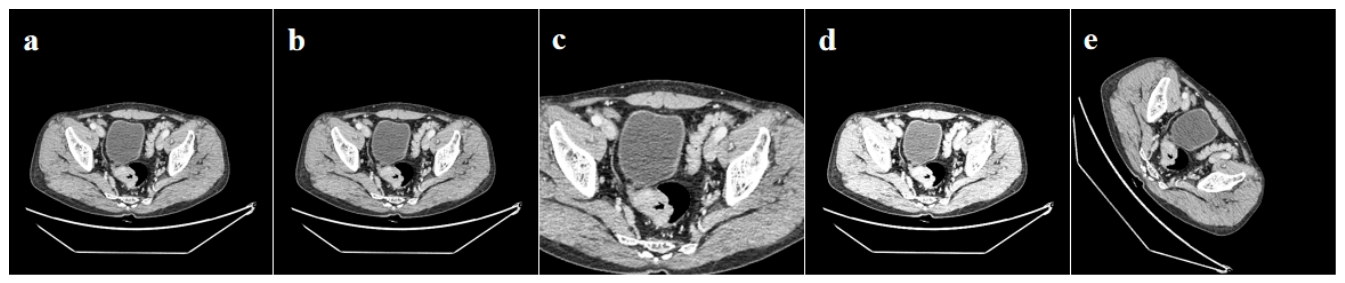



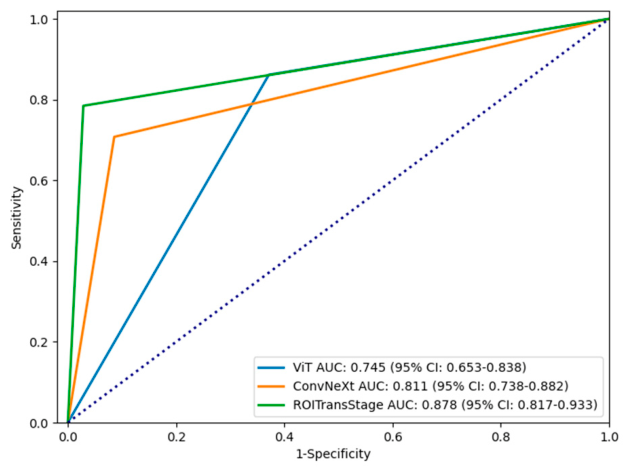
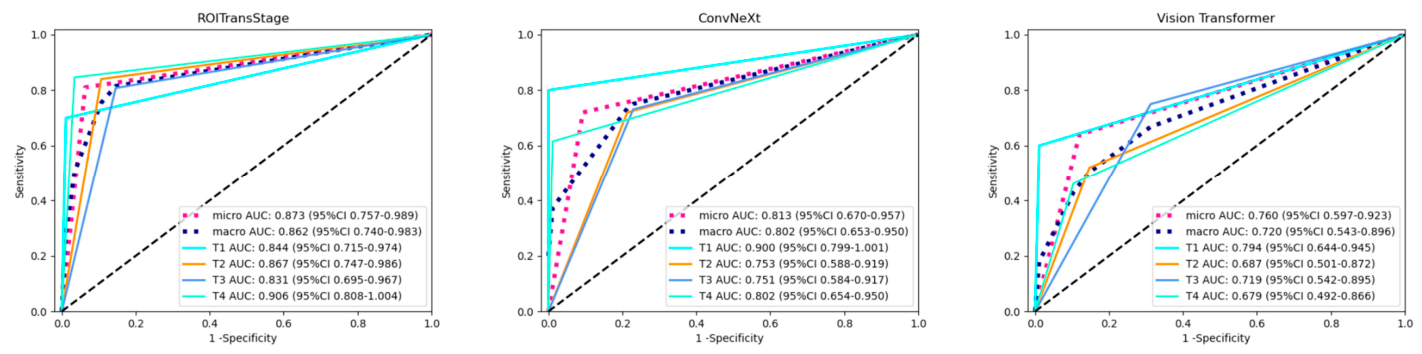


| Total | Training Cohort (80%) | Testing Cohort (20%) | p | |
|---|---|---|---|---|
| Gender | 0.455 | |||
| Male | 324 | 256 | 68 | |
| Female | 176 | 144 | 32 | |
| Age (mean ± SD, years) | 62.95 ± 11.367 | 63.24 ± 11.224 | 61.78 ± 11.908 | 0.251 |
| Tumor Size (mean ± SD, cm) | 5.72 ± 2.928 | 5.77 ± 3.118 | 5.52 ± 1.995 | 0.453 |
| Tumor Location | 0.266 | |||
| Low | 171 | 134 | 37 | |
| Medium | 260 | 207 | 53 | |
| High | 69 | 59 | 10 | |
| Pilnerval Intraepithelial Neoplasia | 0.466 | |||
| Negative | 301 | 244 | 57 | |
| Positive | 199 | 156 | 43 | |
| Lymphatic Invasion | 0.780 | |||
| Negative | 321 | 258 | 63 | |
| Positive | 179 | 142 | 37 | |
| T Stage | 0.723 | |||
| T1 | 48 | 38 | 10 | |
| T2 | 124 | 99 | 25 | |
| T3 | 262 | 210 | 52 | |
| T4 | 66 | 53 | 13 | |
| N Stage | 0.139 | |||
| N0 | 257 | 199 | 58 | |
| N1 | 150 | 123 | 27 | |
| N2 | 93 | 78 | 15 | |
| Height (mean ± SD, cm) | 165.51 ± 6.844 | 165.38 ± 6.853 | 166.02 ± 6.818 | 0.403 |
| Weight (mean ± SD, kg) | 62.10 ± 10.035 | 61.84 ± 9.996 | 63.16 ± 10.174 | 0.240 |
| BMI (mean ± SD, kg/m2) | 22.63 ± 3.148 | 22.56 ± 3.078 | 22.90 ± 3.415 | 0.329 |
| Alpha Fetoprotein (AFP) | 0.806 | |||
| Negative(<7 ng/mL) | 484 | 387 | 97 | |
| Positive (>7 ng/mL) | 16 | 13 | 3 | |
| Carcinoembryonic Antigen (CEA) | 0.696 | |||
| Negative(<5 ng/mL) | 353 | 281 | 72 | |
| Positive (>5 ng/mL) | 147 | 119 | 28 | |
| CA 125 | 0.417 | |||
| Negative(<35 U/mL) | 486 | 390 | 96 | |
| Positive (>35 U/mL) | 14 | 10 | 4 | |
| CA 19-9 | 0.534 | |||
| Negative(<35 U/mL) | 455 | 363 | 92 | |
| Positive (>35 U/mL) | 45 | 37 | 8 |
| Model AdaBoost | Model ExtraTrees | Model GradientBoosting | Model KNN | Model LightGBM | Model MLP | Model NaiveBayes | Model RandomForest | Model SVM | Model XGBoost | |
|---|---|---|---|---|---|---|---|---|---|---|
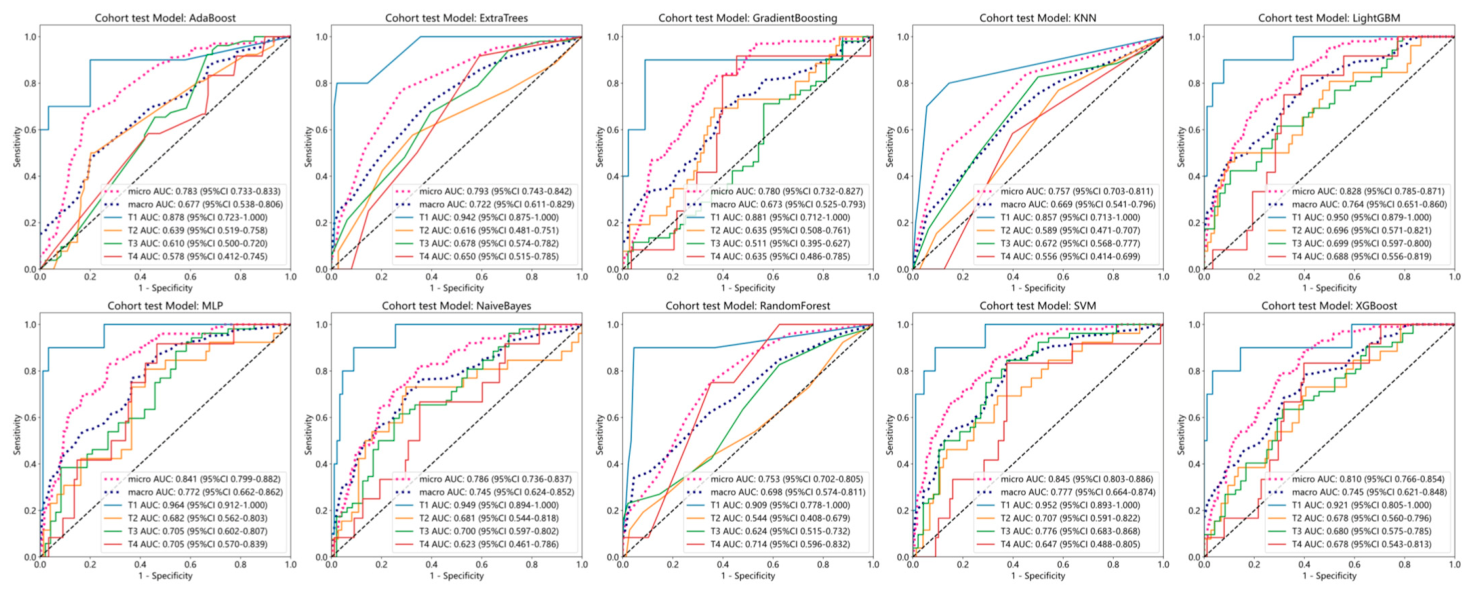
| micro-average AUC | 0.783 (95% CI 0.733–0.833) | 0.793 (95% CI 0.743–0.842) | 0.780 (95% CI 0.732–0.827) | 0.757 (95% CI 0.703–0.811) | 0.828 (95% CI 0.785–0.871) | 0.841 (95% CI 0.799–0.882) | 0.786 (95% CI 0.736–0.837) | 0.753 (95% CI 0.702–0.805) | 0.845 (95% CI 0.803–0.886) | 0.810 (95% CI 0.766–0.854) |
| macro-average AUC | 0.677 (95% CI 0.538–0.806) | 0.722 (95% CI 0.611–0.829) | 0.673 (95% CI 0.525–0.793) | 0.669 (95% CI 0.541–0.796) | 0.764 (95% CI 0.651–0.860) | 0.772 (95% CI 0.662–0.862) | 0.745 (95% CI 0.624–0.852) | 0.698 (95% CI 0.574–0.811) | 0.777 (95% CI 0.664–0.874) | 0.752 (95% CI 0.638–0.849) |
| T1 AUC | 0.878 (95% CI 0.723–1.000) | 0.942 (95% CI 0.875–1.000) | 0.881 (95% CI 0.712–1.000) | 0.857 (95% CI 0.713–0.100) | 0.950 (95% CI 0.879–1.000) | 0.964 (95% CI 0.912–1.000) | 0.949 (95% CI 0.894–1.000) | 0.909 (95% CI 0.778–1.000) | 0.707 (95% CI 0.664–0.874) | 0.964 (95% CI 929–1.000) |
| T2 AUC | 0.639 (95% CI 0.519–0.758) | 0.616 (95% CI 0.481–0.751) | 0.635 (95% CI 0.508–0.761) | 0.589 (95% CI 0.471–0.707) | 0.696 (95% CI 0.571–0.821) | 0.682 (95% CI 0.562–0.803) | 0.681 (95% CI 0.544–0.818) | 0.544 (95% CI 0.408–0.679) | 0.952 (95% CI 0.893–1.000) | 0.667 (95% CI 0.559–0.776) |
| T3 AUC | 0.610 (95% CI 0.5000–0.720) | 0.678 (95% CI 0.574–0.782) | 0.511 (95% CI 0.395–0.627) | 0.672 (95% CI 0.568–0.777) | 0.699 (95% CI 0.597–0.800) | 0.705 (95% CI 0.602–0.807) | 0.700 (95% CI 0.597–0.802) | 0.624 (95% CI 0.515–0.732) | 0.776 (95% CI 0.683–0.868) | 0.789 (95% CI 0.699–0.879) |
| T4 AUC | 0.578 (95% CI 0.412–0.745) | 0.650 (95% CI 0.515–0.785) | 0.635 (95% CI 0.486–0.785) | 0.556 (95% CI 0.414–0.699) | 0.688 (95% CI 0.556–0.819) | 0.705 (95% CI 0.570–0.839) | 0.623 (95% CI 0.461–0.786) | 0.714 (95% CI 0.596–0.832) | 0.647 (95% CI 0.488–0.805) | 0.554 (95% CI 0.367–0.741) |
| Model: AdaBoost | Model: ExtraTrees | Model: GradientBoosting | Model: KNN | Model: LightGBM | Model: MLP | Model: NaiveBayes | Model: RandomForest | Model: SVM | Model: XGBoost | |
|---|---|---|---|---|---|---|---|---|---|---|
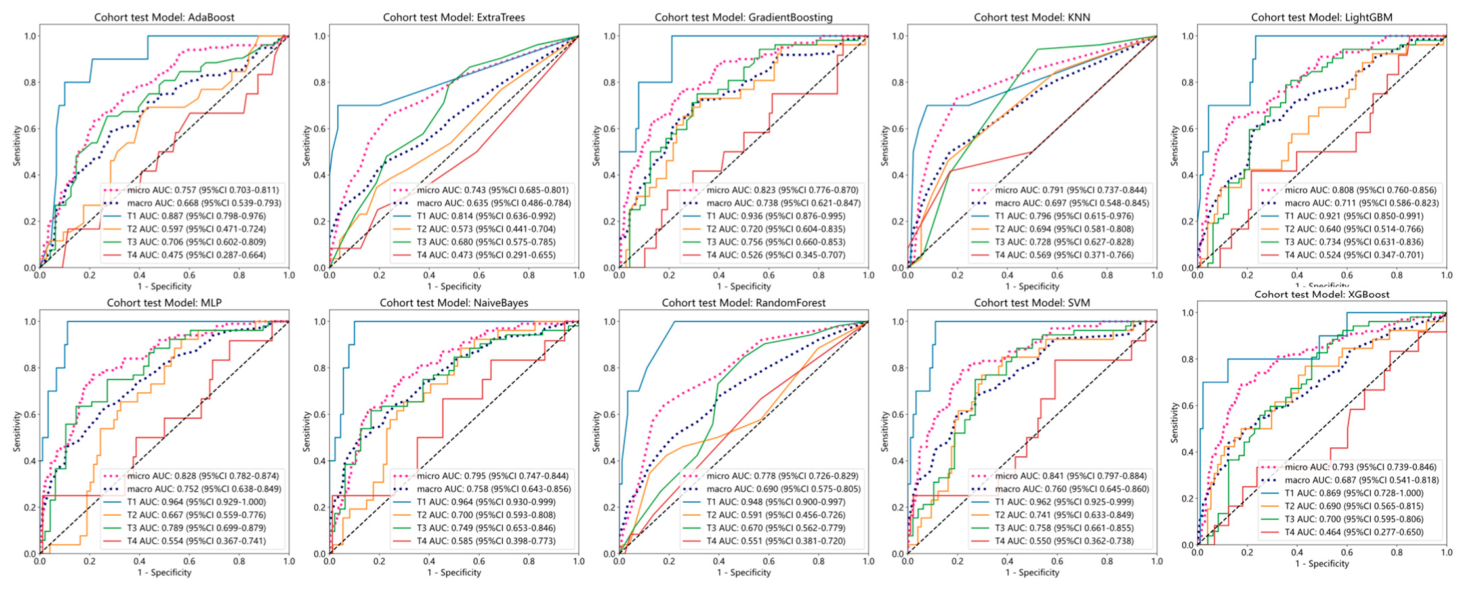
| micro-average AUC | 0.757 (95% CI 0.703–0.811) | 0.743 (95% CI 0.685–0.801) | 0.823 (95% CI 0.776–0.870) | 0.791 (95% CI 0.737–0.844) | 0.808 (95% CI 0.760–0.856) | 0.828 (95% CI 0.782–0.784) | 0.795 (95% CI 0.747–0.844) | 0.778 (95% CI 0.726–0.829) | 0.841 (95% CI 0.791–0.884) | 0.793 (95% CI 0.739–0.846) |
| macro-average AUC | 0.668 (95% CI 0.539–0.793) | 0.635 (95% CI 0.486–0.784) | 0.738 (95% CI 0.621–0.847) | 0.697 (95% CI 0.548–0.845) | 0.711 (95% CI 0.586–0.823) | 0.752 (95% CI 0.638–0.849) | 0.758 (95% CI 0.643–0.856) | 0.690 (95% CI 0.575–0.805) | 0.760 (95% CI 0.645–0.860) | 0.687 (95% CI 0.541–0.818) |
| T1 AUC | 0.887 (95% CI 0.798–0.976) | 0.814 (95% CI 0.636–0.992) | 0.936 (95% CI 0.876–0.995) | 0.796 (95% CI 0.615–0.915) | 0.921 (95% CI 0.850–0.991) | 0.964 (95% CI 0.929–1.000) | 0.964 (95% CI 0.930–0.999) | 0.948 (95% CI 0.900–0.997) | 0.962 (95% CI 0.925–0.999) | 0.869 (95% CI 0.728–1.000) |
| T2 AUC | 0.597 (95% CI 0.471–0.724) | 0.573 (95% CI 0.441–0.704) | 0.720 (95% CI 0.604–0.835) | 0.694 (95% CI 0.581–0.808) | 0.640 (95% CI 0.514–0.766) | 0.667 (95% CI 0.559–0.776) | 0.700 (95% CI 0.593–0.808) | 0.591 (95% CI 0.456–0.726) | 0.741 (95% CI 0.633–0.849) | 0.690 (95% CI 0.565–0.815) |
| T3 AUC | 0.706 (95% CI 0.602–0.809) | 0.680 (95% CI 0.575–0.785) | 0.756 (95% CI 0.660–0.853) | 0.728 (95% CI 0.627–0.828) | 0.734 (95% CI 0.631–0.836) | 0.789 (95% CI 0.699–0.879) | 0.749 (95% CI 0.653–0.846) | 0.670 (95% CI 0.562–0.779) | 0.758 (95% CI 0.661–0.855) | 0.700 (95% CI 0.595–0.806) |
| T4 AUC | 0.475 (95% CI 0.287–0.664) | 0.473 (95% CI 0.291–0.655) | 0.526 (95% CI 0.345–0.707) | 0.569 (95% CI 0.371–0.766) | 0.524 (95% CI 0.347–0.701) | 0.554 (95% CI 0.367–0.741) | 0.585 (95% CI 0.398–0.773) | 0.551 (95% CI 0.381–0.720) | 0.550 (95% CI 0.362–0.738) | 0.464 (95% CI 0.277–0.650) |
| Model AdaBoost | Model ExtraTrees | Model GradientBoosting | Model KNN | Model LightGBM | Model MLP | Model NaiveBayes | Model RandomForest | Model SVM | Model XGBoost | |
|---|---|---|---|---|---|---|---|---|---|---|
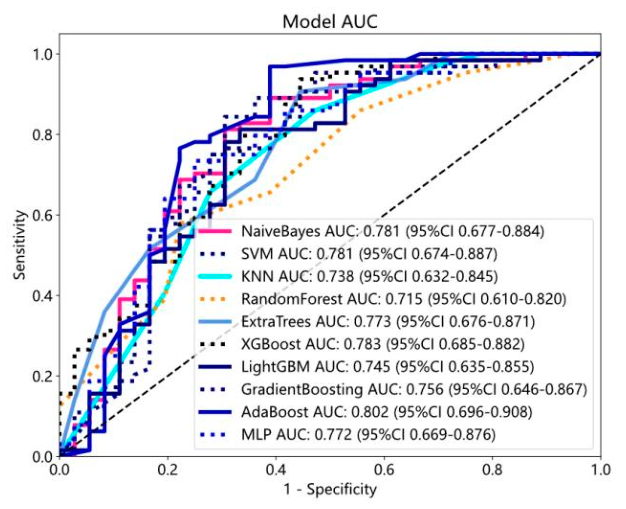
| Radiomics multi-class classification models | 0.620 | 0.550 | 0.510 | 0.570 | 0.590 | 0.620 | 0.490 | 0.470 | 0.600 | 0.530 |
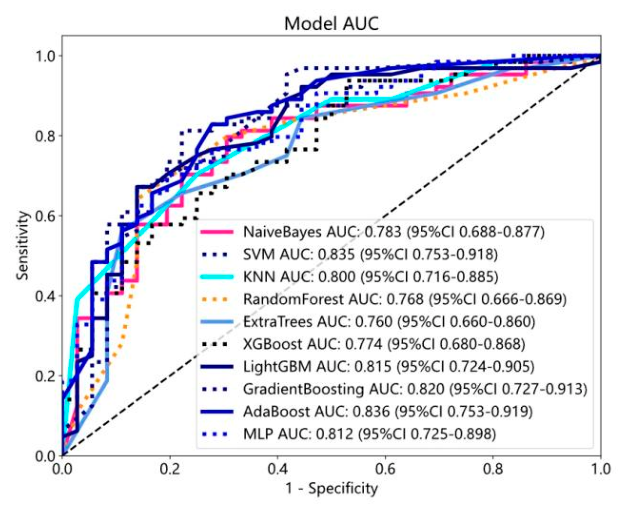
| Clinical baseline multi-class classification models | 0.530 | 0.530 | 0.610 | 0.620 | 0.620 | 0.570 | 0.580 | 0.580 | 0.610 | 0.590 |
Disclaimer/Publisher’s Note: The statements, opinions and data contained in all publications are solely those of the individual author(s) and contributor(s) and not of MDPI and/or the editor(s). MDPI and/or the editor(s) disclaim responsibility for any injury to people or property resulting from any ideas, methods, instructions or products referred to in the content. |
© 2026 by the authors. Licensee MDPI, Basel, Switzerland. This article is an open access article distributed under the terms and conditions of the Creative Commons Attribution (CC BY) license.
Share and Cite
Qiu, C.; Xia, Y.; Feng, Z.; Liu, K.; Zhong, R.; Liu, H.; Zhang, H.; Guo, W.; Wan, S.; Wang, W.; et al. The Diagnostic Value of Deep Learning for Multi-Classification of Rectal Cancer T Staging Based on Regional Attention. Diagnostics 2026, 16, 1525. https://doi.org/10.3390/diagnostics16101525
Qiu C, Xia Y, Feng Z, Liu K, Zhong R, Liu H, Zhang H, Guo W, Wan S, Wang W, et al. The Diagnostic Value of Deep Learning for Multi-Classification of Rectal Cancer T Staging Based on Regional Attention. Diagnostics. 2026; 16(10):1525. https://doi.org/10.3390/diagnostics16101525
Chicago/Turabian StyleQiu, Chenyang, Yihui Xia, Zhiguo Feng, Kaige Liu, Rulei Zhong, Hongwu Liu, Hantao Zhang, Weidong Guo, Shouhong Wan, Wanqin Wang, and et al. 2026. "The Diagnostic Value of Deep Learning for Multi-Classification of Rectal Cancer T Staging Based on Regional Attention" Diagnostics 16, no. 10: 1525. https://doi.org/10.3390/diagnostics16101525
APA StyleQiu, C., Xia, Y., Feng, Z., Liu, K., Zhong, R., Liu, H., Zhang, H., Guo, W., Wan, S., Wang, W., & Zou, B. (2026). The Diagnostic Value of Deep Learning for Multi-Classification of Rectal Cancer T Staging Based on Regional Attention. Diagnostics, 16(10), 1525. https://doi.org/10.3390/diagnostics16101525