Systematic Review

Preoperative CT Evaluation of Abdominal Vasculature and the Risk of Surgical Complications in Colorectal Cancer Resection with Anastomosis: A Systematic Review and Meta-Analysis

by
Mihnea-Ionuț Nicoară
1,2,
Mihai Adrian Socaciu
3,4,*,
Diana Ursu
2,5,
Andra Ciocan
1,6 and
Nadim Al Hajjar
1,6
1
Department of Surgery—Surgery III, “Iuliu Hațieganu” University of Medicine and Pharmacy, 400012 Cluj-Napoca, Romania
2
Department of Radiology, Emergency Clinical County Hospital Cluj-Napoca, 400006 Cluj-Napoca, Romania
3
Department of Medical Imaging and Nuclear Medicine, “Iuliu Hațieganu” University of Medicine and Pharmacy, 400012 Cluj-Napoca, Romania
4
Department of Medical Imaging, “Octavian Fodor” Regional Institute of Gastroenterology and Hepatology, 400162 Cluj-Napoca, Romania
5
Department of Radiology, “Iuliu Hațieganu” University of Medicine and Pharmacy, 400012 Cluj-Napoca, Romania
6
Department of Surgery, “Octavian Fodor” Regional Institute of Gastroenterology and Hepatology, 400162 Cluj-Napoca, Romania
*
Author to whom correspondence should be addressed.
Diagnostics 2026, 16(10), 1449; https://doi.org/10.3390/diagnostics16101449
Submission received: 4 April 2026 / Revised: 26 April 2026 / Accepted: 4 May 2026 / Published: 9 May 2026
(This article belongs to the Special Issue Diagnosis and Prognosis of Abdominal Diseases)

Abstract

Background: Preoperative CT is part of the routine diagnostic work-up for colorectal cancer (CRC), and CT-based biomarkers have been linked to oncological and surgical outcomes in CRC patients. This review aims to evaluate the association between preoperative CT-derived vascular disease markers (calcification and stenosis) and postoperative outcomes after curative CRC resection with anastomosis. Methods: Following PRISMA, we conducted a systematic review and meta-analysis of studies identified from MEDLINE/PubMed, Embase, Web of Science Core Collection and Google Scholar from inception until 1st of January 2026, with the protocol registered in PROSPERO (CRD420251248044). Eligible studies examined CT-derived abdominal vascular disease markers in CRC patients treated with curative resection and anastomosis and reported postoperative outcomes (anastomotic leakage (AL) grade C, major morbidity, and mortality). Risk of bias was assessed using the Newcastle–Ottawa Scale. We pooled odds ratios using random-effects models when ≥3 studies reported comparable exposure–outcome comparisons. Results: Fourteen studies (6712 participants) were included, and 12 contributed to quantitative synthesis. Higher calcification burden was associated with increased odds of any AL (OR 3.08, 95% CI 2.09–4.54; k = 11; n = 5005) and severe/grade C AL (OR 2.68, 95% CI 1.03–6.97; k = 3; n = 3418). Evidence for major morbidity was imprecise (OR 1.99, 95% CI 0.86–4.59; k = 3; n = 841), and data for mesenteric stenosis outcomes and mortality were limited. Sensitivity analyses indicate attenuation without loss of significance after trim-and-fill (adjusted OR 2.39) and that non-ROC cut points yield a smaller effect size (OR 2.42). Conclusions: CT-derived vascular disease markers are associated with higher odds of AL after CRC surgery. Prospective studies should standardize methods and test clinical utility.

1. Introduction

Colorectal cancer (CRC) is the third most common type of cancer and the second leading cause of cancer death worldwide, according to GLOBOCAN 2022 [1]. Surgical resection is central to curative treatment for both colon and rectal cancer and it commonly involves primary anastomosis to restore bowel continuity [2,3]. The ESCP CORREA 2022 snapshot audit [4], which enrolled 3521 adults undergoing colorectal resection across 216 hospitals in 53 countries during a 6-week period (January to April 2022) captured early (30-day) postoperative outcomes. The Clavien–Dindo (C-D) classification is the generally accepted system used for reporting complications after surgery; grades are assigned by the required therapy, from minor deviations (grade I) through complications requiring surgical, endoscopic or radiological intervention (grade III, with IIIa without and IIIb with general anesthesia), life-threatening complications requiring intensive care (grade IV) and death (grade V) [5]. Based on this, CORREA defined short-term morbidity as the worst C-D grade within 30 days and reported that 47% of patients had no recorded 30-day complications, while severe complications (C-D grade III–V) occurred in 12.2% of patients; the 30-day mortality rate was 2.38% [4]. Among complications, anastomotic leakage (AL) is especially relevant as it can progress to peritonitis and severe sepsis, requiring urgent intervention. The International Study Group of Rectal Cancer defines AL as a defect of the intestinal wall at the anastomotic site causing a communication between the intra- and extraluminal compartments and grades severity according to the corresponding change required in clinical management (grade A, no change in management; grade B, active therapeutic intervention without relaparotomy; grade C, relaparotomy) [6]; in CORREA, AL occurred within 30 days in 7.96% of cases [4]. Leakage has been associated with substantial short-term morbidity and hospital mortality. For example, in a German nationwide quality assurance cohort of colon cancer resections, secondary complications occurred in 62.7% of patients with leakage versus 19.9% without leakage and hospital mortality was 18.6% versus 2.6% [7]. Moreover, leakage may also compromise long-term oncologic outcomes, including increased local recurrence risk and reduced survival [8,9]. According to economic analyses, AL generates significant incremental healthcare costs on account of readmissions, intensive care stay and reinterventions [10].
Contrast-enhanced CT (CECT) is routinely recommended for pretherapeutic staging of colorectal cancer, primarily to identify distant metastatic disease and other findings that may alter oncological treatment and/or surgical resectability [11,12]. Recent quantitative imaging work has examined several CT-derived biomarkers with potential applications in oncology, which can be broadly grouped into two categories: tumor-focused and systemic ones. The first category quantifies imaging phenotypes related to tumor heterogeneity and the tumor microenvironment; a systematic review of colorectal cancer radiomics in CT, MRI and PET summarized evidence on prediction of treatment response and survival, showed promising results, but significant methodological heterogeneity [13]. Meanwhile, systemic imaging biomarkers such as CT-derived body composition metrics (e.g., quantification of skeletal muscle and adipose compartments) have also been evaluated for their ability to predict both long-term oncological outcomes [14] and short-term postoperative complications, including those arising after CRC surgery [15]. A less explored category of systemic CT biomarkers evaluates vascular disease using atherosclerosis markers such as calcification burden and splanchnic arterial stenosis as potential predictors of anastomotic leakage and other early postoperative outcomes after colorectal resection, with conflicting findings across cohorts [16,17,18,19,20,21]. Because CECT is already part of the standard pretherapeutic staging in colorectal cancer, CT-derived vascular findings can be regarded as opportunistic biomarkers extractable from routine imaging rather than additional dedicated tests. Full diagnostic assessment nevertheless extends beyond CT and, particularly in rectal cancer, includes histologic confirmation, dedicated locoregional staging and multidisciplinary treatment planning. Beyond routine staging CT, interest is also growing in vascular-focused imaging approaches across the perioperative pathway, including indocyanine green fluorescence angiography (ICG-FA) methods that may facilitate identification of the inferior mesenteric artery [22].
The purpose of this study is to integrate the evidence on the association between preoperative CT-derived abdominal vascular disease markers, including calcification burden and mesenteric arterial stenosis and early postoperative outcomes after colorectal cancer surgery with primary anastomosis, focusing on overall anastomotic leakage, clinically impactful leakage, major morbidity and short-term mortality. Effect measurements were pooled according to biomarker families for the prespecified outcomes, and the certainty of evidence was rated using the GRADE framework.

2. Methods

The present study was conducted in accordance with the PRISMA guidelines [23] and the study protocol was prospectively registered in the PROSPERO database, with the reference number CRD420251248044 (https://www.crd.york.ac.uk/prospero, accessed on 11 December 2025). No amendments to the study protocol were made after registration.

2.1. Search Strategy

We searched PubMed, Embase, Web of Science Core Collection and the first 200 results of targeted Google Scholar search queries from inception to 1 January 2026. The following index terms and free-text words were used, including synonyms and sub-categories, grouped into blocks following the patient, exposure, outcome (PEO) framework: “colorectal neoplasms”, “colorectal surgery”, “diagnostic imaging” and “postoperative complications”. Reference lists of included studies were also screened. Only English-language results were screened because of resource limitations. The most recent search was conducted on 1 January 2026. Search strings were designed using PubMed syntax and translated for use on Embase and WoS Core Collection using the Polyglot Search Translator (https://polyglot.sr-accelerator.com [accessed on 11 December 2025]) [24]. Full search strings are provided in Appendix A and the Supplementary Materials.

2.2. Study Selection

Search results were collected and organized using the reference management software Zotero (https://www.zotero.org). Duplicates were automatically flagged using Zotero’s built-in features and manually removed before screening. Two reviewers (M.N. and D.U.) independently screened titles/abstracts and excluded reports using the following criteria: (1) no full text was available, (2) full text was not translated into English, (3) reviews, editorials, conference abstracts, proceedings, videos, letters to the editor and comments, (4) animal studies, (5) study participants <18 years of age, (6) surgery for benign pathologies, (7) studies exclusively on intraoperative vascular assessment, (8) postsurgical anastomotic complications were not reported as an outcome. Full-text articles were included if (1) study participants were surgically treated for colon and/or rectal neoplasms with curative intent, (2) CT was performed before surgery, (3) abdominal vascular disease (calcification burden or arterial steno-occlusive disease) was evaluated on preoperative CT, (4) outcomes included prediction of post-surgical complications. In the case where a consensus was not achieved, a third reviewer (M.S.) was called to arbitrate.
Studies enrolling mixed benign and malignant indications were eligible only if CRC-only data were reported or could be obtained. For mixed-indication cohorts without CRC-stratified outcomes, we contacted corresponding authors to request CRC-only aggregate subgroup counts.

2.3. Data Extraction

Two independent reviewers (M.N. and D.U.) extracted study design/setting, patient characteristics (age, sex, tumor site, and procedure), CT exposure definitions for calcification and stenosis (territory, scoring method, and threshold) and raw count 2 × 2 tables for each exposure–outcome comparison. For quantitative synthesis, primary pooled estimates were based on crude, study-level 2 × 2 exposure–outcome data after harmonization of high vs. low vascular disease categories. Adjusted estimates were extracted when available and tabulated separately but were not pooled quantitatively. Primary outcomes were major morbidity (Clavien–Dindo ≥III), anastomotic leakage (overall and/or grade C), and postoperative mortality as reported by each study, including the stated follow-up window. No automation tools were used for data extraction.
For meta-analysis, we categorized vascular markers as high vs. low using the threshold reported in each study’s primary analysis. When several thresholds were reported, we prioritized clinically relevant distinctions (i.e., moderate vs. severe calcific burden or stenosis), or, if not possible, we used the authors’ principal cut-off and recorded how it was chosen (prespecified, median or ROC-derived). To account for possible information loss due to dichotomization of continuous variables and ROC-derived cut-off optimism, we applied sensitivity analyses by threshold type (including analyses excluding ROC-derived cut-offs). When available, we also extracted continuous effect estimates for separate (non-pooled) analyses. For multiple vascular territories or composite scores, we prioritized broader coverage, then proximity to the anastomosis.

2.4. Bias and Certainty Assessment

Two reviewers (M.N. and M.S.) assessed risk of bias using the Newcastle–Ottawa scale (NOS), with disagreements adjudicated by a third reviewer (N.A.H.). Studies were classified as being of poor, fair or good quality using scores of 0–3, 4–6 and 7–9, respectively.
Certainty of evidence was evaluated based on the GRADE framework [25]. The predefined primary and secondary outcomes were evaluated regarding risk of bias, inconsistency, indirectness, imprecision, and publication bias, contributing to their respective certainty rating.

2.5. Statistical Analysis

Analyses were conducted in R version 4.5.2 (RStudio environment, version 2025.09.0-387), using the meta and metafor packages. Each study contributed a single effect estimate to any given pooled comparison. Studies with zero events in one exposure arm were retained using a 0.5 continuity correction. Studies with zero events in both exposure arms were prespecified as non-informative for odds ratio pooling and excluded from the corresponding outcome-level analysis. Quantitative synthesis was performed when ≥3 studies reported similar exposure–outcome definitions. Pooled effects were estimated using a random-effects model with inverse-variance weighting and the results are presented using forest plots. Between-study variance (τ2) was estimated using restricted maximum likelihood (REML) and random-effects confidence intervals were calculated using the Hartung–Knapp–Sidik–Jonkman (HKSJ) adjustment, consistent with current Cochrane guidance [26]. This approach was preferred to better reflect uncertainty in the pooled estimate and between-study heterogeneity compared with the conventional DerSimonian–Laird random effects inference, particularly important when the number of studies is small [26]. Statistical heterogeneity was summarized using τ2 and I2 (with ~25%, ~50%, and ~75% indicating low, moderate, and high heterogeneity, respectively). Potential publication bias and small-study effects were assessed by visual inspection of funnel plots, Egger’s regression test (when ≥10 studies were available) and by trim-and-fill analysis. Sensitivity analysis included leave-one-out influence tests and categorical moderator analysis of different harmonization decisions and methodological differences (binary vs. multi-category contrasts, visual vs. quantitative exposure measurement, ROC-derived vs. prespecified cut points, vascular territory and study quality/risk-of-bias category) (Appendix D). In addition, post hoc exploratory univariable meta-regressions were performed for the any AL/AAC synthesis to further explore the sources of heterogeneity using total sample size, scaled per 100 participants, publication year and geographic region (Asia vs. Europe) as covariates. Mixed-indication vascular stenosis studies were analyzed separately as an exploratory post hoc analysis for contextual purposes and were not incorporated into the main CRC-only findings (Appendix E).

3. Results

3.1. Study Selection

Initial search and deduplication yielded 4212 records eligible for title and abstract screening, out of which 30 were reviewed by full-text assessment. Overall, 14 studies [19,20,21,27,28,29,30,31,32,33,34,35,36,37] fulfilled the pre-determined inclusion criteria and 12 could be included in the quantitative synthesis. The reasons for exclusion were absence of quantifiable exposure variables (i.e., studies of vascular anatomy, k = 7 [38,39,40,41,42,43,44]), exclusively non-anastomotic negative outcomes (high-output ileostomy [45], surgical difficulty [46] and colonic hypoperfusion [47]) and lack of CRC-only subgroup data on outcomes (k = 6; [17,18,48,49,50,51]). Of the studies excluded for unavailable CRC-only, four accounted for malignant/benign indication status and included it as a covariate; for these studies CRC-stratified counts were requested from the corresponding authors, but no response was received. The complete study selection algorithm can be consulted in the PRISMA flow diagram (Figure 1).

3.2. Characteristics of the Included Studies

Fourteen studies (Table 1) comprising 6712 participants were included in our analysis. Cohort sizes ranged from 60 to 2412 patients. Most studies reported a male predominance (typically 50.0–68.8% male) and the mean/median participant age ranged from 63.7 to 75.3 years, reflecting predominantly older surgical populations.
Methodologically, the evidence base was largely retrospective (k = 11) and single-center (k = 13). Thresholds used to dichotomize exposure were most commonly ROC/Youden-derived (k = 5; [27,30,31,33,37]) and median-based (k = 2; [28,35]), while 3 studies applied prespecified ordinal/segment staging [21,34,36]; single studies used an author-defined composite threshold [29], binary presence/absence [20], continuous-only comparisons without a cut point [32] or clinical stenosis grades [19]. Studies reported a follow-up window for outcome detection of 30 days (k = 5; [20,21,28,31,33]) or 90 days (k = 2; [19,34]).
Exposure measurement was either visual/semi-quantitative (k = 6; [20,21,28,29,34,36]), software-derived quantitative (k = 7; [27,30,31,32,33,35,37]) or evaluated as stenosis grading [19]. Regarding vascular territory, five studies assessed the abdominal aorta only [21,30,31,35,36], three assessed an aortoiliac territory [28,29,33], two focused on splanchnic arteries only [19,34], three combined aortic and splanchnic territories [20,27,37] and one sampled multiple pelvic vessels plus the superior mesenteric artery (SMA) [32].
Twelve studies contributed data suitable for quantitative synthesis: 11 were included in the meta-analysis of any anastomotic leakage [20,21,28,29,30,31,33,34,35,36,37], and 3 studies contributed to the major morbidity [21,27,28] and grade C anastomotic leakage [20,29,35] analyses each. Two studies were synthesized narratively: Norooz et al. [32] was a comparative cohort study on participants with and without AL that measured differences in mean calcium score, thus precluding effect estimation; Arron et al. [19] was the only CRC study reporting extractable data on abdominal vasculature stenosis measurements and was therefore not pooled.

Risk of Bias Assessment

Across 14 studies, seven were rated “Good” and seven were “Fair” on the Newcastle–Ottawa Risk of Bias Scale, with a median score of six points (range 5–8). Selection scores were uniformly high (4/4), cohorts reflected the typical surgical population, vascular exposure status was determined from preoperative CT records and all outcomes were postoperative by definition. Variation was greatest in the comparability domain: four studies reported unadjusted comparisons (0/2), seven applied limited confounder control (limited adjustment or matching; 1/2), while three studies applied multivariable adjustment (2/2). Only Eveno et al. [21] achieved 3/3 on the “Outcome” domain because outcome ascertainment, follow-up duration, and follow-up completeness were all explicitly reported. While the other studies had objective outcome assessment, incomplete reporting of follow-up completeness and/or the postoperative follow-up window warranted downgrade.
A summary of NOS scores is provided in Table 1, with item-level assessments available in Appendix B. Reported adjusted and matched estimates, along with the variables or matching factors used in each study, are summarized in Appendix C.

3.3. Summary of Findings

Using the GRADE framework, the certainty of evidence for each of the predefined critical outcomes was evaluated, with a summary available in Table 2. We reported the pooled random-effects OR from the meta-analysis and its 95% CI, the number of participants contributing to the estimate and an absolute risk estimate derived from baseline event rates in the low-vascular-disease group and expected risk in patients with substantial vascular disease. Certainty ratings reflect domains of risk of bias, inconsistency, indirectness, imprecision and publication bias. Observational evidence was initially rated as low certainty. Upgrading was considered for a large magnitude of effect. Sensitivity analyses were considered when judging inconsistency and imprecision but were not treated as an independent upgrading domain.
The overall certainty of evidence ranged from “low” (for the AAC score—any anastomotic leak exposure-outcome pair) to “very low” (the other two AAC score exposure-outcome pairs and outcomes related to stenosis and mortality). The chief reason for downgrade was concern regarding the risk of bias, stemming from the predominantly retrospective and non-randomized study designs. Table 2 summarizes the main findings, and the full domain-level GRADE decision process is provided in Appendix F.

3.4. Relationship Between Calcium Score and Surgical Complications

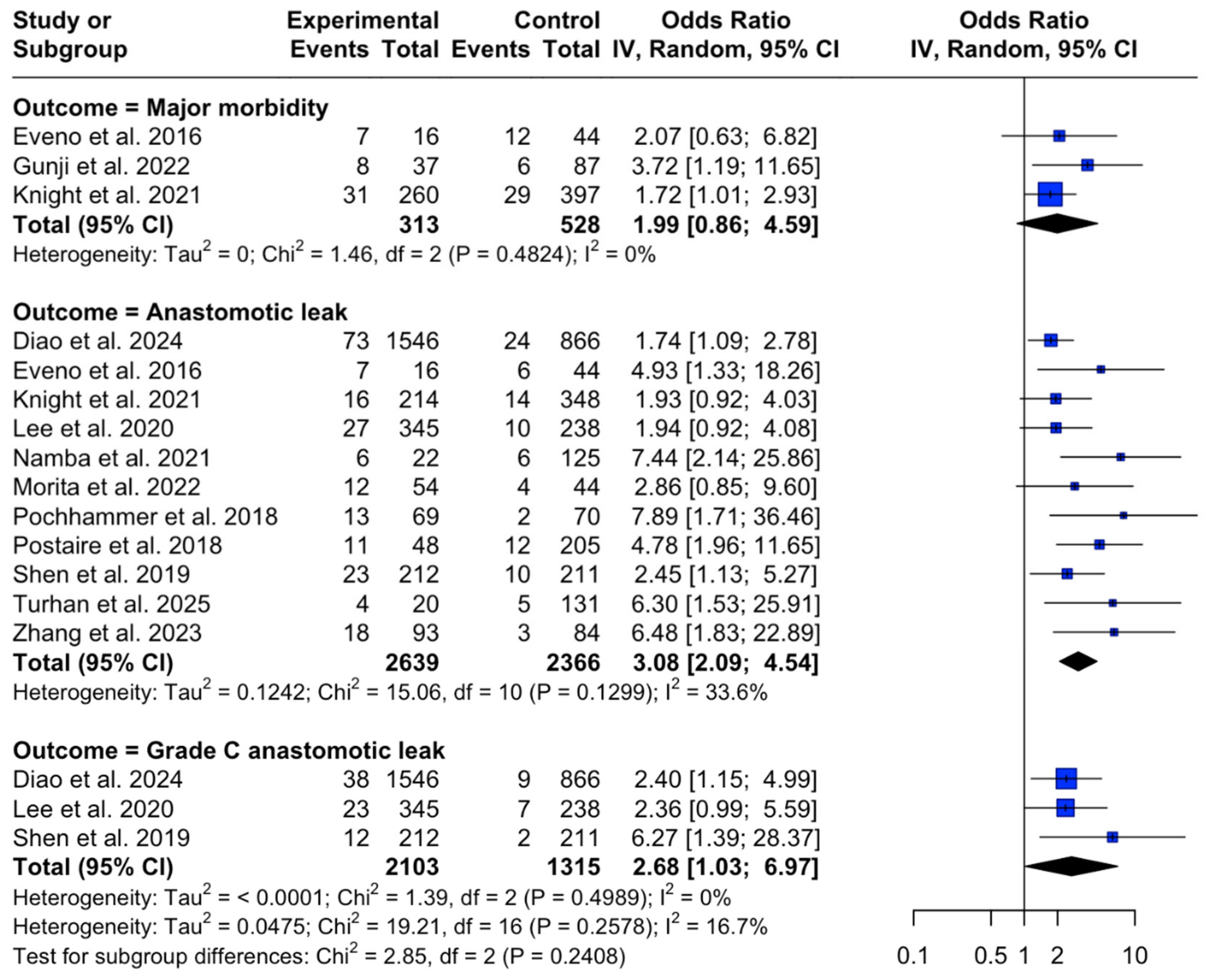
Major morbidity (k = 3; OR 1.99, 95% CI 0.86–4.59; I2 = 0%; Figure 2): Eveno et al. [21] used a simple abdominal aortic calcification score (ACS) based on circumferential involvement (<50% vs. >50%) between the celiac trunk origin and aortic bifurcation and reported higher rates of severe postoperative events with increasing ACS, including more clinically significant leaks requiring reintervention. Gunji et al. [27] quantified an Agatston-type calcium score around the SMA/IMA origins and defined major morbidity as Clavien–Dindo ≥III; an optimal AAC cut-off of 10 identified patients with markedly higher complication rates, particularly in conjunction with abnormal cardio-ankle vascular index (CAVI). Knight et al. [28] (largest cohort, n = 657) used a semi-quantitative visual aortic score (none/minor/major) at the proximal and distal level and found that higher burden was associated with non-infective complications.
Any anastomotic leak (k = 11; OR 3.08, 95% CI 2.09–4.54; I2 = 33.6%; Figure 2): Most studies showed higher leak risk with greater calcification, but effect sizes varied with scoring methods, cut-offs and population. Larger cohorts (Diao et al. [20] n = 2412; Knight et al. [28]) reported weaker and, in the case of Diao, non-independent effect after multivariable adjustment. In contrast, selected cohorts showed stronger gradients: Eveno et al. [21] showed an increase in AL risk across ACS categories; Morita et al. [30] quantified calcification volume percentages using dedicated software (median 2.35%, range 0–40.3%) and Shen et al. [35] derived a custom aortoiliac calcification index (ACI) using a 12-sector method (median 4.8%, range 0–91.1%)—both studies reporting independent associations with AL; the largest effect size was observed by Namba et al. [31] in a cohort of 147 participants, using an Agatston-type measurement and multivariate logistic regression (OR = 6.09 after adjustment, with a 95% CI of 1.48–25.86 for calcium score cut point of 4007). Lee et al. [29] used a pragmatic aorto-iliac score (three-level semi-quantitative assessment of infrarenal aorta and common iliac calcification) and reported borderline association with AL in general, but found that a score ≥ 3 more clearly predicted severe leaks. Norooz et al. [32] found higher calcium scores in the descending aorta and all great pelvic vessels among patients with AL (20% AL incidence in cohort; AAC score of 792 ± 39 vs. 405 ± 45 in AL vs. non-AL patients, respectively; significant at p < 0.001), but could not be pooled because results were reported as continuous scores rather than dichotomized groups. Very large effects were reported in some specialized scoring approaches reporting various stratification systems and cut-off values, likely contributing to heterogeneity: Pochhammer et al. [33] (infrarenal aorta and iliac-focused blinded clinical trial; iliac volume score ≥30 as cut-off value), Postaire et al. [34] (visceral arterial calcification score ≥3 and celiac trunk score = 2), Turhan et al. [36] (celiac-to-bifurcation aortic circumference staging; stage 2 ≥50%), Zhang et al. [37] (dedicated CT calcium scoring workflow at SMA and IMA origin; the AAC score cut-off of 19.6 mm3 that was incorporated in a nomogram). Both Turhan and Zhang reported independent associations after adjustment, whereas Pochhammer acknowledged residual confounding, as renal disease remained the only independent predictor in multivariable modeling.
Grade C anastomotic leak (k = 3; OR 2.68, 95% CI 1.03–6.97; I2 = 0%; Figure 2): Lee et al. [29] found that an aorto-iliac score ≥ 3 independently predicted grade C AL. Shen et al. [35] reported higher ACI with increasing AL severity. Diao et al. [20] observed higher grade C rates with AAC but no independent association following multivariate adjustment.

3.4.1. Sensitivity Analysis

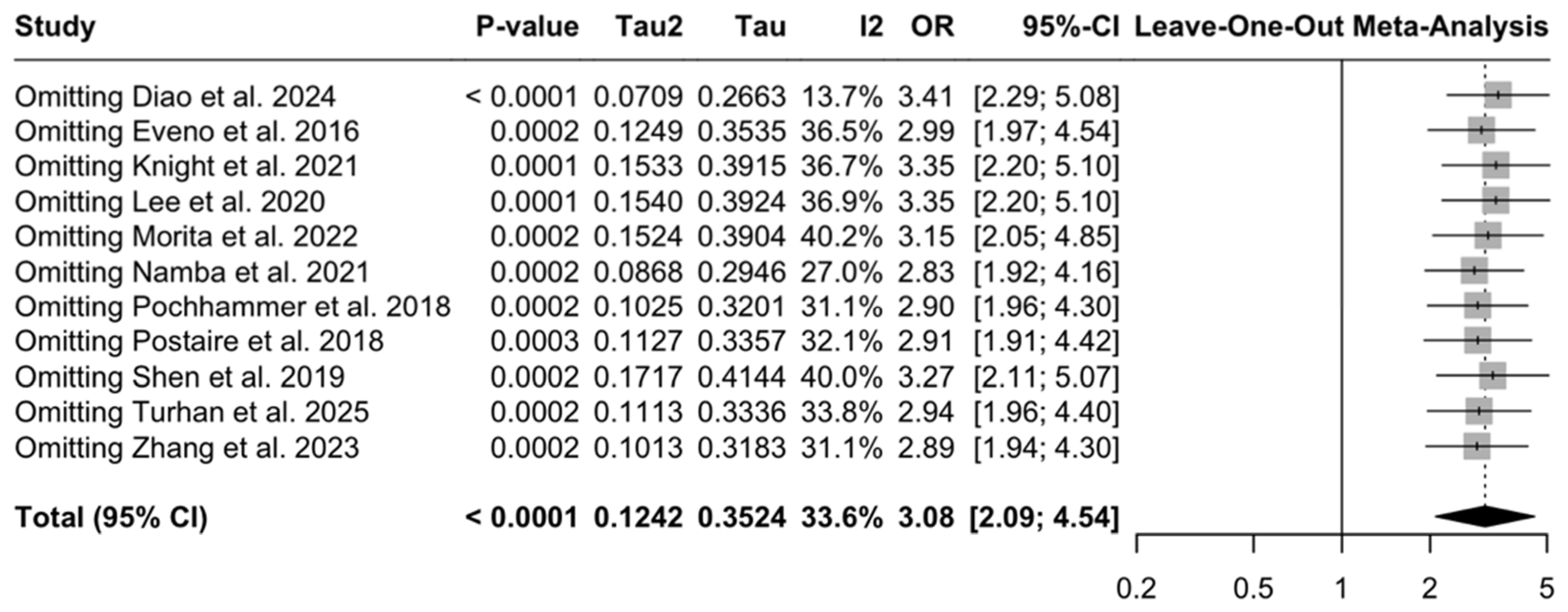
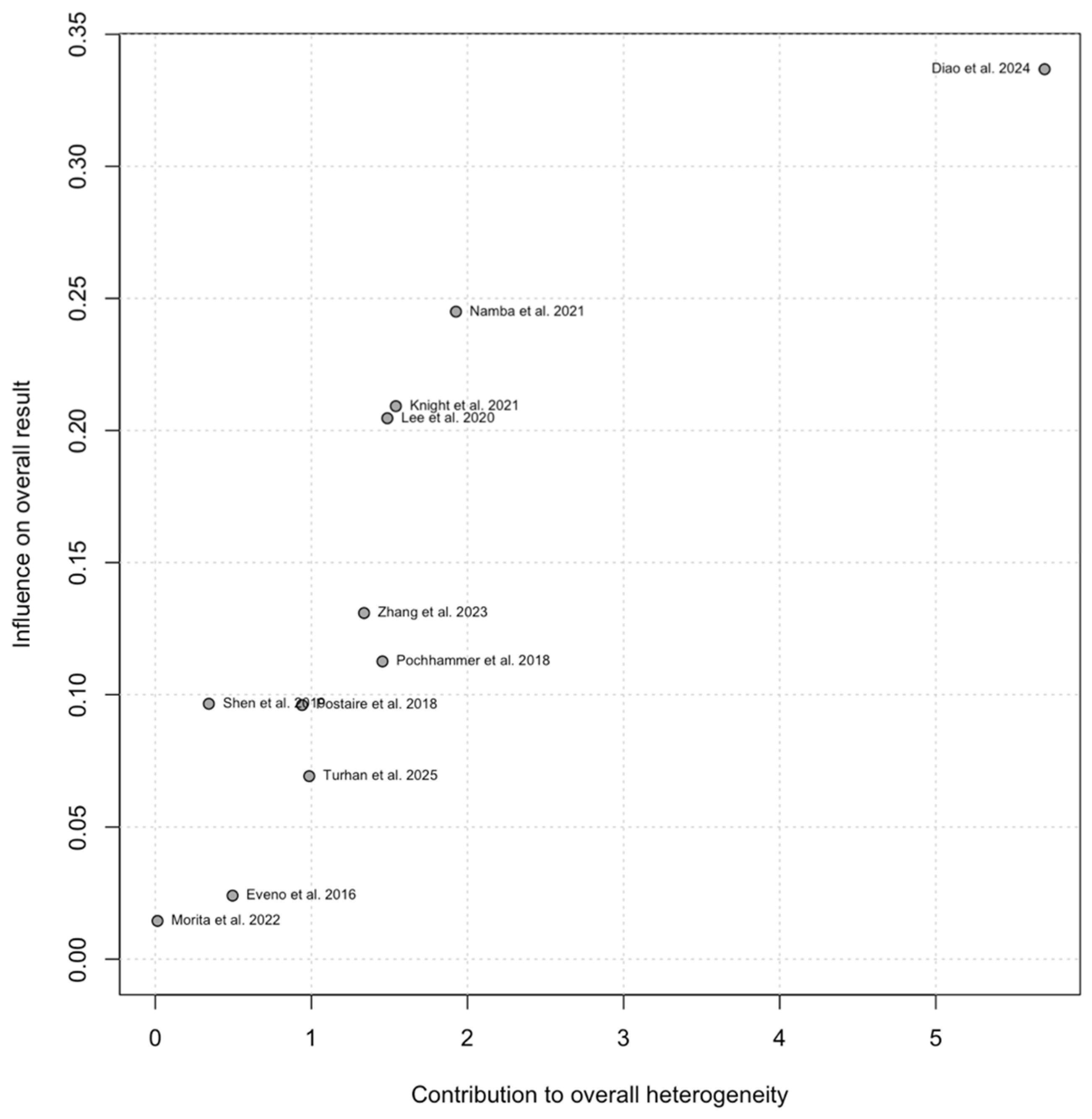
Influence diagnostics using leave-one-out analysis for any AL/AAC score showed that the pooled association was stable and not driven by any single study (Figure 3). For each omission, pooled ORs ranged from 2.83 to 3.41 and remained statistically significant (p < 0.0001). The largest shift occurred when Diao et al. [20] was omitted, with an associated reduction in heterogeneity (I2 = 13.7%), indicating that this study was the largest single contributor to between-study variability. Other plausible sources of heterogeneity include differences in study size, vascular territory, exposure measurement approach, threshold derivation and outcome definitions. Publication year and geographic region may also act as proxies for underlying study-level differences contributing to between-study variability. A post hoc exploratory univariable meta-regression was therefore performed for the any AL/AAC synthesis to further examine potential sources of heterogeneity (Table A7). Larger study sample size was associated with smaller observed effect estimates, suggesting potential small-study effects, whereas publication year and geographic region showed no clear association with effect size. Omitting Pochhammer et al. [33] (the only study in the any-AL subgroup with prospective data acquisition) did not significantly influence the pooled effect (random-effects OR 2.90, 95% CI 1.96–4.29; p < 0.0001) and heterogeneity remained moderate (τ2 = 0.10; I2 = 31.1%). A Baujat plot (Figure 4) also indicated that Diao et al. 2024 [20] contributed most to between-study heterogeneity and had the greatest influence on the pooled estimate. In general, heterogeneity remained low (I2 ~13.7–40.2%, τ2 ~0.07–0.17), indicating that the overall conclusion was robust to single-study exclusion.
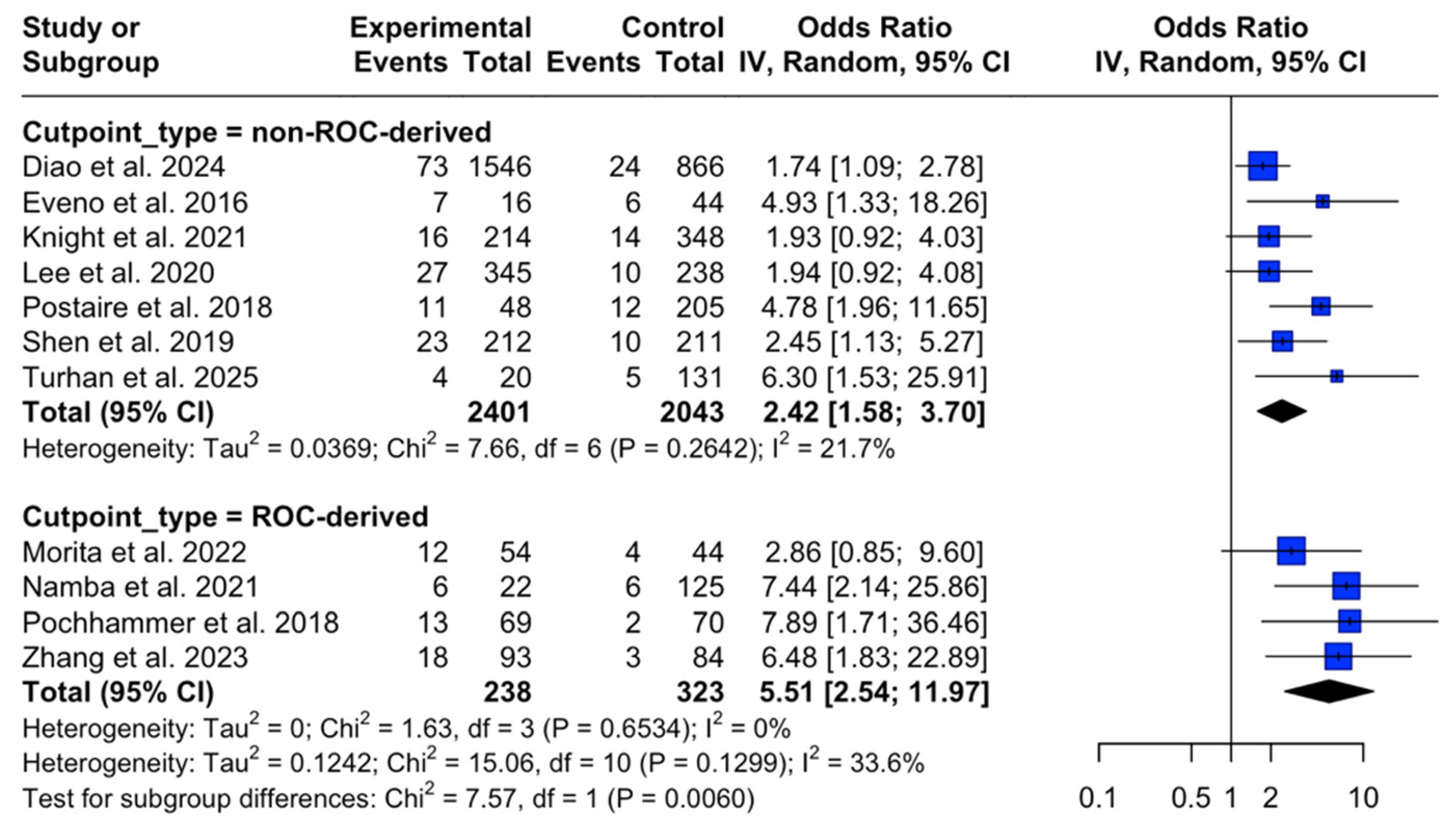
In categorical moderator analyses (Table A5, Appendix D), we explored whether the association between higher vascular disease burden and any anastomotic leak varied by the following study characteristics: cut point derivation, exposure measurement approach, vascular territory, and risk of bias/NOS grade. Studies using ROC-derived thresholds showed a larger pooled effect (k = 4; OR 5.51, 95% CI 2.54–11.97; I2 = 0%) and this difference was statistically significant (F = 5.42, p = 0.044; ratio of ORs 2.32, 95% CI 1.02–5.24), consistent with ROC cut point optimism. After excluding studies that reported ROC-derived cut points, the association between higher calcification burden and any anastomotic leak persisted in the non-ROC-derived group (k = 7; random-effects OR 2.42, 95% CI 1.58–3.70; I2 = 21.7) (Figure 5). No statistically significant effect modification was detected for the other moderators (exposure measurement approach, vascular territory, or NOS grade), supporting the robustness of the pooled association to the main harmonization assumptions.
A post hoc comparison with conventional DerSimonian–Laird random effects inference resulted in narrower confidence intervals than the primary REML + Hartung–Knapp approach. The direction of effect was unchanged for all pooled outcomes. Major morbidity estimates changed nominal statistical significance, indicating estimator sensitivity in a sparse, three-study synthesis.

3.4.2. Publication Bias

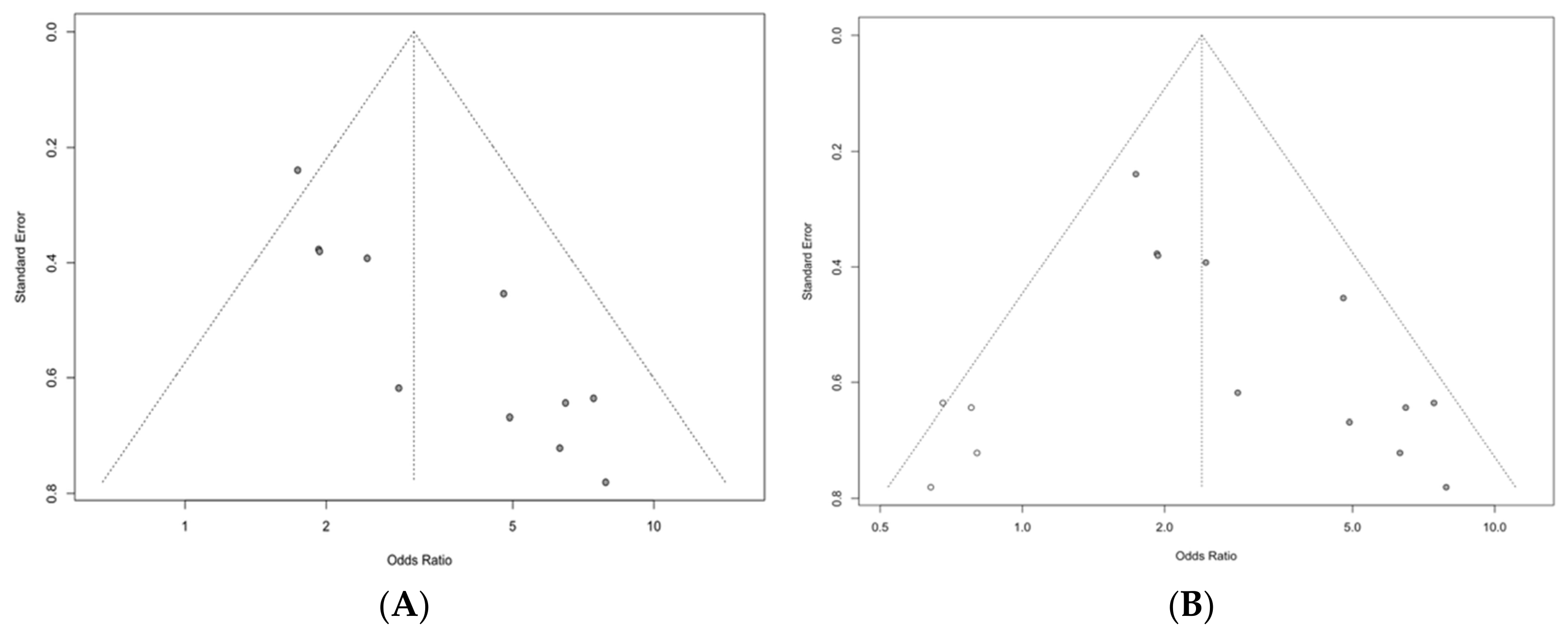
Visual interpretation of the funnel plot (Figure 6) indicated asymmetry, which was supported by Egger’s regression test (t = 5.93, df = 9, p = 0.0002). Using the trim-and-fill method, four studies were imputed, increasing the analysis from 11 observed to 15 studies. The bias-adjusted random-effects model yielded a reduced, but still significant association between higher AAC and any anastomotic leak (OR 2.39, 95% CI 1.53–3.75; p = 0.0009). Residual heterogeneity remained substantial (τ2 = 0.24; I2 = 49.2%; Q = 24.57, p = 0.0162).

3.5. Relationship Between Abdominal Vessel Stenosis and Surgical Complications

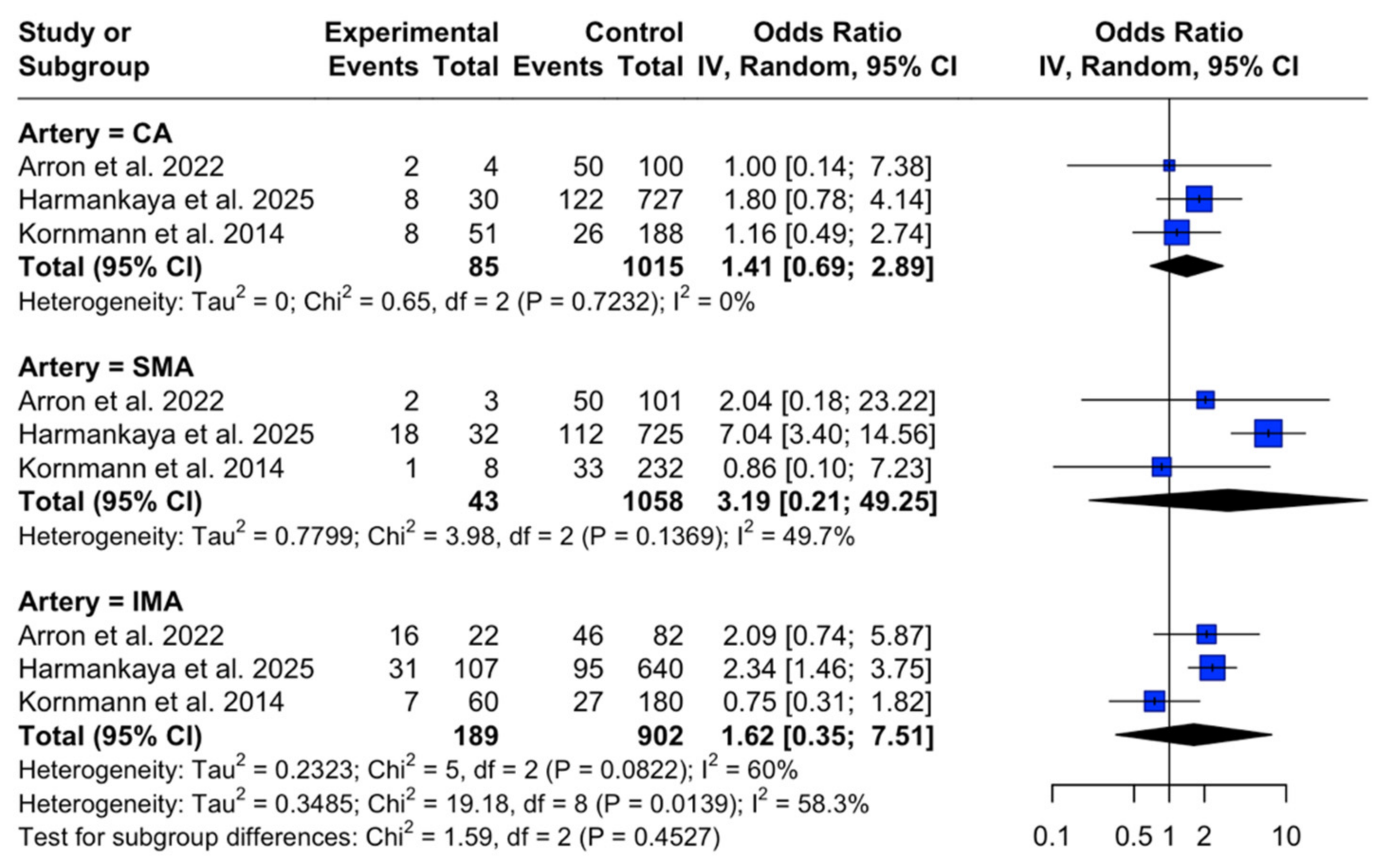
Only Arron et al. [19] met the CRC-specific eligibility criteria for mesenteric arterial stenosis. In this retrospective multicenter cohort study (n = 1273) with a blinded, nested case–control design (52 clinically relevant anastomotic leaks vs. 52 controls; matched for age, BMI and cardiovascular comorbidity) evaluating mesenteric occlusive disease on preoperative contrast-enhanced CT, clinically relevant anastomotic leak was defined as requiring reintervention within 90 days and arterial stenoses (inferior mesenteric, superior mesenteric and celiac) were graded using standard severity categories (<50%, ≥50% and ≥70%). Severe IMA stenosis/occlusion (≥70–100%) was significantly more frequent in leak cases than controls (21.2% vs. 1.9%; p = 0.01), whereas SMA and celiac stenosis did not differ between groups. Because no other CRC-specific stenosis study provided extractable effect estimates, no CRC-only quantitative synthesis was performed for stenosis. A post hoc exploratory contextual summary of mixed-indication stenosis studies (k = 3) is provided in Appendix E; these studies were not included in the main CRC-specific evidence synthesis, GRADE certainty assessment or conclusions.

3.6. Relationship Between Abdominal Vascular Disease and Mortality

Mortality was infrequently reported and inconsistently defined; therefore, quantitative synthesis was not performed. Vascular exposure mortality information was available from two AAC studies. Eveno et al. [21] reported three postoperative deaths, all in the severe calcification group within 30 days after surgery, whereas Gunji et al. [27] reported no mortality. Additional deaths were reported by Norooz et al. [32] (1/100; death due to AL at 2 weeks) and Shen et al. [35] (one in-hospital death in the AL group and one in the non-AL group), but these were not stratified by calcium score category and therefore could not contribute to vascular exposure mortality assessment. Arron et al. [19] reported four deaths within the first year after surgical intervention, but perioperative timing and stenosis status were not provided. Consequently, mortality was summarized as a narrative outcome and rated as very low-certainty evidence in the GRADE assessment.

4. Discussion

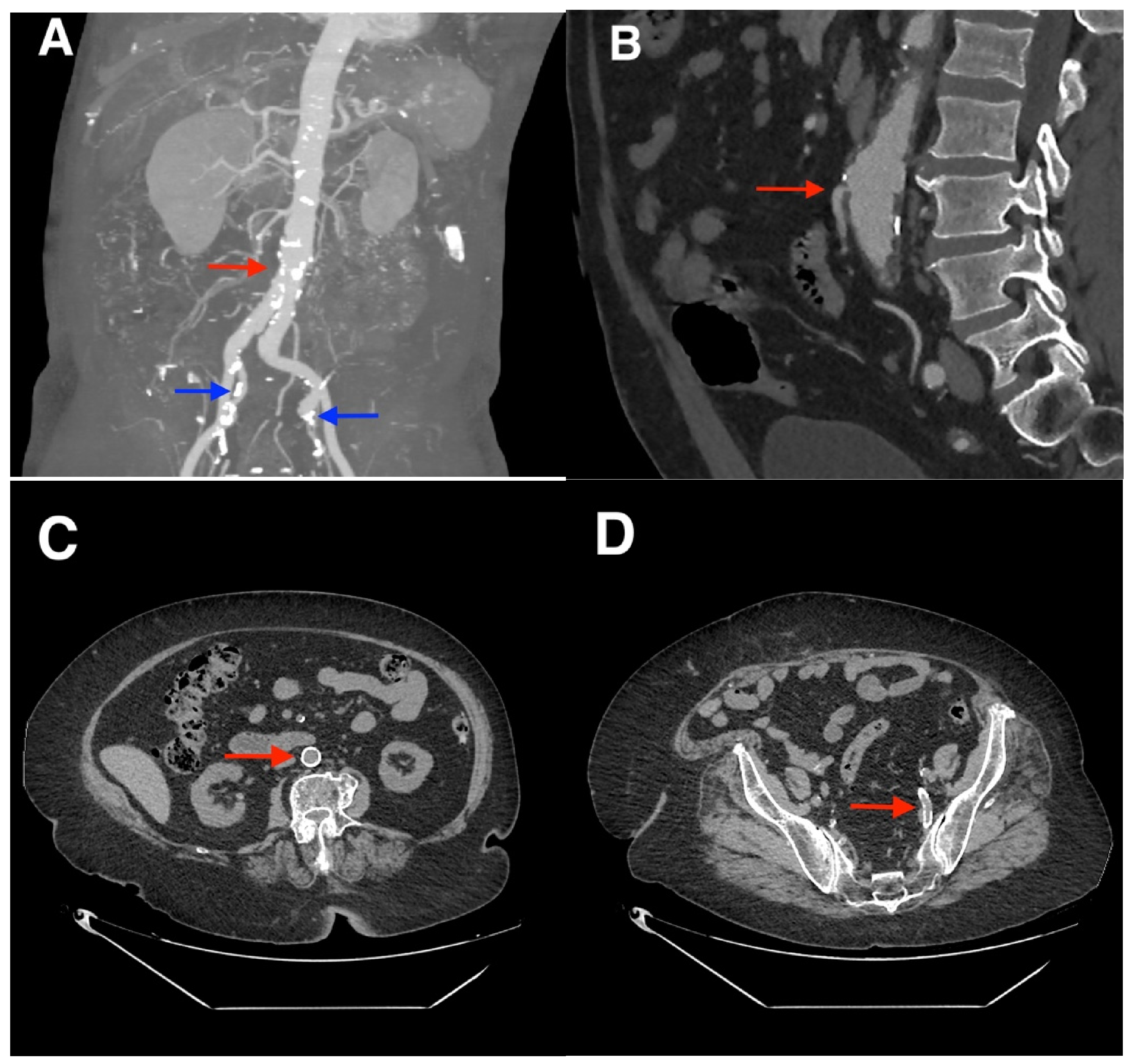
In this review, we explored the association between preoperative CT-derived vascular atherosclerosis metrics and adverse postoperative outcomes after elective colorectal cancer resection with primary anastomosis. The two exposure categories evaluated in our study were calcification burden and mesenteric/visceral arterial stenosis indices. Results could be pooled for three of the prespecified outcomes, namely overall anastomotic leakage, clinically severe leakage requiring reoperation and major postoperative morbidity, whereas short-term mortality and stenosis-based outcomes could not be synthesized with comparable confidence, because reporting was sparse and heterogeneous. Across pooled analyses, higher calcification burden was associated with increased odds of anastomotic leakage and severe leak (any AL: OR 3.08; 95% CI 2.09–4.54; k = 11, Figure 2; grade C AL: OR 2.68; 95% CI 1.03–6.97; k = 3, Figure 2). Major morbidity was not significant in the primary REML + Hartung–Knapp analysis. Although the post hoc DerSimonian–Laird comparison (Table A6) produced narrower CIs and crossed the threshold for nominal statistical significance, this did not alter the interpretation given the small body of evidence (k = 3). We therefore retained major morbidity as imprecise and hypothesis-generating, while the association between calcification burden and any anastomotic leak remained the principal stable pooled finding. We emphasize that the observed associations should be interpreted as risk marker relationships rather than practical thresholds for clinical decision-making (e.g., diversion) to be used in isolation. Although calcification burden was the most consistently supported CT-derived vascular marker across included studies, the currently available evidence for mesenteric stenosis, particularly IMA stenosis/occlusion, remains limited and does not support a definitive hierarchy of prognostic importance. Figure 7 provides examples of the CT-derived vascular disease markers explored.
Sensitivity testing did not significantly change the pooled estimates. Leave-one-out analyses preserved the direction and statistical significance of the associations, suggesting that the overall effects were not due to the influence of any individual study (leave-one-out pooled OR of 3.08, range 2.83–3.41; Figure 3). Trim-and-fill decreased the pooled association from OR 3.08 to OR 2.39 (95% CI 1.53–3.75), imputing four studies without changing direction (Figure 6), potentially indicative of small-study effects. Between-study variability of the “any AL” subgroup was moderate (I2 = 33.6%; τ2 = 0.12; Figure 2) and appeared partly as a result of exposure definition differences, with larger effects observed in studies using ROC/Youden-derived thresholds (Figure 5). Although influence diagnostics identified Diao et al. [20] as the largest contributor to between-study variability, exploratory post hoc meta-regression suggested that study size was also inversely associated with effect magnitude. Together with the funnel plot asymmetry, Egger test and trim-and-fill results, this pattern is compatible with possible small-study effects, rather than indicating an independent clinical moderator. Publication year and geographic region did not clearly explain between-study heterogeneity. Overall, these findings support a conservative interpretation: the association between AAC burden and any AL appears directionally stable, but heterogeneity and possible small-study effects limit derivation of a transferable CT threshold. A complete discussion of residual uncertainty and sources of bias can be found in the “Limitations” subsection.
The biological mechanism is clinically plausible and consistent with the classical surgical model in which anastomotic integrity reflects the interaction between local technical conditions and tissue perfusion. The impact of perfusion has been validated in several studies on indocyanine green fluorescence angiography (ICG-FA), an intraoperative technique that provides real-time assessment of bowel perfusion at the intended transection and anastomotic margins. A large meta-analysis reported reduced leakage with ICG-FA in comparative studies [52], while RCT findings are context-dependent, reporting benefit in rectal cancer surgery [53] and neutral overall results in broader colorectal trial populations [54,55,56]. It should be noted, however, that ICG-FA and CT-derived vascular markers are not directly interchangeable; the first is a functional intraoperative test while the latter is a potential preoperative screening tool that may reflect impaired inflow, collateral reserve or broader vascular vulnerability. On the other hand, preoperative mesenteric stenosis grading on routine CT could serve as an opportunistic assessment of reduced inflow/collateral reserve in the form of an upstream proxy of impaired perfusion. Indeed, Arron et al. hypothesized that severe IMA disease acts as a “functional high tie,” compromising perfusion and increasing leak risk [19] and calcification-based metrics are generally interpreted in the surgical literature as markers of systemic arteriosclerosis with impaired perfusion reserve, although a direct link to anastomotic microvasculature has not been demonstrated. Imaoka et al. [57] proposed a plausible hemodynamic rationale via reduced arterial elasticity and Windkessel buffering, alongside diffuse visceral arterial disease. Moreover, adjacent evidence supporting the importance of CT-derived vascular disease markers exists for other perfusion-sensitive reconstructions [58,59,60,61]. The emerging reverse cardio-oncology literature highlights the overlap between cardiovascular disease and oncology, with studies linking atherosclerotic disease to cancer outcomes through systemic inflammatory and immune–hematopoietic pathways [62] and claims-based analyses reporting an independent association between atherosclerotic cardiovascular disease and increased risk of several cancers, including colon cancer [63]. Selected cardiovascular imaging may become relevant in complex oncologic patients; in colorectal cohorts, Gunji et al. [27] reported routine preoperative echocardiography and electrocardiography in surgical patients older than 65 years, while echocardiography remains useful as a first-line examination for suspected malignant cardiac masses, of which metastasis are the most common, followed by CT and MRI for further characterization [64,65]. Taken together, these observations support the view that CT-detected vascular disease may reflect broader host vulnerability in addition to reduced perfusion reserve.
Existing reviews have addressed similar questions but differ in scope and analytic strategy. Knight et al. [66] evaluated aortic calcification across gastrointestinal resections and highlighted heterogeneity in calcification assessment and limited confounder control in colorectal cohorts, constraining colorectal-specific inference. Tong et al. [67] provided an early colorectal meta-analysis based on a small number of studies using non-uniform quantification methods. Hoek et al. [68] demonstrated that incompatible calcification scoring methods across colorectal studies limited conventional pooling and emphasized the need for standardized vascular assessment, including stenosis grading. Liu et al. [69] reported a positive association but their search included studies up to 2022, applied different effect measures (hazard ratio—HR, not standard practice for short-term binary complications) and mixed benign and malignant indications, with subgrouping. Khan et al. [70] adopted a broader “blood supply” perspective and did not meta-analyze on grounds of heterogeneity, but nevertheless proposed CT-derived vascular assessment for AL prediction and surgical planning. Differences between prior pooled estimates and the present findings likely reflect population restrictions (CRC-only vs. mixed-indication), approach to exposure data (territory and score type) and threshold derivation. In our analyses, studies using ROC/Youden thresholds tended to yield larger effects (Figure 5), consistent with our bias diagnostics (Appendix D). Compared to prior reviews, the present work aimed to reduce statistical noise by restricting eligibility to histologically confirmed CRC with primary anastomosis, employed an updated evidence base through 2026, extended outcomes to clinically severe (grade C/ISREC-equivalent) leak and major morbidity and assessed calcification alongside the limited CRC-specific evidence on stenosis within a formal risk-of-bias and GRADE framework.

4.1. Strengths and Limitations

This review had several strengths, including prospective PROSPERO registration, PRISMA-based methodology, a broad search strategy, duplicate screening and extraction, formal risk-of-bias and GRADE assessments and a clinically focused population of colorectal cancer patients undergoing resection with primary anastomosis. In contrast to broader previous reviews, we evaluated CT-derived vascular disease markers specifically in relation to early post-operative outcomes after colorectal cancer surgery and considered both calcification burden and mesenteric stenosis. The main pooled association was further examined through multiple sensitivity analyses, including leave-one-out testing, trim-and-fill analysis and subgroup analyses according to cut-off derivation and measurement approach, and the direction of the main association proved stable under different sets of assumptions, although effect sizes were attenuated in some sensitivity analyses.
This study also had a number of important limitations. Firstly, the certainty rating of our conclusions was impacted by the largely retrospective and observational nature of the included studies and by incomplete adjustment for confounding variables such as baseline participant health status and intraoperative factors. Technical variables, including mechanical versus manual anastomosis, anastomotic configuration, reinforcement, number of stapler firings, anastomotic height and diversion, may influence leakage risk and may interact with impaired vascular reserve. However, these factors were inconsistently reported across the included studies and were generally unavailable as technique-specific exposure–outcome data suitable for adjustment, subgroup analysis or meta-regression. They should therefore be considered potential sources of residual confounding and heterogeneity in the present review.
The included studies were clinically and methodologically heterogeneous in both exposure and outcome definitions. CT-derived vascular disease was assessed across different arterial territories using non-uniform CT acquisition/reconstruction parameters and with different visual, semiquantitative or software-based scoring methods, while the thresholds used to define high-risk vascular disease were derived through different approaches (clinically motivated, median-based or data-driven) rather than from a prespecified standard. Outcome definitions were also variable; AL follow-up windows ranged from 30-day endpoints in several cohorts to 90-day endpoints or clinically relevant reintervention-based definitions in others, while the rest did not specify an explicit timeframe. Small-study effects and potential publication bias also remain credible concerns, as suggested by funnel plot asymmetry, Egger’s test and trim-and-fill analysis, while selective reporting of exposure specifications or outcomes cannot be excluded. In addition, because the primary meta-analyses were based on crude 2 × 2 data, pooled estimates should be interpreted as unadjusted prognostic associations rather than fully adjusted causal effects. Residual confounding therefore remains an important limitation.
Finally, restricting our analysis to histologically confirmed CRC with primary anastomosis improves clinical coherence but also reduces generalizability to broader colorectal populations. This restriction also limited the evidence for mesenteric stenosis, as only one eligible CRC-specific study provided extractable outcome data. Mixed-indication stenosis studies did not meet the inclusion criteria for the main synthesis and were therefore not incorporated into the main evidence synthesis; instead, they were retained only as contextual supplementary evidence for hypothesis-generation (Appendix E).

4.2. Future Directions

Future work should move from heterogeneous retrospective associations to standardized evidence of clinical decision-making. Comparisons of vascular territories relevant to colorectal perfusion, study protocols and primary scoring approach can facilitate the development of a standardized and reproducible methodology. Standardized technical operative variables should be collected together with CT-derived vascular markers to determine whether preoperative vascular disease adds predictive value beyond anastomotic technique. Prospective multicenter cohorts should validate calcification and stenosis measures using generally accepted outcome definitions and follow-up windows (ISREC Grade B/C or equivalent, and major morbidity Clavien–Dindo type ≥ III). Clinical translation could take the form of preoperative CT-based screening and risk-stratification to identify patients most likely to benefit from selective intraoperative ICG-FA confirmation at the planned transection or anastomotic site. Future validation studies could therefore evaluate integrated pathways combining standardized preoperative CT-derived vascular risk assessment with selective intraoperative ICG-FA, rather than considering the two methods as parallel and competing alternatives. The role of stenosis assessment remains understudied relative to other potential prognostic biomarkers. In conjunction with vascular anatomy, clinically significant stenosis of upstream arteries could represent a type of preoperative perfusion assessment to be used in ascertaining surgical risk. AI-enabled opportunistic CT quantification of vascular calcification, and potentially stenosis grading, may improve the reproducibility and scalability of preoperative risk assessment. Although no such AI models for surgical risk prediction currently exist, analogous applications have been developed for opportunistic cardiovascular risk prediction [71], with some studies even suggesting favorable cost-effectiveness [14]. Finally, dedicated health–economic analyses are needed to establish the utility of a CT triage-to-perfusion confirmation approach in terms of reducing the risk of clinically relevant leaks and reoperations.

5. Conclusions

This review supports an association between preoperative CT-derived vascular disease markers and adverse postoperative outcomes after colorectal cancer resection with primary anastomosis. Calcification-based metrics provided the most consistent associations with any AL and grade C/clinically severe AL, whereas evidence for major morbidity and stenosis-based measures remained insufficient for firm conclusions. These findings indicate that routinely acquired preoperative CT may provide opportunistic information for surgical risk stratification, but the current evidence does not establish a validated clinical decision threshold. Given the largely retrospective and methodologically variable evidence base, these findings are best viewed as a basis for prospective validation rather than directly actionable clinical thresholds. Further prospective studies using standardized CT scoring and uniform outcome definitions are needed to validate clinical benefit, derive transferable cut-off values and determine whether specific vascular territories have differential prognostic value. Clinical use should remain cautious until prospective studies validate pathways that integrate preoperative CT-based risk stratification with selective intraoperative perfusion assessment, including ICG-FA.

Supplementary Materials

The following supporting information can be downloaded at: https://www.mdpi.com/article/10.3390/diagnostics16101449/s1, Table S1: PRISMA 2020 checklist. Ref. [72] is cited in Supplementary Materials.

Author Contributions

Conceptualization, M.-I.N. and N.A.H.; methodology, M.A.S.; software, M.-I.N.; validation, M.-I.N., N.A.H., M.A.S., A.C. and D.U.; formal analysis, M.-I.N. and D.U.; investigation, M.-I.N.; resources, N.A.H.; data curation, M.A.S.; writing—original draft preparation, M.-I.N.; writing—review and editing, M.A.S. and A.C.; visualization, A.C.; supervision, N.A.H.; project administration, M.-I.N. All authors have read and agreed to the published version of the manuscript.

Funding

This research was supported by the project “New smart and adaptive robotics solutions for personalized minimally invasive surgery in cancer treatment—ATHENA” funded by the European Union—NextGenerationEU and Romanian Government under National Recovery and Resilience Plan for Romania, contract no. 760072/23.05.2023, code CF 16/15.11.2022, through the Romanian Ministry of Research, Innovation and Digitalization, within Component 9, investment I8.

Institutional Review Board Statement

Not applicable.

Data Availability Statement

All analyzed data found in this review are accessible through the referenced papers; the generated spreadsheets and code used for statistical analysis are available upon request from the corresponding author.

Acknowledgments

We acknowledge the support of the University of Medicine and Pharmacy Cluj-Napoca and of the Regional Institute of Gastroenterology and Hepatology Cluj-Napoca.

Conflicts of Interest

The authors declare no conflicts of interest.

Abbreviations

The following abbreviations are used in this manuscript:
AACAbdominal aortic calcification
ACIAorto-iliac calcification index
ACSAbdominal aortic calcification score
ALAnastomotic leakage
BMIBody mass index
CACeliac artery
CCCase–control
CAVICardio-ankle vascular index
C-DClavien–Dindo (classification)
CECTContrast-enhanced computed tomography
CIConfidence interval
CORREAESCP CORREA 2022 audit
CRCColorectal cancer
CTComputed tomography
ESCPEuropean Society of Coloproctology
GLOBOCANGlobal Cancer Observatory database
GRADEGrading of Recommendations Assessment, Development and Evaluation
ICG-FAIndocyanine green fluorescence angiography
IMAInferior mesenteric artery
I2I-squared heterogeneity statistic
ISRECInternational Study Group of Rectal Cancer
MEDLINEMedical Literature Analysis and Retrieval System Online
MRIMagnetic resonance imaging
NOSNewcastle–Ottawa Scale
OROdds ratio
PCProspective cohort
PCSProspective cross-sectional
PEOPatient, exposure, outcome
PETPositron emission tomography
PRISMAPreferred Reporting Items for Systematic Reviews and Meta-Analyses
PROSPEROInternational Prospective Register of Systematic Reviews
RCRetrospective cohort
RCTRandomized controlled trial
ROBRisk of bias
ROCReceiver operating characteristic
SMASuperior mesenteric artery
WoSWeb of Science Core Collection
τ2Between-study variance (tau-squared)

Appendix A. Search Strategy

Table A1. Full search strategy in PubMed.
BlockStringNumber of Results
Cancer—1“Colorectal Neoplasms” [mh] OR “Colonic Neoplasms” [mh] OR “Rectal Neoplasms” [mh] OR “Cecal Neoplasms” [mh] OR ((“Intestine, Large” [mh] OR “Cecum” [mh] OR “Colon” [mh] OR “Rectum” [mh] OR colorectal * [tiab] OR colon * [tiab] OR rectal * [tiab] OR rectum [tiab] OR anal [tiab] OR anus [tiab] OR appendi * [tiab] OR cecum * [tiab] OR coecum * [tiab] OR caecum * [tiab] OR cecal * [tiab] OR coecal * [tiab] OR caecal * [tiab] OR sigmoid * [tiab] OR colorectal [tiab] OR colon [tiab] OR colonic [tiab] OR rectal [tiab] OR rectum [tiab] OR “large bowel” [tiab] OR CRC [tiab]) AND (cancer * [tiab] OR carcinoma * [tiab] OR tumor * [tiab] OR tumour * [tiab] OR malignan * [tiab] OR “bowel cancer” [tiab] OR neoplas * [tiab] OR tumour * [tiab] OR cancer * [tiab] OR oncolog * [tiab] OR adenoma * [tiab] OR malignan * [tiab])502,433 results
Surgery—2“Colorectal Surgery” [mh] OR “colorectal surg *” [tiab] OR “colorectal resect *” [tiab] OR “hemicolectomy” [tiab] OR “colon resect *” [tiab] OR “colorectal anastomos *” [tiab] OR “LAR surgery” [tiab] OR “low anterior resection” [tiab] OR “abdominoperineal resec t*” [tiab] OR “abdominoperineal surg *” [tiab] OR “bowel obstruction surg *” [tiab] OR “proctocolectomy” [tiab] OR “ileocolectomy” [tiab] OR “sigmoidectomy” [tiab] OR “colectomy *” [tiab] OR “proctectomy” [tiab] OR “left colectomy” [tiab] OR “right colectomy” [tiab] OR “laparoscopic colectomy” [tiab] OR “colon surg *” [tiab] OR “rectal surg *” [tiab] OR “proctology *” [tiab] OR “coloproctotom *” [tiab] OR “proctocolonic” [tiab] OR ((“operat *” [tiab] OR “surg *” [tiab] OR “resect *” [tiab]) AND (“Intestine, Large” [mh] OR “Cecum” [mh] OR “Colon” [mh] OR “Rectum” [mh] OR colo * [tiab] OR recta * [tiab] OR rectu * [tiab] OR anal [tiab] OR anus [tiab] OR appendi * [tiab] OR cecum * [tiab] OR coecum * [tiab] OR caecum * [tiab] OR cecal * [tiab] OR coecal * [tiab] OR caecal * [tiab] OR sigmoid * [tiab])276,803 results
Imaging—3 “Diagnostic Imaging” [mh] OR “Tomography, X-Ray Computed” [mh] OR “Computed Tomography Angiography” [mh] OR “CT scan *” [tiab] OR “CAT scan *” [tiab] OR “compute * tomograph*” [tiab] OR “X-ray comput *” [tiab] OR CT [tiab] OR CTA [tiab] OR “CT perfusion” [tiab] OR “perfusion CT” [tiab] OR CTP [tiab] OR “computed tomograph * angiograph*” [tiab] OR “spiral CT” [tiab] OR “helical CT” [tiab] OR “multidetector CT” [tiab] OR “dual-energy CT” [tiab]3,460,819 results
Intervention—I“Vascular Calcification” [mh] OR “Atherosclerosis/diagnostic imaging” [mh] OR “Mesenteric Arteries/diagnostic imaging” [mh] OR “Aorta, Abdominal/diagnostic imaging” [mh] OR “Iliac Artery/diagnostic imaging” [mh] OR radiomic * [tiab] OR “radiomic signature *” [tiab] OR “texture analysis” [tiab] OR “imaging biomarker *” [tiab] OR “imaging feature *” [tiab] OR calcif * [tiab] OR calcific * [tiab] OR “calcification” [tiab] OR “calcifications” [tiab] OR “calcified plaque” [tiab] OR “calcium score” [tiab] OR “calcium scoring” [tiab] OR “Agatston score” [tiab] OR Agatston [tiab] OR “aortic calcification” [tiab] OR “abdominal aortic calcification” [tiab] OR “iliac calcification” [tiab] OR “vascular calcification” [tiab] OR stenos * [tiab] OR stenosis [tiab] OR stenoses [tiab] OR occlus * [tiab] OR “occlusion” [tiab] OR “occlusive disease” [tiab] OR “arterial stenosis” [tiab] OR “arterial occlusion” [tiab] OR “arterial obstruction” [tiab] OR “mesenteric stenosis” [tiab] OR “mesenteric occlusion” [tiab] OR “mesenteric ischemia” [tiab] OR SMA [tiab] OR IMA [tiab] OR perfus * [tiab] OR “blood flow” [tiab] OR “tissue perfusion” [tiab] OR microperfusion [tiab] OR “CT perfusion” [tiab] OR “perfusion CT” [tiab] OR CTP [tiab]1,018,018 results
Outcome—Opost-operat * [tiab] OR postoperat * [tiab] OR surger * [tiab] OR surgical * [tiab] OR operat * [tiab]) AND (complication * [tiab]) OR “Postoperative Complications” [mh] OR “Anastomotic Leak” [mh] OR “Anastomosis, Surgical/adverse effects” [mh] OR “Surgical Wound Infection” [mh] OR “Surgical Wound Dehiscence” [mh] OR “Ileus” [mh] OR “Mortality” [mh] OR “Reoperation” [mh] OR “Patient readmission” [mh] OR infect * [tiab] OR outcome * [tiab] OR leak * [tiab] OR hernia * [tiab] OR complicat * [tiab] OR readmi * [tiab] OR prognos * [tiab] OR predict * [tiab] OR abcess [tiab] OR abscess [tiab] OR impact [tiab] OR morbidity [tiab] OR mortality [tiab] OR adverse [tiab] OR recur * [tiab] OR recover * [tiab] OR emergen * [tiab] OR urgen * [tiab] OR death [tiab] OR survival [tiab] OR “acute kidney injury” [tiab] OR AKI [tiab] OR risk [tiab] OR peritonit * [tiab] OR adhesion [tiab] OR ischemia * [tiab] OR perforat * [tiab] OR repair [tiab] OR anastomo * [tiab] OR bleeding [tiab] OR stricture * [tiab] OR stenos * [tiab] OR “postoperative outcome *” [tiab] OR “surgical outcome *” [tiab] OR “treatment outcome *” [tiab] OR “postoperative mortality” [tiab] OR “anastomotic leak” [tiab] OR “anastomotic leakage” [tiab] OR “anastomotic failure” [tiab] OR “anastomotic dehiscence” [tiab] OR “anastomotic insufficiency” [tiab] OR “anastomotic fistula” [tiab] OR “surgical site infection” [tiab] OR SSI [tiab] OR “wound infection” [tiab] OR “intra-abdominal infection” [tiab] OR abscess* [tiab] OR ileus [tiab] OR “postoperative ileus” [tiab] OR “paralytic ileus” [tiab] OR “organ dysfunction” [tiab] OR “organ failure” [tiab] OR “multiple organ dysfunction” [tiab] OR sepsis [tiab] OR reoperate * [tiab] OR “re-operation” [tiab] OR readmiss * [tiab] OR “hospital readmission” [tiab] OR “Clavien-Dindo” [tiab] OR Clavien [tiab] OR “complication grade” [tiab]14,872,887 results
Population—P1 AND 2 AND 3126,080 results
TotalP AND I AND O1717 results
Total—study exclusionTotal NOT (Review [Publication Type] OR “Case reports” [Publication Type]) NOT (animals [Mesh] NOT humans [Mesh])1067 results
Table A2. Full search strategy in Google Scholar. Retrieval of Google Scholar search results was automated using Publish or Perish (Harzing, A.W. [2007] Publish or Perish, available from https://harzing.com/resources/publish-or-perish [accessed on 1 January 2026]).
StringResults Screened
“abdominal aortic calcification” CT colorectal anastomotic leak72
“aortic calcification index” CT rectal anastomotic leak20
“aortoiliac calcification” CT rectal surgery anastomotic leak29
“iliac artery calcification” CT rectal resection anastomotic leak9
“calcium score” aortic CT colorectal anastomotic leak93
Agatston CT rectal cancer surgery anastomotic leak71
“vascular calcification” CT colorectal surgery113
“inferior mesenteric artery” stenosis CT rectal anastomotic leak200
“inferior mesenteric artery” occlusion CT rectal anastomotic leak200
“superior mesenteric artery” stenosis CT right colectomy anastomotic leak200
“celiac trunk” stenosis CT right colectomy anastomotic leak200
“mesenteric artery stenosis” CT colorectal surgery complication149
“mesenteric occlusive disease” CT colorectal anastomotic leak28

Appendix B. Newcastle–Ottawa Scores

Table A3. NOS scoring of the selected studies for each category. Each ☆ denotes one Newcastle-Ottawa Scale point awarded for the corresponding item.
StudySelectionComparabilityOutcome/ExposureTotal
0–9
Study Quality
S1S2S3S4C1C2O1/E1O2/E2O3/E3
Arron et al.
2022 [19]
7Good
Diao et al.
2024 [20]
8Good
Eveno et al.
2016 [21]
7Good
Gunji et al.
2022 [27]
6Fair
Knight et al.
2021 [28]
8Good
Lee et al.
2020 [29]
6Fair
Morita et al.
2022 [30]
6Fair
Namba et al. 2021 [31] 7Good
Norooz et al.
2016 [32]
5Fair
Pochhammer et al.
2018 [33]
7Good
Postaire et al.
2018 [34]
6Fair
Shen et al.
2019 [35]
6Fair
Turhan et al.
2025 [36]
7Good
Zhang et al.
2023 [37]
6Fair
Items: Selection: S1 representativeness; S2 non-exposed from same cohort; S3 exposure ascertained from records/CT; S4 outcome absent at baseline. Comparability: C1 key confounders; C2 additional confounders. Outcome: O1 outcome assessment; O2 follow-up long enough; O3 adequacy of follow-up. Exposure: E1 ascertainment of exposure; E2 same method for cases/controls; E3 non-response.

Appendix C. Adjusted Analyses

Table A4. Summary of confounder-control strategies and adjusted (or matched) estimates reported in included studies.
StudyOutcomeCT Vascular Marker (Cut Point)Adjustment/Matching (Covariates)Adjusted/Matched Estimate
Arron et al. 2022 [19]Any ALIMA stenosis ≥ 70% or occlusion Matched CC (1:1) on age, BMI, cardiovascular comorbidityClinically significant IMA stenosis: 21.2% (AL cases) vs. 1.9% (controls); p = 0.01
Diao et al. 2024 [20]Any ALAAC (present vs. absent)Multivariable logistic regression; sex, HTN, T2DM, tumor location, tumor stage, smoking, drinkingOR 1.443 (95% CI 0.871–2.358); p = 0.157
Gunji et al. 2022 [27]Major complications (C-D ≥ III)AAC score (continuous variable)Multivariable logistic regression; covariates (p < 0.25 in univariate): sex, ASA ≥ 3, hyperlipidemia, chronic renal failure, stage, CAVI, laparoscopic surgery, anterior resection, operative time, AAC scoreOR 1.083 (95% CI 1.009–1.163); p = 0.026
Knight et al. 2021 [28]AL
Major complications (C-D III–V)
Distal aortic calcification (None/Minor/Major)Multivariable logistic regression; covariates: significant univariate predictors (sex, tumor site, surgical approach, smoking)Any complications: OR 1.05 (95% CI 0.83–1.33); p = 0.70. Major complications: OR 1.32 (95% CI 0.90–1.94); p = 0.15
Lee et al. 2020 [29]Grade C ALAortoiliac calcification score ≥ 3 vs. <3Backward stepwise logistic regression; sex, ASA score, operative time ≥ 180 min, AICS ≥ 3OR 2.677 (95% CI 1.040–6.890); p = 0.041
Namba et al. 2021 [31]ALAgatston score (high vs. low)Multivariable logistic regression; male sex, lower rectal tumor, preop WBC, Agatston scoreOR 6.09 (95% CI 1.48–25.0); p = 0.012
Pochhammer et al. 2018 [33]ALInternal iliac artery calcification (volume score ≥ 30 vs. <30; ROC-derived)Logistic regression; multivariable model retained internal iliac volume score + renal diseaseMultivariable: calcification not independent (p = 0.08); renal disease p = 0.001 a.
Shen et al. 2019 [35]ALAortic Calcification Index (ACI) > 4.8% Multivariable logistic regression (after LASSO selection); CAD, TG > 1.7, glucose > 6.1, UICC stage III-IV, op time > 240 min, diverting ileostomy, ACIOR 2.391 (95% CI 1.040–5.494); p = 0.040
Turhan et al. 2025 [36]ALAortic calcification >50%Multivariable logistic regression; TNM stage, HTN, cardiovascular disease, neoadjuvant therapyOR 10.38 (95% CI 1.243–92.118); p = 0.032
Zhang et al. 2023 [37]ALSMA calcium volume score (continuous variable)Multivariable logistic regression; tumor location, albumin, lymphocyte count, NLR, SMA calcium volume scoreOR 6.810 (95% CI 1.870–24.801); p = 0.004
* Abbreviations: AAC—abdominal aortic calcification; AC—aortic calcification; ACI—aortic calcification index; AICS—aortoiliac calcification score; AL—anastomotic leak; ASA—American Society of Anesthesiologists; BMI—body mass index; CAD—coronary artery disease; CAVI—cardio-ankle vascular index; C-D—Clavien–Dindo; HTN—hypertension; IMA—inferior mesenteric artery; NLR—neutrophil-to-lymphocyte ratio; SMA—superior mesenteric artery; T2DM—type 2 diabetes mellitus. a Univariate internal iliac Ca score OR 1.005 (95% CI 1.001–1.008; p = 0.01).

Appendix D. Sensitivity Analysis

Table A5. Results of the sensitivity analysis for the different harmonization assumptions (categorical moderator univariate meta-regression).
Moderator
(Comparison)
k (Ref/Comp)Test of Moderatorp-ValueExp(β) (Ratio of ORs)
(95% CI for OR Exp(β))
Heterogeneity
(Residual τ2; R2)
Cut point type
(ROC-derived vs. non-ROC-derived) a
7/45.420.0442.32
(1.02–5.24)
0.0217/82.5%
Exposure measurement
(visual vs. quantitative) b
5/62.070.1840.61
(0.28–1.33)
0.82/34%
Vascular territory (non-Aorta-only vs. Aorta-only) c6/50.0260.8751.06
(0.46–2.45)
0.16/0%
NOS score
(good vs. fair)
6/50.00550.9420.97
(0.42–2.25)
0.16/0%
a ROC-derived thresholds were obtained through ROC/Youden optimization; non-ROC-derived thresholds were prespecified (e.g., median-based cut point or ordinal staging). b Visual scores include binary presence/absence and visual ordinal staging (e.g., none/minor/major); quantitative measurements are software-derived numerical metrics. c Aorta-only scores include the whole abdominal aorta or infrarenal aorta only; non-Aorta-only scores include aortoiliac, splanchnic-only (celiac and mesenteric arteries), or mixed aortic–splanchnic territories. F, test of moderators from the mixed-effects meta-regression; exp(β) is the multiplicative difference in pooled OR between the compared categories as coded in the model.
Table A6. Estimator comparison check between the REML + Hartung–Knapp and the DerSimonian–Laird methods for CI estimation.
Outcome/
Exposure
Studies/
Participants
Primary Model:
REML + Hartung–Knapp OR (95% CI)
Primary Model:
DerSimonian–Laird OR (95% CI)
Effect of Estimator Choice
Major morbidity/AACk = 3/n = 8411.99
(0.86–4.59)
1.99
(1.27–3.11)
DerSimonian–Laird produced a narrower CI and changed nominal statistical significance
Any anastomotic leak/AACk = 11/n = 50053.08
(2.09–4.54)
3.04
(2.15–4.31)
DerSimonian–Laird produced a narrower CI without changing statistical significance
Grade C anastomotic leak/AACk = 3/n = 34182.68
(1.03–6.97)
2.68
(1.59–4.52)
DerSimonian–Laird produced a narrower CI without changing statistical significance
Abbreviations: AAC, abdominal aortic calcification; CI, confidence interval; OR, odds ratio; REML, restricted maximum likelihood.
Table A7. Exploratory univariable meta-regression for the association between abdominal aortic calcification burden and any anastomotic leak.
ModeratorStudies IncludedCodingRatio of ORs95% CIp-ValueResidual τ2
Residual I2
R2
Interpretation
Sample size11Per 100-participant increase0.9630.932–0.9940.0240.0187
6.65%
84.9%
Larger studies reported smaller effect estimates consistent with small study effects
Publication year11Per additional calendar year within the observed range0.940.801–1.1030.4020.1009
30.07%
18.7%
Publication year did not clearly explain heterogeneity
Geographic region11Asia vs. Europe1.4880.668–3.3100.2900.1085
32.81%
12.7%
No clear regional effect modification was observed

Appendix E. Exploratory Analysis of Mixed-Indication Abdominal Arterial Stenosis (CA, SMA and IMA) and AL

Figure A1. Forest plot of the association between preoperative mesenteric arterial stenosis (≥50% vs. <50%) and anastomotic leak (AL), stratified by artery (celiac axis [CA], superior mesenteric artery [SMA], inferior mesenteric artery [IMA]). These studies did not meet the CRC-specific eligibility criteria for the main synthesis unless CRC-only data were available. Results from this plot were not used for the GRADE certainty rating or for the main conclusions [17,18,19]. Squares represent individual study effects (size proportional to study weight) and diamonds represent pooled effects; horizontal lines indicate 95% CIs.
Diagnostics 16 01449 g0a1

Appendix F. Domain-Level GRADE Evidence Decision Table

Table A8. Domain-level GRADE evidence decision table. The table should be read row-wise. For each outcome, the contributing evidence base and effects are shown first, followed by the starting certainty and the domain-level GRADE judgements that determined the final certainty rating. Downgrades and upgrades are indicated in the relevant domain columns; the explanation line below each outcome summarizes the rationale for the final rating.
Starting CertaintyRisk of BiasInconsistencyIndirectnessImprecisionPublication BiasUpgrade FactorsFinal
Certainty
Major morbidity/abdominal aortic calcification score
k = 3/n = 841
OR 1.99, 95% CI 0.86–4.59
LowSerious; downgraded one levelNot seriousNot seriousSerious; downgraded one levelNot assessableNone⊕◯◯◯ Very low
Explanation: Low starting certainty because the evidence was based on observational studies. ROB was judged serious because of retrospective designs and incomplete confounder control. Serious imprecision on account of the CI crossing the null and including both no important effect and clinically important harm.
Any anastomotic leak/abdominal aortic calcification score
k = 11/n = 5005
OR 3.08, 95% CI 2.09–4.54
LowSerious; downgraded one levelNot seriousNot seriousNot seriousSuspected; concern but no formal downgradeLarge magnitude of effect; upgraded one level⊕⊕◯◯ Low
Explanation:Low starting certainty because the evidence was based on observational studies. ROB was judged serious because most studies were retrospective and incompletely adjusted. Moderate heterogeneity but leave-one-out and sensitivity analyses preserved the direction of effect. Publication bias was suspected, but, since trim-and-fill did not eliminate the association, no additional formal downgrade was applied. Upgraded for large magnitude of effect.
Grade C anastomotic leak/abdominal aortic calcification score
k = 3/n = 3418
OR 2.68, 95% CI 1.03–6.97
LowSerious; downgraded one levelNot seriousNot seriousNot seriousNot assessableNone⊕◯◯◯ Very low
Explanation:Low starting certainty because the evidence was based on observational studies. Serious ROB because of retrospective and incompletely adjusted evidence.
Mortality/abdominal aortic calcification score
k = 2/n = 184; additional deaths mentioned without exposure-stratified data
Not pooled/not estimable
LowSerious; downgraded one levelNot reliably assessableSerious; downgraded one levelSerious; downgraded one levelNot assessableNone⊕◯◯◯ Very low
Explanation:Effect estimate not pooled; downgraded for serious imprecision because mortality events were sparsely reported and some studies did not stratify mortality by exposure, hindering the extraction of stable mortality estimates. Downgraded for indirectness because post-operative and all-cause mortality were not separated. Only two AAC studies provided mortality information compatible with vascular exposure assessment, while additional studies reported deaths without stratification by calcium score category or without perioperative timing.
Any anastomotic leak/clinically significant IMA stenosis
k = 1/n = 104
OR 13.68, 95% CI 1.69–110.4
LowSerious; downgraded one levelNot assessable; single-studyNot seriousVery serious; downgraded two levelsNot assessableNone⊕◯◯◯ Very low
Explanation:Evidence came from a single CRC-specific matched case–control study. The association was large, but the estimate was very imprecise with a wide CI and few exposed events. Inconsistency and publication bias could not be assessed. No upgrade was applied because the evidence was single-study and the association was imprecise. Mixed-indication stenosis studies were not used to determine this certainty rating.
Abbreviations: AAC, abdominal aortic calcification; CI, confidence interval; CRC, colorectal cancer; GRADE, Grading of Recommendations Assessment, Development and Evaluation; IMA, inferior mesenteric artery; OR, odds ratio; ROB, risk of bias.

References

  1. Bray, F.; Laversanne, M.; Sung, H.; Ferlay, J.; Siegel, R.L.; Soerjomataram, I.; Jemal, A. Global Cancer Statistics 2022: GLOBOCAN Estimates of Incidence and Mortality Worldwide for 36 Cancers in 185 Countries. CA Cancer J. Clin. 2024, 74, 229–263. [Google Scholar] [CrossRef]
  2. Argilés, G.; Tabernero, J.; Labianca, R.; Hochhauser, D.; Salazar, R.; Iveson, T.; Laurent-Puig, P.; Quirke, P.; Yoshino, T.; Taieb, J.; et al. Localised Colon Cancer: ESMO Clinical Practice Guidelines for Diagnosis, Treatment and Follow-Up. Ann. Oncol. 2020, 31, 1291–1305. [Google Scholar] [CrossRef] [PubMed]
  3. Hofheinz, R.-D.; Fokas, E.; Benhaim, L.; Price, T.J.; Arnold, D.; Beets-Tan, R.; Guren, M.G.; Hospers, G.A.P.; Lonardi, S.; Nagtegaal, I.D.; et al. Localised Rectal Cancer: ESMO Clinical Practice Guideline for Diagnosis, Treatment and Follow-Up. Ann. Oncol. 2025, 36, 1007–1024. [Google Scholar] [CrossRef] [PubMed]
  4. 2022 European Society of Coloproctology (ESCP) CORREA Collaborating Group. Towards Safer Colorectal Surgery Worldwide: Outcomes and Benchmarks from the ESCP CORREA 2022 Audit. Color. Dis. 2025, 27, e70281. [Google Scholar] [CrossRef] [PubMed]
  5. Dindo, D.; Demartines, N.; Clavien, P.-A. Classification of Surgical Complications: A New Proposal with Evaluation in a Cohort of 6336 Patients and Results of a Survey. Ann. Surg. 2004, 240, 205. [Google Scholar] [CrossRef]
  6. Rahbari, N.N.; Weitz, J.; Hohenberger, W.; Heald, R.J.; Moran, B.; Ulrich, A.; Holm, T.; Wong, W.D.; Tiret, E.; Moriya, Y.; et al. Definition and Grading of Anastomotic Leakage Following Anterior Resection of the Rectum: A Proposal by the International Study Group of Rectal Cancer. Surgery 2010, 147, 339–351. [Google Scholar] [CrossRef]
  7. Kube, R.; Mroczkowski, P.; Granowski, D.; Benedix, F.; Sahm, M.; Schmidt, U.; Gastinger, I.; Lippert, H. Anastomotic Leakage after Colon Cancer Surgery: A Predictor of Significant Morbidity and Hospital Mortality, and Diminished Tumour-Free Survival. Eur. J. Surg. Oncol. 2010, 36, 120–124. [Google Scholar] [CrossRef]
  8. Mirnezami, A.; Mirnezami, R.; Chandrakumaran, K.; Sasapu, K.; Sagar, P.; Finan, P. Increased Local Recurrence and Reduced Survival from Colorectal Cancer Following Anastomotic Leak: Systematic Review and Meta-Analysis. Ann. Surg. 2011, 253, 890. [Google Scholar] [CrossRef]
  9. Koedam, T.W.A.; Bootsma, B.T.; Deijen, C.L.; van de Brug, T.; Kazemier, G.; Cuesta, M.A.; Fürst, A.; Lacy, A.M.; Haglind, E.; Tuynman, J.B.; et al. Oncological Outcomes After Anastomotic Leakage After Surgery for Colon or Rectal Cancer: Increased Risk of Local Recurrence. Ann. Surg. 2022, 275, e420. [Google Scholar] [CrossRef]
  10. Nijssen, D.J.; Wienholts, K.; Postma, M.J.; Tuynman, J.; Bemelman, W.A.; Laméris, W.; Hompes, R. The Economic Impact of Anastomotic Leakage after Colorectal Surgery: A Systematic Review. Tech. Coloproctol. 2024, 28, 55. [Google Scholar] [CrossRef]
  11. Caruso, D.; Polici, M.; Bellini, D.; Laghi, A. ESR Essentials: Imaging in Colorectal Cancer-Practice Recommendations by ESGAR. Eur. Radiol. 2024, 34, 5903–5910. [Google Scholar] [CrossRef]
  12. Expert Panel on Gastrointestinal Imaging; Fowler, K.J.; Kaur, H.; Cash, B.D.; Feig, B.W.; Gage, K.L.; Garcia, E.M.; Hara, A.K.; Herman, J.M.; Kim, D.H.; et al. ACR Appropriateness Criteria® Pretreatment Staging of Colorectal Cancer. J. Am. Coll. Radiol. 2017, 14, S234–S244. [Google Scholar] [CrossRef] [PubMed]
  13. Staal, F.C.R.; van der Reijd, D.J.; Taghavi, M.; Lambregts, D.M.J.; Beets-Tan, R.G.H.; Maas, M. Radiomics for the Prediction of Treatment Outcome and Survival in Patients with Colorectal Cancer: A Systematic Review. Clin. Colorectal Cancer 2021, 20, 52–71. [Google Scholar] [CrossRef]
  14. Bates, D.; Pickhardt, P. CT-Derived Body Composition Assessment as a Prognostic Tool in Oncologic Patients: From Opportunistic Research to Artificial Intelligence–Based Clinical Implementation. Am. J. Roentgenol. 2022, 219, 671–680. [Google Scholar] [CrossRef]
  15. van Helsdingen, C.P.M.; van Wijlick, J.G.A.; de Vries, R.; Bouvy, N.D.; Leeflang, M.M.G.; Hemke, R.; Derikx, J.P.M. Association of Computed Tomography-Derived Body Composition and Complications after Colorectal Cancer Surgery: A Systematic Review and Meta-Analysis. J. Cachexia Sarcopenia Muscle 2024, 15, 2234–2269. [Google Scholar] [CrossRef] [PubMed]
  16. Imaoka, Y.; Ohira, M.; Akabane, M.; Sasaki, K.; Ohdan, H. Abdominal Aortic Calcification among Gastroenterological and Transplant Surgery. Ann. Gastroenterol. Surg. 2024, 8, 987–998. [Google Scholar] [CrossRef] [PubMed]
  17. Harmankaya, D.; Egberts, K.J.V.; Metz, F.M.; Vaassen, H.G.M.; Petersman, S.S.E.; Brusse-Keizer, M.; le Haen, P.; Bruno, M.J.; Geelkerken, B.H.; Noord, D. van Mesenteric Artery Stenosis Is a Risk Factor for Anastomotic Leakage in Colorectal Surgery. Eur. J. Vasc. Endovasc. Surg. 2025, 69, 628–637. [Google Scholar] [CrossRef]
  18. Kornmann, V.N.N.; van Werkum, M.H.; Bollen, T.L.; van Ramshorst, B.; Boerma, D. Compromised Visceral Circulation Does Not Affect the Outcome of Colorectal Surgery. Surg. Today 2014, 44, 1220–1226. [Google Scholar] [CrossRef]
  19. Arron, M.N.N.; Broek, R.P.G.T.; Adriaansens, C.M.E.M.; Bluiminck, S.; van Wely, B.J.; Ferenschild, F.T.J.; Smits, H.F.M.; van Goor, H.; de Wilt, J.H.W.; van Petersen, A.S. Mesenteric Occlusive Disease of the Inferior Mesenteric Artery Is Associated with Anastomotic Leak after Left-Sided Colon and Rectal Cancer Surgery: A Retrospective Cohort Study. Int. J. Colorectal Dis. 2022, 37, 631–638. [Google Scholar] [CrossRef]
  20. Diao, Y.-H.; Chen, J.; Liu, Y.; Peng, D.; Yang, D. Does Aortic Calcification Really Affect Anastomotic Leakage after Rectal Cancer Surgery? Medicine 2024, 103, e38860. [Google Scholar] [CrossRef]
  21. Eveno, C.; Latrasse, V.; Gayat, É.; Lo Dico, R.; Dohan, A.; Pocard, M. Colorectal Anastomotic Leakage Can Be Predicted by Abdominal Aortic Calcification on Preoperative CT Scans: A Pilot Study. J. Visc. Surg. 2016, 153, 253–257. [Google Scholar] [CrossRef] [PubMed]
  22. Roviello, F.; Andreucci, E.; Carbone, L.; Calomino, N.; Piccioni, S.; Bobbio, L.; Piagnerelli, R.; Fontani, A.; Marrelli, D. Preoperative Injection of Indocyanine Green Fluorescence at the Anorectal Junction Safely Identifies the Inferior Mesenteric Artery in a Prospective Case-Series Analysis of Colorectal Cancer Patients. Gastrointest. Disord. 2025, 7, 76. [Google Scholar] [CrossRef]
  23. Page, M.J.; Moher, D.; Bossuyt, P.M.; Boutron, I.; Hoffmann, T.C.; Mulrow, C.D.; Shamseer, L.; Tetzlaff, J.M.; Akl, E.A.; Brennan, S.E.; et al. PRISMA 2020 Explanation and Elaboration: Updated Guidance and Exemplars for Reporting Systematic Reviews. BMJ 2021, 372, n160. [Google Scholar] [CrossRef] [PubMed]
  24. Clark, J.M.; Sanders, S.; Carter, M.; Honeyman, D.; Cleo, G.; Auld, Y.; Booth, D.; Condron, P.; Dalais, C.; Bateup, S.; et al. Improving the Translation of Search Strategies Using the Polyglot Search Translator: A Randomized Controlled Trial. J. Med. Libr. Assoc. 2020, 108, 195–207. [Google Scholar] [CrossRef]
  25. Schünemann, H.J.; Mustafa, R.A.; Brozek, J.; Santesso, N.; Bossuyt, P.M.; Steingart, K.R.; Leeflang, M.; Lange, S.; Trenti, T.; Langendam, M.; et al. GRADE Guidelines: 22. The GRADE Approach for Tests and Strategies-from Test Accuracy to Patient-Important Outcomes and Recommendations. J. Clin. Epidemiol. 2019, 111, 69–82. [Google Scholar] [CrossRef]
  26. Chapter 10: Analysing Data and Undertaking Meta-Analyses|Cochrane. Available online: https://www.cochrane.org/authors/handbooks-and-manuals/handbook/current/chapter-10 (accessed on 19 April 2026).
  27. Gunji, T.; Tomita, K.; Koganezawa, I.; Nakagawa, M.; Yokozuka, K.; Ochiai, S.; Kobayashi, T.; Sano, T.; Tabuchi, S.; Chiba, N.; et al. Impact of Atherosclerosis on the Postoperative Complications of Colorectal Surgery in Older Patients with Colorectal Cancer. BMC Gastroenterol. 2022, 22, 519. [Google Scholar] [CrossRef]
  28. Knight, K.A.; Fei, C.H.; Boland, K.F.; Dolan, D.R.; Golder, A.M.; McMillan, D.C.; Horgan, P.G.; Black, D.H.; Park, J.H.; Roxburgh, C.S.D. Aortic Calcification Is Associated with Non-Infective Rather than Infective Postoperative Complications Following Colorectal Cancer Resection: An Observational Cohort Study. Eur. Radiol. 2021, 31, 4319–4329. [Google Scholar] [CrossRef]
  29. Lee, S.Y.; Yeom, S.-S.; Kim, C.H.; Kim, Y.J.; Kim, H.R. A New Aortoiliac Calcification Scoring System to Predict Grade C Anastomotic Leak Following Rectal Cancer Surgery. Tech. Coloproctol. 2020, 24, 843–849. [Google Scholar] [CrossRef]
  30. Morita, S.; Tsuruta, M.; Okabayashi, K.; Shigeta, K.; Seishima, R.; Monno, M.; Itano, O.; Kitagawa, Y. Evaluation of Abdominal Aortic Calcification by Plain CT Predicts Anastomotic Leakage in Laparoscopic Surgery for Colorectal Cancer. Jpn. J. Clin. Oncol. 2022, 52, 122–127. [Google Scholar] [CrossRef]
  31. Namba, Y.; Mukai, S.; Saito, Y.; Moriuchi, T.; Bekki, T.; Okimoto, S.; Oishi, K.; Fujisaki, S.; Takahashi, M.; Fukuda, T.; et al. Risk Factors for Anastomotic Leakage after Colorectal Surgery with Double-Staple Technique Anastomosis: Impact of the Agatston Score. J. Anus Rectum Colon 2021, 5, 181–187. [Google Scholar] [CrossRef]
  32. Norooz, M.T.; Moradi, H.; Safdarian, M.; Jahangiri, F.; Amoli, H.A. Does Calcium Score in Great Pelvic Vessels Predict Colorectal Anastomotic Leakage? A Prospective Study of One Hundred Anastomoses. Acta Gastro-Enterol. Belg. 2016, 79, 415–420. [Google Scholar]
  33. Pochhammer, J.; Tröster, F.; Blumenstock, G.; Closset, J.; Lang, S.; Weller, M.-P.; Schäffer, M. Calcification of the Iliac Arteries: A Marker for Leakage Risk in Rectal Anastomosis—A Blinded Clinical Trial. Int. J. Colorectal Dis. 2018, 33, 163–170. [Google Scholar] [CrossRef]
  34. Postaire, B.; Abet, E.; Montigny, P.; Vent, P.A. Does the Degree of Calcification of the Celiac Trunk and Superior Mesenteric Artery on Preoperative Computerized Tomography Predict the Risk of Anastomotic Leak after Right Colectomy? A Single Center Retrospective Study. J. Visc. Surg. 2019, 156, 191–195. [Google Scholar] [CrossRef]
  35. Shen, Z.; An, Y.; Shi, Y.; Yin, M.; Xie, Q.; Gao, Z.; Jiang, K.; Wang, S.; Ye, Y. The Aortic Calcification Index Is a Risk Factor Associated with Anastomotic Leakage after Anterior Resection of Rectal Cancer. Colorectal Dis. 2019, 21, 1397–1404. [Google Scholar] [CrossRef]
  36. Turhan, V.B.; Karacif, O.; Tutan, M.B.; Kartal, B.; Şahin, F.; Kendirci, M.; Alkurt, E.G. The Impact of Aortic Calcification on Surgical Outcomes in Colorectal Cancer Patients: A Retrospective Analysis Focused on Anastomotic Leakage. Medicina 2025, 61, 606. [Google Scholar] [CrossRef] [PubMed]
  37. Zhang, Z.; Sun, W.; Wang, J.; Deng, Y.; Yan, Y.; Li, D.; Fu, W. A Nomogram to Predict the Risk of Colorectal Anastomotic Leakage Combining Inflammatory-Nutritional and Abdominal Aorta Calcium Index. Front. Surg. 2023, 9, 1008448. [Google Scholar] [CrossRef] [PubMed]
  38. Nepal, P.; Mori, S.; Kita, Y.; Tanabe, K.; Baba, K.; Sasaki, K.; Kurahara, H.; Arigami, T.; Ohtsuka, T. Anatomical Study of the Inferior Mesenteric Vein Using Three-Dimensional Computed Tomography Angiography in Laparoscopy-Assisted Surgery for Left-Sided Colorectal Cancer. Surg. Today 2021, 51, 1665–1670. [Google Scholar] [CrossRef]
  39. Nozawa, H.; Okamoto, K.; Kawai, K.; Sasaki, K.; Emoto, S.; Murono, K.; Sonoda, H.; Ishihara, S. Anatomical Features of Inferior Mesenteric and Left Colic Arteries and Surgery in Colorectal Cancer Patients with Persistent Descending Mesocolon. ANZ J. Surg. 2022, 92, 1760–1765. [Google Scholar] [CrossRef]
  40. Suh, J.W.; Park, J.; Lee, J.; Yang, I.J.; Ahn, H.-M.; Oh, H.-K.; Kim, D.-W.; Kang, S.-B. Clinical Impact of Inferior Mesenteric Vein Preservation during Left Hemicolectomy with Low Ligation of the Inferior Mesenteric Artery for Distal Transverse and Descending Colon Cancers: A Comparative Study Based on Computed Tomography. Front. Oncol. 2022, 12, 986516. [Google Scholar] [CrossRef]
  41. Wang, Y. Imaging diagnosis and imaging risk factors of anastomotic leakage after rectal cancer surgery. Chin. J. Gastrointest. Surg. 2018, 21, 404–408. [Google Scholar]
  42. Yotsov, T.; Karamanliev, M.; Maslyankov, S.; Iliev, S.; Ramadanov, N.; Dimitrov, D. Mesenteric Vascular Evaluation with Pre-Operative Multidetector Computed Tomographic Angiography and Intraoperative Indocyanine Green Angiography to Reduce Anastomotic Leaks after Minimally Invasive Surgery for Colorectal Cancer. JSLS 2022, 26, e2022.00022. [Google Scholar] [CrossRef]
  43. Kearns, E.C.; Moynihan, A.; Khan, M.F.; Lawler, L.; Cahill, R.A. Comparison and Impact of Preoperative 3D Virtual Vascular Modelling with Intraoperative Indocyanine Green Perfusion Angiography for Personalized Proximal Colon Cancer Surgery. Eur. J. Surg. Oncol. 2025, 51, 109581. [Google Scholar] [CrossRef] [PubMed]
  44. Huang, J.; Zhou, J.; Wan, Y.; Lin, Y.; Deng, Y.; Zhou, Z.; Qiu, J.; Wang, J.; Huang, M. Influences of inferior mesenteric artery types and Riolan artery arcade absence on the incidence of anastomotic leakage after laparoscopic resection of rectal cancer. Chin. J. Gastrointest. Surg. 2016, 19, 1113–1118. [Google Scholar]
  45. Kono, Y.; Yamamoto, M.; Yasui, C.; Ishiguro, R.; Yagyu, T.; Kihara, K.; Matsunaga, T.; Takano, S.; Tokuyasu, N.; Sakamoto, T.; et al. Preoperative High Agatston Score in Aorta Leads to Postoperative High-Output Ileostomy. J. Surg. Res. 2025, 314, 139–145. [Google Scholar] [CrossRef]
  46. Yu, A.; Li, Y.; Zhang, H.; Hu, G.; Zhao, Y.; Guo, J.; Wei, M.; Yu, W.; Yan, Z. Development and Validation of a Preoperative Nomogram for Predicting the Surgical Difficulty of Laparoscopic Colectomy for Right Colon Cancer: A Retrospective Analysis. Int. J. Surg. 2023, 109, 870–878. [Google Scholar] [CrossRef] [PubMed]
  47. Son, G.M.; Kim, T.U.; Park, B.-S.; Jung, H.J.; Lee, S.S.; Yoon, J.-U.; Lee, J.W. Colonic Hypoperfusion Following Ligation of the Inferior Mesenteric Artery in Rectosigmoid Colon Cancer Patients. Ann. Surg. Treat. Res. 2019, 97, 74–82. [Google Scholar] [CrossRef]
  48. Deguelte, S.; Besson, R.; Job, L.; Hoeffel, C.; Jolly, D.; Kianmanesh, R. Assessing Abdominal Aortic Calcifications before Performing Colocolic or Colorectal Anastomoses: A Case–Control Study. J. Res. Med. Sci. 2021, 26, 110. [Google Scholar] [CrossRef]
  49. Komen, N.; Klitsie, P.; Dijk, J.W.; Slieker, J.; Hermans, J.; Havenga, K.; Oudkerk, M.; Weyler, J.; Kleinrensink, G.-J.; Lange, J.F. Calcium Score: A New Risk Factor for Colorectal Anastomotic Leakage. Am. J. Surg. 2011, 201, 759–765. [Google Scholar] [CrossRef]
  50. Boersema, G.S.A.; Vakalopoulos, K.A.; Kock, M.C.J.M.; Van Ooijen, P.M.A.; Havenga, K.; Kleinrensink, G.J.; Jeekel, J.; Lange, J.F. Is Aortoiliac Calcification Linked to Colorectal Anastomotic Leakage? A Case-Control Study. Int. J. Surg. 2016, 25, 123–127. [Google Scholar] [CrossRef]
  51. Krzeszowiak, J.; Wróbel, S.; Del Carmen Yika, A.; Rudnicki, W.; Kenig, J. Evaluation of Individual and Composite CT-Based Markers in Frailty Diagnostics in Older Patients with Cancer Undergoing Major Abdominal Surgery. BMC Geriatr. 2025, 26, 44. [Google Scholar] [CrossRef] [PubMed]
  52. Chan, D.K.H.; Lee, S.K.F.; Ang, J.J. Indocyanine Green Fluorescence Angiography Decreases the Risk of Colorectal Anastomotic Leakage: Systematic Review and Meta-Analysis. Surgery 2020, 168, 1128–1137. [Google Scholar] [CrossRef]
  53. Watanabe, J.; Takemasa, I.; Kotake, M.; Noura, S.; Kimura, K.; Suwa, H.; Tei, M.; Takano, Y.; Munakata, K.; Matoba, S.; et al. Blood Perfusion Assessment by Indocyanine Green Fluorescence Imaging for Minimally Invasive Rectal Cancer Surgery (EssentiAL Trial): A Randomized Clinical Trial. Ann. Surg. 2023, 278, e688–e694. [Google Scholar] [CrossRef]
  54. Faber, R.A.; Meijer, R.P.J.; Droogh, D.H.M.; Jongbloed, J.J.; Bijlstra, O.D.; Boersma, F.; Braak, J.P.B.M.; Meershoek-Klein Kranenbarg, E.; Putter, H.; Holman, F.A.; et al. Indocyanine Green Near-Infrared Fluorescence Bowel Perfusion Assessment to Prevent Anastomotic Leakage in Minimally Invasive Colorectal Surgery (AVOID): A Multicentre, Randomised, Controlled, Phase 3 Trial. Lancet Gastroenterol. Hepatol. 2024, 9, 924–934. [Google Scholar] [CrossRef]
  55. Jafari, M.D.; Lee, K.H.; Halabi, W.J.; Mills, S.D.; Carmichael, J.C.; Stamos, M.J.; Pigazzi, A. The Use of Indocyanine Green Fluorescence to Assess Anastomotic Perfusion during Robotic Assisted Laparoscopic Rectal Surgery. Surg. Endosc. Interv. Tech. 2013, 27, 3003–3008. [Google Scholar] [CrossRef]
  56. Rinne, J.K.A.; Huhta, H.; Pinta, T.; Turunen, A.; Mattila, A.; Tahkola, K.; Helminen, O.; Ohtonen, P.; Rautio, T.; Kössi, J. Indocyanine Green Fluorescence Imaging in Prevention of Colorectal Anastomotic Leakage: A Randomized Clinical Trial. JAMA Surg. 2025, 160, 486–493. [Google Scholar] [CrossRef] [PubMed]
  57. Imaoka, K.; Shimomura, M.; Okuda, H.; Yano, T.; Akabane, S.; Ohira, M.; Imaoka, Y.; Mochizuki, T.; Hattori, M.; Ohdan, H. Abdominal Aortic Calcification as a Predictor of Incomplete Adjuvant Chemotherapy in Stage III Colorectal Cancer: A Retrospective Cohort Study. Cureus 2024, 16, e71288. [Google Scholar] [CrossRef] [PubMed]
  58. Tao, W.; Cheng, Y.-X.; Zou, Y.-Y.; Peng, D.; Zhang, W. Aorta Calcification Increases the Risk of Anastomotic Leakage After Gastrectomy in Gastric Cancer Patients. Cancer Manag. Res. 2021, 13, 3857–3865. [Google Scholar] [CrossRef] [PubMed]
  59. Kakizawa, N.; Noda, H.; Watanabe, F.; Ichida, K.; Suzuki, K.; Rikiyama, T. A High Abdominal Aortic Calcification Score on CT Is a Risk Factor for Postoperative Pancreatic Fistula in Elderly Patients Undergoing Pancreaticoduodenectomy. World J. Surg. 2018, 42, 1129–1137. [Google Scholar] [CrossRef]
  60. Ito, T.; Kuriyama, N.; Kaluba, B.; Teraoka, S.; Komatsubara, H.; Sakamoto, T.; Noguchi, D.; Hayasaki, A.; Fujii, T.; Iizawa, Y.; et al. Impact of Aortic Calcification at the Origin of Celiac Artery on Post-Operative Outcomes of Major Hepatectomy: A Significant Risk Factor for Posthepatectomy Liver Failure. Langenbecks Arch. Surg. 2025, 410, 129. [Google Scholar] [CrossRef]
  61. Hoek, V.T.; Edomskis, P.P.; Menon, A.G.; Kleinrensink, G.-J.; Lagarde, S.M.; Lange, J.F.; Wijnhoven, B.P.L. Arterial Calcification Is a Risk Factor for Anastomotic Leakage after Esophagectomy: A Systematic Review and Meta-Analysis. Eur. J. Surg. Oncol. 2020, 46, 1975–1988. [Google Scholar] [CrossRef]
  62. Aboumsallem, J.P.; Moslehi, J.; de Boer, R.A. Reverse Cardio-Oncology: Cancer Development in Patients with Cardiovascular Disease. J. Am. Heart Assoc. 2020, 9, e013754. [Google Scholar] [CrossRef]
  63. Bell, C.F.; Lei, X.; Haas, A.; Baylis, R.A.; Gao, H.; Luo, L.; Giordano, S.H.; Wehner, M.R.; Nead, K.T.; Leeper, N.J. Risk of Cancer After Diagnosis of Cardiovascular Disease. Cardio Oncol. 2023, 5, 431–440. [Google Scholar] [CrossRef]
  64. Paolisso, P.; Foà, A.; Magnani, I.; Bergamaschi, L.; Graziosi, M.; Angeli, F.; Chiti, C.; Fabrizio, M.; Rinaldi, A.; Stefanizzi, A.; et al. Development and Validation of a Diagnostic Echocardiographic Mass Score in the Approach to Cardiac Masses. Cardiovasc. Imaging 2022, 15, 2010–2012. [Google Scholar] [CrossRef]
  65. Lyon, A.R.; López-Fernández, T.; Couch, L.S.; Asteggiano, R.; Aznar, M.C.; Bergler-Klein, J.; Boriani, G.; Cardinale, D.; Cordoba, R.; Cosyns, B.; et al. 2022 ESC Guidelines on Cardio-Oncology Developed in Collaboration with the European Hematology Association (EHA), the European Society for Therapeutic Radiology and Oncology (ESTRO) and the International Cardio-Oncology Society (IC-OS): Developed by the Task Force on Cardio-Oncology of the European Society of Cardiology (ESC). Eur. Heart J. 2022, 43, 4229–4361. [Google Scholar] [CrossRef]
  66. Knight, K.A.; Horgan, P.G.; McMillan, D.C.; Roxburgh, C.S.D.; Park, J.H. The Relationship between Aortic Calcification and Anastomotic Leak Following Gastrointestinal Resection: A Systematic Review. Int. J. Surg. 2020, 73, 42–49. [Google Scholar] [CrossRef] [PubMed]
  67. Tong, L.; Xie, D.; Song, X.; Wu, X.; Wen, S.; Liu, A. Is Abdominal Vascular Calcification Score Valuable in Predicting the Occurrence of Colorectal Anastomotic Leakage? A Meta-Analysis. Int. J. Colorectal Dis. 2020, 35, 641–653. [Google Scholar] [CrossRef] [PubMed]
  68. Hoek, V.T.; Edomskis, P.P.; Menon, A.G.; Dwarkasing, R.S.; Kleinrensink, G.-J.; Jeekel, J.; Lange, J.F. Calcification of the Aorta-Iliac Trajectory as a Risk Factor for Anastomotic Leakage in Colorectal Surgery: Individual Patient Data Meta-Analysis and Systematic Review. Surg. Technol. Int. 2021, 39, 155–165. [Google Scholar] [CrossRef] [PubMed]
  69. Liu, X.-R.; Liu, F.; Zhang, W.; Peng, D. The Aortic Calcification Is a Risk Factor for Colorectal Anastomotic Leakage. Updat. Surg. 2023, 75, 1857–1865. [Google Scholar] [CrossRef]
  70. Khan, S.M.; Wells, C.; Christou, N.; Tan, C.Y.; Mathur, P.; El-Hussuna, A. Preoperative Assessment of Blood Supply and Its Role in Predicting Anastomotic Leak. Surgery 2023, 174, 46–51. [Google Scholar] [CrossRef]
  71. Berger, J.S.; Lyu, C.; Iturrate, E.; Westerhoff, M.; Gyftopoulos, S.; Dane, B.; Zhong, J.; Recht, M.; Bredella, M.A. Opportunistic Assessment of Abdominal Aortic Calcification Using Artificial Intelligence (AI) Predicts Coronary Artery Disease and Cardiovascular Events. Am. Heart J. 2025, 288, 122–130. [Google Scholar] [CrossRef]
  72. Page, M.J.; McKenzie, J.E.; Bossuyt, P.M.; Boutron, I.; Hoffmann, T.C.; Mulrow, C.D.; Shamseer, L.; Tetzlaff, J.M.; Akl, E.A.; Brennan, S.E.; et al. The PRISMA 2020 statement: An updated guideline for reporting systematic reviews. BMJ 2021, 372, n71. [Google Scholar] [CrossRef]
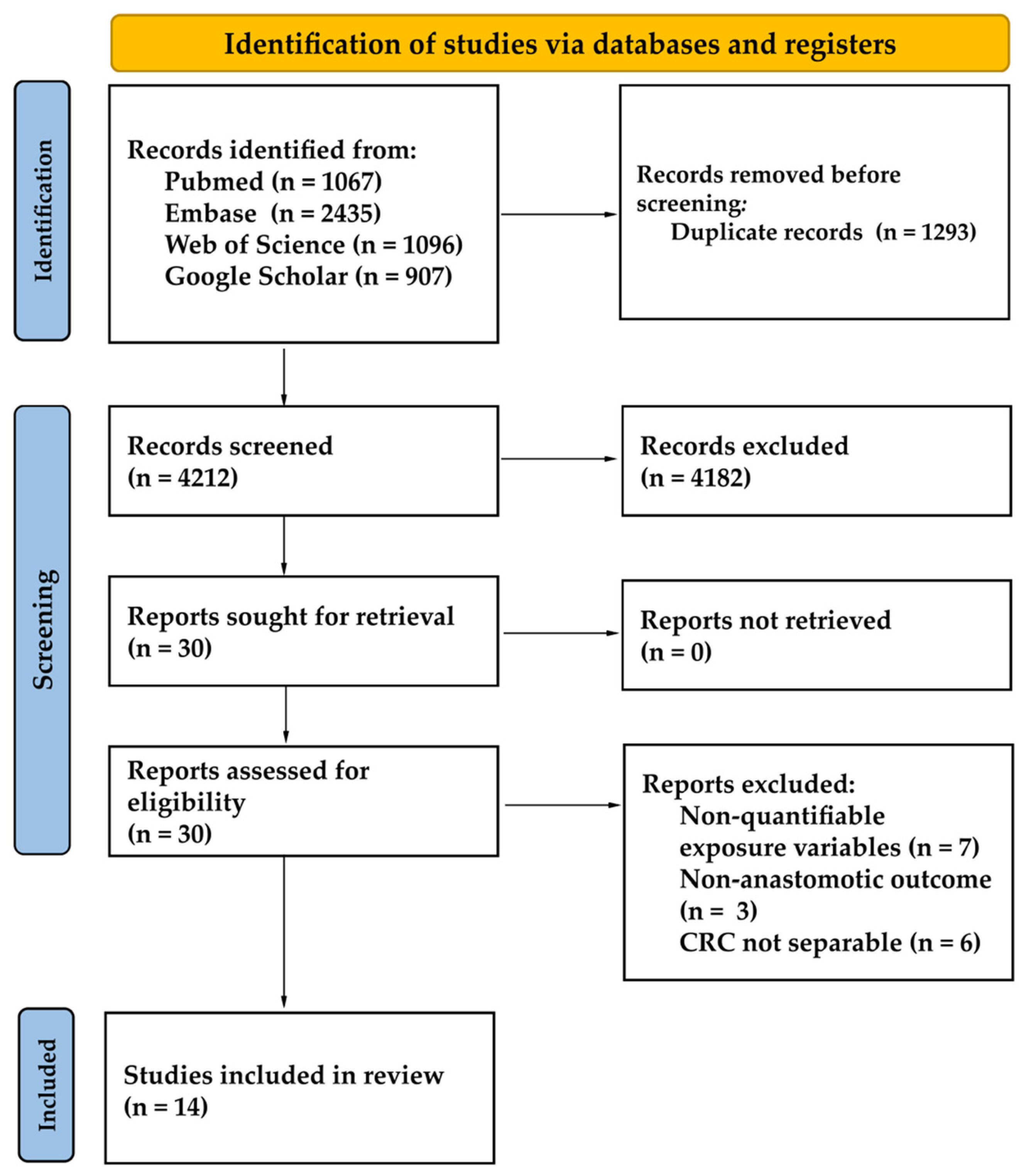
Figure 1. PRISMA 2020 flow diagram for this systematic review.
Diagnostics 16 01449 g001
Figure 2. Forest plot showing the odds ratios (ORs) and 95% confidence intervals (CIs) of abdominal CT calcification scores for the prediction of postoperative complications. Outcomes are grouped into “Major morbidity”, “Anastomotic leak” and “Grade C anastomotic leak” and only subgroup-level aggregate statistics are reported. Squares represent individual study effects (size proportional to study weight) and diamonds represent pooled effects; horizontal lines indicate 95% CIs. No double-zero event study–outcome comparisons were excluded from the pooled calcification analyses shown; the exclusion rule was prespecified but not triggered [20,21,27,28,29,30,31,33,34,35,36,37].
Diagnostics 16 01449 g002
Figure 3. Leave-one-out influence analysis for the random-effects meta-analysis of high vs. low CT calcium score and any anastomotic leak. Each row shows the pooled odds ratio and heterogeneity estimates after omitting the named study [20,21,28,29,30,31,33,34,35,36,37].
Diagnostics 16 01449 g003
Figure 4. Baujat plot for the random-effects meta-analysis of AAC and any AL. The x-axis shows each study’s contribution to overall heterogeneity, and the y-axis shows its influence on the pooled effect estimate [20,21,28,29,30,31,33,34,35,36,37].
Diagnostics 16 01449 g004
Figure 5. Forest plot of the subgroup meta-analysis for the association between AAC score and any AL, stratified by calcification cut point (non-ROC-derived vs. ROC-derived) [20,21,28,29,30,31,33,34,35,36,37]. Squares represent individual study effects (size proportional to study weight) and diamonds represent pooled effects; horizontal lines indicate 95% CIs.
Diagnostics 16 01449 g005
Figure 6. Funnel plot for any AL. (A) Observed funnel plot. (B) Funnel plot after trim-and-fill (imputed studies shown as open points).
Diagnostics 16 01449 g006
Figure 7. Examples of CT-derived vascular disease markers. (A) 3D maximum intensity projection reconstruction of the abdominal vessels showing significant calcific burden predominantly concentrated in the infrarenal abdominal aorta (red arrow) and the internal iliac arteries (blue arrows). (B) CT angiography showing stenosis of the inferior mesenteric artery (red arrow). (C) Non-contrast CT image at the L3 vertebral level showing calcifications covering the entire circumference of the inferior abdominal aorta (red arrow). (D) Same examination: the red arrow points to calcifications involving the internal iliac artery.
Diagnostics 16 01449 g007
Table 1. Summary of study characteristics.
StudyDesign and SettingPopulationTumor LocationPrimary Outcome
-
Incidence
Secondary Outcomes aRisk of Bias
(Newcastle–Ottawa Score)
Arron et al.
2022 [19]
RC and nested CC
Multi-center
Netherlands
2009–2018
n = 1273
Mean age = 67
Gender not reported
Left colon
Rectum
Any AL—6% of subjects
(52 cases vs. 52 controls)
-7/9
Diao et al.
2024 [20]
RC
Single-center
China
2011–2020
n = 2412
Mean age = 62
62.4% M
Colon
Rectum
Any AL—4% of subjectsGrade C AL8/9
Eveno et al.
2016 [21]
RC
Single-center
France
2007–2010
n = 60
Mean age = 70.5
50% M/F
Left colon
Rectum
Any AL—21.6% of subjectsMajor complications (C-D grade ≥III)
Mortality
7/9
Gunji et al.
2022 [27]
PC
Single-center
Japan
2017–2020
n = 124
Mean age = 75.3
61.3% M
Colon
Rectum
Major complications (C-D grade ≥ III)—11.3% of subjects Major complications (C-D grade ≥III)
Mortality
6/9
Knight et al.
2021 [28]
RC
Single-center
United Kingdom
2008–2016
n = 657
Mean age = 68
56% M
Colon
Rectum
Infective (28%) vs. non-infective (20%)
complications
All complications
Major complications
(C-D grade ≥III)
Any AL (5.3%)
8/9
Lee et al.
2020 [29]
RC
Single-center
South Korea
2013–2015
n = 583
Mean age = 66
68.8% M
RectumGrade C AL—5.1% of subjectsAny AL (6.3%)6/9
Morita et al.
2022 [30]
RC
Single-center
Japan
2014–2016
n = 98
Mean age = 69
56% M
Colon
Rectum
Any AL—16.3% of subjects-6/9
Namba et al. 2021 [31]RC
Single-center
Japan
2015–2020
n = 147
Mean age = 73.4
55.5% M
Colon
Rectum
Any AL—8.16% of subjects-7/9
Norooz et al.
2016 [32]
PC
Single-center
Iran
2012–2014
n = 100
Mean age = 63.7
55% M
Colon
Rectum
Any AL—20% of subjects-5/9
Pochhammer et al.
2018 [33]
PC
Single-center
Germany
2014–2016
n = 139
Mean age = 73
52.5% M
Colon
Rectum
Any AL—11% of subjects-7/9
Postaire et al.
2018 [34]
RC
Single-center
France
2011–2016
n = 253
Mean age = 72
Gender not reported
Right colonAny AL—9.1% of subjects-6/9
Shen et al.
2019 [35]
RC
Single-center
China
2009–2017
n = 423
Mean age = 64
62.4% M
RectumAny AL—7.8% of subjectsGrade C AL6/9
Turhan et al.
2025 [36]
RC
Single-center
Turkey
2020–2023
n = 151
Mean age = 65.4
61.6% M
Colon
Rectum
Any AL—5.96% of subjects-7/9
Zhang et al.
2023 [37]
RC
Single-center
China
2018–2021
n = 292
Mean age = 67
57.7% M
Colon
Rectum
AL—12.67% of subjects-6/9
* RC—retrospective cohort; PC—prospective cohort; CC—case–control; C-D—Clavien–Dindo. a The incidence of AL is provided in parentheses.
Table 2. Summary of the main findings and their corresponding level of certainty according to the GRADE criteria.
Outcome (Exposure)Assumed Risk Without Substantial Vascular DiseaseAssumed Risk with Substantial Vascular Disease PresentRelative Effect (OR, 95% CI)Participants (Studies)Certainty (GRADE)Reasoning
Major morbidity (AAC score)~89 per 1000177 per 1000 (95% CI 76.54–408.51)1.99 (95% CI 0.86–4.59)841
(k = 3)
⊕◯◯◯Very lowDowngraded for ROB and imprecision a.
Any anastomotic leak (AAC score)~40 per 1000123 per 1000 (95% CI 83.6–181.6)3.08 (95% CI 2.09–4.54)5005
(k = 11)
⊕⊕◯◯LowDowngraded for ROB a. Publication bias was suspected and retained as a residual concern b. Sensitivity analyses informed the decision not to downgrade further for inconsistency or imprecision.
Upgraded for large magnitude of effect c.
Grade C anastomotic leak (AAC score)~14 per 100037 per 1000 (95% CI 14.42–97.58)2.68 (95% CI 1.03–6.97)3418
(k = 3)
⊕◯◯◯Very lowDowngraded for ROB a.
Mortality
(AAC score) d
Not estimableNot estimable Not pooled Vascular exposure mortality data available from two AAC studies, n = 184⊕◯◯◯Very lowDowngraded for ROB, indirectness from inconsistent reporting and very serious imprecision. Deaths were rare and mortality not consistently stratified by CT vascular exposure.
Any anastomotic leak (clinically significant IMA stenosis) eNot estimable fNot estimable13.68 (95% CI 1.69–110.4)104
(k = 1)
⊕◯◯◯Very lowEvidence came from one CRC-specific case–control analysis. Downgraded for ROB and very serious imprecision.
* Abbreviations: AAC—abdominal aortic calcification, GRADE—Grading of Recommendations Assessment, Development and Evaluation, IMA—inferior mesenteric artery, ROB—risk of bias. a Risk of bias due to observational and largely retrospective evidence, incomplete confounder adjustment and likely unaccounted residual confounding. b Publication bias was suspected in the “any anastomotic leak” outcome category and retained as a concern; however, because trim-and-fill attenuation did not eliminate the association, no additional formal downgrade was applied. c Upgrading was based on large magnitude of effect. Sensitivity analyses were considered when judging inconsistency and imprecision but were not treated as a formal GRADE upgrading domain. d Mortality was summarized narratively because death events were sparse, inconsistently defined and not consistently stratified by CT vascular exposure. e The stenosis certainty rating was based on the only eligible CRC-specific study. Mixed indication stenosis studies served as contextual supplementary evidence and were not incorporated into the main GRADE assessment. f Absolute risks were not directly estimable because the only CRC-specific study used a matched case–control analysis.
Disclaimer/Publisher’s Note: The statements, opinions and data contained in all publications are solely those of the individual author(s) and contributor(s) and not of MDPI and/or the editor(s). MDPI and/or the editor(s) disclaim responsibility for any injury to people or property resulting from any ideas, methods, instructions or products referred to in the content.