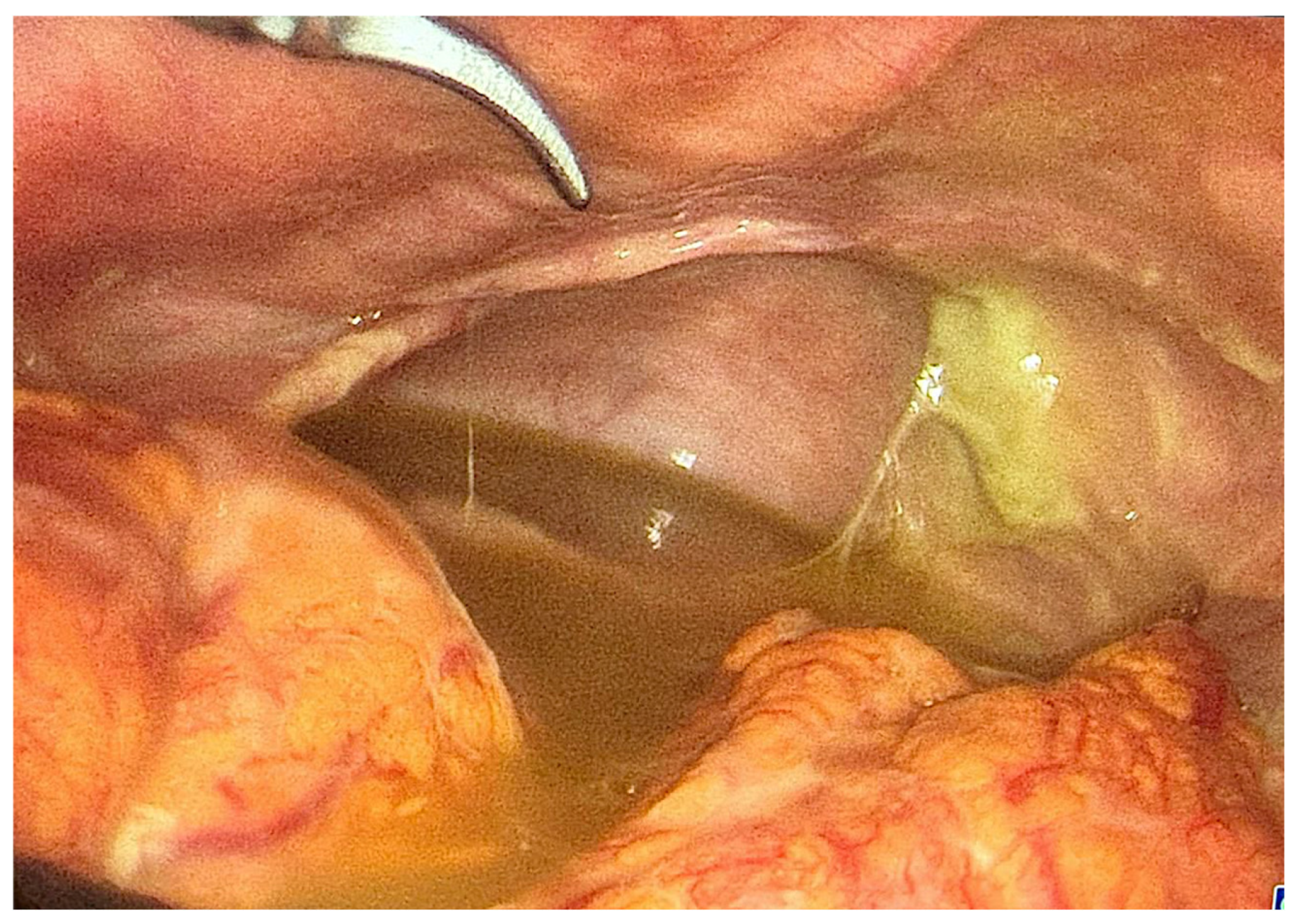

Polymicrobial PID Presenting as Primary Peritonitis in a Young Immunocompetent Patient—Case Report and Disease Perspectives

 , , , , , and
Abstract
1. Introduction
2. Case Presentation
3. Discussion
4. Conclusions
Author Contributions
Funding
Institutional Review Board Statement
Informed Consent Statement
Data Availability Statement
Conflicts of Interest
Abbreviations
| STI | Sexually transmitted infections |
| HIV | Human immunodeficiency virus |
| PID | Pelvic inflammatory disease |
| NAAT | Nucleic acid amplification test |
References
- Shroff, S. Infectious Vaginitis, Cervicitis, and Pelvic Inflammatory Disease. Med. Clin. N. Am. 2023, 107, 299–315. [Google Scholar] [CrossRef]
- De Francesco, M.A.; Stefanelli, P.; Carannante, A.; Corbellini, S.; Giagulli, C.; Lorenzin, G.; Ronconi, M.; Arici, E.; Cadei, M.; Campora, R.; et al. Management of a Case of Peritonitis Due to Neisseria gonorrhoeae Infection Following Pelvic Inflammatory Disease (PID). Antibiotics 2020, 9, 193. [Google Scholar] [CrossRef]
- Yusuf, H.; Trent, M. Management of Pelvic Inflammatory Disease in Clinical Practice. Ther. Clin. Risk Manag. 2023, 19, 183–192. [Google Scholar] [CrossRef]
- Greydanus, D.E.; Bacopoulou, F. Acute pelvic inflammatory disease: A narrative review. Pediatr. Med. 2019, 2, 183–192. [Google Scholar] [CrossRef]
- Greydanus, D.E.; Dodich, C. Pelvic inflammatory disease in the adolescent: A poignant, perplexing, potentially preventable problem for patients and physicians. Curr. Opin. Pediatr. 2015, 27, 92–99. [Google Scholar] [CrossRef] [PubMed]
- Darville, T. Pelvic Inflammatory Disease Due to Neisseria gonorrhoeae and Chlamydia trachomatis: Immune Evasion Mechanisms and Pathogenic Disease Pathways. J. Infect. Dis. 2021, 224, S39–S46. [Google Scholar] [CrossRef] [PubMed]
- Greydanus, D.E.; Cabral, M.D.; Patel, D.R. Pelvic inflammatory disease in the adolescent and young adult: An update. Disease-A-Month 2022, 68, 101287. [Google Scholar] [CrossRef] [PubMed]
- Di Franco, S.; Alfieri, A.; Fiore, M.; Fittipaldi, C.; Pota, V.; Coppolino, F.; Sansone, P.; Pace, M.C.; Passavanti, M.B. A Literature Overview of Secondary Peritonitis Due to Carbapenem-Resistant Enterobacterales (CRE) in Intensive Care Unit (ICU) Patients. Antibiotics 2022, 11, 1347. [Google Scholar] [CrossRef]
- Sara Fernandes, A.F.-G.; Girão, J.; Miranda, C.; Coutinho, J. Primary pneumococcal peritonitis in a healthy woman: Case report and a literature review of the last 10 years. Port. J. Surg. 2020, 49, 82–87. [Google Scholar]
- Liu, T.; Lai, S.Y.; Zhou, W.; Liu, Y.L.; Chen, S.S.; Jiang, Y.M. Analysis of Ureaplasma urealyticum, Chlamydia trachomatis, Mycoplasma genitalium and Neisseria gonorrhoeae infections among obstetrics and gynecological outpatients in southwest China: A retrospective study. BMC Infect. Dis. 2022, 22, 283. [Google Scholar] [CrossRef]
- Petri, F.; Gemayel, F.; El Zein, S.; Tande, A.J.; Thoendel, M.J.; Berbari, E.F. Tiny but Nasty: A case report and a review of the literature on Ureaplasma parvum peritonitis. IDCases 2024, 37, e02015. [Google Scholar] [CrossRef]
- Kirkoyun Uysal, H.; Koksal, M.O.; Sarsar, K.; Ilktac, M.; Isik, Z.; Akgun Karapinar, D.B.; Demirci, M.; Ongen, B.; Buyukoren, A.; Kadioglu, A.; et al. Prevalence of Chlamydia trachomatis, Neisseria gonorrhoeae, and Mycoplasma genitalium among Patients with Urogenital Symptoms in Istanbul. Healthcare 2023, 11, 930. [Google Scholar] [CrossRef] [PubMed]
- Yu, J.; Zhou, Y.; Luo, H.; Su, X.; Gan, T.; Wang, J.; Ye, Z.; Deng, Z.; He, J. Mycoplasma genitalium infection in the female reproductive system: Diseases and treatment. Front. Microbiol. 2023, 14, 1098276. [Google Scholar] [CrossRef] [PubMed]
- Jensen, J.S.; Cusini, M.; Gomberg, M.; Moi, H.; Wilson, J.; Unemo, M. 2021 European guideline on the management of Mycoplasma genitalium infections. J. Eur. Acad. Dermatol. Venereol. 2022, 36, 641–650. [Google Scholar] [CrossRef] [PubMed]
- Chen, L.; Nie, Z.; Zhao, Y.; Bao, B. Peritonitis-associated with peritoneal dialysis following Ureaplasma parvum infection: A case report and literature review. Indian J. Med. Microbiol. 2023, 45, 100410. [Google Scholar] [CrossRef]
- Goller, J.L.; De Livera, A.M.; Fairley, C.K.; Guy, R.J.; Bradshaw, C.S.; Chen, M.Y.; Hocking, J.S. Characteristics of pelvic inflammatory disease where no sexually transmitted infection is identified: A cross-sectional analysis of routinely collected sexual health clinic data. Sex. Transm. Infect. 2017, 93, 68–70. [Google Scholar] [CrossRef]
- Reekie, J.; Donovan, B.; Guy, R.; Hocking, J.S.; Kaldor, J.M.; Mak, D.B.; Pearson, S.; Preen, D.; Stewart, L.; Ward, J.; et al. Risk of Pelvic Inflammatory Disease in Relation to Chlamydia and Gonorrhea Testing, Repeat Testing, and Positivity: A Population-Based Cohort Study. Clin. Infect. Dis. 2018, 66, 437–443. [Google Scholar] [CrossRef]
- Chappell, C.A.; Wiesenfeld, H.C. Pathogenesis, diagnosis, and management of severe pelvic inflammatory disease and tuboovarian abscess. Clin. Obstet. Gynecol. 2012, 55, 893–903. [Google Scholar] [CrossRef]
- Kreisel, K.M.; Llata, E.; Haderxhanaj, L.; Pearson, W.S.; Tao, G.; Wiesenfeld, H.C.; Torrone, E.A. The Burden of and Trends in Pelvic Inflammatory Disease in the United States, 2006–2016. J. Infect. Dis. 2021, 224, S103–S112. [Google Scholar] [CrossRef]
- Workowski, K.A.; Bachmann, L.H.; Chan, P.A.; Johnston, C.M.; Muzny, C.A.; Park, I.; Reno, H.; Zenilman, J.M.; Bolan, G.A. Sexually Transmitted Infections Treatment Guidelines, 2021. MMWR Recomm. Rep. 2021, 70, 1–187. [Google Scholar] [CrossRef]
- Özdemir, Y.E.; Ensaroğlu, E.; Akkaya, S.; Çizmeci, Z.; Kart-Yaşar, K. Clinical Outcomes and Microbiological Profiles of Patients with Culture-Confirmed Peritonitis. Infect. Dis. Clin. Microbiol. 2025, 7, 88–96. [Google Scholar] [CrossRef]
- Aw, A.E.Y.; Lee, J.W.K.; Tay, K.V. Primary Peritonitis Secondary to Streptococcus pyogenes in a Young Female Adult-A Case Report and Literature Review. Infect. Dis. Rep. 2021, 13, 26–32. [Google Scholar] [CrossRef] [PubMed]
- Chen, L.Y.; Harnod, T.; Chang, Y.H.; Chen, H.; Ding, D.C. The Combination of Clindamycin and Gentamicin Is Adequate for Pelvic Inflammatory Disease: A Retrospective Cohort Study. J. Clin. Med. 2021, 10, 4145. [Google Scholar] [CrossRef] [PubMed]
- Drexel, S.; Tseng, D. Primary Peritonitis: An Index Case of Mycoplasma hominis Infection in a Healthy Female. Case Rep. Surg. 2018, 2018, 4587801. [Google Scholar] [CrossRef] [PubMed]
- Rai, B.; Antoun, I.; Rai, S.; Sood, B. Primary Peritonitis Secondary to Klebsiella Pneumoniae in a Healthy Individual—A Case Report and Literature Review on a Rare Event. Internet J. Surg. 2014, 31, 78980242. [Google Scholar]
- Blevrakis, E.; Anyfantakis, D.; Blevrakis, E.; Vlachakis, I. Primary bacterial peritonitis in a previously healthy adolescent female: A case report. Int. J. Surg. Case Rep. 2016, 28, 111–113. [Google Scholar] [CrossRef]
- Ugrinovic, S.; Firth, H.; Kavanagh, D.; Gouliouris, T.; Gurugama, P.; Baxendale, H.; Lachmann, P.J.; Kumararatne, D.; Gkrania-Klotsas, E. Primary pneumococcal peritonitis can be the first presentation of a familial complement factor I deficiency. Clin. Exp. Immunol. 2020, 202, 379–383. [Google Scholar] [CrossRef]
- Sumiyama, F.; Sakaguchi, T.; Yamamichi, K.; Sekimoto, M. Peritonitis caused by group A streptococcus: A case report and literature review. Int. J. Surg. Case Rep. 2022, 92, 106839. [Google Scholar] [CrossRef]
- Matsumoto, Y.; Shimizu, A.; Ogawa, K.; Kuroki, S.; Ikuta, K.; Senda, E.; Kagawa, H.; Shio, S. Primary Peritonitis Due to Group A Streptococcus Successfully Treated with Intraperitoneal Drainage. Intern. Med. 2024, 63, 1229–1235. [Google Scholar] [CrossRef]
- Barrés-Fernández, A.; Piolatti-Luna, A.; Bretón-Martínez, J.R.; Crehuá-Gaudiza, E.; Quiñones-Torrelo, C.; Moscardó-Navarro, A.; Fuertes-Latasa, C.; Martínez-Costa, C. Case Report: Primary Peritonitis as the Onset of Pediatric Ménétrier’s Disease. Front. Pediatr. 2020, 8, 589853. [Google Scholar] [CrossRef]
- Antonik, M.; Ovens, K.J.; Labib, P.L.; Briggs, C.D. Chlamydia (lymphogranuloma venereum) peritonitis in a male patient. BMJ Case Rep. 2021, 14, e240526. [Google Scholar] [CrossRef] [PubMed]
- Gizzatullin, T. Primary Bacterial Peritonitis in a Young Man: A Rare Manifestation of Invasive Group A Streptococcal Infection. Cureus 2024, 16, e73549. [Google Scholar] [CrossRef] [PubMed]
- Chienwichai, K.; Sangaew, S.; Chuachanpipat, L.; Chang, A. Comparison of clinical outcomes between culture-negative and positive peritonitis in patients undergoing maintenance peritoneal dialysis: A prospective cohort study. BMC Nephrol. 2023, 24, 340. [Google Scholar] [CrossRef] [PubMed]
- Moridi, K.; Hemmaty, M.; Azimian, A.; Fallah, M.H.; Khaneghahi Abyaneh, H.; Ghazvini, K. Epidemiology of genital infections caused by Mycoplasma hominis, M. genitalium and Ureaplasma urealyticum in Iran; a systematic review and meta-analysis study (2000–2019). BMC Public Health 2020, 20, 1020. [Google Scholar] [CrossRef]
- Leli, C.; Mencacci, A.; Latino, M.A.; Clerici, P.; Rassu, M.; Perito, S.; Castronari, R.; Pistoni, E.; Luciano, E.; De Maria, D.; et al. Prevalence of cervical colonization by Ureaplasma parvum, Ureaplasma urealyticum, Mycoplasma hominis and Mycoplasma genitalium in childbearing age women by a commercially available multiplex real-time PCR: An Italian observational multicentre study. J. Microbiol. Immunol. Infect. 2018, 51, 220–225. [Google Scholar] [CrossRef]
- Lobão, T.N.; Campos, G.B.; Selis, N.N.; Amorim, A.T.; Souza, S.G.; Mafra, S.S.; Pereira, L.S.; Dos Santos, D.B.; Figueiredo, T.B.; Marques, L.M.; et al. Ureaplasma urealyticum and U. parvum in sexually active women attending public health clinics in Brazil. Epidemiol. Infect. 2017, 145, 2341–2351. [Google Scholar] [CrossRef]
- Frock-Welnak, D.N.; Tam, J. Identification and Treatment of Acute Pelvic Inflammatory Disease and Associated Sequelae. Obstet. Gynecol. Clin. N. Am. 2022, 49, 551–579. [Google Scholar] [CrossRef]
- Hunt, S.; Vollenhoven, B. Pelvic inflammatory disease and infertility. Aust. J. Gen. Pract. 2023, 52, 215–218. [Google Scholar] [CrossRef]
- Ye, H.; Tian, Y.; Yu, X.; Li, L.; Hou, M. Association Between Pelvic Inflammatory Disease and Risk of Endometriosis: A Systematic Review and Meta-Analysis. J. Womens Health 2024, 33, 73–79. [Google Scholar] [CrossRef]
- Clarizia, R.; Capezzuoli, T.; Ceccarello, M.; Zorzi, C.; Stepniewska, A.; Roviglione, G.; Mautone, D.; Petraglia, F.; Ceccaroni, M. Inflammation calls for more: Severe pelvic inflammatory disease with or without endometriosis. Outcomes on 311 laparoscopically treated women. J. Gynecol. Obstet. Hum. Reprod. 2021, 50, 101811. [Google Scholar] [CrossRef]
- Syed Khaja, A.S.; Saleem, M.; Zafar, M.; Moursi, S.; Mohammed, G.E.Y.; Shahid, S.M.A.; Hammam, S.; Moussa, S.; Alharbi, M.S.; Alshammari, A.N. Association between pelvic inflammatory disease and risk of ovarian, uterine, cervical, and vaginal cancers—A meta-analysis. Arch. Gynecol. Obstet. 2024, 310, 2577–2585. [Google Scholar] [CrossRef]
- Chang, C.Y.-Y.; Lin, K.Y.-H.; Huang, C.-C.; Lin, W.-C. Association of pelvic inflammatory disease (PID) with ovarian cancer: A nationwide population-based retrospective cohort study from Taiwan. BMC Women’s Health 2021, 21, 274. [Google Scholar] [CrossRef]
- Hosseininasab-nodoushan, S.-A.; Ghazvini, K.; Jamialahmadi, T.; Keikha, M.; Sahebkar, A. Association of Chlamydia and Mycoplasma infections with susceptibility to ovarian cancer: A systematic review and meta-analysis. Semin. Cancer Biol. 2022, 86, 923–928. [Google Scholar] [CrossRef]
- Jonsson, S.; Jonsson, H.; Lundin, E.; Häggström, C.; Idahl, A. Pelvic inflammatory disease and risk of epithelial ovarian cancer: A national population-based case-control study in Sweden. Am. J. Obstet. Gynecol. 2024, 230, 75.e1–75.e15. [Google Scholar] [CrossRef]
- Huang, J.-Y.; Ma, K.S.-K.; Wang, L.-T.; Chiang, C.-H.; Yang, S.-F.; Wang, C.-H.; Wang, P.-H. The Risk of Endometrial Cancer and Uterine Sarcoma Following Endometriosis or Pelvic Inflammatory Disease. Cancers 2023, 15, 833. [Google Scholar] [CrossRef]


| Sexually Transmitted Diseases Panel—Nucleic Acid Amplification Testing (NAAT) from Cervico-Vaginal Swab Collection | ||
|---|---|---|
| Pathogenic Agent | Patient Results | Reference Value |
| Chlamydia trachomatis | positive | negative |
| Mycoplasma hominis | positive | negative |
| Ureaplasma parvum | positive | negative |
| Neisseria gonorrhoeae | negative | negative |
| Mycoplasma genitalium | negative | negative |
| Ureaplasma urealyticum | negative | negative |
| Trichomonas vaginalis | negative | negative |
| Blood Test | Value Day 1 | Value Day 2 | Value Day 4 | Value Day 6 | Reference Ranges | Units |
|---|---|---|---|---|---|---|
| White blood cell count | 21.45 | 24.83 | 9.97 | 9.47 | 4–10 | (103/μL) |
| Red blood cell count | 4.41 | 3.83 | 3.61 | 3.92 | 4–5 | (104/μL) |
| Hemoglobin | 13.1 | 11.6 | 10.6 | 11.4 | 12.0–15.5 | (g/dL) |
| Hematocrit | 39.8 | 34.7 | 32.8 | 34.8 | 37–47 | (%) |
| Platelet count | 357 | 318 | 351 | 414 | 150–400 | (104/μL) |
| Prothrombin index | 77 | 82 | 80–151 | (%) | ||
| Activated partial thromboplastin time | 36.3 | 42.6 | 23.5–36.5 | (s) | ||
| Sodium | 134 | 142 | 140 | 136–146 | (mmol/L) | |
| Potassium | 3.7 | 3.49 | 3.95 | 3.5–5.1 | (mmol/L) | |
| Blood urea nitrogen | 24 | 30 | 20 | 17–43 | (mg/dL) | |
| Creatinine | 0.78 | 1.16 | 0.82 | 0.51–0.95 | (mg/dL) | |
| Total bilirubin | 1.31 | 0.2 | 0.31 | 0.3–1.2 | (mg/dL) | |
| Albumin | 3.6 | 3.4–5.4 | (g/dL) | |||
| AST | 22 | 26 | 96 | <35 | (IU/L) | |
| ALT | 10 | 20 | 98 | <35 | (IU/L) | |
| Lactate dehydrogenase | 281 | <247 | (IU/L) | |||
| Amylase | 25–110 | (IU/L) | ||||
| C-reactive protein | 16.67 | 18.85 | 4.63 | 2.18 | <0.5 | (mg/dL) |
| Procalcitonin | 0.556 | 0.187 | 0.062 | 0.1 | (ng/mL) | |
| Ferritin | 147 | 108 | 10–120 | (ng/mL) | ||
| Fibrinogen | 681 | 200–400 | (mg/dL) |
| Microorganisms Involved in PID | |
|---|---|
| Most Frequently Identified | Other Microorganisms |
| Chlamydia trachomatis Neisseria gonorrhoeae Mycoplasma genitalium | Mycoplasma hominis Ureaplasma urealyticum Ureaplasma parvum Neisseria meningitides Gardnerella vaginalis Group B Streptococcus (S. agalactiae) Bacteroides species (fragilis, bivius, disiens) Streptococcus faecalis Haemophilus influenzae Coliforms (Enterobacteriaceae) Enterococcus Cytomegalovirus Peptostreptococcus Other anaerobes |
| Study | Patient Characteristics (Gender, Age, and Special Mentions) | Peritoneal Fluid Microbiologic Samples | Treatment |
|---|---|---|---|
| Rai, 2014 [25] | Female 43 years | Klebsiella pneumoniae |
|
| Blevrakis, 2016 [26] | Female 14 years Mild upper respiratory infection two weeks ago | Streptococcus pneumoniae (serotype 3) |
|
| Drexel, 2018 [24] | Female 42 years Uterine fibroids | Gram stain—negative 16S ribosome testing—Mycoplasma hominis RNA |
|
| Ugrinovic, 2020 [27] | Female 16 years Presumptive diagnosis—appendicitis | Streptococcus pneumoniae |
|
| Sumiyama, 2022 [28] | Female 56 years Abnormal vaginal discharge for two weeks | Group A Streptococcus |
|
| Petri, 2024 [11] | Female 36 years History of metastatic sigmoid colon adenocarcinoma | Ureaplasma parvum |
|
| Matsumoto, 2024 [29] | Female 42 years Cesarean section three months prior | Group A Streptococcus |
|
| Barrés-Fernández, 2020 [30] | Male 11 years Initial diagnosis—peritonitis and pleural effusion Final—Ménétrier’s Disease | Negative |
|
| Antonik, 2021 [31] | Male 49 years | Chlamydia trachomatis Syphilis serology positive |
|
| Gizzatullin, 2024 [32] | Male 35 years | Group A Streptococcus |
|
Disclaimer/Publisher’s Note: The statements, opinions and data contained in all publications are solely those of the individual author(s) and contributor(s) and not of MDPI and/or the editor(s). MDPI and/or the editor(s) disclaim responsibility for any injury to people or property resulting from any ideas, methods, instructions or products referred to in the content. |
© 2026 by the authors. Licensee MDPI, Basel, Switzerland. This article is an open access article distributed under the terms and conditions of the Creative Commons Attribution (CC BY) license.
Share and Cite
Nemeti, G.; Neag, M.A.; Goidescu, I.G.; Surcel, M.; Goidescu, C.M.; Rotar, I.C.; Muresan, D. Polymicrobial PID Presenting as Primary Peritonitis in a Young Immunocompetent Patient—Case Report and Disease Perspectives. Diagnostics 2026, 16, 134. https://doi.org/10.3390/diagnostics16010134
Nemeti G, Neag MA, Goidescu IG, Surcel M, Goidescu CM, Rotar IC, Muresan D. Polymicrobial PID Presenting as Primary Peritonitis in a Young Immunocompetent Patient—Case Report and Disease Perspectives. Diagnostics. 2026; 16(1):134. https://doi.org/10.3390/diagnostics16010134
Chicago/Turabian StyleNemeti, Georgiana, Maria Adriana Neag, Iulian Gabriel Goidescu, Mihai Surcel, Cerasela Mihaela Goidescu, Ioana Cristina Rotar, and Daniel Muresan. 2026. "Polymicrobial PID Presenting as Primary Peritonitis in a Young Immunocompetent Patient—Case Report and Disease Perspectives" Diagnostics 16, no. 1: 134. https://doi.org/10.3390/diagnostics16010134
APA StyleNemeti, G., Neag, M. A., Goidescu, I. G., Surcel, M., Goidescu, C. M., Rotar, I. C., & Muresan, D. (2026). Polymicrobial PID Presenting as Primary Peritonitis in a Young Immunocompetent Patient—Case Report and Disease Perspectives. Diagnostics, 16(1), 134. https://doi.org/10.3390/diagnostics16010134